




Abstract
This article examines how upward mobility affects both class and ethnic social positioning of Mapuche indigenous people in Chile. The article builds on cultural class analysis dominated by Bourdieusian approaches, suggesting the incorporation of an intersectional and postcolonial lens, considering the ways in which ethnicity complicates classed trajectories, focusing on class mobility and indigeneity. Drawing on 40 life history interviews of first-generation Mapuche professionals, the analysis reveals complex and varied responses to social mobility. The interviewees display three groups of responses: the ‘mobile-accommodators’, embracing deracinated middle-class identities; the ‘rooted’, asserting connections with working-class and Mapuche origins; and the ‘resignifiers’, embracing a more ambivalent class identity, but articulating a strong sense of Mapuche identity. The experience of upward social mobility represents a challenge to the respondents’ sense of class position, class and ethnic identities, as they have had to manage indigenous identity claims across their social origins and destinations.
Introduction
Chile adopted a neoliberal model during the dictatorship (1973–1989), which focused on market competition and individual efforts to achieve social outcomes, gradually removing the state’s social obligations to citizens. This economic system in Chile has been characterised by mass privatisation of health, education and public companies (Espinoza et al., 2013). Neoliberal policies have also increased inequality in Chile, which has very high levels of income inequality as measured by the Gini coefficient.
Given that class analysts have stressed the significance of the structure of opportunities in shaping social mobility outcomes, we should consider that structure in Chile. Using the Erikson et al. (1979) class schema, Torche (2005: 422) states that ‘social fluidity in Chile is comparable to that of the most fluid industrialised countries, even though Chile is much more unequal’. According to Azevedo and Bouillon (2010), intergenerational social mobility seems to be low in Latin America, even compared with developed countries that have the lowest levels of mobility, such as the United States and the United Kingdom. Torche (2005) found that patterns of class mobility in Chile are characterised by strong barriers to mobility to and from the professional class at the top of the occupational structure, but much greater fluidity between the middle and lower classes, a pattern consistent with the high concentration of income at the top.
Chileans commonly assume that education can facilitate access to more privileged positions and there is increased demand for educational opportunities, which increased considerably (Méndez and Gayo, 2007). However, the emphasis on meritocracy and the neoliberal marketisation of education has not necessarily reduced inequalities and provided individuals with better opportunities.
The situation of indigenous people in Chile is no different. While universities do not deny indigenous people admission, there are structural conditions that make studying at university difficult for them. According to the CASEN (2017) survey, 30% of indigenous people live below the poverty line, compared with 19.9% of non-indigenous people. Mapuche people are three times less likely to complete higher education than Chile’s non-indigenous population (INE, 2017).
Therefore, this research focuses on the experience of social mobility of Mapuche people, Chile’s largest indigenous group, originating from the South. According to the last census (2017), 9.9% of the Chilean population identifies as Mapuche. The relationship between the Mapuche population and Chilean state has historically been characterised by colonial injustice, economic disadvantage and racism (Ruiz, 2008). Most Mapuche have suffered racial and class discrimination because of their skin colour, way of speaking or their lower socio-economic background.
A study conducted in Araucanía by Valenzuela et al. (2016: 537) suggests that both Mapuche and non-Mapuche people share common destinies in poverty, but there are differences in ethnic terms as one moves up the social ladder. Despite the barriers to higher education, some indigenous people have overcome the structural obstacles and subsequently experience a degree of educational upward mobility that produces social diversity among the Mapuche (Fajardo and Ramírez, 2012). However, Mapuche professionals are very much a minority among the middle class in Chile.
Despite considerable difficulties, some Mapuche people have managed to obtain a university education, either via scholarships or by assuming debt to pay university fees. This group has experienced some degree of upward social mobility in their subsequent occupations. It is this experience of social mobility, often challenging and creating cultural and social tensions, which requires complex negotiation and renegotiation of identities.
According to a United Nations Development Programme study (UNDP, 2017), class inequalities in Chile have strong ethnic and racial connotations, and most upper-class people are white, while indigenous people tend to occupy the lowest positions in the social structure. Therefore, indigenous people do not fit the typical profile of the Chilean middle class and stand out in these contexts, with their presence often remarked upon and considered not ‘normal’.
This context raises the question of what happens to indigenous people who have experience of social mobility and are confronted by new social spaces, which are commonly not indigenous. This article investigates how first-generation university students negotiated their indigenous and class identities, arguing that respondents show three main types of responses, demonstrating the complexity and dynamic nature of how people manage their identities in processes of transition. These responses are connected with Bourdieu’s (2002) habitus concept and the habitus interruptions typology developed by Ingram and Abrahams (2018), adding an intersectional approach. The article contributes to analysis of the possibilities for habitus to change and, eventually, for the agent to develop dispositions not directly enshrined in social position. From an evidence-based viewpoint, the article highlights the intersections of class and ethnicity in the formation of habitus responses to mobility, which evidences a deep structural system of exclusion of indigenous people.
Linking Analysis of Class Mobility with Ethnicity
I argue that while Mapuche social mobility represents movement between unequal positions, this must be understood not just in terms of class position, but also in terms of unequal ethnic position. The main goal of this article is to examine how understandings of class mobility should be considered in tandem with questions of ethnicity and ethnic identities.
This article is strongly influenced by the approach associated with Pierre Bourdieu (1984; Bourdieu and Passeron, 1977). Scholars like Friedman (2016), Ingram (2011), Lehmann (2009), Méndez (2008), Miles et al. (2011) and Reay et al. (2009) have worked on subjective social mobility following the Bourdieusian perspective. Such studies focus on experiences of working-class people who have undergone upward social mobility, arguing that this often has consequences for those who experience it. These studies are helpful to understand the dilemmas and tensions people encounter in their old working-class backgrounds and their new middle-class contexts.
I employ the Bourdieusian emphasis on habitus/field disjuncture to analyse a key empirical theme that emerged in the mobility experiences of the sample, where they describe the difficulties of mobility transitions, leading to feeling like a ‘fish out of water’ in their new social positions. However, I also argue that the respondents felt out of place not only in terms of class, but also regarding their indigenous identities, so they deployed different strategies to ‘fit in’ considering these different dimensions.
Bourdieu (2002: 27) defined the connection between agency and structure as habitus, ‘a system of dispositions, that is of permanent manners of being, seeing, acting and thinking’. Habitus is a key concept, which explains social action, but also associates how people inherit and acquire cultural capital and other kinds of capital. For Bourdieu and Passeron (1977), educational credentials are increasingly significant in modern society, but this is not a straightforward process of meritocratic social mobility, since educational success is also related to people’s habitus and cultural capital. Bourdieu (1984) argues that educational competition is largely shaped by how an individual’s class background affects their ability to ‘play the game’ of education, in which the class basis of habitus affects people’s ability to succeed within the middle-class field of education. Therefore, people unaware of how to ‘play the game’ are at a disadvantage in educational processes. A mismatch between habitus and field may also create a sense of not ‘fitting in’ (in either their new or old social environments) and dilemmas regarding people’s identities (Bourdieu, 1984; Bourdieu and Wacquant, 1992).
My aim is to understand the social mobility processes of indigenous people by employing further developments of Bourdieu’s concept of habitus, particularly with Ingram and Abrahams’ (2018) habitus disruption typology, to deepen understanding of possible rearticulations of the habitus when people move through radically different social worlds or fields. Ingram and Abrahams (2018: 140) extend Bourdieu’s concept of cleft habitus, considering ‘the positive aspects of a marginal vantage point, a re-articulation of habitus (rather than a division), which contests the terms of two incommensurable fields to create a new space’. They call this new space a ‘reconciled’ space (Ingram and Abrahams, 2018), which ‘helps us to think about ways of being neither working-class, nor middle-class but something else besides’ (Ingram and Abrahams, 2018: 141).
Ingram and Abrahams (2018: 148) developed the habitus interruption typology, identifying four different re-articulations of the habitus: (a) abandoned, which is separated from the original (working-class) field, as the ‘person renegotiates their habitus in response to the structuring forces of the new [middle-class] field’; (b) re-confirmed, rejecting the new field and reconfirming the structuring forces of the field of origin; (c) reconciliated, occurring when the two fields, although opposing, are integrated; and (d) destabilised, when the ‘person tries to incorporate the structuring forces of each field into their habitus but cannot achieve successful assimilation’ (2018: 148). I analyse the data through the lens of Ingram and Abrahams’ typology and discuss how my participants describe different ways of negotiating multiple fields.
Although my study has a strong Bourdieusian influence, it also suggests that a focus on class mobility and identities alone is too narrow to understand the diverse experiences of upward social mobility of the Mapuche sample and, therefore, I use a more intersectional perspective regarding questions of social mobility. I acknowledge the limitations of conventional approaches to class mobility and use the cultural class approach to class transitions, because of its greater focus on the subjective experience of mobility and class identities. However, while I argue that the Bourdieusian perspective is the most useful for analysing social mobility experiences and their consequences more broadly, it does not suffice for understanding how ethnicity influences social mobility and examining social mobility as a process of ethnic identity transition. I argue for the need to adopt a more intersectional perspective that acknowledges the interwoven nature of class, ethnicity, gender and migration experiences to understand the process of Mapuche social mobility transitions.
Rollock (2014: 445) criticises the work of Bourdieu (1984) and Savage et al. (2013), arguing that ‘class identity cannot be fully understood without taking account of the intersecting role of race’. In particular, she argues that the extent to which middle-classness is associated with whiteness is under-appreciated and ‘the intersection of race (white), class (middle) and gender (male) is reflective of a hierarchical power dynamic that is evidenced – yet seldom named by those embodying that identity profile’ (Rollock, 2014: 446).
This article thus examines how we should consider questions of intersectionality (Crenshaw, 1989), where there is an understanding that class, gender, migration and ethnicity all influence processes of constructing identities and interact in complex ways. Here, intersectionality is understood as ‘a widely used and influential model for an understanding of how different modes of social inequality and discrimination are related to each other’ (Byrne, 2015: 186). I examine studies that argue that the social mobility of indigenous professionals must be analysed from an intersectional perspective. Some studies have adopted an intersectional approach to examine differences of gender, race or indigeneity as impacting individual educational opportunities (Bhopal, 2016; Ingram, 2011; Jackson, 2012; Pereyra, 2016; Rollock et al., 2015). Those studies, from the United Kingdom, the United States and Peru, suggest that the intersection of race/ethnicity, gender and class is necessary to focus on disadvantages and conflicts of identities for the socially mobile. My work extends the intersectional perspective, arguing that while Mapuche people do not have the same experience as minorities in England and other countries, they share similar classed and raced strategies to deal with barriers of inequalities and discriminations faced in their upward social mobility.
Discussion of identity is crucial to understand whether, how and why people identify with class, in order to analyse the consequences of social mobility and how people develop strategies to fit into their social contexts. Although the cultural approach helps us understand inequalities with a more complex concept of social class, it is still necessary to include a perspective that considers ethnicity as a factor as important as social class. This is particularly important in the Chilean context, since the structure of inequalities is complex and convoluted.
Data and Methodology
This article adopted a qualitative research strategy using biographical interviews to generate narratives. My qualitative approach to analyse the biographical interviews was abductive, which, according to Blaikie (2007), requires the researcher to move between theory and data, combining inductive and deductive approaches. This allows the researcher to formulate new ideas, consider things in different contexts and to ‘see something else’ (Meyer and Lunnay, 2013). Therefore, this approach helps the researcher overcome potential bias and give theory-driven research greater transparency. I identified themes by categorising the data from the interviews using a two-level structure of codes, with inductive sub-codes nested in more deductive and broader codes.
My approach to the life history method was to use semi-structured interviews focused on biographical issues, structuring the questions by the order of the life course, while giving the participants the opportunity to construct their narratives and reflections.
The fieldwork took place from July 2015 to February 2016. In that period, I conducted 40 interviews, 20 in the Metropolitan Region (home to Chilean capital Santiago) and 20 in the Araucanía Region (the Mapuche ancestral homeland). The interviews lasted from 1.5 to 3 hours. Participants were selected from these regions to explore the different experiences of Mapuche professionals from the Mapuche homeland compared with those whose family (or own) migration had taken them to Santiago, where they are a minority. All the participants have working-class origins and are aged between 21 and 57, with 18 women and 22 men, each attending or having attended university at the time of the research. Their names have been replaced with pseudonyms and an informed consent protocol was signed. The Ethics Committee of the Sociology Department of the University of Manchester approved this study.
I recruited people through the snowball method, where ‘the researcher accesses informants through contact information that is provided by other informants’ (Noy, 2008: 330). The sample includes people who have at least one Mapuche surname, working-class origins, higher education qualifications and people living in the Araucanía or Metropolitan regions.
All participants were the first generation in their families to attend university. This provoked significant changes in both their and their families’ trajectories. The aim of the sampling was to elicit the narratives of a specific group in Chilean society, rather than being representative (Mason, 2018). However, I also note certain biases in my sample. For instance, almost half of the interviewees (19) were members of Mapuche social, political or cultural organisations, because I used snowball sampling, using members of these groups to recommend me to their networks. Hence, the sample is likely to overrepresent more politically active people who have a particular perspective of the Mapuche situation.
The sampling strategy focused on comparing respondents who were born and grew up in rural areas (generally seen as closer to traditional Mapuche culture) with respondents who were born and grew up in urban areas to explore how their social contexts affected their experience of mobility and the construction of their identities. According to Chenard (2006), Mapuche people who live in rural areas differ from those from urban areas, because the latter are in the process of losing their indigenous identities, as they tend to conceal them in order to integrate into their new contexts. Migration is an important factor in my analysis, and over half of the respondents (21 people, 15 men and six women) had some experience of migration, either from rural areas to nearby towns/Temuco/Santiago or from towns to Temuco/Santiago or from Temuco to Santiago.
Findings
In order to show the complex and diverse dynamics of the sample’s changing identities, I divided the respondents into three main groups (see Table 1), according to the different ways in which they developed and managed their class and ethnic identities, taking into account their range of geographical mobility and experiences of discrimination. As we see below, if we focus solely on perceptions of class identities, we observe only one part of the experiences of social mobility, but if we focus on the intersection between class, indigenous identities, gender, migration and discrimination experiences, we can understand the complexity of the social mobility experience.
Differences among respondents according to class, indigenous identities, social mobility, migration and discrimination experiences.
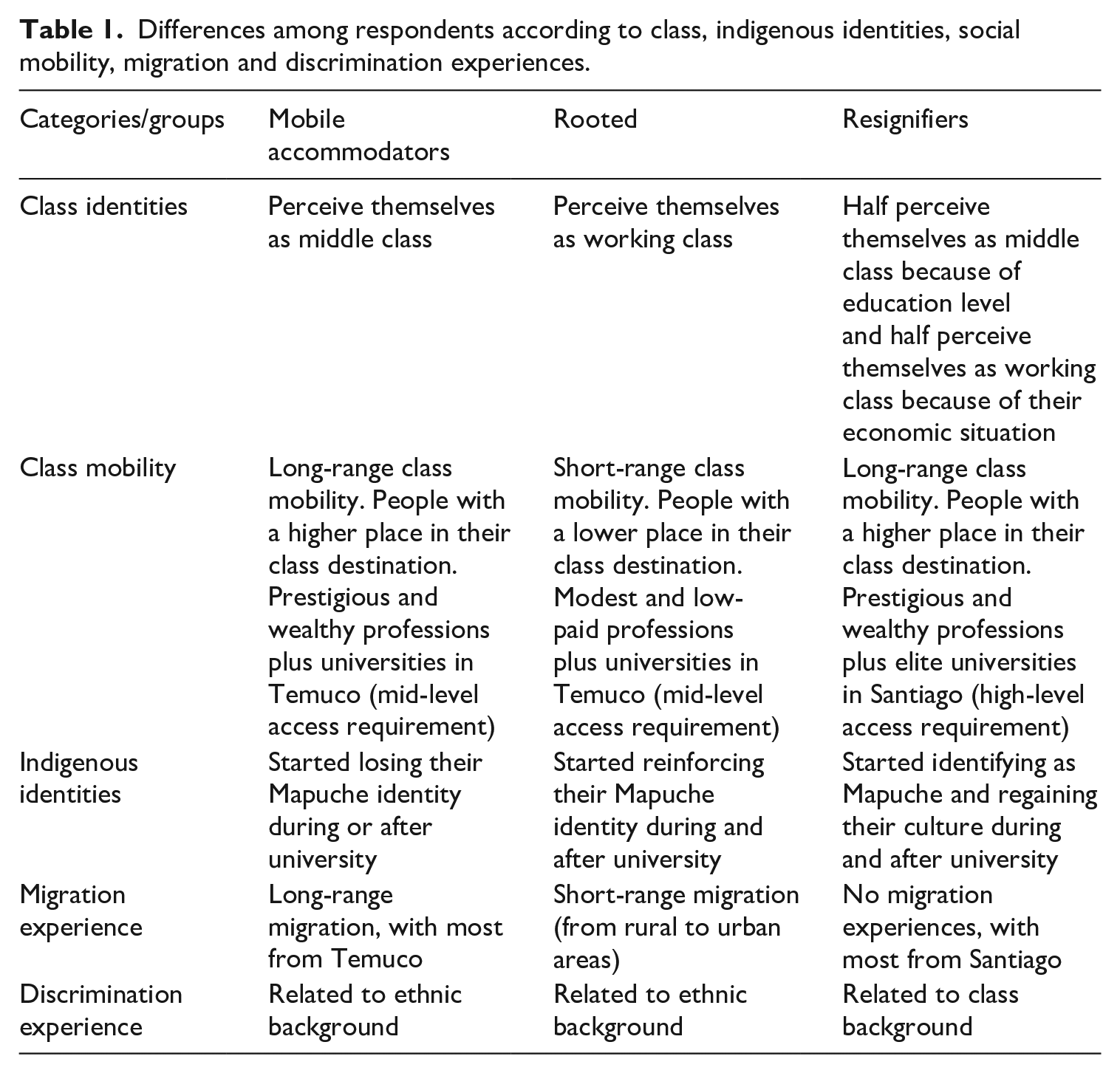
The first group are ‘mobile accommodators’, who identify as middle class, distancing themselves from their formative (working-class) identity and their Mapuche identity. The second group are the ‘rooted’, who maintain a sense of working-class identity, despite their upward mobility experience. This group’s attendance at university also helped them move towards a continued but stronger sense of Mapuche identity. The last group are ‘resignifiers’, whose mobility experiences meant they now identify as middle class, taking distance from their formative (working-class) identity, but also starting to resignify their Mapuche identity during and after attending university. This division is for analytical purposes and I do not suggest the sample’s identities are fixed into groups.
Each group has an intricate dynamic of different kinds of influences and intersections. The respondents had all experienced significant shifts in their social circumstances resulting in equally significant forms of changes in their identities, which – in line with the wider literature – we can view as a process in which people tend to ‘fit in’ or identify with their social contexts (Bathmaker et al., 2016; Diprose, 2008). However, people can choose to ‘fit in’ with different aspects of their social contexts, and the distinction between the three groups in my sample helps contextualise how the respondents negotiated their class and Mapuche identities in complex processes of management and adjustment.
All of the respondents had experiences of social dislocation (habitus/field disjuncture or feeling like a ‘fish out of water’ in Bourdieusian terms) during their social mobility transitions, related to their class positioning and indigenous identity. As a result, the sample deployed various kinds of strategies to negotiate their mobility transitions and ‘fit in’.
The Mobile Accommodators
The mobile accommodators (15 respondents) perceived themselves as middle class and considered their Mapuche identities less significant. During and after university they started distancing themselves from Mapuche culture. This group had experiences of long-range class mobility, as people with higher status and higher salary professions. These jobs were also related to the private sector, where people tend to earn more and acquire greater status than in the public sector. This group included accountants, a lawyer, engineers, nurses, an architect, a dentist and a biologist. Half were born in rural areas and had experience of migration as they moved to Santiago seeking better employment opportunities. They started abandoning their Mapuche and working-class identities owing to their experiences of upward mobility and migration. Another subgroup was born in Temuco to Mapuche parents who had emigrated from the countryside. This group did not have a strong Mapuche identity, because their parents and relatives did not teach them about Mapuche culture, following experiences of discrimination upon moving to the city.
The process of ‘fitting in’ could be difficult for mobile accommodators, as they had to employ several strategies to attain middle-class profiles, but sometimes still felt they did not really ‘fit’ into their new social context, like Sofia, who attended two universities. At her first university, she studied engineering, but felt she could not fit in there, so she moved to another university. So, she felt like a ‘fish out of water’, because this was a big cultural shock for her, which was a reason for changing university:
Good experiences, I learnt so much. I got to know many people. I had a good time! It was the opposite of the first university. Here [the second university] I enjoyed myself; I liked going to university. For example, I lost weight – a lot – so when I went to the second university, I had a different attitude! When I attended the first university, I felt like an outsider in everything, and when I attended the second university I said, ‘I’ll trust here’. I had another perspective and another aptitude for university, and there was also a variety of people, tastes, interests, each with their own style. There were also people wearing expensive clothes, but it looked different, because there were lots of different people. At the first university, all of them wore expensive clothes, so that was it . . . you arrived and they received you a different way. (Sofia)
There is an intersection between gender, class and ethnicity, in the sense that in the Chilean context people tend to associate success with white people with a particular appearance. In this situation, indigenous people are far from being associated with the Chilean elite. According to Polizzi (2014), physical appearance has a social function, which enables the possibility of attaining better jobs and access to a specific social context. Sofia lost weight as a strategy to modify her profile, to ‘fit in’ more easily with her new middle-class context. According to Bourdieu (Lamaison, 1986), strategies are key in the relationship between agency and structure, helping to find the balance of habitus. In this regard, Sofia indicates that she applied strategies to avoid feeling like an outsider again at the second university and, for her, changing her appearance was the best strategy to modify her habitus.
I argue that the experience of social mobility changed the inclination of the mobile accommodators towards their class identities, adjusting their lives to fit in with their new middle-class position. The respondents expressed ambivalence when talking about their indigenous identity, partly because they felt conflict between their old and new class and ethnic positions. This can be noted in people who experienced long-range social mobility. For example, the case of Vicente shows how he felt more Chilean than Mapuche because he was never close to Mapuche culture, as he did not grow up in a Mapuche social context. He said, ‘I can’t say I feel part of Mapuche culture, because I’d be lying.’ In the same vein, Enrique indicated that he had adjusted to his new situation in a way other Mapuche people could not and showed an identity distanced from a negative characterisation of other Mapuche people:
It wasn’t difficult to make new friends, but I think it’s because of my personality, because I realised that when I saw other classmates, they were much more withdrawn. In fact, I realise that about Mapuche people. Now they’re my patients, they’re much more withdrawn, more passive. However, I think that’s because they’re used to living a different way. Obviously, when they go from a town to a city, they sometimes face another system, another tempo, everything must be rapid. We all have goals to achieve and we have to finish quickly, and they live in a slower way. So, I think they’re passive, but they are much shyer and I saw my classmates who were much shyer than me, so it was hard for them to make friends. (Enrique)
Weaver’s (2001) work on indigenous identity in the United States reflects on how internalised oppression/colonisation is associated with identity. In that sense, most of the participants were assimilated into colonial domination and were consequently hesitant about their indigenous identities. In Enrique’s case, he saw himself as different from other Mapuche, distanced from a stigmatised understanding of Mapuche identities. In that respect, this group has similarities with the abandoned habitus (Ingram and Abrahams, 2018: 150). Enrique embodied his new middle-class field and, as the authors indicate, ‘over a period of time the structures of the new field become internally dominant as part of the habitus, and the old/originary structures are usurped or overwritten’. However, people from this group take distance not only from their working-class origins, but also from their indigenous origins, assimilating a white middle-class identity. As a strategy to distance Enrique from Mapuche culture and a working-class environment, his family decided to move from a rural area to Temuco. Therefore, the intersection of migration with class and indigenous identity is present in this case, where living in cities is more suited to experiencing social mobility, contrasting with the ways of other Mapuche people.
The Rooted
The rooted (seven respondents, mainly men) maintained a sense of working-class identity, despite their upward mobility experience, unlike the resignifiers, who embraced middle-class identity. This group’s attendance at university also helped them develop a continued, but stronger sense of Mapuche identity, partly because they framed their social mobility as remaining ‘true’ to their origins and using their new position to help their Mapuche communities.
Like the mobile accommodators, this group experienced tensions between their social origin and destination, but managed these tensions differently by distancing themselves from middle-class assimilation, instead reinforcing the idea that they had not changed their class identities and had remained loyal to their Mapuche heritage. This was partly because middle-class assimilation was also seen as deracination – becoming mestizo.
Most still perceived themselves as working class and they tended to experience shorter-range class mobility than the mobile accommodators, in professions with lower status and salaries (e.g. teachers, journalists, social workers) after attending universities with mid-level access requirements. The jobs of the rooted were in the public sector. Most respondents experienced migration. All of this group are from rural areas but moved to Temuco or other small towns successively to increase their educational opportunities. These respondents grew up in traditional Mapuche social contexts, unlike the resignifiers, and they produced narratives strongly related to Mapuche culture as a strategy to identify with their class position of origin.
The rooted group dis-identified with the idea that they had assimilated into the white/mestizo Chilean middle class, partly because they considered that middle class implied white assimilation and class superiority. One way to resist the middle-class identity that made them feel uncomfortable was by strengthening their Mapuche identities, for example, by learning Mapudungun (the Mapuche language) or joining Mapuche groups during or after university. In this way, they demonstrated that they had not abandoned their Mapuche identities. Patricio, for example, said that higher education changed the way in which he perceived his Mapuche identity:
Yes, I changed at university, even though I don’t speak the language [Mapudungun] . . . the fact I’m from a Mapuche community [rural area], we have a different tone of voice. I mean, at university I lost everything. The few words I knew in Mapudungun were the product of spending time with my classmates. Coincidentally, my three siblings who attended university were more interested in the topic [regaining their culture] . . .. In some way, we valued the cultural issue much more and I think the fact that we experienced many things in our lives helped us to say that in some way it’s our duty to recover the cultural issue. (Patricio)
Here, university represented a threat of assimilation into the white middle class. However, attending university, where this danger was keenly felt, was actually crucial for the rooted group to re-emphasise their Mapuche identity. Patricio’s comments show that the intersection between class and indigenous identities is complicated when he compares his siblings who attended university and those who did not, highlighting the differences between them when some of them experienced social mobility. We can see how the respondents renegotiated their identities in relation to the tensions of a new social environment by re-emphasising their social origins. This renegotiation of identities is a response to the internal colonisation of Mapuche people (Canales and Rea, 2013).
As the participants had early experiences of disruptions in their habitus, they developed a self-conscious reflexivity (Reay et al., 2009), which allows them to incorporate new practices and narratives to reinforce their indigenous identities, but also maintain their sense of remaining true to their working-class origins. The rooted group all identified with the working class, as in the case of Eduardo, who stressed his class origin as being a decisive aspect of his identity:
I consider myself working class. I’ll never be upper class, even if I have lots of money . . .. I don’t like this kind of classification, because how do you classify the upper class? On financial terms? Because of the way people are? Their values? What happens when a poor person wins the lottery? I think they’ll never be upper class. So, why? Maybe because of their cultural history, their personal story, their family story, their network . . .. I always say I’m Mapuche; I’m from a Mapuche community, from the countryside. I think that’s my . . . I consider it my label, but I consider myself like that. I was always from there and always will be from there. (Eduardo)
According to Bennett (2015), people claim authenticity to give their lives and position in society a sense of continuity. Ingram and Abrahams (2018: 151) identify the re-confirmed habitus, where ‘the new field is rejected and so its structures are not internalised: the person’s original habitus is re-confirmed’. In that respect, Eduardo tried to connect to his working-class heritage, identifying with the working class and as a Mapuche person in order to produce a sense of continuity with his past and present social identities. When he talks about class, he also refers to his indigenous identity and mixes both without being mutually exclusive, showing how both class and indigenous identities are connected and intersected.
Reay (2005: 404) suggests that authenticity is classed, and for working-class students in her British study ‘authenticity most often meant being able to hold onto a self which is rooted in a working-class past’. However, in my study, the respondents associated class and ethnicity when referring to authenticity. In that respect, the negative connotations of middle-classness were tied to not being Mapuche and it seems that the sample feared jeopardising their Mapuche identity by becoming socially mobile and resisted this in various ways. Some asserted their authentic connection with their working-class origins or re-emphasised their Mapuche culture – in both strategies claiming that nothing important had changed with their upward mobility.
The Resignifiers
The resignifiers (18 respondents) had mobility experiences that meant they now identified as middle class, taking distance from their formative (working-class) identity. In contrast to the rooted, who had strong connections with Mapuche culture since childhood, the resignifiers had a fragile connection with Mapuche culture until they started university.
Most had experienced long-range class mobility, attending universities with high-level access requirements and achieving professions with high status and salary (such as engineers, actors, musicians, lawyers, linguists, anthropologists, psychologists and designers). People in this group tended to have higher paying jobs in the private sector. Most of them did not have experience of migration (15): the majority are from Santiago and had no strong connections with rural areas, unlike the rooted, who did have migration experiences and were also born and grew up in rural areas near Temuco.
The resignifiers have some similarities to the rooted group, because they attempted to retain or reinforce their Mapuche identities, although the rooted group were closer to Mapuche culture from childhood and had worked more on their class identities (maintaining claims to a working-class identity). By contrast, the resignifiers focused their identity work on their ethnicity and expressed a more politicised sense of their Mapuche identities, with this process starting at university. The resignifiers did not grow up in traditional Mapuche social contexts like the rooted (which respondents variously defined in terms of having a Mapuche surname, speaking Mapudungun or participating in Mapuche cultural or political groups) and, until their mobility, were the group most distanced from Mapuche culture. However, when this group began higher education, they started engaging with what I call the traditional aspects of Mapuche identities; learning to adapt and practise these dimensions in their lives to regain traditional Mapuche culture and claim ‘legitimate’ Mapuche identities. The resignifiers felt tension owing to their initial distance from Mapuche identity and culture, which meant they experienced difficulties in claiming ‘authenticity’ regarding both their class and ethnic identification.
The respondents in this group not only experienced tensions when fitting into middle-class contexts, but also experienced conflict with their old class identities. Half of the respondents in this group identified as middle class based on their education level, but the other half still identified as working class based on their economic situation. Moreover, all of the resignifiers, whether they saw themselves as working or middle class, experienced conflicts in assuming a specific class identity.
The respondents in this group experienced tensions with their class identities as they adapted to the rules of their new social contexts and struggled to fit in. Most of the resignifiers had attended prestigious high schools and universities. It was in high school where the resignifiers experienced a cultural shock – largely along social class lines – as the first time they felt like a ‘fish out of water’, compared with the rooted, whose cultural shock was mostly at university. Owing to this upward social mobility, we can see tension in class and indigenous identities.
As mentioned before, most of the resignifiers did not grow up in what they defined as traditional Mapuche social contexts – lacking key aspects conventionally associated with being Mapuche. Respondents from this group sometimes felt excluded from other Mapuche people because of this. Take the case of Emilio, who felt he was not a proper Mapuche because he lived in Santiago and was an actor:
Being Mapuche from Santiago is feeling that you are not that Mapuche like Mapuche people from other places. You start to discriminate against yourself. Some Mapuche people look at you with suspicion for being an actor. I know that some look at me positively, but also people look at me as a sell-out . . . I’m the only one that decided to be an actor. (Emilio)
The resignifiers expressed an articulation between class, indigenous and spatial identities that entails distinctions between ‘authentic’ Mapuche from the South (living in Temuco or nearby rural areas) and Mapuche people from Santiago. Owing to this distinction, individuals felt they were not authentic Mapuche people. Acting is a profession associated with the elite and is not a traditional occupation for Mapuche people, who tend to work in areas like education and agriculture, so individuals from Santiago who had wider career opportunities felt they were less authentic than Mapuche from southern Chile. Not being recognised as Mapuche, the resignifiers started asking what it really means to be Mapuche and whether they could get closer to that profile.
Friedman (2016) argues that people never feel ‘at home’ anywhere and often feel they have to perform ‘authenticity’. In that sense, all resignifiers felt they lacked sufficient Mapuche symbolic and cultural capital to be recognised as ‘true’ Mapuche people. Because they found their indigenous identities in dispute, the resignifiers started a process of claiming a more authentic Mapuche identity. They began using strategies to compensate for their cultural deficits to be better able to claim an authentic Mapuche identity. Armando felt excluded from Mapuche identity, because he did not know the indigenous language:
Identity is constructed in many ways and some seem incompatible with others. For example, you interviewed someone who was born and lived in the city, you didn’t interview a Mapuche who’s living in the countryside and that’s an important difference. A few days ago, I went to a seminar and a woman said that indigenous people are classified or defined by whether they speak the language. So she excluded me immediately because I don’t speak it, and based on that I’m not Mapuche [which is] horrible! (Armando)
Hall (1996) explains that there is distinction between what people think about themselves, whether they can claim a kind of identity and whether others can dispute this identity. Hall (1992) also argues that identities should not be seen as totally flexible. We can see this in my sample, as the resignifiers had difficulties claiming an indigenous identity that others did not recognise. It seems there are limits to the flexibility of identity and what people can claim of it, with certain kinds of work or symbolic capital necessary for identity claims to be recognised.
In this sense, the resignifiers started a process to create a ‘third space’ (Ingram and Abrahams, 2018: 153), reclaiming a more authentic Mapuche identity. These findings are in line with the idea that the ‘third space’ ‘does not emerge from combining two dominant social fields and picking and choosing aspects of both to fuse together’, as the resignifiers show that they started developing something entirely new. They began using strategies to compensate for their cultural gaps, seeking Mapuche social groups and starting to practise and acquire Mapuche values, in order to be better able to claim an authentic Mapuche identity. However, this ‘third space’ is related to the painful experience of a cleft habitus (Friedman, 2016) in contrast to the positive and reconciled aspect that Ingram and Abrahams (2018) highlight. Because of their social mobility and feelings, tensions and dilemmas with both their old and new class identities, the respondents started resignifying their ‘Mapucheness’. They did so from an urban and middle-class position, both of which are often seen as incompatible with Mapuche identity. The respondents from this group not only attempted to reclaim aspects of Mapuche culture, but also sought to ‘resignify’ what it means to be Mapuche, reworking it as a political identity they could legitimately lay claim to.
Conclusion
This article analyses the Mapuche experience of mobility in the wider context of Mapuche indigenous and class social disadvantages in Chilean society. I argue that the experience of upward social mobility affected respondents in terms of their class position and identities, but also in terms of their indigenous position and identities, and we observe that the respondents managed and negotiated the effects of upward social mobility in different ways. The Mapuche are a minority group whose experiences of transition are not merely a question of class shifts, since their transitions are also tied to dislocations and pressures on their ethnic positioning and identity.
My aim was to analyse the processes of social mobility of indigenous people through Bourdieu’s concept of habitus and Ingram and Abrahams’ (2018) habitus disruption typology. To do this, I do not restrict the analysis to the concept of habitus. In this article, the limitations of Bourdieu’s theory are considered and I therefore suggest an intersectional approach. This article indicates that habitus disruption may be linked to various mechanisms of (re)articulation of habitus related to class and ethnicity, when people move through radically different social worlds or fields.
To a certain extent, similarities can be considered with Ingram and Abrahams’ (2018) typology. Particularly when analysed in terms of class, certain patterns can be seen. However, I suggest adding ethnicity to the analysis and making the typology a more complex lens, considering that class is intertwined with ethnicity/race. Indeed, when the participants were asked about class, the issue of their indigeneity came up. Furthermore, the context and migration experiences need to be considered, as although the participants experienced social mobility, this new space developed by the resignifiers is not necessarily something they have reconciled.
I explored three subgroups of respondents: the mobile accommodators, the rooted and the resignifiers. Despite common experiences of upward social mobility, these groups displayed very different ways of negotiating their class and ethnic identities. For the mobile accommodators and the rooted, their class identities become their dominant identities, but in diverging ways (with the mobile accommodators adopting middle-class identities and the rooted stressing their working-class origins). For the third group, the resignifiers, their indigenous identities became their dominant identities, often with a renewed and politicised focus on their ethnic positioning. These widely varying responses to the experience of mobility show the complexity and dynamic nature of how people manage their identities in processes of transition, in relation to a range of factors such as class, ethnicity, migration and discrimination.
I argue that we need to draw on other perspectives to comprehend the consequences of social mobility in a more fully intersectional manner. In particular, it is essential to understand why the participants spoke of their mobility as a process of ‘fraught achievement’, where they experienced considerable challenges of adjustment to their new social situations. Even though the sample had all achieved higher social positions because of their higher education, their social origins still mattered in their trajectories and social destinations and they had different trajectories depending on their social and geographic origins. More practically, this study contributes to the highlighting of the minority experience in Chilean universities and addresses structural disadvantages by understanding how policies, rules and practices include minorities (or not) in social mobility processes.
Footnotes
Acknowledgements
I would like to thank the anonymous reviewers for their insightful comments. I also thank Dr Wendy Bottero, Professor Bridget Byrne, Professor Anne Lavanchy and Dr Manuela Mendoza for their helpful feedback throughout the various stages of the writing of this article.
Funding
The author disclosed receipt of the following financial support for the research, authorship and/or publication of this article: Becas-Chile 72140258 and Centro de Estudios de Conflicto y Cohesión Social COES ANID/FONDAP/15130009.
