




Abstract
In the Global North, meat consumption is both an integral part of everyday diets and under increasing pressure to be reduced, owing to its various harmful effects. There has been much research on the issues that forestall less meat-dominated diets. Based on interview and participant observation data of consumers with a wide variety of meat relations in Finland, this article extends these discussions by framing the issue as navigating contentious relations of care. This enables a two-fold contribution. First, the article brings together previously disconnected research on these themes and makes explicit the benefits of studying meat consumption through care. Second, it demonstrates how this approach contributes an understanding of the persistence of meat on our plates, by showing how contentious care relations within meat consumption are navigated through moderation: varying degrees of engagement with care, defined by distances and realignments as well as disconnections in the processes of caring.
Introduction
In the Global North, meat has been a valued foodstuff, often associated with power, strength and masculinity (Twigg, 1983), its role essential in making a proper meal (Murcott, 1982), while its relatively recent mass production has made it a staple food, taken for granted (Franklin, 1999). However, meat consumption has increasingly become entangled with concerns for the environment, animal lives and health. Its production is taking a toll on the environment (Poore and Nemecek, 2018), high consumption of red and processed meat seems to be associated with chronic health issues (Godfray et al., 2018) and it has been claimed that animals intertwined in (industrial) meat production are subjected to institutionalised violence (Cudworth, 2015). Calls for reducing meat consumption (The Lancet, 2018) coexist with projections detailing the opposite trend, with meat consumption increasing globally over the current decade (OECD and FAO, 2019). In Finland, the official nutritional guidelines recommend not eating more than 500 grams of red or processed meat per week (VRN, 2014), and several policies recommend cutting down on meat consumption for sustainability and health reasons (Finnish Government’s Report on Food Policy, 2017; Saarinen et al., 2019). Currently, Finns eat around 79 kilos of meat per year on average, and meat consumption has increased relatively steadily since the 1950s (when the annual average was around 30 kilograms) (Natural Resources Institute Finland, 2020). However, there are also signs that some Finnish consumers are interested in consuming less meat and more vegetables (Latvala et al., 2012), with diets not centred around meat being more common among women, younger people and the highly educated (Lehto et al., 2021). In general, it seems that over the past decade, meat consumption has fallen in Finland and the consumption of alternative proteins has become more prominent, although animal-based proteins still play an important role in Finnish diets (Niva and Vainio, 2021).
Reducing meat consumption on the individual level is contingent on whether people care about the issue – that is, engage with harmful aspects of the issue and, based on this, modify their meat consumption practices. However, the issue is more complicated than this. Alongside calls to care about meat’s detrimental properties, caring can also happen through meat. For example, it enables one to pamper others with tasty meat dishes or look after their vitality through meat’s nutritional qualities. Indeed, research has shown that caring is a defining feature of people’s daily food consumption (DeVault, 1991). As a ‘harmful but cherished’ (Graça et al., 2014: 749) food practice, meat consumption presents a fascinating case to map out how people navigate these contentious care relations. To commit to caring is not an easy task, which is also reflected in the semantic connotation of care as ‘the acceptance of some form of burden’ (Tronto, 1993: 103). The aim of this article is to interrogate empirically how these various burdens related to meat are accepted or not, and how they are then handled. Or, to put it more analytically: how are contentious relations of care navigated in everyday meat consumption practices? Studying these care relations is crucial if we are to understand how contentious yet common food practices persist and change, especially given the pressures to reduce meat consumption.
In answering this question, the article brings together research on care and meat by, first, considering studies on the meat paradox through the lens of care, arguing that while an undercurrent of caring can be found in them, it has not received balanced attention. Second, this article discusses earlier studies that have touched on the combination of care and meat in interesting ways (see, for example, Bruckner et al., 2019; Donati, 2019; Miele and Evans, 2010), though care has not figured as a central theoretical concept. This article therefore aims to make explicit the care relations around meat that many other studies leave (terminologically) implicit by focusing on contentious care relations in the context of everyday meat consumption practices.
Throughout the article, the contentious aspects of meat are approached with an emphasis on the animal origins of meat. This is based on the human tendency to define being human in contradistinction to animals (Franklin, 1999: 12); thus, seeing whether animals are included in our circles of care is a heightened example of being able to care for the Other, especially when it becomes entangled with questions of killing. This dynamic of caring and killing in defining our relations towards animals has also been recognised by others (Gibbs, 2020). In the article, meat is defined broadly as the flesh of an animal, with which type of animal specified when necessary. In other words, instead of attempting to define the natural essence of meat, the focus is rather on how meat comes to exist in practice (Yates-Doerr, 2015). It is also worth noting that care related to meat was not always contentious in the data; for example, it could also rather unproblematically provide ways to care for loved ones. However, this article focuses on moments when the participants expressed tensions within their meat consumption.
Next, I will map earlier research on care, food and meat. This is followed by a section on data and methods: the research is based on interviews and participant observation data with 19 Finnish consumers on a range of different meat relations. After this, the empirical findings are explicated in two categories: care within social relations and care towards animals. Finally, the concluding section discusses, on a more general level, the benefits of approaching contentious food practices through care, as well as the specific contributions achieved through combining meat and care.
Care and Food
As a theoretical concept, care is ambiguous, connoting doings that can both support and smother. One possible approach is to see care as asking what is important to us in a given situation: what we are prepared to orient ourselves towards and try to ameliorate. Indeed, this forms the basis of Fisher and Tronto’s (1990: 40) classic definition of caring as ‘everything that we do to maintain, continue, and repair our “world” so that we can live in it as well as possible’. They specify that the world ‘includes our bodies, our selves, and our environment, all of which we seek to interweave in a complex, life-sustaining web’ (Fisher and Tronto, 1990: 40). Following this, caring can be approached as relational doings that do not, however, guarantee perfection or aim for control – rather, the emphasis is on ‘as well as possible’. Moreover, care is always inevitably limited. It is impossible to care about everything, and as care ‘circumscribes and cherishes some things, lives, or phenomena as its objects (. . .) it excludes others’ (Martin et al., 2015: 627). Care is therefore inherently bound up with questions of power and attention, and caring can be understood as productive doings ‘that constitute Others and (re)establish relations between those Others and selves’ (Lavis et al., 2015: 2). To study care, then, requires sensitivity to the politics of care and what kinds of relations are produced through it.
The origins of the research on care date back at least 40 years, when the relations between care and morality were being mapped (Gilligan, 1982; Noddings, 1984). Nowadays research on care flourishes within various fields, with topics ranging from how care intertwines with the more-than-human in our technoscientific worlds (Puig de la Bellacasa, 2017) to how a politics of care can reproduce inequalities within immigration policies (Ticktin, 2011). However, it has been argued that care has not received sufficient sociological attention (Aulenbacher et al., 2018), though researchers have begun to fill this gap recently (Alacovska, 2020; McLaughlin, 2020).
With regard to food, geographers have investigated ‘caring at a distance’ through ethical consumption, such as fair trade, though this focus on consumers’ responsibilities and knowledge has also been criticised for not engaging sufficiently with care as a political and public issue (McEwan and Goodman, 2010). However, the caring consumer need not be an individualistic, rational actor divorced from collective issues. For example, consumers within alternative food networks have been found to enact an ethic of care through concrete actions that encompass not only the home but also wider communities: ‘people, food, animals, soils and ecosystems’ (Dowler et al., 2009: 212). In a similar vein, caring work done through familial feeding practices, such as purchasing and preparing food, is steeped in gendered and classed relations of power (DeVault, 1991). In other words, caring through food consumption can be approached as a relational doing that brings forth our interdependency on various others, such as convenience foods enabling care amid limited time and material resources (Meah and Jackson, 2017) or practices of care within consumption intertwining with saving resources and supporting sustainability (Ariztia et al., 2018).
Next, I discuss some approaches that have brought together care and meat and elaborate on how doing so enables us to understand in greater depth people’s ways of navigating the contentious aspects of meat consumption.
Care and Meat
A thread of studies connected to care can be found within the multidisciplinary research into meat consumption. The much-researched meat paradox, which refers to people enjoying eating meat while simultaneously disliking hurting animals (Loughnan et al., 2010), when viewed through the lens of care, can be seen to rest on a premise of people caring about animals: were they completely indifferent to animal suffering, there would be no paradox. However, most studies on the meat paradox focus on various strategies used to resolve this cognitive dissonance, such as denying animals’ moral status, obscuring one’s personal responsibility or dissociating meat from animals (Benningstad and Kunst, 2020; Graça et al., 2014; Loughnan et al., 2010). That is, the focus is on getting further away from the paradox (and often animals), not so much on where the paradox stems from – how care towards animals or affection towards meat intertwines with meat consumption. However, studying this caring dimension of meat consumption is crucial to the possibility of finding signals of more sustainable, attentive animal–human relations and ways of eating. At the same time, a focus on caring also highlights that care does not guarantee easy solutions to the contentious issues around meat consumption, since caring can be mobilised in various politicised and non-innocent ways to define good or proper eating (Lavis et al., 2015).
Traces of care within meat consumption can be found in some approaches, even if care is not a central theoretical focus. Care is often discussed in relation to the animal origins of meat, with care present in the tensions between animal welfare and meat consumption. Consumers can, for example, not consider the ethical questions related to animal products as relevant and instead emphasise caring for important others by producing a good meal (Miele and Evans, 2010). It also seems that while ‘ordinary’ consumers can feel that they have not been ‘trained’ to care for animal welfare issues, or feel unsure about how to do this (Miele and Evans, 2010: 177, 184–185), consumers who define themselves as conscientious carnivores emphasise ‘a shared sense of well-being produced through encounters with animals’ (Bruckner et al., 2019: 41). However, this caring attitude towards other animal lives, as expressed by conscientious carnivores, is not free from commodification logics – for example, the moment of slaughter can lead to seeing animals as ‘resources destined to die’ (Bruckner et al., 2019: 44). Indeed, Donati (2019: 126) has also noted that while farm animals can be entangled in various care relations aimed at their flourishing, the gastronomically pleasing outcome of this flourishing ‘sits squarely in the interests of humans’. These viewpoints highlight some of the complexity of care in relation to meat consumption, as caring is often somewhat conditional and dependent on the resources available to consumers.
This existing research on care and meat/animals presents interesting gaps. Research into the meat paradox often seems to focus on consumers’ attempts to disengage from care in relation to meat. While other studies have discussed how caring and meat can connect, care has not featured as an explicit, thoroughgoing theoretical approach. In this article, I aim to bridge some of these gaps by intertwining my analysis of everyday meat consumption practices with Fisher and Tronto’s theory of caring. They define caring as a process consisting of four phases: caring about (attentiveness to care needs), taking care of (taking responsibility for how to respond to care needs), care-giving (the concrete work of caring) and care-receiving (the response of those who are cared for) (Fisher and Tronto, 1990: 40; Tronto, 1993: 106–108). This conceptualisation of caring as distinct phases affords valuable insights into contentious care relations. It enables us to note when the progression from one phase of care to the next is disrupted (for example, when caring about does not lead to care-giving), or when contradictions arise between different phases (for example, when care-givers’ way of caring clashes with those receiving it). In addition, Fisher and Tronto (1990: 41) emphasise that care requires certain ability factors: time, material resources, knowledge and skills. This helps show how caring through meat is bound up with practical doings – for example, what are the resources available for cooking, or the knowledge about the origins of meat?
Methods and Data
The research data consist of interviews and participant observations of shopping trips and food preparation situations, conducted from June 2019 to early March 2020. The data were collected in the Helsinki metropolitan area, except for four participants who lived in smaller towns or municipalities in southern Finland. The research participants, 19 in total, were recruited from Facebook groups with various foci on food-related issues: everyday cooking, hunting, organic/local food provision, affordable food and food allergies. The aim was to reach people in heterogeneous situations regarding meat consumption, in order to map out similarly heterogeneous care relations around food and specifically meat (see Table 1). The recruitment criterion was consuming meat in everyday life, and attention was paid to ensuring that participants represented different attitudes and practices towards meat (such as its provision and role in the diet). The contentious aspects of meat make it a potentially sensitive research topic. This likely influenced people’s eagerness to participate in the study; the process of finding enough participants was long. The recruitment letter circulated on Facebook framed the study as focusing on everyday meat consumption, which meant that only people who were willing to discuss meat consumption participated.
Participants of the study.
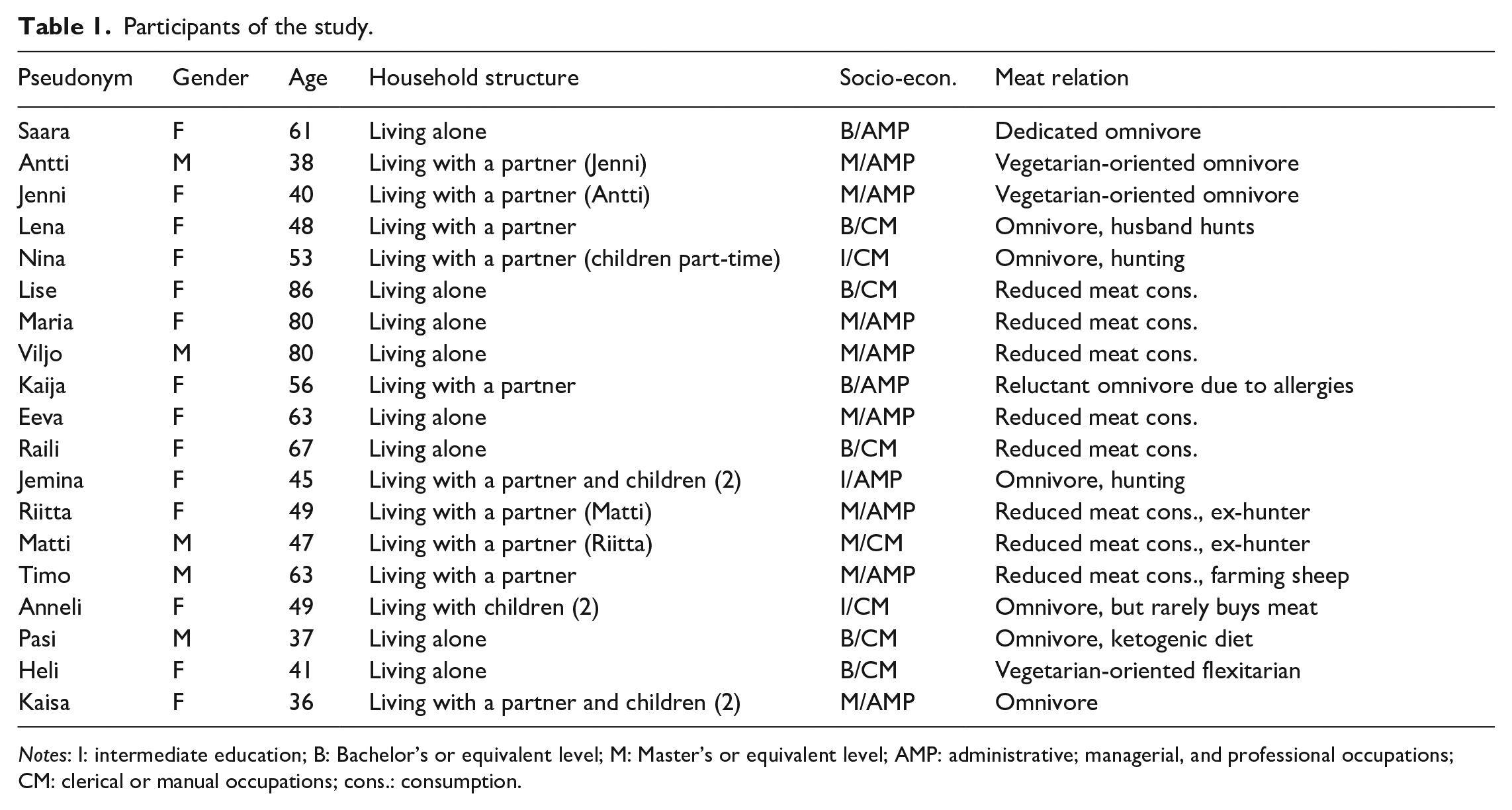
Notes: I: intermediate education; B: Bachelor’s or equivalent level; M: Master’s or equivalent level; AMP: administrative; managerial, and professional occupations; CM: clerical or manual occupations; cons.: consumption.
Age-wise, the participants do not include young adults, who could however provide interesting insights, since they seem to consume meat differently from older consumers (Lehto et al., 2021). The plan to recruit younger participants for the research was disrupted by the spread of COVID-19 in March 2020. The changes that COVID-19 caused in mundane food practices were considered to affect any data gathered in ways that would make it incompatible with data gathered earlier. The participants’ socio-economic positions might also influence the data, in that most participants were women and had a university degree. Previous research on Finnish consumers suggests that women are more willing to reduce their meat consumption (Niva and Vainio, 2021), and that women and the highly educated are more often vegetarians and consume less red and processed meat (Lehto et al., 2021). This could be connected to how all participants spoke of the contentious aspects of meat consumption and discussed their meat consumption practices in relation to them. Some of them had also reduced their meat consumption due to these harmful aspects.
Participation in the study was voluntary and based on participants’ informed consent. I collected the data in Finnish and translated the excerpts used in this article. I conducted the interviews, which lasted between one to two hours each, and transcribed them (around 400 pages in total). All but three of the interviews took place in the participants’ homes. I formed the interview questions through an iterative process, modifying some specific questions during the process, while the main themes remained the same. These were: food acquisition, preparation, responsibilities, cooking-related feelings and values, cooking with meat, meat-related feelings and values, and animal–human relations. In addition to interviews, I accompanied participants who agreed to it (nine) while they went shopping in their preferred places of acquiring food, or cooked food in their homes. During these situations, I took photographs and afterwards wrote down detailed field notes (around 80 pages in total). The rationale for combining interview and observation data was to perceive more fully the socio-material and embodied dimensions regarding meat consumption that might not be present in an interview situation.
I analysed the data starting with the initial observations I made during data gathering and transcription, which was followed by a more focused stage of reading through the transcriptions and field notes, and coding them on Atlas.ti. This process was guided by the principles of abductive analysis, which emphasises intertwining empirical descriptions and theoretical propositions in a way that amplifies both (Tavory and Timmermans, 2014). Following these principles, I coded the data into six main categories: affects, food, sociability, meat, relations and ethics/politics, with each containing more detailed codes. For this article, I focused on how care intertwines with meat in the data. The theme of moderation was developed in dialogue with the interview and observational material, as many of the participants emphasised middle-of-the-road orientations and avoiding black and white thinking. Throughout the analysis, I traced how this theme appeared in the data as it seemed to condense a key aspect of the participants’ ways of navigating various care relations.
Navigating Contentious Relations of Care around Meat
The results of how contentious care relations are navigated in everyday meat consumption practices are presented through two categories: care within social relations and care towards animals. The first category represents the role of care in maintaining social relations through care-giving and receiving, while the second centres on questions of proximity and distance in care through caring about and taking care of. Throughout the categories, the contentiousness of care relations arises because the care circulating in these situations is directed at somewhat incompatible aims, which in turn provides empirically rich occasions for analysing how these tensions are navigated.
Care within Social Relations
In the data, the contentious aspects of care relations were present, first, when the care-givers’ relations to meat were somewhat in contradiction to those of the care-receiver or to more general, cultural norms around meat consumption. Kaisa described a situation like this, wherein caring for her husband’s and children’s preferences meant she was not able to follow as vegetarian-oriented a diet as she would have liked: I would eat a more vegetarian-oriented diet if my husband didn’t absolutely want meat as a protein source for every single meal, and especially if my older daughter weren’t so darned bad at eating, so on her terms I have to make, prepare them [the meals] so I know exactly that she’s getting enough, that she gets all the nutrients, and make the kind of food she likes.
For Kaisa, ensuring sufficient nutrition for her (picky eater) children was the highest priority, and as the children liked meat, it was a staple in the family’s diet, which also corresponded to her husband’s preferences. Later in the interview, she noted that, for example, ham as a part of Christmas dinner was something that ‘personally I would live without, but in the mother-role I won’t, at least for now’. This emphasises the cultural norms around what are considered appropriate meat consumption practices, which consequently might have to be navigated in various ways if they conflict with one’s care relations – in Kaisa’s case, caring for the environment and health by reducing meat consumption. For Kaisa, this navigation is tied to her role as a mother, which can also be seen to intertwine with care: providing one’s children with enjoyable, traditional Christmas experiences. This navigation could also be more mundane, taking place, for example, in the grocery store: ‘The older child drops a packet of “Poppis” chicken nuggets into the cart, she [Kaisa] gives a laugh and says “yes, see, this is also how you end up buying meat”, so [the nuggets] remain in the cart’ (field notes, shopping with Kaisa). Letting the child pick the nuggets attests to how Kaisa defined her food relation as flexible: the child’s preferences and initiative were cared for, not forbidden. However, Kaisa was also committed to manoeuvring the meat eaten within certain flexible parameters that enabled caring for some of the aspects around meat that were problematic for her, which led her to favour Finnish meat and attempt to limit the consumption of red meat to a few times a week. In other words, the caring was moderated in two directions: Kaisa adjusting her preferences of reduced meat consumption towards family obligations, but also moderating the specifics of the meat consumed by the family.
Whereas the navigation above happened in the context of providing others with meat dishes, the reverse was also present in the data: receiving meat dishes could become entangled in contentious relations of care. As above, the contentious aspects were often owing to those involved in the relations having different attitudes and practices towards meat. For example, while Riitta and Matti said that they eat small amounts of meat in their everyday life because they care for the environment and animals, Riitta emphasised that ‘when we are visiting someone, we eat everything, we aren’t picky, wouldn’t dare to be, when visiting everything goes’. During our discussion in a participant observation situation, they elaborated on the topic: When visiting others, it feels weird or you notice the difference, that meat sauce is a MEAT sauce, there might be a small piece of carrot, but phew, it’s quite something to eat it, like where are the greens, maybe there’s a salad but still, it’s different. (field notes, at the dinner table with Riitta and Matti)
Here, not being ‘picky’ and caring for the social relation towards the host by eating what they offer is prioritised over personally preferred ways of consuming meat, even if the larger role of meat in the composition of the meal is a slightly jarring experience. This was also felt physically in that, for example, a weekend visit to relatives led to ‘a kind of a heavy feeling since it’s so meat-dominated’ (Matti). As with Kaisa, the caring here is moderated according to the already familiar logic of adjusting one’s ways of caring in relation to others’ preferences, but this case introduces a new aspect: the work of moderating care has embodied dimensions, such as adjusting to the different bodily feelings that follow eating the meat offered to you.
In the examples above, the navigation of contentious care relations was based primarily on moderation as adjustment. However, there were instances when, instead of conforming, moderation functioned through trying to find a compromise, a more reciprocal negotiation. In Jenni and Antti’s case, Antti had reduced his meat consumption since moving in with Jenni, whose diet was more vegetarian-oriented. However, they had also discovered ways of creating dishes that were in-between meat-based and vegetarian: Jenni: It’s not actually meat eating, but the thing that made you start to like the vegetarian versions much more was when we started using game stock cubes (. . .) then I’ve also bought reindeer bones and cooked meat broth from them (. . .) so then it also brings the flavour to a vegetable soup. It’s not exactly a meat dish but it has. . . Antti: It’s not a meat dish nor a vegetarian dish completely but kind of like this deception.
Such dishes, where flesh is replaced with broth, can be thought of as striving to reconcile somewhat conflicting care relations. Both Jenni and Antti wanted to modify their diet to be more compatible with that of the other, while also wanting to appreciate the taste of meat without having to worry about its environmental impacts as much, which was a concern for both. In addition, the work of moderating care is intertwined with various resources, similarly to how good care also requires sufficient material goods, time and skills (DeVault, 1991): the cooking skills that enable one to come up with the use of the game stock cube, and the materials and time needed to make a meat broth.
Care towards Animals
While the previous category, social relations, revolved around families and relatives, the more central issues with care relations involving animals were proximity and distance. For most participants, the animals they ate were distant from their everyday lives, which meant that the work of hands-on care-giving was not possible or relevant. Instead, a caring attitude towards animals was often signalled by addressing their living conditions and treatment in industrial production, which then had to be navigated with the caring that meat enabled: providing and sharing meat-based meals with loved ones, or alone as a form of self-care. This caring attitude towards animals could be expressed by stating on a general level that animals in industrial production ought to be treated well and raised in good conditions, with ‘as good care as possible, with as little pain as possible’ (Maria). Thus, attitudes like this did not position the production of animals for consumption as contentious. Instead, certain animals were defined as edible, often by categorising them as production animals, and consequently distancing oneself from an affective connection with them. Jemina states this explicitly: I think that animals are meant to be eaten. I’m not an animal lover, not under any circumstances (. . .) When I look at production animals then maybe there’s a small flicker of ‘oh dear’, but then I think it’ll be food (. . .) they need to be raised in good conditions, so in the end maybe in a certain way I am a protector of animals, in my own way, but they don’t awaken those kinds of emotions in me anyway.
Such statements can be seen as ‘caring about’ production animals in that a need for care is recognised (Tronto, 1993: 106), but it does not necessarily lead to doing the work of care, rather remaining a more distant concern or outsourced as an expectation that someone else does the work of care. This introduces new dimensions to moderating care. First, moderating one’s care in this case is based on ethical distance, wherein the category ‘production animal’ tautologically justifies meat consumption, as these animals are defined as edible because they are produced to be eaten – thus excluding them as ethical subjects. Second, care is moderated on an affective dimension. Just as she mentioned the small flicker of ‘oh dear’, Jemina also pondered whether she pitied production animals, answering ‘maybe a little’. In discussions around care, pity has been separated from compassion in that ‘pity requires an object whereas compassion requires a subject’ (Hoggett, 2006: 154). Therefore, an animal as an object of pity comes to be defined without agency, culminating in it eventually becoming food. In this way, the act of advocating on a very general level for good care towards production animals can be seen to hamper alternative, more reciprocal relations of care in which (production) animals could be seen as subjects.
Besides these general and somewhat instrumental relations towards animals, care towards animals could also be expressed in more explicit terms, often in relation to their living conditions in industrial production, which were seen as subpar. For example, participants expressed concern that animals were forced to live in cramped conditions, fed with food that was not appropriate for them and (at least abroad) pumped full of antibiotics or hormones. As such, this kind of care can be seen to extend beyond a more generalised caring about, towards ‘caring for’, which refers to a sense of connection with ‘particular persons in the context of their histories’ (Curtin, 1991: 67). For some participants, awareness of problems in industrial meat production led to excluding (certain) animals from their diet, such as factory farmed broiler chickens or industrially grown salmon. Such exclusions were often somewhat flexible, either over time (having different phases of avoiding certain meats) or within social situations, as in the previous category. Some participants had replaced the meat from animals farmed in ways they deemed harmful with other types of meat, such as those from animals grown locally and organically. If these exclusions and replacements are considered ‘taking care of’, that is, taking responsibility for how to respond to care needs (Fisher and Tronto, 1990: 40), it becomes apparent how caring is moderated here. The participants took responsibility for caring activities in that they avoided certain meat products; they did something about the suffering they perceived. However, this often entangled with limited resources and little power to effect significant changes, leading to the moderation of care. Pasi’s description of his attitude exemplifies this: When you’ve seen the conditions [battery farming] on TV, you do get the feeling of ‘not like this’, but then (. . .) the ethics, for me it’s like I can’t solve the problem, I’m not able to think about it all night through without killing myself with the stress, so I’ve consciously chosen a kind of middle road, in that I’m ready to make some changes, yes, but I’m not going to be the one who makes all of the choices.
For Pasi, the middle road represents a way of dealing with a problem he cannot solve. Caring for the animals’ conditions is framed as something that has the potential to ‘kill with the stress’, which justifies choosing the middle road and not taking (all) the responsibility for responding to care needs in the sense of ‘taking care of’ animal well-being. However, moderation is present in that Pasi does not cut himself completely off from caring; rather, his ‘current choices [buying organic and/or meat produced in alternative food networks] support a different kind of meat farming’ (Pasi). Moderating care is therefore quite concrete, embedded in daily consumption practices.
Sometimes the pull towards caring relations with animals was more ambivalent, with moderating the care relation apparent in moments of hesitation or, conversely, emphatically trying to rid oneself of care towards animals. In the first instance, it was not always straightforward to articulate one’s relation to animals: When there’s sometimes been rabbit [to eat], I avoid it, I can’t say that it tastes bad because I’ve never even tasted it, it’s just somehow disagreeable (. . .) I don’t know, somebody wise could explain why it feels disagreeable, what the reason might be, I don’t know. A rabbit, when you see it jumping over there, it feels kind of disagreeable to shoot it and start eating it. (Viljo)
Even though Viljo offers the proximity of the animal as a reason for his reluctance to eat it in the end, the uncertainty in the process of searching for the reason is interesting, showing how care in this instance is moderated through an unsure, hesitant connection with animals. Care is often devalued both as concrete work and as a concept, as it is connected to vulnerability, neediness and emotion, which are often not valued in societies that privilege autonomy and rationality (Tronto, 1993: 117). Committing oneself to it can be a fraught process, especially in relation to animals, which are often defined in opposition to humans and seen as inferior, consequently making it difficult to care about their suffering (Adams, 2007). For Saara, this process happened in reverse, as she describes her relation to eating game in terms of toughening up: It used to be so that I did not eat any game, when all of them had eyes and they were somebody’s mothers or fathers or children, so I had this kind of strong naive [feeling] that I just couldn’t. But later I had a conversation with myself that damn it, grow up, have some sense. (. . .) I can eat elk and reindeer and of course these production animals, but I wouldn’t eat bunny rabbits and kangaroos and Bambi-deer.
As with Viljo, the potential for care towards some animals is related to their felt closeness and forming a connection with them (seeing their eyes, imagining their families). However, caring for them is defined as ‘naivety’ and irrational, the opposite of having ‘some sense’. Caring for animals is thus devalued according to the same logic of defining caring as the opposite of autonomy and rationality (Tronto, 1993), which consequently makes caring something to strive away from. In addition, caring is mediated according to a commodifying logic that separates production animals from animals often associated with cuteness, such as ‘Bambi-deer’, reflecting how killing (production) animals is a normative and institutionalised routine in our societies (Cudworth, 2015). Here, moderation is thus an active doing, having a stern talk with oneself aimed at cutting these affectionate ties, which then enables Saara to consume a wider range of game.
When meat was concretely handled and cooked, its animal origins were often either not discussed or only jokingly mentioned in passing. However, the materiality of meat could also become entangled with contentious care relations. During one participant observation, Anneli was meticulously cleaning a grilled broiler chicken, separating ‘the extra goo, bones and gristle’ (Anneli) from the meat. While cleaning, Anneli recounted her children’s reactions on earlier such occasions: If they’ve asked, ‘why are you doing that?’ then I’ve said, ‘look, there’s that kind of bit, does it look nice to you? I think it’s kind of gross, so it goes in the trash’, and the child understands that mom is taking care and mom doesn’t want me to eat anything gross, that’s affection.
This exemplified an interesting tension in relation to the animal origins of meat. The ‘gross’ bits – tendons, bones and fat – are tangible remnants of a once moving, living animal. As such, they introduce contentious dimensions: they are ‘something you don’t want in your mouth’ (Anneli); in addition, Anneli’s children ‘don’t want it [the chicken] to look like an animal’ (Anneli). Yet it is precisely this disgustingness that provides an opportunity to show care through removing the unpleasant bits, turning the chicken into a plateful of meat (Figure 1). Here, navigating contentious care relations thus happens through a moderating that is a very tactile doing: finding and separating the edible from the inedible requires sensitivity, as ‘your fingers tell what is meat and what is gunge’ (Anneli).
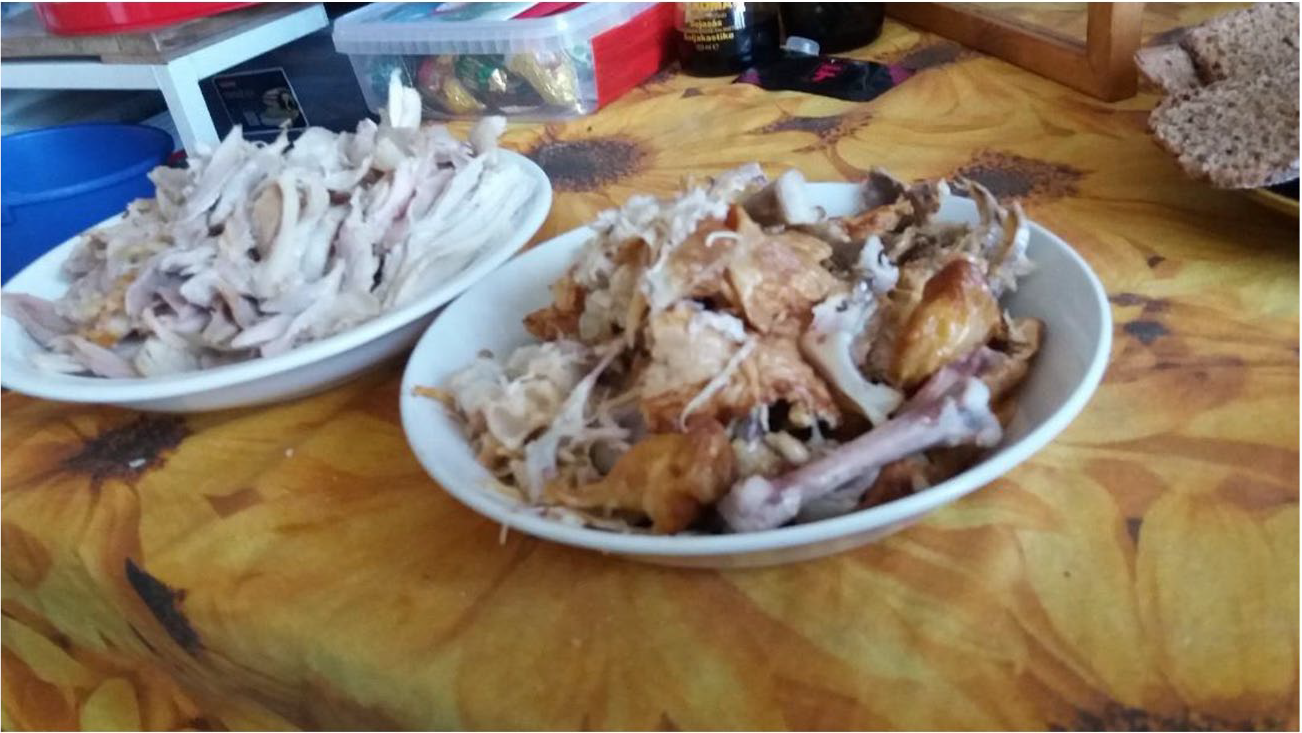
A grilled broiler chicken, cleaned.
These two categories show how navigating contentious care relations within meat consumption happens through moderating, which is enacted in everyday material and embodied food practices as well as through ethical and affective positionings. Next, I will discuss the implications of these results in greater depth.
Discussion and Conclusion
In this article, I have looked at how common, yet contentious, everyday meat consumption practices are navigated from the viewpoint of care relations. This explicit combination of care and meat enabled us to see that the contentious dimensions of meat consumption are navigated by moderating care. This happened in several ways in the data. First, when giving and receiving care within social relations, moderating care happened through flexible adjustments – for example, in relation to the types of meat consumed or the social situations in which meat was eaten. Alongside these adjustments, moderating care happened through negotiations, such as modifying meat-based foods to better correspond to different caring relations. When animals were involved in care relations, moderating care happened by remaining at the level of ‘caring about’, which could mean seeing the animals as objects of pity rather than subjects of compassion, thus distancing the animals ethically and affectively. However, animals could also ‘be taken care of’, wherein certain animals were excluded from one’s diet. Here, moderating care meant that while choices like this were not seen as solutions to the problems in animal agriculture, they still provided a way to take some responsibility. Moderating care was also present in the ambivalence of caring relations towards animals, either based on hesitant connections or consciously striving away from care. To summarise, within social relations moderating care seemed to aim at maintaining and repairing relations among people. Within care towards animals, moderating care brought animals into rather ambivalent relations: instrumental, objectifying or hesitant care could bring animals closer into one’s circles of care as well as keeping them as distant, consumable production animals.
Based on these findings and the conceptualisation of moderating care, the article contributes to previous research that has noted the nuances of care. Pitt (2018) calls attention to the qualities of relating within caring encounters, such as being sensitive to instrumental goals that intertwine with care. This resonates with the finding that moderating care can lead to ethical and affective distance from the care needs of others if they are seen as objects rather than subjects. Complementing Bruckner et al.’s (2019) findings on care and animal–human relations within alternative food networks, moderating care underlines that, even within non-alternative meat consumption, ways of relating to animals cannot be understood in binary terms: animals are neither outright excluded from consideration nor embraced wholeheartedly. Rather, the connections are partial, such as hesitant closeness or determined distancing. On a more general level, moderation could be seen as a way to conceptualise the disruptions of caring. Tronto (1993: 109) notes that while the four phases of care connecting to each other smoothly is an ideal of care, various conflicts often disrupt care both within different phases and between them. Moderating care highlights how these disruptions can stem from situations in which caring is directed at somewhat incompatible aims, which in turn can lead to only partial engagements with care.
The findings of this article also resonate with previous research into the socio-cultural aspects of meat consumption. It has been noted that emphasising consumers’ responsibility for ethical meat consumption through, for example, welfare labels can lead to disengagement: consumers can prioritise caring for loved ones through food and express doubts towards outsourcing animal welfare to consumer markets instead of it being a public good (Miele and Evans, 2010). While the participants in this study expressed their awareness of the contentious dimensions related to meat consumption, and some also modified their consumption practices based on them, the various ways of moderating care nonetheless show that moving towards more sustainable ways of consuming meat cannot be limited to the individual, consumer level. Rather, it is important to note that care relations are always patterned along broader societal and cultural values. In this sense, moderating care can be seen to reflect the somewhat twofold position of meat in Finland: while it still has a strong cultural, social and nutritional position in Finnish food culture, people also recognise the need to reduce meat consumption (Mäkelä and Niva, 2016). Thus, in order to understand the socio-cultural construction of meat consumption in greater depth, it should be seen as being embedded in a web of various care relations. It is their interactions and potential (dis)connections that can lead to reducing meat consumption and exploring alternative ways of consuming it, or supporting existing consumption patterns, as this article has shown.
While the participants in this study represented a wide variety of meat relations, the lack of younger participants can be seen as a limitation that future research could address. In addition, looking into how relations of care are entangled with meat consumption beyond the consumer level could provide valuable insights. This article emphasised the animal origins of meat, but considering the environmental or health-related contentious relations around meat could also be an interesting avenue for future studies. In general, the dynamics of care within food consumption deserve sustained sociological attention. Meah and Jackson (2017: 2077) observe that caring through food provision has become ‘a matter of public scrutiny’. Caring for our own and others’ continued survival and well-being means that we need to be nourished, but our ways of sourcing foods create their own vulnerabilities and harms. As questions around sustainable (food) consumption become more urgent, it is essential to remain attentive to the value of caring for the future of our consumption while simultaneously being aware that caring is not disconnected from potentially oppressive norms and power relations.
Footnotes
Acknowledgements
I would like to thank the participants of this study. I am also grateful to Mikko Jauho, Johanna Mäkelä and two anonymous reviewers for their insightful and constructive comments regarding this manuscript.
Funding
The author received no financial support for the research, authorship and/or publication of this article.
