




Abstract
Although most studies of the transition from school to work take a snapshot perspective in examining economic returns to education, such returns evolve over an individual’s lifetime. We empirically test a theoretical formulation derived from the cumulative advantage mechanism about enduring life-cycle effects of educational mobility on income. We analyse income trajectories for all Danes born in 1960–1961, and we consider how the welfare state may counteract certain mechanisms of intergenerational transmission that give children with college-educated parents better opportunities in the labour market. We find only small direct effects of parental college attainment on earnings trajectories after we control for offspring college attainment. Thus, schooling acts as a powerful and enduring economic leveller of family background effects in Denmark. Our analyses also show direct effects on trajectories in property income derived from wealth, suggesting that the welfare state has a harder time equalising income from wealth than from earnings.
Keywords
Introduction
A vast literature in sociology analyses the facilitating role of educational attainment in intergenerational mobility processes. The literature typically examines the direct and indirect effects of family background on labour market outcomes for offspring, after factoring in the offspring’s attainment of formal educational qualifications (e.g. Bernardi and Ballarino, 2016; Breen and Müller, 2020; Friedman and Laurison, 2019; Hout, 1988; Ishida et al., 1995; Treiman, 1970). While studies find that offspring education mediates a substantial portion of the intergenerational association between social positions of parent and offspring, they also find that education does not fully mediate the association, meaning that family background affects labour market allocation among offspring with similar levels of formal schooling (Breen and Jonsson, 2007; Ganzeboom et al., 1991). Nevertheless, with a few exceptions (Barone and Schizzerotto, 2011; Gabay-Egozi and Yaish, 2019; Hillmert, 2015; Manzoni et al., 2014; Passaretta et al., 2018), most existing studies measure offspring’s labour market outcomes at occupational maturity, thus potentially ignoring the life-cycle returns of family background regardless of offspring education.
This article examines long-term economic returns to parental college attainment among individuals with and without a college degree for all Danes born in 1960–1961. Put differently, we study the economic returns to intergenerational educational mobility over the life course. Students of stratification and mobility have produced over the years a large body of research on social mobility, its determinants and consequences (Blau and Duncan, 1967; Breen, 2004; Erikson and Goldthorpe, 1992; Gabay-Egozi and Yaish, 2019; Sorokin, 1959, among others). The consensus in this literature is that education plays a major role in facilitating social mobility and is often referred to as the ‘great equalizer’ in society (Bernardi and Ballarino, 2016). The centrality of parental education in the education attainment process (see particularly Bukodi et al., 2021) suggests that intergenerational educational mobility is a major force shaping overall equality of opportunity in society, as ‘education is the main vehicle of social reproduction’ (Ganzeboom et al., 1991: 284). Indeed, educational stratification researchers have long been occupied with studying intergenerational educational mobility (e.g. Hertz et al., 2008; Pfeffer, 2008; Shavit and Blossfeld, 1993; VanDoorn et al., 2011, among others). In this study we expand on previous research as we link intergenerational educational mobility to economic labour market returns over the life course.
Being one of the Nordic comprehensive welfare states, Denmark is characterised by generous redistribution of income, substantial public spending on welfare and schooling and a high degree of collective wage setting. Drawing on the national government’s vast administrative registers, we cross-classify our data by parents’ and offspring’s college attainment and analyse for each of these four mobility groups year-by-year income profiles spanning ages 27 through 53. Drawing on theories of human capital, cumulative disadvantage and compensatory disadvantage, we derive six expectations for the patterning of income profiles across mobility groups. We further detail these theoretical expectations in light of three income sources under the Danish comprehensive welfare state: earnings, disposable income and property income (the latter being a proxy for wealth).
Our empirical analyses show only small direct effects (other than through offspring college attainment) on pre-tax earnings across the life course, thus supporting a human capital explanation. For disposable income – a person’s total income after tax and public transfers – we also find evidence of direct effects, but these effects are driven entirely by property income, a measure of income derived from wealth. Indeed, for property income, we find that direct effects start increasing from about age 40, thus providing some support for a mechanism of compensatory advantage. Supplementary analyses based on a longitudinal survey of Danes born in 1954, for which we have a measure of cognitive skills at age 14, show that controlling for the uneven distribution of cognitive skills across family background does not change any of the results we report here. We conclude the article by discussing how welfare states impact the direct effect of social origins on economic outcomes across the entire life course.
Background
Direct Effects of Family Background on Income Trajectories
Most studies examine labour market outcomes among offspring when they reach occupational maturity using a snapshot measure of occupational or economic standing. This approach ignores how family background and educational attainment affect labour market outcomes over the life cycle. To develop a framework that considers these long-run effects, we draw on theories of human capital, compensatory advantage and cumulative advantage.
When examining economic returns to education, human capital theory comes to the fore (Becker, 1964). According to this theory, remuneration from employment is tied to productivity, which is a function of human capital – mainly education. Here, the productivity of one’s parents is irrelevant, and therefore, parental education and other origin effects should not determine one’s remuneration from employment. When parental effects on children’s income do exist, most economists would see them to occur through their effects in early childhood, such as in the association between parental attributes and unobserved tastes in schooling (Lee et al., 2015), in cognitive skills (Black and Devereux, 2011; Cunha and Heckman, 2008; Todd and Wolpin, 2007) or in non-cognitive skills (Anger and Schnitzlein, 2016; De Coulon et al., 2011). Long-lasting effects of parental resources into adulthood, however, have been less studied (but see Hudson and Sessions, 2011), and the direct effect of parental education on individuals’ socio-economic outcomes is considered in the literature on social stratification as a ‘residual’ family background effect (Jerrim and Macmillan, 2015: 507).
Nevertheless, the human capital theory has important implications for life-course earnings. Accordingly, we should expect a positive relationship between education level and earnings, with parabolic-shape earnings curves fanning out by educational levels (Weisberg, 1995: 146). That is, this model explicitly argues that returns to education grow over the life course. This expectation is well rehearsed and corroborated in many advanced economies such as the USA, Britain, Sweden and Israel (Cheng et al., 2018; Gabay-Egozi and Yaish, 2019; Gregg et al., 2017). This being the case, we should expect to find that those with a college degree have the steepest and highest curve, while those without a college degree have a less steep and lower earnings curve. The first two rows in Table 1 summarise these expectations.
Expected effects of intergenerational educational mobility on income trajectories.
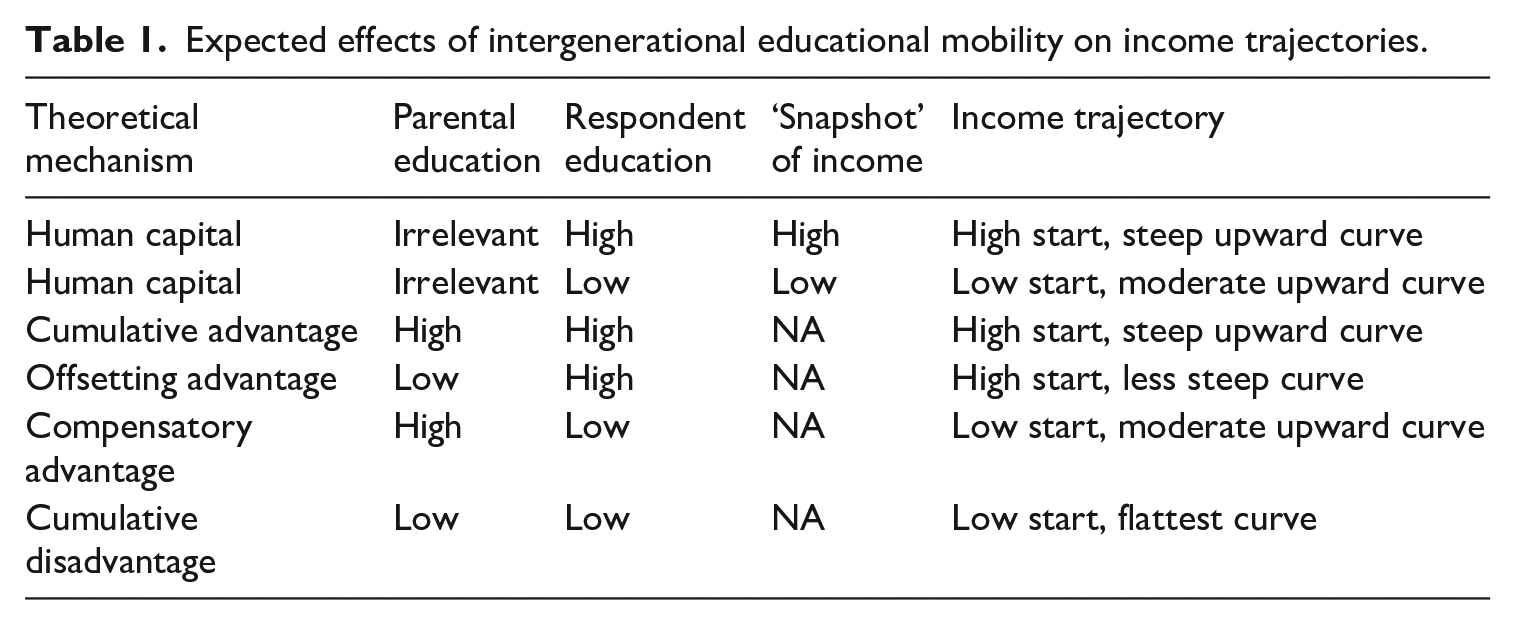
Notwithstanding the importance of human capital theory, the sociological literature on status attainment processes brings to the fore the importance of family background characteristics – particularly parental education (see Sewell and Hauser, 1972). Sociological theories of cultural reproduction, for example, highlight the importance of social background on socio-economic returns (Bourdieu, 1984; Bourdieu and Passeron, 1990; Bowles and Gintis, 1976; Halsey et al., 1980). Similarly, when education functions as a legitimate means for social inclusion and exclusion practices, parental educational credentials (as well as those held by offspring, of course) indicate whether the person comes from the ‘right’ social circles. Parental education can be a resource also in the transition from school to work (Friedman and Laurison, 2019; Lareau, 2011). This is because educated parents can better guide their children on what (fields) and where (institutions) to study. Finally, educated parents can better utilise their social capital to facilitate their offspring’s navigation in the educational system as well as in the labour market. In sum, sociological theories, in contrast to the human capital theory, advance the idea that earnings might be determined not only by one’s own education but also by parents’ education.
As stratification processes are largely intergenerational (Blau and Duncan, 1967; Erikson and Goldthorpe, 1992; Featherman and Hauser, 1978; Sorokin, 1959), and even multi-generational (Mare, 2011), they leave room for parental education influences to operate across the many stages of the life course of their offspring. The sociological literature in this regard, however, has mostly conducted cross-sectional studies, at fixed points in time. In contrast, we take here a life-course perspective and study individuals’ earnings trajectories over a long period of time. This perspective is rare in the field of stratification and inequality, because of its demand for data (see Cheng and Song, 2019), but it nonetheless carries many advantages, as discussed by Manzoni et al. (2014: 1285–1286).
Differentiations in income trajectories, like many other dimensions of social inequality, might thus be path-dependent. This concept is often used interchangeably with the notion of cumulative advantage (Bernardi, 2014), which suggests that an initial advantage in access to a particular resource tends to grow over time (DiPrete and Eirich, 2006; Merton, 1988). If success begets success, parents with more resources at their disposal may help their offspring launch a career with higher income, thereby leading to a long-term advantage of their offspring over their peers from less fortunate origins. Following Gabay-Egozi and Yaish (2019), we propose in Table 1 four possible scenarios, in addition to the human capital scenario, to illustrate the ways in which, ceteris paribus, intergenerational educational mobility might shape life-course income trajectories.
The basic cumulative advantage mechanism postulates that high-educated offspring born to high-educated parents will have both the highest average earnings levels and the highest and steepest parabolic earnings growth curve, as presented in the third row in Table 1. In contrast, low-educated offspring born to low-educated parents will have the lowest average earnings, and also the least steep parabolic earnings growth curve, as presented in the last row in Table 1. We call this the cumulative disadvantage mechanism (see DiPrete and Eirich, 2006). Extending the notion of cumulative advantage, Bernardi (2014) introduces a compensatory advantage mechanism according to which the ‘life course trajectories of individuals from privileged backgrounds are less dependent on prior negative outcomes’ (Bernardi, 2014: 75). Thus, the average earnings and the earnings growth curve of the low-educated born to high-educated parents will be positively affected by their parents’ education. Consequently, their parabolic earnings growth curve will be in-between the two groups described above, as presented in the fifth row in Table 1.
Finally, we propose here to extend the compensatory advantage mechanism to high-educated offspring born to low-educated parents. In our context, for example, this scenario fits first-generation academics, and we label it the offsetting advantage mechanism. Thus, following the logic of path dependence and compensatory advantage, we should expect that low parental education levels will work to offset their educated offspring’s earnings growth curve, such that their parabolic earnings trajectory will also be in-between those with a double advantage and those with a double disadvantage. The fourth row in Table 1 presents this expectation.
In this study, we analyse life-cycle income trajectories by parental and offspring college attainment. The distinction between those with a college degree and those with either no secondary education or a high school or vocational degree presents a major divide in most societies at least since the Second World War. College graduates not only stand out by suffering less unemployment, getting better jobs and earning more money (Brand and Xie, 2010; Hout, 2012), they also appear to experience higher rates of intergenerational occupational mobility (Hout, 1988; Karlson, 2019; Torche, 2011).
Direct Family Background Effects in the Comprehensive Welfare State
Denmark is widely regarded as being part of the Nordic cluster of comprehensive welfare states (Esping-Andersen, 1990). Like other countries in this cluster, Denmark has low income inequality, a high degree of income redistribution via progressive taxation and high social spending, high public spending on education, a high degree of unionisation and collective wage setting and – according to comparative studies (Björklund et al., 2002; Harding and Munk, 2020) – among the highest levels of intergenerational income mobility in the world. Given the way in which the Danish welfare state is structured, we would expect that the mechanisms we outlined earlier will play out differently depending on type of income. Much of the research on intergenerational income mobility focuses mainly on earnings (Black and Devereux, 2011). Clearly, the comprehensive welfare state also has distinctive effects on disposable income and wealth (Hansen, 2001).
In this study, we consider earnings, disposable income and wealth. For earnings, we expect life-cycle trajectories to follow the patterns described in Table 1, although we would expect relatively small direct effects given the low dispersion in earnings (Erikson and Goldthorpe, 1992; Landersø and Heckman, 2017). Such low earnings dispersion makes it more difficult to detect direct effects, all else being equal. For disposable income – income available for consumption or savings after tax and public transfers – we expect to find even smaller direct effects given that progressive taxation and public transfers significantly reduce income dispersion. Moreover, the Danish welfare state’s decommodification of the risks associated with employment should, all else being equal, reduce the influence of parents on children’s disposable income prospects. For example, if parental background affects the likelihood of unemployment, then the generous level of public transfers should counteract (or compensate for) such differences vis-a-vis disposable income. For property income (i.e. income derived from wealth), we expect that the welfare state plays less of a role in compensating for initial family disadvantage and that the direct effect starts growing at a later stage in life when parents begin passing away (Boserup et al., 2016, 2018). 1
Summary and Expectations
The Danish institutional setup leads us to expect that intergenerational transmission of income and wealth inequity is comparatively weak. Thus, applying the four cumulative advantage mechanisms discussed in the previous section to the Danish case, we should expect to find more modest intergenerational transmission of advantages and disadvantages effects in Denmark compared to, for example, Israel and the USA (Gabay-Egozi and Yaish, 2019; Yaish et al., 2021), where the educational and labour market contexts are less egalitarian. Put differently, we expect very small if any direct effects of parental education on life course income in Denmark.
The above discussion on the Danish welfare state illustrates its effectiveness in reducing inequality, particularly in educational attainment and labour market-related outcomes. As in the Swedish case (Hällsten and Yaish, 2021), we expect that these policies may not be as effective in reducing wealth inequalities and the intergenerational transmission of wealth (Boserup et al., 2016, 2018). This being the case, we expect direct parental education effects to surface in the Danish context on our income measure derived from wealth (i.e. property income). This suggests that the four scenarios derived from the cumulative advantage mechanisms presented above, and in Table 1, should apply to wealth.
Data and Methods
We analyse long-run economic returns to college education by parental college education for all individuals born in 1960 and 1961 in Denmark, using data from the Danish administrative registers. We choose the 1960–1961 cohorts, because they are the oldest cohorts with reliable parent–child linkage, and because they can be followed in the income registers until age 53. We exclude individuals with missing information on own or parental education (about 5%). The final analytical sample comprises 140,323 individuals.
We analyse three types of income that are directly available in the income registers at Statistics Denmark: earnings, disposable income and property income. Earnings cover pre-tax income from salaried work and do not include income from self-employment. Disposable income includes earnings, income from self-employment, property income and public transfers, 2 after tax; thus it is a reliable measure of what a person has available for consumption and savings. Property income covers income from interest, stock dividends, capital gains and rental value of property (mainly housing). All income variables are measured in Euros and deflated to 2015 prices. Given that the earnings measure does not include income from self-employment, but the disposable income measure does, to ensure standardised comparisons across the income types, we exclude the self-employed (who comprise about 6% of the total sample) in all of our empirical analyses. 3
Our main independent variable is a college mobility indicator with four categories:
ImmobCol: College graduates whose parents were college graduates.
Upw: College graduates whose parents were not college graduates.
Dnw: Non-college graduates whose parents were college graduates.
ImmobNoCol: Non-college graduates whose parents were non-college graduates.
For parents, we measure college attainment when the offspring is 20 years old. We use the dominance coding principle and assign parents to the college attainment group if at least one of the parents has completed a college degree. For offspring, we measure the respondents’ educational attainment by age 35. For both parents and children, we define a college degree as completing a medium-cycle higher education (a bachelor’s degree of 3–4 years in duration, typically target the semi-professions) or a full university education (a bachelor’s and master’s degree of 5–6 years in duration in total).
Table 2 shows the parent–offspring cross-classification of the college attainment dummies. As the table shows, there are relatively low levels of absolute mobility. 4 Roughly 21% experience educational mobility, and upward mobility (14%) is more prevalent than downward mobility (7%), reflecting educational expansion between parents’ and offspring’s generations. Moreover, while men and women are equally likely to experience downward mobility, more women than men experience upward mobility. Table 2 highlights the advantage of inspecting educational mobility within the mobility table framework. This is because it enables a decomposition of mobility into upward and downward moves. This inspection, moreover, underlines occurrences of downward mobility, which are largely neglected by the research literature (for an exception, see Gabay-Egozi and Yaish, 2019). Finally, Table 2 shows that children born to college-educated parents have about five times the odds of completing college themselves compared to children born to non-college-educated parents. This odds ratio is slightly larger for men (5.5) than for women (4.5), suggesting that women born in this cohort enjoy slightly greater educational fluidity.
Cross-classification of parent and offspring college degrees.
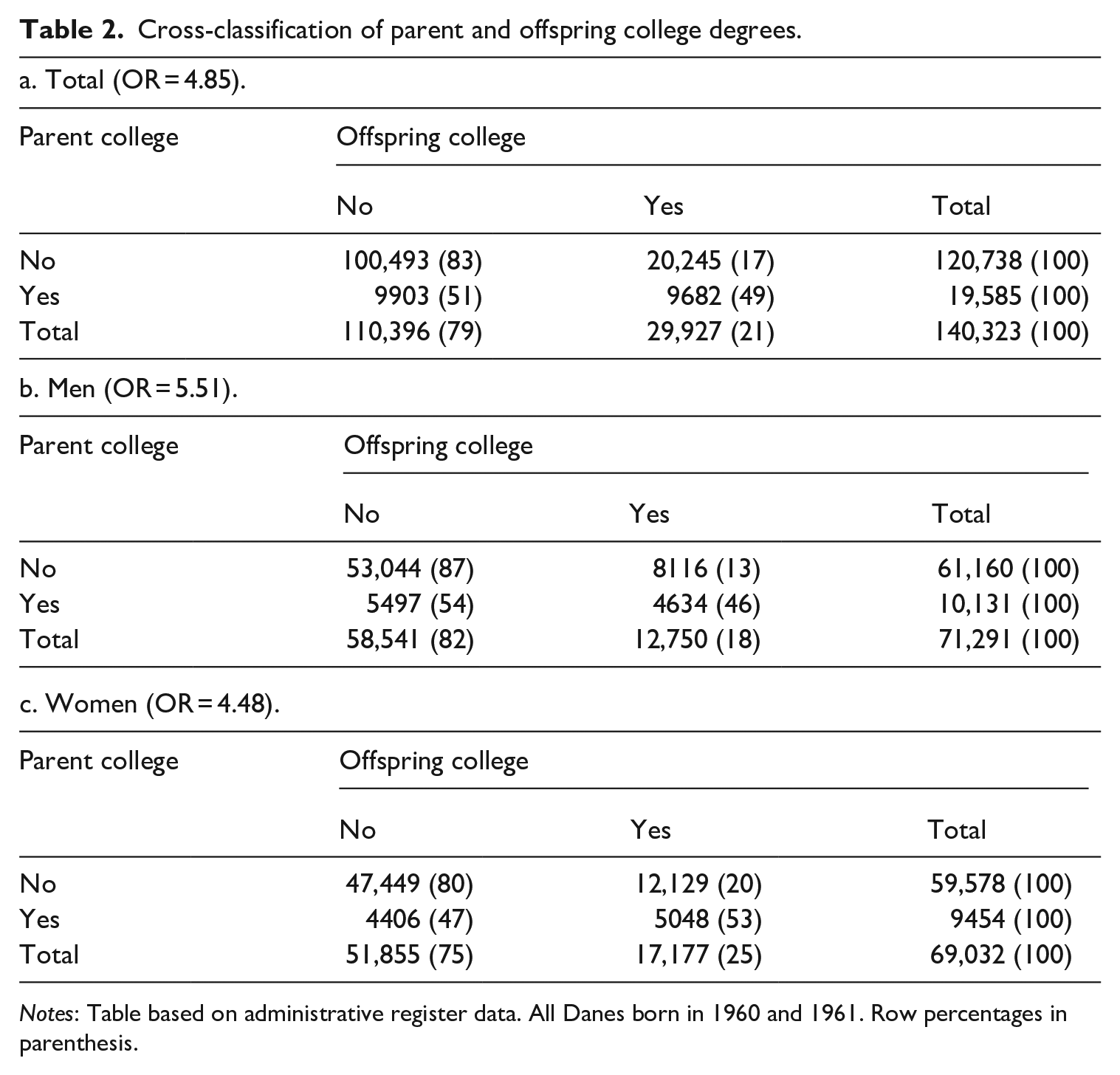
Notes: Table based on administrative register data. All Danes born in 1960 and 1961. Row percentages in parenthesis.
We model the income trends using linear regression models with cluster-robust standard errors, accounting for the panel clustering of respondents. Given that we analyse roughly 140,000 individuals, we use a non-parametric year-by-year specification of the income profiles. Thus, this approach is effectively equivalent to estimating simple averages by the four education mobility groups and age. The advantage of using linear models is that we can properly correct standard errors for the panel clustering and easily control for other covariates in some of our supplementary analyses. As our estimated standard errors are very small, we do not report confidence intervals. 5 We also follow conventions in the social mobility literature and break down all analyses by gender. Moreover, because the administrative registers do not contain information on aspects of human capital other than educational attainment, we report in Online Appendix A the results of a supplementary analysis on earnings trajectories based on survey data covering a sample of people born in 1954 in Denmark. These survey data contain high-quality measures of cognitive skills from three tests measuring inductive, spatial and verbal reasoning. While the patterns in life-cycle returns for these surveys are very similar to those for the 1960–1961 cohorts, controlling for skills does not affect these patterns at all, suggesting that omitted ability is not driving the results we report here. 6
Analysis
Figures 1 to 3 show life-cycle profiles for earnings, disposable income and property income by college mobility group and gender. 7 As Figure 1 shows, offspring college education has a strong main effect on earnings levels and trajectories that increase across the life cycle, particularly in the early years until age 40. College-educated men in their early 50s earn about twice as much as non-college-educated men. The corresponding gap for women is closer to 50%, thus indicating comparatively lower returns to schooling for women. However, within offspring college attainment, parent college attainment has meagre effects, a result that applies to both men and women. For example, among men without a college degree – the group for which the direct effect is largest – at age 53, those born to college-educated parents earn about 13% more than those born to non-college-educated parents (roughly 52,000 vs. 46,000 Euros). While this is not a negligible difference, it is far from the 100% difference found for the net effect of college education. Therefore, we take these small direct effects to support the human capital explanation in that parental education is largely irrelevant for life-cycle trends in earnings. Still, these results highlight the advantage of using the life-course perspective, as income unfolds in a non-linear shape over the life course – as postulated by the human capital theory.
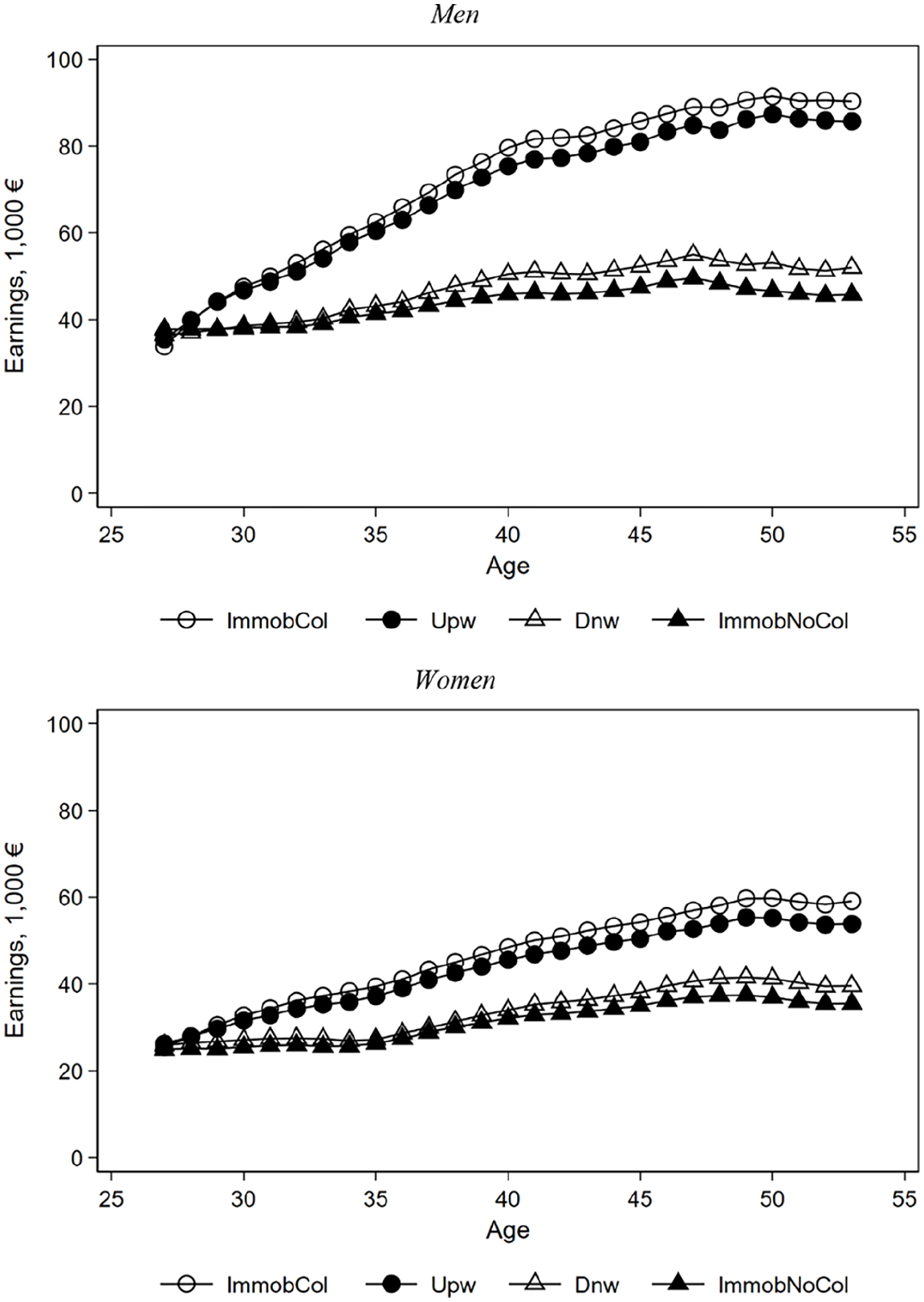
Average earnings trajectories by age and college mobility group, 1960–1961 cohort.
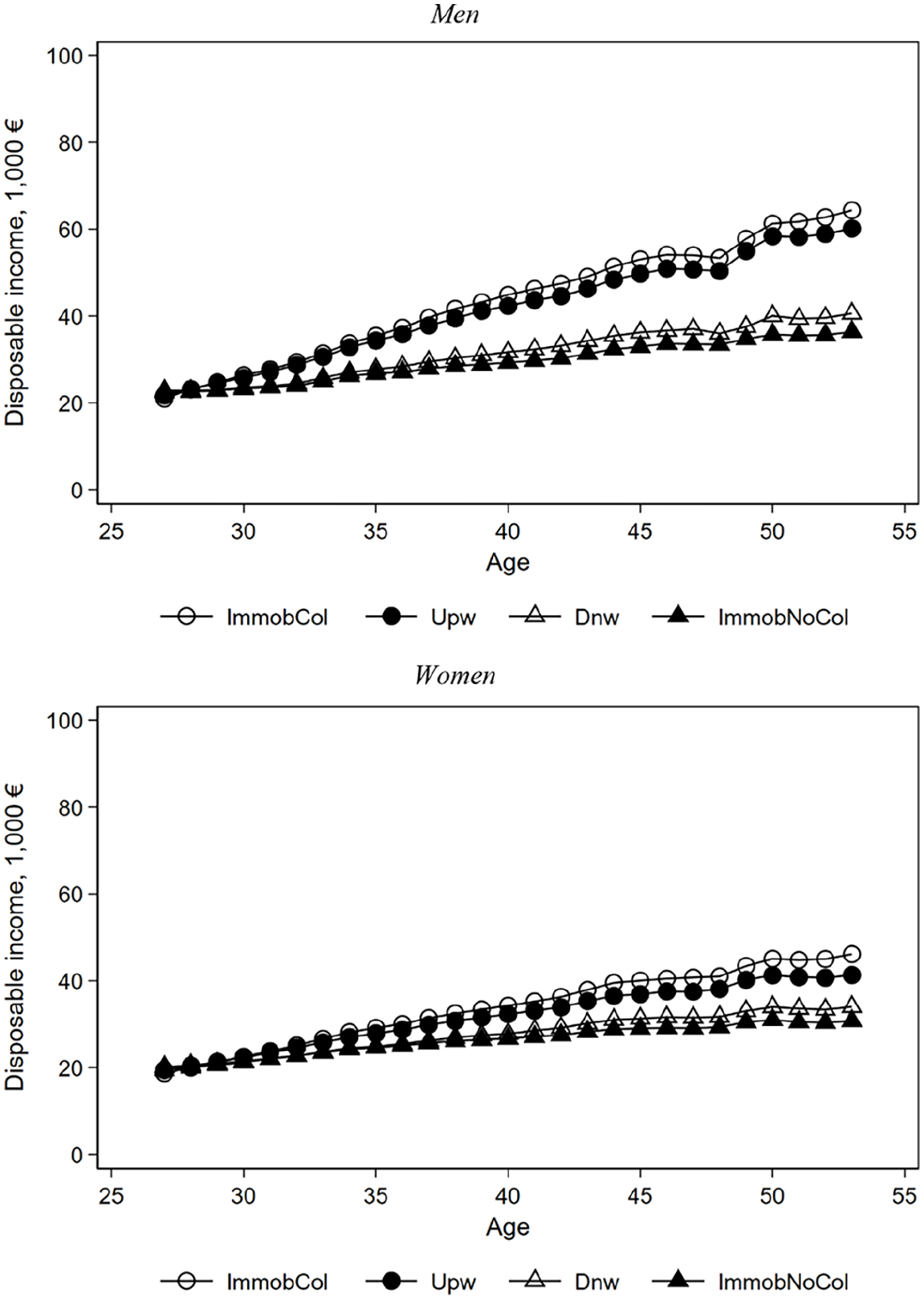
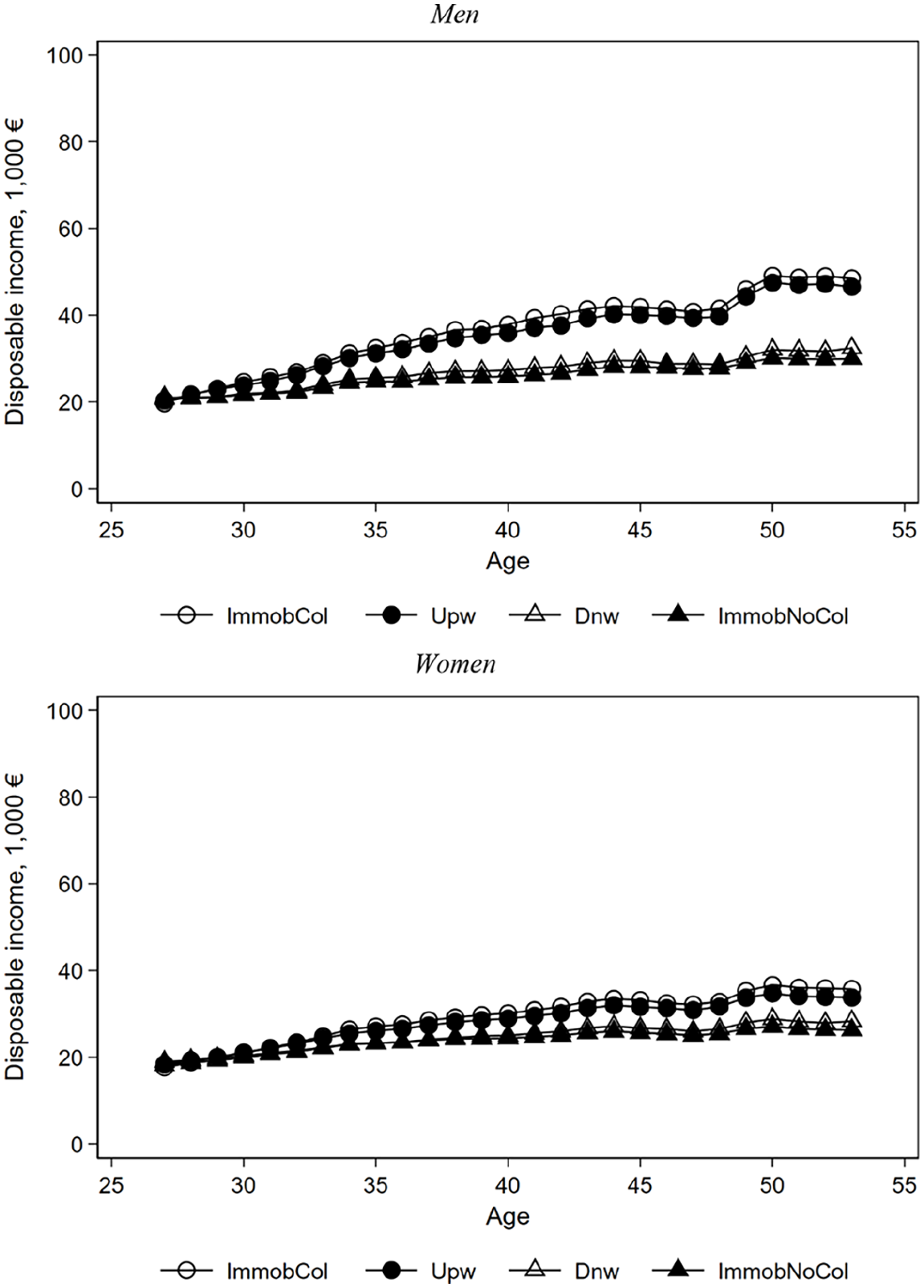
Average disposable income by age and college mobility group, 1960–1961 cohort.
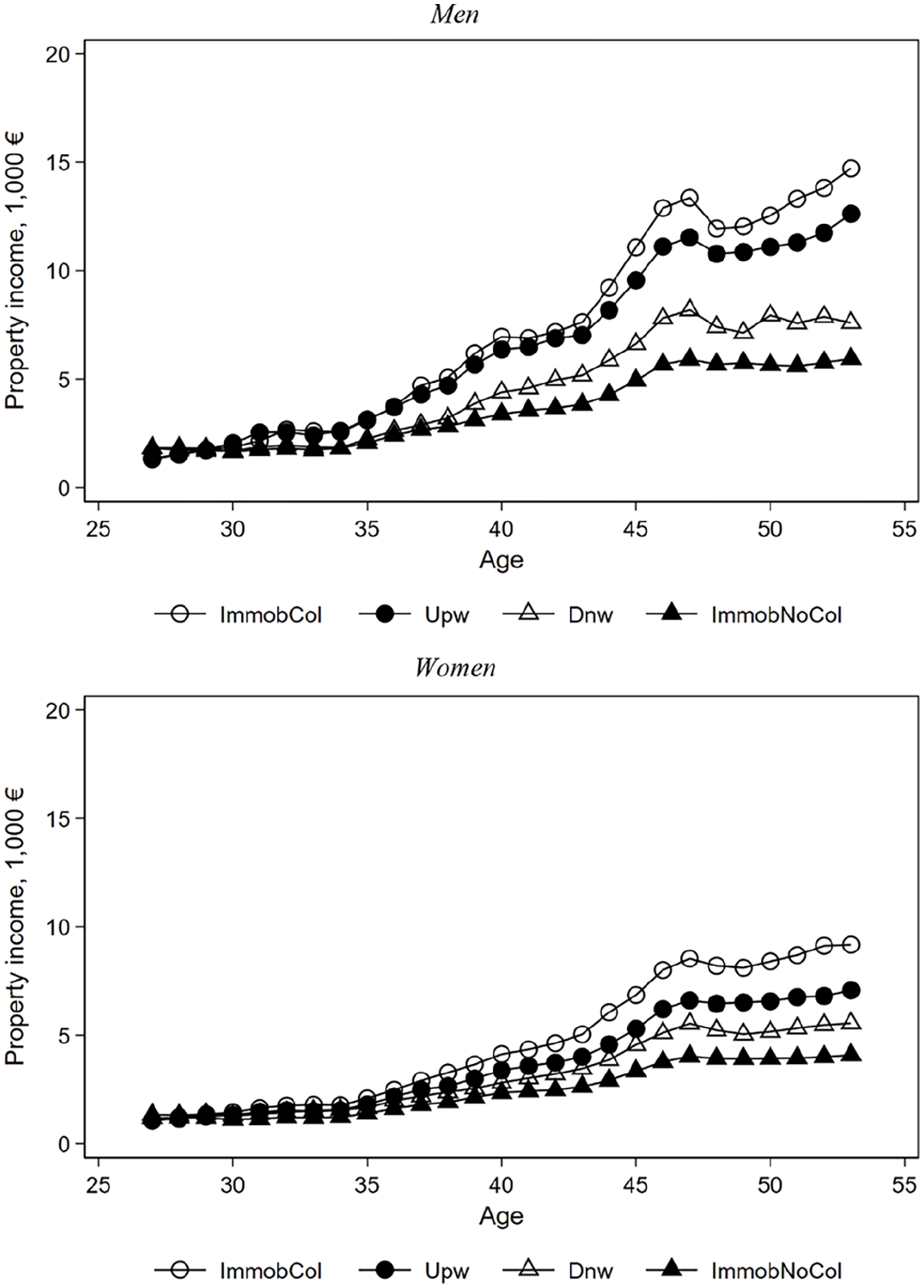
Average property income by age and college mobility group, 1960–1961 cohort.
Figure 2 shows life-cycle trajectories for disposable income, which is our measure of income after tax and public transfers. As we would have expected, the main net effects of college attainment are much smaller than those found for pre-tax earnings, pointing to the dramatic effects of the Danish welfare state on reducing income inequality. However, when considering the direct effects, we find a very similar pattern to that reported for earnings, with even smaller direct effects. While there is a slight tendency for the direct effects to grow over time, in both absolute and relative terms and for both men and women, the gaps by parental college attainment are not very pronounced. For example, among college-educated women, at age 53, offspring born to college-educated parents have about 12% higher disposable income than offspring born to non-college-educated parents (roughly 46,000 vs. 41,000 Euros). These results, again, provide support for the predictions derived from human capital theory, as presented in the first two rows in Table 1.
While the comprehensive welfare state appears quite effective in reducing the direct influence of family background on earnings and disposable income, is it equally effective vis-a-vis income derived from wealth? To examine this question, in Figure 3 we report life-cycle trends in property income by college mobility group. Here we see quite noticeable direct effects, at least in relative terms. The direct effects also appear to grow as people age, particularly from the early 40s onward. This finding offers clear evidence of cumulative advantage mechanisms, and in particular the four scenarios presented in the introduction and Table 1. For example, among non-college-educated men, at age 50, those born to college-educated parents have almost 40% higher property income than those born to non-college-educated parents (roughly 7900 vs. 5700 Euros). While the direct effects on property income are small in absolute terms, they reflect very large differences in underlying wealth. These results support our expectation that the Danish welfare state has a harder time equalising income associated with wealth than other types of income.
To further support this conclusion, in Figure 4 we report life-cycle trends in our disposable income measure after we exclude property income. Comparing this figure to Figure 2, we see that property income drives virtually all of the direct effects on disposable income; that is, the income available after tax and transfers for consumption and savings. This result suggests that the generous redistribution mechanism of the Danish welfare state is a significant equaliser for people with similar education levels.
Average disposable income excluding property income by age and college mobility group, 1960–1961 cohort.
Robustness Analyses
Although the empirical results point to the Danish welfare state as being very effective in eliminating the direct effect of social origins on life-cycle earnings trajectories, our analyses are limited by the fact that we cannot control for selection into college on ability. To check the robustness of our results vis-a-vis this limitation, we conducted a supplementary analysis based on longitudinal survey data for a probability sample of the 1954 cohort in Denmark. The major advantage of this sample is that, apart from being able to link the respondents to the registers (to follow their earnings profiles), it includes a comprehensive measure of respondents’ cognitive skills at age 14, thus allowing us to correct for the selection into college. Online Appendix B describes this sample and shows the key results based on the data. With regard to the selection into college on ability, we find that correcting for cognitive ability does not change any of the mobility groups’ earnings profiles (Figures B1 and B2), suggesting that our result of no considerable direct effects on earnings is robust upon controlling for cognitive skills measured relatively early in life.
Another potential concern with our analysis is the detail level by which we measure offspring’s education. The college degree dichotomy glosses over heterogeneity by field of study among those with a college degree and the distinction between having no degree or a vocational degree among those without a college degree. To the extent that college-educated parents are better at guiding their children towards economically advantageous educational tracks and fields of study, the college degree dichotomy may lead us to overestimate the direct influence of social origins on economic outcomes. Therefore, in Online Appendix C, we estimate the direct effect of parents’ college attainment on offspring’s economic trajectories after we take into account underlying differences in four educational tracks among non-college-educated offspring and nine overall fields of study among college-educated offspring. When we control for this heterogeneity, we find that the small direct effect of parents’ college attainment on offspring earnings is even smaller for men (earnings differences of less than 5% across the life cycle) and virtually disappears for women. This finding lends further support to the conclusion that direct effects of parents’ college attainment on offspring’s earnings trajectories over the life cycle are small in Denmark. Moreover, as we would have expected, the direct effect of parents’ college attainment on offspring’s property income is less affected by controlling for educational tracks and fields of study, which may indicate that social origin differences in such income reflect direct transmissions of wealth from parents to children unmediated by children’s education.
In a further set of robustness analyses, we examine how our results depend on different ways of measuring parental college attainment. In Online Appendix D, we distinguish between having one or two college-educated parents and find that earnings are higher throughout the life cycle among offspring with two college-educated parents – particularly so among offspring who attain a college degree themselves. Earnings among offspring with only one college-educated parent are still higher than earnings among offspring without college-educated parents. We also examine how our results hold up if we construct college mobility groups using only father’s or mother’s college attainment. We find that results are robust to using father’s college attainment, which was expected given that fathers generally have higher levels of education than mothers for the cohorts we study. Results are similar when using mother’s college attainment, although in this specification the direct effect of social origins is slightly smaller among both men and women.
Discussion
This article examines differences in life-cycle economic trajectories among Danes with different intergenerational college mobility experiences. Our results for earnings show that these trajectories do not follow a pattern of cumulative or compensatory advantage, but are instead explained by human capital attainment. In other words, we find small direct effects of parents’ college attainment on offspring’s earnings trajectories over the life cycle. This result is similar to preliminary results from Sweden (Hällsten and Yaish, 2021), but different from corresponding estimates from Israel (Gabay-Egozi and Yaish, 2019) and the USA (Yaish et al., 2021), where patterns of cumulative advantage appear strong. One reason for these differences is the differences in welfare regimes between the Nordic countries (Sweden and Denmark), on the one hand, and the liberal ones (Israel and the USA), on the other.
In the context of the well-known OED triangle – perhaps the most studied set of associations in the social mobility literature – these results concur with a common assertion in the sociological and the economic literatures that net of E (education), the strength of the association between O (origins – parental education) and D (destination – life-course earnings) is attenuated by welfare regime and overall level of social and economic inequality in society (Andrews and Leigh, 2009; Erikson and Goldthorpe, 1992; Raftery, 1983; Treiman and Yip, 1989; Yaish and Andersen, 2012). Accordingly, rates of intergenerational mobility (i.e. the total OD association in the OED triangle) are assumed to be affected by the socio-economic distance between social classes (Tyree et al., 1979). When inequality is high, the socio-economic distance between the classes is large, and thus those at the top of the class hierarchy are highly motivated to ensure that their offspring will not fall downward. These parents will thus mobilise all their resources to make sure that the status quo is maintained. When inequality is low, socio-economic distance between the classes is also small, and thus elites have less reason to be concerned with securing their privileges for their offspring, resulting in fewer barriers for social mobility.
While we only find small direct parental effects on life-course earnings (and disposable income) trajectories, we identify larger direct effects of parental education on income from wealth (property income in our study). We interpret this result as suggesting that the Danish comprehensive welfare state has a harder time equalising intergenerational transmission mechanisms pertaining to wealth, although it is very effective in cancelling these effects on earnings and disposable income in particular. This finding also highlights how intergenerational mobility processes are multidimensional, and provides a reminder to scholars of inequality and stratification that inequality can circumvent policies aiming to eradicate it, and emerge – even in relatively equal societies – in areas less prone to state regulation and intervention.
Thus far, results from Israel (Gabay-Egozi and Yaish, 2019), the USA (Yaish et al., 2021) and Sweden (Hällsten and Yaish, 2021) provide findings that are consistent with the results and conclusions we made here on the basis of the Danish case, regarding the ability and limitations of the welfare state apparatus to mitigate intergenerational reproduction processes. Still, to be able to derive robust and coherent policy recommendations from these conclusions, more research is needed in other contexts and within different inequality and welfare regimes.
Supplemental Material
sj-pdf-1-soc-10.1177_00380385221090877 – Supplemental material for Life-Cycle Economic Returns to Educational Mobility in Denmark
Supplemental material, sj-pdf-1-soc-10.1177_00380385221090877 for Life-Cycle Economic Returns to Educational Mobility in Denmark by Jesper Fels Birkelund, Kristian Bernt Karlson and Meir Yaish in Sociology
Footnotes
Acknowledgements
An earlier version of this article was presented at the 2019 Summer Meeting of the RC28 at Princeton University. We wish to thank participants at this event.
Funding
The authors disclosed receipt of the following financial support for the research, authorship and/or publication of this article: for Jesper F Birkelund and Kristian B Karlson, this work was supported by New Opportunities for Research Funding Agency Cooperation in Europe (NORFACE) under the funding scheme Dynamics of Inequality across the Life-Course: Structures and Processes (DIAL) [grant number 426-16-021].

Supplemental material
Supplemental material for this article is available online.
Notes
References
Supplementary Material
Please find the following supplemental material available below.
For Open Access articles published under a Creative Commons License, all supplemental material carries the same license as the article it is associated with.
For non-Open Access articles published, all supplemental material carries a non-exclusive license, and permission requests for re-use of supplemental material or any part of supplemental material shall be sent directly to the copyright owner as specified in the copyright notice associated with the article.
