



Abstract
Colourism – skin shade prejudice – is a social justice issue for People of Colour globally. Yet, there has been no major sociological study that explores colourism in the UK. Addressing this gap, we draw on nine in-depth qualitative interviews with Black and Mixed-Race heterosexual men living in England that formed part of a larger study of colourism. Using reflexive thematic analysis through an intersectional feminist lens, we argue that colourism is gendered. We found that Black men both experience colourism and perpetuate it by teasing male peers and favouring women with light skin. Our analysis generated three themes: (1) navigating colourism as part of growing up; (2) skin shade paradoxes for Black and Mixed-Race men; and (3) colourism and desirability through the Black male gaze. This research provides a nuanced exploration of colourism from Black and Mixed-Race men’s perspectives. It underscores the significance of colourism in the UK.
Keywords
Introduction
Colourism – skin shade prejudice privileging those with lighter skin – is an important health and social justice issue for People of Colour globally (Dixon and Telles, 2017). However, to our knowledge, there has not been a major sociological study that explores colourism in the UK. This absence is significant given the historical links between colourism and colonialism (Glenn, 2008), Britain’s colonial past (Tharoor, 2017) and the presence of approximately eight million People of Colour living in England and Wales (2011 Census). As colourism is a gendered construct (Hunter, 2002), it is important to explore men’s experiences and understandings of colourism as it applies to their own lives as well as to the women around them. However, qualitative explorations of colourism from a male perspective are sparse in the academic literature (Veras, 2016). To address these gaps, this article provides an in-depth qualitative investigation exploring Black and Mixed-Race men’s experiences of colourism in the UK. We argue that Black and Mixed-Race men both experience and perpetuate colourism, highlighting the complexity of the prejudice.
Colourism is a form of prejudice and discrimination affecting People of Colour based on a hierarchical stratification of skin shade, whereby those with lighter skin are privileged (Hall, 2018; Hunter, 2007). Phenotypes, such as eye colour and shape, hair texture and nose shape, are also relevant to the enactment and experiences of colourism, with People of Colour ‘awarded advantages based on their phenotypical proximity to whiteness’ (Reece, 2019: 5). Colourism is related to racism, but is conceptually distinct. It can occur both within and between racialised groups, meaning People of Colour with darker skin can be subject to both racism and colourism (Hunter, 2007). Acknowledging the specificities of socio-political histories and that manifestations of colourism vary by context and culture (Dixon and Telles, 2017), we focus on the experiences and understandings of colourism for Black and Mixed-Race (White–Black) men living in the UK.
Colourism is insidious, negatively impacting Black people with darker skin in myriad ways. Studies indicate that Black Americans with darker skin shades experience disadvantage compared with their peers with lighter skin in terms of education, employment, wages and income (Hunter, 2007; Monk, 2014; Reece, 2021). Further, consistent with negative stereotypes that dark skin is associated with criminality (Kleider-Offutt et al., 2017), Black Americans with darker skin are more likely to be suspended or expelled from school, arrested or incarcerated, and are more likely to receive longer prison sentences for the same crimes than those with lighter skin (Blake et al., 2017; Burch, 2015). Despite evidence underscoring how colourism negatively affects the lives of Black Americans, there is a lack of academic literature on how colourism affects Black people in the UK.
Scholars argue that colourism is gendered, suggesting that Black women experience greater disadvantage compared with Black men (e.g. Dixon and Telles, 2017; Hill, 2002; Keith et al., 2010). Societal appearance standards serve to perpetuate colourism by constructing light skin and Eurocentric features as the epitome of feminine beauty (Jha, 2016). In turn, these standards, promoted by media and advertising, play a significant role in light skin being a form of social capital for Black women (Hunter, 2002). Internalising colourist ideology (i.e. ‘buying into’ societal skin shade hierarchies privileging lighter skin) has a negative impact on Black women’s self-esteem and increases the risk of engaging in harmful skin lightening behaviours (Glenn, 2008; Hall, 2017). There are indications that Black heterosexual men can perpetuate colourism against Black women through their preferences for romantic partners (Hall, 2017; Mathews and Johnson, 2015). While colourism can be attributed to wider macro-level influences (e.g. media portrayals of Black and Mixed-Race women with light skin as objects of desire), it can create conflicts between Black people and damage Black women’s self-esteem through rejection and humiliation (Mathews and Johnson, 2015). The dearth of research exploring this from a Black male perspective was an important rationale for the present study.
Theoretical Framework
A limitation of existing scholarship on colourism is its lack of theoretical underpinning (Reece, 2019). Our analysis of colourism is informed by intersectionality and theorisation of skin shade as capital (see Glenn, 2008; Hunter, 2002). As a metaphor, intersectionality is ‘a cognitive device’ for conceptualising ‘social inequality within power relations’ (Collins, 2019: 29). According to Collins and Bilge (2020) a commitment to social justice and the idea that different inequalities should not be treated as separate and distinct, but as mutually constitutive, are at the heart of intersectional scholarship (Collins, 2019). Intersectionality can, therefore, be employed to explore how colourism operates as a social division that cross-cuts and decentres other social power relations, such as gender, class and sexuality. This theorisation is equally relevant to the intersecting power relations across diverse societies as well as social relations and individual experiences in everyday life. This multifaceted conceptualisation makes intersectional perspectives helpful in addressing the disadvantages faced by People of Colour with dark skin. It can, therefore, be employed to help explore how colourism operates. It is a valuable lens for investigating how the skin shade of Black and Mixed-Race men intersects with masculinity, racism and their associated power relations and how this influences their male gaze and desires. In this study, we explored intersections of gender, colourism and racism for Black and Mixed-Race men and the associated power dynamics.
Skin shade operates as a form of symbolic capital that can determine a person’s life chances given that people with light skin are considered more intelligent, trustworthy and attractive than those with darker skin from the same racialised groups (Glenn, 2008). Hunter (2002) points out that women are particularly affected by this, since for women beauty operates as social capital that can be transformed into other forms of capital, such as economic and educational capital. Here, we examine how intersections of colourism and gender produce social capital for men with light skin.
The Study
The research for this article comes from a larger qualitative study of 34 People of Colour (25 women and nine men). We extend existing scholarship on racism, identity and masculinity among Black men (e.g. Monrose, 2020) and Mixed-Race men (e.g. Joseph-Salisbury, 2019) in the UK by exploring how skin shade affects Black and Mixed-Race men’s experiences.
Specifically, we set out to explore the following research questions:
How do Black and Mixed-Race men in the UK understand colourism?
How do they negotiate colourism in their everyday lives?
How does colourism affect Black and Mixed-Race men’s romantic desirability and dating choices?
Method
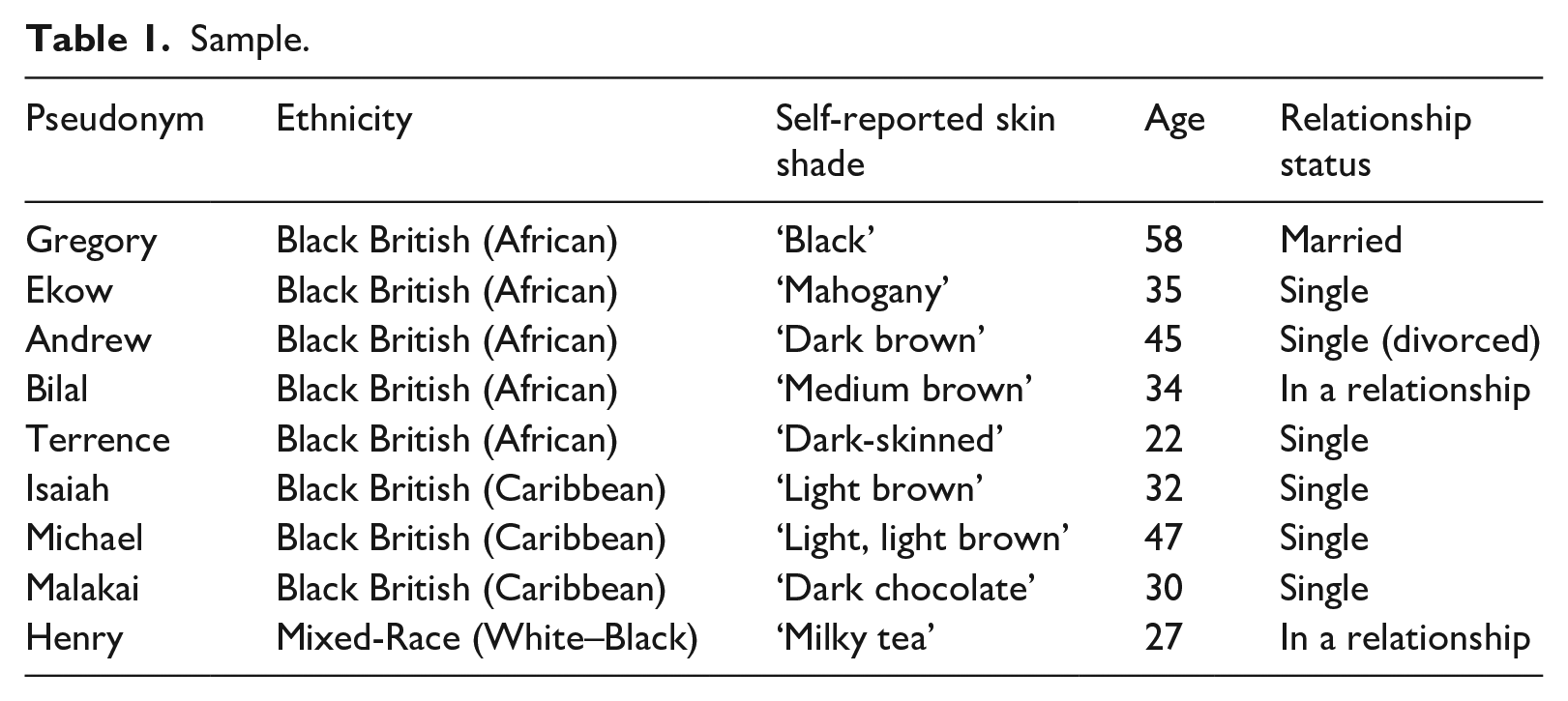
This article is based on nine in-depth semi-structured interviews with heterosexual, Black and Mixed-Race cisgender men living in the UK conducted between January and July 2019. The average age of participants was 37 years, with ages ranging from 22 to 58. There was one student, and the rest were from a variety of public and private sector occupations, including project managers, a doctor, an accountant, a strategy consultant and a train operator. See Table 1 for more details.
Sample.
Upon receiving ethical approval from SOAS, University of London, participants were recruited using purposeful sampling. We posted calls for participation on Twitter, Facebook and Instagram and asked our networks to share the invitation widely. Interested individuals were provided with a study information sheet and gave informed consent prior to participation.
Participants were offered a choice between interviews in person or via video call. Five interviews were conducted in person (four in London, one in Bristol) and four were conducted on Skype. We asked participants questions from an interview schedule exploring perceptions and experiences of skin shade (e.g. ‘How do you feel about your skin shade?’ and ‘Have you ever been treated differently due to the shade of your skin?’), asking follow-up questions determined by participant responses. We asked questions sensitively and were ready to move on from questions the participants found too painful or did not want to answer to mitigate against potential participant distress. However, this need did not arise. Interviews lasted between 54 and 102 minutes (average, 69 minutes) and were transcribed verbatim. Transcripts were anonymised and participants were given a pseudonym.
We analysed the data using reflexive thematic analysis, a theoretically flexible approach to qualitative analysis (Braun and Clarke, 2006). This allowed us to analyse the data using an intersectional lens to explore how skin shade intersected with being male and heterosexual and the power relations central to our participants’ multiple positionings (Phoenix and Pattynama, 2006). Given that all the participants were heterosexual Black or Mixed-Race men, we focused on how gender, heterosexuality and skin shade intersected to inform the multiple ways in which the men were positioned. Further, we considered the power relations central to their multiple positionings and explored how these informed the men’s engagement with the world around them.
In line with Braun and Clarke’s (2006) thematic analysis, we first each familiarised ourselves with the data by reading the transcripts several times. This process facilitated interpretation and allowed multiple opportunities for reflection on the men’s accounts. Next, we independently coded all the data using an inductive approach, which allowed us to prioritise the accounts of the participants. We then came together to discuss and align our coding before developing candidate themes by identifying overarching patterns in our generated codes, reflecting on the notes we had each made during the familiarisation and coding stages, and drawing thematic maps with candidate themes. We also discussed these with academic peers and community groups to assess the wider resonance of our findings. Last, we returned to the data and re-read our transcripts to ensure our candidate themes represented the data, before agreeing on our final themes.
To ensure the quality of our work, we followed Tracy’s (2010) eight markers of quality in qualitative research: worthy topic, rich rigour, sincerity, credibility, resonance, significant contribution, ethics and meaningful coherence. Specifically related to the validity of analysis, we followed Maxwell (1992). For example, to demonstrate descriptive validity, we provide verbatim quotes from participant transcripts. Further, acknowledging that qualitative findings are constructed by the researchers, we detail our positionality for interpretive validity here. The first author (Aisha Phoenix), an African Caribbean woman, conducted all the interviews with the African and African Caribbean men, and the second author (Nadia Craddock), a Mixed-Race woman (Asian-White), conducted the interview with the only Mixed-Race (Black–White) man. Although this was not intentional, this insider status with participants meant they often assumed a shared understanding of the issues elicited in the research and the broader context of colourism in the UK. Conversely, our positioning as Women of Colour meant some participants may have felt uncomfortable sharing their views on women of different shades. However, it may also have avoided posturing based on masculine gender norms. On balance, our different, though complementary positioning as Black and Mixed-Race feminist women researchers of colour facilitated rich analysis and discussions that were attentive to gendered and racialised power dynamics in the interviews.
We do not claim that our participants, and thus our findings, are representative. However, given the paucity of current published work on men’s experience of colourism as well as practical constraints, we prioritised a deep analysis with rich data, rather than attempting to recruit a larger sample with a demographic group that are often reticent talking about colourism (Veras, 2016). While we cannot confidently assert theoretical saturation with nine participants, there was evidence for each theme in all nine accounts. The combined depth of analysis and richness of the data allowed us to provide important insights into the nuanced experiences of colourism for Black and Mixed-Race men living in the UK.
Findings
Analysis generated three themes, which we will explore in turn: (1) navigating colourism as part of growing up; (2) skin shade paradoxes for Black and Mixed-Race men; and (3) colourism and desirability through the Black male gaze. All six participants with self-defined dark and medium skin shades gave examples of negative experiences due to having dark skin. Conversely, the three participants with light skin gave examples of light-skin privilege. While some participants discussed the negative psychological effects of internalising colourism, participants with both dark and light skin expressed pride in their skin shade.
The Impact of Growing Up Navigating Colourism
This section examines participants’ reflections on experiences of colourism growing up. It is notable that although our interview schedule did not include direct questions about childhood experiences of colourism, early accounts of navigating different sites in which colourism was perpetuated in the home and at school were common across participants and a repeated theme. This suggests that the men considered early formative experiences of colourism salient in their adult lives.
Families Perpetuating Colourism
Experiences of colourism within families resulted in some participants with dark skin questioning the value of their skin shade. Terrence, for example, said that in childhood, his oldest brother, who was lighter than him, ‘always used to make jokes’ about his other brother’s dark skin. He said, ‘it would never be directed at me, but I just knew that I was darker than him . . . [Y]ou’re left wondering if . . . what you look like is the ideal.’ That same brother also used to warn Terrence not to ‘stay in the sun for too long otherwise you’ll get darker’. The implication being that darker skin is to be avoided because it is imbued with negativity. While Terrence and his brothers were the same gender, ethnicity and social class, the intersection of skin shade and age affected their social positioning and the power relations between them. His older brother’s lighter skin and seniority in terms of age placed him in a position of influence over Terrence, as well as higher in the skin shade hierarchy. Analysing the family dynamics, Terrence presented a hitherto neglected element of intersectionality, namely how skin shade, age, positioning within a family and generation intersect to inflect intrafamilial power relations. Hordge-Freeman (2013: 1520) argues that families are shaped by racialised hierarchies that both ‘reproduce and resist racism’. In the examples Terrence gave, his family was shaped by a skin shade hierarchy that reproduced colourism.
Similarly, Andrew, who was born in Kenya, said that his family helped to instil in him the idea that light skin was superior to darker skin shades: [W]e grew up in an environment where even we ourselves felt that it was nicer to be lighter. I can remember my grandmother making references to lighter people being more beautiful . . . [I]t’s what we are taught from when you’re younger. You learn these things.
Like Terrence, Andrew suggested that his family reproduced a colourist skin-shade hierarchy with implications for how family members perceived their own skin shades. Kenya’s colonial history is significant here given that European colonialism led to the privileging of whiteness and light skin, something that has been sustained by subsequent generations (Glenn, 2008).
‘Tar Baby’: Colourist Teasing and Rejection from Friends or Peers
Colourist teasing and rejection from friends or peers at school was a common experience for participants. The evocative example that follows underlines how blatant and offensive colourist teasing can be. Malakai explained that Black friends would make ‘jokes’ such as, ‘“Tar baby.” I’m going to be rude, sorry, “You’re Black as fuck.” They would hold something up and say, “that’s you.”’ He held up a jet-black blender as an example. For many participants, witnessing or being subjected to colourism from peers made them feel unattractive or self-conscious for having dark skin. A couple of participants also described subjecting their friends to colourist teasing.
Experiences of witnessing and being subjected to colourism at school had an insidious impact on participants. For Terrence, colourism from his family was compounded by the fact that when he was at school his friend, who had dark skin like his and ‘big lips’, was ‘teased quite consistently’ and people would make jokes about Terrence’s skin shade. In response to these experiences, he said ‘[i]t never really struck me deeply, but . . . sometimes you just look in the mirror and you’re like, “Wow, I am dark.”’ He said that, ‘[g]rowing up you just kind of internalise that idea that lighter is brighter, lighter is better’. This demonstrates how colourism can lead to People of Colour internalising negativity about dark skin and problematising their own skin shades. Through an intersectional lens, Terrence’s claim that it ‘never really struck me deeply’, distances him from the effects of a prejudice often associated with feminine appearance standards, yet his acknowledgement that he sometimes thinks ‘wow’, he is ‘dark’, implicitly connotes undesirability for Black men too.
While not all participants were affected by colourism in the same way, there was a general awareness of its potentially negative effects. For example, Malakai said he takes people to task for their colourism because he dislikes it when people try to belittle him due to his skin shade and he is concerned about the negative effects of the prejudice on those less resilient than him: [Y]ou are Black. So, do you think you’re less than anyone, you’re less than someone who isn’t Black? Because that’s what you’re saying, because I’m darker than you I’m less than you. Do you think a White man is more than you because you are Black and you are a darker skin tone than they are?
He said he confronted Black people who engaged in colourism in an effort to change their mindsets by drawing parallels with racism.
As is commonly the case in societies with histories of enslavement and colonialism (Jha, 2016), colourism was sometimes perpetuated by participants who themselves had first-hand experience of it. Their reflections on how they treated others with dark skin, demonstrated participants’ internalisation of colourist ideology. For example, Isaiah, who described how he had been subjected to colourism, said that he had also perpetuated it when he was younger: ‘those who were dark, I treated them less than . . . treated them not as nice’. Similarly, Bilal said that growing up, he ‘would tease and make fun of my friends who are dark in complexion . . . we would call them “blick” and this, that and the other’. He claimed that this was ‘light-hearted’, thereby seeking to distance himself from censure associated with propagating colourism. However, he also acknowledged the potential negative psychological effects of colourism-driven teasing when he explained that he plays on the insecurities of one friend with dark skin, while not teasing another friend because he has got ‘more insecurities’ and implicitly cannot deal with it.
Thus far, we have explored narratives that suggest that participants, or Black people more generally, have internalised colourism, adopting colourist perspectives and practices. The legacy of transatlantic slavery and colonialism, the racism and colourism that accompanied them, and the prevalence of colourist ideas more broadly, can be seen in participant narratives about growing up with colourism in families and among friends and peers. Malakai said, ‘the problem is partly to do with us. We are mentally enslaved. For 400-odd years you are told: that is better, that is nicer, that is more attractive, and we are still facing that problem now.’ The significant influence of colourism at this formative life stage can be seen in the way that participants introduced the topic of growing up with colourism spontaneously and discussed its impact on both the way in which they viewed themselves and others. For some, the negative effects of the prejudice extended to subjecting other People of Colour to colourism, thereby helping to sustain the prejudice.
Skin Shade Paradoxes for Black Men
Participants often spoke about how Black and Mixed-Race women were stratified by skin shade and afforded greater privilege for lighter skin (Glenn, 2008). At times, they discussed Black men as fitting into a similar hierarchy with increased opportunities, respect and courtesy and relationship advantages for lighter skin. However, at others, they suggested that Black men were not subjected to hierarchies in the same way or that they were positioned in contrasting hierarchies, highlighting the need for an intersectional approach that is attentive to gendered nuances. In this section we centre these intersectional dynamics, foregrounding the shifting complexity of racialised positionings. This section first considers narratives that suggest that the skin shade hierarchy privileging lighter skin applies to Black men. It then explores accounts that described having darker skin as beneficial for Black men in relation to perceptions of authenticity and associations with masculinity.
‘The Whiter You Are, the Better You Are’: Men’s Positioning in Skin Shade Hierarchies
A number of participants described, or alluded to, a skin shade hierarchy in which people with dark skin were at the bottom and those with the lightest skin were at the top, conveying the idea of light skin as symbolic capital (Glenn, 2008). Isaiah articulated this explicitly by arguing that the majority of people think that ‘the whiter you are, the better you are’, and that ‘[e]verything associated with good things is white, and the blacker you are is associated with bad things, negative things’. Participants gave examples of receiving preferential treatment for having light skin or witnessing the light-skin privilege of other Black or Mixed-Race men and described examples of prejudice and discrimination associated with dark skin.
Participants described how colourist attitudes affected the career prospects of People of Colour, providing qualitative support to empirical findings from the USA (Monk, 2014). For example, Michael said that his friends with darker skin would discuss how the skin shade hierarchy affected their prospects: ‘Oh you’re more likely to get a job than I am, because you’re a lighter shade’, and ‘you’re more nearer to what’s the acceptable’ in terms of those who have the power . . . to employ, which tends to be somebody who is White.
Michael’s comments suggest that his friends consider his lighter skin to operate as symbolic capital that gives him employment advantages. Similarly, Ekow described the advantages of light skin in professional contexts: ‘when you’re talking corporate environments, you’re more likely to see a lighter skin, in my opinion, a lighter-skinned Black man in a corporate environment, than you are to see a darker-skinned Black man in a corporate environment’.
Colourist stereotypes also construct Black men with dark skin as aggressive and as criminals (Kleider-Offutt et al., 2017). In line with this, several participants noted that men with lighter skin were perceived as less threatening. For example, Michael, said that ‘because I’m lighter skinned, it’s probably a little bit easier to deal with me, than if I was darker skinned’. Isaiah said his Mixed-Race (White and Black) older brother received preferential treatment for having lighter skin, was viewed as more approachable ‘and police would talk to him nicer’. In order to benefit from the symbolic capital of having lighter skin, Isaiah said that he uses filters to lighten his ‘light brown’ skin in online photographs in an effort to achieve greater social acceptance.
Conversely, Terrence suggested that being ‘dark-skinned’ meant that White people perceived him more negatively than counterparts with lighter skin: ‘I guess for White people, I know how I’m perceived as a Black man. I always assume that just the fact that I’m darker will exacerbate any of those tropes, like if I’m intimidating or scary.’ Here, Terrence captures the ways in which colourism and racism intersect, recognising that the darker a Black person is, the more they are seen to embody racist stereotypes about Black people, implicitly constructing a hierarchy with skin shade gradations from light to dark.
Participants with lighter skin acknowledged their privilege in comparison with peers with darker skin but were aware that they were not treated the same as White people: I’m also fully aware of the stigma attached to dark skin and light skin privilege . . . I think I’m allowed a certain amount of privilege when it comes to certain things . . . I’m accepted a little bit, I’m not all the way there. (Henry, Mixed-Race: White Irish and African American parents)
Implicit in Henry’s comment is the idea that he accrues some social capital due to his proximity to whiteness, but is not treated as if he were White. It points to awareness of a racialised hierarchy in which Black/White Mixed-Race people are positioned above Black people, but below White people. However, as Song (2004) argues, it is important to note that such a crude hierarchy does not allow for the effect of other intersecting identities, such as: class, gender, ethnicity and sexuality, which affect how people are positioned in different spaces and over time. While the participants often did not foreground intersectional sensibilities, their accounts were implicitly gendered as well as racialised and attentive to the effects of skin shade.
Preferential treatment based on skin shade was not necessarily unidirectional for the men in this study. Isaiah described how he was both discriminated against due to colourism, and sometimes privileged in contexts where people with darker skin were present. For example, he reported that he had received preferential treatment in seminars when he was picked over those with darker skin when he raised his hand to ask questions. However, as we saw above, he described how his brother (who had lighter skin) was afforded privileges that he was not. This highlights the complexity of colourist positioning. Isaiah underlined the relational aspect of colourism, arguing, ‘if they’re darker than me, then it’s more likely that they see my skin colour more positively, in a better light . . . Those who are lighter than me . . . will see my skin colour as negative.’
Participants with dark or medium-brown skin also described being subjected to colourism in the form of rejection from women for being too dark or being overlooked in favour of men with lighter skin. While they often spoke about skin shade hierarchies in terms of appearance standards for women, their narratives suggest that colourism can disrupt patriarchal power dynamics that often see women unfavourably positioned in relation to men. For example, Malakai, who likened his skin shade to dark chocolate and said he loved it, described being rejected by a Black young woman with light skin who used his skin shade to put him down. He reported that she told him, ‘“You’re dark, I don’t find you attractive. You’re ugly”’, implicitly linking Malakai’s supposed ugliness to his dark skin shade. In this context, his privileged gender positioning in a patriarchal society did not prevent his female peer from invoking the skin shade hierarchy in which she considered herself positioned above him.
Similarly, Bilal referred to being disadvantaged compared with Mixed-Race men in the relationship market due to his darker skin, which fits with Joseph-Salisbury’s (2019) findings on Mixed-Race men in the UK and USA: [A] lot of girls were interested in the light-skin Mixed-Race boy with the blue eyes, fair skin and fine hair. . . . [F]or a period, I was thinking, I would have liked to be lighter in order to obtain the women or obtain the girls. Not really because I disliked my skin tone.
In Bilal’s account, it was not that he considered light skin superior, but rather he was aware that it operates as social capital and desired access to its privileges, an issue that motivates some people to lighten their skin (Phoenix, 2014). These narratives show that the notion of light skin as an appearance ideal and symbol of attractiveness was not limited to Black women, it also applied to Black men and was relational and spatially specific.
The Value of Dark Skin: Complicating the Dominant Skin Shade Hierarchy
Although participants spoke about the multiple privileges afforded to those with light skin, they also spoke of the value of a dark complexion for Black heterosexual men. They argued that dark skin was symbolic of Black authenticity and therefore pride, in a way that evoked Black anti-racist aesthetics (Tate, 2007). In addition, some described how dark skin was desired by women due to its associations with masculinity, and in some cases hypersexuality.
Some of the participants said they had positive feelings about their skin shade and offered counter narratives to the dominant lighter-is-better paradigm. For example, Ekow said, ‘I like my skin shade, love it.’ He said that in Ghanaian culture, the darker a person is, the more spiritual they are perceived to be. Similarly, Isaiah suggested that dark skin is associated with power and ‘the darker the melanin, the almost more chances you have of being a more optimal, higher-functioning human being’.
Dark skin was associated with Black authenticity and so was a source of pride for some participants. For example, Ekow said, ‘I’ve linked being darker with being more African, because that’s something that I’m proud of.’ Henry, who likened his skin shade to milky coffee or tea, said ‘I love my skin. I love it, there’s no reason for me to feel any other way about my skin other than to love it.’ However, he also demonstrated the pressures of racialised essentialism, arguing that ‘I’ve had moments when it’s been like, “Oh, I wish I was just a bit darker” or “I wish my hair was a little bit curlier so people wouldn’t have to guess [my ethnicity]”.’ In this way, darker skin was associated with Black identity and belonging.
Isaiah, who expressed insecurities about his skin shade and digitally lightened photos of himself, also expressed reverence for people with dark skin, whom he said are ‘more likely to have a more sacred origin, lineage’. This underscores the paradoxical nature of skin shade for some Black men in a similar way to the example from Bilal earlier in this article. The desire to be lighter, and benefit from the social capital associated with light skin, can coincide with an almost essentialising respect for darker skin shades linked to Black authenticity.
Participants also argued that dark skin was viewed as masculine and so could be advantageous in terms of romantic desire from Black women as well as from women of other ethnicities. This is in contrast to Black men’s experiences of romantic rejection for having darker skin, which was seen as ‘ugly’ by some women, underscoring the complexities of colourism for Black men in terms of romantic attraction. For example, Bilal reported that he used to think men with light skin were less masculine and weaker, reproducing the ‘light-skin softie’ stereotype (Joseph-Salisbury, 2019: 1763). He explained that: [A]lthough I was somewhat jealous and envious of my lighter-skin male friends growing up, because a lot of the girls were attracted to them, I was still able to attract some Black, some other races of women because my complexion was seen to be masculine. (Bilal)
His comments underline the importance of nuanced analyses of colourism and its effects. He continued, ‘there’s obviously this perception of Black men or dark-skin men being hypersexual. It always worked in my favour. White girls as well, not necessarily Black girls.’ Similarly, Terrence said that as a Black man with dark skin, ‘you’re kind of exoticized and feared at the same time [by White women]’, which reflects popular stereotypes of ‘highly sexualised’ and ‘potentially criminally inclined’ Black men (Monrose, 2020: 70). The objectification and hyper sexualisation of Black men with dark skin these participants described reflects a broader objectification of Black men in the UK in which the Black male body is a signifier of ‘promiscuity, virility and sexual excess’ (Monrose, 2020: 71). In turn, this demonstrates the inherent racist and colourist power dynamics that constrain how Black people are imagined.
Colourism and the Black Male Gaze
Although participants complicated the idea of a simple lighter-is-better skin shade hierarchy, most nonetheless argued that a variation of such a hierarchy existed and suggested that associations with light skin, beauty and status influenced their romantic relationship choices. For the Black men in our sample, subjugation in UK society increased the appeal of women with light skin, and the status that accompanies them. This did not necessarily mean, however, that women with light skin were the only objects of their desire. This section explores the complexities and contradictions produced by colourism for choosing romantic partners.
‘You Haven’t Made It Until You Have a Light-Skinned Woman’
Participants reported that Black men gained higher status for having partners with light skin. For example, Bilal said: With a lot of Black men, you haven’t really made it or you’re not really successful until you have obtained a light-skinned or fair-complexioned woman . . . As a young boy growing up in London if you’re with a pretty light-skin or Mixed-Race girl you’ll get a slap on the back from your peers and people will be like, you’ve done well and you’ll feel a sense of accomplishment.
Some participants went further, implying that dating a White woman was even more desirable. Michael said that ‘[a] number of Black men perceive it that Black women aren’t good enough for them, so, they tend to go with White women’. Similarly, Ekow said that his friends preferred White women and if they did look at Women of Colour, they were always Mixed-Race, or those with light skin. He suggested that his friends had internalised racism and colourism, arguing that on a ‘subconscious level’ they had ‘been programmed to think that there’s something wrong with Black women’: If you’re willing to dismiss a group of Black women, and not let those women know that they’re pretty and are constantly flocking towards either light-skinned women, or just White women, you’re telling those other Black women, ‘I don’t find you attractive, and I don’t find you worthy of my time.’ (Ekow)
This shows both an acknowledgement of the psychological impact of Black men’s decisions on Black women’s self-esteem (Mathews and Johnson, 2015) and the importance of intersectional approaches to exploring colourism that are attentive to gendered power dynamics.
Michael said that his friends with darker skin than him ‘would always go for lighter-skinned girls’. Dating a White woman would have been ‘too far a jump . . . But if they went out with somebody who was lighter skinned, that was acceptable.’ For Michael then, while partners with light skin might increase the standing of his darker friends, dating a White woman would attract censure, which fits with ideas on policing racialised boundaries that condemn ‘interracial relationships’ (Chuang et al., 2021).
Bilal outlined the racialised hierarchies he observed while growing up in London at the turn of the century, particularly relating to how women were positioned: ‘East African was seen as the bottom, followed by West Africans, followed by Black Caribbeans [sic], then it was Mixed-Race. Then it was Mixed-Race (half West African, half White), then it was half Black Caribbean, half White.’ He argued that there has subsequently been a shift in how different racialised groups are positioned. He said while West Africans and Caribbean people used not to consider East African and Somali women attractive, ‘now they are the flavour of the month’ and considered more ‘attractive’ and ‘fashionable’. According to him, ‘[t]hey have got the best of both worlds, the Black body and the European features’. He suggested that West African or Central African Black women are perceived to be the ‘least attractive’. As Tate (2009: 10) argues, Black beauty is not fixed and unchanging, rather it is ‘subject to the vicissitudes of identity politics, representations and the ongoing racializations of bodies and practices’.
Together, participants’ comments on the dating choices of heterosexual Black men and desirability in women underscore the gendered power dynamics whereby Black men are positioned as having the power to choose whom to pursue or reject, while Black women are not seen as having as wide a range of choices in patriarchal UK society.
‘Black Skin Is What I’m Attracted to’: Countering Colourism
Some participants said they desired Black women, and in one case specifically women with dark skin. This seemed rooted in their family histories, Black pride and identity politics.
Ekow said that when he was a teenager his preference was for ‘darker-skinned’ Black women, whom he saw as ‘more African’. His stance may have reflected Black anti-racist aesthetics in which dark skin is valorised as a ‘signifier of the ideal “natural Black beauty”’ (Tate, 2009: 66). Yet, he said his first girlfriend was from South Sudan and people made fun of her dark skin so now, if he sees someone he is attracted to, he asks himself, ‘do I like this person just because they’re light skinned?’ He suggests that the mocking of his partner’s dark skin as he began to date may have led to his favouring women with light skin.
Malakai was keen to avoid a focus on skin shade when discussing desire, but he expressed racialised preferences: ‘I’ve dated two White girls in my lifetime, but I didn’t find them attractive. I’ve always found Black women attractive.’ He described himself as ‘pro-Black’ and expressed frustrations with people referring to themselves as being a particular shade. He said that what matters is that his partner is ‘Black’. Similarly, Gregory, whose wife is from a Caribbean background, said that he had deliberately chosen a Black wife, arguing ‘that if we all were to intermarry then the Black race would disappear in the long run’. He also said that he wanted Black children who looked like him, rather than Mixed-Race children, implying that the skin shade of his children matters in terms of family connectedness and belonging. He added, ‘I remember my grandmother saying that I must not marry someone that was White’, which highlights the power relations commonly negotiated in families about racialisation and relationships (Caballero et al., 2018).
Discussion
This article makes a unique contribution to the scant literature on colourism in the UK by qualitatively exploring skin shade prejudice from the perspective of Black and Mixed-Race men, taking an intersectional approach, which foregrounds the idea that racialised positionings are multiple, shifting and complex. We found that colourist prejudice was common, insidious and often internalised. Participants’ experiences of colourism differed markedly according to their skin shade, with participants reporting discrimination for having dark skin or giving examples of light skin privilege. They suggested that their experiences of privilege or discrimination based on skin shade were relative to others around them and context specific. However, it affected all areas of their lives, including romantic relationship choices and attraction. Childhood experiences were identified as important by all the men.
Formative experiences of colourism in family and school settings, often in the form of teasing, remained salient in adult Black and Mixed-Race men’s understandings of colourism. Despite often being presented as joking, these examples of colourism were generally experienced as harmful, which is similar to Douglass et al.’s (2016) findings on teasing about ethnicity. For some of our participants, early experiences contributed to the internalisation of colourist ideology and manifested in their insecurities about their own skin shade as well as prejudice towards others with dark skin. Given that families are key for children’s healthy emotional and psychological development and can serve as a ‘buffer’ against racism for children of colour (James et al., 2018), our findings point to an important area for future research, namely the longitudinal investigation of how familial colourism affects the emotional well-being of young People of Colour.
Our findings indicated important paradoxes based on skin shade for Black and Mixed-Race men. First, participants often described themselves or peers with dark skin as being low down in skin shade hierarchies that privileged White or light skin, providing examples of colourism in the job market and professional settings. However, some also positioned themselves in other hierarchies in which dark skin was valorised as more authentic (Nguyen and Anthony, 2014). Darker skin was associated with Black pride and belonging, which helped to buffer the negative effects of colourism for some.
A second skin shade paradox for Black and Mixed-Race men related to how they were perceived by women as prospective romantic partners. Consistent with Joseph-Salisbury’s (2019) research, participants described lighter skin as advantageous for Black men in the relationship market, with those with darker skin being rejected by Black women as unattractive due to their skin shade. Conversely, they also described how dark skin was associated with virility and therefore made them more attractive to some Black women as well as some women from other racialised groups. This link between dark skin and masculinity, and in turn, female desire, may help attenuate cases of rejection and partly explain why Black men with darker skin do not suffer in the same way as Black women (Jha, 2016).
In contrast to the skin shade paradox for Black men in terms of how they are perceived by women, participants almost unanimously spoke about the desirability of Black and Mixed-Race women with light skin, who were described as status symbols. This is consistent with research from the USA which found that African American men choose to marry women with lighter skin in order to increase their social standing (Mathews and Johnson, 2015). It also reflects what Judith Butler (Bell, 1999: 170) terms a ‘culturally instituted melancholia’ in which Black women ‘are constituted essentially as the unthinkable, the unloveable, the ungrievable’, with darker skin shades lacking the capital inherent in lighter skin. We argue that the subjugation that Black men face in UK society increases the desirability of women with light skin because they confer status. However, we suggest that Black and Mixed-Race men also found women with light skin particularly desirable because they had internalised negative perspectives on dark skin. While some participants said they were keen to have a Black partner, which seemed to be related to Black pride and belonging, only one described dating a Black woman with dark skin and explicitly expressed a preference for a Black woman with darker skin.
Our analysis was sensitive to the complexity of Black and Mixed-Race men’s racialised positioning and how their experiences were informed by the ways in which skin shade operates as capital. Our research and intersectional analysis underline the fruitfulness of both investigating colourism and including men in in-depth explorations of colourist prejudice. While the effects of colourism on Black men have been explored quantitatively in international research (e.g. Burch, 2015; Monk, 2014), our qualitative approach has provided much-needed nuanced analysis that contributes to a more holistic understanding of how colourism is experienced, perpetuated and gendered, extending understandings of the complexity of racisms.
Footnotes
Acknowledgements
We thank the participants who gave up their time and generously shared their narratives with us. We would also like to thank the editors and the two anonymous referees for their constructive and helpful comments.
Funding
The authors received no financial support for the research, authorship and/or publication of this article.
