




Abstract
Building on previous work about cultural informalisation and the growing urban–rural divide in western democracies, this article studies symbolic boundary work as performed by white youths living in rural areas in the Netherlands. We conducted a micro-sociological analysis of how these youths celebrate regional festivals in the Netherlands, and particularly the meanings they attach to their affective displays of intoxication and sexuality. We show how distinction is ‘done’ here by many of these youths taking pride in drinking too much beer, sexual directness and impropriety, which they argue are expressions of conviviality and down-to-earthness. In doing so, they appear to be finding dignity and redemption in an image of themselves as savages and reappropriating it as part of their own ‘civility’, contrasting their revelry with what they perceive to be urban, middle-class snobbery.
Keywords
Introduction
Recent studies and international political events, like the 2016 and 2020 presidential elections in the USA and the Brexit vote, indicate that regional distinction is a prime source of contemporary cultural conflict, with far-reaching socio-political consequences that affect people from the centre and periphery, alike (e.g. Brooks, 2020; Hochschild, 2016). Meanwhile, the urban–rural divide is considered to be on its way to becoming the dominant conflict-line in western democracies globally (Rodden, 2019), including in mainland European countries like Germany, France and the Netherlands.
Against this backdrop, dominant voices from the urban centre in the Netherlands, have been articulating concerns about rural people being ‘left behind’ within a process of cultural modernisation: placing rural people within a discourse that has them as being unable ‘to move with the times’, hopelessly clinging to ‘old’ morals and behaviours around issues like immigration, multiculturalism and the emancipation of women and gay people (Cairns, 2013; Hochschild, 2016; Shirley, 2010). At the same time, higher-educated youths are said to be ‘fleeing’ to the urban centre, further depleting the countryside of its cultural capital, and further deepening the cultural rift between the regions (Steenbekkers et al., 2017). In this context, some in the media have raised specific alarm about rural festivals and carnivals, which they claim are a nuisance, characterised by extreme levels of public intoxication and vulgar, homophobic and otherwise ‘uncivil’ behaviour that, taken together, drive the higher educated away (Edzes, 2010; Van Roosmalen, 2018).
In this article, we are not concerned with the truth of these anxieties, nor with the rights or wrongs of the behaviours to which they refer; instead, the focus is on the boundary marking practices they involve and the distances they create between the centre and the periphery. These practices contrast civil and uncivil, modern and backwards, responsible and irresponsible, moral and immoral, and kempt and unkempt behaviour and bodies, juxtaposing all of these latter qualifications with life in rural spaces. Previous studies addressing this have been primarily about the US context, and have shown how popular culture, systems of governance and scientific analysis have a history in stereotyping rural youths, like other low-status whites and non-whites, as being vulgar, profane, backwards, wild, trashy, bestial in the ways they comport themselves and display affect, taste and values (Bell, 2005; Holladay, 2018; Wray, 2006); discursively classifying them as a type of modern-day ‘savages’ with undisciplined bodies and a giant lack of self-control (see Eldridge, 2010; Hubbard, 2013; Newitz, 1997). While class-based distinction is said to have become more complicated and muted in recent times (Jarness and Flemmen, 2019; Van Eijk, 2012), these classifications exemplify how status boundaries are still symbolically drawn by those living in centres (Cairns, 2013; Harkins, 2004; Holladay, 2018; Jarosz and Lawson, 2002; Savage et al., 2001).
Nonetheless, the growing cultural tensions between urban and rural and current socio-political events suggest that rural youths are neither passive nor ‘good willed’ in these processes of distinction (like other low-status groups; see, especially, Lamont, 2000, who originally criticised Bourdieu, 1984, on this point). It is for this reason that this article seeks to approach this regional boundary from the ‘other’ side; that is, from the position of young people living rurally ‘doing’ distinction. To do this, we conducted a micro-sociological analysis of how these youths celebrate rural festivals in the Netherlands, and particularly the meanings they attach to their affective displays of intoxication and sexuality.
Informalisation and Civility as Distinction
The recognition of a strengthening rural–urban divide is occurring in a period when many western democracies, the Netherlands included, consider social-status differences and distinction to be relics of the past. This is an inheritance of the cultural changes produced from ‘the long 1960s’ (Mepschen et al., 2010), after which it became ‘uncivil’ to publicly express feelings of superiority and inferiority. Yet recent research shows that this does not mean that distinction has vanished from the Netherlands (Van Eijk, 2012). As Dutch-based sociologist Wouters (2007) argues, ‘the long 1960s’ spurred the liberation and emancipation of a wide variety of groups – including women, the working classes, the LGBTQ community, youths and immigrants – as part of a larger process of informalisation in which ‘old’ forms of distinction became suspect, but the significance of status boundaries did not wane.
Initially some saw in ‘the long 1960s’ a reversal of the civilising process described by Elias (1994), because it introduced more lenient rules around displaying emotions or affect, including in the formal contexts of work, politics, family and schooling, but also around leisurely behaviour, including drinking and sexuality. Because both formal and informal settings allowed for less formal interactions, previously distant social groups became more alike and in closer contact (Wouters, 2007, 2012). However, while this reduced the social distances between status groups and made people up-and-down society uneasy about hierarchy, it has not stopped people from forming status boundaries.
The informalisation process has rather changed the rules of distinction. As Wouters (2007: 222) argues, following Elias (1994), it meant a highly ‘regulated deregulation’ or ‘controlled decontrolling’ of affect that, depending on the ways in which different status groups encounter it, still forms the basis of present-day symbolic boundary work. This is especially true for exhibitions of leisurely behaviour and sexual affect in the form of bodily displays of tastes, feelings, preferences, norms and values. On the one hand, the informalisation process allows for more relaxed behaviour around such things as drinking and sexuality, as well as the sharing of these practices between different status groups. Yet, on the other, it tightened the reins on civility, on people disciplining themselves physically, emotionally and morally, which has created more subtle forms of distinction.
To grasp these more relaxed forms of distinction, cultural class analysis has somewhat moved from Bourdieu’s (1984) original distinction idiom towards Lamont’s (2000) understanding of symbolic boundary work. The latter is more useful under informalisation as this understanding allows for more fluid, multi-dimensional and dynamic performances of distinction, and does not assume a correspondence between the ways people symbolically mark themselves as different from others and an objective field of institutionalised social differences and inequalities (Jarness, 2015; Lamont and Molnár, 2002). Symbolic boundary work allows for boundaries to be drawn, but also to be crossed and relocated, and has as its advantage that it is widely applicable, not just to class differences, but also gender, race/ethnicity, education and region (Lamont and Molnár, 2002; Pachucki et al., 2007).
When looking at the latter, it appears that informalisation has weakened the socio-economic distance yet deepened the cultural divide between the Dutch urban centre and its rural periphery. The values that it carried, of individualism, freedom, cosmopolitanism and women’s and gay rights (all of which the Netherlands is proud to proclaim are at the heart of its national identity; Butler, 2008; Mepschen et al., 2010), are squarely associated with the major cities, particularly the capital Amsterdam, and not with rural parts of the country. The latter are, by contrast, linked to collective community and traditionalism, and to social control that is enacted externally to the individual and its body. Voices from the Dutch centre consider this to hamper rural youths’ ability to self-discipline, which has become the main marker of difference between low- and high-status groups in informalised societies (Wouters, 2012). Rural youths are thus said to lack the bodily, emotive and moral self-discipline to uphold the Dutch civil liberties around drinking and sexuality. They are considered to be too unconstrained at showing affect, too unprincipled on women’s and LGBTQ rights, too overtly sexual and, therefore, too vulgar, profane, uncivilised, bestial. These are all boundary-marking qualifications that are levelled against youths from the Dutch rural periphery, but also against those in the UK, the USA and other western democracies (see Cairns, 2013; Harkins, 2004; Holladay, 2018; Jarosz and Lawson, 2002; where they are also used to symbolically disqualify lower-status youths in the urban centres, the so-called ‘urban savages’, see Eldridge, 2010; Hubbard, 2013; Newitz, 1997).
The literature teaches us that the self-discipline that these young people are claimed to lack is not only pathologised, however; it is simultaneously romanticised and even celebrated (see Bell, 2005; Wouters, 2007). A good example is the major regional carnivals and festivals in the Netherlands, which as previously discussed, are stereotyped as detrimental to the country, because they showcase sexual deviance and other forms of social disruption that allegedly drive higher-educated youths away. Yet, at the same time, each year high-status youths from the urban centre also travel en masse to join their rural peers in their revelry, often also engaging in public drunkenness and unbridled sexual behaviour like them. Yet this boundary crossing is not without its ambiguities, since high-status youths from the centre get to treat this behaviour as a commodity when they visit these rural events. For them, this is a temporary reprise from ‘civility’ offered by the liminal space of the party (Markwell and Waitt, 2009; Turner and Measham, 2019). In contrast, for rural youths, it is considered to be a way of life and part of their identity.
However, based on the literature on symbolic boundary work in informalised times, we have reason to believe that distinction may run both ways here, as more studies have shown that status boundaries nowadays are not only built top–down, but also bottom–up, by those from social peripheries. To symbolically distance themselves from those ‘above’ them in social space, these groups stake their own claim to civility. For instance, Lamont (2000) has shown how working-class men in the USA and France find dignity and redemption in emphasising a collectivist morality and disciplined work ethic, with which they ‘situate themselves above, or at least side by side with, the upper classes’ (Jarness and Flemmen, 2019: 169). Something similar was found by Skeggs (1997) among working-class women in the UK, who reject class hierarchies while claiming their own respectability. More recent studies point towards groups from the periphery signifying moral superiority by rejecting middle-class snobbery and contrasting it with their own proclaimed ‘down-to-earthness’ (Jarness and Flemmen, 2019; Noordzij et al., 2020; Sutcliffe-Braithwaite, 2018).
Yet, there are only a few studies that we know of that engage performances of regional boundary work by youths living rurally, and those are mostly conducted in the US context and apply a critical whiteness perspective (like Morris, 2012; but also see Leyshon, 2008). The European context, and the Dutch one in particular, has many cultural differences with the USA (especially around drinking and sexuality; see Schalet, 2011), and this literature also does not connect to theories of informalisation. Nevertheless, it does offer us some guidance in analysing how the latter process shapes this boundary work as performed by Dutch youths living rurally at regional festivals. This is the focus of our study.
The Study
We used data from a large research project on young people and sexuality in the Netherlands, called Good Sex: How Young People Perceive and Practice Good Sex (2016–2020). This included participant observations conducted at different types of urban and regional festivals, as well as in-depth qualitative interviews with the young people who regularly attend them, or have done so in the past. We collected these data using an innovative peer-to-peer approach. 1
First, systematic ethnographic observations were conducted by young peer researchers who know the festival scenes and/or (some) of the youths who frequent them. As such, they had unique access to the field. These peer researchers were recruited via master’s, bachelor and honours internship programmes, and by enlisting those who held formal research-assistant positions. 2 In total, 19 peer researchers conducted observations at 50 events, but only five of these are analysed for this study (see Appendix 1 for more details). Rural festivals were specifically chosen as the venues for these five observations, and they included large events that attract thousands of young people from in and around a region, like popular carnivals (which also attract youths from the urban centre), as well as small-town tent-parties that only attract locals.
Before conducting this fieldwork, the peer researchers received extensive training from the principal researcher, and an observation instruction document that incorporated a strong auto-ethnographic component (following Ellis, 2004). The principal researcher also monitored the researchers during their fieldwork, conducting timely reflections, coding the data, adjusting sensitising concepts and ensuring that they were working in unobtrusive and ethically responsible ways. Ethical considerations played a special role in this study in relation to the level of covertness employed during the participant observations. This issue was reflected on continuously, debated with the peer researchers and depended on the particular context and relationships they had with specific participants (see Calvey, 2008; Lugosi, 2006). This covert dimension is common practice in research on and within the context of public festivities, where there are good methodological reasons and practical constraints on full disclosure and consent (Calvey, 2008; Measham and More, 2006).
The peer researchers were fully briefed on the purpose of the research. In turn, they were given the opportunity to provide feedback and suggest changes before, during and after the fieldwork took place. They revealed in full the research questions and purpose to the peers who joined them at some of the festivals. The only people who were unaware of the research were other attendees and personnel at the different public party sites, whose identities were unknown to the peer researchers. In our many discussions about this, we agreed not to actively approach these unknown youths; if they came to us, we considered disclosing the reason for our presence if it was thought safe to do so.
The peer researchers used handwritten memos to document their descriptive and reflexive observations. The former included the details of how they prepared to go to the parties, what the festival spaces looked like, what music was played, how the crowd behaved and notable events; the reflexive observations added the subjective experiences, feelings and opinions of the peer researcher, as well as initial interpretations, hunches and new realisations. We included these subjective memos, recognising that the peer researchers are themselves part of the very thing they are examining, since they also experience and produce symbolic boundaries through their practices at the festivals. Consequently, we did not ask for ‘objectivity’ in their observation memos, as this is never completely possible and would obscure, rather than reveal, the work put into the production of the research findings. Instead, their brief was to be open and candid about their feelings and opinions on the events they experienced.
The memos were written during various stages of, and at various spaces within, each festival. This guided the extensive emic description of developments, with the peer researchers writing from the position of a partygoer. They were allowed to drink alcohol and even to use other legal and illegal substances if they so desired (although the latter rarely happened and not in the observations analysed for this article). 3 Importantly, the peer researchers were told explicitly not to do anything they would not normally do or felt uncomfortable about, and to leave a festival if they experienced it as risky or unpleasant.
The observations were supplemented with 85 semi-structured, in-depth interviews, 11 of which specifically focused on rural festivals (see Appendix 1 for the background details of our interviewees). Most of these interviews were conducted by the second author, who is herself from the rural periphery and, as such, quickly managed to establish rapport with the participants. The interviews were about an hour long and not only addressed the types of carnival these young people enjoyed, but also their perceptions of the practices performed there. The conversations often naturally moved on to presumed differences between the regional parties and those that take place in cosmopolitan-oriented cities in the urban centre. The interview data were transcribed and stored in a Word file, and the participants were given the pseudonyms used in the study’s discussion of our findings. We then conducted an inductive analysis, consistent with grounded-theory principles (Charmaz, 2014; Corbin and Strauss, 2008), of how young people from the regional periphery ‘do’ boundary work in the ways they practise and experience drinking and sexuality.
Distinction at Regional Festivals
This discussion of our findings begins with a peer researcher’s observation, to give readers a sense of what these descriptions look like. The observation relates to an annual festival in the Westland, a rural area surrounded by the cosmopolitan cities that make up the urban centre of the Netherlands. The observation work was conducted by Lucia, a 22-year-old female student from this urban centre, who attended the festival in the rural village her father grew up in. The original observation memo produced by Lucia about this festival was over 4000 words long, and so a much-shortened version is set out below. The observation was summarised and translated into English by the first author: It’s a Thursday afternoon and I’m on the tube. I’ve agreed to stay with friends of my father, because they live in Kwintsheul. These friends are Joris and Els, and they’re very kind, funny, but also really ‘Westlandish’, with a strong accent. Joris and my dad grew up as neighbours in Kwintsheul, which is about 12 km cycling to tonight’s destination. Fortunately, I can borrow Els’s bike, or it would have been near impossible to get back to Kwintsheul after the party. I also agreed to go to the party with their son, Thijs. He’s about my age (19) and has just graduated from his Vocational School. ‘Things are different here from how it is with you guys/over there’, says Thijs as we’re biking. ‘I really wouldn’t want that, I’m fine here.’ Thijs also explains that you often get beer thrown over you during these types of party. Usually, it’s by accident, but I’m told to prepare myself for not going home with clean clothes. He also says that if it is an accident, people often offer to buy you a new beer. Last time, he’d knocked over someone’s beer pitcher, but out of politeness bought him a new one. He thinks that’s an act of good citizenship. ‘Sure, you also have rude people who don’t do that, or who throw beer on you on purpose.’ He also says that ‘everyone in this neighbourhood sort of knows each other’, as he greets the young people we encounter. I treat Thijs to a beer because of his graduation and get myself some wine. Slowly, Thijs is seeing more and more of his friends. He greets them all, but never introduces me. I start to talk to some of them, though, while Thijs continues to move between acquaintances. It surprises me that everyone I meet immediately gives me three kisses on the cheek [the informal way of greeting female friends and family in the Netherlands]. I need to warm up to this; I started the evening with a plan of extending my hand and introducing myself that way. Unlike what I’m used to, the people here are much more friendly and informal. By my standards, people are also drinking quite a lot. While I’m still holding my first plastic cup of wine, Thijs runs past shouting ‘YOU SHOULD DRINK A BIT FASTER LUUS’, and orders another two beers. Within half an hour, he has already drunk four and his friends are also keeping up a steady tempo. I quickly feel at home among the boys, though, because they’ve got a very down-to-earth, open and friendly manner. They also have a very direct and loud type of humour, with lots of yelling. Dancing isn’t something the young people do here. It’s more singing along to the music, or moving and pointing their hands in the air and stamping their feet a bit. Once in a while someone jumps up and down. ‘My hips aren’t very loose’ is what a couple of the boys tell me when I hear merengue music and start to do the dance’s steps. Then I ask Jos [a friend of Thijs] if there’s a lot of flirting at these parties. ‘Like talking or kissing?’ he asks. ‘Both.’ ‘Well, like talking, there’s a lot going on, but if you want to do more than that, people go into an alley-way or something. Or everyone would see.’
Drinking and Sexual Directness as Expressions of Conviviality and Down-to-Earthness
When analysing this and other observations and the in-depth interviews we conducted with the young people who attend such festivals, the stand-out characteristics are an excess of beer, informal interactions, ‘poor’ (in their words) ways of dressing and dancing and a hook-up culture that revolves around finding private spaces for sex around the party’s perimeter. Together these descriptions signify an overarching collectivist morality, in the form of friendliness, homeliness and community-feelings, or ‘conviviality’ (Neal and Walters, 2008), which coincides with previous research about symbolic boundary work performed by those from social peripheries. But they also reflect the notion of ‘down-to-earthness’ as an important regional boundary marker: Because at these types of party the atmosphere is just very friendly. It’s also just a couple of farmers getting together, to put it like that. You can have a fun chat with everyone, you mainly drink, if you’re having a smoke outside everyone can easily approach you, and yes, the atmosphere is just really good. Just very cosy and fun people. (Bob)
Down-to-earthness was expressed in our data in the countless times the youths used phrases like ‘I would describe them [rural youth] as just very down-to-earth’ (Bob) or ‘normal’ (a word that was employed over 30 times in our interviews). Sammy notably used both terms to distinguish herself and other rural youths from their urban peers: I’m aware that when I’m here in Rotterdam [city in the urban centre] that I’m much more down-to-earth than, for instance, the boys I study with, who are from a bigger city. Of course, that can also be an individual characteristic, but they feel like they are better than you, and they also act more like that. At which point I think – ‘just act normal!’, you know?!
What our study adds to the existing literature is that this symbolic boundary work around conviviality and down-to-earthness is importantly expressed through the ways these youths ‘do’ public intoxication and sexuality at these festivals.
To start with the latter, from the observations and interviews emanated a very direct, ‘no nonsense’ attitude to sexuality (see also Wouters, 2012). Our interviewees claimed that this makes courtship ‘easier’ at rural parties than they imagine it to be in the urban centre. Chantal, for instance, explained: Just, like, at the Black Cross [biggest rural festival in the Netherlands], not me, but from what I’ve heard . . . it’s all very easy, you know, look’n at mopeds and then . . . quickly [have sex], so to say . . . [laughs] (. . .) That’s quite normal there.
‘Look’n at mopeds’ is an infamous regional euphemism for engaging in sexual activity around a festival area, like the spaces where mopeds are parked. When we talked about how this compared to the nightlife in the urban centre, Chantal, who acknowledged she never attends parties in these cities, argued: Yes, but there it’s perhaps really more flirting or something, and with us it’s . . . those farmers just don’t get those types of things; there, you really don’t have to start being all subtle, because they don’t get that, so then it’s just more ‘hey, I kinda like you’, and then it’s immediately yes [sex]. It’s really direct, let me put it like that.
Symbolic boundary work is performed here in the way Chantal claims sexual directness as an important characteristic of the regional identity, or what we would like to refer to as: the ‘savage’s charm’. The notion that you should not use ‘subtle’ flirting, because ‘they [those farmers] don’t get that’, is not meant to be derogatory, but instead represents the reclaiming of this rural identity and turning it into something positive and fun; it is an expression of both conviviality and down-to-earthness.
The type of sexuality Chantal refers to is one that has been stripped from chivalry. Showcasing this is questionable, according to our interviewees, because it is considered as something that is part of the urban centre’s superiority signalling, particularly middle-class snobbishness. This is why everything at these parties, from the space to the drinks, to the people, is absent of finery. Rural parties, for instance, do not serve anything other than beer, wine and soft drinks, and the partygoers overwhelmingly prefer large quantities of the first. ‘You smell like beer, everything is covered with beer, your clothes reek like beer, it’s all beer actually’, said Tom. As Tessa noted about the overall context: It’s really a farmers’ party; the main people who come are also really farmers. Then, you have to imagine that these people do really stand there wearing rubber boots in a barn (. . .) on farmland. That really does typify ‘no fuss’ or ‘just simple’, you know.
While the practice of making yourself attractive is often key to young people’s courtship rituals, the absence thereof in this case fits within this type of regional distinction, which is based on being down-to-earth. ‘And people are pretty poorly dressed, not very fashionable, more like farm-types’, said Tom proudly. This is also signified by the fact that, while some of our interviewees talked about how certain men at these festivals sometimes take their shirts off, they agreed that this should not be compared to the way some young men take their shirts off at urban festivals. As Mark explained: Yes [it’s] more for the fun, swirling it in the air and then the shirt goes back on. But it’s not like at festivals [in the urban centre] where they’re showing off their bodies. No, that’s something you shouldn’t do with those farmers anyway, because they’ve substantial facades [laughs].
While the creation and showcasing of fit and able, or otherwise ‘attractive’, bodies is a prominent aspect of distinction performed by higher-status youths (see Wouters, 2012), these young people living rurally turn this discourse around. Showing off a fit and kempt body leads to accusations of unjust claims of superiority, whereas putting an unfit and unkempt body on display, in contrast, signifies that you are friendly and down-to-earth.
Mirjam performed the same type of distinction in the way she stated that: ‘Here at the [rural] tent-parties, people are just cosying up drinking beer and it’s totally not about who’s the best-looking person or who has the most beautiful body.’ However, while for Mirjam this is a way of getting past distinction by rejecting urban, middle-class snobbery, another interviewee discussed this from the opposite side: ‘Yes, there’s a form of aversion. I once went to a party in Zeeland [southern province], and was wearing lipstick and just a nice shirt, and then I was really chided with [comments like] “Hey city-girl” and so on’ (Sara). Sophie had a comparable experience when visiting a tent-party: ‘When I was wearing my jacket halfway down my shoulders, my sister, who thinks people from the urban centre look down on rural people, berated: “Is this hip now or something?”’
Something similar happens with the (lack of) dancing at the rural events. As described in the observation memo about the Westland festival, the type of dancing is likewise unrefined or not intended to appear attractive. ‘The dancing is actually just waving an arm through the air, making big movements from left to right and singing loudly. (. . .) The atmosphere is best described as coarse and casual. Nobody is trying to dance in a sexy way or to really make an impression’, Sophie noted in a second observation memo about a rural carnival near her hometown. If these rural youths do attempt attractive dancing, they again feel singled out, as 19-year-old Benji noted about his visit to the Westland festival: I can remember really well that I was dancing and that people looked at me half shocked, like a culture shock, because everyone there just, well I don’t want to describe it as crude, but everyone there is more about drinking beer and, yes, scoring girls, or if it’s girls, scoring boys. And there’s not much else to it. It’s just everyone’s welcome and a lot of conviviality and careless fun. That’s something they do have there, but because of that they do exclude people, if you know what I mean? Like, you can only have fun with everyone if you also behave masculine or, as a woman, feminine, and you’re just all the same, you see?
Even though Benji highlighted the conviviality of the event, he still felt excluded because he did not participate in the down-to-earthness of just drinking beer and scoring girls. He particularly experienced this as a gay man, since he could not take pleasure from how he was expected to behave.
This, too, shows that while conviviality and down-to-earthness may superficially seem to be a total rejection of superiority signalling (as they are framed as reactions to attempts to ‘out-do’ one another), fitting with people’s hostility to hierarchy in informalised societies, they are, in fact, important boundary markers for these youths when marking their own regional distinction. So, when we asked Freek if he considered beer-induced intoxication and sexual directness to be a form of regional resistance, he concurred: I do think that that’s the case, but not necessarily because they [regional youths] really hate the urban centre, or something. But because they really have nothing [to do] with that whole hipster thing. We think that’s uncalled for, so we just act normal, just booze beer in the tent, and a bit of Dutch folk music is what we like. Not really resisting on purpose. I think it’s more that they criticise the urban centre because they [people from the urban centre] really resist acting normal.
Claiming Civility in Savagery
This use of ‘just acting normal’ as a way to vocalise criticism of the urban centre seems to almost intentionally invoke an image of anti-civilisation. Showing up to a party in rubber boots, drinking beer, getting large quantities of it thrown over you, shouting out songs, making out or having sex outside a tent in the moped parking area with someone you have spoken to only briefly – this all appears to be a purposeful rebuff of self-discipline, or at least of the ways these youths imagine this to work in the cosmopolitan areas of the Netherlands.
Yet it has been shown in the previous sections that this does not mean an absence of disciplinary rules at these festivals. They are in fact rife with them, even though they are mostly informal: knocking over someone’s beer pitcher out of drunkenness is normal, but only if it happens by accident, and if you buy the person a new beer; beer-stained farm-type outfits are normal, trying to appear fashionable is not; displaying an unkempt body is also all right, but exposing a polished body is showing off. These and many more informal rules, rural youths claim separate them from their urban peers.
People here are not judging, [but] you do have some rules that you should or shouldn’t do something that are unspoken, but you just know. Like not picking fights or having sex in public, although outside [the tent] this is all right. And you need to just act normal. Just be normal! (Tom)
When their urban peers visit their festivals and engage in similar behaviours around drinking and sexuality, they are berated for not adhering to the proper rules of civility that lay underneath the savagery. ‘I know that in the weekend many youths from “above the rivers” [negative term locals use for people from the urban centre] come to completely misbehave and score women’, Sophie subjectively noted while attending a local carnival. Some of our interviewees, too, said urban youths are acting abusive and disruptive when they get drunk or try to have sex with local women. In doing this, rural youths seem to romanticise themselves as a type of noble savages, which they reclaim as an identity that is, in fact, ‘more civil’, because less snobbish and disruptive, than the civility promoted by their urban contemporaries.
Two other places in which these youths express this noble savagery ‘as distinction’ is in their treatment of women and gay people. Even though the Netherlands self-identifies as a very progressive country on these issues (Mepschen et al., 2010), many interviewees, like the earlier cited Benji, suggested that gays find it hard to be accepted in rural areas because they deviate from the ‘just normal’ principle. When asked what would happen if two men kissed at these parties, Tessa said ‘I don’t think that would be accepted by the people that go there, purely because they’re not normal.’ Other youths, however, said that rural people are, again, just too ‘down-to-earth’ to ‘worry’ about that. ‘They’ll probably get beer thrown over them, but otherwise people wouldn’t be bothered’, was Bob’s assessment. Admittedly, this is a difficult comment to interpret, since it seems, on the one hand, to be very excluding – getting beer thrown over you could easily signify a rebuke for being gay. Yet, on the other, getting beer thrown over you is constantly and repeatedly described by these youths as an act of inclusion, and as an initiation: you will get beer thrown over you, but people will then treat you to more beer.
This same narrative is also applied to the direct sexual approaches made to women. As an example, our interviewees suggested they would not problematise the unsolicited touching of female partygoers. ‘If a girl got pinched on the butt at some point, you’d turn around, then you’d look angry and it would stop with that. But I don’t think it would become a big deal’, said Sammy. Freek concurred, and in conversation with the second author referred back to the notion of this actually being an act of conviviality, which is ultimately solidified through the practice of drinking beer together: Freek: I think that’s something people aren’t bothered by as much as [they are] here [in the urban centre]. As a man I can’t say this for certain, but in my experience, that’s seen as less wrong there [at rural parties]. Second author: Yes, I think the same. That’s also something that’s seen more as fun or nice attention, isn’t it? Freek: Yes, fun attention or that ‘banter’; then, you slam someone over at the front of the tent and help that person get up, and you’ll drink beer together, done. Or you pinch a girl on the butt and get slapped in the face, and then you drink beer with that girl. More like that.
Another striking example came from the way Chantal talked about an incident during the famous Black Cross festival: Chantal: [laughs] yes, there’re those that are comfortable walking around almost naked. Oh yes, but then someone pulls his underwear down in front of you; he’s completely wasted of course. First author: Ok . . . but you don’t experience that as threatening or something? Chantal: no, not like that. It’s more [laughs harder] . . . in one of the first years I went, there was this guy and . . . well he had his ‘thingie’ out, so to speak [laughs even harder]; so, he was following everyone . . . then you’d have to sing a song very loudly, and then he promised to put his pants back on. Well, I’ve never sung so loudly in my life!
Again, what we see here in the stories of Chantal and Freek is a performance of conviviality and down-to-earthness that is romanticised and expressed through the wildness. Rural youths, so this narrative goes, may act wild, but this is just an act of inclusion and part of the ‘savage’s charm’. They are not people who are going to cause problems, like those ‘Others’ from the urban centre, who hide behind a veil of civility, but in practice use it to signal their cultural superiority (see also van Bohemen and Roeling, 2020). As Mark explained: You could also describe it as discrimination, especially when I look at how much they [people from the urban centre] use that term. But I really do notice that the urban centre, those people, [they] really do feel like they’re better than the north [the northern provinces]. Because they’re from the city. They are developed, and we’re just fishing villages, and then people make jokes about incest and the like.
Concluding Discussion
The incest comment made by Mark is an infamous example of symbolic boundary work by casting rural (young) people as having a savage sexuality (e.g. Holladay, 2018). This is an idea that has a long history in the forming of geographical status boundaries, and in the superiority signalling of centres over peripheries (see especially Said, 1978), but following the informalisation process of the 1960s such signalling of status distinction has become problematic in western democracies (Wouters, 2007). This has, however, not stopped people from forming status boundaries. Informalisation made distinction more subtle, but no less pervasive and, as we have attempted to show throughout this article, it still happens based on the same ‘old’ cultural dichotomies around civil and uncivil, disciplined and undisciplined, decent and indecent, kempt and unkempt behaviours, bodies and morals. Previous studies showed that within this cultural system, white people from lower socio-economic backgrounds and rural areas are stereotyped as vulgar, profane, backwards, bestial, ‘white trash’ for their proclivity for boozing and directness in showing affect, and for the inappropriateness of their sexual mores (e.g. Hartigan, 1997; Holladay, 2018; Wray, 2006).
In this article, we examine how the regional distinction promulgated by those from urban centres is offset by the boundary work performed by youths from the periphery. Our research shows that young people living rurally in the Netherlands counter self-professed experiences of such forms of symbolic violence by finding dignity and redemption in the image of themselves as savages, but noble ones at that. They do this by romanticising and reclaiming it as an expression of both conviviality and down-to-earthness. At their festivals, they celebrate public beer-induced intoxication, sexual directness and impropriety. In terms of their sexual politics, they do not adhere to the rules of sexual correctness in their treatment of gay people and women. In terms of their bodies, they explicitly reject showcasing fitness, cleanliness and other conventional forms of attractiveness. Nonetheless, they typify such acts as being ‘more civil’ than the civility propagated by those from the centre, which they consider to be more a reflection of middle-class snobbery.
These results should be read against a background of increased tensions within the Netherlands over issues relating to lifestyle, identity and politics; showing some of the micro-sociological processes that lay behind large-scale socio-cultural conflicts. These particularly exemplify how in a time in which people up-and-down society actively reject class-based hierarchy, an overt rejection of distinction itself has become a prominent way of doing distinction. Earlier research has shown this for the ‘upper and middle classes [which] are careful [nowadays] to express their “ordinariness”’ (Jarness and Flemmen, 2019: 183; see Savage et al., 2001). However, much less attention still exists for the way groups from the social periphery engage in similar practices.
Given the fact that the urban–rural divide is similarly growing in other informalised western societies (Rodden, 2019), where there are similar anxieties about rural youths clinging to ‘old’ morals and behaviours around sexuality (Wray, 2006), and social disruption caused by excessive alcohol and drug use (Linnemann and Wall, 2013), it is plausible that this type of boundary work may be performed by rural (as well as other low-status) youths more widely (see also Morris, 2012; Shirley, 2010). And given the fact that this boundary work can have far-reaching consequences, impacting the civil liberties of rural youths as well as other marginalised social groups and those from the centre, it is becoming even more crucial that sociologists start expanding their knowledge on regional distinction; especially from this ‘other’ side.
Footnotes
Appendix 1
List of interviewees
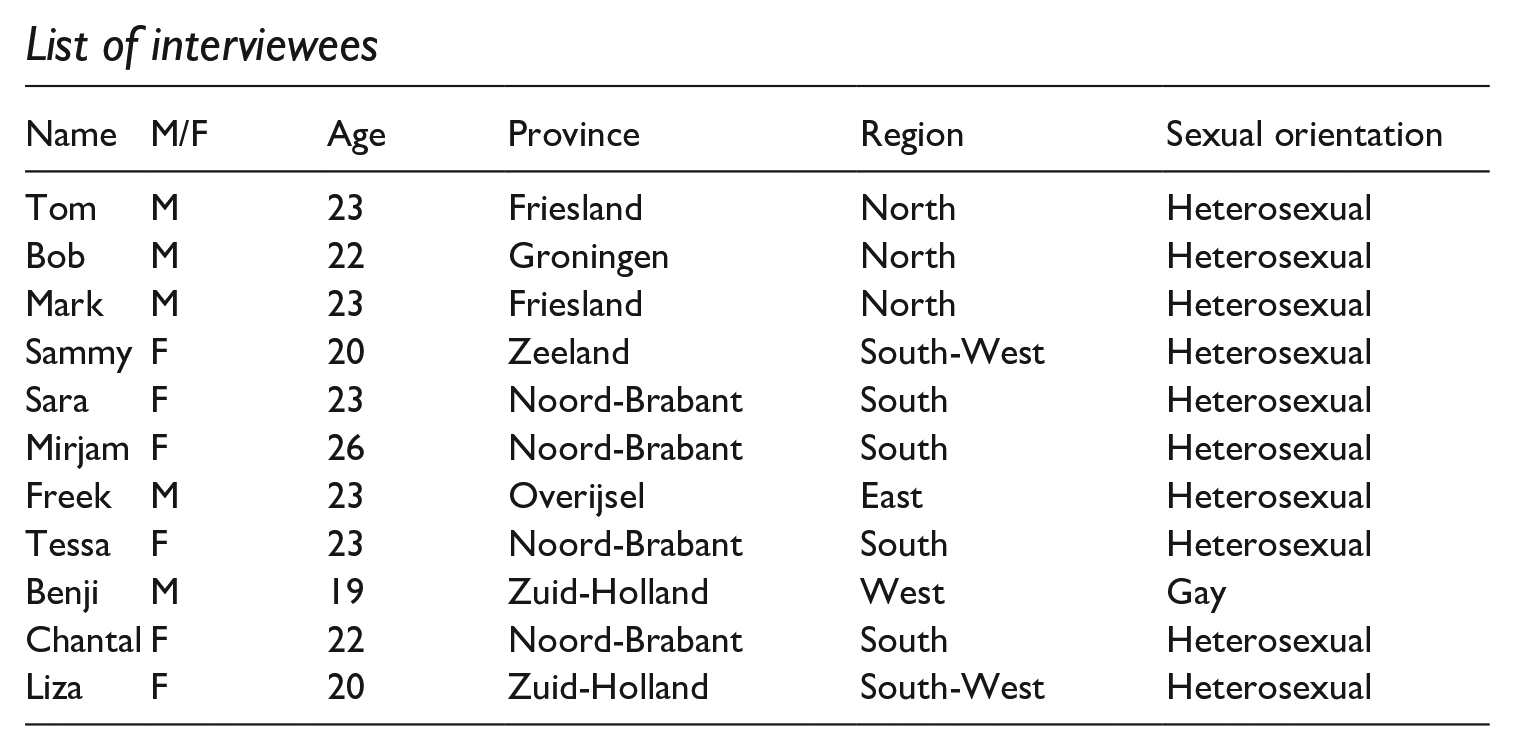
| Name | M/F | Age | Province | Region | Sexual orientation |
|---|---|---|---|---|---|
| Tom | M | 23 | Friesland | North | Heterosexual |
| Bob | M | 22 | Groningen | North | Heterosexual |
| Mark | M | 23 | Friesland | North | Heterosexual |
| Sammy | F | 20 | Zeeland | South-West | Heterosexual |
| Sara | F | 23 | Noord-Brabant | South | Heterosexual |
| Mirjam | F | 26 | Noord-Brabant | South | Heterosexual |
| Freek | M | 23 | Overijsel | East | Heterosexual |
| Tessa | F | 23 | Noord-Brabant | South | Heterosexual |
| Benji | M | 19 | Zuid-Holland | West | Gay |
| Chantal | F | 22 | Noord-Brabant | South | Heterosexual |
| Liza | F | 20 | Zuid-Holland | South-West | Heterosexual |
Acknowledgements
The authors would like to thank the (other) peer researchers who collected data for this project, particularly Lucia Zuiderwijk, and the EICS members for their feedback on an earlier version of this article.
Funding
The authors disclosed receipt of the following financial support for the research, authorship and/or publication of this article: this work was supported by the Dutch Fund for the Scientific Study of Sexuality (FWOS; grant number 14.005C) and by the Executive Board of Erasmus University Rotterdam (EUR Fellowship grant 2019).
