



Abstract
By curtailing workplace socialisation, platform-mediated gig work hinders the development of affective relationships necessary for the experience of recognition. However, extant research into recognition at work has typically only focused on face-to-face interactions, overlooking technologically complex forms of work where recognition might be sought from and via technical intermediaries. Advancing sociological research into the lived experience of contemporary gig workers, this article draws on 41 interviews with Foodora riders in Norway and Sweden to explore how gig workers solicit and experience recognition at work. I identify a process of anthropotropism, whereby gig workers turn to human connections where possible in an attempt to pursue traditional social scripts of collegiality and to gain recognition from legitimate human sources. Further, I identify how platform-mediated communication does not prohibit recognition, but intermittent automation and neoliberal modes of instrumentalising recognition can disrupt the development of individual subjectivities and lead to feelings of mechanistic dehumanisation.
Introduction
Situated against the backdrop of mass-automation, globalisation and the erosion of standard employment relationships, the influential ‘end of work’ thesis proposed that work under late capitalism was no longer effective in generating meaning for all workers in equal measure (Beck, 2000; Granter, 2009, 2021; Rifkin, 1995). This nostalgic approach further argues that increasingly ephemeral workplace relationships no longer provide the social structures necessary for individual subjectification and identity formation (Bauman, 1998; Gorz, 1999). It is, as Strangleman (2012: 412) explains, the ‘intelligible moral order of the workplace’, which has been lost due to industrial change. However, sociological research drawing on the lived experience of contemporary workers demonstrates the continued importance of work in framing identity and well-being (Fincham, 2008; Potter, 2020; Strangleman, 2007).
In this light, Honneth’s (1996) theory of recognition, wherein intersubjective recognition forms the foundation of practical identity, has inspired a recent ‘recognition turn’ in mainstream sociological (Boston, 2018; May, 2016; Sebrechts et al., 2019) and organisational literature (Dashtipour and Vidaillet, 2017; Hancock, 2016). Referring to the positive affirmation of others as human agents, Honnetian recognition is actualised through purposive action and communication that another individual has value: first, as an individual with basic rights, but also as an individual with specific abilities, goals and achievements (Honneth, 1996). Because of this, social pathologies and struggles arise when individuals and groups are either misrecognised or denied recognition altogether (Honneth, 1996; Laitinen et al., 2015; Pilkington and Acik, 2020).
Bolstering opposition to the ‘end of work’ thesis, recognition theorists also argue that the workplace is a key arena where individual subjectivities are both developed and enacted (Angella, 2016; Dashtipour and Vidaillet, 2017; Dejours, 2007, 2009). Organisations constitute ‘sedimented patterns of recognition’ (Honneth, 2010: 117), providing the institutional, social and technical framework for recognitive relationships. As a multi-axial concept, recognition can be sought from supervisors, colleagues, clients and wider society (Brun and Dugas, 2008). However, vertical, hierarchical recognition from supervisor to supervisee forms a particularly important dimension as it compounds identity formation with professional rewards (Ekman, 2013; Hirvonen and Breen, 2020). Unemployment, under-employment and insecure work arrangements thus restrict access not only to the resources necessary for social reproduction, but also to the workplace relationships necessary to generate feelings of self- and social-esteem (Heyes et al., 2018; Jütten, 2017). In light of the increasing normalisation of precarious and atypical work (Rubery et al., 2018), it is important therefore to examine how workers in atypical workplace settings solicit and receive recognition.
Enabled by advances in smartphone technology, work in the gig economy is characterised by atypical working arrangements facilitated by intermediary digital platforms (Gandini, 2019; Goods et al., 2019; Newlands, 2021). Although gig work involves considerable heterogeneity in contractual relationships (Schor et al., 2020), the majority of gig workers are classified as independent contractors or part-time employees (Meijerink and Keegan, 2019). Platform-mediated gig work can refer to remote freelancing and crowdworking, as well as localised tasks accessible on-demand, such as food-delivery, care work or ride-hailing (Van Doorn, 2017, 2020; Woodcock and Graham, 2019). As has been well documented, on-demand gig work comes with its own precarities and risks (Gregory, 2021; Montgomery and Baglioni, 2021) and a near-universal expectation among workers is that gig work will be undertaken short-term (Myhill et al., 2021). Although gig work is defined by its insecurity (Ashford et al., 2018), preliminary research has begun to argue that gig workers can develop work identities through the creation of individual ‘holding environments’ (Petriglieri et al., 2019) and that organisational socialisation can still function to generate meaning even for precarious workers.
Because of how gig work is digitally intermediated through platforms, research has so far focused on how workers face algorithmic management, control and surveillance (Jarrahi et al., 2021; Lee et al., 2015; Newlands, 2021; Veen et al., 2020; Woodcock, 2020). Additionally, attention has been directed towards addressing the implications of how ‘gig-workers do not have a formal human supervisor’ (Jabagi et al., 2019: 194). Although this focus on digital managerialism mostly overlooks how gig workers are still embedded in human relational networks, it does nevertheless highlight how we must consider the role of the technological in intermediating recognition (MacKenzie et al., 2017). However, as it stands, recognition theory’s anthropocentric and immaterial assumptions render it currently insufficient in understanding workers’ experiences of recognition within technologically complex forms of work. Given the increased prevalence of remote working during the COVID-19 pandemic, where workers often interact with colleagues and supervisors only via digital intermediaries (Newlands et al., 2020), such a theoretical omission hinders our ability to address whether and how recognition can be achieved when social relationships are conducted with and mediated by computational processes. Since the technological is ‘constitutive of society’ (Wajcman, 2002: 354), this theoretical reframing would also respond to the stated need in sociological literature to engage more with the technological (Fussey and Roth, 2020).
As a form of work structurally dependent on various forms of human–computer interaction, platform-mediated gig work thus offers a valuable and contemporarily pertinent case study for exploring how recognition may be sought and achieved within a technocentric working environment. In this article, I therefore present the results of an empirical sociological examination of the lived experiences of platform-mediated gig workers. Specifically, I conducted 41 semi-structured interviews with on-demand food-delivery workers of the platform-organisation Foodora. The interviews were conducted across Norway and Sweden, two regions traditionally characterised by robust worker protections and high job quality (Svalund et al., 2018). With a few exceptions, the workers interviewed are part-time employees of Foodora, rather than independent contractors, an important factor which shapes the relational and professional dynamics. The relatively higher working standards experienced by gig workers in this case, compared to global comparisons, thus offer a ‘best case scenario’ which illuminates the importance of recognition even when other working quality standards are (at least partially) met.
Based on this research, I identify a process of anthropotropism, a turning-towards-the-human within an organisation. I identify how workers turn to human connections where possible in an attempt to pursue traditional social scripts of collegiality and to gain recognition from a legitimate, human source. Further, I identify how platform-mediated communication from an organisation does not prohibit recognition, but when interspersed with automated forms of communication can disrupt the development of individual subjectivities and lead to feelings of mechanistic dehumanisation. I also explore how experiences of and struggles for recognition align to pre-existing status hierarchies among workers. Longer-tenured, higher-earning and native workers both demanded and received more intersubjective recognition from the platform-organisation’s human workforce.
Sources of Recognition
Hegel (1979), in his early Jena writings, argued that human identity flourished in social relationships characterised by exchange and reciprocity. Building on this framework, as well as on Mead’s (1932) symbolic interactionist theory of the ‘generalised other’, Honneth (1996) proposed in The Struggle for Recognition that an individual can only achieve recognition and subsequently develop individual subjectivity when they can ‘perspective-take’ with others. For Honneth (1992: 169), recognition is an ‘arc of tension’ between agents, one which must be actualised through purposive, positive communication. Laitinen (2002: 466), proposing a strict practical understanding of recognition, claims that ‘if someone cognizes someone’s merits, but in no way expresses this, the other person does not really receive any recognition’. This relational approach to recognition thus demands the existence of a recogniser and a recognisee and it is in the relations between the two that recognition emerges. Recognition theory, in this way, corresponds to a strictly relational approach to sociology where society is not ‘where relations happen, it is relations’ (Donati, 2010: xv). If we consider recognition as a relational process, the action of recognising another’s humanity and worth, we can also situate it within parallel discourses around workplace respect and dignity (Hodson, 2001; Lamont, 2001; Lucas, 2015). As with recognition, dignity is a relational concept most salient and identifiable when it is absent (Mahalingam et al., 2019).
Although Deranty (2007: 155) has argued for a ‘rematerialised’ theory of recognition, with ‘a retrieval of the non-human, material mediations that interplay with properly intersubjective, interhuman interactions’, the technical and communicative process of recognition remains largely unexplored. Current theories surrounding recognition rely on anthropocentric assumptions, whereby ‘both sides are presupposing that they belong to the same species as rational beings’ (Marcelo, 2013: 218). Ikäheimo and Laitinen (2010), for example, have argued that recognition is a personifying attitude, only possible with human persons. These approaches align with ongoing research demonstrating that computational agents are viewed as transactional and mechanistic, rendering them unsuitable for ‘human tasks’ that require subjective judgements (Gray and Wegner, 2012; Waytz and Norton, 2014).
However, initial discussions on the potential for experiencing recognition from non-human agents have begun to emerge from outside mainstream sociological discourse (Brinck and Balkenius, 2020; Nørskov and Nørskov, 2020). Laitinen (2016: 313), for instance, has reflected on whether robots can give recognition to humans, stating that ‘robots can send real recognitive messages even when they themselves are not recognizers’. Cappuccio et al. (2020: 11) have termed this ‘pseudo-recognition’, whereby ‘most technological devices neither produce significant recognitive responses, nor solicit them in humans’ (2011: 19). The potential for non-human recognition is not only of theoretical interest, but also practical relevance in the context of current workplace practices.
Regarding the gig economy, a growing body of research has focused on ‘algorithmic management’, referring to ‘software algorithms that assume managerial functions’ (Lee et al., 2015: 1603). In this, as in other elements of interspecific organisations (Robinson et al., 2020), non-human computational agents are being increasingly adopted as communicative partners in workplace settings (Guzman and Lewis, 2020; Jarrahi et al., 2021). These agents are autonomous technological entities that, due to machine-learning and natural-language processing, can engage in reactive or proactive organisational communication. This entanglement of the human and digital forms what Orlikowski and Scott (2008) would term a sociomaterial assemblage. As Suchman (2007: 286) notes, ‘the point in the end is not to assign agency either to persons or to things but to identify the materialization of subjects, objects, and the relations between them as an effect . . . of ongoing sociomaterial practices’. In this way, the agency of the ‘recogniser’ is less important than whether or not they are experienced as a legitimate source of recognition, and whether the experienced relations of recognition provide the recognisee with the potential to develop self-esteem and individual subjectivity.
Neoliberal Paradigms of Recognition
Drawing on Marxist theory, Honneth (2014) argues in Freedom’s Right that institutions shape recognition, determining how individuals both desire and receive recognition. Social pathologies thus emerge due to misalignment between institutional paradigms of recognition and individuals’ own expectations and behaviours. Since recognition relationships are fundamentally entwined with power dynamics (Van den Brink and Owen, 2007), Thompson (2016, 2019) has observed that pre-existing hierarchies also shape recognition paradigms, placing particular focus on market relations and capitalist society as influences. Individualistic and competitive, the gig economy is a product of modern neoliberal society (Zwyck, 2018) which, according to Rundell (2012: vii) ‘can disrupt, damage, or destroy those bonds and the experiences of personal and collective recognition’.
Deranty (2009), building on Dejours’ (1998) psychodynamics of work, has explored how recognition relations are shaped by the embodied, material realities of working (Smith and Deranty, 2012). Dejourian work always constitutes a form of praxis, insofar as task execution requires the exercise of a worker’s practical intelligence to overcome the gap between the prescribed and required activity (Dejours and Deranty, 2010). Referring to the activity of ‘worker qua worker’, the psychoanalytic tradition thus demands recognition of the epistemic achievement of work; organisations should provide workers with not only Honnetian recognition of who they are, but also of Dejourian recognition of what they do.
However, as a result of the neoliberal environment of the gig economy, recognition of what workers do is tightly entwined with norms of productivity (Schaub and Odigbo, 2018). Across the economy, increased managerialism, sales targeting and lean production methods have transformed paradigms of recognition from colleagues appreciating how work was performed, to admiring how much work was performed and for what level of profit (Dejours and Deranty, 2010). To make sense of this paradigm shift, Voswinkel’s (2012) work illustrates a move from ‘appreciation’ to ‘admiration’ in the context of organisational recognition. Appreciation refers to long-term esteem for an individual’s sacrifices for the organisation. Admiration, by contrast, is competitive and adheres to external standards, typically those set by management. These findings align with Blonk et al.’s (2019) point that recognition is tied to meeting the goals of the company, even in less overtly managerialist workplaces.
Methods and Approach
In order to empirically examine how recognition may be sought and achieved within a working environment where social relationships are mediated by computational processes, I therefore conducted a study of 41 gig workers currently or formerly hired by the on-demand food-delivery platform Foodora across Norway and Sweden. Foodora entered the Norwegian and Swedish markets in 2015 and, as of 2021, operates in 15 Norwegian and 28 Swedish cities. Riders for Foodora in both countries are given part-time employment contracts, which is an anomaly for the gig economy where the majority of workers recruited by gig-work platforms are engaged as independent contractors (Newlands et al., 2018). In Norway, riders are given a basic contract that guarantees 10 hours of paid shifts a week. However, riders must negotiate for higher contracts based on performance, or try to gain access to extra shifts through the platform’s automated shift-management system. In the Swedish market, riders are given temporary employment contracts lasting three months and renewal is based on performance.
The interviews upon which this article is based ranged from 30 minutes to three hours in length, with the average length of roughly one hour. Since Foodora includes a two-tier system of riders, with a supervisory ‘Rider Captain’ layer, I adopted a purposive sampling strategy and interviewed a mixture of riders (N = 28) and Rider Captains (N = 13). Reflecting the general gender and age balance in on-demand food-delivery work, the gender ratio of the sample was heavily skewed male (38M; 3F), and riders’ ages ranged from late-teens to mid-40s. Because of lower entry requirements and rapid income opportunities, platform-mediated gig work has become a common labour market entry point for new migrants (Veen et al., 2020). As such, the sample included predominantly migrant workers (37 out of 41). Half of the riders were currently students or had recently finished their studies. Some participants held alternative jobs, with only nine riders working exclusively for Foodora. Because of this diversity in the sample, during data collection and analysis I also paid particular attention to how experiences of recognition and misrecognition were shaped by specific socio-cultural expectations.
Data collection occurred in two waves. The first wave was conducted in late spring 2019, and the second wave was conducted during winter 2019/2020. Riders were approached predominantly via social media to generate first contact, followed by snowball sampling to access more varied participant demographics. Participants were compensated for their time with a stipend equivalent to 1.5 times their average hourly wage. To maintain anonymity, all participants have been given pseudonyms and no identifiable information is presented. I performed a mixture of face-to-face and Skype interviews, prioritising face-to-face whenever possible. A small number of interviews (five) were conducted voice-only via WhatsApp. All interviews were conducted in English, which was the main working language for Foodora in both countries. The interviews were semi-structured and, drawing on interpretative phenomenology, I structured the interview protocol to uncover workers’ own lived experience (Frechette et al., 2020). Respondents were asked about their personal backgrounds and work histories, the labour process and social interactions in and around the ‘workplace’. In order to explore the multi-axial nature of recognition relationships, respondents were prompted where relevant to discuss their relationships with different organisational stakeholders.
With the express permission of the riders, all interviews were audio-recorded and subsequently hand-transcribed by the author. They were subjected to line-by-line open coding in QSR International’s NVivo 11 software and all interviews were analysed abductively. After the emergence of clear themes, the data were further subjected to micro-level analysis. After a period of reflection and immersion in the data, I connected the data to theoretical concepts. As a final stage, I performed what Erlandson et al. (1993) have referred to as a member check, where I discussed anonymised research findings with a small number of participants. Throughout the process, I continually and reflexively examined my own researcher-participant relationship (Alvesson and Sköldburg, 2000; Berger, 2013). As a non-native researcher, I was also able to empathise with the participants’ externality with regard to Scandinavian workplaces, though aware of my relative privilege as an employed academic with institutional support. The positionality of the researcher as a ‘recogniser’ was also something I was aware of. By speaking with riders about their experiences, I was not only ‘recognising’ them, but also providing them with an outlet to voice their concerns.
Findings
‘Every Little Human Exchange’
In what I identify as a process of anthroptropism, a turning-towards-the-human, Foodora riders gravitate towards human connections where possible. For any organisational communication more substantial than selecting shifts, registering sick days or receiving payment information, riders seek to communicate with human organisational members instead of digital systems, attempting to pursue traditional social scripts of collegiality and gain recognition from a legitimate, human source. As Piotr (Rider Captain – Norway) explains, ‘Human interaction is really important. We need it. We crave it in our nature.’ Similarly, Alberto, a Rider Captain in Sweden, commented, ‘since this is a job we do mostly on our own, we are alone when we work, every little human exchange has a big impact on the mood, or at least that was for me’.
No rider viewed the algorithm as their ‘boss’, assigning only limited social agency to Foodora’s ‘algorithm’. Riders instead either identified figures in the organisation, such as the Fleet Manager, their Rider Captain, the Chief Operations Officer or claimed that they had no boss at all. Yet, the desire for managerial interaction was often frustrated. Riders struggled to refer to organisational members by name and Foodora management were regarded by riders as remote entities, separate from the riders themselves and the material realities of the work. Scott, a Rider Captain in Norway explained how: ‘We see people face to face. Management, not so much. They are sort of, the office, they are the office, these faceless beings.’ Indeed, a key concern was that the managerial staff do not acknowledge the difficulties of the work, pushing the workers into inhumane conditions: It’s difficult to do this job in winter. They don’t really care. They’re just, ‘ah we’re proud, we are strong, we are Vikings, we never close’. But it’s like, take the fucking bike and do an hour . . . And it’s like, you guys don’t know anything because you’ve never been outside in minus 16, minus 20 even. That was the lowest I’ve been working, minus 21. Imagine that, full of snow, ice falling, it’s just impossible sometimes. (Felipe – Rider Captain – Norway)
Riders expressed frustration about how they felt expected to work as if they themselves were automated. Referring to the lack of recognition of his own human needs, Eduardo (Rider Captain – Norway) described his role ‘as a machine. You are a machine’, forming an instance of what Honneth (2008: 157) terms ‘fictive reification’. Such complaints about the working conditions were, however, moderated by riders’ backgrounds. Riders from disadvantaged backgrounds, particularly refugees, were hesitant to make any complaints about their work and its organisation. Comparative poverty ‘back home’ or among gig workers in other countries meant that they felt relatively privileged. Having access to structural benefits, such as paid work, an employment contract and social security, led some riders to feel guilty about wanting any improvements, particularly in terms of improved interpersonal relationships. This formed a particularly striking contrast with ‘native’ riders and those with extensive work experience before Foodora, who had strong normative expectations of what work should be, and thus had no qualms in holding Foodora to account in the case of perceived deficiencies.
‘You Are Literal Tools’
Foodora riders primarily interact with the rider-facing digital platform, ‘RoadRunner’, which assigns tasks and provides feedback on their work. In the process of their work, riders are geolocationally tracked and their performance assessed through statistics, accessible through the ‘RoadRunner’ application. Riders, for instance, receive automated push notifications from the platform such as: ‘Hey, did you find the customer? If not contact Dispatch for support!’ Push notifications are often used to provide safety and weather notifications, telling riders to ‘be careful!’ on days with particularly bad weather. Yet, lacking clarity about whether the messages were being written by an organisational member or being sent automatically, workers found the messages at best ineffective and at worst, condescending and instrumentalising. Instances of potential recognition, regarding how they were feeling or how they were doing their work tasks, were thus negated by ambivalence about the source.
The ‘RoadRunner’ platform was critically encountered in an adversarial, combative manner, since the platform operated both as the mechanism of surveillance and as the source of statistical feedback about how they were completing their work tasks. Riders can access their performance metrics through the platform, where categories such as average speed, number of deliveries, average waiting time are displayed. Reflecting upon the terminology used, Scott, a Rider Captain in Norway, remarked that: ‘To have Utilisation Rate [UTR]. It does give this kind of connotation of they are using people, like you are literal tools.’ As Scott (Rider Captain – Norway) explained further, communication through automated statistics was experienced as particularly impersonal and devoid of meaning: It’s very easy in this job to feel underappreciated. You are by yourself so much. To have even just a few words, a couple of sentences, even a single sentence would be meaningful because of the nature of the job . . . The point of feedback is to sort of, make someone feel like they mean something, something that’s personalised, something that shows that someone is looking at it and just saying, great, thanks for your hard work, without you we wouldn’t have a job. So, to have an automated comment is just, it’s so impersonal, it’s a bit patronising.
Riders expressed a collective sense that the statistics used for evaluation did not always accurately reflect their individual performance, motivation or the struggles they faced. One particular issue was how the overall fleet statistics were disrupted by some riders using electric bikes. Since there is no distinction in the metrics or feedback about whether riders used a normal or electric bike, riders such as Kasia (Rider – Norway) felt that their efforts went underappreciated, particularly since the feedback was both automated and impersonal: ‘Electric ones can make much more orders than regular ones, and of course, this email comes and says you did a great job but you can do it better, and it’s like . . . ok, but I gave like 100%.’ For Kasia, this was an instance where recognition and misrecognition of a worker’s performance are ‘enfolded’ (Sebrechts et al., 2019: 173).
Recognition also felt illegitimate when it was used in an instrumental fashion, in line with arguments put forward by Ikäheimo and Laitinen (2007). As with Kasia, several riders remarked that feedback they received was not only digital, but also used as a mechanism to encourage more work effort. For example, riders expressed that Foodora’s upper management promotes a highly competitive culture through regularly holding competitions and prizes, highlighting through emails the quickest teams and individuals. However, without a counterbalance of generalised workplace appreciation, where recognition comes decoupled from productivity and performance expectations, such competitions and prizes were received by most as a managerial tool. Compounding this feeling of instrumentalised recognition, Foodora only provides limited feedback about the performance of riders who are doing ‘fine’. This struggle was felt by Abraham (Rider – Sweden), who discussed how his performance had improved and wanted the Fleet Manager to acknowledge it: I had to tell her when my speed was really very very good, I was back in the game and delivering, she never said anything. She just stopped complaining. I told her, I’m doing well, you should tell me, you know, you’re doing really good, we appreciate it.
‘This Chat Has Ended’
Riders identified complex recognitive issues in their interactions with the Rider Support Team, commonly referred to as Dispatchers. Dispatch oversee the delivery process and can reassign deliveries, put workers on breaks and contact the customers/restaurants if required. As the workers behind the screen observing the flow of deliveries and communicating with riders about specific struggles, Dispatchers are sources of potential recognition. However, although Dispatch frequently use phonecalls to contact riders, they communicate primarily via the text-messaging function in the ‘RoadRunner’ platform. Following the framework of social-media messaging, Dispatchers are identifiable to riders by their first name and avatars. However, heavy reliance on text-messaging means that contacting Dispatch becomes a conflation of human and non-human communication. Human Dispatchers not only switch among themselves, but also switch with automated messages. Figure 1 depicts an example of communication from when the rider had delivered orders by foot in sub-zero temperatures after a bike failure.
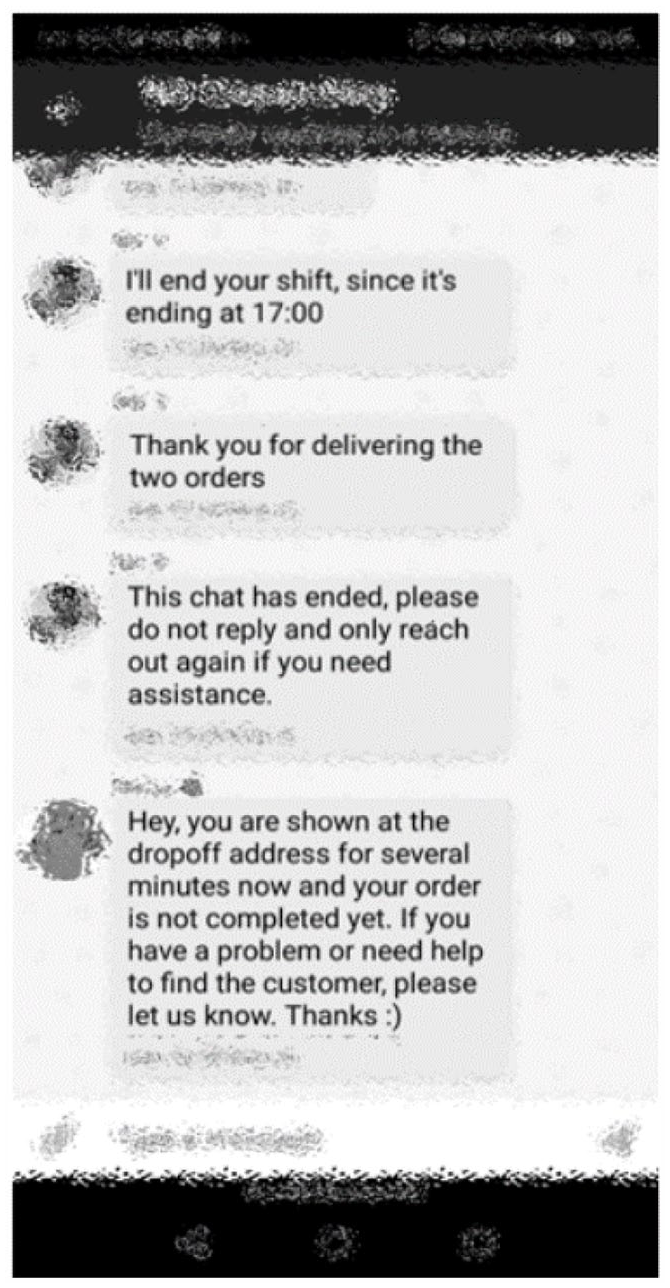
Communication with Dispatch (anonymised – image courtesy of a Foodora Rider).
The first two messages detail how the Dispatcher ended the rider’s shift early and thanked him for his extra effort. This brief communication was experienced as an act of recognition, with the Dispatcher thanking him directly. Immediately, however, the conversation is ended via an automated message. When the rider was next on shift, the communication dyad switched again to a new Dispatcher, identified through a new automated message. Frustrations expressed by this rider about the fractured communication were shared by others, such as Rakib (Rider – Sweden) who complained that ‘they are like talking to you then suddenly they are gone. Again, if you are trying to reach Dispatch you have to explain the whole thing again to them. Because it’s always a new person in the Dispatch.’
The switching behind the screen made communication difficult, but also prevented the development of institutional memory, such as would be necessary to provide a longer-term form of recognition (Wagner, 2012). Longer-tenured riders explained how the Dispatch team went through multiple iterations. Early Dispatchers were locally based and it was possible for riders and dispatchers to become friendly over time. More recent iterations were remote and the communication had become more impersonal and mechanistic. One repeated point of discussion was that in 2019, Foodora moved its Dispatch team from Norway to Germany. As Astrid (Rider – Norway) explains: We liked having the Norwegian team, be connected to them and have a relationship. But the Germans have no understanding of the nuances of the different routes or paths that would give us difficulty or ease. And I’m not sure that they even have the German team, or if it’s all automated.
In the case of Dispatch, computer-mediation was not an inherent barrier to positive, affective relationships between the riders and the organisation, as evidenced by the possibility for riders to develop ongoing friendships with certain dispatchers. Rather, the organisational decision to automate and expedite Dispatcher communication, in addition to worker churn and trans-localism, reduced the potential for more meaningful dialogue and for the development of an institutional memory.
‘You Want to Work for Someone’
In a display of anthropotropism, riders turn towards the Rider Captains as primary sources of recognition. Rider Captains have managerial responsibilities in addition to their delivery work, namely monitoring, motivating and giving feedback to their team of 15–20 riders. However, Rider Captains had an ambivalent liminal positionality in the organisation, viewed by some riders as management, and others as friendly peers. Without a centrally defined set of tasks and expectations, each Rider Captain was able to shape the role as they saw fit. Harald (Rider Captain – Norway), for example, viewed the Rider Captains as a managerial bottleneck: ‘We were introduced so that management wouldn’t have to deal too much with individual riders.’ Indeed, when the relationship between riders and Rider Captains was weak, Rider Captains were viewed as extensions of management and their social communication was resisted. A number of riders who had never met their Rider Captain in person, remarked how they would ignore calls and messages from the Rider Captains in order to avoid additional micro-management. However, when the relationship between the rider and Rider Captain was strong, such as in Miguel’s (Rider – Norway) case, the Rider Captain is ‘someone who understands you, really understands you’. As Lisa (Rider – Sweden) remarks, the Rider Captains are important because ‘you want to work for someone, to be supported by someone, and to maybe get a compliment, or some advice’.
Manuel, a Rider Captain in Norway, discussed how he attempts to foster a relationship with the riders in his team. However, Manuel primarily drew on his previous professional experience, where he would talk to colleagues face-to-face: Of course, on the phone, it’s like very distant to me. I try to talk to them personally, really face-to-face all the time. I’m used to that kind of thing back home, it’s more personal for me. And most of the people appreciate that kind of gesture because they, they always see that you are doing more. In terms of meeting them, meeting them, you know. It’s better. It’s a different thing, you know, it’s a different thing to it.
What made Rider Captains important sources of recognition for riders was that they experienced the struggles that workers faced themselves. Usually Rider Captains had multiple months, if not years, of experience in the company. As peers familiar with the reality of the work, they were able recognise the particular contribution of individual workers and provide targeted feedback and advice. Solomon (Rider – Sweden) explains this well: ‘These captains . . . they are the ones that really understand. Because they have rides. They have rode the streets, know how it takes, know the difficulty of the streets.’
As distinct from the managerial staff or Dispatch, Rider Captains were also accessible to casual forms of communication. As Sayid (Rider – Norway) discussed: He’s really my friend, I can ask whatever I want and whenever I want. I will send a message through WhatsApp or a normal message, he will answer. And he will help, he will help me a lot of times.
For Sayid, a recent immigrant into Norway, the ability to communicate in a personable, informal manner with his captain was vital. This open communication aligned with Sayid’s own cultural expectations for collegiality, and access to ‘insider knowledge’ about weather, clothing and local Norwegian customs helped Sayid to get ‘up to speed’ with the job more quickly. However, in line with current research on communicative availability (Mellner, 2015), Rider Captains’ constant availability through WhatsApp could also quickly become a burden and a source of stress. Riders’ questions and general communication, often did not respect any boundaries of work and non-work time.
There were different struggles for recognition among Rider Captains with longer tenure who expected a higher level of communication, to have their voices heard. Felipe, a long-tenured Rider Captain (Norway), felt particular frustration about not being consulted about changes to the Rider Captain role: I just feel very very unrespected. This is crazy. The last meeting, the previous one, I was so angry I even beat the table. The man was like, ‘You don’t have to be angry.’ How do you expect me to react? If you’re just coming and imposing these things on us and we didn’t even have a meeting about changing what you want us to do. So, that’s the lack of respect I’m talking about.
As a result of the closer relationship of Rider Captains and the office, some Rider Captains aimed for internal promotions and greater individualised recognition for their skills and abilities. One such example was James (Rider Captain – Norway), who leveraged prior professional experience to take on additional duties. Yet, James’ explanation of his own promotion focused predominantly on his interpersonal relationships, which were possible due to his confidence and ‘cultural fit’ as a keen cyclist. As he explained, ‘People build, to use a sales thing, people buy off people, you build relationships with people, work relationships, and that’s the reason that’s helped me, I’ve built relationships with people.’
Concluding Discussion
Since recognition theory requires that individuals perspective-take with others (Honneth, 1996), research to date on recognition at work has focused on face-to-face engagement between recogniser and recognisee. However, as described above, gig work operates outside the norms of face-to-face workplace socialisation. Food-delivery riders have limited face-to-face engagement with supervisors and most communication is digitally mediated to a degree that riders are often uncertain whether they are communicating with a human or an automated system. Yet these automated elements do not suffice as social agents, being unable to offer the same sense of workplace recognition as human partners. This research thus supports Cappuccio et al. (2020) in that technological devices can only provide ‘pseudo-recognition’.
However, rather than being deterred from soliciting recognition, riders actively sought recognition in a process of anthropotropism whereby they actively sought out human members of the organisation with whom to develop positive recognition relationships, a phenomenon strengthened in times of emergency or high stress. Yet, recognition is not only discursive, it is also enacted. Riders experience recognition and misrecognition by the words, tone and mechanism of communication, but also by the organisation’s actions. In this way, riders act anthropotropically by not only turning-towards-the-human but also turning-towards-the-humane. Riders, for instance, turn heavily towards Rider Captains for recognition. As peers familiar with the reality of the work, they were able to recognise the particular contribution of individual workers and provide targeted feedback and advice. This aligns with current research that recognition from the work collective can counter-balance other negative aspects of work (Smith and Deranty, 2012).
In this article, I have explored how the rapid turnover of riders and ephemerality of social relationships generate thin social structures of work, with limited opportunities to generate long-term institutional memory. Elements of individuality, achievement or special circumstances were often forgotten and ignored resulting in a sense of fungibility among riders. Yet, this research also demonstrates that recognition operates on a varied temporal perspective. When long-term recognitive relationships are uncommon and difficult to form, short-term and momentary instances of recognition can be impactful. Drawing from adjacent research on workplace dignity, Stephens and Kanov (2017: 238) argue that a connections lens can highlight the ‘small, everyday moments of interrelating with different people at work that have an impact on people’s felt sense of dignity’.
As the above discussion demonstrates, the experience of recognition is also framed by institutions. In this case, Foodora’s recognition paradigm is driven by neoliberal productivity norms. Workers are valued by what they do, in a Dejourian sense, not for who they are. Currently forms of recognition offered by Foodora, in the form of automated messages or statistics, are viewed as impersonal and instrumentalising: a form of mechanistic dehumanisation (Haslam, 2006). Aligning with Voswinkel’s (2012) discussion of appreciation and admiration, functional and instrumental recognition is even experienced as a form of false recognition.
As atypical work through platforms has become more prevalent, it has also become evident that we must reconsider social theories of work traditionally situated within standard employment contexts. As the ongoing debates around the ‘end of work’ demonstrate (Granter, 2009; Susskind, 2020), the as of yet unfulfilled imaginaries of a ‘post-work’ future have left a new class of what Gorz (2003) terms travailleurs précaires out in the cold, both metaphorically and literally if one considers the physical struggles of gig workers to deliver food in the Scandinavian winters. These gig workers, who are constrained in deriving meaning in their work by asocial, techno-centric and precarious working conditions (Granter, 2021), must nevertheless continue to work to avoid the marginalisation, stigma and financial consequences of unemployment. However, rather than assuming that an erosion of working conditions is matched by an erosion of workers’ need for subjectification and social recognition (Potter, 2020), we can draw on the revolutionary potential of critical social theory to highlight the irrationalities of non-standard workplaces and thus seek novel mechanisms through which workers can seek and achieve recognition.
Footnotes
Funding
The author disclosed receipt of the following financial support for the research, authorship and/or publication of this article: this work was supported by the Research Council of Norway within the FRIPRO TOPPFORSK project ‘Future Ways of Working in the Digital Economy’ (275347).
