



Abstract
This article offers an original contribution as the first to focus empirically on men football fans’ attitudes towards women’s sport in a ‘new age’ of UK media coverage, in which women’s sport has experienced a significantly increased and more positive media profile. We draw on online survey responses from 1950 men football fans of different age groups from across the UK. Our methodological approach used techniques emerging out of the principles of grounded theory. We develop a new, three-fold, theoretical model, covering men football fans’ attitudes to women in the sports nexus and men’s performances of masculinities. Our findings show evidence of a change in attitudes towards women in sport, with men performing progressive masculinities. However, there were also signs of a backlash against advances in gender equality, with men performing overtly misogynistic masculinities and covertly misogynistic masculinities.
Introduction
In most countries across the world professional Association Football or soccer (hereafter football), has continued to operate as one of the ‘last bastions’ of male domination, providing men with a space where they can still prove that they are ‘real men’ in spite of wider changes occurring in men’s and women’s lives (Pfister et al., 2013; Pitti, 2019). Studies since the 1980s have shown the male-dominated media coverage of sport, with a number of techniques being used to devalue women’s sporting achievements (Biscomb and Matheson, 2017; Kian et al., 2008). However, in recent years this approach has, arguably, been challenged and at an unprecedented level. There is evidence that media coverage of football in the UK has moved into a ‘new age’ of greater gender sporting equality, especially in the period since the 2012 London Olympic Games and the 2015 FIFA Women’s World Cup (Petty and Pope, 2019).
The significance of this article lies in its focus on how men are responding to the increased visibility of women’s sport, a development that threatens to diminish this long-lasting ‘male preserve’ (Pitti, 2019). Although research on sports fandom has predominantly focused upon men fans (Pope, 2017; Toffoletti, 2017), very little work has explored men’s attitudes towards women in sport. Here we offer the first large-scale empirical study to focus on UK men football fans’ attitudes towards women’s sport. We offer original insights through the development of a new theoretical model of men’s performances of masculinities. The sociological and theoretical significance is also shown by our focus on gender relations. In Connell’s (1987, 1995) gender order, masculinity and femininity are inherently relational concepts, and this holds across different societies and histories. However, this approach has recently been challenged by Anderson’s (2009) inclusive masculinity theory (IMT). We advance this debate by exploring the views of men football fans on women in sport via an online survey at a moment when women’s football (and women’s sport more generally) has begun to experience a significantly increased media profile in the UK. Our findings offer new insights by developing an empirically driven three-fold theoretical model of men football fans’ performances of masculinities. Although we draw on one arena (sport), we argue that this provides an excellent prism to examine wider sociological issues. For example, the theoretical model we develop has potential to examine gender inequalities in other areas of society, such as in the workplace or in university settings.
A ‘New Age’ for Women’s Football and Women’s Sport?
Football has been a profoundly male domain throughout much of the sport’s history. For example, in 1921, in response to its growing popularity, the English Football Association (FA) effectively banned women’s football, by forbidding member clubs from hosting women’s matches. Seventy-two years later, the FA reluctantly took over the running of domestic women’s football (Dunn, 2016). Petty and Pope (2019) describe how as recently as 2011, widespread institutional sexism in broadcast and print sports journalism was demonstrated by the exposure of highly misogynistic comments and lewd behaviour from key members of the Sky Sports Premier League presentation team, along with the complete absence of women from the BBC Sports Personality of the Year shortlist.
However, as a result of a number of interconnected developments, we have arguably entered a ‘new age’ of media coverage of women’s football and women’s sport in the UK. These developments included: the launch of the semi-professional (now fully professional) FA Women’s Super League; the success of GB women athletes at the London 2012 Olympic Games; and, from 2015, Sport England’s This Girl Can nationwide media campaign. Perhaps anticipating these shifts, and in an attempt to rebrand itself as a more ‘female friendly’ media space, the global sports broadcaster Sky Sports not only sacked men presenters for their misogynistic views but also became increasingly inclusive of women presenters, journalists and pundits covering men’s sport, including football. There has also been an increase in the visibility of women’s sport on the UK broadcast media. For example, the 2015 FIFA Women’s World Cup, hosted by Canada, was the first in which all England’s matches were televised live in the UK by the public service television channel, the BBC.
In contrast to studies which have routinely shown how women’s sport is marginalised in the media (Biscomb and Matheson, 2017; Cooky et al., 2015), Petty and Pope (2019) recently concluded that press coverage in the UK of the 2015 FIFA Women’s World Cup marked a turning point in its positivity. It focused on the skill and achievements of the England women’s national team, rather than trivialising players, for example, by mocking or reducing them to sex objects. However, we also need to exercise some caution here. In the UK, women’s sport still gains just 3–12% of annual print and televised coverage (Women in Sport, 2018). Nevertheless, it is difficult to argue against a more general shift towards greater gender equality, at least in terms of media representations of women’s football and women’s sport in the UK, and within a relatively short period of time.
Theoretical Considerations: Hegemonic and Inclusive Masculinities
Connell (1987, 1995), famously, uses patterns of power relations between the sexes to explain the gender order in society, with hegemonic masculinity at the apex of the gender hierarchy. According to Connell and Messerschmidt (2005: 832), hegemonic masculinity embodies, ‘the most honoured way of being a man’, legitimating ‘the global subordination of women to men’. It is, ‘always constructed in relation to various subordinated masculinities, as well as in relation to women’ (Connell, 1987: 183). This masculinity ideal is centred upon characteristics such as: authority; physical toughness and strength; heterosexuality; and paid work (Pilcher, 1999: 12). ‘Emphasized femininity’, in contrast, is ‘performed especially to men’ (Connell, 1987: 188) and is associated with sociability and heterosexual attractiveness and linked to the private domains of marriage and childcare.
The number of men performing ‘hard’ versions of hegemonic masculinity is likely to be small, but the majority of men stand to benefit from the patriarchal dividend on offer, or the overall subordination of women, so are complicit in sustaining the power of the hegemonic model. However, such men suffer none of the risks and tensions that go with being among, ‘the frontline troops of patriarchy’ (Connell, 1995: 79). Men footballers, for example, are widely held to be exemplars of hegemonic masculinity – symbolic figures that have kudos and authority and are widely celebrated through media images – despite the fact that most men do not live up to such standards (Connell and Messerschmidt, 2005).
However, for Anderson (2009), hegemonic masculinity theory (HMT) does not review dominant masculinities in cultures in which homophobia is declining. Through his empirical research he claims that IMT now supersedes that of HMT by explaining the new social dynamics of masculinities in periods of decreasing homohysteria. Anderson (2009) proposes a horizontal alignment of two key forms of masculinity, orthodox and inclusive. Whereas orthodox-valuing men are ‘homophobic, femphobic, emotionally and physically distant from one another’, men ascribing to inclusive masculinity, ‘demonstrate emotional and physically homosocial proximity’ (Anderson, 2009: 96). Here, hegemonic masculinities are said to lose some of their dominance and softer, more inclusive, masculinities can co-exist with them. However, there has been a reply to IMT from feminist and other critics. For example, Anderson’s (2009) focus on contemporary masculinities challenges some of Connell’s assumptions, but arguably neglects the importance of gender as a relational concept (O’Neill, 2015). It is important not to lose sight of how Connell’s (1995) HMT was originally developed as an extension of feminist theories of patriarchy, beginning from the central premise that: ‘the overall relationship between men and women is one involving domination and oppression’ (Carrigan et al., 1985: 552).
Suggestions that gender is likely to be relational during (earlier) homohysteric periods when ‘orthodox’ masculinities dominate, but not at other times when masculinity is less significant, are tied to assumptions that the decline of homohysteria will also lead to reduced sexism and improved men’s attitudes towards women (Anderson, 2009; Anderson and McCormack, 2018). Our point is that these claims lack empirical research – a major omission of IMT is that the relationship between men and women has not typically been a focal point. Anderson’s (2009) IMT also tends to discuss broad social trends – or a general shift from hegemonic to more inclusive masculinities – meaning that hegemonic or orthodox masculinity loses its hegemonic influence due to the critical mass of men who publicly reject it, serving to marginalise attitudes informed by sexism and misogyny. However, as O’Neill (2015) suggests, this assertion may promote a discourse of undue optimism around men, masculinities and social change, one which assumes that contemporary Anglo-American societies are somehow predisposed towards greater gender and sexual equality.
Methodology
Before commencing our study, ethical approval was obtained from one of the author’s host institutions. From September 2015 to January 2016, we ran a survey aimed at fans of UK football. We called for participants via 150 UK football fan message boards aimed at the men’s game. We focus here on the responses from the 1950 men fans who completed the survey. In order to ensure rigour in our procedure, we used the internet to collect data through an online survey. Online surveys comprise a non-probability sampling technique as the participants would need to have accessed the message board when the survey was open and could self-select whether to take part in the study or not. However, the rationale for using this approach to ensure rigour was, first, that the anonymity of the internet could avoid the effects of social desirability. Our aim was to collect data, at scale, in a more honest and open way (Cashmore and Cleland, 2012). To maintain anonymity, no personal details, besides the age and sex of respondents were collected and we adhered to the ethical guidelines of the Association of Internet Researchers concerning matters of potential harm, privacy, consent and deception. Second, using this method enabled us to cover a greater geographical spread of respondents drawn from across the UK than would have been possible using other procedures. Third, this approach enabled us to combine quantitative and qualitative research approaches (Bryman, 2016). This allowed us to synergise the richness of qualitative data collected through open-ended questions, with numerical data on responses to closed questions. It allowed us to collate in-depth qualitative responses from a significantly larger number of respondents than would normally be possible using other approaches.
The age groups of our sample included: 1% aged 17 and under; 12% aged 18–25; 19% aged 26–35; 20% aged 36–45; 25% aged 46–55; and 23% aged 56+. The broader survey covered a range of issues connected to women and sport, but the majority of questions focused on women’s role in football. This article draws on data from two of the closed, and two of the open-ended questions. The closed questions generated data on perceived changes in media coverage of women’s sport since the London 2012 Olympic Games and how closely men followed the 2015 FIFA Women’s World Cup. The open-ended questions focused on the impact of Team GB women athletes at London 2012 on how women’s sports and women athletes are viewed, as well as on whether the performance of the England women’s team at the 2015 FIFA World Cup (semi-finalists) had led to changes in men’s attitudes towards women’s football. Responses to the open questions were used to develop our theoretical framework. This was conceptualised by drawing on our analysis of: men’s attitudes towards media coverage of women sports and women athletes, including any perceived changes in this coverage post-2012 and 2015; men’s perceptions of the quality of women’s football, and attitudes towards issues of gender (in)equality in sport more widely.
By initiating a new line of qualitative survey-based research focusing on men’s responses to the growing visibility of women in sport, our methodological approach fills a gap in the dearth of empirical research charting men’s attitudes towards women and the reproduction of gender inequality – a void acknowledged by Anderson and McCormack (2018) as a weakness of their work. In this article, we use aspects of IMT alongside the insights of Connell’s HMT. This enables us to foreground gender as a relational concept, but not lose sight of the intersectional and asymmetrical gendered power relations that exist between men and women, while also acknowledging the potential for recent positive shifts in the development of more inclusive masculinities. Although we utilise these ideas as a guiding framework to help us to theorise our data, these approaches do not adequately explain them. Our methodological approach and findings advance this theoretical landscape by producing an empirically driven set of new theoretical ideas around men’s attitudes towards women in sport and their mutual performances of masculinities.
In adopting this approach, we draw inspiration from Glaser and Strauss’s (2008: 255) position that if sociologists simply accept existing theory and elaborate on this in their approach, this can suppress or ignore rich data that could ‘transcend the theory’. Our methodological approach, therefore, utilised qualitative techniques emerging out of the principles of grounded theory, described by Glaser and Strauss (2008) as the discovery of theory from data. Definitions of grounded theory are now contested, as these two founders went in different directions after their original collaboration. However, there are some surviving common characteristics, with the main focus remaining on using techniques and strategies designed to ‘develop theory based on, and grounded in, data’ (Holt, 2019: 25).
We used methodological techniques drawing on these core principles to ensure a rigorous analysis of our dataset. The first involved familiarisation with existing literature and theories in the field of masculinities; providing the foundation to produce unique insights (Holt, 2019). The second involved coding the dataset drawing upon the ‘constant comparative method’, defined by Corbin and Strauss (2008: 85) as an analytical process involving, ‘comparing different pieces of data against each other for similarities and differences’. Lower-level concepts emerge at the earlier stages of analysis, whereas higher-level concepts (themes) come later, and show what groups of lower-level concepts are indicating. At this stage, comparisons were also made between concepts and existing theory (Holt, 2019). We used an abductive approach, engaging in a process of moving forwards and backwards between the data and theory, allowing us to engage with the data in ‘deep’ ways and subsequently moving towards the construction of new theory (Holt, 2019: 30). Since neither Connell’s (1995) nor Anderson’s (2009) work alone was adequate to explain our data, we revisited the dataset and developed a new theoretical model of men football fans’ performances of masculinities.
The third technique involved reaching a point of theoretical saturation, where similar instances were seen repeatedly and adding new data made little difference to the explanation (Corbin and Strauss, 2008; Holt, 2019). Finally, throughout the data analysis stages, to further ensure rigour we drew on ‘critical friends’ to check our progress (Smith and McGannon, 2018). Data analysis for this article was led by the first author, but the co-authors offered critical feedback throughout and cross-checked the original dataset against the themes developed. In addition, a quantitative analysis was undertaken for the closed questions, with these results presented as percentages.
Findings and Discussion
A Model of Men Football Fans’ Performances of Masculinities
Drawing upon our own empirical data, along with both Connell’s (1987, 1995) HMT and Anderson’s (2009) IMT, we contend that our findings advance new theory through the development of an empirically driven three-fold theoretical model of men football fans’ performances of masculinities:
Progressive masculinities: men fans who exhibit more gender-equitable attitudes characterised by IMT.
Overtly misogynistic masculinities: men fans who openly exhibit hostile, sexist and misogynistic attitudes, characterised by HMT.
Covertly misogynistic masculinities: men fans who express gender progressive attitudes in some public arenas, but more privately or in other social conditions identify with hegemonic masculinity.
Our model shows how overtly misogynistic masculinities and more progressive masculinities are located at opposite ends of an overlapping continuum, with covertly misogynistic masculinities occupying a position somewhere in-between:
Locating our qualitative responses within the wider trends and patterns of the quantitative data enabled us to map wider and more complex shifts in masculinity performance, based on a much larger number of cases than is usually available in wholly qualitative studies. By utilising both Connell’s (1995) HMT and Anderson’s (2009) IMT, we address some of the limitations of each of these approaches. Although Anderson (2009) has assumed that progressive social and cultural change has rendered Connell’s (1995) work largely redundant, we argue that aspects of IMT must be used alongside the insights of HMT. In doing so, we can foreground gender as a relational concept and not lose sight of the asymmetrical gendered power relations between men and women, while incorporating the potential for more inclusive masculinities.
We now turn to examine the three types of masculine performances we have identified, and the characteristics of the men who typically perform them.
Performing Progressive Masculinities
Men performing progressive masculinities showed strong support for equality in media coverage of women’s sport and more positive, general attitudes towards women’s football. Some of our respondents agreed that London 2012 was one of a number of events that have played a role in a ‘wider general trend to bring women’s sport into the mainstream’ (age 36–45, Huddersfield Town fan). A Swindon Town fan (age 36–45) described London 2012 as, ‘part of an evolution. 2012 was a step forward in visibility for all athletes, women included.’ Three-quarters of all men in our sample (74.2%) suggested that media coverage of women’s sport since the London 2012 Olympics had increased, lending weight to the suggestion that the UK has entered a new phase of more positive media representations of women’s sport (Petty and Pope, 2019). For fans such as these, such developments were associated with wider socio-political shifts towards greater gender equality in UK society. For example, the increased media exposure (and changes in perceptions of women’s sports) was typically attributed to ‘a general progressive move in society’ (age 26–35, Middlesbrough fan) or ‘a cultural rise in feminism’ (age 26–35, St Johnstone fan).
Some feminists suggest that we have entered a ‘fourth wave’ of feminism, with the internet facilitating this shift by enabling women to build a global community online and creating a ‘call out’ culture whereby sexism and misogyny can be challenged (Munro, 2013). We recognise the complex ways in which anti-feminist and feminist themes are often entangled in the contemporary online sports media culture (Antunovic, 2019; Gill, 2007). However, this wider, more positive, agenda for change did not evade some of our respondents, who linked recent developments in gender relations to more general shifts in sport culture and elsewhere: I believe that the success – being simultaneous in timing to successful campaigns for Gender Equality such as ‘No More Page Three’ and ‘Free The Nipple’ – has increased the public knowledge and perception of women in sport, which has led in turn to female athletes being perceived on a more professional manner. (age 26–35, Middlesbrough fan) It’s one of a series of catalysts in the change process of how women’s sports and female athletes are viewed. The rise of the women’s Super League, through broadcast media, is a similar catalyst. As are the #ThisGirlCan, #TransGirlCan and similar hashtags. (age 46–55, Liverpool fan)
For many of our respondents it was the 2015 FIFA Women’s World Cup which marked a key shift in representations of women’s sport. Just under three-quarters (72.1%) of all men in our sample watched at least one televised match, including nearly one-third who watched England matches and other teams in the tournament. For men performing progressive masculinities, the Women’s World Cup was widely argued to have ‘raised the profile of the women’s game’ (age 36–45, Liverpool fan) and ‘pushed women’s football into the limelight’ (age 36–45, Barnsley fan). The following response, from a Scunthorpe United fan (age 18–25), encapsulates these viewpoints well: I have not noticed a significant increase in coverage of women’s sport because of London 2012. What I have noticed is a significant increase in coverage of women’s football in the past two or three years, which was then increased 10-fold with the major coverage of the Women’s World Cup in 2015. That, I believe, proved to be the most successful women’s sporting event (success being exposure/coverage/hype to women’s sport to the general public) of the modern day.
For fans exhibiting progressive masculinities, an equation was often drawn between greater media exposure for women in sport, a perceived genuine change in men’s attitudes and a subsequent rise in the general popularity of women’s sport. This extended media coverage was deemed a new ‘driver of interest’ (age 26–35, Ipswich Town fan) so that ‘coverage of women’s football, in general, means attitudes towards women’s football have changed for the better’ (age 18–25, Arsenal fan). Greater media exposure, according to this view, could also break down established assumptions about women’s alleged inferiority in sport (Allison, 2018; Pfister, 2010). It meant ‘more people realising that women’s sport is just as good as men’s and starting to take it more seriously’ (age 36–45, Crawley Town fan). For this reason, the media industry was viewed as having obligations to promote women’s football, not only to ‘help it to become accepted by your typical scoffing, uninformed male’ (age 36–45, Halifax Town fan), but also because women’s grassroots and youth participation levels were largely deemed to depend upon wider media exposure: Regrettably, a lot of the televised sport centres around men and therefore it encourages more boys to follow suit. The same result would happen if women’s sport would get the coverage it deserves [. . .]. The coverage of the Women’s World Cup has inspired a lot of girls in our local area to join our football club. It has given them the confidence to play at school and not stand by while the boys play. (age 36–45, Fulham fan)
The exclusion of women from sports media coverage serves to perpetuate wider gender inequalities; by underrepresenting women in the mass media, women are undervalued in society (Swift, 2013). Although it was accepted that things had begun to change positively, there was a general sense, too, that the media simply ‘isn’t doing enough’ (age 36–45, Peterborough fan) and that any improvement in the coverage of women’s sport was perceived as being ‘temporary and largely faded now’ (age 46–55, Leicester City fan). This general lack of media exposure was viewed as having a detrimental impact on the development of women’s football in domestic leagues: ‘Most people don’t realise there is a women’s team nearby to where we live, and even less know where they play or when they play’ (age 56+, Torquay United fan).
Progressive masculinities, therefore, informed arguments that gender inequities in sport should be tackled head-on, through more media exposure, to help implement real social change. More radical proposals centred on necessary policy shifts; an Arsenal fan (aged 46–55), for example, called for the UK to follow the example of Title IX legislation in the United States, which addresses the gender inequalities in monetary spending on college sport and has led to major increases in women’s participation (Kane, 2012). A small minority of ‘progressive’ respondents were long-standing supporters of the women’s game as well as active fans of men’s football. These men were able to discuss their changing experience of following women’s football, over time. In some cases, these fans supported the women’s game: I really hope there has been a change in attitude, as those girls [sic] did the nation proud . . . I expect that major events involving the [England women’s] team will have better and more widespread coverage than before, which it ought to. Quite simply, the entertainment value of women’s football is on a par with men’s [football]. (age 46–55, Chester fan)
It was clear that TV coverage of the 2015 Women’s World Cup had played a crucial role in changing some men fans’ attitudes towards women’s football – and perhaps to women’s sport more widely. Our research shows evidence that media exposure to women’s sport challenged some men’s perceptions. As one respondent explained: ‘From a personal point of view, it changed my view on the sport. I used to see it as a bit of a joke, but having watched the [Women’s] World Cup [I] now feel the opposite’ (age 26–35, Bury fan). A Glasgow Rangers fan (age 46–55) similarly described how: ‘More coverage has given myself, and others, greater respect for women’s football.’ An omission from Anderson’s (2009) IMT is that the relationship between men and women is largely neglected and there is ambivalence regarding the position of women; for example, it is suggested that: ‘inclusive masculinities reduce sexism, but do not guarantee the erosion of patriarchy’ (2009: 97–98). It is here that our work offers new theoretical insights. Our theoretical model of men’s performances of masculinities shows that men’s positions are changeable over time, and that under certain conditions (for example, in this case with greater media exposure for women’s sport), some men will move from performing misogynistic masculinities to progressive masculinities, thus advocating for greater gender equality.
Performing Overtly Misogynistic Masculinities
In this section, we discuss the typical characteristics of fans who performed overtly misogynistic masculinities by focusing on two main areas: their hostile attitudes towards women’s football; and the ‘backlash’ against increasing media coverage of women’s sport. Although progressive masculinities were strongly represented in our sample, expressions of overtly misogynistic masculinities still dominated, at least in terms of the numbers of comments in our qualitative dataset. Connell’s (1987, 1995) HMT was originally formulated as a means of theorising power dynamics among men and between men and women (O’Neill, 2015) but, arguably, this focus is somewhat lost today, given Anderson’s (2009) emphasis on contemporary masculinities and the relations between men. By foregrounding gender as a relational concept, our use of Connell’s work ensures that we avoid this pitfall and do not lose sight of the way power relations are gendered between men and women.
According to Anderson (2009), it would be expected that younger men would express more positive attitudes towards women’s sport and that more negativity would come from older men in our sample, reflecting a general shift from dominant hegemonic masculinities to more inclusive masculinities. However, our findings showed no obvious generational differences between men who typically performed progressive or misogynistic masculinities. And there were numerous examples of men in our younger age groups exhibiting highly sexist and misogynistic attitudes. Therefore, our research shows that Connell’s (1995) hegemonic masculinity is very much alive and kicking among today’s young men – at least in the context of football fandom – and that it cannot simply be reduced to some past, outmoded, phase, with older men as its remaining ‘flag-carriers’ (Bryson, 1990: 174). Three main strategies were used by men in our sample performing overtly misogynistic masculinities to undermine women’s football.
The first was to directly compare the men’s and women’s game, in terms of ticket prices, audience viewing figures and the relative standard of football. Pappano and Tracy (2009: 2) suggest that lower priced sporting events are regarded by fans as ‘lower quality’ and ‘less worth watching or attending’. For some of our respondents, the generally poor attendance figures and low cost of attending women’s club football were clear evidence of its inferior quality. For example, a Gillingham fan (age 36–45) stated: ‘The fact that a season ticket for the Gills women’s team is £25 says it all’, while this Rotherham United fan (age 46–55) suggested, pointedly, that: ‘Women’s sport is cheap as chips, but still no one goes.’ As Smith and Sparkes (2004: 611) have contended, individuals’ usage of metaphors matters, and they should be taken seriously. Metaphors are crucial to how people extend ideas about themselves, their relationships and knowledge of the world (Becker, 1997). In our research, some fans used forceful, sometimes violent, metaphors to show their extreme hostility to media coverage of women’s sport. The BBC was subjected to specific criticism for ‘trying to ram women’s sport, particularly football, down our throats’ (age 46–55, Peterborough United fan) or ‘forcing low quality sport into the spotlight’ (age 36–45, Wrexham fan), instead of spending the ‘licence fee on some proper [men’s] sport’ (age 46–55, Crawley Town fan).
For some respondents, the increasing exposure of women’s sport was part of a media conspiracy, rather than something for which there was genuine demand; it was, as a West Ham fan (age 46–55) claimed, ‘media/institutional led, rather than publicly driven’. Others argued it was part of a ‘media endorsed campaign, rather than [a] genuine wave of support from the country’ (age 46–55, Glasgow Rangers fan). Our quantitative findings showed that many men had observed an increase in the media coverage of women’s sport in recent years; however, our qualitative responses demonstrate the importance of combining research strategies as, clearly, many men were not in favour of this development. Many respondents instead drew dismissively on notions of ‘positive discrimination’ to explain increased coverage, attributing it, variously, to the ‘hypocrisy of political correctness’, the ‘PC brigade’ or simply ‘PC nonsense’. Here, increased coverage of women’s sport was led by ‘the progressive establishment (the government and the media) [which] are keen to shove women’s sport in our faces all of the time’ (age 18–25, Crawley Town fan). In these circumstances, the mass media may be ‘scared to say what they really think’ (age 36–45, Arsenal fan). The following example summarises some of these viewpoints well, and shows the hostility to the perceived threat that women’s sport might invade this traditionally ‘male preserve’ (Pitti, 2019: 318): It now means there is too much women’s sport on the TV; no one really cares [about it]. Women’s football in the media all the time, women’s golf on Sky and the men’s Euro tour on the red button. NETBALL ON SKY!!! The one thing that does irk me is Women’s Hour on Sky Sports News. No woman watches Sky Sports News! NO WOMAN! I honestly wish they’d just piss off out the spotlight. But it’s all PC bollocks nowadays. (age 26–35, West Ham fan)
Responses such as these are part of Faludi’s (2010) anti-feminist ‘backlash’ as women are perceived to be making progress towards greater equality. With women’s sport still making up only a minority of print and televised coverage in the UK (Women in Sport, 2018), clearly, we are far from equal coverage of men’s and women’s sport. Yet even small steps towards showing more women’s sport on TV prompted remarkable resistance and anger from many men. One response was to claim that women’s football is not being watched by ‘real’ (men) football supporters; or that attitudes towards women’s football were somehow artificially generated and were ‘only on the BBC, not in real life’ (age 36–45, Brentford fan). Such accounts lend weight to Pope’s (2017) argument that there are gendered hierarchies in sports fandom; that men fans are routinely constructed as ‘authentic’ or ‘real’ and that women are assumed to be ‘inauthentic’ supporters. These ersatz [women] fans supposedly ‘Know naff all about the beautiful game [so] the media-led [England] “Lionness” guff has been swallowed hook, line and sinker’ (age 36–45, Liverpool fan). Comparisons to men’s football also functioned to trivialise the women’s game, positioning it as ‘outside of “real” football’ (Dunn and Welford, 2015: 93). Here, respondents claimed that the international women’s game was little better than semi-professional men’s football, Sunday League matches or male youth teams. According to a Glasgow Celtic fan (age 46–55): ‘A very good pub team could beat an international women’s team.’ A Newcastle United fan (age 26–35) similarly suggested: ‘The [women’s] standard is [men’s] non-league at best . . . the difference between women and men’s football . . . is cataclysmic.’
The second strategy used to undermine women’s football was to suggest that women should simply not participate in sport – or at least not in football. In our quantitative results, just under one-third of men fans (27.4%) responded that they did not follow the 2015 FIFA Women’s World Cup – some of these men are perhaps likely to have adopted the attitudes expressed here. Pfister (2010) describes how, historically, women were completely excluded from sport or could only take part in exercise deemed ‘suitable’ by men. These views might seem outdated today, but there was evidence of these perspectives in our data. In the words of this Leeds United fan (age 46–55), ‘Women have no place in sport, they are useless at it.’ There were ‘jokes’ about women’s ‘natural’ place. Such accounts draw on Connell’s (1987) emphasised femininity by linking women’s role to the domestic sphere and/or emphasising women’s ‘femininity’ over athletic competence. For example, it was suggested that, after the 2015 World Cup women players, ‘Went back to the kitchen’ (age 18–25, Woking fan); another commented that women ‘Should be home making the man’s tea. Women should not participate in any sport as they are rubbish at them all’ (age 46–55, Glasgow Rangers fan). An Everton fan (age 36–45) mocked women goalkeepers who, supposedly, ‘Can’t catch a ball and they get scared of the ball breaking a [finger] nail or hitting them in the face.’ These kinds of responses might be consciously facetious, or examples of what Drakett et al. (2018: 121) describe as ‘hipster sexist humour’; new forms of hegemonic masculinity that reframe sexism as ‘acceptable’ by using irony and joking. These new forms of misogyny may be more difficult to challenge; objectors can be dismissed as simply having no sense of humour.
Other respondents were content to watch some women’s sports – as long as this did not involve viewing women playing men’s sports. As Allison (2018) notes, individual sports are ‘gender typed’ and these associations with masculinities and/or femininities are socially constructed. In our research, men favoured women participating in sports that were more closely aligned to those characteristics associated with Connell’s (1987) emphasised femininity; the grace of skating, or the individual non-contact versions of track and field athletics. By contrast, women in male-defined team sports were routinely stigmatised. For example, a Sheffield United fan (age 36–45) said ‘I don’t find women’s football as entertaining as men’s football as the skill level seems far inferior in every department. I don’t think the same can be said for athletics.’ Others similarly distinguished between male and female defined sports: ‘“New” women’s sports such as football and cricket are, quite frankly, almost unwatchable and I believe is counterproductive for the sexist element of our society to buy into women’s sport per se’ (age 46–55, Scunthorpe United fan). Football and cricket are not, of course, ‘new’ sports for women; and both have long histories (Williams, 2014). Nevertheless, this set of attitudes illustrates the overt levels of sexism prevalent among fans performing this type of masculinity.
The third strategy used to undermine women’s football was to draw upon notions of biological essentialism: the idea that differences between men and women are unavoidable, simply ‘natural’. This often exists alongside categoricalism – the belief that all men are different from all women and biological sex differences can account for women’s marginal position in sport (Allison, 2018; Messner, 2011). Thus, if men and women are born with different physical capabilities then the lower status attached to women’s sport is to be expected, and inequality is its ‘natural’ outcome. In our research, such respondents typically defined men’s football as having ‘extra speed and strength’ or as being ‘faster and more skilful’. The women’s version was, ‘not as dynamic, quick, skilful’, ‘slower and weaker’ and less ‘competitive’ as women ‘are simply not as strong as men’ and lack ‘power’ and ‘physique’. Such assumptions were often grounded in essentialist reasoning, maintaining the dominant gender ideology of men’s physical superiority (Allison, 2018): Women are biologically different to men in that they are not as physically strong, they can’t run as fast and they’re not as competitive by nature. Women’s sport will never compare because the quality can never be as good as men’s sport. (age 18–25, Crawley Town fan) The problem is still that men are mostly that bit faster/stronger and more interesting to watch. Can’t do much about that. (age 56+, Crystal Palace fan)
Elite professional men football players are seen as exemplars of Connell’s (1987, 1995) hegemonic masculinity, by routinely demonstrating superior physical strength, skill and competitiveness. A large number of respondents were, indeed, complicit in sustaining this hegemonic model, despite its obvious factual failings. In other words, not all men are ‘stronger’, ‘faster’ and ‘more skilful’ than all women. On the sports continuum, many women outperform many men (Kane, 1995). However, maintaining elite sport as a sex-segregated activity and channelling women towards certain feminine-appropriate sports helps to maintain men’s assumed ‘natural’ superiority in sport. Identifying with elite men football players in this way also allows men fans to benefit from essentialist assumptions – that all men are ‘naturally’ physically superior to all women. Thus, although few men have the physical strength, toughness and skill of elite men professional football players, they still benefit from Connell’s (1995: 79) ‘patriarchal dividend’, through their association as fans.
Performing Covertly Misogynistic Masculinities
Men performing covertly misogynistic masculinities made up a smaller, but nonetheless important, component of our sample. Rather than openly supporting or denigrating women’s sport, some men skilfully manoeuvre, impressionistically, between progressive and overtly misogynistic masculinities. This emphasises the usefulness of empirical research for interrogating existing theories in the field and subsequently advancing new theory. Neither Connell’s (1987, 1995) HMT or Anderson’s (2009) IMT alone could explain men’s responses in this category. Our findings showed evidence of a small minority of men who, in public arenas, expressed ‘progressive masculinities’ but in more private moments revealed their covertly misogynistic masculinities. These men could discuss women’s involvement in sport and football in positive ways, appearing to be ‘on message’ and behind gender equality agendas. However, they saw women’s sport as inferior to that of men’s: I have become more politically correct in my view of women’s sport. When people ask, I tell them that I respect their [women players] ability. However, deep down, I still view women as the weaker sex and the standard of their sport when compared to the men reflects this view. (age 56+, Barnsley fan)
We argue that certain social contexts are also likely to play a role in how men present (or represent) themselves. On the continuum of different performances of masculinities, it is possible for the same man to move between performing progressive and misogynistic masculinities, depending on the specificities of the conditions they find themselves in. Given that attitudes around misogyny and sexism are perhaps being challenged by the rise of more inclusive masculinities (Anderson, 2009), men in this group may choose not to display overtly disparaging attitudes towards women, recognising that this could have negative consequences for their presentation of self. Expressions of such sexist attitudes may be reserved for the ‘back stage’ – an area where the ‘performer’ can relax, drop their ‘front’ and step out of character (Goffman, 1990: 114–115). The exposure of these kinds of lightly disguised misogynistic attitudes may therefore be reserved for ‘safe’ spaces, such as the public house, place of work or sports stadium; spaces with other men with whom they can expect to share similar values and ideologies.
Men fans performing covertly misogynistic masculinities also draw on notions of essentialism and biological differences between men and women to explain the ‘natural’ inequalities between men’s and women’s sports (Allison, 2018). However, rather than simply stating that such differences ‘naturally’ equate to men’s sport being superior, more positive sentiments are also included. For example, this Carlisle United fan (age 26–35) attempted to justify his lack of interest in women’s football – and the lower league men’s game – because of its alleged weaker standard. Nevertheless, he backed the England women’s team to be successful: I have no interest in watching what I believe to be a lower standard of sport. But then I don’t watch Notts County v Dagenham & Redbridge [lower league men’s teams] if it’s on, either. I wish the girls well. I hope they win every time they play, as I do anyone representing England, but I won’t be watching.
These kinds of responses, typically, gently praised women’s involvement in sport while simultaneously resorting to accounts of their assumed physical differences and limitations in comparison to men (Vertinsky, 1994). They were frequently ambivalent or contradictory in tone. For example, this Newport County fan (age 56+) stated: I am all in favour of more women being involved in sport . . . I like cricket and football. No women’s team can compete with a men’s team at either sport. Therefore, I have no interest in watching women’s sports. I support women’s sport being properly covered in the media . . . In my experience, women are far less likely to be interested in sport than men.
Here, some fans sought to justify their negative attitudes towards increasing media coverage of women’s sport by suggesting that their own opinions were widely supported by women. For example, this Burnley fan (age 26–35) was keen to point out that women’s sport: ‘Is not as entertaining and my, somewhat of a feminist girlfriend, doesn’t agree with women’s sport coverage, as it’s not as entertaining, except for tennis or athletics.’ Another fan (age 36–45, no team given) similarly criticised the alleged misguided insistence of the BBC that: We must now take women’s football just as seriously as men’s football [. . .] The women I know who are passionate about football . . . not one of them had any interest in women’s football, whatsoever, prior to the World Cup. They watched a couple of matches during the World Cup as something of a novelty and then lost all interest again immediately afterwards.
Still others were keen to emphasise that, ‘I may appear to be sounding sexist. I’m not’ (age 46–55, Swindon Town fan) when critiquing the growing visibility of women in the media coverage of sport. These defensive overtones perhaps demonstrate a growing public awareness of a positive shift towards more ‘progressive masculinities’, but also clear evidence of ingrained sexism and misogyny – albeit expressed in a more covert, rather than overt, manner.
Conclusion
This article fills a gap in knowledge as the first to focus on UK men football fans’ attitudes towards women’s sport in a ‘new age’ of media coverage (Petty and Pope, 2019). While acknowledging the non-probability sampling method we adopted to collect the data, the large response we received has helped produce an empirically driven set of original theoretical ideas. We used Connell’s (1987, 1995) HMT and Anderson’s (2009) IMT as a guiding framework to help us theorise our data, but these approaches did not explain our dataset. Utilising qualitative techniques emerging out of the principles of grounded theory, we revisited our dataset to create a new three-fold theoretical model of men football fans’ performances of masculinities and the typical characteristics of men who performed them.
The multiplicity of masculinities performed by respondents encourages us to be cautiously optimistic that attitudes towards women in sport are, to some extent, changing. Our findings show evidence of progressive masculinities, characterised by Anderson’s (2009) IMT. Such men showed strong support for greater gender equality in media coverage of sport and generally held positive attitudes towards women’s football. Live TV coverage of the 2015 FIFA Women’s World Cup played a crucial role in changing attitudes towards women’s football, showing evidence that media exposure to elite women’s sport can lead to some positive attitudinal shifts and that men’s performances of masculinities are themselves changeable. Policy interventions could ensure that there is more gender equitable coverage of women’s sport to drive more gender equality and promote social justice.
The increase in media coverage of women’s sport also represents, for some, a visible threat to male dominance and an attack on football as a ‘last male preserve’ (Pitti, 2019), at a time of more widespread anxieties about masculine identities. Men performing overtly misogynistic masculinities were the most prominent group in our dataset. Here, there was a pronounced anti-feminist backlash (Faludi, 2010) against what are seen as conspiratorial, pseudo-feminist and/or liberal agendas – usually defined using the derogatory shorthand term, ‘political correctness’. A range of strategies were used to undermine sportswomen, the women’s game and its new media presence. A small number of men in our sample also performed covertly misogynistic masculinities. These men discussed women’s involvement in sport and football in positive ways and appeared to be on board with gender equality agendas, thus masking sexist and misogynistic attitudes. This demonstrates that rather than being ‘fixed’ categories, men can occupy different spaces of our theoretical model depending on reflexivity and prevailing social conditions, so they can move across the overlapping continuum of performances of masculinities (see Figure 1).
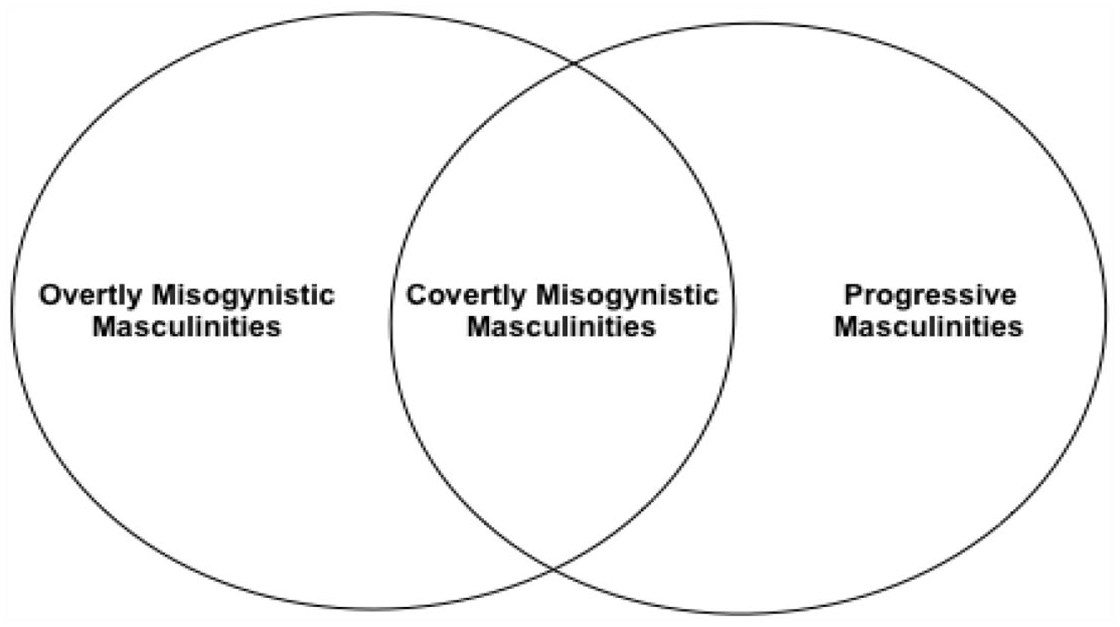
Model of men football fans’ performances of masculinities.
The relationship between men and women has not been a focal point of research on IMT, but our work addresses this omission. However, our findings have also shown the continuing relevance of Connell’s (1987, 1995) hegemonic masculinity – overtly and covertly misogynistic masculinities continue to operate powerfully today, even in supposedly more ‘progressive’ social contexts. Our findings, therefore, have offered new insights into gender relations around sport. By using IMT alongside HMT, we have foregrounded gender as a relational concept in the field of football fandom, without losing sight of the potential for the construction of more inclusive masculinities.
Our model of men’s performances of masculinities in sport will be helpful in future sociological work. For example, qualitative studies could unpack how men perform different types of masculinities in different contexts and relationships, such as in their roles as fathers, carers, partners, work colleagues and/or friends. Our research focuses on one domain (sport), but our three-fold theoretical model has the potential to examine other areas of society. It could, for example, help us to understand men’s complex responses to women in the workplace, where organisations have faced pressure to address gender inequalities, yet low-level harassment and the gender pay gap have remained and women are still less likely than men to be promoted (Blau and Kahn, 2017). It may have applicability, too, for understanding how young men respond to women in educational and creative contexts, where institutional messages may be pro-gender equality and yet cases of sexual harassment, abuse, misogyny and assault are rife (Topping, 2021). The new theoretical model will also be useful to examine future gender relations in women’s sport. We may indeed, be in a ‘new age’ of improved coverage and backing for UK women’s sport but, as our research shows, men’s responses to this are complex, at times contradictory and often oppositional.
Footnotes
Acknowledgements
We would like to thank Professor Brett Smith and the anonymous reviewers for their constructive comments on earlier versions of this article.
Funding
The authors disclosed receipt of the following financial support for the research, authorship and/or publication of this article: the first author was supported by the Arts and Humanities Research Council (grant number AH/N004841/1).
