




Abstract
Recent years have seen the emergence of calls for the transformation of food systems to make these more responsive to environmental, access and health challenges. Addressing how the UK food system may best meet these challenges, this article develops understanding of the multiple food concerns that guide practices of food provisioning at the intersection between markets and domestic life. Combining insights from a survey questionnaire and qualitative fieldwork from research that was part of the EU Horizon2020 SafeConsume project, we depict how practices of food provisioning are guided by concerns driven by economic and environmental logics. The findings suggest economy is prevalent while environmental food ethics are marginalised. The conclusion discusses how the adopted practice theoretical approach, which combines an analysis of the socio-material arrangements of provisioning and the relationship between food concerns and higher order considerations, advances understanding of the nature of food concerns and the challenges of sustainable food transitioning.
Keywords
Introduction
Food systems transformation is increasingly recognised as necessary to ensure the future supply of affordable, healthy and environmentally sustainable food for all (e.g. Willett et al., 2019). Meeting this challenge requires better understanding of the multiple concerns that permeate mundane food provisioning at the intersection between markets and domestic life. In this article, we present an investigation into how concerns associated with environmental food ethics and the management of household resources are organised and related in food provisioning. Because of the price premium demanded, economic constraints predominate in reflections on the limited uptake potential of ‘friendly foods’ 1 (e.g. Aschemann-Witzel and Zielke, 2017). Sociologists have contributed to this debate on ‘green consumerism’ by exploring how economic constraints come to structurally shape access to food and food preferences. Johnston et al. (2012), for instance, evidence how income inequalities have given rise to spatially entrenched localised food supply systems in Toronto that create inequalities of access to friendly foods (see also Gojard and Véron, 2018). Structuration at the intersection of affordability, class practices and food preferences has also been actively explored (Kennedy et al., 2019; Warde, 1997), with scholars demonstrating how the association of friendly foods with high social status prohibits their wider adoption through the shaping of food preferences (Dubuisson-Quellier and Gojard, 2016; Paddock, 2016). Consequently, some scholars (e.g. Brons and Oosterveer, 2017) have asked whether achieving sustainable food transitioning in and through the mainstream is possible, yet even those self-defining as environmentally conscientious have been found to trade their environmentalism off against economic considerations (Evans, 2011a).
The problematic of how the management of household income and resources (we continue to use ‘economy’) and environmental food ethics (we use ‘environment’ from here) are related in food provisioning has become more nuanced and multifaceted following two developments. First, the focus in the sustainability transitions debate has shifted in recent years from green consumerism towards the problematics of food waste, meat and dairy consumption, and the proliferation of single-use plastics in food packaging. In addition, the 2008 global recession has stimulated research into the long-term possibilities for consuming less. Thus, European sociologists have debated the relative and long-term propensity of consuming less among consumers who experienced economic duress during the recession and whose financial circumstances may subsequently have improved (e.g. Katz-Gerro et al., 2017). Our investigation into the ways in which environment and economy are related in mainstream food provisioning in the UK was stimulated partly by the growth in food insecurity here, not just following the 2008 recession, but also as a consequence of subsequent increases in the real price of foods and other commodities, declining real wages, the impact of UK austerity policies introduced from 2011 and, most recently, the impacts on livelihoods and access to affordable food as a consequence of COVID-19 interventions (Barker and Russell, 2020; Davis and Geiger, 2017). O’Connell et al. (2019: 8–9) calculate that in 2013, the food expenditure of 52% of UK families fell below the Food Budget Standard, which they define as the basket of foods needed ‘for a diet that meets needs for health and social participation’, with 31% spending below 75% of this Standard. In addition, Dowler and Lambie-Mumford (2015) remind us that households treat food budgets as relatively flexible and reduce this when economic duress is experienced in order to spend in other areas. Perhaps unsurprising, therefore, has been the re-emerging interest in two consumer dispositions: those of frugality and thriftiness. As the inclination for ensuring the household budget is spent economically, thriftiness was a focal point in early commentary on mundane shopping (Miller, 1998). Building on this, Evans (2011b) attempted to tease out the distinctiveness of frugality and thriftiness, arguing that while in practice, these dispositions are not easily disconnected, theoretically, frugality may be seen as answering to the environmental agenda of consuming less, when thriftiness does not. Interest in frugality and thriftiness has continued as an everyday priority and skill related to environment (Foden, 2012) and economy (Holmes, 2019). The question that engages us here is how much food considerations in the UK are driven by concerns with economy and whether this leaves space for other considerations? That health is traded off against economic concerns has been highlighted (e.g. Penne and Goedemé, 2021). Does the same happen with environment?
We start this article with a discussion on how we conceptualised food concerns and provisioning. We locate our approach within a theories of practice framework, where food concerns are argued to make up the teleoaffective structure of common provisioning practices, like retailing, shopping and cooking. Drawing on new and extensive UK-specific data from the EU Horizon2020 SafeConsume project, we then develop a mixed methods analysis, using materials on mundane food practices from a survey of 1072 domestic food practitioners and in-depth ethnographic fieldwork with 17 households. We first present frequencies of particular food actions captured in the survey and an associated factor analysis, through which we identify the main underlying dimensions of food concerns. Equipped with results revealing various components of economy and environment, we turn to the fieldwork analysis, where the engagement of consumers in market-based food provisioning is shown to indicate the pervasiveness of economy and the marginalisation of environmental concerns. Finally, we return to the questionnaire to consider whether and how the fieldwork findings are supported by the statistical analysis. In the conclusion, we offer final reflections on our theoretical approach and discuss the outcomes of our analysis.
Conceptualising Food Concerns
Different concepts are in use to capture the idea of food concerns and these are related to diverse theoretical underpinnings. Motivations, attitudes and values, for instance, are frequently invoked in economics and psychology, where food concerns are theorised as properties of individuals (e.g. Gatersleben et al., 2019). With interest in the relationship between individuals and the social, sociologists of food and consumption have put forward concepts like taste principles (Warde, 1997), food preferences and orientations to food (Kennedy et al., 2019), (collective) standards and rationales (Plessz et al., 2016) and criteria (Brons and Oosterveer, 2017). Some of these are informed by theories of practice, now commonly used in sociological research on food, consumption and sustainability in everyday life (Halkier et al., 2011; Warde, 2014). Utilising food concerns within this framework is worthwhile for different reasons. We here treat food concerns as teleoaffective elements of food practices, which set out the goals behind performances and thus address why practices are performed. Schatzki (2002: 80) defines teleoaffectivities as ‘a range of normativized and hierarchically ordered ends, projects, and tasks, to varying degrees allied with normativized emotions and even moods’. Teleoaffectivities are distinct from the rules and principles that articulate how performances ought to be carried out. Locating food concerns as teleoaffective elements of food practices, we argue, facilitates scholarly communication through theoretical clarity. Environmental food ethics, for instance, are concerns that are part of the teleoaffectivities of common food practices, like shopping and cooking, rather than practices in their own right, and as such sit alongside other goals or concerns, such as stilling hunger, attending to health and taste, and enjoying sociability. This forms a starting point for investigating the multiple concerns that are evident in mundane food provisioning, and how these are formulated, related and ordered.
There is a rich legacy of qualitative sociology exploring singular food concerns. Examples include thriftiness (Holmes, 2019), frugality (Evans, 2011b), environment and health (Halkier, 2010). Others consider the relationship between two or three, like safety and waste (Watson and Meah, 2012), care and convenience (Meah and Jackson, 2017), and family, taste and food ethics (Dubuisson-Quellier and Gojard, 2016). This shows how the relative significance and even the very definition of food concerns is not only subject to emplaced contingencies (House, 2019), but also to ongoing contestation and (re)formulation (Evans, 2011a). Given the apparent stability these cultural categories engender, caution is therefore justified by attending to the ‘liveliness’ of these elements of the teleoaffective ‘structure’. This dynamism comes to the fore especially in the discursive practices, interests and moralities around food concerns and provides insight into the structuration of teleoaffectivities (Halkier, 2010; Martens, 2018). Yet, this work has tended to adopt a limited focus on consumers and consumption, resulting in the laboured separation of spheres, like ‘production’ and ‘consumption’ (Evans and Mylan, 2019). Consequently, in this article we use the concept food provisioning, interpreted as the work that goes into sourcing food, because it circumvents common associations of the distinctiveness of production and consumption, but also because it is better suited to the idea of food systems consisting of complex interacting and interdependent elements (Hawkes et al., 2019). Conceptualising food concerns as integrated elements of mundane provisioning also has the capacity to demonstrate the utility of theories of practice for conducting food systems analysis, though this demands a shift in approach from what has been commonplace, with investigations remaining at the level of everyday domestic life (Warde, 2014).
Informing this shift is our argument that the teleoaffectivities of common practices are performed by a broader range of ‘actors’ and in contextual environments beyond those that the practice points towards (Martens, 2018). As formational elements in the teleoaffective structure of food practices, food concerns and their performances can thus be investigated through the socio-material arrangements in which human activity is embedded and which, as pointed out specifically in relation to supermarket arrangements (Cochoy, 2007, 2008), intermediates in this activity. A not dissimilar argument is developed by Evans and Mylan (2019), who utilise the notion of ‘qualities’ (Callon and Muniesa, 2005; Callon et al., 2002) to investigate how freshness is performed in the socio-material arrangements of commercial provisioning. Qualities, like criteria or preferences, may be seen as another variant of food concerns. We contend that it is useful to hold onto both, with qualities signifying attributes of foods and food concerns representing what matters in food practices. Our analytical approach seeks understanding of the ways in which performances, driven by different practices (food retailing, purchasing, cooking) and goals (e.g. making profit, maintaining life, budget management), meet and converge around specific formulations and normalisations of food concerns and their relatedness.
Attempts to grapple with multiple food concerns and their relationships have been few, as are efforts to explore these with the use of statistical analysis. An exception is Warde’s (1997) comprehensive analysis of eight food concerns (economy, extravagance, health, indulgence, care, convenience, novelty and tradition) and the relationship between these in the form of four sets of binary oppositions. 2 It gives rise to some questions for us. For instance, do food concerns necessarily operate on an ‘equal footing’ or are these ranked, and if so, what might explain this? Moreover, is the relationship between concerns necessarily horizontal? In view of the latter, the independence of Warde’s taste principles has been questioned by Meah and Jackson (2017), who point out that the apparently distinct concerns of economy, health and indulgence may be regarded as elements of care, making care of interest for reasons other than in its opposition to convenience. Elsewhere, care orientations have been sketched as higher order considerations that, moreover, appear to separate the logics of economy and environment. Miller’s (1998) analysis of thriftiness as a form of familial devotion is suggestive of a care orientation that is inward-looking, concentrating on care of family members and kin. Economy, as well as health and sociality, have been identified as undergirding this orientation (Dubuisson-Quellier and Gojard, 2016). By contrast, the mattering of people other than close kin, as well as animals and a range of environmental issues, has alternatively been presented as caring at a distance (Silk, 2004), everyday politics (Foden, 2012) and self-transcendence (Gatersleben et al., 2019). In view of this, we also note recent growth in theoretical interest in higher order considerations and how these relate to actions at the everyday level (e.g. Balsiger et al., 2019; Wheeler, 2018). Especially pertinent here is Welch’s (2020) conceptual development of teleoaffective formations that builds a bridge between specific practices and large-scale configurations of practice and discourse, and provides tools for attending to the complexities around food concerns. The questions we take forward are: what kinds of food concerns are prevalent in the UK food system and how are these enacted at sites of food provisioning? How are concerns related? Is there evidence of ranking, clustering and higher order considerations? We continue with a discussion of the methods used and the mixed methods analytical strategy.
Researching Food Concerns
The analysis draws on two substantial and new datasets from EU Horizon2020 SafeConsume on food safety in domestic kitchens. The first is a transdisciplinary study of household food practices, combining ethnographic and microbiological methods. The second is a self-completion survey questionnaire conducted online. Evidence was collected from households in multiple European countries. The presented analysis is restricted to the UK data. A more detailed discussion of the project’s methodology may be found in the online methodological appendix.
Transdisciplinary fieldwork was conducted with 17 households in the English Midlands between February 2018 and November 2019. The intention was to document the routines, relations, understandings, competencies and material arrangements that lead to food handling and its coherence with prevailing food safety guidance. The fieldwork broadened analytical attention beyond matters of food safety to the diverse concerns that manifest in mundane food provisioning. Households were recruited within three demographic groups, reflecting their relative risk with respect to foodborne illness: ‘older people’ (aged 70+); ‘young families’ (expectant parents or those with a child under 12 months); and ‘young single men’ (aged 20–29 and not living with their family or a partner). Potential participants were additionally screened on location of residence (urban/rural), income and ethnicity. In line with institutional ethics approval, all participants were given written information about the project, made aware of their right to withdraw from the study at any time, and asked to complete a consent form indicating their willingness to take part. Data were stored on a secure, encrypted drive and transcripts were anonymised prior to analysis.
Each household took part in a series of research activities, carried out during two or three home visits, that centred on two extended episodes of observation and discussion. The first involved accompanying participants on a typical shopping trip, including travel to and from the outlet(s) they would normally visit (Jackson et al., 2006). In most cases, participants were observed unpacking purchases on their return home, often including a wider ‘tour’ of the kitchen and food storage arrangements. The second observation was of preparation and cooking of a typical meal for the household. Semi-structured interviews took place at the beginning and end of engagement with each household. The final interview was also an opportunity to ask more direct questions about aspects of food provisioning not emerging organically during the preceding activities. As is common in qualitative research, participants were rewarded for their participation (Head, 2009). All interviews and observations were audio recorded and transcribed verbatim. Video recordings were made of all observations within the home, including unpacking, sorting and disposing of food, meal preparation and cooking, dishwashing and kitchen cleaning (Martens and Scott, 2004; Wills et al., 2016). Photographs were taken during the shopping visits. Analysis of the fieldwork data was iterative and started with the construction of detailed case summaries for each household. For the purposes of the project, these were given a consistent structure to aid comparison between cases and across countries. Fieldwork data were then imported into NVivo and coded in accordance with the research priorities of the project. More detailed elucidation of the transdisciplinary fieldwork and the cross-country analysis may be found in Skuland et al. (2020). For the purposes of the mixed methods analysis presented in this article, the fieldwork data were further analysed with additional coding work focused especially on the range of food concerns that guide practices of food provisioning. The methodological appendix contains further discussion on the analysis.
The second major data source is an online survey of 1072 UK households; a subset of an international survey of 9966 households across 10 European countries, carried out between December 2018 and April 2019. It was conducted by a specialist subcontractor, using a stratified random sampling design based on location of residence and educational attainment level. Recruitment was targeted at the household member with main responsibility for food shopping. The survey was designed primarily to investigate the prevalence of particular food handling practices deemed by food authorities to be safe or otherwise, in order to estimate risk of foodborne illness in different locations and provide a baseline for assessing future interventions. In addition to the core questionnaire, national research teams specified a list of ‘add-on’ questions, to be asked only of respondents in the relevant country. The quantitative analysis presented here – including factor analysis and reliability tests performed in SPSS (version 24) – focuses chiefly on the UK add-on questions, which related to overall shopping routines and principles and rationales for selecting between foods.
The mixed methods analysis proceeded through interconnected steps. We first explored particular food actions captured in the survey and conducted an associated factor analysis. While this allowed us to identify the main dimensions of food concerns underlying those actions, we turned to the fieldwork data to explore how food concerns converged around economy and environment, and how these concerns were related in the work of food provisioning. Finally, we returned to the questionnaire and conducted reliability analysis to consider whether the fieldwork findings were supported at a generalisable level.
Food Actions and Their Prevalence
Survey respondents were asked 28 questions about what they do and how often when purchasing and handling food. Table 1 presents these food actions, listed in descending order of mean values. There was substantial variation between actions in terms of how often they were performed. Checking use-by and best-before dates while shopping came out as the most commonly performed actions, with 83% stating that they always or often consciously checked date labels and 80% saying they always or often selected food with the longest use-by date. Also widely reported was the visual inspection of the colour of uncooked meat: 79% said they did this always or often. Many respondents stated that they always or often purchased familiar foods that they and their families enjoyed eating (69%), with almost equal numbers saying that they avoided throwing food away and used up leftovers. The mean scores of these food actions were all close to 4 (in a five-point scale). By contrast, only 16% said they always or often looked out for novel or unusual foods, with slightly higher percentages stating that they always or often bought locally grown food (21%), looked out for fair trade products (28%) and limited the amount of meat eaten (31%). Despite the recent mediated outcry in the UK over the global implications of plastic pollution, only 24% of respondents stated that they always or often avoided foods wrapped in plastic packaging.
Food actions, food concerns and the higher order concerns of economy and environment.
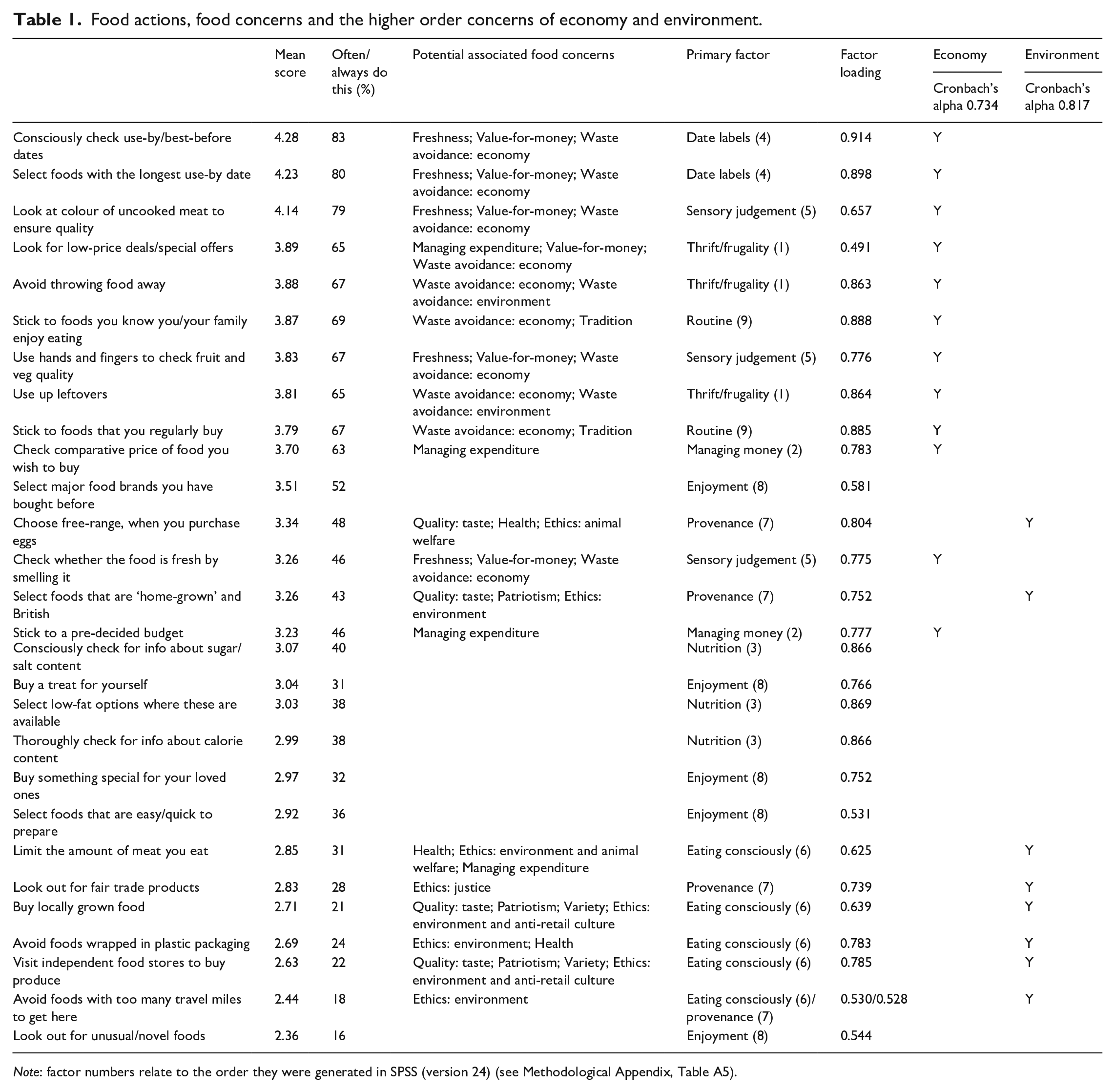
Note: factor numbers relate to the order they were generated in SPSS (version 24) (see Methodological Appendix, Table A5).
With Table 1 providing insight into how different food actions ranked across the sample, we were interested in whether and how the actions grouped together. Following previous studies (e.g. Gatersleben et al., 2019), we started our investigation by subjecting the food actions to factor analysis. Nine factors were produced and given the following names: thrift/frugality (1), money management (2), nutrition (3), date labels (4), sensory judgement (5), eating consciously (6), provenance (7), enjoyment (8) and routine (9). The factors and their loading scores are listed in Table 1. We observe that considerations of economy, including thrift/frugality and managing money ranked slightly below considerations associated with date labels, the freshness of foods and routines. In addition, considerations of economy ranked above considerations of environment, including provenance and eating consciously, while environmental considerations ranked below almost all other considerations, including those of nutrition and enjoyment.
The Performance of Economy and Environment
To further probe the meanings of the factors and best use the mixed methods analytic strategy, we continued our exploration in an interpretive way, relating the statistical analysis to our fieldwork data to discover more about food concerns and their organisation. The analysis presented below addresses specifically how environment and economy are performed in and through the socio-material arrangements of food provisioning and considers how consumers engaged with these arrangements. The discussion is presented in four parts. First, we introduce the notion of the choice arrangement and discuss how this facilitates performance of the explicit mode of economising associated with the food concern ‘managing expenditure’. We then present an analysis of how the choice arrangement moderates environmental concerns through the practice of trading off, when food concerns are ranked. Third, we discuss how economising includes a set of actions broader than ‘managing expenditure’, associated with the food concerns of ‘freshness’, ‘waste avoidance’ and ‘routines’, and through which the food actions associated with four of the factors (date labels, sensory judgement, thrift/frugality and routine) are enrolled into economy. Finally, we consider how arrangements, such as single-use plastic packaging, are normalised and ‘invite’ consumer engagement.
The Choice Arrangement and Managing Expenditure
We approached the performances of our research participants not simply as the actions of autonomous consumers but as collective, more-than-human accomplishments, paying due attention to the devices and arrangements that facilitated some food selections and discouraged others (Cochoy, 2007). The choice arrangement is a socio-material arrangement that is ubiquitous in UK food retailing environments. It is especially prevalent in, but not limited to, the small number of ‘quality’ supermarkets, where it assembles a range of technologies, devices, consumer competencies, food qualities and food concerns, providing the framework in which shopping among varieties of product takes place. The choice arrangement needs to be appreciated in relation to the specific features of food retailing in the UK, where a large proportion of food provisioning occurs through the mediation of major supermarket chains. Survey data show that most households (95%) shop at large supermarkets at least some of the time, with 86% doing their main food shopping there (Food Standards Agency, 2017). UK food retailing is also highly concentrated: the UK has one of the lowest densities of food stores in Europe, with only 97 stores per million in the population (Norwegian Ministry of Agriculture and Food, 2011).
The choice arrangement is constituted by the way retailers display varieties of food products, close together on product shelves arranged in shopping aisles. The choice arrangement invites comparisons to be made between varieties of similar products – whether eggs, tea or potatoes. It is therefore an interactive communication system that, while purveying information, also needs the participation of consumers, the mobilisation of their competencies and balancing of their personal priorities, in order for selection between varieties to happen. Ubiquitous in the communication of food qualities is price: with the use of specific label colours and their location on shelves, price tags are highly visible. Other information is delivered through product packaging with varying degrees of visibility. While brands tend to be highly visible, other information may have to be searched for in the small print on the back of a package. As evidenced in the analysis of shopping visits, presented below, the choice arrangement effectively operates through a specific relationship between price and food quality: the higher the price, the higher the assumed quality, and vice versa. Because of the centrality of price in the choice arrangement and the invitation for trade-offs to be made between product varieties on the basis of price and other food qualities and concerns, economy is thus placed on a pedestal of particular significance.
Fieldwork data add nuanced understanding to some of the explicit economising measures included in the survey. Although exercised differently, economy was not restricted to those with limited financial means and was universal across the participating households. To economise appeared to be common sense, as Susan (70s, medium income) revealed when asked about the importance of price: ‘it’s not a major concern . . . but I think anybody with any sense does look at prices’. Economy was performed in direct and explicit ways involving the management of household finances through competency illustrative of broad knowledge of the monetary cost of foods. In the survey, 63% of respondents reported always or often checking comparative prices, with 46% saying they always or often stick to a pre-decided budget. This bears at least some resemblance to the classical image of ‘the consumer’ as a rational economic actor, calculating the best allocation of limited financial resources. Lorraine (early 30s, medium income) is an example, as she rigorously managed her family’s expenditure by paying close attention to the relative and comparative price of food. She explained how the importance of cost savings organised the retailers she visited and expressed detailed knowledge of the comparative price of food items, pointing out during the shopping visit a few things that she would be purchasing elsewhere where these items were cheaper. Lorraine also spread the cost of Christmas goodies by purchasing something on a weekly basis in the months preceding this event. Managing the food budget in this way meant the household was able to spread its income across different expenditures, including the mortgage, transport and clothing for the family’s three children (Dowler and Lambie-Mumford, 2015).
Expenditure management was supported in-store by a range of pricing devices, with all visited supermarkets offering product-specific price tags, with information usually confirming the product name, a quantity measure, and – a relatively recent introduction – price-per-unit measures that ease comparison between varieties of ‘the same’ product. The arrangement typically included special economy offerings as well as ‘special offers’ and ‘low price’ arrangements supported by communication devices ranging from store brochures through to colour-coded labelling on price tags and in-store spatial display arrangements of ‘special offer’ products, like the use of food storage shelves bordering the central isle. Market devices like these were supplemented by alternatives, invented by shoppers like Archie (70s, low income), in personalised calculation systems enabling them to keep more thorough track of their food expenditure.
Ranking Food Concerns and Trading Off
The association of price and quality in the choice arrangement facilitates the formation of a hierarchy among goods, with ‘budget’ varieties located at the lower end, ‘high quality’ varieties at the top and ‘standard’ offerings in the middle. Interacting with participants during shopping visits, it became clear that, while mobilising the qualities of foods in relation to food concerns, product varieties were located somewhere in this hierarchy. Ryan (20s, medium/low income) provided an illustration of the existence of this hierarchy and, because of his narrative engagement in it, also ensured its continuity: I wouldn’t buy any, like, Tesco’s Finer stuff. I’d either buy the standard or maybe the Everyday Value sometimes. I find that there’s often not a drop in quality with certain things. . . . I did try once buying an Everyday pack of frozen sausages . . . and they tasted okay, but you don’t know what’s in them. I prefer to buy meat that’s more, or I would hope, is of a higher standard.
Friendly foods were treated first and foremost as making claims to improved quality. These would be assessed for their ‘worth’ on the basis of available finances and views on the veracity of the claims to quality. For some, like Mary (70s, medium income), organic chicken was a mark of enhanced taste and enjoyment, to be indulged in only on special occasions, like Christmas. For others, preference for organic foods was a matter of health and nutrition well worth the additional cost. Thus, Chloe (30s, medium income) put responsibility for her two small children forward as reason for eating ‘99% organic’ because of ‘chemicals and things like that’. Another group of participants, including Jean (70s, medium/high income), also assessed friendly foods on the basis of taste and health, only to conclude that they were not worth the additional cost: ‘(organic) is better for you, but is it worth the extra bit? No! We got to this age and we’ve been eating what we’ve been eating.’ Finally, there were those, like Ryan (20s, medium/low income), who lamented that the choice arrangement with its premium price tags essentially made friendly foods unaffordable: ‘I would like to . . . eat that sort of stuff . . . but, the problem with me is money, being a student. Often, organic things can be a lot more expensive.’
The framing of friendly foods as premium thus introduces a tension between economy and other food concerns, leading to the dilemma that trade-offs needed to be made between them. As our participants’ reflections illustrate how economy was traded off against the concerns of taste and health, not those associated with the other-directed considerations of environment, our analysis supports previous work highlighting that friendly foods are not necessarily assessed on grounds of their environmental and ethical worth (Lockie et al., 2002).
Freshness, Value-for-Money, Waste Avoidance and Routine as Economising Concerns
The factor analysis presented in Table 1 grouped together food actions relating to expiry dates (factor 4) and sensory judgement of food quality (factor 5), and these were also among the most popular of the actions participants were asked to comment on. Food actions associated with routines (factor 9) and thrift/frugality (factor 1) also scored highly. The fieldwork analysis suggests that these actions shared the food concerns of value-for-money, freshness and waste avoidance, and all were guided by economy. Consumer actions and narrative reflections here were also intermediated by specific uses of market and home-made devices. Food packaging is a primary mediating device through which communication about, and assessment of, a variety of food qualities and concerns – ranging from freshness, the quality of food, cleanliness and safety, certification of production methods, nutritional content and food handling advice – happens (Callon et al., 2002; Cochoy, 2007). The see-through quality of much plastic packaging, moreover, allows for visual inspection of products. During the shopping visits this happened when consumers selected meat, with Lorraine (early 30s, medium income) checking for the amount of fat she could see through the packaging, as she was looking for ‘the best’ meat, per weight, for the price she was paying.
‘Use-by’ and ‘best-before’ dates are indicators that food is, respectively, safe and sufficiently fresh to eat. The ethnographic fieldwork suggested that expiry dates were scrutinised primarily for economy purposes. Several participants with whom we went shopping gave voice to the calculations they made around date labels. Mary (70s, medium income) even demonstrated how she searched among items for those with ‘the longest’ dates, thus implementing purchase of what she saw as the best value-for-money. The proximity between ‘best quality’, freshness and its opposite, and being in possession of food that is no longer fit to eat, and thus wasted, was voiced by Lorraine in her account selecting products with the longest date: ‘So it stays fresher for longer! I don’t want me bread going off and mouldy in the day. So, I just always get the best, it’s just fresher, nicer.’ During our shopping visits, date labels were also used to gauge how much of a given product to buy, or indeed whether or not to buy it. Thus, Ryan (20s, medium/low income) considered getting two packs of cooked chicken, but noting the date, only bought one, explaining that he had recently thrown away part of a pack of ham having not got through it quickly enough. Respondents saw a later date increasing the likelihood of an item being used, as observed when Paul (34, high income) selected a slightly longer dated pack of cooked turkey, explaining: ‘it gives us an extra day to eat it’. Date labels were also enlisted in interpreting the real value of a special offer or reduction. Susan and Peter (70s, medium income) were drawn to a multi-buy deal on tinned soup, but Peter was wary of buying more than they immediately needed, explaining that ‘sometimes they put the short dates on these offers’. On checking the best before date, they nevertheless decided to stock up.
Finally, concerns with economy were performed in wider routines around storing, preparing and eating food, which ultimately shape and are shaped by what happens in food shopping (Watson et al., 2020). These measures can be grouped into those involving buying and preparing food in bulk and those seeking to avoid overbuying and hence reducing food waste. A common practice among the sample was to buy food – especially fresh meat – in relatively large quantities and to freeze anything that was not for immediate consumption. Archie (70s, low income) would typically buy a six-pack of chicken portions, then parcel these up in individual portions with butter in foil, and then freeze these for future use. Meal planning and list making was a way to avoid buying too much for mothers Kate (30s, medium income) and Melissa (30s, low income), who planned meals for the week and shopped accordingly. These mothers also made routine purchases at a reduced cost, saying that they would only take advantage of low-price deals if they already intended to buy the item. Some even incorporated the availability of reductions into their regular day-to-day routines. Daniel (20s, low income) had learnt to reliably get half-priced bread by visiting the local supermarket ‘between 9 and 11 at night, when they are just closing stuff down’. Finally, Lorraine, whose food practices appeared to be wholly guided by economy concerns, responded to the question why she avoided food wastage by saying: ‘It’s just a waste of money, in’t it, just a waste of food, I don’t like waste!’ before agreeing that the family’s eating patterns were very routine: ‘we do tend to stick to the same things’.
The Loss of Environmental Priorities
Our fieldwork started just after the screening of the British Broadcasting Corporation’s (BBC) ‘Blue Planet’ series, in the winter of 2018, and there was substantial conversation among participants about the environmental implications of the uses of plastics in food packaging. Despite consumers’ environmental worries, we found that shopping routines were subjected to in-store arrangements, including the normality of packaged foods, with the frequent use of single-use plastics. Bill and Mary (70s, medium income) discussed plastics and the world’s environmental problems at some length, saying: Bill: . . . things are not, what’s the word, never-ending, we’re going to run out of things eventually, and those things that we don’t really need, we’re not going to run out of, like all the plastic. I mean if we could use it over and over and over again, that would be great. But when you walk on the beach at Bridlington and the tideline is full of plastic, it’s disgusting . . . and it’s . . . never going to degrade. Mary: . . . yes, I guess we’ve always been sort of relatively ecologically aware, but perhaps not done as much about it earlier on in our lives as we do now.
Like Liam (20s, medium/low income), who could not quite comprehend why he ate barn-reared chicken, despite knowing that they had ‘been cooped up in some horrible environment and slaughtered horribly’, Mary later shared a sense of incredulity about herself for still doing what she was essentially against: the purchase of apples packaged in a plastic bag: we’ve always said, for several years now, there’s far too much of it (plastics)! So . . . I do try to get, on the whole, things like apples, . . . loose. But sometimes it’s just easier to pick up the six-pack, which I probably will do today, with the packaging. Because you still have to use a plastic bag, well, you don’t have to, but in the trolley if you’ve got six apples, they just roll around all over the place. So, I suppose I’m as bad as everybody else really, but it is annoying, the amount of packaging.
Mary’s environmental concerns appeared to fade into the background as she entered the supermarket, where she responded to the socio-material arrangement of food packaging by enrolling into what may be seen as a ‘mainstream’ shopping mode. Thus, the idea of packaged apples suddenly highlighted for her concerns other than her previously stated environmental worries around plastics, including the imagined problem of other people fingering loose fruit and the convenience of packaged products. Mary’s quick reflection, in the above quote, about the alternative options available to her when purchasing apples, further accentuates the environmentally ‘unfriendly’ influence of the arrangement, by illustrating how the shopping mode she enrolled into ‘in store’ prevented her from thinking more creatively about mitigating initiatives, such as bringing alternative containers into the shop with her.
Economy clearly occupies a special place in the in-store arrangements we explored, however, the same cannot be said for environment. In fact, the presented analysis shows that environment is marginalised in at least two ways. First, concerns other than environment appear to easily move into the forefront to compete with economy and, second, provisioning arrangements mainstream normalities that prevent environmental concerns to inform selections. Such provisioning arrangements could be seen to dismiss environmental concerns in more invidious ways, by apparently eliminating such concerns from the repertoire consumers bring with them to stores.
Economy and Environment as Higher Order Considerations
Analysis of the fieldwork shows how economy is a consideration that moves beyond pre-occupation with direct monetary concerns, to include practices and competencies that are best described as concerned with enhancing value-for-money and reducing food wastage. On the whole, economy appeared to be encouraged in food provisioning, with multiple devices, operating in different ways, alone and in combination, becoming useful as tools for economising. Our fieldwork participants, meanwhile, illustrated and narrated the diverse methods they used in order to achieve economy, originating in personalised devices, arrangements and practices, embedded in established routines. We also saw how environmental considerations were not necessarily enabled in these arrangements in a positive and clear way, with the choice arrangement illustrating the ranking of varieties of foods along an axis of price and quality, while products wrapped in plastic packaging were appraised through lenses other than environment. Doubts about the efficacy of supermarket provisioning for shopping in environmentally friendly ways have been raised (e.g. Brons and Oosterveer, 2017), though the reasons behind this have remained opaque. Our analysis of the sales–purchase interface of UK mainstream food provisioning shows that the socio-material arrangements go some way towards obscuring environment.
Given these insights, the final step in our analysis was to return to the survey data with the question whether the fieldwork findings were generalisable. Seven of the nine factors can be interpreted as tapping into the two overarching considerations we are interested in, economy and environment, as the final two columns of Table 1 indicate. Reliability tests demonstrate how the factors, and the food concerns associated with them, scale to produce two distinct dimensions. The economy dimension includes date labels, sensory judgement, thrift/frugality, routine and managing money. The environment dimension includes eating consciously and provenance. There is clearly a degree of synergy between the fieldwork and the survey analysis, with the biggest surprise for us residing in the fact that so many of the food actions and factors are associated with economy and, moreover, that these are also the food actions that were most frequently performed. Less surprising is that provenance and eating consciously loaded onto the higher order consideration of environment, though the marginalisation of environment pointed to in the fieldwork coheres with the survey findings in that the associated food actions were those performed least frequently. It is possible, therefore, to argue that mainstream food provisioning in the UK presents itself as a ‘culture of economy’ and that environmental food considerations, while not absent, do not generally appear as a priority. The analysis further suggests that food concerns are underpinned by broader societal and cultural concerns, and that the relationship between concerns is layered and hierarchically ranked.
Conclusion
This investigation into considerations of environment and economy in the mainstream UK food system was stimulated by calls for attending to the multiple challenges of environment, affordability and health, and by what may be seen as peculiarities of this system, including the concentrated nature of food retailing and the national austerity environment of the past decade. Developing attentiveness to the interconnectedness of elements of the food system, food concerns were conceptualised as teleoaffectivities of practices of food provisioning, where we defined the latter as the work that goes into sourcing food. Our analysis focused on the specific provisioning contexts of the conducted research; those of the retailing/shopping interface and domestic environments. Here, we return to the theoretical grounding of our work in practice theory and to the relationship between economy and environment, and finish by briefly commenting on opportunities for intervention.
We have attempted to align our use of practice theory to the demands of a food systems analytical approach by arguing that food concerns are teleoaffectivities of food practices, and that these are moulded in and through socio-material arrangements and discursive practices. While we do not wish to labour the point, it could be argued that teleoaffectivity; a concept put forward by Schatzki (2002), has not occupied a central location in practice theoretical applications in sociology (though see House, 2019; Welch, 2020). Yet, as organising principles of mundane practices associated with normatively formulated ends and goals, their importance for debate on how societies may transition in ways that are more environmentally friendly should be acknowledged (e.g. Abson et al., 2017; Soper, 2009). We have argued that food concerns can, and indeed should be studied at the level of consumption, but that such concerns are not properties of individual consumers, nor is their formulation limited to the realm of consumption. In our analysis of food concerns, therefore, consumers and their performances and priorities were embedded in an integrated analysis of the socio-material arrangements of commercial food provisioning.
Our findings broaden understanding of the challenges of food systems transformation by showing alternative ways in which specific formulations of environment and economy, and their relationships, become locked-in. Sociologists have keenly explored how material resource inequalities feed class practices, leading to a form of material-cultural locking in of consumer preferences and performances (Dubuisson-Quellier and Gojard, 2016; Johnston et al., 2012; Paddock, 2016). Our analysis shows how socio-material arrangements, common in UK food retailing, help normalise particular calculative consumer practices while simultaneously marginalising environmental concerns (Cochoy, 2007, 2008). From a practice theoretical perspective, the analysis shows how socio-material arrangements fix teleoaffectivities in specific ways, in what may be seen either as the institutionalisation (Warde, 2014) or infrastructuration (Leigh, 1999) of food concerns. Simultaneously, we have attended to liveliness in performances of food concerns. For instance, in tune with the broader focus of the research project, we expected date labels to be about health and safety and the prevention of food waste about environmental safeguarding. What we found was that our participants clearly reworked these in relation to their priorities. In this study, disparate concerns appeared to be ‘gathered up’ and clustered around the priority of economy. This demonstrates the challenges of researching food concerns and calls to mind the emphasis, in recent work by House (2019) on meal events, on teleoaffectivities ‘floating free’ from specific practices, being drawn upon when the context demands this.
Finally, by providing insight into how food concerns cluster around higher order considerations, and how these are ranked in the process, thinking across qualitative and quantitative analysis has pushed understanding of the relationship between environment and economy. Thus, the question that warrants attention is why the food actions that cluster around economy were identified as more frequently performed than those that cluster around environment. It may be argued that there is nothing novel about economy being prominent in this context, indeed, thrift has figured prominently in analyses of shopping and consumption (Miller, 1998) and coheres with the centrality of cost considerations in the post-war UK food system. Yet, while Warde (1997) found no evidence of the significance of economy changing over the period between 1968 and 1992, our research suggests that the contemporary UK food system converges in a ‘culture of economy’. Commentaries on UK food insecurity have been clear that alongside austerity measures, real wages have declined while food prices have risen (Dowler and Lambie-Mumford, 2015). These developments sit alongside more intense coordination in food provisioning around economy. As stated above, the UK food retailing sector is very concentrated, dominated by a limited number of powerful businesses (e.g. Hawkes, 2008). Demarcated by the split between new discounters and traditional food retailers, austerity conditions have led to increased competitive conflict around economy. Thus, while the discounters Aldi and Lidl have been active in the UK since the early 1990s, their share of the food market has only grown significantly over the past 10 years. 3 At the same time, calculative devices in food stores have proliferated and gained in sophistication (Kelsey et al., 2019). Whether a product of more consumers shopping on lower budgets or internal competition, or both, economy is currently a dominant higher order consideration in UK food provisioning. The clustering, in our work, of food concerns around economy and environment, speaks to Welch’s conceptualisation of teleoaffective formations, which, like the work of House (2019), presents the argument that teleoaffectivities are not necessarily limited to specific practices. Even when the goals and ends these refer to are performed at the mundane everyday level, these are also formed at different scales of the social. While our analysis provides insight into how economy is shaped and prioritised at the level of socio-material arrangements in retailing and consumption practices, it seems simultaneously clear that other ‘agents’ in the food system, such as governance and policy, are also active in this formation.
Our work builds on the growing call for attending to interconnections between levels of the food system and for paying more attention to the moral work that happens in market contexts (e.g. Wheeler, 2018). There is without doubt much scope for thinking through exactly how food systems may be transformed. Given the centrality of the socio-material arrangements of food retailing in our analysis and the fact that food retailers in the UK are often ‘let off the hook’ in intervention debate, we finish with some thoughts at this level. One honest question for broader consideration is whether major food retailers should stock products that are unethical and unhealthy, especially in trade-offs on price when, as shown by O’Connell et al. (2019), a significant proportion of families in the UK need to prioritise economy. In view of this, we did find some examples of supermarkets manipulating the choice arrangement, for instance, by making available affordable free-range eggs and fair-trade tea, or by taking environmental priorities out of the choice arrangement altogether. Perhaps more could be done on that front by retailers without policy intervention. Also useful, we think, would be demonstration of how cost savings may be made by households outside the choice arrangement, while still providing healthy and environmentally friendly food. Here, retailers could borrow from already existing consumer competencies and expertise on meal planning. An example could be the creation of cost-effective meal plans, where economy is achieved by working across food groups rather than within product varieties, as happens in the choice arrangement. This could demonstrate that food items that in the choice arrangement appear expensive, can nevertheless be part of an affordable diet that does not compromise on health and environmental considerations.
Supplemental Material
sj-docx-1-soc-10.1177_00380385211043679 – Supplemental material for Environment or Economy? Food Concerns and Sustainable Food Transitions in the UK
Supplemental material, sj-docx-1-soc-10.1177_00380385211043679 for Environment or Economy? Food Concerns and Sustainable Food Transitions in the UK by Mike Foden, Emma Head, Tally Katz-Gerro and Lydia Martens in Sociology
Footnotes
Acknowledgements
We would like to thank the EU for financially supporting this research, and SafeConsume colleagues for their research collaboration, good humour and help with approvals for this article. We thank Dr Solveig Langsrud for reading and commenting on the article, and two anonymous reviewers for their helpful suggestions to improve the article. The usual disclaimers apply.
Funding
The authors disclosed receipt of the following financial support for the research, authorship and/or publication of this article: the data presented in this article are part of the EU Horizon2020 funded SafeConsume project, Grant number: H2020 – SFS – 2016 – 2017: Project no. 727580.
Supplemental material
Supplemental material for this article is available online.
Notes
 .
.
References
Supplementary Material
Please find the following supplemental material available below.
For Open Access articles published under a Creative Commons License, all supplemental material carries the same license as the article it is associated with.
For non-Open Access articles published, all supplemental material carries a non-exclusive license, and permission requests for re-use of supplemental material or any part of supplemental material shall be sent directly to the copyright owner as specified in the copyright notice associated with the article.
