




Abstract
This article explores the ways in which the intensification of parenting and the notion of children at risk have influenced grandmothers’ narratives and practices. Interviews with grandmothers who regularly look after their grandchildren, reveal that their practices are framed around the notions of children to be protected, educated and entertained. Such notions reveal that aspects of grandmothers’ roles as protectors, educators, playmates and confidants involved negotiations with parents around the ideal of ‘putting the child first’. The article argues that intensive parenting has influenced grandmothering but the way this is enacted reveals resistance to certain aspects of intensive parenting.
Introduction
Timonen (2020b: 271) considers whether the 21st century could be referred to as the ‘grandparents’ century’, given the demographic changes associated with the ageing population. Traditionally, grandparenthood has been associated with old age and Attias-Donfut and Segalen (2002) argue that the historical devaluation of older people has resulted in grandparenting receiving little attention. However, even though modern states may not fully recognise the value of the support they provide, grandparents have been found to provide considerable support (Tan et al., 2010; Wheelock and Jones, 2002). Changes in the nature of family life, including women’s increased employment, greater life expectancy and the diversification of family patterns, are important contexts whereby grandparents, and particularly grandmothers, provide valuable support to working mothers (Arber and Timonen, 2012; Attias-Donfut and Segalen, 2002; Wheelock and Jones, 2002). The relatively high cost of formal childcare and its often patchy nature in the UK (Glaser et al., 2013) also form an important backdrop to the childcare provided by grandparents, and grandmothers in particular. As a consequence of these structural and cultural aspects, grandparents in the UK spend an average of eight hours each week providing childcare (Buchanan and Rotkirch, 2018). While we know that grandparents are more involved in childcare, less is known about the nature of their involvement. Considering how parenting culture has been recently transformed by new models of childhood and the discourse of intensive parenting (Hays, 1996), this article examines the extent to which grandmothering might have been influenced by such transformations. As Timonen (2020b: 282) asks: We have witnessed the rise and impact of ‘intensive parenting’ or ‘concerted cultivation’ (Lareau, 2011) of middle-class children in many societies – might we next detect ‘intensive grandparenting’, as the older family generation invests heavily in concerted cultivation of the youngest?
We know that the quantity and the nature of childcare provided by grandparents is gendered (Horsfall and Dempsey, 2010; Timonen, 2020a), which we explore in more depth later on. Furthermore, intensive parenting particularly impacts mothering practices (Hays, 1996; Lee et al., 2014) which may include restricting or ‘micro-managing grandparental involvement’ as a way of coping with anxiety (Sivak, 2018: 842). Consequently, this article focuses on grandmothering and seeks to address the following research question: to what extent are notions of intensive parenting influencing the grandmothering role? Theoretically and empirically, the article shows how the role of grandmothers – as protectors, educators, playmates and confidants – has been influenced by the current ideas of intensive parenting. Additionally, we also demonstrate that grandmothers express some resistance to certain aspects of intensive parenting and reclaim their right to ‘step back’ and negotiate parental expectations regarding their role.
Changing Childhoods, Changing Childcare?
Arber and Timonen (2012) argue that in order to truly understand current grandparenting practices, cultural perceptions of childhood must be taken into account, as well as the changing scripts for older people. In reviewing the literature on childhood and parenting, it emerges that dominant themes relate to the notion of children at risk (Marx and Steeves, 2010) as well as the pervasive nature of intensive parenting, which affects mothering more than fathering (Lee et al., 2014). The idea that children are seen as subjects at risk and in need of vigilant protection by adults has been documented extensively (see, for example, Marx and Steeves, 2010). Given the range of risks that may potentially befall children, whether being attacked by unknown adults met online or becoming obese, children’s own agency is perceived as insufficient for negotiating the risks of everyday life. As such, parents’ intensified surveillance is now considered the only plausible way of ‘doing’ good parenting, which means that parenting has become highly politicised (Lee et al., 2014). Commentators have highlighted how the intensification of everyday parenting produces anxious parents, especially mothers, who attempt to ameliorate their anxieties through increased consumption to support their monitoring and safeguarding efforts and who need reassurance about their ways of looking after their children from experts (such as nutritionists, paediatricians, teachers, celebrities and parenting experts) (Lee et al., 2014).
The child is not only seen as at risk, but also as innocent and priceless (Hays, 1996). As Hays reminds us ‘good’ mothering requires an intensified labour of nurturing the child, anticipating his/her desires and developing his/her talents; making mothering financially and emotionally demanding (see also Lareau, 2003). Thus, good parenting is never-fully-achieved since it is viewed as a ‘skill set’ to be learnt and kept updated rather than an activity which comes naturally (Lee et al., 2014: 8). The model of childhood promoted here is one of concerted cultivation rather than natural growth (Lareau, 2003), in which childrearing is seen as a project with skills to be learnt, targets to be achieved and money to be spent. This is indeed in contrast with the ideal of accomplishment of natural growth whereby parenting does not aim to develop children’s capitals but children are given freedom to identify and follow their own interests and skills (Lareau, 2003). If from the intensive parenting literature we gain an understanding of how parenting has been reshaped by the overall idea of the innocent and priceless child at risk, we are left with little understanding as to whether these notions have in turn affected grandmothering (Timonen, 2020b).
Grandparenting: Roles, Relationships and Complexity
When individuals become grandparents, they sometimes find their various roles to be in competition with one another. The two central norms of grandparenting are ‘being there’ and ‘not interfering’ (Breheny et al., 2013; Mason et al., 2007; May et al., 2012). Mason et al. (2007) note that balancing being a good grandparent and being a good parent to adult children can be difficult, because while grandparents feel they should not interfere in the way in which their children raise their grandchildren, they also feel a sense of responsibility to their grandchildren and worry that on some occasions not interfering could be interpreted as not caring. Additionally, grandparents may feel they should not need to interfere in parenting, having already socialised their adult children into skills and values which fit their notion of ‘good parenting’ (Breheny et al., 2013). Grandparents may therefore negotiate tensions between their approach and that of their adult children by ‘reshaping the relationship with grandchildren as a freely chosen relationship of companionship and support’ (Breheny et al., 2013: 181).
Research has highlighted that grandparents may use consumption practices to strengthen their relationship with their children (Godefroit-Winkel et al., 2019). Gram et al.’s (2019) research with middle class grandparents and grandchildren in Denmark and New Zealand shows that ‘grandtravel’ is a type of holiday offering fun, bonding and legacy for the relationship. Furthermore, although some grandparents want to be involved in their grandchildren’s lives, with increased life expectancy and more years in good health, grandparents have been recorded as wanting to balance this with enjoying their own life (including work, hobbies and social interactions) (Godefroit-Winkel et al., 2019; Mann and Leeson, 2010; Mann et al., 2016). As parents act as mediators of the grandparent–grandchild relationship (Chan and Elder, 2000; May et al., 2012; Tan et al., 2010), grandparents can feel pressured into pleasing the parents of the child to ensure they can maintain contact with their grandchild (Mason et al., 2007). This situation can lead to grandparents feeling put upon (Mason et al., 2007), but the extent to which grandparenting practices and interactions with grandchildren are shaped by contemporary notions of the child at risk is yet to be explored.
When questioning how grandparenting has changed, it is important to note that grandparents are far from a homogenous group and demographics such as age, health, gender, social class, sexuality, ethnicity, culture and welfare regime all play a role in determining expectations (Timonen, 2020b). The changing nature of families, including relationship breakdown and re-partnering for both grandparents and their children is also important when considering relationship dynamics (Mann et al., 2016). While much of the research discussed so far has focused on middle class grandparents, the existing literature has demonstrated some social class differences in relation to the involvement of grandparents and their experience of their role. Working class women under 50 years old are four times more likely to become grandparents than middle class women (Emmel and Hughes, 2011). In their longitudinal study of a low-income estate, Emmel and Hughes (2010) show how, in the context of recession and long-term experiences of material deprivation including unemployment and social housing, the collective resources families have access to are limited. In this situation grandparents were more likely to engage in ‘rescue’ grandparenting, for example looking after grandchildren placed in their care by social services (Emmel and Hughes, 2011). Tarrant et al. (2017: 363) focused on the experiences of grandparents engaging with professionals in Children’s Services and found that some were expected to ‘carry out almost impossible burdens of care’ while being unclear about their rights to financial and other support. These studies show that some grandparents are in more precarious circumstances and as such may frame the grandparenting role differently to middle class grandparents.
As well as being influenced by social class, various research studies have revealed ‘a highly gendered division of labour amongst most grandparents’ (Timonen, 2020a: 9). Although much of the literature focuses on qualitative research primarily with grandmothers, there is a growing interest in exploring grandfathers’ accounts (see, for example, Buchanan and Rotkirch, 2016), as well as comparing grandmothers’ and grandfathers’ experiences. Horsfall and Dempsey (2010) found that grandmothers were performing more care work than grandfathers and had more responsibility for domestic labour associated with or occurring at the same time as looking after children. On the other hand, grandfathers were described as ‘role models’, were more involved in play, games and educational tasks, but were less likely to be involved with some everyday tasks such as toileting and meal preparation (Horsfall and Dempsey, 2010). Similarly, Craig et al.’s (2020: 159) analysis of self-completed time use diaries in Australia, Korea, Italy and France, found that ‘a higher proportion of total physical care is performed by grandmothers than by grandfathers in all four countries’. There was also variation in relation to the composition of care provided by grandfathers and grandmothers across the four countries studied, suggesting that factors such as the availability of publicly funded childcare, gendered social norms and women’s employment patterns are important (Craig et al., 2020). As a result of the quantitative and qualitative differences that have been found in relation to the provision of care by grandmothers and grandfathers, our research focused on the experiences of grandmothers.
Research Methods
This study adopted a qualitative and interpretivist approach, centred on semi-structured photo-elicitation interviews. Posters about the study were displayed in venues utilised by grandparents (cafes and libraries) as well as circulated by two schools and a bowls club. Snowballing and the personal networks of the research team were also utilised for recruitment. Initially we sought to recruit grandparents who looked after their grandchildren at least once a week. However, we realised that we needed to be more flexible when we were contacted by a grandparent who does not look after her grandchildren weekly, but rather for the entire duration of every school holiday. Indeed, this highlighted the variation in grandparents’ provision of childcare.
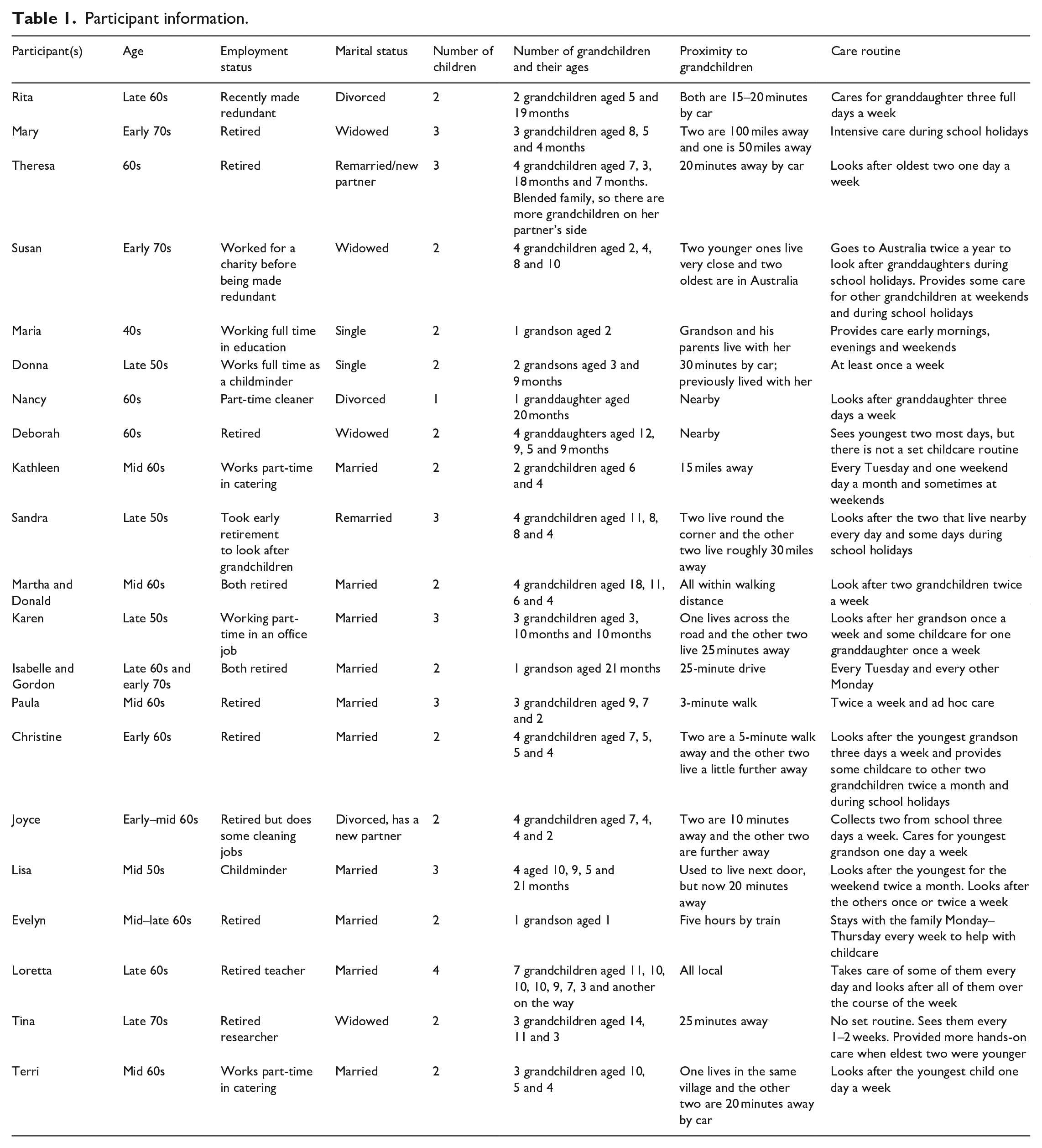
We conducted 21 interviews with grandmothers who regularly care for their grandchildren aged 11 or under. The majority of these were individual interviews, but two were joint interviews with a grandmother and grandfather present. Although our initial focus was grandparenting rather than grandmothering, the gender division in the sample was not unexpected given the recruitment method and what is already known about the gendered nature care work provided by grandparents (Horsfall and Dempsey, 2010). However, with the exception of ethnicity, the sample was diverse in many other ways (see Table 1). Participants were white British grandmothers who ranged in age from early 40s to late 70s. They had between one and seven grandchildren. Physical proximity ranged from grandmothers living in the same house as their grandchildren or next door, to living at the other end of the country, and in one case a transnational grandparent who looked after her grandchildren in the UK and in Australia in the school holidays. Generally, participants were retired but five were employed part-time and three were employed full time. The majority of the grandmothers described their adult children as having professional careers; however, the socio-economic background of the grandparents themselves was more diverse. In some families there was a clear sense of children’s social mobility and parents were therefore able to financially compensate grandmothers for their care. However, the grandmothers noted that their children’s lives were characterised by increased housing costs and working pressures.
Participant information.
The interviews, which were each conducted by one of the authors of this article, generally took place at the participants’ homes, but in a minority of cases they took place in a café. In one case an interview took place at the researcher’s office and in another it took place at the participant’s own workplace. In terms of positionality, we are female researchers who are younger than our research participants and none of us are grandparents. At some points in the transcripts, we were positioned by respondents as being of their children’s generation. However, this was not the case in all the interviews given the age diversity among our participants.
Prior to the interviews, participants were asked to take and send the interviewer five to 10 photographs of the activities, places and equipment that they considered to be most important to their grandparenting practices. The initial interview questions sought to gain an understanding of the family and their patterns of care. Then participants were asked to discuss their photographs, reflecting on their experiences of looking after their grandchildren. Because photographs can help to make the ‘invisible visible’ (Bukowski and Buetow, 2011: 739), we were also able to use them to access some of the more routine and taken-for-granted aspects of daily life that might have otherwise been overlooked, such as the motivating factors for purchasing particular equipment. This is primarily because ‘photographs elicit extended personal narratives that illuminate the viewers’ lives and experiences’ (Clark-IbáÑez, 2004: 1511). The interview topic guide also explored what the grandparents particularly liked about looking after their grandchildren, as well as aspects they found stressful or difficult. On average, the interviews lasted one hour. The shortest was 30 minutes and the longest was 1 hour and 40 minutes.
The research followed ethical procedures outlined by the British Sociological Association’s Statement of Ethical Practice. We followed the ethical approval processes of the researchers’ institutions and approval was granted before the fieldwork began. All names have been changed to pseudonyms.
The interviews were audio recorded and transcribed verbatim. An inductive thematic analysis, as outlined by Braun and Clarke (2006), was then conducted on the interview transcripts. The photos taken by the grandparents were not analysed; instead, they were used as a prompt for discussion during the interviews. Codes were initially drawn from reading through the data; some of these were descriptive, such as those relating to different activities, and others were more conceptual, for instance, regarding the way in which children were framed in the grandparents’ discussions. These conceptual codes were used as the basis for developing the overarching themes and, in turn, this framework was sensitised by our review of the literature on intensive parenting.
Findings
As illustrated in Table 1, family composition, age and working commitments varied across our participants and there are, thus, noticeable differences in the amount of time grandmothers spent undertaking caring activities. Some provided regular support on a daily or weekly basis, while others ‘stepped in’ during school holidays and ad hoc weekends. The caring tasks provided by grandmothers varied, but across the sample these tasks included: taking children to and collecting them from school and extra-curricular activities, preparing food, entertaining them, assisting with homework and providing personal care. This heterogenous set of time, commitments and overall responsibilities can be framed as intergenerational support (Breheny et al., 2013; May et al., 2012), which many participants described as not having received from their own parents. Despite such a heterogeneity, there were commonalities in the ways in which participants talked about their grandchildren and, consequentially, their roles as grandmothers.
Children to Be Protected
The notion of children at risk (Marx and Steeves, 2010) was prominent in participants’ accounts of their everyday caring activities. Grandchildren were seen as subjects at risk of hurting themselves and as such participants explained that children’s mobility, access to technology and food consumption had to be supervised by adults. Supervision was more intense with young children, but the idea that children need protection from physical harm was a key theme emerging from our participants’ narratives and this framed the grandmothers’ practices. As Theresa explained: My feeling is you don’t want anything to happen to them on your watch and you’re really responsible. I don’t remember being so fussy with my own children but the difference is there. That’s what I feel, grandparents fuss more, wrap them up in cotton wool a bit more than you did your own children.
Like Theresa, many participants noted intensified supervision practices, which related to their grandmothering role and being responsible for children for whom they are not the parent. Furthermore, the grandmothers’ reflections on their own childhoods highlighted a socio-cultural shift regarding the way in which children’s autonomy has been reduced in contemporary society. Some compared the autonomy they enjoyed as children (being able to walk to school at a very young age) and the one given to their own children (playing unsupervised and walking to school with friends) with the very limited autonomy their grandchildren have (often being driven to clubs and classes). For example, Paula who lives a three-minute walk away from her nine-year-old grandson compared her grandchildren’s more restricted sense of movement with the relative freedom that her own children had: By his age our children would have been out playing. So that’s changed. [. . .] I think that’s the main difference, that they seem younger and more protected in that way. Partly where [my daughter] is living, it’s a through road so you couldn’t really let them play outside, but he hasn’t come round and walked round to ours on his own yet, whereas I know that [my daughter] and her friends were out younger.
Interestingly, Paula hints at how such a protective parenting and grandparenting style might affect the children’s sense of independence and overall growth, echoing academic remarks on the negative effects of intensive parenting (Lee et al., 2014).
Another consequence of such an intensified parenting culture is the idea that managing risk implies looking after children with the support of specialised equipment (Lee et al., 2014). Many participants described having purchased items including bed-guards, baby-gates, highchairs, pushchairs and other equipment to assist with their caring practices. The purchase of equipment was also a cause of tensions between participants and their children. Parents were seen as the most competent to make ‘good choices’ in this domain and thus the majority of participants purchased the same equipment as their children. This was done to reassure themselves and their own children about the quality of the items they purchased and the consequent reliability of their caring practices. There were however cases in which tensions over equipment emerged. Isabelle and Gordon explained how this was the case in relation to a car seat they had purchased for use when taking care of their grandson: Isabelle: We didn’t really take him out very much at all for the first four or five months, I think, because Emily [daughter] wasn’t happy with him being in a forward facing seat and that’s all we had. [. . .] she wasn’t happy with him going forward facing until she came out with him in a seat. Isabelle: He was a lot older and bigger than he had to be. Gordon: He had to get to 10 kilos, didn’t he? The law said 9 but we had to wait for him to be 10. Isabelle: And then it was gone 10. I mean, she just kept putting him off. It was annoying in some respects but she’s the mother. Mum knows best. I’ve always said that.
This quote is revealing of tensions between these two grandparents and their daughter in relation to what can be considered ‘good’ for the child. Adhering to the principle of being there without interfering (Breheny et al., 2013; Mason et al., 2007; May et al., 2012), Isabelle and Gordon tended to go along with what was decided by their daughter but admitted disagreeing with her decision. The mantra mum knows best seemed to be used by Isabelle to emphasise that her role was to support her daughter, but she admitted that this created tensions since it interfered with her own understanding of how to do grandparenting.
Children to Be Educated
Commensurate with the emphasis on the development of the priceless child (Lee et al., 2014), participants spoke about an increasing attention to education and the financial investment in extra-curricular activities. As we know from the literature, families are increasingly expected to ‘participate’ in children’s education (Lee et al., 2014) and this is not only confined to school-aged children but is also expected in relation to pre-school children. Such an emphasis on developing the potentials and talents of the children, which is typical of intensive parenting, was seen as a new phenomenon by grandparents like Nancy: They’re expected to know an awful lot before they even start school. That sort of thing. Whereas mainly I look at it from an old-fashioned point of view. I mean I went to school when I was five and so did [my daughter] and we didn’t have that kind of pressure at all. [. . .] They’ve got to be more successful.
The intensification of parenting, which is focused on the academic outcomes of the child, also affected grandparenting. While our participants described ‘helping out’ with learning activities – from doing homework with children to taking them to music classes – selecting such activities and deciding which schools or nurseries to send children to were firmly positioned as tasks belonging to the parents. Grandmothers appeared to resist the competitive nature of current parenting culture and positioned themselves outside such an intensified emphasis on education and results. While noting this increased focus on educational success, some of the grandmothers spoke about the pleasure of their role and not having to focus on the educational development of their grandchildren. As Donna said: You haven’t got the responsibility of the school or whether they do well or whether they achieve because you’re just happy to see them. It doesn’t matter if they didn’t get an A in maths. It doesn’t matter to me. It’s less stressful. You enjoy it as well.
What is interesting is that Donna works full time as a childminder for several children as well as looking after her grandson. She implies that intensification has occurred but that this has been borne largely by parents (mothers) rather than grandmothers. While many participants adopted a similar position to Donna, they also recognised that their grandmothering activities had been impacted by the increased emphasis on children’s educational development and success. In particular, participants who were involved in children’s everyday lives took them to educational activities, bought educational resources or did educational activities with them. Among domestic educational activities, homework was the most common.
Christine explained that her grandson received spelling to learn every week and some of the strategies she used to assist with this including the use of a badge which she wore: ‘what you have to do is you have to look, cover, spell, so you look at it, you go through it’. While Christine enjoyed her involvement in this learning activity, others saw it as a very stressful aspect of grandparenting. Sandra explained that her grandson was ‘a bright boy’ who was preparing to take a test to hopefully gain entry to a selective secondary school. While Sandra was happy to drive the grandchildren to various learning activities, pushing her grandson do his homework was a stressful aspect of grandmothering for her: I don’t want any aggressive side and the arguing side of it so if he wants to do it, fine, if he doesn’t want to do it [homework] then take it to school and tell your teacher that you didn’t do it. So I’ve learnt to step back.
‘Stepping back’ and taking a more detached approach to her grandson’s educational activities was Sandra’s way of redefining her role and choosing which responsibilities she wanted. This is an interesting finding as it shows how grandmothers reclaim some discretion in defining their roles, responsibilities and activities. Such discretion was not always possible and some grandmothers explained that they had to compromise by taking on tasks that they did not enjoy. For example, Rita looked after her 19-month-old granddaughter for three full days a week. As part of this, she took her granddaughter to Baby Sensory – an educational and sensory programme for babies – because her daughter wanted her to and had made the booking and pre-paid for two terms. She explained that she does not particularly enjoy this: The women at Sensory – I’m the only grandma so obviously they are a lot younger than me. They’ve been a bit – I don’t know how to put it – sort of not very friendly. They talk amongst themselves rather than to me if you know what I mean. But I understand that. I’m not there for me, I’m there for HER so it doesn’t really matter.
Framed within the mantra of ‘putting the children’s needs first’ (McCarthy et al., 2000), Rita is able to reconcile her preference for doing something else with the obligation of taking her granddaughter to Baby Sensory. This example shows how the nature of intensive parenting which relies on external provision (paid for classes and clubs) combined with an emphasis on parental (and consequently grandparental) involvement in education has created particular demands on grandparents. Grandmothers sometimes had mixed feelings about their role in terms of education but largely followed approaches promoted by parents on the understanding that they were best for the child (Hays, 1996; Lee et al., 2014).
Children to Be Entertained
If extra-curricular activities – from sports to music classes, from foreign language courses to ballet classes – were decided by parents with a clear emphasis on their learning outcomes (Lareau, 2003), leisure activities were seen as an area where grandmothers who were regularly looking after their grandchildren could show more autonomy. Extraordinary activities, including visiting theme parks and museums, were planned in advance and usually scheduled when children were to spend a prolonged period with grandparents, for example, during half-term school holidays and weekends. Christine explained that during the school holidays she liked to structure the days by scheduling a ‘big treat’ alongside other less expensive activities, including going to local parks, to National Trust proprieties and visiting her allotment: We try not to spend too much money on them because otherwise they get used to going, so, you know, we’ll take them one paying place, like this year we took all four of them to Legoland. [. . .] we give them one sort of really big treat and then the other two or three days we’ll just go to woods or parks or something like that.
These were activities that Christine described enjoying herself and some were part of her routine (walking the dogs and visiting the allotment), which she thought would also be ‘good’ for the children. Similarly, Sandra talked about a common passion for cinema that she shares with her grandchildren: We call ourselves ‘cinema buddies’ because I’m the only one who really takes them to the cinema so we do try to go and see whatever films they want to, as I say, I have sat through some that I’ve lost the will to live half-way through [. . .] My mind wanders a bit!
Although the choice of the film might have been dictated by her grandchildren, and the overall understanding of putting children’s needs first, Sandra affirms that she enjoys taking her grandchildren to the cinema. The expression ‘cinema buddies’ highlights how going to the cinema was also a source of bonding which she exclusively shared with them. While the literature highlights the growing reliance of parents on experts’ opinions in the form of manuals, blogs and indeed classes, to organise leisure activities with children (Lee et al., 2014), grandmothers seemed to rely more on their own parental experience as well as suggestions received by family members and friends who are grandparents. As Loretta said: ‘I have some friends who say “have you tried various cafes around where grandparents can bring their children, have a coffee and the kids can play?” [. . .] it’s a social thing for grandparents as well.’ Loretta explains that taking her grandchildren out was a way of improving her social life and networking with people of a similar age and with the same role. This shows how entertaining children is also an opportunity for grandparents to expand their social capital. Domestic and local activities also featured in the grandmothers’ narratives; many of these were part of the weekly routine, including watching a specific TV programme together, going for a walk to the local park, reading together and having meals together. Some of these activities, such as reading together, could also be seen as educational but here they were positioned more as being for enjoyment, with learning being a potential positive side effect. While there was a focus on the priceless child which is commensurate with intensive parenting (Hays, 1996; Lee et al., 2014), these activities were not future orientated (for example in providing an educational advantage) for competitive benefit.
There were also many examples of creativity in transforming ordinary events into extraordinary ones. For example, Theresa described the weekly ritual of waiting for the bin men to come with her pre-school-aged grandson and how she and her husband bought him a fluorescent tabard to wear so that he could appear to ‘join in’ on bin day. Such activities were described as recently created ‘traditions’ that grandchild and grandmother built together. Most of these traditions were seen as a form of entertainment but also a way of providing some structure and interest to the day or week. This was particularly important for participants who looked after younger children whom they felt had to be constantly monitored.
Using computer technology to play games was another source of domestic entertainment, which was used with younger and older children. However, this was understood by grandparents as an activity which was associated with risk and could potentially harm relationships within the family. This emerged in Sandra’s interview where she explained that her son and his wife had told the children they could not have the video game Fortnite but one of the boys had downloaded it. He was playing it and Sandra was unaware that it was not allowed: ‘I just took it, I didn’t say “well he did it without me knowing”, I just pretended that I knew ’cause I didn’t want him to get into trouble over it but I gave him “what for” afterwards.’ The way Sandra recalled the story is revealing of her role as mediator between her son and her grandson (see Chan and Elder, 2000; Tan et al., 2010). Some of her expressions (for example I gave him ‘what for’ afterwards) show the complexity of her role in mediating the parent–child relationship, and the way she sees herself in relation to the authority of her son. Her attempt to defend her grandson reveals some bending of parental rules and decisions, without compromising the role of educator (see May et al., 2012).
Discussion
Despite many differences across the sample, there was a strong commonality around the current notions of children to be protected, educated and entertained. In positioning themselves in relation to these notions, the different roles of grandmothering emerged. As others have pointed out (Gram et al., 2019) grandparenting involves the interplay of different roles depending on the activities undertaken. From our findings it emerged that different roles are not simply related to the activities that grandmothers undertook with their grandchildren, but they were associated with their positioning in relation to the sacred child and current intensive parenting culture (Lee et al., 2014).
The roles emerging most clearly from the findings are the roles of protector, educator, playmate and confidant. Grandmothers described themselves as protectors and, regardless of the age of the child, many enacted more restrictive rules than they used in their role as parents because they felt this was expected in contemporary society, including by the child’s parents. In most cases technology and other equipment used to protect the child were purchased with the approval of their adult children or daughters-in-law. Purchasing specific items to keep children safe was framed by participants as a way of being supportive and responsible. Going along with what was decided by parents was also seen as a way of being there without interfering (May et al., 2012), even when disagreements emerged around how to protect the child. In fact, some grandmothers seemed to actively resist the pervasive notion of children at risk, by defending their own way of protecting the child during the interview and constructing it as ‘equally good’ (take, for example, the case of Isabelle and Gordon and their dispute with their daughter around the car seat).
Grandmothers sometimes had mixed feelings about their role as educators but largely followed approaches promoted by parents on the understanding that they were ‘best for the child’ (McCarthy et al., 2000). When they were involved in domestic and/or external activities, including homework and attending courses with children, these were framed as duties and in some cases as a self-sacrifice. This sense of self-sacrifice in relation to one’s own preferences seems to fit well with intensive parenting. Overall, the role of educator seemed to be welcomed by participants with some reservations and attempts to disengage with some of the disciplinary and confrontational aspects of the role. This is indeed in line with the idea of being there but not interfering (Breheny et al., 2013; Mason et al., 2007; May et al., 2012), since participants saw education as a parental responsibility and their role simply as executors of parents’ decisions. Using the discretion to step in and out of this role, grandmothers seemed to disengage themselves from the competitive side of education, which is typical of intensive parenting (Lareau, 2003), and instead framed learning as a long-term investment where learning outside of the classroom (for example in relation to the natural world) is also important.
Being a playmate seemed to be the role where grandmothers had most agency; they decided what activities to select and were creative in transforming some of the more ordinary aspects of the day into extraordinary occasions. This is because parental control over such activities seemed to be more relaxed as long as parents felt their general guidelines (e.g. around safety) were being followed. Entertainment activities were left at the discretion of the grandparents and as such were not framed as a way of acquiring cultural capital, but simply as a way of ‘having fun’ together. Grandparents also revealed selecting activities to entertain themselves and develop their own social capital. As such, it can be argued that spending time with grandchildren is also an opportunity to engage with activities otherwise precluded. The role of confidant also emerged as grandmothers keep some aspects of children’s behaviour secret from parents, bending parental rules to maximise children’s enjoyment and to avoid family conflict (Breheny et al., 2013).
The participants’ positioning in relation to these various roles also reveals the existence of expectations that parents have and these are not always shared and appreciated by grandmothers. Many of the grandmothers spoke of the gratitude that their children have towards them and the financial assistance they provide by offering childcare (unpaid in the majority of the cases), but tensions nevertheless emerged around the boundaries of grandparenting. There appeared to be a fine balance not simply between being there and not interfering (Breheny et al., 2013; Mason et al., 2007; May et al., 2012) but also between offering care and support but limiting parental expectations. As such, grandmothers reclaimed their freedom to step in and out of the aforementioned roles, removing themselves from the competitive aspects of raising children (Hays, 1996). It is in reclaiming the right to step in and out of these roles that grandmothers reclaim their agency in deciding how to spend time with their grandchildren. Many declared dedicating full attention to their grandchildren by avoiding domestic multitasking and other ‘distractions’. This suggests an affective and temporal difference in comparison to their past experience of parenting; a disengagement with other tasks in order to facilitate a complete focus on the child. Although in some ways commensurate with intensive parenting and the idea of a priceless child requiring full dedication (Lee et al., 2014), this way of planning time also seems to transcend the competitive idea of investing time, since it is present rather than future orientated. If intensive parenting is driven by investing time in activities aimed at developing the cultural and social capital of the child and to provide the child with an advantage in a competitive environment (Lareau, 2003), grandmothers’ ways of investing time appear to be aimed at entertainment and enjoyment for its own sake.
Conclusion
This article considers the extent to which the cultural ideology of intensive parenting is influencing grandmothers when they regularly look after their grandchildren. We found that grandmothers in our sample showed an awareness of changing childhoods and changing parenting cultures in a way which is commensurate with intensive parenting. Their own practices were largely described as facilitating the intensive care of children, although their accounts also emphasised an enjoyment of the moment and a freedom from some of the more strategic forward-thinking worries, which were seen as the domain for parents. The paradox is that the present-focused exclusive orientation both achieves and resists intensive parenting – differences appear temporal and affective. Our contribution is precisely at this nexus of emotions and practical care. In their everyday care practices grandmothers were connected to an emotional landscape, spanning their past family histories of relationships and memories of parenting their children and their time with their grandchildren in the present. This led them to cultivate a protected space of time together with grandchildren in a landscape quite different from their own childhoods in terms of risk, educational activities and leisure.
Footnotes
Acknowledgements
We would like to thank the grandparents who participated in this study. We are also grateful to Vanessa May and two anonymous peer-reviewers for their helpful comments on the manuscript.
Funding
The authors disclosed receipt of the following financial support for the research, authorship and/or publication of this article: this research was funded by the British Academy SG163235.
