




Abstract
Based on research with eight to eleven-year-old girls from the South of England, I discuss the relationship between their clothes, identity, temporality, life course and the ageing process. Despite media accounts suggesting the passivity of pre-teen girls’ fashionable dress consumption, unknowingly becoming prematurely sexualised through hyper-feminine dress, by using the interlinking of materiality and life course as a lens to explore girls’ understanding of fashion, my research showed that girls engage with popular debates about age-appropriate dress. I demonstrate that the participants were aware of sexual generationing and explored older, hyper-feminine, sexualised identities at specific, socially-approved times. Most significantly, this materiality/life course approach offers new insights into how girls explore the past, present and the future, feeling the passing of time and the ageing process on their bodies, through the materiality of their clothes. It is through dress that girls come to understand age, temporality and where they are on their life course.
Introduction
‘Matalan 1 is accused of sexualising children with black “padded” plunge-front bras for girls as young as EIGHT’ (Cliff, 2016); reads a newspaper headline indicative of popular debates in the UK about the sexualisation of pre-teen girls through fashionable dress. Such headlines suggest that there is a direct correlation between sartorial objects, like padded bras, and girls becoming inappropriately sexy for their age. These arguments demonstrate that strong views are held about what children and childhood should be like, making assumptions about young girls’ passivity of their fashion consumption, and emphasising a young chronological age as related to a lack of agency and knowledge, particularly sexual knowledge. Fashion is associated with speed of change, here potentially speeding up the growing-up process, threatening the age hierarchy and rushing girls through their childhoods. Yet few academic studies have explicitly explored the dynamic between girls, their embodied interactions with dress, and their agency in these processes of constructing themselves as gendered, raced, classed and aged (see Cook, 2008; Pilcher, 2010 for critiques of this dearth). This gap prompted my doctoral research with young girls about fashion and their constitution of identity so as to enrich the sociology of childhood, fashion and consumption (Blanchard-Emmerson, 2017). It was during this PhD research that the importance of agedness, and the little explored experiences of young girls of temporality, ageing and positioning on their life course through dress, came to light. It is these experiences that are the focus of this paper.
James et al. (2005) in their discussion of ‘social generationing’ consider how children’s lives are temporally structured with regard to both age grade and age class. ‘Age grade’ indicates status categories in the social structure such as child or teenager; categories that are fluid, blurred and shift in relation to each other and to adulthood (James et al., 2005). ‘Age class’ is, in Western societies, defined by the school system where groups of children progress together, grouped narrowly by calendar age (James et al., 2005). Both forms of generationing entail the construction of norms that inform the ways in which children are treated according to their temporal location, and shape the lives of the children themselves; the research drawn upon in this article explored how girls move between these categories and thought of themselves as a particular age through their clothes. Renold (2005) goes on to formulate the concept of ‘sexual generationing’ (Renold, 2005: 25), a concept that seeks to encompass the ways in which girls are positioned and position themselves according to aged expectations of girls’ sexual and social behaviour and practices, as children are not just aged but also gendered. I propose that sexual generationing is a useful tool to examine both how girls’ dressing is shaped by aged and gendered expectations, and offers them a way of understanding their age and experience their ageing.
Yet ageing is not just socially constructed, it has physical effects on the body and material consequences in terms of clothing. The materiality of these items is often absent from academic and popular discussions about fashion and dress, which frequently focus on fashion as representing cultural ideas that reside in the surface appearance of clothes and as unambiguous carriers of meaning (Barthes, 1985; Lurie, 1992). A crucial part of interpreting fashion, often missing from sociological study, is to understand the multi-sensorial aspects of fashion objects – the tactile, visual and material (Woodward and Fisher, 2014: 14) - in order to consider how the cloth of these garments interacts with peoples’ bodies enabling them to think about and experience themselves as particular embodied selves. As Woodward and Fisher (2014) suggest, ‘“people” and “things” exist in mutual self-construction and dialectical co-dependency’ (Woodward and Fisher, 2014: 5); our clothing constitutes us but concurrently we construct the meaning of that clothing. Identity is produced through dress and is co-constituted between the interaction between body and dress. Yet girls’ bodies are constantly changing as they age and grow, therefore, so does the dynamic between their physical body and their clothes. In order to extend sociological writing about the construction of pre-teen feminine identities through dress, it is this under-explored relationship between time, age and dress for young girls, which is the focus of this article.
Theoretical Framework
My research builds upon sociology of childhood that considers girls’ voices as valuable in eliciting their perspective of their social worlds (James et al., 2005; Pilcher, 2010, 2013).
The study has a feminist, social constructionist framework, developed from works such as Renold (2005) and Russell and Tyler (2002), which seeks to acknowledge that identities are something that are constantly done and re-done. The theoretical approach involves taking up the notion that dress is one of the ways in which we can attempt to give material form and a sense of coherence to our self-identity, whilst situating the formation of that subjectivity within a set of gendered, classed and aged expectations (Craik, 1993; Sweetman, 2001; Wilson, 2005).
Sociologists have long recognised the importance of fashionable dress in understanding cultural norms and social roles; Simmel (1997 [1905]) addressed fashion in relation to social class, enabling people to fit in to the prevailing norm for their class and differentiate themselves from other class positions. For Simmel (1997 [1905]) fashion was particularly important for women who, condemned to a weak social position, use it as a form of creativity and individuation, even if that individualism is restricted (see Blanchard-Emmerson, 2017 for discussion about girls, fashion and individualism). The link between fashion, the body and gender has been a focus of many feminist writers (Tyner and Ogle, 2009 give an extensive review), with authors such as Bartky (1988) and Bordo (1993) suggesting that while fashion is a system which maintains the hegemonic ideal of the gendered body, and discourses of femininity are inscribed upon the female body, beauty ideals are also internalised by women who learn to police their own bodily performances and those of other women. Cultural constructs of femininity are cross-cut with notions of class, age, race, and sexuality, and Skeggs (2004) argues that the Western European ideal of femininity is white, asexual, hetero-feminine and middle-class. This ideal leads women and girls to distance themselves from sexy dressing, express disgust about excessive sexual display and project it onto others (Skeggs, 2004). However, Jackson et al. (2013) maintain that girls are also subject to a postfeminist address in popular culture, which implies that to be successful, girls should be hyper-feminine (girls’ critical engagement with popular culture is addressed in Blanchard-Emmerson, 2017). For Jackson et al. (2013) this hyper-femininity includes wearing make-up and body-revealing clothes such as short shorts, skirts or tight garments. Hyper-femininity suggests the construction of a (hetero)sexually attractive appearance and an interest in the male gaze (Francis et al., 2017), but these authors note that girls themselves do not use the word hyper-feminine. Instead, much research with primary school-aged girls reports that ‘girly girl’ is the term used by participants to describe this engagement in stereotypically feminine aesthetics and behaviour (Paechter, 2006; Renold, 2005). For girls, the discourse of childhood innocence further emphasises the need for them to tread carefully with regards to their dressing, so as to construct what is considered age-appropriate femininity and avoid castigation (Jackson et al., 2013; Renold, 2005).
In order to move beyond the binary lens of working-class versus middle-class, the position taken within this paper is to complement and almost transcend the class-based literature by focussing on exploring the complexities of constructing an aged subjectivity. Fashionable femininity is negotiated by girls (Blanchard-Emmerson, 2017; Jackson et al., 2013) so that while the body/dress is caught up in relations of power, fashion is not only discursive, it is also material, embodied, and an everyday practice that is lived in and acts on individual bodies (Entwistle, 2000; Sweetman, 2001; Woodward and Fisher, 2014). Clothes do not just carry certain cultural and social expectations they also change the ways in which we move and experience our bodies. Drawing on the adult-focussed work of Woodward (2007) and Sherlock (2014), my study considered the ways in which girls’ identities and experiences are mediated by the clothes that they wear on their bodies, and the idea that simultaneously their clothes and their understanding of their clothes, are shaped by their experiences of the world. Researching the materiality of girls’ clothes and their sensuous, tactile relationship with garments adds to knowledge about how the creation of identity is fluid and mutable (Sherlock, 2014). This fluidity manifests in girls responding to time and place, engaging with socially-constructed norms of dress for certain times of day and events (Woodward, 2007), including ‘special occasions’ (Jackson et al., 2013; Renold, 2005; Tseëlon, 2001).
Materiality is also useful in considering children’s movement through time as they grow and age through their life course. Time and ageing are both socially constructed concepts (Lahad, 2017; Moran, 2015), which shape our interactions with the world and have physical consequences, and examining the interplay between dress and the growing body gives access to the experience of the almost imperceptible processes of ageing. As Hockey and James (2003) suggest, the social processes and experiences of becoming a particularly aged identity and moving to the next are under-theorised, but concentrating on materiality to consider how girls experience ageing and the passing of time on and through their physical, clothed bodies, supplements our understanding of temporality and dress in connection to childhood. Clothes can act as a physical, sartorial biography, a material manifestation through which particular selves are, or were, created (Woodward, 2007). Memory is crucial to knowing who we are (Hockey et al., 2014) and memories and mementos, such as garments, are how we come to understand the temporal flow of our life course. Sometimes these mementos are kept to remind us of a sense of self that we do not want to leave behind, as Banim and Guy (2001) found with adult women who kept clothes they no longer fitted into.
In addition, seeing a life course not as a chronological set of fixed events but rather as an unpredictable flow (Hockey and James, 2003), allows the consideration of girls using clothes in ways that access the past, but also situate themselves in the present and project into the future. Developing Friese’s (2001) notion of the wedding dress as ritual artefact, this article considers how garments allow girls to experiment with their future role as teens. Vincent (2003) discusses the idea of clothing providing a way of thinking about and undergoing the process of maturation, and refers to the AA cup ‘training’ bra as not for support of breasts but as one of the ways in which femaleness is created. Bras are a way of marking bodily transition and facilitating the body moving from one state to another (Vincent, 2003), from child to teen, from asexual to potentially sexual. Wærdahl (2005) refers to the concept of ‘anticipatory socialization’ to explore the ways in which children’s consumption, as social practices, allows them to orient themselves to the future. The future is anticipated through alienation from your current age group (Wærdahl, 2005), and by having knowledge about physical changes that will happen and about what goods might offer symbolic and social capital (Wærdahl, 2005: 218). The concept of anticipatory socialisation can be critiqued in terms of the developmentalist implications inherent in the term socialisation, against which Cook and Kaiser (2004) propose the alternative theorisation of anticipatory enculturation to suggest a more dynamic relationship between girls and fashion.
It is the inter-linking of materiality and life course that will be the lens that I use in order to offer a new perspective on the ways in which girls interact with fashionable dress and explore their aged identity.
Methodology
The study was investigated with a qualitative research design, so as to ask girls to express what fashion meant to them; using a mix of focus groups, participant photography and interviews in order to create a multi-faceted picture of girls’ experiences of fashion and their articulation of identity through clothes. Data collection was through empirical research carried out in 2011 and 2013, when I gained access to 32 girls aged between eight and eleven-years old at two primary schools in the South of England. The predominately affluent, white, middle-class catchment area of the schools (see Blanchard-Emmerson, 2017 for further discussion) meant that participants were mostly white and middle-class, their social class mainly determined by parental occupation (Bathmaker, 2016).
Focus groups were chosen in order to explore collective understanding of fashionable identities (Eckert, 1993), as my theoretical stance acknowledges that all social practice is inter-subjective (Bottero, 2010); fashion is a shared phenomenon and what is in fashion and what to wear are matters negotiated amongst peers. The role of the materiality of dress in the construction of identity (Woodward and Fisher, 2014) was also fundamental to my approach: by doing focus groups with the girls wearing their own choice of clothes, in asking participants to photograph their clothes and undertaking interviews about the photographs, the research focussed on the dynamic between the girls and their dressed bodies. The six focus groups contained between three and eight participants who were all either friends or at least familiar with each other, which helped to foster a comfortable atmosphere (Renold, 2005). The aim was to have the girls outnumber me, in order to reduce my power as the researcher, and hopefully prevent them just telling me what they thought I wanted to hear (Punch, 2002: 325). Certainly, questions I occasionally posed were debated amongst them with minimal intervention from me, the researcher (Gibbs, 1997), for between forty minutes and an hour. The rebalancing of power meant that girls moved around, arguing at high volume, asking each other questions, jostling with each other playfully and pulling each other’s clothing to emphasise points about outfits, and sometimes asking me directly about my research.
Next, participants were asked to take photographs (Pink, 2007) of their favourite outfits (the clothes, but not the girls wearing them, to maintain anonymity, see the ethical discussion below). These photographs allowed girls to make their own choices about which clothes are important to them; they also captured some of the visual and material aspects of fashion that are intrinsic to why certain clothes are worn. Finally, interviews of about twenty to thirty minutes in length, were conducted individually with each of the 21 girls who took photographs, in order to draw out meanings in relation to those photographs (Pink, 2007). Girls set the agenda for the interview in their choice of what they photographed and which photographs they shared or not. The intention was to access some of the personal relationships that participants have with worn and lived garments through their narration of the image. These photographs and interviews enabled a personal perspective to be gained on a more focussed level and allowed the studying of material features of the clothing photographed. Subjects such as sexualisation were allowed to arise spontaneously from girls’ own discussions, in order that the girls framed it through the language that they were familiar with and their understanding of the issue, the significance of which will be seen below.
As the research was conducted as part of a doctorate, it was subject to a rigorous ethics procedure to which the importance of informed consent was central (British Sociological Association, 2002). I gained access firstly through Head-teachers as gate-keepers who explained about my study during their assemblies and asked anyone interested to inform the school secretaries. Once girls had registered their interest in being involved, part of my methodological approach of treating children as social actors meant that, ethically, it was crucial to provide information sheets to the girls and gain their informed consent (Wiles et al., 2007: paragraph 3.11) to taking part in the study, being recorded visually and audibly, and to have their words and images reproduced. Parents also gave consent for their children to take part. Anonymity was discussed with the girls and some groups talked about the notion of pseudonyms, thereby confirming their understanding of the issue.
Once the data was gathered, thematic analysis was carried out (Nowell et al., 2017), the first stage of which was to familiarise myself with the data, transcribing all of the recordings, noting speech, gestures and facial expressions to capture girls’ constitution of themselves as embodied subjects (Jewitt, 2009). Listening and watching recordings repeatedly fostered familiarity with the data (Bezemer, 2014), and allowed for concepts to arise inductively from the data itself, which were coded and classified. Thematic analysis uncovered two major themes related to time and age: dressing older (with sub-themes of inappropriate ageing up and its antithesis, socially-sanctioned ageing up), and understanding current time and age through clothes (with sub-themes of remembering the past, distancing from the past and projecting into the future). Using my theoretical framework of attending to materiality, temporality and life course, these themes can be seen to relate firstly to the social construction of age and second to the inter-relatedness of past, present and future in understanding our life course.
Age, Temporality, Life Course and Materiality: Dressing as a Girl
The primary purpose of this article is to consider the ways in which understandings of age, temporality and positioning on their life course, intersect with dress, in the lives of young girls. I now turn to the data that reveals the ways in which both age, as a social construct, impacts on the ways in which girls dress, but also the ways in which ageing as a physical process of bodily growth, informs the girls through the materiality of clothing that they are ageing and therefore of the passing of time.
‘Some Children Act Older Than They Are’: Dressing to Look Older
Most of the girls in the study enjoyed fashion and related it to becoming feminine and heterosexed (Blanchard-Emmerson, 2017: 6); however, becoming appropriately heterosexually attractive through dress was a fraught activity. There was a delicate dividing line between being ‘girly’ and being ‘too girly’, in other words between being feminine and attractive, and being excessive in terms of sexual display. There were instances in all bar one of the groups of using notions of bad taste: ‘tacky’ (Focus Group 5) and of excess, for example ‘showy’ (Focus Group 5) and ‘show off’ (Focus Group 2 and 6), to describe sexualised clothing. Others have shown that this language of bad taste and excess is associated with working-class displays of hyper-femininity (Jackson et al., 2013; Skeggs, 2004; Walkerdine, 1997) and therefore deemed inappropriate for middle-class girls. In my research girls equated sexualised display to looking older and criticised those who dressed too old for their age, drawing on discourses of childhood (Pilcher, 2013) referring to children ‘missing childhood’. For example when Focus Group 6 mentioned ‘unsuitable’ clothing, and I asked them to explain:
Really, short skirts, like crop tops that are way, way, too small. I think Becky actually buys the crop-tops two sizes smaller than she used to, so now they’re actually higher. Because hers are like here (gesticulates very high on her chest)
Too small
What’s wrong with her wearing these kinds of things?
It’s wrong
Nothing’s wrong, but it’s just. . .
It’s just showing off
It’s not ladylike. I’m sounding like an adult!
She looks horrible in them
It’s not for children, or like. . .
We’re growing up too fast, that’s it.
Abbie’s talk of showing off and Anna’s approbation of Becky’s (not a participant, social-class unknown) dress as ‘not ladylike’ might been seen to relate to the social class of these participants. As middle-class girls they have potentially learnt that dressing in a sexualised way is ‘not ladylike’, not appropriately middle-class, therefore to be avoided, and projected on to the other (Allan, 2008; Skeggs, 2004). As Skeggs (2004) explains, in her discussion of Bourdieu’s examination of taste, it is the middle-class who have the symbolic power to judge taste and expressing distaste classifies the one making the judgement, suggesting that perhaps the girls’ expressions of distaste informs us of their middle-class habitus (Skeggs, 2004). However, there is also a direct engagement with childhood discourse, ‘growing up too fast’ (Pilcher, 2013), suggesting an understanding that there is a cultural expectation of an appropriate speed with which to age and that sexualised clothing is thought to speed up that process. That this group thought that girls should not wear these types of sexualised clothes demonstrates their awareness of sexual generationing (Renold, 2005), the social construction of age-appropriate sexual knowledge, and of cultural expectations about young girls not looking sexy. Anna acknowledged that these discourses about childhood were derived from adult expectations and constructions of appropriate age-grade behaviour, with her comment ‘I’m sounding like an adult’.
That sexual dressing is understood to be related to aged expectations can be seen in the critiquing of middle-class Abigail’s (Focus Group 3) hyper-feminine appearance by Caitlin (Focus Group 5), showing that middle-class status is no guarantee of being judged as successfully performing femininity. Caitlin pronounced Abigail as having ‘eyeliner that smudged’ and after describing her ‘bright red high heels’, demonstrated Abigail tottering along, swaying precariously. It was partly the wearing of the make-up and heels, seen as signifiers of hyper-femininity, that was judged as inappropriate, but also the lack of skill in wearing them successfully, making the aged up performance problematic (see Hockey et al., 2014 about adult women being disparaging about an inability to walk in heels). Caitlin’s embodied performance of hyper-femininity highlighted her understanding of the bodily technique that must be learnt in order to perform adult femininity correctly, and to progress through a feminine life course appropriately (Lahad, 2017).
In my study it was perhaps not so much about making class-based judgements but about having constrained language and meaning with which to engage with the concept of sexuality. Positioned by adults as asexual, yet heterosexual-in-the-making, girls’ sense of agency was partial and negotiated through their relationship with the adults around them, as Anna points to in her comment about sounding like an adult. Girls’ agency was restricted and negotiated in terms of their access to sexual knowledge and language with which to explore their own dressed performance and that of others. Most of the language that they are given access to with which to constitute themselves, was limited to the judgemental (as Jackson et al., 2013 also found) and as demonstrated here, linked to sexual generationing.
Certainly ageing up (Pilcher, 2013) successfully was about learning age-related skills, but also about choosing the correct time for the performance, and there were certain scenarios in which ageing up was deemed acceptable. Using ‘special’ clothes such as dresses, heels and make-up to construct a hyper-feminine appearance was not just allowed, but encouraged by adults for certain events, such as parties and weddings. Expectations of what to wear for particular occasions ‘entail specific calculations about clothing behaviour and milieu’ (Craik, 1993: 10) and in such situations conventional codes of gender are accentuated (Entwistle, 2000: 15) (see Blanchard-Emmerson, 2017 for further discussion about girls awareness of dressing for audience, activities etc.). The school disco was one such context in which participants wore make-up, when asked why cosmetics were acceptable in that scenario, Focus Group 3 responded:
Because normally they try and impress boys by looking very pretty
It’s the time where like you’re with everyone in school, where teachers don’t care what happens
It’s time you got to wear whatever you wanted
And you could kiss if you wanted
And my mum wouldn’t really care what I wore then, but she would say, ‘You’re allowed to wear this, but you’re not allowed to wear this, on days like this’. But on the school disco you’re allowed to wear what you want, even if it’s like inappropriate, too grown up for you
Mia starts with othering the notion of the girl who wants to gain male approval. However, the discussion quickly becomes about the girls themselves, who are permitted to try out a more explicit form of older feminine identity in terms of dress and heterosexualised behaviour (as Renold, 2005: 48 also notes about school discos); the materiality of dress and performance are interlinked. Ellen and Mia co-produce this one evening as a socially-constructed time (Moran, 2015) when an older subjectivity can be constituted. My research suggests that there is an element of the carnivalesque (Bakhtin, 1984: 7) about the school disco, a time of celebration outside of typical daily life, without the everyday expectations of behaviour and dress. It is a moment of opposition to normal school-time and the usual social order, which is ruptured for one sanctioned occasion (Tseëlon, 2001: 28) and the girls were able to experiment with a more adult, hyper-feminine appearance. These special occasion clothes were saved only for the most infrequent of events, therefore were non-habitual clothes (Woodward, 2007: 140), and in Woodward’s (2007) study with adult women, provided a contrast to women’s ordinary selves that they create through clothing, and allowed them to try out a new identity through dress. For girls, this identity enabled them to experience an older self for one brief socially-approved moment.
‘Unfortunately It’s Getting Too Small For Me Now’: Remembering Who You Were/Are
While circumstances caused girls to change their sartorial behaviour, growing out of their clothes also meant altering their dressing. Garments becoming too tight reminded many that present time was soon to be in the past; growing out of items was particularly strongly felt when they were deemed special in some way. ‘Special’ might be because it was aesthetically pleasing, occasion-wear, a memento, a present, or because of who was the gift-giver, and there was often a cross-over between these meanings (as Csikszentmihalyi and Rochberg-Halton, 1999 [1981] discuss in relation to domestic objects). For example, Millie told me that her high heels were special and when asked why, she responded:
They’re just so pretty. I’ve been to two weddings and I’ve worn them. And I would wear them to the disco. The sad thing is, I think I’m growing out of them.
A number of factors made these shoes distinct, they were both attractive-looking and had been worn to a couple of socially-significant occasions. Several girls talked about family weddings, sartorial items given as gifts for such occasions, and the family members involved; dress acted as mementoes of these important events and relationships. As Finch (2007) explores, both narratives and objects are ways in which people ‘do kinship’ and explore and display what it means to be part of a family (further explored in Blanchard-Emmerson, 2017).
Articles of dress are also valued by girls because they can only be appreciated for a transitory period, before they are outgrown, as many participants mentioned. Time heightens the significance of special clothing, in that dress materialises the passage of time and makes it meaningful.
The outgrowing process means that clothes acted as frequent prompts to the girls about their age; the fit and feel and size of clothes upon the body served as regular reminders of their ever-growing bodies. The present and their current age were often understood in relation to the past (Hockey and James, 2003), but growing up and leaving the past behind was sometimes experienced negatively. In addition to Millie, six of the other participants referred to garments or shoes in their interviews that had become too small; it was a source of disappointment that favourite items could no longer be worn. For example, Leah discussed a photograph of a close up of a favourite dress (Figure 1), explaining sadly, ‘it’s unfortunately getting a bit too small now’. In Bye and McKinney’s (2007: 495) study some women kept garments that no longer fitted them because they wanted to continue to admire how aesthetically pleasing they were. That Leah only took a close-up of the fabric of the dress suggests that the beauty of the pattern was one reason why it was beloved and still her favourite despite becoming too small. Leah described how ‘I really like the patterns on it because I quite like the smell of roses, because I’ve got roses all over my wall, and look it’s actually the same as that’ (she pointed to the tiny flowers on her duvet cover in Figure 2 far left). The rose-patterned dress, her photographs of the dress and duvet helped to materialise (Allen, 2011) Leah’s notion of herself as a ‘rose lover’. The dress was also a reminder of a sense of self that she was reluctant to leave behind (Banim and Guy, 2001). Girls are building up a sense of who they have been and therefore who they may be now.
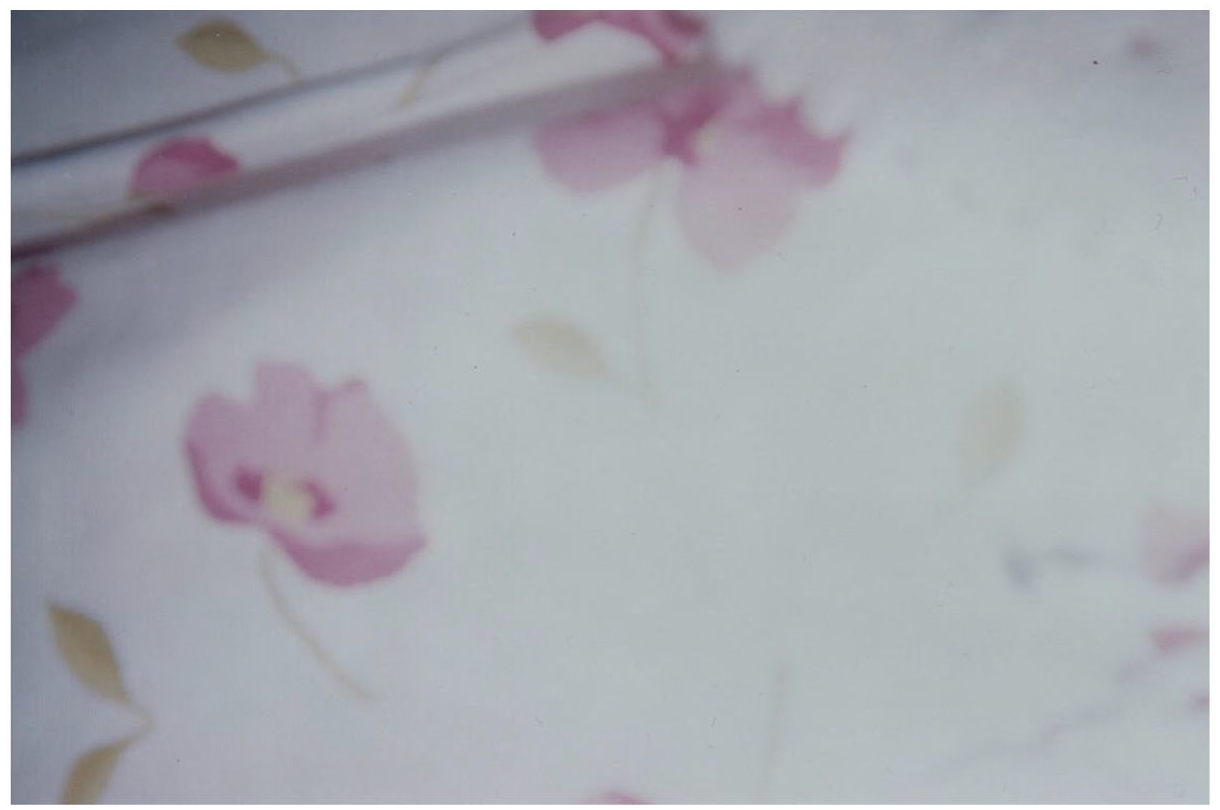
Leah’s rather blurred close-up image of her favourite dress.
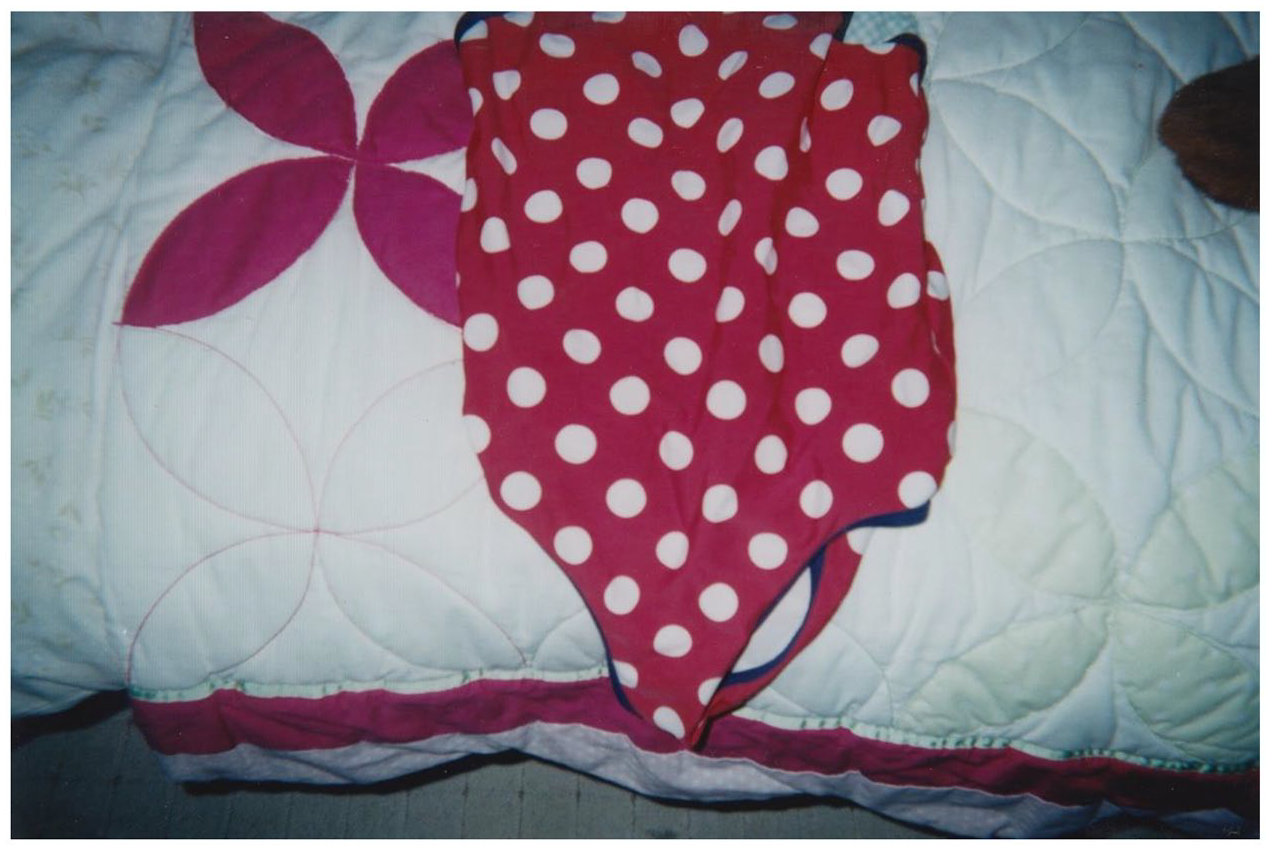
Leah’s photograph with her duvet in, helping to materialise ‘Leah, the rose lover’.
It can also be argued that this relationship between the wearer and the meaning of the tactile, visual, material object of dress is part of reciprocal dialogue between wearer and garments (Sherlock, 2014). We do not exist separately from the material objects of dress; we exist through them. This relationship constantly changes as the girls grow, the feedback from clothes changes and they begin to become uncomfortable. As Hockey and James (2003) assert, time is an abstract concept, which is not easily grasped, yet we still feel ‘its passage and pressure on a daily basis’ (p. 45). Girls were able to feel the passing of time on and through their bodies as the relationship between their clothes and bodies changed. The ‘interrelated temporal dimensions of the past, present and future’ (Hockey et al., 2014: 259) help us to think through who we are. Participants like Leah described how thinking about and trying on shoes, and other clothes that have become too small, enabled the wearer to understand who they were in the present, by orienting themselves in relation to who they had been in the past. For young girls it might be more a pragmatic case of mothers (usually discussed by the girls as being involved in clothing matters) having to find the time to go through the clothing collections with their daughters, working out periodically which garments no longer fit.
‘I Was Very Unfashionable When I Was Younger’: Distancing Yourself From the Past
Dress is important in enabling participants to think about the difference between the past and present, between being younger and their current age. Pilcher (2013) explains how girls may use clothing to ‘age up. . . away from children younger than themselves’ (Pilcher, 2013: 93) and certainly in Focus Group 2 there was a discussion about dressing differently from younger children. However, the girls also wanted to dissociate themselves from their younger selves.
I was very unfashionable when I was younger
Yeah, I wore like baby stuff with ducks on
I used to look like a cowboy when I was younger
. . .
I was really chubby
I have a very embarrassing picture of me on Facebook, I was wearing these cowboy boots, these really baggy huge jeans
These comments suggested that these girls wished to distance themselves from dressing in ways considered infantile. To be young was to be unfashionable and wear babyish clothes; for Georgia that meant to be dressed in masculine, big, baggy jeans (explored further below). In thinking through the relationship between the materiality of clothes and their embodied selves, either through photographs or their memories of wearing particular clothes, they were able to understand the temporal flow of their life course (Hockey and James, 2003: 206). It was through their constructed narrative of comparisons with the past that these girls came to know, and experience, that they were ageing.
A garment’s fabric, fit and embellishments are part of what message about gender or sexuality it is thought to transmit (Woodward and Fisher, 2014), and my study highlights that the cultural category of age can also be examined in relation to the material presence of clothing. During the period of my study ‘skinny’, form-fitting jeans were fashionable for girls; figure-hugging garments are distinctly gendered and are associated with femininity (Entwistle, 2000; Klepp and Storm-Mathisen, 2005), however, tight-fitting clothes were also associated with a particular aged notion of femininity. As discussed earlier, participants understood that various types of bodily practices are linked with older, sexualised femininities; wearing figure-hugging clothes is also associated with teenage fashionability and sexy dressing (Klepp and Storm-Mathisen, 2005). As Hockey and James (2003) argue, discourses of sex and gender intersect with age and it is through restrictions about choice and activities that children come to know that they are ageing (Hockey and James, 2003: 45).
Despite the association of skinny jeans with older sexualities, they were worn by many participants. Notions of the fit of clothes are both socially and culturally constructed (Craik, 1993; Wilson, 2005), and work in terms of oppositions (Wright, 1992), here between masculinity/baggy/young/past and femininity/tight/older/present. These oppositions are made more explicit in this discussion from Focus Group 4:
I’ve changed, my fashions quite changed cos when I was little I used to like love jeans that weren’t tight
Yeah?
I used to hate jeans that were tight and now I do
So why do you all like tight jeans?
Do you mean skinny jeans?
Because with baggy jeans they’re just baggy and just make your legs look massive, they just make me feel comfy
They make me feel pretty
They make me feel slim
As with Georgia, baggy clothing was associated with being younger, however figure-hugging jeans were worn now they are older and care about looking slim and pretty. These girls are exploring how, at their age, it was important to look heterosexually attractive, through form-fitting clothes. ‘Comfy’ was not about the material sensation on the body but about fitting with aged cultural norms of fashionability, femininity and sexuality (Miller and Woodward, 2012). It was not just through memories of the past that girls come to understand their ageing, but an on-going relationship between past and present; we know ourselves because of our ability to compare ourselves with the past (Hockey et al., 2014: 259).
‘It’s For Next Year’: Projecting into the Future
In terms of forthcoming identities, girls also projected forward into the future through their clothing, while simultaneously their clothes acted as bodily reminders of their current immaturity or smallness and therefore of their present temporal position. For example, Lucie (aged 9) referred to the past, present and future as she excitedly discussed her crop-top:
That’s my pretend crop, well it’s a crop-top for next year and they’re my pants.
So the crop-top you said is?
It’s quite comfortable and I wear it at night sometimes
But you said it’s for next year?
Yeah, I wear it to bed. I used to wear it to school but I don’t anymore but it’s for next year if I start needing to wear them
In explaining that the top was ‘pretend’, Lucie seems to imply that it was not meant for her current age but for ageing up at home (as with high heels Pilcher, 2010 and Blanchard-Emmerson, 2017). The crop-top acts as a ritual artefact allowing Lucie to experiment with her future role (Friese, 2001) as an older girl with breasts; there was a projecting into, and an anticipating of, the future, through wearing clothing (Cook and Kaiser, 2004; Wærdahl, 2005). Lucie acknowledges that it was something that she might ‘need’ next year, as she foresees needing to cover and support the breasts she does not yet have (Vincent, 2003). Earlier, the experimentation with an older identity at a socially-sanctioned public occasion was discussed in a loud focus group, here the more intimate experience of bodily anticipation, takes place in the privacy of Lucie’s own home and is accessed via the one-to-one interview with her photographs. This personal, material focus showed that simultaneously the crop-top also reminded Lucie of her current bodily state, her lack of breasts. As Hockey and James (2003) argue, it is a ‘conjoining of our past and our projected selves which produces our current, age-based identity’ (Hockey and James, 2003: 203). That sense of identity was constructed here through the relationship between the clothing and the body, which enables a thinking through of the past, present and future. I would add, in line with Hockey et al. (2014), that the temporal dimension of the embodied and material relationship girls have with dress, demonstrates that the life course trajectory was also not simply experienced as a one way journey, but oscillates between past, present and future. Knowing about crop-tops or having a crop-top to wear at home facilitates girls anticipating the future, while simultaneously gaining awareness of their present embodied state, and recognising that their current self will soon be in the past.
Conclusion
British popular media accounts and government reviews have expressed apprehension about pre-teen girls’ clothing practices, and their uni-directional, speeded-up, movement through time, to becoming prematurely sexualised by their fashion consumption. However, we knew little about how the growing process, or the passing of time, feels to girls or how girls’ clothing practices might engage with socially-constructed notions of age, gender and sexuality. Using sartorial materiality as a lens, this research offers a focus on young girls’ constitution of themselves located in time and on their life course. Participants were aware of sexual generationing and engaged with both gendered and aged expectations of dress, such as childhood innocence discourses (Pilcher, 2013), critiquing and othering perceived age-inappropriate displays of sexuality. My research demonstrates that doing hyper-femininity has a temporal element for girls, subjectivities were not fixed but time-specific, and considered the social expectations of each occasion. There are carnivalesque moments, out of normal time, which enable public displays of what was considered an older, sexualised self, but as the concept of life course suggests, the ‘unpredictable flow’ (Hockey and James, 2003: 203) allowed the return to a present-aged self after the event. Paying attention to the materiality of dress, gave access to girls’ projections into the future through their clothing. Clothes assisted participants to materialise an older identity, and therefore have a sensory experience that allowed them to consider physical changes that their body would go through. Yet, simultaneously these garments also served as reminders of their current bodily lack, of breasts or of height for example; the future and the present are understood in relation to each other.
Current, aged identity is also about the interaction between the present, the projected self and the past (Hockey and James, 2003). My data shows that the relationship between sartorial items and the past was two-fold, girls wished to distance themselves from their younger selves through rejecting earlier fits of clothing, yet sometimes, as previously only seen in research about adults, girls did not want to let go of past selves achieved with certain garments. Girls often wore clothes that they were growing out of, thus materiality in the present was continuously a reminder that it would soon be in the past, and the tightness of these garments acted as sensory prompts of the ageing process. Time is an abstract concept (Hockey and James, 2003) but by focussing on the materiality of dress and its relationship to girls’ bodies, this study shows that what participants wore, enabled them to feel its passing on and through their bodies. This article proposes that it is through their embodied relationship with dress that girls experienced temporality and their own ageing, which was always inflected with gendered expectations. As pre-teens these girls exist in what is constructed as a liminal space, between the age grades of childhood and teenhood, and dress is part of negotiating bodily and materially that life course positioning. It is both through future projections and reminders of the past, facilitated through clothing, that participants came to know their present, aged, gendered and embodied selves.
Whilst the data in this article was limited to predominately white, middle-class girls in the South of England, it suggests the potential of studying other embodied, material relationships with dress, the understanding of temporality and the social practice of time. It implies that researching people’s material relationship with their clothes might be productive in exploring how subjects engage with socially-constructed notions of age-appropriate clothing, and traverse the liminal boundaries between various age grades. This article also indicates the possibilities for examining the ways in which dress practices help to structure time, socially and culturally: day/night, weekdays/weekends, work-time/party-time, on-trend/out of fashion, and therefore our embodied experiences of temporality. Dress may play a role in how we locate ourselves on our life course, through feeling the way our clothes fit on our bodies as we grow older, allowing us to think about the past and consider what we might wear in the future. Combining materiality and life course as a lens to explore people’s understanding of their dress, potentially offers us a window into the ageing process, the interaction between the social, physical, and temporal, and the ways in which we construct our aged identities.
Footnotes
Acknowledgements
Many thanks to Professors Pauline Leonard and Susan Halford for their continued support and advice, and to the reviewers and editors for their comprehensive feedback. Thanks also to UCA for funding my PhD, and to the girls, without whom my research would not have been possible.
Funding
The author disclosed receipt of the following financial support for the research, authorship, and/or publication of this article: UCA funded the doctoral research on which this article is based.