




Abstract
Multiple sociological studies have demonstrated how talk of ‘good’ motives enables people to maintain the presentation of a moral self in the context of stigmatised behaviours. Far fewer have examined why people sometimes describe acting for the ‘wrong reasons’ or choose to qualify, or reject, assumptions that they are motivated by a desire to ‘do good’. In this article, I analyse one such situation: sperm donors who describe being partially motivated by a ‘selfish’ desire to procreate, a motive which these same men frame as morally questionable. I argue that such accounts are explicable if we consider the (gendered) interactional and cultural contexts in which they are produced, particularly the way interactive contexts shape the desirability and achievability of plausibility and authenticity. I suggest that analysis of similar social phenomena can support sociologists in better understanding the complex ways in which moral practices are woven into social interactions.
Keywords
Introduction
The sociology of morality has experienced something of a revival in recent years (see Abbott, 2020; Hitlin and Vaisey, 2010). This ‘new’ sociology of morality explores the (variable and changing) ways in which people enact morality in everyday life. Authors in this field often take a broad view of what constitutes moral practice, arguing that, with varying levels of reflexivity, moral concerns and judgements are embedded in most, if not all, social interaction (Abbott, 2020); even mundane interactions require that we present ourselves as moral actors in order to be seen as ‘proper’ persons and to facilitate participation in social life (Goffman, 1959; May, 2008).
One way in which people ‘do’ morality is by telling stories about themselves and their lives. Within these (intrinsically moral) accounts, people select from the ‘vocabularies of motive’ available (Mills, 1940), in order to explain their actions and decisions, particularly those that might be considered deviant (Scott and Lyman, 1968). Many empirical studies have examined this process of moral accounting in relation to stigmatised actions or identities, such as divorce and single motherhood (May, 2008) and illicit drug use (Monaghan, 2002; Weinstein, 1980). Such studies show that motivation talk (specifically the idea that they acted for the ‘right reasons’) is a key way in which participants excuse or justify the breaking of an established social norm. With a few notable exceptions (detailed later), much less sociological attention has been paid to vocabularies of motive and moral self-presentation in the context of socially accepted, or even highly esteemed, behaviours. Even fewer have examined cases where people report having done something ‘good’ but for the ‘wrong reasons’. This article fills this gap through an analysis of UK sperm and egg donors’ narratives of becoming a donor.
In contemporary Britain, altruism is widely regarded as the ‘right reason’ to donate sperm or eggs and gift rhetoric is common in recruitment literature (Gilman, 2018). It is therefore unsurprising that the 52 egg and sperm donor participants in this qualitative study all described a desire to help as a primary or secondary motivation for donating. However, more surprisingly, a significant (overwhelmingly male) minority also reported a desire to procreate as another motivation. This was widely described by these same men as a morally questionable reason to donate and they recognised that a degree of stigma might be attracted by such statements.
In this article, I show that existing sociological theories of motive and moral accounting do not fully explain this finding, nor similar situations in which people adopt a vocabulary of motive which they expect will be negatively regarded. Building on insights from an interactional relational sociology of morality (Abbott, 2020; Crossley, 2006; May, 2008), I suggest that such social phenomena can be explained if we consider the interactional and cultural contexts in which moral accounts are offered and the ways in which issues of plausibility and authenticity are shaped by these.
Sperm and Egg Donors’ Motivation Talk
The motivations of sperm and egg donors have long been a topic of both public interest and research. Numerous studies, primarily surveys, have asked donors to categorise their reasons for donating, variously concluding that people donate egg or sperm because of a desire to help others, financial incentives, a desire to procreate, to assess their own fertility, or a combination of these factors (see Bracewell-Milnes et al., 2016; Van den Broeck et al., 2013).
Survey reports often treat respondents’ stated motivations as straightforward representations of internal psychological processes. In contrast, qualitative and ethnographic work has examined how narratives of becoming a donor are produced in gendered social and organisational contexts. For example, Orobitg and Salazar’s (2005) ethnographic study of egg donors in Barcelona highlights ambivalence in donors’ accounts of their motivation and demonstrates how these can change over time, for example in response to new experiences and knowledge, such as the labour of donating and the high costs of treatment for recipients. Almeling’s (2011) comparative ethnographic research similarly explores the social organisation of egg and sperm donation in the USA. She finds that, through interactions with clinic staff and recruitment literature, sperm donors are encouraged to think of their donations as a job and to articulate their motivations as financial. In contrast, while they are offered higher levels of compensation, egg donors are expected to articulate an altruistic desire to help another woman. Almeling (2011) finds that, while both egg and sperm donors often report an initial financial motive, over time they come to articulate their motivations in line with the organisationally expected narrative.
Mohr’s work introduces the concept of morality to analyse the accounts of sperm donors in Denmark. His work responds to the plethora of survey studies in this area to suggest we look ‘beyond motivation’ (Mohr, 2014) and examine accounts of donating more holistically, demonstrating how sperm donation offers opportunities for men to enact moral selves, bound up with notions of masculine subjectivity. He highlights that, while sperm donors can often be regarded with suspicion in Denmark, donating also represents the ‘enticement of gender’ – an ability to enact gendered moral subject positions as good fathers, sons and partners (Mohr, 2018). In this article, I take up Mohr’s concern with the enactment of moral selves through narratives of donation. However, I suggest that such an approach is compatible with a focus of motivation, as long as we analyse donors’ accounts of motives as social acts (an approach that I outline below).
Vocabularies of Motive and Moral Accounts
Sociological work on motivation often begins from Mills’ (1940) theory of ‘vocabularies of motive’ which argues that statements of motive should be analysed as social acts, attempts to shape, or assess others’ self-presentation and relationships, not as a direct expression of some inner psychological state. Mills explains that particular actions are associated with different ‘vocabularies of motive’. These are established ways of talking about the reasons people take certain actions and they are ‘situational’ in the sense that different categories of motives (religious, sexual, individualistic, hedonistic, to use some of his examples) may be more or less prevalent or comprehensible in different times, places and in relation to different actions.
In line with an interactional and relational conceptualisation of the self (Mead, 1934), Mills (1940) argues that our knowledge of these available vocabularies forms the backdrop to our own internal dialogue and self-assessment of our reasons for taking (or considering taking) certain actions (see also Crossley, 2006). Indeed, Mills (1940) explains that, if no socially acceptable account of our motives can be imagined in relation to a particular action under consideration, this may well dissuade us from that particular course of action. Knowledge and understanding of our own motives is thus inseparable from the vocabularies of motive which are available to us in particular interactional contexts.
Many scholars have applied the concept of vocabularies of motive to analyse accounts of deviant actions, such as divorce and single motherhood (May, 2008), ‘juvenile delinquency’ (Sykes and Matza, 1957) and illicit drug use (Monaghan, 2002; Weinstein, 1980). These empirical studies examine motive talk as an attempt to ‘account for’ a stigmatised action or identity while maintaining a ‘good’ self-presentation. Following Scott and Lyman (1968), motivation talk is one way in which people excuse or justify deviant behaviours, an attempt to avoid or neutralise potential stigma.
A more limited body of empirical work has applied the concept of vocabularies of motive to actions that are not widely stigmatised but which may require explanation on account of their being unusual or new, for example gym going (Crossley, 2006) ethical consumption (Grauel, 2016) and becoming a foster carer (Doyle and Melville, 2013). This smaller body of work has drawn attention to the ways in which the vocabularies of motive available to actors change over the course of their moral career (Crossley, 2006) and the ways in which people anticipate and distance themselves from potential ‘wrong reasons’ for their ‘good’ actions (Doyle and Melville, 2013). Analyses of ethical consumption similarly demonstrate how narratives of motives are here bound up with the process of constituting oneself as an ethical subject (see Grauel, 2016; Varul, 2009).
However, of particular relevance for this article, is that Grauel (2016) and Varul (2009) both also report instances of participants explaining their decisions to buy ‘fair trade’ or ethical products as motivated by ‘personal taste’ (e.g. they happen to enjoy the taste of fair trade coffee) rather than by an explicit intention to ‘do good’. Both authors explain this finding through the moral imperative upon contemporary consumers to present their choices as an expression of an authentic inner self. It is not enough to present oneself as ‘doing good’, one’s consumption choices must be seen to emerge ‘naturally’ from ‘being good’ (Varul and Wilson-Kovacs, 2008). A vocabulary of motive which centres on personal taste enables this (Varul, 2009).
While clearly sperm and egg donation are very different activities to buying ‘fair trade’, in this article, I also examine a context in which people appear to pass up the opportunity to present themselves as motivated exclusively by the desire to ‘do good’. Specifically, I seek to explain why some donors offer accounts of their motivations as procreative, something which they themselves frame as morally problematic, in a context where ‘helping others’ is widely regarded as the ‘right reason’ to donate. Previous work on moral accounts does not fully explain why people would offer an account of their motives which they expect will be viewed negatively, when alternative socially-valued vocabularies of motive appear to be available to them.
Methods
The data discussed in this article were produced as part of a study at The University of Manchester, led by Petra Nordqvist, which aimed to explore the impact of sperm and egg donation for donors and their relatives, and was approved by a University of Manchester Research Ethics Committee. The study included analysis of UK laws and policies relating to donor conception and interviews with 18 clinic staff (mostly fertility counsellors) and 21 donors’ relatives. In this article, I focus primarily on the 52 interviews conducted with men and women who had donated eggs (n = 25), embryos (n = 1) or sperm (n = 26).
For reasons that were both pragmatic (donors constitute a ‘hard to reach’ population) and theoretical (in order to include a wide range of experiences), multiple strategies were adopted to recruit donors: contacting past donors with the help of staff across three English clinics, using personal and professional networks, advertising via online networks for donors and through support organisations. The overall focus of the project was on donors’ experiences in the context of increased openness and traceability. Consequently, recruitment targeted people who had donated in the UK since April 2005; since this date, all persons who donate in UK licensed clinics must consent to their identity being disclosed to any person conceived from their donation, should they request it after the age of eighteen.
However, as Table 1 shows, participants ‘donation pathways’ varied across a number of dimensions. Although most had experienced or pursued ‘identity-release’ donation, others knew their recipients prior to donating and some got to know recipients for the purposes of donating, via online networks or agencies. A small number had also donated anonymously prior to 2005, or abroad. About half of the sperm donors interviewed had donated outside of clinics, facilitated through online or personal networks. Furthermore, 11 of the egg donors had donated as part of an egg-sharing programme, meaning they had donated half their eggs in exchange for reduced cost IVF treatment for themselves. Many donors had experienced or pursued more than one donation pathway.
Number of donors who had experienced or pursued different donation pathways.
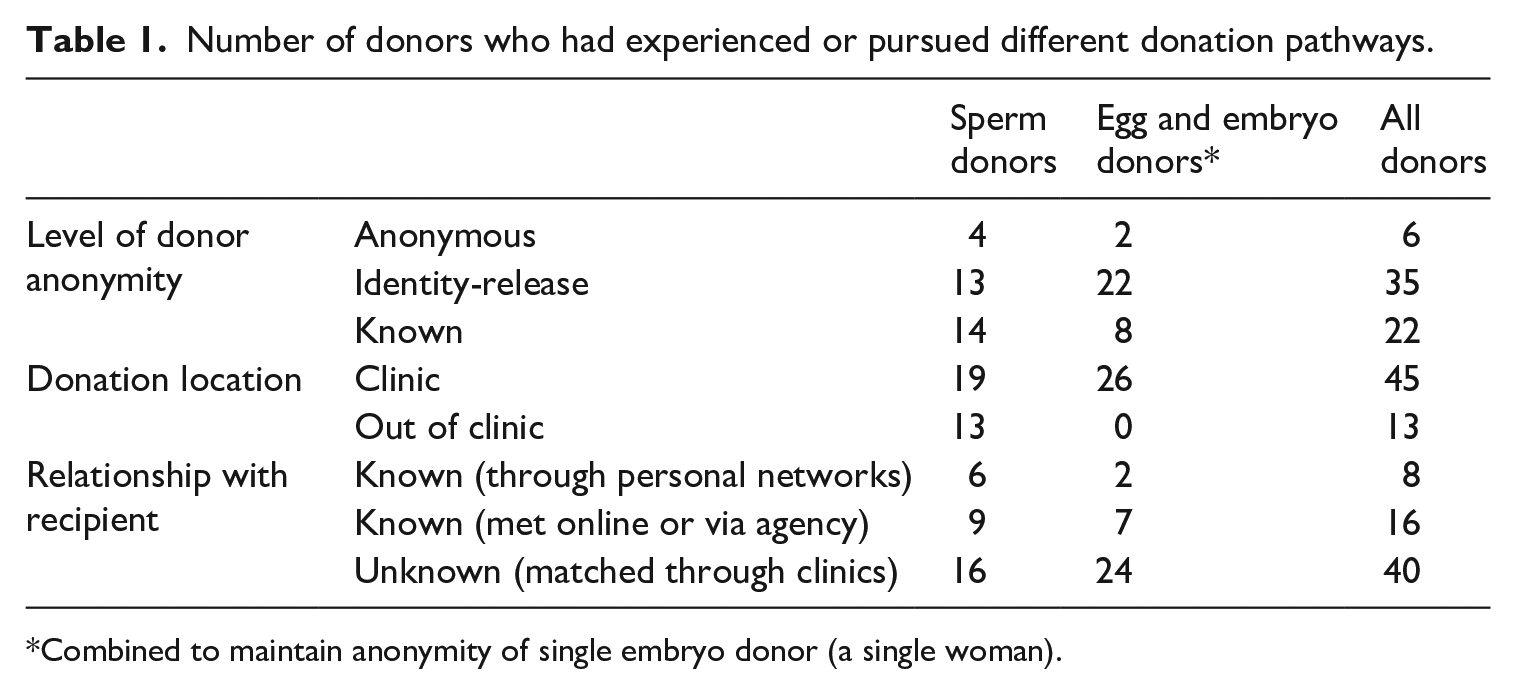
Combined to maintain anonymity of single embryo donor (a single woman).
The sample is diverse in relation to many demographics. Sperm donors aged between 22 and 58 at the time of first donation and egg/embryo donors between 21 and 40. Approximately one third of both male and female donors identified as gay/lesbian or bisexual and the remainder as heterosexual; 31% of male donors and 73% of female donors had their own children at the time of interview and both groups included a wide range of socio-economic backgrounds. However, in relation to ethnicity, the sample is notably white; all donors identified as a white ethnicity except two (both sperm donors) who identified, respectively, as Black and Asian.
The interviews were conducted between 2017 and 2020 and lasted between one and three hours. In the vast majority of cases, interviews were conducted face-to-face and by the author, with a minority conducted by Petra or a research assistant, all women working in academia. Two interviews with donors’ relatives and five with clinic staff were conducted via telephone. Interviews with donors and their relatives were in-depth and loosely structured, allowing participants to tell their donation stories in their own terms and order. A topic guide was used to probe further for areas of interest (e.g. responses of family, experiences in clinics). Interviews with clinic staff were slightly more structured and explored aims and experiences of their interactions with donors.
Interviews were audio recorded, transcribed verbatim (replacing identifying information) and subsequently analysed with the support of Nvivo software to code the data by both descriptive and analytic themes. In this article, I focus primarily on two codes: ‘becoming a donor’ (including a sub-code: ‘categorising motivation’) and ‘being a good donor’ (including a sub-code: ‘good and bad motives’). Interviewers did not ask donors to categorise or morally assess their motives but frequently they did so spontaneously.
Following Mills’ (1940) approach to motivation talk, I examine these stories with a view to understanding the complex social practices donors are engaged in when they talk about their motives, not in order to ascertain donors’ ‘real reasons’ for donating. The sample is not representative of the wider donor population and thus I make no claims as to the prevalence of the motivation narratives described. Nor do I suggest these accounts cover all motivation stories amongst donors. Instead, I seek to explain how interactive and cultural contexts shape those narratives which are not easily explained by existing sociological theories. In this way, I use the findings to refine and build sociological understandings of morality and motivation talk.
The ‘Right Reasons’ for Donating
Both clinic staff and donors described altruism or a desire to help as the ‘right reason’ to donate. If motivated in this way, donation was seen as an admirable act which leads to positive outcomes for both donors and recipient families: My view is that you’re doing it to help somebody, there’s no other reason to do it. Like, if you’re only doing it for a selfish reason, don’t do it. If you’re doing it to make yourself feel better, don’t do it. If you’re doing it for selfish reasons as in. . .‘I’ll donate my eggs, that’ll be great, that’ll make me feel good about myself’, don’t do it because that’s the wrong reason. (Hannah, identity-release egg donor) I think [I] try to put [the donors] into the place of. . . they are doing it because they want to, their motivation is altruistic. . . When we talk about, what are the reasons you are doing this? We talk about the motivation. It is about helping other people. It’s not monetary. (Rita, fertility counsellor)
Both Hannah and Rita approved of donation as a practice which could alleviate suffering. However, their positive assessments rely on an understanding that the donor in question is motivated by a desire to help. The perceived moral good of the act is thus contingent on an altruistic vocabulary of motive and being able to articulate such an account is crucial to being seen as a ‘good donor’ in contemporary Britain.
Altruistic motivations were often presented as self-evidently ‘right’. However, when justified, this was often achieved through, explicit or implicit, opposition to financial motivations (as in Rita’s interview above), which, under UK policies and practices, are discouraged. Although UK clinic donors are usually offered fixed payments (£750 per cycle for egg donors or £35 per clinic visit for sperm donors) or receive reduced cost treatment (as in egg-sharing), clinics are required to present donation as ‘voluntary and unpaid’ and payments must be described as ‘compensation’ (HFEA, 2012). Counsellors raised concerns that donors motivated by payment would be less committed or that they may donate without fully considering, or being comfortable with, the consequences. Financial motives may be regarded as particularly problematic because donors are potentially identifiable; in a previous study with UK identity-release donors, several participants commented that donor conceived people might be negatively affected if they contacted their donor and learned they had donated ‘for the money’ (Gilman, 2018).
Given the policy context, counsellors’ expectations and the ubiquity of gift rhetoric in donor recruitment literature (Gilman, 2018), it is unsurprising that all donor participants included a motivation to help others in their accounts (see also Almeling, 2011; Mohr, 2018; Orobitg and Salazar, 2005): I just like the idea of facilitating people, making people happy. . .that would be my motivation, for improving somebody else’s life. (Ian, known clinic and non-clinic sperm donor) So it seemed like a really easy way to be able to make a difference to those couples who I could help. (Abby, known and identity-release egg donor) It was completely for altruistic reasons, and the primary motivator at the time is, I want to help couples that may not be able to have children of their own. (Vincent, identity-release, clinic sperm donor)
In the statements above, participants (re)produce the vocabulary of motive most valued by clinic staff and their peers and which, the extract from Rita’s interview suggests, were necessary to successfully navigate clinic processes. In contrast with Almeling’s (2011) findings, both male and female donors used this language of ‘helping’ and ‘giving’, including men who donated outside of clinics. In doing so, they construct themselves as ‘good’ donors and moral persons, in line with context-specific ideals.
The ‘Selfish Element’ and the (Masculine) Desire to Procreate
I do not wish to underplay the importance of these narratives of helping in donors’ accounts. However, donors’ motivation stories were usually more complex than the statements above would suggest. Many combined ‘altruistic’ narratives with other (implicitly or explicitly) self-interested narratives of motivation. This was not always the case but, when an additional motivation was stated alongside ‘helping’, egg donors most commonly referenced financial ‘bonuses’ (see also Gilman, 2018) whereas sperm donors tended to talk about a desire to procreate. A similarly gendered pattern of combined motives was observed in Nelson and Hertz’s (2017) recent comparative survey of egg and sperm donors in the USA.
These ‘selfish elements’ are my primary focus in this article and I analyse them with a view to developing sociological theories of motive and moral accounts which can account for their articulation. I focus specifically on the procreative motivations, most commonly articulated by men, precisely because there is no clear reason why participants might have felt compelled to articulate such motives (in contrast with financial motives, which donors might feel are implied by accepting payment). Thus, it offers an opportunity to examine why people may articulate poorly regarded vocabularies of motive when others are, seemingly, available.
Half of the sperm donors interviewed (13) clearly identified a desire to procreate as a partial reason for donating, variably described as a primary motivator or secondary consideration: I thought. . . I’m in my mid-thirties, single, I don’t have any children. Am I ever going to have any children? Well, maybe I should, you know, leave a legacy behind. Because I’m the only one that could carry on, because my sister hasn’t got any kids. She doesn’t want kids, and it’s just the two of us. (Kyle, known, non-clinic sperm donor) But from a purely evolutionary point of view, I think we all do have a little bit in us, that drive to procreate. So that would be the 10% or 5% in me that’s wanting to do this. (Gavin, known, non-clinic sperm donor)
The vast majority of men who articulated procreative motivations were non-parents at the time of their donation and they usually related this motive to an expectation (or concern) that they might never have children. Donation was presented as either an ‘insurance policy’ against not achieving, or an alternative to, ‘real’ fatherhood, enabling the fulfilment of a desire to procreate, while not becoming a parent in the more established sense of the word.
Like Gavin, these donors framed the desire to procreate as ‘natural’ or ‘biological’, with words such as ‘drive’, ‘instinct’ and ‘urge’ used frequently. Procreation was sometimes presented as a familial duty, usually to their parents (though in one instance to his late wife), to have children (see also Mohr, 2018). While no sperm donor specifically identified this as a masculine drive, a notable minority of sperm donors drew on emblems of hegemonic masculinity to explain their desire to ‘leave a legacy’: Soldiers in Afghanistan. . . they think tomorrow I can get blown up so I might as well become a sperm donor and reproduce that way. So at least, if it does happen, I can leave something behind. I can actually relate to that because psychologically I went through something similar. (Michael, identity-release, clinic sperm donor)
A military analogy was used by two other donors. Others referenced extreme sports or driving fast cars to explain their reasoning. The ability of male donors to frame their procreative desires as an, implicitly masculine, ‘natural’ drive was perhaps enhanced because they were always in conversation with a female interviewer, a gendered subject position from which it is arguably more difficult to challenge such claims.
In comparison, only two egg donors said their motivations included a desire to procreate (one of whom referenced this motive very briefly as ‘silly’). Another, Beth, spoke of her desire to ‘pass on her genes’; she self-mockingly described her motivation as ‘yeah let’s populate the world with my genes’ which, she added, was ‘a bit unusual for an egg donor. . . . . more of a sperm donor type attitude’. Beth thus explicitly identifies this as a masculine vocabulary of motive.
The Complex Relationship Between Gender and Morality
The finding that procreation is a more readily articulated motivation for sperm donors than egg donors makes sense in the context of gendered frameworks for understanding reproduction and parenting. Delaney (1986) argues that Western understandings of reproduction frequently emphasise a man’s role as genitor and the male body as a transmitter of genetic material (p. 510). Sperm is often framed as a fertilising agent in contrast with eggs which are instead described as passive and women’s bodies framed primarily as gestators and nurturers (Hayden, 1995; Martin, 1991). The transmission of genetic material is then ordinarily understood to be a key aspect of what it means to reproduce as a man, something which tends to be downplayed for women. Hence sperm donors are more likely to understand themselves as ‘leaving a legacy’ and performing this recognisable and valued aspect of masculinity by procreating. For men, ‘passing on’ one’s genes is a ‘natural’ and expected (though, as I will go on to show, not necessarily approved) desire. Women who adopt this vocabulary of motive recognise that they may be perceived as ‘silly’ or ‘unusual’ for doing so.
Differing moral expectations of mothers and fathers perhaps also make procreative motivation talk more risky for egg donors to adopt (Almeling, 2011). Academics in parenting studies have noted a shift in recent decades to an ideal of ‘intensive motherhood’ (Hays, 1998) in which mothers are expected to devote increasingly large proportions of time, money and emotional energy to the care of their children. Being seen as a ‘bad’ (May, 2008) or absent (Morriss, 2018) mother has such stigma that it is almost impossible for women to be seen as a ‘good person’ if so perceived. Although these ‘intensive’ ideals are increasingly expected of fathers too, research suggests that, where they fail to live up to such ideals, fathers are able to insulate themselves from ensuing moral anxiety through reference to alternative moral norms of autonomy and independence (Ribbens McCarthy et al., 2003; Shirani et al., 2012). The stigma of ‘bad motherhood’ helps explain why so few egg donors adopted a narrative in which they valued genetic motherhood or procreation because to present themselves as any kind of mother to their donor offspring could risk such censure.
In the context of these gendered ideals and expectations, we could read sperm donors’ appeals to a ‘natural’ (masculine) desire to procreate as a way of accounting (or specifically, justifying, to use Scott and Lyman’s (1968) terminology) a stigmatised act of sperm donation. This is similar to Mohr’s argument that sperm donation is ‘positioned as morally acceptable. . . through the enticement of gender’ (Mohr, 2018: 48).
However, while I accept the ‘enticement of gender’ as a partial explanation of these findings, I do not find this reading satisfactory in isolation because it relies on an understanding that 1) the act of donating sperm is necessarily what is stigmatised and 2) the ‘natural’ desire to procreate is understood to neutralise this stigma. This does not fully reflect participants’ narratives. In fact, donors very rarely questioned the morality of sperm donation, as an act in itself. Although some reported occasional negative reactions from others, this was often associated with assumptions about their motives. Whilst in past decades sperm donation may have been viewed as intrinsically wrong through associations with adultery and masturbation (Haimes and Daniels, 1998), findings from this study (including Rita and Hannah’s words, cited earlier) suggest that in contemporary Britain it is particular motives which are portrayed as ‘wrong,’ rather than the act itself. In addition, while expressing procreative motives did enable sperm donors to enact certain elements of hegemonic masculinity, as I will now demonstrate, their accounts positioned such motives as having (at best) an uneasy relationship with what is ‘good’ or ‘right’.
While on the one hand, sperm donors often presented the desire to procreate as ‘natural’, as a motive for donating sperm it was also often framed as morally questionable (certainly less straightforwardly ‘good’ than the desire to help others): But there is also the selfish element which is I want kids, what if it doesn’t happen? So it was a backup policy. (Nicholas, identity-release, clinic sperm donor) So, it’s kind of like leaving a legacy, isn’t it? Because I’m not really a maternal person, or I didn’t think I was. So, I thought I’ll be a donor. So I probably was a bit selfish in the beginning. And then when I started to get updates and photos and stuff, I realised what it actually meant to people and how happy I was making them. (Kyle, known, non-clinic sperm donor)
In these extracts, Kyle and Nicholas are fairly offhand in categorising their procreative motives as ‘selfish’ but implicitly oppose them with more altruistic ‘elements.’ However, donors could also be more critical in their moral self-assessments. Nicholas, for example, later described his (Darwinian) desire to ‘get his genes out there’ as ‘the dark side. . . of sperm donation’. Carl, who did not wish to be quoted directly, compared his desire to continue donating (and therefore procreating) to being addicted to heroin. Fred similarly judged his own procreative motives in strongly negative moral terms and, in his case, also expressed considerable guilt about having donated for these reasons: I don’t know how many people admit it in interviews and. . . it’s all about altruism. I don’t think it is all about altruism. I think it is an urge to leave something behind. That makes me sound like a terrible egoist
Both Fred and Nicholas told me that other participants would not admit these ‘darker motives’ but they would also have felt this way. They thus suggest this is a motive few will articulate because doing so is perceived to undermine the speaker’s moral self-presentation.
Procreative motives were also stigmatised by those sperm donors who actively rejected them, presenting such motives as narcissistic or associated with a predatory sexuality. Louis, for example, distanced himself from other (hypothetical) sperm donors who were motivated by a desire to ‘spread [their] seed’. Oliver explained that he was not ‘trying to create little Olivers’.
In this context, where procreative motives are categorised as ‘selfish’, or even ‘dark’, and often associated with a toxic hyper-masculinity, such vocabularies of motive cannot straightforwardly be read as an attempt to justify or excuse the breaking of a social norm, because it is the voicing of such motives (more than the act of donating) which is framed as deviant.
The Need for a ‘Selfish Element’
Of course, this raises the question: why do men frame their reasons for donating in this way? If we understand motivation talk as a social act of moral self-presentation (Mills, 1940) such statements are puzzling. These interviews were confidential, one-to-one conversations. All of these participants were unknown to the interviewer who had no ability to verify their stories. Seemingly, all participants had free reign to present their reasons as entirely ‘right’, in line with the narrative widely expected of ‘good donors’ in contemporary Britain. Why qualify their accounts of wanting to help others with ‘a selfish element’?
I offer two inter-related explanations for this finding: 1) the need to offer an account which will be viewed as plausible by others, and 2) a desire to articulate an account which feels authentic. The desire and ability to achieve both plausibility and authenticity are shaped by the interplay between specific interactional and wider cultural contexts.
Plausibility
In most situations, donors need to offer an account of their actions which is not just socially acceptable but also plausibly moral. If others do not regard their account as believable then it risks being rejected (either openly challenged or privately disbelieved).
In an individualistic, neoliberal society, such as the UK, claims to be acting for ‘purely altruistic’ reasons may be viewed with suspicion. Shaw’s (2019) analysis of medical professionals’ responses to non-directed kidney donation is here instructive. She finds that those who offer to donate a kidney to someone they do not know (or know well) are often viewed as either pathological or unbelievable. Medics might question the psychological well-being of these donors or whether they are being secretly paid or coerced into donating. Fertility counsellor participants in this study sometimes raised similar concerns regarding known egg donation, particularly when recipients and donors were only loosely acquainted. Consequently donors might have expected a degree of cynicism in relation to a purely altruistic vocabulary of motive, particularly if donating to someone they did not know well.
Enduring stereotypes mean sperm donors are particularly likely to anticipate such responses. Most sperm donors in this study were aware of the public image of a sperm donor as a young man seeking ‘beer money’ (Thompson, 2008) and many had encountered assumptions from friends or acquaintances that they were ‘doing it for the money’. As previously discussed, being categorised in this way is problematic in the context of UK policies and clinic practices. While findings from this, and previous (Gilman, 2018; Nelson and Hertz, 2017), studies show that egg donors often express a combination of financial and altruistic motives, this combination is perhaps less plausible for sperm donors, for whom the expression of financial motives conjures the stereotype of this casual, ‘beer money’ donor. By claiming an alternative ‘selfish element’ to their motivations, sperm donors render their account as a whole, including the ‘altruistic bit,’ more plausible and avoid being (privately) viewed as this ‘type’ of financially motivated donor.
Furthermore, when sperm donors articulate a procreative motive, they select and reject particular aspects of this narrative. Men who expressed this motivation often used ‘defensive othering’ (Schwalbe et al., 2000), distinguishing their (‘natural’ and moderate) version of this desire from other men’s extreme and pathological desires to reproduce: [My recipients] were. . . being approached by really dodgy guys. . . I think [they] got off sexually on the fact that they were donating sperm to lots of people. So. . . because you know, I didn’t approach anybody I just put the profile up and waited for people to contact me. But they said they were having lots of messages off dodgy guys wanting to donate and it’s like an ego thing for them, I think. (Gavin, known, out-of-clinic sperm donor)
Although Gavin previously reported a ‘drive to procreate’ as a partial reason for donating, he differentiates his own motives from others’, who are perceived to take sexual pleasure from, what he frames as excessive, reproduction. This distinction is underlined by highlighting his passive approach to finding a recipient and (later in the interview) by his intention to donate only to one couple.
The gendered subject positions of donors are thus important in shaping how they achieve plausibility in their moral accounts. However, this is just one aspect of the interactional contexts in which these accounts were produced. Since the interviews with donors were face-to-face, relatively unstructured and conducted in informal settings (mostly cafes or donors’ homes) they were subject to many of the same interactional norms that we encounter in everyday conversation with strangers. Abbott (2020), drawing on Goffman (1959), argues that this a key context in which we ‘do’ morality, for example, by keeping conversations going and avoiding others’ embarrassment. At this micro level, the introduction of ‘selfish’ motives into narratives of ‘helping’ can be interpreted as an attempt to avoid implicitly criticising the interviewer for not having donated. Furthermore, a solely altruistic account might have been seen as inviting praise, something which again violates the norms of everyday conversation (particularly in the UK) but also, importantly, could risk undermining the solely altruistic narrative because the desire for praise could then be perceived as the ‘real’ motivation for donating. Somewhat paradoxically then, the inclusion of a ‘selfish element’ in a motivation story can be understood as a performance of modesty and kindness and therefore as a narrative device which bolsters the credibility of a primarily altruistic account of one’s motives.
Authenticity
Thus far, my analysis may give the impression that I view participants as acting very cynically – consciously assembling the most plausibly moral motivation story they can get away with. This is not my interpretation. While I recognise that people will give consciously fabricated or limited accounts of their motives in different contexts, there is good reason to view these donor participants as striving to offer an authentic account. This does not mean I view their accounts as representative of a singular truth about why they ‘really’ donated. Instead, I suggest they are seeking to offer an account which was viewed by themselves as a plausible account of the reasons they donated, and not just one which would be believed by others.
An ethic of authenticity has been linked to modernity and a culture of individualism (Taylor, 1992). In such a context, ‘being true to yourself’ may be viewed as a higher ethic than achieving ‘respectability’ through following social norms. This chimes with Grauel’s (2016) finding that being perceived as authentic in their consumption decisions was more important for consumers, than being seen to have bought ‘responsibly’. In donors’ narratives, there is also evidence that they wanted to feel (and not just appear) that they were offering an authentic account, and this helps to explain why some chose to adopt vocabularies of motive which they expected would be viewed negatively.
The evidence that (in certain contexts) donors value the ability to experience and not just be perceived as, offering an authentic account is clearest in accounts where donors report actively rejecting a socially valued vocabulary of motive. Such discussions happened most frequently for egg donors who were more likely to be told by friends or family they were ‘altruistic’ or ‘inspirational’ (as Becky responds to below) but they also feature in Aiden’s account of visiting the clinic: No, I’m not remotely inspirational. I had the opportunity to do something and get what I wanted, and it worked for everybody, which is wonderful. (Becky, egg-share, identity-release donor) So they [clinic staff] were like ‘wow it’s a really good thing that you’re doing’, and it’s really sort of altruistic and all these things. And I said ‘well I’m sure it is but I’m actually doing it for selfish’. . .well for my own reasons anyway, not selfish ones, but for my own reasons. (Aiden, identity-release, clinic sperm donor)
Here, Becky and Aiden are offered an account of their motives as highly moral, very much in line with the ‘right reasons’ encouraged. However, both choose to explicitly reject this interpretation, both in the course of the original interaction and again in their recounting to me. Both instead present a narrative of their motives as self-interested (though notably not selfish).
These excerpts demonstrate that it is not always sufficient for one’s motivation narrative to be viewed as plausibly moral by the others we are speaking to. At least in certain interactions, we also aim to give a moral account of our actions which is plausible to ourselves, one that we experience as authentic. Authenticity, in this case, does not mean identifying and expressing a pre-linguistic, pre-social drive behind our actions (although it is possible that we experience it that way). Starting from an interactional view of the self (Mead, 1934), in which our sense of self develops through interaction with others and reflection on those interactions, I instead suggest that it is through telling stories, and imagining telling stories, to (both specific and generalised) others about our actions and motives that we develop an understanding of our own desires and drives (Crossley, 2006). An authentic vocabulary of motive is one that we find plausible in our internal dialogue, one which offers coherence with the stories we tell ourselves about the kind of person we are and which we could imagine telling, and being accepted, by others who know us well. Through this process, the factors which shape the plausibility of particular vocabularies of motive during interactions with others (e.g. cynicism about ‘pure’ altruism) also shape how people understand their own ‘real’ motives.
Of course, it is impossible to know to what extent participants aimed to offer an authentic account of their actions during interviews. However, aspects of their story-telling suggest that the interview context is one in which they experienced a moral imperative to be authentic. This becomes apparent when participants frame statements as disclosures not widely shared (e.g. Fred, above) or in the use of phrases such as ‘to be honest’. It is also evident in exchanges whereby participants would carefully ponder their own past thoughts and feelings in response to an unexpected question, often explicitly stating that the interviewer had ‘got them thinking’ and enacting a process of self-reflection.
Arguably, the interview context is one which valorises not just authenticity but also a confessional narrative. Being a ‘good’ interview participant, particularly as part of an in-depth qualitative study, means engaging in personal reflection and disclosing aspects of the self that may be hidden from others. Such expectations are perpetuated in standard practices of confidentiality; the implication is that disclosures will (and should) be made but these will be kept secret.
Conclusion
Most sociological work on ‘vocabularies of motive’ (Mills, 1940) has focussed on contexts where people offer ‘good’ reasons for deviant actions. Far fewer studies have examined situations in which people reject, or qualify, socially valued motives in favour of those less highly esteemed. This is something which can be observed in everyday interaction but is not well accounted for in existing sociological theories of motivation talk.
In this article, I have analysed one such situation: sperm donors who articulate a stigmatised motive (procreative desire) for donating, in a context where ‘helping others’ is widely regarded as the ‘right reason’ to donate. Using this example, I have argued that the articulation of negatively-regarded motives is explicable when we view actors as adopting a vocabulary of motive, or combination of motives, which are plausibly moral. The plausibility of any particular motivation story is shaped by both the specifics of the interaction (who is talking to whom and in what context) and wider cultural norms and expectations relating to the actor and action described. Of particular relevance for donors is a widespread cynicism, in neoliberal secular societies, regarding the possibility of ‘pure’ altruism towards strangers, gendered frameworks for understanding reproduction and stereotypes of sperm donors as donating for ‘beer money’.
I have also shown that the moral norms applicable to different interactions shape how plausibility can be achieved in a person’s motivation story. For example, violating the norms of everyday conversation by being seen to invite praise from one’s conversational partner may undermine the plausibility of a solely altruistic vocabulary of motive. Attention to the interactive context also requires an examination of the extent to which actors are subject to an ‘ethic of authenticity’ and thus experience a moral imperative to convey a motivation story which feels plausible to themselves and not only to others.
My analysis therefore demonstrates that, in the context of specific interactions, people are ‘doing’ morality in relation to multiple dimensions at once. In the case of donors, their narratives are oriented not only towards presenting oneself as plausibly moral in relation to their decision to donate, but also as ‘good’ conversational partners and ‘authentic’ research participants. Understanding this multiplicity helps to explain the changing, complex and sometimes surprising motivations people express in different interactions.
Future empirical research which explores these kinds of social phenomena, in which people appear to pass up opportunities to present their motives (and themselves) as entirely ‘good’, offers opportunities to understand the complexity of everyday moral practice. Studies might focus on situations where people offer ‘wrong’ or ‘amoral’ reasons for doing something widely regarded as ‘good’ or interactions where people decline to excuse or justify their ‘bad’ behaviours. These interactions may involve practices of confession, apology, modesty, self-parody and self-deprecation, practices which sociologists must analyse in order to understand the complex, sometimes contradictory, ways in which moral practices are woven into our social lives.
Footnotes
Acknowledgements
First and foremost, I would like to thank the participants in this study who gave up their time to support the research, as well as the many staff at clinics and other organisations who helped us to contact donors about the study. I would also like to thank Petra Nordqvist, Vanessa May, Owen Abbott, Alex Bridge, the editors and two anonymous reviewers for insightful feedback on a previous drafts of this article and the ideas expressed within. I would also like to thank Luciana Lang for her important contributions to data collection on this project This article is based on data collected as part of the Curious Connections study (PI: Dr Petra Nordqvist) and is funded by the Economic and Social Research Council.
Funding
The author disclosed receipt of the following financial support for the research, authorship, and/or publication of this article: I gratefully acknowledge funding from the Economic and Social Research Council (grant number: ES/N014154/1) which enabled the research reported in this article.
