




Abstract
In response to criticisms of whiteness and the privileging of middle-class South African experiences over the black majority and those in poverty, Johannesburg Pride expanded from a one-day event to include a ‘Lifestyle Conference’ in 2018. This article argues that rather than including broader South African LGBTQ+ experiences, rights and needs, the conference centred privileged and normative ‘lifestyles’ and emphasised individual agency, rather than making intersectional inequalities visible and a basis for collective action. Drawing from ethnographic research at Pride events, and interviews with Pride organisers and LGBTQ+ activists, this article builds on critiques and insights from social theory to analyse Johannesburg Pride’s Lifestyle Conference; its aims, politics, marketing and messages. By exploring the raced and classed exclusions of Johannesburg Pride, this article addresses key gaps in the academic literature on Pride, and traces how the lifestylisation of LGBTQ+ identities obscures inequality and contributes to the neoliberal co-option of Pride.
Introduction
There are members of the LGBT community [in South Africa] who are quite comfortable, blacks, whites, Indian, coloured . . . expat. Quite regular. Comfortable. Normal! Professional. Two-income households, fancy houses, fancy holidays. Adopting children, getting married, going out to dinners. Very, very normal lifestyles! So . . . there’s no one catering for that. When we looked at the Lifestyle Conference, we did that with the express purpose of saying, where are the gaps? (Kaye Ally, organiser of Johannesburg Pride, interview with the author, 4 October 2018)
Johannesburg Pride has been the focus of controversy and division for most of the post-apartheid period, and in particular since the 2012 parade was disrupted by black lesbian and gender non-conforming protestors (Milani, 2015; Scott, 2017). These divisions mirror broader socio-economic, spatial and ethnic tensions in South African society, but also reflect divergent beliefs about the purpose of Pride; who it should represent and what issues it should engage with. As shown above, the organiser Kaye Ally’s explanation of the Lifestyle Conference indicates Johannesburg Pride is premised on a very particular understanding and representation of LGBTQ+ lifestyles. A representation that is at odds with the reality of the majority of LGBTQ+ experiences in contemporary South Africa. This article engages with the politics of Johannesburg Pride by exploring the framing and significance of the ‘lifestyles’ constructed and catered for by Johannesburg Pride, considering them in relation to broader trends in the LGBTQ+ Pride movement, LGBTQ+ rights in South Africa and as a significant manifestation of ‘lifestyles’ and ‘lifestyle projects’ (Bell and Binnie, 2000; Giddens, 1991). To paraphrase Butler (2010): the Lifestyle Conference identifies ‘whose lifestyle matters’ in relation to a nexus of corporate, media and LGBTQ+ interests in South Africa and, by omission, whose does not.
This article also contends that research on Pride, with its international importance to LGBTQ+ politics and activism, needs to engage more fully with social theory. To date, Pride’s incorporation into broader neoliberal discourses and processes, its co-option by corporate elites and state agencies, and its transformation into a site for blithe celebrations of ‘diversity politics’ (Ahmed, 2012) has not been a focus for academic analysis. I argue that this is a matter of concern, as the co-option of Pride creates alternative narratives that displace the reality of LGBTQ+ lives. It distracts from ongoing discrimination and violence, and removes the possibility for intersectional understandings of oppression and exclusion. As the organiser of Johannesburg Pride’s justification for holding a Lifestyle Conference makes clear, the event intended to cater for ‘two-income households’ with ‘fancy houses, fancy holidays! Adopting children, getting married, going out to dinners. Very, very normal lifestyles!’ (interview, 4 October 2018). This centring of privileged lifestyles follows broader trends in Pride events internationally (Ward, 2008), but is particularly out of place in Global South contexts, such as South Africa, where ‘normal lifestyles’ do not include ‘fancy houses’ and ‘fancy holidays’.
This article begins by explaining the research methodology and continues by discussing previous work on Pride. It then introduces the concept of ‘lifestylisation’, before discussing the tense politics of Johannesburg Pride. The framing of an exclusive and gentrified LGBTQ+ ‘lifestyle’ at Johannesburg Pride is then analysed in relation to broader tensions and debates about precarity, marginalisation and race in post-apartheid South Africa. Analysis of the ‘lifestyles’ offered at the Lifestyle Conference relates not only to Johannesburg Pride, but also to broader conceptual debates about lifestyles in late-modernity, individual agency and reflexive projects of the self, and Pride and LGBTQ+ rights discourses internationally. By exploring the raced and classed exclusions of Johannesburg Pride, this article addresses key gaps in the academic literature, and traces how the lifestylisation of LGBTQ+ identities obscures inequality and contributes to the neoliberal co-option of Pride.
Methodology and Data
LGBTQ+ activism in South Africa is enmeshed with the country’s history of racism and the Liberation Struggle against apartheid (Conway, 2009, 2016; Gevisser and Cameron, 1994). Consideration of embedded structural, societal and cultural contexts is therefore essential when researching social and political activism in South Africa. In this article, I adopt an interpretive approach, using critical theories on race and sexuality, and situating activists’ accounts in the broader historical, social and spatial realities of South Africa. The controversial history of Pride in Johannesburg results in contradictory accounts of Pride, which poses challenges for interpreting interview data. As Blee (1993: 598) writes, interview evidence about social activism can be ‘at once revelatory and unreliable’. In South Africa, activist self-narratives can reproduce discourses of privilege and of ignorance about broader socio-economic conditions, histories and needs (Conway, 2016). Conflicting accounts about Johannesburg’s Prides can appear to be a war of words between activists, and between the different Pride events held across the city (Van Niekerk, 2017). However, these disagreements and criticisms are not merely interpersonal. They stem from contentious histories of protest that themselves draw from underlying social divides.
Reflexivity when conducting and interpreting qualitative research becomes particularly important when researching in contentious socio-economic and political contexts (O’Reilly, 2012: 219). As a white, British-born male, I have written elsewhere about the complex raced, classed and gendered dynamics of these identities in South Africa and how they inform the co-construction of interview narratives (Conway, 2008). While I was often one of the only white people at Pride events, it was my identity as a researcher that most strongly mediated interactions. A shared critical perspective on race in South Africa seemed to enable rapport with black activists, but perception of me as a critic appeared to cause defensiveness and some tense interactions with the organiser of Johannesburg Pride. As an LGBT-identifying researcher, participants responded readily to requests for access, and interviews often combined gathering information with discussing and sharing perspectives on and experiences of Pride, LGBTQ+ rights in South Africa and elsewhere.
The article draws from interviews with Pride organisers and LGBTQ+ activists in Johannesburg, and from ethnographic participant observation at Johannesburg Pride. I interviewed the organisers of Ekurhuleni, Soweto and Johannesburg Pride, LGBTQ+ activists and members of the Gay and Lesbian Archives (GALA) in Johannesburg. A research assistant (Jamie Martin) undertook participant observation and took field notes at the Lifestyle Conference and at Johannesburg Pride. Transcripts from these semi-structured interviews were coded for common themes and interpreted in triangulation with field notes, media accounts of the events and photographs. This enabled the situating of activists’ claims in context to disentangle partial narratives, fictions and realities.
Pride
Pride is widely considered to be the most significant social movement for LGBTQ+ visibility and community building, and the primary platform to campaign for social, political and legal change (Ammaturo, 2016; Browne, 2007; Bruce, 2016; Formby, 2019; Johnston, 2005; Peterson et al., 2018). Initially, and commonly, organised as a parade, Pride has been described as a set of ‘foundational rituals for LGBT movements across the globe’, which ‘act as collective responses to oppression, encourage redefinition of the self, and express collective identity’ (Peterson et al., 2018: 17). Many Prides have expanded from a parade to include after-parties, music festivals, conferences, film festivals and corporate diversity events, and have become major tourist events for their host cities. Pride’s expression of celebration, colourful display and street theatre have been considered integral to its political purpose; Pride being a ‘party with politics’ (Browne, 2007) that challenges cultural and social norms and enables political and legal change (Bruce, 2016).
The majority of academic literature on Pride characterises it positively, overlooking or minimising critiques of raced, gendered or classed exclusions, and making strong claims for its transformational social, cultural and political impacts (see Browne, 2007; Bruce, 2016; Kates and Belk, 2001; Peterson et al., 2018). However, this can belie underlying tensions and controversies, which have arisen around issues such as the role of state institutions in Pride; the replication of divisions of class, race and gender; and disagreements about the balance between celebration and protest. These omissions are due to the relatively limited scope of Pride research to date, which has been predominantly in metropolitan North American and European contexts, with conclusions drawn from western-centric viewpoints.
The involvement of business in Pride is also debated. Some researchers argue that the benefits to Pride outweigh any drawbacks of commercial involvement (Bruce, 2016; Kates and Belk, 2001), whereas others including Ward (2008) and Schulman (2012, 2013), along with a number of grassroots queer activist groups, such as the Reclaim Pride Coalition (Kilgannon, 2019; Reclaim Pride Coalition, n.d.), are critical of the commercialisation of Pride, arguing it locates Pride on axes of privilege that obscure queer precarity. This division in the literature reflects a second deficit of existing research on Pride, which while richly detailing local experiences and impacts of Pride events, does not seek to analyse these in terms of their macro-social or political implications. This article therefore does not focus on participant experiences, but instead examines how the lifestylisation of LGBTQ+ identities at Johannesburg Pride obscures inequality in South Africa and contributes to a broader neoliberal co-option of LGBTQ+ identities.
Criticisms of Pride also reflect broader debates about normative shifts in LGBTQ+ activism and the positioning of certain LGBTQ+ individuals as consumers. For Schulman (2013), LGBTQ+ activism has been subject to forms of spatial, cultural and political ‘gentrification’, reproducing norms of respectability that are framed by capitalism, class privilege and whiteness. This process of gentrification erases knowledge of previous queer activist struggles, and the communities they served, and prevents consideration of inequality and social injustice in LGBTQ+ advocacy. Similarly, Duggan (2004) analyses how the creation of a new ‘gay normality’ is part of a broader neoliberal process of dismantling radical queer, anti-racist and feminist politics and replacing it with a ‘homonormativity’ that reproduces neoliberal norms of market-based equality. This defines LGBTQ+ subjects as consumers in markets for advertising and consumption, where new legal rights and protections, such as same sex marriage, deliver these market opportunities (Duggan, 2004). While this process of gentrification and neoliberal LGBTQ+ inclusion began in the Global North, it has expanded internationally with the advance of LGBT rights, the spread of global popular culture and LGBTQ+ themed advertising by transnational corporations. I contend that the commercialisation of Pride is one aspect in the broader reframing of LGBTQ+ subjectivities, rights and political activism along neoliberal lines, and this raises significant implications for the possibilities for intersectional understandings of oppression, the erasure of histories of queer protest and the ability for activism to challenge inequality.
LGBTQ+ Lifestyles and Lifestylisation
Using the language of ‘lifestyle’ to frame LGBTQ+ identities and lives evokes particular forms of privilege and exclusion, and intersects with broader debates about individual agency and identity in social theory. Here, I adopt Featherstone’s (1987: 55) definition of lifestyle that includes an individual’s everyday habits, practices, tastes, consumption choices, leisure activities, dress and speech, defining ‘individuality, self-expression, and stylistic self-consciousness’. As such, ‘lifestyles’ can be considered as premised on and expressing forms of privilege. For example, ‘lifestyle migration’ applies to relatively privileged western migrants emigrating in search of a ‘better lifestyle’, as opposed to migrants driven by poverty and desperation (Benson and O’Reilly, 2009). For Giddens (1991: 52–55) and Beck (1992; Beck et al., 1994), the comparative wealth and education of western societies, alongside consumer economies of choice, have enabled individuals to craft their own lifestyles through a ‘reflexive project of the self’. These ‘consumer lifestyles’, make self-presentation a project of individual choice where ‘identity is an activity of aesthetic self-fashioning or creative improvisation’ (Binkley, 2007: 112). This claim of individual agency over lifestyle, and the contrasting pressures to conform and ‘choose’ a normative lifestyle, has been criticised for opening ‘new realms of injury and injustice’ (McRobbie, 2008: 19). This injustice is engendered through obscuring structural barriers to individual agency, unfairly distributing responsibility for decision making on the most marginal and least affluent and for undermining collective movement politics, particularly feminist, anti-racist and LGBTQ+ politics (Binkley, 2007; Binnie and Skeggs, 2004; McRobbie, 2008). To consider life to be the active pursuit of a particular ‘lifestyle’ rests on assumptions of individual agency that belie the material and social constraints that inhibit its actual realisation. In South Africa, this assumption obscures the lived reality of the majority of LGBTQ+ people. Indeed, Scott (2013: 549) has argued that the focus on and celebration of ‘homonormative’ same sex marriage rights in South Africa marks a ‘murderous inclusion’ in LGBTQ+ campaigning, because it obscures violence against non-normative lifestyles and against black lesbians in particular (see also McCormick, 2019).
With the advance of legal rights in many states from the 1990s onwards, there has been a shift in dominant representations of LGBTQ+ ‘lifestyles’ as morally corrupt and deviant, to positive and normative (McRobbie, 2008). However, the ‘mass-mediated queer lifestyle’ (Eng, 2010: 3) evident across many aspects of popular culture in the Global North, and in LGBTQ+ focused advertising, constructs and privileges particular LGBTQ+ ‘homonormative’ lifestyles over others (Butler, 2002; Duggan, 2004; Parsemain, 2019; Ward, 2008). The ‘lifestylisation’ (Bell and Binnie, 2000; Puar, 2017) of LGBTQ+ identities, where being gay becomes ‘one more brand name to buy’ (Bell and Binnie, 2000: 99) is precisely what concerns queer critics of the commercialisation of Pride. For these critics, the framing of correct, or desirable, LGBTQ+ lifestyles is problematic in restricting identities to categories that are acceptable in heteronormative and capitalist terms.
Johannesburg Pride
Pride in South Africa reflects the country’s activist history, and its tense and ongoing racial, gendered and economic divisions. Johannesburg Pride emerged out of the broader history of international LGBTQ+ activism and also particular praxes of South African activism against apartheid (De Waal and Manion, 2006). Within the African National Congress (ANC), Simon Nkoli and others had successfully campaigned for the liberation movement to commit to delivering LGBT rights in a future non-racial South Africa (Gevisser and Cameron, 1994). As a result, South Africa’s transitional and final democratic constitution in 1996 was the first in the world to enshrine rights on the basis of sexuality (Conway, 2014). However, South Africa’s legal protections obscure ongoing social, educational and employment-based discrimination and physical violence against LGBTQ+ citizens. Despite a progressive framework for LGBT rights, the disparity between legal rights and everyday experience can be stark, particularly for black South Africans (Judge, 2017; Scott, 2013). Violence against black lesbians, from ‘corrective rapes’ to murder, has steadily increased from the 2000s onwards and has been accompanied by a general lack of official action or broader societal concern (Fletcher, 2016; Judge, 2017; Moreau, 2017). While the governing ANC formerly led the enactment of LGBT rights, there is now a distant relationship between formal politics and Johannesburg’s Pride events, with little engagement from the ANC but more visible involvement by the predominantly white-supported Democratic Alliance, which seeks to present itself as the more LGBT-friendly party.
Johannesburg is now a city of at least three public Pride events, Soweto Pride, Ekurhuleni Pride and Johannesburg Pride, 1 with none taking place in the streets of the city centre. These separate Prides have emerged out of a fraught and complex history of LGBTQ+ organising, but also reflect the distinctive geographical, social and political contexts of the city. Johannesburg Pride is the largest, best-funded and most prominent event, and in 2018 took place within the luxury shopping mall, Melrose Arch, in a wealthy and historically white suburb. 2 Here, a small parade takes second place to a live music stage, outside bars, stalls and a large party (see Figure 1). Soweto Pride, organised by a black queer and feminist women’s non-governmental organisation (NGO), expressly aims to raise issues faced by black LGBTQ+ South Africans, and in 2018 took place in a fenced park at the edge of Soweto, a predominantly black township with a mix of working- and middle-class residents, with a protest march around neighbouring streets and music event featuring local performers. Ekurhuleni Pride first took place in the wake of the murder of an LGBTQ+ soccer player in the economically disadvantaged and predominantly black township of Kwathema (interview, 5 October 2018), an area with high crime, squatter camps and limited public infrastructure. It aims to raise the visibility of LGBTQ+ people in townships and campaign against homophobic violence, with a protest march and social event held in a different township each year. The support received by Pride events in Johannesburg also reflects broader socio-economic and political issues in South African society: both Ekurhuleni and Soweto Pride have struggled to gain sponsorship or official support and, in the year I attended, only a handful of white people were among the hundreds of attendees at Soweto Pride. There is also limited interaction between Prides, which Ntsupe Mohapi, the organiser of Ekurhuleni Pride, regretted: ‘there is no relationship, which I feel is so unfortunate . . . they’re not taking our Pride seriously and they don’t want to support us in any other way’. Simon, a co-organiser of Ekurhuleni Pride added: ‘When it comes to Joburg Pride, I think to me, it is sort of racism because Joburg Pride is too white . . . they don’t want to come to our Prides because we are blacks’ (interview, 5 October 2018). While Johannesburg Pride has a multi-racial organising committee, it has been subject to criticisms of being a ‘white Pride’ (Matsoeneng, interview 3 October 2018), a criticism that is discussed later in this article.
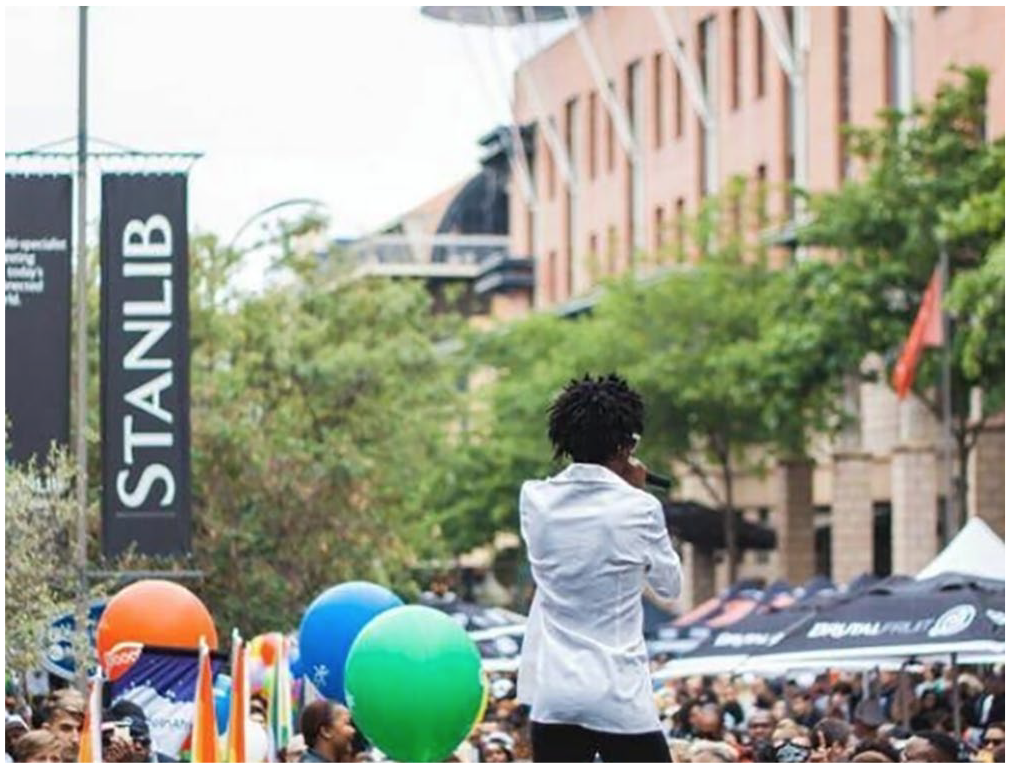
@gyre_sa (2018) Johannesburg Pride, Melrose Arch. Available at: https://www.instagram.com/p/BsuUCZ8hWHm/.
The location of Pride in Johannesburg has been a longstanding source of conflict. In the years following the end of apartheid, the Pride march moved from the centre of the city to the formerly whites only and affluent northern suburbs. This provoked criticisms about the representativeness, accessibility and inclusivity of Pride, which became particularly acute when Pride organisers started to charge an entrance fee to the Pride enclosure in the suburb of Rosebank from 2004 onwards. At these Prides, many black attendees sat outside the fence of the enclosure with picnics because they were prohibited from taking their food and drinks into the enclosure and could not afford the entrance fee, while wealthier and mostly white attendees partied inside (Mathabela, interview, 1 October 2018). Tensions spilled over into protest and open conflict in 2012, when members of the One in Nine Campaign disrupted the parade route. Mpumi Mathabela, an activist involved in the protests, explained that the location of Pride was significant to its role as a vehicle for social change as ‘violence on our bodies happens in our back yards [in the townships], it doesn’t happen in Rosebank’ (interview, 1 October 2018).
The 2012 protestors’ issues included the location of Pride, its de-politicisation, its commercialisation and its focus on partying rather than social issues. They wore T-shirts with ‘STOP the war on women’s bodies’, ‘Dying for Justice’ and ‘No Cause for Celebration’ and held a silent protest in front of the Pride parade route (Scott, 2017: 43–44). For Mathabela, this was not a rejection of Pride’s celebratory and community building purposes but, as she says, ‘can we acknowledge that people are dying before we do this extravagance’ (Mathabela, interview, 1 October 2018). The protest also sought to broaden Pride’s conception of the LGBTQ+ community: We had T-shirts with different identities of those they left out. We had trans, we had lesbian, we had gay, we had feminist, we had sex worker, we had foreigner, because these are all our identities as queer people. We’re not just queer. We’re all of these other things. (Mathabela, interview, 1 October 2018)
However, tensions escalated between the Pride participants and counter-protestors. When the protestors attempted to stage a ‘die in’ in front of the parade route, the then Pride organiser began shouting out of the window of her gold Mercedes. As Mathabela recalled: She [the Pride organiser] clearly said, ‘this is my Pride!’ and she said ‘This is my route! Get off my route! This is my route. If they don’t move run over them!’ And they did exactly that. So one guy on a bike went over someone’s foot. The other one head-butted an unarmed woman standing there with a banner. (Interview, 1 October 2018)
These scenes were accompanied by racial abuse and threats from the mostly white Pride parade participants, who began to step over the bodies of the protestors lying on the road. Following this, videos of the confrontation were circulated via social media, causing furore in media, activist and academic communities in South Africa (Martin, 2017; Milani, 2015; Scott, 2017). As Martin (2017: 5) notes, the protest at Joburg Pride ‘intensified conversations over the meaning of Pride: who could claim the space as their own; [and] how queerness and transness intersects with race, gender and class’. Following the protests, the organising committee of ‘Joburg Pride’ resigned, and a new committee was formed to hold the renamed Johannesburg Pride in 2013. However, tensions and divisions remain, particularly about the class, race and safety implications of the location of Pride, which moved further north to the luxury shopping mall district Melrose Arch in 2013. As LGBTQ+ activist Zandile Matsoeneng commented: How does a young black lesbian, or a black unemployed person, get to Melrose Arch? How does this person get to Melrose Arch and then afterwards, how do they get back safely? It’s not safe and it’s expensive to get to and from there. They can’t afford it. (interview, 3 October 2018)
In the 2018 Pride parade, one person carried a banner with the slogan ‘There’s no pride in marching where it’s safe’, another, dressed in a hat with a Melrose Arch security badge, wearing a tutu made of pink dollars and a sash proclaiming ‘sell out’, carried a sign with the caption ‘Move the Porsche bitch, Pride is here!’ (see Figure 2).
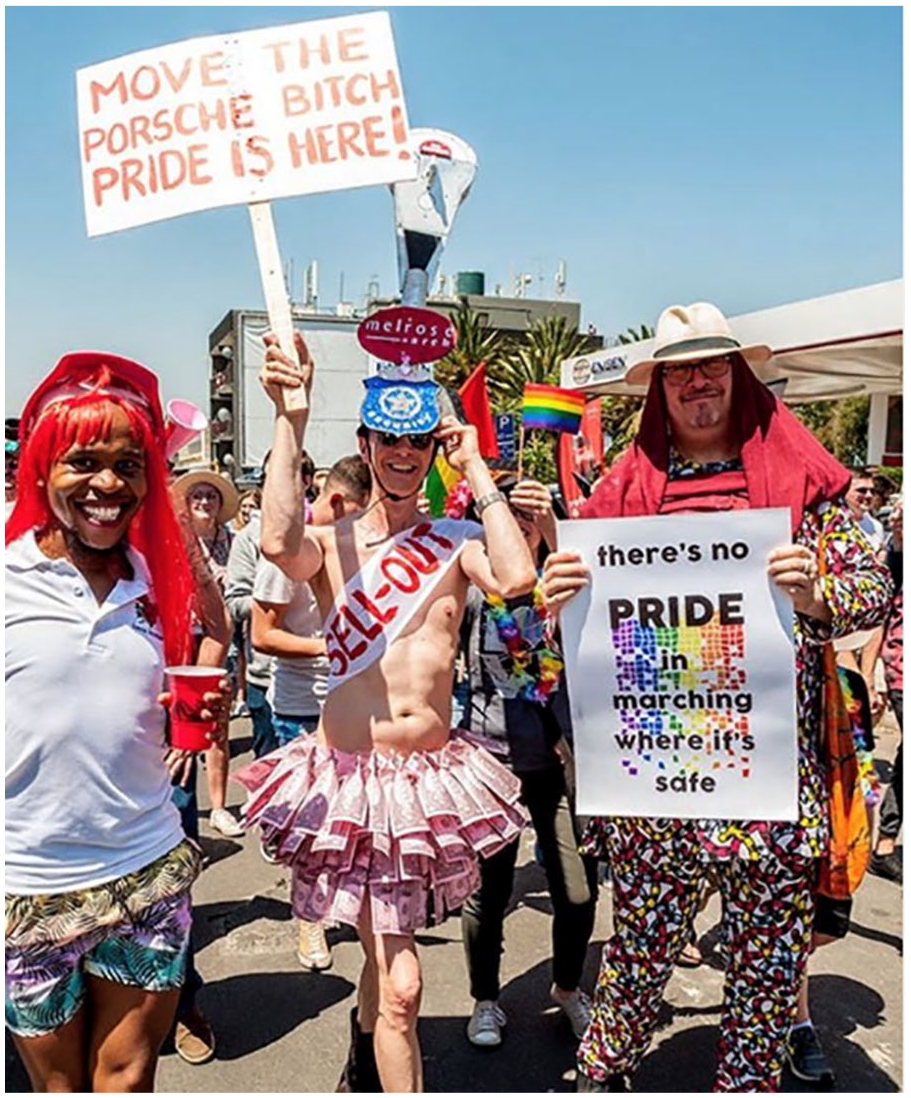
@jhbpride (2018) Move the Porsche bitch. Available at: https://www.instagram.com/p/BqPCIBSh5EQ/.
Beyond the Closet: The Lifestyle Conference
In 2018, Johannesburg Pride re-branded as ‘Pride of Africa’ and ‘Africa’s Pride’, with the marketing slogan ‘Proudly African! Authentically You!’ Its events expanded to include the ‘Beyond the Closet: Johannesburg Pride Lifestyle Conference’, sponsored by Accenture, EY and Essence Cosmetics. Held in a corporate event space close to Melrose Arch, the room was adorned with crystal chandeliers and prominently displayed LGBTQ+ focused advertising, including EY’s rainbow Pride banners and Accenture’s ‘Diversity Makes Us Stronger’ slogan. The event was attended by a multi-racial but relatively wealthy audience and was addressed by the organiser Kaye Ally, the radio DJ Slim G Mpho Buntse, a prominent LGBTQ+ member of the ANC and four ‘legal experts’ to speak about employment law and surrogacy. This section explores the conference’s positioning ‘beyond human rights’, its construction of LGBTQ+ lifestyles and consumers and its obscuring of inequalities and social injustice.
‘Beyond the Closet’ and ‘Lifestyle’ were specifically chosen as names for the conference to emphasise the claim that LGBTQ+ visibility, equality and human rights had been achieved in South Africa. When I asked the organiser if the conference would discuss human rights, she replied that it would not because ‘that’s why it’s a lifestyle conference! It’s no human rights no, no. It’s a lifestyle conference because we’ve gone beyond the human rights now’ (interview, 4 October 2018). Lifestyle, in these terms, is premised on the same assumptions about individual agency that underpin Giddens’ (1991) ‘reflexive project of the self’; that individuals exist in an equitable marketplace where questions of prejudice or inequality are in the past. Ally’s claim that ‘we’ve gone beyond the human rights’ rests on the limited understanding that where formal legal rights have been achieved there is no need for social justice activism but in South Africa access to these rights is highly limited by class and race. However, as the earlier quote from Ally makes clear, the lifestyles in mind were ‘normal’, ‘professional people’, with ‘fancy’ lifestyles.
The LGBTQ+ lifestyle articulated at the conference constituted a very specific consumer identity. When challenged about the criticisms of holding Pride in Melrose Arch, Ally responded by defending the choice of venue in terms of its lifestyle affordances. Ally explained that Melrose Arch was the ‘perfect place’ for Pride and narrated her consumer’s frictionless journey through the Pride events: You just park your car in the basement, you came up the escalator, you checked out the Pride scene, there’s an entire Pride village catered to you, you had a few drinks, you waited for your friends, you could go anywhere for a meal and you could come back at any time. (interview, 4 October 2018)
Ally’s evocation of a moneyed LGBTQ+ consumer considering options at a securitised mall recasts Pride as one of a number of leisure diversions for an elite class. This vision of Pride, as a lifestyle destination, evokes Schulman’s (2013) characterisation of the tastes, politics and mindset of ‘gentrified’ white, urban LGBTQ+ communities. For these individuals, the history of queer activist struggles, LGBTQ+ identities and Pride become more akin to commercial ‘brands’ that evoke emotional and cultural associations divorced from any troubling associations with poverty, oppression or marginalisation. The similarity between ‘lifestyles’ on offer at Johannesburg Pride and other Prides in the Global North continued when Ally explained that one of her proudest moments was when a friend mistook photos of Johannesburg Pride with New York Pride (interview, 4 October 2018). By contrast, Mathabela considered the economic exclusivity of Johannesburg Pride particularly troubling, because it led to ‘peeling off layers of people. So we start excluding this group of people who cannot afford it. So black middle class can come in, but a certain class is left out’ (interview, 1 October 2018). The organiser of Soweto Pride also emphasised the class implications of Johannesburg Pride: ‘It’s classist because if I’m not able to get to Joburg Pride . . . and when I get there I have to spend an exorbitant amount of money for drinks, etc’ (Madingwane interview, 7 October 2018). Johannesburg Pride’s gentrified vision of Pride and its attendees, reflecting broader lifestyles of commercial consumption, excludes people who cannot access this ‘lifestyle’ and effectively erases them from not just Pride, but also broader LGBTQ+ politics and identity.
The elite lifestyle envisioned for the conference participant framed its content, which focused on employment law and surrogacy. In place of protest, solidarity or public visibility, Ally explained that the conference’s purpose was to share information: ‘people don’t know what is the requirement for a civil union. People don’t know how taxing it is for an adoption process, or if you want your own child via a surrogacy, how expensive is it’ (interview, 4 October 2018). However, the information provided was only relevant to economic and professional elites in South Africa. The session on workplace harassment and discrimination law gave examples of best practice, and how the law can protect LGBTQ+ employees, but was only useful for those in professional jobs, or in organisations with clear policies and HR procedures. Such advice would be of little use to the 18% of South Africans who work in the informal sector, the over one million domestic workers or the 27% of South Africans who are unemployed (Yu and Nackerdien, 2019). Similarly, the lawyer who specialised in surrogacy explained at the conference, the average cost of this process was ZAR300,000. This is out of reach of most in South Africa, where the average annual salary is ZAR254,000 (BusinessTech, 2019). Following the session on surrogacy, one attendee remarked ‘I thought this would be really interesting and I wanted to come, but it was a disappointment . . . just fancy white lawyers going on about how rich you need to be to do a surrogacy’ (field notes). The information offered at the conference, information that was claimed to empower LGBTQ+ attendees in their lives, was only relevant for those with the financial, social and educational means to access those rights and obscured the reality of the lives and needs of the majority of South Africans.
Extending its focus on the individual lifestyle, the marketing of Johannesburg Pride reframed Pride from being a collective endeavour to a project of the self. Johannesburg Pride’s adverts extended the acronym LGBT+ with ME (meaning the personal pronoun ‘me’), deploying the phrase ‘Liberate LGBTQ+ME’ (see Figure 3). Thereby framing Pride, and attendant concepts of liberation, empowerment and community, in relation to the individual me. Ally introduced the conference by explaining that Pride was ‘a place for everyone’ and her aim was ‘to liberate every LGBT+ME person on the continent’ (field notes). This individualist logic reproduces a broader neoliberal reorientation of Pride from a collective, communal endeavour, to an individual one (Ward, 2008). The repeated use of the word liberation in Ally’s introductory talk evoked the politicised history of the anti-apartheid liberation movement, along with the liberation history roots of Pride in Johannesburg. However, the addition of ‘plus me’ focused this on individual, rather than collective liberation. The presence of Mpho Buntsi in the introductory session, who had established the Simon Nkoli Memorial lectures, further sought to associate the event with the Liberation Struggle lineage and to tie the themes of the conference to notions of liberation and empowerment. Yet the conference, the space it was held in and the issues it discussed, sanitised and repurposed the concept of liberation for the achievement of an individual lifestyle, rather than for social justice for a community.
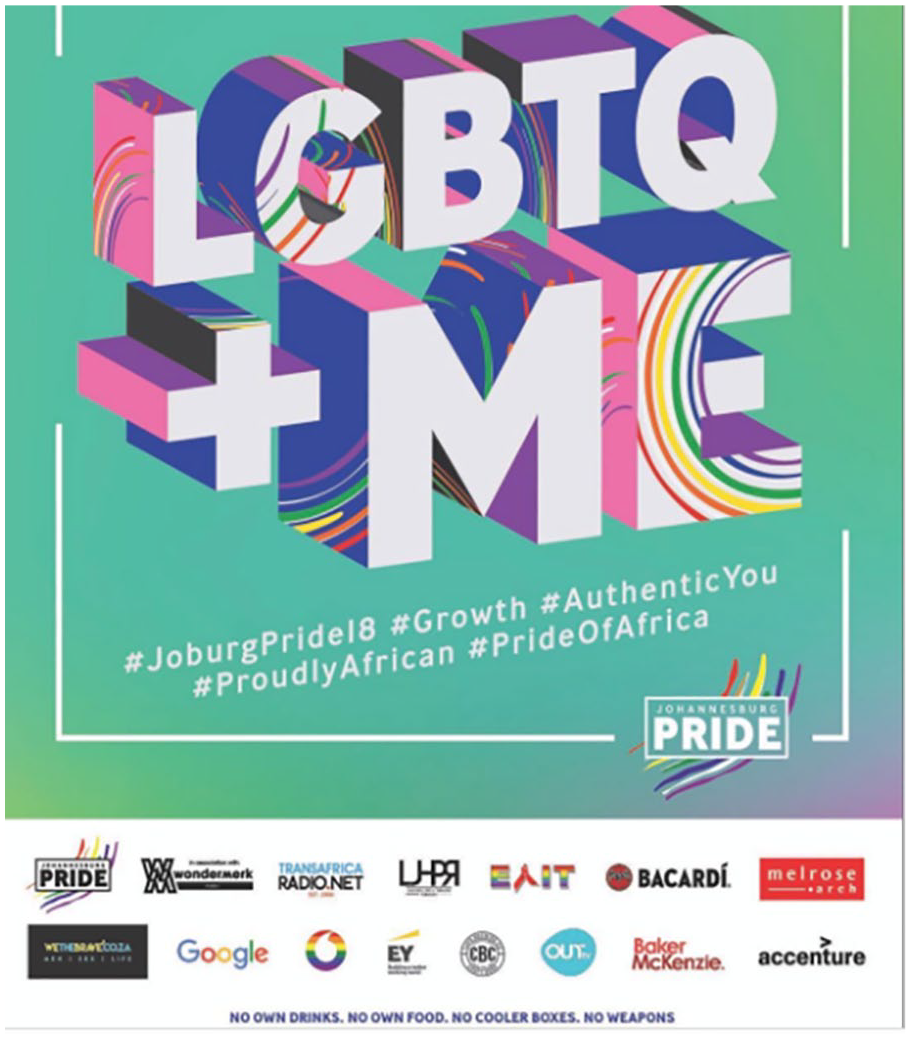
@jhbpride (2018) LGBTQ+ ME. Available at: https://www.instagram.com/p/Bon8VtChrH2/.
Throughout the Lifestyle conference there was an explicitly positive and affirmatory tone, with Pride serving as a celebration of ‘the world we have won’ (Weeks, 2007) rather than a platform for highlighting inequality or demanding change. As Ally explained, this was a deliberate decision: The rationale behind what we do is very much around raising mood. Everyone advocates all the negativity: there’s hardship, there’s hate crime, there’s gay bashing. [If] there’s everything bad that happens to anyone; it happens to everyone in South Africa . . . It’s not just the LGBT community that is a victim in South Africa . . . When we looked at extending Joburg Pride, my only reason[ing] to the team was as long as it has positive messages. (interview, 4 October 2018)
Such positive, affirmatory intent, along with the belief that violence in South Africa does not have a particular homophobic or gendered character, is precisely what the One in Nine Campaign activists had protested against in 2012. It evokes the joyful, reparative emotional tenor of Pride, but without any defiant queer politics or activism. At the conference, this focus obscured the realities of LGBTQ+ lives (and deaths) in South Africa and undermined the event’s potential for raising awareness of homophobic violence and for political action. The desire to be ‘positive’ and not carry the ‘negative’ emotions of focusing on problems, anger or protest resembles the broader ‘feel good’ politics of diversity discourses (Ahmed, 2012: 69). Here, the ‘happy talk’ (Ahmed, 2012: 72) of diversity distracts from ongoing inequality by celebrating a change that is only partly achieved and restricting opportunity for critique. In common with the broader lifestylisation of LGBTQ+ identities and politics at the conference, this removes spaces for activism in Johannesburg by centring privileged and normative ‘lifestyles’, emphasising individual agency, obscuring intersectional inequalities and undermining the possibilities for achieving meaningful equality.
Discussion
The lifestylisation of Johannesburg Pride has broader implications for Pride as a platform for activism, visibility and community building, and for conceptions of race, class and social justice in contemporary South Africa. LGBTQ+ lives, identities and rights are framed by and at Pride events; articulating what it is to be LGBTQ+ to both individuals and broader society. Partial, exclusionary and neoliberal framings of Pride are harmful because they can obscure socio-economic inequality, homophobic violence, and other forms of ongoing prejudice. Thus, Pride constructs and affirms whose queer lives matter, and whose do not. For Butler (2010: 7), making the precarity of marginalised and otherwise ignored lives visible is a vital project, for only some lives are recognised as matters for concern; ‘a life has to be intelligible as a life, has to conform to certain conceptions of what life is, in order to become recognisable’. Butler (2010: 7) is clear that in order to make precarious lives ‘matter’, the conditions that underpin precarity must be fully considered and incorporated into ‘the very terms of recognisability’. Therefore, just as Scott (2013) argues that the exclusive focus on and celebration of normative same sex marriage rights mark a ‘murderous inclusion’ in South Africa, the focus only on privileged lifestyles, or indeed only those privileged enough to have agency over a lifestyle at Johannesburg Pride, defines whose life and lifestyle matters and obscures those that do not.
For Mathabela, the framing of Johannesburg Pride on privileged individual lifestyles, reflects the relatively privileged nature of its organising group and their sense of ownership of the event. Mathabela imagined the organisers’ of Johannesburg Pride responses to criticism being: ‘It’s my thing. I started this, I’ve worked hard all year to organise this thing, you can’t ruin my thing’, but that’s the problem. Your thing [Pride] holds people’s lives in it. And when you organise a thing like that, you think about everyone else. You cannot be thinking about yourself and your own. (interview, 1 October 2018)
Criticisms about Pride being organised by a privileged group relate not just to the individuals and groups who organise Pride events, but to the worldview and communities they envisage and create, the people they include and exclude, and the emphasis and balance between celebration and protest. In organising Pride, activists can reproduce their tastes and lifestyle aspirations through the choices they make, and this can have significant impacts on the inclusion, or exclusion, of LGBTQ+ communities.
Johannesburg Pride has been criticised by LGBTQ+ activists for being a ‘white Pride’ (Matsoeneng, interview, 3 October 2018), in terms of its location, its economic exclusivity, the identities and ‘lifestyles’ it represents and its presentation as a ‘Global North’ Pride event in the mode of New York or San Francisco Pride, with US Drag Queens, TV celebrities and sponsorship from Levis and Bacardi. However, in South Africa, some have argued that the salience of race is declining. For Nuttall (2004), younger and urban South Africans have moved beyond race, using consumer culture and urban spaces such as shopping malls to ‘self stylise’, choosing brands, clothes and identities as they see fit. This adapts Beck’s (1992) and Giddens’ (1991) contention that structures such as class no longer constrain the life course, to the claim that race has declined as a salient identity or barrier to equality. From this perspective, claiming Johannesburg Pride was ‘white’ is anachronistic; the Lifestyle Conference was indeed a space ‘for all’ and a potentially transformational space. However, I contend this ‘post-racial’ (Nayak, 2006) argument focuses on the agency of the privileged and obscures the socio-economic, intersectional struggles of the rest, mirroring its ‘post-feminist’ (McRobbie, 2008) and ‘post-gay’ (Ghaziani, 2011) equivalents.
Post-racial conceptions of South African identity reproduce a neoliberal rationality that emphasises the individual over the collective, rejects the reality of structural constraints, and presents tolerance, rights and diversity as already achieved. These are also the essential tenets of whiteness (Ahmed, 2012: 147) where, in common with neoliberal and lifestyle discourses, individuals are conceptualised as consumers who just need to make the correct, well-informed choices in order to deliver the lives they wish and deserve. Steyn (2012: 8–12) has argued that contemporary tropes of racial privilege and inequality are maintained in South Africa through an active and purposeful ‘white ignorance’. The omission at the conference of the majority of South African lives and the precarities they face, of violence, poverty and inequality, reproduced this, enabling belief in equalities achieved alongside the maintenance of ongoing inequality. Kaye Ally, the organiser of Johannesburg Pride, is of Muslim Indian heritage and as she explained to me has faced discrimination on ‘multiple levels’ (interview, 4 October 2018). Yet the speakers and symbols of whiteness do not necessarily have to be white. Indeed, it is helpful if they are not, for it confirms and reinforces the logics of a competitive marketplace, lays blame on the ‘unsuccessful’ and removes questions of inequality from consideration. If anything, the Lifestyle Conference revealed the continuing salience of race in South Africa and how neoliberal discourses of lifestylisation co-opt, subvert and conceal ongoing socio-economic divides.
Conclusion
As Pride becomes an increasingly global phenomenon, it is important to pay attention to how Pride represents, includes and excludes LGBTQ+ identities, communities and socio-political issues. This article has explored how the framing of LGBTQ+ ‘lifestyles’ at Johannesburg Pride focused on privileged LGBTQ+ consumer identities and excluded the lives of those who do not possess the agency to achieve such lifestyles. This marks the latest development in the fraught and problematic history of Johannesburg Pride, itself symptomatic of broader tensions in South African society. Despite claiming to be the ‘Pride of Africa’, Johannesburg Pride strongly evokes the glamorised and commercialised Prides held in major cities of the Global North, obscuring the lived reality of the majority of LGBTQ+ communities. In South Africa, this has particularly egregious consequences given the stark socio-economic inequalities and the exacting toll of homophobic violence. For Johannesburg, the locating of Pride in a wealthy and formerly whites only area and the neoliberal co-option and framing of LGBTQ+ ‘lifestyles’ in such a divided racial and socio-economic context, also reflects and perpetuates socio-economic divides.
Johannesburg Pride has been criticised for its focus on partying and celebration, and its location in wealthy suburbs and securitised luxury shopping malls. The Lifestyle Conference held at Johannesburg Pride was organised in an effort to address some of these criticisms. However, the lifestyles considered at this event were never intended to include the majority of LGBTQ+ South Africans. This mirrors a broader individualisation and consumerisation of LGBTQ+ identities and gentrification of LGBTQ+ advocacy. The articulation of LGBTQ+ identities as ‘lifestyles’, alongside the attendant individualised, consumer-based logic assumes LGBTQ+ individuals have unlimited agency over their lives and removes the spaces, and disputes the rationale, for intersectional activist struggles for social justice. The lifestylisation of Pride makes it a platform for the celebration of claimed social progress and consumer consumption, but not for campaigning against ongoing injustice and prejudice.
The original purpose of Pride was to open transformative socio-political spaces, envisioning new social realities as well as campaigning for rights. As this article has argued, Pride events that are premised on assumptions of lifestyles are inherently exclusive. Pride, as the most significant LGBTQ+ community and activist platform, makes LGBTQ+ lives and attendant socio-economic, political and legal issues visible. Existing academic analyses of Pride, however, give insufficient attention to activist criticisms of the raced, classed and gendered dynamics of Pride, and often reproduce the narratives of Pride organisers and participants without critically interrogating them through the lens of social theory. Through this, academic research can become complicit in the reproduction of post-racial, post-feminist and post-gay discourses which obscure the lives of LGBTQ+ people who don’t, or can’t, participate in the ‘lifestyles’ on offer. This is further exacerbated by research being mostly situated in Global North contexts, with limited representation of marginalised and Global South communities. Further research on Pride in global contexts is needed to explore how these events reveal, conform and contest broader neoliberal and sanitised presentations of LGBTQ+ rights, identities and diversity politics. For example, in Johannesburg, both Soweto and Ekurhuleni Pride, alongside NGOs such as the One in Nine Campaign, seek to contest neoliberal versions of Pride and develop intersectional understandings of race, gender and class for LGBTQ+ communities.
Since the 1970s, Pride has been an example, in Butler’s (2010) terms, of where making LGBTQ+ lives visible has made them matter. However, as Butler also contends, making sure everyone’s life matters requires not just making everyone’s life equally visible, but that representations are accurate in their portrayal of precarity, prejudice and inequality. For Pride in South Africa, this means continually engaging with and highlighting the racial, classed and gendered dynamics of LGBTQ+ lives with the attendant challenges of inequality and violence. The question of ‘whose life matters’ in Pride, and LGBTQ+ activism and advocacy is a universal one and has major significance for broader social justice activism. By reframing LGBTQ+ liberation as a ‘lifestylised’ project of the self, activists obscure the actual lives that people live.
Footnotes
Acknowledgements
I would like to thank Jamie Martin who provided research assistance and the anonymous reviewers, Ipshita Basu, Alex Green and Ana Jordan for providing helpful comments on drafts of the article.
Funding
The author disclosed receipt of the following financial support for the research, authorship, and/or publication of this article: research for this article was funded by the Leverhulme Trust Research Fellowship.