




Abstract
Applying a dual-process framework to in-depth interviews and survey data, this article explores behavioural manifestations of intercultural attitudes for white majority Norwegians. The article builds upon established literatures on social cognition showing that humans operate with two separate cognitive systems. Affective ‘automatic’ heuristics often generate negative stereotypes, aversive emotions and behavioural responses to ethnic diversities. In contrast, the ‘discursive’ cognitive system, which stores cultural scripts, motivates predominantly egalitarian aspirations and performances. As people balance their behaviours according to contextual evaluations of costs and benefits, the article’s findings indicate a tendency to practise openness and civility in public and spatio-temporally bounded encounters, and to reject or exclude the Other in half or more of privately made selection decisions.
Keywords
Introduction
Applying a dual-process interpretive framework (Kahneman, 2011; Vaisey, 2009) to survey data (1100 respondents) and qualitative interviews (25), this article explores white majority Norwegians’ variably cosmopolitan and racist behaviours. From the dual-process perspective, humans operate with two distinct thought systems that take turns or cooperate in guiding behaviours depending on the context. As the current research empirically demonstrates, a given behaviour rarely satisfies both the reflex-like inclinations and rational considerations that are activated in people’s interactions with cultural and racial Others. Instead, tensions and conflicts tend to arise between actions and visceral dispositions, or people’s behaviours and the values and principles they are expected to or aspire to live by. Indeed, and while it intuitively makes sense to imagine separate clusters of people adopting and using the parochial and ‘cosmopolitan’ (Delanty, 2006; Skrbis and Woodward, 2007) cultural scripts of western liberal democracies, the article finds the same individuals participate in dual conflicting processes. The principle that ‘attitudes lead to actions’, then, must further specify under what conditions different attitudes guide actions (Fazio and Zanna, 1981). In this context, the current research explores Norwegian citizens’ behaviour preferences in a diverse set of imagined scenarios, including (1) everyday encounters; (2) physical touch; (3) employment; and (4) buying a used car, giving insights about the conditions under which white Norwegians accept and reject cultural and racial diversities, as well as how their behaviours harmonize and disharmonize with their attitudes. The article will discuss these matters as forms of ‘intercultural behaviour’, which denotes interactions between ‘distinct’ communities or ‘bounded’ cultures (see Alexander, 2008).
Both within research on ‘cosmopolitanism’ (Høy-Petersen and Woodward, 2018; Skrbis and Woodward, 2007), and ‘multicultural conviviality’ (Back and Sinha, 2016; Gilroy, 2004), a need has been identified to develop analytically how antagonistic impulses of openness and racism work together in everyday life, and to establish the place and significance of racism, which is sometimes omitted or minimized in understandings of contemporary multiculture (Back and Sinha, 2016; Nayak, 2016). The dual-process perspective contributes towards this end by demanding that equal analytic attention is given to the dual impulsive and reason-based components of cognition that have been repeatedly found to facilitate conflicting responses to cultural and ethnic diversities (Dovidio and Gaertner, 2004). Although the dual-process framework has proved itself a central tool in the advancement of intergroup relations research in social psychology (review in Dovidio and Gaertner, 2004), it has not yet been sufficiently integrated in sociological studies on these topics. This is even though the central tenets of the theory are identifiably sociological, and – as explained by Vaisey (2009) – revolve around Swidlerian and Weberian-Parsonian theories of action (also, Bourdieu, 1990). A core objective of the current article, then, is to demonstrate the value of a dual-process approach to sociological thinking about intercultural behaviours, which draws lessons from far advanced and key studies from psychology (e.g. Dovidio et al., 2002; Fazio and Olson, 2003; Kahneman, 2011).
Cosmopolitanism
This research frames the responses to diversity that occur in the intersect between principles and intuitive impulses via the concept of ‘cosmopolitanism’, defined flexibly in this article as ‘an “openness” towards others, people, things, and experiences whose origin is non-local’ (Skrbis and Woodward, 2007: 730). Originally, ‘cosmopolitan’ was an abstract term used to describe a selfless global citizen, deeply committed to humanitarian values (Kant, 1970 [1795]). In more recent times, however, researchers have widely agreed that cosmopolitanism should not be exclusively conceived as an ethical disposition: studies of ‘actually existing’ (Robbins, 1998) or ‘ordinary’ cosmopolitanism (Skrbis and Woodward, 2007) have identified that the forms of cosmopolitan openness practised in everyday life are rarely ‘ethical’ in the sense of challenging racial and cultural divides (Høy-Petersen and Woodward, 2018): it is also used as an instrumentalist means to accrue forms of capital and social acclaim, while covertly maintaining white hierarchies of power and value (Bookman, 2013; Høy-Petersen and Woodward, 2018; Molz, 2012; Peterson and Kern, 1996; Skrbis and Woodward, 2007). These new directions of research pointing to the ambiguity, superficiality and self-interest that lie within many cosmopolitan practices render the concept uniquely applicable to a dual-process account of contemporary intercultural interactions, where cosmopolitanism often exists as a discursive capacity to strategically manage normatively valued and egalitarian self-presentations for people who simultaneously embody deep-seated racist impulses.
Public discourse in Norway where the current research was conducted inspires the cultivation of an ethically cosmopolitan, egalitarian or anti-racist national imagination by emphasizing the country’s welfare state and contributions to third-world aid, while downplaying Norway’s history of war-participation and colonialism (see Gullestad, 2002, 2004). As a result, most Norwegians are generally ‘cosmopolitan’ in terms of their abstract self-concept. On a more practical or ‘actually existing’ (Robbins, 1998) level, and combining this public discourse with a growing immigrant population as well as the country’s educational emphasis on anti-racism and knowledge of foreign cultural practices, most Norwegians are also ‘cosmopolitan’ in terms of their acquired ‘know how’ and ability to manage everyday multicultural encounters appropriately. However, once we expand past abstract principles and normative practice repertoires to emotions and heuristics, it appears that these cosmopolitan ideals and practical skills exist alongside hidden processes of racial devaluation and boundary maintenance which is sustained even in seemingly convivial multicultural encounters. Dual-process theory, as outlined next, explains the cognitive processes that facilitate this attitudinal dissonance.
Dual-Process Theory
Dual-process theory has roots in sociology (Bourdieu, 1990; Vaisey, 2009) and social psychology (for review, Lizardo et al., 2016). In these literatures, the two thought systems are named in diverse ways, for example as ‘practical’ and ‘discursive’ (Bourdieu, 1990), ‘impulsive’ and ‘reflective’ (Strack and Deutsch, 2004), or ‘fast’ and ‘slow’ (Kahneman, 2011), to mention a few. In neuroscientific terms, they map on to an evolutionarily old part of the brain known as the ‘limbic system’, and the more recently developed ‘frontal lobes’. In the current article, however, they will be referred to as the ‘automatic’ and the ‘discursive’ cognitive systems, as these labels contrast the involuntary nature of some cognitions with the intentional ‘use’ of normative scripts, which is a central theme in the data.
The automatic cognitive system contains affective and intuitive attitudes and heuristics that will be explained here as resulting from a combined natural evolution and cultural learning process (see Haidt et al., 1997; Mayr, 1960). Through natural evolution, the automatic cognitive system developed embodied schemata such as disgust, contempt and fear that would respond instantaneously and viscerally to certain external triggers (Haidt et al., 1997). As part of a developing ‘behavioural immune system’ (Schaller and Park, 2011: 99) set up to avoid foreign pathogens and develop strong in-group coalitions (Faulkner et al., 2004; Navarrete and Fessler, 2006), foreign and unfamiliar people were established as core triggers of such aversive responses. Moreover, in contemporary society, humans continue, through the early socialization of children, to forge neurological pathways between foreign cultures, racial categories and these evolutionary mechanisms of rejection. Importantly, automatic cognitions are powerful behaviour motivators (Greenwald et al., 2009; Oswald et al., 2013), both due to the effortlessness of automatic thinking (Fazio, 1986; Kahneman, 2011), and because this cognitive system communicates through embodied schemata and emotions that have a unique agency to move the body (see Ahmed, 2014); to moderate the hormonal flows that ‘direct’ people, through bodily sensations, to approach or avoid; fight or flee. This is not to say that automatic thinking is void of what might be argued to be cosmopolitan propensities (e.g. Levinas, 1979; Nava, 2007), but rather that racist aversions have been repeatedly identified as deeply ingrained in the automatic mental structures (see review in Dovidio et al., 2017).
To maintain social cohesion in culturally diverse societies where citizens are predisposed to racial aversions, western liberal democracies have developed anti-racist laws, discourses and norms (Ivarsflaten et al., 2010) that people store in their discursive cognitive systems alongside a larger body of ‘whatever it is one has to know or believe in order to operate in a manner acceptable [to the members of one’s culture] in different social situations’ (Goodenough, 1957: 167). Discursive scripts facilitate intentional and goal-oriented actions (Lizardo et al., 2016), and for the majority of people, one of the normatively ascribed ‘goals’ is to behave according to ideals of ‘openness’ associated with intellectualism and valued qualities of tolerance and worldliness (Ljunggren, 2015; Peterson and Kern, 1996).
Although automatic and discursive cognitions can potentially harmonize, intercultural behaviours tend to instead trigger ‘action-control conflicts’ (Fazio and Olson, 2003), where people must evaluate the contextual costs and benefits of acting on the basis of controlled (discursive) versus heuristic (automatic) thinking. Analysing these action-control conflicts raises the question of whether people with racist dispositions who behave in cosmopolitan ways manage mainly outer impressions (Goffman, 1961), or if they try (and potentially succeed) to modify their feelings according to social norms (Hochschild, 1979). With that said, and although the current research finds that both perspectives resonate with the data (i.e. people perform but they also often want to be open and tolerant), findings will be sectioned into ‘front stage’ and ‘back stage’ behaviours (Goffman, 1978 [1956]), as the public/private distinction was identified as particularly consequential.
Methodology
This research combines computer-mediated quantitative survey data with qualitative interviews. The survey-sample consists of 1100 respondents, and is representative of the white Norwegian population in terms of distribution by geographical areas, as well as gender and age – albeit slightly skewed towards highly educated individuals. The dual-process approach requires researchers to specify which thought system their method(s) is accessing (Lizardo et al., 2016). With that said, the fixed response survey method is often believed to capture respondents’ automatic cognitions, which intuitively know what ‘feels right’ (Vaisey, 2009) and requires little cognitive effort. However, one must be aware that people are often both consciously and subconsciously committed to respond without prejudice (Dovidio and Gaertner, 2004; Ivarsflaten et al., 2010), and that measures of racism are heavily subjected to ‘preference falsifications’ (Kuran, 1997). For this reason, quantitative findings are conceptualized here as measuring a combination of respondents’ ‘automatic’ attitudes moderated by ‘discursive’ reasoning.
Quantitative variables were constructed in agreement with findings from recent research (Axt, 2018; Kteily et al., 2015) suggesting that blatant measures of racial attitudes are more effective than implicit measures. For example, measuring racial attitudes indirectly through views on affirmative action may limit preference falsifications, but comes at the cost of including construct irrelevant information that makes the variable less accurate. Furthermore, and based on the premise that people can (be prompted) to access prejudices that are often deemed subconscious (see Allport, 1954), the survey repeatedly reminded respondents to ‘answer according to how you really feel, not how you think you should feel’. More specifically, the quantitative component relies on two core ‘automatic’ attitude questions, namely ‘how do you feel about foreigners coming to live in your country?’, as well as an indication of level of agreement/disagreement to the statement ‘I would prefer if there were no Muslims in Norway’. These variables were then cross-tabulated against different blatant measures of behaviour preferences to explore under what conditions people act on or alternatively suppress their ‘automatic’ attitudes.
A separate qualitative sample consists of 25 white majority Norwegians recruited at demographically diverse ‘sites’ (Arcury and Quandt, 1999) within six geographical locations across Norway that vary in terms of urban/rural areas, and percentage of immigrants. At each ‘site’, participants were sought out on the basis of contributing to sample variation in terms of age, gender and profession. Participants were interviewed face-to-face for approximately one hour, covering broadly the same topics as the survey to flesh out the complex thought processes that take place behind statistical patterns. In the interviews, I – a tall and typically Nordic looking female – made efforts to self-present as non-judgemental, and commenced the interviews by stating that I do not consider myself free from racial bias. I also spoke with an aura of naivety about the topic, and made sure to receive all responses with a light-hearted and inquisitive demeanour as this seemed to create a more relaxed mood and conversational interview dynamic.
Notably, qualitative interviews are a contested means for conducting dual-process research, particularly due to the perception that automatic cognitions are non-verbal and therefore inaccessible to interviewers (discussions in Pugh, 2013, 2014; Vaisey, 2009, 2014). The current research follows Kahneman (2011) and Pugh (2013, 2014) in arguing that automatic cognitions can also be discursively deliberated. For example, interviewees are often able to say what they like or dislike, even if they cannot accurately explain why (Vaisey, 2014). The findings presented in the current article show that the categorizations and associations people make ‘automatically’ are also commonly visible in their talk, for example when broad-brush generalizations are made about different cultural groups, as well as through body language including emotions observable in facial expressions (Pugh, 2013, 2014).
Measuring Behaviour
The data presented shortly are based primarily on self-reported behaviour intentions – in other words attitudes about actions. The problem with this (albeit common) approach to measuring behaviour is that genuine actions are motivated by ‘contextual cues’ (Fazio, 1986) that are often absent from the interview or survey setting. To remedy this issue, and inspired by Lamont and Swidler (2014: 7–8), the questions posed to participants were formulated to ‘evoke a variety of interactional settings, social contexts, and institutional situations’. More specifically, large sections of the survey and interview guide focused on triggering memory and imagination – a strategy that has been found to contextualize and thereby make reported behaviour preferences more congruent with real-life behaviour (Fazio, 1986; Snyder and Swann, 1976). Furthermore, although automatic cognitions are frequently considered subconscious, ‘contextual cues’ momentarily bring them into conscious awareness and render them accessible. Having introduced the central methodological concerns, the following sections proceed to empirically explore majority Norwegians’ contextual intercultural behaviours, and the tensions and conflicts that arise between behaviours and attitudes. Starting with ‘front stage’ (Goffman, 1978 [1956]) behaviours in everyday encounters, the article moves ‘back stage’, where action decisions are made privately.
Front Stage Behaviours
Everyday Encounters
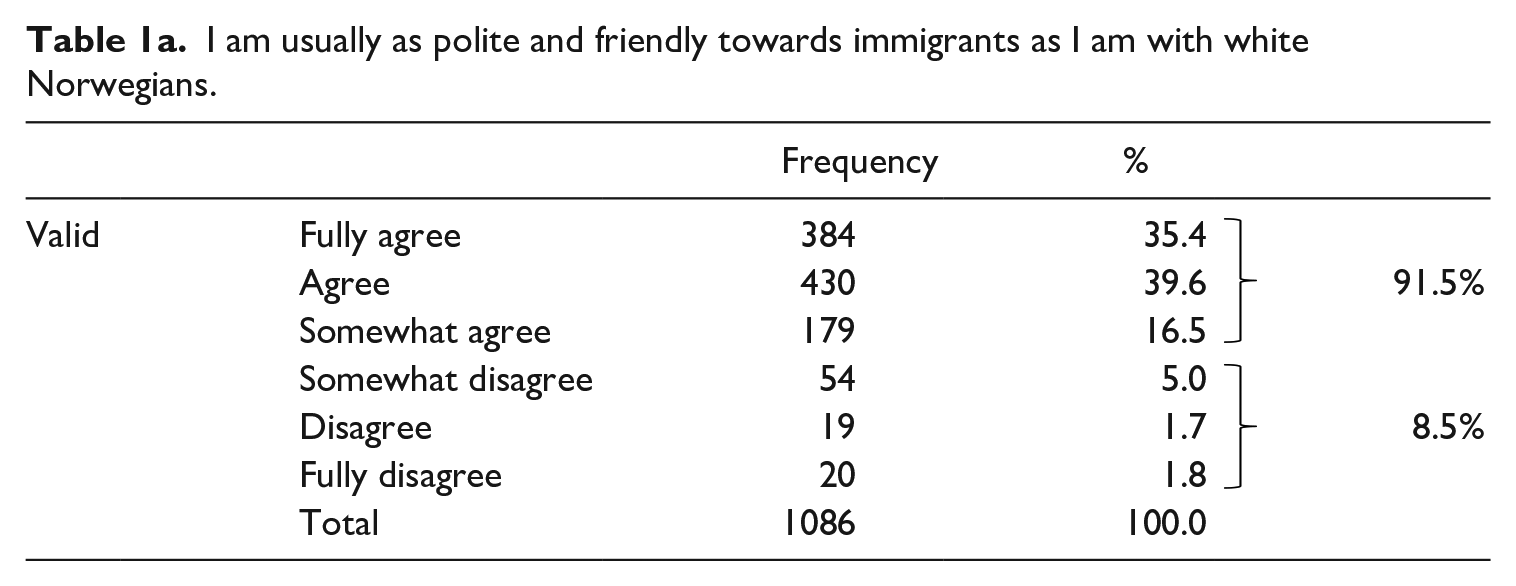
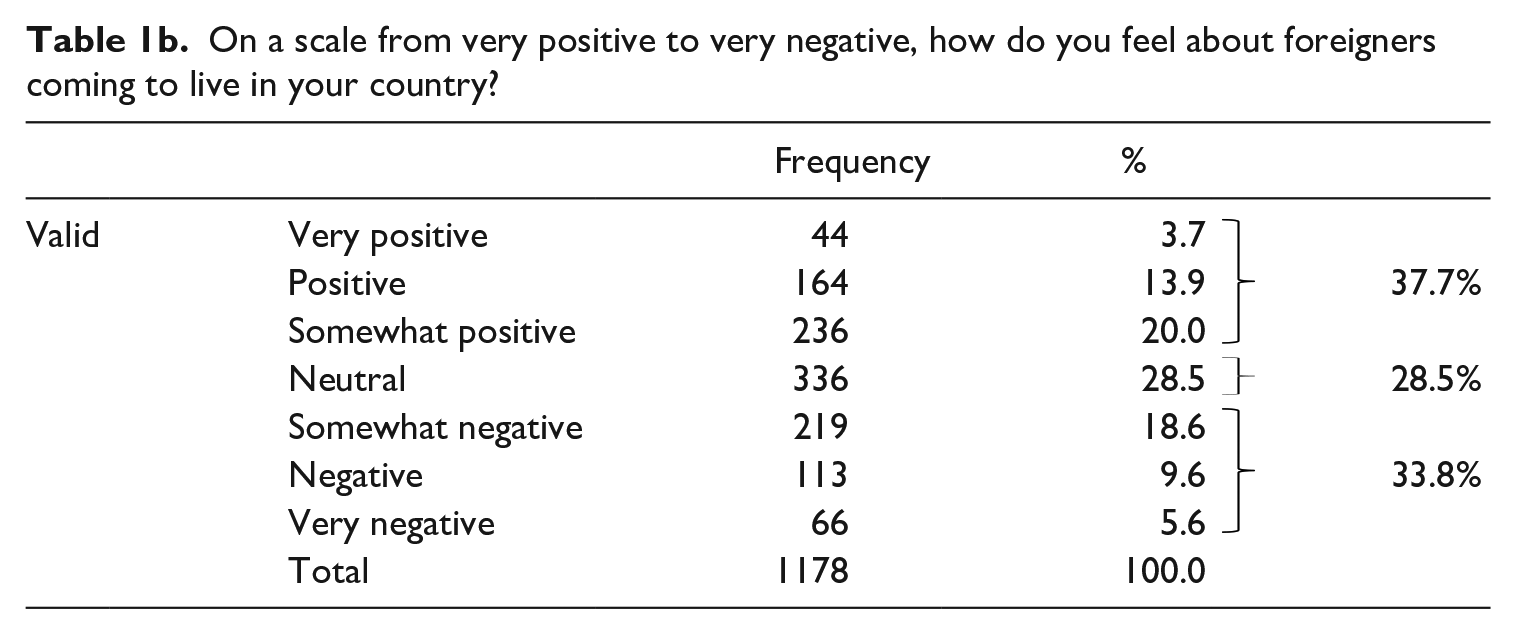
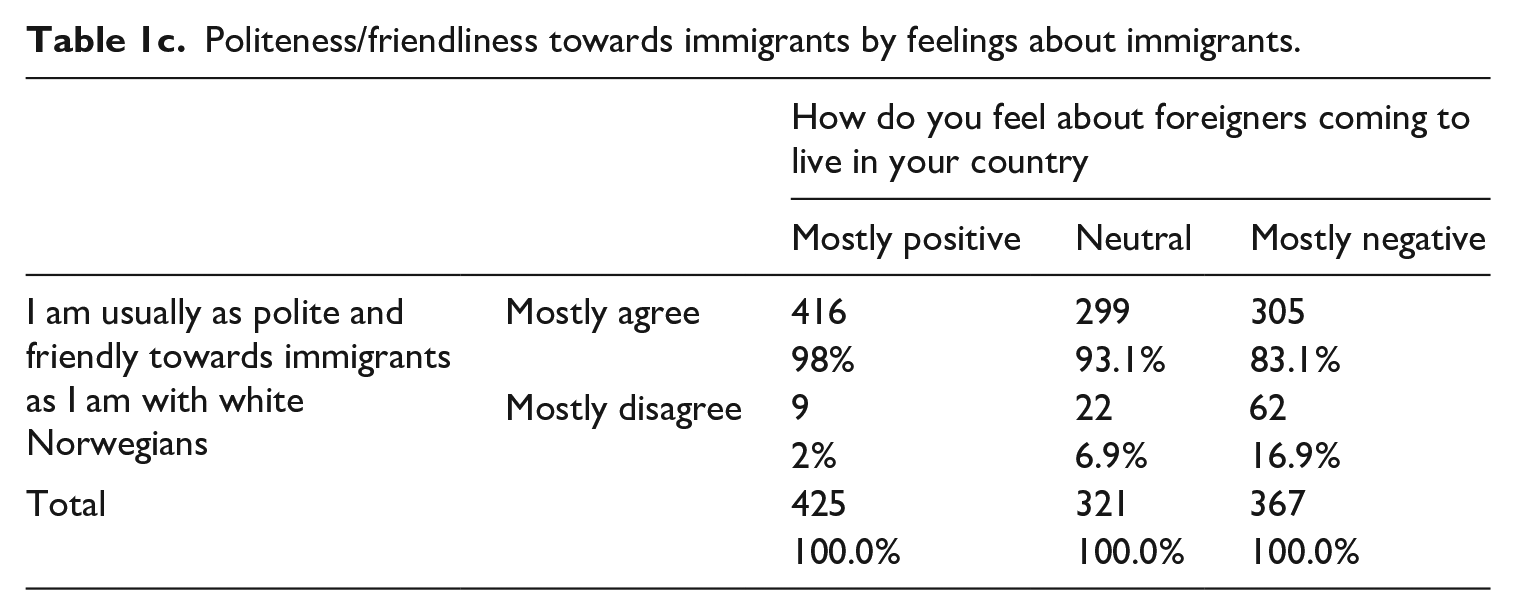
Survey respondents were asked if they are ‘usually as polite and friendly towards immigrants and white Norwegians’ (Table 1a). Furthermore, to explore whether people’s behaviour preferences reflect their ‘automatic’ attitudes, they were asked how they feel about foreigners coming to live in their country (Table 1b). As indicated in Table 1a, 91.5% of the sample predominantly agreed that they are equally polite and friendly to immigrants and white Norwegians – a number which far exceeds the 38% of people who reported having immigrant-positive attitudes (Table 1b). Indeed, and moving on to Table 1c, 83% of white majority individuals with negative feelings about immigrants would be polite and friendly regardless (γ = .407, p < .000).
I am usually as polite and friendly towards immigrants as I am with white Norwegians.
On a scale from very positive to very negative, how do you feel about foreigners coming to live in your country?
Politeness/friendliness towards immigrants by feelings about immigrants.
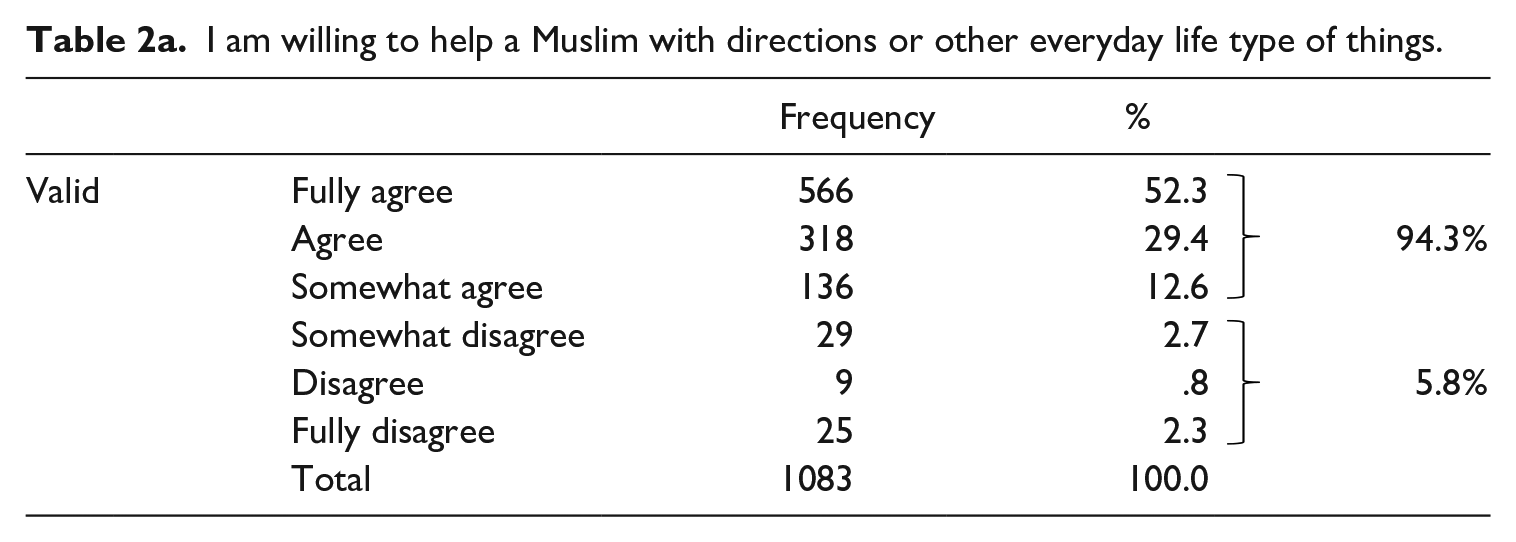
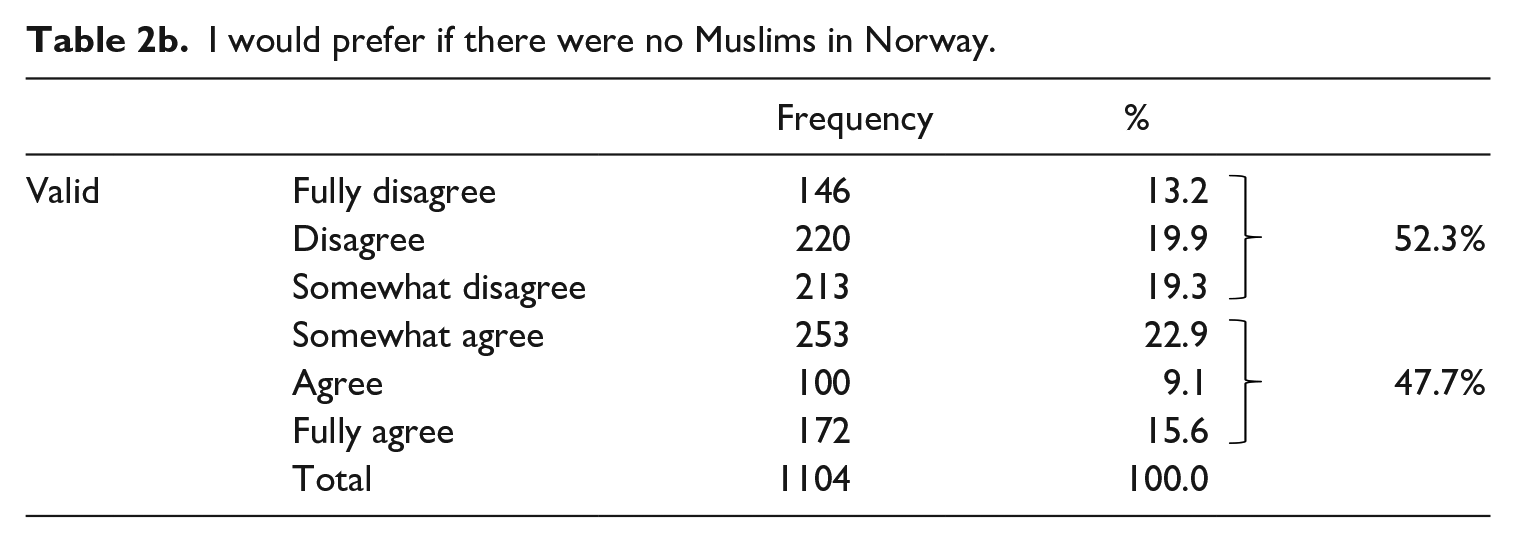
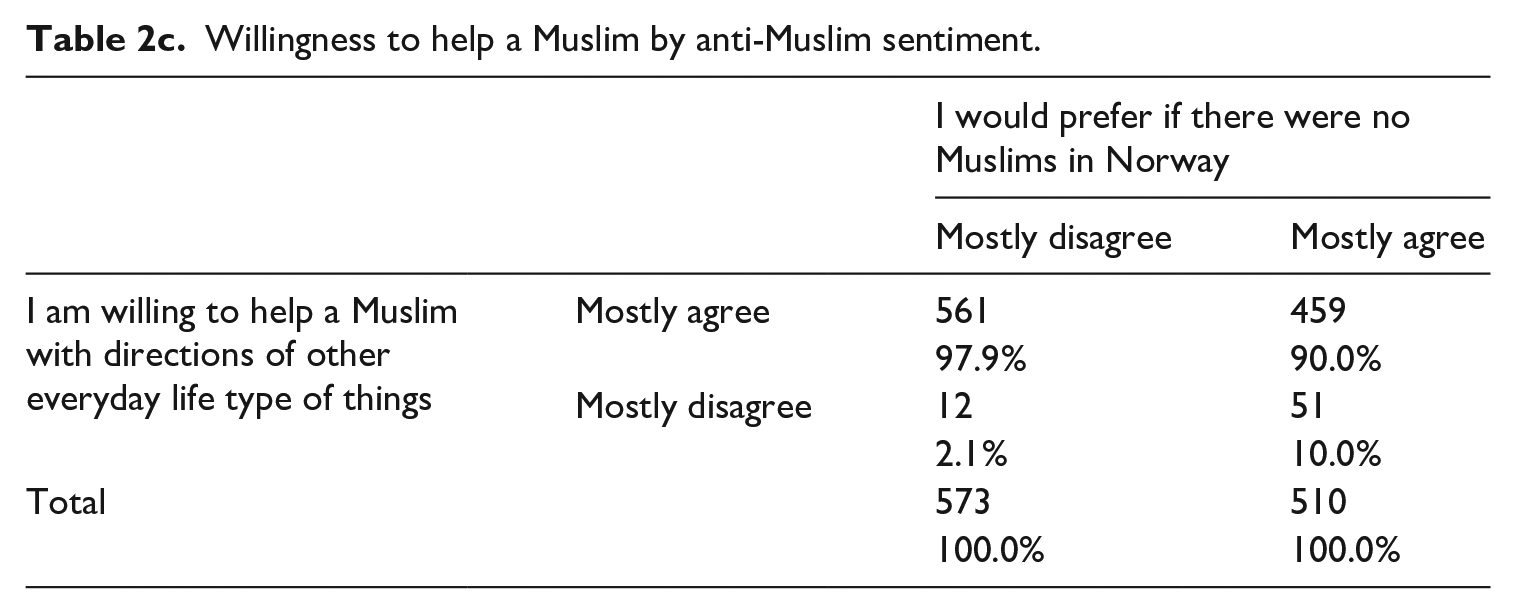
A second measure pertained to respondents’ ‘willingness to help a Muslim with directions or other everyday life type of things’, and respondents were also asked for their level of agreement to the statement ‘I would prefer if there were no Muslims in Norway’. As seen in Table 2a, 94% of all survey participants were willing to help Muslims, even though 48% of them would prefer if there were no Muslims in Norway (Table 2b). Moving on to Table 2c below, 90% of those who preferred to have no Muslims in Norway were nevertheless willing to help Muslims (γ = .385, 1 p < .000). These numbers indicate that in mundane intercultural encounters, majority Norwegians’ normative ‘discursive’ cognitions in most cases take action-control over their more racist ‘automatic’ inclinations.
I am willing to help a Muslim with directions or other everyday life type of things.
I would prefer if there were no Muslims in Norway.
Willingness to help a Muslim by anti-Muslim sentiment.
Narratives of Everyday Cosmopolitan Civility
The quantitative finding that approximately 9 out of 10 majority Norwegians consider themselves equally polite and helpful to immigrants and white Norwegians was replicated in qualitative interviews with 25 participants, where only one woman in her 90s professed to being less polite to immigrants. Interestingly, interviewees delineated everyday cosmopolitanism as being mostly motivated by prevailing cultural values mounting to an informal social contract. For example, ‘Samuel’, an 80-year-old mathematician interviewed in urban Telemark, detailed his aversions for ‘Islamic people’. Even so, he posited that citizens in the communal space of ‘the streets’ are obligated to suppress personal aversions and implement controlled behaviours according to the will of the Norwegian state: When the Norwegian government has decided to grant somebody permanent stay, it is my responsibility as a citizen to be welcoming towards them in the streets, regardless of how I might ‘feel’. [. . .] Islam is a religious, political, territorial and militant ideology that truly frightens me. But when I meet Muslims in my everyday life, I treat them with kindness.
‘Samuel’ did not narrate a ‘convivial’ ‘indifference to difference’ (Amin, 2013: 3), where he is able to ‘invoke difference whilst avoiding communitarian, groupist precepts’ (Valluvan, 2016: 218), nor an attempt to ‘work on’ (Hochschild, 1979) his racist emotions. Instead, he represents a tendency found within a subcategory of the interviewees, of people who engage in cosmopolitan social performance (Goffman, 1961) while leaving emotional aversions unchallenged. This narrative shared parallels with that of a young professional in the culture sector named ‘Pernille’, who would, quote, ‘smile to immigrants but not as much to white people’. At first, her narrations of playful intercultural encounters were taken to indicate a deep appreciation for diversity. But, as she went on to talk about her efforts to include an Iranian neighbour in the Norwegian tradition of ‘dugnad’ [voluntary communal labour], it became clear that her cosmopolitanism was predominantly duty-driven: Pernille: I explain ‘dugnad’ to her, and I can joke around and say ‘you’re a Norwegian now’. She’s the only immigrant in our neighbourhood [laughs]. Interviewer: Would you talk with her if she was white? Pernille: No. I really want her to feel that my partner and I don’t discriminate. We’re open, we’re nice people. So then we overcompensate. Like, if someone else offered me a homemade cookie, I might say ‘no thanks’. But with her, it’s exotic, and I’ll eat the cookie. [. . .] Interviewer: I feel that way too, but maybe I’m too shy or introverted to engage in such conversations even though I would love to come to their house and. . . Pernille: [interrupts] . . . I’m not that curious. In part I see it as a moral duty. I feel an obligation to talk to people and an obligation to make people feel included . . . But I’m not interested in visiting her home, if you know what I mean? [Laughs].
Paradoxically, ‘Otherness’ seemed to simultaneously attract and create boundaries from deeper forms for interaction. Specifically, interviewees were attracted to mundane cosmopolitan exchanges as opportunities to develop a positive self-concept. Particularly for those who lacked diversity in their lives, such encounters provide a safe experiential basis for egalitarian identity building. This point will be further illustrated by a middle-class retiree named ‘Ragnhild’, who felt ashamed to, quote, ‘live in a white bubble’ in an almost exclusively white suburb. Like ‘Pernille’, ‘Ragnhild’ at times sought out encounters with foreigners in easy and manageable forms. For example, she dropped money to Romanian street-beggars, quote, ‘to feel better about myself’. In another instance, as she recounted with beaming pride, she had approached an Indian jogger: Ragnhild: I have an exercise route where I run into an Indian guy with a turban, and I’ve thought ‘I want to talk with that guy’. One day I took the initiative and said to him ‘you’re staying in shape!’, and when I see him now we exchange a few sentences, like ‘you’re still staying in shape’, ‘nice pants’ and then we go our separate ways. [. . .] You rarely see someone jogging with a turban. Interviewer: Would you have talked to him if he was white? Ragnhild: No. You don’t see people with turbans jogging, so I thought I could say something to him. Lots of white Norwegians run there, but I don’t talk to them. There was something special about him.
With his foreignness at once accentuated in Norwegian nature and rendered harmless by the familiarity of his activity, this Indian man became an attractive target for ‘Ragnhild’s’ cosmopolitan identity project. From this perspective, ‘Ragnhild’s’ enthusiasm is not necessarily (or exclusively) grounded in her appreciation for difference or ability to avoid groupist precepts, but pride in being able to engage with a person despite their difference, and the allure of feeling like a ‘good person’ which tends to follow from such an encounter. Still, for ‘Ragnhild’ as for many others, their highly conditional and instrumentalist form of cosmopolitanism appeared fragile to underlying tensions arising from the automatic consciousness. To exemplify, this fragility of superficial cosmopolitan civility was observed in my interview with a young small-town woman named ‘Sarah’, who worked at a local bakery. ‘Sarah’ was adamant that she would be friendly to foreigners regardless of her negative feelings about them. However, in the following interview excerpt, as she talked about situations where ‘foreigners’ were perceived to challenge the symbolic boundaries established by her automatic consciousness, I noticed subtle aversions appear on her face, and imagined that in real-life encounters, so would her minority interaction partners: Sarah: I don’t think I’d have a problem helping foreigners with simple things, like picking up something they drop, or give directions. But if they ask to borrow something, like my phone, I’d be sceptical. Interviewer: What if the person asking to borrow your phone is Norwegian? Sarah: That would be fine. Interviewer: So do you think you’re equally polite to foreigners and Norwegians?Sarah: That depends. Groups of guys who keep glancing over at the nightclub irritate me, and I sometimes pretend I don’t see them. If foreigners do that, it feels disgusting to me. But with Norwegian, it’s normal and fine, ’cause they don’t mean any harm.
In public everyday life contexts, ‘Sarah’ rarely gave her ‘automatic’ attitudes full ‘action-control’ (Fazio and Olson, 2003) to be expressed overtly, but they would nevertheless ‘seep-out’ regardless of her conscious effort to be friendly. Problematically, then, minorities are known to rate non-verbal communication more heavily than verbal behaviour in their impressions of white interaction partners (Penner et al., 2010; see also Dovidio et al., 2002). A second way in which ‘automatic’ racial tensions disrupt ‘discursive’ cosmopolitan civility came to light in my interview with 80-year-old ‘Roger’, who described himself as a typical ‘farm-boy’. ‘Roger’ remained polite towards Muslims and immigrants regardless of being, quote, ‘among the strongest opponents of Muslims’. However, and highlighting the importance of ‘contextual cues’ (Fazio, 1986) for behaviour motivation, it seemed that this politeness broke down whenever he could find contextual justifications to act contrary to egalitarian cultural norms. In the following quote, as I probed the contradiction between his feelings about Muslims and his everyday hospitality towards them, he divulged one such instance: Interviewer: It’s fascinating that regardless of your scepticism you’d still help them with stuff. Roger: Yes, I would, but I have reprimanded one of them. It was stupid ’cause I could have been stabbed. I was chatting with someone on a street corner when a [Muslim] teenager crossing the street let some trash fly out of his hand, and I said ‘you dropped something’, and I told him without thinking ‘look at the pigsty behind you, you’re a pig!’ And a pig to Muslims is not good. [. . .] That’s the culture I was talking about, it’s all shit and they throw their shit everywhere, and we don’t do that here.
What we decide to do in a given situation may ‘owe a great deal to the chance matters of what [culture] is available’ (Martin, 2010: 240). The above quote presents an example of contemporary covert racism, where Roger uses the thrown napkin as an alternative ‘support for action’ (Swidler, 1986) to justify and disguise his racist aggression towards Muslims as a rational response to public littering. In summary, then, and across age-groups and locations, cosmopolitan openness appeared to exist predominantly as a discursive, superficial and instrumentalist practice externally motivated by cultural norms, which is conditioned on the spatio-temporal boundedness of encounters, and vulnerable to racist tensions arising from the automatic consciousness.
Back Stage Behaviours
Physical Touch
As a first example of a private selection decision, participants were presented with the following vignette: Imagine that you’re working as a massage therapist, and you can choose between giving a back-massage to a customer of Somali background or a customer of white Norwegian background. No one will know what you decide. Who would you choose?
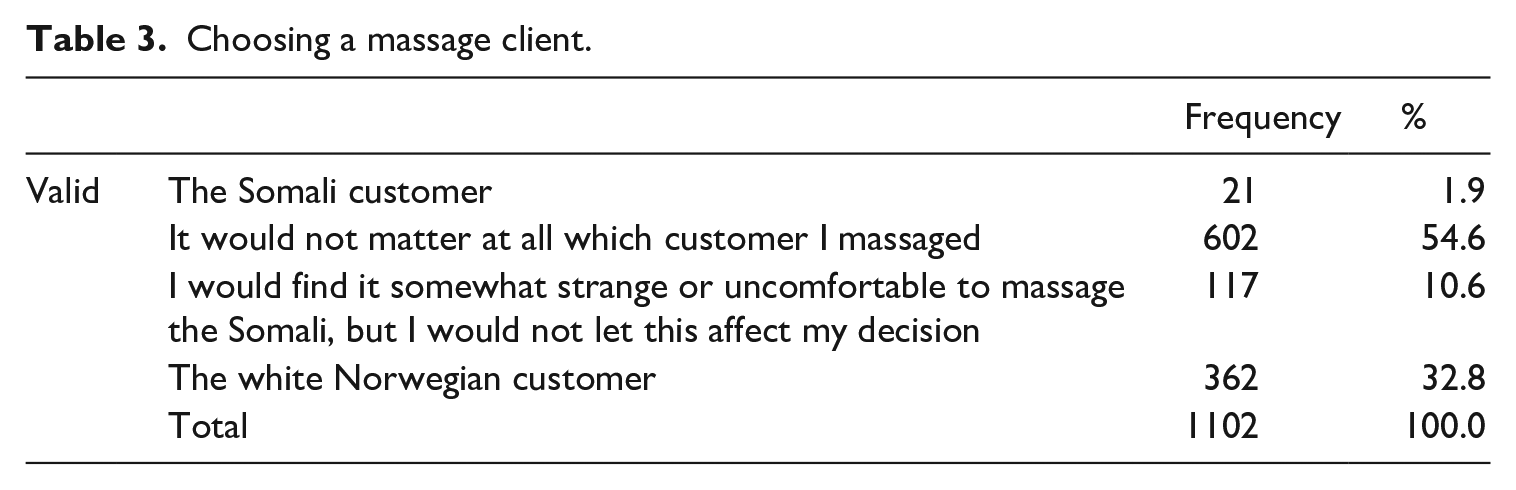
Physical touch in this scenario is conceptualized as a measure of racial ‘disgust’ (Haidt et al., 1997; Miller, 1998; Tate, 2016), which may in equal measures be rooted in foreign pathogen avoidance (Haidt et al., 1997; Navarrete and Fessler, 2006), and the perceived ability of ‘the black touch’ to pollute in more symbolic terms (Tate, 2016: 69). Indeed, and according to Tate (2016: 79) racism is a game of opposites that requires physical and psychic distance from the Other, and which therefore must deny ‘the potential of border crossing produced by touch’. With these perspectives in mind, 55% of the survey respondents reported that it ‘would not matter at all which customer I massaged’ (Table 3). However, 33% reported a preference to massage the white body, with an additional 10.6% selecting the option ‘I would find it somewhat strange or uncomfortable to massage the Somali, but I would not let that affect my decision’. These results give two important indications: first, that 10.6% of majority Norwegians may rationally override the automatic racism they experience in relation to intercultural touch, and second, that Somali people (and perhaps a greater spectrum of immigrants) may be included in 43.6% of majority Norwegian’s ‘categories of people heuristically associated with disease’ (Faulkner et al., 2004: 336), or other forms of symbolic pollution (Tate, 2016).
Choosing a massage client.
The qualitative interviews procured similar results, with half of the interviewees responding that it would not matter, or that they hope it would not matter, who they massaged. The remainder of narratives indicated two conflicting cognitive processes where automatic heuristics group immigrants together and activate the ‘disgust’-response (Haidt et al., 1997; Tate, 2016), followed by rebuttal from controlled discursive rationalizations. In one such instance, a young airplane technician from Nordland named ‘Jens’ opted not to massage the Somali on the count of imagining that ‘the Norwegian has better hygiene’, before adding ‘although I know that’s not true’. Likewise, when I asked an accountant in her 60s referred to as ‘Linda’ why she chose the white customer, she replied with a similarly dualistic and dissonant narrative: In addition to them being two different races, it’s about what the person looks like, ’cause for me, it’s about not wanting to touch someone who’s a bit gross. But I guess the Norwegian could also be fat and gross.
Notably, it is worth considering if such ad-hoc rational statements are little more than face-saving artefacts of the interview setting that do not play a part in behaviour decisions.
High-Stakes Selection Decisions
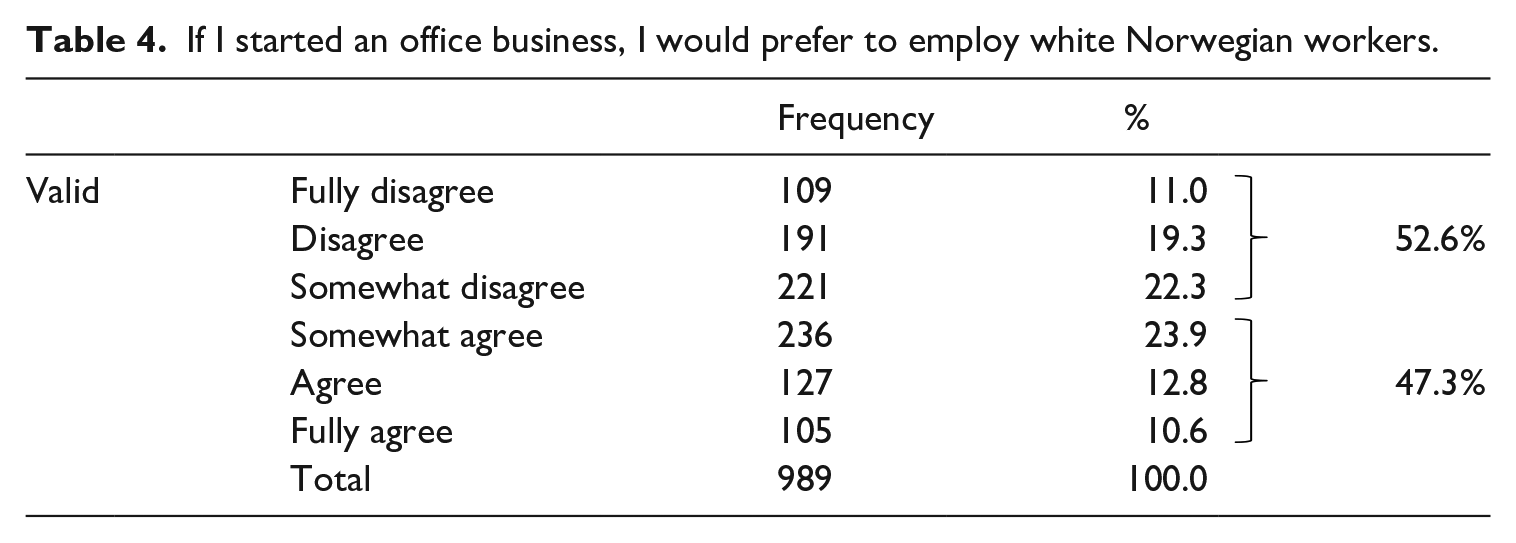
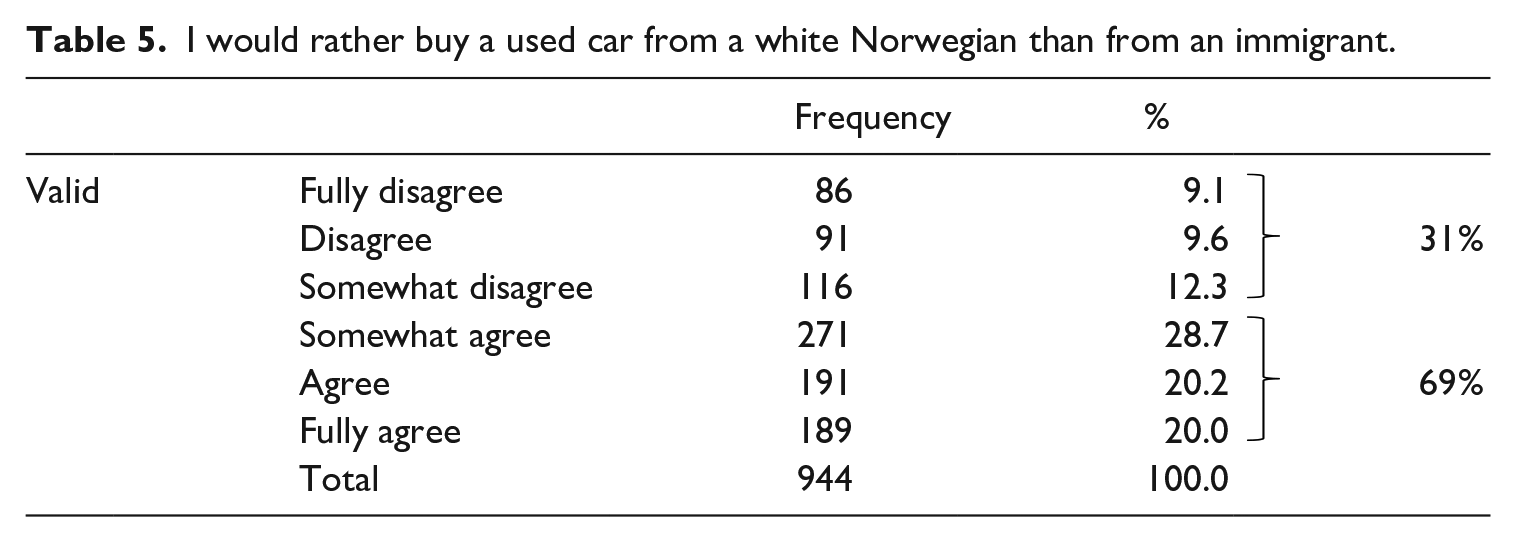
Disgust, as a system of rejection, has expanded past physical proximity and touch to include ‘moral-disgust’ (Haidt et al., 1997; Miller, 1998) for the perceived moral impurity of foreigners, and prompting rejection of immigrants in social, economic and professional arenas. From this theoretical backdrop, the final form of intercultural behaviour explored relates to privately made decisions concerning employment, and buying a used car from a private seller. As demonstrated in Table 4, close to half of the Norwegian majority population reported that in the scenario of opening an ‘office business’, they would prefer to employ white Norwegians, and as seen in Table 5, 69% reported that they would rather buy a used car from a white Norwegian seller. These findings are taken to indicate that roughly more than half of the Norwegian majority population is motivated by ‘automatic’ racist stereotypes to exclude immigrants in contexts that require genuine trust in their moral integrity and competence.
If I started an office business, I would prefer to employ white Norwegian workers.
I would rather buy a used car from a white Norwegian than from an immigrant.
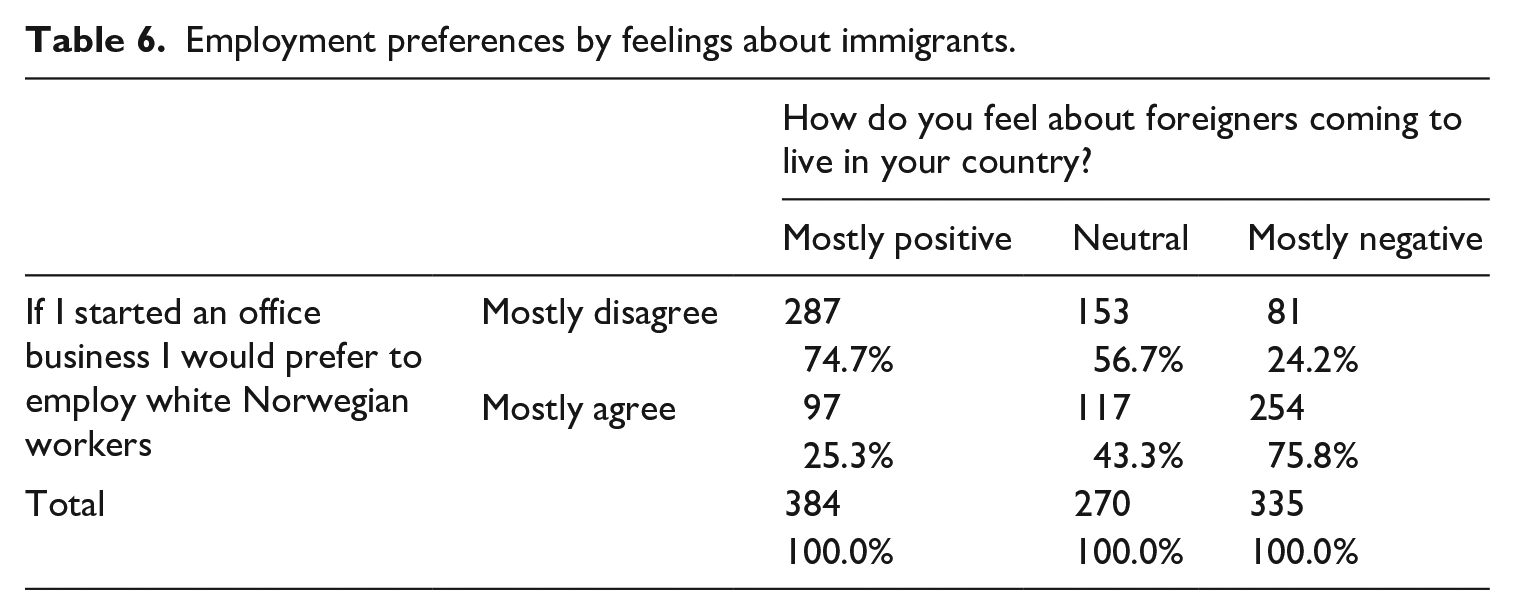
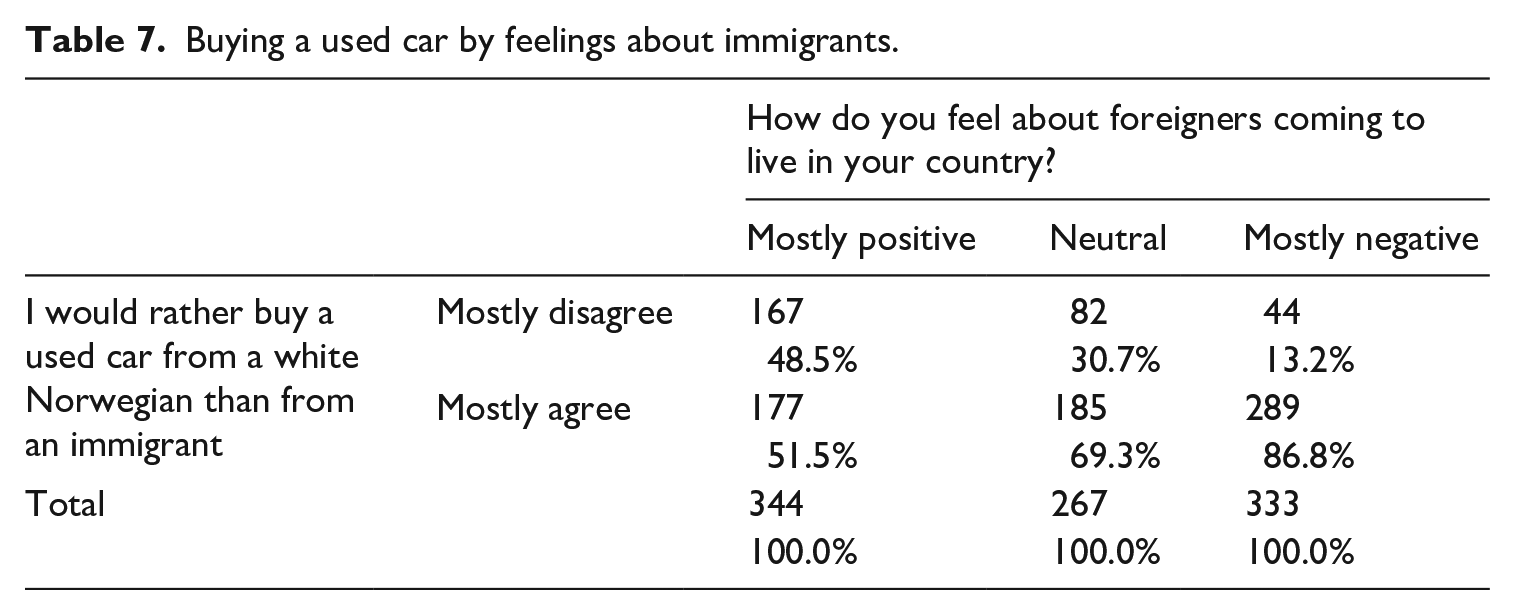
Furthermore, and shedding light on the flawed nature of many Norwegian people’s egalitarian self-concepts, one in four of those who reported positive feelings about immigrants would nevertheless prefer to employ white Norwegians (Table 6, γ = .560, 2 p < .000), whereas just over half of them would prefer to buy a used car from a white Norwegian seller (Table 7, γ = .487, 3 p < .000). For many Norwegians, then, immigrant-positivity is perhaps more ‘discursive’ and principle-based than it is emotionally anchored. Finally, it is interesting to note that among those who indicated ‘neutral feelings’ about immigrants, almost 70% would prefer to buy a used car from a white Norwegian seller. This confirms a previous finding that because people want to avoid thinking of themselves as ‘racist’, they often express negative attitudes only through an unwillingness to give positive evaluations of cultural and racial diversities – thereby ‘hiding’ much of their racial animus in the ‘neutral’ category (Pettigrew and Meertens, 1995).
Employment preferences by feelings about immigrants.
Buying a used car by feelings about immigrants.
Narratives of Back Stage Selection Decisions
The pattern of immigrant-rejection in high-stakes selection decisions was even more evident in qualitative interviews. In one instance, when asked whether she would buy a used car from a white Norwegian or an immigrant, ‘Linda’ who was previously quoted for imagining the Somali massage customer to be ‘a bit gross’ made a similar generalization about the moral impurity of immigrants: I’m concerned they’d sell a me car with rust holes, and just patch them up add car paint so that it looks good when it’s really a pile of junk. So for me, it’s because I don’t trust that they’re not crooks out to make money.
This stereotypical perception of immigrants as morally corrupt was echoed by 18-year-old ‘Sarah’. When asked about her employment preferences, ‘Sarah’ recalled a specific memory which confirmed her prejudices, as people often do (Fiske, 1998), of seeing refugees loitering in her hometown, responding, quote ‘I would employ Norwegians. I mean, I wouldn’t hire someone who hangs around the local shop with a group of people.’ ‘Sarah’s’ attitude towards immigrants was clearly driven by disgust, which is far more powerful than dislike, as only disgusting objects can contaminate what it comes in contact with (Haidt et al., 1997). Moreover, as she explained that driving a car pre-owned by an immigrant could potentially degrade her both physically and socially, distance was again pointed out as central to the maintenance of racial power hierarchies (see Tate, 2016): I would buy the car from a white Norwegian because of the smell. Their smell sticks to the walls. But it’s also about the car’s condition – ’cause the Norwegian is better at keeping things neat and in working order. And then I just don’t think I would be driving around town in a car when people know it used to belong to an immigrant. That’s just how it is.
Importantly, and whereas the two women quoted above became increasingly uncensored through their interviews, participants more commonly attempted to construct a balanced narrative and self-presentation. For example, and when asked which private seller he would prefer to buy a used car from, ‘Jens’, the young airport technician from Nordland, made sure to insert cosmopolitan cultural scripts into the reporting of his ‘automatic’ behaviour preference: Many Polish and other people take shortcuts because they have a stubbornness and confidence they don’t quite deserve. I would look at the person rather than their skin-colour, but I think it would be a much safer bet for me to hire a Norwegian. Norwegians are timid and they only want what’s best. But there are also lots of lazy Norwegians, so there are pros and cons.
As ‘Jens’ became aware of the problematic nature of his initial statement, he attempted to give the appearance of an ‘action-control conflict’ (Fazio and Olson, 2003) between his ‘automatic’ stereotype-generating heuristics and his discursive awareness that skin-colour does not determine ability. In the context of his wider interview, however, automatic cognitions were clearly given priority in his decision making, and ‘Jens’ went on to say that he would prefer to buy a car from a white Norwegian, explaining that ‘many immigrants are sloppy’ and ‘lie about the car they’re selling’. His narrative closely resembled that of a 60-year-old mechanic from eastern Norway referred to as ‘Herman’, who also repeatedly commented on the erroneous and reprehensible nature of the stereotypes guiding his decision making: You can’t judge a book by its cover, but there’s lots of immigrant workers from Eastern Europe that are very badly qualified. Well, of course there are good and bad workers among them as well. But if you’re stupid enough to let a Lithuanian fix the rust on your car then the result probably won’t be good. Of course, you can’t say that for sure. But when it comes to hiring, it has to do with money, so that decision should come as no surprise.
The findings presented here indicate that people are knowledgeable of and even invested in cosmopolitan values and principles, but that because these ideals tend to contradict ‘automatic’ racial aversions triggered in ‘high-stakes’ selection decisions, they are often not put into action. Interestingly, then, it seemed that engaging in superficial cosmopolitanism may be enough to sustain people’s egalitarian self-concepts, and most of the interviewees quoted here gave themselves high ratings on a scale of openness regardless of their rejection of immigrants ‘back stage’ (Goffman, 1978 [1956]). For example, 90-year-old Astrid – the only person who reported being less polite to immigrants – placed herself as an eight on a scale of openness on the basis of international travel and consumption. Furthermore, both ‘Herman’ and ‘Roger’ identified as an eight or nine, with Herman adding, quote, ‘as long as they don’t force their culture on me’, and ‘Roger’ admitting, quote ‘I don’t want to have a coal black African in the office. There are some barriers there for me.’ As a final example, ‘Karl’ considered himself a nine on the scale of openness to other cultures regardless of his aversion to touch or employ dark bodies, and having just stated that ‘immigrant [car] salesmen would have a higher threshold to gain my trust’.
Conclusion
Drawing on a combination of interview and survey data, this article explored the conditions under which white majority Norwegians engage in forms of cosmopolitan (Skrbis and Woodward, 2007) or racist behaviours. The research approached this objective by introducing a dual-process analytic framework (Kahneman, 2011; Vaisey, 2009) to sociology of everyday intercultural relations, which demands that equal analytic attention is given to the intuitive (‘automatic’) and reason-based (‘discursive’) motivations of human behaviour. More specifically, findings indicate that in ‘front stage’ (Goffman, 1978 [1956]) public contexts, and regardless of their ‘automatic’ racial attitudes, nine out of 10 white majority Norwegians perform an instrumentalist and discursive variation of cosmopolitan openness based on an acquired awareness of normative cultural scripts and multicultural ‘know how’. This superficial cosmopolitan conviviality seemingly manifests within settings that enable people to humour their curiosity for the exotic and enjoy aspects of difference while maintaining distance, and it is easily disrupted by underlying tensions when foreign interaction partners are perceived to overstep the symbolic and physical boundaries on which the interaction depends. Findings also gave support to the interpretation that multicultural encounters are used by some white Norwegians for the purpose of maintaining positive self-concepts and sustain an exaggerated sense of innocence and egalitarianism which has previously been noted as a problematic quality of the Norwegian self-understanding (Gullestad, 2004) as it inhibits critical self-reflection and the ability to combat racism. Additionally, seeing that the majority was inclined towards racial aversions even in simple everyday multicultural interactions (see Dovidio et al., 2017), findings harmonize with research that breaks with delineations of cosmopolitanism as a pure and ethical disposition, and instead emphasizes the ambiguity of ‘actually existing’ (Robbins, 1998) cosmopolitan openness. With that said, however, the research focus was placed on the dominant attitude pattern of the samples, and there are exceptions of people who express a more consistent and deeply ethical cosmopolitan outlook that will be noted as a matter for further research.
Giving further credence to the argument that much everyday cosmopolitan openness is ‘discursive’, instrumentalist and performative rather than indicative of deeper emotions, findings also suggested that those who practise cosmopolitan conviviality would uphold this openness only in between 30% and 50% of ‘back stage’ (Goffman, 1978 [1956]) scenarios relating to physical touch, employment and buying a used car. One potential explanation for this is that private settings allow people to submit to the wills of their automatic thought processes without experiencing stigmatization and loss of social acclaim. Additionally, and unlike easy forms of everyday civility or conviviality, the private action scenarios required mutuality and trust in the physical and moral integrity and competence of immigrants that many participants were not prepared to give. In summary, then, the dual-process analysis gives indications that many white Norwegians practise mainly instrumentalist forms of cosmopolitan openness that give the benefits of egalitarian cultural value without the cost of destabilizing racial or cultural power hierarchies, and relatedly, that they practise covert forms of racism that sustain white privilege without risking personal stigmatization by the wider society.
Implications
The dualistic interpretation of intercultural behaviour and attitude patterns outlined here brings three important insights to the sociological field of intergroup relations. First, the dual-process approach identifies that the majority of racism is a product of the ‘automatic’ cognitive system which forms predominantly through implicit learning in early socialization (Bloch, 1991; Shore, 1996). Cosmopolitan discourses, including anti-racist teaching efforts, will mainly develop people’s ‘discursive’ self-representational skills, whereas the ‘automatic’ cognitive system that guides most ‘back stage’ actions (Goffman, 1978 [1956]) (for review, Greenwald et al., 2009; Oswald et al., 2013) is not immediately susceptible to this method of learning. Even so, explicitly taught cosmopolitan cultural scripts may prompt people to engage in cosmopolitan intercultural encounters where a transformative implicit cultural learning process can take place (Chaiklin, 2011). In short, the dual-process framework could prove valuable to further studies on attitude and behaviour change.
Second, the dual-process approach can advance sociological understandings of how it is possible for minority groups to experience stagnant or even rising levels of racism when self-reported majority racism has declined. More specifically, and because humans have two thought systems, it is possible to find immigrants ‘aversive’, and at the same time ‘find any suggestion that we might be prejudiced “aversive” as well’ (Dovidio and Gaertner, 2004: 4). Moreover, as racist attitudes tend to reside in the semi-conscious ‘automatic’ system, people are often quite incognizant of the racist decisions they make ‘back stage’ (Goffman, 1978 [1956]), whereas the cosmopolitan civility performed in everyday encounters enables them to bolster their egalitarian self-concepts. It is arguably good that most people publicly suppress racism, but they suppress it ‘to a point where it cannot be confronted directly and changed . . . more fundamentally’ (Schneider, 2004: 415).
Finally, dual-process theory could be used to advance sociologically informed anti-racism education. Some empirical evidence from psychological research suggests that people who are made aware of their racist behaviours will monitor their prejudices and perform them less often (Green et al., 2007; Monteith and Voils, 1998; Son Hing et al., 2002). Particularly within organizations, a psychology-led initiative referred to as ‘unconscious bias training’ (UBT) is now increasingly implemented, including using Implicit Associations Tests (Greenwald et al., 2009) to heighten employees’ awareness of their biases and promote strategies to reduce their impact in decision making (review in Atewologun et al., 2018). Importantly, however, and as noted by Noon (2018), people’s receptiveness to UBT depends not only on the strength of their biases, but on whether or not they also have egalitarian aspirations. Moving beyond techniques that measure implicit bias alone, the sociological dual-process line of questioning proposed in the current article can be used to identify people’s automatic and discursive attitudes, thereby developing more complete ‘profiles of bias’ that will respond differently to anti-racism education, and assist in better evaluating the effectiveness of different approaches to UBT on this basis. Such a sociological approach would also expand past the psychological emphasis on individual agency to change, and enrich the discussions with explorations of structural constraints on agency, as well as the role played by socialization processes and context in the development of different racial attitudes.
Footnotes
Acknowledgements
Appreciation goes out to my colleagues at C-REX for their valuable comments on early drafts of this article, as well as to Professor Ian Woodward and Professor Katrine Fangen for their close readings and guidance throughout the writing process.
Funding
The author disclosed receipt of the following financial support for the research, authorship, and/or publication of this article: this research was funded by the Research Council of Norway.