




Abstract
Drag performance has entered mainstream British culture and is gaining unprecedented appreciation and recognition, yet no sociological accounts of this transformation exist. Using an inductive analysis of in-depth interviews with 25 drag performers, alongside netnography of media and other public data, this article develops a sociological understanding of the mainstreaming of drag. There are two clear reasons for the success of drag. First, there is a pull towards drag: it is now seen as a viable career opportunity where performers receive fame rather than social stigma in a more inclusive social zeitgeist, even though the reality is more complex. Second, there is a push away from other creative and performing arts because heteronormative perspectives persist through typecasting and a continued professional stigma associated with drag. In calling for a sociology of drag, future avenues for research on contemporary drag are discussed, alongside the need for the sociology of cultural and creative industries to incorporate sexuality as both a subject and analytic lens.
Introduction
Drag performance has undergone radical change in recent years. Once known as female impersonation, US reality competition TV series RuPaul’s Drag Race (RPDR) has epitomised dramatic shifts in the practice, consumption and economy of drag in British culture, and internationally. While there is a developing research agenda in cultural and performance studies about drag practice and representation (e.g. Brennan and Gudelunas, 2017; Crookston, 2021; Edward and Farrier, 2020), the current dynamics of drag, and the shifting experiences of its performers, are absent from contemporary sociological research. Even as the sociology of the cultural and creative industries has expanded to include important critiques of class, race and inequality (see Casey and O’Brien, 2020; e.g. Friedman and O’Brien, 2017; Saha, 2017), studies related to drag, Lesbian, Gay, Bisexual and Trans (LGBT) cultures and sexuality more broadly are notable omissions.
The foundation of this article is the contention that where British drag was once a subculture within already stigmatised LGBT cultures, it has become mainstream and is vibrant both in less marginalised LGBT cultures and also in arts and performance cultures in cities across the UK, even as heteronormativity persists. Drag is present in theatres, museums, heterosexual bars and nightclubs and mainstream media, alongside a touring economy of international drag performers. While drag has been present in mainstream culture previously, the current trend reaches beyond a few ‘break out’ individuals to a broader cultural recognition and appreciation that marks a distinct shift from previous iterations.
Using an inductive analysis of in-depth interviews with 25 drag performers, alongside a netnography of social media and public data, this article documents the mainstreaming of drag and explains its success. First, there is a pull toward drag: it is now seen as a viable career opportunity where performers receive fame rather than social stigma, even though the reality is more complex. Second, there is also a push away from other creative industries: participants spoke of heteronormativity in the form of typecasting from other industries, such as dance and musical theatre. We also highlight the limitations of mainstreaming, both in terms of the types of drag that have been mainstreamed and the damaging consequences it can have. Through these arguments, we develop a sociology of drag that moves beyond critique of representation in cultural studies and broadens the heteronormative narrowness that currently characterises the sociology of the cultural and creative industries, calling for greater recognition of sexuality as a structuring force in social and cultural life.
Mainstream Gender-Bending and Subcultural Drag
Much has been written about cross-dressing in theatre and culture historically and cross-culturally (e.g. Rodger, 2018; Senelick, 2000). Part of the complexity of defining drag and understanding its history comes from its presence in two distinct but overlapping cultures: one strand within dominant heterosexual or mainstream culture, which we refer to as gender-bending or cross-dressing, and the second within LGBT subcultures, which has become known as drag (Baker, 1994).
In mainstream culture, men have performed women’s parts in Shakespearean and other related theatre, most often as a source of comedy. Part of the intended humour was that a male actor was performing a female character who was masquerading as a man. Comedy became increasingly important in these roles and the primary reason for them in established theatre by the 1700s (Ackroyd, 1979). Then, by the late 1800s, ‘female impersonation took on its most grotesque but acceptable face’ (Ackroyd, 1979: 101) of the pantomime Dame. This figure always retained the explicit understanding between actor and audience that the ‘Dame’ is performed by a man, known as ‘false disguise’ (Baker, 1994: 15). In mainstream theatre, the false disguise approach is inherently desexualised, and the humour is partly the supposed absurdity of men in women’s clothes. This re-inscribes a sex binary and is a form of heteronormativity (see Schilt and Westbrook, 2009: 441) – defined as ‘cultural, legal, and institutional practices that maintain normative assumptions that there are two and only two genders, that gender reflects biological sex, and that only sexual attraction between these “opposite” genders is natural or acceptable’.
Many male actors dressed as women in false disguise for comedic effect in British television and film (Ginibre, 2005). For example, in the Carry On films, characters played by Charles Hawtrey and Kenneth Williams regularly dressed as women – while both men are now understood as closeted gay men, their dressing as women tended to be independent of their private sexualities (Dyer, 2002). Similarly, heterosexual male comedians regularly incorporated female characters in their repertoire in false disguise, including Cissie and Ada as played by Les Dawson and Roy Barraclough, and various characters by The Two Ronnies and the Monty Python team. Cautioning against a simplistic narrative of historical erasure, drag performers from LGBT subcultures have found success in the British mainstream, such as Danny La Rue, Hinge and Bracket, and Lily Savage, but they were exceptions to the broader marginalisation and appropriation of drag performance (Halberstam, 2005) and LGBT cultures (Bernstein, 2006; Dolan, 2010).
Drag performance has mostly occurred in subcultural venues such as LGBT clubs, bars and ballrooms and can be traced to the Molly Houses and balls of London, Manchester, New York and various European cities (Chauncey, 1994; Cocks, 2007). Here, drag was performed by people of all genders not for a paying audience, as per mainstream theatre, but for gender and sexual minorities who faced social and legal censure (Dyer, 2002; Houlbrook, 2005). Drag served a community-building function for LGBT people and was a site for political resistance to homophobia, transphobia, heteronormativity and other damaging social norms including police harassment (Halberstam, 1998; Rupp and Taylor, 2003). For much of the 20th century, drag performance existed as a subculture within the marginalised ‘homosexual’ subculture of the time (Baker, 1994; Newton, 1979). Subcultural characteristics included broader marginalisation, a language and norms shared by its members, a specific and shared geographical space, a sense of community identity and an understanding that it is subcultural (Snyder, 2009; Wignall, in press). Drag queens experienced double marginalisation being both gay performers rejected from mainstream performance and performing a feminised homosexuality which was stigmatised by many gay men (Newton, 1979), and drag had a marginal status in LGBT cultures (Garber, 1992).
The nomenclature of ‘drag queen’ (typically performance where gay men dress as women) and ‘drag king’ (typically performance where lesbian women dress as men) took hold, alongside a rich tradition of trans and gender non-binary performers doing drag using both these and other labels (Grace and Halberstam, 1997), as well as cisgender women performing as drag queens. Distinct but overlapping cultures developed for drag queens and drag kings (Rupp et al., 2010), with different political perspectives and dynamics. Drag king cultures, often with greater inclusion of queer and trans drag performers, engaged in more political performances, foregrounding anti-transphobic, anti-racist and anti-capitalist perspectives (Basiliere, 2019; Drysdale, 2019), alongside an overt critique of heteronormativity (Rupp et al., 2010). Contrastingly, drag queen performances focussed more on entertainment and the subversion of norms of sexuality and heterosexual privilege, particularly stereotypes of gay men and femininity (Baker, 1994). As Dyer (2002) argues, the political nature of drag exists on a spectrum, dependent on the performer, the venue and the broader social and cultural context in which the drag is performed. Thus, while drag was political and subversive when same-sex sexuality is either criminalised or heavily policed, its meanings and practices change as broader shifts in society occur.
The Sustained Rise of the Drag Queen
In his seminal book on drag in the performing arts, Baker (1994) identified a ‘rise and rise’ of drag queens, contrasting with the rise and subsequent fall of female impersonation. Some drag performers gained significant social and economic benefits from their work by the start of the 21st century (Hopkins, 2004). Schact (2002) identified the position of the drag queen within LGBT cultures as often one of fame and privilege, but in a community marginalised in broader culture – leading to a ‘contradictory status’ (Berkowitz and Belgrave, 2010: 168). In the more-than twenty-five years that have passed since Baker’s framing, the drag queen has continued to rise and the current period has been characterised as a ‘golden age’ of drag (Brennan and Gudelunas, 2007: 1). While the terminology has shifted from ‘drag queen’ to ‘drag’ to recognise gender diversity, the golden age is mostly restricted to cisgender gay men, with trans performers and drag king performance arguably remaining subcultural, not least because RPDR is almost exclusively restricted to cisgender gay male performers (Drysdale, 2019).
The mainstreaming of drag is primarily attributed to the remarkable success of RPDR in popular culture. It currently airs on Netflix in the UK and, at the time of writing, there are 13 seasons of the US show, which has won nine Emmys, and several spin-off series: 13 seasons of Untucked, five seasons of RPDR All Stars, three seasons of RuPaul’s Drag U, two seasons of RuPaul’s Drag Race UK (RPDRUK), and franchises for Australia and New Zealand, Canada, Holland and Thailand. Most of the shows have been available to British viewers through streaming services. RPDRUK, commissioned by the BBC, had over one million views on iPlayer in the first week of its first season and over 12 million views by the end of 2019 (Kanter, 2019), with two further seasons commissioned and a spin-off series God Shave the Queens. RPDRUK has provided a route into other mainstream media for its most popular contestants, including appearances on television shows such as The Celebrity Circle, Celebrity Masterchef and I Like to Watch UK, alongside an official national tour of the RPDRUK cast.
A broader cultural engagement with drag has also occurred. National and regional museums have hosted drag exhibitions, including London’s The Hayward Gallery (DRAG: Self-portraits and Body Politics, 2018), the Tate Modern (Ladies and Gentlemen, 2020) and Manchester Central Library (Life’s a Drag, 2016). A growing number of books have been published on British drag, such as Diary of a Drag Queen by Crystal Rasmussen in 2019, Serving Face by Felix le Freak in 2020, and several photographic and illustrated books.
Several production companies organise drag shows and tours across cities in the UK, in large LGBT clubs and mainstream theatres and clubs. This has partly been spurred by touring American drag performers, both former RPDR contestants and other established international drag performers, such as Coco Peru and Peaches Christ. American drag star Bianca Del Rio, for example, headlined Wembley Arena in 2019 as part of a sell-out global tour. Mainstream venues including theatres in major cities hosted drag shows on almost a weekly basis prior to COVID-19 restrictions, in addition to performances in LGBT venues. ‘Drag brunch’ is another increasingly popular form of heterosexual drag consumption (Siddons, 2019), often occurring in mainstream venues.
Drag conventions are another significant area of growth. DragCon, the convention associated with RuPaul and World of Wonder, reportedly generated nine million dollars of merchandise sales and over a million dollars of ticket sales in 2018 (Jordan, 2018) and it has grown since, now running annual conventions in LA, New York and London. A competing convention, Drag World, claims to be Europe’s biggest, and runs an annual convention in London with tens of thousands of attendees. Drag performers can be paid for appearing, sell merchandise and earn money through performing and ‘meet and greet’ photo opportunities with fans. This is part of the practice of drag performers developing their own brand and associated merchandise (Campana and Duffy, 2021).
It is in this context that the mainstreaming of drag is facilitated by a ‘celebrification’ of popular culture, where celebrity is a commodity that is actively constructed and produced by the media and the ‘celebrity industry’ (Rojek, 2001; Turner, 2014). Part of the success of the RPDR franchise is its use of the reality TV format (Gamson, 2013), and its ability to harness social media through memes and self-branding (Mercer and Sarson, 2020). This has provoked questions about the radical potential of drag and its scope for transgression (Brennan, 2017), as well as whether the mainstreaming of drag exploits performers and drag culture more broadly (Feldman and Hakim, 2020; Vesey, 2017). For example, many contestants on RPDR reportedly take on significant debt to buy or commission expensive outfits to compete at the so-called Olympics of drag without any guarantee they will recoup the investment as this is dependent on being embraced by the fanbase and maintaining a successful drag brand (LeBlanc, 2021).
More broadly, the mainstreaming of drag has occurred as British society became more liberal regarding aspects of personal sexuality. Homophobic attitudes have markedly decreased since the late 1980s, with data from the 2018 British Social Attitudes survey showing 66% of adults think same-sex relationships are ‘not wrong at all’ compared with just 11% in 1987 (Albakri et al., 2019). Attitudes toward non-marital sex also significantly improved across the same period (Gubernskaya, 2010), suggesting a broader attitudinal change related to consensual sexual activity between adults that is part of the individualisation of society during the latter part of the 20th century (Beck, 1992; Weeks, 2007). People are seen as able to create their own biographies and life stories, including diversifying narratives about gender and sexual identity (Savin-Williams, 2005), even as these new possibilities are circumscribed by structural constraints connected with class and gender (Jamieson, 1999), connecting with RuPaul’s famous phrase ‘you’re born naked and the rest is drag’. Yet, how drag went mainstream beyond the success of RPDR, and how drag performers experience this change, has not been the subject of sociological study.
Methods
Participants
The current study addresses the absence of sociological research on contemporary drag by foregrounding the perspectives of drag performers. We undertook in-depth, semi-structured interviews with 25 drag performers, collected between April 2017 and November 2018. Criteria for inclusion in the study were that participants had to regularly perform in drag, received payment for their performance, and identify with the term ‘drag’ in a way meaningful to them. Participants were based across the UK and Ireland, aged between 18 and 52, and had been performing drag for between one and 27 years (mean = 11.44 years) at the time of interview. Nineteen participants identified as cisgender male, three as trans, two as gender-nonconforming, and one as cisgender female.
All participants gave informed consent and were asked if their drag name could be used in publications (see also McRobbie, 2016), and all but three consented to this. Participants sometimes requested that specific comments were not attributed to them: requests we have honoured. Most participants were White, with one Black participant.
Table 1 provides further information about participants: location refers to area where they most frequently perform and years doing drag was at the time of interview. Regarding the relative homogeneity of our sample, 12 performers of colour were contacted to participate, and we hypothesise that the predominance of White participants is a combination of the ethnicity of the researchers, the greater scrutiny performers of colour face in the media (Puwar, 2004), and the structural privilege present in RPDR and mainstream culture.
Participant information.
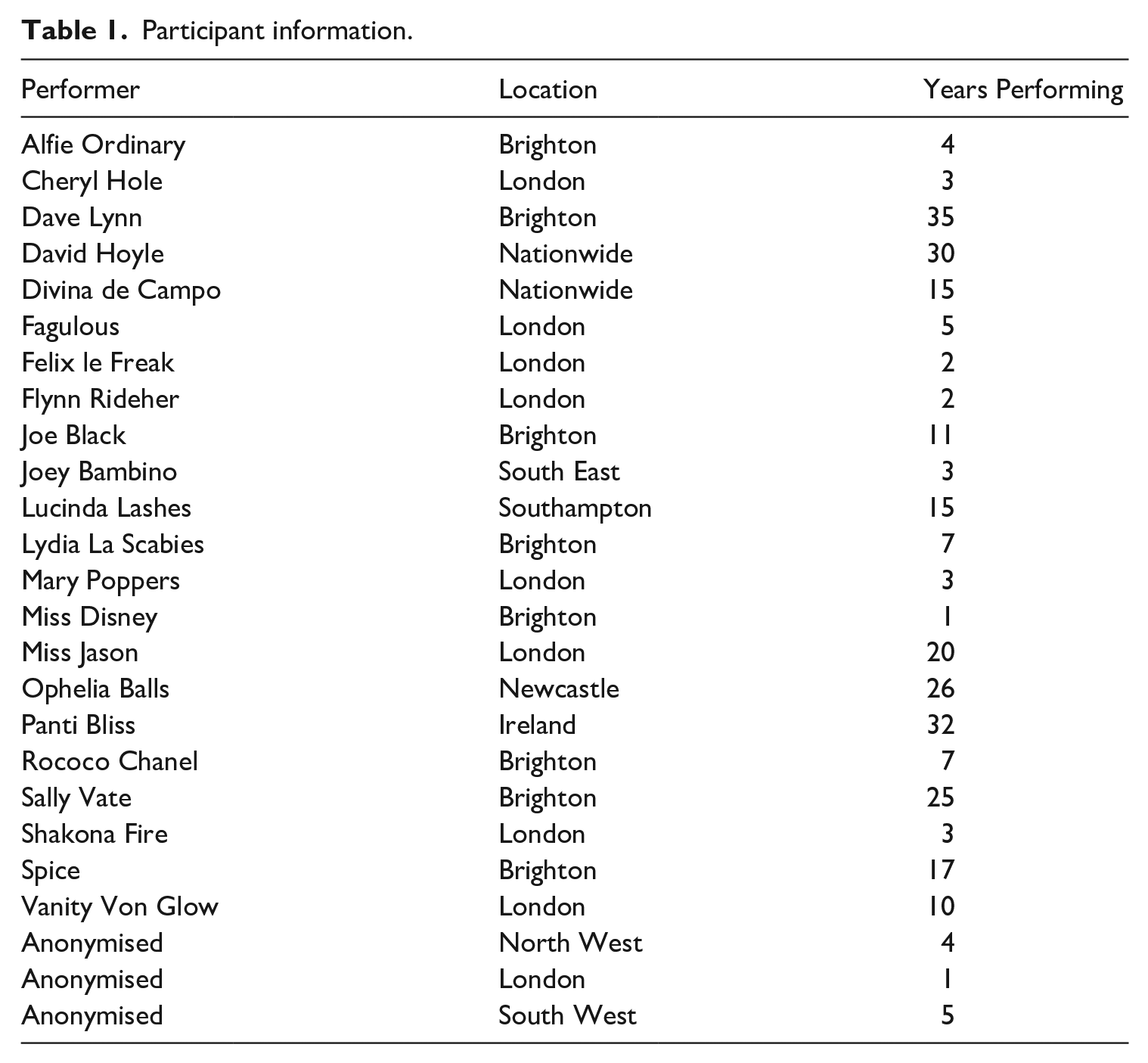
Participants were recruited primarily through the research team contacting individuals via publicly available contact details. A few participants were recruited directly through personal interactions, and some participants recommended friends. Participants come from a range of geographical areas, but there is a preponderance of participants based in London and Brighton. Within these locations, care was taken to ensure that different venues and networks were sampled.
Procedures
Semi-structured, in-depth interviews were adopted and averaged 65 minutes, not including the informal conversations before and after the interview. Primarily occurring in cafes and bars, with a small number occurring via Skype, interviews were digitally recorded and transcribed. Ethical approval was gained from the lead author’s university. Participants who did not want to be named have had their details anonymised. All participants had the opportunity to read their interview transcript and make changes after the interview. Two performers provided follow-up interviews as themes developed.
Interviews were supplemented by a sustained engagement with the public side of drag and LGBT cultures. Both authors are White cisgender gay men and have been audience members for many drag performances in LGBT and mainstream venues during the period of data collection and beyond, and a diary of our observations was kept during this period. We also undertook a ‘netnography’, following several British and international drag performers on social media, listening to related podcasts and watching drag-related shows on television and YouTube. As such, our interviews and analysis of data occurred within a broader understanding of the contemporary context of drag performance (McRobbie, 2016).
A modified grounded theory analysis was employed (Charmaz, 2014; McCormack and Wignall, 2017), involving initial independent coding by both authors, using constant comparative methods. Emerging codes were discussed and developed into focus codes that provided a grounded theory of the phenomena. Undertaking middle-range coding (Dey, 1993), the analysis continued by connecting codes with the literature, combining these themes with existing frameworks related to drag cultures and other sociological theories. Final themes were related back to the transcripts to confirm internal coherence and assure analytical rigour.
Results
Our analysis finds that the mainstreaming of drag is a result of factors pulling people towards drag performance and issues pushing them away from other cultural work. We first show the pull of drag is that it is now seen as a viable career that attracts celebrity and potentially fame, highlighting that this perception does not always reflect reality, particularly for performers newer to drag. Then, in documenting the push to drag, we show how heteronormativity in other creative industries and broader culture makes drag attractive for queer performers.
The Pull of Drag
Celebrity Status
Contrasting with the once-marginal position of drag queens in LGBT cultures (Newton, 1979; Rupp and Taylor, 2003), drag performers have gained celebrity status. As Divina de Campo said, ‘Drag queens are, in the gay community, some of the most privileged people. That has changed very much . . . I think it’s important as a drag queen to recognise the privilege you have.’ Alfie Ordinary commented, ‘I get kudos for [being in drag]. There is a celebrity culture that happens within drag now.’ Similarly, Lydia la Scabies said: ‘As soon as you have a wig on, people bend over backwards for you – “go on, go in the club”. At first, I would be in the queue, and they’d be like, “get in darling”.’
Embraced by RuPaul and RPDR (Mercer and Sarson, 2020), social media contributed to celebrity status for participants. Sally Vate said, ‘I use social media for business, to update where I am performing etc. I post pictures for business and social celebrity status . . . People come up to you and recognise you in and out of drag.’ Highlighting the importance of social media, Mary Poppers said, ‘Instagram obviously nowadays is the place to be and that’s where I’ve managed to speak to all these drag performers.’ Similarly, Rococo Chanel said, ‘[Instagram] certainly does help with the fan base and visibility’, with Shakona Fire adding, ‘Social media is a good way to market yourself . . . writing funny captions to allow more personality in, or doing an Instagram story out of drag and talking about your day job.’
Participants also recognised the potential for exploitation through engagement with celebrity culture (Turner, 2014). Several participants received recruitment calls from mainstream talent shows such as X Factor and Britain’s Got Talent and rejected them. As Alfie Ordinary said, ‘[They’re] not going to have my interests in mind.’ Joe Black discussed the fleeting nature of much celebrity, having experienced media attention after appearing in Bizarre magazine and supporting Eddie Izzard on tour earlier in his career, saying ‘It’s all very in the moment . . .You’ve got to snap out of it eventually and realise that you’ve just got to continue working hard.’ Participants also expressed reservations about the fanbase’s perception of drag being through the prism of RPDR. As Lydia la Scabies commented, ‘People say “You look amazing, do you watch RPDR?” It’s like asking a footballer do they watch Match of the Day. Yes, I watch it out of obligation to know what the fuck is going on.’
Despite these concerns, the celebrity status and mainstreaming of drag was broadly welcomed and seen as a result of more accepting attitudes toward sexual minorities in British culture (Weeks, 2007). Experienced performers such as David Hoyle spoke about how society had changed and was ‘more accepting’ today, which had positive effects on the diversity of drag; a point echoed by Dave Lynn. This was part of a broader response, both in news media reports and our interviews, where there was a lack of discussion of harassment or stigma for being a performer. Divina de Campo joked that she experienced more stigma for being English in a small Welsh town than for being a drag performer. Vanity Von Glow commented, ‘I’m of the opinion that there must have been a sort of cultural psychological change which has happened which has allowed things like drag race to become big in the first place and then that’s also made it bigger’; akin to what McCormack (2012: 63) calls a ‘virtuous circle of decreasing homophobia’. In general, participants recognised continued issues of heteronormativity while highlighting progressive social change.
Drag as a Legitimate Career
The celebrity status of the drag performer in a context of more liberal attitudes helped promote the other key component of the pull of drag: that it is now seen as a legitimate career. While participants still valued the queer politics and cultural history of drag (Baker, 1994), they also considered it to be an established form of work and a viable career, with most participants having drag as their main employment. Spice said, ‘Drag is a career now.’ Similarly, Cheryl Hole, prior to her successful appearance on RPDRUK, said, ‘I’m very fortunate . . . I’ve had to say to people “look, if you do want me for upcoming shows, we need to put the dates in the diary, it can get quite busy”.’ Miss Jason, who has been a performer for 20 years, spoke of being booked up to a year in advance.
Some of the older participants expressed surprise at this change. For example, Panti Bliss said, ‘It is gob-smacking to me that now these baby drag queens think that being a drag queen is a legitimate career choice.’ She added that much of this perspective was because of the success of the TV series, saying, ‘Until RPDR you were never going to land the big TV series or soap opera, you were never going to be on Coronation Street for 20 years.’ The substantial number of performers with successful drag careers also provided a clear model for young artists considering drag. As Divina de Campo commented: There’s been lots of groundwork from people who are great, like Sandra, Drag With No Name, Dave Lynn. People who have been putting the work in consistently for tens of years, so then it’s less of an issue. Then it becomes easier for TV people to follow.
Participants also highlighted diverse ways of making money from drag. Ophelia Balls discussed having distinct types of work that constituted her income: from residencies on ‘the [LGBT] scene’, to ‘corporate and hospitality events’ and bookings in the heterosexual night-time economy, adding, ‘I do a lot of ladies nights, a lot of compering and hosting off the gay scene, which is half of my work.’ Joe Black worked in the cabaret scene alongside drag. Several participants worked in pantomime over Christmas, with some such as Dave Lynn widely respected for their pantomime work.
The touring economy of international drag performers was another income source. Joe Black said, ‘I do a lot of the Drag Race shows, supporting them on tour.’ Similarly, Alfie Ordinary hosted American queens, saying, ‘There is a huge market for [drag], which is great because it gets me regular income and a regular platform.’ When not hosting American performers, participants still mentioned benefits through performing alongside the guests and being seen by a new audience, as well as an increased attendance at local venues. However, we heard several critiques of some British production companies who paid touring US stars far more than the British drag acts who either performed as a support act or worked behind the scenes. This was dependent on the production company and the British performers, but some reportedly had exploitative practices: highlighting the need to understand how the financial benefits of the mainstreaming of drag are shared unequally (LeBlanc, 2021).
A key mechanism that helped make drag a viable career for new performers was the popularity of drag competitions, both local and national (see Parslow, 2020). One participant highlighted that drag competitions provided a large audience for new performers and ensured venues would be full on a weekday for 10–12 weeks of the year. These competitions also had prizes, including national and international tours. Joey Bambino said: I was part of an online competition called King Me: Rise of a Drag King. Someone just suggested I should try it, so I sent an audition and got in, and somehow won the competition. My prize was I got to go to America for a month-long tour, ending the tour by headlining at Austin’s National Drag Fest. It was so good.
Similarly, Felix le Freak, 2018 winner of the nationwide competition Drag Idol, said: Drag Idol was always going to be my last ever competition, whatever the outcome. Thankfully it was the outcome I wanted. About 20 venues enter and they all agree to find a champion, with each venue booking the winner. That’s my main source of income for this year.
Drag competitions were also a way for drag performers to network with other performers. Participants would highlight how they had close bonds with other performers, and how these networks helped new performers find their place in the drag scene, hone their craft and book gigs they would not have otherwise received. Whereas older participants spoke of ‘falling into’ drag, the development of these competitions, tours and success on social media served as a grass-roots training which made entering the drag scene more feasible (see also Farrier, 2017). Our observations of drag competitions was that while many new drag performers had ‘come up through the scene’ with little formal training, there was a sizable number who were professionally trained. Several younger participants had undergraduate degrees in theatre, postgraduate qualifications in performing arts or excellent music qualifications. As one participant with such a qualification said, ‘I could have carried on waiting tables like other out-of-work actors, but I decided to do drag instead.’
Yet, there were also concerns about the potential transience of drag as a career, not least because of its recent entry into the mainstream (Snyder, 2012). Several participants spoke about a concern that the current mainstreaming of drag would not endure, particularly once RPDR ends. For this reason and also to supplement their income, several performers had other drag-related jobs, such as managing bars, having wig or dress-making companies, producing other events, or selling merchandise to supplement their performance income; either on their own websites or on tailored ones (e.g. www.dragqueenmerch.com). Miss Jason said ‘I have a little costume business . . . The business is a back-up in case this suddenly goes tits up and people don’t want to see me anymore.’ Similarly, Panti Bliss described her bar PantiBar as a ‘pension plan’, saying, ‘It was in my late 30s I thought what do aging drag queens do, because it’s an issue . . . the obvious answer was open a bar – I’ve worked them all my life.’
Fans of RPDR often believe that drag performers are well-paid and financially secure, but this perception does not reflect the reality for many drag performers. Some of the participants newer to drag had either part-time or full-time jobs, which was physically and emotionally demanding. For example, Shakona Fire spoke of the difficulty involved with working alongside drag, saying, ‘It’s definitely hard for anyone who is working full time, because that’s you putting your body and your faith through a lot of different things.’ Even performers who were more established, but who did not have the best paying gigs in leading LGBT venues, did not experience drag as a high-paying career. The issue was exemplified by Lydia la Scabies’ comment: ‘People think you’re loaded because you’re a drag queen and you look expensive. The reality of it is no, everything I get goes back into it or pays a bill.’ In this way, many people who perform drag are pursuing creative and artistic passions over financial security in a manner similar to that documented in DIY cultures (Threadgold, 2018), rather than the mainstream success that is visible through RPDR.
The Push of Heteronormativity
While the benefits of drag exerted a real pull for performers, the presence of heteronormativity in broader society and in other mainstream cultural sectors also pushed several participants to explore drag. Alfie Ordinary said: I created the character as a response to heteronormativity. It was a rebellion against it, I created a male identifying, really camp [person] . . . The idea of Alfie is that he lives in a utopian world where there is nobody telling him not to do things. He just turns into this really happy, camp, effeminate boy.
Similarly, Mary Poppers said: There’s a lot of stuff from my personal life that informs my drag . . . A lot of my own queerness comes out of Mary because although I do try to wear my campness and femininity as a badge of honour, it’s still quite hard.
Drag was often framed as a way of playing with dominant gender norms. Joey Bambino said, ‘I see drag as a performance as the extension of gender . . . Drag is saying, “this is who I am, and this is how I’m going to express myself”.’ While this can be framed positively, with drag a creative route to explore queer identity and counter broader social inequalities, it is also a push toward drag from negative social forces – and it is also limited by expectations of audiences, venues and the drag culture in which a performer is located. A minority of participants also spoke about challenging transphobia, body image and racism through their drag performance: the performers who emphasised this aspect tended to be, although not exclusively, either trans or gender non-conforming, part of drag king cultures, or participated in more radical and subversive drag outside of the mainstream (see also Grace and Halberstam, 1997).
Participants also spoke of rejections from education and cultural industries. For participants with a background in theatre or performance, some described rejection in the form of heteronormative typecasting (Puwar, 2004). For example, Felix le Freak said: I’ve auditioned for shows before, and I saw them write down ‘he’s too camp, not convincing for the male romantic lead’. So, we, and I can only speak myself as a sort of gay male-bodied person, are not deemed convincing enough to play straight parts, and when the gay parts come out, we are not deemed convincing enough to play those either.
Similarly, another participant said, ‘It can be really difficult in theatre – you don’t even get a chance to audition sometimes because you’re already excluded based on how you look, mannerisms, things like that.’ Divina de Campo recognised the ‘heteronormative theatrical structure’ and how she was ‘never going to fit in there’. She added: I’m small framed, fine featured, and often get confused for being female. It doesn’t bother me, but it happens a lot . . . You have to understand that you look the way you look, and you are that thing . . . There is only so far that the suspension of disbelief will go. As a performer, you have to make the industry work for you.
However, ‘making the industry work for you’ was not an easy task due to the lack of support available. In theatrical or performance settings, drag was often seen as trivial and lowbrow. Exemplifying this, Lydia la Scabies said: I grew up doing musical theatre, classical and drama theatre, and it was almost like a threat or prophecy: ‘if you don’t make it in the West End you can always be a fucking drag queen’. That was a joke among teachers and other students.
Cheryl Hole valued drag because it was an opportunity to combine the high culture aspects of her dance training with the pop culture that she was interested in but was not positively received during her training.
In this way, there are both pulls toward drag as it has become a viable career in a more liberal social context, yet continued cultural heteronormativity pushes queer performers to drag through typecasting and continued stigma of its roots and associations with LGBT cultures and queer politics.
Discussion
The mainstreaming of drag has been widely acknowledged but little consideration has been given to what this means beyond cultural and performance studies critiques of representations of drag in the mainstream. By combining interviews with 25 drag performers alongside immersion in drag media and LGBT cultures, we develop a sociological account of contemporary drag and its mainstreaming. Going beyond the obvious role of the success of RPDR, we highlight positive pulls of drag and problematic pushes of heteronormativity. The attraction of drag is that it is an art form that is now seen as a viable career. The stigma attached to drag performers in LGBT cultures has almost entirely transformed to one of popularity and celebrity. There are much clearer routes into drag, through drag competitions and with social media providing platforms, tutorials and networking opportunities. The heteronormativity of mainstream culture is, counter-intuitively, part of drag’s success, pushing sexual minorities to explore gender and sexual expression through the arts; yet heteronormativity in the arts stereotypes queer bodies and renders them unsuitable for leading roles (Puwar, 2004), meaning that performers turn to drag. While the double marginalisation (Newton, 1979) has lessened as drag is increasingly celebrated in LGBT venues and mainstream culture, typecasting by sexuality and the stigmatisation of drag in other cultural and performing sectors remain significant issues. Furthermore, the benefits of mainstreaming are not evenly distributed among performers, with cisgender gay men most privileged and significant geographical differences existing. The celebrification of drag also has the potential to exploit drag performers (Feldman and Hakim, 2020; Turner, 2014).
Despite this, the popularity of drag fits with broader trends of cultural life. Cultural consumption has become more ‘omnivorous’, including both ‘high’ and ‘low’ forms of culture (Bennett et al., 2009). Contemporary drag performance is a decidedly low brow form of culture that both parodies and valorises high cultural forms such as fashion. Part of the success of RPDR is its successful adoption of the reality TV format and celebrity culture (Turner, 2014), and this speaks to the omnivorous and eclectic nature of contemporary drag (Gamson, 2013). Drag also provides heterosexual consumers the opportunity to demonstrate liberal values regarding sexuality and diversity without attending to related social inequalities in a pro-active manner (O’Brien et al., 2017) – known as performative progressiveness (Broydin and Ghaziani, 2018).
This limited engagement with contesting inequality highlights some of the political complexity of drag in the mainstream: while drag is often considered subversive and a form of political resistance, this embrace by heterosexual viewers and mainstream culture can deradicalise it – a significant concern of the cultural studies critique of RPDR (Brennan, 2017; Feldman and Hakim, 2020; Vesey, 2017). Yet, while it is argued that mainstreaming has resulted in drag becoming a ‘vehicle for enterprise as opposed to a means through which dominant power structures might be mocked, queried or dismantled’ (Feldman and Hakim, 2020: 388), such arguments neglect the subversive potential of mainstream drag, how radical queer forms of drag persist beyond mainstream venues, and present a false history of drag as once inherently radical but corrupted by mainstreaming. In some respects, RPDR continues the political tradition of drag queen performance that subverts dominant understandings of sexuality and cis-gender norms (Dyer, 2002), while lacking the gender, class and race politics of drag king and other radical drag subcultures. The lack of broader subversion in mainstream drag is about the type of drag that has been mainstreamed as much as deradicalisation that occurs through mainstreaming.
Important to this debate is also to recognise a different kind of subversion of mainstream drag. Mainstream drag provides an avenue for queer performers to thrive where other cultural arenas remain heteronormative. Our participants welcomed the visibility and additional income streams provided by the mainstreaming of drag, even as they had concerns about how such income was distributed and its sustainability. We contend that a nuanced position recognises the ambivalent politics of drag historically, the subcultures of radical and transgressive drag that persist, and the transgressive potential that even mainstreamed drag has both for heterosexual consumers new to drag and for media and the cultural industries that otherwise remain damagingly heteronormative.
The present study suggests that sexuality needs to be foregrounded in sociological analysis and cultural policy interventions to recognise two forms of inequality: the stereotyping and exclusion of LGBT performers in the mainstream cultural arena and the marginalisation of drag in art and culture even as it goes mainstream. There has been a welcome turn toward considering inequalities of gender, race and class in the cultural and creative industries (e.g., Friedman and O’Brien, 2017; Saha, 2017), yet sexuality remains under-examined as a vector of oppression and marginalisation. Heteronormativity is a useful concept by which to understand inequality of sexuality, particularly in a sector which ostensibly rejects homophobia.
Despite its growing popularity in a broader history of marginalisation, drag receives little consideration and no explicit protection in British cultural policy. Drag performance is overwhelmingly undertaken by gender and sexual minorities, and it has deep connections and symbolic associations with LGBT cultures. Yet, these cultures are facing profound constraints and economic challenges (Campkin and Marshall, 2017; Ghaziani, 2014), exacerbated by the COVID-19 epidemic. London saw a decline of LGBT night-time venues of 58% between 2006 and 2016 that are the result of a complex mix of issues including geographic dispersion of LGBT people, gentrification and the growth of ‘hook-up’ apps (Campkin and Marshall, 2017; Ghaziani, 2019). Social policy interventions seek to protect LGBT culture and history, such as London’s Culture-at-Risk office, yet they do not explicitly mention drag performance. Grass-roots charities like Raze Collective support queer performing artists, but there is a clear need for greater support and intervention in this area.
Our research has limitations. While foregrounding drag performers’ voices, participants are primarily White cisgender men, despite our attempts to represent diverse demographics – more research is needed on drag performers who are trans, cisgender women and people of colour. Given these groups are more likely to experience discrimination and precarity, such research would likely find greater inequalities than this study. Data collection occurred before COVID-19, and little is currently known about its impact on performers and LGBT venues, which is likely to be profound. RPDRUK also launched following interviews, so the impact of the UK series is also not known.
Research on contemporary drag performance has focussed on questions of performance, representation and cultural critique. We have developed a sociological account of drag’s transition from subculture to the mainstream, drawing attention to complexity and continued inequality while recognising the benefits of mainstreaming. Still, profound sociological questions about contemporary drag exist, as well as how heteronormativity continues to structure cultural life in the UK. As a discipline, sociology should lead this research agenda, collecting varied forms of data using diverse methodologies and theoretical approaches. To develop a full account of drag – in its audiences, performers and cultures in which it is performed – future research should investigate precarity, exploitation and the labour of drag both in the mainstream and in its subcultures, as well as how it is consumed by heterosexual and LGBT audiences; considering intersections with class, race and gender alongside other significant variables. The study of sexuality is often marginalised in mainstream sociology, and consideration of drag as a valued form of LGBT and now mainstream culture is an important component of addressing this issue. It should be accompanied by a renewed focus on how heteronormativity continues to structure social and cultural life in the UK, and internationally.
Footnotes
Acknowledgements
We thank all the performers for their time, Christopher Green for his interview that informed our thinking around the boundaries between drag and gender-bending in mainstream theatre, and Miss Coco Peru who inspired this project.
Funding
The author(s) received no financial support for the research, authorship, and/or publication of this article.
