




Abstract
Following Shilling’s arguments on body pedagogics in sociology, we show how the negotiation of epistemic concerns is central to our understanding of practices of embodied interaction. Using conversation analytic methods, we examine audio and visual data from recordings of tuition in the Alexander Technique to accomplished amateur musicians. Our analysis builds on previous research on the body in pedagogic contexts, and focuses on embodied and discourse practices through which imperceptible changes to the body are warranted, the management of recruitment and agreement to embodied change, and the use of embodied mimicry. We position our approach as a rapprochement between the concerns of the sociology of the body and interactional studies of embodied action.
Introduction
For much of Sociology’s history the body was subordinated to the mind. Yet, according to Shilling (2007, 2017a), this was better seen as an ‘absent presence’. While never the focus of attention, the body was key to sociological concerns. Epistemology, the study of knowledge, was situated as a mental concern. Yet, knowledge of the body and such issues as ‘body technique’ are key to social coordination and understanding. Body pedagogy, the training of the body, is then an omitted, but essential sociological issue. In this article we use conversation analytic techniques to examine video recordings of an expert in the Alexander Technique providing guidance to aspiring professional musicians as part of a music master class. Empirically, we focus on the embodied and communicative practices through which matters of authority and expertise are asserted and negotiated. In this we contribute to the sociology of the body by producing an empirically grounded contribution to an understanding of ‘reflexive embodiment’.
Crossley (2006) asserts that much of the work in the sociology of the body has been concerned with ‘reflexive embodiment’, that is the manner in which actors ‘“turn back” upon their own embodiment, reflecting and acting upon it so as to modify or maintain it in a variety of ways’ (Crossley, 2006: 21). Such reflexivity is explained variously in terms of pre-reflective dispositions, or habitus (Bourdieu), self-policing premised upon ‘panoptic’ mechanisms (Foucault) or individual choice brought about by changes in modernity (Giddens). Crossley views each position as inadequate in various ways and instead advocates for an interactionist understanding.
Crossley utilises the influential study of boxing by Wacquant (2004) to develop his arguments (as have others, such as Adelman and Ruggi, 2016). Wacquant’s (2004) observations on his training as an amateur boxer are informed by Bourdieu’s remark that we ‘learn through the body’ (cited in Wacquant, 2004: viii). As an autoethnography study it brilliantly explores the role of the body in the instruction of technical pugilistic knowledge, and also reveals how embodied instruction enacts and makes relevant a culture of expectation and moral obligation, often in the presence of other trainee boxers (Wacquant, 2004: 116).
This production of expert knowledge for the benefit of the intended recipient, and observing others, resonates with the way that Alexander Technique instruction in master classes invariably involves focused instruction, mediated through bodies, in front of an audience of similarly skilled and motivated students. As Wacquant’s work shows, the proximal positioning of bodies in instruction is a site of moral work, and the expression of interpersonal influence. However, his research is based primarily on ethnographic notes of his experiences in the gym, and thereby invites a more technical appreciation of actual embodied pedagogies, first, in respect of the way that bodily expertise is conveyed in the details of interaction between student and teacher and second, in the way those interactions may be framed for the benefit of the observing others.
While Adelman and Ruggi (2016: 919) celebrate the work as revealing the ‘intersectional (classed, raced, gendered) dynamics of embodiment’ as eloquently detailed through notions of body capital and hence indicative of the complexities of social body, Crossley (2014: 107), in a ‘spirit of academic jousting’, questions the utility of the term habitus by Wacquant and instead proposes the term ‘disposition’ or ‘habit’.
For Crossley (2014: 108), habit is a better term because it requires an embodied actor; it is ‘embodied actors who have the power to turn useful forms of action into habitual schemata’. At the same time, habits are impersonal and occur independently of conscious awareness. As a consequence, all that we might want to know about habits can be observed ‘from the outside’.
Our approach to the moral and interpersonal work of the body in instruction is informed by Shilling’s (2007: 13) discussion of body pedagogics: Body pedagogies may be defined as referring to the central pedagogic means through which a culture seeks to transmit its main corporeal techniques, skills and dispositions, the embodied experiences associated with acquiring or failing to acquire these attributes, and the actual embodied changes resulting from this process.
Body pedagogy implicates interactional settings in which the body undergoes instruction and learning (Aalten, 2017; Crossley, 2007; Lande, 2007; O’Connor, 2007). These interactions involve forms of body knowledge and experience, sanctioned, in broad terms, by claims to expertise in the unfolding embodied ‘transactions’ between actors. Such transactions are implicated in forms of embodied instruction that in turn involve forms of power in interaction. As Shilling (2017a: 1216) points out: Tacit knowledge is generally viewed as ‘know how’ resistant to conscious explication. Yet the fact occupational body pedagogics can be designed explicitly to structure the tacit – even in terms of how people stand or move – illustrates that it can be translated into prompts/exercises designed to teach others specific ways of knowing and acting. The power relationships implicated in who is able to direct consciously the pre-conscious cultural learning of others is an important sociological issue.
While Shilling’s writing enriches our understanding of body pedagogics, and points to important sociological issues of power, it does so through theoretical means. Arguably such a strategy precisely escapes the embodied instantiation of knowledge in ongoing and practical instances of learning. Our research aims are to extend Shilling’s sociological focus on body pedagogics through empirical investigation of practical ‘encounters’ with institutional knowledge in the training of the habitual body. The central sociological theme of power is expressed in the ‘morality’ of epistemic claims (Stivers et al., 2011) to know and direct the body of another by an institutionally sanctioned expert. In this way we situate our work within the sociology of the body and the sociology of education more broadly.
Data and Method
The extracts presented here are part of a corpus of video recordings of musical master classes collected over a three-year period (2011–2014) amounting to 50 hours of data. The data were collected for a research project on music education that brought together researchers from Sociology, Music and Education. Questionnaires were used to gauge the education experience and audio and video recordings were used to capture the interactions between participants. Data were collected in the host institution and through a national charitable organisation that trains classical musicians. Recruitment rested upon existing organisational practices, specifically in relation to a programme of invited experts to the music department and the training practices of the national charity. Individual informed consent was gained for each training cohort before any recordings were made and all identifying information has been removed or obscured (in the case of visual materials). The resulting recordings were transcribed using a tailored form of the Conversation Analysis notation system (Sidnell and Stivers, 2013) drawing on Heath et al.’s (2010) work on video transcription. Findings from the questionnaire and interactional analysis were fed back into both teaching domains and are the focus of a number of academic publications over the past seven years, but it is only the video materials that inform this article.
The analytic method of Conversation Analysis involves audio and video recording of mundane behaviours. Recording devices are positioned so as to capture talk and movement, but so as to not interrupt the behaviours. Recorded materials are then transcribed and repeatedly examined, often in data sessions, so as to identify and detail interactional phenomena. Data extracts are then selected that convey these phenomena and an analytic account constructed. The motivation is to describe with analytic rigour and clarity the behaviours, premised upon a strong claim of social meaning as interactionally constituted.
Alongside musical performance instruction, the aspiring classical musicians were guided by an Alexander Technique (hereafter AT) practitioner. Frederick Matthias Alexander (1923, 1932) created and developed the technique in the 1890s as a form of therapeutic interaction in which the body is observed, diagnosed and instructed so as to effect ‘better’ body use (Valentine, 2004). Such improvements were formulated as a re-asserting of the ‘natural’ use of the body and the manner in which the person normally uses their body is characterised as habitually incorrect (Tarr, 2008).
AT is premised on the idea that only through guided instruction from a trained practitioner can a person become aware of the deficiencies in the way that they hold and use their body. The instruction is both verbal and tactile: an AT practitioner uses his or her hands to manoeuvre the trainee’s body, while talking to the student about what they are attempting to accomplish, and why, and what the student needs to do in response to their touch to benefit from the instruction. Instruction in AT is, then, a relationally framed confluence of embodied and discursive actions, echoing aspects of doctor–patient relationships, and sports coaching such as gymnastics.
Instruction in AT entails a further degree of intimacy and control in that the student is assumed to be mistaken about their sense and awareness of their own body. Situated as ‘unreliable sensory appreciation’ this extends from the central ‘discovery’ of the approach: Alexander was able to demonstrate that feelings (sense of position and movement, expenditure of effort, etc.) are conditioned by established habit and so are an unreliable guide to working out how best to respond in new or unfamiliar situations . . . For this reason, someone can feel comfortable even though they are sitting or lying in inappropriate positions that are constraining or damaging to health. (Woods et al., 2018: 94–95)
Conventional understanding that we are expert over our own private domain of experience is suspended; the AT practitioner attains authority over the student’s sense of her own interiority. This authority is an epistemic matter that has to be managed interactionally.
In recent years, there has seen an upsurge of research on epistemic relationships that are negotiated in the turn-by-turn unfolding of talk-in-interaction. This has occurred in the sociological discipline of Conversation Analysis, an empirical approach to the analysis of mundane and everyday practices (Hutchby and Wooffitt, 2008; Sidnell and Stivers, 2013), which involves recording of ‘naturalistic’ interactions, transcription and description of sequences of verbal and embodied actions. Here, epistemics refers to tacit understandings of interpersonal rights and obligations that rest on claims to knowledge states, and the moral or normative expectations that are attendant on such rights and obligations (Heritage and Raymond, 2005; Raymond and Heritage, 2006; Stivers et al., 2011). The focus is on the way that epistemic rights are advanced, negotiated or contested in turns in interaction that address routine interpersonal business: making assessments, telling stories, asking questions, making offers and invitations, and so on (Bolden, 2013; Stivers et al., 2011; Weiste et al., 2015). While our work is informed by these studies, our focus is on the interrelationship between talk and embodied practices.
The following preliminary observations illustrate how epistemic issues figure in the AT interaction data, and show their relevance to work on embodiment and power. In example 1 the student initiates an interaction with the AT practitioner on the second day of training. In the first they had been shown how to sit without tension, while holding their instrument.
After a request to the AT practitioner to provide guidance on sitting down, the student asks if she can practise the correct physical movements, by implication, by herself, and not under the guidance of the practitioner. It is here that epistemics and the authority they confer surface explicitly. That is, if a skill can be practised in the absence of the practitioner, then there is weakening of the practitioner’s epistemic status with respect to the student’s body. The practitioner’s orientation to this epistemic threat is observable in various aspects of her subsequent conduct. There is a 1.2 second silence before the AT practitioner responds, a sure sign that there is interactional trouble (Jefferson, 1989) and evidence that the response is going to be, in CA terms, ‘dispreferred’ (Pomerantz, 1984), a turn that, in this context, is a negative rather than positive response.
As she says ‘the thing of knowing’, the AT practitioner moves to the side of the student and speaks into her left ear; the student remains facing forward towards the audience, holding her instrument (Figure 1, Images 1-3).
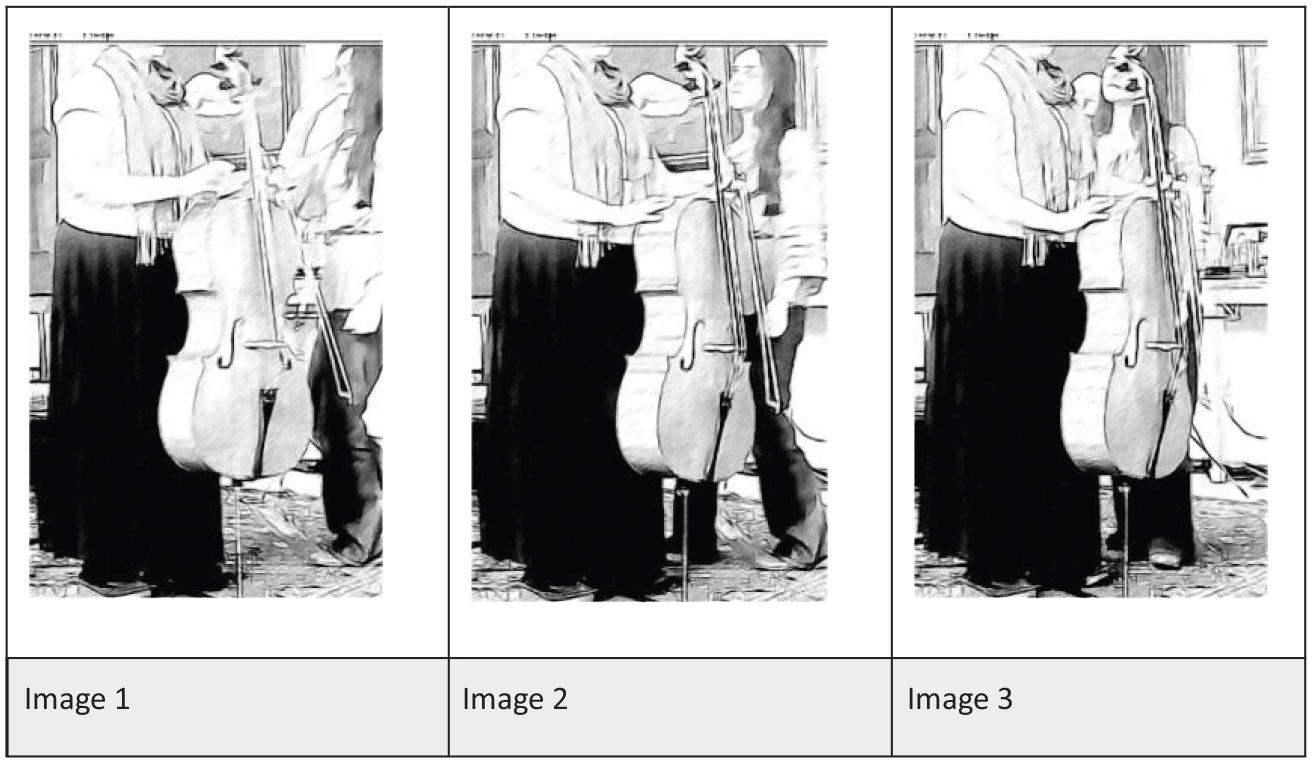
Images relating to Transcript (1)
In part the practitioner’s physical positioning may also reflect the presence of the audience as her standing to the side of the student allows her comments to be heard more clearly in the room. However, her proximity to the student is noticeable, in that even on camera it is clear that she is unilaterally entering the student’s personal space. Her subsequent talk about the economic threat to her livelihood posed by the possibility of individual practice seems to be non-serious, but it is delivered without any facial expression to mark it as a non-serious response. The tone of the delivery, coupled with the practitioner’s physical proximity to the side of the student, confers upon the turn the sense of an admonishment.
In lines 23 to 29 the practitioner emphasises the fallibility of the student’s perceptions of her own internal physical state. It is here that the AT philosophy – that the person is in error with respect to their knowledge of their own body – is realised as part of the account as to why individual practice cannot be undertaken. The practitioner explicitly remarks that the student’s ‘feeling sense’ (line 28) would be unreliable even after (hypothetically formulated) guidance.
This is potentially controversial: in talk-in-interaction, there is considerable evidence that participants recognise that the individual has epistemic primacy over personal matters such as emotional states, pain, biography, family and so on (Heritage, 2014). Nonetheless, here the epistemic authority over internal sensations is claimed not by the person but by a co-interactant. There is evidence that the AT practitioner is tacitly sensitive to the contestable status of the epistemic assumptions which underpin her account. The practitioner refers to a period of earlier instruction (not on the transcript) in which she discussed the fallibility of one’s own internal sensations. Note that this earlier discussion is prefaced as ‘we said that at some point that our feelings can be unreliable’ (lines 16 and 17). Here the student (and by implication, the observing audience) is recruited to the earlier position: it is we who recognised the unreliability of our feelings, thereby invoking consensual agreement for her own epistemic authority. Only when this consensus is established does she revert to the first person to articulate further her epistemic authority over the student’s internal sensations.
We noted earlier that Crossley’s (2006) argument for the use of ‘habit’ to underline the importance of exploring how forms of action can be transformed into ‘habitual schemata’. Here we see a habit in the making: through her body and her talk, the AT practitioner seeks to instil not merely the value of a physical regime and its underlying philosophy, but a set of maxims by which that regime can be self-regulated, reproduced and imposed internally by the student.
The interaction between an AT practitioner and the student is fundamentally about the body: the student’s body, the relationship between the practitioner’s physical instruction and the student’s responses, and the positioning of their respective bodies in relation to the observing audience. Nonetheless, as these preliminary observations have indicated, underpinning the embodied dimension of the relationship is a set of epistemic concerns to do with authority, expertise and rights to speak on embodied matters. In subsequent sections we focus more systematically on specific phenomena of epistemic embodiment.
Grounding the ‘Absent Presence’: Implicated Embodied Responses
Shilling (2007) has argued that the body has been an ‘absent presence’ in a range of sociological perspectives. By this he means that ‘the organic foundations of our human being, social identities and relationships had an important, if sometimes implicit, place in the discipline’s foundations’ (2007: 2). The idea of the absent presence of the body is an arresting concept with which to draw attention to the way that the body can be at the same time central to social order but not observed, and vital to social action but merely assumed, its role remaining un-explicated in accounts of social organisation. In this section we are inspired by this concept, but use it to frame our examination of the particulars of action in Alexander Technique instruction. We co-opt the theoretical concept of the absent present to point to orders of social action, thereby grounding the concept in empirical analysis.
The relevance of the absent yet present body to our discussion lies in the way that the practitioner places her hands on the students’ bodies and asks them to move in a particular way, monitoring and assessing their responses through sight and touch. She then verbally evaluates their responses. This instructional sequence has much in common with interaction in classroom settings. For example, it is similar to the Initiation-Response-Evaluation (IRE) sequence identified by Mehan (1978) or the Initiate-Respond-Follow-up sequence identified by Sinclair and Coulthard (1975). Here is an example of the evaluative format. (‘T’ is the teacher, ‘S’ the student.)
What’s the boy doing? (I)
He’s climbing a tree. (R)
That’s right. He’s climbing a tree. (E) (From Cullen, 2002: 117)
There are two significant differences between this very common type of pedagogic sequence and the one from the AT instruction. First, the student is not required to respond verbally, but physically. Second, the physical response to the practitioner’s instruction can be so minimal as to be unobservable by others in the room and not captured by the camera recording the interaction. That a response has occurred at all is only known because the practitioner responds as if she has detected a bodily response. The practitioner’s claim that there has been a change in the student’s body is accomplished verbally. The three-part instruction response evaluation sequence then, is produced through two spoken turns and an implied embodied response. Here is an example.
This sequence has three parts: first there is a ‘directive’ (Szczepek Reed et al., 2013), ‘just soften a little bit let go f’me’; second there is an evaluation, ‘great’; and third there is an implied embodied response in between the two verbal elements. The body here is both absent and present. It does not speak and it does not move (not perceptibly, at least). Its interactionally relevant presence is established through the practitioner’s touch and her evaluation of the implied response to her directive. This sequence of action in turn reflects – and lays claim to – underpinning epistemic domains: the rights of the practitioner to lay hands on another’s body, the authority to issue directives and the expertise to evaluate responses.
This ‘directive–(embodied) response–evaluation’ (DRE) sequence and the attendant epistemic concerns which are mediated through it, are also evident in the following two cases. As in extract 2, there are no discernible physical responses by the student to the practitioner’s directive. However, instead of moving immediately to an evaluation, there is a break in the talk before the practitioner speaks again.
The directives, to take a breath and ‘soften’ the knees, are followed by silences of 0.7 and 0.3 seconds, respectively. The practitioner’s next turns are positive evaluations (‘great’, ‘lovely’) implying that the student has complied with the directives. Moreover, these evaluations are then extended to focus on physiological benefits from compliance that (should be) observable by the student: that the body is moving more effectively or that standing in this new way can be a pleasurable experience. The silences between the directives and evaluations may have epistemic significance, in that they suggest that it is at this point that the practitioner detects the response which is then subsequently evaluated.
Taking a breath and softening the knees seem like small movements. In both cases the practitioner has her hands on the body of the student. In the first case the practitioner is standing to the side of the student and has one hand on the back of the student’s neck, in the second the practitioner has one hand on the student’s hip and the other on her lower back. This close proximity and touch affords the practitioner implied access to these small movements, and in turn when an audience member observes this embodied connection it supports the impression that indeed something does happen. We – as observers – do not have the same haptic access to the student’s body. This unilateral ‘access’ bestows upon the practitioner the right to make a range of claims about the body of the student. What is more, this access occurs as part of an interaction in front of others. Only by paying close attention to the talk and behaviours can we analytically establish these rights.
In these directive–response–evaluation (DRE) sequences, the body is both absent and essentially present. It is absent in that the student’s embodied response may be invisible both to the audience and the camera, but is fundamentally implicated in the practitioner’s pursuit of epistemic concerns, primarily her expertise in detecting bodily responses to her directive and evaluating the extent to which those responses comply to the directives.
In this analysis we have tried to ground Shilling’s concept of the absence-present body in the socially organised details of turn design and coordinated touch of the practitioner on the student. The directive sequence we have examined here is a clear form of body pedagogics. Most obviously, the student with whom the practitioner is interacting is being trained in how to move her or his body; and as a consequence, is being instructed in the broader principles of the Alexander Technique. He or she is being instructed in how to interpret their own inner sensations. Of more sociological relevance, both the student and the observing audience are being trained in the interactional production and management of epistemic claims to authority and expertise. Through the practitioner’s talk, and in coordination with her touch of the student’s body, the importance of establishing epistemic rights, and practices for the accomplishment of this specific epistemic authority, are being demonstrated.
Student Recruitment
While compliance with a directive is a matter for the practitioner, this takes us only so far into the ability of the practitioner to speak to the internal workings of the student’s body. The more ambiguous directives (such as to soften the knees) clearly implicate a form of interpretation and it is quite possible that the student could offer an alternative interpretation. It is precisely such ambiguities that are ‘shored up’ through another form of interaction sequence that we might categorise as student ‘perceptual recruitment’. By recruitment we mean that the student is co-opted into the meaning or interpretation of the practitioner. By being ‘recruited’ into a particular interpretation, all other interpretations are ruled out. Such recruitment does important work in the progressive development of epistemic rights of the practitioner. It allows the practitioner to move from tentative understandings to precise interpretations of the embodied acts and licenses other activities such as an extended ‘learning account’ (Szczepek Reed et al., 2013) delivered to the student and attendant audience.
One locale for student recruitment is the talk immediately following a directive–response interaction – that is a sequence composed of the first two elements of the DRE sequence. At times, this recruitment functions as a form of ‘evaluative follow-up’ in that it is positioned at the point when a practitioner evaluation would be relevant. Rather than issue an evaluation of the embodied activity, the practitioner invites the student to confirm that they have experienced something. In the following example, the practitioner has their hands on the hips of the student.
Note there is not only a directive for the student to move her arms but also a statement that the practitioner will ‘rebalance’ her. There follows a question to the student as to whether they have felt ‘that’ in line 6 (note the ambiguity here, however). This is followed by an agreement by the student (line 7). The practitioner then begins an ‘upshot’ account with an inbreath and ‘therefore’ that provides more precise characterisation (that there is no need for body tension). Arguably without the agreement confirming the practitioner’s intervention, hearable as the ‘rebalancing’, this general assertion could not be made.
The question to the student and their reply could be called an ‘other-initiated assessment’, in that the practitioner gets the student to evaluate the movement through agreeing that it has happened. The idea of ‘feeling’ a movement secures the assertion that something did indeed happen in line 5. In a rather similar way to the follow-up turn in the other examples, the question–answer adjacency pair establishes that the embodied movement has occurred for the attendant participants.
While an other-initiated evaluation might occur in place of a practitioner follow-up utterance it can also follow minimal or muted versions of the follow-up utterance seen in the first set of examples. In example 6, we see a directive (line 1) and a qualification of why it is done (line 2) as the student complies. This is followed by a gap in the vocal production in which the practitioner feels the student’s back and then utters a quietly spoken ‘ukay’. In line 7 the practitioner begins to form an account that ‘pivots’ from the follow-up utterance (‘ukay’) through the use of ‘m .hh so’ (‘.hh’ indicates an inbreath). This is discarded in favour of a question to the student, ‘do you feel th’t you’ve lost some of the softness and flexibility in your spine’ (lines 7–8).
As with the previous example we see agreement by the student (first in overlap in line 9 and then in the clear in line 10) followed by an upshot utterance, this time beginning ‘now I think’. In this instance the agreement is garnered for a more specific characterisation of the loss of softness and flexibility.
In these small pedagogic moments, we see the interactional scaffold for the ‘reflexive embodiment’ that is the focus of much recent work in the sociology of the body. Directional sequences, mediated by embodied instruction, encourage and facilitate an internal understanding of what it means to have that body in that moment, and lay the foundations for a subsequent monitoring and awareness of the subtlest of embodied sensations.
Epistemic Mimicry
In this section we analyse a sequence in which the Alexander practitioner identifies the student’s postural errors for the benefit of the audience. She uses her own body to mimic the student’s body movements. By transposing the ‘unseen’ features of the student’s body onto the practitioner’s body, various rights are afforded the practitioner. At the same time agreement is garnered from the student in a progressive manner (typically in relation to non-contentious features of the mime and description). The result is that by the end of the sequence the practitioner has made specific claims about the student’s body, gained (token) agreement from him or her and then full agreement from selected audience members (in this case two of the other practitioners or masters). This is a longer segment of interaction, so we will work through it in smaller extracts (extracts 7.1. to 7.7).
Example 7.1 shows a segment of an interaction between a practitioner and a student who plays a viola. Over the course of the interaction the issue of the shape of the chest of the student as he plays the instrument and the resulting pelvis movement compose the central knowledge claim and ‘learnable’ in the situation. The practitioner deploys a series of embodied actions and mimes to convey the body posture of the student and turn the interaction towards a public agreement to her assessment by the other actors in the room.
The practitioner announces in line 1 that she will just say what she can see. She points at the viola (not transcribed) and then utters ‘what I feel that you do and I’m sure it’s connected it all to do with that is this’. At which point she adopts a mime shape involving an imaginary instrument and bow, rolls her shoulders forward and tilts her head to the side (Figure 2: image 1). She makes this shape looking forward towards the audience and then turns her eyes to the student (Figure 2: image 2).
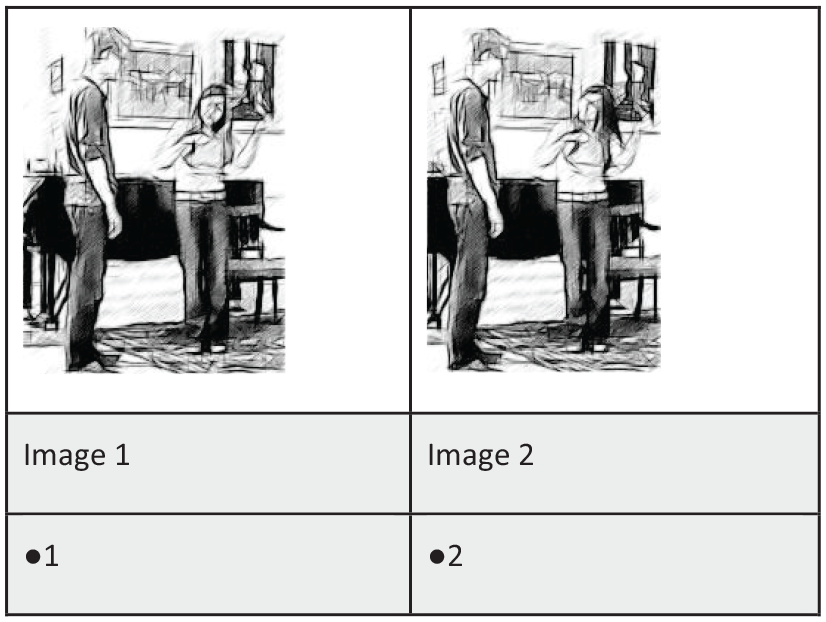
Images relating to Transcript (7.1)
Instead of detailing the ‘problem’ through verbal means, she produces a body mime. This is produced so as to be seen by the student and the attendant audience members. The focus is now not on the student’s body per se, but her representation of it. She then connects this representation back to the student’s body (7.2).
The practitioner says ‘so its that’ with a gesture towards her body (Figure 3, image 1), and then moves her right hand to the chest of the student (Figure 3, image 2) while saying ‘that’. This combination of gesture, touch and talk makes a physical connection between the mime and the body of the student. The hand of the practitioner remains here (effecting small tapping gestures) as she utters ‘your ch’. She moves her hand back to her own chest forming a flat palm shape (Figure 3, image 3) during ‘est is’ and then presses it to her chest during ‘sunk’ (Figure 3, image 4). This small movement reiterates the ‘incorrect’ body posture of the student. The response by the student is quiet and minimal.
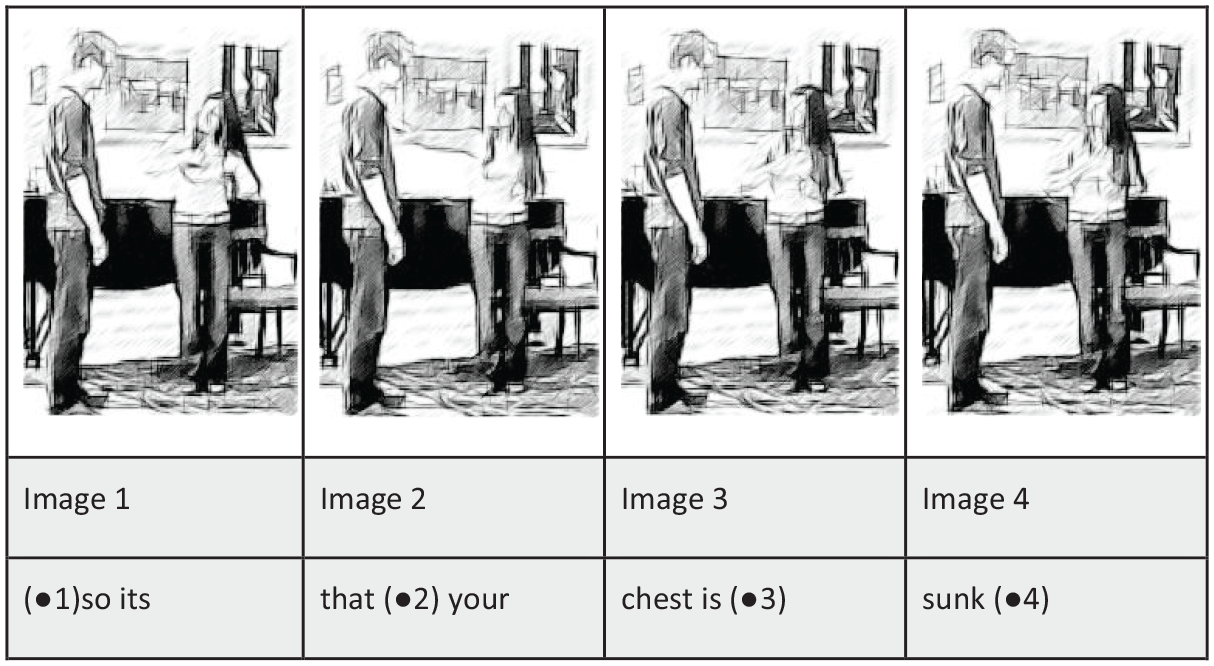
Images relating to Transcript (7.2)
The mime shape is produced again as the practitioner continues; this time with the emphasis of a fist shape patting the chest (in extract 7.3) (Figure 4, Image 1) and then looking at the student (Figure 4, Image 2). The student verbalises an agreement (line 26). This agreement is in response to the idea that he does in fact ‘put a viola in it’ (his body), rather than any negative consequence of doing so.
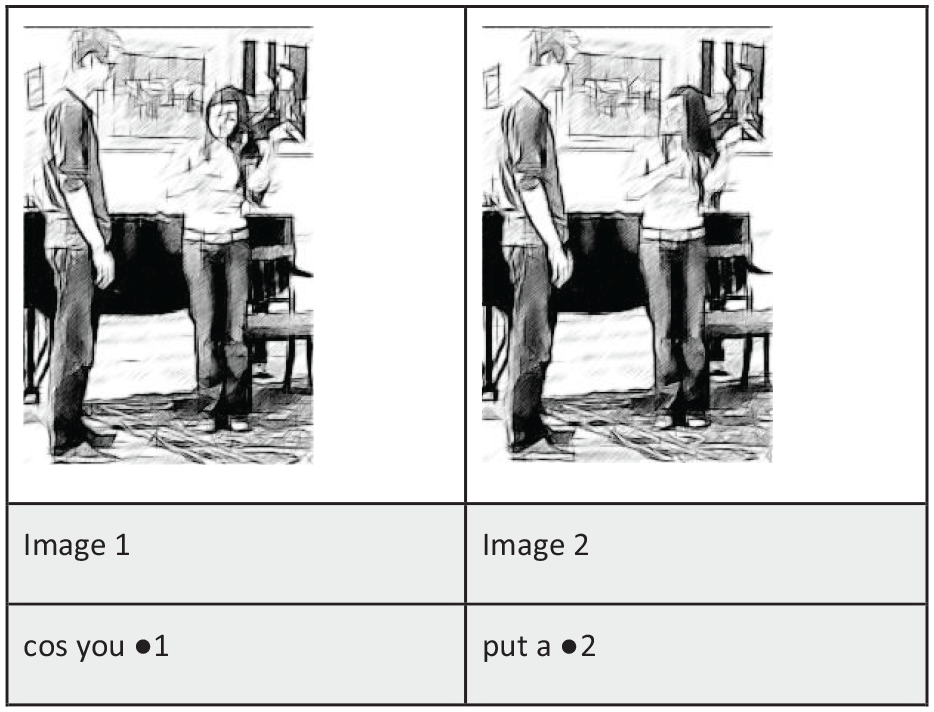
Images relating to Transcript (7.3)
Following the repetition of the original embodied mime shape the practitioner provides an upshot while forming a second mime shape (in the sequence in extract 7.4).
Here the practitioner steps away from the student taking a side-on position looking down and forwards and moves her hands to her chest (line 31, Figure 5, image 1). She then moves her right hand to her upper back (line 32, Figure 5, image 2) as she puts her feet together. Finally, she moves the right hand to her chest, positioning the left hand forward with palm facing upwards (Figure 5, image 1). This final move comes with a small head tilt forward.
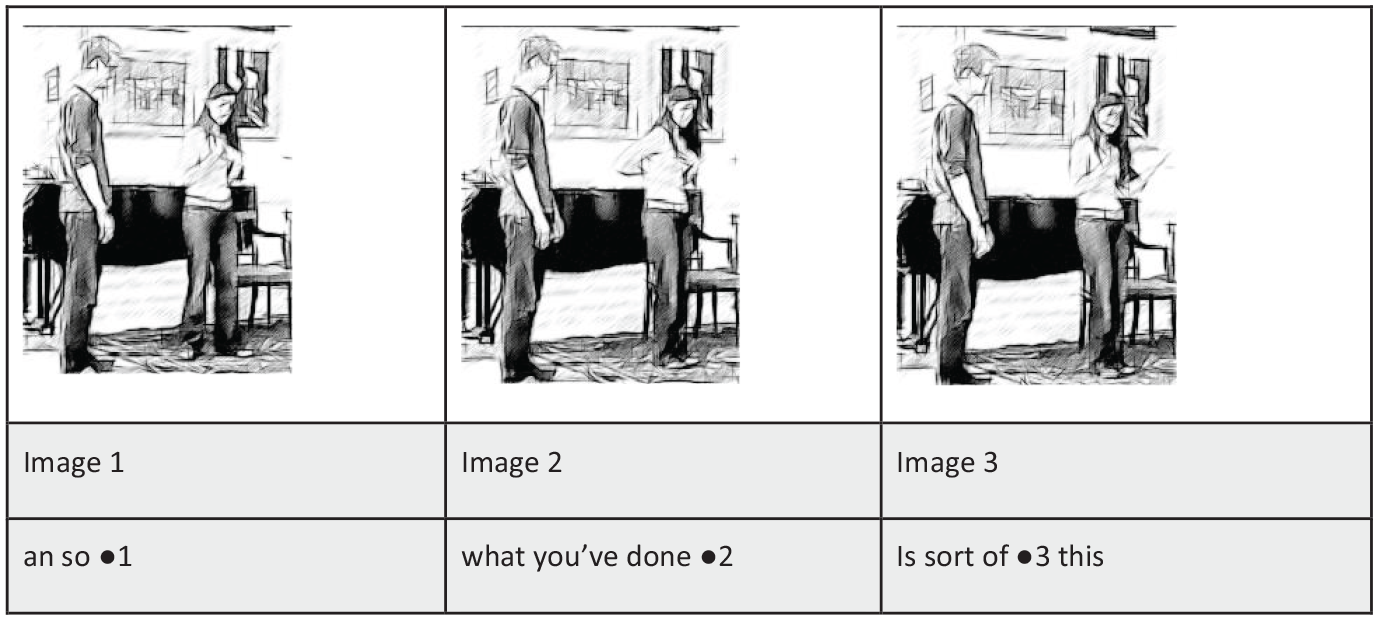
Images relating to Transcript (7.4)
The movement phrase forms a mime for the student, in the sense that it is at right-angles to him and is composed of a summative diagnostic movement-utterance assessment. This is followed by a question answer pair (in 7.5) (Figure 6), that attains agreement from the student and is then extended to an account of the embodied issues (in 7.6) (Figure 7, images 1-4). It is important to note that the agreement (line 36) is with what has happened in her back, and not his. It is not an agreement with what he has done to himself.
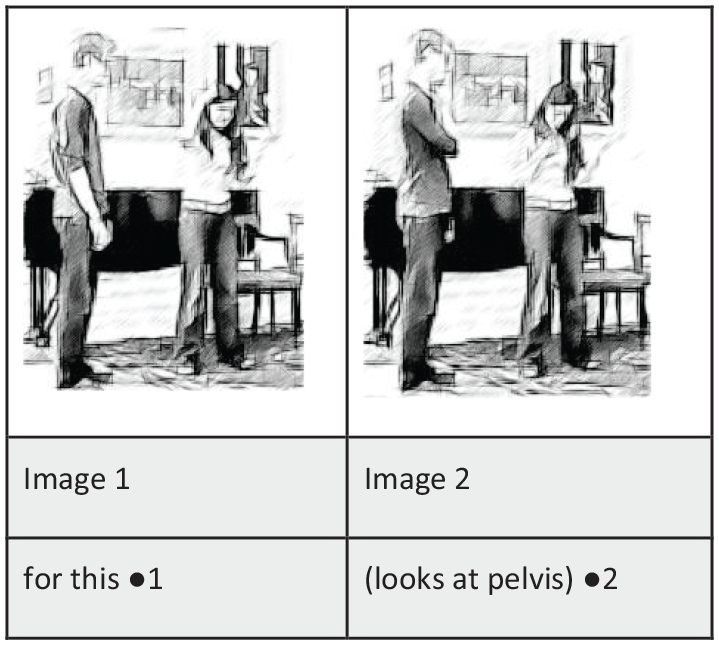
Images relating to Transcript (7.5)
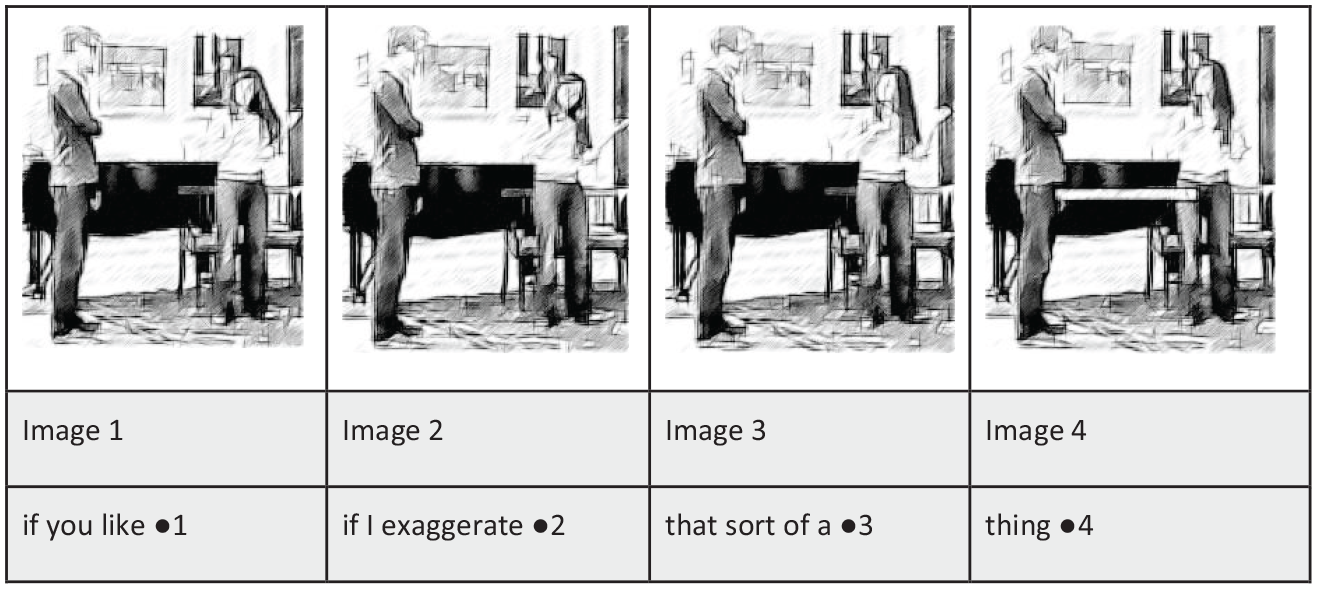
Images relating to Transcript (7.6)
The practitioner turns her attention to the attendant audience while “gesturing towards the student in line 47 (Figure 8, image 1) of extract 7.7. In the second half of the utterance the student turns his attention to the audience (Figure 8: image 2). Two members of the audience (two other practitioners/masters) respond, one saying ‘yes’ the other ‘mm’ (lines 49 and 50).
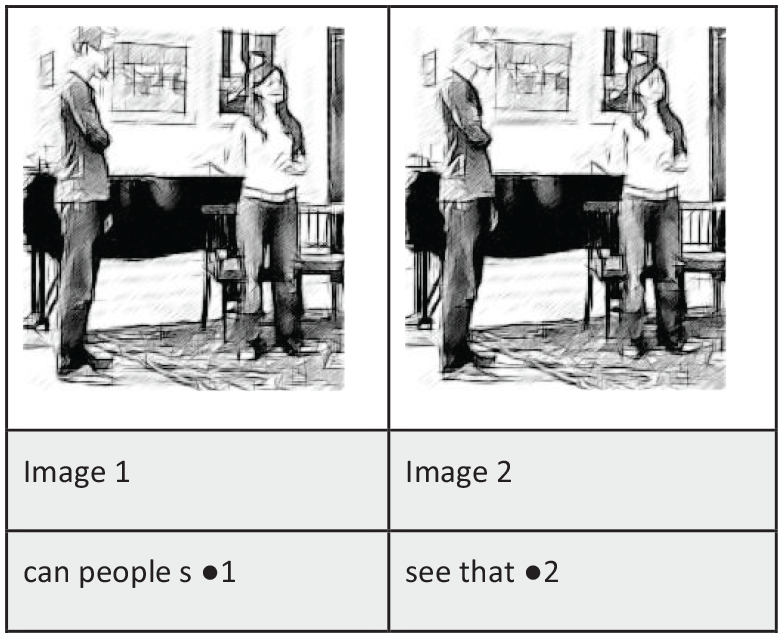
Image relating to Transcript (7.7)
In this sequence of activities, the practitioner uses her body to mimic the student’s movements, thereby demonstrating to him the pedagogic import of her talk while at the same time making the instruction publicly available to the observing audience. In this way, the management of epistemic concerns moves from the privately embodied to the publicly demonstrable.
Concluding Discussion
Through empirically grounded investigation, the manner in which body knowledge is achieved through interactive practices was revealed. These efforts contribute to the sociology of the body by addressing and foregrounding the absent present body and showing how it is subtly integrated into teaching practices. In addition, these efforts connect the concept of body pedagogy to practical instances that in turn make it available to rigorous study. In this discussion, we summarise our findings, reflect on their relevance to body pedagogics and, finally, we situate this work within broader concerns of the sociology of the body.
Analysis of music master class teaching by an Alexander Technique practitioner has allowed us to identify robust interactional practices that form the foundation of a ‘body pedagogics’. The three analytic instances exhibit a progressively public dynamic that rests upon a strategy of materialisation of the body, and central to each is the negotiation of epistemic rights. With respect to the first extract, we identify how the invisible (or absented) body is given presence through an integrated set of practices that claim rights precisely through the detail of the interaction; the body is made ‘accountable’ (Garfinkel, 1967). Such accountability has the added feature of rendering epistemic rights to the practitioner so as to evaluate and interpret the movements of the student. In the second analytic section, we see how the potential for student disagreement with the characterisation given to body movements and feelings is anticipated and avoided through explicit recruitment of the student to a particular interpretation of what has just happened. This is afforded through agreement with the somewhat ambiguous phrasing of ‘do you feel that’. Even when the focus of attention is more specific, the phrasing is still ambiguous. Once attained, this agreement affords the practitioner the right to speak more specifically about the student’s body. In the third, we described how the practitioner mimics the body of the student with her own body, and attains agreement with statements about the mime (and not the original movement). In this way, both conceptually and spatially, she establishes her evaluative assessments via public recognition of her epistemic rights and claims.
We can see, from such simple beginnings, the roots of the claims to body experience and epistemic access. This shows the import of this form of analysis, in that it exhibits precisely where and how such incremental accumulation of rights occur.
These analytic observations speak to Shilling’s (2017a: 1216) observation that ‘power relationships implicated in who is able to direct consciously the pre-conscious cultural learning of others is an important sociological issue’. The proposal, exercise or resistance of epistemic authority is a form of power struggle; in some cases, it is a form of social control at its most basic, lived in the fabric of everyday social interaction (Drew, 1987). This echoes the power relationships in other forms of talk-in-interaction: in the economic obligations established and imposed through market pitchers’ sales spiels (Pinch and Clark, 1986), in the positioning of ‘who speaks when’ in argument (Hutchby, 1996) and the sequential basis of verbal harassment (Tainio, 2003). The negotiation of the AT practitioner’s authority over the student’s posture is a form of power negotiation over the body and the student’s internal experience of their own body. It establishes the value of a CA perspective in identifying the micro-interactional beats in the moment-by-moment expression of power to shape another, pedagogically, physically and experientially. In later writings Shilling (2017b: 77) advocates ‘practical epistemic analysis’, which is concerned with particular ‘encounters with . . . organisational practices, customs and knowledge’. The approach we have developed here, focusing on epistemic management in embodied features of talk-in-interaction, offers an empirical route to realise such a practical epistemic analysis.
Our emphasis on the management of epistemic authority in body pedagogics forms a bridge to wider issues in the sociology of the body. In our introduction, we referred to Wacquant’s ethnographic study of the body in becoming a boxer. His publications chart the way in which the boxer’s body, through training, becomes the site of cultural capital and its exchange (Wacquant, 1995, 2004). The relevance of Bourdieusian habitus is apparent through his work, a conceptual influence that has generated a vast literature. Through habitus, Bourdieu drew attention to the body, for it is here (in part) that wider structural and cultural practices find expression and legitimisation through physical dispositions and bodily habits.
And yet, while the novelty of the embodied dimension of habitus generated numerous studies of embodiment, the empirical work is curiously staid. It is difficult to find empirical investigation of embodied dimensions of habitus that actually study recordings of the body as it is, in naturally occurring moments, unmediated by retrospective interviews, uncontaminated by the researchers’ capacity to discern and retain detail, or the interpretation of field notes, and so on. Even the account of training to be a boxer offered by Wacquant, intimate and compelling as it is, relies not on recordings of actual training practices that, in some form, we can see, but on his account of them from his experience of undergoing that training, and his recollection of what his peers and trainers said at the time. As in much of the research informed by the idea of embodied habitus, the empirical detail – the actual practices of the body at work – are tantalisingly one step removed from the page.
We have tried to bring those practices to the page, both in the description of the bodies and the coordination of their movement in talk. This empirical imperative, a hallmark of conversation analytic work, provides a step towards investigation of the work of the actual body. Imperfect as any recording is, it still provides a way to explore ‘the diverse ways in which specific social worlds invest, shape, and deploy human bodies and . . . [their] concrete incorporating practices’ (Wacquant, 1995: 65).
Our exploration of the negotiation of epistemic rights suggests, possibly, a new dimension to the understanding of the body and wider cultural practices. This is because epistemic matters are not only a momentary concern in some interactions, but may be foundational in shaping human (embodied) relations, period. Over a substantial and cumulative series of studies, the conversation analyst John Heritage has demonstrated that orientation to epistemic issues informs the most mundane interactional episodes (Heritage, 2014; Heritage and Raymond, 2005; Raymond and Heritage, 2006). It is his conclusion that the management of territories of knowledge in human relations is as foundational as the patrolling of physical territories by animals. It may be a key driver for embodied talk-in-interaction. Our understanding of embodied habitus may be enriched by taking into account the ways in which we manage epistemic concerns through our bodies and our talk, even in the most routine of interactional episodes.
Footnotes
Funding
The authors received no financial support for the research, authorship and/or publication of this article.
