




Abstract
This article examines lived experiences of food insecurity in the United Kingdom as a liminal phenomenon. Our research is set within the context of austerity measures, welfare reform and the precarity experienced by increasing numbers of individuals. Drawing on original qualitative data, we highlight diverse food insecurity experiences as transitional, oscillating between phases of everyday food access to requiring supplementary food, which are both empowering and reinforcing of food insecurity. We make three original contributions to existing research on food insecurity. First, we expand the scope of empirical research by conceptualising food insecurity as liminal. Second, we illuminate shared social processes and practices that intersect individual agency and structure, co-constructing people’s experiences of food insecurity. Third, we extend liminality theory by conceptualising paraliminality, a hybrid of liminal and liminoid phenomena that co-generates a persistent liminal state. Finally, we highlight policy implications that go beyond short-term emergency food access measures.
Keywords
Introduction
This research examines lived experiences of food insecurity in the UK, illuminating this as an intricate liminal phenomenon resultant from intersectional marketplace exclusion (Saren et al., 2019). Definitions of food insecurity tend to overlap with those of food poverty. Nevertheless, we see food insecurity as more encompassing; signalling that an inability to access food is a facet of poverty and the way in which poverty is structured socio-politically. Thus, we employ the term food insecurity to refer to people’s inability to access or afford a sufficient quantity of healthy foods to eat (Dowler, 2002; Furey, 2019; Purdam et al., 2016). Our research is contextualised within ongoing socio-economic challenges in the UK, including significant austerity measures, welfare reform and the increasing precarity that growing numbers of people experience and which the COVID-19 pandemic exacerbates (Power et al., 2020).
Recent estimates suggest that 14.3 million people live in poverty in the UK, including seven million in persistent poverty (SMC, 2019). Additionally, while politicians have emphasised work as key to alleviating poverty (Cameron, 2012), the UK has witnessed growing ‘in-work’ poverty, with an estimated four million people classified as ‘working poor’ (JRF, 2018). This increase in poverty has manifested in many ways, including rising food insecurity, with a growth in daily struggles to eat and a consequent demand for emergency food provision (Cooper and Dumpleton, 2013; Garthwaite, 2016). Across the UK, the Trussell Trust (2020a) operates over 1200 foodbanks, which collectively have seen the number of emergency food parcels they provide increase by 73% in the last five years (Sosenko et al., 2019). They estimate a 61% rise in the need for food parcels between October and December 2020 (Trussell Trust, 2020b). Additionally, reflecting the diverse and widespread nature of food support in the UK (Blake, 2019), FareShare (2020) redistributes surplus food to just under 11,000 charities and community groups, while IFAN (2020) suggests that there are over 3,000 independent organisations providing varied forms of community-based supplementary food that differ from the Trussell Trust’s foodbank model.
Despite the increasing prevalence of food insecurity in the UK, official data remain scant (End Hunger UK, 2019). Nevertheless, there is growing research examining experiences of food insecurity (Cooper and Dumpleton, 2013; Dowler, 2002; Garthwaite, 2016; Lambie-Mumford, 2013, 2019; Loopstra et al., 2018; McEachern et al., 2020; Purdam et al., 2016; Sosenko et al., 2019).
We advance these important debates by drawing upon liminality theory (Turner, 1974; Van Gennep, 1960 [1906]), to examine the transitional aspects of food insecurity through a focus on supplementary food access at independent foodbanks and pantries. We do so because, initially, UK foodbanks saw themselves as fulfilling a need for short-term, transient emergency support. Trussell Trust and many independent foodbanks limit the amount of food they provide any one household to three parcels every six months to a year, which accentuates this understanding of foodbanks as supplying emergency support in circumstances of transiency and extraordinary hardship (Trussell Trust, 2020a). Food pantries (also called food clubs or social supermarkets) complement such provision and go beyond food emergency, offering a more sustained form of food access for a peppercorn fee. Food access in these organisations is more sustained than the short-term Trussell Trust model, tending to include ladders of support whereby food access is flexible and tailored to support people as their circumstances change (Blake, 2019). Nevertheless, whether people perceive themselves to be experiencing food insecurity transiently remains under-examined. Liminality, thus, is significant as an enabling theory for understanding experiences of food insecurity and supplementary food access.
We theorise food insecurity as liminal because of its fluid qualities, involving a transition from, and/or to, what is relatively and socio-culturally considered the normalised food practices of citizens (Hamilton, 2009). In establishing food insecurity as a liminal phenomenon, we give voice to diverse food insecurity experiences that go beyond those of Trussell Trust foodbanks, focusing instead on the experiences of people accessing independent foodbanks and pantries. We show that these liminal experiences out of necessity oscillate between non-linear phases of food access limbo; an ‘in-between’ state. We also illuminate instances of liminoid phenomenon that occur out of choice within the same food access spaces. In both instances, people are removed from their past food-secure states and not yet inserted into food-secure futures. Where people reintegrate into normalised food practices, this happens precariously, if at all, challenging emergency food providers’ perspectives regarding supplementary food access being transiently short-lived and demanding expansion of liminality as a theoretical lens.
By examining emic experiences of food insecurity through the perspective of liminality, we make three original contributions to existing sociological research in the field. First, we expand the scope of empirical research on food insecurity by conceptualising it as a liminal phenomenon. Doing so is significant because it allows us to disentangle food insecurity into many uncertain trajectories, shedding light on the multiplicities of individual experiences of transitioning into and through such insecurity. Second, our research elucidates shared social processes and practices that intersect individual agency and structure, co-constructing and co-reinforcing people’s experiences of food-related vulnerability. This contribution is significant because these processes and practices illuminate the non-linear nature of food insecurity trajectories. Finally, we extend liminality theory by establishing the original concept of paraliminality. We define this concept as the non-linear co-existence of liminal and liminoid phenomena within the same social space, highlighting its significance in co-generating a persistent, self-reinforcing, in-between state that can have both positive and challenging social effects. Consequently, we build on prior studies that distinguish, or that problematise the distinction, between liminal and liminoid phenomena (Turner, 1974), but which neglect to develop a conceptualisation of such a liminal/liminoid co-existence and what this may mean sociologically. The sociological relevance of this research lies in its ability to illuminate, expand and add nuance to understandings of the structuring forces that tend to perpetuate, and the agency that can potentially countervail, liminal transitions in and out of food insecurity.
Conceptual Development: Food Insecurity through a Liminality Lens
Originally developed anthropologically in relation to rites of passage (Turner, 1974; Van Gennep, 1960 [1906]), and further advanced across disciplines (Thomassen, 2009), liminality theory can illuminate the complexities of transitions and flows in food access states, often associated with significant life challenges (Kimball, 1960; O’Loughlin et al., 2017). Thus, a liminality lens enables us to theorise instability and flows through food statuses, places, situations and times (Van Gennep, 1960 [1906]). It also offers a means to conceptualise challenges to ‘normative social structure’ (Turner, 1974: 60), and ‘moments between structure and agency’ (Andrews and Roberts, 2015: 132). This is because liminality illuminates the socio-symbolic processes and practices that co-construct the in-betweeness or, in other words, limbo of food insecurity, including the structures that foster it and the organisations that plaster it. Liminality theory can also illuminate how people might make sense of their food insecurity in relation to mediated stigmatising rhetoric (McArthur and Reeves, 2019), and broader structural disadvantages (Irwin, 2018; Saren et al., 2019). Thus, its sociological relevance lies in its ability to clarify how structure and agency intersect to influence trajectories into, and the potential to emerge from, food insecurity.
Given the complexities, fluidities, uncertainties and diversity of food insecurity, food-related liminality trajectories are not necessarily linear. Nevertheless, in drawing on liminality theory, we suggest that, for most people, food insecurity begins with a first stage of separation from stable social standings as conventional food consumers who rely on the marketplace for food access. This separation can be prompted by critical life moments that affect people and their social identities (Kimball, 1960; O’Loughlin et al., 2017; Thomson et al., 2002), triggering a transitioning process into food insecurity. In a second stage, people might undergo a marginal phase of in-betweeness or limbo, whereby food consumption practices depend on access to supplementary food. Here, people find themselves in fluid, ambiguous, stressful, between-and-betwixt situations out of necessity (Van Gennep, 1960 [1906]); they require an active and laborious pursuit of food while removed from past consumer states and not yet inserted into a food-secure future. With the uncertainties and challenges experienced in this second stage comes the potential for new practices and social identities to emerge (Andrews and Roberts, 2015; Turner, 1974). Another aspect of this stage entails the emergence of communitás, that is, a sense of comradery and relational flow beyond formal, socio-structural ties (Mulligan, 2015; Turner, 1969, 1974), arising from shared food insecurity experiences. The third and more elusive stage is that of reintegration (Turner, 1969), which in our context relates to reintegration into the food marketplace.
Turner (1969, 1974) makes a distinction between liminality and liminoid phenomena, which we argue is significant to the food insecurity context. Liminoid experiences resemble their liminal counterpart (Andrews and Roberts, 2015; Turner, 1974), in that they are somewhat removed from core social and economic processes (Taheri et al., 2017). However, they are not the same. Originally, liminal experiences and stages were theorised in relation to pre-industrial societies, in which work and leisure were not as clearly defined and separated as in present consumer societies (Andrews and Roberts, 2015). Although work and leisure have become distinct entities, liminal experiences usually metamorphose into ephemeral, liminoid moments of playful, artistic and almost subversive leisure experiences in contemporary societies (Andrews and Roberts, 2015; Turner, 1974).
Thus, the liminal offers transitional experiences that are necessary, unavoidable, usually distanced from food-related social structure. It involves some form of labour and leads to what in our context is a food-related status change (Willey, 2016). The liminal can be exemplified by what Patrick (2014) suggests is the laborious process of navigating emergency food services. The liminoid, however, suggests a more experimental, tentative, optional and potentially subversive (in the original phrasing of Turner’s theory, leisure-oriented and playful) form of engagement in transitional moments (Andrews and Roberts, 2015; Turner, 1974), which can be transformative without entailing food consumption-related status changes or transitional resolutions (Andrews and Roberts, 2015; Thomassen, 2009). Thus, the liminoid is more pluralistic, individual, erratic and freeing than the liminal (Turner, 1974; Willey, 2016), occurring out of choice and in different spaces to that of the liminal.
Additionally, we elaborate and build on three aspects of liminality theory, developing and interconnecting them further, given their significance to the food insecurity context. First, we suggest that communitás is formed through shared experiences of food insecurity, such as accessing supplementary food. Communitás engenders a sense of personal belonging to an inclusive food-insecure collectivity (Cumbers et al., 2018; Newbrough and Chavis, 1986), entailing spontaneous connections, making sense of those relational connections and co-creating norms that attempt to maintain the nature of those connections (Turner, 1974). In particular, we argue that shared experiences of supplementary food access are essential for those spontaneous connections and their meanings to emerge, thus, co-generating and co-reinforcing communitás. Prior research suggests that outsiderhood can occur relative to a loss of past identities (O’Loughlin et al., 2017), or to social comparisons vis-a-vis people who are not facing food insecurity. This is because people experiencing food insecurity are suspended from social interactions that are embedded in food consumption practices and spaces, which are situationally or temporarily unavailable to these individuals, such as going out to eat. Thus, building on Turner’s (1974) arguments, shared experiences of accessing supplementary food can facilitate social bonding among those who experience food insecurity, forming and reinforcing kinship and comradery among those at the margins of the food marketplace.
Second, food insecurity communitás enables us to problematise an aspect of the distinction that Turner (1974) makes between the liminal and the liminoid. We argue that communitás, as developed through the uncertainties of food insecurity experiences, enables the liminal and the liminoid to co-exist in a co-generative and entangled manner within the same ‘liminal field’; that is, within the same ‘temporary, erratic and heterogeneous social space’ of food insecurity (Willey, 2016: 132). This co-existence of both liminal experiences (i.e. the necessary in-betweeness of those in deeply precarious states) and liminoid phenomena (i.e. the more experimental, transformative and potentially subversive experiences reflecting voluntary in-betweeness with a paying-it-forward character), in turn, enables the co-creation of meanings and norms that sustain the nature of food insecurity communitás. This co-existence, thus, interconnects food-insecure consumers – both those who are experiencing precarious states and those who choose to engage with liminal spaces – into a persistent in-between state that we conceptualise as paraliminality; that is, a combination or hybrid of liminal and liminoid. While Turner (1974) argues that the liminal and the liminoid can co-exist in culturally pluralist societies through distinct institutions and spaces, he does not theorise whether or how this co-existence could manifest through communitás within the same liminal field (Willey, 2016). By conceptualising paraliminality as this co-existence of the liminal and the liminoid within the same liminal field, we challenge the linearity of Turner’s (1974) theory, destabilising the idea that food liminality is short-term or a carefully bounded period.
Third, the nature of paraliminality reflects a porosity between agency and structure within the same liminal field, revealing the social patterns that relate to the inherent dangers and empowering potential of losing one’s pre-liminal, food-related social identity without ever being reincorporated into the food marketplace as previously anticipated (Andrews and Roberts, 2015). However, through our conceptualisation of paraliminality, we problematise Turner’s (1974) views on reintegration, the third stage of liminality, by suggesting that reincorporation into the food marketplace is not always adequate or indeed desired, particularly where the ‘tyranny of choice’ might create feelings of anxiety and inadequacy for some (Salecl, 2011).
Consequently, we argue that what results from paraliminality is at once positive and potentially challenging. Positive for its empowering social dynamic and creative agency, given its capacity to engender community-level care, compassion and support towards the self and others experiencing food-related hardships, along with coping strategies that build transformative resilience through communitás. However, it can have a potentially challenging and somewhat disabling effect, where a return to the food marketplace may not be an adequate solution or where alternative modes of food access or a strong welfare system might fall short, reinforcing loops of precarity that enable, and are enabled by, circular patterns of individual and structural disadvantages. In deploying and advancing liminality theory to further existing understandings of food insecurity experiences, we untangle the social dynamics of trajectories into, and through, supplementary food access.
Methods
Our interpretive analysis draws upon 24 in-depth interviews with people accessing supplementary food in the West Midlands and Greater Manchester, two municipalities that are among the top 10% most deprived nationally (IoD, 2019). These interviews were part of a wider project focusing on food insecurity (McEachern et al., 2020).
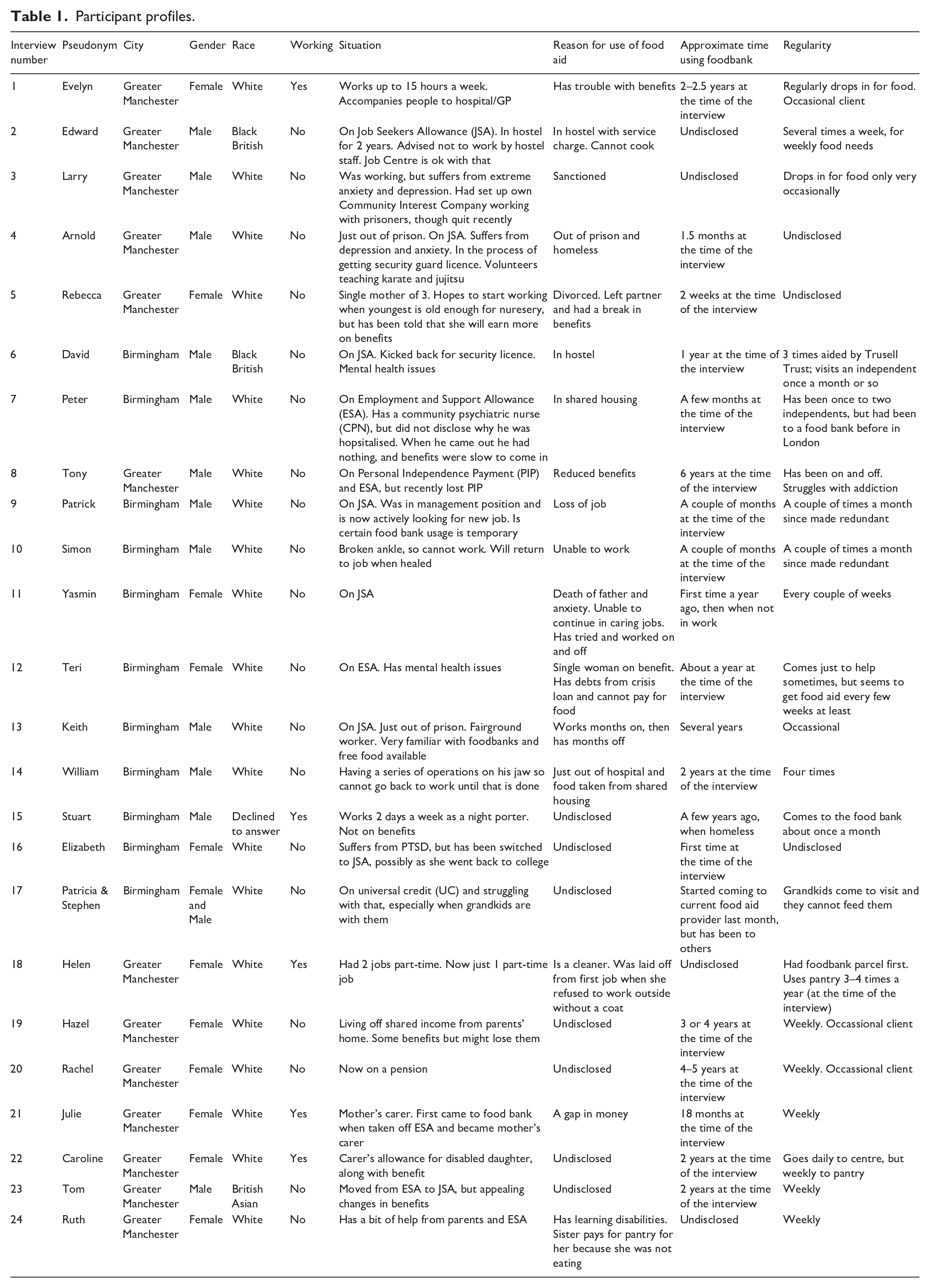
Volunteer-managers distributed posters calling for research participants at a number of independent food access organisations, including independent foodbanks and pantries. Participants’ profiles and backgrounds (Table 1) reflect the diversity of individuals in need of supplementary food, including those who are in work (Cooper and Dumpleton, 2013). Given the potential vulnerabilities of the people we were seeking to interview, we wanted to ensure that participants felt comfortable when sharing their experiences. Thus, we included ethical procedures such as interviewing participants where they were accessing supplementary food, pausing and/or shortening interviews where needed, building rapport and respecting participants’ feelings and emotions when telling their stories. The research received ethical approval from the authors’ institutions.
Participant profiles.
The discussion guide included questions about participants’ backgrounds, how they came to access emergency and/or supplementary food including why, for how long and how often, whether they had any support networks, how they had transitioned into and through food insecurity, and whether they had access to any additional support services. The interviews took place between August and December 2018, each lasting from 30 minutes to one hour.
We are aware that our own personal histories, experiences and positionality regarding class and other intersectionality issues shape our scholarship on poverty (Adair, 2005). Consequently, it was important that the author with lived experience of food insecurity conduct the interviews. We believe this approach enabled us to avoid, as much as possible, a ‘poverty safari’ account that resembles a short-lived expedition by outsiders into precarity (McGarvey, 2017).
Once transcribed verbatim, we analysed the data using a thematic approach, involving a back-and-forth iterative reading of transcripts, and between transcripts and theory (Braun and Clarke, 2006). We focused particularly on narratives of food insecurity trajectories and flows, and their contributions to liminality theory.
The discussion of findings is organised around three core themes, enabling us to establish our concept of paraliminality in incremental layers. The first addresses our participants’ liminal trajectories into food insecurity, including their attempts to seek help and reaffirm their positions of food security. The second focuses on participants’ state of in-betweeness, including their acceptance of, and experiences of coping with, the challenges of food insecurity and their imagined reconfiguring of potential food-secure futures. Finally, we discuss communitás via shared experiences of supplementary food access services and the experimental, subversive, pay-it-forward practices that destabilise precarious food consumption arrangements, enabling the liminal and the liminoid to co-exist within the same social field and co-generating paraliminality. We use pseudonyms to protect our participants’ identities.
Transitioning from Food-Secure to Food-Insecure
In this first stage of liminality (Turner, 1974), our research shows a nuanced malleability in how people move into, and navigate, a period of fluid vulnerability away from normalised food practices (Hamilton, 2009). Echoing previous research (Garthwaite, 2016; Peterie et al., 2019; Purdam et al., 2016), structural factors such as austerity and welfare reform, coupled with limitations in material and social capital (Panori et al., 2019), contribute to people’s transitions from food-secure to food insecurity: My daughter . . . she’s tried to help but I don’t want to depend on my children. It’s not meant to be that way. I’ve just got to wait for them now to see how I figure out my benefits. I think because I’m currently seeking a diagnosis for Asperger’s as well . . . there’s just too much to get my head around. It’s really difficult. (Elizabeth)
For many participants, major intersecting crises experienced as critical life moments affect their social identities (O’Loughlin et al., 2017; Thomson et al., 2002), becoming the tipping point for transitions into food insecurity. Indeed, similar to Elizabeth, many participants displayed a complex interplay of limited social capital, mental and other health issues, caring responsibilities, job losses, debt, homelessness, bereavement, accidents, relationship breakdown, alongside issues relating to benefit claims or low wages that, together, characterise dimensions of this first phase of liminality (Turner, 1974); a stage of separation from the food marketplace and transition into emergency food access. As Larry illustrates: My mum and dad’s death, I moved home and I gave up my relationship with my girlfriend . . . I’d been with her for nine years, and when you get that phone call that your dad’s got cancer, it’s like, ‘I’m moving on.’ So I had to explain to my girlfriend, ‘I’ve got to go home’. (Larry)
Following the loss of his parents, Larry ended his relationship and lost his home and employment, resulting in him requiring emergency food access. Larry’s case reflects the transitioning patterns found in many participants’ experiences. Further, echoing existing research (Garthwaite, 2016; Peterie et al., 2019; Purdam et al., 2016), participants discuss their food insecurity trajectories as challenging, stigmatising and even traumatic, adding three internalised dimensions to this first liminal stage. Shame and stigma are major barriers to seeking support, with many participants still remembering their first visit to a foodbank and how that made them feel. Caroline exemplifies: No matter what you’re going through, the foodbank’s degrading. It’s like, I know a lot of people have to use it and it’s the thought, you just feel so low that, to me, it could bring on depression and stuff like that because it’s like, I can’t afford to feed my kids, I’ve got to go and beg for food. (Caroline)
Shame is a common finding in research on food insecurity (Walker et al., 2013). However, our findings show additionally that the physical set-up of some food access spaces (i.e. glass partitions and doors) is implicated in participants’ sense of shame as they transition into accessing emergency food: I used to get a referral for a food parcel from the foodbank. You’d go in there and you’d see ex-school colleagues and you wouldn’t – because it’s all glass-fronted . . . It took me hours to go in, I had to make sure the shop was shut – well not shut, but empty. (Larry)
In trying to counteract stigmatising rhetoric (McArthur and Reeves, 2019), some participants feel compelled to prove their deservingness by giving ‘something back’: Because I’m taking free food . . . I’d like to give something back if I can, but I don’t know what, like. So that’s probably my way of doing the [karate] lessons here [. . .] to show that we’re not all bums. (Arnold)
This socio-cultural shame in accessing emergency food demonstrates that the inherent social stigma of transitions into food insecurity flows through places, spaces, situations and times (Andrews and Roberts, 2015; Van Gennep, 1960 [1906]). Nevertheless, participants feel that volunteers often help them overcome such feelings: ‘Sometimes you get someone [who] comes down and does health checks and stuff . . . sometimes they do cakes and stuff like that . . . the staff are so friendly and they’re so nice and caring’ (Tom). Thus, Tom’s quote illustrates that supplementary food providers often offer non-judgemental, compassionate, caring and safe spaces for people transitioning into, and through, food insecurity, characterising the social support available during this first stage of liminality. Indeed, participants highlighted the breadth of support provided by independent supplementary food services, addressing some of the additional wider needs of those accessing supplementary food: You can get cheap furniture, clothes and a food parcel – when I was in there, they gave me a sleeping bag for free and stuff like that. They’re really nice and helpful and when you’re leaving it’s like, ‘Is everything all right?’ They really worry after you . . . If you’re poorly you can have a cup of tea and relax just to soften the anxiety. (Edward)
Our findings show that internal dimensions (e.g. health issues, bereavement, job loss), internalised factors (e.g. stigma, trauma) and external structural factors (e.g. social welfare issues, austerity), in addition to social support (e.g. care, safe spaces) intersect people’s lives, characterising this first stage of liminal food insecurity. Thus, our findings foreground the dimensions of the first stage of liminal transitions, affording an extension of its existing sociological understandings. This extension acknowledges but goes beyond the individual and their immediate social relations (Turner, 1974). It shows, at a particular historical moment, how individual factors as impacted by the more lasting and solid qualities of structure – qualities that ‘constrain or facilitate the wider categories of actions of large masses of people’ (Sztompka, 2019: 326) – can contribute to transitions into liminality and its insecurities.
Coping with and through the In-Betweeness of Food Insecurity
As people transition into this second liminality phase of food insecurity (Turner, 1974; Van Gennep, 1960 [1906]), what emerges is their experiences of coping with the fluid and stressful challenges that this marginal, indeterminate stage brings. Characterised by in-betweeness or between-and-betwixt qualities, food insecurity circumstances create a limbo for people’s food consumption practices due to their need for supplementary food. A key food access issue for many was the limited types of foods they receive in food parcels: I come here when I can, because this is the only place that does fresh vegetables and frozen food. Sometimes you get lots, sometimes you get a bit, but it’s still okay. There’s enough to keep you going. I’ve been to other foodbanks, some of them are totally cack, totally useless. Most times, they give you all tinned stuff. There’s no meat, there’s no stews or nothing, just a basic tomato, beans, and soup. (Stuart)
Significantly, Stuart feels constrained as he wants to eat a balanced diet, but this is a choice he no longer has. On learning what is on offer at different supplementary food providers, he seems able to choose, to a certain extent, between independent food access providers, signalling a move beyond the Trussell Trust referral model to a more beneficial type of food access. Stuart exemplifies a laborious pursuit of nutritious food while removed from his past food consumer state and not yet inserted into a food-secure future, characterising an in-between state. Furthermore, in responding to choice constraints, some participants develop resourceful, experimental and, in some cases, collaborative cooking strategies: At the moment I don’t have a cooker. I’ve got one of those George [Foreman Grill] thingies . . . and I’ve got a microwave . . . my neighbour, she’s brilliant. She’s got a cooker and we just take turns at that. She cooks it for us and stuff . . . I just pick like coffee, peanut butter and then if she gets something on the Friday that I like and she doesn’t, we swap. (Hazel)
As Hazel’s quote exemplifies, collaborative and sharing practices that are functional, but also somewhat subversive, reflect the liminoid actions that take place. These collaborative and sharing practices are subversive because they challenge food choice constraints that are imposed by restrictive systems of supplementary food access and, thus, socio-economic structures that perpetuate liminal food insecurity conditions. These practices are characterised by authentic help between people and for mutual benefit, where helping is free from the helper dominating the helped (Freire, 1978, in hooks, 1994). These practices enable participants to develop relationships beyond formal, socio-structural ties (Mulligan, 2015; Turner, 1969, 1974), giving them a sense of comradery and choice. However, the extent to which healthy eating plays a role in people’s food decision making and strategies is unclear. Unhealthy choices are not always about lack of access, information, nutrition knowledge or cooking skills (Surman and Hamilton, 2019). Often, participants cannot cook a healthy meal using fresh vegetables not because they do not want to or for the admittedly sparse access to such foods, but rather because they have to choose among the cost of using a cooker, keeping a fridge running and/or putting something in it. Here, Tony talks about how he calculates such trade-offs (Snell et al., 2018): Can I afford to have the oven on for 40 minutes for potentially one thing just for me? I’m in that bracket where I don’t use enough to get the lower rate so I’m paying the top rate every time. (Tony)
Tony shows that trade-offs among food choices arise because people may not be able to afford the energy required to cook, where healthy eating may not be a priority. The focus is instead on addressing lack of adequate access to benefits, jobs and/or the mental health issues that emerge from extended periods of precarious living. This extended precarity then lends itself to a prolonged state of liminality, leading many participants to transition from emergency food use to ongoing supplementary food reliance: So first time I accessed it about five or six years ago and then two or three months ago I needed to in the space of a two-week period . . . because the food parcel’s meant to be, they say three days, don’t they? Three days’ worth of food but it’s not, I don’t think, and if your next money will come that won’t be for another two weeks. How many food parcels are you going to need? (Tony)
As Tony suggests, participants use supplementary food services persistently and in non-linear ways. This is a key finding, showing that supplementary food access is not a one-off, short-term practice. Indeed, all but one participant had been accessing supplementary food on and off for some time and, from the perspective of those who are in work, intermittent usage of a food pantry is a lifesaver: I think it was about two years ago and then, I started coming again all the time last year and I’ve been coming every week . . . Anybody in the [. . .] area can use the pantry, which is good, because a lot of the time it’s only people on benefits that get help . . . By the time they’ve paid all the bills out, there’s nothing left for shopping, so I know a good few people that work and they do come here and it helps them out a lot. (Caroline)
As both Tony and Caroline indicate, most participants were accessing supplementary food support recurrently. In fact, only three of the 25 participants could imagine a food-secure future. On the one hand, Tony highlights that the emergency food parcel model is insufficient vis-à-vis the length of food-insecure periods, making the amount of food they provide any one household inadequate (i.e. three parcels every six months to a year) and driving many people to seek additional food from pantries. On the other, Caroline suggests that food pantries offer sustained ladders of support tailored to people’s circumstances (Blake, 2019). While participants transition from emergency food access to using food pantries intermittently, they experience a liminal situation that is not characterised by time. This is contrary to existing theory (i.e. Turner, 1974), supporting our conceptualisation of paraliminality and building an alternative reaggregation or third stage of liminality as discussed next.
Communitás and the Reconfiguring of Food-Secure Futures through Paraliminality
In the transitions from a prolonged second stage to the third stage of liminality, access to food that fluidly transitions from emergency access to food pantries, alongside the coping strategies that participants develop collaboratively, enable resilience building through communitás. Communitás manifests ‘in resistance to structure, at the edges of structure, and from beneath structure’ (Turner, 1969: 128), emerging through participants’ shared experiences of food insecurity and of using food access spaces: Within minutes of being here, everybody makes you feel dead welcome . . . It’s a community. I help on one of the community groups – we’re called [X]. It’s a community garden and each person gets a 3 x 3 plot that’s raised . . . we’re doing pretty well. (Julie)
As Julie’s quote demonstrates, shared experiences of using supplementary food spaces and the experimental activities that emerge help to engender kinship and belonging among an inclusive group (Cumbers et al., 2018; Newbrough and Chavis, 1986). Through new social connections, people support each other and, in turn, develop communitás: ‘I do karate and Brazilian jujitsu. I teach for free because it gets them off the street. They’re learning something new, they’re getting fit while they’re doing it and it’s good bond time’ (Arnold). As Arnold’s quote illustrates, shared experiences of using supplementary food services have extended to include leisure activities. These types of optional, experimental activities illuminate empowering practices of social integration and co-organising, which would not exist if people were not socialising at pantries. These activities are also essential to developing communitás, enabling participants to bond and support each other while co-generating and co-reinforcing norms that maintain the nature of those social connections (Turner, 1974). Co-generative practices engendering supportive social inclusivity can be understood as a type of collective normalising and caring tactic that is subversive of the socio-cultural shame that stigma generates. Stigma is a quality that suggests deeply derogatory stereotypes (Clair, 2019), which are given weight by austerity policies that punish those experiencing poverty (Shildrick, 2019). Thus, collective normalising and caring practice becomes subversive because it necessarily requires valuing and dignifying people experiencing stigma due to food insecurity. This is also an example of how structure permeates people’s lives, showing the complex interplay and porosity between the food injustices of structure and people’s agency while at the margins of the food marketplace. These practices also reflect the co-existence of the liminal and the liminoid within the same social field, suggesting that communitás is both a feature and an enabler of paraliminality.
Further, communitás also manifests through the social support and relationships people form with food access volunteers: It’s a safe environment. People come and go. They have a brew, they have cereal and they just have a good laugh. She [volunteer] brings a load of food and normally packs me a bag. I’m blessed for that really, and I can’t really thank her enough. (Arnold)
Arnold’s quote illustrates that, through caring, volunteers at independent food pantries facilitate the most valued aspects of their services, namely making people feel welcome, providing a platform for everyone to help each other and socialise, and enabling people to partake in non-stigmatised practices.
Thus, beyond providing food access to people in need, supplementary food spaces also afford the potential for communitás through socialisation, as well as experimental and potentially subversive leisure. These spaces engender a sense of kind, belonging and comradery to an inclusive food-insecure collectivity (Newbrough and Chavis, 1986), where reciprocity and care emerges towards the self, vulnerable others and the volunteers who help: [They are] starting up a crocheting group again, and because a lot of people are lonely and then live on their own . . . It’s like, ‘Are you coming to the pantry?’ The cafe girls and the pantry girls and boys, we’re all interlinked. Say, we run out of something, ‘Can we borrow a tin of tomatoes?’ ‘Well, yes, there you go.’ We look after each other. (Caroline)
Caroline’s quote shows a sense of shared care and reciprocity, but also that communitás enables the liminal and the liminoid to co-exist in a co-generative way within the same ‘temporary, erratic and heterogeneous social space’ of food insecurity (Willey, 2016: 132). Most of these activities are organised by supplementary food clients and within food access spaces. The activities resemble the idea of the liminoid and its freeing and optional form of engagement (Turner, 1974), which can be transformative without concrete resolutions for people’s food insecurity (Andrews and Roberts, 2015). However, they do not represent the same concept of liminoid as developed by Turner (1974), as our research suggests that people do not engage in these types of activities just for their leisure value. Instead, the activities help to strengthen social ties, have a ‘pay-it-forward’ character and occur within food access spaces, enabling the continual embedding of non-judgement, positivity, compassion, safety and mutual care and support, which we term paraliminality: I was struggling with my benefits . . . I just used to come once a week just to help me out to get by and then when they sorted my benefits out, I just used to go in and have a cup of tea and a chat, meet new people and then I volunteered . . . just to give a bit back of what they give me. (Evelyn)
Evelyn’s quote shows participants’ conscientious forms of food access, destabilising the idea of precarious consumption at food access spaces and enabling liminal and liminoid activities to co-exist within the same social field (Willey, 2016). This co-existence interconnects both people who are experiencing precarious states and those who choose to engage with liminal spaces. We conceptualise this phenomenon as paraliminality, reflecting a flexible and complex porosity between individual agency, for example in the form of taking action as a volunteer, and the food injustices of structure that manifest due to a complex benefits system. Here, paraliminality helps to reveal the danger of losing one’s pre-liminal, food-related social stand, pulling people into an ongoing, prolonged state of reliance upon supplementary food access, rather than the market, for accessing food: For me, at the minute, because I’m doing all right, financially, it does make a difference but to some people, it’s crucial . . . so to lose that . . . I mean, [they] wouldn’t be able to do her crochet club, there would be loads of different people that would be excluded again and sat on their own. (Caroline)
Caroline’s quote shows the potential for normalisation of supplementary food access, also demonstrating paraliminality’s inherent paradoxes. However, paraliminality can be positive for its empowering potential and the creative agency it affords to those experiencing precarity. Thus, it enables new types of food access states and experimental practices to develop, going beyond what existing theory suggests (Turner, 1969, 1974).
In addition, we argue that as people experiencing food insecurity transition from emergency food to supplementary food accessed via food pantries, they experience an alternative reaggregation stage (Turner, 1969); the equivalent to, but not quite the same as, a third stage of liminality, as pantries usually require a peppercorn fee from people accessing their supplementary food. This uncertain and complex reaggregation differs from participants’ past consumption states as mainstream consumers who engaged in normalised food consumption practices in the marketplace (Hamilton, 2009). Thus, our findings problematise the linearity of liminality theory, highlighting issues with the food marketplace itself, particularly where people perceive large supermarkets as ‘isolating’, highlighting the stresses of size, too much or too little choice and noise, without personal connection. These findings suggest that reincorporation into the food marketplace is not always desirable, particularly where exclusion (Saren et al., 2019), and the ‘tyranny of choice’ (Salecl, 2011), create feelings of anxiety for people. As some participants highlighted, food access options such as pantries do not necessarily feel stigmatised or second best. Instead, we see greater potential for pantries than emergency foodbanks to transform people’s relationship to food and community positively. Thus, paraliminality at food pantries offers ambiguous and fluid states of food security that reflect the structural disadvantages that participants experience communally.
Conclusions and Implications
Our research establishes food insecurity as experientially uncertain trajectories, showing flexibility in how people navigate their periods of transition into and through food insecurity. Our study illuminates the multiplicities of individual experiences of food insecurity that include oscillating between phases of everyday, normalised food access practices to requiring emergency and/or ongoing supplementary food access. This work is significant in light of the growing numbers of people currently facing food insecurity in the UK and given the projected rise in demand for supplementary food during the COVID-19 pandemic.
In this work, we make three original contributions to extant research on food insecurity. First, we expand the scope of empirical research in this area by conceptualising food insecurity as liminal. In doing so, we disentangle food insecurity into many uncertain trajectories, giving voice to diverse experiences. These experiences include how people transition into and through food insecurity, oscillating between phases of food insecurity out of necessity, where they must leave their past food-secure states behind, without having a food-secure future to go to (Van Gennep, 1960 [1906]). Our research shows that participants can re-emerge from their states of food-related liminality into renewed states of reintegration into food access inclusion. Where this re-emergence occurs, food access inclusion tends to take a non-linear and alternative shape to that of mainstream marketplace access, as participants source much of their foods from non-profit food pantries in their attempts to regain some degree of food choice. That a full reintegration into the food marketplace should entail shopping at a supermarket is questionable; shopping from alternative food retailers like food pantries can be a positive means for people to transition into a more secure food state. Nevertheless, many people remain reliant on cyclic emergency food supplies for prolonged periods of time, given the complexities of the personal (e.g. unexpected job losses, mental health issues), internalised (e.g. stigma) and structural issues (e.g. inadequate wages, issues with social security benefits) that hinder a lasting transition back into the food marketplace. These findings regarding prolonged transitioning into and through precarity, thus, illuminate a more nuanced picture of food insecurity that contrasts with practices that suggest a more time-limited or one-off occurrence (Trussell Trust, 2020a).
Second, we contribute to existing research by illuminating shared social processes, mechanisms and practices that intersect agency and structure, co-constructing people’s lived experiences of food insecurity. Thus, we determine that liminal experiences of communitás formed through a sense of outsiderhood, plus the simultaneous existence of necessary (i.e. liminal) and experimental (i.e. liminoid) food practices, contribute to entangling people into a continuous state of supplementary food access that differs from both concepts of liminality and liminoid. Food access spaces provide care, positivity and non-judgemental support, while fostering a sense of community, reciprocity and opportunities for enriching activities, which are subversive of stigma and the structuring forces that intersect people’s lives. These characteristics and relational connections would not exist outside the spaces of food pantries and, together, go beyond mere socialising. This contribution is significant because these processes and practices illuminate the nature and non-linearity of food insecurity trajectories, illustrating more broadly the interconnections between patterns in individuals’ lives and larger socio-economic forces.
Further, our third contribution lies in extending liminality theory by establishing the original concept of paraliminality. We define paraliminality as the co-existence of the liminal and the liminoid within the same social field, enabled by the communitás that emerges through the hardships, optional pay-it-forward practices and caring relational bonds formed through people’s food insecurity experiences. Paraliminality is significant because it is at once an empowering mechanism leading to social resilience, and a challenging force that co-generates a persistent in-between state of supplementary food access that is not defined by time. Consequently, paraliminality represents a porosity between agency and structure. As an original concept, it offers a theory of why and how the liminal and liminoid can co-exist within the same social space, as well as what this may mean sociologically and in the context of food insecurity.
The sociological relevance of this theoretical work lies in its ability to illuminate and expand ways of understanding liminal phenomena, including the interconnected fluidity of structuring forces that tend to perpetuate, and those that can potentially countervail, liminal transitions. The particularities of food insecurity and food support produce the conditions and practices that we observe in developing the concept of paraliminality. However, the concept has the potential for application to other contexts where liminal and liminoid states can co-exist in the same social field. Examples include other types of liminal hardships involving transitions of identity states and the need for social support, such as other poverty-related insecurities, periods of overcoming illness, transitional moments related to infertility and its treatment, bereavement and grief. In applying paraliminality to a range of contexts and experiences, future sociological studies can develop more nuanced understandings of their liminal phenomena, while also creating opportunities to develop the concept and its dimensions further.
Additionally, a key societal implication arising from this research includes evidence that short-term emergency models of food access (i.e. foodbanks) are inadequate, as food access services need to be accompanied by the social practices that give people dignity and build resilience over time. As we write this article during the COVID-19 pandemic, we acknowledge that growing numbers of people are experiencing increased precarity (Power et al., 2020). Thus, future research can explore alternative models of supplementary food access, which can rely on the concept of paraliminality.
Finally, we need to acknowledge the significant role of non-statutory, community-based organisations and charities in providing a safety net for people experiencing food insecurity. Ideally, we should have fewer rather than more emergency and supplementary food access providers. For this to happen, we acknowledge, and call for, the root causes of poverty to be addressed by policymakers, including the implementation of real living wages and a strong social security system, whether or not in times of crisis. However, beyond debates about the living wage and the adequacy of the benefits system (although important), we need to recognise how these intersect with a range of traumatic life events. As such, policymakers also need to consider why people seek out the ongoing support of non-statutory services, including the ability of such services to provide the caring support that people need when experiencing food insecurity trajectories, but also their ability to respond to the wider and sometimes complex needs of those who access their services.
Footnotes
Acknowledgements
We would like to thank our research participants for taking part in this project and the anonymous reviewers for their constructive feedback. We also thank the British Academy for their financial support.
Funding
The authors disclosed receipt of the following financial support for the research, authorship and/or publication of this article: this research project was funded by the British Academy/Leverhulme Small Research Grants 2017-18 Round Scheme.
