




Abstract
This article explores how meanings of class are constructed in elite businesswomen’s autobiographies. It extends existing sociological studies of elites in two ways. First, by theorising the cultural mechanisms that contribute to the reproduction of business elites, and second, by examining the hitherto under-researched gendered aspects of the reproduction of business elites, and the legitimisation of wealth. We show how these autobiographical texts acknowledge class yet render it irrelevant through discursive repertoires of ordinariness, a universal gender struggle and the unimportance of wealth. We argue that in doing so the genre of elite businesswomen autobiographies contributes to the cultural erasure of class, perpetuating messages that contribute to the creation of a cultural milieu in which class and wealth inequalities remain unquestioned. In an economic context where social disparities continue to grow, the article importantly furthers our understanding of the cultural means by which a plutocratic elite holds on to power.
Introduction
The sociological analysis of economic elites has a long history (Wright Mills, 1956; Useem and McCormack, 1981), but following increasing social inequality and the recent economic crisis, the scrutiny of ‘the 1%’ has received renewed attention (e.g. Davis and Williams, 2017; Dorling, 2014; Korsnes et al., 2018; Savage, 2015a, 2015b). This article focuses on exploring a growing and powerful segment of economic elites: the business elite, 1 here understood as the top tier of corporate management and elite entrepreneurs (Ellersgaard et al., 2013). How the elite class is reproduced is of key interest to sociologists (Savage, 2015a). Through exploring the formation, composition and self-perceptions of contemporary business elites recent studies have provided valuable insights into structural and material aspects of elite class (re)production and capital accumulation (Davis, 2019; Ellersgaard et al., 2013; Flemmen, 2012; Kantola and Kuusela, 2019; Moran, 2008). However, following Crompton (2006, 2015), this article views class as both material and cultural, maintaining that cultural discourses significantly shape material practices and systems of privilege and inequality. With few exceptions (Littler, 2007, 2018), there has been surprisingly little analysis of how business elites maintain and bolster their structural reproduction through cultural means. Furthermore, recent theorising of elites and business elites in particular has so far remained mostly gender blind. This article aims to address these gaps by exploring how elite businesswomen construct meanings of class in the burgeoning cultural genre of business celebrity autobiographies, and how these discursive constructions contribute to the reproduction of the elite class. The gender dimension of our inquiry is especially pertinent given that elite businesswomen increasingly declare affinity to the feminist cause and the pursuit of equality.
The contribution of the article is twofold. First, it extends the sociology of elites literature by complementing existing structural analyses with an analysis of how cultural mechanisms contribute to the reproduction of business elites. Extending the nascent theorising of business elites’ cultural power (Bloom and Rhodes, 2018; Littler, 2007, 2018), the article unpacks discursive strategies of constructing meanings of class in celebrity autobiographies showing that this genre with its conventions of individualist writing may be instrumental for the cultural reproduction of business elites. We demonstrate how class suffuses these texts in a complex and contradictory manner of presence and absence, which simultaneously acknowledges class yet renders it irrelevant. We argue that in doing so these discourses contribute to the cultural erasure of class (see Savage, 2015a, 2015b; Tyler, 2015) and the creation of a felicitous climate for the wealth and privilege of the business elite to remain unquestioned. We also demonstrate that these discourses aid the reproduction of the elite class and the legitimisation of wealth in a gendered way. Therein lies our second contribution to existing research into elites, which has hitherto remained gender blind.
The article proceeds with a review of the literature on elites and their cultural influence, suggesting the need for further gendered analysis. We then discuss our method and outline the findings drawing on the analysis of autobiographical texts. The discussion situates our findings and contribution within the existing literature.
The Cultural Influence of Business Elites
In his seminal study of elites, Wright Mills (1956) suggests that studying economic elites is paramount in order to reveal their widespread power. Research has demonstrated the ability of corporate executives to translate their influence into other realms, such as politics (Davis, 2019; Davis and Williams, 2017; Ellersgaard et al., 2013; Savage, 2015b). Interestingly, Bloom and Rhodes (2018: 148) have recently argued that the influence of business elites extends beyond economy and politics to ‘guiding contemporary knowledge and identity’. This development is closely intertwined with a neoliberal capitalist logic following which economic rationale permeates all spheres of life, and the ability to be calculating and enterprising becomes linked to the morality of the citizen subject (Brown, 2003). In this context, business elites emerge as a much-admired embodiment of capitalist freedom and success (Bloom and Rhodes, 2018).
Yet, Moran (2008: 64) argues that the ‘massive enrichment of the corporate elite and huge increases in inequality have exacerbated legitimacy problems for the corporate order’ which means that ‘to maximise their advantage over the vast majority of society, economic elites are required culturally to be “given licence” to do so’ (Bloom and Rhodes, 2018: 107). Hence, we suggest that to further theorise elite power and reproduction it is crucial to explore how their privilege is legitimated through cultural means.
Elites have always had access to shaping cultural meanings, as the media sector in general remains in the hands of a ‘predominantly privately educated elite’ (Tyler, 2015: 504), and media images are typically produced not by ordinary people but for them. The presence of business elites as experts on TV has risen dramatically in recent years (Boyle and Kelly, 2012). As Guthey et al. (2009) argue, it takes a well-oiled publicity machine of journalists, publicists and editors to produce a business celebrity, and a booming genre of celebrity autobiographies worth around £3 million in the UK alone (Adamson, 2020) is certainly part of this process as famous business personalities increasingly publish their life histories. We argue that examining this highly popular genre offers an excellent opportunity to explore how particular cultural meanings which underpin classed differences are propagated by business elites.
Several recent studies have examined the discursive strategies through which elites create a more palatable public self-image. Du Gay (2008: 99) for instance, shows how public sector elites present themselves as ordinary by adopting an anti-elitism discourse, which recasts the ‘old’ elites as snobbish and corrupt. Schervish (2016) shows that business elites also demonstrate discursive cultivation of ‘ordinariness’, for instance through perpetuating discourses of ‘humble beginnings’ and ‘hard work’ which firmly link achievement to individual effort alone and help ‘erase any image of over-privileged indolence’ (Littler, 2018: 92). Elite entrepreneurs also construct moral boundaries between themselves and the ‘less deserving’, such as the ‘lazy’ unemployed, who in the context of meritocracy are blamed for their own poverty, while business elites become an exemplar of aspiration and hard work (Kantola and Kuusela, 2019). As Khan and Jerolmack (2013) argue, such accounts are not necessarily reflective of action: while privileged people may rhetorically ascribe to meritocratic ideals, they may simultaneously act to limit the advancements of others. Littler (2018) further posits that discourses of individualism and meritocracy perpetuate class reproduction and the unequal distribution of economic resources because ‘buying into them’ particularly disadvantages the (lower) working classes (see also Abrahams, 2017). Building on this analysis, this article seeks to further unpack how particular constructions of class in the elite business autobiography genre contribute to legitimising and perpetuating the status quo. However, as the structures of elite reproduction are gendered (Toft and Flemmen, 2018), we also argue that it is crucial to understand whether and how such cultural messages are gendered, and with what effect which we discuss below.
Gendering the Business Elites
Gender analyses in the sociology of elites are scarce. A few notable contributions are Yanagisako (2002) whose study of the Italian silk industry details the misrecognised contributions of women to family businesses, and Glucksberg (2018) who sheds light on how elite wives and girlfriends are instrumental to maintaining family wealth reproduction. However, there has been little analysis of women who are business elites themselves, not least because out of the overall population of the super-rich only 11.4% of wealth is controlled by women (Glucksberg, 2018: 229).
Class and gender are intertwined, which is evident in employment structures, and in how social opportunities and constraints are shaped (Crompton, 2006, 2015; McDowell, 2008). Studies that explore structural issues related to elite mobility unequivocally show that gendered patterns generate differing mobility opportunities for women and men in their ascent to the elite class (Toft and Flemmen, 2018). Women’s mobility into business elites is more contingent on the material, cultural and social resources of their family than men’s, meaning that women often need a stronger socio-economic and cultural background to achieve the same positions as men (Vianello and Moore, 2016). In fact, although employment and higher education ‘increases the likelihood that women will personally earn sufficient income for one percent status’ the gender gap in the ability to become a top earner has increased in the last two decades (Yavorsky et al., 2019: 54).
Furthermore, Lawler (1999), who like Crompton views class as comprising material and cultural aspects, explains how women’s social mobility is culturally differently conditioned to that of men. While, for example, a ‘working-class boy made good’ narrative is available to valorise men’s social mobility, women’s aspirational desires ‘are marked as apolitical, trivial, [and] pretentious’ (Lawler, 1999: 12). Hence, for girls striving for upward social mobility this may therefore produce feelings of guilt and shame, and the need to strive to ‘pass’ through various means, including seeking to craft and display a particular type of femininity (Francombe-Webb and Silk, 2016), typically in line with the middle-class respectable ideal (Skeggs, 1997). Demonstrating ‘respectable’ femininity and carefully managing professional identities remains necessary once women reach elite (corporate) positions as they still ‘struggle to be evaluated as credible and respectable as leaders and as women’ (Mavin and Grandy, 2016: 380, emphasis in original).
Female chief executive officers (CEOs) and celebrity elite businesswomen are, of course, themselves subject to certain cultural and social expectations as discussed above; however, it is important to emphasise that they are also highly instrumental in (re)producing particular meanings of gender and class (Adamson, 2017; Rottenberg, 2014). Rottenberg (2018), for instance, shows how highly visible and influential elite women promote a neoliberal feminist discourse, which constructs a happy well-rounded femininity, able to achieve work–family balance, as a progressive gender ideal. This discourse supplants the critique of gendered structures and social justice issues with an emphasis on agentic choice and meritocracy (see also Gill, 2007; McRobbie, 2009). The offered individualistic, consumption-centred recipes for empowerment only tend to work for the affluent few (see Gerodetti and McNaught-Davis, 2017). We build on these insights to analyse how gender and class intertwine, and with what effect, in the elite autobiography genre.
Methodology
In contrast to previous research on elites based on surveys, interviews and ethnographies, this article focuses on the analysis of business elites’ published autobiographies. There are however caveats when analysing autobiographical texts. Autobiographical criticism studies argue that autobiographies, written by a privileged few (typically male authors), are subjective and fictional, rather than factual representations of authentic events (Gilmore, 1994). While some have suggested women’s autobiographies may be emancipatory, written from a particular point of difference and giving voice to hitherto neglected female experiences (Joannou, 1995), elite businesswomen’s autobiographies are likely to have been produced with much editorial steer and/or perhaps with the help of ghost writers (see Guthey et al., 2009). While they may offer under-represented stories, they still are a commercial product aiming to generate sales. The very format of autobiography also means that these texts rely on particular storytelling conventions that typically present the subject and their life as exemplary, overcoming obstacles and transforming trouble into triumphs (Stanley, 1992). Hence, we do not view these texts as ‘authentic’ personal narratives, but as a form of cultural discourse. This means that regardless of whether they are true or not, these discourses circulate in the public domain, ‘performing a complex kind of cultural work’ (Gilmore, 1994: 23). We see these discourses as productive, adding to the creation and normalisation of particular cultural meanings and ideas of gender and elite class which become part of the contemporary cultural imagination. Interestingly, Gilmore (1994: 72) notes that autobiography is a ‘literary discourse that develops in line with the emergent political discourses of individualism’, hence, the genre may in itself be well suited to reproducing individualist, classless narratives.
The article analyses four autobiographies, by Karren Brady, Hilary Devey, Michelle Mone and Helena Morrissey. Several considerations motivated our selection. First, we focused only on British businesswomen because class discourses vary between cultural contexts. At the time of our research we conducted an exhaustive search and found 11 autobiographies by elite UK businesswomen. Of these, we selected texts that potentially had a wider readership and hence more impact. Our final sample were books that were relatively recent and had featured on best-seller lists, and whose protagonists were highly distinguished businesswomen (between them they have been awarded an OBE, two CBEs and a DBE 2 for their services to business) with a high profile media presence (all of them frequently feature on TV and in the press). We tried to ensure a variety of educational backgrounds (Devey and Mone both left school at 16, Brady did A-levels, Morrissey went to Cambridge); geographies (Brady and Morrissey are from ‘the South’ and Devey is from ‘the North’ of the UK and Mone is Scottish); and career journeys (Brady and Morrissey had corporate careers and Mone and Devey are entrepreneurs). Two women self-identify as coming from a working-class background (Devey and Mone), and two, based on markers like family background and education (Crompton, 2006), are representative of a middle-class background (Brady and Morrissey). Table 1 provides more detailed contextual information about the lives of these women.
Biographical profiles.
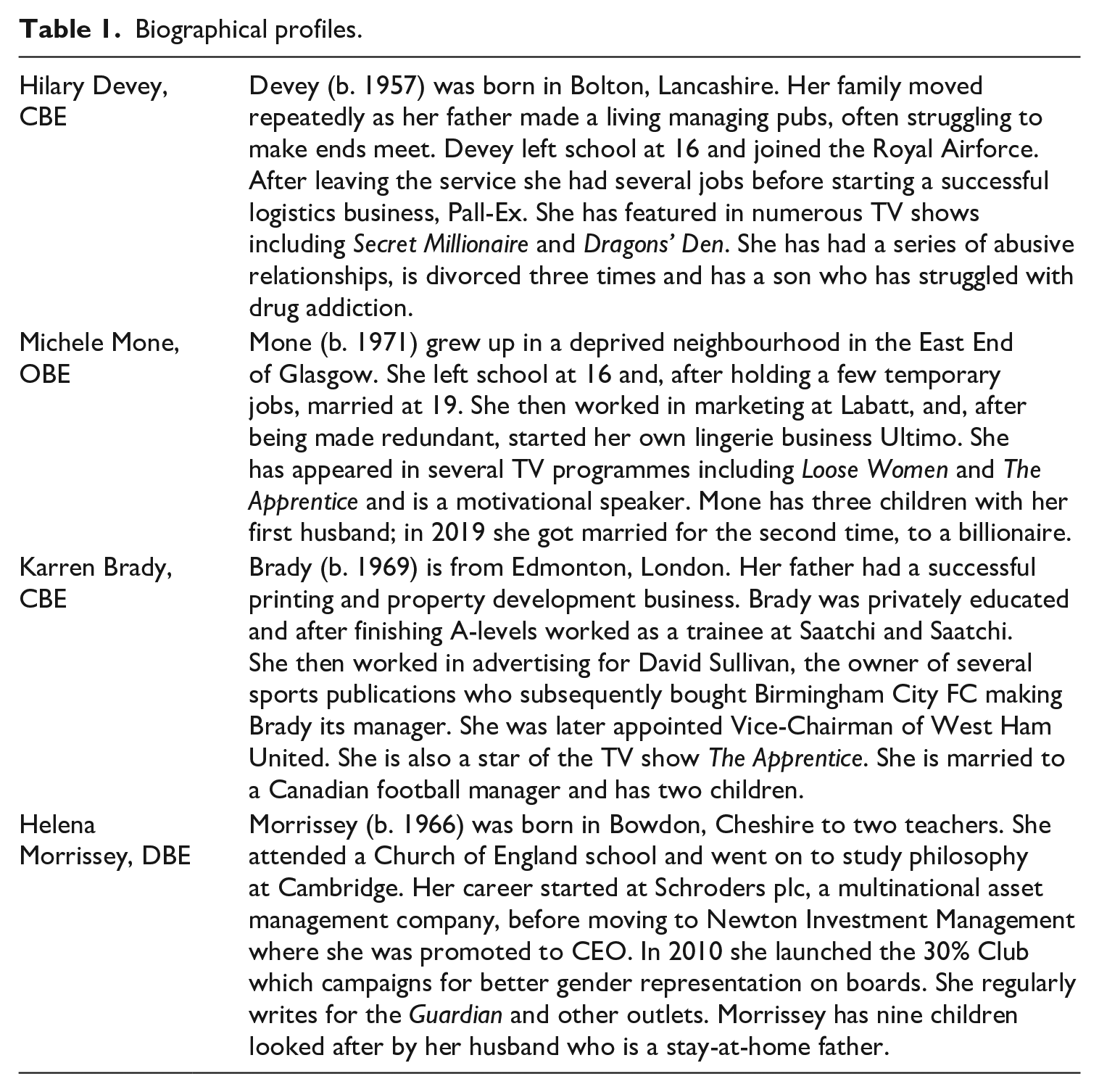
Studies that focus on autobiographies typically analyse one to five texts (Adamson, 2020). The four books we chose generated about 1150 pages of data and although we do not claim this sample to be representative, in line with our constructionist approach, we deemed the sample appropriate for illustrating the types and patterns of discursive tropes that are present in such texts.
We used Potter and Wetherell’s (1987) version of discourse analysis, which sees discourses as rhetorically organised to achieve certain effects and to convince the audience. The approach is therefore well suited for understanding how common sense and status quo are constructed as non-questionable. The key analytical feature here is identifying dominant interpretative repertoires: routine arguments that often contain familiar cliches and tropes mobilised to make a point in a specific format (Edley, 2001). For our first reading we looked for passages explicitly and implicitly discussing class, and in line with our approach noting both material and cultural class practices (Crompton, 2006, 2015). We also noted if and how these intersected with gender. Applied codes included material things, money, education, tastes and social practices. For the second reading, following Potter and Wetherell (1987), we sought to notice discernible rhetorical patterns or interpretative repertoires related to class that emerged from an array of identified codes and contextual situations. To ensure the consistency of interpretations both authors conducted their analysis independently before discussing repertoires that emerged. This process is, of course, still interpretative and multiple interpretative repertoires may be present, but following Potter and Wetherell (1987) we identified three that were dominant; that is, appeared in all the texts to make sense of class- and gender-related practices: constructing (extra)ordinariness; aligning with a universal gender struggle; and emphasising the unimportance of wealth for its own sake.
Gendered Constructions of (Extra)ordinariness
While class was rarely mentioned explicitly in the autobiographies, one of the few places where it surfaced, albeit in varying detail, was when the authors discussed their upbringing and education. Mone and Devey clearly self-identify as working class in the texts. Their origins are presented as a unique asset that has helped them succeed in business (see Lehmann, 2009). Devey (2012: 20) writes how needing to work as a child alongside her parents in the pub shaped her: I think it’s probably why I learned to cope so well in later life with whatever was thrown at me. I realized early on that you have to be adaptable, bend to whatever direction, which is the quality you need to succeed in business.
Mone (2015: 9) describes how growing up in a poor, rough and violent neighbourhood made her ‘streetwise’, ‘always on the lookout’, and states that it helped her develop intuition which is the reason for her business success. She writes: ‘I would not be the person I am today if I hadn’t learnt those life lessons growing up’ (Mone, 2015: 9). In these cases, class is explicitly written into the accounts. However, this is only for it to be written out subsequently, as it is presented as something to overcome. Mone (2015: 2) for instance, says that her ‘biggest fear is that one day I’ll be in the same situation I was in as I was being brought up [being poor]’. Both texts include vivid descriptions of struggles early in life, and the extraordinary hard work involved in achieving success and overcoming those conditions. Schervish (2016) argues that the emphasis on ‘humble beginnings’ in elite entrepreneurial autobiographies involves the recounting of overcoming challenges and hardships, which underscores the extraordinary virtues of the individual. A common trope deployed to justify wealth as rightfully deserved in this context is hard work (Kantola and Kuusela, 2019; Littler, 2018). The virtue also stems from becoming a self-made, enterprising subject of neoliberalism (Brown, 2003) who is able to convert hardship into economic capital. However, the accounts also demonstrate a distinct gendered element to their struggle to overcome material and social barriers: [My father] was lovely, but a typical northern misogynist all the same. . . he thought nothing of keeping me off school . . . because why did I need to be educated? I was a girl and so I was going to get married one day and didn’t need proper schooling. (Devey, 2012: 11) We couldn’t afford to pay for a nursery so [my daughter] was dropped off at my mum and dad’s every day. I’d make time for her . . . when I could. I’d feed her breakfast and do her bath when I got home. I probably didn’t have the balance right, but I was working hard for her as well. (Mone, 2015: 37)
Devey’s quote points to additional difficulties she had to face as a working-class girl; for instance, a restricted access to education (Vianello and Moore, 2016). Meanwhile, Mone’s quote points to the fact that excessive hard work is only a virtue for women if it does not jeopardise their gendered roles of ‘good mothers’. McDowell (2008: 156) writes that: the good mother now [in advanced capitalism] is a mother who enters the labour market to raise her income for the benefit of her children and who . . . hands over the care of her children to another (woman) for part of the day.
However, Mone, whose ambition requires overworking, is compelled to justify the lack of ‘balance’ in attending to her child by appealing to the need for providing for her, echoing the neoliberal feminist ideal of a ‘balanced’ femininity (Rottenberg, 2018). Devey (2012: 128) similarly writes that she had no choice but to work to provide for her son, highlighting that she ‘never met a man who feels guilty about leaving his kids to go to work in the way that a woman does’. Hence, while the celebrity women’s stories demonstrate similarities with archetypal ‘rags to riches’ through hard work tropes, becoming an exemplary successful neoliberal subject (Brown, 2003) appears to be clearly gendered.
Interestingly, while Kantola and Kuusela (2019) found the narratives of elite entrepreneurs from different backgrounds to be very similar, we found nuances related to class origins. In the texts of Brady and Morrissey, who, according to their accounts, had ‘comfortable’ upbringings, class is constructed differently. Unlike being working class, capitalising on a middle-class background is not as appropriate, as it may call into question the legitimacy of one’s achievements. Hence, rather than an emphasis on extraordinary efforts, the trope of constructing ordinariness was prevalent here (see Schervish, 2016). In the case of Brady, the humble background of her father and traditional role of her mother are described: ‘Dad came from very humble origins, not knowing who his father was and with a mother who had to work very hard all her life. . . . As for my mum, she was a conventional mother and housewife’ (Brady, 2012: 19).
When mentioning attending a private school she emphasises that ‘it was all the result of hard graft’ (Brady, 2012: 18) by her father. This allows her to lay a claim to ordinariness: ‘Boarding school makes my early life sound all ponies and privilege, but before I went I’d had a very normal upbringing’ (Brady, 2012: 18), and recasts wealth as deserved (as opposed to, for instance, inherited riches). Further claims to ordinariness by Brady and Morrissey are made through downplaying special talents and abilities: I wasn’t naturally gifted at anything . . . I wasn’t academic – I wasn’t the best at anything. (Brady, 2012: 20) The truth is, I am just an ordinary girl from an ordinary background, not the cleverest or the most talented amongst any group of peers. (Morrissey, 2018: 143)
This is interesting, as both women have had quite extraordinary careers. Brady became the youngest managing director of a public limited company (plc) in the UK at 23, then ran two Premier League football clubs. Morrissey was a fund manager at a prestigious City firm at the age of 26 after graduating from Cambridge and winning a competitive placement in New York. The dismissal of special talents and abilities may be read as a gendered trope as elite women walk a thin line of balancing the display of extraordinary characteristics and ambition with needing to be modestly feminine (Mavin and Grandy, 2016). Instead of claiming exceptional talents the autobiographies emphasise other characteristics such as being ‘very persistent’ (Morrissey, 2018: 143) and having ‘enormous energy’ (Brady, 2012: 25) and, of course, hard work. Tapping into the discourse of meritocracy and individual achievement (Littler, 2018) by emphasising the role of individual determination while toning down the structural context works to offset the exceptionality of these women’s career trajectories, making the extraordinary seem achievable.
Hence, class is written in and out in different ways in the above accounts. Class background is either constructed as a resource to draw on (which however ultimately should be left behind) or framed as irrelevant, with individually based characteristics and efforts heralded as the key conditions for success in both cases. Furthermore, both ways of constructing (extra)ordinariness, be that through emphasising class origins to highlight one’s effort or downplaying it, reflect structural and cultural conditions of doing gender.
The Universal Gender Struggle
Another repertoire through which class was written in and out of the accounts was through references to the universality of gender struggle. For instance, the texts connect with the (typically female) reader by emphasising the challenges of balancing intense work necessary to achieve success with being a good mother. Mone (2015: 58), for instance writes: I was working all the hours . . . but I was still taking [my small son] with me into the office. Mum would sometimes take him away for a few hours to give me a bit of respite. I would then pick [my daughter] up from nursery. I was basically multi-tasking to get whatever I needed done so I could also be a good mum and wife. It was really difficult. That first year I returned to work after having Fitz [the first child] was tough, particularly when I didn’t get the promotion that might have eased our financial strain. (Morrissey, 2018: 24)
Comments similar to the above were present in all four texts and, as many female readers may probably recognise themselves in such representations of struggling with work–life balance and childcare, these tropes do the work of creating a feeling that all women have issues in common regardless of wealth and social status. Framing these themes as universal allows elite businesswomen to position themselves as being like any other working mother. This is reinforced through juxtaposing women’s experiences with those of men: Many women have a common aim: to fit a career around a family. Yes, we have to juggle and, yes, sometimes we have to leave work early because our family needs us . . . Most business leaders are still male, and most male chief executives, chairmen or managers have a wife . . . who sorts out the school uniforms, who does the weekly supermarket shop, who gets the call from school when a child needs to go home sick . . . Good for them. (Brady, 2012: 4–5) How many men have polished shoes, packed lunchboxes, put homework into bags, made breakfast . . . and driven kids to school before a 9am meeting? Not many. I’ve lost count of the times I’ve walked into boardrooms and looked at the men around the table with their ironed shirts, clean homes, cared-for children and dinner on the table and wondered what they did with all their spare time? (Devey, 2012: 179)
The contrasting of women’s and men’s experiences serves to reinforce a sense of a shared woman’s fortune. This alleged commonality works to erase differences between women and obscure the relative privilege of elites in the context of class struggle. For example, one proposed way of dealing with work–life balance issues is through outsourcing responsibilities. Brady (2012: 12) writes that ‘working women are weighed down with the guilt’, and that ‘if you have a career, children and a nanny, you’re some sort of ruthless bitch’. She urges women to renounce this guilt as ‘you can only do what you can do’ (2012: 13). She writes that she ‘did miss out on school holidays’, but that she was there for key events and that she would sometimes get the nanny to bring the kids to work for lunch (2012: 163). All four texts mention hiring domestic help and nannies as a ‘must do’, positioning it as a successful way to resolve a universal women’s issue of balancing work and life. The high expense involved in domestic ‘outsourcing’ is sometimes acknowledged in passing but is rendered a matter of good planning and choice. Devey (2012: 176), for instance, states that she was ‘on a good wage . . . but money was tight’ because she chose to hire a live-in nanny. Morrissey (2018: 24) writes that ‘buying a modest house enabled us to hire a wonderful nanny’. Thus, hiring help is constructed as being achievable with a bit of sacrifice and frugality – a rhetoric that glosses over the realities of class differences (see Rottenberg, 2018). As research demonstrates, the ability of middle-class women to sustain their ‘balanced’ lifestyle is dependent on classed care chains, that is, outsourcing (some) care responsibilities to working-class women (McDowell, 2008). Meanwhile, ‘lower- or working-class women have reduced access to financial resources to help manage work–life balance, [and] also have reduced access and choice around flexible work arrangements’ (Ravenswood and Harris, 2016: 617). Hence, while class is written out through the appeal to a common gender struggle, it remains subtly present as strategies offered to deal with balancing work and family are clearly classed.
The Unimportance of Wealth for Wealth’s Sake
Despite referring to ordinariness and feminine commonalities, it is impossible to completely mask the fact that these elite women still enjoy extraordinary wealth. To address this, a third interpretative repertoire was employed, which emphasised the unimportance of wealth for wealth’s sake through highlighting ‘acceptable’ attitudes towards material riches, and particular ways of being rich. For example, Brady (2012: 97) writes that factors other than money motivated her: ‘I earn a lot now. Yet money has never been my driving force. I have never lain awake at night thinking, I need money. Independence has always been a much more important motivator.’ She acknowledges that her ‘attitude towards money comes from having had a good upbringing in a safe environment . . . we were a long way from being rich . . . [but] there was always enough’ (2012: 97). The latter statement rhetorically renders having money positive and productive as it allowed her to aim high. The sense that there are certain ‘appropriate’ ways of being wealthy is further reinforced by ‘othering’ particular types of wealthy elite femininities. For instance, Brady goes on to be rather dismissing of women whose ambition seems to be to use their femininity to gain wealth but who lack independent aspirations and the desire to work: I don’t think there’s any harm in loving your husband, looking good and dressing nicely, but going out with or marrying a footballer seems to be the limit of some women’s ambition. It starts and stops there which I think is very sad. It concerns me that this is the dream for some young women, a life free of work and achievements but with all the trimmings. These women seem so vulnerable to me: they appear to have no independence and are reliant on a man saying, ‘Here’s some money. Go and buy a car.’ (Brady, 2012: 88)
Meanwhile, Mone invokes the figure of a ‘diva’ in relation to becoming a wealthier but nastier version of herself: ‘I was turning into a real monster – a diva . . . nothing was ever good enough. The hotels I was staying in weren’t good enough and the restaurants I was dining in weren’t good enough . . . I found fault in everything’ (Mone, 2015: 158).
Othering is a common technique of creating hierarchies based on moral boundaries, as the other is constructed through visualising a certain moral subject (Skeggs, 2005; Van Eijk, 2013). Kantola and Kuusela (2019) show how a moral distinction between productive entrepreneurial individuals and the lazy unemployed is constructed to emphasise the deservedness of wealth. As the quotations above illustrate, this distinction was constructed in our data in a gendered way through questioning the deservedness of other types of wealthy femininities. Deservedness was about working towards a ‘real’ achievement and aspiration rather than using one’s femininity to advance socially through marriage. The latter is a conventional narrative of women’s social mobility (Lawler, 1999), but it is here framed as a desire that is seen as sad. It also indicates appropriate behaviour while being rich, that is, displaying an appropriate kind of ‘nicer’, more respectable femininity rather than an unruly vulgar one (Skeggs, 1997; see also Mavin and Grandy, 2016). Discursively constructing such moral boundaries works to present the (re)production of wealth as palatable as long as it is done in the ‘right’ way.
The autobiographies are also interesting in relation to how material comfort is addressed. In Brady’s and Morrissey’s accounts there are cursory mentions of the ability to afford nice holidays with their families, or the occasional luxury brand indulgence. A more ostentatious flaunting of wealth is indicated as an inappropriate characteristic of people of a certain upbringing: ‘Often the celebrities you see who are flash with their money are people who have grown up with very little. They need the trappings to say to the world, “I’ve got money, don’t you know?”’ (Brady, 2012: 99). Indeed, coming from a poor background, Mone (2015) writes explicitly about her fascination with material possessions and wanting to acquire more: Once I’d got a taste of it there was no stopping me. Back then, material things turned me on. (2015: 37, emphasis added) I started splashing cash like it was going out of fashion. Jewellery, flash cars, designer shoes and designer dresses . . . I chose the most expensive postcode . . . millionaire’s row. (2015: 153–154)
An important point in the excerpt above is the reference to the past. An initial desire for wealth is presented as acceptable because the rest of her story is about overcoming the fetish of material processions. Wanting ‘stuff’ is explained by her background and a naive belief that wealth can fix personal issues: I thought that buying a bigger house and having a nice car were the key to happiness – because I’d never had those things. I thought you could fix problems by becoming rich. (2015: 37) I was in an unhappy relationship and I was buying all these things because I thought it would numb the pain, but it didn’t. (2015: 158–159)
The story culminates in the epiphany that it is not the money that matters, ‘I realised how spoilt I was and how I didn’t need half the things I owned . . . You need money to survive but happiness is more important’ (2015: 197). Mone continues: I started to do a lot more with my kids. I’d cancel going into work if they were ill . . . I don’t need material things to make me happy. I have also realised my kids don’t need the fancy things. They just need my time. Your heart costs nothing. (2015: 161)
Similar tropes are also found in Devey’s (2012: 342) account: ‘I’m proud of what I’ve achieved too . . . materialistic success doesn’t mean that much, to be honest, but my sense of professional pride and love of family and friends really do.’
Thus, while the key marker of the elite class – material wealth – surfaces in the accounts it is subsequently erased by charting the journey towards a realisation of its unimportance. The epiphanic journey is about overcoming the unsophisticated fascination with material things and embracing more ‘appropriate’ tasteful aspirations, helping to overcome and eradicate a working-class background (see Skeggs, 1997). It is also about understanding the value of ‘true’ (gendered) desires for a happy relationship and a happy home, which for a woman may be jeopardised by possessing wealth: The bigger my profile grew . . . the nastier Michael [her husband] became . . . I suppose the fact I was earning four times more than Michael, may have had a part to play [in all the arguments]. Michael had been the breadwinner when we married, and now the roles had been reversed. (Mone, 2015: 182) Take it from me: a healthy bank balance certainly brings you options, but if you think it will also bring you emotional security and friends, love and happiness, then think again . . . I’ve found it hard when my bank balance has made me question if there was anything real in some of my relationships . . . I’m no different to most women: I want . . . someone to put their arms around me at the end of a bad day. (Devey, 2012: 232–233)
The above tropes work to remove potential wealth ‘envy’ by emphasising its drawbacks especially for women. Thus, the focus on the gendered aspect further erases the elite class elements by discursively and morally decoupling these women’s wealth from classed inequalities. However, these discourses also serve to reproduce the gendered nature of elites by marking boundaries around ways which it is acceptable or desirable for a woman to be rich.
Concluding Discussion
Davis and Williams (2017: 4) have recently called for research on elites to continue to identify and investigate the different kinds of bases of contemporary elite power. This article offers such a contribution by focusing on the cultural influence of elites – an analysis which, we argue, is crucial for understanding how and why the general public may ‘buy into’ plutocratic elite rule, its structural reproduction and growing inequality. Specifically, drawing on the analysis of how class is written in and out of elite businesswomen’s autobiographies, we have argued that these discourses add to the cultural erasure of class, albeit in a gendered way.
First, class is written out as structure and written in as individual-based identity differences, through the discursive repertoires of ordinariness, universal gender struggle and unimportance of wealth. The texts render social stratification irrelevant, suggesting that either it does not stop you from succeeding (if you are working class) or it does not automatically make you successful (if you are middle class) – in both cases the implication is that it is one’s individual effort and desire that makes a difference. As Francombe-Webb and Silk (2016) observe, neoliberal prescriptions which individualise success and failure produce the simultaneous downplaying or denial of class and the continued playing out of meanings of class in everyday interactions. This was traceable in our texts: structural privilege was glossed over by the emphasis on the highly individualistic trope of hard work and persuading the reader that wealthy women have the same concerns as all other women, positioning their success in accumulating wealth as a matter of individual ‘business guile, determination and sheer will’ (Bloom and Rhodes, 2018: 78). The unimportance of wealth repertoire, in its emphasis on having appropriate attitudes to and ways of being rich, works to secure the ‘palatability’ of elites. Hence, in the autobiographical genre ‘the positioning of individuals via class and status mechanisms is replaced by a focus on the construction of individual identities’ (Crompton, 2006: 9). As a result, not only is the accumulation of wealth made to appear more acceptable, but inequality becomes decoupled from class to become a matter of individual effort (or lack thereof). In doing so, we argue, the genre contributes to the cultural erasure of class – a process whereby people from a broad range of backgrounds do not identify with any class, or identify as middle class (see Savage, 2015b; Savage et al., 2010). This is not trivial, as class fundamentally describes issues of inequality and unequal distribution of resources (Tyler, 2015), and therefore ‘remains decisive in who succeeds and who does not’ (Gerodetti and McNaught-Davis, 2017: 356). The social implications of cultural class erasure are crucial as research shows that working-class people may be particularly disadvantaged by ‘buying into’ the notions of meritocracy and individualism (Abrahams, 2017; Littler, 2018). Through (re)producing these cultural discourses the business elite autobiography genre feeds into the creation of a felicitous climate for persisting social inequalities.
Second, focusing on elite businesswomen allowed us to demonstrate that the discursive erasure of class has gendered dynamics and effects. Through deploying a repertoire of ordinariness and by explaining how they share the same universal gender struggle as other women, elite businesswomen (who are clearly outliers when it comes to gendered and classed experiences) come to be constructed as representatives of the universalised experiences of all women, thus rendering class irrelevant. As research highlights, structural inequalities continue to have a significant effect on the life trajectories of women and ‘for working-class women, work is thus characterised by internal segregation and segmented opportunities rather than by lacking aspiration’ (Gerodetti and McNaught-Davis, 2017: 362). Hence, the getting-on strategies that the genre offers under the guise of feminist empowerment and unity work to reproduce highly individualistic neoliberal feminist suggestions that responsibility for success or failure rests with individual women, regardless of privilege or constraints (Eisenstein, 2010; Rottenberg, 2018). These discourses also serve to remove the concerns of different categories of women from the agenda, thus perpetuating cultural meanings that sustain social inequalities.
Our analysis underscores that the cultural discourses of elite class reproduction are gendered. Through illustrating how some previously identified tropes, such as ordinariness (Du Gay, 2008), hard work (Littler, 2018) and moral boundary construction (Kantola and Kuusela, 2019) are gendered, we highlight that the story of becoming (and being) a wealthy elite woman requires particular discursive self-presentations in order to ‘balance’ typically masculine success story tropes (Gilmore, 1994) with displaying an appropriate feminine identity (e.g. Mavin and Grandy, 2016). This indicates that gendered structures of elite class reproduction are intertwined with, and sustained by, cultural meanings.
Overall, our study highlights the importance of the autobiographic genre as a powerful vehicle of reproducing cultural meanings of class and gender. Autobiographical texts assume a degree of authenticity, even if they are often not authored by the protagonists themselves. The purported look into someone’s private life creates a sense of intimacy and trust, providing elite authors with a legitimate voice and allowing them to normalise certain cultural meanings. Yet, these texts are not produced in a vacuum; in fact, it is a network of interlocking publicity and media engines that produce business celebrities. Guthey et al. (2009: 5) write that ‘business celebrity functions as a forum for concerns and debate about what it means to be an individual in a complex modern society’ and the celebrity autobiography genre is definitely a site where such meanings are explored and negotiated. Hence, while personal autobiographies are a form of public relations (PR) of the elites, the genre itself informs constructions of what counts as good personhood and virtue, making the ideals and identities offered in these books admirable and desirable. As Bloom and Rhodes (2018: 109) observe, ‘whether one believes the stories or not, the dream on which they rest is potent’. As such, these texts are important ideological instruments that work to contribute to the erasure of class and the legitimisation of wealth, supporting a social system where inequalities persist.
As Glucksberg (2018: 231) argues, an analysis of the socio-cultural ‘aspects of elite life and reproduction’ does not ignore structural conditions of accumulation; instead, it seeks to understand how elites ‘hide and naturalize their own structural advantages’. This article contributes to these debates through unveiling how the construction of particular cultural meanings of class may contribute to the gendered reproduction of elites. Given an economic context where disparities – including gendered ones – in income, educational attainment and access to other social goods continue to grow (Dorling, 2014), and where a meritocratic rhetoric is flourishing, we argue that further research that explores the gendered cultural reproduction of economic elites is very much needed.
Footnotes
Acknowledgements
The authors would like thank Professor Roger Burrows for his helpful comments on the early version of this article.
Funding
The authors received no financial support for the research, authorship and/or publication of this article.
