




Abstract
The rise of different nationalisms in an increasingly unequal and neoliberal world makes predictions about the dawn of a post-national, global society seem both incongruous and fraught with Eurocentric occlusions. In response, we present a postcolonial analysis of research into Muslim youth narratives of nation in Northern Nigeria. This highlights the continued significance of nation for youth as well as the historical fractures – both internal and external – that infused their identity narratives. We further show the entanglement of nation and religion in youth imaginaries, and their anti-colonial ambivalences, notably with respect to gender reforms. Our analysis calls for a sociology of nation that goes beyond a modern framing and instead attends to the agonistic affective relations through which national imaginaries are constructed; the historical sutures that were intrinsic to the creation of postcolonial nations and their enduring persistence as points of fracture.
Introduction
Only recently late modern sociologists suggested that the nation-state was no longer useful as a category of analysis through which to understand the complexities of living in a globalised world. Youth identities in particular were framed by global flows that transcended the nation as a natural ‘container’ and implied instead an unavoidable cosmopolitanisation (Beck, 2002). In contrast, we see an intensification of appeals to national values, increasingly vigorous policing of national borders, and record numbers of displaced peoples, as the ‘others’ of the nation. While cosmopolitanisation is one way of interrogating the global flows of our late modern world, others take up postcolonial analyses which point to the historical interdependences between the Global North and South (Bhambra, 2016; Go, 2013). Drawing upon postcolonial writers (Bhabha, 2004; Said, 1978), they illuminate the Eurocentric biases of classical sociology and call instead for ‘connected sociologies’ (Bhambra, 2014) that better recognise the deep inequalities that have informed relations between the ‘West’ and the ‘rest’ (Hall, 1992).
In this article we similarly adopt a postcolonial lens to challenge Eurocentric understandings of nation and its modern associations. 1 We draw on postcolonial scholars (Bhabha, 2004; Chatterjee, 1993; Spivak, 1988) to explore the elisions of a conceptualisation of the nation as an imagined community (Anderson, 2006). We then take up recent empirical research into Muslim youth narratives of nation in Northern Nigeria as a critical case of the construction of the nation, in ways that trouble Eurocentric assumptions. Our analysis demonstrates how youths’ identifications with their nation remain significant, but also how these go beyond modern (secular) understandings that assume a separation of the state and religion. Through our analysis of youth narratives, we show that a secular understanding of time as linear and homogeneous (Anderson, 2006) fails to recognise the historical fractures in youths’ imaginaries and the axes of differentiation through which postcolonial nations claim their distinctiveness (Bhabha, 2004; Chatterjee, 1993, 2003).
Context
Nigeria is a critical postcolonial context through which understandings of the nation can be problematised. In this section we provide a brief overview of Nigeria’s contemporary socio-economic situation and its history as a nation-state, including how contemporary regional, ethnic and religious divisions were shaped by its colonial past.
Located in West Africa, the Federal Republic of Nigeria was created in 1963 after gaining independence from British colonial rule in 1960. It is the most populous country in Africa, with an estimated 193 million inhabitants (UNDP, 2018). Its population is also very young, with a median age of only 18 years and 62% under the age of 25. Although its economy is now larger than that of South Africa, the majority of Nigerians (70%) are estimated to live below the poverty line (CIA, 2019). Regional variations are also significant. Figure 1 shows that against a national human development indicator (HDI) of 0.521, HDI figures for Nigeria’s northern states are significantly lower than for southern states (UNDP, 2018). These inequalities are compounded when gender is brought into play. Nigeria ranks 133 out of 149 countries for gender parity (World Economic Forum, 2018).
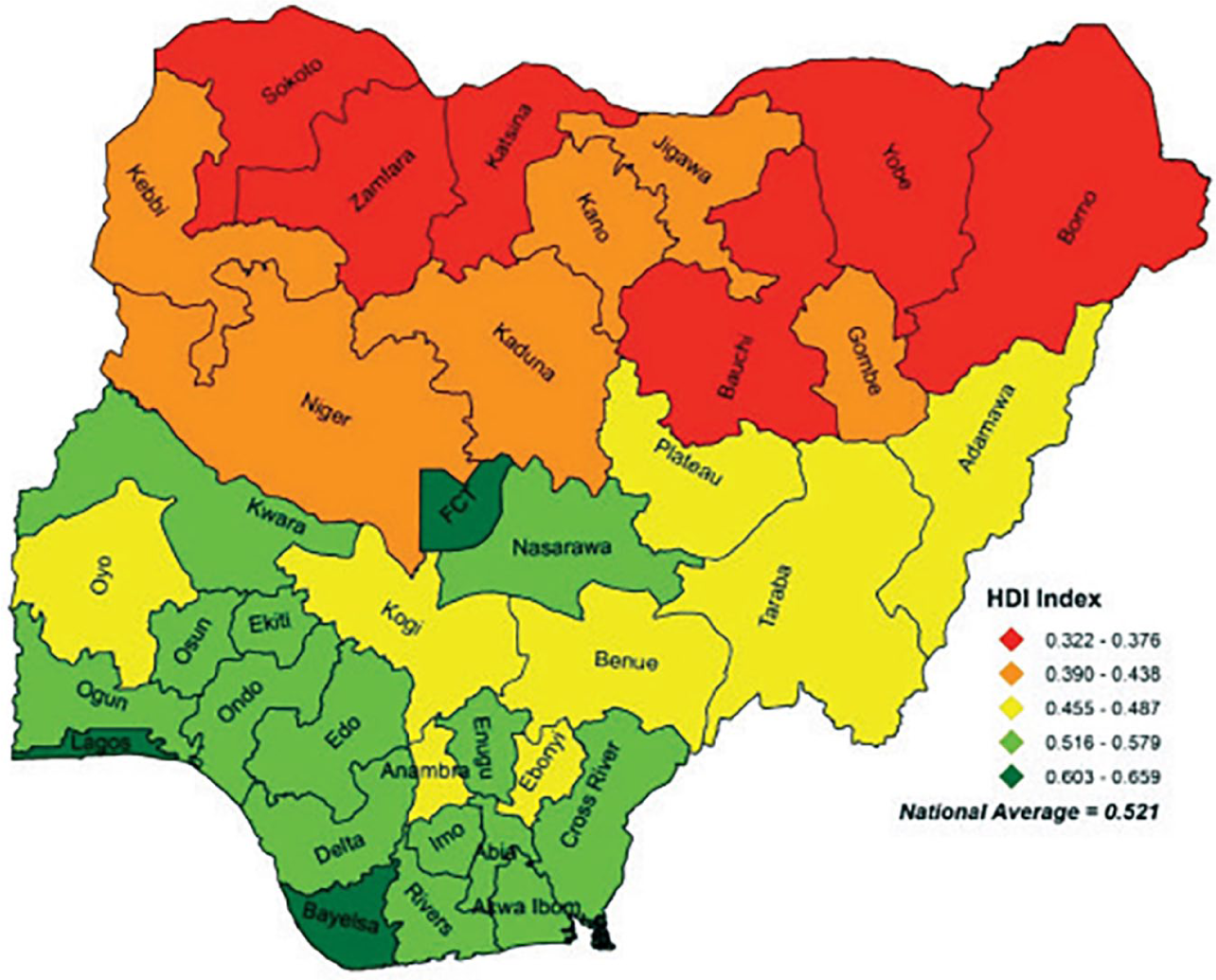
Human Development Index for Nigerian states (UNDP, 2018).
Nigeria’s constitution as a nation-state reflects a history of territorial, religious and ethnic differences and conflict (Dunne et al., 2017; Nnoli, 2008). Its territory was a product of British colonialism, which was consolidated in 1914 through the amalgamation of Lagos Colony, the Southern Nigerian Protectorate and the Northern Nigerian Protectorate. Despite their considerable differences, these three regions, North, South-East and South-West, later became the territorial basis of Nigeria’s federal government upon independence. Although Nigeria is now divided into the Federal Capital Territory and 36 administrative areas, the tripartite regional structure remains important in popular memory and reflects enduring religious and ethnic differences. These are to a large extent legitimated by Nigeria’s federal constitution and the different legal codes in place in the North and South. While the Nigerian constitution guarantees freedom of thought, conscience and religion, some northern states have a dual legal system that recognises Shari’a law, although not in the states where the research was conducted.
Nigeria is a multi-ethnic state, with around 500 languages and 300 ethnic groups. Of these, the Hausa from the North make up 27% of the population; the Yoruba (14%) originate in the South West; the Igbo from the South-East represent a further 14%, leaving the remainder (45%) distributed across a plethora of other ethnic groups (CIA, 2019). Turning to religion, just over 50% of Nigeria’s population is Muslim, predominantly living in the Northern states; 45% are Christian, residing mostly in the South, with 9% also practising traditional religions (CIA, 2019). This pattern reflects the spread of Islam from North Africa since the 12th century, and the later arrival of Christianity from the South during European colonial eras. At the same time, these regions are not religiously homogenous – many Christians live in the North, and vice versa. Nigeria’s regions are also ethnically heterogeneous.
Alongside resistance to colonial rule, Nigeria’s history as a nation-state has been fraught with conflict, including attempted secession by the South-Eastern region in the Biafran War, coups, attempted coups, military regimes, ongoing inter-ethnic conflict in the Niger Delta, Plateau, Kaduna and Kano State (Daily Trust, 2019), rising kidnapping and banditry, and the Boko Haram insurgency. The latter has caused many Muslim and Christian deaths, as well as large numbers of displaced people. It also led to a state of emergency being declared in 2013 in some Northern states, including in Adamawa, one of our research sites. Significantly, the current religious and ethnic fractures in Nigeria have been traced back to the strategic favouring of particular groups and regions by the colonial administration and its systems of indirect rule (Onapajo and Usman, 2015; UNDP, 2018). Nigerian politics remain sensitive to regional, religious and ethnic divisions. Strong regional differences are evident, for example in voting patterns in recent presidential elections (BBC News, 2019). These saw the re-election of Mohammadu Buhari, leader of the All Progressives Congress party (which is largely associated with the North), despite contestation of the election results (Egbejule, 2019). Overall, this national context is fraught with deep inequalities, and divisions of an ethnic and religious nature that were instantiated during the colonial eras and sedimented in the formation of Nigeria as a nation-state.
Theoretical Framing
Having outlined elements of Nigeria’s contextual history, we now take up postcolonial discussions of the concept of nation. While the turn of the century saw suggestions that the concept was of diminishing sociological relevance (Beck, 2002), events in the last decade have shown this to be misplaced. On the contrary, rather than the emergence of a global, post-national society, we are witnessing an intensification of appeals to national values, more stringent policing of national boundaries and ever-increasing numbers of displaced people – the ‘others’ of the nation. However, a further critique of late modern theories is their neglect of postcolonial and Global South perspectives. This article draws on postcolonial and poststructural writers to highlight sociology’s historical Eurocentric biases, its neglect of the interdependencies of modernity with coloniality and its misrecognition of the complexities of nation in contexts of postcoloniality (Bhambra, 2007, 2016; Chatterjee, 1993, 2003; Go, 2013).
A starting point for our article is therefore a critical engagement with the orientalism of classical sociology, which constructed non-western societies as backward and static, in contrast to the dynamism and creativity of European societies (Go, 2013; Said, 1978). It has assumed a modern teleology of progress and development. This has failed to recognise the colonial histories upon which western development depended, as well as the epistemic injustices implicated in the construction of western superiority (De Sousa Santos, 2007; Spivak, 1988; Wa Thiong’o, 1986). As Go (2013) argues, classical sociology occluded the ways that modernity was constituted through colonialism, while also privileging western ontologies and epistemologies that constructed colonised peoples in deficit ways. Importantly, these modern ontologies often cast religion in a negative light, as something that an enlightened citizenry would increasingly eshew or relegate to the private sphere (Asad, 2003; Krämer, 2013).
Postcolonial analyses also inform our engagement with the concept of nation. An influential discussion of ‘nation’ has been Anderson’s (2006) portrayal of it as an ‘imagined political community’. However, although Anderson’s opening chapters pointed to nationalism’s emergence as a response to imperialism and colonial domination in the Americas, these anti-colonial roots have been glossed over in later analyses. Instead, its emergence is often related to the rise of the modern nation-state, as a largely European phenomenon. As Anderson (2006: xiii) notes, although his intention was to highlight the ‘New World’ origins of nationalism, European scholars have often assumed the later ‘second generation’ European nationalisms as a starting point in their analysis. This has allowed the imaginary of the nation to be understood as a primarily European invention.
A particular issue here for postcolonial writers is the negative construction of ‘ethnic’ versus ‘civic’ nationalisms, and more generally how terms such as ‘tribal’, ‘indigenous’ and ‘native’ produce such groups as the ‘uncivilised others’ of western modernity (Bhambra, 2007; Chatterjee, 2003; Go, 2013). Following Said (1978), postcolonial scholarship has shown how colonisation and orientalism contributed to the production and reification of ethnic boundaries within colonial contexts (Said, 1978; Spivak, 1988). For Mamdani (1996), a consequence was that African politics has remained fractured by ethnic particularisms.
However, others suggest that expressions such as ‘ethno-nationalism’ continue to reflect orientalist perspectives by denigrating those nationalisms which did not become ‘official nationalisms’ (Larmer and Lecocq, 2018; Tinsley, 2019). Like Fanon (1967), Larmer and Lecocq (2018) point out that ‘official nationalisms’ in African contexts were often propelled by local elites working within colonial administrations, rather than by popular consensus. This left national imaginaries multiply contested, to the extent that the national ‘integration’ which such ‘official nationalisms’ proclaimed could be experienced as ‘internal colonisation’ by non-dominant ethnic groups (2018: 910). As such, they argue for a historicised exploration of national imaginaries that attends to regional, ethnic and religious affiliations, rather than dismissing these in orientalist ways.
A related issue is the significance Anderson attaches to modern (secular) understandings of time for making the imagined community of the nation possible. Chatterjee (2003) questions Anderson’s understanding of time as linear, homogeneous and empty, as well as his utopian construction of this. Chatterjee (2003: 166) argues instead that time in postcolonial contexts is ‘heterogeneous, unevenly dense’, more consonant with a ‘heterotopia’. Bhabha (2004: 221) similarly disputes Anderson’s emphasis on the uniformity of serial, homogeneous time, highlighting instead the ‘double temporality’ that is involved in the construction of a national culture and the interpellation of national subjects: The scraps, patches and rags of daily life must be repeatedly turned into the signs of a coherent national culture, while the very act of the narrative performance interpellates a growing circle of national subjects. In the production of the nation as narration, there is a split between the continuist, accumulative temporality of the pedagogical, and the repetitious, recursive strategy of the performative.
This has important implications. First, rather than having ‘sociological solidity’, the ‘nation’ and its historical narration should be considered as an ongoing fabrication, in which multiple temporalities are implicated. Second, in contrast to Anderson, Bhabha highlights the ambivalences and tensions that are intrinsic to any modern, national imaginary which attempts to bring a heterogeneous community together through the ‘disjunctive narrative’ of the nation. Rather than being consensual, we need instead to be alert to the agonistic nature of this fabrication (Mouffe, 2005).
A further important issue from postcolonial perspectives is the continuing, constitutive difficulty for new nations emerging from colonial rule in relation to a wider imaginary of ‘the West’. Following Said (1978: 5), the ‘West’ is not a stable or geographical ‘fact’, but rather ‘an idea that has a history and a tradition of thought, imagery and vocabulary [. . .] shaped by a relationship of power, of domination, of varying degrees of a complex hegemony’. These relations inform Chatterjee’s (1993) questioning of what is left for the postcolonial nation to imagine, if the nation has to be imagined in forms already proposed by Europe. Stressing the importance of difference in the constitution of any identity, he suggests that although new postcolonial nations followed the West’s modes of statecraft, particularly in terms of economic and political governance, they asserted their difference through cultural and spiritual domains. These became a ‘fundamental feature of anticolonial nationalisms in Asia and Africa’ (1993: 6).
Importantly, the emphasis on the spiritual sits in considerable tension with western imaginaries of the nation as secular. The ‘stripping away of myth, magic and the sacred’ was constitutive of what Asad (2003: 13) describes as the ‘secular space’ of modernity, as well as the ‘myth’ that secularism was intrinsic to the development of liberal democracies. Such assumptions have allowed Islam and Islamic societies to be constructed as ‘pre-modern’, or even ‘anti-modern’, despite the ways that Islamic leaders have been implicated in democratic ‘modernising’ movements (Krämer, 2013). The analysis that follows contributes to such debates by showing the fusions of nation and religion in youths’ national imaginaries (Chatterjee, 1993). We argue for a sociology of nation that goes beyond a modern secular framing.
Bhabha’s emphasis on narration and interpellation is also critical to the analysis we present below of youths’ identity constructions. We resist modern understandings of identity as reflecting a unitary, rational, autonomous self. Instead, we think of identity performances as discursively produced (Foucault, 1984), involving ongoing processes of becoming that are contingent, saturated with power relations and never complete (Hall, 1996). This is framed by poststructural understandings of signification that recognise all meaning-making to be constituted through difference, in ways that are agonistic and indeterminable (Mouffe, 2005). Taking up these perspectives, we see the production and performance of identities (including national identities) as always being constituted through relations of difference, or relations to the ‘Other’: it is only through the relation to the Other, the relation to what it is not, to precisely what it lacks, to what has been called its constitutive outside that the ‘positive’ meaning of any term – and thus its identity – can be constructed. (Hall, 1996: 4–5, emphasis in original)
As we recount below, our research methodology aimed to create spaces for youth to narrate how they identified with their nation, and to articulate to us the ‘scraps, patches and rags’ through which this was constructed for them (Bhabha, 2004), in reference to their ‘constitutive others’ (Hall, 1996). This is based in a Foucauldian understanding of narrative as a product of ‘the structures and forces of discourse, power and history’ (Tamboukou, 2008: 102).
Methodology
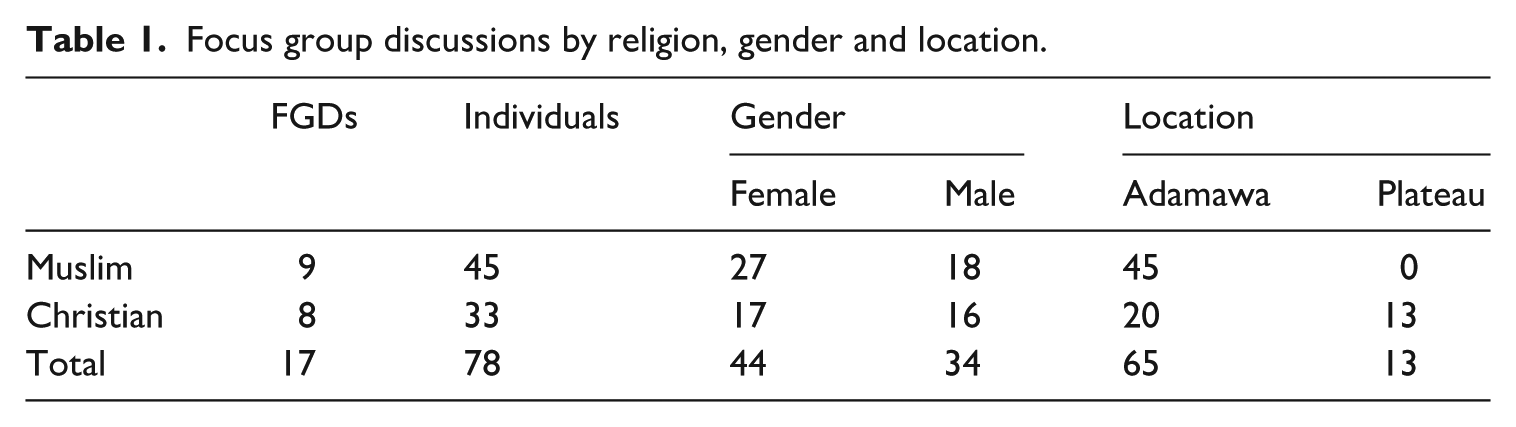
The research drawn upon in this article was part of larger study of youth narratives of identity with respect to nation, religion and gender in four different postcolonial contexts (Dunne et al., 2017). This article focuses on the research in Nigeria, as this context illuminates particularly well the contested nature of nation within a multi-ethnic and multi-religious postcolonial context. The research took place within two northern states in Nigeria, Plateau in North Central and Adamawa in North-East, and involved a team of nine local research assistants from these contexts. Alongside observational data, the main data set comprised focus group discussions (FGDs) with Muslim and Christian youth in 2014. Nine FGDs were held with females and eight with males; nine were with Muslims and eight with Christians. In total 78 youth participated, of whom 58% were Muslims and 56% were female. Participants’ average age was 24 years, and their age range 18–36. Table 1 provides a summary of the FGD sample. Youth were self-selected volunteers; their participation in the research followed an invitation through local intermediaries who were education professionals working in local higher education institutions. As also clarified below, we make no claim that the participants constitute a representative sample. The research underwent ethical review at the UK university of the lead researcher and in its local contexts. Ethical processes included use of an information sheet to gain participants’ consent. For reasons explained below, the analysis focuses on the FGDs with Muslim participants.
Focus group discussions by religion, gender and location.
After unsuccessful trials with mixed sex groupings, the FGDs were segregated by gender and by religion, with the aim of allowing more open discussion of potentially sensitive issues. At the start of each FGD, participants were asked to complete a bio-data sheet, providing their age, religion, ethnic group and main languages. All the Muslim participants were from Northern Nigeria and were in higher education. They came from nine ethnic groups. One-third were Fulani (the Hausa term for the Fulbe). A further quarter were Hausa. Multiple tribal affiliations were also identified (Bachama, Kilba, Higgi, Bura, Gude Gombe in Adamawa; Berom, Amo, Goemai, Jukun, Ngas, Talet, Tarok in Plateau State).
The FGD schedule and research protocol were developed through an initial research pilot in Nigeria in 2011 and then subsequently refined (see appendices in Dunne et al., 2017). This included translation into relevant local languages with the support of the local research assistants, who were themselves youths. They also translated the transcripts into English. At the beginning of each FGD, participants were invited to say how they would introduce themselves to someone who was not from their national context, which generated responses such as ‘I am a Muslim Nigerian from Adamawa’. Participants were then asked a range of questions about their nationality, religion, ethnicity and gender, and their intersections. For example, participants were asked what their nationality meant to them, what they saw as important national characteristics, who were their national heroes/heroines and what made them proud (or not) to be a national of their country. The schedule included similar questions in relation to religion, asking for instance what the characteristics of an ideal Muslim or Christian were, what religious figures were important to them, how life would be different if they were Christian rather than Muslim (and vice versa). All of these questions were probed for gender differences, for example what male and female ideals were for their nation, and their religion. The questions also intersected nation, religion and ethnicity, through questions such as how Nigerian Muslims were different from Muslims in other national contexts, or how being Muslim was different for someone of a different ethnic group. It elicited the ‘others’ of national and ethnic identifications (Hall, 1996) by asking participants what other nationalities and ethnicities they would not want to have, as well as those they would like to have. Finally, questions probed generational differences.
The FGDs mostly had five to six participants and lasted between 40 to 90 minutes. The FGD schedule was followed in a flexible way to facilitate an open discussion and create space for youths’ identity narratives. Many FGDs were highly animated and illustrated well the affective and agonistic nature of participants’ identifications with their nation. We were aware of pressures towards conformity however, as discussed further in Crossouard et al. (2020). Although individual excerpts are mainly used to support the analyses below, this is for conciseness. Our unit of analysis is not the individual, but the discourses available in these contexts for youth to construct and narrate their identities.
Data analysis began by discussing the FGDs with the local research assistants, how they felt the discussions had developed, what key issues had emerged and translation queries. The transcripts were re-read repeatedly, and issues clarified through revisiting the audio and/or discussing the transcript with the interviewer. The transcripts were coded by hand against the key concepts (nation, religion, gender and ethnicity). Finally, codes of ‘internal other’ and ‘external other’ were developed to reflect whether the ‘constitutive others’ against which youth identity narratives were constructed were internal or external to the nation. Each FGD was allocated a code that denoted religion, gender, location and an ordinal FGD number (1–17). So a code of MMA16 refers to FGD 16, with Muslim, male youth in Adamawa State, while MFP13 refers to FGD 13, with Muslim, female youth in Plateau State.
The lead UK-based researcher conducted the pilot FGDs in Nigeria and inducted the team of nine local research assistants into the conceptual framework for the research, the research instruments and research ethics. The research team included Muslim and Christian males and females, which allowed matching of participants’ religion and gender with those of the interviewers in most FGDs. The local research assistants encouraged participants to use their preferred language which led to code switching between Hausa, English, Pidgin and other vernacular languages. FGDs were recorded, transcribed and translated into English.
The main focus of this analysis is the FGDs conducted with educated Muslim youth in 2014. At that point a state of emergency had been declared in Adamawa after the escalation of the Boko Haram insurgency. This prevented the UK-based researcher from travelling to Northern Nigeria. It was also felt that FGDs with out-of-education youth could put the local research assistants at risk. As access through teacher training and higher education institutions remained possible, this became the key route through which participants were identified. Given the low percentages of youth in higher education in this context, they can be considered a relatively elite group. However, given the complex history of Nigeria’s national formation and the contemporary conflicts afflicting this region, the narratives of nation of educated Muslim youth in this postcolonial context are of high relevance for this special issue. We have therefore made these FGDs the focus of this analysis.
Youth Narratives of Nation in Northern Nigeria
Our research set out to explore the ways in which youth in this postcolonial context identified with the concept of ‘nation’. Given its colonial fabrication, it is notable that the great majority of participants were strongly positive about ‘being Nigerian’. An analysis of participants’ responses to an opening question about how they would introduce themselves to someone from outside their national context showed that they referred most frequently to nation, religion and region. This produced responses such as ‘I am a Nigerian, a Muslim from Adamawa State’. More powerfully, however, discussion of what being Nigerian meant to these youth and what made them proud to be Nigerian provoked strong affective responses that suggested its significance for their identities: I really thank God for making me a Nigerian because it is something of great priority for me to be a Nigerian because as compared to other countries in Africa or in the world at large, Nigeria is actually a peaceful country. (P4, MMA16) we have many refugees here in Nigeria [. . .] that means Nigeria is peaceful place where any can come live and you see by just looking that I am proud to be a Nigerian. (P2, MFA24) There is one big thing that makes me proud being a Nigerian. That thing is unity. . . . Nigeria is blessed with different multi-ethnic groups . . . despite our diversity, we are able to unify ourselves and achieve a kind of development. (P3, MMA16)
Many participants emphasised how Nigerians lived peacefully together, specifically resisting Nigeria’s associations with ethnic conflict, religious fundamentalism and/or terrorism. In other words, the process of asserting Nigeria’s national unity invoked its ethnic and religious pluralism, even as this is brought together as one imagined community. Through these articulations, youth are signalling the ‘constitutive others’ of their national identities (Hall, 1996). However, as we discuss further below, such claims to nation are ongoing agonistic productions which are multiply contested (Mouffe, 2005).
A further distinguishing characteristic of youths’ national imaginaries is the way these were sutured together with their religious affiliations. While appeals to religion are already visible within the previous excerpts, many other assertions of youths’ sense of nation specifically brought nation together with religion: To me I am proud to be a Nigerian because Nigerians are very religious people, in terms of their faith, either Muslims or Christians, they are very religious. (P7, MMA16) Seventy per cent of Nigerians they have their religion in their heart. (P5, MFA12)
These excerpts show how Christianity and Islam are embraced with pride within this fusion of nation and religion, and how its religious pluralism is asserted as a distinguishing feature of being ‘Nigerian’. Just as ‘nation’ has not withered away in contemporary societies (Beck, 2002), this is clearly also the case for religion. Indeed in a postcolonial context, religion was often critical to national self-definition. As Chatterjee (1993) argued, the cultural and the spiritual were ‘defining features’ of the national imaginaries in postcolonial nations in Africa and Asia.
This suturing of nation and religious identities in this context also challenges a western, secular thesis of the nation, which assumes religion will be progressively eschewed. As noted earlier, such assumptions have led to Islam being constructed in popular western media as pre-modern, or even anti-modern (Asad, 2003). In contrast, it is significant that youths’ imaginaries of nation in this context were both religious and modern. This can be seen in responses to what made youth not proud to be a Nigerian. These showed both male and female youth to be highly critical of the workings of the Nigerian state and desirous of change: they don’t bring out money to help people, like bad roads, schools are not equipped, hospitals too they are not well equipped, there are some operations we Nigerians we have to go outside to have that operation, why can’t we have it in our own country? They are eating money. (P1, MFP13)
So while youth embraced their nation, they also called out for change. As Dunne et al. (2017) illustrate, there was much debate across male and female FGDs about poor amenities, political corruption and incompetence. Many assertions of pride in being Nigerian also invoked comparisons of Nigeria with other African nations. These were often framed through a global hierarchy of developed and developing countries, and a binary opposition of the ‘West’ versus ‘the rest’ (Hall, 1992) that is significant in this postcolonial context. These youth narratives do not suggest the emergence of a post-national society (Beck, 2002) but demonstrate awareness of a global geo-political arena and Nigeria’s positioning within that. Importantly however, the embrace of development and change in their narratives (echoing the national motto of Unity and Faith, Peace and Progress) also suggests that their national imaginaries were modernising, at the same time as being infused by religion.
Fracturing the Nation: Intersections of Religion and Region
The section above showed how the signifier of the Nigerian nation worked to unify its imagined community across its many differences. We now explore the fractures of youths’ national imaginaries, noting as we do so their complex temporalities (Bhabha, 2004) and how divisions instantiated during colonial eras remained at the forefront of youth narratives.
We focus here on the intersections of nation with region, religion and ethnicity. Before turning to our analysis, we recall the complex ethnic composition of Nigeria, with over 500 languages and 300 ethnic groups, and how its major ethnic groups (Hausa, Yoruba and Igbo) are identified with the North, South-West and South-East respectively. As explained earlier, religious differences between the predominantly Christian South and the predominantly Muslim North also intersect to some extent with ethnic affiliations. Nevertheless, each region is ethnically and religiously diverse.
Importantly however, region (North versus South) proved to be a dominant signifier of internal difference in youths’ narratives of nation, particularly within the male FGDs. As we show below, this was again entangled with religion, along with ethnic differences. A further recurring dimension of youth narratives was their reference to the histories of these tensions. As Bhabha (2004) has argued, the construction of the nation is not done in linear, homogeneous time, but involves multiple temporalities where an imagined past constantly infuses the present.
This is evident in the excerpt below from an extended conversation exploring internal differences. This illustrates a deep affective differentiation between the North and South: our forefathers have inculcated in us an element of hatred between the North and the South and there is no respect if you see an Igbo man here, he will be first identified as an Igbo not as Nigerian. (P2, MMA16)
The reference to ‘our forefathers’ signals the historical roots of the differentiation, whose affective intensity – involving elements of hatred – is also made clear. The North/South division is then mapped onto a differentiation against the major ethnic group from the South-East, the Igbos. This is constructed as a dominant signifier of identity that puts in question his Igbo identification as a Nigerian.
If this excerpt illuminates the history of such tensions, the following quotation shows how such divisions continued to reverberate within contemporary contexts. Here we again see the invocation of a North/South divide, mapped onto ethnic categorisations: if something like violence comes up in Nigeria, so, the Igbos are the first target. The Northerners will attack on Igbo’s property in the North, and likewise in the South, if something happens there. . . for instance just recently, there was a bomb blast in Kano. So, the Igbos. . . because the people that were killed are Igbos, so, the Igbos that are in the Southern part of Nigeria retaliate towards the Northerners that are living there. (P4, MMA15)
In consonance with these sensibilities, when our Northern Muslim participants were asked if there were particular ethnicities they would not want to have, the Igbos were consistently named.
In another instance, a history of regional differences between North and South was taken up as the starting point for internal fractures in the nation, but then associated with religious differences. So in the excerpt below, in response to questions about how the North sees the South, being Northern was associated with being Muslim, in a pejorative way, and linked to the Boko Haram insurgency: Actually there are a lot of problems between the North and South. It is in the history that since the Biafran War the Southerners have it in mind that they are non-Nigerians up till now. They regard themselves as citizens of a Biafran country because at this particular point in time, especially during this democratic period, the Northerners do not want the Southerners to rule them while the Southerners do not want Northerners to rule them. This is because of the regional differences between us. So my own observation, we are living like the ‘yam and palm oil’ [a Hausa saying used to describe a distrustful relationship], we are living together but our minds are not clear. More especially during this insurgency, if you go to the South they think you are Boko Haram. They will call you Boko Haram straight forward. (P3, MMA16)
Here we see regional differentiation being mapped onto religious (Christian/Muslim) differences, even if Nigeria’s regions are religiously diverse. Interestingly, the regional division between North and South also produced an internal hierarchy between Muslims, in which Yoruba Muslims or Muslims in the South were felt not to be ‘proper’ Muslims compared to Muslims in the North: A Muslim from Yoruba land is different from (one in) Kano or another (northern) state. (P5, MFA13) they value culture more than religion, it’s just ignorance of religion before it was like that (in the North) now it is changing. (P4, MFA13) If Abdul (a Muslim) is from a southern part of Nigeria, if he comes to the North . . . some Muslims do not accept them as good brothers and sisters. . . . some Northerners will think that your religion is not as perfect as his (northern) religion. (P3, MMA15)
Again, alongside these deep divisions, youth narratives often pointed to the histories of these differences. In the example below this was related to colonial practices of ‘divide-and-rule’: there is a concept of divide-and-rule that our leaders introduced to us, your blood brother who happens to be a Christian will hate you because of what is introduced to him by politicians, so that is what makes me feel bad. The kind of leadership being practised in Nigeria is what is making me very sad about being a Nigerian. (P1, MMA2)
Importantly, these comments are not only a critique of what this youth sees as the injustices of the colonial era but are also directed towards the politicisation of religion by contemporary Nigerian leaders.
Overall, our analysis of these data shows region to be the most significant internal fracture in Nigeria as an imagined nation. The use of ‘hatred’ to depict regional relations shows the profound affective charge in these fractures. The sedimentation of the North/South differentiation was however often associated with differences between the three major ethnic groups (Hausa, Igbo and Yoruba), in ways that flattened recognition of the multi-ethnic diversities within Nigeria’s main geographic regions, and indeed the diverse ways that ethnicity, religion and region map onto each other. As Larmer and Lecocq (2018) note, the use of an ethnic signifier (e.g. Igbo) constructs their affiliations as ‘ethno-nationalisms’ in ways that tend to disqualify them from being ‘proper’ Nigerians. Given that these relations have been forged over centuries, including those of the colonial era, this suggests the importance of an historical analysis of the divisions that reverberate within postcolonial nationalisms (Go, 2013; Larmer and Lecocq, 2018). This leads us to the final section in our analysis, which takes up the construction of the postcolonial nation against the ‘other’ of the ‘West’ (Hall, 1992, 1996).
A Postcolonial ‘Modern’ Nation: Ambivalences and Contradictions
We start this section by revisiting the concept of the ‘West’, including our critique of binary constructions such as the ‘Occident’ and the ‘Orient’. As Said (1978: 5) commented, the ‘West’ is not a stable or geographical ‘fact’, but ‘an idea that has a history and a tradition of thought, imagery and vocabulary’. Although we agree with Hanafi (2019) when he calls for a sociology that transcends binaries of East versus West, or indeed tradition versus modernity, this section is prompted by the recurring invocation of notions such as ‘the West’, ‘western civilisation’ or ‘white people’ by our participants. Their identifications against such concepts were shifting and ambivalent however, rather than suggesting an Occidentalist ‘hatred’ of the West (Buruma and Margalit, 2004). Their more antagonistic constructions nevertheless had important implications for gender equality reforms, as we show below.
We introduce this part of our analysis by linking the invocation of discourses of ‘the West’ to the regional divisions between North and South that we depicted in the previous section. In the excerpt below, region was again intersected with differences in religion and ethnicity in ways that constructed the superiority of the national imaginary of the North: Currently our Nigerian Muslims are imitating the white people. So, as of now you can’t differentiate them, more especially, Yoruba people [Southerners]. (Laughs). (P1, MMA17)
In this excerpt, imitating ‘the white people’ is represented as being inauthentic, a kind of contamination of local, ‘indigenous’ Nigerian culture. At the same time, as the following excerpts show, the notion of ‘the West’ was not always constructed as an antagonistic other: We must not forget that the world we are in today is a western world, we are civilised [. . .]. For instance I am a Nigerian, I wear English clothes. (P4, MFA24) But the youths there do not believe with these [ethnic] traditions nowadays. So you can see that our parents believe in traditions while we believe in western civilisation and the rest. (P1, MMA16)
Here the ‘western world’ and ‘western civilisation’ are embraced, although this was not without contradictions (see further quote from P1, MMA16 below). More frequently, the epithet of ‘western’ was used to symbolise rejection of practices that were represented as an alien imposition from other cultures (Krämer, 2013), associated with colonial or neo-colonial domination.
It was particularly in relation to gender equality legislation that tensions between ‘western’ and ‘local’ traditions were evident in youth narratives. Several postcolonial writers have highlighted how colonialism reconstructed local gender relations and imposed western ‘liberal’ gender ideals (Chatterjee, 1993; Coly, 2015; Lugones, 2007; Spivak, 1988). Indeed, with respect to Yoruba culture, colonialism is accused of introducing the concept of woman to its society and imposing a binary ‘bio-logic’ of male and female that was deeply patriarchal (Oyěwùmí, 1997).
With others, such writers have highlighted how national imaginaries are deeply gendered, and how this leads to the policing of women, with respect to their bodies, their dress and their moralities. This typically involves a gender regime of compulsory heterosexuality, wherein women are held responsible for the moral codes of the nation and for its reproduction, in ways that are naturalised as a biological fact, or as Butler (1990: xxxi) puts it, ‘a naturalised facticity’. The additional importance of the spiritual and the cultural as defining features of postcolonial nationalism implies an intensification of the regulation of women as symbolic guardians of their national cultures (Chatterjee, 1993).
The regulation of women seemed extremely powerful in this context, as discussed in Dunne et al. (2020). This was reflected in the relative assertiveness of the male FGDs and their more outspoken commentary on public issues. Responses to a question about male and female ideals of nation often illuminated a public/private divide that saw women confined to the private, domestic sphere of the home: Women in Nigeria, most of them are housewives. Most of them are restricted to domestic roles. More especially here in the North. (P4, MMA17)
Female FGDs echoed this gendered division but also attributed the domestic positioning of women to Islamic traditions: ‘the Muslim men are to go outside and look for what to take care of the family, while the women you’re going outside without your husband permission is totally unacceptable’ (P4, MFA14). Here we recall our earlier arguments about the complex fusions of different gender regimes in contexts of coloniality and postcoloniality (Chatterjee, 1993; Oyěwùmí, 1997). Female FGDs sometimes contested such gender relations. For example, when asked how Nigerian men were different from Nigerian women, they critiqued how men could marry four times, and women only once (see Crossouard et al., 2020). However, their narratives also testified to the strength of these gender norms. This meant that national legislation promoting gender equality now sat at odds with the gender relations that male and some female participants saw as legitimate, as illuminated by the following responses: I cannot allow my wife to go out in public without a reasonable excuse that is allowed by my religion. . . . I cannot allow her to work in a public institution; my religion denied me that, so I cannot expose her to such level. . . . the law is saying that women should go out and participate in politics, this is against my religion. (P1, MMA16) in Islam it is not accepted for a woman to become a leader . . . they (men) are more economical, they control our economy. We women we do as women we are just there to guide them and help them, they have the powers – they rule us. (P1, MFA13)
Female participation in the public sphere was constructed as incompatible with proper Islamic practice and indeed as an import from ‘other nations’ (MMA17). In other words, association with the West is constructed as alien to local culture and actively resisted. As Chatterjee (1993) has highlighted, the postcolonial (anti-colonial) nation asserts its distinctiveness against the West by preserving its unique cultural and spiritual domains, in ways that are intensely gendered. Women’s bodies become a critical symbol for the anti-colonial nation and as such are subject to intense moral scrutiny and policing (Coly, 2015; Dunne et al., 2020).
Conclusion
In this analysis, we have drawn on predominantly postcolonial theorists to illuminate three key issues. First, these Muslim youth strongly embraced the imagined community of their nation, in ways that were affectively charged and agonistic. Second, this nation was a profoundly religious nation. Importantly, when imagining their nation, many youth wanted change and improvement in their social situations. This could be characterised as a reforming and religious imaginary. This disrupts the thesis of the secular nation and confirms the importance of moving beyond pejorative constructions of religious belongings as being non-modern, and indeed beyond modern assumptions that a separation of political and religious beliefs is possible (Asad, 2003; Hanafi, 2019). As Butler (2011: 72) has argued, religion works as a ‘matrix of subject formation, an embedded framework for evaluations, and a mode of belonging and embodied social practice’. She challenges the supposed absence of religion from contemporary public life by highlighting how the very concept of the public sphere can be considered a ‘protestant accomplishment’. This means that ‘public life presupposes and reaffirms one dominant religious tradition as the secular’ (2011: 71, emphasis in original), at the same time as demanding that other religions are relegated to the private sphere.
Third, our analysis presents a related critique of Anderson’s (2006) premise that a historical condition of possibility for the imaginary of the nation was the advent in the modern age of secular time – this being empty, homogenous, linear time, measured by the clock and the calendar, on which the development of capitalism depended. Following Bhabha (2004) and Chatterjee (2003), we have shown how the imagined past of the nation (and the history of its formation) infuses contemporary constructions of nation for these youth. Their national imaginaries remained scarred by the continuing traces of the colonial past and the regional, ethnic and religious divisions this had consolidated. As Coly (2015: 18) has argued, ‘the temporality of colonial modernity haunts postcolonial time’. Even if youths’ national imaginaries had modernising elements, these were positioned in conflicted ways against an imaginary of ‘the West’ that could also be expressed in racialised terms (i.e. with reference to ‘white men’). While cautious about binary constructions, including with respect to East–West flows (Buruma and Margalit, 2004), youth themselves defined their nation in such oppositional terms, and used notions of cultural authenticity to disqualify state-level gender equality legislation as an illegitimate western import (Dunne et al., 2017).
In concluding, we argue that a sociology of ‘nation’ needs to take account of the socio-historical contexts through which nations have been forged, especially for postcolonial nations. This includes an awareness of historical Eurocentric biases, and how these have produced understandings of the nation through the lens of secularisation and secular time. We agree with those who call for ‘connected sociologies’ that attend both to the historical inequalities that have informed relations between the Global North and South, and the internal fractures of the postcolonial nation (Bhambra, 2007; Fanon, 1967), particularly when, as Spivak (1990: 166) reminds us, ‘[w]e live in a post-colonial neo-colonized world’. We further argue for the relevance of a poststructural analysis that can attend to the affective, agonistic construction of national imaginaries and their historical injustices.
Footnotes
Acknowledgements
We wish to thank the research gatekeepers, focus group participants and research assistants for their willingness to support and participate in the study. We greatly appreciate their time, generosity and enthusiastic engagement, which together made this research possible. Finally, we also thank the anonymous reviewers for their comments and helpful insights.
Funding
The authors received no financial support for the research, authorship and/or publication of this article.
Notes
 ). Her research has attended to social and educational inequalities and stratification. In particular, she has focused on identities and difference; gender and sexuality; youth and citizenship in contexts of poverty, inequality and conflict. Máiréad has drawn on feminist, poststructural and postcolonial theories to explore the experiences, perspectives and livelihoods of young people within different local and national contexts. Her research includes multiple international collaborations in contextually located, multi-dimensional explorations of policy, institutions and practices.