




Abstract
This article explores changes to the domestic division of labour and how these are negotiated, following both female and male redundancy among heterosexual dual-earning couples in the north of England. Using a qualitative, longitudinal research design, we engage with and extend relative resource bargaining theory to consider its different manifestations in the negotiation process, in relation to ‘silent bargaining’ and collaborative decision making over time availability and earnings. Despite espousing egalitarian attitudes, couples were found to ‘do’ gender to varying extents, with women typically taking on greater shares of the domestic division of labour even in cases of male redundancy. In the absence of explicit negotiation, a range of implicit strategies to resist changes in the domestic division of labour was evident in some cases, alongside more overtly conflictual tactics to both evoke, and resist, change. In the main, men were found to be more instrumental in their attempts to secure a preferred domestic division of labour than women.
Introduction
The domestic division of labour (DDOL) within which women typically take on a disproportionate share of unpaid household work, is a cornerstone of research on gender, employment and the family. Classic texts illuminate power dynamics and inequalities between men and women as a result of the DDOL, notably for women’s social and economic independence and livelihood over the life course (Delphy, 1984; Hochschild, 1989; Walby, 1990).
Households are now more gender egalitarian in their views towards domestic work, care and paid work (Taylor and Scott, 2018), but there are significant differences in attitudes towards the DDOL across and within countries, and by age and gender (Berghammer, 2014; O’Reilly et al., 2014). Increased female labour market participation and growth in the number of dual-earner couples is not always reflected in the share of domestic and care work (Kan and Laurie, 2016). There has been an erosion of the male breadwinner model (Lewis, 2001) but equally a stalled revolution and resilience of within-couple inequalities (Dieckhoff et al., 2016), reflected in findings that men’s hours of household work in dual-earning or female breadwinning households rarely exceed those of their partners (e.g. Mannino and Deutsch, 2007; Thébaud, 2010). Likewise, the division of specific unpaid tasks themselves, whereby men are more likely to engage in childcare than housework, while women undertake more time-inflexible routine activities, remains remarkably persistent (e.g. Roberts, 2012). Women also tend to work fewer paid hours, earn less and are more likely to work in low paying occupations, especially when they work part-time (Tomlinson et al., 2009). These economic tendencies also shape within-couple power dynamics and household relations.
A number of theoretical perspectives help to explain why traditional aspects of the DDOL persist, such as relative resource bargaining and the notion that couples ‘do’ gender. However, the within-couple decision-making process is rarely explored. In particular, accounts from cohabiting couples of how divisions of labour are allocated, resisted or perhaps become routinized without explicit negotiation remain under-researched (Carlson and Hans, 2020). We draw upon data from a total of 80 qualitative interviews with 20 dual-earning couples (married or cohabiting) in the north of England (UK). Participants were interviewed individually at two points in time: within one month of their partner or themselves being made redundant and then again six months later to examine how the impact of redundancy was experienced in terms of the DDOL over those six months. Given the DDOL is often established in long-standing routines and rituals (Evertsson and Nyman, 2011), redundancy is a potential source of disruption and change as household dynamics are in flux. Ten couples experienced cases of female redundancy, and 10 male redundancy, enabling comparisons of the nature and extent of any (re)negotiation in each instance.
The objectives of this article are as follows. First, to identify changes in the DDOL of dual-earning couples following job loss, and any marked differences between couples experiencing redundancy of a female or male partner. Second, to understand how renegotiation, where it occurs, takes place. Within this, we seek examples of interactions between partners that may involve open and co-operative decision making, but also tactics and strategies of resistance. Finally, we aim to understand whether established theoretical perspectives on the DDOL accurately reflect the lived experience of contemporary dual-earning couples.
Theorising the Domestic Division of Labour (DDOL)
Early theories of household behaviour (e.g. Becker, 1991; Parsons and Bales, 1956) depict households as composed of rational economic decision-makers, with adult members voluntarily opting to maximise family investment and income by specialising in roles (domestic and market-orientated) to which they are most suited. Becker (1991) argues that differences in human capital – skills, education and training – combined with wider forces such as discrimination, encourage the specialisation of women in domestic capital and men in market-based capital. For Parsons and Bales (1956), women perform an ‘expressive’ role (orientating towards a nurturing role within the home) and men an ‘instrumental role’ (as more suited to breadwinning). Roles are deemed complementary, with the DDOL an outcome of consensus and economic efficiency (Folbre, 2001). For example, when a traditional gendered DDOL is adopted, such as after the birth of a first child, women accumulate human capital at a slower rate, thus increasing pressure for further specialisation within households (Kan et al., 2011).
However, evidence on household specialisation is mixed, with some authors questioning whether a strategy relying on one earner is best for families given changes in family composition (Williams, 2004) and structural changes in the labour market (Rubery and Rafferty, 2013). Despite an increased participation in paid work, women still undertake a disproportionate share of unpaid work, which implies scope for role tension rather than role complementarity (Ruppanner et al., 2017). The emphasis of specialisation theories on rational collective decision making is also problematic as power dynamics and interpersonal preferences, including selfish and altruistic behaviour, are rarely adequately addressed (Delphy, 1984; Hochschild, 1989).
In contrast, the relative resource bargaining perspective focuses on the importance of power and interpersonal preferences as a potential site for household conflict. The premise of the bargaining perspective is that the partner with the greatest economic resources and power (typically measured in actual or potential earnings, paid working hours and educational attainment) is able to determine their role in the household, with the partner with fewer economic resources taking a larger share of unpaid domestic work (Crompton, 2006). In such instances, household dynamics are more conflictual, with ‘resource-powerful’ individuals able to strengthen their bargaining position in negotiations regarding the DDOL (e.g. Connolly et al., 2016; Lyonette and Crompton, 2014; Van Der Lippe et al., 2017).
Bargaining is often assumed rather than observed, with relative resources, such as paid working hours or earnings, taken as a proxy for the ‘best deal one can get’ (Thébaud, 2010: 332). Rarely has this process been analysed (Livingston, 2014), in terms of whether partners strike explicit verbal agreements or how bargaining takes place at the household level (Sullivan, 2004). If the DDOL were a simple trade-off between wage and time availability, one would anticipate greater congruence between the paid working hours of cohabiting women and men and their contributions to housework and caring. Furthermore, whether couples and notably women make decisions solely on the basis of economic power is contested. For example, Duncan et al. (2003) emphasise the need to move beyond analyses where individuals are characterised as making economic cost benefit decisions for personal gain, towards a recognition that moral judgements, values and political views also shape decisions about working lives in different family contexts, particularly in relation to care.
The appearance of gender neutrality – that is, that anyone with sufficient resources can opt out of domestic labour – is contentious as research tends to demonstrate that in households where women earn the same or more money than their male partners, they still undertake more housework (e.g. Gough and Killewald, 2011; Legerski and Cornwall, 2010; Lindsay and Maher, 2014). This has encouraged thinking that integrates the bargaining perspective with a greater emphasis on the role of gender in the DDOL, including the notion that resources are bargained up to a point, before ‘gender trumps money’ (Bittman et al., 2003). Other theorists place greater emphasis on gender norms and prescribed gender codes. Couples ‘do gender’ (West and Zimmerman, 1987) and in doing so, may not act as rational economic actors, as outlined in the specialisation and bargaining perspectives. Many couples are said to consciously and unconsciously adopt gendered norms and behaviours, recreating family dynamics to meet gendered expectations and relational commitments (Duncan et al., 2003). As such, women may continue to undertake a disproportionately large share of unpaid labour even when their paid working hours are equal to or surpass their male partner’s, and notably so in terms of the ‘third shift’, in which women take responsibility for mental or worry work: the planning of care and household tasks (Duncan et al., 2003).
While there are various theoretical frameworks that help to explain the resilience of the DDOL, other scholars (Carlson and Hans, 2020; Speakman and Marchington, 1999) argue that we know relatively little about processes of negotiation that result in change or continuity in the DDOL. Addressing this gap represents a key focus of this article.
(Re)negotiating the DDOL
There has been long-standing interest in the effects of (typically male) unemployment on the DDOL. For example, Wheelock’s (1990) study in the north of England found that the majority of households transitioned away from a traditional DDOL, to varying degrees, without actually sharing housework and childcare equally. In the short term, households may decide to ‘carry on as usual’, but longer term, men increase their time spent on unpaid work to differing extents (Gough and Killewald, 2011; Gush et al., 2015). That women continue to undertake a greater share of unpaid labour in cases of male unemployment is typically attributed to the entrenchment of the male breadwinner ideology. Indeed, the legacies of male breadwinning and hegemonic masculinity may influence the DDOL even when individuals vocalise support for egalitarian values (Legerski and Cornwall, 2010; Miller, 2011). As such, the dual adult worker model is thought to be more ‘the new ought to be’ than the ‘new is’ (Duncan et al., 2003: 310).
While structural change such as redundancy might lead to a renegotiation of the DDOL, maintenance of gendered roles and identities may also serve as a coping mechanism for dealing with disruptive and emotionally challenging economic and household change (Chesley, 2011; Legerski and Cornwall, 2010). When job loss is imposed upon households, change could be embraced or resisted. This may manifest in strategies adopted by partners who resist undertaking a greater share of unpaid housework and childcare without engaging in sustained purposeful dialogue. For example, Deutsch (1999) reported ‘passive resistance’ whereby men ignored requests from their partners to contribute more at home. Fox (2009) found that men engage in ‘unpleasant compliance’, resulting in female partners absorbing additional chores themselves rather than creating tension and engaging in conflict. Other research highlights the (largely male) approach of ‘strategic incompetence’ in chores (e.g. Hochschild, 1989). In Deutsch’s (1999) study wives reported deliberately refraining from cooking meals, cleaning the house and washing their husbands’ clothes – reducing their own time spent on unpaid work hoping to effect a change in their husbands’ behaviour. Mannino and Deutsch (2007) found that when wives were more assertive, a change in the DDOL was more likely. However, attempts to effect change by no means necessarily evoked the desired outcomes, as found elsewhere (Bulanda, 2004; Hochschild, 1989).
Strauss (1978) uses the term ‘silent bargains’ to denote how individuals may influence the outcome of situations that have the potential for conflict (and explicit negotiation) with little verbal exchange. Silent bargains are common with regards to daily routine behaviours as negotiations are seldom explicit ‘round-the-table’ discussions (Finch and Mason, 2003). Researchers have noted that power is exercised not only explicitly in observable negotiation, that is, through one partner having the ‘final say’, but also implicitly (Collis, 1999; Komter, 1989). Silent bargains may occur when less economically powerful partners decide not to seek changes in the DDOL, anticipating a negative response.
There are a number of key arguments to emerge from this review of the extant literature. Primarily, theories of resource bargaining, ‘doing’ gender, gendered moral rationalities and household economics have been invaluable for gaining a better understanding of the factors that influence the DDOL, and thus in helping to explain why a gendered DDOL persists. However, these theories do not comprehensively account for the steps taken by couples to actively (re)negotiate and allocate tasks and responsibilities (Carlson and Hans, 2020; Livingston, 2014; Sullivan, 2004). Qualitative research focusing on the decision-making process, whether prolonged verbal exchanges or more implicit strategies through which partners may assert or resist change, offers a fruitful avenue for examining how and the extent to which couples renegotiate the DDOL in a period of change.
Methods
To address the objectives of this research, 80 qualitative, semi-structured interviews were conducted with 20 couples in the north of England (UK) who were affected by redundancy. Prior to the interviews couples completed a series of closed-ended questions detailing their background information (see Table 1) and provided agreed estimates of paid and unpaid working hours, which were confirmed at each interview. Key terms (e.g. what constitutes housework) were clarified in advance. Partners were interviewed separately, providing each with the opportunity to speak openly about their experiences of the DDOL. Both partners were interviewed twice, six months apart. Changes in paid and unpaid work may not occur immediately, but take place gradually (Gush et al., 2015), or not at all if unemployment is perceived as temporary (Gough and Killewald, 2011). Therefore, initial interviews were conducted within one month of redundancy taking place, during which participants were asked about their DDOL pre-redundancy. Second interviews took place six months later, to allow participants to reflect upon changes in the DDOL post-redundancy, and the process(es) of renegotiation during that period.
Participant characteristics.
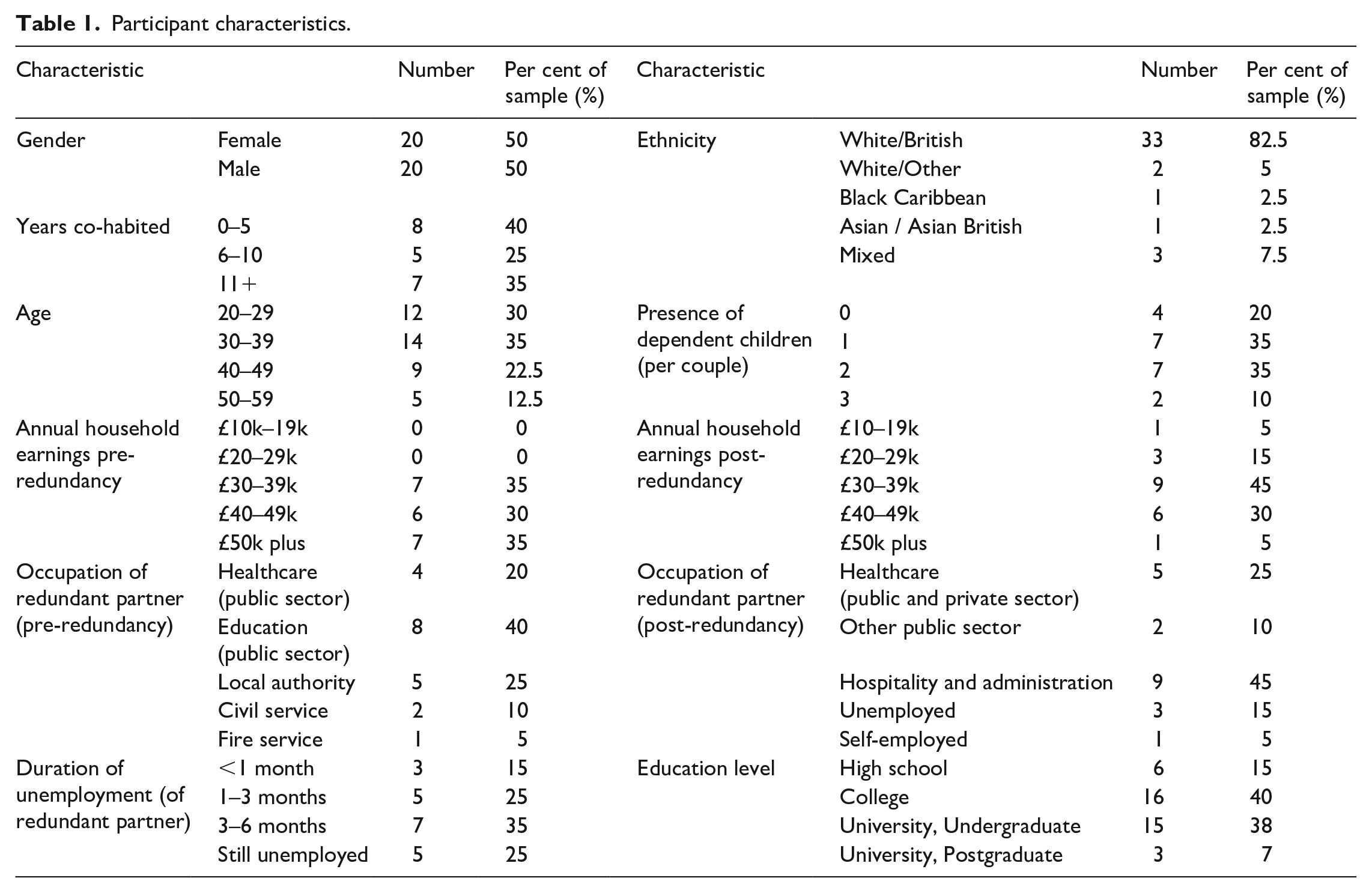
The following criteria were set for inclusion in the sample. Couples were required to have been cohabiting for a minimum of two years (an established DDOL) and both working full-time prior to one partner’s redundancy. Ten cases involved female redundancy, and 10 cases male redundancy, facilitating comparison of how negotiations might vary depending upon whether a female or male partner experienced job loss. Public sector occupations were identified as sites of traditionally secure, well-paid employment that had experienced significant restructuring at the time of data collection (April 2014 to October 2016). HR personnel with responsibility for overseeing redundancies acted as gatekeepers by disseminating information about the research to those serving redundancy notices. The sample was also boosted via snowball sampling – those initially recruited to the study identified other potential participants for the study. Pseudonyms have been used to ensure anonymity. However, participants were likely to be able to identify their partner through the couple-level analysis. This was discussed with couples and approved in all cases. Both sets of interviews were recorded and transcribed and then each individual had the option to review and revise their interview transcripts once completed. Table 1 provides an overview of the key characteristics of the participants.
Both sets of interviews consisted of open-ended questions such as, ‘As a couple, how do you allocate housework and childcare?’ (first interview) and ‘What factors have been the driving force in any change/lack of change to your household’s division of paid and unpaid labour in the past six months?’ (second interview). These questions were followed by probes informed by existing theory and research, for example, the extent to which time availability or relative earnings were perceived as influencing the DDOL. The second interviews were designed with open-ended questions focusing on the extent of change in the DDOL post-redundancy and how any changes evolved over the six months since the first interview.
Consistent with this design, the data were analysed utilising the phronetic iterative approach (Tracy, 2013). In this process, data analysis was developed iteratively, alternating between a consideration of emergent qualitative data (via the open-ended questions) and existing theories, concepts and research (aided by the probing questions). This enabled new insights to emerge from respondent accounts both relating, and in addition to, the findings of existing research as comparisons were drawn to those themes from the first interviews. Using the above example, emphasis on certain resources became more visible in the second interviews as justification for DDOL, and perceptions of fairness around these, as will be discussed in the findings.
Findings
Domestic Division of Labour Pre- and Post-Redundancy
In this section we provide data on changes in couples’ paid and unpaid work following redundancy, noting differences between female and male cases. We then interpret and explain both change and renegotiation in the DDOL using the qualitative interviews, drawing on theoretical perspectives and concepts critically evaluated in the literature review.
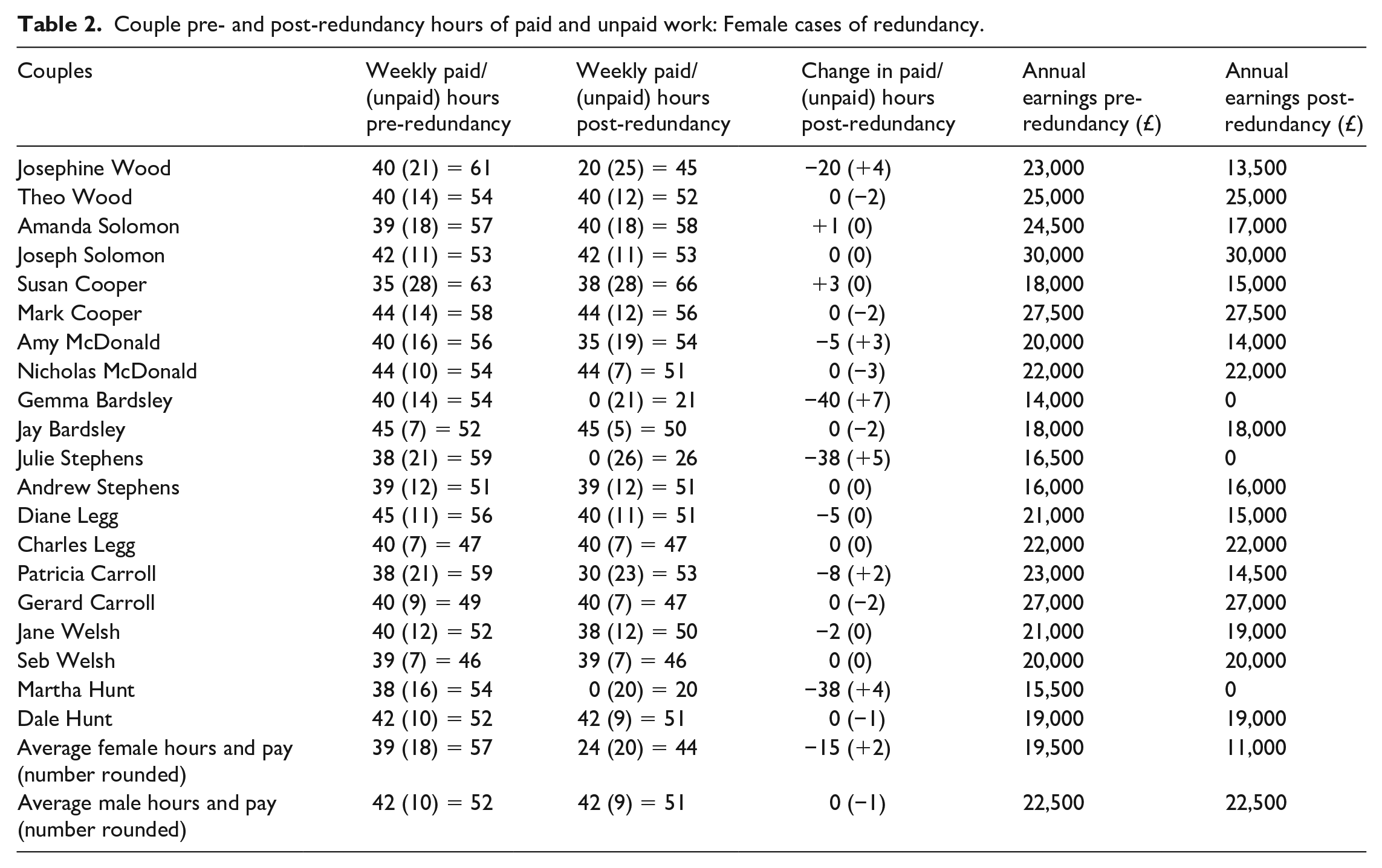
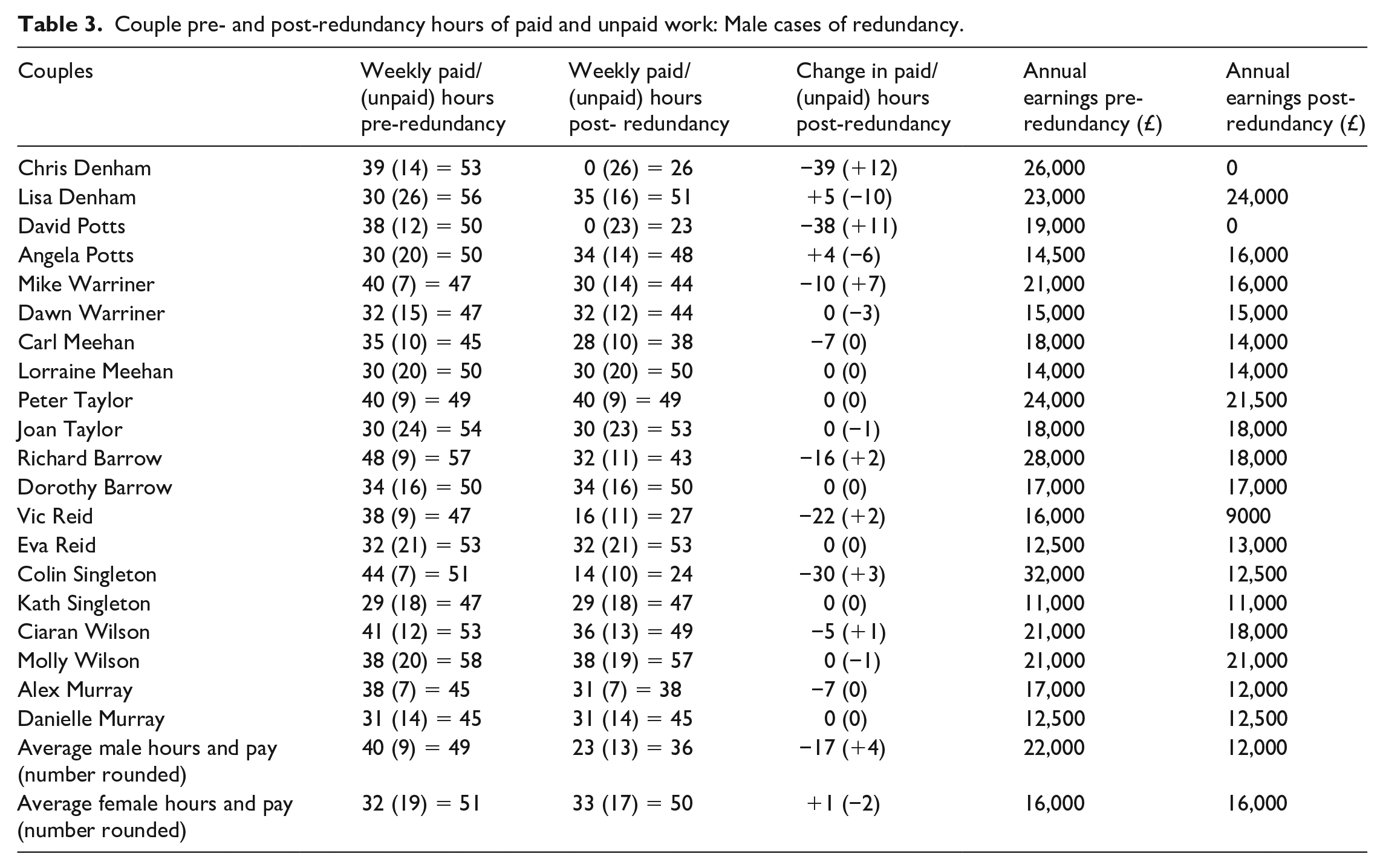
Data in Tables 2 and 3 demonstrate that a gendered DDOL exists among the 20 couples pre- and post-redundancy. Prior to redundancy, on a weekly basis, men worked on average five more paid hours than women: 41 hours compared with 36 hours. In contrast, women spent twice the amount of time on unpaid labour than men did: an average of 18.5 hours compared to 9.5 hours.
Couple pre- and post-redundancy hours of paid and unpaid work: Female cases of redundancy.
Couple pre- and post-redundancy hours of paid and unpaid work: Male cases of redundancy.
In eight out of 10 male cases and seven out of 10 female cases, the partner who experienced redundancy had found work by the second interview, but typically worked fewer paid hours than they did pre-redundancy. Six men returned to part-time work and two to full-time work, while two women returned to part-time work and five to full-time work (defined as 35+ hours per week). On average those made redundant increased their unpaid work by three to four hours per week. Table 2 illustrates an entrenchment of traditionally gendered DDOL in cases of female redundancy. The average time spent on unpaid labour among female partners increased from 18 hours per week to 20 hours per week, despite seven out of 10 women securing re-employment, five full-time.
Male redundancy led to more varied responses as indicated in Table 3. In four cases of male redundancy (Meehan, Reid, Singleton and Murray) men resumed work part-time and female partners either had significantly higher paid working hours and similar or higher pay, yet still spent between seven and 10 more hours per week on unpaid work than their male partners. These are particularly illuminating cases. There were no cases of men earning more money and doing more hours of housework than their female partner pre- or post-redundancy in this sample. These data point to evidence of a stalled revolution (England, 2010) as women appear to retain primary responsibility for a larger share of household work irrespective of who is made redundant. There were just two instances (Denham and Potts) where there was a pronounced renegotiation of roles – men who assumed primary childcare/household responsibilities following six months’ redundancy, and one case where responsibilities were equally shared (Warriner). How these varied responses unfolded will be the focus of the following sections.
Relative Resources and ‘Silent Bargains’
The analysis of the first set of interviews revealed that there was rarely extensive negotiation regarding the DDOL pre-redundancy, rather it was something that ‘worked itself out’ during early cohabitation. Couples spoke about falling into routines as opposed to prolonged discussion about task allocation: I don’t think there was too much to discuss really. Considering Richard had the opportunity to work overtime and the pay was really good for those hours it was a bit of a no brainer for us. Where I work there just isn’t the same opportunities and we needed the money, so the decision kind of took care of itself. (Dorothy Barrow; male redundancy, first interview) At some level there is a negotiation of sorts. Without him saying look, I have to work fairly long hours, the implication is obviously there and I feel that I need to take care of things at home. I’m not saying that he wants to work those hours or that I mind being at home, but in a somewhat unspoken way his working arrangement has dictated our situation. (Kath Singleton; male redundancy, first interview)
As these accounts illustrate, time availability and earning capacity were provided as justification for the DDOL prior to redundancy, typically without explicit verbal negotiation or bargaining. Furthermore, in both the first and second interviews (the latter mapping change, or lack thereof, post-redundancy) there were few instances of an adversarial bargaining dynamic, whereby the partner with the greatest relative resources uses their economic power/time scarcity to secure a better ‘deal’ for themselves, minimising unpaid work. Instead, the second interviews revealed that those with the fewest resources typically took the lead in any negotiation following the first interview, increasing their own contribution in lieu of earnings and time spent in paid employment. This was evident in all female cases of redundancy, and visible in three cases of male redundancy (Denham, Potts and Warriner) where a significant renegotiation of the DDOL took place: It makes perfect sense, when you think about it. Why and how could I not pick up more of the things we need to do at home, with the kids, and so on? I wasn’t working anymore, Lisa was, so I had time. (Chris Denham; male redundancy, second interview)
These accounts suggest that relative resources can take either an adversarial or more collaborative form. This is particularly apparent where relative resources encouraged a DDOL that was neither partner’s preference: Dale has never used his job to get out of the housework or looking after the children. If anything, he would rather work less hours and spend more time at home and I would too. So the current situation wouldn’t be either of our first choices. But his job brings more money into the house than mine does. (Martha Hunt; female redundancy, first interview)
‘Silent bargains’ (Strauss, 1978) is a useful concept for understanding how relative resources influence the DDOL in lieu of any extensive discussion, certainly in the establishment of a DDOL that becomes routine over time. Silent bargains offer a means through which partners undertaking less housework and childcare can maintain the status quo while minimising confrontation (characteristic of explicit bargaining). In contrast, those women who undertook a disproportionate share of unpaid work and felt frustrated by it, often sought to maintain harmony within their households by internally rationalising their situation, with reference to differences in either time availability or earning capacity. By doing so they were involved in silent bargaining: I don’t kick up much of a fuss because honestly, doing it myself gives me the peace of mind that things are actually done properly. He does earn more, and if I stopped then it would have a negative impact on the family. (Kath Singleton; male redundancy, first interview)
This is one illustration of how the notion of gendered moral rationalities (Duncan et al., 2003) influences the extent to which women actively pursued conflict or tactics to effect a renegotiation of the DDOL. Often the well-being of the family was referred to as of greater importance than achieving greater gender equality or fairness in the DDOL, both pre- and post-redundancy.
Rationalising Gendered Divisions of Labour
Relative resources were a key justification for the DDOL across the sample. Notably in the second set of interviews, respondents spoke about changes to the DDOL as redundancies impacted time availability: I’m now in a situation where I spend a lot of time at home. It makes sense that I do more because, quite simply, I can. It would be pretty unfair on Jay to come home to no dinner and an unclean house when he’s putting in a lot of hours. And how would I even justify that to him? (Gemma Bardsley; female redundancy, second interview) Gemma is doing a lot more around the house now that she’s working less. Including some of the jobs I used to do, because she’s got more time basically. If she’s spending a pretty significant part of the week at home then I guess it’s a way to use the time productively, whilst I’m out at work. (Jay Bardsley; female redundancy, second interview)
Undoubtedly, one’s availability to undertake childcare and housework is, in part, determined by the number and timing of paid working hours. However, the data in Tables 2 and 3 illustrate that time availability did not stimulate a significant renegotiation of the DDOL in seven cases of male redundancy, despite six men returning to part-time rather than full-time employment. Interestingly, neither Gemma nor Jay Bardsley above mention the importance of time required to seek new employment opportunities as a justification for Gemma not taking on more work in the home. Yet this was a primary justification in the case of male redundancies for lack of change in the DDOL. Change in the short term was deemed undesirable as job loss was perceived as temporary and couples appeared to prioritise job search in cases of male redundancy, more than in female cases.
Women who became the sole earner were often providing emotional and practical support to help redundant partners find work, as well as doing the mental work of organising household responsibilities: Being made redundant isn’t easy for anyone to cope with. The last thing I wanted to do whilst he came to terms with it was say oh by the way, the oven needs a good going over. Or the front garden needs de-weeding. So when I got in from work I would do my best to take the onus off him. (Molly Wilson; male redundancy, second interview) If you begin saying things like now you’re out of work you can be in charge of certain things, it almost gives off a greater permanency, because you’d be less likely to start reorganising how everything’s done if you expect to be back in work quickly. So no, I tried to keep things normal. (Kath Singleton; male redundancy, second interview)
There was little direct reference to gender roles in interview accounts, yet female and male responses to their partner’s redundancy were markedly different. Men rarely articulated the importance of emotional and practical support in the way female partners did. For example, in a number of cases, women attempted to maintain and even increase their (already high) contribution towards unpaid labour to afford their redundant partners more time to job search and secure re-employment. These female participants appeared to draw on ‘moral’ rationalities (Duncan et al., 2003) as well as factoring in time and finances in decision making. They emphasised the importance of relational commitments towards their children and partners’ emotional well-being, more so than male participants.
Explicit and Implicit Power in the DDOL
There was also evidence that many decisions that couples framed as being ‘joint’ were sometimes the result of implicit power struggles conducted through silent bargaining. Men were demonstrably more selective about the relative resources used to justify a gendered DDOL, which benefited them both pre-redundancy and in the time that elapsed between the interviews. For example, Colin Singleton’s paid work hours were reduced to half the amount his partner did following his redundancy, so he specifically referenced his higher earnings as a justification for doing much less housework and caring. In contrast, during the first interview Andrew Stephens spoke about having more paid work hours than his partner, rather than earnings, as his annual salary was less than hers. Most of the men appeared to be instrumental and individualistic in applying criteria to explain an unequal DDOL when it suited them, while women tended more to refer to what might benefit (or harm) the family or household unit. This placed women in a position where they were more likely to agree an outcome that did not benefit them and/or one that increased their share of unpaid work.
Over the six months between interviews, data revealed that power dynamics evolved, in terms of a willingness to accommodate or resist change. Effecting change that requires both parties to agree upon a course of action is arguably more difficult than inaction and/or a refusal to change. There was evidence of resistance to change in cases of male redundancy by the second interviews, but also female redundancy, notably where female partners returned to work full-time but retained an increased share of household work. Avoiding or refusing renegotiation was unique to male participants in the sample, who personally benefited from a lack of equity. Responsibility was placed onto the partner with a grievance to effect change: It would be pretty dishonest to say that I was completely unaware that we do not exactly split things equally. I guess it’s been easy for me to just allow that to continue. If I was unhappy with something, where I felt I did more than someone else, for example someone on my team at work, then I would probably say something, yeah. (Alex Murray; male redundancy, first interview)
Partners with the responsibility to effect change who had comparatively fewer resources to draw upon and therefore less negotiating power, often anticipated a negative response and chose to avoid conflict: ‘Truthfully, getting him to do chores can be a chore in of itself. By the time he’s finished ranting about how much he “hates” cleaning, it’s quicker to just have done it myself’ (Patricia Carroll; female redundancy, second interview). Displays of power were more visible in cases of tension, which varied from very slight to strongly adversarial confrontations across several couples. Tensions arose most commonly in cases where female partners voiced frustrations at an unequal DDOL by the second interviews. Despite engaging in significantly more unpaid labour prior to redundancy, the unsettling of long-established routines had stimulated a process of ‘unsilencing’ (Benjamin, 2003) and a catalyst for critical evaluation and attempts at renegotiation.
Negotiation and Tactics for Resisting Change in the DDOL
In the time that elapsed between interviews a recognition that the DDOL was neither fair nor desirable led to explicit forms of negotiation, alongside tactics to effect change – and to resist it. This was evident in four cases of male redundancy, where there was little change in the unequal DDOL: I supported him through the redundancy but it became pretty obvious that as well as working longer hours I was doing even more around the house, and it was disappointing to have to bring that up to him once he was settled in the new job [part-time] . . . it created an atmosphere at home that I think was unnecessary and really unfair. (Eva Reid; male redundancy, second interview)
In three cases of female redundancy, once new employment had been secured, re-adjustments in male partners’ contributions to unpaid household work were not forthcoming: As far as he’s concerned, he still works longer hours so I’m available and it’s my responsibility to do everything else. But if you add all what I do it dwarves what he does in total. So I’ve shouted, deliberately washed everyone’s clothes except his so that he had to do it himself, all sorts. There’s no doubt at all that he’s supportive of my employment, but for whatever reason this doesn’t translate across to the housework. (Susan Cooper; female redundancy, second interview)
Resistance from men varied across the sample. In both the Solomon and Wood households where tensions had been running high, as conversations led to arguments the men would use this as an opportunity to disengage: The minute she starts yelling and criticising you know that the conversation is basically done, it’s target practice and it’s a guilt trip. Actually it’s counter-productive because we both look to avoid confrontation for a while afterwards. (Joseph Solomon; female redundancy, second interview) I’m a right stickler for being spoken over. It effectively says ‘I’m more important than you so I’ll talk now, thanks.’ But I get so annoyed I find it impossible not to, and the result at times is he gets annoyed with me too . . . that then gives him an excuse to walk away from the conversation. (Josephine Wood; female redundancy, second interview)
General complaints about doing domestic tasks were more prevalent in the second interviews, compounding the inertia and assertions of incompetence that were a feature of the first interviews, where a number of men looked to resist changes to the DDOL. This reflects findings elsewhere (e.g. Deutsch, 1999; Fox, 2009), with proclamations including ‘I’m just not as good at cleaning the bathroom as she is’ (Gerard Carroll) and ‘I can’t meet her standards’ (Jay Bardsley), referring almost exclusively to routine, mundane cleaning and household tasks.
For the Reid, Wood and Solomon households, tensions had risen since the first interviews and the women in these couples demonstrated resistance too, for example, using oven-ready meals to insist on a partner’s contribution to preparing dinner: ‘At least he can’t use the fact that he isn’t Gordon Ramsey to get out of cooking . . . it clearly defines that cooking is a shared responsibility’ (Eva Reid; male redundancy, second interview). One female participant managed to avoid certain tasks by defining them as ‘men’s work’, to push back against an already large share of household work: Even though it is completely ridiculous, this idea that a man’s job is paying the bills, despite the fact we both earn . . . playing on it allowed me relief from those tasks and the mundane admin that goes with it, such as setting up direct debits, checking bank statements, etc. (Amy McDonald; female redundancy, second interview)
Across both sets of interviews most couples espoused egalitarian ideals and described themselves as operating in dual-career partnerships, keen to downplay the influence of traditional gender roles. Yet perhaps the most stark indication that couples ‘do’ gender, and were influenced by traditional gender roles, was regular references to men ‘helping’ with, rather than taking shared responsibility for, housework and childcare: If I ask him to take care of a few chores he will do it without any fuss. But he would see this as a one-off, as though he was doing me a favour. So eventually I said we could make this your thing, you know, it would help me out a bit. (Lorraine Meehan; male redundancy, second interview) It bothers me a lot that I’m left to do the majority of things around the house. I do ask for help, I’ll say can you do this, and even ask frequently where really he should take the hint and see that I want him to take ownership of that task. (Amanda Solomon; female redundancy, first interview)
Our findings support those of Miller (2011) that even practices that might constitute ‘undoing’ gender do not necessarily unsettle traditional gender roles, or are at least reconstructed in gendered terms, particularly in relation to parenting. For example, the two men who took on primary responsibility for childcare directly as a result of being made redundant, articulated their approaches to this role in typically masculine ways. Chris Denham made several references to being a ‘strong father figure’ and the perceived benefits his greater involvement offers to his children. Similarly, David Potts distinguished between the types of activities that the children undertook now that he was more involved, compared to their mother’s care: It’s quite funny, Angela was very much on hand to oversee things in the beginning. But I have developed my own way of doing things so actually play time, how homework gets done, what we have for dinner, quite a lot really, is very different depending on whether it’s me or mum in charge . . . so I’ve not just replaced her we actually do the parenting role very differently. (male redundancy, second interview)
The accounts of male respondents across both sets of interviews reveal that men ‘do’ gender, and masculinity in ways that were diverse and indicated more willingness in some cases to actively parent than actively share the responsibility for domestic work.
Conclusion
The primary aim of this article was to illuminate the process of negotiation in cases of both female and male redundancy, and to better understand how – and the extent to which – the DDOL is reorganised. This article responds to calls (e.g. Carlson and Hans, 2020; Livingston, 2014; Lyonette and Crompton, 2014) for in-depth qualitative research into how couples establish and negotiate the DDOL in dual-earner households. We do so through an innovative couple-level analysis, longitudinally, at a time of significant change and uncertainty in working lives. Data from the first interview acted as the benchmark of how the domestic division of labour had been arranged pre-redundancy, with the second interview enabling an insight into change from the point of redundancy onwards. Our key contention is that while existing theories and research help to explain why the DDOL becomes established, fewer studies focus on the process whereby couples actively maintain or attempt to initiate change in the DDOL.
This article confirms that women in dual-earner couples continue to undertake a disproportionate share of unpaid household labour. While this is unsurprising, what is distinctive and novel about our research is the degree of resilience of the DDOL, even in cases of male job loss, despite both partners espousing egalitarian ideals about dual-earning. Our research adds weight to the claim that the dual adult worker model is more ‘the new ought to be’ than the ‘new is’ (Duncan et al., 2003: 310).
The data and analysis demonstrate the centrality of time availability and earnings potential in decision making and justification for the DDOL. Despite assertions across the sample that traditional notions of gender-appropriate behaviour did not inform their DDOL, clear differences both pre-redundancy and in the responses to job loss, indicate that most couples ‘do’ gender to some degree. Notably, men were more instrumental in the way they approached and rationalised an unequal DDOL. Women tended to draw on a wider set of resources and reasoning – both economic and moral rationalities – to explain the DDOL pre- and post-redundancy and appeared, in this sample, to approach the issue of DDOL in a more collaborative way, articulating wider concerns for their own well-being as well as that of their children and partner.
Further, women were more reflexive about the importance of giving male partners time and space to adapt to redundancy, including time to job search. In no cases of female redundancy was the importance of this emotional and practical support, afforded to men, explicitly mentioned. This finding is unique and facilitated by a study designed to illuminate the DDOL in both male and female cases of redundancy. Across this sample, gender roles were undone in just two cases, when male unemployment became longer term.
Extending our contribution further, we did not find strong support for the conventional bargaining dynamic whereby the partner with the greatest relative resources determined the DDOL. Often the priority was not specialisation but maximising the potential for dual earnings over time, and this was best evidenced among couples where inequalities in the DDOL were less pronounced. Interviewee accounts also revealed that the DDOL is often not the product of prolonged, explicit negotiation. Instead, ‘silent bargains’ (Strauss, 1978) played a significant role in setting the tone for who does what work, and when. Silent bargains, alongside tactics such as inertia and ‘strategic incompetence’ were employed to not only resist changing the DDOL, but to avoid more overt (potentially confrontational) bargaining too.
Acknowledging the limitations of our sample, existing research demonstrates that decisions regarding the DDOL vary significantly across households, for example in terms of household income and class (e.g. Usdansky, 2011), household composition (e.g. Moilanen et al., 2019) and sexuality (Duncan et al., 2003). Examining the renegotiation process when household routines are disrupted, as in the case here of redundancy, across diverse household forms would provide a fruitful avenue for future research.
Footnotes
Funding
The authors received no financial support for the research, authorship and/or publication of this article.