




Abstract
This article examines whether and how globally mobile middle-class professional families engage in practices of nationalism through forging connections with a ‘home nation’ despite continuous relocations for work. Drawing on the concept of boundary objects which are used to facilitate frequent boundary crossings, we identify the promotion of language acquisition and cultural or national rituals and traditions as two central family practices that maintain strong connections to a form of national belonging despite being physically de-territorialised. We coin the term ‘mobile nationalism’ to make sense of the ways these globally mobile professional parents cultivate a sense of identity, coherence and the necessary resources for future mobility. We argue that these articulations of nationalism continue to be critical as we seek to understand subjecthood formation in the face of the imperatives of globalisation.
Introduction
There has been a broad appropriation of the theoretical existence of a distinctive social group – the global middle class 1 (GMC) (Ball, 2010) – within recent scholarship (Higginson et al., 2019; Maxwell and Yemini, 2019; Yemini and Maxwell, 2018). The GMC are positioned as a transnational ‘service class’, a group of global professionals who facilitate the functions of transnational corporations and are responsible for the middle management tiers. These professionals and their dependants are usually found in global cities around the world, where most multinational organisations are based (Ball and Nikita, 2014; Favell, 2011). This social group is constructed as individuals who are constantly ‘on the move’, regularly crossing nation state borders as they seek out new employment opportunities or are transferred between their employers’ global network of bases (Ball and Nikita, 2014). To date, the constitution of this group – as a fraction of the middle class – has only been theoretically developed rather than empirically substantiated (Yemini et al., 2019).
Our ongoing work (Maxwell and Yemini, 2019; Yemini and Maxwell, 2018; Yemini et al., 2019) seeks to examine the extent to which the GMC could be accurately described as a ‘well-formed class with its own distinct social identity’ (Lockwood, 1995: 3). One specific aspect that arguably distinguishes them as a group from their non-mobile middle-class peers is their continuous mobility for work (Beaverstock, 2005; Embong, 2000; Sassen, 2000). Linked to this characterisation of the GMC as hyper-mobile is that relations between ‘home’ and the ‘nation state’ might become blurred, thus these individuals (and their children) become global citizens – nomadic, disconnected, belonging to ‘the world’ (Koh and Wissink, 2018). In this contribution we seek to directly examine whether and how participants, who are arguably members of the GMC and parents to school-aged children, relate to the notion of a ‘home nation’, or whether, as the theory suggests, relations to nation have become blurred or non-existent.
Of course, this question of relations to ‘home’ becoming unstuck or re-negotiated through mobility is not only a feature of this particular social group. Another group who have perhaps even more freedom to be mobile are the so-called transnational elites or transnational capitalist class (Sklair, 2000). A third group would be those for whom mobility is often more of a necessity or even forced – migrant workers, refugees and victims of human trafficking for instance. Furthermore, often migrant workers are unable to bring their dependants with them, causing disruptions to forms of parenting (Paul, 2011). Whether mobility is forced or chosen, relations to an identifiable ‘home nation’ is an interesting focus for enquiry across all the three groups; however, in this article, our analysis aims to directly contribute to empirically substantiating or challenging one of the centrally argued characteristics that constitute the GMC – whether or not they become state-less nomads. We do this by investigating their relations to a ‘home nation’ and how these are fostered through their parenting practices. We specifically seek to understand the purposes of such practices employing the concept of ‘mobile nationalism’ and conclude by considering their effects in distinguishing this group from others and how this might affect broader relations of sociability.
In our study, we interviewed globally mobile professionals about their transnational trajectories, sense of identities and parenting practices. We focus on how these participants articulate their identity and how they seek to pass on a sense of belonging to their children while simultaneously shoring up their education, and cultivating the necessary resources understood as critical for ensuring future success as well as the potential for future geographical mobility. Our research is therefore situated at the nexus of various fields of study – middle-class parenting strategies, questions of belonging within a cosmopolitan sociology and discussions of nationalism.
Relevant scholarship within work on education and middle-class parenting highlights a relatively similar commitment to concerted and concerned cultivation strategies across many different parts of the world (Lareau, 2003; Reay et al., 2011; Stefansen and Aarseth, 2011; Van Zanten, 2016; Vincent et al., 2012). Some of this research has also focused on when these strategies take on a transnational element, especially in relation to schooling choices (Gerhards et al., 2017; Waters, 2005, 2006; Weenink, 2008; Yemini and Maxwell, 2018). However, what is missing from the literature is an examination of families who are continuously moving, and a consideration of how education and broader cultivation strategies related to identity might be influenced by such mobility. This is specifically where our work seeks to make a contribution.
We also position our work within Beck’s (2003) call to replace ‘methodological nationalism’ within the social sciences with a cosmopolitan sociology. From this standpoint, we do not take for granted the nation state as the key feature in constructing our theoretical reference point to define our sample, nor to analyse our data. Thus, we are not making any comparative claims across the different country data sets because our aim is not to distinguish between how transnational mobility is experienced by professionals from different national origins, but rather to explore the possibility that GMCs ‘do social class’ through parenting in particular ways, irrespective of their nationality of origin. To be clear, differences between national groups do exist. For example, the relevance of a second language was very different for nationals from English-speaking countries when compared to other groups. Yet, the analysis of nationalism in our study is embedded within a broader interest in understanding the intergenerational transmission of belonging among global professionals.
Within the lens of a cosmopolitan sociology, questions of where ‘to belong or not to belong’ (Beck, 2003: 454) are opened up due to increasing levels of global inter-connectiveness. Such claims of global inter-connectiveness, however, have their limits. Wendy Brown (2014) writes about how contemporary nation states are building walls and policing territorial boundaries in contrast to those arguments that suggest a porosity and fluidity of border-crossing. Thus, despite more universalist or at least regionalist (such as EU) political and cultural projects (Brubaker, 2009; Byrne, 2017; Skey, 2017), national sovereignty and articulations of nationalism sit alongside social imaginaries of cosmopolitanism and belonging anywhere and everywhere. It is within this complex set of spaces, with loosening and tightening national boundaries, that globally mobile professional families are manoeuvring and negotiating everyday practices of identity work alongside developing future imaginaries for themselves and their children. This blurred, complicated and at times seemingly contradictory social reality is the space our current research is seeking to make sense of. To this end, our article necessarily takes up the concept of nationalism, and examines it in relation to maintaining commitments to nationalism while outside the geographical boundaries of the nation state itself.
Theoretical Orientation: Mobile Nationalism
Nationalism is a contested term that lacks conceptual clarity. Clifford Geertz (1963: 107) referred to the ‘stultifying aura of conceptual ambiguity’ surrounding the subject of nationalism. Yet it is also precisely this conceptual ambiguity that has led to a flourishing of analysis on nationalism. Benedict Anderson (1983), Ernest Gellner (1983), Eric Hobsbawm (1990), Anthony Smith (1983), among many others, have made key contributions to developing our understandings of this term. Drawing on this body of seminal scholarship, Craig Calhoun (2007: 38) in Nations Matter synthesised four main themes within the literature. The first is ‘nationalism as a source or form of conflict’ while the second, third and fourth themes are respectively ‘nationalism as a source of political integration’, ‘nationalism as a reform and appropriation of ethnic inheritance’ and ‘nationalism as a new cultural creation’. While this plurality of definitions offers greater conceptual clarity to the term, we take heed of Calhoun’s (2007: 45) advice that ‘explanations of nationalism . . . need to address the contemporary conditions that make it effective in people’s lives, their attempts to orient themselves in the world, and their actions’. Indeed, the gathering pace of migration and mobility across geographical boundaries, and by people from across all social strata is a contemporary condition, thus the politics of identity and of belonging once again must be the focus of fresh areas of enquiry (e.g. Gomes, 2018; Pluss, 2018).
We note in the literature that practices of nationalism do not appear to have receded or diminished. Instead, scholars argue that nationalism has become an everyday practice, common and central to contemporary global politics and to liberal democratic states in particular (Billig, 1996; Kymlicka, 2001), practised not only by governments of nations but also by individuals. While nationalism and its practices are usually defined as taking place with distinct national boundaries, some scholars are beginning to challenge such top–down articulations of nationalism, emphasising the performative function of ‘everyday nationalism’ (Fox and Van Ginderachter, 2018). Drawing on ideas of nationalism and our data of globally mobile professionals’ experiences, we aim to add to this literature by proposing a new permutation of the practice of nationalism, which we call ‘mobile nationalism’ – a term which could also be used for examining the experiences of diasporic communities, lower-skilled migrants and members of the transnational elites.
The group we focus on in our work – globally mobile middle-class professionals and their families – suggests that engagements with nationalism come via a focus on how parents seek to maintain and facilitate connections between the past, present and future. We later show how parents are seeking some form of coherence and belonging while continuously ‘on the move’, as well as preparing their ‘mobile children’ for a successful future. We found that globally mobile families practise what we call ‘mobile nationalism’ referring to how parents consciously educate their children about belonging to a nation even while they are de-territorised from ‘home’ because of their mobile trajectories.
To better understand the practices of mobile nationalism we utilise Akkerman and Bakker’s (2011) notion of boundary objects that enable boundary crossings. Boundary crossings are understood as the transition from one space to another (Suchman, 1994), while boundary objects refer to artefacts that act as a bridge between spaces (Star, 1989). Another insight that we draw from Akkerman and Bakker (2011: 132) to develop our concept of ‘mobile nationalism’ is their formulation about identity (re)making: ‘what is part of me versus what is not (yet) part of me’. Parents are seeking to embed within their children ‘what is part of me’ (i.e. their nationality, their experiences of the Other, their management of being mobile), with a forward-looking focus on ‘what is not (yet) part of me’ (i.e. proficiency in English, confident adaptability in the face of mobility across borders, re-articulating national belonging as a resource in transnational spaces). Thus, ‘mobile nationalism’ is a family practice or parenting style mobile professionals employ to simultaneously facilitate future mobility with a strong sense of mooring and belonging to the nation.
Our study found that mobile nationalism is practised through deploying a number of boundary objects. First, there is a continual investment in activities that can usually be undertaken in whichever geographical location children are in (such as attending scouts, music lessons, continuing with the same type of curriculum, e.g. International Baccalaureate, etc.). This practice acts as an immediate form of mooring when families start their lives in a new place. These are also practices commonly associated with middle-class forms of concerted cultivation. Second, the mastery and proficiency of English acts as a boundary object facilitating movement across borders – enabling communication and collaboration – both in the present, but also the future. Third, developing a sense of national belonging allows the children to retain a thread that runs through their understandings and positioning of the self. What is particularly curious and fascinating about this third aspect is that the sense of national belonging is developed based on parents’ own experiences and nostalgic memories of ‘the home nation’, however unfamiliar or foreign these might be for their children (May, 2017). This is significant for our notion of ‘mobile nationalism’ – an expression of nationalism and sense of belonging to a nation some children have never lived in and may well never live in. Thus, the parenting practices narrated to us can be understood as parents cultivating a series of boundary objects that simultaneously facilitate their children’s adaptability and provide for a coherent sense of self, thereby allowing the children to successfully cross borders as the family continually relocate for the parents’ employment.
In what follows, we illustrate our concept of ‘mobile nationalism’ by drawing on our analysis of how parents are continuously re-creating a ‘sense of belonging from afar, that’s building on one’s belonging in the past’ (May, 2017: 402). Linking this to the call of the special issue to re-examine the sociological understanding of nationalism, we claim that globally mobile professional families could serve as an interesting analytical setting to examine the micro-practices of ‘mobile nationalism’, as they endeavour to cultivate a sense of ‘belonging as a personal, intimate feeling of being at home in a place’ (Antonsich, 2010: 645) that is not located within the nation state itself. As Knott (2017) suggests, globalisation may reinforce rather than erode the nation state as the locus of belonging, thus reinforcing various forms of nationalism and their penetration into parenting strategies, especially for the constantly mobile.
Methodology
The data drawn on to inform this article emerge from a collaborative project, funded by the British Association of Comparative Education, comprised of scholars from Denmark, Hong Kong, the USA, Israel and Argentina. We used a snowballing sampling strategy to talk to globally mobile professionals based in various corners of the world (Hong Kong, Buenos Aires, Tel Aviv, London), utilising personal connections, approaching human resources departments in multinational firms and university alumni association to seek out relevant contacts. We also approached specific schools where many mobile families sent their children. Conscious of the possible biases of a snowball sampling strategy, we interviewed no more than two families secured through each lead (as suggested by Huang and Yeoh (2005) in their study of Chinese ‘study mothers’ in Singapore). In this article we focus on the data generated with 18 families, which all authors helped to collect.
This article is part of a larger study of parental practices of professionals who work within a global space (meaning they are currently mobile for work, have a history of moving internationally to take up a new position or work in a multinational company with offices and partners based all over the world who they directly work with). The larger study (led by three of the co-authors) has involved over 100 interviews with parents with school-age children. Thus, the main themes emerging from our collaborative analysis of the 18 families were cross-referenced to ensure these resonated with the findings of our larger data set. Most of the families in our larger study are of the Israeli origin, so this new data set aims to increase the diversity of the narratives collected in terms of countries of origin and mobility paths. The study is not a comparative one, in the first instance, but an attempt to increase the diversity of our empirical base from which to examine the extent to which those fitting the category GMC might or might not practise similar orientations and practices concerning mobility, school choice, cultivation of identities and so forth. Our work is therefore seeking to use ongoing empirical work to develop theoretical concepts to extend this field of enquiry. Thus, in this article we do not set out to comparatively study how GMC families organised practices of ‘mobile nationalism’ and the education for their children, but to propose a set of conceptual tools to make sense of what we have found to date. Our ongoing work seeks to build a larger data set over time, necessary to undertake a more meaningful comparative analysis. However, we are methodologically aware that our data analysis must be sensitive to the different contexts of where the GMC originally came from and where they may eventually move to. This is where the various research positionalities of our team have been useful as we interrogated the data for contextual nuances. We drew on our own expertise as a multinational and differentially mobile research team to reflect on how origin and context might help explain any differences found. However, this article is specifically about a key common practice we identified across this sample of 18, and which resonated with the globally mobile families in our larger data set – the practice of mobile nationalism.
The study was based on a constructivist qualitative approach, whereby semi-structured, in-depth interviews were conducted and then inductively analysed (Bauer and Gaskell, 2000). The interviews followed an interview guide comprised of a number of different thematic areas: the research participants’ professional and personal biographies and mobility experiences (McGhee et al., 2012); their children’s education and schooling; home practices in relation to language, identity and cultural/religious habits; friendships and networks they belonged to; their broadly understood worldview; aspirations for their and their children’s futures. Due to our sampling approach (approaching members of the family who worked in a professional capacity), the data utilised in this article are mainly comprised of interviews with fathers. Where possible we interviewed mothers as well, given they are often understood as being responsible for the day-to-day parenting work (Ryan and Mulholland, 2014). In comparing the perspectives offered by the fathers and mothers, we have not found significant differences in their narratives, therefore the data shared here are justifiably drawn heavily on the interviews with fathers across the four locations.
The selection criteria for ‘globally mobile professionals’ used in our broader study required that participants: hold a minimum undergraduate degree; work for a multinational corporation; have relocated with their family for work at least twice; and have school-age children. Alongside these specific criteria of the group of globally mobile professionals, we interviewed participants from industries ranging from IT, banking and finance sectors, global consultancies firms and technopreneurers. Given the location of the research team, and a concerted focus on recruiting from a range of global cities, our participants are of different nationalities, ethnicities and religions.
The recruitment of a diverse group of participants located in the various cities the authors are based in was done purposively to examine themes that appeared relevant to a range of potential participants who arguably fit the category of GMC (see Appendix 1 for the list of participants). This approach was intended to enable the development of a set of conceptual tools which could be further refined and extended during a future phase of our research – which aims to empirically substantiate or challenge the idea of globally mobile professionals as a distinct fraction of the middle classes.
The semi-structured interviews (as per Johnson and Christensen, 2014) were conducted by the authors in person or via video link mainly in English, but also in Spanish and Hebrew (based on the informants’ preferences). The interviews lasted between one and two hours, were recorded and then transcribed verbatim immediately following the data collection. Interview transcripts were translated to English (from Spanish and Hebrew) when required, by bilingual speakers, so all members of the team could read them. Quotes drawn on in this article were translated into English as per the above process, but then re-checked with the original language recording in order to avoid errors in the translation process (Clandinin, 2006). We took advantage of the relatively large team of differently located researchers – in terms of academic seniority, education, own experiences of mobility, parenting and so on – to ensure we were continually reflecting on how our own positionalities and research backgrounds might be shaping our analyses, via regular face-to-face and Skype meetings.
After the data collection and initial thematic analysis stages (following an open coding and then focused coding approach), we generated theoretical explanations for the social phenomena derived from the interviews, using the constructivist grounded theory approach (Thornberg and Charmaz, 2014) – an approach particularly well suited to a topic on which there has been relatively little research to date. More specifically, initially one member of the research team undertook an inductive analysis of the entire data corpus, using a constant comparative approach. Following this, all members of the team commented on the outcomes of this initial analysis and a new set of codes were applied to the data in a second round of initial thematic analysis. The codes included ‘school choice in a new setting’; ‘keeping in touch with families’; ‘motivations for mobility’; ‘returning home’; and ‘children’s futures’. This process confirmed our previous research findings (Yemini and Maxwell, 2018) about the criticality of the ‘home’/‘nation’ as a resource for identity construction for all participants. Given this, we returned to the literature in order to develop an appropriate theoretical framework to support a re-analysis of the data focusing in on this question more closely. Thus, the third distinct stage of analysis was a theoretically informed deductive analysis. The codes we applied were refined to focus on the kinds of boundary objects parents drew on to facilitate frequent mobility; parental attempts to create links between their home nation(s) and their children; and their articulations of how boundary crossing processes are experienced and the implications these have for parenting practices.
Boundary objects can be conceived of as resources which are thought to facilitate boundary crossing – a practice these mobile families intend to continue following as they move for work and to extend their children’s future opportunities. We identified two main boundary objects in our data, that were common across all participants: (1) languages; and (2) the celebration of relevant national and/or cultural traditions which are proactively embedded in the nuclear family routines. These two practices, when compared to our larger data set, appear common and distinctive to globally mobile professional families as opposed to more locally moored middle-class/professional families. Furthermore, these two types of boundary objects are directly related to practices of nationalism, the focus of this article. In what follows, we examine how mobility does not dismantle territorially bound identities. Instead, expressions of (mobile) nationalism persist and ‘mobile parents’ consciously aim to connect their children to the idea of a nation.
‘Mobile Nationalism’: Languages as Boundary Objects
A critical boundary object frequently discussed by parents in our study was the importance of languages, as a resource for the present and future. On the one hand, English (and in some cases Mandarin) was held up as vital for the navigation of future spaces and opportunities (in schooling, for work, to adapt to new places of residence). On the other hand, all parents emphasised the necessity of sustaining their children’s fluency in their native/home nation(s) languages. This was understood as critical to first, preserve a sense of national identity and belonging, but also second, to keep open the possibilities for a child to return ‘home’ at some point in their future (to permanently reside there, or undertake higher education there, complete compulsory military service and so forth). Thus, parents insisted on children cultivating fluency in a global language and a ‘home’ language. The latter would likely be much less of a concern for parents living in their home nation, where fluency in a national or native language might be expected and facilitated by the local environment outside the family.
An Israeli father, currently having been relocated back to Israel by his company, explained: ‘In the US we insisted on speaking Hebrew (at home) because they received a lot of English from the surroundings. Here we speak more English because we want them to preserve, to maintain their English.’ This father described how he and his wife strategically use everyday communication to sustain fluency in both English and Hebrew, which varies depending on where they live. Thus, language acts as a boundary object, facilitating adaption to a new location, being prepared for future mobility as adults, but also a resource to ensure children can communicate with family and friends.
The same rationale was found in an Argentine family, where the family had also temporarily relocated to Argentina for the father’s work. This quote comes from a longer discussion about how the parents had chosen the school in which to enrol their children upon their return ‘home’: I think it is a school that is quite advanced and that I appreciate. For example, the English level is good, it is a bilingual school and I think that is a necessary requirement today, for any company. A lot of sources are in English, so proficiency in English is the first point on my list [for choosing a school].
Here the father claims that proficiency in English is a critical skill for future employment on a transnational stage (King and Fogle, 2006; Weenink, 2008), emphasising this as ‘the first point on my list’. Nevertheless, when discussing the choice between an international school and a bilingual school, this family, who had lived abroad for many years, had decided to opt for a school which would enable them to preserve their children’s fluency in Spanish (their mother tongue) alongside a continued focus on English.
Some parents felt that the need to cultivate language skills was a critical boundary object to facilitate future family relocations for work, and prioritised these concerns over their own resistance to the dominance of English as a global language: If we continue to go on the road, even if we pick say a Singapore system while we are in Hong Kong, the next place we go to might not have that choice. This is the kind of soft power I feel that US and UK can have. So, for example, I let my child to be in the Singapore system and she studies for a few years and then we go to Nigeria, say. We go there and there is a British School and there is a US school and there is a French school there but there is no Singapore school there. So, we then break the system. I mean it’s already kind of traumatic enough that you have to change your friends, new environment and then what you study is then potentially mismatched or was displaced. (Singaporean father, currently living in Hong Kong)
While positioning English as a boundary object for the present and future, all our families also emphasised the importance of their ‘mother tongue’– this time as a resource to maintain a sense of who they were and where they belonged, despite continuous boundary crossings. It is through the participants’ discussions of promoting fluency in their mother tongue that we gain insights into the embodiments and forms of nationalism promoted by this group of participants. In the interview excerpt below, a Singaporean father who moved his entire family to Hong Kong, including his own parents, shared with us how speaking ‘Singlish’ – a local hybridised version of English widely spoken in Singapore and by Singaporeans – allowed him and his children to remain very Singaporean despite the main language in Hong Kong being Cantonese:
One final question. For parents who relocate for work, what advice would you give them, for them to prepare themselves and also their kids for the change, the mobility and all that? What kind of advice would you give?
This is a little bit tough. May I be a bit broader than that? I think the first thing is to re-understand your own background. I am Singaporean and I still speak Singlish fluently. That hasn’t changed at all. I have only picked up new languages and new ways to interact with other people but I haven’t lost any of the Singaporean identity. I think my children, through me, have also picked up on that to a certain extent, you know, the way we say certain things, the words, etc. Because me and my wife tend to speak Singlish at home, that we are most comfortable with. We don’t insist that we should speak proper English. So, that clearly has an effect on my children. (Singaporean father, currently in Hong Kong)
By straddling the need to develop a proficiency in at least two languages, these families are creating third-culture spaces of belonging (Bhabha, 1990) – being able to navigate life wherever they move to, while simultaneously retaining a strong sense of who they are and where they come from – most strongly articulated by thinking and speaking in that language. We suggest that this practice can be conceptualised as a form of ‘mobile nationalism’ – a practice that facilitates mobility without jeopardising a sense of belonging somewhere, to a particular nation.
‘Mobile Nationalism’: Rituals and Practices
Despite languages being a core part of identity, oftentimes colonialism and histories of diasporic movements mean that language does not neatly underscore cultural, ethnic or national belonging. For this reason, the family practices our participants narrated for us did more than cultivate fluency in a native language. More specifically they sought to celebrate and embed particular national and/or cultural traditions into family life as a way of remaining connected to a home nation. This boundary object actually had the dual function of facilitating ‘mobile nationalism’ while also sustaining a close, connected set of family practices, which on their own also helped anchor the parents and children against the ravages of constant mobility on a sense of belonging. The distinction is articulately expressed by another Singaporean father currently based in Hong Kong: I do think it is important to keep two things. One is the cultural identity which is being Chinese and I find it very adaptable. Sometimes it is quite annoying because people say, ‘you’re from China’. No, we’re not. And Chinese people will say, ‘you’re not Chinese’. I am not from China but I’m Chinese. I think it’s important to at least have the base. Just accept where we come from. I find it quite rich to know the history and culture, the Chinese culture, as much as we can. Even if it is diluted, we keep to it. And the other one as I said before it’s the family traditions. So we do certain things always together. There’s no excuse, right? Having a religious reason is great because it creates some cultural identity.
Equally, a mother (originally from Israel, but currently living in Canada) explained:
What aspects of your life were important for you to preserve?
Judaism, holidays, language. I told you at home there is no language other than Hebrew. Unless their girlfriends come and then I can’t say anything to them but when we’re alone or when we are with our (Israeli) friends we speak Hebrew. And they know it.
Sounds like you’re not planning to return to Israel, so why is it so important to you?
. . . Yes. Hebrew is important to me, because of Judaism. We are registered here at a synagogue, yet we are not religious. My husband goes to the synagogue to show them. To teach them that’s what Jews do. We celebrate Yom Kippur even though we do not fast.
Thus, cultural or religious traditions connected to national belonging are practised to embed a sense of ‘what is part of me’ (Akkerman and Bakker, 2011: 132): Here [in Israel] we have all the family to celebrate the holidays. We still tried to give the holidays some meaning there [in the USA], but it’s harder there. Like Yom Kippur, it’s a regular working day there so it is much harder to mention it [and celebrate it]. So you need to make a bigger effort in your [own] home to give a meaning to [these special events outside Israel]. (Israeli father, currently residing in Israel)
Meanwhile, another family used the ‘excuse’ of Chinese New Year to ensure they returned to their home nation annually, as a minimum – ‘We go to Singapore for Chinese New Year every year. So that’s one key thing that we do’ (second Singaporean father, currently residing in Hong Kong). Other families also made the regular ‘pilgrimage’ back ‘home’: And we always we always come back to France during the summertime or at Christmas time and I think from the beginning we wanted our children to keep this connection with France, yeah, and to have the roots in France so. (French father, currently in Mexico)
By acknowledging national and cultural events, by returning regularly to a ‘homeland’ many children had never lived in, and by seeking to be a family that saw itself as being of a particular nationality or cultural identity – the families we interviewed illustrated these consistent practices of ‘mobile nationalism’. We have conceived of these practices as boundary objects that stay the same – no matter what borders are being crossed and how frequently this occurs. These are the artefacts that remain central to anchoring the family and its members to a sense of themselves as having a past, present and future – ‘what is part of me’ (Akkerman and Bakker, 2011). Having a secure set of boundary objects that clearly substantiate a self or sense of identity (for their children), meant that parental cultivation of boundary objects (such as a proficiency in English, a strong sense of national identity) slowly moved from ‘what is not yet part of me’ to becoming inculcated into the sense of self and articulated identity of their children, as well as developing their capacity for navigating these third spaces of belonging. We suggest that such a framework governing practices of cultivation acts as a form of ‘mobile nationalism’.
As the following two Israeli participants, who at the time of being interviewed lived in two very different parts of the world, explained, mobility means you have to concertedly cultivate practices that are attuned to the past, present and future, that result in tangible advantages (global language for future employability for instance) and more intangible or affective forms of nourishment of the self. The following comment by an Israeli father demonstrates that such practices can contribute to a continuing strong sense of national belonging: I think only when you go, when you live abroad you realise it [thinking about belonging] is important. Because when you are here, they say ‘the US is for the money, Israel is for the soul’. Ok? but this is where I feel my roots are, this is where I feel my family is, my friends. I never saw myself. . . even after 10 years in the US I never saw myself as being an American. (Israeli father, currently residing in Israel)
The second participant emphasises how this necessity to feed the ‘soul’ continues, no matter where you are currently living or plan to live in the future. To meet this need, he turns to his home nation and seeks to replicate a sense of national and cultural identity no matter where they are based: I think when the kids get older they will go to the Israeli scouts here [in the USA] . . . I know it’s very popular [as currently their children are too young to join]. We have been in touch with the Israeli community, so that keeps us close also, closer to Hebrew and the Israeli culture . . . We teach them Hebrew . . . and when they learn Hebrew they [also] learn about the holidays and that made them a little bit more connected [to Israel]. (Israeli father, currently living in the USA)
Such questions of belonging were constantly interwoven into the narratives produced by the participants in our study, whether when rationalising their past choices or discussing their future plans. Efforts to further their children’s needs in this complex web of opportunities, decision making about where to live, what school to choose and so forth, as well as managing processes of change following mobility were continually juxtaposed with participants’ desire to preserve a sense of belonging. As explained by a British father, currently living in Hong Kong: We’re all white British. To put the box in the particular form. . . So in the last two years he [my eldest son] has been starting to have accidental questions about [being a] third culture kid and it all started on a holiday. Someone asked him ‘where are you from?’ and he said ‘Hong Kong’. ‘No you’re not! Where are you really from?’ the other child asked, and he [my son] said ‘well. . . Hong Kong’. And he couldn’t understand why he [the other child] didn’t believe him. And at that point we thought ‘what about that?’ [how do we ensure] . . . he feels belonging as it were?
Partly prompted by this experience, when his son was aged 10, and by concerns about elderly parents back in England, the family had decided, at the time of the interview, to move back to the UK temporarily to foster a sense of being ‘English’ for their sons. The father emphasised they would move again, but that they needed to move ‘back home’ for a period of time. Encouraging fluency in native languages, celebrating national and cultural traditions, returning ‘home’ regularly for holidays, or in this case (and in the case of many Israeli families we interviewed) relocating back to their home nation for a period of time, are all, we argue, practices of ‘mobile nationalism’. Such practices were found to be common across our sample of globally mobile professionals and their families.
Conclusion
This article sought to specifically examine whether a group of participants – globally mobile professionals – who constituted people from a range of national and cultural backgrounds and living in various parts of the world, could be argued to be connected by their nation-less existence and commitment to global citizenship. Our findings suggest that there are significant similarities in terms of this group’s desires to concertedly cultivate a sense of national belonging in their children (see also Maxwell and Yemini, 2019), through a commitment to proficiency in their own ‘native’ language, knowledge of and experiences of being in their home countries, as well as celebrating national or cultural events. Such a similarity in practices and outlooks across this group of globally mobile professionals could be part of an empirical substantiation that they are a ‘well-formed class’ (Lockwood, 1995: 3). But, critically, there does not appear to be empirical evidence to support the theoretical assertation that members of the GMC have blurred or non-existent relations to nation states. Having identified this significant divergence from the theoretical literature, our analysis attempted to make sense of this commitment to nationalism. We proposed that many of these globally mobile professionals practise a form of mobile nationalism – that seeks to facilitate continued mobility, all the while ensuring that children and parents maintain a sense of belonging and feel anchored to a ‘place’ – however imaginary it may be, given that often these families have not lived in their ‘home nation’ for many years.
We argue that the concept of ‘mobile nationalism’ allows us first, to understand the practices of these mobile professionals, who are arguably middle class in terms of education levels, professional employment status, parenting practices, but seeking to secure advantage and futures in yet to be determined and/or transnational spaces. Second, the concept of ‘mobile nationalism’ may also prove productive for studying the practices of members of the diaspora, who do not necessarily have the same ‘professional’ status, and for migrants who have fewer resources and are less able to move around freely. Third, practices of ‘mobile nationalism’ may be significant in shaping how others who encounter these globally mobile professionals in their work and personal lives come to understand and categorise people from these various countries (Singapore, Argentina, Israel, France, Germany – as examples from our current study) as these globally mobile professionals may be the only ‘French’, ‘British’, ‘Singaporean’, ‘Israeli’, ‘German’ nationals they meet and develop connections with. As such, these globally mobile professionals and their practices of mobile nationalism may contribute to shaping relations between various groups of people – ‘people like us’ and ‘people not like us’. Finally, we also suggest that understanding these articulations of ‘mobile nationalism’ will facilitate our continued research into whether or not, and how, globally mobile professionals are engaged in processes of class making – within a transnational space, but also within national spaces. We show how nationalism is operationalised in the lives of families detached from their nation states, and how ‘mobile nationalism’ is a concept that is able to talk about and develop deeper understandings of these peoples’ lives and aspirations. We therefore continue with Beck’s call for a cosmopolitan sociology by empirically examining how constant mobility can be simultaneously practised alongside belonging to a nation state.
Footnotes
Appendix
Informants and their background.
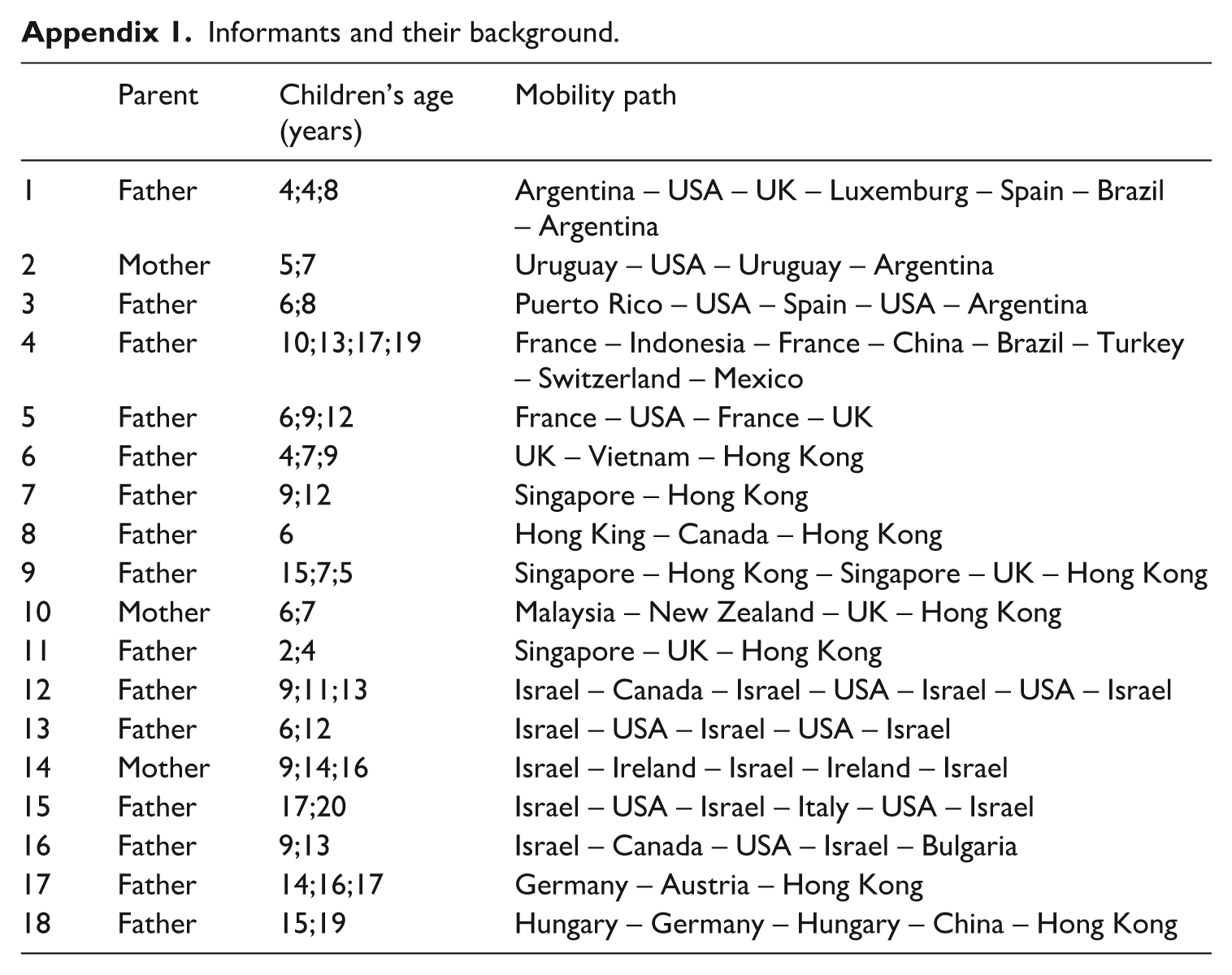
| Parent | Children’s age (years) | Mobility path | |
|---|---|---|---|
| 1 | Father | 4;4;8 | Argentina – USA – UK – Luxemburg – Spain – Brazil – Argentina |
| 2 | Mother | 5;7 | Uruguay – USA – Uruguay – Argentina |
| 3 | Father | 6;8 | Puerto Rico – USA – Spain – USA – Argentina |
| 4 | Father | 10;13;17;19 | France – Indonesia – France – China – Brazil – Turkey – Switzerland – Mexico |
| 5 | Father | 6;9;12 | France – USA – France – UK |
| 6 | Father | 4;7;9 | UK – Vietnam – Hong Kong |
| 7 | Father | 9;12 | Singapore – Hong Kong |
| 8 | Father | 6 | Hong King – Canada – Hong Kong |
| 9 | Father | 15;7;5 | Singapore – Hong Kong – Singapore – UK – Hong Kong |
| 10 | Mother | 6;7 | Malaysia – New Zealand – UK – Hong Kong |
| 11 | Father | 2;4 | Singapore – UK – Hong Kong |
| 12 | Father | 9;11;13 | Israel – Canada – Israel – USA – Israel – USA – Israel |
| 13 | Father | 6;12 | Israel – USA – Israel – USA – Israel |
| 14 | Mother | 9;14;16 | Israel – Ireland – Israel – Ireland – Israel |
| 15 | Father | 17;20 | Israel – USA – Israel – Italy – USA – Israel |
| 16 | Father | 9;13 | Israel – Canada – USA – Israel – Bulgaria |
| 17 | Father | 14;16;17 | Germany – Austria – Hong Kong |
| 18 | Father | 15;19 | Hungary – Germany – Hungary – China – Hong Kong |
Funding
The authors disclosed receipt of the following financial support for the research, authorship and/or publication of this article: this research was partially funded by the British Association for International & Comparative Education.
