




Abstract
In this article we demonstrate that those from working-class backgrounds face a powerful ‘class ceiling’ in elite occupations. Examining how class origin shapes economic returns in the Norwegian upper class (3.8% of the population), we first find that the income advantage enjoyed by those from privileged backgrounds increases sharply as they ascend the income distribution in both elite business and cultural fields. Second, we show that those from economically upper-class backgrounds enjoy the highest pay advantage in all upper-class destinations. Finally, we demonstrate the profound propulsive power provided by parental wealth. Our results indicate that this is the most important single driver of the class-origin income gap in virtually every area of the Norwegian upper class. These findings move forward an emerging literature on class-origin pay gaps beyond mean estimates to reveal the distinct ‘pay-off’ to class privilege in the very highest income-earning positions.
Introduction
Rising inequality since the 1980s – particularly at the very top of the income distribution – has prompted a strong renewal of interest in elites across the social sciences (Savage, 2014). Yet analysis of the class backgrounds of such affluent groups has largely been absent from this new research agenda. This represents a significant omission. Probing the social origins of top income earners not only sheds light on continuing processes of elite reproduction but may also help us understand why high-income earners continue to ‘pull away’ in many western contexts. After all, family wealth often provides individuals with distinct advantages in accumulating economic resources later in life (Hansen and Wiborg, 2019; Pfeffer and Killewald, 2018; Sherman, 2017). The social reproduction of high income also has theoretical significance. Where top income earners are disproportionately drawn from similar backgrounds they may be more likely to develop ‘a unity and cohesion of consciousness and action’ which, in turn, can have profound implications for the exercise of power (Scott, 2008: 35; see also Domhoff, 2005) and even the healthy functioning of democracies (Reis and Moore, 2005).
An allied body of literature has begun to touch on these questions through a focus on the ‘long shadow’ (Lareau, 2015) cast by class origins in the labour market. This work has shown that across a range of national contexts it pays to be privileged; even when those from working-class backgrounds are successful in entering professional and managerial occupations they go on to receive significantly lower incomes than their privileged colleagues (Hansen, 1996; Hällsten, 2013; Laurison and Friedman, 2016). This research has also gone some way in probing the mechanisms that explain this class-origin income gap, with some studies emphasising educational attainment (Hällsten, 2013) and others pointing to the ‘sorting’ of the socially mobile into lower-earning locations, firms, sectors, occupations and specialisms (Friedman and Laurison, 2019; Hansen, 2001b).
While innovative, we argue that this line of research has yet to reach its full potential. This is due to two key obstacles. First, class-origin pay gaps have thus far only been estimated at the mean of the income distribution, either in ‘big-class’ groups or within individual occupations. This means we know very little about how class origin matters at the very top of the class structure and, specifically, whether the upwardly mobile face a particularly steep income gap – what we call here a class ceiling – as they approach the top of the income distribution. Second, significant gaps remain in our understanding of why the privileged tend to receive higher incomes. Are some forms of privilege more profitable than others, and what resources that flow from an advantaged background go on to yield such distinct pay-offs?
In this article we argue that Norway represents an ideal context to explore these questions. This is partly down to the unique administrative registry data available; this allows us here, first, to pinpoint a very small Norwegian upper class and then show how economic rewards vary within this group according to both class background as well as more Bourdieusian ‘capital-specific’ modes of upper-class origin. Our findings demonstrate the value of this latter innovation. We find, for example, that it is specifically those from economic upper-class backgrounds that tend to enjoy the highest income advantage over colleagues from working-class backgrounds, in all segments of the dominant class. Moreover, we move beyond mean estimates to examine class-income gaps at every 5th quantile of the income and earnings distributions. This reveals distinct class ceiling effects; the pay-off to economically advantaged origins becomes more marked as people move up the income distribution, is most acute at the 95th quantile of the distribution and is evident in both cultural and economic fields.
Second, the unique coverage of the data also allows us to explore why economic privilege is so profitable, and particularly the centrality of parental wealth in understanding this relationship. And here we would further argue that Norway represents an intriguing case. While Scandinavia is often characterised in terms of its comparatively egalitarian wage equality, concentration of high-end wealth is very high and strongly reproduced intergenerationally, particularly at the top end of the distribution (Fochesato and Bowles, 2015; Hansen, 2014; Skopek et al., 2014). Indeed, our results indicate the profound propulsive power of parental wealth. Put simply, this is the most important single driver of the class-origin income gap in virtually every area of the top income-earning Norwegian upper class. In some ways this may appear unsurprising; parental wealth is clearly likely to stimulate economic returns where in-vivo gifts or inheritances are invested to generate capital gains (Hansen and Wiborg, 2019). However, our results suggest that parental wealth is often also an important driver of class-origin earnings gaps. Among those working in elite cultural occupations, parental wealth is the most significant mechanism explaining why the children of the economic upper class enjoy higher earnings than their upwardly mobile colleagues. This suggests that parental wealth may act more indirectly as a ‘bank of mum and dad’ that insulates the economically privileged from many of the uncertainties associated with forging a successful elite career.
Pinpointing the Class Ceiling
Sociological analyses of class mobility have consistently demonstrated the unequal opportunity chances that exist in modern capitalist societies. At the crux of this research tradition is a particular and fairly fixed approach to measurement – comparing the absolute and relative rates of mobility between a person’s class of origin (usually measured in terms of parental occupation) and their class of destination (measured in terms of own occupation) within a set of socio-economic classes.
Notwithstanding the centrality of this work, a growing body of literature has begun to highlight the limitations of this dominant approach (Friedman and Laurison, 2019; Hansen, 1996; Hällsten, 2013). In particular this research highlights how conventional approaches to mobility tend to underestimate the extent to which class origin continues to shape outcomes throughout the life course. Specifically, by limiting our understanding of class destinations to simply who enters occupations, standard analysis tends to miss the ‘long shadow’ that class origin casts over entire career trajectories. For example, a number of recent studies have demonstrated that even when those from working-class backgrounds are successful in entering a range of elite occupations, they go on to receive significantly lower incomes than their privileged colleagues. Such a class-origin pay gap has now been documented in a range of national contexts, including Britain, the USA, France, Norway, Sweden and Australia (Falcon and Bataille, 2018; Friedman and Laurison, 2019; Hansen, 2001b; Hällsten, 2013; Mastekaasa, 2011; Torche, 2011). While some studies attribute this inequality to fine-grained differences in educational attainment (Hällsten, 2013; Torche, 2018) other studies find that class pay gaps remain substantial even after adjusting for class-origin differences in education, demographics, work location, occupational sorting and supposedly ‘meritocratic’ measures of ‘human capital’ such as experience, training and hours worked (Falcon and Bataille, 2018; Friedman and Laurison, 2019; Hansen, 2001a, 2001b; Ljunggren, 2016). These studies not only demonstrate how standard approaches to mobility tend to obscure the stickiness of class origin but they also reveal a powerful and previously unobserved axis of inequality.
The existence of class-origin income gaps, however, may reflect at least two distinct processes. First, they may indicate, for example, that those from working-class backgrounds are earning less for doing the same work (that is, for doing jobs at the same level, same company and same department). Second, they may indicate patterns of workplace segregation, that is, those from working-class backgrounds may receive lower incomes because they are less likely to enter the most prestigious and lucrative specialisms or departments (horizontal segregation) or because they are less likely to reach the most senior or lucrative positions (vertical segregation). Such vertical segregation is often measured by looking at class-origin differences in average earnings. But it is important to consider that such segregation may also reflect income differences that exist beyond a person’s earnings (Hansen, 2001b: 210–211). For instance, chief executive officer (CEO) compensation often takes the form of dividend pay-outs, stock options and capital gains. 1 Similarly, many elite professionals, such as self-employed doctors or partners in large law, accountancy or professional service firms, receive significant self-employed or capital income in addition to, or instead of, earnings.
These two processes are also sociologically distinct. Unequal pay for equal work is significant in that it indicates clear-cut discrimination in the labour market, whether directly (e.g. class prejudice) or indirectly (e.g. inclination towards pay negotiation). Segregation or sorting, on the other hand, implies that the upwardly mobile face certain threshold or ‘class ceiling’ effects in their career progression. While of course this kind of ceiling effect also implies profound inequities in life chances, and possible class discrimination, it also has a wider theoretical significance. This is because when elites are drawn from narrow social origins, sociologists have long argued they are more likely to develop ‘a unity and cohesion of consciousness and action’ which, in turn, may have profound implications for the exercise of power (Scott, 2008: 35; see also Domhoff, 2005; Reeves et al., 2017).
Recent work suggests that underpinning class-origin pay gaps may well be class ceiling effects. Friedman and Laurison (2019), for example, draw on in-depth case studies of a large multinational accountancy firm and a national television broadcaster to argue that patterns of horizontal and particularly vertical segregation (by class background) are commonplace in elite occupations. Similarly, Toft (2019) shows that the socially mobile tend to have much less stable careers when they reach the highest rungs of the occupational hierarchy, arriving later than their privileged colleagues and being less likely to ‘stay up’. However, while these studies show us that class origin is implicated in the overall ‘slope and thrust’ (Bourdieu, 1984: 331) of elite careers, no study to date has looked beyond the mean of income distributions to see whether class ceiling effects exist among the most highly remunerated. Does the ‘long shadow’ of class origins wane when studying the most successful among the upwardly mobile, or is class origin actually a more forceful predictor in stratifying income at the very top of the income distribution?
In this article we tackle these questions head-on. And to do so we draw on uniquely rich data; administrative registry information on all Norwegian adults born after 1955. The granularity of this data allows for four distinct empirical innovations: first, we are able to identify an upper class normally indiscernible in sample survey data. This group comprises just 3.8 per cent of the Norwegian (adult) population but is still large enough (by pooling 16 birth cohorts we analyse N = 49,862) to conduct very detailed analysis. Second, we are able to draw on unusually rich measures of income that are not hampered by the validity issues associated with the self-reported information usually included in survey data. These include an individual’s officially registered (rather than self-reported) earnings, capital income and self-employed income. Third, we examine class-origin income gaps not just at the mean but also at every 5th quantile of the income distribution. This allows us to see definitively, and for the first time we know of, the importance of threshold mechanisms in stratifying privilege within the upper class. Fourth, and finally, we make use of data on wealth to go a step further to shed light on the role played by parental wealth in facilitating class-origin pay gaps.
The Specificity of Economic Privilege
We have explained the importance of adapting standard approaches to social mobility to better capture the fact that, even after occupational entry, class origins continue to stratify careers and economic returns. But to understand why this might be, we also need to unpack what class origin means and why it matters. Sensitising the notion of class to different types of power resources is key to this. Certain types of privilege, after all, may be more ‘profitable’ than others. While most work on class-origin income gaps tends to categorise people’s origins in large occupational classes, our own approach is more influenced by the Bourdieusian notion of a multidimensional social space. This is organised according to both the volume of capital held by individuals, as well as a capital composition principle differentiating their relative stocks of cultural and economic capital. Here we approach these two dimensions by proxy via occupations which are generally held to be ‘good and economical indicator[s] of position[s] in social space’ (Bourdieu, 1987: 4) and which can be differentiated in terms of their reliance on economic versus cultural capital.
Some work in Norway and the USA has demonstrated the importance of registering class origin in this capital-specific manner (e.g. Flemmen et al., 2017). Significantly, this work highlights the particular long-term advantages that flow from economically upper-class origins (Flemmen, 2009; Korom et al., 2017), even within cultural fields (Ljunggren, 2016).
But why might economically privileged origins be associated with such long-term pay-offs? The most powerful mechanism suggested in this literature is parental economic capital, and its ability – through direct intergenerational transfer – to enhance children’s life chances. This might be particularly crucial in the upper echelons of business, for example, as inherited wealth may facilitate direct entry into the economic elite (e.g. via the inheritance of a family business or by providing the funds to purchase a business) (Björklund et al., 2012; Hansen, 2014). Moreover, given that a large share of top incomes in business consist of capital income and dividend pay-outs, parental in-vivo ‘gifting’ or inheritance may directly facilitate investment incomes, or even help facilitate a dispositional inclination to engage with wealth management services that yield such incomes (Kuusela, 2018; Pfeffer and Killewald, 2018; Sherman, 2017).
Yet parental wealth may also play a more indirect role in scaffolding elite careers. An emerging literature, for example, has documented the ways in which family (parental and grandparental) wealth is increasingly used to directly purchase educational quality (via private tutors, private secondary schooling and university tuition fees), 2 which in turn acts to propel elite careers (Friedman and Laurison, 2019; Kynaston and Green, 2019).
Parental economic support may also be implicated in scaffolding particular work trajectories. For example, one key driver of the class ceiling effect pinpointed in Friedman and Laurison’s (2019) work is what they call ‘The Bank of Mum and Dad’. They argue that both the concrete provision of parental financial support, as well as the more abstract possibility or promise of its availability, is pivotal in propelling careers forward. This kind of safety-net, they show, often acts as an important early-career lubricant, allowing the privileged to negotiate internships, manoeuvre into more insecure but lucrative career tracks, invest time and resources into developing valuable networks, resist exploitative employment and take risky opportunities – all of which increases their chances of long-term success. Moreover, and chiming with the work of Ljunggren (2016), Friedman and Laurison (2019) find that the financial patronage provided by ‘The Bank of Mum and Dad’ is actually most powerful in cultural rather than economic elite occupations. In these labour markets, where early- and mid-career work is often freelance, short term, poorly paid, extremely competitive and concentrated in urban areas with very high living costs, a financial cushion provides a pivotal layer of insulation from chronic conditions of precarity and uncertainty.
Thus, parental wealth may generate labour market income premiums through the provision of a more diffuse safety-net that facilitates career progression with subsequent labour market returns, whether remunerated in the form of capital income, self-employed income or earnings. Yet, analysing parental wealth as a channel for class-origin income premiums potentially introduces some circularity to our estimates: rather than facilitating labour market advantages, we may simply pick up on the tendency of those from economically privileged backgrounds to receive financial gifts that then facilitate capital gains that are largely unrelated to any labour market activity – that is, via housing or other investments (Druta and Ronald, 2017; Hansen and Wiborg, 2019). In an attempt to disentangle these processes, our analysis therefore distinguishes between class-origin pay gaps based on a composite income measure and one that relies solely on earnings. 3
Fractional Divides in the Dominant Class
Before we explain the methodology we employ in our analysis, it is first important to elaborate on how we operationalise class origins and destinations in this article. We employ the Oslo Register Data Class scheme (ORDC) – visualised with example occupations in Figure 1. This allows us to identify not only a distinct upper class, but also to further differentiate cultural, balanced and economic fractions. 4
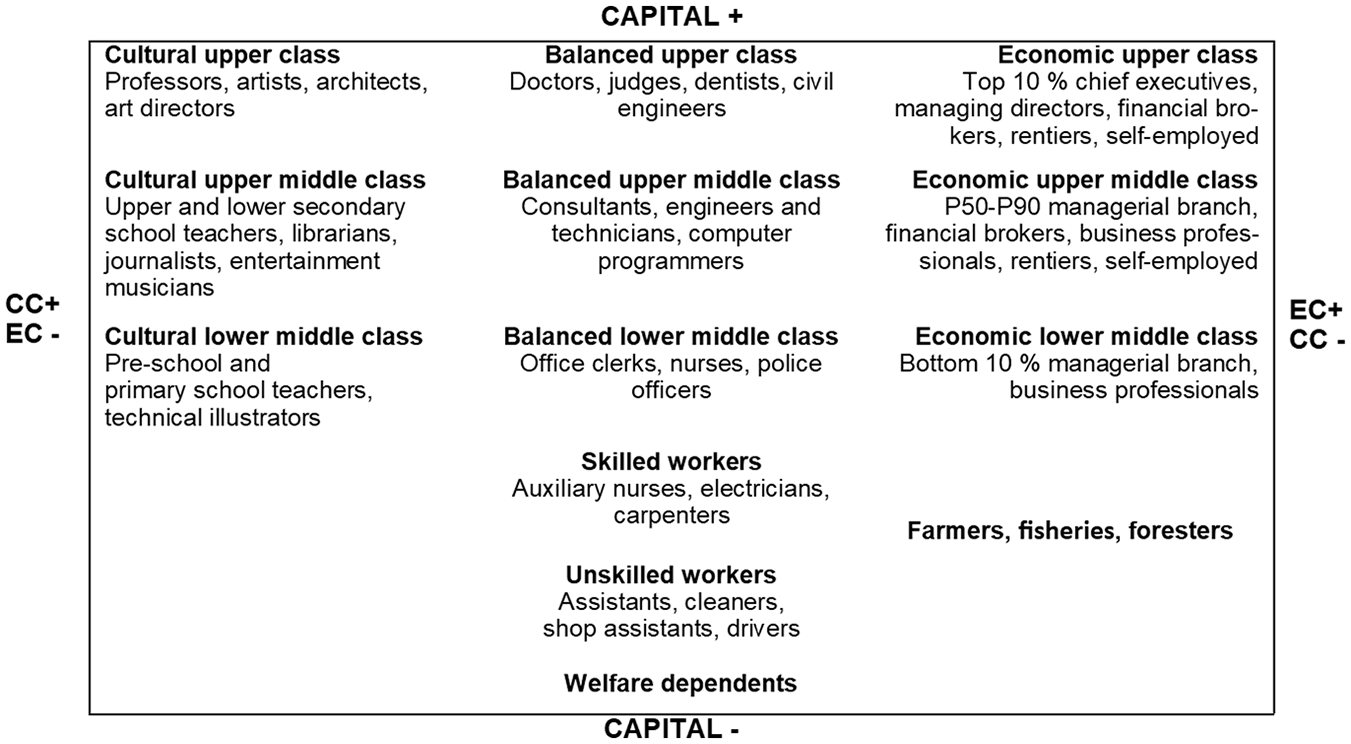
The Oslo Register Data Class (ORDC) scheme with example occupations.
The construction of the economic fraction of the upper class relies on a tripartite strategy; first, we identify employed managing directors, chief executives, financial brokers and business professionals through fine-graded occupational coding. Next, self-employed, proprietors and rentiers (SPRs) are identified by proxy by the type of income they receive; individuals that live off self-employed income and capital income, but are not occupationally active, 5 are identified as SPRs. Third, a capital volume principle is enforced to distinguish the class position of those in these two groups; specifically, the top 10 per cent of income holders (the total of capital income, earnings and self-employed income) are assigned to the economic upper class.
The cultural fraction of the upper class aims at capturing the dominant within different cultural fields. These positions are anticipated to hold considerable symbolic power over national cultural production, expression and representation. They include university professors, publishers, architects, artists and directors of large cultural institutions (see online Appendix B for a more detailed list of occupations).
A group that relies on a more balanced composition of capital – tending to hold high volumes of both cultural and economic capital – is also identified. In the ORDC scheme this includes elite professionals such as civil engineers, judges, lawyers and surgeons, as well as top-level bureaucrats, administrative officials and politicians.
Arguably, the ORDC class scheme, which is tailor-made for detailed registry data, has at least three advantages over the most often applied scheme in conventional class mobility research – the EGP (Erickson-Goldthorpe-Portocarero) class schema. First, it explicitly offers an operationalisation of the traditional emphasis on ‘property classes’ rather than class divisions that are derived solely from the division of labour, and second, it highlights intra-class divisions along a capital composition principle that separates the logic of cultural capital from that of economic capital. Finally, and most significantly for our analysis, it identifies a much more restricted group than the top-level service class of the EGP scheme. Thus, it allows us to pinpoint an upper class at the very top of the class structure. Here, we study the individuals with at least a three-year stable affiliation to each upper-class fraction. 6 This amounts to only 3.8 per cent of the adult population.
Data, Variables and Methodology
In order to zoom in on potential origin ‘effects’ on income at the high-end of the class structure, we exploit the richness of administrative registry data. These data encompass the whole Norwegian population starting from the 1955-birth cohorts and are compiled from a number of official registers such as registers on tax, education and employment. This provides an unprecedented opportunity to study elite or upper-class groups; first, they provide the granularity necessary to scrutinise groups normally too small to discern in sample survey data and, second, they rely on officially registered rather than self-reported data on variables like income. 7 We study economic rewards as the mean of the income received during the years 2010–2012 for the birth cohorts of 1955–1970.
We analyse two different dependent variables. Income attainment, is measured as the natural logarithm of the three-year average of the sum of earnings, capital income and self-employed income. Earnings is measured as the natural logarithm of the three-year average of occupational earnings. In the registers, both self-employed income and capital income may have negative values. We opt to treat negative values as missing in order to avoid underestimating the composite income measure. However, we have performed robustness checks that include the negative values in the summarised income measure. The results from this procedure revealed similar trends and patterns as that highlighted with the non-negative income measure.
The key explanatory variable, class origin, is conceptualised as in Figure 1 and is based on parental occupational information derived from the census in 1980, or 1970 if 1980 is missing or a higher-class position is observed in 1970. We therefore have information about class origins at ages 0–15 and 10–25 for the selected birth cohorts. The parent with the highest class position is selected and the economic fraction is selected if parents have the same class position but are situated in different fractions of the upper class. Having working-class origins (skilled or unskilled) is the selected reference category in the analyses. As seen in Table 1, about 20 per cent of the upper class originate in the skilled or unskilled working class.
Descriptive statistics for subpopulation under study.
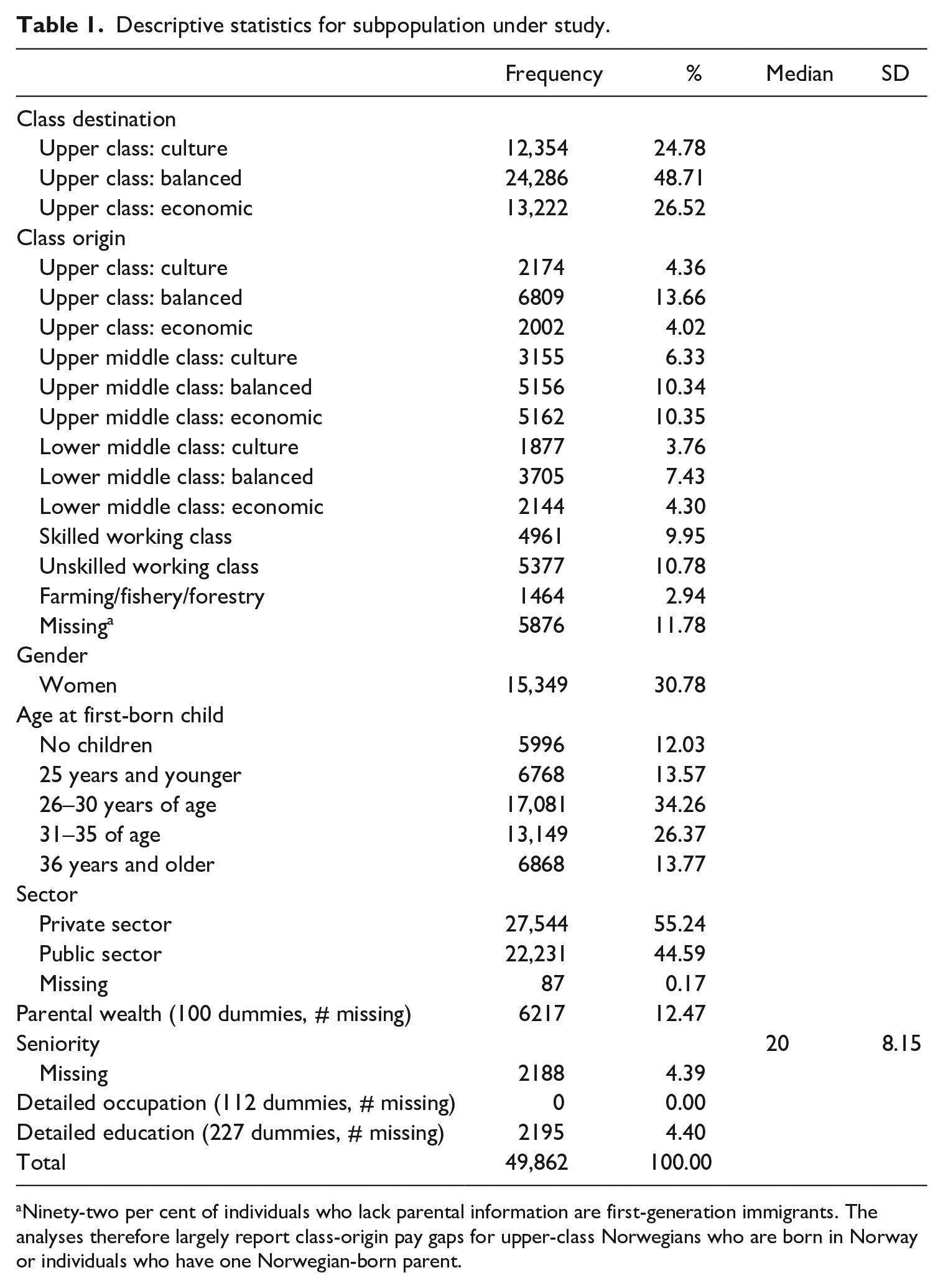
Ninety-two per cent of individuals who lack parental information are first-generation immigrants. The analyses therefore largely report class-origin pay gaps for upper-class Norwegians who are born in Norway or individuals who have one Norwegian-born parent.
Drawing on previous class-origin income gap research, we analyse five potential channels between parental class origin and adult income attainment. First, education has been shown to be an important driver of the income gap in a number of contexts, particularly fine-grained measures of attainment (Friedman and Laurison, 2019; Hällsten, 2013). We follow Hällsten’s (2013) lead in including very detailed measures of educational attainment, employing 227 combinations of detailed levels and fields of education.
Second, we analyse a person’s level of experience, or potential for labour market activity, which is measured as a quadratic term of the number of years since highest educational level was obtained. Third, we analyse various forms of workplace sorting; that is, that those from different class backgrounds filter into certain work sectors and specific occupations that then explain their different incomes. Public sector (versus private sector) is included as a dummy; occupation is measured via a detailed occupational coding. For instance, in the Norwegian classification scheme, a seven-digit code differentiates managing directors and chief executives according to the number of employees and industry affiliation. We differentiate 112 dummies for occupational positions.
Finally, we examine the impact of parental wealth. Wealth is notoriously difficult to assess, as it is systematically underreported in official registers. In these analyses, we make use of Hansen’s (2014) procedure for creating an adjusted measure of net wealth that approximates the market value of fixed assets by accounting inter alia for different value of real estate in geographical regions. The variable relies on the summarised level of mother’s and father’s fixed wealth and financial wealth subtracted from debts. We attempt to measure parental net wealth at similar ages for the subpopulation under study. For the birth cohorts 1959–1970, parental net wealth is the average at ages 34–36, whereas data availability restricts the ages for the older cohorts, ranging from ages 35–37 to 38–40. The variable is introduced as the percentile distribution of the total birth cohort. All models include demographic controls such as birth cohort, as well as an interaction term between gender and age at first-born child.
Two sets of models are employed. First, we implement ordinary least square regression (OLS). This allows us to analyse class-origin income gaps at the mean of the income distribution. In order to shed light on whether there are threshold mechanisms in the income and earnings distributions, and thus whether the mean estimate might underappreciate a comparative ‘pay-off’ of privileged origins, we make use of unconditional quantile regression (for non-technical introductions see e.g. Killewald and Bearak, 2014; Porter, 2015). In order to provide multivariate models that assess different channels of these relationships, as well as account for various demographic controls, we implement unconditional quantile regression. Here we make use of the recentred influence function (RIF) (Firpo et al., 2009).
Results
Economic Privilege and the Class-Income Gap
We begin our analysis by examining class-origin gaps at the mean of the income and earnings distributions in each of the three upper-class fractions. 8 Figure 2 shows the log point increase in income associated with upper-class origins, and then more specifically economic upper-class origins, when compared to individuals (in the same destination) from working-class origins. Significantly, this shows that class-origin income gaps and earnings gaps exist in all three fractions of the upper class.
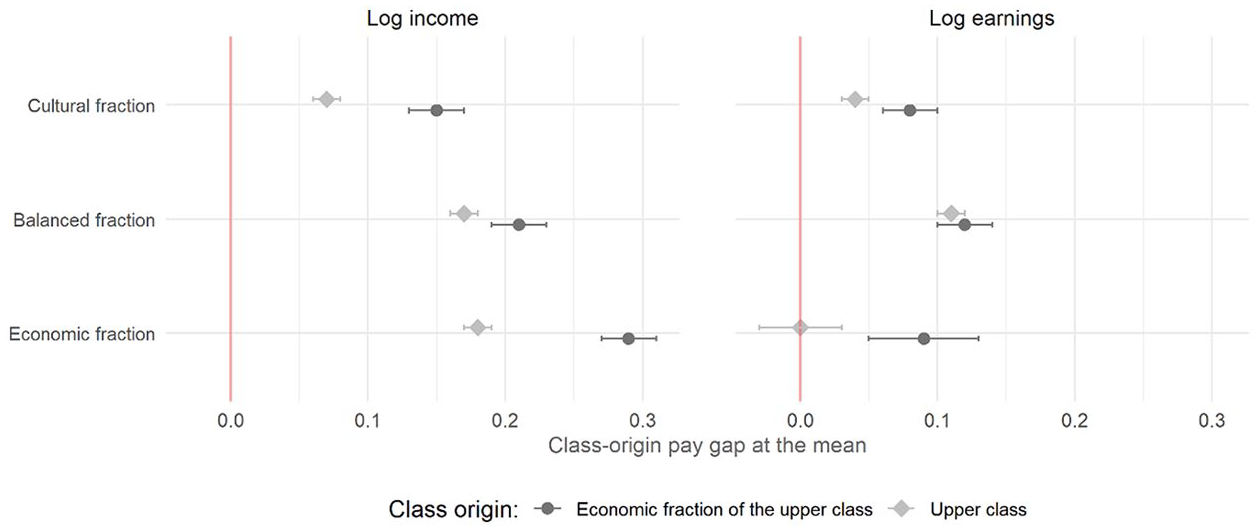
OLS estimates of class-origin income and earnings gaps in each upper-class fraction. Comparing origins in the upper class, broadly defined, to economic upper-class origins, acccounting for demographic controls. Working-class origins as baseline.
Yet Figure 2 also reveals that certain types of privilege are significantly more ‘profitable’ than others. In particular, hailing from the economic fraction of the upper class is clearly associated with the largest income advantage in all three fractions of the upper class. For example, within the economic fraction of the upper class, individuals hailing from an economic upper-class family receive an average income 34 per cent higher than individuals from working-class origins (log points of 0.29). Differentiating economic upper-class origins is also important for understanding earning gaps. Notably, we only find significant earnings advantages among the economically privileged.
These findings illustrate the importance of probing granular class origins in understanding class-origin income gaps. Specifically, our results here demonstrate that analysing class in a manner that elides the capital-specific dynamics of class origins, underestimates the distinct advantages transmitted intergenerationally within economically privileged families.
Locating the Class Ceiling
So far our analysis has only interrogated class-origin differences at the mean of the income distribution. But there is notable dispersal in income within the upper class. It may be that class origins play a more decisive role at the very tails of this distribution. In other words, income gaps may more accurately reflect a ‘class ceiling’; that is, those from working-class backgrounds may struggle to attain the very highest incomes or earnings.
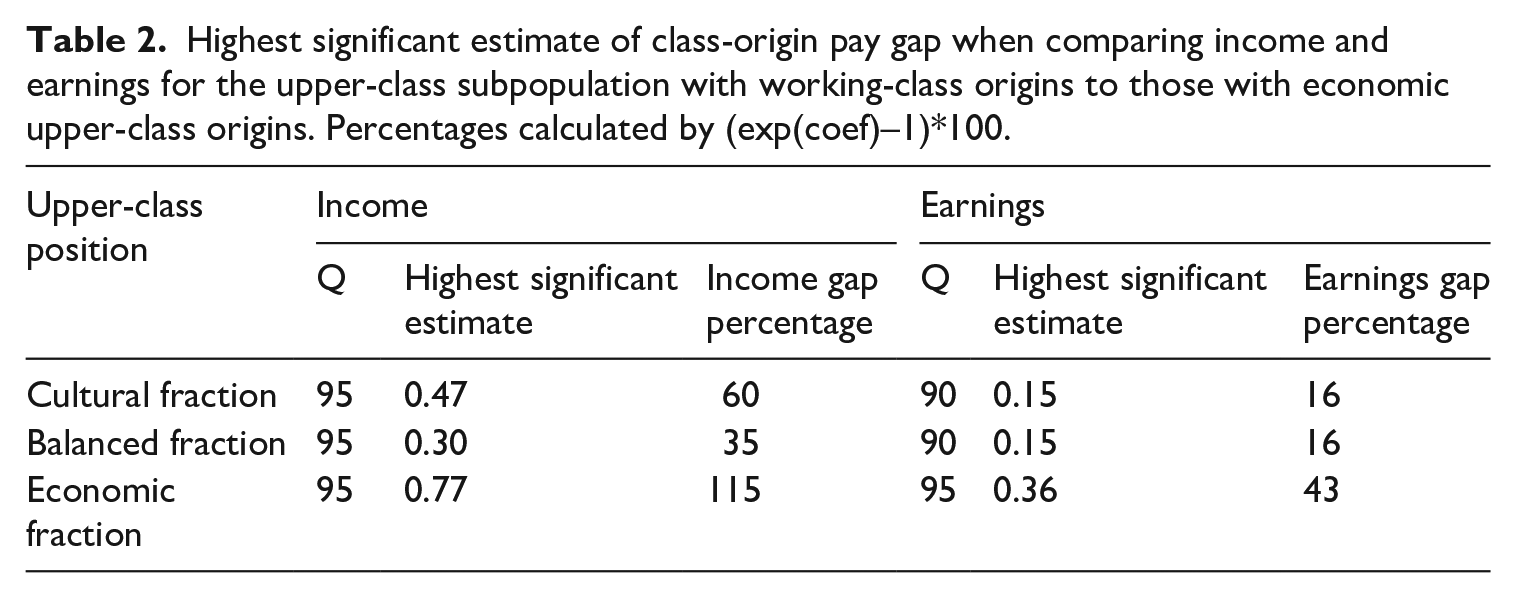
Figure 3 directly addresses this question. It displays the discrepancy in income and earnings between those with economic upper-class origins and working-class origins at different quantiles. For the income distribution, this reveals two key findings. First, it is clear that statistically significant class-income gaps exist at every 5th income quantile and within all fractions of the upper class. However, second, it also shows that the magnitude of these income gaps tends to significantly increase as individuals ascend the income distribution. This increase is most gentle in the balanced fraction of the upper class, where any ceiling effect is fairly modest. While the balanced fraction as a whole lacks a clear indication of ceiling effects, we find a trend towards high-end income discrepancies among politicians. For instance, at the 95th quantile of the distribution, politicians with origins from the economic upper class enjoy incomes on average 100 per cent higher (70 log points) than those from working-class origins. 9
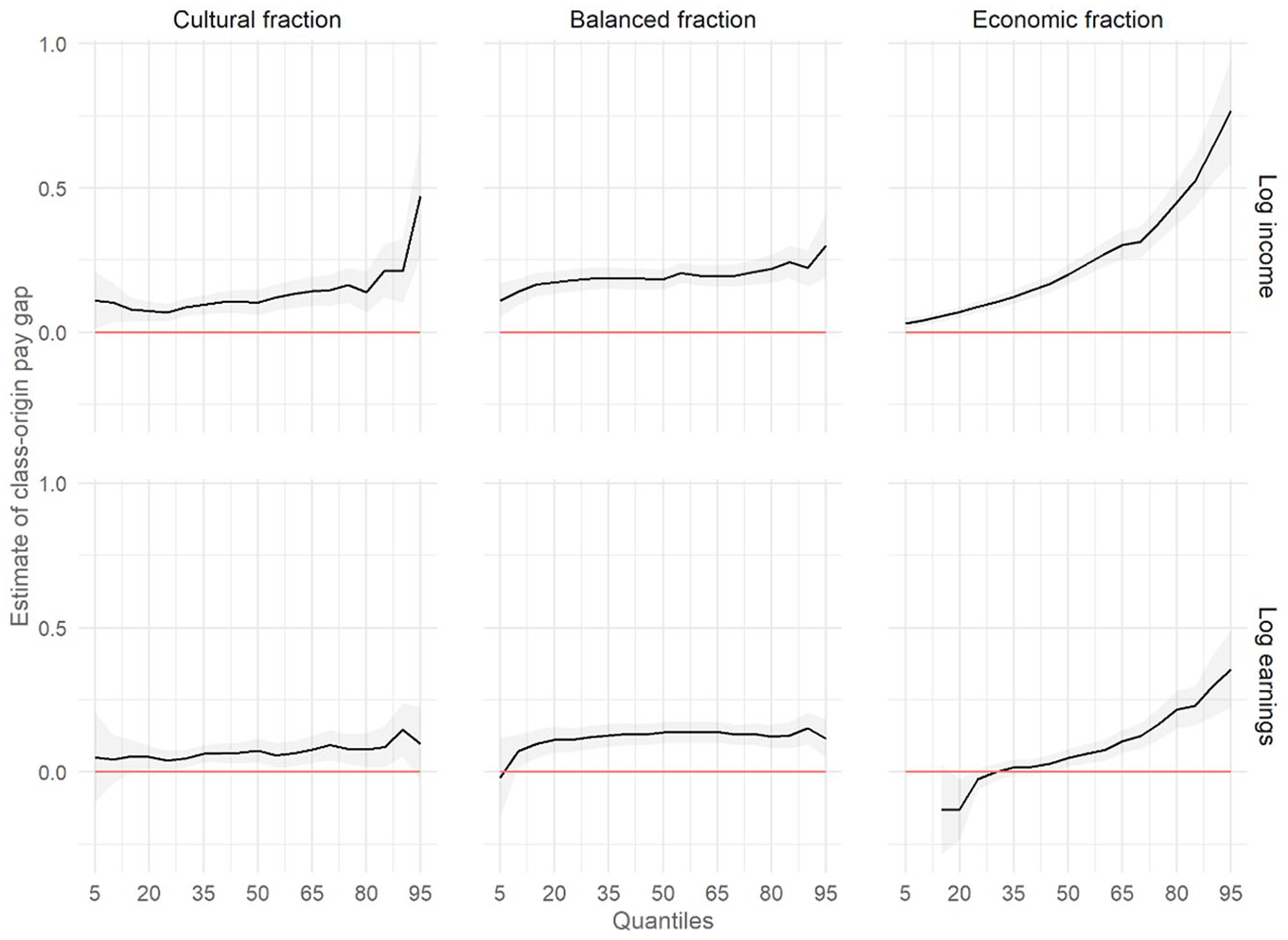
Unconditional quantile regression. Class-origin income and earning gaps (log points) at every 5th quantile (excluding the large earnings disadvantage at the lower tail of the earnings distribution within the economic fraction, see online Appendix C). Economic upper-class origins versus working-class origins, accounting for demographic controls. Separate analyses for each upper-class fraction.
In contrast, in both the cultural fraction and economic fraction, we detect a very marked class ceiling. In the cultural fraction, for example, among those in the most lucrative 95th quantile of the distribution, those from economically privileged backgrounds earn incomes 60 per cent (47 log points) higher than those from working-class backgrounds. And in the economic fraction, at the 95th quantile, the estimated pay-off of economically privileged origins amounts to a staggering 115 per cent (77 log points). In both cases, then, mean estimates of the class-origin income gap grossly underestimate the advantages enjoyed by the sons and daughters of the economic upper class once they move into the very top echelons of business and culture.
When we limit the analyses to earnings, we also see significant gaps across most of the earnings distribution. However, only in the economic fraction do we see a clear ‘class ceiling’ effect in terms of earnings. Here, at the 95th quantile, individuals with economic upper-class origins earn on average 43 per cent (36 log points) more than the upwardly mobile.
The Bank of Mum and Dad: Understanding Class-Origin Pay Gaps
So far our analysis has suggested that examining mean income and earnings differences by class origin risks obscuring the fact that in elite economic and cultural occupations the issue at hand is more that those from economically upper-class backgrounds enjoy particular advantages at the very top of the distribution.
The question this raises, of course, is why; why are economic upper-class origins associated with such high pay-offs? To disentangle potential sources of class-origin income and earnings differences, Figure 4 shows a series of regressions that control for five potential drivers (as outlined in the methodology section): parental wealth; (detailed) education; (detailed) occupations; work sector; and experience. Specifically, Figure 4 shows the percentage reduction in the highest quantile pay gap (as outlined in Table 2) in the three upper-class fractions when each control is separately introduced.
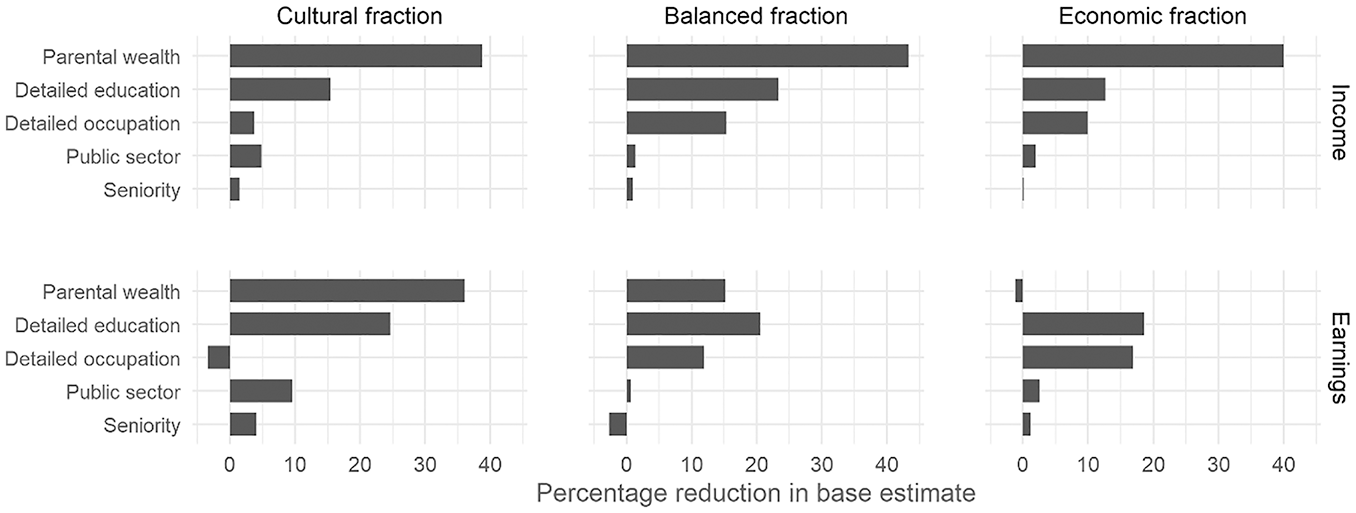
Percentage reduction in the highest observed class-origin pay gap when each channel is individually introduced. All models account for demographic controls. Percentage reduction is estimated by ((β1–β2) / β1)*100.
Highest significant estimate of class-origin pay gap when comparing income and earnings for the upper-class subpopulation with working-class origins to those with economic upper-class origins. Percentages calculated by (exp(coef)–1)*100.
Four key findings emerge from Figure 4. First, mechanisms such as work sector and experience do little to explain the high-end gaps we identify here.
Second, selection-effects into certain occupational groups do act as an important driver in the balanced and economic fraction of the upper class. Here our results mirror previous work (Friedman and Laurison, 2019; Hansen, 2001b) in pointing to a distinction between more socially open but less lucrative elite occupations that tend to value technical skills and where performance is more easily measurable, transparent and widely agreed upon, and more socially exclusive elite occupations where knowledge, ‘talent’ and competence are more ambiguous and diffuse. For example, we find that the economically privileged are particularly overrepresented in medicine and law while the upwardly mobile are overrepresented in engineering. Similarly, we find that the upwardly mobile are overrepresented in areas such as technical and commercial sales, while the economically established are more prone to work in more speculative economic areas like trade and ship brokering.
Third, education does act as a partial equaliser of pay gaps within the upper class. In other words, those from economically privileged backgrounds have different educational credentials than the upwardly mobile, and this accounts for about 13–25 per cent of the income and earnings gaps.
Fourth, and most importantly, Figure 4 shows the importance of parental wealth in explaining both class-origin income and earnings gaps. In particular it suggests that in all elite fractions parental wealth constitutes the single most powerful explanatory mechanism for class-origin income gaps. This is perhaps to be expected in terms of income gaps. Indeed, as noted, this channel may reflect the fact that individuals that originate in the economic upper class receive in-vivo gifts from family that they employ in wealth accumulation strategies outside of the labour market that in turn generate capital gains (Hansen and Wiborg, 2019). Yet Figure 4 also shows that parental wealth acts as a very significant driver of class-origin earnings gaps in the balanced and particularly cultural fraction of the upper class. More specifically, it is the single most important driver of earnings differences among those at the top echelons of politics, academia, architecture and in large cultural institutions (see online Appendix D for more details).
Discussion and Conclusions
This article draws on unusually rich data to significantly push forward an emerging body of literature examining the long shadow of class origin in structuring careers at the high-end of the class structure. The analysis contains three key contributions.
First, it demonstrates the importance of distinguishing different modes of privilege in the pursuit of understanding the class-origin income gap. Specifically, this reveals that, in a Norwegian context at least, coming from an economically upper-class background is associated with much greater career advantages than other types of upper-class privilege. Tellingly, the relative ‘pay-off’ of economically privileged origins is most effective in economic destinations.
Second, our work is the first we know of that has been able to effectively disentangle the relationship between class-origin pay gaps and class ceilings. While some case study and qualitative work has found class ceiling effects in particular organisations, our innovation here is the use of detailed quantitative data on the complete population which allows us to see that, in many elite occupational groups, those from working-class backgrounds face the steepest income and earnings gaps as they approach the top of the income distributions.
In this way, our analysis arguably returns the sociological gaze to issues of ‘elite closure’, and in particular the way in which gatekeepers to many elite positions may still use class origin, consciously or unconsciously, as an axis on which to enact social closure. And, of course, such elite closure has important wider ramifications. When those at the very top are drawn from narrow social origins, they are more likely to develop ‘a unity and cohesion of consciousness and action’ which, in turn, may have profound implications for the exercise of power and the healthy functioning of democracy (Scott, 2008: 35; see also Domhoff, 2005; Mills, 2000 [1956]).
Third, we are also able to provide important new insights on the mechanisms that help understand why the upwardly socially mobile fail to receive the same incomes as their economically privileged peers. Here the unusual quality of the registry data we draw on is key. In particular, this furnishes us with an unprecedented ability to discern the long shadow of parental wealth in affecting children’s career trajectories. While this has been mentioned in other studies as a potential mechanism for understanding the class ceiling (Friedman and Laurison, 2019), no other study has had access to reliable data on parental wealth. Our results indicate what an important part of the puzzle parental wealth may be; put simply, this is the most important single driver of the income class ceiling in the Norwegian upper class. How might we account for this? Clearly, this is a pressing question that requires further, in-depth research. Yet existing research points towards three directions, above and beyond the importance of direct inheritance of economic assets. First, parental wealth likely has an important impact on a person’s geographical mobility, and particularly their ability to take up important career opportunities in cities where living and particularly housing costs can be prohibitive. This seems to be the case in the Norwegian capital, Oslo (Toft, 2018), but also in cities such as London, Paris and New York (Friedman and Laurison, 2017), where parental financial gifts are particularly common in facilitating property purchases.
Second, parental support may act as an important career lubricant, providing the privileged with the financial freedom to negotiate unpaid or low-paid early-career work, manoeuvre into more promising career tracks, resist exploitative employment and take risky opportunities – all of which may speed up their upward trajectories or increase their chances of long-term success. Indeed, it is perhaps not surprising that parental support is so important in cultural careers. Financial patronage is arguably particularly pivotal here, where labour markets tend to be disproportionately precarious, short term and uncertain (Friedman et al., 2017).
Third, it may be that parental economic capital is such an effective driver of the class ceiling because it is largely hidden from public view. As Sherman (2017) notes, those from economically privileged backgrounds tend to publicly downplay the true extent to which they have benefited from, or rely upon, parental economic capital. These ‘anxieties of affluence’, as she calls them, are rooted in the fairly significant tension between benefiting from unearned wealth and adherence to dominant norms of meritocracy. Yet this downplaying has important implications for people’s perception of the class ceiling. It means the true value of The Bank of Mum and Dad goes largely unspoken in professional life, and its distorting influence on individual trajectories remains hidden from public view.
We would add here that this capital-specific dimension of intergenerational transmission may be worth exploring further in other national contexts such as the USA and the UK where wealth inequality is high and where family wealth has been shown to play an important role in the intergenerational reproduction of wealth inequality (Appleyard and Rowlingson, 2010; Pfeffer and Killewald, 2018; Sherman, 2017). Indeed, given the results we uncover here in Norway – a country known for a compressed wage distribution and centralised wage bargaining – it seems likely that the power of parental wealth may be even starker in other national contexts with more unequal income distributions.
It is worth acknowledging, however, that although parental wealth is by far the most significant driver of the class-origin income gap – and the most important channel of earnings gaps within the cultural fraction – it still only ‘explains’ part of the income advantage enjoyed by those from economically privileged backgrounds. Understanding this unexplained difference is beyond the scope of the data at our disposal here. However, drawing on previous work, it is possible to suggest a number of potential channels. One powerful potential mechanism, for example, may flow from the ability of the privileged to call upon, and leverage, valuable social networks in the workplace. Such social capital may work through career ‘sponsors’ (Turner, 1960), who are able to directly fast-track career progression, or the provision of more diffuse but valuable forms of knowledge about the ‘rules of the game’ (Friedman and Laurison, 2019). Indeed, lack of information on social networks is one of the key limitations of the kind of administrative data we use here, and may well drive some of the observed association we see in our results. In addition, central here are likely the particular dispositions inculcated in economically dominant families and how these may furnish children with valuable forms of knowledge and profit-seeking inclinations (Kuusela, 2018; Ljunggren, 2016), and a more general sense of ‘ease’ (Khan, 2010), when making their way in certain elite fields. Similarly, the way these dispositions may be misrecognised as signals of ‘talent’ or ‘merit’ by homophilous gatekeepers may further provide advantages in these fields, facilitating sponsorship relationships with senior staff (Friedman and Laurison, 2019) or via ‘cultural matching’ mechanisms in interviews or promotion panels (Rivera, 2012).
Finally, we also believe our findings may contribute to wider debates about rising income inequality and the turn towards those at the high-end of the income distribution. So far sociologists interested in social class have only entered these discussions in a fairly limited manner. In particular, they have largely confined their contributions to interventions concerning the role of growing between-class income differences in driving overall income inequality (Weeden et al., 2007; Williams, 2012; Wodtke, 2016; Zhou and Wodtke, 2019). While this literature is important, it has failed to think about the intergenerational dimension of class dynamics and how this might also be implicated in rising income inequality, particularly in terms of the widely documented pulling away of those at the top end of the income distribution (Piketty, 2014). We have shown here that such top incomes are often contingent on hailing from economically privileged origins, and specifically the parental wealth that often flows from such backgrounds. The propulsive power of such direct and indirect forms of intergenerational transfer, then, may represent an important and underexplored dimension of understanding income inequality.
Supplemental Material
Online_Appendices – Supplemental material for Family Wealth and the Class Ceiling: The Propulsive Power of The Bank of Mum and Dad
Supplemental material, Online_Appendices for Family Wealth and the Class Ceiling: The Propulsive Power of The Bank of Mum and Dad by Maren Toft and Sam Friedman in Sociology
Footnotes
Acknowledgements
We are grateful to three anonymous Sociology reviewers for their valuable comments. Special thanks to Øyvind Wiborg and Nicolai Topstad Borgen for discussions on unconditional quantile regression and to Ida Drange for help with classification of public sector occupational titles. Several drafts of this article have been presented at project-group seminars organised by Marianne Nordli Hansen. We thank the participants of these meetings for thorough feedback. In particular, we thank Olav Korsnes, Jørn Ljunggren, Marianne Nordli Hansen as well as Aaron Reeves for useful suggestions and criticisms. The article is part of the research project ‘Paradoxes of wealth and class: Historical conditions and contemporary figurations’ (HISTCLASS) at the Department of Sociology and Human Geography, University of Oslo. We thank Statistics Norway (SSB) for providing the administrative registry data.
Funding
The authors disclosed receipt of the following financial support for the research, authorship and/or publication of this article: part of this research was funded by the Research Council of Norway, grant no. 275249.

Supplemental material
Supplemental material for this article is available online.
Notes
References
Supplementary Material
Please find the following supplemental material available below.
For Open Access articles published under a Creative Commons License, all supplemental material carries the same license as the article it is associated with.
For non-Open Access articles published, all supplemental material carries a non-exclusive license, and permission requests for re-use of supplemental material or any part of supplemental material shall be sent directly to the copyright owner as specified in the copyright notice associated with the article.
