




Abstract
Volunteering is routinely advocated in British policy as a key mechanism for young people to gain employment, but with little evidence of its viability as a strategy. Indeed, the limited research in this area suggests the link is weak and that access to good quality volunteering is differentiated along class lines. This article draws on a mixed methods approach, using survey data from the Citizenship Education Longitudinal Survey and qualitative interviews, to analyse the relationship between youth volunteering and employment. It finds that volunteering is not unequivocally beneficial for employment, particularly if it does not offer career-related experience or is imposed rather than self-initiated. It can even have a negative effect on employment. Furthermore, social class mediates access to volunteering opportunities most likely to convert into employment. We conclude there is little evidence to support policy assumptions that, in the short term, volunteering has a positive relationship to paid employment.
Introduction
Youth unemployment remains a key concern in the UK, hovering stubbornly around the half-million mark for the last few years (Parliament UK, 2020), with only a slow improvement from the impact of the 2008–2012 economic recession (Hoskins et al., 2018). Since the turn of the century, governments have consistently prioritised volunteering as a key plank of youth employment policies (DirectGov, 2016; Hawkins, 2015). Young people are exhorted to do ‘community work from the very start of their claim for unemployment benefit’ (Hawkins, 2015) and, oxymoronically, some young offenders under a rehabilitation order ‘must’ volunteer as part of their sentence and/or welfare payments (Sentencing Council, n.d.). At the same time, however, while research investigating the efficacy of volunteering to access paid work is limited, this suggests that the link is weak (Rutherford et al., 2019), or inconclusive (Meager et al., 2014), and may even produce a negative effect on employment for young people (Ellis Paine et al., 2013; Leonard and Wilde, 2019; Ockenden and Hill, 2009; Wilson, 2000). For policymakers and young people alike, more accurately ascertaining the relationship between youth volunteering and paid work is a matter of vital importance.
This article draws on the English Citizenship Educational Longitudinal Survey (CELS) to contribute to filling the lacuna in knowledge about volunteering, unpaid work and youth employability. It takes a mixed methods approach, incorporating both quantitative and qualitative analysis, to investigate three broad research questions: (1) Which young people have access to unpaid work experiences? (2) What is the relationship between unpaid work and paid employment? and (3) How does this vary by social background?
Young People, Volunteering and Employability
Volunteering as a desirable activity for young people has received considerable policy attention within the UK since the turn of the century, primarily influenced by broader concerns with perceived declines in civil society, social responsibility and citizenship, as well as changes in community and family life, rather than employment prospects per se (Gaskin, 2004). For this reason, the concept of ‘volunteering’ rather than ‘unpaid work’ initially dominated policy and academic literature relating to young people’s skills development, aligning with Davis Smith’s (2003) definition of volunteering as constituted by three core elements: freely undertaken; of benefit to others; and unpaid. 1 As such, volunteering was seen to provide a means by which young people were able to ‘reconnect’ politically and socially as citizens (Lister et al., 2002), engage with local communities and minimise the uncertainties produced through an increasingly individualised society (Beck and Beck-Gernsheim, 2002; Hustinx, 2001).
As the UK tipped into recession in 2008, notions of employability and ‘work readiness’ became more central to policy on youth volunteering. A raft of initiatives aimed at enhancing employability through volunteering was introduced by successive governments, to encourage all young people ‘to consider volunteering as a way of improving their employment prospects while looking for work’ (DWP, 2012: 1). These were joined by a proliferation of unpaid work programmes from 2011 onwards, to encourage out-of-work young people to gain experience of the labour market (Full Fact, 2016). Unpaid work became increasingly common for young people of all backgrounds, and internship schemes expanded, particularly for graduates (Leonard et al., 2016). For entry into certain careers, performing a spell of unpaid work became an absolute necessity, rather than merely desirable (Lawton and Potter, 2010).
Yet what became clear from this development in youth employment policy is that routes into volunteering and unpaid work vary significantly between young people. Indeed, a key critique of volunteering programmes is that the ability to capitalise on the potential of unpaid work to accumulate important human and social capital is strongly differentiated by social class (Musick and Wilson, 2008; Smith, 2010). Inspired by a Bourdieusian approach, analysts argue that those with economic capital, in the form of savings or family support, higher cultural capital in the form of educational qualifications, skills levels and embodied performances, and stronger social capital, in the form of influential networks and contacts, are in a far better position to take advantage of the opportunities which then lead more directly into paid work (Egerton and Mullan, 2008). However, research also demonstrates that youth volunteering has an unpredictable relationship with work, with poor outcomes commonly experienced in all but a few highly specific contexts (Ellis Paine et al., 2013; Kamerāde and Ellis Paine, 2014; Ockenden and Hill, 2009; Wilson, 2000). Our research aimed to contribute to establishing exactly ‘who wins’, and how. Does the context of volunteering – private, public or third sector – also play a role?
Methodology
Our methodology combined survey and follow-up interviews. The CELS data consist of a nationally representative cohort of young people from England who were first surveyed aged 11–12 in 2003, and then in five waves until 2014 (aged 22–23). Each round of the survey included a top-up to maintain the nationally representative nature of the dataset. As our research questions concerned the transition into work, the survey data focus on CELS’ final two rounds: Round 5 (2011, aged 19–20, N = 1509) and Round 6 (2014; aged 22–23, N = 945). Between these two rounds, the attrition was 13 per cent with a combined dataset of 824 participants. As there were no significant differences on responses by social background variables between the combined and Round 6 dataset, Round 6 weighting, based on gender, ethnicity and number of books-in-home, was applied to logistic regression analysis to maintain the representative nature of this sample for this cohort.
Overall, CELS suffered from considerable attrition, with only 734 participants (4.2%) from the first round left in the final round, making it problematic to include early rounds in the analysis of the young people at the age 22–23. Nevertheless, while the attrition makes it harder to realise the full longitudinal potential of the dataset, it continues to provide useful insights about young people, as they transition into adulthood (Hoskins and Janmaat, 2019; Hoskins et al., 2018).
Our interviews included participants from the CELS sample (N = 50) topped up with interviewees recruited via snowballing, twitter and a youth organisation working with young offenders (N = 51). Interviews were wide-ranging, covering young people’s opportunities, aspirations and views on society. They were recorded, transcribed and initially coded using NVivo into broad themes of ‘employment’, ‘entry routes and practices’, ‘volunteering’ and ‘volunteering and work’. Deeper systematic analysis was then conducted into transcripts where these themes were discussed extensively, exploring each respondent’s story and their intentions for, and experiences of, working unpaid or volunteering. From these stories, we analysed how closely employment experiences corresponded to desired careers and how useful these were perceived to be for gaining work. We then organised the data by developing a three-fold typology (Smith and Sparkes, 2005): career-specific – unpaid work closely aligned to a desired career; career-related – unpaid work with some relevance to individuals’ goals (e.g. to practise relevant transferable skills); and career-unrelated – unpaid work not clearly linked to individuals’ goals or offering skill development. This typology also linked to our survey data by distinguishing the context within which the volunteering was undertaken: private, public, charity/community, to investigate how context affects its conversion into paid work.
To present the qualitative data, we focus in-depth on five narratives selected as representative of each category of our typology. As such, we are not claiming definitive findings (Atkins, 2017) but draw on Lakoff’s (2008) suggestion that members of an abstract category can be related to a prototype of that category by being ‘typical’, or otherwise. Typical cases can be used to illustrate ‘normal’ category members, being most representative of the category and containing the key conceptual themes found in the quantitative evidence (Steiner et al., 2010), in this case performing unpaid work and social class. Through team discussion, we identified transcripts that typified each category. While illustrative narratives constitute only a subset of all the issues experienced, they enable demonstration of the interactions between themes, provide contextual detail and can describe the relationship between themes and outcomes in a tangible way (Steiner et al., 2010).
More diversity of social background and experience was found within the latter two categories of the typology, and for this reason, two illustrative narratives were selected for each. As we discuss more fully later in the article, participants from working-class backgrounds were more likely to be positioned here, with those whose volunteering was enforced as part of welfare-to-work or community service orders more heavily represented in the final category.
Quantitative Analysis
Our substantive quantitative analysis employs binary logistic regression to investigate: first, levels of access to different forms of unpaid work; second, the relationship between different forms of unpaid work and paid employment; and third, the relationship between different forms of unpaid work and employment for different social groups. We focused on three different sectors: private, public and voluntary/charity, to encapsulate the diversity of settings in which young people perform unpaid work and to establish differences in the relationships between unpaid work and paid employment. The following survey questions were used: Round 6: In the last 12 months, have you performed any unpaid work in any of these situations?
– In a charity or volunteer organisation
– In a public sector organisation
– In a company in the private sector
The new questions on unpaid work added to the Round 6 data collection can only allow for cross-sectional analysis and can only demonstrate associations rather than causality. For this reason, we also used the approximate measure of ‘volunteering’ from Round 5. Here the question was: Round 5: In the last year have you taken part in any of these activities?
– Helping out in the local community.
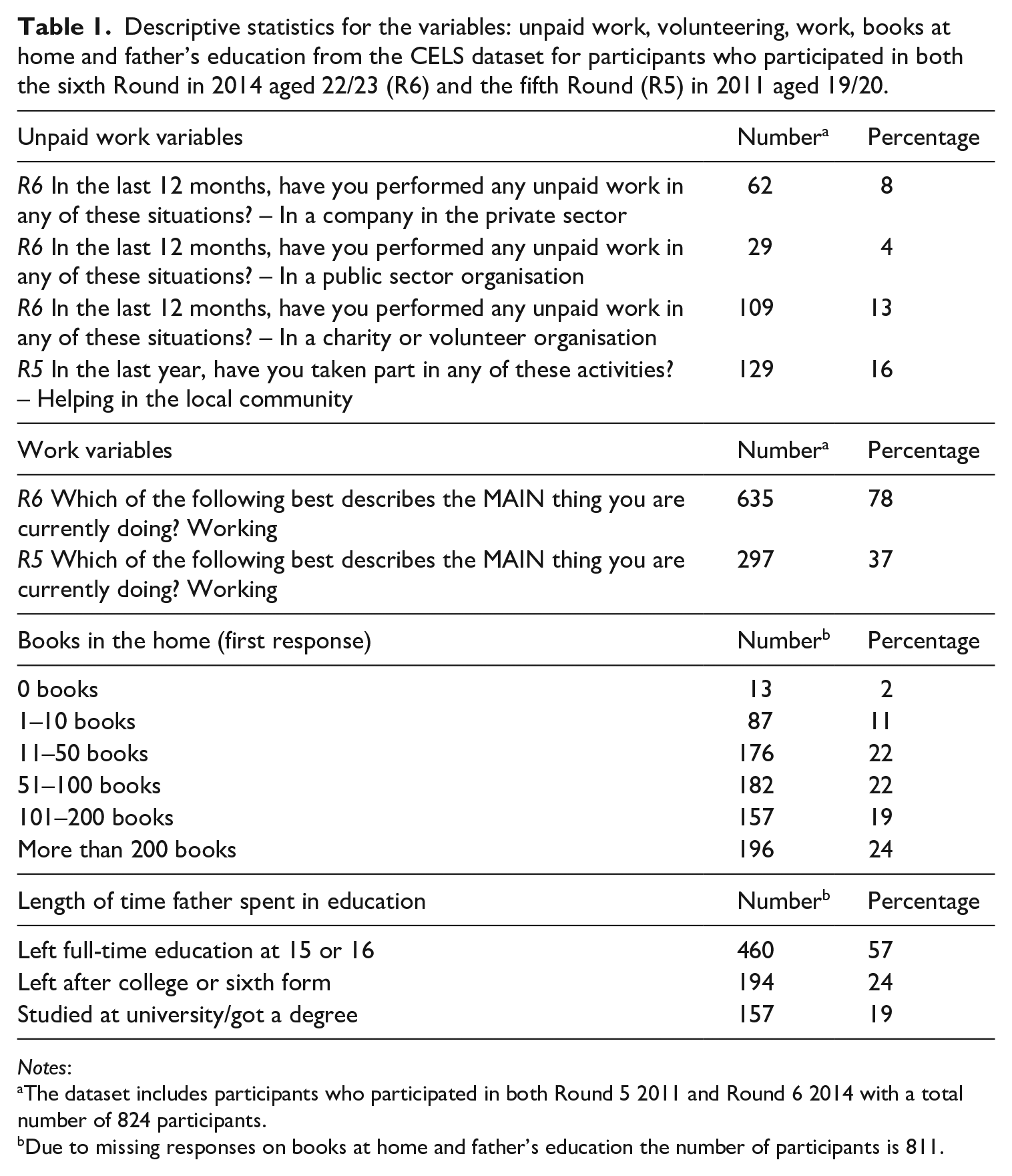
The above unpaid/volunteer measures were used as dependent variables in the models addressing the research question on access. They were then used as independent variables in the subsequent models that addressed the relationship between volunteering and employment. The descriptive statistics (Table 1) show, at age 19–20 (Round 5), that helping out in the community was a popular form of volunteer work (16%). At age 22–23 (Round 6), unpaid work in the charity sector was the largest category at 13 per cent, followed by unpaid work in the private sector at 8 per cent; only 4 per cent participated in unpaid work in the public sector.
Descriptive statistics for the variables: unpaid work, volunteering, work, books at home and father’s education from the CELS dataset for participants who participated in both the sixth Round in 2014 aged 22/23 (R6) and the fifth Round (R5) in 2011 aged 19/20.
Notes:
The dataset includes participants who participated in both Round 5 2011 and Round 6 2014 with a total number of 824 participants.
Due to missing responses on books at home and father’s education the number of participants is 811.
To measure social background, we used the variables of ‘number of books in family home’ and father’s education (mother’s education has a considerably higher number of missing cases). The books-in-home variable has been used widely in research using this dataset and found to be the most reliable measure of social background (Keating and Benton, 2013). The response category has six options, ranging from ‘no books’ to ‘more than 200’. This measure is used as an independent variable to measure access to volunteering and then to split the datasets into two approximately equal groups to explore differences by social background: Group 1, young people with less than or equal to 100 books (N = 458) and Group 2, those with greater than 100 books-in-home (N = 353). ‘Father’s education’ response options were: ‘left full-time education at 16’, ‘left after college/sixth form’ and ‘studied at university’; and was used in all the analysis models.
To measure employment, we used the item: Which of the following best describes the MAIN thing you are currently doing?
– Working.
In Round 6, about 80 per cent of the young people were in work and in Round 5, at the younger age of 19–20, about 40 per cent were in work.
The control variables we added to our models for addressing questions on paid employment is ‘Paid Work’ at age 19–20 in Round 5. Our prior research using the CELS data (Hoskins et al., 2018) demonstrated that employment in Round 5 has a very strong association with being in work in Round 6. We also added ‘doing a degree’ in Round 5, as this is also associated with being in work in Round 6, although less strongly than ‘prior paid work experiences’ (Hoskins et al., 2018). Finally, we used the control variables ‘gender’ and ‘ethnicity’, as these background variables can influence both the desire to volunteer and employability (Anders and Dorsett, 2017; Gaskin, 2004).
Results
Which Young People Have Access to Unpaid and Voluntary Work?
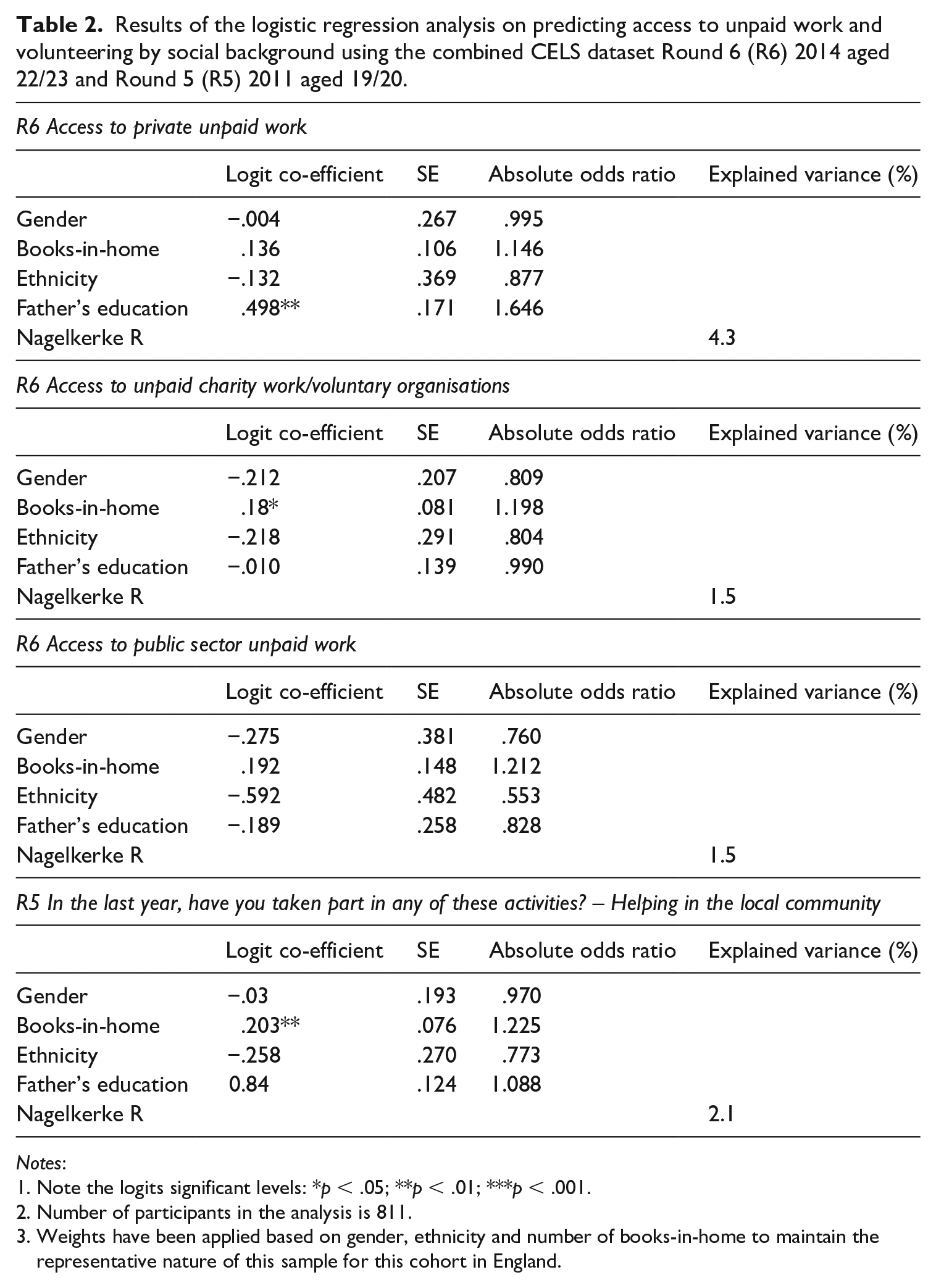
The results of the logistic regression on access to types of unpaid work show that ‘books-in-home’ is positively and significantly associated with unpaid work in the voluntary sector in Round 6 at the age of 22–23 with an odd ratio (OR) 1.198 and volunteering in Round 5 at the age of 19–20 with an OR 1.225 (Table 2). The other measure of social background, father’s education, was found to be positively and significantly associated with participation in unpaid work in the private sector (OR 1.646). These results indicate that social background is likely to be influencing access to these forms of unpaid work experience.
Results of the logistic regression analysis on predicting access to unpaid work and volunteering by social background using the combined CELS dataset Round 6 (R6) 2014 aged 22/23 and Round 5 (R5) 2011 aged 19/20.
Notes:
Note the logits significant levels: *p < .05; **p < .01; ***p < .001.
Number of participants in the analysis is 811.
Weights have been applied based on gender, ethnicity and number of books-in-home to maintain the representative nature of this sample for this cohort in England.
There is less evidence to suggest social background is associated with access to unpaid work in the public sector at the age 22–23, as neither the relationship with books-in-home and father’s education are statistically significant. Optimistically, this could be a reflection of the equality duty governing anti-discrimination in the public sector, but may also be partly due to the very small numbers who managed to access this form of unpaid work in the last 12 months (see Table 1).
The explained variances for the access to unpaid work models are low and between 1.5 and 4.3 per cent (Table 2). This is partly due to the small number of variables in the model and the fact that the only variables which are significant are either ‘books-in-home’ or father’s education. Surprisingly, gender and ethnicity are not associated with participation in unpaid work activities at age 22–23 in this study. The low explained variance suggests that there are other factors influencing participation in unpaid work, such as individual attitudes and dispositions (Hirst, 2001).
The Relationship between Unpaid and Paid Work
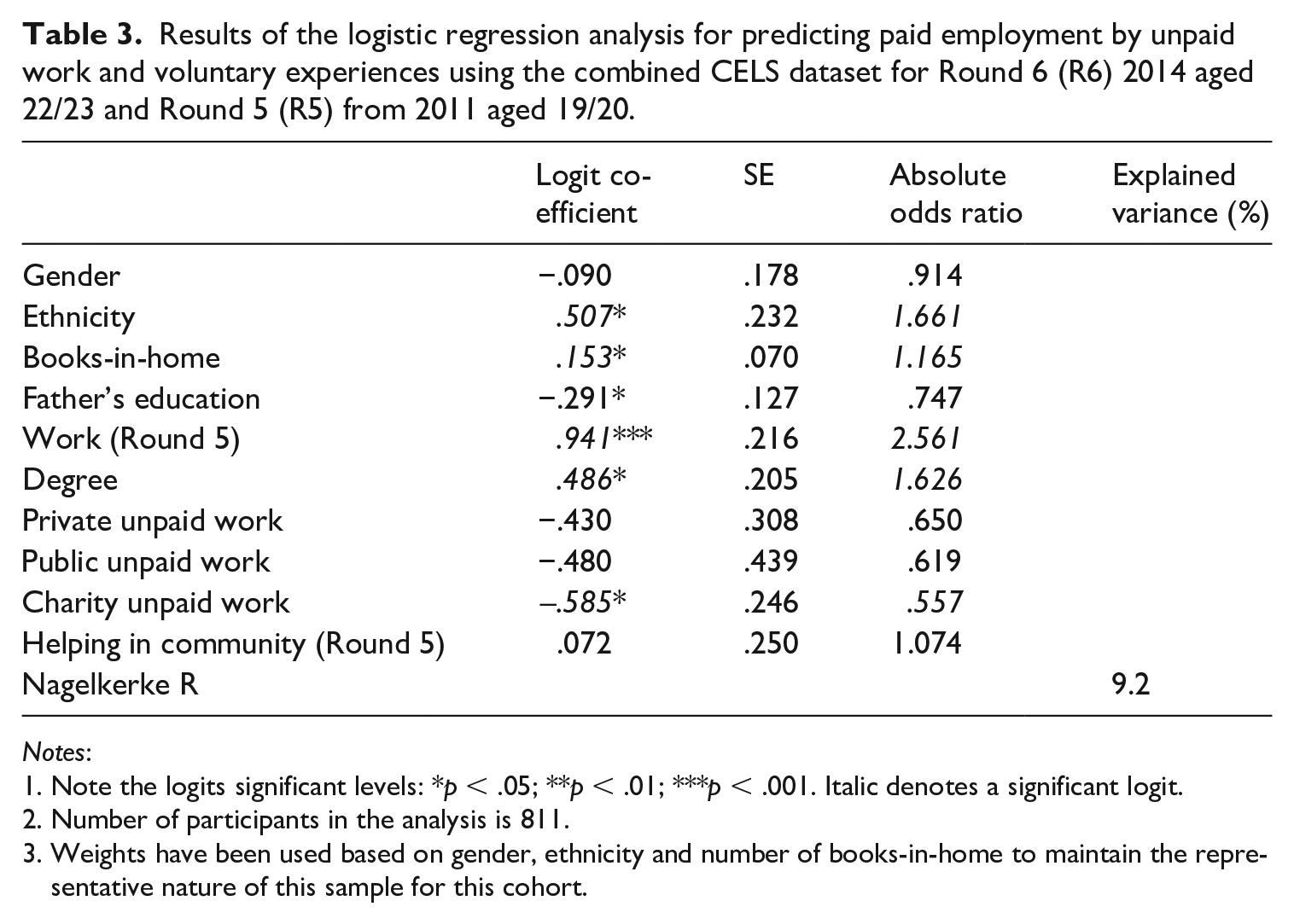
The results of the logistic regression on employment (Table 3) suggest that there are no positive associations with ‘doing unpaid work in the last 12 months’ to ‘being in employment’ in Round 6. The only result which is significant is ‘participating in unpaid work in charities and voluntary organisations’: producing a negative association with ‘being in employment’ in Round 6 (OR .557). Taking into account this part of the analysis is cross sectional and causality cannot be determined, the negative association between volunteering and paid employment could be explained in the following alternative ways: first, volunteering experiences could have a negative effect on getting employment; second, not being in work is the driver for volunteering; third, young people are actively pursuing their volunteering and are not available to work; and/or fourth, these young people were less likely to get a job anyway, and so are keeping busy by volunteering. With the available quantitative data, it is not possible to determine which of these explanations is the more likely, revealing the value of combining with qualitative analysis.
Results of the logistic regression analysis for predicting paid employment by unpaid work and voluntary experiences using the combined CELS dataset for Round 6 (R6) 2014 aged 22/23 and Round 5 (R5) from 2011 aged 19/20.
Notes:
Note the logits significant levels: *p < .05; **p < .01; ***p < .001. Italic denotes a significant logit.
Number of participants in the analysis is 811.
Weights have been used based on gender, ethnicity and number of books-in-home to maintain the representative nature of this sample for this cohort.
Volunteering by ‘helping out in the community in the last 12 months’, when the young people were 19–20, is found to have no relationship with being in paid work at 22–23 (Table 3). It should be considered that ‘helping in the community’ is a much broader and more informal concept than ‘doing unpaid work in charity and voluntary organisations’ and may therefore have no association for the individual with work, either paid or unpaid.
The explained variance for this model is 9.2 per cent. Although the explained variance can differ due to the size of the dataset and the types of variables used, close to 10 per cent is reasonable for social science research (Fichman, 1999).
Is There a Social Background Effect on the Relationship between Unpaid and Paid Work?
To identify if there was a similar relationship between performing unpaid work and securing paid work for different social groups in Round 6, the dataset was split into two groups by books-in-home (the small sample size meant the dataset could not be divided more finely). Rerunning the analysis produced some interesting results.
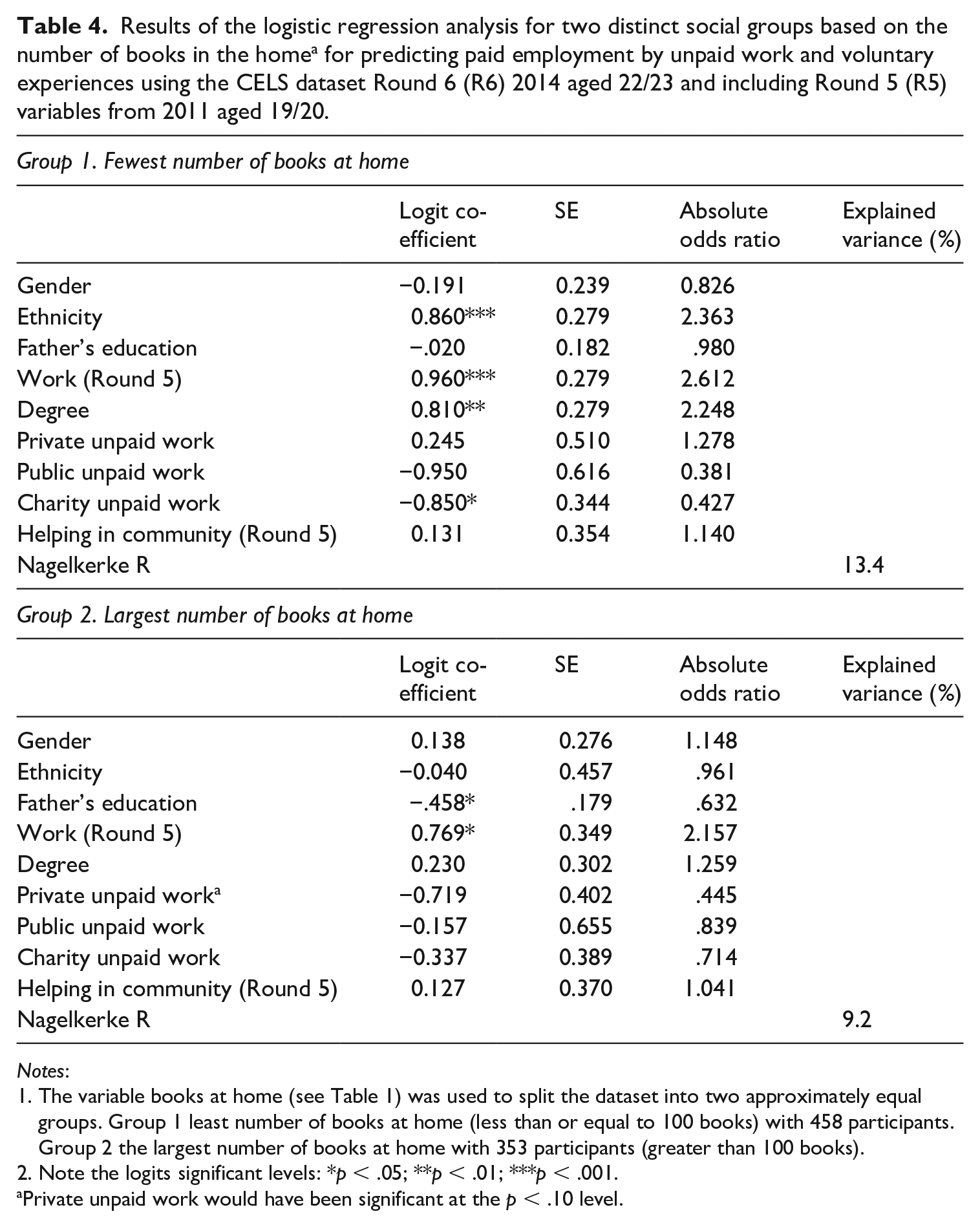
For the group with the fewest number of books-in-home (N = 457), the explained variance of the model increased by 4.2 percentage points from 9.2 per cent to 13.4 per cent (Table 4). All the same variables were significant, with all the logit coefficients following the same direction as the previous model, only the effect size and OR increased in magnitude. For example, ethnicity (i.e. being white British) is a powerful predictor of being employed at 22–23 with an OR 2.363 for those with the fewest books-in-home.
Results of the logistic regression analysis for two distinct social groups based on the number of books in the home a for predicting paid employment by unpaid work and voluntary experiences using the CELS dataset Round 6 (R6) 2014 aged 22/23 and including Round 5 (R5) variables from 2011 aged 19/20.
Notes:
The variable books at home (see Table 1) was used to split the dataset into two approximately equal groups. Group 1 least number of books at home (less than or equal to 100 books) with 458 participants. Group 2 the largest number of books at home with 353 participants (greater than 100 books).
Note the logits significant levels: *p < .05; **p < .01; ***p < .001.
Private unpaid work would have been significant at the p < .10 level.
In contrast, the explained variance of the model for the group with the most books-in-home (N = 367) remained the same at 9.2 per cent (Table 4). Interestingly, the results for this model are quite different from the full case analysis. Ethnicity, for example, is no longer significant. The only variable to remain significant from the full case analysis was the strong relationship between ‘being in work’ in Round 5 to ‘being in work’ in Round 6. Unpaid work in charity and volunteering organisations no longer had a significant negative effect. Private sector unpaid work was negative and would have been significant at the 10 per cent level with an OR of .445 (Table 4). Father’s education, as with the full model, perhaps surprisingly is also negatively correlated with being employed (OR .632).
Discussion of Quantitative Findings
The results demonstrate that, for this cohort of young people, access to unpaid work and volunteering appears to be structured by different aspects of social background. Those from backgrounds with more books-in-home have greater access to volunteering while those with more highly educated fathers have more access to unpaid work in the private sector. While these findings are perhaps of little surprise, they provide important evidence to justify concerns that access to unpaid work opportunities is dominated by young people with higher levels of economic, cultural and social capital.
However, and importantly, our findings reveal no evidence that, by the age of 22–23, the unpaid work experience or period of volunteering had effectively led to securing a job. Of course, it could be that this process takes longer than the time period covered by our research. Nevertheless, our approximate measure of volunteering in Round 5 ‘helping in the community in the last 12 months’, when the young people were 19–20, also had no significant effect on paid employment at 22–23. Although we do not know what will happen in the young people’s future, this evidence queries policy assumptions that volunteering and unpaid work are beneficial for gaining employment.
Another explanation is that the young people are waiting for jobs of quality rather than accepting just any form of paid work. When we split the dataset according to social background, only the group with the greatest number of books-in-home had a negative correlation for father’s education on employment. This perhaps provides evidence of parental support enabling a young person, in the context of economic recession, to hang on for a quality job opportunity. The analysis on access suggests that highly educated fathers facilitate access to unpaid private sector work. This perhaps reflects an acquiescence to policy discourses promulgating that unpaid work equips young people with valuable work experience for future quality careers. These private sector experiences showed no positive relationship with work at 22–23, however. Once again, it may be that there was simply not enough time within the study for these experiences to have a positive effect, or that the economic climate still had to improve before these experiences could be exchanged for quality employment.
Of further importance is the fact that, when we split the dataset according to social background, the negative experience of performing unpaid work in voluntary organisations was only found to be significant for the lower social group. This suggests that it is even less likely that this form of volunteering will benefit those from lower social backgrounds to secure a job. To shed further light on these findings, we now turn to the qualitative data.
Qualitative Analysis
In this section, we consider in greater detail how unpaid work and volunteering may affect labour market entry, and the relationship social class plays with accessing efficacious forms of unpaid work. As explained above, the qualitative analysis aimed to complement the quantitative analysis and, as such, we selected interviews that provided depth to its key themes. We then categorised these into a typology of unpaid work experience, before selecting illustrative narratives to present the findings.
Career-Specific: Holding Out for the Dream Job
Young people undertaking ‘career-specific’ unpaid work or volunteering have clear strategies for their pathways into work. They aim to use the experience to test out their chosen careers and gain the skills employers want, deploying agency in making choices about how to achieve their goals. Narratives of young people within this category predominantly reflected middle-class backgrounds. For example, Polly, 22, is white with both parents having PhDs and working in education, suggesting no shortage of books-in-home. She attended one of the UK’s top universities and is currently living in the family home in London. She is particularly strategic with her career preparation. Hoping to become a journalist or work in policy, she has undertaken several paid and unpaid internships in the private sector. That such internships are seen as a particularly prestigious form of volunteering, delivering ‘brag-worthy’ experience (Leonard et al., 2016) is borne out by her researching, report-writing and event organisation experiences at ‘blue chip’ organisations: Reuters, ITV, an online magazine and a policy think tank. These enabled her to try out these areas as well as increase her skillset. She says the graduate schemes in journalism ‘won’t even look at you unless you’ve got months of experience’. She is, however, reluctant to take paid work straight away, whether working in a cafe, or communications and marketing, where she thinks there are plenty of jobs for graduates like her, before she knows what she wants to do as her ‘proper’ career. She is fearful of making the wrong choice too early. Being able to live with her parents in London means she can afford to work unpaid while she figures out what she wants. Her goals are to ‘cut out a good career path . . . build a portfolio’ before she makes her choice. She explains, ‘I’m worried I’ll end up going down a path that I can’t then back out of and can’t get into something that I’m interested in.’
Polly has considerable resources to back her during this period of exploration, and was well aware of her advantages in comparison to others her age: I’m probably one of the luckiest people I know, I’ve always had support from an early age financially, emotionally. My parents live in London. I’ve always had everything so cushy. . . . the one thing I’m doing now that makes it so clear to me is with journalism, that you have to have so much unpaid work experience. Things like a Masters too . . . that’s completely elitist as well, it’s only people that can afford to do it get to do it.
While Polly is markedly strategic in forging her career, as we now go on to show, other young people we spoke to were far less able to spend time building a ‘portfolio’ of unpaid experiences to improve their career prospects, due to fewer resources. Thus, our qualitative data add weight to our quantitative findings of the significance of class in access to unpaid work experience opportunities. Polly’s next task will be to convert her experience into paid employment and she spoke highly of how her experiences have been helpful for understanding particular careers and gaining skills, and was therefore optimistic about her prospects. Polly’s approach might give one explanation for our quantitative findings regarding the lack of effect noted from unpaid work in the private sector and participants with highly educated parents having a negative correlation with being employed. Able to rely on her family’s resources, Polly is able to ‘hold out’ for her dream job.
Career-Related: Gaining Skills
Some young people had done forms of volunteering which were related to accessing paid work in the longer term, but not specifically connected to a desired career. Conforming to policy discourses, for this group unpaid work was conceptualised as delivering side-benefits, such as keeping busy, becoming more motivated, helping with self-confidence and/or with specific skills such as teamwork and communication. Most of the unpaid work performed by this group was in the charity sector, where there can be less training or fewer funds for career development or paid work, and this may explain the lack of paid work outcomes that resulted, and the findings of negative association from our quantitative data with ‘being in employment’ in Round 6. Our findings reveal that this group are also sometimes yet to make choices about their career goals or, again, are struggling to access the right sort of experience required for their chosen path.
Janice (white, 22) is working class and has been unemployed since she left college five years ago. She lives with her mother, who is also not working, and younger brother. She was unsure if her mother had qualifications. She has struggled with self-esteem, motivation and has no work experience. Her Job Centre advisor suggested she try volunteering in a charity shop to help boost her confidence. This has been very beneficial, helping Janice get used to getting up early and working full-time, as well as talking to customers and using the tills. After a long period of inactivity, it seems that volunteering, even though she is not interested in retail as a career, has given Janice more energy and confidence to pursue paid work: ‘I think because I’ve been doing more things it’s made me think now I need to get a job, I need to do something with my life.’ She is now on a training course to become a security guard, and is committed to finding a job, hoping to work with children in the longer term. Despite her progress, paid work is yet to materialise, and Janice remains quite far away from the labour market.
Janice’s experience aligns with our quantitative findings that volunteering in charitable settings may have a negative effect, suggesting that a reason for this is that it may be undertaken by NEETs (Not in Education, Employment or Training) who are often less likely to find work (Simmons and Thompson, 2011), as well as those still preparing for work, rather than those actively seeking it. Context is important here, given that charities tend to be run largely on voluntary labour, and often have an ethical commitment to supporting volunteers from a wide range of non-traditional backgrounds (Leonard et al., 2016). However, they also have limited paid positions for volunteers to then move into.
It must be acknowledged, as the quantitative findings indicated, that while the connection between volunteering and paid work is weak, a limited number of young people in our sample who had done some form of unpaid work did go on to some form of paid work. However, this was always unrelated to their desired careers. This group tended to include young people who were the first in their families to attend university, or who did not enter tertiary education at all. Some undertook work experience as part of their course requirements. While these experiences were related to the careers that they wanted to enter, most have been unsuccessful in turning these into their desired careers and have instead taken jobs in other fields. These young people were frustrated by being unable to gain the vital components required for career entry and expressed less agency overall in preparing themselves for work.
Tim (white, 23) states that he is working class, and does manual labour in a factory. He thinks his parents went to college and his mum is a trainee manager. He currently lives with his girlfriend and grew up nearby, in what he describes as an ‘awful estate’ in a deprived region of north-east England. He completed his GCSEs (level 2 qualification), went on to do a BTEC (level 3 qualification) in sports and hoped to work as a personal trainer. His BTEC qualification included the requirement that he complete a set of voluntary hours in a related context. Tim managed to find a position volunteering with a local football team. Like Polly, his volunteering was both specific and useful for: just testing to see what the job entailed really and whether I’d be able to do it or not . . . was really helpful for me obviously getting myself into a working environment and sort of seeing how the job works and how sort of easy or difficult it was.
However, while he would like to work in this field, he has found that jobs are simply not being advertised. As such, the experience has not been specifically valuable and has not led to the areas in which he has secured work. Indeed, he tells us that he has not even used it on his CV or in interviews. Unlike Polly, he has been unable to afford longer periods of unpaid work to hold out for his dream career.
Career-Unrelated: Volunteering as ‘Punishment’
Our final group are those who have undertaken ‘compulsory volunteering’ as part of a community service order (CSO) imposed upon young offenders as part of their sentencing, or a mandatory work placement required by the Job Centre. The ‘volunteering’ was usually in the public sector, supporting council workers or in charities, and much of it was characterised by an absence of skills development. Compounding this, the lack of agency in deciding what to participate in meant young people were rarely engaged in these experiences. Consequentially, these ‘opportunities’ were ineffectual in supporting young people towards work.
Many young offenders resisted the compulsory nature of their work initially, and although some began to see benefits, many have been on multiple orders, cycling through support agencies with little real change in their lives. The atmosphere surrounding the CSO meant that many of the participants did not view the work as a route into employment. They felt their orders were a punishment and having to wear high-visibility jackets marked them out as offenders and constituted, for them, public shaming. It is not hard to understand why these experiences did not feel developmental for these young people.
What is significant, however, is that when the young people participate in volunteering voluntarily, they did gain a sense of achievement and self-worth from these activities. This was the case for Nathan (working class, 22, mixed race), who has frequently been on probation since the age of 13 and in prison twice. He was brought up in care, his mother passed away and he never met his father. He moved foster families and schools many times before being permanently excluded. Thus, he has no family resources to support him. After tutoring, he achieved two GCSEs but has never had a paid job. His initial experiences on his CSO were negative. He saw it as a punishment, had no agency in deciding what to do, learnt very little and felt supervisors were not interested in helping young people: I was, like, digging holes and cutting down trees and shit, instead of doing stuff like, that they could actually put you into a trade. I think they should put you into a trade, yeah, like, and learn a trade as your unpaid work, so you gain something from it, not just digging a hole in a park.
He noted that being unable to access a toilet or hot drinks during his CSO labouring made the experience particularly unpleasant. In contrast, the volunteering he chose to participate in at the Care Leavers Association, alongside his compulsory order, has been something he cared about, and enabled him to feel he has something to contribute. This has led him to be offered a job with the organisation he volunteered for.
Our participants who were forced to complete unpaid work placements in return for welfare payments as part of Job Centre Work Programmes had similarly poor outcomes, but were often able to see some value in completing work experiences. Ian (white, working class, 25) has also been in care since he was 11 with very little contact with his family. He thinks his parents are a butcher and a nurse but knew little about their education. He worked unpaid in a charity shop for his Job Centre placement: he had no say in this and would have been sanctioned if he did not do it. He says he did not mind so much, as it passed the time, but feels there were few positive outcomes from the experience: You’re not achieving anything really out of that, you’re only achieving like probably, what, one or two certificates, that’s about it. But that’s not really going to do anything for you is it? Only just put it on your CV, that’s about it . . . It was all right. People think it’s crap, but it’s not. Yeah cos it gets you out and about, it stops all the idiots taking drugs and everything like that, killing themselves drinking beer – it’s like what’s the point in that? . . . You just learn a new lot of skills . . . And it starts quickening your head after a couple of days, then you know what you’re doing.
The main issue for Ian was that despite the promises, there were then no vacancies available, meaning the unpaid work is unlikely to result in paid employment. This was a similar view and experience of others on compulsory forms of unpaid work. Indeed, several commented that they felt the work they were doing prevented someone from being paid to do it instead, actually exacerbating the problem of lack of job opportunities. Though the CSO and Job Centre did provide access to forms of unpaid work in the public and charitable sectors that this group may not otherwise have had the networks to organise for themselves, their experiences again add richer detail to our quantitative findings that those from working-class backgrounds are less likely than their middle-class peers to find volunteering an effective means of entry into the labour market.
Discussion of Qualitative Findings
Our illustrative narratives demonstrate how young people have vastly different access to sources of capital and agency. Those able to draw on capital to exercise agency and gain unpaid work/volunteering experiences related to their chosen career were the most positive about what these opportunities offered them. They recognised the need for, and value of, career-related work experience, and its importance to their own skills development as well as to employers, but were disappointed that it did not provide a straightforward pathway into paid work and a desired career. Likewise, our participants who engaged in career-unrelated volunteering derived personal benefits from their efforts, but again these had poor material gains in terms of labour market entry. Those who were required to engage in compulsory unpaid work often had negative experiences and no positive outcomes.
Our qualitative findings also help to explain the differences in outcomes according to social background and volunteering context, as established by the quantitative analysis. Those such as Polly, with highly educated, middle-class parents, were afforded the time and space to use unpaid work to explore career options. Private sector placements were seen as most related to her career-specific motives and, while not immediately productive, may yet deliver in the longer term. For others, from families with fewer resources and/or who had left home, unpaid work was undertaken with far less agency or sense of entitlement. They were more likely to perform public sector and charity placements, connected as these are to varieties of ‘compulsory volunteering’ or young people with complex needs. In a context of austerity, these sectors are less likely to lead to paid work opportunities.
Conclusion
The findings of this article provide additional support to the evidence base suggesting the links between volunteering, employability and paid employment are weak. While working unpaid may deliver some benefits to young people, securing access to a desired career is not one of them (Culliney et al., 2016; Ellis Paine et al., 2013). This was the case across the sample, in different contexts and forms of unpaid work, whether performed in more prestigious careers in the private sector, through opportunities provided by the Job Centre or through ‘compulsory volunteering’. Further, while some of the young people now in work had done a period of volunteering, either as part of their higher education programme or sourced themselves, this was not perceived to have contributed to their final paid work outcomes.
Second, we contribute to deeper understanding of access to, and outcomes from, volunteering via the lens of social class. Our analysis reveals both the complexity required to capture and measure social background and family resources, and how this then contributes to the resilience and agency with which young people approach – and obtain – volunteering. While those with individual and family capital may be able to shrug off the experience as part of an unrushed journey, for others the opportunity cost can be to delay earning through false hope that a desired career may be obtainable. However, others revealed that they had gained beneficial experiences. While immediately accessing a job might not be among these, their reports of improved senses of self-worth and confidence support the policy rhetoric of the broader benefits of volunteering.
Finally, our findings also highlight that the working-class/middle-class distinction may be a rather blunt instrument to analyse the data, and that we need to consider the multiplicity of factors which contribute to young people’s different relationships to the labour market, as well as what may be appropriate for them at particular moments. Young people not only differ in terms of capital and resources, but also in terms of health, vulnerability to crime, housing, institutional support and so on. This may mean that doing just any form of volunteering or unpaid work is not necessarily the best solution for all and can result in compounding frustration and feelings of worthlessness. In short, current understanding and policy making requires a shift from the linear and universal assumptions of the volunteering = employability model towards a more responsible and informed approach to the complexities of young people’s routes to employability.
Footnotes
Funding
The authors disclosed receipt of the following financial support for the research, authorship and/or publication of this article: this research was funded by the ESRC as part of the ESRC LLAKES centre (grant number ES/J019135/1).
