




Abstract
Theories of post-nationalism are concerned with deconstructing the relationship between citizenship and national identity. While literature in this field has tended towards macro-institutionalist analysis, recent research has re-articulated post-nationalism as micro-level practice. This article builds on this development by attending to the ‘affective conditions’ of such micro-political practices. The article draws on research into protests in Brisbane in February 2016 to prevent ‘Asha’, a child seeking asylum, from being returned to offshore detention. The analysis of this case demonstrates that affect performs a dual function in the practice of post-nationalism, to catalyse action in solidarity with the noncitizen informed primarily by the emotional resonance of a particular rendering of vulnerability, and in re-imagined solidarity with the co-citizen around a post-national community of feeling. Informed by this analysis, the article highlights the complex and fragile nature of a post-national solidarity dependent on intersecting, overlapping and at times problematic, affective conditions.
Introduction
In February 2016, the pseudonymously named ‘Asha’, a 12-month-old baby, was transferred to the Lady Cliento Hospital in Brisbane, Australia. She had suffered severe burns to her body after pulling a pan of boiling water onto herself while her mother prepared her formula milk. Following medical treatment, Asha was deemed well enough to discharge. However, the doctors and nurses responsible for her care refused to release her because they believed that to do so would be to expose her to the risk of further serious harm in her home environment. That environment was an immigration detention facility on the island of Nauru, which had been Asha’s home following her birth when she was transferred there with her asylum seeking parents. The actions of the healthcare professionals set in motion a 10-day dispute between the hospital which refused to release Asha and the government, which took the view that Asha should be returned to Nauru as quickly as possible. This dispute inspired a large-scale protest outside the hospital which was active 24 hours a day for the duration of the dispute and included hundreds of local people. The government subsequently allowed Asha and her mother to be discharged into community care in Brisbane.
In this article, I draw on this case to explore the affective conditions which make possible the micro-political disruption of nationally defined borders between ‘us’ and ‘them’. I conceptualise this ‘post-national’ solidarity as that which exposes, troubles, problematises and resists the near hegemonic nationalist logics upon which political community and membership is built. While much of the empirical work on this subject has focused on macro-institutional change, recent research has demonstrated its relevance to understanding micro-level practices of discursive contestation against exclusionary logics of nationalism (see Abji, 2013; Tonkiss, 2019). This article contributes to this emerging literature, seeking specifically to examine the affective conditions which catalyse such post-national practice.
I draw on qualitative research into the Asha protests to examine the functioning of affect in this case. I show that it was the emotional resonance of vulnerability that primarily underpinned the solidarity through which the protest disrupted nationally defined bordering practices, but that this vulnerability was contingent upon gendered and racialised rendering of worthy and unworthy bodies so as to make it a fragile and contingent source of affective solidarity. Alongside this, I show that the emergence of a strong ‘community of feeling’ (Koschut, 2019: 161) among the protestors, which centred around imagining solidarity in ways alternative to the binding sentiment of nationalism, was also key to the strength and momentum of the protests. As such, I argue that this case suggests that the affective conditions of the emergence of micro-political post-national practice are best understood as two concurrent threads; of (often contingent) solidarity with the noncitizen, and of re-imagined solidarity with the co-citizen.
After first defining micro-political post-national practice in relation to the sociology of cosmopolitanism, I introduce the concept of affect and its relationship to this post-national solidarity. I then discuss the methods of my research into the Asha protests and provide background context on the case, focusing in particular on why the protests reflect the characteristics of the micro-political practice of post-nationalism. I discuss the findings of this research and the affective conditions of post-nationalism revealed by the case, before finally reflecting on these findings to consider the fragile and contingent nature of these solidarities in my concluding remarks.
Post-Nationalism and Affect
Post-nationalism, at its core, refers to the idea that ‘the logic of personhood supersedes the logic of national citizenship’ (Soysal, 1994: 164). It is theorised normatively as a process of troubling, problematising and decentring nationalism as the basis for political community, membership and belonging, and is accompanied by the formulation of re-imagined allegiances which themselves resist nationalism. The central target of critique is not the state in and of itself, but specifically the nation-state. Concerned by the exclusionary logics reproduced by polities defined by national group membership, these approaches deconstruct both the nation-state hybrid and the relationship between citizenship and national identity. They advocate ongoing micro-level contestation in particular bounded contexts over how best to realise core commitments to human rights, and it is this discursive practice which forms the basis of post-national solidarity (Abizadeh, 2004; Benhabib, 2004, 2007; Cronin, 2003; Habermas, 1998; Krause, 2018; Lacroix, 2009; Müller, 2007).
Given that ‘post’ implies ‘after’ nationalism, it might be assumed that to be post-national is understood as being to live in a world without nationalism. However, post-nationalism replicates the central premise of the critical cosmopolitan literature that the universal and the particular do not exist in binary opposition to one another; that the centrality of nation-states persists in both the lived experience and international organisation of societies, but that forces of cosmopolitanism are, at the same time, shaping and transforming social relations within those societies (Beck and Sznaider, 2010; Levy et al., 2011). Here, the potential for ‘imagined cosmopolitan connectivities’ to emerge is imagined around the shared experience of risk from threats which span international boundaries (Beck and Levy, 2013: 9; see also Levy, 2018) as well as around everyday – often banal – experiences of cosmopolitan belonging (Farrugia, 2019; Jones and Jackson, 2014). Similarly, post-national theorists imagine alternative forms of solidarity that are not dependent on nationalism in the context of a cosmopolitanising world, and post-nationalism is itself understood as process, emphasising the transformative processes through which societies might become increasingly post-national in character (cf. Lacroix, 2009), while at the same time observing that these post-national orientations themselves grow out of nationalism through complex, overlapping and inter-related routes.
The locus of attention of empirical studies labelled ‘post-national’ has tended towards macro-political change. Research has examined, for example, the development of an international human rights regime and the protection of minority rights, the potential for globalisation to erode the relevance of nationalism to political organisation, and the emergence of supra- nation-state legal and political institutions (Arcarazo, 2015; Besson, 2006; Kostakopoulou, 2001; Nanz, 2006; Soysal, 1994; Tambini, 2001). Recently, however, a small body of scholarship has sought to re-focus the lens of post-national analysis onto micro-political discursive practices of contestation which seek to resist hegemonic nationalist framings of membership and rights (Abji, 2013, 2018; Tonkiss, 2019). Here post-nationalism is conceptualised as ‘actor-oriented’ and is studied empirically as micro-level practice (Tonkiss, 2019). This theorisation offers a framework to capture the specific means through which nationalism is troubled and resisted in micro-level social relations.
This article seeks to contribute further to this theorisation by examining the affective conditions of this micro-level practice of post-nationalism. Affect refers to the relationship between emotion and action (Thien, 2005) and is central to the sociological study of emotion as a collective experience (Hutchison and Bleiker, 2014). ‘Affective solidarity’ occurs following the amplifying [of] an initiating emotion . . . transferring it to a sense of collective solidarity’ (Juris, 2008: 65; see also Foy et al., 2014). This affect, and the solidarity it may generate, is inherently political. Collective emotions and the affect they give rise to are used by political elites to sustain their power, but may also ‘be contested, embodied, incorporated and re-appropriated’ (Beattie et al., 2019: 140); they are understood as a potential ‘emancipatory force to re-imagine or resist hegemonic power’ (Beattie et al., 2019: 144) with the potential for political transformation (Ahall, 2018; see also Koschut, 2019).
Affect is central to nationalism. Nations are ‘imagined communities’ (Anderson, 2006) rooted in the binding sentiment which emanates from identification with the national construct, with ‘collective emotional energy’ channelled ‘towards its maintenance’ (Berezin, 2002: 40) and sovereignty maintained through affective practice (Navaro-Yashin, 2012). This energy is manipulated by political elites in order to maintain power and justify exclusion (Abizadeh, 2004). Given this relationship between nationalism and the maintenance of elite power as well as of exclusion and marginalisation, alternative post-national solidarities can be understood as a site of resistance to, and re-imagining of, this nationalist hegemonic power.
Indeed, wider cosmopolitan theorisations have emphasised the importance of affective experiences to the emergence of cosmopolitan allegiances, in particular with reference to suffering taking place in other parts of the world. For example, Judith Butler (2004, 2009) conceives of grief and mourning as the basis for a potential cosmopolitan consciousness, because vulnerability to death is the core shared condition of being human (see also McIvor, 2012; Papailias, 2019; Szorenyi, 2018), and Luc Boltanski (1999) roots cosmopolitan concern in the politics of pity, through which ‘spectators’ disrupt the distance between themselves and others by articulating discourses of the suffering other (see also Kyriakidou, 2015). In the remainder of this article I seek to bring this affective lens to bear on the micro-political practice of post-nationalism, to examine the affective conditions which catalyse post-national practices of contesting and resisting nationalist exclusion.
The Asha Protests as Micro-Level Post-Nationalism
In order to interrogate the role of affect in the micro-level practice of post-nationalism, it was necessary to take a micro-political focus on a point of post-national contestation. Contestation over the rights of noncitizens offers a useful space for empirical study because such contestation involves resistance to nationally defined exclusions and marginalisations, and is where allegiances and solidarities which trouble nationalist parameters are re-made. In this section I provide brief background detail on the Asha protests, and explain why these protests fit the criteria to be considered as a case study of the practice of post-nationalism.
The mandatory detention of people seeking asylum for the duration of the processing of their claim was introduced in Australia in 1992. So-called ‘offshore processing’ was introduced in 2001, whereby such individuals were held in detention centres located away from the mainland of Australia while their claims were processed. While this policy was repealed in 2008, it was re-introduced in 2012 and people seeking asylum arriving by boat must be processed at offshore locations on the islands of Nauru and Manus with little chance of settlement on the mainland. Until 2019, children were detained on Nauru alongside their parents, or in some cases as unaccompanied minors, and as of April 2017 there were 45 children held on Nauru (see Essex and Isaacs, 2018).
The offshore detention of children has been shown to be extremely harmful to their physical and mental health, and to place them at high risk of violent and sexual assault (Farrell et al., 2016; Physical and Mental Health Subcommittee of the Joint Advisory Committee for Nauru Regional Processing Arrangements, 2014). While child protection is the responsibility of sub-national, state-level government in Australia, the federal immigration department had responsibility for children residing in immigration detention. This added bureaucratic complexity to an already desperate situation, with an absence of clear lines of responsibility for child welfare beyond the immediate immigration detention context.
It was in this context that the case of baby Asha received national and international attention. Asha was born on mainland Australian soil to parents who had arrived to seek asylum in the country from Nepal, but shortly afterwards was transferred to Nauru. The area in which she lived was infested with rats and tents leaked. Asha was hospitalised at five months old, suffering from gastroenteritis. Her mother’s milk had failed due to the stress of the transfer to the offshore facility and she did not respond well to the formula milk provided. She was returned to detention, despite warnings from Save the Children that this would be a ‘potentially catastrophic’ move. Then, in February 2016, at 12 months of age, she was once again hospitalised after suffering accidental burns when hot water was spilt on her. On this occasion, however, doctors refused to release her from medical care unless alternative accommodation arrangements were found for her and her family in a community facility on mainland Australia. Telephone calls to the immigration department cited concerns that Asha could not be kept safe from harm in the Nauru facility (Doherty, 2016a).
The ensuing battle between the healthcare professionals and the government, who insisted on Asha’s discharge, lasted for 10 days. Protests outside the hospital in support of Asha and her family were held 24 hours a day for the full 10-day duration of the dispute, attracting large numbers with the help of social media (Hall, 2019; Robertson et al., 2016). While many of those present were already part of the Let Them Stay movement which, in tandem with the ‘Sanctuary’ movement led by the local church diocese, was campaigning for an end to offshore detention, many more had never previously engaged in a noncitizen solidarity movement but were moved by this case. When it became known that government-contracted security guards had increased their presence at the hospital and that Asha’s mother’s phone had been taken away from her, local activists blockaded hospital entrances, checking cars to avoid security guards removing Asha without their knowledge. After 10 days, the government agreed to allow Asha to be discharged into community care rather than return to Nauru (Doherty, 2016b). In late 2018, it was reported that the government would move all children off Nauru, and in early 2019 a bill was passed by the Australian parliament providing doctors with additional powers to order the urgent medical transfer of anyone held on Nauru or Manus (Gothe-Snape, 2019; Kids Off Nauru, 2019).
Three central characteristics define the micro-level practice of post-nationalism (see Tonkiss, 2019) and, as I will now discuss, the Asha protests meet these three criteria to offer a useful case through which to examine the affective conditions of post-nationalism as practice. First, the protests involved direct contestation of a nationally defined membership and rights regime. The detention of people seeking asylum is a tool in the policy apparatus of nation-states which serves to construct the illegality of specific migrants, reinforced by (and reinforcing) the imagined borders and sovereignty of the nation (Mainwaring and Silverman, 2017). People seeking asylum are constructed as suspicious and criminalised populations in order to regulate the nation by confining and deporting the undesirable (Khosravi, 2010). Resistance to such policies, as in the Asha protests, troubles and problematises the nationalist framing of membership and rights.
Second, the protests were grounded in alternative solidarities rooted in human rights, the second characteristic of post-nationalism as practice. The healthcare professionals who refused to discharge Asha framed their actions primarily in terms of harm to the individual regardless of their nationality, which subverted the nationalist division in obligations towards Australian and non-Australian children and focused instead on their rights in virtue of their humanity (Mortimer, 2016; Robertson et al., 2016). Third, and finally, the healthcare professionals refusing to discharge Asha and figures from the refugee solidarity movement in Brisbane who led the protest took a leadership role in these practices of contestation over rights and membership, the third characteristic of post-nationalism as practice.
Researching Affective Post-Nationalism
The Asha protests, then, are an example of the micro-level practice of post-nationalism which elicited strong involvement from local people in Brisbane in solidarity with a noncitizen family and against the membership laws of their own nation-state. What were the affective conditions which made possible this micro-political disruption of the nationalist division of ‘us’ and ‘them’ in this case?
The sociological study of affect involves the examination of embodied experience, and as such qualitative research is often adopted by researchers in the field because it facilitates the in-depth exploration of the ways in which people experience, interpret and assign meaning to the world around them (see Hammarberg et al., 2016). Auto-ethnography is often favoured in the field as a means through which to analyse affect as this embodied experience (see Beattie, 2019; Militz and Schurr, 2016), but in cases where such an approach is not possible, for example for geographical or temporal reasons, an alternative means through which to study affect is to focus on narration. Here, narrative is understood as an expression of, and sense-making process for, the experience of emotion (Kleres, 2011) and participants construct meaning through the stories that they tell to explain a particular social action (Chase, 2003). In relation to the sociology of affect, interviews have been used as a means to analyse how individuals retrospectively narrate their experiences, and the emotional roots of the justifications that they provide for their action (Boyer, 2012; Karakayali, 2017). This is a proxy for the real-time experience of affect, where the focus is on the representation of emotion related to past events; that is, how people talk about the past experience of their action and how they make sense of that action.
Following this methodology, I developed a research design centred on very loosely structured interviews with individuals who were involved in the Asha protests to analyse the justifications for action provided by the participants as they narrated the story of the protest. How did they frame their affective solidarity with baby Asha and her family? I adopted a problem-centred interview style (see Scheibelhofer, 2008) through which I asked participants to tell me the story of their involvement in the protest, and then later in the interview used themes raised in their narrative to probe more deeply on their justifications for action. This approach meant that the focus of the interview was on their interpretation of events, rather than any pre-conceived meanings developed by the researcher.
I conducted 15 interviews with participants who had been present at the protest, one-third of whom had been directly involved in organising the protest, while two-thirds participated as protestors. I used snowball sampling (Noy, 2008) to identify these participants from an existing contact involved in refugee rights activism in the Brisbane area; I interviewed 10 women and five men. 1 Interviews lasted for an average of one hour and were conducted by Skype, owing to the geographical distance between researcher and researched. Skype is an increasingly popular means through which qualitative researchers are able to reach geographically distant participants, offering an audio-visual medium through which to conduct interviews. While a noted drawback of this software is its impact on interview rapport, the prevalence of this technology around the world means that participants are increasingly comfortable with the approach (see also Iacono et al., 2016; Seitz, 2016) – as was the case in this project.
Informed consent was obtained from all participants for the interview to be audio-recorded, and for these recordings to be securely stored, transcribed and quoted from in subsequent publications on an anonymised basis to protect the confidentiality of the participants. 2 All but one participant consented to their interview data being anonymously quoted in publication, and as such no direct quotation of this participant has been used in this article. All names featured in the article are pseudonyms. In addition to these interviews, some participants also provided an archive of photographs of the action outside the hospital which was used to supplement the analysis. One of these photographs is reproduced here with the permission of the participant. Wider publicly available documentation related to the case, including text of speeches, news reports and social media posts, was also drawn upon to contextualise the analysis of the interview data. This analysis was conducted thematically in order to identify dominant patterns in the dataset, with codes generated from the data and developed into emerging themes (Braun and Clarke, 2006). 3 Codes were therefore generated inductively, but guided by an interest in identifying and exploring the affective solidarities at work in the case.
The Affective Dimension
I turn now to the findings of this analysis in order to explore the affective conditions of the protest. The analysis showed some, limited evidence of affective solidarity rooted in notions of shared humanity that would be associated with post-nationalism. For example, many of the participants positioned the detention of people seeking asylum as unjust, with recourse to a more universal notion of justice informed by shared humanity. For example, Amanda articulated this with reference to medical ethics:
And it also brought home that this is what health professionals do is care for people without fear or favour. And this is an ethical obligation for them to not care about unjust laws. It is actually making sure that this baby is safe and not returned to an unsafe environment. (Interview, July 2018)
Amanda’s reference to ‘unjust laws’ invokes a conceptualisation of justice which problematises nationalist parameters by suggesting that individuals have the same healthcare rights regardless of their nationality – in Soysal’s (1994) terms, it invokes personhood, rather than national citizenship. Sandra makes a similar line of argument, but this time rooted in child protection:
Just because the federal government has got this outrageous draconian legislation, how could you have two standards for a child depending on what ethnicity and legal status they were? How could you? Literally, any health professional who discharged a baby into an unsafe environment would be up on charges. (Interview, July 2018)
In this quote Sandra challenges directly the difference in treatment between citizen and noncitizen children, between co-national and ‘other’, and the framing is almost one of common sense – that it would be morally abhorrent for the nation-state to treat children differently regardless of their nationality. Both of these framings, in medical ethics and child protection, draw on a sense of shared humanity to contest the definition between national self and non-national other, which is a central feature of post-nationalism.
However, alongside this explicit concern for shared humanity, the analysis showed that there were other affective conditions of the protest which were not necessarily post-national in character. In other words, these affective solidarities underpinned the micro-politics of post-nationalism found in the protest as described in the preceding section, but cannot themselves be characterised directly as post-national. The most significant of these was the emotional resonance of a particular rendering of vulnerability. Specifically, Asha and her mother were characterised primarily in relation to their vulnerability. For example, Helen commented, ‘I think because we were talking about a baby or a very, very young child and mother; I think it just really caught the imagination of the Brisbane people’ (interview, June 2018), and Heather said simply, ‘[a] baby is a baby’ (interview, July 2018). The perceived vulnerability of Asha and her mother was frequently expressed alongside empathy, with participants moved by the common ground that they perceived with the family as parents themselves. For example, Luke noted that ‘[b]eing a parent, I wasn’t happy about that. That was sort of the catalyst for the whole thing’ (interview, August 2018). One particular group, Mums for Refugees, was galvanised into action by the shared experience of breastfeeding, and the knowledge that Asha’s mother had not been able to breastfeed due to her transfer to offshore detention. As Louise commented, ‘[t]hey breastfed as a mum, or do breastfeed, and they have become really passionately involved in that cause and so, there’s an element of relatability’ (interview, July 2018). Many of the participants similarly drew parallels between themselves as parents and the situation of Asha and her family to explain why they had been moved to action.
The interaction between vulnerability and empathy is central to understanding the affective solidarity at work in the Asha protests. Constructing Asha and her family as innocent victims vulnerable to suffering contested the nation-state’s narrower definition of its child protection obligations to Australian children only, and grounded these obligations instead in the shared human condition of vulnerability. This disrupted the nationalist parameters of grievability 4 (see Butler, 2004). At the same time, the participants empathised with Asha and her family, with the common experience of parenting invoked to render a perception of similarity with those who, in nationalist terms, would be perceived as ‘other’ (Kyriakidou, 2015).
However, while vulnerability and empathy appear to have been critically important in catalysing the post-national micro-politics of the protest, these framing constructs are in other ways problematic. In focusing on the perceptions of sameness arising from feelings of empathy, the participants were less able to articulate the reality of sustained difference (see also Schick, 2019). For example, in describing Asha most of the participants made no reference to her ethnicity, and very few referred to racism when discussing the experience of Asha’s family and others like them in offshore detention. The vast majority of the Asha protestors were white Australians, while the vast majority of those held in offshore detention on Nauru and Manus are people of colour – Asha and her family are Nepalese. Whiteness is, in this case, an invisible yet critical means through which meanings in the context of the protest were constructed (Carbado, 2013; Myong and Bissenbakker, 2016). A small number of the participants mentioned that they felt any mention of racism would have undermined the success of the action. Steven noted, for example, that ‘[i]t’s a manifestation of racism. You get people’s backs up if you use that word but yes I think there’s some truth to it’ (interview, August 2018). This framing reproduces the invisibility of racism in the politics of migration and belonging (see also Grosfoguel et al., 2015; Moras, 2010) and means that the voices defining the protest are those least likely to be affected by the issue that is being protested.
While, then, affective solidarity grounded in vulnerability underpinned the contestation of nationally defined bordering practices in the Asha protests, it also reproduced other exclusionary logics, such as with regards to racism as noted above, but also with regards to which bodies are deemed to be worthy and which are seen as unworthy. The solidarity with the noncitizen was based upon a particular understanding of vulnerability. It is the mother and child in the Asha case who are constructed as particularly vulnerable, while Asha’s father is largely absent from the narratives. Indeed, some of the participants reflected on this, and Heather captures the point particularly well:
I think the fact that this was a baby. If this had been a 27-year-old man, I don’t think you would have had the outcry. And we’ve had issues where we’ve had deaths on Manus Island. But it didn’t elicit the same kind of reaction. (Interview, July 2018)
The reliance of the protestors on Asha’s vulnerability as a baby and, by proxy, her mother’s gendered vulnerability, to ground their solidarity is a case of the emotional reproduction of exclusion (see Pedwell and Whitehead, 2012), where – with regards to refugees and people seeking asylum – worthy bodies are typically those of women and children, whereas male bodies are at best invisible, or at worst criminalised (Ryan and Tonkiss, 2016; Sirreyeh, 2018). In summary, then, while these findings show that post-national notions of shared humanity underpinned the protests, perceptions of vulnerability and feelings of empathy were as – if not more – important in catalysing the action. As conditions of the emergence of a post-national micro-politics, these are potentially problematic because they also reproduced intersectional marginalisations.
In addition to building this common ground and solidarity with the noncitizen, as discussed above, affect also functioned in the Asha protests to build a ‘community of feeling’ (Koschut, 2019: 161) among the protestors. This community of feeling appears to have been a centrally important condition for the emergence of the post-national practice personified by the protest. It acted as the binding sentiment between the protestors themselves, in being physically present together and embodying the protest collectively. For example, as Richard described,
But for a lot of people, what can you do about it? How do you put your body in the line to stop this? You can sign petitions, you can ring up politicians, or we’d have rallies and marches and we marched through the city. But you felt like you couldn’t put your body in the line to try and stop it. (Interview, August 2018)
Embodying the performance of the protest (see also Hodge, 2019; Juris, 2015) as a collective informed the perception of shared experience in solidarity with the noncitizen. Furthermore, in contrast to the remote offshore locations within which people seeking asylum are routinely held in Australia, the proximity and presence of Asha as the suffering ‘other’ disrupted the often distancing character of discourses surrounding the suffering of displaced people (Szorenyi, 2018) and made this physical embodiment possible.
Alongside these ‘big moments of energy’ (interview with Michael, August 2018) was a repetitive, ritual element to the protest which also underpinned the collective solidarity generated (see Berezin, 2002). The protest was well organised, with a number of different groups organising events on different days. For example, one day was centred on school children, another was a multi-faith vigil and another was led by trade unions. It was these groups which gave a sense of identity to the community, but that identity was one of diversity and inclusion which decentred co-nationality as the central binding sentiment of the protests. The involvement of these groups also made it easy for people to join the community and feel that they were part of the movement, as Sandra described:
Now, people felt they could come in on the roster, safely do it, hold up a friendly sign, welcoming refugees. You got immediate feedback, people tooting when they went past. You felt like you were doing a very small thing to raise awareness. And there was people around you, a momentum happening, and that was nice. (Interview, July 2018)
That sense of momentum was reflected on both most of the participants, and was also captured in relation to the notion of an ‘atmosphere’ generated by the protest or, as Amanda described it, ‘a really nice vibe’ (interview, July 2018). This atmosphere (see also Anderson, 2009; Navaro-Yashin, 2012) was reflected upon by almost all of the participants, not just in terms of the feelings generated by being with other like-minded people, but also by other features which ‘definitely played a role of that kind of wondering if people are part of it and you know, feeling like this was something kind of creative’ (interview with Joanne, July 2018), with a local singer-songwriter and an opera singer some of those who performed. 5
Another component of this atmosphere was generated by the delivery of food to participants, with pizzas being sent from others elsewhere in Australia who could not attend in a show of solidarity with the protestors. This, in particular, seems to have given the protestors a strong sense of community, not just with their co-protestors but with others not present. These others and their motivations were unknown to the protestors, but in many ways acted as a physical embodiment of the ‘ideal spectator’, who the protestors imagined to be observing them and judging their actions to be morally appropriate (Boltanski, 1999). The protest space itself also appears to have contributed to this atmosphere which sustained the community of feeling. Laura described how ‘just like the space seems like set up for something like this. It turned out to be a fire escape area, basically like a little amphitheatre for gathering’ (interview, August 2018). Figure 1 shows a speaker addressing the crowd during the protest, with the speaker looking upwards into makeshift bleachers in a semi-circle. This configuration of space meant that the protest was concentrated into a focused collective, as an ultimate ‘theatrical space’ in which the protest could be performed (Juris, 2008).
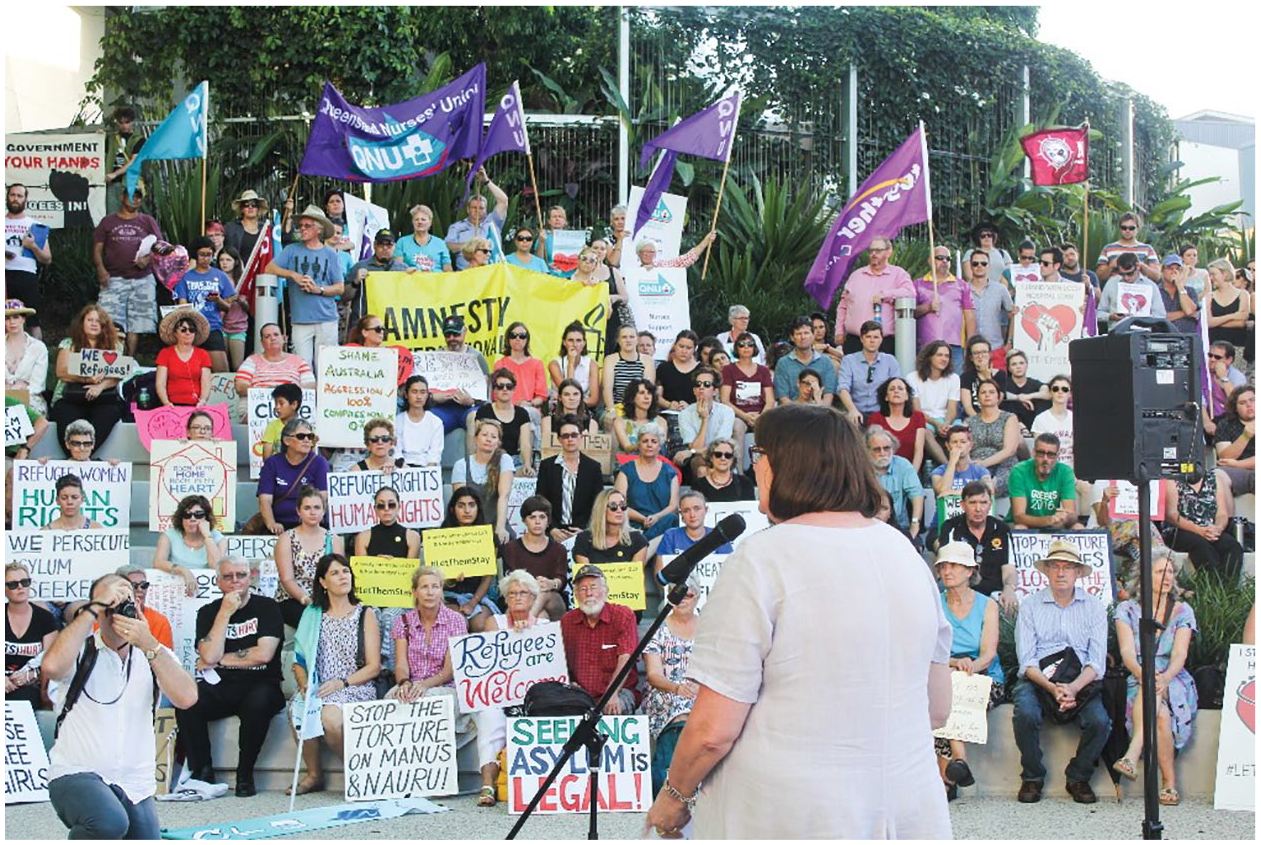
Speaker addressing protest outside Lady Cliento Hospital, Brisbane, February 2016 (provided by, and reproduced with the permission of, a participant in this research).
Finally, the notion of emotional achievement, or the idea that participating in protest creates self-affirming emotional experiences (Juris, 2008; Yang, 2000), is also strongly relevant to the community of feeling which emerged at the protests. Sandra noted, for example, that ‘none of us go to church anymore, anyway. So for our, I guess, gatherness, together, something beyond, a meaningful life that gives opportunity for that’ (interview, July 2018). For many of the protestors, the protests embodied this search for meaning and community articulated without reference to co-nationality and rather through practices which troubled and problematised the nationalist border regime of the state.
Similarly to Karakayali’s (2017) study of pro-refugee solidarity in Germany, it is critical to note that as much as there was solidarity with Asha and her family, what kept this protest going was the extent to which it developed this community of feeling with other co-citizens, and this has continued, with a range of groups including trade unions, faith organisations and pro-refugee activist groups continuing to work together locally for the rights of refugees and people seeking asylum. One group, Nurses and Midwives for Refugees and Asylum Seekers, formed as a direct result of the action. As such, the affective conditions for the emergence of micro-political post-nationalism are perhaps best understood as two concurrent threads; of (often contingent) solidarity with the noncitizen, and of re-imagined solidarity with the co-citizen. It is these concurrent threads which drove support for micro-level political action that troubled and resisted the exclusionary nationalist logics underpinning the detention of Asha and her family.
Conclusion
In this article I have drawn on the protests surrounding baby Asha in Brisbane in February 2016 to explore the affective dimensions of the practice of post-nationalism. I sought to understand the affective conditions which make possible the micro-political disruption of exclusionary bordering practices which define a national ‘us’ from a non-national ‘them’. I presented the Asha protests as a moment of such post-national resistance, and through detailed analysis of data obtained in interviews with protestors, I interrogated the character of the affective solidarities underpinning the action.
This analysis revealed the role of affect in motivating solidarity with, and political action on behalf of, the noncitizen. However, while this affect could be characterised as in part post-national, given the centrality of notions of shared humanity to many of the accounts, it was also shown to be heavily contingent on problematic perceptions of the vulnerability of Asha and her family and on the experience of empathy generated by (potentially ill-founded) perceptions of sameness. This means that the affect experienced was highly contingent on factors which themselves reproduced intersecting exclusions, and so while this affect generated a micro-politics of post-nationalism the affect itself was not necessarily, and not solely, post-national in character. Alongside this solidarity with the noncitizen, affect also functioned to construct a community of feeling as binding sentiment for protestors whose allegiances, in this instance, challenged the exclusionary structures of their own nation-state. Yet again, this community of feeling was contingent on a number of factors including the proximity of Asha as a physically present ‘other’, the wider acknowledgement of anonymous others who acted as ‘ideal spectators’ and on the possibility of emotional achievement on the part of the protestor. As such, the analysis demonstrated the dual functioning of affect to catalyse action in solidarity with both the noncitizen and the co-citizen, but in both cases it also highlighted the complexity and fragility of post-national practice as dependent on a number of intersecting, and at times problematic, affective conditions.
While this was a small study and as such does not offer the scope for generalised findings, its in-depth analysis has provided some initial indications of the functioning of affect in the practice of post-nationalism. In particular, it has provided the first threads for how we may begin to understand the affective conditions necessary for the emergence of micro-political post-national contestation. The analysis demonstrated the dual functioning of affect to catalyse action in solidarity with both the noncitizen and the co-citizen, but in both of these cases it also highlighted the complexity and fragility of post-national practice as dependent on a number of intersecting, overlapping, and at times problematic, affective conditions. These findings provide an agenda for future research to consider critically the fragile character of contemporary post-national solidarity and the role of re-imagined co-citizen solidarity in disrupting the division between national self and non-national other. Interrogating these dynamics is critically important to understanding the means by which nationalism is confronted, problematised and resisted.
Footnotes
Acknowledgements
I am grateful to the British Academy and the Centre for Critical Inquiry into Society and Culture at Aston University for their financial support for the research presented in this article. An early version of the article was presented at the Borders, Racisms and Harms symposium at Birkbeck, University of London in May 2018, and I am grateful to participants on that occasion for an insightful discussion. In addition to the anonymous reviewers of this journal, I am also very grateful to Kelly Staples, Pam Lowe and Tendayi Bloom for their comments on previous drafts, and to Amanda Beattie for helpful discussion on the micro-politics of emotions.
Funding
The author disclosed receipt of the following financial support for the research, authorship and/or publication of this article: this article was funded by the British Academy (ref. SG142335).
