




Abstract
This article is located within sociological research exploring the subjective experiences and emotional consequences of social mobility in the UK. It adds to recent attempts to examine the role of everyday cultural practices in making sense of journeys of upward mobility. The article draws on these theoretical advancements and applies them to a case study of everyday gambling practices using qualitative data (N = 24) collected from the Mass Observation Archive. The article represents one of the first attempts to examine the connections between social mobility and gambling. It draws on sociological research that explores the cultural as well as the economic underpinnings of social mobility and connects this to research examining the inter-relationships between gambling and class. By doing so, it aims to present a novel theoretical approach to the study of gambling as everyday consumer practice; one which can be understood alongside broader cultural and structural inequalities of class.
Introduction
Poor people believe there’s one shot to get rich. They put getting rich down to luck and think they can take a gamble. They also have time on their hands. My voters are too busy working hard to earn a reasonable income. (John Redwood MP, 2017)
In 2017, the British Conservative MP John Redwood denounced gambling as an unappealing affliction of the idle, feckless and work-shy poor. His comments about gambling and ‘idleness’ as the antithesis of hard work and personal determination are echoed throughout the 20th century. In 1923 a Select Committee marked gambling as a ‘detriment to productivity’ (McKibbon, 1979: 160) and the British Prime Minister Ramsay MacDonald described gambling as a ‘disease which spreads downwards to the industrious poor from the idle rich’ (McKibbon, 1979: 173). The British Prime Minister Margaret Thatcher’s reluctance to endorse a UK National Lottery under her leadership reflected her Methodist principles of thrift and hard work but also her neoliberal ideals of aspiration, entrepreneurship and talent as ‘proper’ routes to wealth and success.
Much academic research and political debate into class-based gambling focuses predominantly on the working class poor who gamble and also on the minority of ‘at-risk’ or ‘problem’ gamblers. Although gambling prevalence is highest in higher income households (Wardle and Seabury, 2013) there is very little focus within the academic literature on gambling among higher income people. Furthermore, there is currently very little research to address the everyday and ordinary-ness of gambling and to contradict assumptions around the ‘reckless abandon’ of the gambler (McKibbon, 1979: 163). I argue that a dual focus on first, the performance of everyday processes and practices on the one hand, and second, how these connect to institutional practices at the level of the structural on the other is crucial in order to fully comprehend how broader structural inequalities and processes are mapped onto everyday practice and work to provoke action (see also Kuhn, 2002; Warde, 2015). The article guards against simple pathologizing or dismissal of gambling as class-based consumption arguing instead that consumption practices are inextricably linked to the reproduction and formation of classed selfhoods (Cappellini et al., 2014; Ibrahim, 2018; O’Connell et al., 2015).
The article thus proposes new accounts of gambling practice that seek to trouble mainstream dialogues of gambling as simply irrational and pathological. This follows previous research such as Beckert and Lutter (2013) who highlight two prevailing myths around class-based gambling. The first is that gamblers lack an adequate work ethic, and the second is that gamblers are merely irrational consumers (2013). Beckert and Lutter’s study supports other research which has demonstrated that far from the popular representation of the idle and irrational gambler, working class gamblers are more likely to resist gambling expenditure if it negatively affects their household budgets (Casey, 2003, 2007). Other research has similarly found that gamblers frequently employ strategies to manage their gambling ‘identities’ and to protect the self from the dangers not only of gambling ‘in excess’ but also from drifting into new and unwanted selfhoods. Larsson for example, in his study of lottery winners in Sweden, noted active attempts not to become an ‘unfortunate winner’, whereby social identity and social relations are lost (Larsson, 2011). This can be understood, first, by considering the moral parameters that surround the ‘legitimacy’ of becoming wealthy via gambling as opposed to via hard work and talent, but also by recognizing the deeper loss of social connections that went with the old pre-wealth self. Other work has also refuted the popular myths of the ‘jet-set’ lottery winner and the reckless, desperate and irrational gambler. For example, (Casey, 2008) describes a ‘fear’ of the lottery jackpot for working class gamblers, of not ‘fitting in’, and an associated feeling of a loss of selfhood, identity and sense of belonging. Similarly, Larsson’s (2011) participants sought stable and continual identities while simultaneously achieving ‘higher levels of consumption’. They looked for ways of taming and domesticating their winnings, for example via monthly instalments. Research by Casey (2010, 2014) shows that for working class people in particular, austerity intensifies an anxious desire to be able to consume in ways that are less ‘jet-set’, conspicuous and ‘wasteful’ and more a means of confronting anxieties, everyday stresses and uncertainties around economic life.
The next section explores gambling as a key site whereby capitalist aspirations of mobility are both reproduced and contested (see also Reith, 2004) and where emotional experiences and encounters of mobility as escape and betterment alongside feelings of guilt and shame are revealed. The article explores the subjective complexities of mobility journeys by problematizing dominant, prevailing myths and discourses around mobility experiences as ‘seamless’ and ‘straightforward’ (see Reay, 2013: 665) and asks how it is that popular discourses of social mobility are interwoven into narratives of gambling. It does this via a close examination of the everyday gambling experiences of a group of upwardly mobile Mass Observers.
Mobility and Class-Based Subjectivity
Recent sociological advancements have emphasized the central role of biography, emotions and experience with class-based subjectivity. In particular, contemporary research is characterized by a renewed focus on the subjective and emotional experiences of inter-generational social mobility. This article offers a novel contribution to this literature by applying some of these key theoretical developments to a case study of Mass Observers’ everyday gambling practices within a UK context. Mass Observation is a national panel of correspondents (or ‘Observers’) who report on diverse aspects of contemporary life, offering personal and reflexive responses to these (Casey et al., 2014). Currently there are 500 people on the Mass Observation Panel, who three times a year receive a ‘Directive’ inviting them to write entirely freely about their experiences, views and feelings on a variety of subjects. This article utilizes richly detailed Mass Observation accounts to add to current research that marks a shift from economic towards cultural accounts of the subjective underpinnings of class and how these are mapped onto everyday practices.
The article argues that rather than becoming an objectifiable ‘outcome’ of structural forces of class, subjectivity is formed within everyday cultural processes. People become subjects via their everyday practices (Li et al., 2008), with change, struggle and transformation replacing fixed and static accounts of class. As Thompson (1963: 939) remarks ‘class is not a thing, it is a happening’. Kuhn (1995: 101, emphasis added) warns of the importance of exploring the effects of class on our ‘inner worlds as it conditions our life chances in the outer world’ and in their classic study, Sennett and Cobb (1972: 258) point out the ‘emotional grip’ and injuries of class.
Over the course of the 20th century, class discourses shift from class as an ascribed and fixed part of birth and upbringing, towards contemporary articulations which offer a far more reflexive and individualized expression of class position and mobility (Savage, 2007). In a related study, Casey (2014) contrasted two Mass Observation Directives about gambling from two historical periods (1948 and 2013) and found that over time, accounts of class identity and representations of a classed self shifted; by 2013 and in contrast to the earlier Directive, accounts of class and gambling revealed a deeper focus on ‘cultural value’. This concurs with work on class and cultural representation, showing that as modernity unfolds and develops, an intimate link between economic and moral value forms (Skeggs, 2004: 75) and class becomes a struggle against classification and over value. For Tyler (2015: 507, emphasis in original): The most effective forms of class analysis are concerned not with undertaking classification per se, but rather with exposing and critiquing the consequences of classificatory systems and the forms of value, judgements and norms that they establish in human societies.
This work follows Skeggs’ account of ‘revalourization’ as individuals seek ways of initiating a refusal of the stigmatizing judgements of others. Skeggs (1999: 79) notes that understandings of class tend to be fragmented, drawing on popular representations with definitions of class position frequently being pitted against an ‘imaginary other’. Thus, economies of value are a key part of the reproduction and injuries of neoliberal class-based consumption where contemporary individuals struggle over value, judgement, representation and the ‘idea’ of class (Skeggs and Loveday, 2012). This article draws on the ways in which class is structured around feelings and emotions by offering an account of the ‘lived’ relations of social inequalities (McNay, 2004).
Other research has demonstrated that the path towards upward mobility is frequently painful with working class people habitually denied the economic, cultural and social resources that are available to the middle classes. In their study exploring under-representation of working class actors in the cultural industries for example, Friedman et al. (2017) argue that middle class actors are blessed with the occupational advantage of cultural, embodied markers of class origin. Similarly, Rivera (2012) points to the cultural similarities in hiring processes which reproduce inequalities and stratification in elite professions. These accounts contradict neoliberal ideals of social mobility – that anyone can make it if they possess sufficient talent and will (Casey, 2010). Gill and Scarff (2011) establish a link between neoliberalism and consumption, arguing that in late modern societies, individuals turn to the market rather than the state to offer scope for personal transformation and self-improvement. This article uses this work as a springboard from which to problematize some of the popular narratives around neoliberalism and social mobility (Littler, 2017) that are frequently reflected in mainstream accounts of gambling.
By emphasizing the role of culture and ‘value’ in analyses of class mobility, the article argues that it is important also to recognize the intimate and personal effects of class and inequality (Mendick et al., 2015); especially how social inequalities are mapped onto and work to reproduce everyday practice. In her account of women’s narratives of class mobility, Lawler (1999: 4–5) describes how class is embedded into people’s histories and personal biographies and made real via ‘cultural mechanisms of inclusion and exclusion, of normalization and pathologization’. She describes the anxiety, insecurity and pain around class, particularly during journeys of social mobility where the shame and discomfort of inhabiting the wrong habitus without the requisite symbolic capital leads to painful feelings of inauthenticity (1999). Friedman picks up these themes and offers a novel re-reading of Goldthorpe and Hope’s classic 1974 study of British social mobility. He identifies the problem of ‘biographical illusion’, whereby some of the more problematic and painful responses to mobility were overlooked by Goldthorpe who had tended to account for mobility as straightforward and painless (Friedman, 2014: 356). In contrast, Friedman argues that self-conscious recognition of working class background, combined with a fear either real or imagined, of a loss of contact with friends and community, means that mobility was never seamless or easy. He writes: ‘People make sense of their social trajectories not just through “objective” markers of economic or occupational success, but also through symbols and artifacts of class-inflected cultural identity’ (2014: 364, emphasis in original).
Other work (e.g. Lareau, 2015: 16) identifies ‘bumps in the road’ of social mobility, and in a separate study, Allen (2014) notes how for the working class people of her study, a lack of middle class history or origin made newly upwardly mobile positions both precarious and vulnerable. Making connections between class mobility and emotions, Friedman (2015: 129) points to the absence of studies exploring how mobility affects individual experience and the ‘psychic and emotional life of the individual’. Friedman (2014: 362) adopts Bourdieu’s (1984) account of habitus as a useful means of uncovering the subjective experiences and the ‘psychological price’ of mobility. He points out that Bourdieu overlooks the extent to which habitus is ‘durable’, disrupting and altering (Friedman, 2015: 144) and exposes ‘difficult’ long-range mobility experiences including ‘a slew of hidden emotional injuries’ (2015: 144). In a similar vein, Reay (2013: 673) argues that upwardly mobile individuals are constantly vigilant to the possibility of shame, pointing out that mobility is never uncomplicatedly about ‘escape’ or personal betterment, it is also about discomfort including painful feelings of guilt and ambivalence.
Class and Mobility in the Mass Observation Archive
Here I describe my methodological choices and provide an account of the particular uses of Mass Observation Archive (MOA) in exploring subjective experiences and practices of social mobility. Mass Observation was founded in 1937 by Tom Harrisson, Humphrey Jennings and Charles Madge; a group of anthropologists and ‘literary intellectuals’ committing to waiving their ‘social privilege to share experience with the working class’ (Casey et al., 2014). The early aim of Mass Observation was to provide social facts and detail of social life that ‘could not simply be reduced to statistics’ (Hubble, 2006: 7). The intention was for research participants (‘Observers’) to write in private, without interruption about aspects of their everyday lives which had hitherto been largely overlooked by social scientists, and to make this information publicly available. Mass Observation is often credited with bringing the everyday lives of ‘the masses’ into the public domain, and to start a dialogue between the political and intellectual elites and the masses.
However, the early goal of recording working class everyday life at MOA has only been partially successful given that today, the majority of Mass Observers are estimated to be middle class (Jeffery, 1978). In an attempt to address this skew, from 2000, MOA researchers have implemented recruitment strategies in an attempt to make the MOA more representative of the general population. Although Mass Observation keeps only limited demographic data on its correspondents (Bloom et al., 1993: 13), it is nevertheless possible to make a number of inferences about the overall demographics of Mass Observers. First, we know that overall, there are more women correspondents than men; second, that correspondents tend to be over 50, although with a broad spread across the upper age range (Sheridan, 2002: 75); and third, that correspondents tend to be from higher socio-economic backgrounds. This latter feature tends to generate criticism of Mass Observation – as offering un-representative accounts of everyday life that are skewed towards the experiences of ‘middle class’ correspondents.
There are two notable problems with this critique. The first is that definitions of class derived predominantly from occupation with no reference to culture or value are misleading. Second, although the majority of Mass Observers occupy middle class occupations, many not only originate from working class backgrounds, but also continue to identify as working class despite their upward mobility (Sheridan, 1996a: 13). Contrary to assumptions about the middle class ‘privileged’ Mass Observer, Observers frequently articulate their role within MOA as being one of expressing the views and opinions of ‘the marginalised’; of those whose voices and stories are not routinely told within ‘the media’, by ‘big cheeses’ or by ‘kings and queens’ (Mass Observers cited by Sheridan, 1996a: 14).
Furthermore, other research has demonstrated that the class positions of Mass Observers are rarely fixed and static and that the MOA provides great potential to reveal the shifting and flexible everyday personal engagements with class. From this perspective, one of the key achievements of MOA has been to offer historical accounts of the shifting practices of selfhood as Observers reflect upon their journeys through various occupied positions of class including narratives of upward mobility. One of the great contributions of Mass Observation has been to provide us with a lens through which we can observe the shifting practices of selfhood. As Hinton (2010: 10) remarks, Mass Observation ‘take(s) us as close as a historian can hope to get to observe selfhood under construction’. It provides unique insights via detailed narratives of how people see themselves rather than simply how they might be seen through the eyes of a passing researcher. For Sheridan (2002: 75), Mass Observation offers a unique insight into the complex ‘contradictions of everyday life, and to the changes of people’s perceptions of themselves and the world they inhabit’.
One way in which scholars have made sense of the shifting and transformative practice of selfhood, is to describe the temporal nature of Mass Observers’ accounts. Observers frequently use their narratives to ‘think through’ their lives, often from their earliest memories through to their dreams of imagined futures. Observers are also generally mindful of ‘others’ from the future that will read their accounts. Observers thus see their contributions as part of a project of making present-day ordinary lives visible to historians of the future. For example, in the Spring 1996 Directive, an Observer writes: I am proud to be one of your writers . . . knowing that in just a small way, I am contributing to the Archives that will help students now and in the future from the ideas and views we send in. Otherwise, there might not be any comparison stored of what our life was like in our past, now and in the future.
Mass Observers remind us that positions of self that we occupy are rarely fixed and static. As Highmore (2011: 92) points out, ‘correspondents consider their (and others’) past and futures in the context of the ever-changing present’. Observers are notable for their fondness for exploring their memories and experiences of the past (Smart, 2011), and also for their ideas about the future (Kramer, 2014). That is, Mass Observation can be likened to ‘life history’ research which reveals issues ‘about memory, about the construction of identity through narrative’ (Sheridan, 1996b: 4).
Mass Observation then, is well placed to provide qualitative data exploring the inter-connections between gambling practice and subjective experiences of upward mobility. This article draws on data collected from the 2013 Directive Gambling and Households, which included questions about personal experiences and memories of gambling and also enquired specifically about routines of gambling and patterns of expenditure. It also asked Observers to comment on their particular feelings about gambling, including daydreams about winning money and also thoughts about others who had won money. Replies were received from 214 Observers. The replies were mainly very detailed – some up to 10 pages long. Rather than provide a detailed analysis of all 214 responses, a decision was made to select a smaller subsample (n = 24) of accounts chosen because they addressed explicitly the issue of gambling and social mobility across time, using autobiographical accounts. Thus, accounts that focused specifically on the topic of social mobility were selected. An attempt was made to select across a range of ages, occupations and geographical locations, although, as described earlier, the limited demographic scope of Mass Observers meant that the range was not especially wide. Table 1 summarizes the demographics of the 24 correspondents whose responses are discussed in this article:
Age, gender and occupation of mass observers.
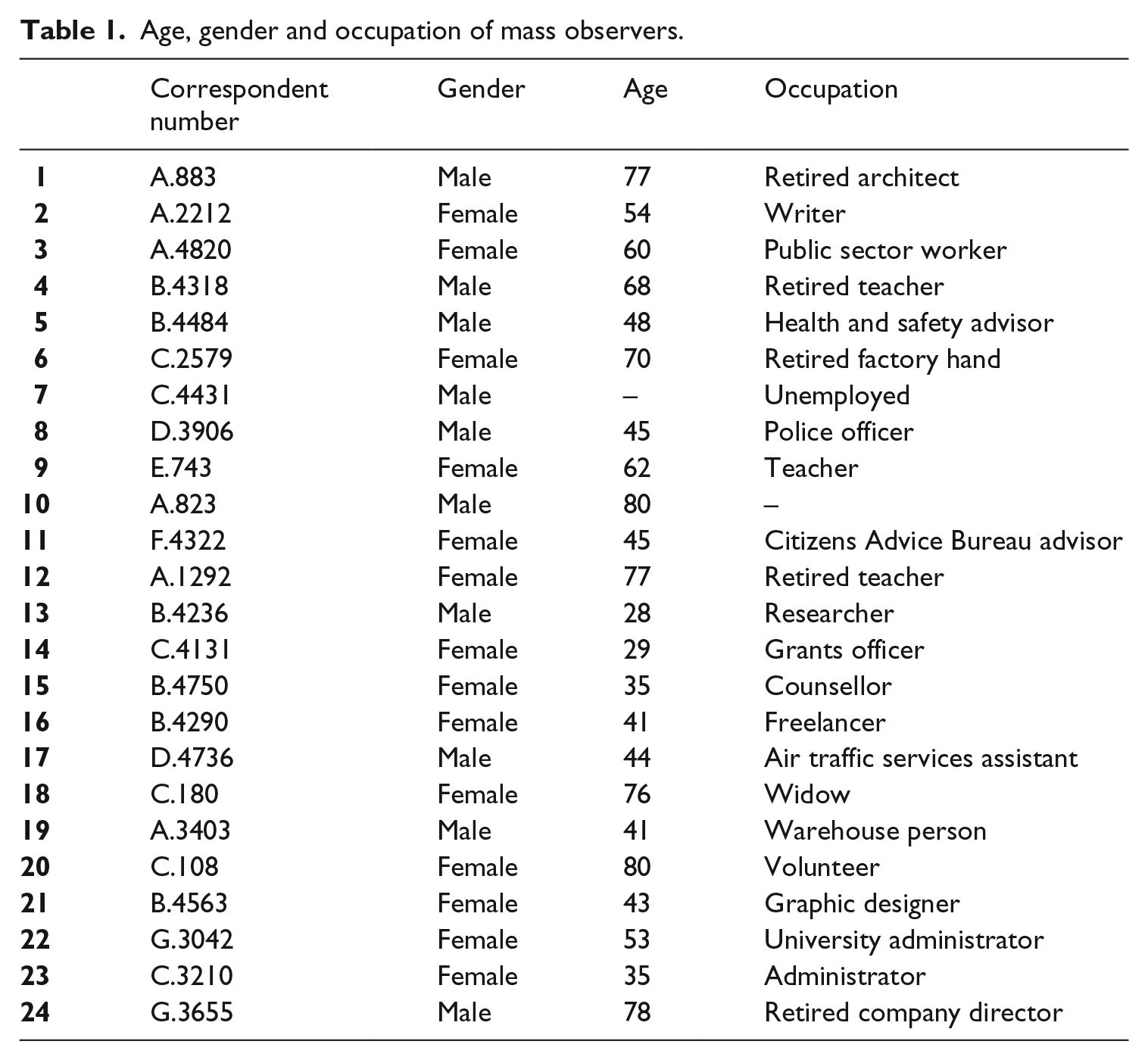
We can see from Table 1 that there were more women than men in the sample (14 women and 10 men), with a mean age of 55.6. In terms of occupation, the correspondents were mostly engaged in professional ‘white collar’ jobs, notably public sector work (n = 18) with just two in manual/unskilled work, one unemployed and just one at higher grade professional level (now retired). This gives nuance to the claim that Mass Observers are skewed towards the middle classes. For this sample at least, it seems that the majority were ‘modern professionals’ but rarely high grade professionals.
Gambling Narratives as ‘Parables of Mobility’
As regards views of class itself, the mixtures of self-justification, self-deprecation, evasion and embarrassment are not only understandable but partly justifiable responses. Class is morally problematic because of its arbitrary relationship to worth, virtues and status, and this is why it is a highly sensitive subject. (Sayer, 2005: 211)
In line with previous studies informed by Mass Observation data, the Observers who took part in this project devoted a good deal of time to describing their childhood memories of gambling. In part, this was not surprising given there was a question in the Directive which asked Observers to reflect on their earliest memories and experiences of gambling. However, this was only one out of a total of nine questions, and it was notable that Observers overwhelmingly focused the majority of their written responses here. This reflects previous research that has similarly found that Observers habitually reflect on their past experiences and especially on their personal and familial biographies and histories in order to reflect on their actions in the present. It also illustrates the importance of biography as Observers produce accounts of their upward mobility by making reference to their working class origins. Many of the Observers described how they were first introduced to gambling as children, for example Observer A.2212 whose father on a childhood trip to amusement arcades at the seaside ‘took a few coins out of his purse and showed me how the machine worked’, and Observer C.2579 who recalled that as a child, ‘every Saturday we had to keep quiet whilst the football results were read out on the wireless’. Observer C.4131 also described visits from her grandfather, which regularly involved trips ‘to see “Uncle Len”. . . which just meant going to the betting shop’ and Observer C.180 remembers ‘Charlie our milkman taking bets on horses for us’. Here, I want to unpick some of the meanings behind these stories and consider what role the detailed recollections of past experiences and observations of gambling might play in making sense of the experiences of social mobility. The Mass Observers’ accounts were not simple factual recollections of the past; rather, they were self-reflexive narratives that helped to constitute the story of upward mobility.
As described above, the Mass Observers tended to be occupationally upwardly mobile. That is, they now occupied higher social class positions, at least in terms of occupation, than those into which they had been born. Historical gambling stories were broadly synonymous with neoliberal discourses surrounding accepted and normative routes of mobility in a variety of ways. First, many of the Observers recalled traumatic and difficult memories of the effects of gambling on family life, while simultaneously articulating a self-conscious ‘distancing’ and ‘shedding’ of a past ‘that is no longer me’. For example, Observer C.4431 describes how he remembers as a child ‘when the men were all unemployed my dad and his brothers would pool their “brew” money and put them on an accumulator bet’, and Observer A.883 contrasts his own present-day gambling with the ‘reckless’ spending of his father that he witnessed as a child: ‘I have never gambled if I haven’t got the money to waste; this did not apply to my father; he’d bet his last penny as he didn’t think he’d lose.’
Similarly, other Observers made connections between childhood experiences of poverty, precarity and crime, with Observer B.4318 describing gambling as ‘probably the only illegal acts my father ever carried out’. The Mass Observers presented a pathologized version of the gambling that they were exposed to as children against a backdrop of insecurity and deprivation. As Observer B.4484 described, gambling was associated with early childhood memories of parental unemployment, poverty and familial unhappiness. He writes: ‘I’m sure his gambling was the cause of many of the arguments my parents had. We were never well-off and my dad was unemployed for years, but he always gambled.’
The quotes above mirror neoliberal discourses of mobility, in particular, ‘heroic narratives’ of ‘bootstrapping’ (Sayer, 2005: 202) whereby individuals who possess the requisite talent and/or skill can unproblematically transcend their working class origins. The bootstrapping parable and meritocratic fantasy have long been popularized in mainstream culture, which celebrates the ‘rags to riches’ fable of the ‘working class hero’ (e.g. Littler and Couldry, 2011). The difficult origins described in these accounts offer additional nuance to previous studies of habitus and the emotional imprint of class that have presented habitus as durable; as a set of cultural dispositions that we carry with us through life (Friedman, 2015; Lawler, 1999). In contrast, here we see a self-conscious shedding and distancing of a self that ‘is no longer me’. In these examples, the Observers offer insight into the inter-generational effect of social and economic mobility. They offered a self-conscious and reflexive expression of their upward mobility, using their narratives as a contrast to illuminate these trajectories. For example, Observer E.743 who explains ‘my dad loved a bet on the horses – it was a typical working class pastime after all’. In contrast with other work, there was less shame associated with working class pasts, and more pride in re-telling difficult pasts that help to illustrate ‘how far I have come’ and to have ‘made it against the odds’. This was a way of dispelling the discomfort often internalized by working class people and experienced as ‘self doubt and lack’ (Allen, 2014: 776). Often, these psychic reflections of the past were articulated with a good-humoured nostalgia in the re-telling of stories. For example, Observer D.3906 describes trips as a child to the bookies with his uncle who ‘always took away small strips of paper which I later learned were betting slips – and he always kept them in his shoe!’ and Observer A.4820 who remarks: My father did the football pools every week during the 1960s . . . I think that Dad may have had a system for completing his coupon probably based on birthdays and house numbers (because) he could not read or write but he could check his coupon.
This concurs with other work exploring biographical accounts of the painful and unsteady routes to upward mobility. For example, in the Sayer quote opening this section, a range of dispositions including self-deprecation is highlighted as a self-conscious response to class position and the moral sensitivities around class ‘worth’ and ‘value’. The Observers resisted moral judgements of others around their working class pasts, resisted being categorized or ‘fixed’ into place and importantly, were very conscious of their shifting class positions. Their accounts of working class, precarious childhoods emphasized not only their class positions in flux, but also worked to evidence their stories of aspiration and betterment. They helped to fix the Observers as ‘worthy’ neoliberal citizens; as agents of aspiration and mobility, with, as in the examples cited here, gambling as a metaphor for a culturally bereft past from which the Observers sought to distance themselves: ‘The bookie in our village was in a dark, grey and smoky building. More often than not the kids were told to wait outside for what seemed like hours on end’ (Observer C.4431).
The adjectives used in this example (‘dark’, ‘grey’ and ‘smoky’) and in other examples such as Observer A.1292’s dismissal of ‘scruffy’ betting shops, help to reproduce childhood memories of gambling as parables of mobility. The quotes reveal the relationships between class, culture and social mobility and the everyday subjective experiences of upward mobility. Observers’ narratives of the past held a cultural significance that was managed within the discourses in two key ways. First, in terms of a conscious distancing and shedding from traumatic experiences of the past and second, via an articulation of pride in how far they have come. Neither of these positions is far from conventional narratives of neoliberalism and meritocracy. Bourdieusian accounts of mobility have tended to focus on the ways that habitus endures, making the journey from working to middle class painful as upwardly mobile people are caught between two worlds (Lawler, 1999). However, in The Weight of the World, Bourdieu (1999) argues that habitus is more malleable than is represented in his earlier work and points to a more flexible account of habitus whereby the upwardly mobile take on and adapt the habits, tastes and dispositions of the upper classes. From this perspective, habitus is conscious and strategic especially during times of personal ‘crisis’ such as throughout mobility processes (Bourdieu and Wacquant, 1992). This helps to make sense of the Observers’ vocal accounts of distance (or ‘clivé’) by rejecting their working class origins and simultaneously defending their moral worth. The following section looks more closely at the notion of a ‘divided habitus’ and particularly the painful and psychic cost of ‘changing habitus’ (Skeggs and Loveday, 2012) as Observers describe their attempts to assimilate into elite groups.
Gambling Narratives and Discourses of Meritocracy
In the previous section, I explored how habitus in the narratives of the Mass Observers was flexible. Observers used their narratives of childhood gambling experiences in order to ‘cast off’ and distance themselves from working class pasts. In this section I say more about how these class-based histories and stories linger. I will consider the ways in which ‘distancing’ underpinned action in the present, and how through present-day gambling narratives, Observers sought to cement new identities, distinct from the habitus of their childhoods. I argue that this process was less about being stuck between two conflicting worlds, and more about a self-conscious adopting of a new habitus.
The stories of economic hardships that were exacerbated by excessive gambling practices, were strongly intersected with discourses of alternative, present-day gambling. There was a self-conscious attempt by the Observers when asked about their gambling routines, practices and experiences, to distinguish these from the pathologized accounts of the type of gambling to which they had been exposed as children. Discourses around gambling offered a means of presenting a respectable version of upwardly mobile middle class selves that were distinct from both the economic and cultural markers of their working class childhoods. The Observers achieved this in two key ways. First, through describing ‘legitimate’ routes to economic mobility and second, through presenting a set of cultural tastes that chimed with middle class ‘signs and symbols of power’ (Bourdieu, 1984: 282).
Despite the positioning of gambling as synonymous with childhood trauma and anxiety, all of the Observers gambled, although with varying degrees of regularity. Given the dominant narratives and moral framing around gambling discussed earlier, as associated with deepening poverty, greed and disreputable routes to wealth, the Observers were tasked with the burden of producing accounts of their present-day gambling which were distinct from these discourses. Recent mainstream neoliberal narratives of meritocracy emphasize notions of aspiration, hard work and ‘natural’ talent as being the markers of mobility, value and success, with gambling, an activity requiring neither skill nor labour presented as the opposite. For the following Observer who plays the National Lottery every week, gambling contrasts directly with meritocratic principles of ‘hard work’. Here, winning money through gambling is described as ‘cheating’; as an illegitimate and value-less route to upward mobility: I don’t [talk to others about dreams of winning money]. I think it would be almost indecent. It’s weird. Sometimes I wish we had more money but I think that we have to continue to work hard to get it. Get promotion etc. I think that winning it means cheating almost! (Observer B.4750)
In common with the others, the Observer above traces her own story of upward mobility alongside her ‘hard work’, which along with ‘promotion’, she cites as a legitimate route to economic mobility. It is clear that despite being upwardly mobile and occupying a middle class occupation, she remains haunted by a concern over economic insecurity (‘I wish we had more money’). Partly this is related to anxiety and stress around maintaining economic stability where, contrary to those hailing from middle class backgrounds, there is no economic ‘safety net’. The chance of winning money through gambling offers the (unlikely) possibility of permanent financial security, but this comes alongside the reality acknowledged by the Observers that this would never be considered a culturally legitimate escape route. This is compounded by the above Observer’s assertion that merely daydreaming or talking about winning money would be ‘indecent’; synonymous with ‘tasteless’ and valueless cultural attitudes towards money and wealth.
Other Observers expressed their distaste towards gambling in different ways. Subject to particular derision was the National Lottery and especially its role as a revenue raising device. In support of his decision not to purchase lottery tickets, Observer D.4736 explained his perception of the National Lottery as a means of ‘swindling’ the vulnerable poor in order to fund essential public services. In contrast, the upwardly mobile middle class Observers tended to sympathize with similar projects, although importantly, not the way that they were funded via gambling revenue. For Bourdieu (1984: 44), ‘appreciation’ of arts and culture is dependent on subjective experiences, biographies and histories, with assessment of value made by individuals who ‘apply to them the perpetual schemes of their own ethos’. The same is true for the following Observer (D.4736) who articulates an empathetic response to the plight of the poor alongside a critique of the marketization of public spending; not only did he grow up poor, but he also benefitted from the post-war public spending that assisted his upward mobility: The National Lottery leaves me cold. I regard it as a tax on the poor as the majority of players come from lower-income social groups. It is distasteful that as a society we cannot support certain groups and projects, ‘good causes’ without this weekly pantomime.
The expressed disgust at winning money in this way (‘distasteful’ and a ‘pantomime’) presents a sentiment opposed to mainstream neoliberal accounts whereby commerce and individual accountability is put forward as a solution to austerity. Here, political tastes articulated through gambling narratives function as markers of class with class position and experience both past and present connected to attitudes towards gambling.
The Observers went to lengths to distinguish their gambling from the popular representations of the pathological, irrational and ‘out of control’ gambler. For example, Observers F.4322 and B.4236 both deride online gambling as ‘the lowest form of gambling’ (F.4322) and Observer A.3403 remarks ‘I hardly ever gamble’ and that ‘you should only gamble what you can afford to lose’. Similarly, Observer C.108 insisted, ‘I wouldn’t gamble if I could not afford to lose and certainly would not get into debt by doing so’ and said that she is ‘more likely to gamble if I have more money not less’. These comments reflect an attempt to avoid the risk of drifting into new, undesirable selfhoods associated with excessive, irresponsible spending. Similarly, the Observers frequently expressed sentiments that set their gambling experiences apart from ‘jet-set’ and ostentatious displays of wealth typically associated with the stereotyped National Lottery winner. That is, the journey to middle class upward mobility that they sought to narrate was one that adhered to neoliberal normative values of hard work and thrift, as opposed to economic wealth as a consequence of gambling. Describing a family member who has made her wealth through gambling, Observer B.4290 illustrates the importance of ‘taste’ in the struggle over value: My husband’s niece is currently in a relationship with a young man whose family made their money from gambling: in an amusement arcade in a seaside resort. This family have branched out into a fish bar and a restaurant since then, but it’s perfectly clear where the money has come from. Their arcade is stuffed with fruit machines and other tacky paraphernalia, all pre-programmed to separate punters from their cash, for not very much in return. Talk about getting your money for nothing.
Here, the Observer notes her disgust at her relative’s refusal to ‘cover up’ their gambling as a source of wealth. Observers commonly distanced themselves from consumption that they defined as ‘conspicuous’, ‘flashy’ or, as in the quote above, ‘tacky paraphernalia’. This supports earlier research around the subjective experiences of mobility, where a lack of middle class origin can perpetuate feelings of instability and precarity and where value judgements of ‘others’ who are ‘culturally lacking’ operate as a cultural mechanism of exclusion (Lawler, 1999). In contrast to the flamboyant displays of wealth described above, the Observers’ dreams of winning money through gambling and particularly the National Lottery, were generally more mundane and more of an opportunity to remove some of the everyday stress and anxiety surrounding the precarity of their altered class positions. Paying off mortgages was frequently cited (C.3210) along with ‘looking after’ relatives (C.3210) and paying for annual holidays (C.4131). Resistance to ostentatious displays of wealth was common, as described by Observer G.3655 who imagines an alternative to the customary high-publicity of the champagne cork-popping, giant cheque display of lottery winners: If we did win a large sum on the lottery what I would love to do is wait until all the press was at my door. A large bottle of champagne would be produced. They would ask us to shake the bottle and squirt it round so they could take the normal boring photographs. I would politely accept the bottle with thanks explaining that we would drink it later.
As the quotes above demonstrate, gambling for the Observers was less about the ‘big win’, which in fact provoked significant fear and anxiety in terms of perceived judgements of cultural legitimacy. On the contrary, daydreams around monetary wins via gambling were more to do with easing everyday anxieties and uncertainties around elevated class positions.
‘Status Anxiety’: Gambling and Social Networks
In this final analysis section, I want to move on from discussions of economic and cultural capital as associated with the experience of gambling against the backdrop of social mobility. Here I focus on ‘status anxiety’ and the role of gambling as both reaffirming and potentially threatening to social networks and social relations. First, then, Observers frequently described ways in which gambling contributed to a feeling of ‘belonging’ that was closely entwined with notions of selfhood and identity. This offers nuance to earlier accounts which have tended to focus on individualized interpretations of gambling practice and have overlooked the importance of gambling ‘communities’ and broader relationships between gamblers. The Observers frequently reflected on the ways in which part of the seductive appeal of gambling lies in opportunities to gamble with others, as part of a group (A.823). Observers were frequently members of lottery syndicates at work (B.4563), and described this as part of belonging to a wider community. Observer A.2212 describes participating in ‘a sort of gambling’ programme on late night television and the allure of ‘joining in with other people’. She explains: ‘I think perhaps the false sense of community, the impression that the presenter was a sort of . . . friend . . . contributed to a feeling of joining in and belonging, and that was a big temptation to participate.’
For individuals who experience significant social mobility as they move between classes, ‘belonging’ holds a particular importance as membership of a given group is rarely taken for granted or seen to be secure. The Observers regularly described a fear of ‘being out of place’ and an acute awareness of the ‘emotional injuries’ of social mobility. In addition, the Observers recognized a connection between economic wealth and feeling part of a given social group. As one Observer explained, playing in a work-based lottery syndicate, is not only a ‘communal activity’ and an opportunity to have a collective ‘moan’, it also offers longer-term security as to membership of a given social group (G.3042). That is, participating in the syndicate removes the possibility of loss of contact with friends and community in the event of a big win; a fear that as Friedman (2014) argues, is familiar among upwardly mobile individuals. As Observer G.3042 elaborates: I enjoy the interactions around it, seeing how other people react to it etc. and if we did win, I would want to be part of that group still – it’s more about that for me; if everyone else was suddenly a millionaire I would want to be also.
The Observers’ narratives support previous research illustrating the ways in which economic mobilities often pose a threat to social networks and social relations making the journey of upward social mobility a frequently painful one. We have already seen how gambling acts as a response to feelings of precarity around upwardly mobile class positions; here gambling with others acts as an opportunity to protect social relations, both via the communal act of gambling and also as means of ensuring a sense of belonging to a given social group.
Conclusion
Gambling is frequently pitted as the lowest form of popular culture. It has long been disdained as irrational, deviant and importantly, hindering the spirit of aspirational mobility. In this article, I have demonstrated some of the ways in which middle class Mass Observers via their narratives of gambling offer a novel insight into the subjective markers of social mobility. I make no claims to ‘fix’ or categorize the social class positions of the Observers. Instead, by making use of limited information held on demographics of the Observers, their own accounts of their class mobility and the wider body of research examining Mass Observers’ accounts as flexible practices of classed selfhoods, the article reveals untapped feelings and experiences of social mobility, including some of the status anxiety surrounding their upward mobility. The article taps into previous research exploring the relationships between identity, selfhood and belonging in gambling (Larsson, 2011), but also offers new innovations by providing a particular focus on upwardly mobile middle class gamblers. It examines how the journey of upward mobility is documented and expressed in gambling narratives, considering how these broadly echo neoliberal discourses surrounding accepted, normative routes of mobility in a variety of ways. These include, identifying culturally acceptable routes to wealth such as ‘hard work’ and ‘talent’ as opposed to gambling; discretion around discussing money, especially money won through gambling; and a vocal resistance and disgust towards conspicuous displays of wealth, particularly gambling accumulated wealth. Observers frequently identify ‘culturally lacking’ others from their pasts and present; this serves a dual purpose of exclusion of value-less others on the one hand, and cementing their own middle class selfhoods on the other.
The article also offers additional nuance to studies which have revealed the anxiety, insecurity and feelings of ‘lack’ among upwardly mobile people whereby a specific habitus and symbolic capital is not fully inhabited (Lawler, 1999), and the process through which a self-conscious recognition of working class background means that journeys of mobility are rarely seamless or easy (Friedman, 2014). The Observers wove their working class pasts into their narratives of mobility. These ‘lingering’ and revealing versions of the past helped to guard against the shame of exposure. The Observers, via their discourses of gambling, seek to evade judgement and devaluation, first by creating distance between the ‘then’ and ‘now’, and second, by working to identify and distinguish themselves from culturally devalued ‘others’. In conclusion, this article has shown how Mass Observers’ narratives of everyday gambling serve as an example of the everyday construction of class. By analysing these individual expressions and articulations of class position and mobility, the article adds to previous research that demonstrates how class-based subjectivity is formed and re-formed within everyday cultural practices.
Footnotes
Acknowledgements
Thanks are due to participants at the Everyday Participation conference 2018, at Manchester University who provided stimulating discussions following a presentation of the research findings. Thanks also to the generous and helpful comments from the three anonymous referees and to Dr Dave O’Brien who offered invaluable feedback on an early version of the article.
Funding
The author disclosed receipt of the following financial support for the research, authorship and/or publication of this article: The research was funded by the Economic and Social Research Council (Gambling and Households: New Gambling Directive at Mass Observation Archive, RES-000-22-4314).