




Abstract
This article investigates the (dis)embeddedness of digital labour within the remote gig economy. We use interview and survey data to highlight how platform workers in Southeast Asia and Sub-Saharan Africa are normatively disembedded from social protections through a process of commodification. Normative disembeddedness leaves workers exposed to the vagaries of the external labour market due to an absence of labour regulations and rights. It also endangers social reproduction by limiting access to healthcare and requiring workers to engage in significant unpaid ‘work-for-labour’. However, we show that these workers are also simultaneously embedded within interpersonal networks of trust, which enable the work to be completed despite the low-trust nature of the gig economy. In bringing together the concepts of normative and network embeddedness, we reconnect the two sides of Polanyi’s thinking and demonstrate the value of an integrated understanding of Polanyi’s approach to embeddedness for understanding contemporary economic transformations.
Introduction
The spread of the Internet to three-and-a-half billion people has helped to give rise to a diverse range of outsourcing practices. An important recent development is the adoption of platforms that enable global outsourcing by bringing millions of clients and workers together to exchange money for labour in the form of digital gigs (Kuek et al., 2015). A World Bank study estimates that such platforms had annual revenues of $4.8 billion in 2016, and that these will have grown to $15–$25 billion by 2020 (Kuek et al., 2015). These new outsourcing techniques represent a new way in which the ‘fissuring of the workplace’ (Weil, 2014) is taking place and have been an important component in the growth of what has become known as the ‘gig economy’.
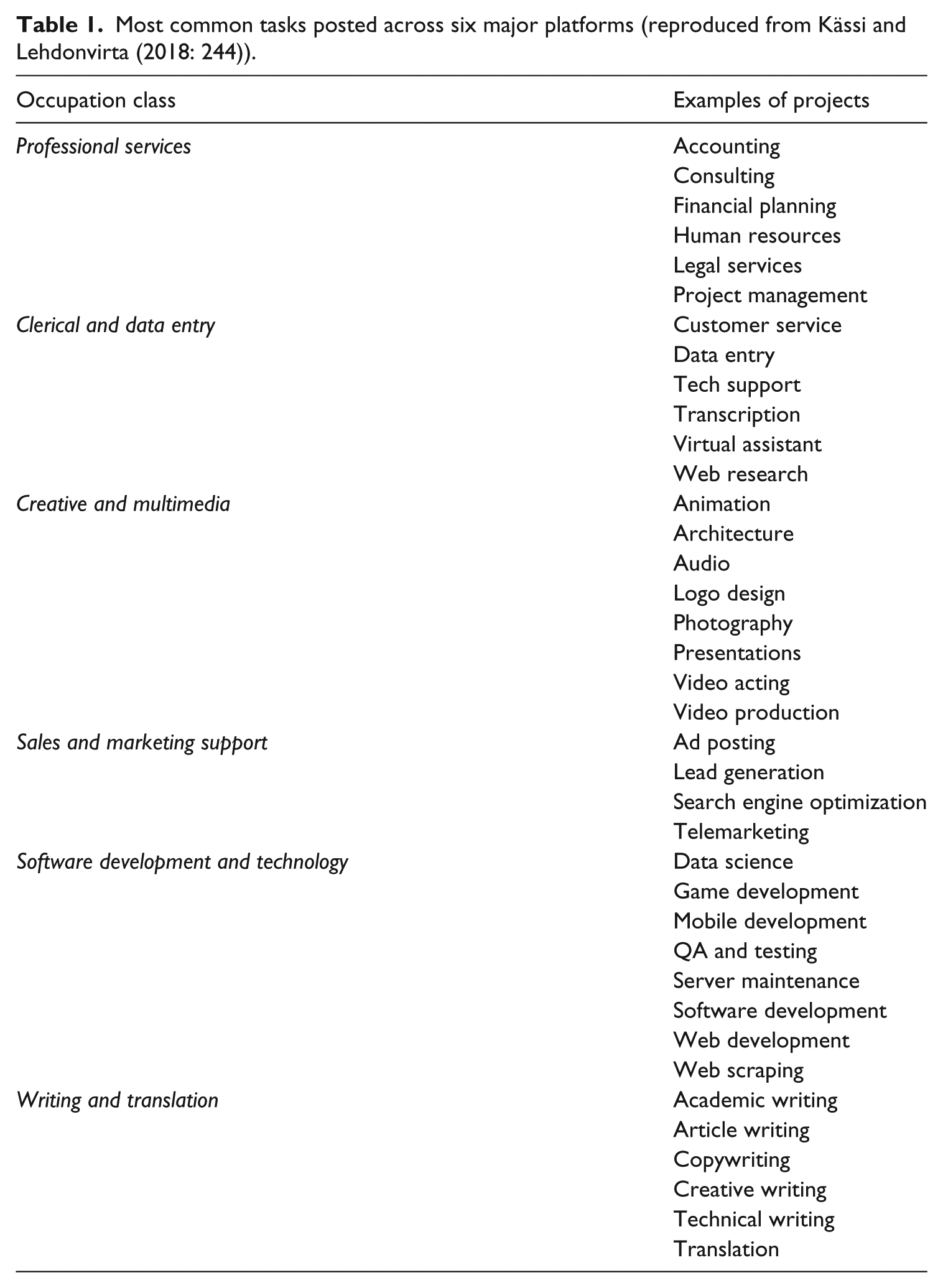
The gig economy consists both of work that is transacted via platforms but delivered in a specific locality and of platforms that enable remote working (Wood et al., 2019). Examples of platform work in the local gig economy are transport and food delivery, while remote gig work consists of the non-proximate provision of a wide variety of digital labour, ranging from data entry to software programming (see Table 1). Kässi and Lehdonvirta (2018) estimate that use of remote gig economy platforms is growing at an annual rate of 25%. Some commentators even suggest that within the next decade every one in three labour transactions will be mediated by such labour platforms (Standing, 2015). The growth of these new gig economy practices raises important questions regarding how these emerging economic activities are best understood in sociology (Howcroft and Bergvall-Kåreborn, 2018). In this article, we focus on elucidating an original understanding of the (dis)embeddedness of digital labour in the global gig economy. In doing so we highlight the commodification of labour in this emerging sector and how workers are embedded within interpersonal networks based on trust. Our findings demonstrate the conceptual value of an integrated understanding of Polanyi’s approach to embeddedness.
Most common tasks posted across six major platforms (reproduced from Kässi and Lehdonvirta (2018: 244)).
The intellectual heritage of embeddedness lies in the work of Karl Polanyi. Embeddedness has become a key way in which economic practices have been conceptualised and understood in sociology. However, Polanyi used embeddedness in two contradictory ways. At times he focused on the disembedding of labour, land and money from societal-level legal, normative and cultural constraints to exchange through the process of commodification (Block, 2001; Bolton and Laaser, 2013; Burawoy, 2010; Harvey, 2014; Kalleberg, 2009; Strangleman, 2017; Webster et al., 2008). We follow Greer (2016: 165) in defining the process of labour commodification as: ‘any institutional change that reinstates the discipline of labour market competition on workers, whether in or out of work and whether through reforms to welfare states, industrial relations, or labour markets’.
In an apparent contradiction, Polanyi also forcefully argues in other places that all economic activity is always ‘embedded and enmeshed in institutions economic and non-economic’ (Polanyi, 1957: 250). Peck (2013) refers to this as ‘soft Polanyi’; that is, the enmeshing of exchange within institutions, as opposed to Polanyi’s more critical and radical ideas regarding commodification, which Peck terms ‘hard Polanyi’. In this article, we apply embeddedness to the new setting of digital labour in the remote gig economy. 1 In doing so, we explore two influential elaborations of Polanyi’s original concept.
The first is the soft-Polanyi influenced network embeddedness of Granovetter (1985). Granovetter developed a convincing micro-level explanation of how exchange is always embedded within institutions. According to Granovetter, exchange is embedded within interpersonal trust networks built upon personal interactions. This approach to embeddedness has proven extremely influential in both new economic sociology (Bair, 2008; Hess and Coe, 2006) and global production networks (GPN) research (Henderson et al., 2002).
The second elaboration of embeddedness is the hard-Polanyi equation of embeddedness with de-commodification, which has become influential over the last decade in labour sociology (Burawoy, 2010; Kalleberg, 2009; Webster et al., 2008). For instance, Polanyi’s account of commodification featured heavily in Kalleberg’s (2009) Presidential Address to the American Sociological Association. 2 We demonstrate the value of both approaches to embeddedness for understanding the gig economy. However, we contend that sociology has not yet fully recognised the existence of these two sides of Polanyi’s thinking, and thus risks focusing on network embeddedness while paying insufficient attention to the commodification of labour. Therefore, the main theoretical contribution of this article is a demonstration of the value of an integrated understanding of Polanyi’s theorisation of embeddedness for analysing contemporary economic transformations. We also contribute to the empirical literature on the gig economy with mixed-methods data from two understudied geographic regions.
Embeddedness: Soft and Hard Polanyi
Network Embeddedness
Embeddedness has been the source of much conceptual confusion due to Polanyi having used the term in the two contradictory ways outlined above (Block, 2001; Gemici, 2008). The most influential attempt to elaborate on the concept is that of Granovetter (1985). Granovetter seeks to provide a middle way between what he argues is the under-socialised view of neo-classical economics and what he considers Polanyi’s over-socialised focus on macro-institutions. Granovetter argues that Polanyi’s approach relied on an appeal to the influence of internalised norms or shared values rather than the effects of individual action (Bair, 2008). He therefore seeks to provide concrete micro-foundations for embeddedness in the process of networked trust building. As economic actors have information about their own ‘quality’ that others need, a bilateral asymmetry exists – and as people generally prefer to learn about one another from personal sources and communications that they trust, exchange tends to become embedded within personal networks (Granovetter, 2005). This form of embedding essentially takes place through the generation of interpersonal trust networks built through micro-level interactions. We follow GPN researchers in referring to this understanding of embeddedness as network embeddedness. 3
Hess (2004), a leading GPN theorist, accepted Granovetter’s elaboration and argued that it helped explain how economic action was embedded within networks and territories. But he also argued that it led to an ‘overterritorialised’ account of embeddedness, and sought to add another dimension that better accounted for the manner in which economic action was influenced by the social. Through an engagement with Polanyi’s original work, Hess (2004) highlights the importance of what he terms societal embeddedness, and argues that this understanding of embeddedness complements Granovetter’s network-based embeddedness (Bair, 2008). Societal embeddedness refers to the ways actors are influenced and shaped by the institutional, social and cultural heritage and context in which they are located (Hess, 2004; Hess and Coe, 2006). Particular importance is placed upon state policies and legal frameworks and how a lead firm’s origin and heritage can shape the entire GPN (Burt et al., 2016). For instance, in a recent study of crowdsourced work, Schwartz (2018) highlights the manner in which US-based computer game artists, designers and programmers are embedded within occupational communities. Such work is important in highlighting the societal dimension of embeddedness and in rectifying overterritorialised accounts.
However, both Granovetter (1985) and Hess (2004) ultimately only engage with the ‘soft’ side of Polanyi’s thinking. This is problematic, because as Gemici (2008) points out, the soft-Polanyi understanding of embeddedness is more a methodological principle than a theoretical proposition: it invites the researcher to look for social processes that shape economic life, but does not itself necessarily constitute a causal process or mechanism. Empirical studies based only on this understanding can fall into the trap of offering embeddedness as a ‘general answer to specific problems’ (Beckert, 2007: 10). Without denying the importance of Hess’s societal embeddedness (Hess, 2004; Hess and Coe, 2006), we therefore next highlight an alternative hard-Polanyi form of societal embeddedness. To distinguish it from extant uses of the term societal embeddedness, we term it ‘normative embeddedness’.
Normative Embeddedness and Commodification
In contrast to the two elaborations above, much labour sociology, as well as recent theoretical work by geographer David Harvey, has focused on Polanyi’s understanding of embeddedness as relating to commodification. Central to Polanyi’s ‘hard’ conception of embeddedness was the commodification of labour, the environment and money, which Polanyi argued to be ‘fictitious commodities’ (Block, 2001; Bolton and Laaser, 2013; Burawoy, 2010; Harvey, 2014; Kalleberg, 2009; Webster et al., 2008). The reason that labour, the environment and money were considered fictitious rather than pure commodities (as neo-classical economics suggests) is because they are not produced for the market, and thus treating them as if they are is seen to destroy their essential character (Burawoy, 2010). For instance, treating labour as a factor of production rather than as a human quality can lead to working conditions that are harmful to the very people who embody that labour. Similarly, the treatment of houses not as homes but as financial assets, in combination with the use of money for speculation rather than exchange, has been blamed for the destitution and bankruptcy wrought by the sub-prime mortgage crisis and the Great Recession (Harvey, 2014).
A hard-Polanyi (1944/2001) approach to embeddedness highlights how capital and the state must go to great effort to break fictitious commodities free from the ‘broader flows of cultural life and living matter’ (Harvey, 2014: 58). This is achieved through the destruction of collective norms, 4 so as to leave them free-floating within a self-regulating market (Harvey, 2014; Polanyi, 1944/2001). As the fictitious commodities of labour, the environment and money are increasingly treated as if they were ‘pure commodities’, hard Polanyi argues that they become disembedded from the society which sustains them and their essential character and use value is destroyed (Burawoy, 2010).
This understanding of normative embeddedness has been influential in labour sociology, where it has been drawn on to highlight the pendulum-like process of de-commodification/re-commodification
5
of labour (Burawoy, 2010; Fudge, 2017; Kalleberg, 2009; Webster et al., 2008). According to this Polanyi-inspired framework, during the period 1940–1980, in high-income countries, labour (as well as money and land) was increasingly ‘de-commodified’ due to its embedding in various institutional interventions (particularly firm internal labour markets, welfare states and strong trade unions) which loosened the disciplinary power of labour market competition (Esping-Andersen, 1990; Fudge, 2017; Greer, 2016). However, since the 1980s, labour market reforms have attempted to reverse this effect and reinstate labour market discipline, a process termed ‘re-commodification’ (Offe, 1984). According to this influential account, the pendulum has swung from commodification to de-commodification and back again. The commodification of labour threatens its social reproduction, as: ‘labour power’ cannot be shoved about, used indiscriminately, or even left unused without affecting also the human individual who happens to be the bearer of this peculiar commodity. In disposing of a man’s labour power the system would, incidentally, dispose of the physical, psychological, and moral entity ‘man’ attached to the tag […] Robbed of the protective covering of cultural institutions, human beings would perish from the effects of social exposure [and] social dislocation. (Polanyi, 1944/2001: 76)
The rest of this article uses a study of the remote gig economy in Southeast Asia and Sub-Saharan Africa to empirically demonstrate the value of both network and normative (dis)embeddedness in understanding contemporary economic transformations. Our research question is, in what ways is labour in the remote gig economy (dis)embedded? In particular, does labour in this setting exhibit network and/or normative (dis)embeddedness?
Research Strategy
Empirical Setting
Remote gig economy platforms have become increasingly important nodes within global outsourcing networks (Graham et al., 2017a, 2017b). These platforms act as market intermediaries that significantly reduce the overhead costs of outsourcing and offshoring by providing an architecture for cheaply identifying and contacting workers, and a standardised means to contract and pay them. Moreover, transparent pricing mechanisms make contracting costs simple to calculate. This lowering of overhead costs opens up the possibility for small firms to outsource and offshore small-scale and fragmented digital tasks. As shown in Table 1, online gig work includes a wide variety of informational services, ranging from data entry to software programming (Kässi and Lehdonvirta, 2018). Outsourcing platforms typically extract value through charging workers and/or clients service fees of 10–25%.
The global gig economy is a relatively new economic practice, and little is currently known of the embeddedness of this sector. However, Wood et al. (2019) demonstrate that the manner in which gig economy platforms operate can result in low pay, social isolation, working unsocial and irregular hours, overwork, sleep deprivation and exhaustion. Shevchuk and Strebkov (2018) highlight that embeddedness may be a fruitful framework for further exploring outcomes such as these. They investigate the network embeddedness of clients and workers in the remote gig economy and the consequences this has for client-side opportunism, but do not consider societal conceptions of embeddedness. Examining both network and societal embeddedness requires rich and wide-ranging data.
Data and Analysis
We draw primarily on two data sets. The first consists of 152 face-to-face semi-structured interviews with workers and stakeholders. We interviewed 27 stakeholders, comprising government and non-governmental organisation (NGO) officials and representatives of remote gig economy platforms, and 125 workers: 45 workers in Southeast Asia (16 in the Philippines, eight in Malaysia, 21 in Vietnam), and 80 workers in Sub-Saharan Africa (38 in Kenya, 23 in Nigeria, 19 in South Africa). Interviews were conducted during seven months of fieldwork in Southeast Asia and Sub-Saharan Africa in 2014–2015. These regions were selected due to theoretical and practical concerns. First, as work in the remote gig economy can, in theory, be undertaken anywhere, most of the remote gig economy workforce is located in the Global South (Graham et al., 2017a; Lehdonvirta, 2017). Yet there is a general lack of research investigating experiences of workers in such countries – especially in Sub-Saharan Africa. For instance, job quality research predominantly focuses on the Global North (Wood et al., 2019). Second, these specific Asian and African countries were chosen as they were believed to be home to many remote gig workers, and as a result of practical considerations such as public infrastructure, local contacts and language.
Worker participants were recruited via listings on four of the largest platforms and were shortlisted based on a range of predefined sampling criteria, including types of work performed, feedback profiles, platform membership duration, hourly rates, gender and location. The main sampling goal was to ensure varied representations of primarily low-skilled labour experiences in the countries of interest. These interviews were transcribed and coded following Vaughan’s (1992) theory elaboration approach. Nvivo enabled systematic theoretical coding to be undertaken and hundreds of initial codes to be generated. Focused coding was then employed to highlight the most common and revealing initial codes and to merge appropriate initial codes into new higher-level codes, as suggested by Charmaz (2006). Further details regarding our approach to mixed methods, interview sampling, recruitment and interview protocol can be found in the methodological appendix to Lehdonvirta et al. (2019).
The second source of data comes from a survey of 656 online workers located in Southeast Asia and Sub-Saharan Africa. These workers were recruited through the posting of a survey (lasting approximately 30 minutes) as a job task paying $3 on two of the largest online outsourcing platforms. Workers from Southeast Asia or Sub-Saharan Africa who had been active in the last two months and who had completed at least five hours of paid work or who had five or more reviews were invited to complete the survey. Invitations were targeted to achieve a spread of nationalities, gender and skills. The result is similar to a stratified or quota sample, except that the subsample sizes were not predefined but depended on how easy or difficult it was to find members of each subpopulation on the platform. The result is likely to be more representative of the population than samples recruited simply by posting an open task because it mitigates self-selection biases from task type preferences and reservation wages. The response rates to our survey job invites were 30% and 7% on the two platforms, respectively. When compared to what might be considered typical in conventional social surveys these rates are low, but they can be considered an improvement on much Internet survey research that relies on respondents self-selecting (meaning a response rate cannot be determined). We obtained 853 responses, of which 197 were excluded due to not being located in Southeast Asia or Sub-Saharan Africa, not having completed the modules related to embeddedness, or failing an attention check.
In the sections below, we combine findings from these two data sets by using the interview data to generate insights about embeddedness, and the survey data to support the generalisability of these insights beyond the interview participants.
Findings and Discussion
Network Embeddedness
In this section we consider the network embeddedness of labour in the remote gig economy; that is, the degree to which the purchasing of labour power is shaped by interpersonal networks of trust generated through micro-level interactions. The workers we interviewed suggested that the majority of their clients were located in high-income countries. The non-proximate nature of these work relations raises questions regarding the development of trust. The building of trust relationships is key to network embeddedness and is based upon personal communication (Granovetter, 1985). A CEO involved in the founding of two outsourcing platforms has explained: ‘The thing that makes work-from-home tough for businesses is that it’s really hard to manage workers who are far away’ (Perez, 2013). Not only does non-proximity create spatial barriers for interaction but it raises a further problem for the purchasing of labour power. Labour contracts are by their nature indeterminate and imprecise in terms of how much and exactly what work they entail. It is not possible, even for the most routine tasks, to prescribe every element and moment of the labour process. Purchasers of labour are not buying a finished item as with true commodities; they are only procuring labour power, that is, someone’s ability to work (Wood, 2018). Thus trust, and its absence, has long been identified as a defining feature of labour relations (Fox, 1974).
The importance of trying to develop long-term higher-trust personal relationships with clients was widely recognised by our informants. There were some examples of higher-trust relationships, including long-term relationships, personal communication via other mediums, the granting of advances and the giving of gifts. Some of our interview informants had continuous relationships lasting years, while the average maximum length of time that our survey respondents had worked continuously for a single client was seven months.
The development of higher-trust relationships enabled workers and clients to take their relationships outside of the online platforms that had originally mediated and disciplined them. In such cases, other digital communication technologies were used to bypass the platform and avoid the associated fees. But the fragmentation of labour processes and tight focusing of pay to productive tasks meant that short-term one-off unstable connections tended to be more common than long-term ones. As suggested by Shevchuk and Strebkov’s (2018) survey research on a Russian platform, there was a tendency for the non-proximate client–worker relationships, at least those that remained mediated by the platforms, to remain low-trust, short-term and unstable. As Nicole (Philippines; virtual assistant, translation and writing) summed up: [My] online job is not that secure, because unlike with actually working physically in an office, [where] you get to sign a contract, you get to see your bosses, they get to see what kind of work you actually do… [Online] work varies from one thing to another. And the fact that you don’t have an actual binding agreement with your employer other than you rely on [the platform] to treat you and somewhat like negotiate whatever disagreement you may have with your employer. Yes, you kind of feel that it’s not secure.
Further evidence of the absence of trust is provided by the importance of ‘systems of control’, which ensure that labour is appropriately carried out on the basis of the threat of discipline rather than on interpersonal relations of trust (Granovetter, 2005). Remote gig economy platforms provide clients with various monitoring and disciplining mechanisms, the principal one being rating systems that record worker (and in some cases client) performance. Ratings from previous contracts are algorithmically aggregated and made easily accessible, as is information on previous hours and earnings. Some platforms also certify workers’ skills using standardised tests, and some utilise managerial and algorithmic quality controls to test the standard of work carried out. The largest platforms enable clients to view screenshots and mouse and keyboard movement records from workers’ computers (Wood et al., 2019). Additionally, mechanisms also existed which regulated clients’ behaviour through grievances and dispute procedures, and, perhaps most importantly, escrow facilities to prevent non-payment. These monitoring and disciplining mechanisms suggest that outsourcing platforms do not provide an architecture for generating trust on the basis of thick, strong, stable and durable ties. Indeed, they are disincentivised from doing so, as they would soon be bypassed by clients and workers communicating directly.
Trust beyond Platforms
Reputational systems are the most effective mechanisms of control in this environment marked by non-proximate low-trust labour relations (Wood et al., 2019). Maintaining a high reputational rating on the platforms was seen as crucial by all of our informants, with those lacking a high rating struggling to secure work. The weight placed upon reputation meant that work flowed to those workers who had accumulated a large amount of previous work and good reviews. Indeed, these workers were in such demand that they often could not satisfy it on their own. One solution was to use the platforms to re-outsource the work. In total 33% of our survey respondents reported that they had re-outsourced work in the seven previous days either through hiring other online workers, or by hiring workers in their local area or friends and family. It was in this manner that labour became embedded within interpersonal networks of trust generated through micro-level interactions.
Lead workers would place work back on the platform in order to hire secondary workers who lacked their own reputational credentials. These re-outsourced relationships tended to constitute quite durable ties, which entailed frequent communication and thus enabled a greater degree of trust to develop. The lead worker would provide their secondary workers with instructions on how to undertake the task. Abaeze (Nigerian; customer support, virtual assistant and data entry) provided an illustrative description of this process: It’s just like a chain. He employs us as his freelancers. We do most of the calls for him … [He has] a very good profile … [he] just appl[ies] for multiple jobs … and get[s] jobs because … he has a very good account.
Fifteen per cent of our survey respondents had re-outsourced work via a platform during the previous seven days. During re-outsourcing, the lead worker might further fragment the task to enable more workers to work simultaneously on it, and thus increase the speed at which it could be completed. This additional fragmentation made the lead worker responsible for checking quality. David (Kenya; transcription) explained particularly clearly the process he used to do this: ‘I split the audio into 10–10–10 [minute chunks] and then I post [it] on GigOnline … Then I proofread, I combine, I send it to my employer.’ Filipino worker Victoria likewise explained how this fragmentation could be used to speed up production: They would pass that [task] to other freelancers. If it was a 1-hour file, they would divide that to 20 minutes each to three freelancers … they have a fixed job description and they just change the length of the file and the number of freelancers to be hired. They always make it urgent … tell them to submit it in four hours. It really takes four hours to finish 20 minutes if you work non-stop … When you would look at the freelancer profile of the freelancer-turned-client, you would always find the comments of their clients like ‘She finished 1-hour file in just six hours. I would recommend her.’
But ensuring the quality of the work could be very labour-intensive and time-consuming. Not only was this process arduous for the lead worker, but it also represented a significant reputational risk which constituted an existential threat to their platform work.
A further consequence of undertaking re-outsourcing in such a low-trust environment was the fear that secondary workers, who despite the more durable ties, could never be completely trusted as they might try to cut out the lead worker by contacting the client directly. Therefore, the additional costs and risk could be reduced and trust increased through utilising local interpersonal networks made up of family, friends and local colleagues. For example, Hani (Malaysia; writing, transcription) explained how she would not risk outsourcing to other platform workers she did not personally know. However, she explained that she would trust her friends with whom she felt a personal connection: There’s a pool of people who are just ready to work for any amount you set. You just don’t do anything … the work is done is for you … [But] I think as long as I can finish my own work I would do it by myself. I don’t trust other people. I trusted this specific friend because I know her personally.
James (Kenya; research, data entry, virtual assistant and lead generation) further explained how the trust generated from existing interpersonal networks could lower the costs of re-outsourcing: If you outsource it [using a platform], you have to advertise it. Then, it will take you a while to get the person. You have to also do interviews. You can’t just get a random person from outside. I decided to get those guys that I know. I know there wouldn’t be any complications … [such as] interviews, questions, timing. It was immediate work. I prefer just calling a few friends, and they did the work.
Seventeen per cent of our survey respondents had re-outsourced to workers in their local area with whom they could engage in face-to-face relations and 26% to friends and family in the last seven days. In total 30% of our survey respondents had re-outsourced work using their local and personal networks in the last seven days. However, even using existing personal networks did not guarantee that secondary workers
6
would do a good job, as they may well lack the necessary skills for more difficult tasks. Moreover, Shevchuk and Strebkov (2018: 362) highlight that network ‘embeddedness may have a dark side… [when] one party exploits established social relations’. In this case, despite network embeddedness, the lead worker could not always be guaranteed that those they considered to be friends would not try and cut them out by going directly to the client. David, a Kenyan worker, explained how he: looked for a few friends I knew that were looking for work. Asked them if they have a computer. They did, so I call them to my house because I have Internet connection. I call them, so I delegate each person a certain task.
But in the past a friend whom he had subcontracted sent the client ‘an email, telling him that I’m incapable’.
The embedding of labour within personal networks played a further important role. Remote gig economy platforms operate in a competitive market with an oversupply of workers (see Table 2). In the face of a high level of global competition, it is very difficult for workers to find paid work, especially initially. The importance of interpersonal networks for labour recruitment is suggested by our survey results, in which 51% of respondents said they signed up to their first remote gig economy platform after hearing about it from friends or family members. Additionally, 88% responded that they had been told about online work opportunities by friends and 59% reported that they had shared online work opportunities with friends and family, while 29% had shared online work opportunities with other workers in the previous seven days. In our interviews, few informants suggested that they were recruited by the platforms themselves, and instead pointed to the active role of interpersonal networks. Our interviewees explained how they introduced their friends and family members to the work, teaching them how to use the platforms successfully and undertake tasks. Importantly, they convinced them that it was possible to make money, that the platforms were not a scam and not to give up on the platforms as a source of income.
Labour oversupply on largest platform in countries studied (reproduced from Graham et al. (2017b: 6)).
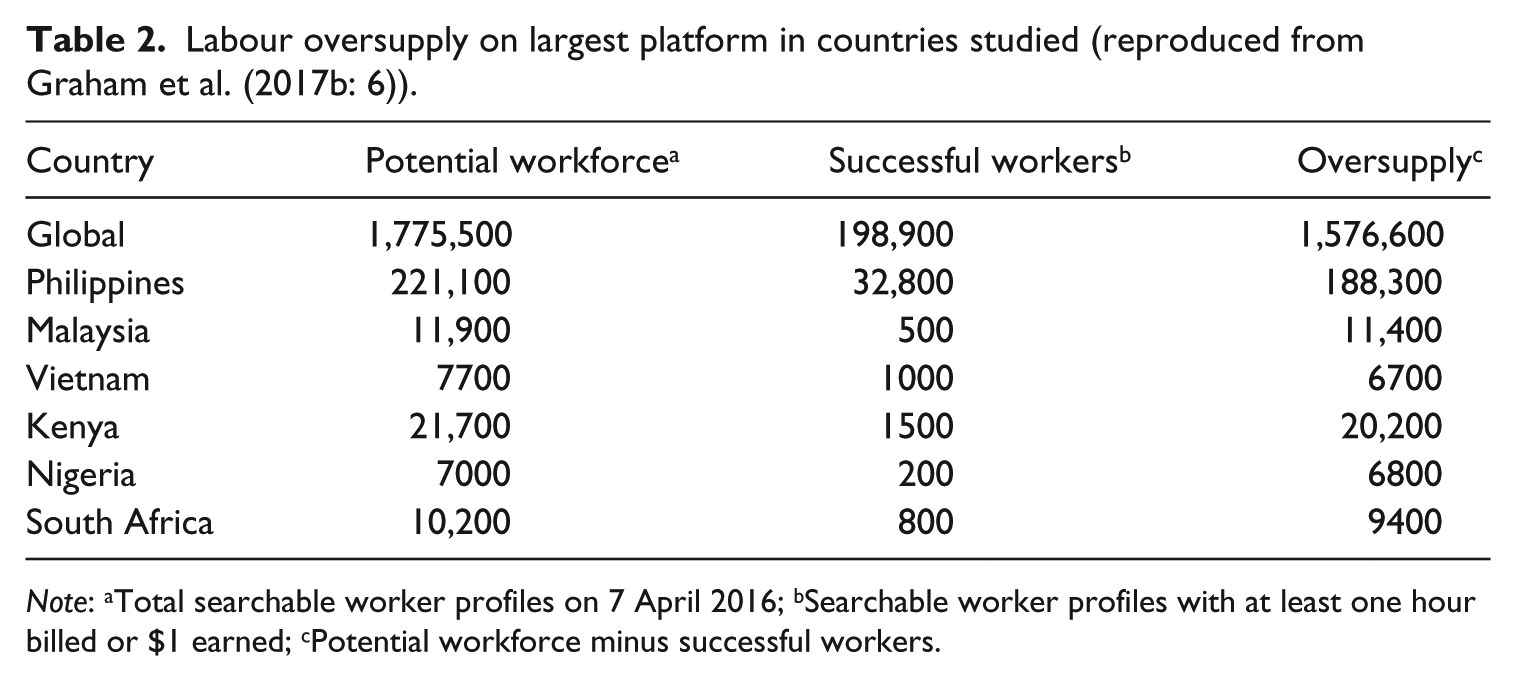
Note: aTotal searchable worker profiles on 7 April 2016; bSearchable worker profiles with at least one hour billed or $1 earned; cPotential workforce minus successful workers.
These examples illustrate how even when formal economic institutions provide little support for durable stable interpersonal connections, the benefits of embedding productive activities within interpersonal relations mean that actors will, nevertheless, find novel ways to embed them within personal networks. The findings therefore support the importance of Granovetter’s (1985) soft-Polanyi notion of network embeddedness for understanding the gig economy. In the next section, we consider whether the hard-Polanyi notion of normative embeddedness is also a useful concept.
The Commodification of Labour
An important feature of the platforms we examined was the manner in which they were engineered and framed so that labour could be purchased and dispensed with on demand. The CEO of one of the largest platforms explained his motivation for founding the company: ‘As an entrepreneur, I had this army of people I can hire on demand to do things for me … So I then thought to myself, why isn’t there an eBay of jobs?’ This quote is indicative of an aspiration to treat labour the same as the commodities bought and sold on digital marketplaces. However, doing so requires that labour be just as easy to hire and sell as a phone or a book. Another major platform made clear to clients that they were free to end any worker’s contract at any time without notice, and to ‘fire them on the spot’. The absence of protective regulations for labour, which would otherwise act as market rigidities, was key to how such platforms were envisioned: We don’t get involved in telling people where to work or how to work or whatever, it’s literally, ‘It’s up to you, you can pick and choose whatever’ … sort of like frictionless little marketplace, it really is up to you. (CEO, major platform)
Gig economy platforms also explicitly offered their clients an ‘on-demand’ workforce made up of ‘online freelancers and contractors’. However, the construction of workers as online ‘freelancers’ and ‘contractors’ left them without legal labour rights and protections. Although task allocation and pay on some platforms were controlled by algorithms, this was not at the expense of competition. As a manager of one of these platforms explained: It’s a completely open marketplace … within our system, we use an algorithm … which is basically learning what every worker is good at, what they like doing and what they’ve earned the most at, and it picks those three factors.
Our interview data indicate that across platforms, labour in this sector was highly commodified with very little shielding from the external labour market via regulative institutions. The commodification of labour was also related to the fragmentation of labour processes into tightly packaged tasks to be spatially and temporally distributed across the network through algorithmically enhanced arm’s-length market transactions. Remuneration was attached only to specific tasks, leaving other necessary work-related activities (gaps in the workflow, selection, test and trial activities, training, etc.) and social reproduction (rest breaks, healthcare costs and the living and education costs of the next generation of workers) unremunerated. As a manager of one platform explained: We take a lot of the benefits and approaches of crowdsourcing in terms of breaking the work out and to solve pieces so that we can then automate as many of those tasks as possible and then send the remainder out to our workforce.
Traditionally, the costs of replacing sick workers acted as an incentive for employers to maintain a healthy workforce (Doogan, 2009; Hall and Soskice, 2001). Gig economy platforms undermine this incentive by reducing the costs of replacing sick workers through spatially and temporally fragmenting labour processes, and providing clients with access to a large supply of workers. A handful of workers we interviewed could afford health insurance, but the vast majority were without any access to healthcare, as few of the countries studied offered a functional public health service. Moreover, the ability of the state to compensate for this commodification by providing healthcare was limited as very few informants reported paying tax on their online earnings. One justification being: ‘The government doesn’t know about this online job; they just think it’s not that creditable’ (David, Kenyan; transcription). Only 18% of our survey respondents suggested that they had paid income tax on their online earnings in the past year. Most clients were located in high-income countries, as were the headquarters of nearly all the platforms and the vast majority of their subsidiaries. Therefore, the potential for this sector to generate significant tax revenues which could have funded social reproduction was limited.
Moreover, commodification entailed significant unpaid ‘work-for-labour’ (Standing, 2016) as time spent on work-related activities such as breaks, training, job searching and applying and waiting for work went unpaid, even though such activities were inevitable consequences of the manner in which these platforms organised labour. Our survey respondents said they spent an average of 16 hours every week browsing, applying for and reading about jobs. Most interview informants spoke of the skills they had developed to effectively compete for more tasks, and 93% of our survey respondents agreed that they had acquired new skills. However, these skills were almost always self-taught using online resources, and this training went unremunerated.
Learning new skills was essential in what workers widely perceived to be a highly competitive environment, and workers saw themselves as competing globally against workers whose cost of living was presumed to be lower than their own. In fact, global competition was central to the operation of outsourcing through these platforms: There are 7.1 billion people on the planet, there are 2.4 billion people on the Internet … They’re what I call ‘PHDs’, poor, hungry, driven … They’re willing to work on any sort of job, right, a lot harder than maybe you or I are, for less money … it’s highly competitive and it changes dramatically as the Internet gets turned on in various countries … And those [unskilled] rates are going down because the more [workers there are], when you’re talking about unskilled jobs there’s almost no floor as to where those actual prices go. (CEO, major platform)
Indeed, our interview informants strongly sensed that they were easily replaceable and that they had to maintain a high standard of work. For example, Joseph (Nigerian; social media advertising and lead generation) explained this common experience when trying to get work: ‘Immediately you see an offer being posted … you will see 50 proposals have been submitted.’
Government officials did not seek to regulate this work taking place within their territories. Our interviewee at the Nigerian Ministry of Communication Technology, responsible for the Nigerian government’s ‘Microwork for Job Creation’ initiative, explained that work terms and conditions were not something that needed regulating, as they were a ‘function of supply and demand in the market … we let the free market dictate’. Similarly, the CEO of one leading platform explained: ‘it’s almost like a frictionless marketplace; we abstract away nationalities and cultural biases and social biases really’. However, this quote fails to recognise that all of this work is done by real people in real places that are governed by real labour laws (Graham and Anwar, 2018). As Jayson (Filipino; data entry, virtual assistant) explained, some of the work was essentially the same as that undertaken by an employee at a business process outsourcing centre, minus the labour protections: The jobs that we are being asked to do on GigOnline are most probably the same as what we’re doing in the office. But when we do it on a freelancer perspective, it puts more pressure to it … That contract could be ended right there and then, if the client isn’t happy … [With conventional employment] your job is secure. We’ve got Philippine laws and stuff like that. But with the platform no, you’re on your own.
Unsurprisingly, every country in which we conducted research has some form of regulation governing the relationships between employees and those they work for. However, these local regulations are in almost all cases entirely unknown to non-local clients outsourcing through these platforms. Enforcement of these rules is bypassed by defining all outsourced work (irrespective of type, duration, dependence and level of control) carried out via platforms as a service contract between an independent client and a self-employed independent contractor (rather than as an employment contract between an employee and a client or platform), and by platforms reframing their role as that of a technology company providing these two parties a service. The power relations that this situation gave rise to, led to workers frequently experiencing high levels of work intensity and overwork, even while at the same time experiencing considerable autonomy and flexibility (see Wood et al., 2019 for further discussion of this finding).
Irani (2015) draws attention to the ways in which outsourcing platforms attract investment by presenting themselves as technology companies. Our research supports this finding, but we suggest that by framing themselves as technology firms that only act as intermediaries between clients and workers (or two sets of entrepreneurs), platforms in the gig economy manage to disembed themselves from labour regulations in a similar manner to how online content providers (such as YouTube) discursively frame themselves as a conduit rather than publisher of content to avoid regulation (Gillespie, 2010). Thus, a platform CEO described his firm in the following way: Every industry is waking up to discover it’s now a software business … I don’t think of us as an outsourcing business because … what we do is connect two entrepreneurs, we connect a small business entrepreneur in the West with a small business entrepreneur in the developing world and they just work it out amongst themselves to get something done.
In summary, we find that despite labour remaining embedded within workers’ interpersonal networks, it is at the same time being disembedded from cultural and legal norms that would limit its commodification.
Conclusions
In this article, we examined the value of the soft- and hard-Polanyi influenced concepts of network and normative embeddedness for understanding contemporary economic transformations. Hess (2004: 166) argues that studies of embeddedness can only avoid conceptual fuzziness by demonstrating ‘who or what the socially embedded actors are, and in what these actors are actually embedded’. In this study, we showed how labour in the remote gig economy is embedded within interpersonal networks which workers themselves generate so as to overcome the low-trust nature of non-proximate labour relations enabled by gig economy platforms. However, we also argued that conventional uses of the concept of embeddedness, including Hess (2004), have often ignored the importance of commodification in Polanyi’s thinking. We therefore returned to Polanyi’s original ‘hard’ understanding of societal embeddedness, as relating to the commodification – that is, the degree of exposure to market exchange – of labour, land and money. We showed that despite labour being embedded within interpersonal networks, it was simultaneously disembedded from the cultural and legal norms that would limit its commodification. We thus demonstrated the value of both network and normative embeddedness for understanding simultaneous but qualitatively different processes.
Moreover, these understandings of embeddedness are not mutually exclusive. While an economic relationship might be disembedded from norms and laws, it may remain embedded within interpersonal relations and specific geographies at various spatial scales. In fact, these latter forms of embeddedness may be necessary to overcome problems such as lack of trust and opportunism (Shevchuk and Strebkov, 2018) and the barriers to social reproduction created by the process of normative disembedding and commodification, and thus explain how the economy is able to function. Therefore, this article not only contributes to our empirical understanding of the gig economy, but also demonstrates the theoretical value of an integrated understanding of Polanyi’s approach to embeddedness.
This article has highlighted the need to place commodification at the heart of societal (dis)embeddedness. Future research must not take the network embeddedness of the gig economy to mean that labour is ‘embedded’, without commenting on the absence of normative embeddedness and the consequences this has for workers. In highlighting the importance of (dis)embeddedness this article also suggests the potential for what Polanyi refers to as a ‘double movement’ against commodification. In fact, Wood et al. (2018) provide some evidence that such a counter movement might emerge among remote gig economy workers, and future research will further investigate this potential. In short, this article demonstrates that network embeddedness is crucial for understanding how work gets done, whereas normative disembeddedness is important for understanding the conditions under which the work is done and the risks it may represent to social reproduction. We believe that applying Polanyi’s insights in this manner will benefit future sociological research of work and employment.
Footnotes
Acknowledgements
We are grateful to Helena Barnard for the role she played in the research design and data collection and Tess Onaji for her work collecting data. We are also thankful to Liinus Hietaniemi and Ilinca Barsan for their help with survey data collection and Otto Kässi for his support with the survey data analysis. We also wish to specifically acknowledge the crucial role that the International Development Research Centre played in supporting our research on this topic from an early stage, and – more generally – encouraging critical social science research on the future of work in the Global South. This article has been much improved by constructive feedback provided by the participants of the ‘Global production networks and social upgrading: Labour and beyond’ workshop held at the University of Manchester 4–5 May 2016. We are especially thankful for the thoughtful discussion of our work which Martin Hess provided. We would also like to thank Neil Coe for the feedback he provided on earlier versions of this manuscript. Finally, we would like to thank the editor Alan Warde, and the three anonymous reviewers for their comments which guided the manuscript towards publication.
Funding
This work was supported by the International Development Research Centre [grant number 107384-001]; and the European Research Council [ERC Grant Agreement n. 335716 and ERC Grant Agreement n. 639652].
