




Abstract
This article analyses practices of intergenerational support for homeownership among different generations of families in Milan, Italy, highlighting the role of housing in family welfare relations and life-course transitions. It makes use of an original dataset of qualitative interviews investigating homeownership pathways and the negotiations of support that they pre-suppose. The article explores the meanings and moral reasoning behind the decision to accept (or not) support in context of contemporary discourses surrounding the liquidity and availability of housing and finance. It highlights the moral compromises and emotional negotiations inherent in the giving and receiving of support for housing, contributing to a body of literature concerned with the reproduction of home and family. Furthermore, it stresses the importance of homes and housing assets in mediating dependence and re-affirming family bonds within a family-oriented welfare context, despite conflict, resistance and frustrated aspirations.
Introduction
Young adult housing trajectories are rarely ‘a solo project’ (Holdsworth and Morgan, 2005: 125) and often depend upon the support of family. Moreover, while homeownership has become central to achieving adult independence (Forrest and Yip, 2013), it often still relies upon support across generations. In Italy in particular, transfers of housing wealth and property have been understood to form a basis of family solidarity and, increasingly, sustain adequate living conditions for younger adults (Aalbers, 2007; Allen et al., 2004; Castles and Ferrera, 1996; Filandri and Bertolini, 2016; Padovani, 1996; Poggio, 2008; Tosi, 1987). However, solidarity often comes at a cost, with support for housing transitions associated with reciprocal obligations and future care responsibilities.
Despite evidence that housing support within kinship networks contributes to other forms of welfare in Italy (Allen et al., 2004), little attention has been paid to the moral dimensions of practices featured in housing pathways. This article consequently addresses the complex negotiations and moral compromises that closely interdependent relations pre-suppose, contributing to existing literature on the role of the family in the intergenerational transmission of homeownership (Barbagli et al., 2003; Castles and Ferrera, 1996; Mulder et al., 2014; Poggio, 2008; Ronald and Lennartz, 2018; Tosi, 1987; Zajczyk, 2008). Indeed, though analyses of welfare in South European countries focus on familialism in explaining regional characteristics, housing practices and the family itself are often taken for granted in the comparative literature, rather than dissected as dynamic and idiosyncratic features.
In addition, while the interconnections between family housing assistance and life-course transitions have been emphasized (e.g. Mulder, 2007) processes have largely been imputed. We, therefore, address the ‘paradoxical role’ (Mencarini and Tanturri, 2006: 410) played by family both expediting the social and economic emancipation of adult children and sustaining reliance on, and subjugation to, the family. In the last decade, parental support has assumed even greater import as a means of sheltering young Italians from the effects of post-crisis austerity, welfare retrenchment and destabilized labour market conditions. As we argue, intergenerational transfers for housing subsequently become critical to life-course transitions and the achievement of adult autonomy, while enhancing dependence on, and obligations to, the family as a unit of welfare.
We specifically draw on two- and three-generational qualitative interviews conducted in Milan. Our analysis focuses on how structural factors inherent in local housing and labour markets are internalized and played out in the negotiations of family loyalties, obligations and responsibilities. We further illustrate how support for becoming a homeowner impacts contemporary family relations and intergenerational contracts. In contrast with Coda Moscarola et al. (2011: 11), who argue that adult children ‘welcome the reward’ of family transfers (especially those concerning housing), we apply a micro-sociological approach to highlight the ambivalence behind decisions to accept (or not) support in the context of contemporary discourses surrounding access to housing and finance.
The first part of this article explores contemporary understandings of intergenerational support for housing and its centrality in sustaining socio-economic stability. The second part then considers the nature and purpose of our empirical approach and the salience of Italy and Milan as cases. Our findings address the complexity of practices of support nested in family relations considering housing transitions and routes to adulthood experienced by contemporary young adults as well as their families. We argue that the way in which homeownership is being (re)produced within families often requires adult children to assume obligations and responsibilities despite frustrated aspirations towards autonomy. Meanwhile, a discourse of sacrifice for the greater good of the family colours the accounts of both parents and children. Our conclusions reflect on the moral implications of support for homeownership, in particular, the loss of emotional freedom and growing sense of indebtedness associated with the ‘reward’ of assisted transition to household independence.
Intergenerational Support
Various studies investigating intergenerational support for homeownership have focused on material assistance and its effect on market behaviour. Financial transfers have been shown to smooth transitions into homeownership, influencing the timing of homeownership, but also the characteristics of the dwelling purchased (Engelhardt and Mayer, 1998; Guiso and Jappelli, 2002). Sociological studies have centred on intergenerational support more holistically, identifying different dimensions of solidarity (functional, associational, emotional) (Szydlik, 2008) and the ways they interact. International comparative studies have illustrated different ‘transfer regimes’ across Europe, with variation in levels of functional support and types of support exchanged (time, money, etc.) (Albertini and Kohli, 2012).
Studies of intergenerational support as practised, however, are rare (see Brannen, 2006), with more recent contributions focusing on negotiations of material support and the understandings that frame giving and receiving (e.g. Heath and Calvert, 2013). Finch and Mason’s (1993) study of family responsibilities remains the most comprehensive consideration of support in practice. Central to their analysis is that family support has both a material component, the actual giving and receiving, and a non-material component, or a moral dimension. The non-material/moral dimension has to do with the ongoing development of personal identities that people perform in relation to their families. Critical to identity formation is the ability to balance ‘dependence’ and ‘independence’, and in particular the equipoise between receiving assistance and feelings of indebtedness. In this sense, while family support is common and often unremarkable, there is a risk that even if family relations work out materially, they might not work out on the moral level (Finch and Mason, 1993). More recent research from the UK has identified how important this balance has become to contemporary intra-familial relations, particularly since intergenerational transfers (or gifts) related to home purchase increasingly play a part in defining adult relationships between parents and offspring (Druta and Ronald, 2017).
The concept of ‘intergenerational ambivalence’ (Lüscher, 2005) captures these tensions between needing support and desiring independence, as well as conflicts between self-interest and moral imperatives of obedience, selflessness and sacrifice to the family. According to Connidis and McMullin (2002) ambivalence with respect to inter/intra-generational relations is framed by context and represents structured contradictions that manifest at the level of social relations. Among Southern European countries, where welfare policies sustaining younger adults have not been well developed (Allen et al., 2004; Ferrera, 1996; Padovani, 1996; Poggio, 2012) intra-family solidarity has remained an important source of informal provision, facilitating the reproduction of ostensibly strong family ties (Barbagli et al., 2003; Saraceno, 2003). Duties to support the well-being of descendants in Italy are not only rooted in normative expectations regarding welfare, but also in the legal framework that hangs reciprocal obligations upon principles of ‘subsidiarity’ (Naldini, 2003; Saraceno and Naldini, 2013).
In this context, self-sacrifice in the service of family members (Bahr and Bahr, 2001), becomes ‘the ready index to the moral quality of a relationship’ (Myers, 1983: 11). ‘Sacrifice’, though usually discussed in religious/communal practices and rituals (see Mauss, 1966), in this case also refers to the process of giving up to, or going without for, one’s kin. Thus, from a moral point of view, intergenerational transfers and support represent a process of renouncing personal comfort (sacrificing) for the benefit of another.
Transfers for housing play a particular role in engendering feelings of ambivalence. The intergenerational transmission of homeownership represents a core element of Italy’s familial welfare regime (Poggio, 2008), providing the basis of a ‘pre-modern care-for-inheritance generational contract’ (2008: 84). A recent study by Coda Moscarola et al. (2011) examining relations between proximity and housing-related transfers, emphasizes the role played by credit constraints in enhancing children’s disposition to live closer to their parents. The authors postulate that if parents enjoy living close to their offspring and the further care perspective, children, especially the more credit-constrained ones, will ‘welcome the [transfer] reward’ (2011: 11) of greater proximity. However, little has been done to pull apart the values and discourses surrounding negotiations or to challenge the taken for grantedness of intergenerational exchanges. A closer focus on the strong interdependences perceived and negotiated among family generations over the life-course, as examined in this article, reveals a more contested picture. In context of shifting market and welfare conditions, the focus on housing brings to light both the conflicts inherent in exchanges as well as intergenerational inequalities shaped around access to housing property wealth.
Since the early 2000s, the scale of intergenerational exchanges related to housing has augmented across developed societies, reframing routes towards independence more broadly. On the one hand, housing markets have become embedded in wider (often global) circuits of finance, influencing property values. On the other, access to credit as well as stable employment necessary for home purchase diminished, especially since the global financial crisis (Lennartz et al., 2016). Moreover, the attainment of homeownership has become critical in context of, first, increasing reliance on housing assets in the face of welfare state retrenchment (Conley and Gifford, 2006), and second, the status of ‘homeowner’ as a marker of adult autonomy and requisite of economic security in later life (Forrest and Yip, 2013; Ronald, 2008). As such, life-courses that align with housing careers featuring property ownership have become important to life chances, with kinship networks increasingly drawn upon to ensure access (Druta and Ronald, 2017). Family gifts and loans that assist housing transitions have become an important feature of the (moral) economy of the family (Heath and Calvert, 2013), especially in terms of rights, debts and obligations negotiated across generations. The Italian case then, where the home has long played a role in intergenerational exchanges and adult emancipation, has attained a wider salience.
Homeownership and the Family in Italy
A focus on the moral dimensions of intergenerational support in Italy brings contemporary exchanges and transfers into sharp relief, especially the ‘paradoxical’ dependency on family for homeownership considered necessary to adult autonomy. Becoming a homeowner represents an important life-course transition in Southern European countries (Allen et al., 2004; Kurz and Blossfeld, 2004; Poggio, 2008; Tosi, 1987) where the family plays a central role in the social (re)production of this tenure (Baldini and Poggio, 2014).
Poggio (2012) argues that the expansion of homeownership has differentially shaped opportunities and constraints for each of Italy’s post-war generations. First, those entering adulthood between 1950 and the early 1970s benefited most from industrial growth and new housing opportunities provided by private market and social sector expansion. Second, those entering adulthood between the early 1970s and early 1990s experienced higher levels of unemployment following the post-industrial restructuring of the Italian economy, but also enjoyed the ‘Golden Age’ of the Italian welfare state. This cohort was pushed into homeownership by a declining rental market and greater spatial and economic pressures to move to suburbs. They were also able to accrue significant assets through homeownership, which increased their capacity to support their offspring.
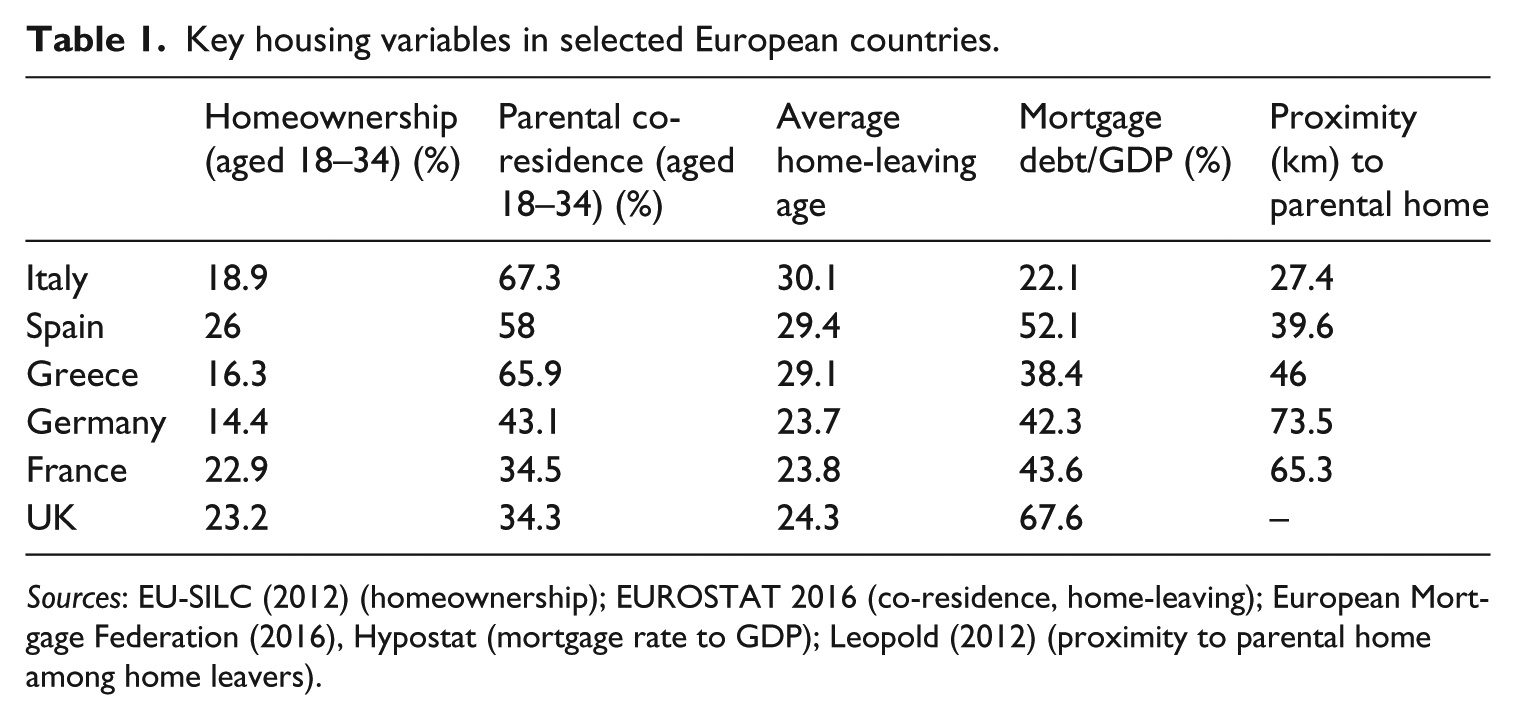
Finally, those entering adulthood since the early 1990s have been subject to increased labour market insecurity and welfare state retrenchment featuring the progressive dismantling of affordable housing policies, and the residualization of rental tenures in favour of ever expanding homeownership. Mortgage debt, although still small compared to other European countries (see Table 1), has expanded in recent decades (see Aalbers, 2007), with transactions typically featuring large deposits and cash buys. Nevertheless, the progressive ‘marketization’ of the housing system has exacerbated affordability problems, particularly for young adults. For many, the tradition of buying a home before marriage has thereby become an unachievable aspiration, marking a shift from previous generations (Baldini and Poggio, 2014: 319).
Key housing variables in selected European countries.
Sources: EU-SILC (2012) (homeownership); EUROSTAT 2016 (co-residence, home-leaving); European Mortgage Federation (2016), Hypostat (mortgage rate to GDP); Leopold (2012) (proximity to parental home among home leavers).
Table 1 identifies key features surrounding homeownership and household transitions in Italy, as well as how they compare to other Northern and Southern European countries. Postponed autonomy among Italian millennials is illustrated by the late age of departure from the parental home, high rates of co-residence with parents and late entry to home ownership. Even after emancipation, Italians are also more likely to live in continued proximity to parents. Recent increases in housing costs have also been associated with diminishing labour mobility (Bentolila and Dolado, 1991; Cannari et al., 2000), and delayed family formation (Caltabiano and Dalla-Zuanna, 2014; Kohler et al., 2002; Mulder and Billari, 2010).
A significant concern then is how Italian families continue to assist the housing careers of their children and how this affects family relations and adult transitions, in particular, increasing dependence and the loss of autonomy. We frame autonomy as not only an individual capability opposed to dependence but also as a project that is collectively constructed as an interaction of internal capacity and external opportunities arising from contexts and institutions (Rosina and Pasqualini, 2015).
Research Design and Context
Our study draws on two- and three-generational semi-structured interviews building from the youngest generation, who were aged 30–44 years at the time of the interviews and had entered the housing market in the previous decade. Given the focus on support between generations, we investigated family networks using an open, follow-up design (see Druta and Ronald, 2017). Younger respondents were asked to refer family members that were most important in supporting their housing situation. In Italy, where networks are usually extensive and assistance may take place beyond parent–child dyads, we interviewed 14 younger ‘anchors’ and 29 related (older) households: in total, 43 households and 64 participants.
We aimed at achieving a maximum variation sample, in terms of household composition, income and education level, and housing situation. To ensure variety on housing situations we selected neighbourhoods in terms of key housing variables: tenure split; housing types; and neighbourhood reputation. Given the limited number of interviews, the explicit consideration of diversity, especially ethnicity, was beyond the scope of this study. Also, though some of the practices described in our findings reflect arguably heteronormative values surrounding marriage and childrearing, the study does not reflect on these issues. Our participants were typically, although not exclusively, from white, middle-class Italian families. That being said, we interviewed seven lower-class respondents and seven upper-class ones.
Interviews took place from late 2013 through early 2014 in the metropolitan area of Milan. We identified our initial participants through the institutional networks developed during the field research. Interviews were conducted, wherever possible, with all adult household members. Interviews lasted between 60 and 180 minutes and took the form of a detailed household housing history that allowed us to investigate the character of housing pathways, generational differences and the impact of life events. Information on the nature of family networks was captured in both interview transcripts and through relational drawings respondents made during the interview.
Interview material was coded in the original language, using a predetermined content analysis framework with two steps. Initially, interview transcripts were coded in detail using the Atlas.ti software package. Subsequently, a matrix (Ritchie and Lewis, 2003) was constructed with broader themes to facilitate the interpretation process, and additional material such as relational drawings, visual material and interview notes were added to the analysis. For the purpose of this article excerpts were translated and revised by the (native-speaking) authors.
The Milan Context
The city of Milan is by no means typical of the country as a whole, but nonetheless offered an effective setting for the study due to the structure of its housing market and its demographic and economic characteristics. Milan is one of the major economic, cultural and political engines of Italy, concentrating many financial and executive activities (Andreotti et al., 2000). Its population is better off and older than the national average, showing a higher rate of employment and higher educational averages. A decrease in birth rates since the 1990s has also transformed the traditional nuclear family structure in Milan (the average number of household members is 2.3).
In terms of tenure, a tremendous shift has occurred in Milan over the last half-century with homeownership rising (see Figure 1) from 7.9 per cent in 1951 to almost 64 per cent in 2011 (ISTAT, 2011). Despite economic resilience, younger Milanese have seen their life choices diminish in recent years, in terms of the cost of living, career opportunities and family formation (Bricocoli and Sabatinelli, 2016), but also in regard to housing options. Essentially, Milan is an expensive homeownership-oriented city, where ‘mortgages are mainly taken out by young couples who are supported by affluent parents. As a result, the high degree of family support and the housing cycle (and social selectivity) are intertwined’ (Aalbers, 2007: 194).
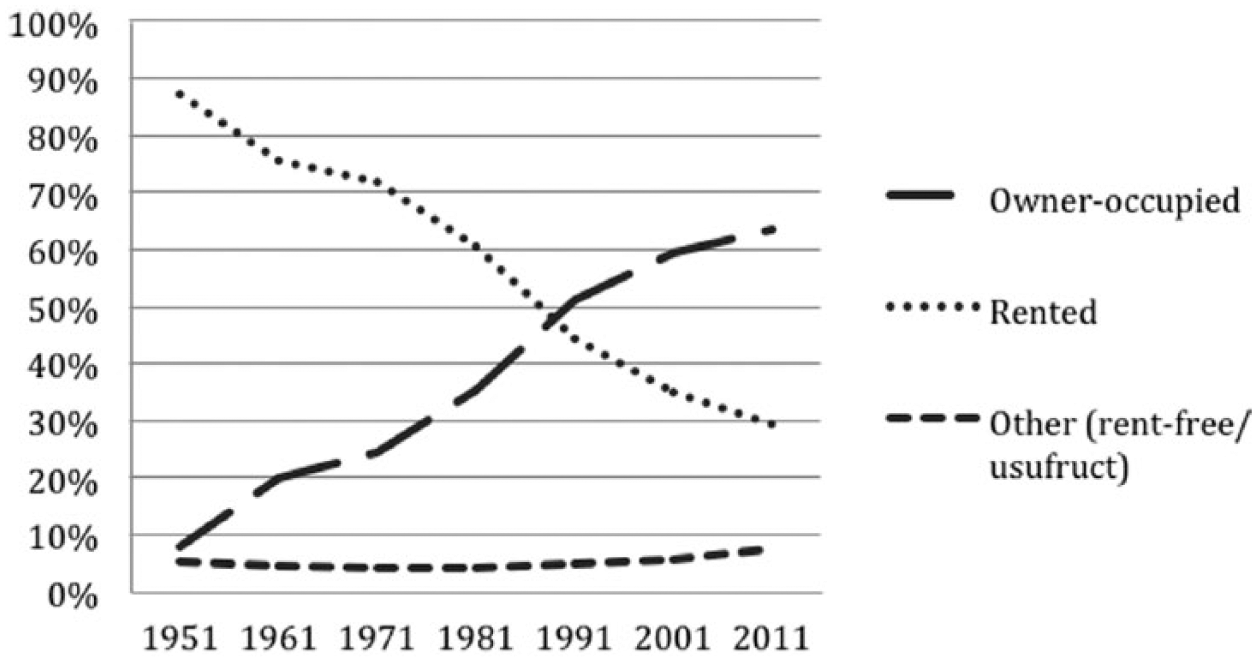
Distribution of household by tenure in the city of Milan, 1951–2011.
Our sample embodied much of what we expected in regard to housing and household transitions in Italy. First, homeownership was common across the social-strata (Barbagli et al., 2003). Moreover, nearly all our ‘anchors’ who had entered homeownership, had done so with financial support from parents or grandparents, usually with marriage or partnership as a trigger. In some cases, support was given to help defray the cost of a mortgage, while in others an entire home had been gifted. Our informants often reciprocated by moving somewhere in close proximity to the family, a common Italian practice (see Table 1).
Informants often remarked that they had decided to move out of the parental home to give a romantic relationship ‘a chance to grow’. At the same time, they expressed a general sense of anxiety about this step. Renting in Milan was considered highly problematic, especially in the expensive free market sector. Those with more precarious working conditions navigated the few social rental opportunities for young people provided by the city, or occupied shared accommodation. In two cases, both lone-mothers, household autonomy meant living rent-free in a property owned by their parents. Indeed, living rent-free in family owned housing – at almost 4 per cent of households – effectively constitutes a tenure of its own in Italy.
By contrast, a large number of the older households in our sample (parents or grandparents of anchors) owned a second, or even a third, home; usually a vacation property. In describing their own housing careers, older informants often reflected on differences in economic conditions in the past. Housing prices in and around Milan were relatively low before 1990 and it had been common to rely entirely on wealth from within the family rather than apply for a mortgage when purchasing a home. Moreover, many had also inherited their parents or other relatives’ homes. Few were public or cooperative sector tenants, and of those that were, all had contributed to the home purchases of their adult children.
Practices of Giving and Receiving
The Home, Family Expectations and Obligations
The deep connections between the material home and the emotive concept of family were evident throughout our conversations with our Milanese informants. Homes and families mutually constituted each other, with the former important in sustaining a sense of succession or continuity for the latter. Indeed, individuals typically defined themselves in relation to a process of transition from one generation to the next that was often embodied in the object of a family owned property (especially if it was, or would be, inherited). Intergenerational wealth transfers were imbued with a sense of ancestral continuity, especially if these were intended to assist housing transitions.
In one illustrative case, Carla, a 58-year-old psychologist (middle generation) who had inherited a house in a prestigious central neighbourhood from her parents (and they, from their parents), while aware of her privilege, also expressed contrasting feelings. She considered intergenerational transfers as a practice rooted in the past, but with effects in the present. She recognized that her home was the space of family memory affecting her individual identity (Finch and Mason, 1993). Such moral emotion was at the same time both comforting and oppressive: It’s worth a fortune, I consider myself very lucky… but then of course this house contains the whole story of my family, my grandparents, my parents… The fact is that it is great here, impossible to find a better place, however it is a very deep root to have, and sometimes… I do not feel that is mine!
While the direct inheritance of a house provided the most obvious examples, other interviews suggested that practices of kinship support – of receiving and passing on – were highly variable. Assistance often came in the form of prolonged co-residence in the parental home (facilitating saving), or a rent-free house (inherited from grandparents or donated by parents), or a gift of money to help with deposits and mortgage repayments. Help could also mean practical support for moving, decorating and furnishing as well as advice on the legal hurdles of home purchase. For many respondents, assistance with housing was not just about intergenerational continuity, but also reflected values of family solidarity, fairness and equity between siblings (Heath, 2017) and obligations to each other. In the following, Angela, a widow in her 80s (older generation), shared with us memories of the self-sacrifices (see Bahr and Bahr, 2001; Myers, 1983) endured when she and her husband sought to secure homes for each of their sons. This story begins in the early 1970s when the apartment above them became available: the first one that gets married will get it! We did not think specifically of one or another, but the first that married… My husband said ‘if we make some sacrifices, we can buy it!’… And so we bought it… Then my husband went to search again, and he found the apartment for the other son too. We put in it a bit of furniture we had left from a vacation place we used to have… and, step by step, we furnished the whole apartment. Through sacrifices we have solved everything for everybody.
In this case the morality of kinship characterized by altruism and willingness to ‘not count the cost in sacrificing for one’s own’ (Bahr and Bahr, 2001: 1233) is contrasted with the reality and ‘morality’ of the market (2001: 1233). Overall, the practices surrounding the transition of each generation to their own home affirmed the family bond. However, our informants also expressed ambivalence towards these practices.
Housing Gifts and Feelings of Ambivalence
Despite the focus on continuity and solidarity, as well as parental ‘sacrifice’, the giving and receiving practised within families could also be highly instrumental. The material value of support was often interwoven with the moral dimensions of family relationships. Family responsibilities and obligations along with feelings of autonomy or frustration were indeed embedded with the moral reasoning surrounding gifts and transfers of, and for, housing. In contrast with Coda Moscarola et al. (2011) this represented something of a paradox for many of our anchors. On the one hand, emancipation from the parental home required adult children to accept family support, on the other, this was often perceived as a sort of ‘gilded cage’, and ultimately came with conditions and expectations, confirming the structured ambivalence of intergenerational support (Lüscher, 2005, 2012).
Acceptance of such a meaningful gift (a property or money for the deposit) typically meant an acceptance of the rights of parents to exert continued influence over adult offspring (and ultimately their spouse and children). This sometimes manifested in requirements of children to buy property in close proximity, which enhanced the influence of parents, but could also potentially facilitate care exchanges in the future, as parents aged and families grew. This contract could often be divisive. Conflicts often arose in families when young adults, who possibly never got along with their parents, at some point in their lives needed to negotiate with their elders in order to achieve independence. Household transitions and gifts of housing property were central to this dilemma. For example, Martina, a 50-year-old (middle generation) employee of a social-cooperative, described the struggle to accept financial help in the context of a very conflicted relationship with her father: I have always had this rebellious attitude toward my family. I am very left wing, but my father is a businessman and between us there has always been this political contradiction… when he wanted to give me this house, it was very hard for me on an emotional level, it was exhausting. But I felt lucky compared to my friends and I did not want to throw away this opportunity. It was a real dilemma, but in the end I accepted, I did it!
In another case, a young couple that had been gifted a house expressed that, over the years, their own freedom and well-being had been compromised by the extreme intrusiveness of the husband’s family. Interviewing the parents, we discovered that they considered themselves entitled to judge and make decisions about their children’s home (from the furniture, to the car parking spot, to the arrangement of spoons in the kitchen drawers). This was perceived by the younger couple as burdensome, as something excessive that had nothing to do with family support and reciprocity. This particular couple eventually decided to distance themselves from their wider family: Our parents paid for everything. I remember receiving monthly payments of 13 million lira for each of us. My parents drew from our ‘family well’, the money, in fact, has always been administered by my mother for everybody… Then when we got married, I realized that I was living in a matriarchal society and that we must get away from this everyday form of control over our lives. So I questioned my family, we even went to a relationship counsellor… and then we set the boundaries and now we proudly administer our own finances. (Adele, 40, secretary, homeowner at 29)
For Elena, a 43-year-old lawyer (homeowner at 39), obligations to parents and family were very onerous, even though she also contributed significantly to the costs of her home. She revealed that relations with her parents-in-law featured daily conflicts over small domestic matters. This sense of subjection to ‘unreasonable questions’ had gradually exhausted her, contributing to an accumulated resentment towards an ‘oppressive’ family: Owning this home gives me a sense of security, but it’s also a ball and chain (una palla al piede)! It becomes a constraint on any choice you want to make; here we are co-owners you know, while if we would have been renting I would be more… free! Here, whatever you want to do in the house is contested and I have to negotiate everything with my in-laws, they want to put their nose in every stupid thing, from hanging a frame to buying a coat rack, everything! So that we don’t do anything, I mean everything has remained almost in the same position, after three years we don’t even have the curtains yet, it’s kind of… as if the house has been mummified since we got in.
During our study, there was only one case of active resistance to the ‘gilded cage’ of a gifted property. Following the death of his grandmother, Francesco, a 36-year-old freelance consultant (homeowner at 31), had been offered her apartment by his parents who lived in the same building. His parents attempted to convince him that living in the same building would be mutually advantageous. Even though Francesco and his partner had no offspring, his parents strongly pushed the case of future children and the care opportunities for living in close proximity. Francesco, however, resisted. Despite the attraction of mortgage-free living, the close parental proximity would endanger his, and his wife’s freedom and privacy. Indeed, Francesco, emphasized the ‘moral value’ of getting by on one’s own, focusing on the home they currently lived in as ‘the home they chose’. He also reflected on the fact that his parents, while contributing towards the deposit on his current home, had no interest in selling grandma’s apartment and giving him the money to pay off his mortgage. The gift, in this sense, was very much self-serving: They have a fear of having complete strangers living in the apartment below them, so they asked us to make a big decision… we could stop making sacrifices, we are actually paying a mortgage that costs, if not half, at least 40% of our total income. It was hard to say ‘no thanks’.
The different cases discussed in this section highlight the ambivalence of intergenerational relations (Lüscher, 2012) challenging the tendency to assume harmony and functionality in the family mode of cohabitation, exchange and wealth/welfare transfers. Instead autonomy and dependence, selflessness and self-interest, commitment and need for distance represent conflicting yet coexisting dispositions among different generations of families.
Changing Aspirations and Structural Constraints
Ultimately, negotiations between parents and children are shaped around cultural, social and institutional contexts. In Italy, support for housing has had a particular salience and families focus on this form of assistance – as demonstrated in the examples above – in light of everyday moralities and subjective appraisals of personal circumstances, abilities and histories. A specific concern is the reproduction of the family. In recent years however, the chances for young adults to leave home and form a new household have been more forcefully undermined by economic uncertainties, a weakened labour market and state austerity measures. In many of our interviews these destabilizing factors presented as a sense of concern or constraint that shaped how different family members decided ‘what to do’ and ‘how to help’ each other.
Younger respondents consistently framed their housing pathways in terms of the various contemporary ‘costs’ of autonomy and adulthood. Leaving the parental home required an income that could, first of all, meet the increasingly prohibitive costs of independent living. For most, declining access to a mortgage was also a specific barrier. Some identified themselves as ‘undesirable bank clients’ due to their precarious employment situations. In this context, by contributing to down payments, acting as mortgage guarantors, paying bank interest, or simply providing more money, families could act ‘against the market’ (Poggio, 2012), with parents even more critical to their children’s housing transitions. The young Milanese we talked to were very conscious of their dependence: Yes, this house is ours, but of course it is not really of the two of us, I mean none of us can buy a house… The bank would never have given us a mortgage if we had really asked. In the end we knew that we had to launch ourselves otherwise. (Sara, 35, Physiotherapist, homeowner at 33)
More recent homebuyers specifically identified the importance of familial economic support in avoiding exposure to the unfairness of banks. In Sara’s case, the sale of another family apartment and a gift of money (added to other savings), allowed them to buy their apartment in cash. Without this support, she claimed, they would have had to significantly postpone the move to independent living: ‘Well, maybe after another… 11 years of work we could pay for a “normal” mortgage by ourselves.’ Sara also noted the ‘ambivalence’ (Lüscher, 2005, 2012) embedded in the negotiation of family support that had saved her from years of ‘financial sacrifice’. In many instances young adults used the concept of ‘privilege’ when discussing their situation, especially in comparison with their less fortunate peers. They understood the role of family support as enhancing their standard of living and contrasted it to the situations of those held back by prohibitive mortgage costs.
Other respondents expressed major anxieties when recalling experiences with banks and mortgage applications, especially those made around the time of the financial crisis. Francesco talked about feeling desperate during such negotiations for his apartment: We both work, we had the 30,000 euros for the down payment that my grandmother gave us… the bank told me that there were no problems…. Then I began to feel a bit worried… that these banks were beginning to fail… and one day we were called in by the banker who, indeed, offered to sell us a life insurance product associated with the mortgage. But this was proportional to the total cost of the loan… and we didn’t have that money at all. So we couldn’t accept and when the banker told us that they then had to double the interest spread, we said ‘we can’t do that!’ The banker said that they no longer had the same freedom as before. However for us it was absolutely unbearable, impossible! At that point we had to change bank, and this happened two weeks before we were due to sign the deed. We were desperate, we risked losing the apartment and the down payment too.
In the context of economic difficulties, parents often felt responsible to act, even if family support had already been provided. In the case above, the purchase of a home was only made possible in the end by an additional family gift (of money) out of the family assets and by parents acting as mortgage guarantors.
Homeownership and Life-Courses
In Italy, homeownership has been deeply normalized, with rental housing usually considered inappropriate to the raising of children (Mulder and Billari, 2010; Poggio, 2012). Emerging tensions between homeownership, family formation and economic constraints derived from changes to the mortgage, housing and welfare systems, were, similarly, clearly evident in younger people’s discourses. This tension also appeared to be exacerbating the role of the housing system in delaying family formation.
Marco, a 24-year-old sales engineer, for instance, identified the need for both he and his fiancée to first find stable jobs before they could even begin to consider forming an independent household: ‘In my opinion you must have economic independence… I would get married then, have kids while I’m still young. I mean this would be my ideal.’ Continued reliance on his parents, in the meantime, inhibited mobility, with pressure to remain in close proximity competing with aspirations to move in the pursuit of other opportunities. There was little resentment towards the family, but there was also ambivalence about what dependence meant. For Marco and his partner, there were few acceptable housing alternatives. Certainly not the kind that would facilitate starting a family of their own together. Homeownership constituted a basis for achieving the necessary housing independence for emancipation and life-course progression, but also, due to a lack of economic security, presented a barrier to it.
While limited access to homeownership made it difficult for younger adults to progress, it could also be an obstacle to mobility for those that did become owner-occupiers, especially when tied to staying close to parents. Pino, a 35-year-old language teacher who had travelled internationally during his academic training (homeowner at 30), talked of a different landscape of housing opportunity in northern European cities. There, rental homes were ‘cheap, nice and centrally located’. In the following dialogue he discusses with his partner the fact that he must commute three to four times a week from Milan to Bologna for work. If they were renters, perhaps they could more easily move instead of feeling almost trapped in their current place.
I remember when I was in Germany I lived in the centre of Munich, which is one of the most expensive German cities. Renting was way cheaper than in Milan. Now I got this teaching position in Bologna last July. For me it is a very important thing and… then I found myself saying ‘what the hell will I do if I’ll have to teach four days a week?’ I’ll have to commute back and forth like crazy, and I thought of this house, but what could we do? Rent out the apartment we own and rent another one in Bologna and move there?
Well yes, we have sometimes thought about the possibility to relocate, however…
In the end I decided to commute to Bologna during the week and even if I would love to stay there, we didn’t move.
Pino and Sara’s experiences provide a vivid example of linkages between socio-economic changes in the familial welfare system that have undermined conditions for young people transitioning through adulthood in Italy. Within this changing dynamic, reliance on housing property – and family support of it – has been both enhanced by the opportunities to accumulate housing equity among earlier generations (Poggio, 2012), and become a problem for new cohorts who rely on it. As Pino explained: It’s all basically anachronistic, this whole thing of support, I mean the heavy, concrete support that our parents gave us, is outdated. It’s like a non-value, there is something that is not working, a divide… we are a generation that has far fewer resources than our parents!
It appears then that although family assistance and housing gifts continue the thrive in Italy – sustaining a family-based homeownership and welfare model – the meaning and salience of these transfers are far more conflicted than has been so far assumed (i.e. Coda Moscarola et al., 2011). While younger Italians have ostensibly sought greater autonomy and earlier emancipation, these desires have been strongly tempered by shifts in housing and credit as well as work and welfare conditions. Our younger interviewees were often reticent about accepting assistance for, and gifts of, housing, but on the whole considered them necessary – along with accompanying family obligations and expectations – in order to form their own family household and become fully independent adults themselves.
Discussion and Conclusions
In this article we approached intergenerational support for homeownership from the perspective of the practices and moral conundrums that accompany the giving and receiving of support among Italian families in Milan. Our analysis showed that despite the deep mutually constitutive nature of homes and families, the duties, obligations and responsibilities that come with highly interdependent relationships should not be taken for granted. The advantages of accepting financial and material support were usually balanced by obligations felt towards family members, framing the way young adults perceived their dependence and independence (á la Finch and Mason, 1993). Meanwhile, the interference in everyday domestic life that proximity to, and dependence on, parents typically facilitated, was perceived as burdensome and frustrating. Thus, while recognizing the ‘privilege’ of secure housing, the ‘anachronistic’ nature of having to rely on kin to satisfy housing needs also came to the fore. Nonetheless, beyond the grumbling and half-hearted contestation there was little most adult children could do in their pursuit of autonomy other than depend on their families.
In his discussion of delayed adult transitions in Italy, Poggio (2012) stresses that differential acquisition of family support for housing transitions is strongly related to the perpetuation of inequalities in life chances. Among our Milanese respondents, we found the commitment of parents to their children to be deeply influenced by the context of restricted state welfare provision and labour insecurity, but also by limited rental housing affordability and access. Support for homeownership thus provided the most expedient means to satisfy adult children’s housing (and welfare) needs. However, parental expectations were attached to housing gifts, instilling a sense of obligation among adult offspring: to live close to parents and abide by the ‘rules’ of the family. As such, the feelings of ambivalence experienced by most of our respondents appear to reflect a particular structural context (Connidis and McMullin, 2002) that frames adult transitions and perpetuates dependence on the family. Indeed, familialism as the basis of social relations, especially those related to housing and welfare (Allen et al., 2004; Druta and Ronald, 2018), does not seem a simple outcome of ‘tradition’ or cultural values in this case, but is, rather, more structured by socio-economic conditions.
For many of our respondents, the loss of emotional freedom and sense of indebtedness was at the root of tacit resentment towards everyday intergenerational interactions. Family conflicts were not simply an outcome of intergenerational interdependences (Micheli, 2013; Sciolla, 2009), neither was support for homeownership universally embraced as a ‘welcomed reward’ (Coda Moscarola et al., 2011), but often, rather, represented an inevitable compromise, a sort of ‘gilded cage’.
While the housing context has been shown to modify the distributional family justice described by Finch and Mason (1993) in other contexts (e.g. Heath and Calvert, 2013), homeownership has played a particular role. For our Milanese respondents, it not only materially embodied family identity and continuity, but also framed moral judgements about fairness and entitlement that shaped redistributive politics within families. Equity between offspring seemed to be an important preoccupation for parents, even though it was at times mediated by other considerations regarding marriage and family formation. Meanwhile, adult children’s efforts to secure their own autonomy were appreciated and considered an additional incentive for the extension of support. Owner-occupation was important because it was deemed necessary to the secure transition to independent adulthood, despite the recent erosion of work, welfare and credit conditions. Furthermore, owner-occupied homes also represented a particular kind of asset project that brought adult children and their parents together and sustained negotiations concerning exchanges of care and transmission of wealth.
It is important to point out that the young adults and families in this study operated in a particular urban context that mediated their experience of housing and labour markets, their expectations, life chances and aspirations towards greater independence and more ‘equal’ roles within the family. The city of Milan represents a particular configuration of opportunities for, and constraints on, pursuing more individualized lifestyles, significantly different from both other urban and rural contexts in Italy.
Nonetheless, our Milanese families challenge assumptions concerning the persistence of a harmonious ‘tradition’ of family-based welfare and exchange in Southern European contexts. Conflict and cooperation between different generations in our study also provide insights on delayed home-leaving and adult transitions, and how Italy contrasts with early emancipation countries of Northern Europe (see Albertini and Kohli, 2012; Billari, 2004). Younger Italians do not simply choose to rely on their parents or resist the autonomy that their North European counterparts seem to embrace by living independently. Our respondents, on the contrary, often aspired to be more independent and resented reliance on family. Nonetheless, shifting economic conditions in recent years seem to have effectively reinforced the family, in the context of an underdeveloped welfare state and more fragile market. The post-war development of the owner-occupied housing market also seems to have played a distinct role in this, by initially concentrating housing wealth among early cohorts, and then making access to it more family dependent for later ones. This is not just a frustration for younger Italians in terms of adult identity. Inhibited or late housing transitions, especially to homeownership, can delay or undermine family formation and thereby erode fertility further (Mulder and Billari, 2010).
Recent studies suggest reconfigurations in the political and economic frames that sustain familialist modes of welfare provision are not static (Estevez-Abe et al., 2016; Saraceno, 2012). We would argue that the families operating in them, despite the endurance of discourses surrounding familialism, are also dynamic. Changes in the political and economic conditions, in particular labour market restructuring and welfare state retrenchment, but also demographic changes such as ageing and low fertility, have challenged family practices as well. The re-negotiations of roles, conflict and resistance, detailed in this article testify to these changes in micro-level practices and the re-alignment of families to new socio-economic and political realities.
Housing represents a particularly salient lens through which to examine these re-negotiations, since homes are essentially the point at which economic pressures associated with financialization and the progressive withdrawal of social safety nets interact with everyday family practices. Through a micro-sociological approach geared towards understanding intergenerational support as it is practised, this article has enriched understanding of the role of families in Southern European welfare configurations and in the reproduction of homeownership as the principal locus of welfare through the family nexus. Furthermore, it has advanced debates on family solidarities in Europe more broadly. Indeed, families have become increasingly important in many European contexts in shaping young adult housing transitions through the transmission of wealth accumulated in housing property (Forrest and Yip, 2013; Hochstenbach and Boterman, 2015; Lennartz et al., 2016). The Italian case discussed here highlights the tensions within families that a heavy reliance on intergenerational transmission engenders.
Footnotes
Acknowledgements
The authors would like to thank Magda Bolzoni and Lory Leo for their invaluable contribution to the data collection involved in this project.
Funding
This research has been supported by a European Research Council Grant awarded to Prof. Richard Ronald for the project HOUWEL [grant number: 283881].