




Abstract
There is currently widespread concern that access to, and success within, the British acting profession is increasingly dominated by those from privileged class origins. This article seeks to empirically interrogate this claim using data on actors from the Great British Class Survey (N = 404) and 47 qualitative interviews. First, survey data demonstrate that actors from working-class origins are significantly underrepresented within the profession. Second, they indicate that even when those from working-class origins do enter the profession they do not have access to the same economic, cultural and social capital as those from privileged backgrounds. Third, and most significantly, qualitative interviews reveal how these capitals shape the way actors can respond to shared occupational challenges. In particular we demonstrate the profound occupational advantages afforded to actors who can draw upon familial economic resources, legitimate embodied markers of class origin (such as Received Pronunciation) and a favourable typecasting.
Keywords
Introduction
‘You need to be white, you need to be male, and you need to be middle class.’ These are the key attributes, according to actor Christopher Eccleston, that one needs to secure the top roles in contemporary British theatre (Denham, 2015). Provocative, perhaps, but Eccleston is only the latest in a long line of British actors to express concern about inequalities within the acting profession. Most have focused on the problems faced by those from working-class backgrounds. Actor David Morrissey has decried what he calls the slow ‘economic excision of working class actors’ while Julie Walters warns that ‘the way things are now there aren’t going to be any working class actors’ (Hough, 2012, emphasis added; Plunkett, 2014).
Curiously, interest in this topic has not extended to British sociology. Instead, scholarship has tended to focus on the other axes of inequality Eccleston mentions, particularly the underrepresentation and ‘glass ceilings’ experienced by women and black and minority ethnic (BAME) groups and, more generally, the poor and unstable working conditions found throughout the UK cultural and creative industries (CCIs) (Conor et al., 2015; Creative Skillset, 2010; Gill, 2014; Hesmondhalgh and Baker, 2010; McRobbie, 2002).
Yet there is a gap in our understanding of how these conditions of cultural work, as well as inequalities of gender and ethnicity, intersect with the class origins of those labouring within the CCIs. Elsewhere in the labour market recent work has revealed that class background strongly predicts different levels of occupational success (Laurison and Friedman, 2016). This analysis suggests that in Britain’s high-status occupations a ‘class ceiling’ exists alongside the traditional ‘glass ceiling’, with those from working-class origins facing a powerful class pay gap. In this article we use the case study of British acting to demonstrate that the concept of a class ceiling may also be fruitful to researchers interested in cultural work.
British acting represents a salient field of enquiry for two main reasons. Despite the fact that class is currently a high-profile issue within the profession, insights have been almost entirely anecdotal and, aside from Dean’s (2005) work, there is a conspicuous lack of empirical research on the social composition of British actors. Second, class inequality is particularly problematic in acting because of the way in which the profession is tied to cultural industries, such as theatre, television and film, whose cultural outputs shape and organise understandings of society (Tyler, 2015; Wood and Skeggs, 2011).
Our analysis proceeds in two stages. First, we use survey data on actors from the 2013 BBC Great British Class Survey to provide the most detailed picture to-date of the social composition of the acting profession. Here we demonstrate not only the striking underrepresentation of actors from working-class backgrounds, but also that these actors are less likely to have accumulated the same economic, cultural and social capital as those from privileged backgrounds. In particular, we find that working-class actors have considerably lower average incomes, pointing towards the kind of class pay gap found previously in Britain’s high-status occupations. Next we draw upon 47 qualitative interviews to provide a more nuanced understanding of how class inequality is actually experienced within acting. Here we explore how the greater stocks of capital inherited and accumulated by those from professional or managerial backgrounds, along with the structure of the profession, combine to afford certain actors concrete occupational advantages.
Inequality and Cultural Work
The UK cultural and creative industries (CCIs) have become the subject of sustained academic attention over the previous two decades, in terms of both cultural production and consumption. A number of studies have extended the work of Bourdieu (1984) in highlighting the ways in which cultural consumption in Britain is heavily socially stratified, particularly in terms of the classed nature of which ‘tastes’ are deemed culturally legitimate (Bennett et al., 2009; Warwick Commission, 2015). Issues of cultural production, in contrast, have been largely absent in this literature and research on ‘cultural work’ has instead evolved rather separately. In particular, this has been marked by a tension between celebratory discourses that focus on the apparent meritocratic, creative and autonomous nature of cultural occupations (most obviously found in Florida, 2002) and more critical voices. This critical work has shown that working conditions in the CCIs actually tend to be precarious, un-paid or low-paid and exploitative (Gill, 2014; Hesmondhalgh and Baker, 2010).
Gender and ethnicity have been the major concern in discussions of inequality within the CCIs (Conor et al., 2015). For example, the recent high-profile Warwick Commission on the Future of Cultural Value (2015) underlined the underrepresentation of women and ethnic minorities in the UK cultural workforce, and demonstrated that this had been exacerbated over the last five years. Similarly, Creative Skillset’s (2011, 2012) reports have continually drawn attention to how CCIs are a site of gender and ethnic inequality, as a result of industrial and organisational structure, patterns of work, hiring practices and discriminatory pay gaps (Conor et al., 2015; Gill, 2014).
Work examining the role of class inequality within the CCI is less developed. As highlighted recently by O’Brien and Oakley (2015), this is in large part due to the lack of large-scale representative data documenting the class origins of those working in the CCIs. There is, however, an important body of qualitative work that probes social mobility into the CCIs. This has focused on the classed nature of particular educational pathways (e.g. Allen et al., 2012b; Banks and Oakley, 2015; Bull, 2015; Scharff, 2015) or the way the privileged often draw upon powerful social networks (Grugulis and Stoyanova, 2012; Lee, 2013). And more recently, the work of Randle et al. (2015) has highlighted the significant barriers to entry faced by those from working-class backgrounds attempting to move into the TV and film industries.
One limitation of this work, and indeed dominant approaches to social mobility more generally, is that they often imply that the impact of class origin (on labour market outcomes) ends at the point of occupational entry. 1 Yet while those from working-class backgrounds may secure admission into the CCIs, they do not necessarily enter with the same resources as those from more privileged backgrounds, and therefore do not necessarily achieve the same levels of success (Ashley, 2015; Friedman, 2015; Hansen, 2001; Li et al., 2008; Rivera, 2015). Getting in, in other words, is very different from getting on.
Here instead we advocate an approach that focuses on the classed resources or capitals (Bourdieu, 1987) to which individuals have access. Along with many others inspired by Bourdieu (e.g. Atkinson, 2010; Flemmen, 2012; Savage et al., 2015a), we believe that class destination is more than occupation alone; it comprises earnings and education, as well other forms of economic, cultural and social capital. In particular, we emphasise the importance of interrogating what Lareau (2015) has recently called the ‘long shadow’ that class origin casts on outcomes in occupations like acting. For example, in recent analysis of the self-selecting but unusually large Great British Class Survey (GBCS) and the nationally representative Labour Force Survey (LFS), we have found that those from routine/semi-routine backgrounds who successfully enter Britain’s higher professional and managerial occupations, have considerably lower levels of cultural, social and economic capital than otherwise-similar peers in the same occupations, pointing towards a worrying and previously undetected ‘class ceiling’ (Friedman et al., 2015; Laurison and Friedman, 2016).
In this article we seek to build on this work by examining whether the class ceiling extends to the CCIs, and specifically the acting profession. Acting provides an appropriate case study for two main reasons. First, there is currently only a small UK literature on the sociology of acting. Shevtsova’s (2009) book is the major work in the area, from the sociology of theatre tradition. This sits alongside Menger (1999), an article important to the literature on artistic labour more generally and Dean’s (2005, 2012) interrogation from a gender and organisations perspective. This relative lack of sociological attention is curious, particularly considering the role actors play in representing social reality on stage, in film and on television; and how these representations, in turn, constitute and reproduce powerful ‘common sense’ understandings of race, gender and class (Malik, 2013; Tyler, 2015; Wood and Skeggs, 2011).
Second, acting arguably represents a useful ‘ideal type’ of the CCIs more generally. In particular, it exhibits many of the wider characteristics (and attendant inequalities) critical scholarship has sought to demonstrate. For example, acting is characterised by precisely the forms of uncertainty – around professional training, access to work and demands of supplementary employment – identified by Hesmondhalgh and Baker (2010) in their wider study of work in film and television. It also reflects the wider CCIs in terms of gender inequality, with demand for labour heavily skewed towards men (Dean, 2005, 2012; Menger, 1999; Shevtsova, 2009).
In this article we therefore use acting as a case study to probe the significance of class origin in shaping work trajectories within the British CCIs. Drawing on both quantitative and qualitative data, our analysis reveals how cultural and material inequalities rooted in class origin fundamentally shape the way different actors can respond to the uncertainties inherent to the acting labour market.
Methodology
We draw on data from a mixed methods study of British actors. The project first involved secondary analysis of data generated by the Great British Class Survey (GBCS). The GBCS was a web survey that ran on the BBC website from January 2011 to July 2013 and elicited 325,000 responses. This unusually large sample provides an unrivalled opportunity to explore the internal composition of occupations such as acting that would ordinarily contain too few respondents for meaningful analyses in representative surveys. For example, there are 402 self-identified actors in the GBCS, compared to just 61 in the largest representative survey of British employment, the Labour Force Survey (LFS).
As a self-selecting web survey, the GBCS by no means provides a representative sample of the acting profession. In line with the whole GBCS sample (Savage et al., 2013), it is likely actors who are highly educated and economically well-off are overrepresented. However, while the GBCS sampling frame precludes formal statistical inference, no other survey offers such a large sample of actors alongside details of their class background and an array of social and cultural indicators. We therefore take the pragmatic view that, in the absence of representative data, it remains possible to cautiously draw out findings using the GBCS. This approach has been partially validated by other comparisons of GBCS and LFS data (see Friedman et al., 2015) and here, where possible, we compare GBCS actors to their counterparts in the LFS.
In order to measure respondents’ occupational class origin we rely on the GBCS question asking respondents what kind of work the ‘main income earner’ in their household carried out when they were 14. The nine answer categories were then mapped onto seven of the eight major National Statistics Socio-Economic Classification (NS-SEC) categories (the self-employed were not included). We coded responses into three groups: ‘traditional professional occupations, senior managers and administrators, modern professional occupations and middle or junior managers’ as an approximation to NS-SEC I–II origins; ‘clerical and intermediate occupations’ and ‘technical and craft occupations’ to NS-SEC III and V; and ‘semi-routine manual and service occupations’, ‘routine manual and service occupations’ and ‘never worked’ to NS-SEC VI–VIII. In the LFS, we use the respondent’s main-earner parent’s SOC 2010 code to assign them to these groups. In the rest of this article we refer to the three origin groups as professional or managerial, intermediate or working class, and due to space constraints we concentrate on comparing actors from professional or managerial (middle-class) and routine and semi-routine (working-class) backgrounds.
The second part of the project involved 47 semi-structured interviews with actors conducted between November 2014 and March 2015. Interviews probed experiences of training and work, as well as actors’ family and cultural backgrounds. Due to BBC data protection policy it was not possible to draw a sub-sample from GBCS respondents. We therefore placed an advert on social media asking for interviewees to take part and shared this with a range of acting websites, news outlets and unions. This yielded 31 interviewees. We then used snowball techniques to complete the sample and match it to the demographic makeup of the British acting profession in the representative LFS. As illustrated in Online Appendix A, our sample is broadly representative in terms of gender, ethnicity, age and location. For theoretical reasons, we also wanted a broadly equal proportion of actors from different class backgrounds, resulting in 19 respondents from professional and managerial backgrounds, 10 from intermediate backgrounds and 18 from working-class backgrounds. All names have been changed to ensure anonymity but the age, location, gender, ethnicity and parental occupation of each interviewee is detailed in Online Appendix A.
The Social Composition of British Actors
We begin by providing the most detailed portrait to-date of the social composition of British actors. Table 1 displays the distribution of actors in the GBCS by sex, ethnicity and social class origins.
Ethnicity, gender and social origins of actors in the LFS and GBCS, compared to the population (estimated from the LFS).
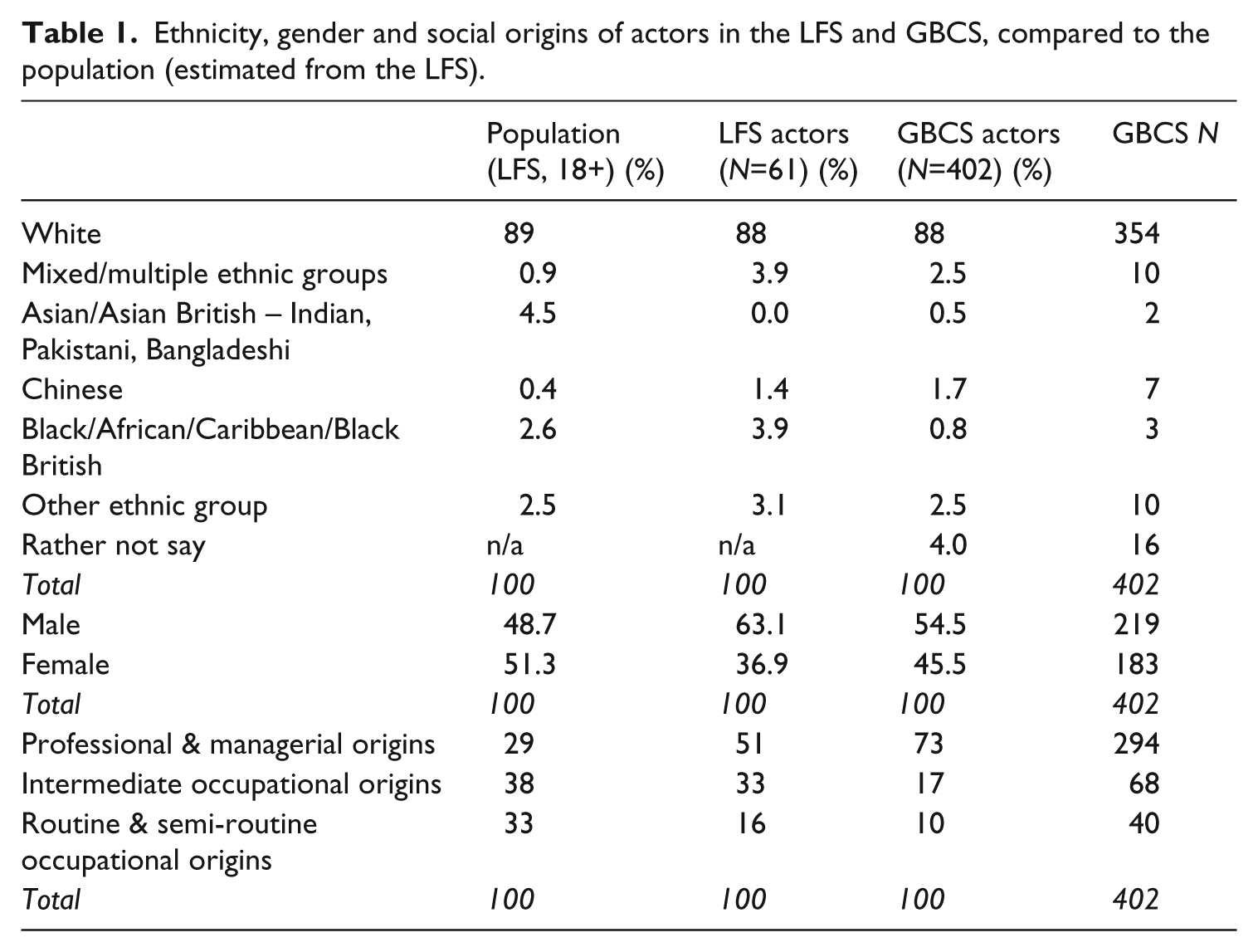
Table 1 displays two key findings. First, it indicates that British actors are broadly similar to the rest of the UK population in terms of ethnicity but that actors in the LFS and, to a lesser extent, the GBCS are disproportionately male. Second, it demonstrates that actors are disproportionately drawn from privileged class backgrounds. More specifically, 73 per cent of actors in the GBCS and 51 per cent of actors in the LFS come from ‘middle-class’ professional or managerial backgrounds whereas this group constitutes only 29 per cent of the population in the representative LFS. Moreover, only 10 per cent of actors in the GBCS and 16 per cent in the LFS have parents who worked in semi-routine and routine employment, or who never worked, compared with 33 per cent of all LFS respondents. Both the GBCS and the LFS confirm, then, media perceptions that the class makeup of the British acting profession is heavily skewed towards the privileged. However, Table 1 does not tell us whether those from such backgrounds are at an advantage within the profession relative to others. Next we therefore investigate whether stocks of economic, cultural and social capital differ among actors from different social origins.
Before doing this, it is briefly worth outlining our measurement of these capitals. In terms of cultural capital, we use two measures – legitimate cultural taste 2 and educational attainment (specifically whether respondents have attended university and/or private school). In terms of social capital we use questions based on the Lin position generator (Lin, 2001), which asks respondents whether they know someone in each of 34 occupations and then calculates the mean ‘status score’ of their social contacts. 3 Finally for economic capital, we look at two measures assessing household income and house price (see Savage et al., 2013 for more detail).
Table 2 demonstrates that stocks of cultural, social and economic capital are all higher among actors from professional or managerial backgrounds. Beginning with cultural capital, Table 2 shows that those from privileged backgrounds tend to engage more in ‘highbrow’ culture and are more likely to have a degree than actors who have been upwardly socially mobile into the profession. It also illustrates that they are more likely to have benefited from elite educational pathways, with a considerably higher proportion educated privately or at ‘Oxbridge’. In terms of social capital they also have higher status social contacts. Finally, in terms of economic capital, Table 2 illustrates that actors from professional or managerial backgrounds own homes worth at least £35,000 more on average than other actors, and their average annual incomes are between £7k and £21k higher.
Stocks of capital of actors in the GBCS.
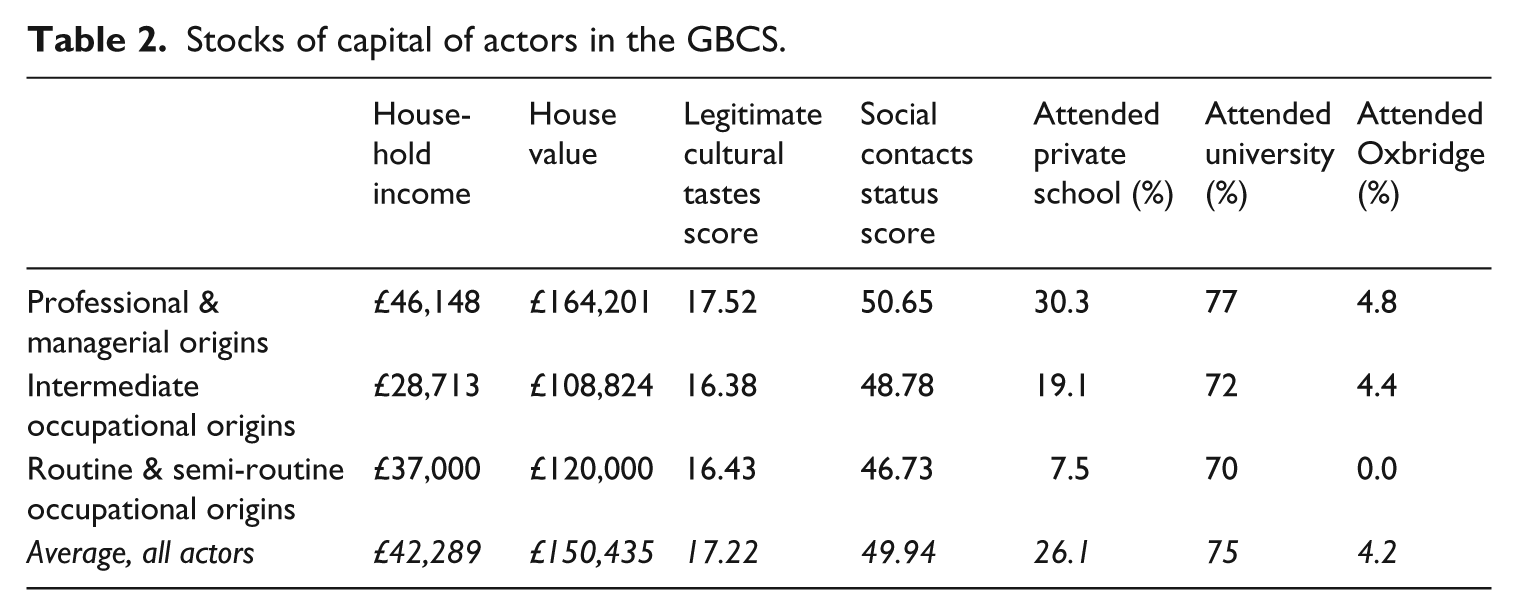
Some of these differences in capitals are most likely evidence of direct intergenerational transfer. Yet processes of inheritance cannot explain the variations in income demonstrated in Table 2. Indeed, this origin-income difference suggests that privileged actors may not only be overrepresented but also achieving more success. 4 However, a simple distribution of income averages cannot tell us whether those from lower-class origins face a class ceiling, or whether they are simply different to the privileged in other respects. In order to address potential sources of class-origin income differences, Table 3 shows the results of a series of linear regressions of annual household income among actors. Specifically, we regress income on origins, controlling for education, ethnicity, age, gender, region and whether the respondent is living with a partner or not.
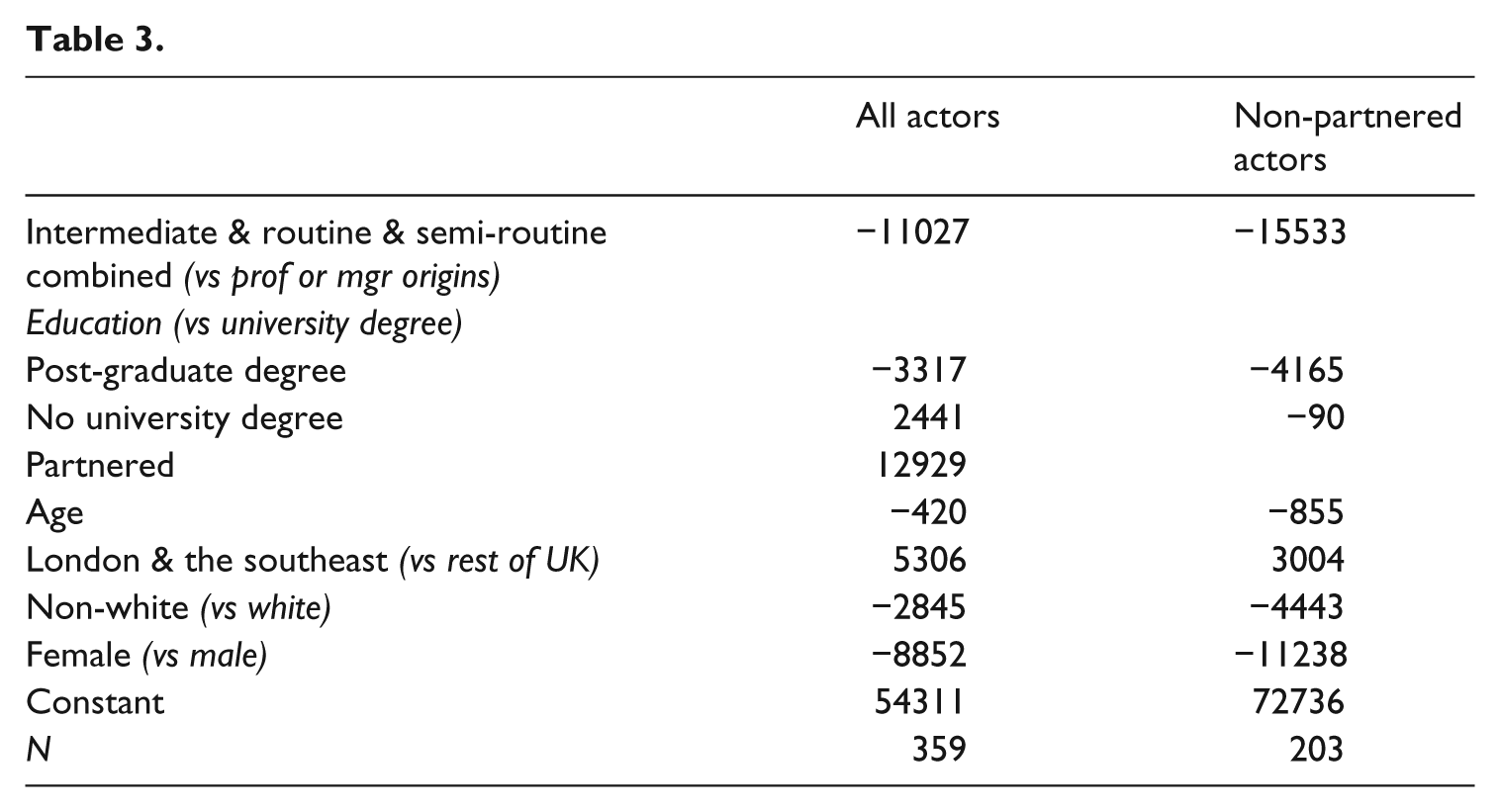
Once we have controlled for these factors, it is striking that the class pay gap among actors remains substantial. In particular, Table 3 demonstrates that, even after controls, actors from professional or managerial backgrounds have incomes on average over £11,000 higher than actors from intermediate or routine/semi-routine backgrounds. It should be noted that these average income figures are substantially higher than other estimates of acting earnings in the UK (Equity, 2015). This reflects both the more general GBCS sample skew towards the economically successful (Savage et al., 2013) and the fact that the survey measured household rather than individual income. For this reason, we must be cautious about using these data to make inferences about actors in the UK population. However, we have no reason to suspect that the people who responded to the survey have different sets of relationships among their attributes than non-respondents; that is, it is theoretically possible, but farfetched, to suggest that our results are driven by a disproportionately large response from working-class actors who are underpaid compared to colleagues from professional or managerial backgrounds. 5
Proceeding from this position we believe three tentative but significant findings emerge. First, British actors appear to be disproportionately drawn from privileged backgrounds. Second, those from working-class backgrounds who are successful in entering acting do not – on average – have the same resources of economic, cultural and social capital as those from privileged backgrounds. Third, and perhaps most significantly, even when controlling for important variables such as schooling, education, location and age, working-class actors have lower incomes than their socially privileged colleagues, pointing towards a clear ‘class-origin pay gap’.
Capitals in Context
While results so far indicate that actors from professional or managerial backgrounds possess greater stocks of capital, quantitative data cannot tell us how these capitals actually confer advantage in the acting profession. In order to investigate this question, we now turn to 47 in-depth interviews with British actors. These interviews revealed that to understand the way social origins shape acting trajectories it is first important to understand the shared occupational challenges facing actors. Echoing the wider literature on cultural work, for example, our interviews underlined that conditions of low pay, extreme competition, chronic insecurity and ‘bulimic’ work patterns are common to all British actors (Gill, 2014; Hesmondhalgh and Baker, 2010). Indeed, experiences of precarity, exhaustion and anxiety dominated accounts of work, regardless of age, gender, ethnicity or class background. This was perhaps best illustrated when discussing the issue of success. We expected actors to hold divergent views on this topic but instead responses were strikingly uniform. Success, we were repeatedly told, simply equals ‘working’. As David noted, ‘[t]his must be one of the hardest professions in the world ... if you can make a living that is success’. Amid such widespread uncertainty, then, achievement hinged on the basic ability to work, and work consistently.
Yet although actors faced a set of similar challenges, they did not do so on an equal footing. In particular, interviews revealed that the considerable resources of economic, cultural and social capital that some actors bring with them into the profession provide them with concrete occupational advantages. These assets, highly stratified by class origin, fundamentally shape what courses of action are possible and how individuals can respond to the contingencies of the profession.
Economic Capital
Above all else interviews revealed the profound occupational advantages afforded to actors who could draw upon economic resources beyond their own income. All actors acknowledged that those with money ‘behind them’, as Olly put it, had it easier in acting. Although GBCS measures of savings and house value captured some of this wealth, interviews demonstrated that most economic advantage possessed by middle-class-origin actors was rooted in the intergenerational gifting of capital, either ‘in vivo’ or through inheritance. The ability to access, or call upon, familial wealth shaped the experience of these actors in myriad ways. First, it provided insulation from much of the precariousness of the labour market, particularly the need to seek alternative work to support oneself between acting roles. Andy, whose parents are both clinicians, explained that his existence as an actor is heavily contingent on the ability to ‘call mum’ during lean spells for financial top-ups. ‘It’s not great’, he explained, ‘but I can’t imagine how I would be able to do it if it wasn’t for her. I really can’t.’ For Andy, as with many middle-class-origin actors, the significance of this safety net was not just about economic survival but the ability to respond more rapidly to the demands of the labour market, to fully prepare for roles, be immediately available for auditions and not feel tired or burnt out from other work. He explains: It’s like you get a phone call to audition tomorrow and they want you to be ‘off book’ and then you have to spend every second til the audition working on the script. It would be impossible if I had no outside support.
Although familial support was often a somewhat sensitive topic, most of these actors acknowledged that they were fortunate. This was often revealed in moments of spontaneous comparison with less privileged colleagues. Tommy, for example, was from a very wealthy background and had attended an elite public school. He explained that he initially quit acting in his mid-20s after sustained periods of unemployment but after a long period travelling had recently re-entered the profession – a luxury he recognised was not available to most peers: I am 30 and effectively dipping my toe back in the water because I have an apartment in central London. I have another that pays rent. I have money, assets, capital. It’s desperately unfair. My friend lives in a Peabody House and struggles finding all kinds of work. He has a degree from Cambridge but you know he sells maps and chewing gum and washes cars. He sometimes turns down jobs because it doesn’t make economic sense in terms of rent. If I go off and have a successful career now, [I know] it’s unfair. Really unfair.
The stories of Andy and Tommy capture much of the security provided by economic capital – of being able to survive periods with little or no acting work, of having access to affordable and well-located housing and more generally of ensuring one can be as competitive as possible when opportunities arise. Yet it is only possible to fully capture the advantages conferred by economic resources when comparing actors from different class origins. Here the contrast with actors making their way with little or no economic safety net was striking. Ray, for example, is from a working-class background in northern England. After getting a good agent from his graduation showcase, Ray, like many actors, moved to London. He worked consistently during his first nine months but now, after several months without work, was suddenly ‘on his arse’ financially. Without the luxury of financial help, and facing ‘impossibly high’ rent, he had been forced to take a full-time non-acting job. But this, he explained, left him in a difficult bind. He knew that ‘exhausting’ non-acting work was having a ‘knock-on effect’, but he needed to survive. His predicament, he summed up, has ‘a massive element of chaos to it, I feel like I’m skydiving without a parachute’. This experience of daily life as economic chaos was a recurring theme among working-class actors, particularly those who were under 35. High rents had forced many out of London, but while this made economic survival easier it also distanced them from opportunities clustered in the capital.
The broader point we wish to underline here is that material inequalities between actors had a profound impact on the courses of action available to them. Just as economic resources had afforded middle-class actors like Andy and Tommy a host of occupational opportunities, working-class actors often reflected on obstacles rooted in their lack of money. In this telling passage, Brian, a black-British actor from London, explains how economics ultimately determines who can and cannot take risks:
If I had inheritance or something I would have been able to take more risks. I would have been able to travel more which would have informed my work. I would have been able to see more theatre and meet people.
What do you mean by risks?
I mean being able to plug into everything. A lot of British actors have explored their luck in the States. I couldn’t do it. I didn’t have the money. I didn’t have the time. Or to take jobs that didn’t pay anything because they just sounded like great ideas and might have ended up being full blown productions.
What is significant here is the way Brian connects economic capital to a host of advantages associated with being ‘plugged in’: knowledge about acting craft; social capital; and most significantly the luxury to invest in unpaid work for creative reasons or for a long-term pay-off. It is possible to see, then, how material inequalities often created structural barriers for working-class actors attempting to forge a career in acting. Although in theory they faced similar challenges to those from affluent backgrounds, the restricted resources at their disposal meant they were considerably more vulnerable to the ruthlessness and instability of the acting labour market.
Institutional Cultural Capital
The economic barriers faced by working-class actors were strongly intertwined with cultural constraints. Again the GBCS data revealed this in a general sense, indicating that upwardly mobile actors are, on average, less likely to have a degree and hold legitimate cultural tastes. However, interviews demonstrated that more field-specific ‘institutional’ and ‘embodied’ cultural capital was more decisive (Bourdieu, 2011 [1986]). Institutional prestige revolved, in particular, around attendance at the ‘Big 4’ London drama schools 6 or Oxford and Cambridge universities. All actors recognised the value of this particular ‘route-in’ and how it acted, as Archie described, to ‘rubber-stamp’ emerging actors.
Yet this institutional cultural capital was highly stratified by social origin. Fifteen interviewees from professional or managerial backgrounds had either attended ‘Big 4’ London drama schools or ‘Oxbridge’, compared to only five working-class actors. The significance of these pathways also extended far beyond credentials. These institutions were invariably described as gatekeepers of social capital, actively introducing valuable professional contacts and helping actors secure an influential agent. This usually took place via high-profile graduation showcases which attracted ‘not just any agent’, as Olly explained, ‘but one of the 10 that can actually get you in the right room’.
The educational pathways described by working-class actors were markedly less linear. Around half had attended drama schools, but these were generally the less prestigious institutions outside London. As Lola explained of her decision to study in Wales – ‘it was just the most affordable option – my parents couldn’t afford the London schools’. For these respondents, though, there was an acute awareness that their deviation from the dominant path had implications. As Alaina explained: There is so little good material and it’s all going to the same people. The agents pick off clients from the main drama schools and they are all given sort of the best opportunities in that early stage. It is almost impossible to work out how to get in…
Here it is possible to detect Alaina’s palpable exasperation at feeling locked out of dominant channels. This sentiment was common, and often coupled with a sense that less well-trodden pathways were marginalised by the profession. Sophie, for example, explained that ‘she can’t get seen’ at West-End theatres because her northern English drama school ‘just doesn’t register’. The implications of this, she explained, were long-lasting and cumulative. No London agents came to her showcase, so she signed with a northern agent. But this has been ‘eternally restricting’, with most ‘high-quality work based in the capital’ and London agents gatekeeping most opportunities. ‘I feel like I am always starting from the bottom’, she concluded.
Embodied Cultural Capital
Not all cultural barriers faced by working-class actors were related to the legitimacy of educational pathways. After all, a number of working-class actors had followed more prestigious routes into the profession. However, regardless of credentials, all working-class actors we spoke to had experienced barriers rooted in judgements of their class-cultural identity. Here there was a sense that embodied markers – of speech, accent, mannerisms and dress – set these actors apart, differentiating them as outsiders in an industry ‘dominated by middle-class culture’ (Derek). Jim, for example, who described his background as ‘very poor’, spoke eloquently about a snobbery he felt had profoundly affected his entire acting career. It began, he told us, when he was at drama school in Scotland: ‘I had no experience of middle-class life so suddenly being thrown into that kind of environment, I was completely a fish out of water.’ This initial dislocation was heightened by the fact that the drama school’s stated aim was to ‘break you down and build you back up again’. For Jim, though, this process of ‘breaking’ felt like a direct attack on his working-class identity – on his accent, on the way he expressed himself, on the way he held his body. His reaction was to resist (‘I was just like – I won’t be broken down’), but this only caused more problems and, after three unhappy years, he narrowly escaped failing his degree. Jim summed up his experience as an ‘assault’: One of my lecturers said to me, ‘have you ever considered going back and being a plumber?’ This is what he said to me. Go back and be a plumber. It’s that kind of thing. So you look back on it, it’s like an assault from various angles ... And that really fucks with your confidence, fucks with your head, because you are in this very competitive environment.
This sense of stigma was most commonly felt in terms of judgements about regional accent, particularly during auditions where, as Ray noted, ‘they just make a snap judgment about you’. It was clear that many working-class actors continually grappled with the threat – whether real or imagined – of feeling looked down upon: You do sometimes think ‘why did you ask me to come here?’ I am here for the audition not to fix the radiator. (Mason) I haven’t been seen by any of the big theatres in London and there is no doubt in my mind that is because of my accent. (Ray) People put you in a class depending on your accent and I do feel quite judged. But it’s who I am. [in an audition] Someone asked me once whether I could speak ‘properly’ if I wanted to. They actually said that to my face! (Grace)
These comments all illustrate the felt snobbery experienced by working-class actors, and echo recent work highlighting the continuing significance of class-cultural boundary-drawing in the UK (Savage et al., 2015b). However, the focus here on voice and accent also relates to the more field-specific way embodied markers of middle-class identity are subtly institutionalised in British acting. As all actors readily explained, the acting profession considers Received Pronunciation (RP) to be the ‘neutral’ intonation of an actor and the vocal starting point of classical acting practice. Its importance, Jim explained, is constantly ‘hammered into you’.
Yet this presents a clear barrier for working-class actors who are perceived as lacking ‘natural’ RP intonation. As Derek explained, ‘if you have a regional accent people assume you are stuck with it’. Aiden, who spoke with a broad north-east ‘Geordie’ accent, had experienced the normative power of RP as a recurring obstacle in his career. He explained that in classical theatre, and particularly in productions of Shakespeare, regional accents like his own tend to be reserved for supplementary characters, as a counterpoint, a foil, for ‘the smaller comedy roles where you have to take the piss out of yourself to get the audience on side’. Aiden told us that over time he had come to see this as deeply offensive, a process through which he was continually asked to ‘mock his heritage’ to get work, where ‘it just feels like prostitution’. Moreover, while Aiden had never explicitly been advised not to use his accent when auditioning for larger roles, 10 years of experience had taught him ‘if I do my own accent I am actually doing myself out of the job’. Derek elaborated a similar point: They don’t want to hear you spouting Shakespeare, they want someone with a ‘clear voice’. You still get that now – ‘must be RP’, ‘genuine RP speaker’. Not that you can’t do RP. Most actors can. No, it has to be your accent. No reason why. But if you see a Shakespeare character with a regional accent it’s always ... like a gimmick.
The construction of RP as the ‘neutral’ voice of British acting may appear an innocuous professional practice, but what these interviews illustrate is that it has become a powerful somatic norm that tacitly designates middle-class voices as having a greater ‘natural’ right to occupy both a higher proportion, and a more prominent array, of roles within the profession. In contrast, the regional accents of working-class actors often act as a cultural barrier to getting work, marking them out as outsiders, as ‘space invaders’ (Puwar, 2004) lacking the embodied cultural capital to be legitimately recognised in a highly classed professional space.
Typecasting and the (Dis)advantages of Class Origin
So far we have described that while acting involves shared challenges of irregular, precarious and poorly paid work, the way individuals respond are shaped by cultural and material inequalities rooted in class origin. However, interviews also revealed that some difficulties inherent to acting are not shared by all. All actors we spoke to explained that the work they receive is heavily subject to ‘typecasting’. By this they meant that the roles they are encouraged to audition for, and that they tend to get, follow a set social ‘type’ that normally reflects their real-life demographic characteristics – particularly in terms of age, gender, ethnicity, region and class. Most acknowledged that this typecasting was useful in the sense that it provided a set of defined roles where they had comparative advantage. However, there was a sense among working-class actors – particularly those who were female and/or BAME – that there are far fewer roles written for their ‘type’. Deborah, for example, explained her enduring frustration with the limitations of her casting type as a mixed-race woman from a working-class background: I am a black character actress in my 40s and there just is not a lot of stuff out there. You know, I’ve played a hell of a lot of nurses. I’ve played more nurses than there are in the whole of St George’s Hospital! So yeah I started to get bored of that and I wouldn’t take it if all she was saying was ‘the doctor will see you in a few minutes’.
For Deborah, then, like many others, the issue is not just about the size of the roles she is cast to play but also the type of roles – roles she feels are caricatured and politically problematic; that fundamentally do not reflect anything of her actual experience as a mixed-race woman. Mia recounted a similar story. She explained that her career had largely involved playing a narrow range of secondary characters: ‘the battered wife, the junkie, or someone who has lost a child because of their badness – I always get cast as working-class victims’. Mia was clearly uncomfortable with this (‘I don’t want to do that anymore, I wish I could be more brave’), but at the same time was realistic about the basic need to work and survive as an actor (‘I’m not exactly being flooded with loads of different options’). The stories of Mia and Deborah underline the professional bind frequently faced by working-class actors, particularly those who are female or BAME. While they often object to the gendered, raced or classed representations they are asked to portray, their ability to reject such work is simultaneously weakened by the restricted supply of roles available.
Significantly, this disadvantage was rarely contested by middle-class actors. Instead, most reflexively acknowledged the structural advantages afforded by their own playing ‘type’. Nathan, for example, a privately educated actor from West London, first told us of his frustration at being typecast as ‘nice clean-cut middle class’ but later acknowledged that this same typecast had ensured a long line of ‘wonderful’ leading roles. Similarly, Mollie, who was also from London and privately educated, expressed frustration at ‘always getting middle-class princess-girl-parts’ but immediately recognised the comparative breadth of this ‘playing type’: The smaller your pigeon-hole gets the more offensive it must feel because at least I would get opportunities to play a range of different types of middle-class people whereas with ethnicity or working-class roles – it must be so frustrating.
What was significant about the accounts of actors like Mollie and Nathan was that although they rejected the idea that working-class actors were overtly discriminated against in acting, they readily acknowledged the professional barriers these actors faced. In particular, echoing the findings of Dean (2008); O’Brien et al. (forthcoming) and Randle et al. (2015), they pointed to the overrepresentation of white, male, middle-class writers and casting directors in British film, television and theatre, who in turn create more white, male, middle-class characters. As Mollie continued: If you strip it back there is so much stuff being written for middle-class characters, about middle-class people, I feel like the conversation is more about supply and demand, the kind of material, rather than prejudice. It makes sense for casting directors to look for authenticity so if they are casting Downton Abbey they are going to go for actors that bring some kind of authenticity.
Seen in this way, then, the class ceiling in British acting is not just the result of the different resources actors themselves bring to the profession, but also that the industry itself is structurally skewed to better reward middle-class actors – particularly those who are white and male. Not only do these actors have a far greater pool of roles to choose between but such roles are consistently larger and better remunerated.
Conclusion
Our main aim in this article has been to build on recent studies of inequalities within the CCIs by paying closer attention to the role that class origin plays in shaping occupational success. Focusing on British actors, and drawing on both quantitative and qualitative data, we have shown that those from working-class origins appear to face a powerful class ceiling within the profession. While class disadvantage may be most immediately visible in terms of a pay gap, our analysis demonstrates that – at root – it is more about the unequal distribution of cultural, social and economic capital. In particular, we find that the ability of actors from privileged backgrounds to draw upon familial economic resources is pivotal in insulating them from much of the precarity and uncertainty associated with acting. Moreover, this economic advantage is also instrumental in helping these actors follow culturally legitimate educational pathways, which in turn facilitates key early opportunities in terms of representation and casting.
We should emphasise that this analysis is not meant to suggest that actors from working-class backgrounds cannot reach the top of the British acting profession. Far from it. Many working-class actors we spoke to had been significantly more successful than peers from privileged backgrounds. We also want to stress that we are not completely discounting the role of ‘talent’ in acting, however sociologically problematic this concept is to define (Banks, 2015). Instead our point here is simply that the extent to which an actor can realise, or cash-in on, ‘talent’ is heavily contingent on the economic, cultural and social capital at their disposal.
Sociologically, these findings have implications in two key areas. First, we hope this work underlines the need for more interrogation of how class origin shapes work trajectories beyond occupational admission. This is both an important issue for scholars of ‘cultural work’, where most research focuses on access, but also more widely for class analysis. In this dominantly quantitative arena sensitivity to the linger of class origin is often absent. Instead, approaches largely proceed from the logic of the standard mobility table which compares identically measured class origins and occupational destinations at usually two points in time. However, as we show, this misses the ‘stickiness’ of class origin. There appear to be hidden barriers that those from low-class origins face within highly prized occupations like acting, much as there are similar barriers or ‘glass ceilings’ for women and ethnic minorities in many occupations. We believe borrowing and adapting this feminist approach thus adds an essential new analytic strategy to studies of social mobility and class reproduction.
Second, we also believe our analysis points towards the need to connect up two sets of academic concerns: questions concerning representation of Britain’s diverse population by the CCIs (Malik, 2013; Tyler, 2015); and sociological work focusing on the impact of class origin in specific cultural careers (Randle et al., 2015). To date, the study of these two aspects of the CCIs has been disconnected. However, as we show here, the kind of skewed portrayals of class (as well as gender and ethnicity) that are forcefully illuminated in the work of Tyler (2015) and Wood and Skeggs (2011) are instrumental in exacerbating inequalities within occupations – like acting – that are on the ‘front line’ of enacting such representations. Indeed, working-class actors must battle on two fronts. Not only do powerful somatic norms preclude them, as ‘non-natural’ RP speakers, from many leading parts but even when they do revert to ‘type’ they often face a restricted supply of politically problematic roles.
Footnotes
Acknowledgements
We are grateful to Kate Oakley, Kim Allen, Mike Savage and the anonymous Sociology reviewers for their helpful comments on early drafts of this article. We would also like to thank all our interviewees, without their invaluable insights this research would not have been possible.
Funding
This research received no specific grant from any funding agency in the public, commercial or not-for-profit sectors.