




Abstract
In the context of environmental, social and economic crises, Levitas urges sociologists to engage with imagined futures and desires for better ways of living. At a local level, facilitating collective visions of desired futures is a vital component of democratic sustainable regeneration. Imagining positive future visions is often challenging, however, for residents of post-industrial cities where good work and future prospects are lacking, infrastructure has declined, and once close-knit communities are increasingly divided. This article explores how emergent narratives of a future good life may be pieced together from nostalgic discussions of the past and critiques of the present. While there is a resurgence of literature considering how forms of nostalgia shape perceptions of the present, reconceptualising it as potentially positive and future-facing, there has been little empirical exploration of how nostalgia might inform utopian imagination of a future good life in post-industrial settings. Drawing on focus groups with white residents of Stoke-on-Trent we show how the past, and conditions of the present, shaped imagined futures in three ways: invoking a nostalgic longing for recreation of an idealised industrial past; rejecting the past to create an entirely different future; and critically engaging with the past to identify valued elements of a better future. We suggest that facilitating discussion of present and past local life can provide the basis for engaging residents in constructing collective, historically grounded utopian visions for their city, a crucial step in moves towards a future which might enable living well within environmental limits.
Introduction
In this article we explore how good life narratives might emerge in a post-industrial city and consider how these are shaped by conditions of the present and connections to the past. We argue that a process of facilitating such narratives might play a role in elucidating possible pathways to a more sustainable future. Levitas (2013) argues that sociologists should be concerned with ‘the imaginary reconstitution of society’ conceptualising this as an analytic method with three elements: an ‘archaeological’ mode, an ontological mode and a constructive ‘architectural mode’. She explains: ‘The archaeological mode . . . involves the excavation of fragments and shards and their recombination into a coherent whole. The point of such archaeology is to lay the underpinning model of the good society open to scrutiny and public critique . . . the ontological mode is concerned . . . with the subjects and agents of utopia, the selves interpellated within it’ (p. xvii) and the architectural mode involves the ‘institutional design and delineation of the good society’ (p. xvii). Levitas’s focus is on utopia as a project for sociology; she argues for a normative reorientation of the discipline to centrally engage with constructing visions of a better society. In this article we draw on her conception of utopia as method but use it in a more empirical and participatory way.
Post-industrial cities are often characterised as sites of disillusion and hopelessness rather than fora for the development of utopian visions (Bazzani, 2023). Yet the field of utopian studies emphasises the everyday nature of utopian desires (Garforth, 2018). Levitas (2013) sees utopia ‘as the expression of the desire for a better way of being or of living’ (p. xii) and Garforth (2018) suggests utopia involves a capacity to be critical of present social arrangements and to creatively imagine alternatives, however briefly and superficially. On these grounds we can see utopia as commonplace, emerging from everyday expression of dissatisfaction or lack.
Utopian impulses may spring from a sense of loss (Bloch, 1986), thus nostalgic accounts of a lost past might play a key role in everyday utopias in post-industrial settings (Kelly, 2015). While nostalgia has been studied in the context of deindustrialisation (De Monteiro, 2017; Strangleman, 2013) and also reconceptualised as a creative, affective, potentially future-facing force (Blunt, 2003; Boym, 2001; Sedikides & Wildschut, 2016; Smith & Campbell, 2017) which plays an important role in connection to place (Colin, 2021), there is limited empirical research connecting nostalgia with the imagination of a future good life in post-industrial settings (Berlant, 2011). Recently Strangleman (2023) has called for more attention to this area, pointing to the identification of loss and a historical consciousness as fundamental to make sense of future possibilities in post-industrial settings and in sociology more generally.
In this article we identify the fragments of desire for a better society which can be unearthed in discussions with white Stoke-on-Trent residents about the past, present and future of their city. We commence by considering literature on deindustrialisation, memory and nostalgia, before introducing our study and exploring the character of the narratives about the past and present which emerged in our research and signalling what these might indicate about ideas for a future good life. While our research identifies broad utopias rather than specific policy directions, eliciting and debating these shared visions might contribute to the culture of dialogue which Bauman (2017) suggests is critical for constructing a better future. In this we follow Levitas’s (2013) conception of utopia as method, aiming to ‘make explicit embedded ideas of the good society and bring them to debate’ (p. 155). Moore and Woodcraft (2019) point to the need for such research on how living well ‘is conceptualised . . . across places, cultures and generations’ (p. 277) as a fundamental element in constructing locally shared visions for a sustainable future. We conceptualise a sustainable future as one which is socially just and facilitates living well within environmental limits (Jackson, 2016; Kelly, 2015). While participants themselves may not explicitly reflect on environmental limits or the concept of sustainability, their perspectives on what makes for a good life are integral to the development of any meaningful local sustainability.
Deindustrialisation – taking the long view
It is over 30 years since the decline of traditional industries in the UK. Research has moved beyond a focus on immediate impacts of the closure of industries to examine the ongoing aftermath which ripples on for decades affecting future prospects for living well (Linkon, 2018; Mah, 2012; Strangleman, 2013, 2017; Strangleman & Rhodes, 2014). Deindustrialisation is thus an ongoing process, rather than an event. Walkerdine and Jimenez’s study of Steeltown vividly exemplifies how the history of both industrialisation and deindustrialisation in a town leaves significant affective traces ‘like half-lives’ (Walkerdine, 2016, p. 702) for present residents. Linkon (2018) also runs with the idea of the ‘half-life’ effect, noting that the practices of the past frame ‘structures, ideas and values that influence our lives long after those practices have ceased to be productive’ (p. 1).
Similarly, Mah (2012) suggests that deindustrialisation is an ongoing process of ‘ruination’, whose form is the physical reminders of industry slowly decaying in sight of the communities that were once employed in them. The impacts of this process fall mostly on working-class communities and are exacerbated by the failure of promises of regeneration. This is particularly problematic in those sites which have experienced a switch from industrial production to an economy based on logistics and call centres, characterised by precarious and low-skilled employment, zero hours contracts and low wages. In such contexts successive generations continue to struggle, and remain disadvantaged (Stewart, 2015). The loss of secure employment has social and economic impacts for individuals but also destabilises the collective sense of a ‘moral order’ in which predictable employment was regarded as a feature of a good life (Strangleman, 2012, p. 419).
Collectively, the ‘ruination’ of place, the destabilising of economic security and a lack of an imagined future can lead to the labelling of post-industrial cities as ‘left behind’ and the emergence of new forms of populism to challenge ongoing discourses that these cities ‘don’t matter’ (Kenny, 2017; Rodriguez-Pose, 2018, p. 189). Yet, critically, Linkon (2018) suggests that in spite of such negative depictions, the pride that communities feel at having been at the heart of a booming industrial city remains and is passed on through subsequent generations, even as they continue to experience job losses, declining landscapes and threats to social cohesion.
Collective memory, nostalgia and utopia
Local memories of the past are mediated and consolidated within networks of social relationships and become ‘well-rehearsed’ and generalised over time (De Monteiro, 2017; Edensor, 2005; Halbwachs, 1980). They are also selected and arranged according to present conditions (Jedlowski, 2001) and as a way of managing challenging current circumstances (Wright & Davies, 2010). Through retelling, memories become transformed into an idealised image (Halbwachs, 1980) which is often ‘drastically selective’ as certain memories linger whilst others are distilled out (Olick & Robbins, 1998, p. 110). Critically, Loveday (2014) suggests that the specific content of the collective ‘myth’ is less important than its shared meaning.
Geoghegan (1990) makes a direct link between nostalgic memories of the past and utopia. He notes that the term nostalgia originally ‘meant the agony of being separated from home . . . quite literally homesickness’ (p. 53). He suggests that collective ‘memory traces evoke something valuable which has been lost’, thus nostalgic memories, while inaccurate, can have ‘a built in utopian function’ (Geoghegan, 1990, p. 54). Raychaudhuri (2018) suggests that this conception of nostalgia as ‘homemaking’ – the ‘use of the past in order to re-create an imaginary . . . version of it in the present’ (p. 11) – allows for the possibility of radical counter-hegemonic nostalgias. The extent to which nostalgic remembering can provide the basis for such progressive imagination of the future is contested, however. Bauman (2017) sees place based romanticisation of the past as an attempt to find security in the midst of contemporary insecurities and anxieties. For him such ‘retrotopia’ is individualistic and defensive, fuelled by populism and informed by concerns to better one’s own position rather than to build a better shared future.
Authors often seek to classify different kinds of memory and nostalgia, distinguishing the potentially utopian from the conservative and regressive. For instance Geoghegan (1990) outlines Bloch’s (in discussion with Landmann, 1975) distinction of anamnesis (recollection) from anagnorisis (recognition): characterising the former as a conservative desire to recreate the past with little role for transformative change, while in anagnorisis ‘the power of the past resides in its complicated relationship of similarity/dissimilarity to the present. The tension thus created helps mould the new’ (Geoghegan, 1990, p. 58). Similarly, Boym (2001) defines ‘restorative nostalgia’ as an emotional, fixed, attachment to the way things were and a desire to bring an (idealised) past to the present. It is such restorative nostalgia and anamnesis which Bauman (2017) draws on in depicting contemporary reactionary ‘retrotopia’. In contrast, Boym (2001) identifies the possibility of ‘reflective nostalgia’ which combines emotional attachments to the past with a willingness to be critical of it and an openness to acknowledge the modern. This reflective, potentially positive type of nostalgia has clear resonance both with anagnorisis and also with Raychaudhuri’s (2018) imaginary ‘homemaking’. Nostalgia here works as the basis for creative and critical engagement with what is valued from the past and hoped for in the future. In practice, however, it is often difficult to draw a hard line between different forms of nostalgia, with regressive and progressive threads often being entwined (Geoghegan, 1990; Pickering & Keightley, 2006). Lawler (2014) suggests that nostalgia is neither entirely good nor bad but there is a need for careful examinations of the forms of nostalgia which emerge and what these tell us about what and who is valued.
In this article we detail the character of nostalgic memories (both social and spatial) of Stoke-on-Trent which emerged in our research. We use these to consider what glimpses of utopian desire, of who ‘we’ are and should be, and of what might constitute ‘a good life’ in the city, these might indicate. We begin by describing our case study site and methodology.
The study
Stoke-on-Trent
Stoke-on-Trent is a city of just over a quarter of a million people in the county of Staffordshire. It was one of many UK cities to experience rising status and wealth during the industrial era, when coal mining, steel production and the ceramics industry were well established. Stoke-on-Trent was, and to an extent still is, the home of the pottery industry in England and is often known as The Potteries, and its residents as Potters or Stokies.
Since the late twentieth century Stoke-on-Trent’s coal mines and steel mills have all closed and the ceramics industry has significantly declined, resulting in high levels of unemployment (Mahoney, 2015). However, to define Stoke-on-Trent solely as a post-industrial city would not do justice to aspects of its history which shape its residents’ collective identity and pride (Domokos, 2018), such as Stoke City football team, local playwright Arnold Bennett and its status as one of the UK’s greenest cities. Stokies are proud of being friendly and welcoming, celebrate their city’s ceramics heritage and are defensive of its present status. Nevertheless, the shift from guaranteed, well-paid and often high-skilled employment to jobs that are generally low-paid, 1 low-skilled and transient within service industries and distribution centres has led to local dissatisfaction (Domokos, 2018). This has been exacerbated by several stalled regeneration projects, and the media labelling Stoke-on-Trent as the ‘Brexit Capital’ following the almost 70% vote to leave the EU in 2016.
Stoke-on-Trent is polycentric, made up of six towns, each with their own centre and community allegiances. The majority of the population (83%) identify as white, with the next largest group being those who identify as Asian (9.9%) (Office for National Statistics [ONS], 2023). In 2023 ONS noted that the proportion of all groups other than white British had increased over the previous decade. It is a city ‘in between’, halfway between Manchester and Birmingham, two of the largest city economies outside London (Elledge, 2017). It sits between two major roads, which has led to challenges in maintaining a workable public transport system and exacerbated the parochial nature of its six towns. Finally, the city is between periods of regeneration, with some demolition having taken place and replacement buildings not yet materialised. Existing research on Stoke-on-Trent has focused on the issues arising out of deindustrialisation, and on identifying potential solutions to them (see Etherington et al., 2022; Jawad et al., 2014). Our approach in this article is distinct in searching for residents’ implicit utopias or good life narratives.
Method
The study was conducted in 2017. We began by interviewing informants from local organisations to understand their perceptions of key local issues and for suggestions on demographics to recruit for focus groups. Informants suggested important groups to recruit were young men not in work, employment or training; working families on above average local incomes; and older people living on low incomes. This sampling strategy enabled us to access perspectives across generations and distinct economic circumstances. We chose focus groups for their potential to identify areas of agreement and disagreement as well as offering insights into shared accounts and collective knowledge of everyday life (Gibbs, 1997).
We used a market research company to recruit as we were geographically distant from Stoke-on-Trent. We asked them to recruit to the following criteria:
Focus Group 1 (FG1) – Men and women aged 50–60 years, household income < 16K;
Focus Group 2 (& 3) (FG2 & 3) – Men and women aged 25–45, with children, in employment, household income > £30K;
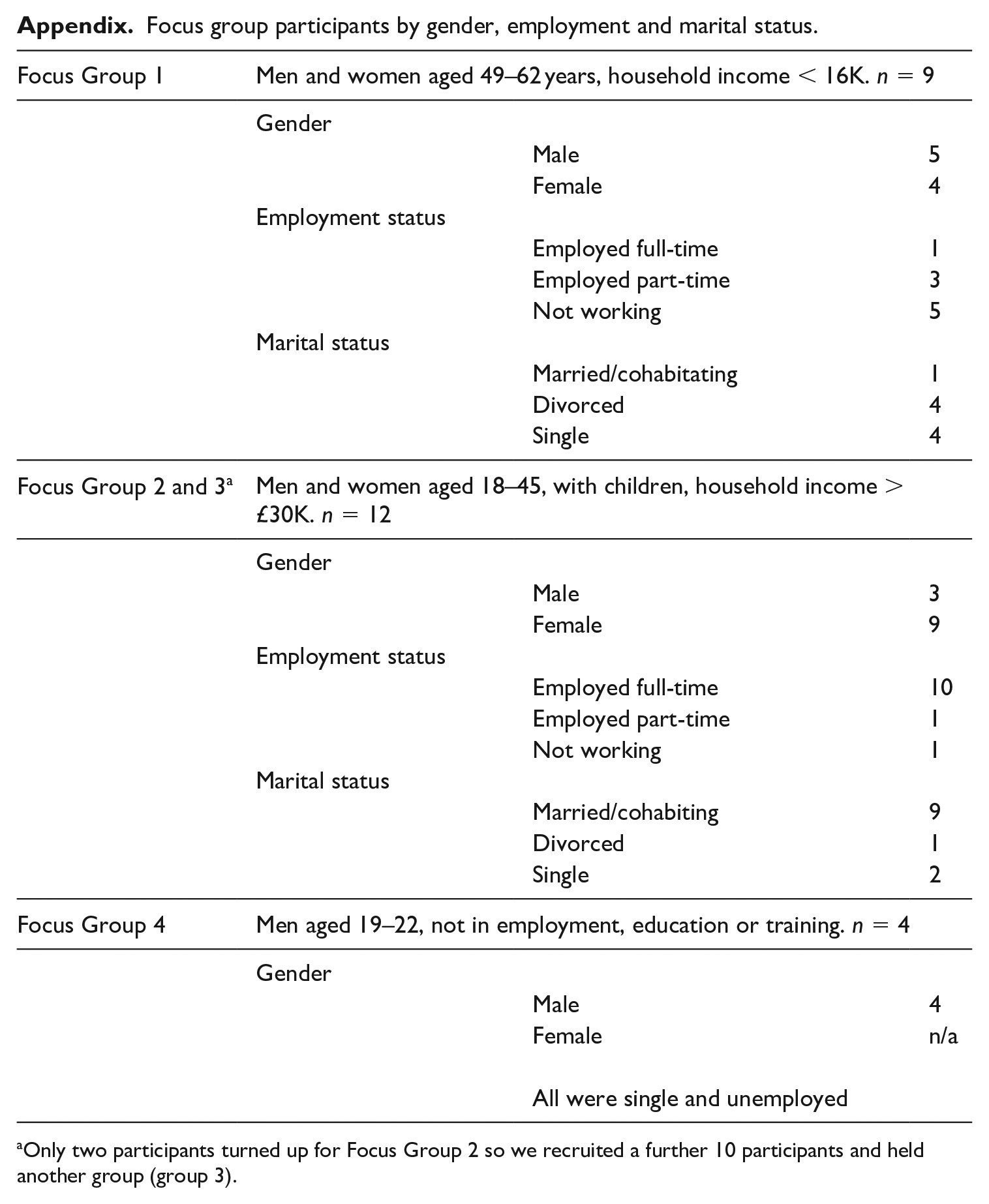
Focus Group 4 (FG4) – Men aged 18–25, not in employment, education or training. (See Appendix for details of participants by gender, employment and marital status.)
Market research companies facilitate recruitment but sometimes rely on existing lists or recruit in specific locations which can result in a sample which omits key local demographics. We did not specify race or ethnicity as a recruitment category and subsequently realised that this had resulted in a sample exclusively of white residents. While our focus was on accounts across generations and distinct economic circumstances rather than specifically on racial, ethnic or national identity, we recognise that at the time we did not reflect sufficiently on issues of race, ethnicity and white privilege. We acknowledge the limits of our sample and in particular that the nostalgic memories and implicit utopias of white residents are likely to be distinct from those of their Asian neighbours (Raychaudhuri, 2018). A total of 24 participants were recruited (see Appendix for details).
As white, middle-class, southern academics we recognise our outsider status within Stoke-on-Trent. While this may mean that we missed some of the unspoken meanings in local discussions (Walkerdine, 2016), it also had some advantages as people were keen to explain their city and their feelings about it to us.
Ethical approval was granted by University of Surrey Ethics Committee. Participants provided informed consent and to protect anonymity are identified by focus group number and pseudonym only. 2 All received a small honorarium in compensation for their time. A topic guide was used to ensure consistency across the groups, but participants were encouraged to talk freely and openly (Patton, 2001). The groups began with an ice breaker in which participants identified locations from photographs of the city. Questions then focused on what it is like to live in Stoke-on-Trent, what participants liked about the city, what they would change, and their visions of what would constitute a good life in the city. Whilst the focus of the topic guide was on the present and the future, in each group much of the discussion actually focused on narratives of the past. Focus groups were fully transcribed and NVivo 11 used to support thematic analysis, which involved a combination of deductive codes based around focus group topics and inductive codes around emergent narratives.
The final phase of our study involved running a workshop in collaboration with the city council where we presented initial findings for feedback and facilitated discussions about what would make Stoke-on-Trent a better place to live. The workshop was attended by representatives from a range of local arts and culture groups, charity organisations, businesses, the city council and local universities.
Pathways to a future Stoke-on-Trent
At first glance our focus group discussions offer scant vision for the future, focusing more on complaints about present problems. While outlining current concerns, however, participants often provided comparison with ideas about how things were in the past or how they could be in the future. Thus, using Levitas’s (2013) definition of utopia as ‘the expression of the desire for a better way of being or living’ (p. xii), our data provide glimpses of the character of local utopias for Stoke-on-Trent. Informed by Levitas’s archaeological and ontological modes we identified ideas about how life, people and the place could and should be which ran through discussions. We then presented these elements within the workshop with local people to check their authenticity, and through group work and discussion collectively identified distinct narratives of the future.
Three distinct but intertwined narratives about the past in relation to creating a future good life were identified: first, a yearning for a return to the former industrial past as a solution for problems in the present; second, a desire to break away from the past to forge something better for the future. Finally, whilst acknowledging the importance of the industrial past, the key to a better future was seen in reshaping its legacy. Elements of all three narratives often emerged within a focus group, although, as we indicate in the analysis, the first narrative predominated in the group with unemployed young men, the second was most evident in the groups with working parents and the final one emerged most clearly in the group with older residents. There was both disagreement between participants in groups and evidence of individuals drawing on elements of all three narratives interchangeably at different points during the discussions.
Restoring the past: Narratives of loss and absence
Narratives of loss and absence, shared through restorative nostalgia (Boym, 2001) for an idealised past, were reproduced across the focus groups. It is easy to trace elements of what Bauman (2017) would cast as reactionary retrotopia, but we prefer to approach this less judgementally and seek to understand its roots and meaning (Walkerdine, 2016).
Accounts of personal loss for individuals and their families encompassed discussion not only of jobs lost but erosion of the security of guaranteed employment (Strangleman, 2012). These accounts were not just given by older participants who had worked in the local industries but most forcibly by the young men who had yet to find work (Walkerdine & Jimenez, 2012). Individual accounts fed into and drew upon collective accounts of loss of security and social identity. For instance, Craig, a young man who had never worked and had experienced homelessness, encapsulated this broad sense of loss: I would say like we need to go back to having the job thing, it is being able to have something so you know you can step into and you are not going to lose. Like back then . . . they are all working in the mine, that is what you did, you followed your dad into the mine, that was your job, you knew what you were going to do and they were all your mates and you went down the pub with them . . . and it would be nice to have that feeling again. (Craig, FG4)
At the heart of his account is the need for a job, but more fundamental is the sense of loss of a known job (‘you knew what you were going to do’) which is guaranteed (‘you can step into’) and that will remain secure (‘you are not going to lose’). In this short excerpt Craig also invokes a sense of loss of a working life which was intertwined with close relations with male family members (‘you followed your dad into the mine’) and workmates (‘they were all your mates, and you went down the pub with them’). His final lament, ‘it would be nice to have that feeling again’, underlines the affective quality of that loss (Walkerdine & Jimenez, 2012). This is reinforced by one of the other participants who contrasts the connected past in which ‘you went to work with your mates, you went on holiday with them’ with his current isolation, ‘now it is just . . . you are on your own’.
The only solution these young men could imagine which would improve the city was to ‘Bring back the industry, that is the only thing that you can do’.
Across the groups overt connections were made between the loss of the industry and an existential loss of identity, who we are: You call Stokies the Potters. That was our identity. Now, obviously, we’ve got no pits we have got no potteries. We’ve lost our identity. Therefore, where do we fit in? Who are we? (Sandra, FG1)
Here Sandra draws attention to the extent to which the industry and the people were entwined, and thus the profound sense of alienation which follows its loss. The industry provided a sense that Stoke as a place was recognised and valuable: We used to be the heart of Britain do you know what I mean, the coal, everything from cutlery to the finest plates and design, where are we now? (Mike, FG4).
Mike suggests that the loss of industry provoked dislocation, thus questioning not only ‘who are we?’ but ‘where are we now?’ Both the place and the people have lost their value and place in the world. Loveday (2014) notes how white working-class identities are increasingly positioned as valueless and suggests that invoking links to past industrial work and community can be a way of providing a valuable identification in the present. For the young men, without jobs and even homes and a persistent sense that ‘they just don’t care’, the imagined past of job security and close ties offers a glimpse of a better world in which they could have a sense of worth and belonging.
These nostalgic ideas about the loss of past employment were tied into populist and nationalistic narratives by some participants. The idea that present problems were attributable to ‘masses of immigration’ (Josh, FG4) was raised by individuals in both groups 4 and 3 (but in the latter was directly challenged by other participants). For instance, Mike spoke admiringly of Trump’s wall between the USA and Mexico suggesting that something similar was needed to protect jobs and homes for ‘English’ people’. Here most evidently, the description of retrotopia as characterised by a return to tribalism, which portends ‘shelter for some (for “us”) hatred for some others (for “them”)’ Bauman, 2017, p. 70) seems to fit. Rather than simply condemning this, however, Walkerdine and Jimenez (2012) suggest that in post-industrial towns fear of new people coming in can be understood in terms of a threat to the community ties which comprised such an essential aspect of established local ‘ways of being’ (p. 11).
References to the industrial past also had a moral dimension, depicting it as a time when people knew their place within the city and behaved appropriately. This was often encapsulated in nostalgic longing for park keepers, regarded as guardians of the city’s green spaces and responsible for preventing anti-social behaviour. Memories of the ‘parkies’ were drawn on as a collective symbol of the erosion of appropriate ways of behaving and an illustration of what was better about the past and missing in the present. Persons in the past were remembered as having a shared understanding of the importance of respect for each other and the natural environment, indicating a holistic understanding that social order is intertwined with care for the natural environment and physical infrastructure. It was felt that not only have jobs and local infrastructure been destroyed in the present, but people too have changed for the worse.
Throughout this narrative the present is consistently compared negatively to the past. One element of value which persists over time though is ‘the people’. This is despite the loss of valued working identity, and coexists with the fear of incomers and concerns about growing lack of respect. We will return to this as we outline two alternative narratives of past, present and future, but note that even in the midst of hardship and neglect the young men we spoke to agreed that ‘the people are good round here’. At the same time, these disadvantaged young men also articulated a strong critique of social inequality (‘You have got them kids that have got mummy and daddy’s money and if you haven’t got nobody you haven’t got nothing’) and a need to care for the most disadvantaged (‘there are people that are homeless and what have you and these are the kinds of things that you should spend money on’ [Mike, FG4]).
In conclusion, this narrative presents the solution to current problems as ‘restoring the past’ by bringing the original industries back. In this it conforms with Bloch’s characterisation of anamnesis (Landmann, 1975), restorative nostalgia (Boym, 2001) and retrotopia (Bauman, 2017). In the laments for what has been lost we saw glimpses of ideas about how life, the place and the people could and should be, but the narrative rarely moved from anger and sadness at what had been lost to any clear future hopes. This narrative was articulated most forcibly by the young white men whose lives most clearly illustrate the ‘structural cocktail of disadvantage’ (Etherington et al., 2022, p. 1) suffered by many in the city. In this context nostalgia entwines with regressive views of the past and reactionary politics at least for some participants.
Breaking from the past: Narratives of ‘something better’
The second vision for a good life rejected nostalgia and sought a new identity for the city which was ‘something better’ than the economically problematic present and the no longer tenable past. It emerged most strongly from discussions in groups 2 and 3 with the relatively well-paid participants from working families. These people had mostly grown up locally and continued to live in Stoke but worked in neighbouring towns and cities where they could earn more.
While aspects of the past were recognised as valuable, this narrative indicated that harking back to it was futile. Sophie explicitly rejected nostalgic ideas of following your parents into a job, embracing a more ‘ambitious’ perspective: If people have not got any ambition, I’d think, oh, my mum worked in a pot bank, so I’ll work in a pot bank, where’s the ambition? My mum worked in a pot bank, but I want to be something better. Pot banks were fantastic but they aren’t even here anymore. (Sophie, FG3)
Here we see an overt desire for mobility away from past industrial employment (‘we’ve now got to . . . forget about all that’) with the remaining physical traces of industry seen as ‘fantastic’ in terms of heritage value rather than ongoing relevance for employment (‘I’d like to see them preserve the kilns . . . because it’s a big part of Stoke’ [Jess, FG2]). While Bauman (2017) is critical of the way in which ‘heritage consoles us with tradition’ (p. 59), there is little sense of looking to the past for ‘consolation’ in this narrative. While the industrial past was rejected as no longer viable, its legacy of social cohesiveness and community spirit was valued (‘Friendliness comes from the industry, doesn’t it?’ [FG3]). A strong connection to their identities as ‘Stokies’ remained, but in contrast to the sense of lost identity apparent in the first narrative, these financially secure participants were more confident about who they were: ‘I’d say I’ve still got a strong identity, but it’s just different.’
These participants were particularly critical of what they saw as the interconnected physical and social decline of the city, citing boarded up shops, beggars and ‘drunks, drug addicts and all sorts’. While the young men we spoke to wanted to see money spent on solving social problems, here the focus was clearly on ‘the economy’ with repeated claims made about the need for ‘investment’. Exactly what should be invested in (and by whom) was vague but included the physical infrastructure and well-paid jobs. Josh sums this up: . . . economy’s on its arse, wages are probably a quarter of what they were back in the heyday, derelict . . . buildings, no money being spent on making it any better . . . so basically it’s about money. (Josh, FG3)
When asked explicitly ‘what would make for a good life in Stoke-on-Trent?’ answers focused on new leisure, consumption and cultural opportunities (‘Nice restaurants and wine bars’, ‘Nice places to go’) alongside better paid jobs. The ‘better’ lives desired align with contemporary expectations of ‘normal’ consumption. This narrative rejects the backward-looking hallmarks of retrotopia, but Bauman’s (2017) concern that for many ‘the vision of a better life has been commodified . . . and abominably impoverished by having been emptied of its ethical relevance’ (p. 128) might seem to fit. Bauman is harsh about the ‘senseless preoccupations . . . of consumerist culture’, in this he exhibits the pervasive anxieties about increasing working-class affluence which Lawler (2014) suggests are: . . . anxieties about a decline in an ‘authentic’ working class existence. It is as if the working class to be valuable, must remain in Rita Felski’s words ‘poor but pure, untainted by consumer culture and social aspirations’. (p. 712)
Miller (2001) notes that the idea of a ‘superficial person who has become the mere mannequin to commodity culture’ is ‘never the rounded person who is encountered within an ethnographic engagement’ (p. 229) and reminds us of the centrality of material culture for human relations, wellbeing and sociality. If we look in a rounded way at the character of the ‘better’ lives envisaged here, we see that they are about the desire to stay and live well in a place to which people are committed. A central concern is with the prospects not only of their own children but other young people in the city who they believe will move away as ‘there’ll be no jobs for them’. Participants expressed concern that the situation of Stoke meant that it was currently seen as ‘a blot on the landscape’ or a ‘shit-hole’, both locally and by outsiders. The calls for investment embodied a desire to improve the reputation and reality of the city. Even though most of these participants were working and socialising outside of the city, they were attached to it and wanted to remain there. Those who stay in deprived post-industrial places are sometimes seen to lack aspiration or to be clinging to a place which previously provided security. However, as Lawler questions, ‘why should people have to leave the post-industrial place to have a better life?’ (2014, p. 710).
In summary, this narrative explicitly rejects nostalgia and seeks a break from the past. Those adhering to this narrative presented themselves as ambitious and forward looking, desiring a Stoke-on-Trent which was ‘better’ than and different from the past. Employment was still prioritised with a focus on decent pay, but desire for new leisure, consumption and cultural opportunities was also highlighted. The industrial legacy of strong social relations and iconic buildings was valued but these were seen as elements which could be carried into the future.
Building on the past: Narratives of reflection
The final narrative suggests that a future good life in Stoke-on-Trent could lie in the city building on its past, rather than rejecting or returning to it. Attachment to moral and physical traces of the past provided inspiration for renewal (Colin, 2021). Narratives were nostalgic in that they included aspects of loss and longing but were also ‘reflective’ in being realistic about the need for change, and ‘productive’ in imagining how that change may take place (Blunt, 2003; Boym, 2001). This narrative emerged most strongly amongst the oldest group of participants (FG1), the majority of whom were long-term residents, with two having worked in the potteries.
When asked what changes they would like to see in the city, several resources were identified as offering potential for a better future. Firstly, it was felt that the former ceramics industry was deeply embodied in their past identity as potters (‘[it] gets ingrained in you’) and has an important role in shaping current identities.
Secondly, it was suggested that there was a moral obligation to realise the potential of industrial ruins by transforming them into heritage attractions which could be catalysts for local renewal. We note again that Bauman’s (2017) dismissal of heritage as ‘consolation’ does not do justice to the way in which its potential was conceptualised here. In a tense exchange between two participants who felt differently about the city, Keira emphasised the need to draw on the positivity of these existing assets in order to move forward and counter negative perceptions of the city: Look what potential we’ve got, we are lovely people, we are friendly and we’ve got these things [heritage] to promote, and if we can get some investment in there, we can make it even better. You’re never going to get anything just by moaning. (Keira, FG3)
Thirdly, as seen in the quote above, local citizens themselves were regarded as assets. Stoke-on-Trent still has many skilled crafts people and new forms of investment into arts and culture offer a potential pathway to regeneration. Craft was recognised as being skilled work in contrast with the jobs in logistics or call centres currently prevalent in the city (Strangleman, 2007). Older people in particular were valued for their skills and knowledge, gained from employment in the potteries with the potential to benefit younger generations: We’ve got this vast population that are old people and I think there’s a real resource there. Well, the fact that they can teach the younger people. (Martin, FG1)
In this narrative human flourishing was implicitly conceptualised as involving pride in good work, the passing on of skills and knowledge, and intergenerational relations.
Finally, the ‘green areas’ and canals were seen to have ‘fantastic potential’ to attract visitors and to transform the city. In perhaps the clearest example of utopian thought, one of the participants in the group of older people said: I have a vision of Stoke-on-Trent, the future of Stoke-on-Trent, it’ll be like the green city.
Thus this vision involves reimagining the best of the city and its people and using them to attract new people and forms of investment. The nostalgia deployed here was fluid, enabling an attachment to the past, but also a reimagining of it into a different future, via a challenging present (Blunt, 2003; Bonnett & Alexander, 2013; Boym, 2001). The role of imagination, so central to reflective nostalgia (Boym, 2001) and homemaking (Raychaudhuri, 2018), was explicitly invoked with calls for ‘the people that are in charge in the city . . . [to]be imaginative about how we approach and look at the positive things that the city has got’.
We have shown how three distinct but interrelated narratives about a future good life in Stoke-on-Trent can be pieced together from collective memories and perspectives on the city. We move now to discuss the implications of these different future visions in relation to the potential to achieve a sustainable good life.
Discussion
Since carrying out our research in 2017 the political representation of the city has changed repeatedly (with all three constituencies returning Conservatives MPs in 2019 and Labour ones in 2024), and the city has received funding from the Conservative government’s levelling up fund to support major regeneration projects. While the investment was welcomed, critics suggested that it did little to recompense for a continuing climate of austerity (Jennings et al., 2021) and was motivated by electoral calculation rather than a long-term strategy to address the interlocking disadvantages that characterise places like Stoke-on-Trent (Etherington et al., 2022; Jennings et al., 2021; Moore & Collins, 2021). To date little of the promised redevelopment has materialised and doubts are expressed locally about whether they ever will (Barrett, 2024; Corrigan, 2024; Harris et al., 2024). In addition, the Covid pandemic exacerbated the economic and health problems faced by low-income households in Stoke-on-Trent and widened educational inequalities (Etherington et al., 2022). Thus, despite high-profile changes in the city since we carried out our focus groups, participants’ views remain resonant.
Discussions in our groups were not overtly utopian. Participants rarely presented transformative visions and did not specify what institutional, political or economic change would be necessary. However, through complaints about the present and nostalgic discussion of the past, valuable ‘fragments and shards’ were unearthed (Levitas, 2013, p. xvii) which can be used to piece together visions of desired local futures. The key distinction that we identify between the three narratives is how the relationship between the past and the future is conceptualised – whether the ‘utopia’ for Stoke-on-Trent is seen as lying in restoring the past, breaking from it or reimagining and building on it. Importantly, distinguishing these narratives was not simply a process of our own data analysis but was refined and validated through discussions at the local workshop in which we presented emerging findings.
In this section we distil the distinct utopias or narratives of a ‘good life’ and consider how they might align with the need for a sustainable future which we conceptualise as facilitating living well within environmental limits (Jackson, 2016), recognising its social and economic dimensions. Interestingly, Davies (2010) draws a direct parallel between nostalgia and the dream of sustainability suggesting that both share the goal of creating ‘a stable home’. While sustainability was never explicitly discussed in our focus groups, conversations about the importance of social relationships, the value of green spaces, the quality of the built environment and the kinds of opportunities desired are all centrally relevant (Jackson, 2016; Levitas, 2013).
The first narrative conforms to ‘restorative nostalgia’ (Boym, 2001) with the pathway to a better future being to ‘bring back the industry’ and Stoke-on-Trent regaining its place as a global centre of heavy industry and manufacturing. While the distinction between what is ‘realistic’ and what is ‘impossible’ is often political, the past cannot simply be recreated. Moreover, the vision of the return of heavy industry is at odds with the urgent need to decarbonise the economy. Secure and well-paid local work is necessary, but the form this work takes needs to be reimagined if the future for Stoke-on-Trent is to be a sustainable one (Van Lerven et al., 2020). Elements of this narrative were clearly reactionary and racist and this also means that this utopia cannot be seen as a sustainable one as justice is always an intrinsic element of sustainability (Agyeman et al., 2016). However, the construction of sustainable futures demands inclusive decision making. We suggest that the identification of positive elements of sustainability across the distinct narratives might provide grounds to draw people together into dialogue (Bauman, 2017; More in Common, 2025). Without in any way endorsing the intolerance expressed, this nostalgic account of the past can be mined for some glimpses of a sustainable future – good work, community ties, local pride, social order, care for the physical environment, a critique of social inequality, and care for the most disadvantaged are all discernible.
The second narrative rejects nostalgia and seeks to break with the past in favour of ‘something better’. Investment in the city was repeatedly called for, with a better Stoke-on-Trent envisaged as one which offered improved quality of life through decent wages, a regenerated built environment and new leisure opportunities. What elements of this narrative of a better Stoke might inform a vision of a sustainable future? While a focus on well-paid jobs and leisure opportunities could be seen as hopelessly consumerist (Bauman, 2017) and at odds with sustainability, we are cautious about such moralistic judgements (Lawler, 2014; Miller, 2001). Underlying the focus on providing decent pay and leisure opportunities was the desire to make a place in which future generations could live well and would want to stay.
Finally, the narrative of ‘building on the past’ involves reflective (Boym, 2001) and imaginative nostalgia (Raychaudhuri, 2018) – or Bloch’s ‘anagnorisis’ – in which what is valued from the past is used as the basis for imagining a transformed future (Bonnett & Alexander, 2013; Landmann, 1975). Communities and people, green spaces, canal networks, surrounding countryside, heritage buildings and skilled craftworking were all identified as resources the city could build a renewed future upon. These aspects of urban spaces are commonly recognised as important elements in supporting deindustrialised cities to make the transition to a sustainable future and to be places where people want to live and work, now and in the future (Moore & Woodcraft, 2019; Vallance et al., 2011). The narrative indicates a vision which incorporates clear ideas about strengthening intergenerational relationships, valuing the skills of older residents and passing on something of value to younger ones. It resonates with the vision of an economy based on community, craft, care and culture (Jackson, 2016) and in this most clearly contains the seeds of a vision of a more sustainable future, environmentally as well as socially. Most importantly, these foundations of what might comprise a socially sustainable city were also identified by participants in our stakeholder workshop and there are many examples in the city of this vision already being enacted. A variety of community arts-based organisations are working creatively in participation with local people developing initiatives of bottom up sustainable and equitable cultural regeneration (Arts Council England, 2024; Higgins, 2024).
The three narratives are all situated visions of the good life, produced by white residents embedded in particular social situations and life stages. We note that the utopia of a return to the past was most apparent amongst the young men who lacked the job security and value afforded in the industrial past. They also expressed anger at social inequality and the need to provide for homeless people like themselves. The utopia of investment for ‘something better’ was expressed most clearly by those from working families. This vision reflected their own desire for improved local amenities and concerns about their children’s prospects. Finally, the vision of building on the past was most clearly articulated by those in the oldest group, some of whom had direct memories of the industrial past and sought a future in which the skills and potential of their generation would be recognised. Further analysis could examine the extent to which these accounts were gendered (Lawler, 2014; Loveday, 2014; Walkerdine & Jimenez 2012).
To recognise the situated character of these utopias is not to reject them as selfish. Rather it highlights the need to gather, and to empathetically engage with, the perspectives of diverse groups in order to build inclusive visions for the future (Moore & Woodcraft, 2019). Bauman (2017) ends Retrotopia with a call for dialogue and the need for us ‘to perceive and treat each other as valid dialogue partners’ (p. 165). His approach throughout his book is oddly out of line with this aim, however, as it involves disparaging rejection of the perspectives he assumes that people hold. The first two narratives we identified have elements which, following Bauman, would simply be decried as populist or consumerist. We have chosen instead to follow Walkerdine’s (2016) example to try to understand local concerns and hopes in a way which might support steps to support community and build dialogue. In a limited way our research provided opportunities not only to elicit some utopian visions in Stoke-on-Trent but also to enable dialogue about them. Discussion in our workshop reinforced the distinct narratives and confirmed that core elements are shared, with all highlighting the value of secure well-paid work, strong community and local identity and the maintenance and preservation of the material and natural environment. Additional research might explore whether these elements also resonate with a more diverse sample.
Conclusions
In this article we have shown how collective narratives of a good life – or utopian futures – can be constructed from discussions about the past and the present in Stoke-on-Trent. While focusing on the narratives of white residents of Stoke-on-Trent, our project indicates the broader potential of utilising Levitas’s conception of utopia as methods within empirical research. While features of the utopian visions which emerged are specific to the past and present Stoke-on-Trent, we anticipate that many features would be shared in other post-industrial places. Much of the legacy of industrialisation and post-industrialisation and the nostalgia that ensues has been observed vividly in other settings (see the earlier sections in the article), thus it seems likely that the visions for the future borne out of this may also have transferable elements.
Eliciting conceptions of a future good life is a challenging exercise, especially in places characterised by economic hardship and physical decline where narratives of loss and hopelessness often prevail. Rather than trying to steer participants into explicit discussion of sustainable futures, inspired by Levitas’s ‘archaeological mode’, we focused on the shards of desire for an alternative future embedded within their discussions of the failings of the present and good things of the past. We also employed the ‘ontological mode’ to examine participants’ conceptualisations of how local people and their social relationships could and should be and what conditions support their wellbeing. Our use of the ‘architectural mode’ is most tentative, and the alternative visions of the future constructed here are fragile. Group discussions contained within them little consideration of the institutions and infrastructures which might support an imagined future. Thus, we have grounds for only preliminary architectural sketches, the sustainability of which cannot be fully scrutinised.
For Levitas (2013) ‘utopia as method’ is a call for more normatively engaged sociology which involves an explicit identification of elements of a ‘good’ society. Our focus here has been on teasing out the utopian visions held by residents of Stoke-on-Trent, however in this we also reveal our own. Our vision of a sustainable society or of a thriving city (C40 Cities et al., 2019) is one in which people are able to live well within planetary limits (Jackson, 2016), and it is this broad template which we have held up to evaluate the visons unearthed in Stoke-on-Trent.
Debates about utopias often revolve around how useful or realistic they are. The visions of the future we have pieced together here might be criticised as politically and economically naïve and insufficiently detailed to provide practical input. However, our research did not aim to draw up a blueprint, but to provide one way for local people to think and talk together about desired elements of a good life within their city. This aligns with Levitas’s (2013) conception of utopia as: . . . a journey and not a goal. This demands an open and indeterminate future, which refuses the illusory coherence of a fully worked out alternative. (p. 109)
Running through all the narratives we outlined is an emphasis on the desire for ‘good’ work, a sense of security, community integration and the conservation of the physical and natural environment. While the specific ways in which this might be realised remain vague and contested it provides a strong sense of a guiding vision for a sustainable future for the city which is locally desired. Developing utopian visions of the future might seem an indulgent distraction from the pressing need to develop tangible regeneration policies which are able to adapt to and mitigate climate change, yet the need for transformative and shared visions of the future is vital – as Levitas (2013) puts it: ‘Our very survival depends on finding another way of living’ (p. xii).
Footnotes
Appendix
Focus group participants by gender, employment and marital status.
| Focus Group 1 | Men and women aged 49–62 years, household income < 16K. n = 9 | ||
|---|---|---|---|
| Gender | |||
| Male | 5 | ||
| Female | 4 | ||
| Employment status | |||
| Employed full-time | 1 | ||
| Employed part-time | 3 | ||
| Not working | 5 | ||
| Marital status | |||
| Married/cohabitating | 1 | ||
| Divorced | 4 | ||
| Single | 4 | ||
| Focus Group 2 and 3 a | Men and women aged 18–45, with children, household income > £30K. n = 12 | ||
| Gender | |||
| Male | 3 | ||
| Female | 9 | ||
| Employment status | |||
| Employed full-time | 10 | ||
| Employed part-time | 1 | ||
| Not working | 1 | ||
| Marital status | |||
| Married/cohabiting | 9 | ||
| Divorced | 1 | ||
| Single | 2 | ||
| Focus Group 4 | Men aged 19–22, not in employment, education or training. n = 4 | ||
| Gender | |||
| Male | 4 | ||
| Female | n/a | ||
| All were single and unemployed | |||
Only two participants turned up for Focus Group 2 so we recruited a further 10 participants and held another group (group 3).
Acknowledgements
We thank the research participants in Stoke-on-Trent who shared their perspectives with us and colleagues in CUSP (The Centre for Understanding Sustainable Prosperity) who supported both data collection and the development of our ideas.
Funding
This research was funded by the ESRC (ES/M010163/1) and the Laudes Foundation as part of CUSP (The Centre for Understanding Sustainable Prosperity).
