




Abstract
This article examines the processes that shape pupils’ higher education (HE) aspirations and choices. At the theoretical level, I argue that while Pierre Bourdieu’s field-centred approach is ideal for grasping specific field dynamics and stakes, Axel Honneth’s perspective allows for a focus on the broader normative and moral dimensions that extend beyond a particular field. Thus, by applying Honneth’s recognition theory, I analyse how normative content is involved in pupils’ HE decision-making. In doing so, this article conveys the idea that Honneth’s conceptual insights complement and strengthen Bourdieu’s perspective on this matter. Empirically, this study draws from the case of Chile, looking at 23 semi-structured interviews with middle-class pupils in their final year of secondary school. My findings reveal how moral and normative dimensions influence pupils’ HE desires, whether it is in the fact that HE appears as a normative imperative pushing their decisions; in the responses they raise to confront economic constraints; or through the two cultural tropes – personal effort and individual responsibility – associated with the meritocratic principle that markedly shape their dispositions.
Introduction
Drawing on the sociology of recognition (Lamont, 2018), this article demonstrates empirically how higher education (HE) aspirations can be examined through the lens of Axel Honneth’s recognition theory, thereby complementing prevalent Bourdieusian analyses. Using Pierre Bourdieu’s conceptual toolbox, many scholars from around the world have depicted how class and individual, collective and institutional practices are involved in the formation of higher education (HE) aspirations and choices (Abrahams, 2018; Ball et al., 2002; Reay et al., 2005; Stich & Crain, 2023). However, less attention has been paid to the normative and moral dimensions underpinning this process (Baker, 2020). While the normative dimension refers to the set of standards for how things ought to be, which arise from social interactions and relations of mutual recognition, the moral dimension concerns the evaluative principles guiding individuals’ behaviours and thoughts about what is right and wrong. In this article, based on the case of Chile and drawing on Honneth’s ideas, I address both dimensions as a way of complementing the Bourdieusian understanding of this phenomenon.
I argue that while Bourdieu’s perspective is more appropriate for grasping specific field dynamics and stakes, Honneth’s viewpoint is more suitable for comprehending the broader normative and moral elements that significantly influence individuals’ aspirations. Thus, although Bourdieu’s field-centred approach has proven helpful in understanding some significant aspects of the HE decision-making, there are still societal normative and moral elements playing a meaningful role in this process.
Honneth (1995b) himself has critically engaged with Bourdieu’s work. Even though he depicts a utilitarian image of Bourdieu which blurs some elements of his fundamental logic (Bourdieu & Wacquant, 1992; Carré, 2021; Piroddi, 2022), Honneth’s crucial argument is that Bourdieu’s framework is inclined to neglect norms of action and moral models to explain individuals’ strategies and practices in society. If this is so, it becomes relevant to address this normative dimension in toto. In so doing, I bring the concept of recognition to the fore. I contend that, although the notion of recognition is placed at the centre of both scholars’ theoretical projects (Bourdieu, 2000; Honneth, 1995a), Bourdieu’s field-centred perspective overlooks an overarching normative dimension that is crucial in shaping pupils’ HE desires. I bridge this gap by applying some key aspects of Honneth’s theory.
A number of authors have discussed Bourdieu’s and Honneth’s ideas (Basaure, 2011; Carré, 2021; Piroddi, 2022), showing disagreements and convergences between both scholars. Carré (2021), for example, successfully explains the overlap between Bourdieu’s and Honneth’s views on recognition and domination. He transcends the archetypal image that puts both thinkers on opposite sides: Bourdieu in an anti-recognition stance and Honneth in a pro-recognition posture. Piroddi (2022), on the other hand, seeks to harmonise Bourdieu’s concept of field and Honneth’s notion of spheres of recognition. From his perspective, intentions, decisions and practices (i.e. elements associated with fields) appear mediated by individuals’ normative and moral expectations for social recognition (i.e. elements associated with spheres of recognition). However valuable they may be, these contributions still remain on a theoretical plane. In this article, alongside its theoretical discussion, I apply Honneth’s theory to the case of Chile, to empirically contribute to building upon Bourdieusian research. The Chilean case is an interesting one for analysis, since it has been considered one of the first neoliberal laboratories (Araujo, 2022) in the world. This condition entails the influence of specific normative and moral principles that are particularly relevant to contemporary societies.
The article is structured as follows. I begin by outlining Bourdieu’s ideas on recognition and aspirations, showing how they can be restated. I then shed light on some essential conceptual elements that constitute Honneth’s theory, and present how they can be articulated for the analysis of HE. Then, I focus on the case of Chile. I introduce the study’s methods, followed by its empirical findings. These are divided into three subsections that examine how normative and moral dimensions influence pupils’ HE decision-making. I conclude by emphasising the article’s main theoretical and empirical contributions.
Bourdieu’s notion of recognition and the shaping of aspirations
Often overlooked, recognition in Bourdieu’s theory is intimately intertwined with domination and misrecognition. In Bourdieu’s (1998) view, symbolic domination is based on the transfiguration of the relation of domination. Thus, the dominated is subjected to the dominant insofar as the former acknowledges, through an act of recognition, the power of the latter. Yet the recognition act occurs with the misrecognition of the objective truth behind it – i.e. with the concealment of the objective relation of domination of one party over the other. Hence, symbolic domination rests on both recognition and misrecognition. Importantly, Bourdieu (2000) contends that the effectiveness of recognition and its legitimation is greater when individuals who perform the act of recognition are themselves recognised.
Bourdieu (2000) asserts that individuals’ search for recognition starts in early childhood within the family field through socialisation. During this period children discover themselves as subjects insofar as they discover others as objects and take the viewpoint of those others upon themselves. Thereby, individuals define themselves by the perception of others. Furthermore, intrinsic to the accumulation of symbolic capital, an essential property of symbolic domination, is the pursuit of others’ recognition. Human beings, therefore, are situated on battlefields in which, ultimately, recognition is at stake. Arguably, there is an inherent sense of being recognised that is intrinsic to being human. As Atkinson (2020, p. 47) notes, Bourdieu puts recognition ‘at the heart of the human condition’.
For Bourdieu (2000), socialisation also involves a process of inculcation. Through socialisation, individuals incorporate specific dispositions into the body from which habitus emerges. Habitus represents the continuous incorporation of the external world, whether within the family or in other fields. Crucially, it functions as a system of inclinations that orients individuals’ claims and acts of recognition within specific contexts. Thus, placed in particular fields that exert a symbolic force, and equipped with certain dispositions, individuals strive for recognition while bestowing it on others (Bourdieu, 2000).
Importantly, habitus also shapes individuals’ aspirations and expectations. It provides a ‘sense of limit’ (Bourdieu, 2010, p. 164) that excludes what is beyond their possibilities. Thus, those situated in the field of HE build their aspirations based on their habitus, which encompasses acts of ‘recognising’ and ‘being recognised’ (Bourdieu, 2000, p. 189).
While recognition is crucial in Bourdieu’s thought, his approach is inclined to focus on the dynamics and stakes of specific fields. This field-centred perspective implies that aspirations and decisions are shaped by the interests ruling those particular fields. In what follows, I contend that Honneth’s recognition theory opens new avenues for the understanding of the HE choice-making process, in particular, by shedding light on an overarching normative dimension.
Outlining Honneth’s recognition theory
Honneth’s (2005) starting point on recognition is somewhat different from that of Bourdieu. Drawing on Hegel’s political philosophy and Mead’s social psychology, he proposes a social theory with a normative content in which he identifies three spheres of recognition: love, legal relations and social esteem. Honneth borrows from both thinkers the idea that the nexus between subjects gives rise to an intersubjective process of mutual recognition. The abilities and qualities of the subject are recognised by others through this process, which also allows the subject to become aware of their own actions, recreate a practical self-image and recognise their own identity. Thereby, individuals take the normative viewpoint of others and apply it to interpret their own circumstances. Furthermore, insofar as individuals incorporate the viewpoint of others, they are recognised by them as members of the community (Mead, 1934).
In Honneth’s (2005) view, mutual recognition is central to the process of moral development of societies, which is triggered by the subject’s struggle for higher levels of autonomy and the expansion of social rights. This condition – and not necessarily domination – would be the frame in which individuals’ struggle for recognition in modern societies occurs. These struggles can be traced back to the three sequential interaction spheres: love, legal relations and social esteem. The differentiation between these spheres comes together with additional possibilities for both individualisation and social inclusion (Honneth, 2004), and it is within them where individuals acquire dignity and integrity as human beings (Honneth, 2001).
The question now arises as to how HE aspirations and choices fit into Honneth’s perspective. Crucial, in this respect, is the pattern of recognition linked to the social esteem sphere. While the love sphere, Honneth (2005) explains, is associated with the first phase of an individual’s socialisation in which the primary emotional relationships are gradually developed, and the sphere of legal relations refers to the dimension in which certain legal obligations and rights are agreed, the sphere of social esteem is linked to the emergence of a shared value-horizon against which individuals’ qualities and achievements are mutually assessed. Honneth (2005, p. 122) speaks of a ‘framework of orientation’ or a ‘system of reference’ which guides individuals’ judgements according to culturally defined values. This pattern of recognition presumes shared responsibilities and duties for the members of the community (Honneth, 2001), while individuals understand themselves as potentially having valuable talents for society (Honneth, 2003).
Honneth (2005) associates the emergence of the shared value-horizon with the transition from traditional to modern societies. This also entails the replacement of the idea of social honour with social prestige. The latter arises as a result of the individualisation of achievement and openness to various forms of self-realisation. Thus, the individual is socially recognised according to their particular form of self-realisation, which gives them a certain degree of prestige. Moreover, the degree of worth ascribed to the individual is, ultimately, associated with the way in which that particular form of self-realisation contributes to the goals that society has agreed upon. Accordingly, the valuation of achievement is tied to an institutional framework from which the distribution of resources is defined in accordance with a normative agreement (Honneth, 2003). Thus, the achievement – or meritocratic – principle provides ‘rational grounds for publicly justifying the privileged appropriation of particular resources like money or credentials’ (Honneth, 2003, p. 148).
Following Honneth’s line of reasoning, it appears clear enough that in contemporary societies, the meritocratic principle reaches one of its most meaningful expressions in the HE system. Considering the Chilean case, I delve into this condition by analysing pupils’ discourses about their HE aspirations and choices.
The worth of higher education, struggle for recognition and its denial
Certainly, HE has become an essential part of the institutional framework and the collective value-horizon that serves the established social order to justify the unequal appropriation of valued resources – i.e. using Bourdieu’s vocabulary, the distribution of institutionalised cultural capital in the form of credentials (Bourdieu, 1986). Consequently, HE appears today as a fundamental mechanism for individual achievement, self-realisation and gaining prestige in society. Individuals’ struggle for recognition within the social esteem sphere, therefore, may help to explain the growing demand for qualifications and the expansion of HE in the last few decades, either in Chile or elsewhere (Marginson, 2016).
Conversely, the denial of recognition – which is not the same as Bourdieu’s misrecognition concept – can be regarded as the flip-side of the coin in Honneth’s scheme. As Honneth (2005) explains, it entails different forms of disrespect, which typically harm the positive self-understanding, self-esteem and self-identity that the individual has acquired in their interaction with others. Especially in the social esteem sphere, disrespect involves the depreciation of the social value ascribed to a person in relation to their particular form of self-realisation (Honneth, 2001, 2005). This is the case, Honneth (2005) points out, when certain ways of life, beliefs and achievements, considering the dominant system of reference, are seen by others as inferior. This form of degradation to which the individual is exposed is coupled with experiences of both social devaluation and loss of self-esteem.
If HE, as a fundamental constitutive piece of the prevailing system of reference orienting individuals’ valuations in terms of their achievements and merits, becomes an essential mechanism for gaining social recognition, no wonder that the inability to access it may be associated with certain forms of disrespect, social devaluation and loss of self-esteem. Thereby, entering HE becomes a sort of normative imperative not only for self-realisation and recognition but also as a means of preventing disrespect, and I should add discrimination, stigmatisation (Lamont, 2018) and shame (Sayer, 2005). Pupils’ HE aspirations and choices, we may assume, would be significantly affected by this condition.
Bourdieu’s and Honneth’s recognition approaches in perspective
When looking at HE aspirations, Honneth’s conceptualisation can complement Bourdieu’s theoretical scheme and add new insight to the understanding of the phenomenon. While for Bourdieu (2000), recognition and aspirations materialise in the context of autonomous fields in which individuals recognise and are recognised according to the stakes imposed by the field, according to Honneth (2005), mutual recognition appears as inherent to the development of modern societies. Thereby, Honneth adopts a broader approach in which recognition develops, throughout its different spheres, into an overarching normative dimension. His perspective hence allows us to examine how HE aspirations and choices are shaped, considering not only the stakes and properties that exclusively pertain to the HE field, but also to a wider normative dimension that unfolds with the development of societies.
Furthermore, while recognition is always intertwined with misrecognition and domination in Bourdieu, Honneth’s conceptualisation is framed in a more positive understanding that points towards social inclusion and individualisation. The question arises as to what extent Honneth’s approach may also involve the deployment of power relations underpinning misrecognition, symbolic violence and reproduction (Bourdieu, 1996; Carré, 2021), which are central to Bourdieusian analyses of HE. According to Honneth (2012), social recognition may take an ideological function too. He argues that, in some situations, recognition may operate as a mechanism of ‘subjection’ that serves to reinforce those attitudes that adhere to the dominant order. Resonating with Bourdieu’s ideas, Honneth understands that ‘to recognize someone is to encourage them . . . to adopt precisely that self-conception that conforms to the established system of behavioural expectations’ (Honneth, 2012, p. 76). Hence, social recognition would appear to secure practices of domination rather than individuals’ personal autonomy. In its ideological form, social recognition operates as a ‘conformist ideology’ that triggers some ‘forms of voluntary subordination’ (Honneth, 2012, p. 77). When looked at this way, we would be closer to what Bourdieu understands as misrecognition and symbolic violence, which are essential aspects for social reproduction (Bourdieu & Passeron, 1990).
In the sections below, I apply Honneth’s ideas to the case of Chile. First, I present some relevant background characteristics of the Chilean education system and society.
The Chilean context
Due to the market-driven reforms introduced during the 1980s, Chile has been regarded as a neoliberal laboratory (Araujo, 2022), notably influencing the educational sector (Bellei & Vanni, 2015). According to Araujo (2022), neoliberalism was implemented with the promise of a better life based on personal effort and the individualisation of responsibility. In this framework, HE has been promoted as an engine for social mobility (Simbürger, 2013). Through deregulation, the sector experienced a rapid expansion that has gone hand in hand with the growth of private suppliers (Guzmán-Valenzuela & Bernasconi, 2018). Enrolment increased from approximately 245,000 students in 1990 to nearly 1,280,000 in 2024 (Ministerio de Educación [MINEDUC], 2024), while the gross enrolment ratio rose from around 20% in the early 1990s to nearly 90% in 2020 (Economic Commission for Latin America and the Caribbean [ECLAC], 2024). During this period, the introduction of new policies, including a new loan scheme in the mid-2000s and the Tuition-Free HE programme in 2016, fostered the system’s expansion. An important part of its growth is explained by the entry of pupils whose families can be found in intermediate and lower positions in the social class structure (Programa de las Naciones Unidas para el Desarrollo [PNUD], 2017). Unsurprisingly, the increased opportunities in the area have led to high expectations (Rojo-Mendoza et al., 2023).
Nonetheless, Araujo (2022, p. 19) argues that the neoliberal promise has remained broken. This is primarily due to the action of ceilings that undermine individuals’ aspirations for upward mobility and mean low returns on their endeavours. The configuration of the country’s educational system has contributed to this situation. Until recently, Chile’s school system was firmly grounded in freedom of choice and a voucher scheme. This promoted competition, particularly between public schools and private subsidised schools. While the former are publicly managed and free of charge, the latter receive public financial support and were allowed to charge co-payment fees. The system also includes some delegated schools that are public vocational institutions whose administration has been transferred to non-profit organisations, and there is a small group of prestigious public establishments known as emblematic public schools. These used to be highly selective, attracting some of the most outstanding pupils. Finally, fully private schools are institutions that are permitted to charge tuition fees at their discretion. Under this scheme, the school system became highly segregated socioeconomically (Valenzuela et al., 2014) and distinctly influenced by class divisions (Carrasco et al., 2021). Moreover, it forms a gradient where public schools tend to attract the least privileged and private establishments the most privileged pupils.
In the case of HE, while historically marginalised groups have increased their participation in the sector, the system still reproduces social inequalities (Espinoza et al., 2023; PNUD, 2017). HE choices are strongly influenced by individuals’ class positions (Espinoza et al., 2023; Palma-Amestoy, 2022), which reinforces a segregated system. These divisions are then mirrored in the labour market. For instance, while selective elite universities are typically the pathway to top positions and well-paid jobs, massive and less prestigious institutions provide rather limited opportunities for social mobility (Quaresma et al., 2022; Zimmerman, 2019).
Methods
The data used in this article are drawn from a larger study that included 46 semi-structured interviews with pupils aged between 18 and 20 years old, in their final year of secondary school. They were recruited from 13 schools in the Santiago Metropolitan Region of Chile during the second half of 2018. To gather a socially diverse sample, pupils were selected from different types of schools: delegated, public, emblematic public, private subsidised and private. As will be explained below, this article focuses specifically on those from middle-class backgrounds. These participants were attending public, emblematic public or private subsidised schools, whereas those from delegated and private establishments were in working-class and upper-class groups, respectively.
Pupils were invited to voluntarily participate in the study by a member of the school staff who was appointed by each establishment to facilitate the research process. Although this procedure might have introduced some unintentional bias, I provided the schools with guidelines to ensure diversity in terms of gender balance, pupils’ achievements and areas of interest. Once selected, I personally conducted the interviews at the respective schools. To guarantee pupils’ well-being and safety, each establishment provided a quiet space in which to conduct the interviews. Before starting the interview, I presented the pupils with an informed consent form that outlined the ethical considerations of the study. 1 I stressed to them that they were not obliged to participate and that they had the right to withdraw at any point during the research process. Likewise, I emphasised that during the interview they were free to choose whatever information they wanted or did not want to share. I also assured them that their identities would be kept confidential.
I was aware of the asymmetrical power dynamic that being an alumnus of a prestigious university in Chile and, at that time, a researcher supported by a foreign institution from the Global North might create between myself and the participants. To tackle this, I openly shared this information and answered any questions they may have had related to this. This approach helped me build confidence and trust with the interviewees. Once everything was clear, the informed consent was then signed, as all pupils were aged 18 or older. The interviews lasted between one and one and a half hours.
The interviews focused on identifying pupils’ HE aspirations and potential choices. To accomplish this, the research strategy was to capture pupils’ habitus (Costa et al., 2019), which was pursued by applying a biographical approach. Sociological biography, Lahire (2019, p. 379) argues, aims ‘to reconstruct the successive or parallel socialising experiences . . . through which the respondent has been constituted and which have settled in them in the form of schemes or dispositions to believe, see, feel and act’. In line with these ideas, the interview schedule was designed considering different dimensions related to pupils’ parallel experiences. Thus, in addition to questions related to aspirations towards HE and perceptions about the HE field, the interview schedule considered various questions associated with pupils’ social origin, educational trajectories, tastes and lifestyles. Thereby, this research strategy considered socialising experiences and interactions as crucial, making it suitable for enquiry by applying recognition theory.
After the interview stage, the 46 pupils were assigned to three different classes: the upper class, the middle class and the working class. The allocation process was based on several factors, including the cultural and economic capital of pupils’ parents, the pupils’ family structure (this factor was particularly important in cases of single-parent families) and the type of schools that pupils attended throughout their school trajectories. This process was possible thanks to the rich information gathered during the fieldwork. For instance, the information helped identify parents’ occupations and levels of education, and pupils’ educational trajectories in great detail.
My article focuses only on those in middle-class positions, who hold aspirations which may be somewhat similar to what Stich and Crain (2023, p. 806) identify as middle-class aspirations in the US. Table 1 shows how middle-class pupils within the sample are distributed.
Pupil sample by type of school and gender.
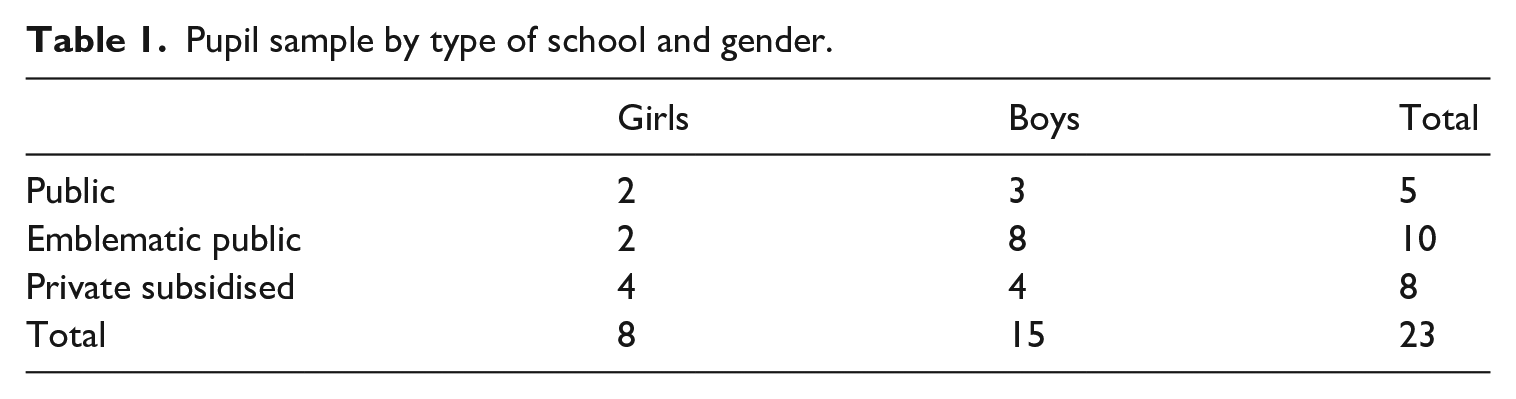
The focus is on those in the middle class because throughout the analysis there was a clear differentiation regarding how the members of the three different groups approached the transition from school to the next stage in life. While in the upper class the process was navigated as the taken-for-granted pathway towards university, and in the working class as an experience surrounded by a sense of anxiety and discomfort, in middle-class positions the transition to a new phase and the possibility of HE was often lived as a demand of society (Palma-Amestoy, 2022). This article aims to explore and deepen understanding of the experiences associated with the latter condition wherein the possibility of HE is associated with the prospect of upward social mobility and fundamentally influenced by meritocratic discourse.
For the data analysis, all the interview transcripts were uploaded to the qualitative data analysis software, NVivo, and a thematic analysis was conducted. I began rereading and coding the transcripts based on the broader dimensions outlined in the interview schedule. I then grouped the codes into emerging themes and sub-themes through an iterative process informed by relevant literature. Additionally, I wrote several annotations for each participant during the coding to record meaningful ideas and connections between cases.
As previously noted, I apply a qualitative approach to grasp the process of formation of HE aspirations and decisions. Particularly, I focus on the normative and moral dimensions associated with this process. Qualitative enquiry, Baker (2020) argues, is ideal for researching ‘thick’ morality. In the following sections, I delve into these dimensions considering three issues: how HE is perceived as an external demand, pupils’ moral responses against economic constraints, and the influence of meritocratic discourse on pupils’ struggle for recognition.
‘Our head up high’: Higher education as a demand of society
Generally, participants’ aspirations are to continue studying after school. If they go to HE, many would be the first generation in their families to do so. Notably, several take the possibility of pursuing HE as a demand of society. Here we can note some relevant elements indicating that the possibility of HE for these pupils is intertwined with Honneth’s notion of social recognition. This is the case for Catalina,
2
who attends Las Naciones private subsidised school and would like to pursue a law degree. At best, she is thinking of a prestigious public university. However, given the academic requirements involved in the selection process, she asserts that the most likely option is to go to a private – less prestigious – institution. When she is asked why she would like to continue studying, she stresses that ‘they demand that we get a degree to satisfy ourselves’, which reveals that HE is viewed by her as an external demand. She then justifies her position, stating that HE will allow her: ‘to be able to hold our head up high’. This assertion is particularly striking since it connects the possibility of HE with a sort of strategy oriented to gaining respect and dignity – which echoes Baker’s (2017) interviewees in England. As Honneth (2005) suggests, dignity and recognition are interrelated concepts. Arguably, there is a close connection between the idea of holding your ‘head up high’ and what intersubjective recognition denotes. Catalina closes her argument about the importance she gives to HE by pointing to an economic dimension merged with a normative stance:
. . . to have our career or whatever we want to study. And also, to get a salary that we deserve. (Catalina, private subsidised school)
Catalina’s standpoint is shared by Andrea at Libertad emblematic public school, who aspires to get a law degree from a prestigious university. Her parents are both professionals with university degrees and occupy a stable position in the middle class. They have been fundamental in her educational trajectory and decisions, especially her mother with whom she lives. Andrea thinks that getting an HE diploma is not only a way to accumulate valuable capital but also a way to secure a good job that will earn her respect. When she addresses why she aspires to pursue an HE degree, she asserts:
Mainly because – and not only in Chile, but everywhere – it’s difficult to get a job in which you’ll be respected without holding a degree, without a diploma. I think that this is the reason why almost everyone studies something, why they go to university, because without a degree you are not even considered. (Andrea, emblematic public school)
HE is appreciated by Catalina and Andrea in two fundamental dimensions. It is perceived as a way ‘to get a salary that we deserve’ and also as a means to be ‘considered’ and ‘respected’. Hence, the possibility of entering HE not only refers to pupils’ chances of securing better material conditions of life and access to economic capital, but is also connected with symbolic, normative and moral properties which are valued in the social world. Thus, the subjective appreciation of HE as a demand of society, more than being linked to two separate forms of struggles – that is, for redistribution (i.e. economic) and for recognition (i.e. cultural) (Fraser, 2003) – is in practice conceived by pupils in a way in which both aspects appear intertwined, and in which the idea of recognition occupies a central place.
On the other hand, in line with Honneth’s (2004) scheme, processes of individualisation and social inclusion, as two sides of the same coin, emerge as key aspects in shaping pupils’ aspirations. As suggested by Daniel, who is attending an emblematic public school, HE allows people to differentiate themselves from others (i.e. individualisation) as well as to avoid the likelihood of being subject to discrimination (i.e. social inclusion), as the following excerpt shows:
. . . people say that if you don’t study at university, you are just another pawn. And this is like really discriminatory. I don’t get it; it’s so discriminatory. If you’re not at university, doing an elite degree, you are a nobody in society. Because it’s not the same if I studied something in comparison to a guy who didn’t do it. People think that they can do whatever they want with the guy who didn’t study. (Daniel, emblematic public school)
Daniel’s reflections are underpinned by the idea that social recognition is the main issue at stake when the question is about the possibility of entering HE. ‘If you’re not at university, doing an elite degree, you are a nobody in society’, says Daniel – a statement that shows how HE has become central within the social esteem sphere and, therefore, part of a shared value-horizon (Honneth, 2005) in society. Consequently, the possibility of HE encompasses both material and symbolic properties, which are merged into a sense of being recognised that orients pupils’ aspirations. Admittedly, this sense transcends the stakes of the purely educational field.
Cristóbal makes similar points. He attends El Valle public school and would like to continue studying through HE. He aspires to do civil industrial engineering at a traditional university. However, he is struggling to improve his University Admission Test score, which is essential to apply to selective institutions in the country. Cristóbal points out that the only way to fund his studies at university is via the Tuition-Free HE programme. Otherwise, he will be forced to enter a professional institute since these institutions offer cheaper – but less prestigious – degrees. Certainly, his parents do not have the means to pay for university. In this context, the possibility of continuing studying through HE is associated by Cristóbal with the opportunity of ‘emerging as a person’, a condition that denotes the potential for flourishing (Sayer, 2005). When asked why this is so, Cristóbal explains:
Because I think that this [studying at HE] is the only way you can be someone in life. (Cristóbal, public school)
The idea of studying ‘to be someone in life’ – or ‘becoming somebody’ (Reay, 2002) – summarises well the emotions and subjectivities underpinning pupils’ discourses. Notably, HE appears as an essential piece of the framework of orientation (Honneth, 2005) driving pupils’ struggle for recognition.
Overall, pupils in middle-class locations perceive that society has changed. The ‘rules of the game’ (Bourdieu & Wacquant, 1992, p. 99) with which their parents and older relatives grew up are not the same. Currently, they are required to attain higher levels of education not only to avoid being relegated to a devalued position within the labour market, but also to be recognised and respected as human beings. Catalina gives a clear account of this transformation from one generation to another:
. . . like my father, he didn’t study, but in spite of it, people didn’t care. So, he got into the truck factory at seventeen years old, and even without studies, they accepted him. However now, they don’t accept you if you haven’t at least finished secondary education. (Catalina, private subsidised school)
Accordingly, the younger generations inhabit a transformed social world that imposes new requirements around gaining social recognition. HE, as a constitutive part of the meritocratic principle, turns crucial in this transformed context.
‘I’ll pay for it on my own’: From economic constraints to moral responses
As research in the area has shown, economic capital plays a fundamental role in shaping pupils’ HE decisions (Ball et al., 2002; Guzmán-Valenzuela et al., 2022; Stich & Crain, 2023). The high cost of some institutions and degrees is a critical factor influencing pupils’ aspirations. This is particularly true for those coming from middle-class and lower social positions. Consistent with this condition, most of the participants in this study declared that they only aspired to attend affordable institutions, due to the economic constraints facing their families. These constraints bring uncertainty, which becomes more frequent as we move towards the lower echelons in the social space. In such scenarios, some pupils look for alternatives. Some of them assert that they will work and study simultaneously to pay for their HE. This is the case of Camila who attends San Pedro private subsidised school:
. . . in any case, I’ll work to pay for it [HE] on my own, to fund myself. So, if they [universities and degrees] are too expensive, I won’t be able to choose them, because my resources are limited. (Camila, private subsidised school)
Yet the relationship with money is complex. The possibility of working and studying at the same time not only responds to an economic necessity but may also come mixed with a ‘moral meaning’ (Baker, 2017) which denotes normative and moral aspects that underpin pupils’ potential decisions. Carolina at Las Naciones private subsidised school is a case in point. Both her parents have indigenous roots and migrated to the capital in search of new opportunities. Carolina’s mother works as a cleaner and her father is already retired, so her family are in a tight economic situation. Although Carolina wants to pursue an HE degree, she does not know which one, and at which institution. The main issue she identifies is the high cost of degrees. For this reason, she would prefer to pay for her studies instead of her parents:
I don’t want my parents paying it [HE] for me, because it’s not . . . because this is something for me; I want to work and pay for university on my own, and that’s it. In any case, my parents wouldn’t have enough money. (Carolina, private subsidised school)
Carolina wants to find a job because she feels that paying for her HE is the right thing to do, even though her family have shown her support. This action can be understood as a kind of moral duty, as part of certain ‘ethical dispositions’ (Sayer, 2005, pp. 42–43) that are activated in the context of economic constraints that restrict what her parents can afford for her. Another pupil who shows a similar stance is Arturo at El Valle public school. Whilst his father is unemployed, his mother, with whom he lives, has a stable job. Nevertheless, he is not sure if this will suffice:
. . . since my father is unemployed, I don’t know if my mother’s salary will be enough. However, it’s not the end of the world. I told her that if she doesn’t have enough money, I’ll look for a job and I’ll help her to pay for it [HE], because it’s not the plan to delay it one more year, as after me it’s my sister’s turn . . . she doesn’t have many years left in school, and she’ll go to university, she has to pay for it too. So, there are no excuses. If we need more money, I’ll have to find a way to pay for it [HE] on my own. (Arturo, public school)
The latter passage exemplifies how pupils’ decision-making process responds to a complex web of alternatives and restrictions which are materialised in specific strategies. Notably, in line with Honneth’s ideas and extending beyond Bourdieu’s field-centred approach, these strategies are not only driven by the logic of the HE field but also by moral claims (Carré, 2021) in which pupils’ significant others play an essential role. As Honneth (2005) argues, individuals incorporate the normative viewpoint of those around them, to later apply this standpoint to their own circumstances. This condition allows them to be recognised by those others as part of the group to which they belong. Thereby, behind pupils’ dispositions for working and studying simultaneously – and thus paying for their HE on their own – there is also the sense of being recognised and a moral dimension that influences their decisions.
Arguably, the sense of being recognised, which underpins individuals’ processes of individualisation and social inclusion, pushes pupils’ intentionality. This intentionality is rooted in emotional ties (within the love sphere) as well as in the individualisation of achievement and the search for self-realisation (within the social esteem sphere). As Carolina states: ‘I don’t want my parents paying it [HE] for me . . . because this is something for me; I want to work and pay for university on my own.’ Hence, the possibility of HE, under the dominion of the meritocratic principle, must be understood as an essential mechanism for individual achievement and self-realisation which is at the basis of pupils’ struggle for recognition when in middle-class positions in society.
The meritocratic principle, personal effort and individual responsibility
Personal effort and individual responsibility appear as critical elements for individual achievement and self-realisation in pupils’ narratives. These attributes are, in the eyes of the participants, part of the essential features they need to succeed in life – which reminds us of the upwardly mobile individuals examined by Fercovic (2022). These two cultural tropes emerge, either explicitly or implicitly, as essential components of the meritocratic principle that grounds individuals’ struggles for recognition associated with the social esteem sphere. Diverse pupils’ reflections bring the two mentioned cultural tropes to the fore. For instance, Andrea, at Libertad emblematic public school, reflects on the importance that personal effort and HE ultimately have on individuals’ trajectories:
I think that if a person endeavours, has good intentions and works hard, I don’t think that HE would be very important for them. (Andrea, emblematic public school)
One of the effects of the influence these two cultural tropes have is that they conceal the real weight of structural constraints on pupils’ trajectories and place the burden of responsibility on individuals’ shoulders. In fact, personal effort is seen by Andrea as one of the key attributes which enable – when all else fails – the demands of society to be overcome. This implies that the responsibility for success or failure rests, in the end, on individuals’ endeavour. Bárbara, at San Pedro private subsidised school, makes a similar point. When she is asked if there are some limitations that may hinder pupils’ HE choices, she affirms:
I think money; how much you’ll earn. I think that, socially, it’s like the dilemma of choosing a degree in which one isn’t going to earn enough money. However, I have always thought that it depends on the effort you put into it. (Bárbara, private subsidised school)
The thought that ultimately, ‘it depends on the effort you put into it’ is shared by many of the interviewees. Even more striking are some judgements in which lack of effort is cited as the main reason preventing students from getting into HE. Mariana is a girl whose parents emigrated from Peru to Chile in search of new opportunities. After a period of unstable employment and deprived material conditions, Mariana’s family is now somewhat more settled, although they are still located towards the lower end of the middle class. Both of her parents have stable jobs, but neither of them pursued HE. During the interview with Mariana at Los Boldos public school, the theme of free HE – a demand raised by HE students during the 2010s (Bellei et al., 2014) – comes to the fore. She explains her stance in this respect:
I think that [access to HE] cannot be given to a person for free, to a person who has never endeavoured during all their secondary school and throughout their life, or to a person who has never been interested in their studies. . . . If they want free education, they should get certain grades. . . . So, not everyone should go to university. You can’t give it to them for free just because that’s the rules – one has to earn their own things. (Mariana, public school)
As in Mariana’s case, personal effort and individual responsibility appear intertwined in pupils’ accounts, while both connect with meritocratic discourse and a ‘culture “of striving for success” and ruthless individualism’, as Reay (2001, p. 338) puts it for the case of the UK. Indeed, many participants believe that individuals deserve access to HE based just on their merits and the effort they have put in to achieve this goal. Therefore, individual achievement, self-realisation and prestige are mediated by the two mentioned cultural tropes. This is coherent within a social formation that has been considered a neoliberal laboratory (Araujo, 2022). As Lamont (2018, p. 432) notes for the US, and which also applies to Chile, ‘neoliberal scripts’ promote responses to stigmatisation in which individuals must prove that they are ‘competitive’ and ‘hard-working’. For this reason, it comes as no surprise that schools help reinforce the idea that the possibility of HE entails an individual struggle through discourses that merge personal effort and individual responsibility as a condition for success. From Honneth’s (2008, p. 89) viewpoint, this can be understood as part of the strategies of ‘institutionalised individualisation’ that contribute to supporting ‘the ideology of achievement’. This is evident, for instance, when pupils refer to how their establishments approach the University Admission Test, which is perhaps the most essential mechanism in the country that serves to legitimise the meritocratic tenet. Francisco at San Pedro private subsidised school explains what they have been told by teachers about the test:
[They have told us that] it isn’t just one more test but it’s like an important test. It’s as if it were important on a personal level. They tell us a lot: ‘Okay guys, relax because now the worst is coming, and then if you get out of here, you’re going to have to put in a lot of more effort for the University Admission Test. There are going to be days when you will have to study from morning to night.’ . . . They tell you: ‘Wait for that moment and prepare yourself’, with the intention that you can prepare yourself for the shock that the University Admission Test means. (Francisco, private subsidised school)
According to Francisco, the University Admission Test, which is the key threshold for the transition to university, is lived as a ‘shock’ – so much so that it appears as a condition that transcends the field of education to break into personal life (‘It’s as if it were important on a personal level’), which may suggest how much an overarching normative dimension weighs on pupils’ shoulders. Even though some establishments try to help pupils cope with the pressure the test involves, in practice they still reinforce an ethos (Atkinson, 2011) that fosters individual responsibility and personal effort as fundamental attitudes for success. This causes anxiety and stress, as the following excerpt shows:
Even though they tell you: ‘Don’t worry, this doesn’t measure anything; the University Admission Test score that you obtain doesn’t mean that you are either like that or are going to do this’; [they also tell you]: ‘You must study because, if you don’t, you are going to fail and you’re not going to get anything.’ So, in the end, they just give you stress and anxiety. I have really seen some classmates feeling very bad. (Andrea, emblematic public school)
We should note that what is behind these feelings is not only the potential test failure, but the fact that this failure opens the door to the denial of recognition, to disrespect (Honneth, 2005) and even to shame (Sayer, 2005). On the same issue, Carolina at Las Naciones private subsidised school adds:
They [teachers] say that it’s very important [the University Admission Test]. They talk all the time about this. And most of the teachers say: ‘You must take the University Admission Test to get into university’; they attach a lot of importance to university. They say that without a university degree, you cannot continue. (Carolina, private subsidised school)
Failure in the test is presented as the impossibility ‘to continue’. This represents the possibility of being excluded (‘you are going to fail and you’re not going to get anything’) or being ‘nothing’ (Reay, 2001). It should be noted that this is not the same as the ‘self-elimination’ we may find among the members of the working class (Bourdieu & Passeron, 1990; Palma-Amestoy, 2022), but it refers to a form of exclusion that occurs along with the process of striving for recognition.
Conclusion
In this article, I have contributed in a novel way to shedding light on how moral and normative dimensions significantly influence pupils’ HE aspirations and choices. In so doing, on the one hand, I contribute to a theoretical sociological discussion that has gained some traction in recent years, namely, the convergences and dissonances of Bourdieu’s and Honneth’s theories (Basaure, 2011; Carré, 2021; McNay, 2008; Piroddi, 2022). Recognition is a key element in both authors’ theoretical schemes (Bourdieu, 2000; Honneth, 2005). However, unlike Bourdieu’s field-centred approach, Honneth’s ideas on recognition allow focusing on the analysis of aspirations by taking into account an overarching normative dimension in society. As seen throughout this article, this dimension is far from trivial. Pupils’ decisions are traversed by normative imperatives and moral dilemmas which extend beyond the limits of a particular field. Thereby, I convey the idea that Honneth’s insights offer new angles to investigate the shaping of HE decision-making, and can complement and strengthen Bourdieu’s field-centred perspective.
Empirically, on the other hand, I have focused on the case of Chile, particularly on those in middle-class positions in the Chilean social space. In the context of a society that has been considered a neoliberal laboratory (Araujo, 2022) – a situation that has significantly impacted the educational system (Bellei & Vanni, 2015) – I first reveal how HE appears as an external demand and as a normative imperative pushing pupils’ potential HE choices. Secondly, I show the tensions that pupils and their families encounter when decisions on HE must be made in the face of economic constraints. As participants’ accounts demonstrated, pupils’ responses to these limitations are problematic and mediated by moral insights. Finally, through analysing the two cultural tropes – namely, personal effort and individual responsibility – that significantly shape pupils’ dispositions, I expose the influence that the meritocratic principle has on pupils’ struggle for recognition. Alongside this, some of its consequences have been discussed, including feelings of stress, anxiety and distress. These feelings become particularly prominent when what is at stake is perceived as the possibility of success or failure in life.
Importantly, this study charts new ground for understanding individuals’ meritocratic striving (Sandel, 2020) and the struggle for recognition (Bourdieu, 2000; Honneth, 2005) of those occupying middle-class and lower positions in the social class structure, whether in Chile or elsewhere. Meritocratic discourse that emphasises upward social mobility and hard work is likely to be particularly appealing to them. HE has surged as a key mechanism to fulfil these expectations. The question arises as to what extent these expectations are fulfilled and fulfillable (Mijs, 2016). Further research might explore how these expectations are met or unmet, and the consequences this has for individuals and society. Drawing on these issues, these findings advocate for a research agenda that empirically delves into the study of recognition, misrecognition and ideological forms of recognition.
Footnotes
Acknowledgements
My thanks to the anonymous reviewers and the editorial team of The Sociological Review for their very constructive comments and suggestions on the article.
Funding
This work was supported by the Agencia Nacional de Investigación y Desarrollo [grant number ANID/FONDECYT/3240057; ANID/FONDAP/1523A0005].
