




Abstract
This article juxtaposes cases of grandparents who provide care for their grandchildren in two broad types of migrant families: (1) families where some members have migrated from the Chinese countryside to larger cities and (2) families where some members have migrated from China to Australia. By examining the proximate, mobile and digital forms of their grandparenting care labour, this article demonstrates the surprising durability and stability of care repertoires across distance and class. Despite the great differences of their migration geographies and family resources, these families nonetheless all demonstrate remarkably similar repertoires of caregiving articulated with reference to similar cultural scripts. We argue that the mobility of family members both within China and across international borders transforms practices of intergenerational care, yet in both types of mobile family intergenerational care circulation is now predominantly characterized by descending asymmetry whereby grandparents provide more care than they receive. This finding also spotlights how migration, whether domestic or international, intensifies the seldom acknowledged costs that grandparents incur in taking on childcare, such as negative impacts on their earnings, comfort, leisure time and other relationships.
Introduction
Grandparents in Chinese migrant families increasingly provide childcare and domestic labour to support the workforce participation of adult children, to fulfil intergenerational care obligations and to perform social and familial roles that may be important to their own self-identification (Qi, 2025). Grandparents may also receive care as they age, particularly under traditional models of cohabitation and filial care. However, the mobility of family members, both within China and to overseas destinations, transforms care practices and care repertoires, disrupting traditional models of care and necessitating creative approaches to support the care needs of geographically dispersed families.
This article compares grandparents who provide care for their grandchildren in two broad types of families: (1) families where some members have migrated from the Chinese countryside to larger cities and (2) families where some members have migrated from China to Australia. These families differ in the geographies of their migration as well as in relation to their family circumstances and resources, with the former belonging to semi-proletarianized rural–urban migrant families and the latter members of a transnational middle-class. Even so, grandparents in these families demonstrate remarkably similar repertoires of care or sets of beliefs and practices about caring, which are articulated using similar cultural scripts (Coe, 2014, p. 5; see also Swidler, 1986). Despite these differences of geography and class, we find that in both types of families, intergenerational care circulation is now predominantly characterized by what we term descending asymmetry whereby grandparents provide more care than they receive, especially while they are still healthy. This concept leverages the synergy between Yan’s (2016) description of descending familism in contemporary Chinese family life and Baldassar and Merla’s (2014) identification of asymmetry in the care circulation within transnational families that changes over time in response to family care needs.
This article explores the notion of descending asymmetry with reference to the proximate, mobile and digital forms of care provided by grandparents in migrant families. Proximate care refers to the emotional support, hands-on and practical care that grandparents report providing for grandchildren. Expectations around this proximate care are heavily gendered, with grandmothers doing most, and with grandfathers’ care typically conforming to notions of appropriately masculine work, such as preparing meals or transporting children to school. Mobile care refers to how both grandparents and grandchildren move between places to allow for ongoing reconfigurations of care that respond to changing family needs. Grandparents who move to provide care both within China and overseas explain their mobility as a burden or sacrifice, one that disrupts not only their own preference to age in place but also their intimate relationships as married couples are frequently separated for long periods by their grandparenting responsibilities. Digital care refers to the ways that Chinese grandparents use new communication technologies, especially WeChat video calling on smartphones, to perform the emotional work of grandparenting that sustains relationships across distance.
By examining intergenerational care practices in rural–urban migrant families and international migrant families, our findings further unsettle some assumptions prevalent in extant research on Chinese grandparents in each type of family. Grandparents in families that engage in rural–urban migration within China are far from the passive ‘left-behind’ care recipients commonly depicted in the literature. Rather, they engage in similar repertoires of care circulation to their internationally mobile peers. Meanwhile, grandparents and adult children in transnational families negotiate care obligations with reference to distinctly Chinese cultural scripts. In contrast with migration settlement literature that assumes acculturation to practices encountered in the host country (Guo et al., 2021; Lin et al., 2020), the cultural scripts observed are much more strongly informed by homeland discourses of care and intergenerational obligation.
This article begins with a review of intergenerational care practices within and outside China. Thereafter we introduce the fieldwork with our 31 Chinese grandparent research participants, examining how these grandparents incorporate proximate, mobile and digital practices into their caregiving repertoires of care against a background of descending familism. We conclude by reflecting on inequalities among individuals, generations, classes and migration patterns in grandparents’ capacities to negotiate their caregiving expectations and the sacrifices they incur.
Changing intergenerational care practices of geographically dispersed families within and outside of China
Under the changing social and economic conditions that have accompanied urbanization and population mobility, traditional stem models of patrilineal cohabitation within China have been disrupted and replaced with a range of family residence arrangements (Pan & Bian, 2025). Although scholars debate the extent to which processes of individualization have changed or undermined ideas about family obligation (Qi, 2015; Yan, 2009), mass migration (Murphy, 2020, 2022), a demographic shift towards low-fertility high-investment parenting (Fong, 2006) and accompanying adjustments in daughter–parent relationships (Cong & Silverstein, 2008; Evans, 2007) have undoubtedly resulted in evolving family norms and expectations.
Family obligation, including filial care of ageing parents, nevertheless remains an enduring principle of social organization (Qi, 2015, 2018; Zavoretti, 2016), and not only informs social action but is also codified in law (Qi, 2015, 2021). Even so, Yan (2016; see also Yan, 2025) argues that relationships between parents and their adult children have shifted from a filiality predicated on submission and obedience to forms of intergenerational emotionality and intimacy that may have been unusual for earlier generations. But Yan (2016) also claims that alongside this shift towards emotional openness in families, there has been a refocusing of family resources, including care labour, away from older generations and towards the youngest generation, intensified partly by adults’ worries about growing economic insecurity and children’s futures. Yan calls this a shift from ancestors to descendants, which he characterizes as ‘descending familism’. Under these changed norms of filiality and family reciprocity, grandparents are increasingly obligated to provide care labour as a contribution to family social reproduction and mobility, even at the cost of their own financial, mental or physical wellbeing (Goh & Wang, 2019; Liu, 2016; Qi, 2018, 2021; Zavoretti, 2016; Zhao & Huang, 2021).
New discourses and repertoires of intergenerational caregiving emerging within China do not stop at the border. Chinese families overseas continue to engage similar care norms, particularly under contemporary conditions of continuous engagement with homeland media and friends through social media and smartphones (Baldassar et al., 2022; Chiu & Ho, 2020). Transnational grandparents engage in care circulation (Baldassar & Merla, 2014) and participate in care collectives (Ahlin, 2023) in ways responsive to the conditions they encounter in the host context but that are informed by prevailing practices and expectations discussed among their peers back ‘home’.
Existing literatures on grandparents in Chinese domestic migrant families and Chinese international migrant families present their subjects in distinctly different lights, reflecting the differing policy and research priorities informing these two fields of scholarship. However, to date no studies have explicitly compared grandparenting practices in these two broad types of mobile families. In bridging these fields, our article offers new insights into the care repertoires and intergenerational dynamics in both family types. By considering rural grandparents with reference to the transnational literature, it becomes clear that these older adults, although subject to situational constraints, are nonetheless creative actors who develop dynamic strategies that shape family care practices. Conversely, by examining Chinese grandparents overseas with reference to research on intergenerational relationships within China, we can better understand the family negotiations and decisions involved, and the imbalanced distribution of resources between generations that inform their caregiving practices.
In relation to domestic migrant families, much literature focuses on the ‘left-behind’ grandparents in villages whose adult children work in the city (Chen & Sun, 2015; Li et al., 2021; Murphy, 2020) and whose already limited access to welfare and social support is degraded as a result (He & Ye, 2014). Many of these studies emphasize the role of China’s hukou system, effectively an ‘internal passport’ system (Solinger, 1999), in contributing to the phenomenon of spatially dispersed families (He & Ye, 2014; Xiang, 2007). The hukou ties individuals’ access to public services to their registered place of residence and prevents many migrants from moving with their children because of difficulties in obtaining urban school places and other resources for them. The hukou also designates individuals as either ‘non-agricultural’ or ‘agricultural’, which determines whether they obtain state and employer provided welfare packages or instead receive use-rights to an allocation of farmland in their village as their subsistence welfare net (He & Ye, 2014; Xiang, 2007).
Powerful narratives about rural–urban migration that are produced through policy documents and the media tend to then be reproduced by scholars. These narratives result firstly in research that is trapped in a dichotomized rural–urban geographic mobility paradigm, thereby overlooking other points of difference such as social class and location (Chen & Wang, 2021; Lee & Shen, 2009). Secondly, research tends to position grandparents in rural migrant sending areas as non-agential actors (Xiang, 2007), reinforcing a tendency to represent older people as passive (Goh & Wang, 2019).
Common depictions of older adults in the literature as the passive recipients or non-recipients of care overlook the dynamic caregiving roles that they can play in their families This blind spot exists despite evidence about the active contributions of older rural women to intergenerational care in migrant families (Liu, 2016; Qi, 2018, 2021; Santos, 2017). Importantly, Qi’s (2018, 2021; see also Qi, 2025) study of floating grandparents, like Liu’s (2016) application of Baldassar and Merla’s (2014) concept of care circulation to rural family interactions, demonstrates that these relocations in older age are not simplistically undertaken for want of any alternative. Rather, they entail processual negotiations of family obligations. We heed the salutary caution that the adaptive capacities of the elderly who end up absorbing the risks of urbanization should not be overly romanticized (He & Ye, 2014). Nevertheless, we see scope for building on the insights of Liu (2016) and Qi (2018, 2021) in revisiting the role of grandparents in geographically dispersed families by comparing their caregiving in contexts of domestic rural–urban migration and transnational middle-class migration.
Turning to the transnational family literature, research into migration and ageing is relatively new (King et al., 2017), while grandparent migration studies is a small, albeit growing field (Nguyen et al., 2024). Studies of Chinese grandparents in transnational families prioritize mobile grandparents, the ‘flying grannies’ whose adult children have settled and formed families overseas and who may move frequently to provide care under restrictive visa regimes, ‘changing shift’ with grandparent affines (e.g. Baldassar et al., 2022; Ho & Chiu, 2022; Lie, 2010; Zhou, 2019). Although some studies consider the impacts of adult child migration on ‘left-behind’ grandparents (Lee et al., 2015; Tu, 2018), these are far fewer than those exploring grandparenting in destination countries.
A broader transnational family literature, meanwhile, highlights the idea of ‘care circulation’, defined by Baldassar and Merla (2014) as ‘the reciprocal, multidirectional and asymmetrical exchange of care that fluctuates over the life course within transnational family networks’ (p. 22). We leverage the synergy between Yan’s (2016) concept of descending familism and Baldassar and Merla’s (2014) concept of asymmetry in care circulation at different points in the family life course to emphasize the descending asymmetry that characterizes grandparents’ caregiving in contexts of both domestic migration and transnational migration. We explore this descending asymmetry at work in the provision of proximate care, mobile care and digital care.
Methods
Our interest in comparing the care practices of grandparents in migrant families arises from Murphy’s long engagement with domestic migrant families in Anhui and Jiangxi (Murphy, 2020, 2022) and more recent fieldwork in other parts of China, Huang’s research with migrant grandparents living in Shenzhen (Zhao & Huang, 2021), Baldassar’s work on caregiving across borders (e.g. Baldassar et al., 2007; Baldassar & Merla, 2014) and Baldassar and Stevens’ research with Chinese grandparents in Australia (Baldassar et al., 2022; Stevens et al., 2024).
This article purposively draws on interviews conducted with grandparents in geographically mobile families. Our detailed analysis of four cases – two featuring grandparents in domestic migrant families (Grandmas Zhang and Hong) and two featuring grandparenting in international migrant families (Grandmas Li and Ma) 1 – highlights the many similarities we found among the intergenerational caregiving practices in these families.
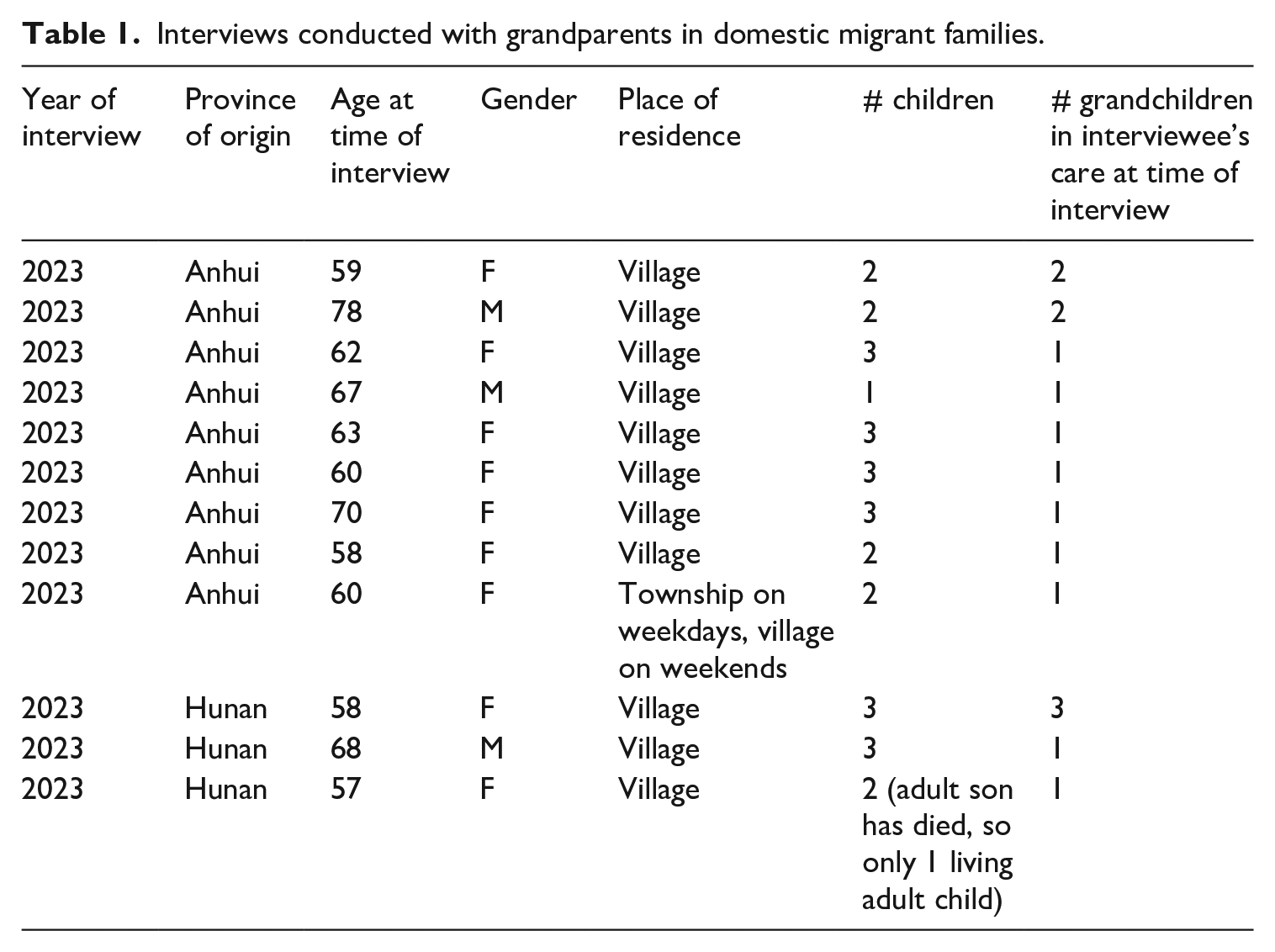
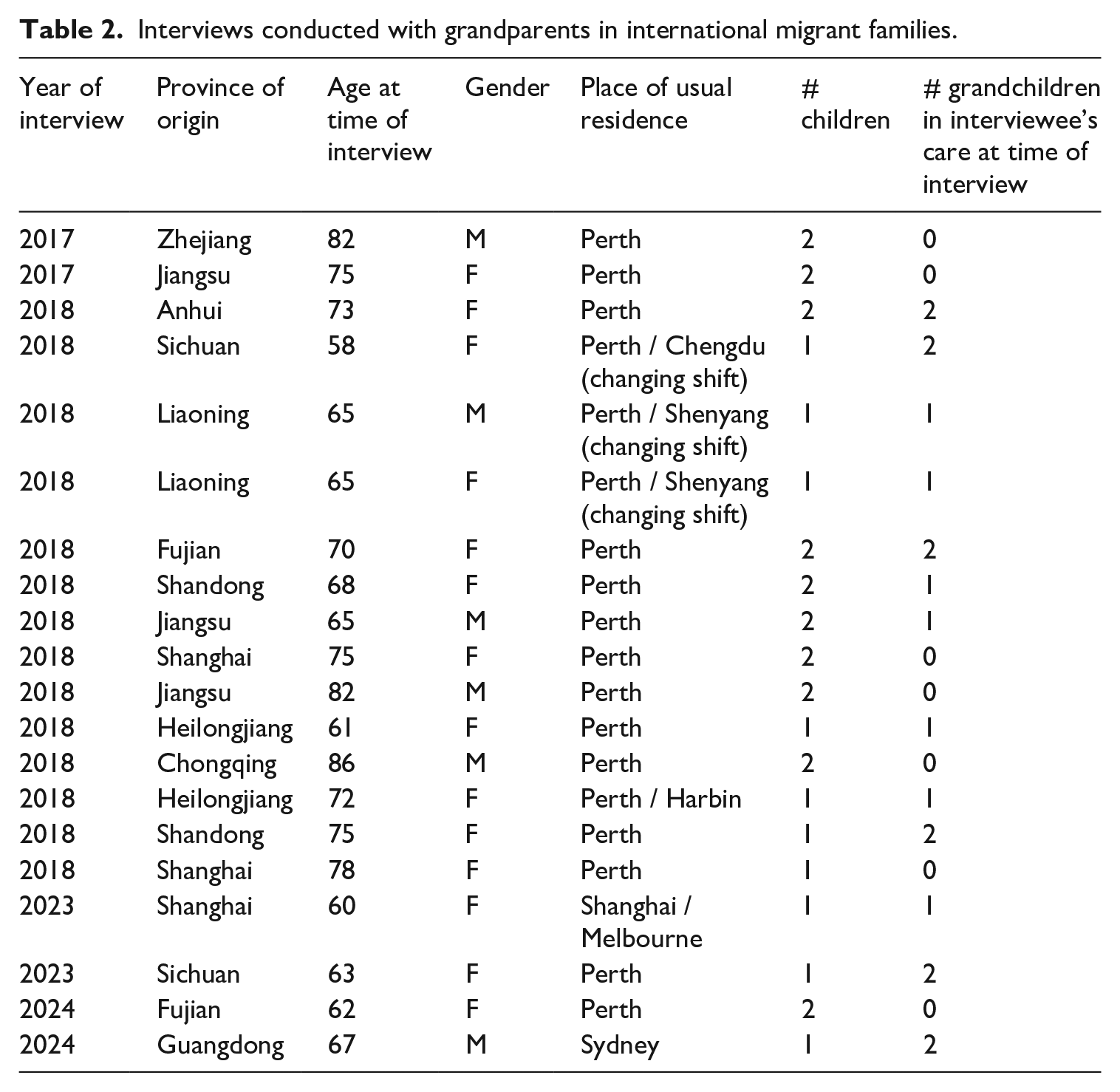
These cases are drawn from a dataset comprising 27 interviews with 31 participants (see Tables 1 and 2).
Interviews conducted with grandparents in domestic migrant families.
Interviews conducted with grandparents in international migrant families.
Between October and November 2023, Murphy conducted interviews in China with grandparent caregivers of school-aged children, including grandparents in three rural households in Hunan and nine rural households in Anhui. Chinese scholars from local universities accompanied Murphy, facilitating entry to the fieldwork sites. 2 Murphy led in asking the interview questions and she audio-recorded, transcribed and translated the interviews, supplemented with fieldnotes. These interviews were part of a wider project on how members of rural–urban migrant families use new communications technologies in care.
Between April 2017 and August 2018, Stevens conducted 12 interviews in Perth, Australia with 16 Chinese grandparents (including four married couples), 3 part of a wider study that explored digital media and care exchange practices of older adults (Wilding & Baldassar, 2018). Stevens led the research, while research assistants transcribed and translated the interview recordings. From September 2023 to March 2024 Huang and Stevens conducted four further interviews with Chinese grandparents whose adult children had migrated to Australia. These interviews were audio-recorded, transcribed and translated by Huang.
The interviews conducted in both China and Australia in 2023–2024 addressed predetermined topics to support the comparison of intergenerational caregiving practices. These topics covered family composition and locations of family members, family care practices, including digital communication and the use of the social media platform WeChat, the impacts of mobility regimes and the impacts of Covid-19 policies on grandparents’ care practices during and after the pandemic. The interviews were conducted with approval from the ethics review committees at the authors’ respective universities.
An abductive thematic analysis of transcriptions focused on these topics to guide our analysis. Group discussion with all authors present identified the many continuities and discontinuities between the experiences of grandparents included in this study, with the similarities in their care practices emerging as a key finding. Following this discussion, Murphy and Stevens selected four illustrative grandparent cases that indicated wider characteristics of proximate, mobile and digital care practices common among these migrant families.
Proximate care
Consistent with our concept of descending asymmetry in intergenerational care, both domestically and internationally mobile families demonstrated strong expectations that grandparents should provide proximate, practical care labour to support the economically productive activities of adult children. Moreover, both types of families also exhibited strongly gendered assumptions about who can and should provide this care, with female caregivers preferred. Yet despite this preference, our findings also reveal grandfathers playing active caring roles. This section explores how grandparents care for children in different kinds of migrant family.
Grandma Zhang (58) works hard caring for three grandchildren aged between 10 and 13, all the children of her eldest son, who works away from their home village in a large city. She previously had an even heavier care workload, looking after five grandchildren, three from her elder son and two from her younger. However, five years ago her younger son’s children, then aged four and five, moved to the city to join their parents. Each week the three remaining grandchildren travel to and from their school in the town on a bright yellow bus, spending weekends with Grandma Zhang and weekdays boarding at school.
The changing contributions of Grandma Zhang and her husband demonstrate how gendered assumptions mediate intergenerational responses to evolving family needs. As paternal grandmother, Grandma Zhang took responsibility for the five children as soon as each of them ‘stopped suckling breast milk’, doing all the cooking, feeding, nappy-changing, nighttime soothing and cleaning that raising young children requires. Five years ago, when their second son moved to the city, the ageing couple faced a situation where both sons required childcare. Cultural assumptions that children need a female caregiver informed their decision of how to divide their labour, as Grandma Zhang explained: ‘We considered that the children in Shaoyang city have their mother with them, but these three children did not.’
This thinking informed the decision that Grandma Zhang would stay in the village with the elder son’s children while her husband went to the city. We later learned that the elder son had recently divorced, leaving him with custody of the children, and it is likely the divorce strengthened the view that she should fill the maternal care gap. Grandma Zhang explained that in this maternal role she makes most parenting decisions, saying: ‘The eldest son leaves most matters up to me regarding the children, apart from telling me not to let the children play on their phones for too long.’
Meanwhile, her husband’s grandparenting work involves chores in keeping with ideas of rural masculinity, such as taking children to school by motorbike or cooking meals, since men often cook for village festivals and some men work as chefs (Choi & Peng, 2016). However, we also discerned intergenerational mutability in gendered practices, with some grandfathers taking on caring tasks that they had seldom performed when their own children were young (Murphy, 2020). Also noteworthy is that the grandfather was available for childcare because the family had rented out their farmland.
Grandma Hong’s (60) care for her 12-year-old grandson in Anhui is likewise affected by gender norms. She has looked after him since birth, and now they share a small, rented room near his school, returning to their village each weekend, a 20-minute ride on her three-wheeled motorbike. Consistent with Yan’s (2016) concept of descending familism and with literature on the gendered expectations that women’s care work supports migration (Chuang, 2016), Grandma Hong explained that her son felt entitled to her childcare, tearfully recalling:
When my son asked me to look after the grandson, he said, ‘if you don’t look after him and let me earn money, then you need to give me money yourself’.
Grandma Hong was initially reluctant as she was working as a cleaner in Hefei city and did not want to forfeit her earnings. However, telling herself that she was fortunate to have a grandson, she finally agreed to undertake his sole care. Her husband, a construction worker in Hefei, did not help her with either childcare or money. Instead, Grandma Hong and her grandson lived off remittances from the son, her vegetable patch and rent from her land.
Intersections between descending asymmetry and gender norms could likewise be seen in transnational families, where family members similarly expected that grandmothers would provide most care to support their adult children’s work (Lamas-Abraira, 2019; Pan et al., 2021; Zhou, 2019). However, transnational grandfathers helped grandchildren with homework and provided transport and cooking, resembling the gendered labour of rural migrant families.
Grandparents in Australian transnational families expressed a strong preference for life in China where they perceived friends enjoyed a better life and more free time. In contrast to the comfortable life of middle-class retirees in urban China, Chinese grandmothers in Australia described long, lonely days of housework and childcare, and social, linguistic and spatial isolation in Australian suburbs as necessary sacrifices made for their descendants (Baldassar et al., 2022; Stevens et al., 2024). We further noted a common expectation that children would remain in Australia with their parents, requiring grandparents to undertake international travel to provide care. Although our interviews include some grandparents who raised grandchildren in China in early infancy, these were rare and the grandchildren all moved to Australia when they commenced school.
Having finished working two years before the birth of her first grandchild in 2015, Grandma Ma (63) enjoyed retirement, dancing, socializing and attending a seniors’ college in her provincial capital hometown. Since the birth, she has spent half of her time in Australia. She loves her granddaughters and is happy being near her only child, but reflected that her pace of life has changed dramatically, saying: ‘Now I am busy from dawn to dusk. Every day I take care of the children, two children, and I’m busy every second.’ Both her daughter and son-in-law work full-time, leaving Grandma Ma to do most of the childcare, housework and cooking. She initially shared these caring responsibilities with her son-in-law’s mother, ‘changing shift’ (huan ban) every six months to meet the requirements of their temporary visas but also to give each other a rest while back in China. Although the load has lightened as the granddaughters have grown, when we last spoke with Grandma Ma in December 2023, near the start of the long, hot summer holidays, she was evidently tiring of keeping them entertained in the house and longing for the relief of the next school year.
Clearly, then, the differing geographic and class contexts of the families’ migration notwithstanding, many grandparents responded to strong normative expectations that they would provide ongoing childcare. Moreover, consistent with other scholars’ observations (Goh & Wang, 2019; Liu, 2016; Zhou, 2019), these expectations were gendered, with grandmothers assuming the lion’s share of the domestic workload. Less visible are the sacrifices that grandmothers make to shoulder this asymmetric intergenerational care exchange. While the substance of the grandparents’ sacrifices varied by individual and by families’ circumstances, the grandparents’ caregiving entailed them forfeiting earning opportunities, leisure time, personal rest and comfort. In return, though, they sought a good relationship with their adult children, emotional closeness with their grandchildren and pride in their contributions to their family.
Mobile care
Grandparents in our sample often needed to be mobile themselves to provide proximate care, a practice that has become increasingly common in transnational and domestic migrant families (Nguyen et al., 2024; Qi, 2025). In the context of intergenerational care obligations characterized by descending asymmetry, our participants moved frequently in response to their family’s changing care needs, work requirements and educational priorities, and the physical movements of other family members. These grandparents’ movements included both short-term relocations (such as for summer holidays or in times of increased care needs like the birth of a child) and longer-term extended relocations (such as to provide year-round childcare or to help with the protracted illness of a family member). Below, we consider how both domestically and internationally mobile grandparents experienced moving to provide childcare, and the impacts of the resulting separations on their other relationships.
When we met Grandma Zhang in 2023, she had spent most of the past five years living apart from her husband. She looked after the three children of their eldest son in the village during the school term time, and then she took them to the city to stay with their father during the summer holiday break. Like many other rural grandmothers, she told us that city life was inconvenient. She experienced travel sickness on the journey, she had to buy food rather than using her vegetable patch, and the room that the family rented in the city was small. Moreover, there were no places for her to walk around and there was no-one to play mahjong with. In short, she did not feel well in ‘that place’.
Even the summer holidays did not permit Grandma Zhang to reunite with her husband. Rather, each summer Grandma Zhang’s husband accompanied the two children of their youngest son to the village to escape the city heat while she and the other children were visiting their father. When asked if she missed her husband, Grandma Zhang responded with a hearty laugh that she did. This was surprising as rural people seldom verbalize feelings of intimacy so directly. Nevertheless, we found that many rural couples did feel close, with the three widowed grandmothers interviewed all missing their husbands.
Grandma Hong, in contrast, was not troubled by her geographic distance from her husband as they were already emotionally distant from each other. She explained:
We were an arranged marriage. He tells me little. He doesn’t tell me what he earns or gives me much. If there is anything, I’m the last to know.
Indeed, any travels that Grandma Hong undertook outside the village – which she experienced as a big effort and extremely tiring – were to take her grandson to see his parents rather than to visit her husband.
At time of interview in September 2023, Grandma Li (60) was in Shanghai, taking care of her daughter and her grandson who had just turned 100 days old. Grandma Li obtained Australian permanent residency (PR) rights through an expensive parent visa before retiring, but it was only after leaving work in 2019 that she moved to Melbourne to live with her daughter and son-in-law, who were planning to start a family. When the Covid-19 pandemic began less than six months after her arrival, she found herself stuck in Melbourne. During the pandemic both China and Australia maintained strict border quarantine policies that effectively stopped most movement of people between these two countries. Grandma Li was unable to return to Shanghai until 2022, and spent two long years separated from her mother, brother and hometown friends, enduring endless lockdowns in Melbourne, the most locked-down city in the world (McCreadie, 2022), while performing household chores in her daughter’s home.
As soon as flights resumed, Grandma Li returned to Shanghai to see her mother. When her daughter, who had delayed pregnancy during the pandemic, told her she would become a grandmother, Grandma Li insisted she give birth in Shanghai. Grandma Li could not bear returning to Melbourne and leaving her family and friends so soon after their long separation. Paradoxically, since the birth, Grandma Li found she became too busy with grandparenting to maintain her usual contact with them. Nonetheless, she was glad her daughter had agreed to come to Shanghai. Her son-in-law remains in Australia for work reasons and so Grandma Li anticipates she will soon need to return to Australia to continue her grandparenting work.
Grandma Ma’s experience of family separation during the pandemic differed from Grandma Li’s because she was in China when the borders closed. This meant she was spared grandparenting duties, but she also missed out on grandparenting joys for over two years. She came back to Perth in 2022 at great expense on the first flight available once normal travel resumed. The urgency of booking this early flight was not because she was eager to return, but rather because her son-in-law’s mother, who had been on the grandparenting ‘shift’ when the borders closed, was desperate to leave Perth and go home. Grandma Ma has remained in Australia ever since.
Like other transnational grandparents, Grandma Ma must navigate complicated mobility regimes that aim to limit older adult settlement in migrant-receiving countries, where they are typically framed as a fiscal burden (Braedley et al., 2019; Hamilton et al., 2021). This introduces an additional complexity to the care circulation practices of her family and others like them, as grandparents without permanent residency (PR) are only permitted entry on strictly limited visitor visas that require them to spend half their time outside Australia.
In 2014, Grandma Ma decided to invest in an expensive contributory parent permanent visa to facilitate caregiving across borders, which was granted in 2018. Her husband did not apply for PR, partly because he had not yet retired, partly to spend less on visa fees, but also because he did not think he would ever want to live in Australia. During her second interview, though, Grandma Ma explained that they both now accept that they will have to live in Perth in their older age. With their only child a settled Australian they see no other choice, despite an ongoing preference for life in China. However, because her husband’s own ageing mother requires his care, and because he does not have PR, he can still only come for short visits. He flew to Perth with her in early 2022 but returned to China after three months. They regularly talk on WeChat but have not been together for over one year. Once Grandma Ma has fulfilled the necessary residency requirements of 10 years with PR, they will apply for him to join her in Australia on a spouse visa. For now, he remains in the hometown living an independent life without her.
Clearly, then, regardless of whether family members migrate internally or internationally, most grandparents would prefer not to move themselves, though they differ in their reasons for wanting to stay put. Instead, the grandparents travelled to places of destination only reluctantly to fulfil their care obligations. Our analysis therefore spotlights movements by grandparents as constituting a form of mobile work that they undertake to provide care within their geographically dispersed families.
Digital care
Grandparents not only provide proximate care, they also use digital communication technologies to do remote care. Much as migrant parents separated from their left-behind children use communication technologies to do care across distance (e.g. Carling et al., 2012) and grandparents use communication technologies to help migrant parents and their children stay connected (e.g. Gan et al., 2020), our cases show how some grandparents use communication technologies to ‘do care’ from afar, both for grandchildren and for other family members from whom they have become separated by their own migration. Although digital care practices are increasingly well documented among transnational grandparents (e.g. Baldassar & Wilding, 2022; H. Chen, 2022; Ho & Chiu, 2020; Nguyen et al., 2024) we find that grandparents in domestic migrant families also draw on similar technologies to support and sustain relationships across distance.
Within China, smartphones and new stable internet services have meant longer video calls have recently become feasible in rural areas. Grandma Zhang kept her three grandchildren’s mobile phones in a drawer which she only unlocked Sundays so that they could talk with their parents and cousins in the city. She controlled their access to the mobile phones because she worried that they would play games to the detriment of their studies. When visiting Grandma Zhang one weekend, on receiving a notification that one of his children had turned on their phone, their father in the city phoned to ask why they were online. They explained that there were some visitors from a local university, and they were showing them their phones. While we were chatting, Grandma Zhang’s grandson from her younger son also called for a video chat. On finishing the call, Grandma Zhang said:
That youngest boy of [my] second son still phones me all the time because he misses me. He phoned me every day after he first left me. I raised him since he was a baby. Five years ago, my husband migrated to look after the two children of our second son in the city. He takes the two children to and from school and he cooks for them.
Echoing Gan et al.’s (2020) findings about grandparents’ emotional work in facilitating long-distance calls in migrant families, Grandma Hong told us, ‘My grandson is close to his parents. I always encourage him to leave voice messages for them on Weixin.’ In demonstration she played a message of the boy happily reporting good school test results. She continued, ‘He’s very warm to his parents on the phone. I encourage him to be proactive in talking to them.’ Grandmas Zhang and Hong both resembled the ‘other mothers’ observed in other country contexts, such as Mexico, where as Dreby (2010) notes, caregiving grandmothers did not want to replace migrant parents in their grandchildren’s lives, but instead they worked to sustain parent–child communications and emotional bonds.
For Grandma Li and the many other Chinese grandparents who were in Australia in March 2020, WeChat was an essential means of connection to loved ones in China. The digital care practices, such as video calls or sharing content in group chats that were already embedded in most grandparents’ daily lives (Baldassar et al., 2022; Ho & Chiu, 2020), assumed a new significance following border closures. Nonetheless, Grandma Li felt a change in her transnational relationships and regretted not being near her own ageing mother. She recalled:
Definitely my mother was affected. I used to visit her every week, and any issues were handled by my brother and me. After I moved to Melbourne, I could only keep up with things through calls. Especially during the pandemic years, when I called my mother and brother, they kept telling me everything was fine. In reality, I knew they were worried.
Grandma Li’s experiences illustrate the benefits but also the limitations of digital communication technologies and the care practices they afford (Stevens et al., 2024).
Grandma Ma shares Grandma Li’s reliance on WeChat to maintain relationships across distance. Before, during and after the pandemic, her digital care practices have continued. She spends as much time as possible online, making video calls and posting in the many WeChat groups that sustain her offline friendship groups in both China and Australia. She uses a Huawei brand smartphone that can take two SIM cards, so she never misses a message no matter whether it is sent to her Chinese or Australian number. While in China she invests significant time maintaining relationships with her daughter, grandchildren and friends in Perth; while in Australia she performs similar digital emotional labour, resulting in relationships that she describes as largely unchanged.
Clearly, then, in circumstances of both internal and international migration, grandparents use digital communication technologies in ‘doing care’, alongside proximate care and travelling to provide care. Grandparents engage digital technologies with differing frequency, but they all use these communications to help sustain connection and affection within their families. Our analysis reveals, though, a difference in grandparents’ primary contacts. Chiefly, grandparents in domestic migrant families put grandchildren at the centre of virtual communications. By contrast, grandparents in international migrant families make greater use of communication technologies to maintain relationships with family members and friends from whom they have become separated by their childcaring duties in Australia and who are important for personal wellbeing (Stevens et al., 2024)
Discussion
Over a decade ago King and Skeldon (2010) called for integrated approaches in the study of internal and international migration. Despite attempts to bridge theoretical gaps between other forms of internal and international migration (e.g. Kalir, 2013), few studies have compared grandparenting practices in domestic and international migrant families. Research into migration and ageing (King et al., 2017) and grandparent migration (Nguyen et al., 2024) is also at an early stage. There is, though, a substantial literature on both mobile families within China (e.g. Liu, 2016; Murphy, 2020; Qi, 2021; Santos, 2017) and global transnational families (e.g. Baldassar & Merla, 2014; Dreby, 2010; Sun, 2021), some of which explores intergenerational caregiving.
This article makes no claims to be a comprehensive review of the kinds of grandparenting practices and subjectivities to be found in Chinese families, recognizing the limitations of both our geographically particular empirical samples and of the analysis presented. For reasons of length, we have not expanded beyond the domestic–international comparison and suggest future research might consider other sites of difference between families, such as regions of origin, social class and education or family composition, including sibling dynamics in the middle generation. However, by listening to the experiences of grandparents who provide childcare in migrant families we have mapped out some key observations.
Firstly, our analysis confirms that regardless of migration type, families share cultural expectations about intergenerational care obligations that are characterized by ‘descending asymmetry’, which intersect with gender norms to compel grandmothers to provide most care work. Gendered divisions of labour, notions of intergenerational reciprocity and a focus on securing long-term family continuity and advancement prove durable across vastly different migration contexts. Perhaps less acknowledged and contravening common perceptions about older women’s attributes and lives, is the sacrifices grandmothers make to provide childcare, including their own earning opportunities, leisure time and other important relationships, with the specific sacrifices involved varying by class.
Our research widens understanding of the emotional aspect of the caring that grandparents perform for their migrant families and the kinds of discomforts incurred. Grandparents often find themselves living in environments where they do not feel at ease. Although grandparents’ reasons for preferring to stay at home varied, for most, the experience of moving elsewhere commonly resulted in them feeling dislocated and tired. Some older couples also endured physical separation from each other as an emotional cost of moving to provide childcare. However, we found no neat relationship between physical distance and feelings of intimacy among older couples. Some older couples had intimacy that helped them to withstand their long-term physical separation, as in the case of Grandma Zhang. For other couples, though, there was little intimacy to erode: Grandma Hong’s emotional and financial security came not from her marriage but from keeping a good relationship with the middle generation and from her closeness with her grandson. Meanwhile, in many international migrant families, such as that of Grandma Ma, each spouse got on with their respective lives in different places, with an eye to their eventual reunification in Australia. Some transnational migrant families, including both the cases featured in this article, were further affected by the need to provide care to a fourth generation of ageing great-grandparents. Grandma Li’s unhappiness at being stuck in Melbourne throughout the Covid-19 border closures was exacerbated by being separated for so long from her own mother, while one of the factors that influenced Grandma Ma’s decision to apply for citizenship when her husband did not, was his need to provide proximate filial care to his elderly mother. The long-term impacts of this decision are yet unknown since the couple’s plans for future reunification through a spouse visa depend on Australian migration policy remaining unchanged.
Grandparents also used new communications technologies in their caregiving. The rise of WeChat video calling and messaging is a notable development that has encompassed not only major cities, including in China and Australia, but also most of China’s countryside. Even so, because of differences in their family migration strategies, grandparents in domestic migrant families and in international migrant families differed in the principal relationships that they sustained digitally. In families involved in internal migration, grandparents were often primary caregivers for left-behind grandchildren. They therefore felt under pressure to ration the children’s usage of smartphones, reserving the devices for calls with migrant parents. They also worked hard to encourage and facilitate the children’s phone communications with their migrant parents, and they put their grandchildren at the centre of their own digital communications. By contrast, grandparents who moved internationally used WeChat and video calls to sustain relationships with a broader range of friends and relatives. In other words, they used digital technologies to sustain relationships with individuals from whom they had become separated to provide childcare in Australia.
Conclusion
By examining the care labour performed by grandparents in two different kinds of Chinese migrant families, our research demonstrates that the transnational care practices of Chinese grandparents from more privileged family backgrounds closely resemble those of their rural counterparts, illustrating the durability of repertoires of care across great differences of geography and class. The cases presented reveal the commonalities and the persistence of strong intergenerational relationships in Chinese families despite the disruption caused by modernization and mobility at various scales. Furthermore, and consistent with our observation of descending asymmetry in intergenerational care circulation in both types of families, our findings also support Goh and Wang’s (2019) argument that grandparents have unequal access to the cultural scripts that enable them to negotiate or resist care provision, leading to some situations of ambivalent obligation or even the unwilling provision of care labour.
Through this comparison, we also contest some assumptions about each broad ‘type’ of grandparent. Grandparents in domestic rural–urban migrant families are far from the passive ‘left-behind’ care recipients commonly depicted in the literature. Rather, they engage in similar repertoires of care circulation to their internationally mobile peers, with similar patterns of descending asymmetry evident in both types of families. Meanwhile, grandparents and adult children in transnational families negotiate care obligations with reference to distinctly Chinese cultural scripts that are more strongly informed by homeland discourses of care and intergenerational obligation than by practices encountered in the host country, yet also shaped by the immigration and welfare regimes through which these internationally mobile people must move.
Like Qi (2025) our cases highlight the importance of the grandparent generation in contemporary family life, but like Yan (2025) we note that this creates tensions and ambivalence within families when individual comforts in older age must be subsumed to the needs of younger generations. Our findings spotlight how migration intensifies the seldom acknowledged costs that grandparents incur in taking on childcare, such as to their earnings, comfort, leisure time and other relationships. However, we show that grandparents knowingly incur these costs as they work to nurture their grandchildren and sustain consistency in family relationships across ongoing disruptions and change.
Footnotes
Acknowledgements
Rachel Murphy thanks He Shifu, Qiong Liu, Li Mi, Gaohui Wu, Yanrong Wang and Yan Zhang, who worked as research assistants or accompanied her to the field to provide help, enabling introductions to fieldwork participants, meeting local expectations of accompaniment and translating dialect. Rachel is also grateful to Shuangxi Xiao and Bencheng Wu for fieldwork facilitation. She is furthermore incredibly grateful to the research participants for their time and sharing. Catriona Stevens, Yu Huang and Loretta Baldassar gratefully acknowledge the support of collaborating researchers in the Decentering Migration Knowledge (DemiKnow) project and in particular thank DemiKnow Australian team Project Manager Dr Hien Thi Nguyen for her coordination of interviews conducted by Edith Cowan University researchers in 2023–2024.
Funding
The research and authorship of this article was conducted with funding support from: Australian Research Council Discovery grant number DP160102552; University of Oxford John Fell Fund grant as part of a wider project on Digitally Visibilised Life-Making in Migrant Families in China; and Canadian Social Sciences and Humanities Research Council (SSHRC) as part of a wider study, the Decentering Migration Knowledge (DemiKnow) project.
