




Abstract
Live Methods argued that there is an ethical imperative for sociologists to really listen to what precariously positioned people say. Research methods can be exploitative in how they render people’s presence. This paper discusses how I practised Live Methods in one ethnography conducted with young migrants in London over 15 years. This research was meant to last two years, but continued on the basis of an emerging ethical covenant with participants – that both researchers and people taking part believed that these individual stories said something about individual lives, but also about others’ experiences of precarity. A tension emerged between keeping this covenant and sociological strictures that forbade making general claims from qualitative ‘samples’. In this article, I work productively through this tension in close engagement with ethnographic encounters with one participant, Mardoche. I argue that conducting research across time and the in-depth quality of the interviews opened up the possibility of making more general claims from individuals’ stories. I conclude that while my ethnographic iteration is in keeping with Live Methods’ ethical imperative, whether it is ‘speakable’ within the discipline of sociology is questionable.
My first interview
Twenty-five years ago, I did my first interview. I stood near the University of Essen campus finding students with a Turkish heritage to talk to for my PhD research. A young woman agreed, and we sat on a concrete bench. I pressed record, and for the first but not the last time, worried about whether my recorder was actually recording. She spoke about her father’s experience as a Gastarbeiter (guest worker), the name given to migrants employed on a time-limited basis in specific low-paid, unhealthy, heavy manufacturing jobs. The young woman said: ‘I’m Turkish, not German. My dad worked himself sick here.’ This is the quote from Interviewee 11 that made it into my doctorate.
Sometime later I completed my fieldwork and moved to the discrete analytical stage that took place in room 2.02 in the Williamson Building at the Manchester University campus on Oxford Road – far away from the concrete bench and smell of chips, mayonnaise and curry sauce where it began. While sitting in room 2.02, I did analysis. I cut up the transcript containing Interviewee 11’s words, placing its segments alongside other interviewees’ cut-up words under piles with labels on them like ‘forms of discrimination’, or ‘employment in heavy industry’. In qualitative research, we move successively from interview to recording, transcription, data and analysis. At each stage of doing this, I made Interviewee 11 more invisible and inaudible in the research.
The tension in her words and its release were lost; the widening of her eyes, and the posture changes she used to make her points – lost too. ‘My dad worked himself sick here’. I could not get across the weight of the word ‘here’. And the weight of the word, and its utterance for how she acted in society. Part of this relates to sociological form, and its privileging of written words and numbers produced within the format of journal articles, book chapters, reports and so on, the limits of which I am exploring elsewhere. But part of it relates to what we can do better when working within these forms. I felt there had to be a better way of learning from people and telling what we learn. And this led me to Live Methods.
Most pointedly for me, live methods saw its craft as an ethical vocation whose drive came from the imperative of paying the kind of attention ‘to vulnerable and precarious lives’ I did not with Interviewee 11 (Back & Puwar, 2012, p. 14). Ethically, paying this attention meant that Live Methods was a ‘disposition’ and carried an ‘imperative to care about and to ameliorate suffering’ (Gunaratnam, quoted in Back & Puwar, 2012, p. 14). Further, that paying such ethical attention might entail representing people like Interviewee 11 more vibrantly and meaningfully than the reduced way I represented her. To do this Live Methods argued for adapting and using artistic techniques; positioning sociology more as a craft; and representing the sensory, aesthetic and affective qualities of social life.
In the end, Les Back and I adapted Live Methods to our own ethnography unconnected to my PhD that involved working with the same group of participants over 15 years (Back et al., 2018). Looking back, I did not know what ethical quandaries would come from practising these methods over such a long period with the same people, and what that would tell us about its future practice.
In our research, we worked with 30 young migrants for nine years to 2018, and with four until 2024. As our engagement lengthened, I began to think about how much research participants were giving of themselves in my efforts to listen better, and what shared understandings of this project we had and the ethics of this. Participants like Ali started this research before the button on the audio recorder was first pressed by me on the basis that readers would eventually be offered the chance to understand the reality of life for precariously placed young migrants, living with and through ‘difference’ in London. He had fled Afghanistan, seen many deaths, had contemplated suicide and was attempting to make east London his home, despite the problems the Home Office were causing him. He said: ‘You know what Shamser, I’m gonna tell you what it really is.’ As time went on, participants and researchers gave more and more of themselves to the research, deepening our shared stake in achieving this.
Ali told me about how his jaws clench and cannot be unlocked when he is reliving a trauma from which he struggles to escape. He used this to describe two things. One was the complex interlinkages between the UK’s geopolitical concerns in Afghanistan and UK immigration policing. The other was the kind of mental prison in which asylum seekers lived more broadly. That prison concerned how an inability to move forwards in asylum seekers’ lives and be active in the present meant they spent time reliving traumas and separations from loved ones. But I venture he would not make these points and reveal their connection to how his jaws clenched if he thought I did not believe his jaw-clenching and the points he was making by telling me. Ethically, is it right to explore this with him over years if I actually think the epistemological value of what he said was limited to his singular personal experience, standard questions concerning the ways identities are formed, or merely advancing a theoretical understanding of a phenomenon?
Ali’s aspiration for what his story might communicate is based upon the power of an individual account amassed over a period of 15 years: to say something real about lives and social conditions; to represent something that was true for him but to reach beyond that to others seeking asylum, and which would strike a chord with other readers in some way too.
Ali’s participation was given on that basis and I could not have ethically done that work with him otherwise. If that is the case, this throws up a tension. Our existing sociological frameworks cast qualitative accounts as not generalisable, a performative moment specific to a time/space, or at best representative of the person giving the account or a limited sub-sample (Bryman & Burgess, 1994; Clark et al., 2021, p. 370; Jacobson, 2020). But my work on Migrant City was predicated on a different, more expansive view of what ethnographic work could do. So, does the process of doing ethical, attentive ethnographic work over long periods of deep disclosure necessitate stepping outside of sociology? If so, is what is found then sociologically speakable? And if not, where does this leave ethnography and Live Methods? I attempt to address these questions in this paper.
Background
Live Methods developed in the context of what Savage and Burrows (2007) identified as ‘The Coming Crisis of Empirical Sociology’.
Both critiqued sociological methods, arguing these needed to respond to the informational technologies reshaping our lives. Savage and Burrows maintained these technologies meant transactional data were available on a hitherto impossible scale and depth, detailing what we did and social trends. This rendered existing sociological tools such as surveys and interviews outdated, offering a chance for us to avoid often unreliable, sociological theoretical insight about what data meant.
Contrastingly, Gane (2020) put a focus on understanding how social inequalities occurred and were reproduced, rather than only describing data. For him, a solely descriptive focus risked obviating attendance to the human costs of social processes such as those resulting in class inequalities. Live Methods directed itself towards opposing these human costs. Its ethical premise was to cultivate methods to really listen to people living precarious lives beyond the problematic ways in which sociological methods often had. While Live Methods critiqued existing research approaches, this was from a different vantage point than Savage and Burrows. Part of live methods’ critique was that research methods had a historical and colonial rooting based on the extraction of surveillance data for exploitative purposes (Steinmetz, 2009). Further, qualitative enquiry was still based on the extractive hold of researchers over an agenda whereby interviewers asked questions and interviewees answered (Kvale & Brinkmann, 2009; Sinha & Back, 2014). The challenge was to ethically pay attention to vulnerable and precarious lives in a manner equal to the new coordinated forms of social reality in the contemporary social world (Adkins & Lury, 2009; Back & Puwar, 2012, p. 7).
Over 15 years of ethnographic work, Les Back and I devised ways of lessening our hold over research processes to support going beyond the limits of extractive qualitative methods. Participants were well used to interviewers pressurising them to give accounts of dates, places and movements for immigration surveillance by police, immigration officials, welfare agencies and so on. Ethical attentiveness demanded something different. Les and I tried to provide and co-make a way of working whereby participants could share with us in any variety of ways they wanted. They did this through talking about and showing us the journals, scrapbooks, poems, paintings, drawings and so on they made for the research. Participants were so central to the agenda-setting and making sense of the material the research created, we developed a model of co-authorship where some were acknowledged as authors. Others ideally wanted to be named authors but doing so would have rendered them potentially vulnerable to deportation.
The longevity of our work on Migrant City meant there was a scope to see what time can do for understanding present accounts, and re-understanding what you thought you knew from prior ones. And as it turned out this was relevant for Live Methods and how it positions sociological research as an ethical vocation. There is a dimension that time gives to the ethnographic process I was part of undertaking that is helpful to think through by drawing on the art of creative writing. This is because of how aspects of it deal with time and intersubjectivity, raising questions concerning what this might mean for Live Methods and what is sociologically speakable or not.
Mahasweta Devi’s (1974) creative writing bears some similarities with our iteration of Live Methods in Migrant City. The fine details of her accounts were similar to the detail of ethnographic ones, although hers were fiction. Her practice spoke to our ethnography because of how she worked considerably closer and longer with Adivasi and Dalit people than Les and I did with our research participants, or than was usual in social research. Similarly to us too, she used their songs, stories, pictures and so on, as ways to get to know and understand them. She sought an intersubjectivity between her characters and readers that resonated beyond the individual cases she describes in her books. I looked at her writing to see what I could learn from the way individual Adivasi and Dalit characters were used to represent these groups more generally, and to strike intersubjective notes with us as readers.
In Hajar Churashir Maa (Devi, 1974), we can see how the weight of individual characters’ micro-details accumulate over time and their character journeys. Translated by Gayatori Spivak into English, its central character is the mother of a dead son whose existence is reduced to a number: Corpse 1084. As she struggles to understand her son’s militant, Communist, Naxalite fight, we are invited to as well. Echoing Mills (1959), her characters linked the private, specific struggles of Adivasi and Dalit people to public issues. Paradoxically, by becoming more specific, each character connects more with us, and perhaps with the Adivasi and Dalit people for whom she spent decades advocating.
The way she writes supports readers in holding different spaces and times together within the shared horizon of the front and back covers of a book. This allows the reader to see the power of initially small details, and past events as they unfold over subsequent chapters and the specific role they play in a character’s development. It is contrary to my approach to my PhD research, based on the cutting out of snippets of data and time and transforming them into data segments. She uses the specificity of detail and personhood of character as means to connect with us as readers, and to illustrate the condition of a social group. This has a methodological relevance for listening attentively to people and attempting to represent them in a lively way. Meeting Mardoche in 2021 enabled me to start unpicking this, beginning with the sound of his voice when he said one particular thing.
‘What’s next for me?’
On the 19 May 2021, I met Mardoche in the Angel area of London. We took a walk around the streets we had walked around when we first met in October 2009. Les and I were writing a new preface to the Japanese language translation of Migrant City, so we decided to talk with some of our participants about what life had been like for them since the book was first published in 2018.
Originally, in 2009, Mardoche had agreed to a one-off interview at the Copenhagen Youth Project in Islington. All I knew about him prior to this was that he had, until recently, been what is called ‘a looked after child’ in the UK, leaving social services care as an 18-year-old. The meeting was arranged through a social worker. We continued talking long after the youth club closed at a local cafe. But talk was stunted, although I gained the impression Mardoche wanted to talk more. He had spoken about the local streets where he lived, so I thought walking with him there might promote conversation. To a degree it worked, but I sensed there was still more Mardoche wanted to tell. So I offered him a camera so he could photograph places he wanted to talk about with me on a separate occasion. Mardoche was enthusiastic and agreed. He became an observer of his own life for the research.
At our next meeting a month later Mardoche showed me a photo he had taken and described why he took it.
It was of a bench where he had previously sat to decide ‘what’s next for me’, and concluded it was the planning of his suicide. He was 11 or 12 at that time. His plans were discovered, he was taken into social care and became a looked after child. Mardoche used this photograph alongside others he had taken to show me how he was rebuilding his life.
Born in Kinshasa in Congo, Mardoche migrated to London as a refugee when he was 8. His uncle brought him because there he was labelled ‘a witch’ and held responsible for his birth mum’s death. So he lived with his aunt and uncle. But he did not feel safe and was often instead on the streets or at friends’ houses. The reason he went to the bench and planned his suicide was because his aunt had threatened him with a knife, saying ‘If I have any dream from you, I will kill you’. She too feared he was a witch.
Mardoche had since worked to rebuild his life, with the support of friends, youth workers and his foster mum. His network of support came to be like a family for him. It comprised people coming from many different places on the planet but who had made London their home, as well as those with various heritages born in London. Nine years after we first met, and after many meetings with him and others, Migrant City was finally published. By this time, I felt I knew what a pause, or a comma, or a beat, in Mardoche’s speech might indicate. I knew what a transcript could not.
By the time I met up with Mardoche again in 2021 life was different for him. He now worked with young people in care and care leavers, alongside being a painter and decorator. Mardoche went hiking with them. This was over extended periods of time and was physically, and sometimes mentally, tiring. His purpose was to help them move forward with their problems. Like my practice with Mardoche on Migrant City this necessitated spending long periods of time with people, listening to them and learning about their lives. Some important differences between my practice and his were that our walks were in Angel, sometimes punctuated by coffee, and our sessions could last two or three hours. His lasted days, were in nature and involved staying overnight in largely hostel accommodation.
Mardoche described hiking as ‘being with your mind, alone in your mind, that’s what I think’. For him, going on the physical journey of the hike was about how serenity supported people to understand their journeys in life, and how he could help them think through challenges. This was similar to the way in which talking while walking was understood by researchers to elicit understanding based too on the overlap between physical journeying and journeying through a life while conversing about it (O’Neil & Roberts, 2019). Mardoche talked about an incident on a hike I came to think about in connection with something he said to me way back in 2009 when he showed me the photos he took of the bench. He had recently been hiking in Spain. There was a particular point one young person had reached:
You think it’s good they got to that point.
Yeah.
How come?
Every day you were doing the same thing, well you’re walking, 20K. 20K! That’s a lot every day. The sun, it don’t help.
Specially, when you’re talking about Spain, because that’s bare hot.
It’s hot, and every single day. And you’re in a group as well. Time will tell, someone is going to break down. It happens to one in the group, it happens to others in the group, so it[’s] kind of like. . . But it’s good, it’s good.
How do you handle that yourself? Do you not feel a load on you? Do you not break down? You’ve got the weight of the young people you’re trying to help.
When we’re there, I don’t, it’s like we’re here to help one another. And some of, some of, when they break down that’s good. Because now you came across it’s like, now we’re getting somewhere. Now you’ve had enough! (Mardoche slaps his hands to emphasise a person hitting their mental wall) You know now it’s like, you hit the wall. Now you have to decide to go on, or just quit. So, it’s good like –
That’s the point.
That’s the point.
You made that decision.
Now, what you gonna do like?
As Mardoche said, ‘Now, what you gonna do like?’, something chimed with me. There was something in the sound of his voice that signalled to me that this sentiment was related to his past. In that instant I could not set upon what exactly. When back in Ipswich, I wondered if going back to some of the photos and conversations we had had years previously might show up something new about what Mardoche did now and how it was linked to the past. I wanted to know why what Mardoche had said chimed with me.
Teaching commitments meant it was months later before I did. And on the 23 March 2022 at 10:28am I looked at an old photo he took not included in the book.
Mardoche had photographed it from the bench he planned his suicide on. But unlike the photo of the bench (Figure 1) this photo (Figure 2) looks to the right of that bench and features a river and a tree. I imagine the tree and river seemed innocuous when I viewed the photo in 2009. They did not now. Their presence made me wonder if Mardoche sought peace, nature and space to help him process his thoughts as he contemplated his suicide. That same space that he felt the young people needed on the hikes. This alerted me to why when Mardoche described young people coming to a point on the hikes where they thought, ‘Now, what you gonna do like?’ it chimed with that moment on the bench, when he thought, ‘What’s next for me?’ There was a similarity in his voice as he expressed both sentiments although separated by over a decade. Both appeared to be about reflecting on past lives, where people had come to, and contemplating the future. Both referred to a past that either could not be returned to, or which was traumatic, a troubled present and the finding or not of a liveable future. When Mardoche originally sat on the bench he decided that future was not liveable and planned his suicide.
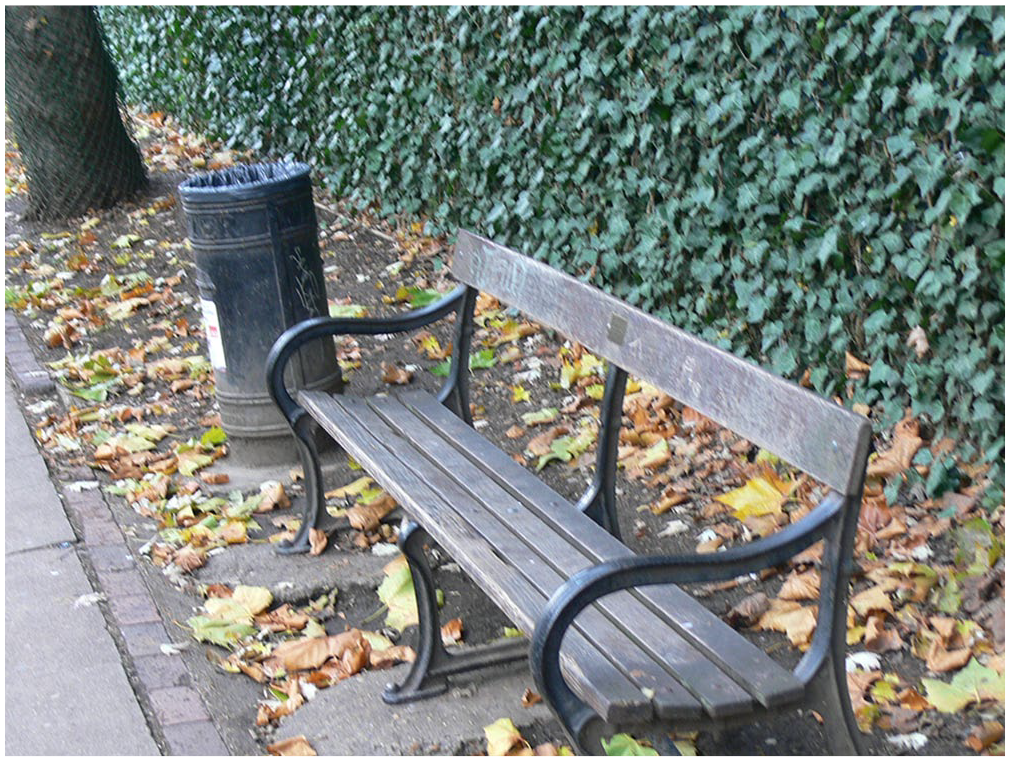
This is a photo Mardoche took of the bench where he originally planned his suicide.
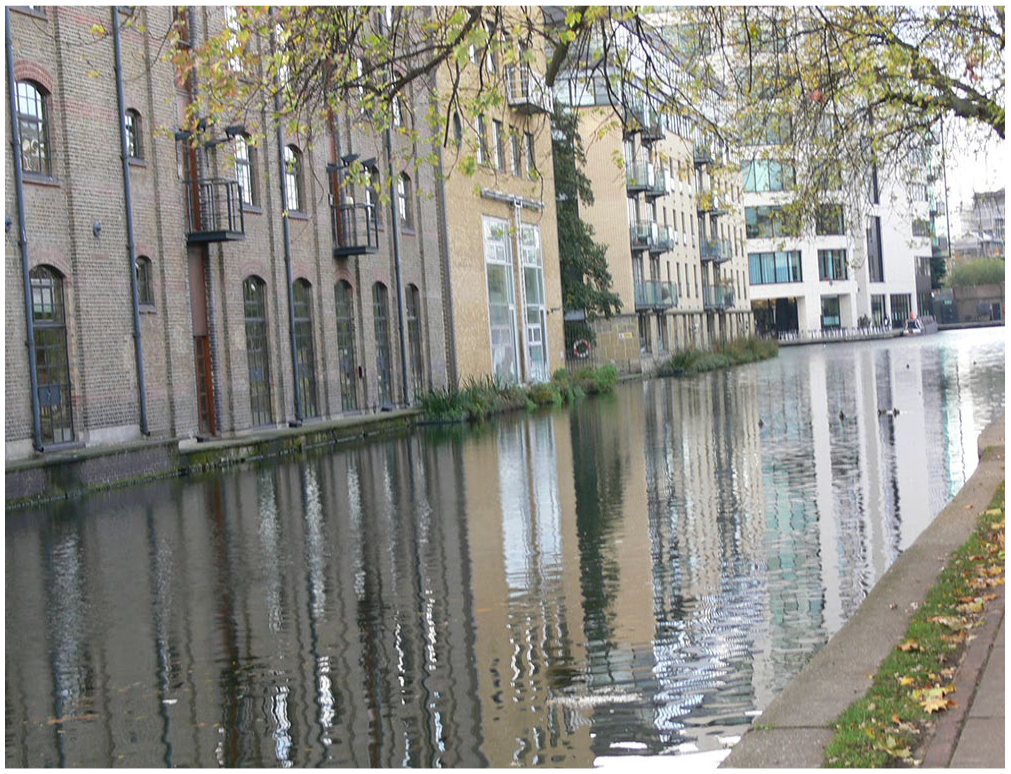
This is a photo Mardoche took of the view to the right of the bench from where he originally planned his suicide.
The closing horizons of space and time seemed to operate similarly to the way described in A Seventh Man, in how at their worst they choke the life out of a person (Berger & Mohr, 1975). I resolved to ask Mardoche about this and did so in the summer of 2022. Mardoche explained how he liked to walk and think and talk, but that the countryside was a better environment for that than Angel in north London. He said, ‘It’s like nature, nature. Quiet’. I asked him about whether he felt there was a parallel between the ‘what’s next for me moment’ on the bench where he planned his suicide, and the ‘what you gonna do like’ moment he mentioned regarding the hike in Spain. Mardoche’s response carried the sound of someone discovering something they did not know before, but which was important. Or the sound of someone discovering something they already knew on some level but had not acknowledged the importance of. That excitement in the conversation, the audible surprise and overlapping dialogue are difficult to convey in the format of a transcript but were there when the following words were exchanged.
Oh yeah, yeah! The same, yeah!, you hit the wall.
That’s what I mean.
You hit the wall, yeah. That’s it, I’m done. Finish. Right now, I’m done! I need something different. Or just I’m done.
I began thinking about that and although we never said it in the conversation, I think that must be important to you when you’re walking with the young people, because you must -,
Yeah.
You want to get them.
Yeah.
To encounter
Yeah, their lives, when they hit the wall! That’s the whole, I think that’s whole point of the hiking because it does something to you.
For Mardoche, the past changed because of what he had come to understand it to be. Particularly, in terms of how it served as a motor for his work with young people in care, and care leavers – which he was once himself. The ‘what’s next for me’ moment was less about ‘despair’ now, but instead a personal ‘recovery’ for him and a possible one for others. Sharing space across long periods of time with one person allows for an understanding of this. Qualitative approaches risk missing the temporal context of the before and after if they are based on one-off encounters. They also risk missing this if their methods isolate data segments from the ‘before’ and ‘after’ of a conversation, to re-aggregate those segments with other isolated segments from other participants under specific themes or ‘codes’ – like I did with Interviewee 11. The approach Les and I took allowed for the joining up of time while the other approaches described work toward the opposite. So, for me the ‘liveliness’ of Live Methods came from the enriched sense of knowing that happens when you join time up.
The ability to do this involves a particular kind of craft. That of being attentive to the sound of Mardoche’s voice, his cadences of speech and pauses, the constant theme of self-reflection, and his embracing of opportunities for joy. These sharpened my listening and led to my hunch concerning the connection between that moment when he said, ‘Now, what you gonna do like?’ and his description of what was going through his mind when he sat on that bench all those years ago. They led to the ‘chime’, if you like.
There are ethical dimensions to this craft pushing us towards avoiding temporal truncation. If researchers disconnect participants’ pasts from their presents, what value are we placing on participants’ efforts to join together moments from the past in their rendering of it to us? Particularly, when working with those who are or have been vulnerable in different ways and are making this visible. In that sense, we are ethically required to try and hold that visibility.
Mardoche’s practice with young people was a kind of ‘walking with’. It bears a similarity with how we walked and talked on that first evening in 2009, but also taught me new lessons useful to ethnography and Live Methods. His work involved longer treks than our walks. Space and time were shared for extended periods in his practice. Experiences and stories were swapped, and periods of silence were shared. In the ethnography Les and I undertook we did not cultivate a space where such silences were possible as they might be if you are hiking. Mardoche ‘walked with’ younger people in both a physical and dialogic sense. This ‘walking with’ required physical fitness, but also a patience, devotion and the giving of time. He was cultivating an attentiveness to listen, which is easy to describe. However, its practice is active, hard, and requires his constant attention on the treks.
Some of the young people had very different experiences to him. Mardoche gave an example of this with a young woman who had left care and with whom he was hiking in Scotland. When he mentions Ben Nevis, he is referring to a mountain in Scotland he climbed:
One of them has been in 18 homes.
18!
[inaudible]
When did you first meet her?
It was, Ben Nevis, Ben Nevis, that’s when I first meet her, because she was part of [inaudible]. ’Cause we been doing, like trips, day trips, hiking. So, I’ve been talking to her, she’s doing really well, given like she’s been in 18 homes. She’s had a kid, she’s been university, bettering herself, going hiking.
So, she’s got a kid as well, that’s a lot.
Yeah yeah. She’s like, I want my kid to have a better upbringing, stuff. I can do more with him,
(as though he was speaking to her directly)
‘You know what fair play to you’.
(The conversation continues)
So, we’re talking eight months ago, so eight months ago, how old is she now?
21, 22, 21, 22.
So, in the life of someone who’s 21, 22, who’s been in 18 different foster placements, eight months is a long time you’ll, you’re, you’re the person who’s known her
(He continues)
There’s a few of them [the young people he works with], it’s just, it’s just, talking. Obviously, we share a different, same like care thing, but it’s like compare her experience, like my one’s completely different. I never been, I never been to like 18 homes! So, talking to her, just trying to understand.
Mardoche’s craft is not a not a naïve ‘walking in someone’s shoes’, but instead a ‘walking with’. He grasps how it is not possible to feel another person’s life from within their skin. Even though he shares with them being or having been in social services care. But his work is based on understanding as well as you can. It is a reflexive practice. He says ‘also you learn about yourself’.
Mardoche’s practice involves a kind of close-up proximity, which allows the time and space for details to emerge, and the ability to have a go at placing/weighing the significance of these details in the context of a person’s life. And there was a crossover here, with the kinds of Live Methods I had begun to practise. I could now see the importance of details such as a tree and river near the bench Mardoche sat on all those years ago.
These close-up details can also mark a significance to research audiences, in a manner similar to fiction writing focusing on the particularity of a character detail to connect with readers. We can glimpse this again through Mardoche. This time from his experience of reading Migrant City. Before walking around Angel in 2021, Mardoche and I popped into a coffee shop. He shared his liking for the book. Mardoche was particularly engaged with our work with Ali, and Ali recounting how his jaws are often clenched when he wakes from nightmares. Ali is a Hazara from Afghanistan whose asylum claim took 10 minutes to be rejected, but 10 years to overturn. Mardoche does not ever remember any uncertainty over his immigration status, and certainly had indefinite leave to remain long before we met. Ali is haunted by his memories both from Afghanistan and the asylum system in the UK, while Mardoche is not. For years Ali did not have the legal right to work whereas Mardoche did. But the detail in Ali’s account still struck a deep note of understanding with Mardoche despite their differences:
The amount of work, I was just looking through the book, you guys put a lot of work in.
You too.
The stories in there, and like the details. Did that guy, Ali, he ever get his visa?
Mardoche and Ali’s lives were different, but both knew the personal effects of expanding/diminishing horizons of time and space – and the ways they could asphyxiate life. Both knew what it was like to be visited by a traumatic past it was hard to escape from, being constrained in the present, and unable to move forward to a foreseeable and liveable future. Mardoche also remembers the horizons of time and space closing from the context of lockdown during the heights of the Covid-19 pandemic. Here he felt life was suspended and he spent long periods at home without knowing what quality of future awaited.
Mardoche is drawn to the detail in Ali’s story. This is not an argument saying such an identification is premised on being a migrant, although that are certain shared experiences among certain participants in Migrant City. Instead, people share their existence within the dimensions of time/space and lockdown gives us a heightened memory of suspended life and uncertain futures (see Coleman et al.’s article in this collection). Although we may or may not be migrants, there is an enhanced opportunity to understand aspects of Ali and Mardoche’s various private troubles through the prism of moments in our lives where time/space compression brings its own pressures. And its own successes in rebuilding lives. Figure 3 is a photo I took of Mardoche talking about this when we met in 2022.
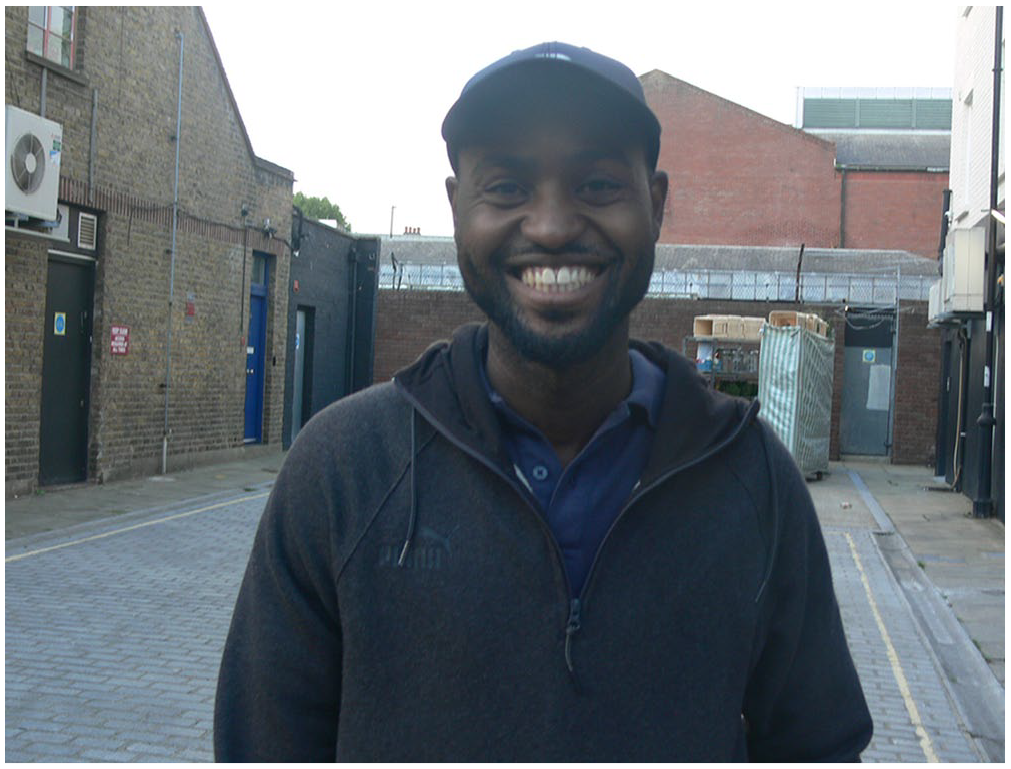
The photo I took of Mardoche in 2022.
Mardoche wanted his photo in this journal article. It was part of the journey from his photographing his local neighbourhood without himself in the photos in 2009, where he chose the name ‘Joseph’ to be known by in the research. Then as Les and I developed a model of named ‘author-participants’, Mardoche chose to be known by his actual name in the book. And now he wants his visual likeness known to complete that journey. 1
Sociology and its borderlands
My work with Les Back on Migrant City was an ethnographic iteration of Live Methods. Back’s (2007) The Art of Listening foreshadowed both because of its focus on attentive listening. Returning to this theme in The Listeners, Les looks at creative writers to describe what listening to people does for making precarity visible (Back, n.d.). But listening attentively and making precarity visible do not go as far as we could towards the ethical injunction to honour the importance of people’s lives and their meaning for society that is so central to Live Methods.
My research with Les ran for over a decade, though we had planned for it only to last two years. The passing of time threw into sharp relief unforeseen issues coming from trying to enact Live Methods. These related to what seeking to represent people and speak what was learnt in a livelier way meant for ethics and analysis. Underpinning participants like Mardoche and his openness was a kind of covenant between researchers and participants. Les and I strove to write a book whereby participants’ presence would be rendered in such vibrant ways that readers could understand as much as possible about being a young migrant, building a life in London, precarity and the contours of a convivial multiculturalism around which people connect (Back et al., 2018).
Figuratively speaking, that was what Mardoche signed up to when we met in 2009. The more meetings he, Les and I had, the deeper our shared stake in this became. I argue part of this covenant between researcher and participant was that individuals like Mardoche, Ali, Charlynne, Jemima, Dorothy, Hueguette and others had stories to offer that said things more representative than the different ways sociology usually attributes values to an individual experience. If that was not the case then a practice eliciting deeply personal disclosures would not be ethically warranted if we attribute only a theoretical value, or only individual value to what they say (Bryman & Burgess, 1994; Clark et al., 2021, p. 370; Jacobson, 2020). Could I explore Ali’s reactions to the death of different friends and family and his brutalisation by the Home Office otherwise? But keeping this covenant also meant stretching tensions surrounding what we think qualitative data can reveal and what is sociologically speakable. The stakes of this stack higher when participants read what you write about them and are named as authors, as was the case for some on Migrant City.
While conducting our research brought about ethical questions, a consequence that the depth of time gave me is a potential way of addressing them. The value of what Mardoche was saying, and my ability to hear it comes from being able to hold the different spaces and times of his life together. The move to hold together runs opposite to the breaking up of time and space. That was enacted by me with Interviewee 11 when I cut up snippets of space and time to make data segments that reduced the power of what she was saying when she said, ‘My dad worked himself sick here’.
Holding these moments within the same horizon allows us to see what we otherwise cannot. For Mahasweta Devi, the horizon was the front and back covers of a book. I attempted to hold the different spaces and times of Mardoche’s life together within the horizon of the book Les and I were writing and subsequent articles. Counterposing these moments gave a depth of detail, insight and the representative value beyond that which is usually, sociologically attributed to an individual account. This representativeness is based on depth of detail and the ways it resonates with readers and other migrants, contrasting with quantitative statistical models whose representativeness comes from sample size.
My contention is problematic for several reasons. The representative quality I am talking about cannot provide a truth of the kind sociologists use in a chi-square ratio for establishing relationships between variables that are not due to chance. Neither is it generalisable in the way Big Data are because of the size of their data trail. Nor can the representative quality I am arguing for sit within sociological understandings of qualitative data as: not generalisable; a performative moment specific to a time/space; or at best representative of the person giving the account, or a limited sub-sample (Bryman & Burgess, 1994; Clark et al., 2021, p. 370; Jacobson, 2020). So, if sociology is based on these understandings of quantitative and qualitative data, then my practice of Live Methods cannot be sociology. This is as the claim to representativeness from my work with Mardoche concerns the work’s ability to represent something that is true beyond him, a sub-sample or even other migrant people.
A way of understanding how ‘representativeness’ can come from depth rather than only breadth can be gleaned from other writing practices outside of sociology. Just prior to the Migrant City research, I became a professional playwright and gained a heightened awareness of how the apparently small, innocuous details of a character’s actions can carry a meaning as a story unfolds because we are able to place them against what we know from before or learn after. This gives those details a new and/or different resonance. So, examples might be a speech tone, word choice, body language, or a mannerism that we either know the meaning of because of what came before, or that carry a new resonance given what happens after.
These ‘innocuous details’ are rendered through a dramaturgical prism, bearing a similarity to how space/time works in the biographies and day-to-day dynamics of our lives as chronicled in the depiction of John Berger and Jean Mohr’s fictional migrant in A Seventh Man. In this prism, these seemingly innocuous details carry a deeper meaning relating to the tensions arising as a person cannot go back in time to a happy past or is haunted by it, finds it difficult to live in the present, and the possibility of a happy, liveable future is rescinded. Or conversely opens up as the possibilities of a liveable present and future expand. From my understanding of Mardoche’s work, the presence of the tree and river in a photo he took seemed innocuous to me in 2009 but resonated powerfully 13 years later because of the shape his life had taken. Similarly innocuous on its own would have been the moment he said, ‘Now, what you gonna do like?’ had I not been able to compare it with when he said, ‘what’s next for me?’ as he contemplated suicide years previously.
These dramaturgical elements are essentially the horizons of space and time opening or shrinking around a person, as was the case with Mardoche on the bench. More than that they are central to storytelling whether in fiction or not. This is one reason why others argue for exploring the overlap between academic and creative writing and what each can learn from the other (Hilevaara & Orley, 2018; Hurley, 2011). Attentiveness to these horizons is central to listening better and is something Mardoche practised in a different way though his walks over time with care-experienced young people. It is also a hub around which the promise I shared with research participants on Migrant City could be kept. This dramaturgical structure are ways through which stories can work to provide a prism through which we see ourselves in others and get closer to walking in their boots. We identify in some way with the tensions and their release that the protagonists experience as we go through the story. These tensions are an avenue through which readers come to vividly understand social injustices experienced by one person, but which say something about the precarity others share that they too can gain an enhanced understanding of.
A future challenge for ethnographic iterations of Live Methods is how to shape our methods, and the form/s we render research through to cultivate attentiveness to the moving horizons of time/space. Time shared with participants gave me what I feel to be an understanding of this as expressed through speech rhythms, cadences, tone and body language. An attentiveness to this with Mardoche prompted me to go back to photographs he took over 10 years previously. Cultivating methods alert to this means exploring the enigmatic understanding between researchers and participants that Yasmin Gunaratnam identifies as a ‘sociological problematic’ which is more ‘analogous to certain art forms than the rationalities of conscious thought’ (Gunaratnam, 2013, p. 6). This is because such a cultivation is predicated upon trying to transgress the limits of what a literal transcription, or ‘interviewee’ quote is said to mean. It requires a commitment to understanding how feelings expressed through tone, rhythm or body language for example relate to meaning.
Whether this work is recognisable or encompassable within sociological formats or not, perhaps there are other possibilities relating to intersubjectivity and a commitment towards acting upon the ethical imperative to be attentive to vulnerably positioned people that premises Live Methods.
In Freedom is a Constant Struggle, Davis (2016) celebrated the intersectionality evident in global political protests from Ferguson to Palestine. Alliances, protests and campaigns involving different groups are premised on a level of intersubjectivity allowing us to fail as well as we can in putting ourselves in someone else’s shoes. After being a part of the Migrant City research for so long, the value of my work lay in the depth of engagement, and vibrancy of accounts that offer an aesthetic truth that hopefully supports a sense of politically engaged intersubjectivity. This might be in keeping with the political commitment behind Live Methods to tackle precarity and be attentive to lived experience. But it is not necessarily exclusive to sociology. This is as much an intellectual as institutional concern. This article does not explore the difficulties of practising Live Methods within contemporary UK university-based sociology, partially because I want to avoid the way others have had their careers penalised for taking a critical lens to sociology and universities. It is enough here to question what happens if key decisions over research funding, promotion and curriculum content are driven by a conception of sociological research that excludes the value of individual stories for sociological knowledge I argue for here. However, there are other opportunities elsewhere for Live Methods practice. These go beyond the literal limits of transcripts and engage with how understandings are shaped and communicated via tone, rhythm, body language and so on.
Concluding thoughts: South Street Kids
In Ipswich where I live are a number of organisations outside of universities including The Hive, Ipswich Community Media and South Street Kids, who regularly attempt to use creative means to listen to vulnerably positioned people, create platforms to report/display what has been heard and learnt, and to campaign. There are several aspects of South Street Kids’ work common to my work with Mardoche, while there are also new lessons to learn. South Street Kids is a children’s group for 7- to 12-year-olds (Ipswich Community Media, n.d.). It includes a number with special educational needs, and is diverse comprising Roma, refugees and others who are migrant or Ipswich-born. Until recently I volunteered there. As with my work with Mardoche there is a commitment to understanding the depth in an individual’s story and what it reveals more generally beyond that individual’s life. There is also the attentiveness I cultivated with Mardoche to how the children’s feelings are expressed through rhythm, body language, speech cadences and so on, and their relation to the communication of meaning. Again, as with Mardoche, this process requires taking the time to learn about individual children, continuities, and changes in their lives and how they express these.
To do this we used various activities where the children share thoughts and have fun. One game led by child worker and musician Kristin Caswell involves her devising a rhythm using clapping and the clicking of fingers that all the children sit in a circle and do. The children say their names in turn as the rhythm and its gaps dictates. The clicking and the rhythm is a collective act giving solidarity to the individual saying their name aloud. As each child says their name it struck me as a powerful moment of affirmation of who they are. Some of the children held a lot of tension in their bodies, and saying their names visibly released this. Doing this affirmation-building is part of a process. Like in Migrant City, without meaningfully showing we value the children it is difficult to see them revealing the vibrancy of their thoughts – particularly given how other adults and agencies from schools to the police have treated them.
The affirmation of their importance and their thoughts was carried over into tasks including one where children wrote and voiced concerns about their local area on a big sheet of paper. The children raised concerns around schooling, road safety and the police which Kristin, I and other workers explored. This in turn fed into the devising of a performance to an audience comprising carers and parents, children and other locals as well as politicians and teachers.
As with Mardoche there was a covenant between the workers and the children. Both sides believed that the children’s thoughts said something beyond only the children participating, their struggles and successes in overcoming precarity. Instead, what these children said connected more broadly with other children’s lives, as well as on some personal level with the other audience members watching the performance or associated video content made. Again, as with Mardoche, the methodological process in getting us to that point involved the workers being attentive to the effect of time unfurling and children’s lives changing – in particular how the horizons of space and time closed in on them creating tension, such as when a child is bullied, and found it difficult to see a way out, or its release when those horizons expanded, the present was more liveable, and the future held hope. One example was when a child was supported to access a regular dance class and how transformative that was.
Unlike Migrant City this work involved a team of dancers, visual artists and musicians all sensitive to rhythm, tone, body language and the meanings they carried. Cultivating a sensitivity to this offers opportunities for unpicking the ‘sociological problematic’ identified by Gunaratnam (2013, p. 6). This is as it engages with what this means for the aesthetics of how we express words, sounds, movement and meaning. This points to opportunities for Live Methods methodological development within other disciplines and also outside of university-based sociology. It also points to a challenge for Live Methods practitioners in finding spaces outside of sociology as well as within. If we continue to hold close the ethical imperative of paying attention ‘to vulnerable and precarious lives’, to craft methods that really listen, and if we believe this requires an ‘imperative to care about and ameliorate suffering’ then we should seek to forge alliances where we can do it (Back & Puwar, 2012, p. 14; Gunaratnam, quoted in Back & Puwar, 2012, p. 14). This may be within other disciplines and/or outside university. Listening to Mardoche has taught me that doing anything less would risk compromising that ethical imperative.
Footnotes
Acknowledgements
Thanks to Mardoche Yembi for inspiring me to revisit my work, purpose and method. Thanks, Kristin Caswell, for allowing me to use an example from South Street Kids for this paper. Thanks also to Professor Les Back for giving me a job.
Funding
The research received funding from the European Union between 2009 and 2011, and was part of the EUMargins programme. After this, the research received no specific grant from any funding agency in the public, commercial, or not-for-profit sectors.