




Abstract
The development of direct-to-consumer genetic testing (DTCGT), in conjunction with social media, has had profound consequences for the management of information about donor conception. One outcome is that it is now possible to circumvent formal age-restrictions on accessing information about people related through donor conception. Consequently, many donor conceived people and their parents face questions regarding what is the ‘right age’ to seek out such connections with ‘donor relatives’. In this article, we share findings from 20 interviews with UK-based parents through donor conception, exploring how they grapple with such questions and possibilities. This involves parents reflecting on the meaning of childhood and its significance in processes of kinship. We identify three ontologies of childhood in participants’ reasoning: children as kinship catalysts, children as vulnerable to kinship risk and children as emerging kinship agents. We discuss what our findings tell us about the generational ordering of kinship. We show that processes through which genetic relatedness is made to matter (or not) are understood to operate differently according to the generational position of those involved due to culturally-specific understandings of childhood. These ontologies of childhood, and their relationship to kinship, are (re)produced in and through parent–child relationships.
Introduction
[For a sperm or egg donor] being contacted by somebody who’s eighteen is one thing but the parents of somebody who’s eight getting in touch with you is really quite different, isn’t it? (Diana, mother of donor conceived child)
For Diana, it is obvious that, when it comes to the kinds of connections that might be formed through donor conception, age matters. Or to put it another way, the relational significance of a genetic connection is contingent, amongst other things, on the ages of the parties involved. Perhaps because it appears self-evident, this ‘social fact’ has received little attention in social scientific work on assisted reproduction. There is now a large and growing body of work which explores assisted reproductive technologies, such as IVF, donor conception and surrogacy, with a view to understanding (changing) cultures of kinship. However, there has been remarkably little attention paid to how the structuring of societies around the positions of children and adults, what Alanen (2009) terms the ‘generational order’, shapes connections formed through assisted reproduction or indeed in sociological theorisations of kinship more broadly.
The UK provides an interesting context to examine this process due to recent developments in the regulatory and technological contexts in which donor conception operates. Here, in 2005, the law changed from anonymous to identity-release donation; donor conceived people, conceived since 2005 via licensed clinics, can access identifying information about their donor (and since 2008, by mutual consent, same-donor siblings), but only after the age of 18. However, since then, the expansion of direct-to-consumer genetic testing (DTCGT) and social media has increased possibilities for, what legal scholar Fiona Kelly (2023) terms, ‘early contact’ (prior to 18). Consequently, families formed through donor conception are encountering new decisions to make regarding the ‘right age’ for such information to be shared or sought.
In this article, we analyse in-depth interviews with 20 UK-based (predominantly white, highly educated, female) parents through donor conception in which they consider the possibilities and implications of ‘early contact’. We show that, in the context of new online routes for tracing donor connections, being a parent through donor conception involves careful consideration of the relationship between childhood and kinship. Thus, parents’ narratives illuminate that which might otherwise be taken for granted regarding the role of generation in UK (white, middle class) cultures of kinship. We use the term ‘ontologies of childhood’ to refer to these culturally-specific understandings of childhood and children which parents mobilise and negotiate as they seek to embed their children within kinship networks. Specifically, we describe understandings of childhood as a kinship catalyst, childhood as a period of kinship risk and children as emerging kinship agents.
The key contribution we offer in this article is to show how the meaning of genetic relatedness is understood and managed through these culturally-specific ontologies of childhood. Ontologies of childhood are, we suggest, a key way in which kinship is generationally ordered in the UK and important to consider when researching kinship cultures more broadly.
Assisted reproduction as a lens to understand kinship
Particularly since the advent of IVF, social scientists have explored people’s engagement with assisted reproductive technologies with a view to better understanding (changing) cultures of kinship. Initially focused on Euro-American contexts (Franklin, 1997; Strathern, 1992) but now increasingly global in focus (Inhorn & Patrizio, 2015), these studies examine how reproductive technologies can give rise to new forms of relating and shift understandings of what it means to be a parent or family. Such research makes visible wider aspects of kinship culture which otherwise remain ‘black boxed’, e.g. what is meant by ‘blood’ or ‘natural’ (Edwards, 2009) or ‘genetic’ (Nordqvist, 2017) connections. For example, Nordqvist (2017) analyses the narratives of parents and grandparents through donor conception to illustrate the salience of ‘genetic thinking’ in family imaginaries. Thompson’s (2005) research in a US fertility clinic shows how genetic connections can be deprioritised and gestational connections ‘naturalised’ in the context of donor conception, whilst the opposite may be true in relation to surrogacy (Dow, 2015).
Many studies have examined how social categories and hierarchies around, for example, gender (Almeling, 2011; Mohr, 2018) and race (Davda, 2019; Keaney, 2023) are made to matter in relation to the connections formed through these kinds of reproductive practices. Almeling (2011) demonstrates how, in the USA, sperm donors are more likely to describe themselves as ‘fathers’ to people conceived from their donations than egg donors are to describe themselves as ‘mothers’. Almeling explains this through reference to gendered understandings of reproductive bodies and processes, as well as the gendered organisation of gamete donation. Davda’s (2019) analysis of egg donor matching practices in the UK demonstrates how racialised differences between donors and recipients are understood as ‘kinship risks’ which may threaten the kinship displays of the families created. Andreassen (2019) explains how same-sex couple parents construct donor siblings as ‘happy objects’ (Ahmed, 2020), thus positioning themselves as ‘good parents’ in heteronormative contexts which can stigmatise or undermine their families. These studies collectively demonstrate that social categories and hierarchies shape the kinds of connections and kinship possibilities which arise from reproduction, whether ‘assisted’ or not.
In contrast, generation (here used to refer to a person’s positioning in relation to the social categories of adult and child) has received very limited social scientific analysis as a social category – one which, we suggest, also has the potential to shape the character of connections formed through assisted conception. This seems remarkable when we consider that generation, and closely related concepts such as age and maturity, are, as demonstrated below, highly significant in the regulations which govern access to information about donor conception, in the UK and internationally.
Kinship culture and generation
Our analysis addresses the conspicuous absence of generation in analyses of the connections formed through assisted reproduction. Inspired by Alanen’s (2009) work, we view childhood and adulthood as mutually interdependent social positions within a generationally ordered society. Whether a person is positioned, at a particular time, as an adult or a child (of a particular age) has profound consequences for how they inhabit social spaces and the rights and responsibilities assigned to them. For Alanen (2009), taking a generational lens, requires us to analyse both the processes through which persons are generationally positioned and also the meaning and consequences of such positioning in particular social contexts (see also Leonard, 2016). Similarly, we aim to understand the ways in which (donor conceived) kinship is generationally ordered through understandings of what it means to be a child, themselves (re)produced through parent–child relationships.
Our analysis builds on the work of sociologists who have explored children’s own understandings of kinship. This body of research often draws attention to children’s agency in defining who ‘counts’ as family and what that means (Caneva, 2015; Davies, 2015, 2023; Mason & Tipper, 2008). Whilst these scholars do not explicitly adopt a ‘generational’ lens (in Alanen’s sense), their work shows how children’s social positioning shapes how such agency is enacted. Davies (2012), for example, notes how generational power dynamics limit children’s ability to either achieve or refuse contact with family members. Mason and Tipper (2008) also highlight the importance of broader expectations of adult–child relationships and suggest that children are more likely to feel they have ‘licence’ to reckon kin for themselves in societies where they experience legal and social participation rights (however limited). Clearly children’s relatively limited power and material resources are an important way in which kinship is generationally ordered in many contexts.
However, existing literature suggests that children’s kinship is also generationally ordered in less visible yet profoundly important ways through understandings of how being a child is understood to shape kinship possibilities. Looking specifically at the UK-based research in this area, several studies position childhood as a temporal context which fosters kinship. For example, drawing on interview studies, Hayley Davies (2012) and Katherine Davies (2023) both demonstrate the perceived importance of face-to-face, embodied contact, and a sense of shared biography, during childhood for defining who children (and adults) ‘count’ as siblings. Similarly, Mason (2008) explains how relationships developed with parents’ friends, during childhood, may be claimed as kin by children. These findings, like Diana’s statement above, make clear that, in the UK, childhood is readily perceived as a ‘special’ time vis-a-vis kinship. However, what is less clear from existing research is why; what are the perceived properties of children and childhood which underpin such statements and how do such constructions shape experiences and practices of kinship?
Broader theorisations of Euro-American childhoods inform how we address this question. For instance, foundational to the ‘new’ childhood studies is a critique of the dominant understanding of children, rooted in developmental psychology, as ‘human becomings’ – incomplete, partially formed, adults-in-the-making whose identity and agency (unlike adults) is understood as incomplete (James & Prout, 2015). Within such a framework, institutional interventions and adult–child relationships are centred on preparing children for ‘adult’ society (Qvortrup, 2009).
However, in the last few decades, in some ways countering this ‘becoming’ model of childhood, children’s participatory rights have evolved as both a legal obligation for states to uphold and also a discursive ethic which shapes expectations about intergenerational relationships. Smart (2000), for example, shows how a suite of UK legal developments in the 1980s and 1990s (including the Gillick decision in 1986, 1 and becoming a signatory of the UNCRC in 1991) reflect and reproduce broader changes in social attitudes regarding children’s place within families and society more broadly. In many Euro-American contexts, there is now an expectation of more equal parent–child relationships with parents encouraged to consult their children on decisions which affect them (see Mayall, 2009).
At the same time as accruing these participation rights, contemporary children are frequently framed as being particularly ‘at risk’ (physically and/or psychologically) in relation to manifold aspects of everyday life (car accidents, the foods they eat, ‘screen time’) (see Lee et al., 2010) as well as perceived threats to childhood ‘innocence’ through exposure to ‘adult’ concerns (Garlen, 2019). Rosen and Faircloth (2020) argue that this construction of the vulnerable child is intertwined with ‘intensive’ parenting cultures. Contemporary parents are expected to surveil and mitigate these myriad risks through their parenting practices (Faircloth & Murray, 2015; Lee et al., 2010), something which can give rise to what Nelson (2010) terms ‘anxious parenting’.
The continued salience of these three cultural constructions of children and childhood as simultaneously ‘human becomings’, social agents with participative rights and ‘at risk’, and the tensions which can arise in responding to them, underpin the experiences of the parents we interviewed.
Donor conceived parenthood and childhood in the UK context
As well as these broader framings of childhood, in the context of donor conception, parenthood and childhood are also shaped by the policy regimes which apply where children are conceived, including formal systems for accessing information about people genetically related through donor conception (henceforth ‘donor connections’).
In the UK, formal routes for accessing information about donor connections are primarily managed by the Human Fertilisation and Embryology Authority (HFEA), an arm’s-length, government-funded body which regulates fertility treatment in UK licensed clinics. The HFEA holds information about all donor conceptions in UK licensed clinics since August 1991. People involved in donor conceptions since this date can access specified information from this register but access varies according to their role in the donor conception process, the date of the donor conception and their age.
Parents through donor conception can access non-identifying information (e.g. physical characteristics, hobbies, a goodwill message) about their donor and basic information about any same-donor siblings their child may have, at any time, on the understanding that this is information that should be shared with their child(ren) (Gilman & Nordqvist, 2018). From the age of 16, their donor conceived child(ren) can also access the same non-identifying information themselves. From the age of 18, donor conceived adults can apply to join the Donor Sibling Link – a service which, by mutual consent, connects donor conceived people who share the same donor.
In addition, donor conceived people who were conceived after April 2005 and aged over 18 can access identifying information about their donor. Those conceived prior to this date are not usually able to access identifying information about their donor, unless their donor has ‘re-registered’ as identifiable. Age and generational status are thus central to formal systems for managing information about donor conception. This is similar to other jurisdictions which have abolished absolute donor anonymity. In the Netherlands, for example, identifying information can be accessed at age 16 and in Norway and Finland the age is 18.
Informal routes for accessing information about donor conception now exist alongside these formal systems, and these are critical for the discussion in this article. These include online systems for sharing ‘donor numbers’ (e.g. the US-based Donor Sibling Registry). However, increasingly they involve direct-to-consumer genetic testing (DTCGT) via companies such as AncestryDNA and 23andMe. These companies market themselves as a way to find out about yourself and often enable customers to ‘match’ with any genetic relatives registered on their database. This means they can be used, often in combination with social media data, to identify people related through donor conception – either purposefully or (e.g. when a person is unaware they are donor conceived) accidentally (Crawshaw, 2018; Gilman et al., 2024; Zadeh, 2024). It is possible to identify genetic relatives even if they have not themselves registered with a DTCGT platform. For example, a donor conceived person may be able to identify their donor after matching with the donor’s parent, cousin or other relatives and cross-referencing with publicly available information (Darroch & Smith, 2021; Harper et al., 2016).
Where informal routes have age restrictions, they can often be circumvented relatively easily. For example, the terms and conditions of DTCGT platforms often state that those who purchase and activate DNA tests should be aged over 18 but age verification is typically limited to users stating their date of birth. DTCGT platforms also usually enable users to submit another person’s sample and manage accounts on behalf of others (including children).
Compared with formal routes, informal routes thus provide greater flexibility regarding the age at which information or connections can be sought, although, importantly, no guarantee of finding either. DTCGT and online platforms afford possibilities to find and connect with genetic relatives in the first years of a donor conceived person’s life and any time thereafter. DTCGT thus creates, previously unlikely, possibilities for people connected via donor conception to meet during a donor conceived person’s childhood and therefore raises new considerations about when and how such processes should be managed within parent–child relationships. In this article we explore how parents negotiate such possibilities.
Methods
Our findings are based on data collected as part of the ConnecteDNA research study, based initially at the University of Liverpool (2021–2022) then, from 2022, the University of Manchester, and led by Professor Lucy Frith. The study examines the social, ethical, legal and psychological implications of DTCGT in relation to donor conception. Ethical approvals were obtained from Research Ethics Committees at the University of Liverpool and the University of Manchester. The study included interviews with people impacted by donor conception and DTCGT. In total, we conducted 60 interviews with sperm/egg/embryo donors (19), donor conceived (DC) people, aged 16 and over (25), parents through donor conception (20) and relatives of donors (2), with some participants occupying more than one of these roles. An overview of key findings from all interviews is published separately (Gilman et al., 2024). In this article, we focus on interviews with parent participants because this group was particularly aware of, and articulate in relation to, the flexibility regarding age restrictions afforded by informal routes for tracing donor connections. In contrast, the donor conceived people we interviewed, who overwhelmingly were conceived via anonymous donation and had often experienced ‘late disclosure’ of their conception, tended to focus on their ability to access (or not) any information about donor connections, rather than the age at which such abilities were afforded.
Parent participants were recruited via a range of primarily UK-based support organisations, by sharing adverts in relevant social media networks and groups and via referral from existing participants. We aimed to maximise the diversity of our sample in relation to categories which we expected to be of explanatory importance, such as gender, age, family structure, donation type, ethnicity and timing of donation. A short questionnaire was used to screen potential participants to work towards this aim.
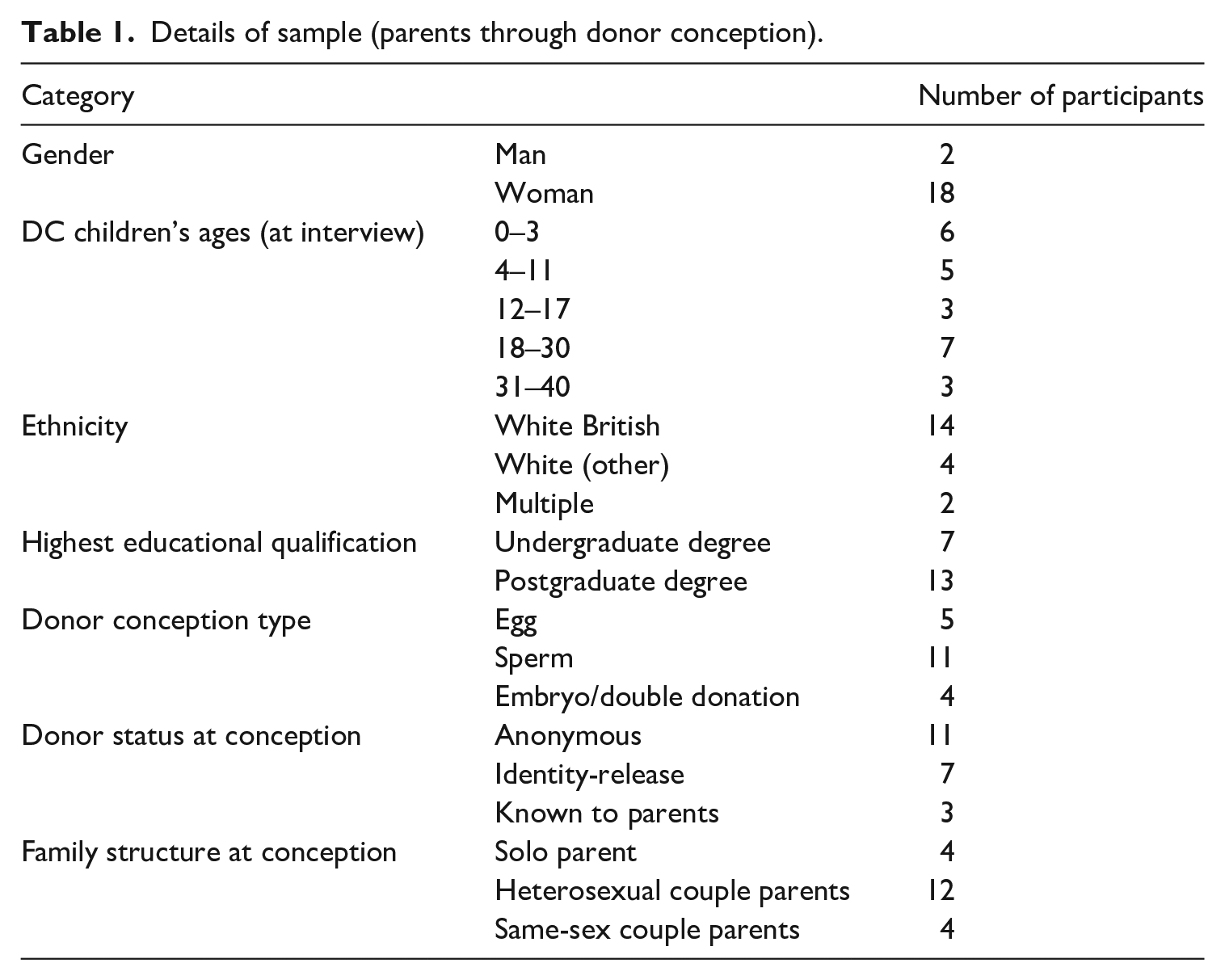
Table 1 summarises the demographic data we collected about parent participants. The sample is varied in relation to many categories, including age, donation type, donor’s status at conception and family structure. However, there are some notable limitations to our sample; all were university-educated, the overwhelming majority identified as white and only two as men.
Details of sample (parents through donor conception).
All interviews were one-to-one and conducted by the first author via video call or telephone. Interviews were semi-structured, lasted between 51 and 143 minutes and followed a loosely chronological framework, beginning with the journey to conception before asking their views on and/or use of DTCGT and its impact.
Interviews were recorded and transcribed verbatim, with the exception of one, where detailed notes were taken instead. The transcripts were then anonymised through the removal of identifying details. NVivo 12 software was used to code the data thematically, with codes and sub-codes derived from our research objectives, existing literature and repeated readings and discussion of the data within the research team. In addition, the interview data were analysed more holistically, by reading individual interview transcripts and through the creation of interview summaries. Both the line-by-line coding and more holistic analysis identified age and generation as recurring themes.
For this article, we undertook multiple readings of the interview data coded as ‘age and generation’ and ‘relationships with children’ looking for patterns of similarity and difference in how parents talked about childhood and adulthood and, by reading coded extracts in the context of participants’ narratives, the significance this had in their experiences and decisions as a parent. In our discussion, some minor details have been changed to protect the anonymity of participants in this small population and pseudonyms used.
Overview of parental responses to informal routes
In order to situate our analysis, we first offer an overview of the decisions (or non-decisions) parents reported in response to the existence of informal routes for seeking donor connections. Participants responded to such possibilities in a range of ways and in varied contexts (notably, their children’s ages). For example, of the five parents with children aged 0–3, three had decided that they would use DTCGT on behalf of their child and two were weighing up this option. Of the eight parents with children aged 4–18, five had used some kind of informal route to seek out donor connections (not always successfully), one parent was firmly opposed to this and others unsure whether they might do so in the future. Six participants’ adult children had decided, during adulthood, to use DTCGT. Another participant’s adult child had never shown any interest in seeking donor connections. Whilst several parents had strong views for or against using informal routes to trace donor connections at particular ages, many more expressed considerable ambivalence and indecision.
We make no claims as to the prevalence of any particular response to DTCGT amongst the wider population of parents through donor conception in the UK. However, we suggest that, whatever their decision, parents’ deliberations, and reasoning, in response to the possibilities (for their own children and others) of ‘early contact’, makes visible the generational ordering of kinship in the cultural context in which they live. Specifically, we identify three recurring understandings of the nature of childhood and children – what we refer to as ontologies of childhood – and their relationship to kinship: childhood as a catalyst for kinship, childhood as a period of kinship risk, and children as emerging kinship agents.
Childhood as a kinship catalyst
A common thread in parents’ narratives was an understanding of childhood as the key time when kinship connections, bonds and claims were formed. Children were routinely depicted as primed to connect, particularly liable to be claimed as kin or to become objects of familial feelings or obligations. Interestingly, this ontology of childhood underlined both strong objections to seeking donor connections during childhood and those most seriously considering this course of action.
Parents who opposed connecting with ‘donor relatives’ during childhood often imagined that people connected through donor conception would seek to claim their donor conceived child as kin and that this could be problematic:
[Not using DTCGT], I feel, protects me a bit. I don’t want, while she’s still a kid, any of his family to find her through that. And then think that they can have some kind of involvement. . . I don’t like the idea of someone going, oh, I have a granddaughter, or something like that. . .
You said particularly when she’s young?
Yeah, I think that there’s a difference, because I don’t know if people find out that there’s a child there, it’s a different feeling. (Ellie, Parent to DC child aged 0–3)
Helen speaks more hypothetically on this theme since her own child is now an adult:
I think there is a problem [with ‘early contact’] for single mums. . . As a single woman, I’m well aware of how, we’re open to criticism basically and to question. And men can have a sense of rights over their biological children. And I would not want to expose myself to that at all. (Helen, Parent to DC child aged 25–40)
Both Ellie and Helen suggest that when a person meets a genetically related child (rather than an adult relative) this provokes particular kinds of feelings, including a sense of a claim, even a ‘right’, to a relationship with that child. Such expectations are not limited to genetic parents but also included wider genetic relatives, although it is notable that, when framed in this negative way (as a claim or right to a relationship) the scenarios always involved connecting with adult donor relatives. For Ellie and Helen, and others who raised similar concerns, such kinship claims were potentially disruptive to the families they had created for their child, and particularly to their own status as parents.
Elias (1978) uses the chemical term ‘valency’, a measure of an element’s combining power, to describe the ways in which people are directed towards, and develop bonds with, others. We extend this metaphor to describe the characterisation of childhood outlined above as a kinship catalyst. This term is intended to capture the view of childhood as a generational position which heightens possibilities for, speeds up or intensifies the process of kin-making. Whilst kinship bonds can be developed at any time in the life course, the perception is that this process is more likely and more intense if one or more parties are children at the time.
An understanding of childhood as a kinship catalyst was also referenced to explain why avoiding contact with the donor during childhood was necessary in order to protect their status as a non-parent. Parents (including Diana cited in the introduction) repeatedly told us that meeting a child would be a ‘very different’ experience for donors, compared with meeting an adult:
I understand why the donor information is restricted until they’re 18. I do understand why they’re doing that because, you know, as a donor, having a six-year-old child pitch up on your doorstep, they are quite possibly looking for a parent. Whereas having an eighteen or nineteen-year-old pitch up it’s much less likely that they’re looking for a relationship. (Cleo, Parent to DC child aged 8–12)
Cleo’s words help explain why meeting a genetic child during childhood is seen as so different to meeting that person as an adult. As she explains, children are understood to need parents and, if they reach out to a genetic adult relative, to be ‘looking for a parent’. Often, participants assumed that donors would prefer not to be contacted before the people born from their donations were adults, in line with formal systems of identification in the UK, and predicted a negative impact on donor recruitment if anonymity could not be maintained until 18.
In the examples above, an understanding of childhood as a kinship catalyst is used to explain a preference for deferring donor connections till adulthood. However, this same ontology of childhood was also strongly evident in the narratives of parents who were planning to seek out donor connections, during their child’s childhood; this was particularly though not exclusively evident in discussions about potential donor siblings. In our interviews with parents, donor sibling relationships were widely celebrated and nearly every parent participant told us about the potential for fulfilling relationships with same-donor siblings. This positive view of donor sibling connections led, for some, to fears of their children ‘missing out’ or even blaming them (their parents) in later life, if they did not seek out these connections during childhood. Many parents suggested that the quality of donor sibling relationships formed in adulthood would be inferior, or less sibling-like, compared to those initiated in childhood:
For some people [donor siblings] are their family. They are their brothers and sisters. . . And if [my daughter] feels like that then. . . should I not allow her to have that connection until she’s eighteen? By which point, it could, you know, if you’re trying to create a relationship with somebody who’s so potentially important to you, that could be a really difficult relationship to build when you’re eighteen. Whereas if I build that for her when she’s younger, then it will be a much more natural kind of a relationship for her and not like such a big thing. (Imogen, Parent to DC child aged 0–3) And I started to worry that if we left it till sixteen. . . It was going to be that, actually, they’d all met each other before, and that my daughter was going in there, [having] not, you know. And I worried that she was gonna turn around and say, why did you deprive me of that connection that I could have had? (Ellie, Parent to DC child aged 0–3)
Ellie and Imogen’s words support Mason’s (2008) argument that an important dimension of kinship is that it involves connections which feel fixed or permanent and that this fixity can be attained through their establishment during childhood. This framing of childhood as the time to create kinship bonds can be understood as a development of the ‘becoming’ model of childhood described previously (James & Prout, 2015). Kin relationships are here framed as something which are ‘naturally’ developed during childhood and thus somewhat fixed and completed by adulthood.
Childhood as a period of kinship risk
The second (related) ontology of childhood we identified was childhood as a time when people were especially vulnerable to various kinship risks. Perceived risks included ‘identity crises’, rejection, developing fantasies and ‘drama’. In line with the broader work on parenting and risk (see Lee et al., 2010), parents envisaged their role as one of identifying and protecting their children from such harms. This ontology of childhood was drawn on by parents with varied attitudes towards ‘early’ connection-seeking.
Kinship risks were most strongly associated with adolescence. A commonly used image was an adolescent engaged in a somewhat fraught and emotionally challenging process of development and identity formation. Parents framed the teenage years as those in which people figured out ‘who they were’ – portrayed as a relational, often challenging, sometimes chaotic process, in which emotional turmoil was expected. Echoing Bolt et al.’s (2024) interview findings with DC people and families, the inherent risks of this life stage were often imagined to be accentuated for donor conceived teenagers, including through a lack of pre-existing knowledge about one’s genetic background. As Imogen explains:
I can imagine growing up and not knowing where half of you come from. . . And I think the idea of waiting and then putting that burden on your child in their teenage years. . . I don’t think that’s particularly healthy for that child. They’ll be going through their own identity crises at that time, figuring out who they are. (Imogen, Parent to DC child aged 0–3)
Imogen is planning to DNA test her young daughter as soon as practically possible. Like Faye (below), Imogen talks about taking the ‘burden’ of tracing donor connections from her child by undertaking this process at a young age and thus shielding her child from emotional upheaval and potential rejection.
Faye also planned to use DTCGT and described wanting to trace her child’s donor to avoid the potential ‘trauma’ of her growing up without access to both genetic parents. She added that taking this decision now would avoid her child experiencing a prolonged anticipation of connection – a process that she associated with fantasy and inevitable disappointment:
It is a massive emotional thing to go through isn’t it? Trying to track them down and that kind of waiting and that expectation. And at that point they’ll already have started figuring out in their mind who they think their donor is. And what if that doesn’t live up to being that person ’cause, at the end of the day, they’re human. So I. . . want to negate that by knowing who her donor is and what kind of person she is. And not having that fantasy of this amazing person. (Faye, Parent to DC child aged 0–3)
At the time of treatment, Faye had been told that any child conceived would have the option to access the donor’s identifying details formally at 18 – an age she then perceived as ‘reasonable’. However, Faye now sees this as ‘so so late’ and insufficient to avoid the potential harms she foresees. ‘Early contact’ is presented as a solution, albeit uncertain and imperfect.
On the other hand, other parents drew on similar images of adolescence as ordinarily a period of emotional turbulence to explain why they would encourage their children to wait until they were 18 before seeking out any connections with donor relatives. Keira, for example, explains:
I would encourage them to wait till [eighteen]. . . Just because I think you’re a bit more. . . you can handle things a bit better. And if they were to do it [contact donor relatives] for example when they were sixteen, that’d be right in the middle of GCSEs [UK qualifications] and I don’t think we could cope with any other drama. . . Whereas at eighteen. . . you can take things a bit better. (Keira, Parent to DC child aged 8–12)
In line with an ideal of childhood innocence (Garlen, 2019), Keira’s words perhaps also reflect a desire to protect her child from ‘adult’ dramas, complicated emotional relationships, and allow them to focus on ‘normal teenage’ dramas (like exams). Although sympathetic to arguments about identity formation, Helen is also cautious about tracing donor relatives in the teenage years:
I’d be cautious about young teenagers [tracing donor connections]. But I think, well it depends on the child as well. Some children are much more sort of emotionally stable and might be fine finding this sort of thing, you know, following this up at fourteen or fifteen. But [pause] yes, I’m not sure about- I mean, the thing I feel strongly about is, it actually would be much healthier to have links with donors, well with donor siblings anyway as early as possible. (Helen, Parent to DC child aged 25–40)
In summary, for many parents, the ‘ordinary’ kinship risks of childhood and adolescence (processes of identity development, ‘drama’ and fantasies) are heightened for donor conceived children by the absence of knowledge about some of their genetic background and the anticipated emotional demands of seeking or making connections. Arguably, perceptions of childhood kinship risks are connected to the perceived catalytic properties of childhood. The development of fantasies or the harm caused by rejection, for example, may be anticipated because of the particular charge of connecting during childhood, with the potential for such connections to develop in unpredictable, volatile or haphazard ways. For some, this is why deferring attempts at contact till adulthood are safer. However, for others, the absence of information about ‘donor relatives’ during this period of identity formation is also risky and, for these parents, making these connections in infancy or early childhood is preferable.
Children as emerging kinship agents
Cutting across these discussions of kinship risk and connection were themes of children’s emerging kinship agency – their rights and abilities to shape who counted as kin and the significance therein. Within this theme, we observed more variation than others regarding how childhood was conceptualised.
There was agreement on some key issues. All parents acknowledged that donor conceived people varied regarding their perceptions of the significance of genetic connections created through donor conception. Given this uncertainty, it was widely accepted that the donor conceived person (rather than their parents) should be the ones to choose how to enact these connections. Connecting with ‘donor relatives’ is seen as something which is rightly for donor conceived people; this is the dominant ethical norm and is reflected in UK identity-release policies which only enable donor conceived people, and not their parents, donors or other relatives, to access identifying information about donor connections (Nordqvist & Gilman, 2022). Despite this moral position, parents varied markedly regarding the extent to which they positioned children (here, defined by age) as capable of exercising such agency.
For some parents, upholding donor conceived children’s right to choose the meanings of connections through donor conception meant deferring such connections until adulthood. Keira, for example, had conceived her son with an anonymous donor abroad. After coming across the Donor Sibling Register (a website which enables connections via clinic assigned ‘donor numbers’), she had discovered a half sibling match with her son. However, in our interview, she explained her decision not to pursue this any further:
So I just put in the guy’s, donor’s number and then something came up. So erm [pause] but I haven’t gone as, because you have to pay to be a member to contact the people on it. . . And that is a step too far for me in my mind. That is up to [my son] if he wants to do that when they’re eighteen, that’s up to them. And I’ll support him or if he doesn’t want to do it, he doesn’t want to it, if he does, doesn’t matter. So I’m not doing it. I know it’s there. (Keira, Parent to DC child aged 8–12)
Despite Keira’s evident curiosity about the donor, she feels uncomfortable taking any further steps to connect because she understands this as her son’s choice to make. Crucially, she does not consider it appropriate to ask him immediately but instead assumes that, for him to properly make this choice, he will need to be an adult.
Dora explained that postponing these decisions was the dominant approach within her online communities:
Some [parents in a social media group] were like, I don’t want to know [the identity of the donor]. I want to leave it up to our kids to decide. That’s kind of like the stock response. I’d say that’s 75% of the response is I will let my children decide when they hit eighteen what they want to do. Because they might not want to know. (Dora, DC children aged 4–7)
It is perhaps unsurprising that Dora finds this view to be dominant amongst donor conceived communities because it mirrors the logic of the UK’s current identity-release system, which, though premised on a rhetoric of children’s rights enacts this ideology through the allocation of rights to adults (Nordqvist & Gilman, 2022; Wade, 2022).
We suggest that this somewhat paradoxical policy position, along with the dominant view in Dora’s social media group, rests on a particular understanding of what it means to be a kinship agent, and an assumption that children are unable to fully exercise such agency. There are, of course, extensive and ongoing debates within childhood studies as to how children’s agency should be conceptualised (see Abebe, 2019; Esser et al., 2016; Hammersley, 2017). We do not rehearse these in detail here because our interest is not so much in the actual nature of children’s agency but instead parents’ conceptualisations of it vis-a-vis kinship. However, perhaps what Keira and others are anticipating when their children come of age is the attainment of autonomous responsible subjectivity – of the kind so venerated in neoliberal modes of governance and widely critiqued by social theorists for its Eurocentric assumptions of individualised personhood (see Abebe, 2019). Keira’s assumption is that this can only be fully realised in adulthood. In this way she arguably draws on an understanding of children’s agency as incomplete.
In contrast, some parents drew on an understanding of children’s kinship agency as interdependent (Abebe, 2019; Punch, 2016) or negotiated (Hungerland, 2016), emerging in and through relationships with others. Cleo, for example, articulated a commitment to her child being able to choose whether they pursued connections with donor relatives. However, the way she enacted this principle changed over time. When her son was pre-school age, she was inspired by a conversation with an acquaintance to register with the Donor Sibling Register, a decision which appears to have been quite spontaneous and not taken in consultation with her child. However, a few years later she presented her son with a choice to use DNA testing:
And he was about seven. . . I said to him, obviously in language he could understand, ‘Would he be interested in finding out a bit more about himself and where he came from? And we might have a possibility one day from that of finding half siblings. Er, but no guarantees and probably wouldn’t be able to find out until he was at least 13.’ And he said, ‘Yes.’ He would be interested. So, I bought 23andMe and we both did it and sent it off. (Cleo, Parent to DC child aged 8–12)
However, by the time of our interview, her son was approaching his teens. Cleo explained how she had therefore changed the settings on his online profile such that he now has to opt-in to being traceable, explaining, ‘Now I feel it’s got to be his choice’.
Similarly, for Emily, enabling children’s kinship agency did not necessarily mean postponing decisions until adulthood. Instead, she emphasised the importance of parents listening and responding to their children’s kinship preferences as and when they were expressed:
I can just see some children saying, you know, ‘why do I have to see these people, you know, what have they got to do with me?’ when they are older. I mean they won’t when they are younger. I just think, from the parents’ part, it’s really important that they understand that the child must have choices as they get older and that this is not something to be forced. And just because the parent’s getting something out of the connection, the child might not. (Emily, Parent to DC children aged 25–40)
Like Keira, Emily and Cleo conceptualise children’s kinship agency as emerging over time. However, for Emily and Cleo, kinship agency is something which can be fostered at a young age, in part through relationships with parents. Hungerland (2016), in her analysis of German parenting guides, argues that this model of children’s agency has become normative with good parents encouraged to provide a framework or boundaries within which children can exercise agency. Given its dominance in parenting discourse, it is interesting that, in the context of donor conceived kinship, it is not, according to Dora, the dominant paradigm when it comes to parental decisions about tracing donor relatives.
The kinship context and an understanding of childhood as catalytic to kinship perhaps help to explain this. There is a sense, in parents’ narratives, that when (genetic) connections are initiated in childhood they are somehow automatic or beyond the control of either party and particularly beyond the control of the child. Emily, above, warns of the risk that parents, perhaps inadvertently, end up ‘forcing’ kinship connections with donor relatives on their child. Similarly, Ellie (cited earlier), discussing her fears about her child connecting with her donor’s mother, explains she ‘I don’t want to bind, you know, her biological grandma by submitting [her child’s DNA] onto a DNA thing’. Similarly, explaining her reasoning as to why this was a particular concern whilst her child was still young:
If people find out that there’s a child there, it’s a different feeling. And once she’s an adult, she can walk into that herself, with a little bit more knowledge. I don’t like the idea of her life being interrupted before she’s able to know it’s being interrupted. (Ellie, Parent to DC child aged 0–3)
There is a sense here of children’s relational agency being easily overpowered. The catalytic properties of childhood mean that connections made at this time are, parents assume, liable to create bonds which may feel automatic or fixed and a threat to the fragile or future agency of children to define kin on their own terms.
Conclusion
Our analysis has identified three interrelated ontologies of childhood kinship, evident in parents’ deliberations over the ‘right age’ for their donor conceived child to seek out connections with donor relatives in the UK. First, childhood is understood to be a kinship catalyst – a status which intensifies or speeds up processes of kinning (Howell, 2006). Second, and at least partly related to its perceived catalytic character, childhood is understood as a period of kinship risk, with children, particularly adolescents, imagined as susceptible to ‘identity crises’, fantasies and relational ‘drama’. And finally, children are understood as emerging kinship agents with rights to direct their own kinship relationships. There was significant variation across our sample with regard to how children’s kinship agency was imagined and managed, in part linked to tensions between these different ontologies of childhood. However, the catalytic properties of childhood were commonly understood as a potential threat to children’s ability to exercise kinship agency and associated with the risk of relationships being ‘forced’ upon children.
One question which readers may be asking themselves is to what extent these ontologies of childhood, articulated by parents, reflect the realities of children’s lives and relationships. Our response is that they are real in their consequences. These ontologies of childhood shape decisions which profoundly impact children’s relational lives including whether and when they meet genetic relatives and how this is framed. Thus they are part of the generational ordering (Alanen, 2009) of kinship – shaping the kinds of ‘genetic thinking’ (Nordqvist, 2017), discourse and imaginaries which are fostered within and beyond family relationships. These are interwoven with broader regulatory, material and economic structures, e.g. formal systems for donor linking, limitations on children’s mobility and expectations of children’s financial dependence on parents.
However, there is no direct line between parents’ ontologies of childhood and either practices of parenting or children’s experiences. As we have demonstrated, understandings of children and their positioning within kinship cultures can give rise to tensions and dilemmas and these are resolved (or not) in myriad ways in the context of parent–child relationships. Furthermore, whilst adult perspectives do offer important insights into childhood (Hoang & Yeoh, 2015), our research relies on adult narratives and thus limited knowledge of how children themselves respond. Following Leonard’s (2016) concept of ‘generagency’, we can assume that children will, in varied and perhaps unpredictable ways, reproduce, rework and resist these ontologies of childhood and their mobilisation in parent–child relationships. Parents’ accounts suggest some of the ways this is happening, such as children persuading their parents to purchase DTCGT or, in another case, a child themselves deciding to wait until they were 18 before making contact with their donor. Children’s own ontologies of childhood kinship will be important avenues for future research.
Whilst the accounts we analyse in this article are situated in the particular, albeit increasingly prevalent, context of parenthood through donor conception, our conclusions illustrate something much broader about the ways in which UK cultures of kinship are generationally ordered – findings which are likely to have significance in other Euro-American contexts. Due to the choices provoked by an evolving cultural-technological context, these parents are required to engage with fundamental questions about the relationship between generation and kinship, and how they ought to negotiate this. In this way, they make visible ontologies of childhood which are a fundamental part of the generational ordering of kinship. We show that not only is kinship generationally ordered through laws and policies which place formal age restrictions on the timing of connections, but also through understandings of what it means to be a child, (re)produced through parent–child relationships. Thus our key contribution is to the social science literature on kinship, particularly work on the relationship between genetics and relatedness (e.g. Edwards, 2000; Mason, 2008; Mason & Tipper, 2008; McKinnon, 2015; Nordqvist, 2017) by highlighting the importance of culturally-specific ontologies of childhood in the ways in which genetic connections are managed and made meaningful.
In addition, we show how tensions can emerge for parents in negotiating these multiple ontologies, particularly an understanding of children as both emerging kinship agents and also kinship catalysts who experience heightened kinship risks. These somewhat contradictory expectations, and the absence of any clear guidance as to how they should be managed, can heighten the anxiety which scholars have already identified as part of contemporary parenting cultures (Faircloth & Murray, 2015; Nelson, 2010). This parental kinship anxiety is likely to be distributed in gendered ways. Whilst only two fathers took part in this study, and it should be noted that both were highly involved parents to their now adult children, neither had given much consideration to the details of when and how DTCGT should be used by donor conceived families and occasionally referred the interviewer to their wives as ‘the experts’ on such matters. In addition, as Helen considers in relation to solo mothers, it is likely that families who more generally experience misrecognition, marginalisation or stigmatisation (e.g. same-sex couples and single, working class, racialised or disabled parents) might experience such anxiety more acutely or for whom the stakes may be higher.
Of course, the ontologies of childhood we identify as salient here, and the tensions therein, are particular to the cultural context we are analysing. We do not assume that they are either exhaustive or universal. They tell us primarily about the generational ordering of white, middle class kinship cultures in a Euro-American context and thus an understanding of parenting and relatedness which is privileged and dominant, both within the UK and increasingly globally (Rosen & Faircloth, 2020). However, it is important to identify these assumptions (about childhood or any other social category) which are woven into hegemonic kinship cultures. This is because if such ontologies are not named and their situated character explained, Euro-American ontologies of childhood are liable to be invisiblised as ‘natural’. We hope that our analysis will prompt critique regarding how these Euro-American childhood-kinship ontologies are mobilised in practice. This includes examining how they are embedded in laws and policies regarding donor conception (e.g. in age restrictions on accessing information) and family relationships more widely, and the impact this has on children and family relationships. We also hope our analysis will prompt further comparative analysis of how more varied ontologies of childhood are embedded (or not) in kinship cultures globally.
Footnotes
Acknowledgements
The authors would like to thank everyone who contributed to the research underpinning, and the writing of, this article. First and foremost, we would like to thank those people who generously shared their time and experiences as interview participants and during stakeholder workshops for the ConnecteDNA study. In addition, we would like to thank the other members of the ConnecteDNA team (Caroline Redhead, Marie Fox, Fiona MacCallum and Jackson Kirkman-Brown) for helpful discussion on the ideas we write about here, and internal peer reviewers, Katherine Davies and Julie Walsh at the University of Sheffield, for both encouragement and insightful comments on earlier drafts of the article. Finally, we are hugely grateful to the two anonymous peer reviewers and the editor for their helpful feedback.
Funding
The ConnecteDNA research is funded by the UK Research and Innovation Economic and Social Research Council (ref ES/V002430/1). PI Professor Lucy Frith.
