




Abstract
Democratic politics in many parts of the world seems increasingly characterised by intense emotions, bitter divisions and growing polarisation. Amidst this charged political atmosphere it is a common refrain that an emotional politics forfeits rational dialogue and threatens our democracy. In contrast to such claims this article argues that emotions are central to citizenship and political participation. Drawing upon qualitative archival material from the British Mass Observation Project (1983–2017) the article explores the enduring emotional dimensions of dutiful citizenship. Civically engaged respondents experienced electoral politics emotionally and with a striking intensity. In contrast to accounts which associate dutiful citizenship with dry notions of duty, responsibility and obligation, this article begins an exploration of the emotional underpinnings of dutiful citizenship; the deep and abiding feelings citizens can have towards democratic politics and their political engagement. Findings indicate that a wide range of emotions are central to the evaluative and sense-making processes of dutiful citizens and the ways in which they are mobilised for sustained political engagement. The article concludes by suggesting that a focus on the emotional and expressive aspects of dutiful citizenship may help to cultivate committed young democrats for the future.
Introduction
Democratic politics in many parts of the world seems increasingly characterised by intense emotions, bitter divisions and growing polarisation. In the UK, the referendum on membership of the European Union involved a particularly acrimonious campaign, during which Member of Parliament Jo Cox was murdered in her constituency. The referendum result divided voters and analysis also reveals divides along generational and racial lines (Sayer, 2017). In the United States, Hochschild (2016) identified anger and resentment as two key emotions among Republican and Tea Party supporters, feelings which would later play an important role in the election of President Trump. Within a very short space of time, Trump’s leadership provoked anger from many social groups within the US, not to mention other populations and world leaders. Australia’s ‘survey’ on marriage equality for same-sex couples also proved highly divisive and fractious (Meagher, 2017). Indeed, taking a longer historical view, Mishra (2017) describes our times as an Age of Anger.
While the emotional intensity of politics may have increased recently, and certain political actors and organisations openly court powerful emotions, I want to argue that emotion is always part of political engagement and citizenship. To do this, I draw upon data from dutiful citizens who occupy the normative core of democratic citizenship. According to dominant models, these are the very citizens whose participation and orientation to politics should exalt reason over emotion, and yet their accounts reveal deep and abiding emotional attachment to the practices of normative citizenship and an emotional investment in political players, processes and outcomes. At a time when democracy seems under threat on a range of fronts, I conclude by suggesting that a focus on the emotional and expressive aspects of dutiful citizenship may help to cultivate committed young democrats in the future.
The article begins by considering the role of emotions within ‘good citizenship’ and political participation – in particular, the dominant liberal notion of politics as a realm in which emotions are to be subordinated in favour of cool rationality and argumentation. This view of politics raises questions about the ability of such a model to sustain the commitment and participation of citizens. The following section sets out the Mass Observation Project data and methods used in this research to empirically explore the emotional depths of dutiful citizenship before discussing the findings.
Check your emotions at the door
The resurgence of populism in many democracies (e.g. Oswald, 2022) has meant powerful emotions are a regular feature of electoral politics. From the UK’s referendum on EU membership to the election of Donald Trump, and as seen with a variety of populist parties and leaders across Europe and elsewhere, democratic politics seems to be in the grip of strong emotions like anger and resentment. This is typically understood as problematic for the functioning of democratic politics. Dominant understandings of liberal democracy advocate for the exclusion of emotion from politics. The manipulation of emotions by politicians and public figures drawing upon populist and fascist politics is often invoked as an example of the dangers of mixing politics and emotions. In their influential study, Berelson et al. (1954, pp. 314–315) argue that a lack of ‘passion’ or ‘affect’ for politics is a good thing for the functioning of democracy as it provides for compromise and resolution of political problems (Lipset, 1963; Yeo, 1974).
For classical liberal theorists, emotions presented several dangers for politics. Emotions were understood as irrational, characterised by volatility, selfishness and the threat of tyranny. For theorists like Hobbes, the diversity of people’s emotions was thought to make consensus and agreement difficult, thus leading to a fragmented and conflict-ridden political sphere. Locke and Madison were concerned that an emotional politics would be one riven by selfishness, partiality and factional divides. An emotional public life was also thought to risk tyranny by leaders or mob rule by an overly passionate public, with either scenario causing intolerance and violence (Hall, 2005). For each threat, reason was thought to provide a remedy – drawing citizens away from the selfish, unstable or intolerant, towards fairness, stability and moderation; away from partiality, particularity and the extreme towards the objective, universal and harmonious. Outside the liberal tradition, Habermas (1989) provides a contemporary account of the public sphere which shares an emphasis on the need for public debate to be defined by cool rationality, impartiality and objectivity. In line with many liberal thinkers, Habermas’s account implies emotion and subjectivity must be excluded from public debate, lest they contaminate the process and undermine rationality.
Implicit in such accounts of the effect of emotion on politics is that reason is weak relative to emotion (Marcus, 2002). Concerns about the ability of ‘the masses’ to exercise reason in political engagement have a long history (Yeo, 1974) and fears about the capacities of particular social groups – e.g. young people – persist (Eichhorn & Bergh, 2019). Beyond questions of capacity for reason, emotions are typically understood as dominant forces too strong for individuals to resist (e.g. Le Bon, 1896). Indeed, emotions are often described as powerful, as responses which overwhelm us; or indeed understood as welling-up from within and are described as ‘needs’, ‘impulses’ or ‘drives’; natural or biological responses that we struggle to control (cf. Burkitt, 2014). The concern that reason is weak and in need of bolstering can be seen in the range of devices used, and reforms called for, to promote reason in politics (Coleman & Blumler, 2009).
Of course, these ways of understanding emotion and reason reflect a much deeper historical and cultural separation of reason from emotion in western thought: a division which works in tandem with a public/private split. These divisions are also part of women’s subordination to men and their exclusion from a political realm which is understood as public, governed by rationality and coded as masculine (Pateman, 1988). Indeed, women’s ‘natural’ affinity with the private/domestic sphere and claims about their more emotional natures were key reasons for their historical exclusion from politics (Riley, 1988). Related logics have been used to exclude indigenous peoples and other racialised groups from politics and the public sphere (Grimshaw et al., 2001).
Various bodies of literature challenge this view of politics as best practised when emotions are ostensibly kept in check by calm rationality. But as outlined below, the emotional dimensions of normative democratic citizenship, and how this is understood by citizens, have largely been overlooked.
Emotional citizens?
The field of social movement studies has a burgeoning literature on the importance of emotions in the study of Passionate Politics (Goodwin et al., 2001; Flam & King, 2007). However, through its focus on social movements, this body of literature is typically not concerned with electoral politics (but see Roth & Saunders, 2020). Furthermore, as Ost (2004) argues, the focus of this literature on the importance of emotions for social movements, while neglecting elites, reproduces dichotomies common in thinking about emotions. Such dichotomies function to marginalise movement politics as ‘the less mature and less rational part of politics’ (Ost, 2004, p. 236).
Recent scholarship on affective citizenship also takes the role of emotions in politics seriously (Di Gregorio & Merolli, 2016). However, this approach tends to focus on the role of states in legitimising particular intimate/familial relationships between citizens and the ways states and political elites try to manage and encourage certain feelings among the citizenry (Johnson, 2010), often as part of strategies of governmentality (Fortier, 2010). The ways citizens interpret and make sense of the affective citizenship enacted by states and political elites remain underdeveloped.
Though not always a dominant view, within political science emotions have for some time been recognised as important for electoral politics and the development of partisan attachments (Campbell et al., 1960). This ‘affective orientation’ is understood as guiding partisan citizens through the many decisions confronting them. The recent rise of right-wing populism has seen renewed interest from political scholars in the emotions of electoral politics (e.g. Breeze, 2019; Rico et al., 2017; Salmela & Von Scheve, 2017). Indeed, some argue that populism is characterised by emotion over rational considerations (Tarchi, 2016). Rather than view emotions as being important only for particular forms of politics or types of citizens, or as a threat to the proper functioning of democratic politics, this article aims to demonstrate how emotions are a routine and central part of how those at the core of normative citizenship engage with and participate in politics.
Other research suggests that citizenship norms are changing in ways which elevate the role of emotions in new practices of citizenship. Research across a number of countries indicates that young people are shifting away from duty-based notions of citizenship towards more personalised and self-actualising forms of citizenship (Bennett, 2008; Dalton, 2009). This literature suggests young people have a weaker sense of duty to participate in government and are increasingly engaged in forms of life politics (Giddens, 1991), which tend to be more self-expressive and provide for self-actualising forms of political participation (e.g. political consumerism, activism, volunteering). This ‘actualising’ or ‘engaged’ citizenship contrasts with dutiful forms of citizenship which are underpinned by a stronger sense of duty to participate, wherein voting is understood as ‘the core democratic act’ (Bennett, 2008, p. 14) and participation in civic and political organisations is more common. Dutiful citizens also tend to show higher levels of trust in political leaders and the media, and feel an obligation to follow politics issues/events through mass media.
Young people’s increasing preference for political practices that provide scope for forms of self-expression and identification (Hooghe et al., 2016) would seem to open the door to a more emotional politics and practice of citizenship. Recent activism by school students in the global climate strike mobilisations are good examples of these expressive, actualising forms of citizenship. In contrast, the depiction of dutiful citizenship within this literature is strikingly unemotional. It is as though a sense of duty and obligation to participate in civic and political life can be sustained by external pressures or tradition alone, without any emotional commitment on behalf of citizens themselves. Such a thin and unemotional view of dutiful citizenship is challenged below.
Clarke et al. (2018) argue that citizens in the early decades of the twenty-first century increasingly experience deeply felt negative feelings for politics, associated with the rise of anti-politics. Their longitudinal analysis shows that from the mid-twentieth century to the early twenty-first century, British citizens have shifted from a typical position of being reluctant to judge politicians, due to a perceived lack of knowledge, to viewing politicians as a joke, an embarrassment and deserving of ridicule. Central to the argument is the claim of a rising intensity to citizens’ negative feelings for politics and that feelings of anger, disgust and depression are increasingly common. These are important insights regarding citizens’ changing emotional engagement with British politics and this work has significant implications for addressing the problem of anti-politics and associated anti-democratic developments. Nonetheless, as discussed below, my research shows that while emotions of anger, disgust and depression are important, the emotional basis of dutiful citizenship is not just about ‘negative’ or anti-political emotions and feelings – dutifulness itself was an important feeling for participants. In addition, Clarke et al. have a close focus on politicians, whereas the analysis below highlights a wide range of feelings arising from various aspects of democratic politics. And while the strength of negative feeling towards politicians may have increased in recent decades, the broader argument being made here is that at the normative core of dutiful citizenship, emotions are central to the ways in which citizens interpret, evaluate and engage with democratic politics. The emotional foundations of dutiful citizenship are under-researched and involve deep and abiding feelings towards democratic politics and one’s own participation.
Data and methods
The Mass Observation Project (MOP) is a volunteer writing project based in the UK, and is predominantly comprised of texts written by a semi-permanent panel of approximately 500 volunteers. Panellists respond to set ‘Directives’, groups of questions or prompts sent out by post or email several times a year. Directives are wide ranging and cover aspects of everyday life as well as reflections on major events or MOP writers’ lives and experiences. The MOP is a revival of the original Mass Observation which ran from 1937 to the mid-1950s (Hubble, 2010). In its current form, the MOP has been running since 1981; between 1983 and 2017 Directives addressed each of the nine UK general elections during this period. 1 This material provides a unique resource for exploring citizens’ understandings of their political (dis)engagement over time and there is a wealth of relevant data to explore.
For the analysis presented in this article, I sought to construct a sample of dutiful citizens of varying ages. I deliberately selected those MOP writers who had contributed to the greatest number of election Directives and aimed for an even gender split, resulting in a total sample of 40 (17 men, 23 women). Female Observers had responded to more elections during the period than men, with one woman responding to all nine Directives. In total there were 111 responses from women, with an average of five each, and 67 from men with an average of four. The MOP is an excellent place to source dutiful citizens as it is constituted by those who volunteer for a social history project. The longitudinal approach to sampling was designed to maximise the recruitment of dutiful citizens – those with the most commitment to the MOP are more likely to exhibit dutiful forms of citizenship than those with a fleeting engagement. Furthermore, the longitudinal frame provides additional insights into the abiding nature of some of the emotions of dutiful citizenship. While the sample is not representative of the British population, there is some variation in terms of occupation, the regions in which Observers lived and their voting preferences. Mass Observation panellists tend to be older, female and more middle class (Shaw, 1994), but the dataset provides a unique qualitative and longitudinal resource rich in detail and personal experiences. Appendix 1 provides an overview of the sample.
The election Directives covered in this article were varied in form. Directives often sought the factors determining one’s vote or decision not to vote; some Directives asked for comment on specific features of an election – e.g. campaign styles, experience of door-to-door canvassing – and requests for election diaries featured for the 1997, 2001 and 2010 elections. Most Directives were issued before an election while the Directive for 2005 was issued after the fact and was included with other major events to be reflected upon for that year.
In addition to variation in the Directives issued, MOP writers respond in a variety of ways and not always in accordance with those writing the Directives (Harrison & McGhee, 2003). For example, while Directives routinely ask for the interpretations of MOP writers, by asking for their ‘thoughts’/‘feelings’/‘reactions’/‘considerations’ about elections and campaigns, large sections were often given over to quite dry description and commentary of political events. The analysis for this article focused on Observers’ more sustained interpretive and evaluative comments as these provide greater insight into their feelings and experiences of electoral politics.
A detailed discussion of the relationship between emotion and feeling is beyond the scope of this article, but the analysis discusses emotions in terms of embodied experience (e.g. feeling pride, fear, sadness, anger). These bodily sensations are ascribed social meaning and reflect social patterns of relationship (Burkitt, 2014). Hence, feeling and bodily sensations are central to emotions, but not all feelings are emotions (e.g. hunger, pain). Emotions are central to the way we make meaning and evaluate situations, experiences and other people (Barbalet, 1998; Demertzis, 2020, esp. pp. 13–15). The article highlights the centrality of the evaluative and sense-making role of emotions for normative, dutiful citizenship. As set out below, respondents explicitly and implicitly drew upon a wide range of emotions when discussing politics. The analysis tends to focus on those emotions mentioned most frequently across the sample, while engaging with the breadth of emotions reported.
While the 34-year time span covered by this dataset might suggest the merits of a narrative approach to analysis, I have eschewed this for a thematic approach. The analysis progressed iteratively and inductively to allow themes to emerge from the data (Braun & Clarke, 2006). Working with physical copies of each Mass Observer’s responses to election Directives in chronological order, the data were read, biographical notes were made and responses were loosely coded for explicit and implicit feelings and emotions, with links made across elections. Reading like this for the first stage of analysis helped develop familiarity with each respondent and their relationship to politics over time. After this first flush of coding, data excerpts were transcribed by the author. This second phase of analysis involved re-reading excerpts and complete responses to refine codes and assemble crosscutting themes.
The decision to employ thematic analysis was in part taken because the required biographical depth is not always present. 2 Further, as indicated above, responses often do not take a narrative form – moments of narrative sit alongside dry description, reflections and interpretations of events and individuals. A thematic approach also provides for inclusion of a broader range of MOP writers’ concerns. Using thematic analysis allowed me to identify themes which cut across the sample and featured in responses to several or all elections. This approach necessarily limits the detailed coverage of election-specific context or an individual’s longitudinal relationship with electoral politics. It is also beyond the scope of this article to carefully delineate the discrete emotions of dutiful citizenship. Indeed, as evident below and reflecting the way emotions are experienced (Barbalet, 1998), MOP responses often involved different kinds of emotions being clustered together and interconnected, undermining any attempt to neatly separate and isolate an emotion. Below, focus is upon illustrating the emotional foundations of dutiful citizenship. Future work should pay closer attention to the nuance and complexities of citizens’ political emotions and also pursue the narrative and biographical aspects of respondents’ relationships with politics. A closer cross-generational analysis may also prove fruitful. Nonetheless, it is hoped that the richness of the presented data furnishes the reader with a sense of the strength and longevity of feeling reported by respondents and the ways in which emotions are central to the political engagements and sense-making of dutiful citizens.
Findings
Citizenship as mere obligation?
The first characteristic to note about respondents is their dutiful approach to citizenship, which manifests itself in a range of ways. Firstly, each respondent was a volunteer for a social history project – a commitment for some which spanned decades. Appendix 1 shows that a number of respondents had been involved with political parties as activists/volunteers or members. In particular, W632 3 was a councillor in local government, W729 served as a polling clerk/presiding officer at several elections and G3187 would plan to take annual leave on the day after elections so she could stay up late and watch election results roll in. While levels of political participation and interest varied among the sample, as a group they were broadly engaged, and a sense of obligation and duty characterised their citizenship; this was particularly notable in their comments about voting.
I do feel proud that almost everyone I know voted, as I hate political apathy. (L5604, 2015) [. . .] people who don’t bother to vote should be fined. Living in one of the comparatively few countries where ballots are truly secret and not rigged, it seems to me to be totally irresponsible not to use one’s vote. (D996, 1987) I think it’s important for women to vote at elections and I always vote. (W729, 2005) Generally I’m not a political animal, but I am determined to use the vote I have, mainly because it was hard one [sic] by those in the past, and it would be a disgrace to those folk that fought so hard to get it. (T3155, 2010)
This small number of excerpts reflects an overwhelming theme among respondents of taking their right to vote seriously and, in accordance with the norms of dutiful citizenship, understanding it as ‘the core democratic act’ (Bennett, 2008, p. 14). Many women invoked the suffragettes when accounting for their sense of the need to value the franchise, while others like T3155 drew upon the wider struggle for universal suffrage. The strength of feeling respondents hold for voting is reflected by being ‘determined to use the vote I have’ and the view that one should ‘always vote’. Similarly, not voting was linked with being ‘irresponsible’, apathetic, and denigrating the memory of those who ‘fought’ for the franchise. As such, the act of voting is not just about feeling one has influenced the result of an election, but also about staking a claim to the public sphere (Coleman, 2013). Clearly, feeling dutiful for citizens like these is important for their sense of self and a motivating force for their political participation. These excerpts also highlight the enduring nature of some political emotions. As Barbalet (2006) has pointed out, many emotions that are politically important are experienced over long periods of time. Feeling dutiful and informed/engaged with politics and the public sphere are not emotions that dissipate once expressed, but endure and help sustain the participation of dutiful citizens. Moreover, feelings of duty and obligation are not the only emotions underpinning dutiful citizenship. As L5604 suggests, dutiful forms of citizenship are also cultivated and sustained through feeling other emotions like pride.
Emotions like pride often featured in accounts of how respondents identified and connected with politics, politicians and its processes. Some, like B5342, who ‘felt so proud of the Tories’ in 2015, felt pride in the achievements of politicians and parties they supported. For others, feelings of pride featured in their political participation, in the way they voted and the ‘logical decision’ process they followed in deciding how to vote (L5604, 2015). G4374 felt pride in democratic institutions, which in 2010 led to the ‘positive, enthusiastic solution’ of a coalition government that in his view was ‘a real triumph for democracy’. He went on to say: By chance I was in London on Wednesday, and I made a point of walking past the Houses of Parliament, along Whitehall and down to the Palace. It felt good just to be there, and I felt proud to be living in a country where these sorts of things can happen.
Accounts of dutiful citizenship have tended to emphasise notions of duty and obligation (e.g. Dalton, 2009), but as already indicated, respondents in this study highlight the way a range of other emotions are important for dutiful citizens. Moreover, the political emotions of dutiful citizens are not simply the register used to express political views and experiences, but are deeply connected to their sense of self and are an important part of how they interpret/evaluate politics and sustain their political participation (Barbalet, 1998; Demertzis, 2020). In a variety of contexts, emotions like excitement, happiness, schadenfreude and hope featured in respondents’ accounts of their experience of electoral politics.
Many respondents expressed excitement regarding the process, prospects and results of elections. For respondents like L5604 above, elections seem inherently exciting, while for many others it is clear that some elections are more exciting than others, with the end of 18 years of Conservative rule in 1997 and the election of a coalition government in 2010 being two standout examples.
Wow! What an incredible night [. . .] an amazing night. [. . .] As each minute passed, the excitement mounted and I knew I was watching something pretty special. [. . .] There was a definite sense of being part of history. [. . .] It was difficult to sleep after all that. (A2801, 1997) [Nick Clegg’s] abilities have made for one of the most exciting elections I have lived through and the possibility of change in our voting system, and even a written constitution, is something wonderful to look forward to. (B2240, 2010)
The historic election of a Labour government in 1997 saw many respondents express emotions of joy and happiness; and not simply according to party allegiance. Such emotions were also expressed at other elections, with B5342 describing how on election night 2015 she, ‘Went to bed so happy and surprised after fantastic exit poll showing Tories ahead.’ By the morning she describes the election result as ‘superb’ and notes that she, ‘Never dreamed of a result like this, never dared to.’
Respondents also expressed similar emotions towards other aspects of the electoral process and these further highlight the important role emotions play in sustaining citizens’ political participation, making it meaningful and enjoyable. For example, W729 talked about enjoying her experience as a polling clerk, ‘all the bustle and excitement of a voting day’ (2010) and how it made her feel ‘more part of what’s going on’ (1992); and G226 commented on enjoying the social aspects of being a member of the Liberal Democrats in 2001 and her enjoyable experiences of leafleting in 2010 – admiring people’s gardens and getting ideas for her own. Respondents like E2977 felt ‘reasonably happy’ about the act of voting, participating in democracy and having ‘added a small obstacle to a Conservative win’ in 2010. C3167 had been involved with politics for 15 years, volunteering for various duties during elections. In 2015 the Green candidate he had been supporting telephoned, ‘to say he can get me into the count if I’m interested, is the Pope going to mass?’
Schadenfreude was another commonly described emotion among dutiful citizens. Several respondents enjoyed seeing the ‘discomfiture’ (W1813, 2001) of politicians asked ‘awkward questions’ (R1418, 2015). Many respondents took pleasure in witnessing the failure, suffering or humiliation of individual politicians and political parties. R1760’s reflections from the day after the 2001 election capture this emotion well: Having watched nothing during the run up to the election, once it was all over I had the television set switched on from 6.00 a.m. on the day following polling day until I went to bed, a most unusual occurrence. I think the term for what I was experiencing was schadenfreude. I had a wonderful day. I almost succumbed to temptation and ordered the video from the New Statesman advertised as “Watch the Tories lose again, and again, and again.” but better judgement prevailed.
In responses like these we see further support for Clarke et al.’s (2018) claim that from the late twentieth century onwards citizens increasingly view politicians as sources of embarrassment and deserving of ridicule.
Hope has been recognised as an emotion important for democratic politics (Jenkins, 2018) and was expressed by MOP writers across the sample. Hope was typically mentioned in terms of overall election results, but also at constituency level (e.g. P1009, 2015). Again, the elections of 1997 and 2010 were often interpreted by respondents as offering hope for the future, but other elections were also mentioned in these terms. Some respondents mentioned hope within a context where they acknowledged little was available (D996, 2015) or that their hopes were most unlikely – as P1009 prophetically said referring to the Conservative government elected in 2015: ‘Hopefully it will all collapse before 2020 but I am not holding my breath!’
Emotions like hope, pride, excitement and happiness played an important role in dutiful citizens feeling connected to democracy, parties and politicians and featured as part of motivating and sustaining their political participation. Nonetheless, feelings of disillusionment with politics and politicians were equally prominent in the data, serving to undercut political engagement.
Politics and feeling blue
Periodic feelings of disillusionment with politics were very common across the sample. For most respondents these feelings were related to a range of criticisms they held about the conduct of politicians, parties and electoral campaigns (Manning, 2018). Many respondents thought politicians were self-serving and dishonest. The lack of voter choice caused by party convergence was a factor commonly cited as a cause of frustration and a driver of political disengagement among the electorate. The nature of election campaigns was also seen as a turn off. Many respondents felt ‘fed up’ (W3994, 2010) and ‘jaded’ (B5342, 2015) with perceived stage-managed campaigns that rehearsed the same slogans, often degenerating into ‘mudslinging’ (W1813, 2001) and trying ‘to score points off one another instead of working for the good of the country’ (S3035, 2010). For most respondents, feeling disillusioned with politics did not result in political disengagement, although at least one respondent chose not to vote in a particular election (e.g. H1543 in 2001). Others described feeling sympathetic towards ‘those who decide it is not worth the effort to go out and use their vote.’ (R1418, 2015).
Related to these experiences of disillusionment were frequent feelings of disappointment and depression regarding politics. Across different elections and all ages, many respondents experienced the outcomes of elections as a cause for feeling depressed and downcast. For some respondents these are deeply felt emotions: She [Margaret Thatcher] seems immovable and looks like carrying out her promise to go “On and on and on.” Gloom and despondency flood my thoughts. (T1285, 1987) By 2 a.m. we [she and her husband] realised that our worst nightmare was about to happen. The polls – ALL OF THEM – had got it wrong. We were lying in bed, having had showers, drinking whisky and water. The cat couldn’t stand the tension so had gone off to ‘her’ room. We drank another whisky to create oblivion then, thankfully, went to sleep. (G226, 1992) I feel totally at the Government’s mercy – and despair. (R860, 2001) Felt very depressed at thought of 5 more years of cuts, anti-immigrant rhetoric and David Cameron’s smug face. (M4780, 2015)
The performance of governments was a driver of disappointment for numerous respondents. Other respondents particularised some of these feelings by mentioning specific politicians. In 2010, W3994 described Ed Miliband as an ‘utter disappointment’, while in 2017, S4002 felt ‘sad’ about Jeremy Corbyn’s leadership of the Labour Party. In 2010, D996 reflected on her feeling that Tony Blair was a ‘let down’ ‘from the euphoria of that election night in 1997!’ In 2015 she felt ‘disappointed’ by the performance of the Greens leader in a televised debate, and ‘nothing but gloom at the thought of Cameron back in power and Boris cheering him on (or waiting to stab him in the back?)’.
Others felt downcast by fellow citizens. In light of the election of a Conservative government in 2015, S4002 remarked that ‘I have never been so disappointed in my fellow country people as I was in the announcement of the results.’ While W3994 felt ‘disappointed and saddened’ by the same election result. For other MOP writers these feelings were more extensive and may be better described as forms of alienation (Burkitt, 2019). Three respondents – S1399, G226 and R1418 – felt so alienated by the political context and out of step with their fellow citizens that they mentioned a desire to emigrate. Trying to account for election results was a common spur for feelings of alienation. C2600 felt ‘completely sickened by the result’ of the 1992 election, adding, ‘I really don’t know what’s wrong with the people of this country’, and that ‘I honestly can’t imagine why ordinary people vote for them [Conservatives].’ Responding to the same election, B2240 described ‘reeling from the disappointment and wondering how on earth people think the Tories are fit to govern’. Despite being an active member of the Liberal Democrats, he felt ‘very inclined to say that people deserve what they’ve got and just opt out’. Respondents like C4131 identified multiple layers affecting her feelings of frustration and alienation.
This is the thing that I find frustrating. All these people who vote Conservative (and especially UKIP); I never meet them. I do know people who vote Tory, but they’re very much in the minority. [. . .] It adds to the sense of politics not being something I can play a role in. Particularly being from the north, not only do I feel alienated by the London/South East focus of British politics, but I feel like whatever happens here doesn’t matter, because we’ll always be outnumbered. (2015)
C4131 expresses some of the disconnection from fellow citizens highlighted above, but also points to the problem of a London centric politics and the demographic disparities which can overwhelm regional differences in election results. Significantly, these excerpts highlight the role of emotions for interpreting and evaluating various aspects of electoral politics, and the role of emotions in political disengagement and alienation (Manning, 2015).
Fear, worry and anxiety
Respondents articulated feelings of fear, concern, worry and dread over a range of different topics, but the overwhelming majority of these emotions were connected to election results and political parties. In 2015 a number of MOP writers were ‘terrified’ (W632), ‘concerned’ (D996), ‘afraid’ (P1009) and ‘very worried’ (M4463) at the prospect of a new Conservative government. With a similar strength of feeling, respondents like S1399 and B5342 mentioned feeling ‘dread’ at the idea of Labour winning government in the elections of 1992, 1997 and 2015. In 1987, P1786 was unable to sleep on election night as she lay in bed worrying about a predicted win for the Conservatives, ‘what would happen if that prediction was wrong and Labour got in’. In part, this relates to her ‘fear of the Labour Party and the control held on them by the Unions and Militants’, but also because she knows, ‘my husband would not want to live here under a Labour government’. In 1997, she reports feeling ‘dread [at] the thought of a Labour government’ and also states that ‘One of the reasons I was pleased to leave the UK last year was that I would not have to live there under such a government.’
The success of right-wing parties like the British National Party (BNP) and the United Kingdom Independence Party (UKIP) was also cause of significant concern for a number of MOP writers. W1813 is the first in the sample to raise concerns over the BNP, describing how their ‘twisted view of life makes [her] skin crawl’ (1997). In 2001, A2801 describes the success of the BNP as ‘a really disturbing development’, which she finds ‘depressing indeed’. While in 2005, C3167 notes the attendance of ‘four young men from the BNP’ at the count for a constituency he has been campaigning in and says, ‘their presence makes me worry about the direction politics is taking in this country’. E2977 describes being ‘concerned’ at the sight of UKIP posters in 2005 and worries about their ‘rise in the public’s eye’ and that their policies may be attractive to voters. By 2015, respondents like C3210 and R4365 are fearful that UKIP might be part of a coalition government and ‘get their hands on power’, which C3210 says is ‘the thing I fear the most this election’. Clearly, significant feelings of concern played an important role in the way some dutiful citizens interpreted and experienced the rise of right-wing politics in Britain.
These sections on feelings towards election results and political parties again highlight the enduring nature of politically relevant emotions (Barbalet, 2006), identified by individuals and across groups of respondents over time.
‘Politicians – aagh!’ Anger, frustration and disgust
Emotions of anger, frustration, outrage and disgust were widespread across the sample and regularly featured in responses of MOP writers. Such feelings were directed at a wide range of issues and targets – from criticism of first past the post as an electoral system, to the perceived narrowness of political debate, to issues of representation and identity for those in Wales and Scotland. However, it was politicians, governments, and to a lesser extent political parties that were routinely cited by respondents as the source of their ire.
Unsurprisingly, the MPs’ expenses scandal was particularly prominent in writings for the 2010 general election and emotions of disgust and indignation were invoked to condemn behaviour seen as offensive and grossly inappropriate. P1009 thought most people were ‘disgusted’ by the expenses scandal ‘because of the greed and cunning shown by both sides [of politics]’. W1813 referred to it as ‘shocking behaviour’, while R860 described how her local MP was ‘found syphoning off expenses’ and showed her exasperation in saying, ‘what a gravy train!’ E2977 described the scandal as ‘a true disgrace and thoroughly sickening’.
A number of MOP writers were angry and frustrated at politicians in general and some raised this to a systemic critique. R1418 thought the low turnout at the 2001 general election supported his claim that ‘the majority of the electorate are pretty well fed-up, if not disgusted, with politicians of all parties – who have justifiably earned reputations as an unsavoury bunch of mendacious power-seekers’. In a similar vein, E2977 remarked in 2010 that the frequency with which ‘politicians tell lies, or cheat, or manipulate’ means that a ‘cynical and sceptical’ reception from citizens is entirely reasonable. Others extended these criticisms of politicians by saying that they were ‘fed up’ with politics (W3994, 2015). Writing in 2015, T3155 thought ‘Westminster is now filled with evil’ and that ‘the most promising, keen, new MPs [are] soon “whipped” into shape’ and told, ‘ “Go along with the party line or get sacked”’. Also writing in 2015, C4131 claimed that ‘politics is broken’ and unable to deliver the kind of society she wants to see: it [politics] makes me so angry. I believe in looking after each other, in giving people a chance, in FAIRNESS. And I don’t believe we’re going to get that from any of the parties [. . .] politics is broken. It is government by the elite for the elite, and I don’t know where it will end. (C4131, 2015, her emphasis)
Writing in 1997, W1813 reflected the feelings of many MOP respondents in saying, ‘Politicians – aagh!’
Other respondents were more specific about their political anger and articulated this as loathing for particular politicians. S1399 disliked a range of politicians including ‘the weasel Kinnock’ (1987 and 1992) describing him as ‘awful’ (1987); while she ‘dislike[d] Paddy Ashdown’ (1992) and Tony Blair (1997). In 1997 she noted that she ‘can’t stand John Major’, and in 2010 declared, ‘I hate G. Brown’. Nicola Sturgeon also generated strong feelings among respondents: B5342 described her as ‘a rude, charmless dictator – I can’t bear her. [. . .] she is far to[o] aggressive’ (2015). While P1796 noted in 2017 that she has ‘no time at all for’ her.
Others expressed feelings of disgust and revulsion towards particular politicians. P1796 also ‘never liked’ Gordon Brown, but she went on to note that ‘his smirky grin made my stomach turn’ (2010). W3994 felt repulsed by David Cameron, remarking in 2010, ‘I can’t bear to see his smug chops if he wins. Yuck.’ For C2600 it was the sight of ‘Paddy Ashdown with his arm around his wife’ that he ‘found totally hypocritical’ and ‘really made my stomach turn’ (1992).
For other respondents, anger at politicians resulted from more direct and local experience. In 1987, W1813 referred to a ‘rude’ letter she received from her local MP: ‘To say that I was incensed by this reply would be a severe understatement.’ Following a meeting with the Labour MP for Chesterfield in 2015, W3994 remarked, ‘I hate him intensely. He is self-serving & self-promoting.’
Specific areas of policy were a source of anger and outrage for several participants. W1813 had been a teacher for almost 40 years and thought that successive governments had a poor track record in this area. In 2015 she introduced her discussion of education with a comment reflecting her embodied anger: ‘another subject area that is bad for my blood pressure’. Other MOP writers described embodied emotional responses regarding government policy, but these were of ‘disgust’ (W729, 1987) and nausea (C2600, 1992) rather than anger. W3994’s anger in 2010 at a proposed increase of the Value Added Tax was channelled towards political activism: ‘Mark my words, we’ll be marching again!’ A moralistic anger was also important for B3227’s motivation to vote for the Liberal Democrats in 2010, as a means of recording his ‘disapproval of the Labour Government’s disgraceful behaviour over Britain’s invasion of Iraq and also their lies about weapons of mass destruction’. These examples highlight the motivating potential of an emotion like anger (e.g. Demertzis, 2020).
Notwithstanding B3227’s comments above, it was Conservative governments that were described in particularly angry, hateful and violent terms. T3155 wrote of how he would ‘dearly love the Tory party to get a slap’ at the 2010 election as he thought they were assuming they would be the next government. He went on to describe how ‘the Tories want to bash the unions’ and that this ‘sticks in my gullet, and that’s why I detest a Tory, the smarmy well educated, privileged well off’. Others referred to ‘the evils’ (T1285, 1987) or ‘the horrors’ (T3155, 2005) of Thatcher’s governments. Reflecting on Labour’s victory in 1997, L1477 thought that ‘the electorate had pretty well stuck the knife in’ to the government because ‘it hated a lot of the things the Conservatives had done’. He added that he ‘detested’ the privatisation of rail and water and many of the education reforms. A2801’s comments below reflect well the views of this subgroup of respondents and the enduring nature of such feelings: I despise much of what the Tories stand for. So many of their MPs appear aloof, arrogant & bigoted, with little concept of what life is like for many ordinary people. Over the past 18 years, I have found myself almost constantly angered & horrified by what the Tories have done [. . .]. (1997)
The Labour Party was also the subject of anger, but this tended to be framed by discontent at their shift away from democratic socialism. L1477 flagged this early with his characterisation in 1997 of Labour as ‘evidently not interested in any form of redistributing wealth’. He thought the ‘high level of unemployment’ and the ‘pauperisation’ of many people in a wealthy country like the UK was a ‘scandal’. His sense of indignation and incredulity is evident in the following remarks, ‘As if they [Labour] would lose many votes simply for standing up for decency and human solidarity!’ In 2001, T1285 reflected feelings of betrayal at a Labour Party ‘corrupted by power’ and uninterested in ‘standing up for ordinary people!’ In 2010, W3994 discussed prospects for the leadership of the Labour Party in the wake of Gordon Brown’s resignation. She conceded that her preferred option of an ‘old Labour coup’ led by Dennis Skinner or John Prescott was impossible and instead predicted ‘it’ll be someone we can barely tell apart from Cameron & Clegg’. She concludes by saying, ‘If it’s another ex-public school boy I shall scream.’ By 2017 she describes herself as being ‘frustrated’ with the state of the Labour Party and feels Corbyn is ill-suited to the leadership role. Despite having ‘always voted Labour’, she says she would be ‘tempted to vote Green if they bothered standing in my constituency’.
Like other emotions discussed above, feelings of anger/frustration and disgust/revulsion are not simply used as a means of expressing views about politics, but are central to the evaluative/interpretive processes, motivations and participation experiences of dutiful citizens.
Implications and concluding remarks
This article aims to contribute to empirically grounding the emotional experiences of normative democratic citizenship. Such a project is significant in several ways. Firstly, it undermines pervasive divisions between emotion and reason and the longstanding claim that politics should exclusively be a realm of rationality. In contrast, these findings indicate that a wide range of emotions are central to the evaluative and sense-making processes of dutiful citizens and the ways in which they are mobilised for sustained political engagement. The powerful and enduring emotions experienced by MOP respondents reflect how much they value democratic politics and their own dutiful forms of participation. Secondly, if dutiful and normative forms of democratic citizenship have an emotional foundation, this would suggest that forms of democratic citizenship in general are underpinned by emotions. Strong and abiding emotions are as much a part of dutiful forms of citizenship as they are newer, more expressive, personalised and self-actualising forms of citizenship (cf. Bennet, 2008; Dalton, 2009). Similarly, an emotional politics and citizenry is clearly not the sole province of populism or anti-democratic politics. A polity should discuss the range and nature of emotions that are sanctioned in public life, but this is not the same as viewing emotions as an inherent threat to democratic practices or attempting to seal public life off from emotions.
Nonetheless, other research using MOP material suggests that citizens may still hold to notions of emotions as inferior to reason and as posing a threat to democracy. Moss et al.’s (2020) research illustrates the way MOP respondents drew upon emotions and reason as part of their decision-making during Britain’s referendum on EU membership. Significantly, while the analysis revealed the complex ways in which Observers’ feelings, lived experience and reason were part of their decision-making, Observers themselves did not share this understanding. Instead, Observers condemned those they perceived as trusting their emotions in the referendum decision and reasserted classical liberal binaries of mind/body, reason/emotion. Emotion and reason may be inherent to political decision-making, but views about emotions as inferior to reason and as having a corrupting and dangerous influence on politics appear deep-seated.
In closing, I would like to suggest that the findings of this article have implications for how we nurture a commitment to democratic engagement among young people. For the citizens discussed above, politics is brought to life and made meaningful through an emotional embodied engagement with its issues, practices, processes, events and people. In contrast, much citizenship education focuses on the perceived knowledge gaps of young people and their need to understand democratic processes (Manning & Edwards, 2014). Taking inspiration from the highly engaged and dutiful citizens discussed in this article, perhaps citizenship education should start with feelings and emotions, working with what young people value and care about as a vehicle for generating knowledge about ways to affect political change. An approach like this would also cultivate feelings of care for, and engagement with, politics that could serve as a bulwark against feelings of political alienation or that politics is not relevant to the lives of young citizens. Such a shift would also align with young people’s greater preference for more personalised, expressive and self-actualising forms of citizenship (Hooghe et al., 2016). Open classroom discussion of the role of emotion in political engagement would also assist in undermining the emotion/reason binary. If young people can appreciate the emotional foundations of democratic citizenship and political engagement this should go some way to undercutting the judgements and condemnations of citizens seen to be relying on their emotions for political decision-making and participation. Providing for a more open discussion of emotions and politics should also facilitate a discussion about the kinds of emotions appropriate and useful for democratic citizenship. An emotional citizenship of this nature could lead to greater understanding and mutual respect across political differences and be part of developing a more emotionally literate citizenry – one less inclined to blame those with opposing views for being ‘too emotional’ or disregarding ‘the facts’, and instead more appreciative of how deeply held and constitutive some views/experiences can be. Cultivating committed young democrats is as important now as it has ever been, but without an emotional foundation, politics and democracy are scarcely worth caring about, and without challenging the emotion/reason binary we misjudge the importance of emotion as a wellspring for democratic citizenship.
Footnotes
Appendix
Respondent information.
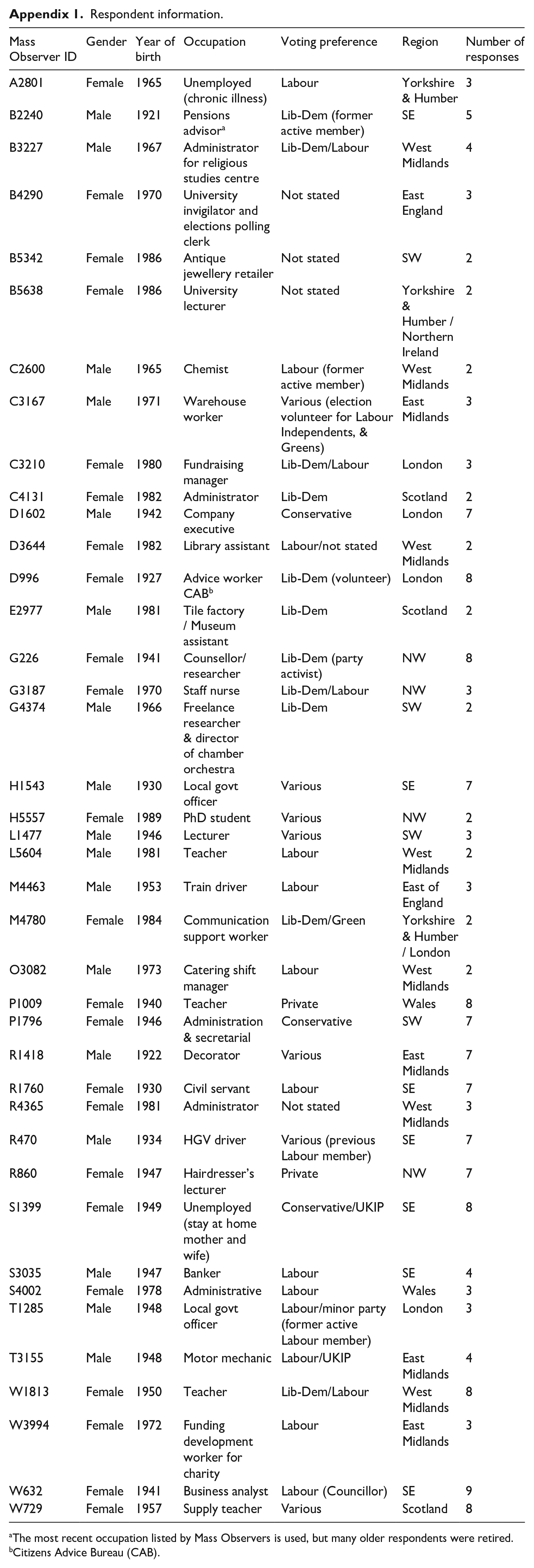
| Mass Observer ID | Gender | Year of birth | Occupation | Voting preference | Region | Number of responses |
|---|---|---|---|---|---|---|
| A2801 | Female | 1965 | Unemployed (chronic illness) | Labour | Yorkshire & Humber | 3 |
| B2240 | Male | 1921 | Pensions advisor a | Lib-Dem (former active member) | SE | 5 |
| B3227 | Male | 1967 | Administrator for religious studies centre | Lib-Dem/Labour | West Midlands | 4 |
| B4290 | Female | 1970 | University invigilator and elections polling clerk | Not stated | East England | 3 |
| B5342 | Female | 1986 | Antique jewellery retailer | Not stated | SW | 2 |
| B5638 | Female | 1986 | University lecturer | Not stated | Yorkshire & Humber / Northern Ireland | 2 |
| C2600 | Male | 1965 | Chemist | Labour (former active member) | West Midlands | 2 |
| C3167 | Male | 1971 | Warehouse worker | Various (election volunteer for Labour Independents, & Greens) | East Midlands | 3 |
| C3210 | Female | 1980 | Fundraising manager | Lib-Dem/Labour | London | 3 |
| C4131 | Female | 1982 | Administrator | Lib-Dem | Scotland | 2 |
| D1602 | Male | 1942 | Company executive | Conservative | London | 7 |
| D3644 | Female | 1982 | Library assistant | Labour/not stated | West Midlands | 2 |
| D996 | Female | 1927 | Advice worker CAB b | Lib-Dem (volunteer) | London | 8 |
| E2977 | Male | 1981 | Tile factory / Museum assistant | Lib-Dem | Scotland | 2 |
| G226 | Female | 1941 | Counsellor/researcher | Lib-Dem (party activist) | NW | 8 |
| G3187 | Female | 1970 | Staff nurse | Lib-Dem/Labour | NW | 3 |
| G4374 | Male | 1966 | Freelance researcher & director of chamber orchestra | Lib-Dem | SW | 2 |
| H1543 | Male | 1930 | Local govt officer | Various | SE | 7 |
| H5557 | Female | 1989 | PhD student | Various | NW | 2 |
| L1477 | Male | 1946 | Lecturer | Various | SW | 3 |
| L5604 | Male | 1981 | Teacher | Labour | West Midlands | 2 |
| M4463 | Male | 1953 | Train driver | Labour | East of England | 3 |
| M4780 | Female | 1984 | Communication support worker | Lib-Dem/Green | Yorkshire & Humber / London | 2 |
| O3082 | Male | 1973 | Catering shift manager | Labour | West Midlands | 2 |
| P1009 | Female | 1940 | Teacher | Private | Wales | 8 |
| P1796 | Female | 1946 | Administration & secretarial | Conservative | SW | 7 |
| R1418 | Male | 1922 | Decorator | Various | East Midlands | 7 |
| R1760 | Female | 1930 | Civil servant | Labour | SE | 7 |
| R4365 | Female | 1981 | Administrator | Not stated | West Midlands | 3 |
| R470 | Male | 1934 | HGV driver | Various (previous Labour member) | SE | 7 |
| R860 | Female | 1947 | Hairdresser’s lecturer | Private | NW | 7 |
| S1399 | Female | 1949 | Unemployed (stay at home mother and wife) | Conservative/UKIP | SE | 8 |
| S3035 | Male | 1947 | Banker | Labour | SE | 4 |
| S4002 | Female | 1978 | Administrative | Labour | Wales | 3 |
| T1285 | Male | 1948 | Local govt officer | Labour/minor party (former active Labour member) | London | 3 |
| T3155 | Male | 1948 | Motor mechanic | Labour/UKIP | East Midlands | 4 |
| W1813 | Female | 1950 | Teacher | Lib-Dem/Labour | West Midlands | 8 |
| W3994 | Female | 1972 | Funding development worker for charity | Labour | East Midlands | 3 |
| W632 | Female | 1941 | Business analyst | Labour (Councillor) | SE | 9 |
| W729 | Female | 1957 | Supply teacher | Various | Scotland | 8 |
The most recent occupation listed by Mass Observers is used, but many older respondents were retired.
Citizens Advice Bureau (CAB).
Acknowledgements
Mass Observation material reproduced with the kind permission of the Trustees of the Mass Observation Archive, University of Sussex. I would also like to thank Anthony Mc Coubrey for his excellent work with the archive and Jessica Scantlebury from The Keep for all her support and assistance.
Funding
This work was supported by a British Academy/Leverhulme Small Grant (grant number: SG130352).