




Abstract
This article advances literature on reflexive habitus in relation to LGB people by demonstrating empirically that habitus and reflexivity can coexist, albeit in very complex ways. The analysis offered relies on interview data with self-identified lesbian women, gay men and bisexual people in Cyprus – a context that is undergoing social change while however preserving its core heteronormative and conservative values. Drawing on LGB people’s experiences, perceptions and practices in this context, the article demonstrates how socio-cultural ideologies and discourses that stigmatise and Other LGB people constrain what they may do while at the same time making them increasingly reflexive. Their reflexive habitus generates constant reflection, self-awareness and reflexive practices, but these practices tend to mainly reproduce existing social structures. And yet, when LGB people find themselves in empowering interactions and relations, they may engage in acts of resistance that challenge and stretch structural boundaries and are often liberating in their ways, portraying thus the complexity of navigating LGB lives in this context. As such, the analysis shows how habitus and reflexivity may coexist and generate post-reflexive practices that are contextually bound and vary in their capacity towards social change.
Introduction
Habitus and reflexivity have been traditionally discussed as opposites, with the former being broadly associated with the unconscious and the latter with conscious deliberation. Reflecting on the relation between the two, Brooks and Wee (2008, p. 506) wrote that the concepts ‘create a conceptual conundrum since it is not clear how the former can (ever) give rise to the latter, or how the two can co-exist’. In this article, we engage with this assertion and demonstrate empirically that when it comes to gay, lesbian and bisexual people (LGB 1 ), reflexivity may exist as a core disposition of the habitus. Focusing on Cyprus – a context that is undergoing social change while largely preserving heteronormative and conservative values – we offer insights into the experiences, perceptions and (post-reflexive) practices of LGB people. We discuss the structures that seem to contribute to the shaping of LGB people’s habitus – dominant Church discourses, family expectations, and by consequence collective social expectations and societal ideologies – and the ways these constrain their practices while making them reflexive. Paradoxically, while these structures may limit what LGB people can do, they also condition them as highly reflexive social actors consciously acting to protect themselves while identifying spaces for resistance and defiance. In discussing these complexities, we advance literature attempting to unpack the ‘conceptual conundrum’ in relation to LGB people specifically. We show empirically that habitus and reflexivity may in fact coexist, albeit in complex ways (Adams, 2006; Christofidou, 2021; Mouzelis, 2008; Sweetman, 2003), and that LGB people’s reflexive habitus generates post-reflexive practices, which serve different purposes and involve social reproduction and change to varying degrees.
Habitus and reflexivity
Habitus, conceptualised as ‘a structured and structuring structure’ (Bourdieu, 1987/1994, p. 170), denotes the values, behaviours and acquired dispositions which become naturalised and embodied, are rarely questioned and are mainly done unreflexively (Bourdieu, 1977). As a largely embodied phenomenon, habitus reflects individuals’ cultural contexts and conditions of existence; becomes visible through people’s practices; and conditions the ways individuals think about the world and the bodily systems of dispositions they carry to different fields. As per Bourdieu, individuals enter fields and cultivate ‘a feel for the game’ – the practical knowledge that orients their practices and actions – as they learn the rules and regularities of the field. Although social agents may appear creative in this process, Bourdieu clarifies that they never encounter an unmediated or endless array of available options. They can rather sense what will be regarded as tolerable in a group, based on the group’s broadly shared understandings. Hence, while acknowledging that social agents can improvise, Bourdieu (1990) suggests that they can only do so within the limits of their habitus and, as Messerschmidt and Bridges (2022, p. 25) argue, ‘without consciously (and thus reflexively) considering each adjustment as it is being made’.
This assertion led scholars to criticise Bourdieu’s thesis for neglecting reflexive agency, which involves conscious deliberation and awareness (e.g. Jenkins, 1992; Sayer, 2009; Wimalasena & Marks, 2019). Bourdieu though, accounts for reflexivity as ‘a form of habitus, a required constituent of a particular field’ (Adams, 2006, p. 515) and more specifically the scientific and academic fields, in which reflexivity develops as a form of habitus. Likewise, Bourdieu discussed the potential of reflexivity as the outcome of crisis situations where ‘the habitus encounters a context which is so different from that in which it was structured’ (Farrugia, 2015, p. 879). Crisis situations may also occur as individuals move between fields, a common condition in contemporary societies where individuals fulfil a wide variety of roles (McNay, 1999). But even in the case of crises, habitus guides the awakened conscious reflexivity (Messerschmidt & Bridges, 2022, pp. 25–26).
Proponents of the reflexive modernisation thesis, on the other hand, discuss social actors in post-modern societies as increasingly reflexive and flexible; as self-fashioning their identities, self-authoring their biographies and monitoring their presentation of self (Beck et al., 1994; Giddens, 1991, 1992). Likewise, scholars looking at reflexivity in relation to sexuality assert that ‘contemporary culture is characterised by significant processes such as individualisation, de-traditionalisation, and globalisation that lead to pluralisation of meanings and life worlds, proliferation of choice, diversification of lifestyles, and fluidity and hybridity of identities and social relationships’ (Yip, 2008, p. 4). They tend to approach lesbian and gay people as inclined to chronic reflexivity and their lives as highly reflexive forms of existence, which they mainly attribute to (a) the new freedoms and opportunities of empowerment that social movements, post-modernity and globalisation have enabled (Giddens, 1991; Heaphy, 2008, 2012; Weeks, 2007) and (b) the enduring homophobia that encourages conscious self-monitoring in social contexts, cultural locales and everyday practices (Cooper, 2013; Eribon, 2004; Rothman, 2017; Ural & Beşpınar, 2017).
Those highlighting enduring homophobia, approach gay and lesbian as being constituted as subjects via regulatory and power-infused schemas such as homophobic discourses, insults and name-giving. Eribon (2004), for example, provided an analysis of how the heteronormative sexual order and ‘the collective history and the social and sexual structures that are the product of that history’ (p. 57) get incorporated into (lesbian and gay) individuals’ habitus; their schemas of thought and perception. Eribon (2004, 2013) focuses on, among other things, verbal aggressions and insults, which gay men and lesbian women can hear at any moment of their lives, as staying in their memory and body, shaping the relation that they have to others and to the world, their personality, subjectivity and their being as individuals – in other words, their habitus. Insults, stigma and shame, Eribon notes, produce ‘an awareness of oneself as other’ (2004, p. 16), leading to distinctions between ‘normal’ and stigmatised people, which are internalised by insulted individuals. Such practices of subordination, which remain largely unchanged, form gay and lesbian people’s subjectivities in an almost universal manner through feelings of shame and self-hatred (Eribon, 2004, 2013). Other references to ‘gay habitus’ come from Sender (2001), who discusses it as the outcome of ‘belonging in what we may call the “gay community”’. Differently though, Sender approaches gay habitus as being structured by an ‘economic relation to taste and established (and changing) aspects of gay sensibility’ as well as a ‘gay-specific subcultural capital’ (p. 75).
Yet, and while reflecting on discussions on this topic, Heaphy (2012) highlights that LGB people’s lives and practices are often discussed in ways that undermine the diversity of experiences that different resources may provide. Yip (2008) also highlights that cultural and structural specificities, such as traditional practices and ideologies, religion and close-knit family and kin networks, can influence the experiences of different cultural groups. Nonetheless, much discussion on LGB lives tends to suggest a ‘universal subjectivity or form of existence, and imply a lesbian and gay “ethos” of self-making and self-determination, that is closely akin to “reflexive habitus”’ (Heaphy, 2012, p. 16), but the concept has not been used in research with LGB people.
In this work, we focus on Cyprus and demonstrate how the concept of reflexive habitus may be used in the analysis of LGB people’s socialisation, experiences and (post-reflexive) practices. We suggest that among LGB people in this context, reflexivity and habitus coexist and interact. Socio-cultural ideologies and discourses, which stigmatise and Other LGB people, contribute to the shaping of their habitus, which in this context seems to be increasingly reflexive, thus generating reflexive practices. Reflexive practices paradoxically largely reproduce existing structures, but at the same time also challenge and shape them in manners that are personally liberating, albeit not necessarily structurally emancipatory. As such, this work adds to the few empirical studies (e.g. Christofidou, 2021; Messerschmidt & Bridges, 2022; Wimalasena & Marks, 2019) looking at how reflexivity and habitus can be mapped within a single theoretical framework, and to the even fewer empirical studies applying this lens to understand the experiences and practices of LGB people.
Methods
This study derives from a larger five-year project on LGB people’s experiences of inclusion/exclusion in the workplace and their negotiations of gender and sexuality in the employment field in Cyprus. The wider study documented LGB people’s work experiences and perceptions over their lives and across different organisations. To contextualise these, participants were encouraged to elaborate on their sense-making of their social world, resulting thus in narratives that touched upon multiple issues and provided a holistic overview of their lives, subjectivities, experiences and everyday life practices in Cyprus that, as we explain below, constitutes a context of particular interest when it comes to matters of gender and sexuality.
The context of Cyprus
Since the decriminalisation of same-sex sexual contact in 1998 2 , Cyprus has been caught in a journey of change in relation to issues of gender and sexuality. The island managed to improve its position in the rankings of achieved LGBTQI+ human rights, but the active recognition of LGBTQI+ rights is attested as a difficult and slow process (European Commission, 2015; ILGA-Europe, 2019). This could be attributed to a variety of intersecting factors, with the island’s history comprising one of the most important ones.
The Cyprus problem, 3 which occupies the central position in the country’s socio-political life, has left little space for other issues to enter the political realm, less so for issues relating to gender and sexuality non-conformity, which are perceived as less politically important, if not as apolitical (Kamenou, 2021). For Kamenou (2019, 2021), it was the island’s admission to the EU in 2004 that pushed towards facilitating changes in political opportunity structures. The formation of the LGBTQI+ organisation, Accept-LGBTI Cyprus (2009), was an outcome of that. Despite the challenges the latter faced, it strategically used Europeanisation to create alliances and push for LGBTQI+ issues (Kamenou, 2019, 2021), laboriously achieving the implementation of the Civil Union and the adoption of hate speech and crime legislation in 2015.
Though admittedly these developments signal a process of social change, the fundamental issues that remain stagnant denote persisting conservative social values. To indicate, same-sex marriage and joint or second-parent adoption are still prohibited (Kamenou, 2021). Strong resistance to such legal advances rests in the persistence of conservative family notions and gender roles, both cultivated through legal provisions, or the lack of thereof. Political instability and war have established men as protectors of women, women as carers of family and the established familial system – alongside the Church – as central to social cohesion (Cockburn, 2004; Kouloumou, 2004).
In turn, the last report of the European Commission against Racism and Intolerance (ECRI, 2016) suggested that Cyprus is characterised by attitudes of intolerance towards LGBTQI+ people. Indeed, the scarce evidence we have available from this context shows that Cyprus is a highly conservative and patriarchal society (Apostolidou, 2018; EU Agency for Fundamental Rights [FRA], 2014; Kapsou et al., 2011; Trimikliniotis & Karayanni, 2008). The Greek Orthodox Church, which publicly and openly declares its opposition to LGBTQI+ people and same-sex relationships, continues to play an important role in Cypriot society (Apostolidou, 2018; Trimikliniotis & Karayanni, 2008; Tryfonidou, 2018). The State Church that gets infused in Greek-Cypriots’ everydayness through education, customs and culture, declares homosexuality as a sin and a perversion, while on numerous occasions, the late Archbishop and other high-ranking members of the Greek-Cypriot Church publicly asked people to condemn homosexuality. Likewise, the media tend to ignore the existence of LGBTQI+ people and contribute to their construction as ‘abnormal’ and ‘unnatural’ (Apostolidou, 2018; Kapsou et al., 2011).
Homophobia and transphobia might be less acceptable on the institutional level of social life and Cyprus’s public sphere. At the same time, though, homosexuality (and bisexuality) remains a taboo in Cyprus. Homophobia and biphobia, though subtler than in the past, negatively affect how LGBTQI+ people experience themselves in this context, which leads nine out of ten LGBTQI+ people not disclosing their sexual orientation or gender identity to protect themselves (Apostolidou, 2018). In the sections that follow we show empirically how the enduring matrix of sensibilities that LGB people’s habitus creates leads to reflexive practices that are relational and situational, hardly emancipatory but still often liberating in their ways, portraying thus the complexity of navigating LGB lives in this context. In doing so we highlight the specificities of this context and show how habitus and reflexivity may coexist.
Data collection and analysis
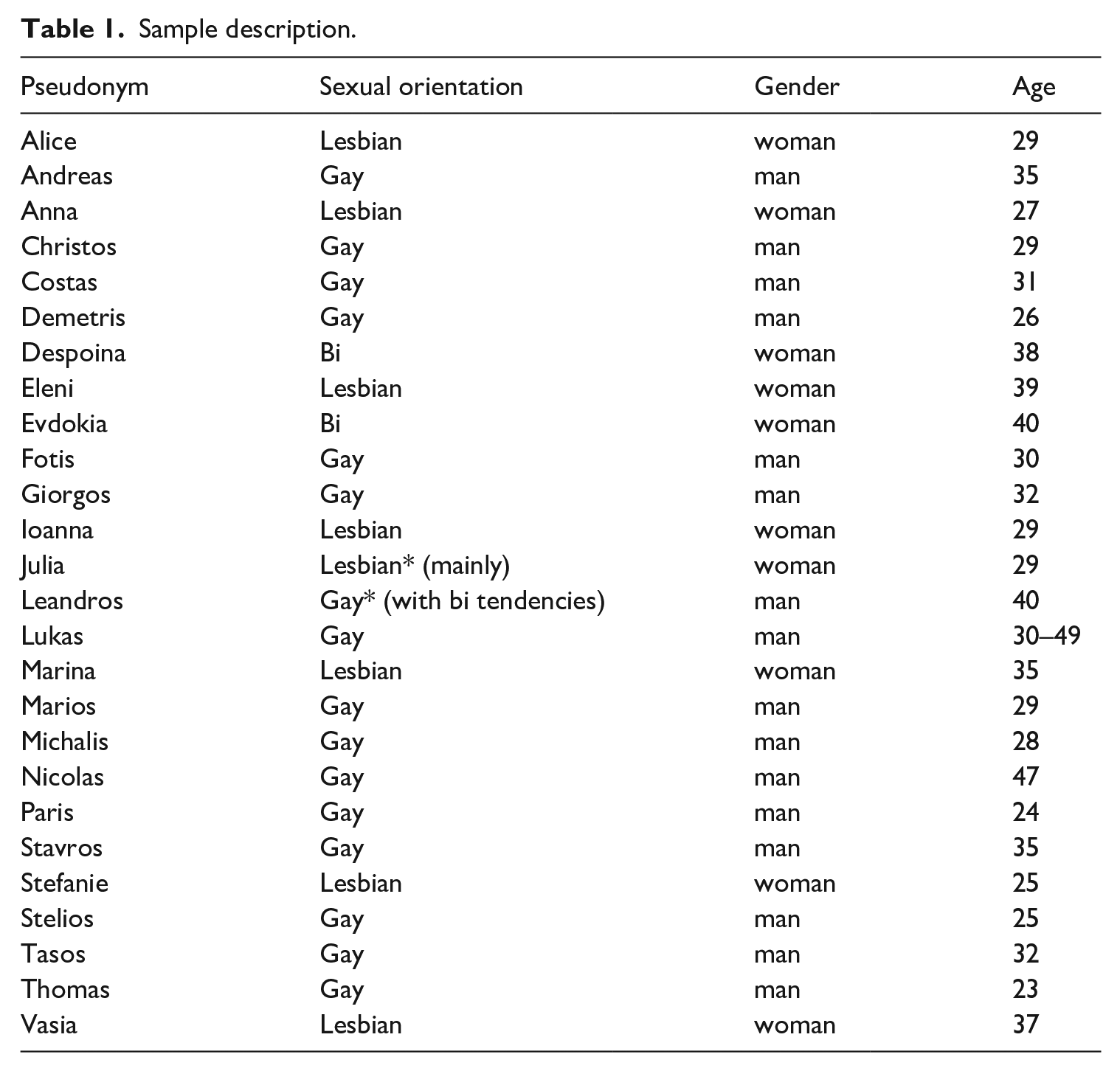
The analysis offered below relies on interview data that were collected between 2017 and 2020 in Cyprus. The sample includes 26 LGB people who: (a) self-identified as lesbian, gay or bisexual; (b) were raised in Cyprus; and (c) had work experience in this setting (for sample description see Table 1).
Sample description.
Pseudonyms are used for all individual participants, who were mainly recruited through social media, social networks and local LGBTQI+ activist groups, following the logic of a snowball sampling. A few people responded to our ‘call for interview participants’ on social media, and those then referred us to friends or colleagues. Despite the limitations of snowball sampling processes (Browne, 2005), this recruitment method is commonly used in studies with sexual minorities (Fahie, 2016; Ozturk, 2011; Ozturk & Rumens, 2014) and was proven especially appropriate in this context as many LGB people remain closeted and worried about the potential risks of opening up to, and sharing their personal information with, strangers.
Interviews, which lasted on average one hour, were conducted with either one of the authors in Greek and were guided through a shared interview guide that was developed by the two authors. During the interviews, participants were asked about their early life experiences as LGB people – especially in family and education settings – their relationships and employment trajectories. Therefore, they discussed life milestones in relation to experiences of inclusion/exclusion, as well as negotiations of gender and sexuality in the employment field and across other fields. Approaching the interviews as life stories facilitated participants to talk about sexuality in relation to other aspects of themselves and their lives, providing thus rich data, combining the objective with the subjective. The interviewers’ shared knowledge and common experiences of growing up in this setting made apparent some issues which helped us better contextualise interview commentaries. Similarly, our identification as heterosexual, cis-gender women often encouraged participants to give more detailed accounts of their stories, feeling it necessary to explicate how that which is typically unseen by most people acted to Other them.
Interviews were transcribed verbatim in Greek. Authors worked on interview transcripts independently, making notes and developing one-page summaries of each interview that highlighted key themes and initial reactions to data. These summaries guided the thematic analysis unfolding in this work. Data extracts included in this article were translated into English independently by each author, who agreed on minor translation differences through discussion.
Findings and discussion
The analysis begins by discussing the social conditions under which participants’ subjectivities are formed. It starts by highlighting the intersecting Church, gender and familial discourses that condition LGB people’s habitus as inherently reflexive. It then discusses LGB people’s post-reflexive practices with a critical view on how and under what circumstances these may relate more to social reproduction or emancipation.
The structuring of habitus
Participants’ reflections on the social context painted a picture of some shifting social structures and attitudes that evidenced some progress but remained insufficient to signal substantial social change, therefore creating a ‘not yet’ situation. Many participants discussed how nowadays there are more public spaces where LGB people can express themselves openly. Stavros, for instance, explained that whereas in the 2000s gay men would meet with other gay men in parks, public toilets or parking spaces, nowadays they have ‘gay clubs [and] gay saunas. Places where they can go out and feel comfortable. Where they can kiss.’ While emphasising that other public spaces are not offered for such acts of affection, their stories reflected how Cyprus is indeed changing but deeply ingrained patriarchal norms still act as structuring structures.
In my time, telling I am gay would not occur to me. Today it’s easier for kids to tell. Not that they tell. It’s just not how it was. Even the Ministry [of Education] now has directives on homophobia. You can see that nobody enforces them, but they exist. So, Cyprus has potential. It just needs work. (Marios)
Even the more positive narratives among this study’s participants suggested that acceptance is conditional, with homophobia and biphobia still manifesting through small, mundane homophobic or biphobic acts and jokes that are rarely perceived as discrimination, but end up subtly silencing, excluding and marginalising LGB people (see also Kadianaki et al., 2018; Kapsou et al., 2011; Tryfonidou, 2018). Relevant literature highlights ‘gay habitus’ as cultivated by gay men’s and lesbian women’s participation in the ‘gay community’ (Sender, 2001), and the insults that they receive throughout their lives (Eribon, 2004, 2013). In our case, LGB people’s (reflexive) habitus seems to be primarily cultivated by intersecting Church, gender and familial discourses, which continue to mainly marginalise, stigmatise and Other LGB people.
The State Church was discussed as cultivating LGB people and same-sex relationships as different, leading participants to experience feelings of self-doubt, self-disapproval and self-denial, and to even challenge their own value system.
I grew up in a strict family which was quite religious. And to me, religion, especially when I was a teenager, had a great influence on my life. [. . .I had a crush on a girl.] It upset me very much. Eeerr, and I couldn’t accept it because I felt it was wrong. [. . .] and I believed that it was a passion that I had to fight. Like an addiction. [. . .] Eeeerr, and I was trying for years to fight this thing. I had feelings, of course, I still had feelings. And attractions. I never expressed them. Never. I found myself expressing them at university. [. . .] my first experience [with a woman] was just one month before I left England [to return to Cyprus]. Because I said ‘it’s now or never’ [. . .]. I wasn’t comfortable with this thing. After a certain point, I confessed for this thing, I was going to Church, praying, doing. . . [. . .] I am not an atheist. I am semi-atheist. And this is why, ever since I decided to accept it [my sexuality], I neither confessed nor went to communion again. (Marina)
The socially conservative State Church comprises one of, if not the, most important factors that shape perceptions of what is moral, good and proper on the island. LGB people, who internalise these widely diffused moral and social values during their primary and secondary socialisation in familial, school and other settings, end up battling with feelings of guilt and denial of their attractions. As Thomas said, ‘they made [homosexuality] so forbidden in Cyprus that you feel guilt for this thing that you feel at the time. And you deny it. You deny your own self at that time. Automatically.’
Some participants, who are or were religious, experienced what they felt as a sin and approached priests for forgiveness. Participants grew up hearing devaluing and exclusionary comments about LGB people and same-sex relationships – insults in Eribon’s (2004) words. These ranged from the most common: ‘I don’t have a problem with gay people, but they should do whatever they want to do in their home, on their bed’ (Costas) to rarer views on how ‘they do not give back to society [. . .]. They sleep on benches and have sex wherever they can’ (Ioanna). While not necessarily targeting them personally, the stigmatisation of LGB people flooded them with a sensation of ‘the affect shame’ (Sedgwick, 2009), making them the target of stigmatisation even before – or without ever – becoming direct victims (Eribon, 2004). Such linguistic acts, and their effects, led to the internalisation of homosexuality or bisexuality as shameful, forbidden or unacceptable, and to the durable alteration of LGB people’s identities (Sedgwick, 2009). Consequently, the more participants identified with their sexuality the more they experienced themselves as different; as persons ‘about whom something can be said, to whom something can be said, someone who can be looked at or talked about in a certain way and who is stigmatised’ (Eribon, 2004, p. 16). Common effects of this were battling feelings of shame and self-guilt, and difficulties in coming to terms with their sexuality.
I made two suicide attempts at 19. Because I come from a very religious family, so it was a great taboo to differ so much in this respect and because I had a cousin who was. . . is gay, eer. . . [. . .] Eeer, and I took in everything that was said about my cousin [. . .] and at some point, it became so intense: the contrast between what you are and religion [. . .] And at some point, at 19, when I had joined the army, eeeerr, I confessed for the first time and told a priest. OK, his views were not that. . . good [. . .] I made two attempts. . . emmm suicide [lowers tone]. Ok, not. . . nothing came out from this [laughs], but I had decided that ‘ok, this is it, you will remain alone’. (Costas)
The importance given to heterosexual marriage and conservative gender roles – preserved and preserving heterosexist assumptions and patriarchy (Kouloumou, 2004) – acts as an additional, yet directly related to the above, factor that Others LGB people. Like others conditioned in this context, participants did not question the institution of marriage. Instead, they typically discussed it as one’s life destination, as something they would have liked for themselves. Marriage in this case, or more so the importance attributed to marriage, acts as another reminder of their difference; of the ways they fail to meet social expectations. Ioanna, for instance, told us that ‘my father insists on [asking] when will I get married. He always thought that I should study, get a good degree and then marry a man.’ While Ioanna’s father knows that she is planning her life with her female partner, he preserves and shares his wish of his daughter to get married, substantiating (heterosexual) marriage as a longstanding institution and normative structure.
Other participants commented on their parents’ concerns about them becoming the subject of social disapproval or remaining alone for life because of their sexual orientation. Indicative was Anna’s recollection of how her mother reacted to her coming out as a lesbian woman: ‘She took it badly in the sense that. . . The two problems: “what will people say?” and “you will be alone for life”.’ Similar stories were told by all participants, even by those who had comparatively positive experiences in disclosing their sexual identities. Concerns related strongly to dominant perceptions of coupledom, marriage and childrearing as the primary destination for all people in this context (Kouloumou, 2004).
Mouzelis (2008) argued that reflexivity may be enhanced when social agents have to handle ‘intra-habitus conflicts’. LGB people in this context seem to deal with such conflicts: their sexuality clashes with the religious and conservative values they internalised throughout their socialisation and that comprise core dispositions of their habitus. But it is precisely because of this that reflexivity develops as a core part of LGB people’s habitus.
For Bourdieu, habitus leads to non-reflexive practices; reflexivity and rational strategising can appear only during crises. For participants in this study, the crisis may be discussed as that moment when they realised their Otherness.
We are born in a society that gives us some standards, ideals to grow up with. If you are a man, to grow up, marry a nice girl, build a house with a garden, two dogs, two cars. . . Ideal situations. And at some point, here you are and all this collapses because you are something else. (Costas)
That first crisis, the moment of realising ‘you are something else’, was described by invariably all participants in this study. It emerged, however, not as a temporary or transitional state, but as the marker of thereafter existing in a constant state of reflection, where they think about all these things that are taken-for-granted and are rarely questioned (Akram & Hogan, 2015; Bourdieu, 1977). Reflexivity, as ‘the systematic exploration of the unthought categories of thought that delimit the thinkable and predetermine the thought’ (Bourdieu & Wacquant, 1992, p. 40), becomes evident in this case: the crisis LGB people experience leads to long-lasting feelings of cautiousness, affecting LGB people’s sense of self, everyday lives and practices. They seem to think and rethink their practices and their potential outcomes; a state of being that goes beyond specific fields.
In contrast to previous studies dealing with LGB people as reflexive agents, on the one hand, and reflexive habitus as an outcome or condition of late modernity, on the other, we argue that in this case reflexivity is ‘contextually bound’ (Akram & Hogan, 2015, p. 618). Conservative religious, familial and social discourses persist, and lead LGB people who grew up in this context to exist in a state of constant reflection. This constant reflection cultivates a reflexive habitus that conditions LGB people to be self-aware of and reflect on their identities, interactions and practices prior to participating in social action, different interactions and situations. It is a reflexive habitus that leads to conscious, reflexive practices in a framework that offers, however, a rather limited array of post-reflexive choices.
(Post-)reflexive practices
Bourdieu discusses practices as largely unconsciously generated individual-level acts that are coordinated through the habitus. Reflexivity emerges when habitus encounters a context that is vastly different from the one in which it was structured. However, in our case we see people feeling like ‘fish out of water’ in the very same context that they were raised in and that structured their habitus. Their socialisation produces an awareness of themselves as Others (Eribon, 2004), leading participants to engage in a process that Giddens (1992) would discuss as the ‘reflexive project of the self’. Reflexivity becomes a feature of their everyday life, shaped by their life experiences and affecting their practices (Mouzelis, 2008).
The constant evaluation of their lives, the settings and situations they find themselves in and the people with whom they interact has primarily a self-protective function for LGB people. Since the worry about other people’s negative perception of their sexuality is ‘always there. . . very stressful and very, errr, exhausting. . .’ (Lukas), it becomes rooted in their habitus and leads to reflexive thinking and strategic design across different fields of engagement. 4 It enables them to learn what can be said or done in different situations so as to avoid (further) stigmatisation. As such, reflexive habitus becomes a tool to protect the self and post-reflexive practices are primarily motivated by a fundamental need for survival.
Even if I am in a relationship, I won’t go walking hand-in-hand in the [city’s main road]. I will go without anyone knowing who, what, why or anything. Neither will I say anything or do anything exorbitant on myself [. . .]. I mean, short hair or earrings and so on. (Anna)
Others also talked about feeling unable to be publicly affectionate with their same-sex partners, expecting social disapproval if they did. Eleni, for example, said that if she walked hand-in-hand with her partner she would ‘get five, ten intense eye looks. . . hear five or three whispers. This is something we learn to live with.’ All these seemingly ‘self-oppressive habits’ (Eribon, 2004) are a way to keep themselves safe and protected from social disapproval, insults, shame and stigmatisation. The awareness of the possibility, or even expectation, of harassment and/or violence becomes an ‘intrinsic part of [LGBTQ] lives and features in how they conduct their relationships in both public and private spaces’ (Rohleder et al., 2023, p. 559). In contrast to Bourdieu’s schema, LGB people’s practices are the outcome of reflexive designing that, however, emerges out of the necessity for self-protection and survival, as well as the stigma and feelings of shame they internalised while growing up (Eribon, 2004; Sedgwick, 2009; Warner, 1999).
There was a widespread and subtle acceptance that ‘we live in Cyprus, not Sweden’ (Stefanie), which made participants a bit more conscious and cautious about how much they could reveal about their personal lives and to whom. Most avoided taking any risks by just being cautious in public spaces. The constant worry about seemingly unimportant micro-reactions such as disapproving looks or whispers policed their behaviour, leading them to proactively monitor their behaviour and presentation of self. As Messerschmidt and Bridges (2022) note, ‘interactional accountability encourages internal deliberation about and subsequent accomplishment of sex, gender, and sexual appropriate practices – and thus accountable identities – in particular contexts’ (pp. 39–40).
These very reflexive practices were done so continuously, but consciously, that they felt almost routine, and were discussed as a core part of their (habitual) everydayness. These evidently reflexive acts, which were coordinated through their habitus, were particularly evident in the employment field that in this small locality, with its close social networks, is very much affected by wider social structures, norms and expectations.
Being LGBT. . . you feel that some things affect you in general. In your life and in the society and. . . generally. And the workplace is part of all this. I don’t separate the workplace from the society. In an ideal society, it wouldn’t be an issue if someone was LGBT. So, if it wasn’t an issue in the wider society, it wouldn’t be an issue at the workplace either. Therefore, I consider the workplace as part of the community, the wider society. (Eleni)
When people are at work they engage in practices and mobilise relevant capitals to maintain or improve their position in the field (Bourdieu, 1990). LGB people monitor the information they communicate to others, carefully select words and use specific pronouns when they talk about their relationships or partners to hide that side of themselves. They take extra care of their appearance to come across as conventionally feminine or masculine respectively to not raise any suspicions. They often maintain a distance from colleagues and clients to not risk people finding out about their personal lives. Reflexivity and flexibility, thus, become habitual.
In the school [I work], I am careful about what I will say. [. . .] Every sentence I say I need to be careful. I need to be careful of the gender I will use when I refer to people. For example, I need to be careful to not say something that will reveal it [my sexuality]. If we are at an event with my partner, I will introduce her as my best friend and not as my girlfriend. I need to be careful to not call her ‘my love’. [. . .], we need to be careful of the verbal speech. (Ioanna)
Ioanna repeats five times in seven sentences that she needs to be careful with what she says and how much she reveals about herself and her personal life. Most of her colleagues in school know that she self-identifies as a lesbian woman. And yet, she still needs to be careful because she does not know how her students’ parents will react to her sexuality, and by consequence to the person and professional that Ioanna is. It is as if for LGB people in this context sexuality takes over their whole existence, only reducing the whole person to that part of their identity. The necessity that Ioanna discusses reveals precisely how ‘forbidden’ (Thomas) homosexuality remains. In addition to this though, it reveals how increasingly reflexive she became because of her sexuality. LGB people’s reflexive evaluations of each field, and their positions in social relations within these, lead them to develop a strategy to play each game by calculating the potential costs and benefits of their possible actions. This is often a ‘strategy of hiding’ (Eribon, 2004), which becomes an ‘essential’ part of their identity (p. 99). When we asked Stefanie if she would prefer that her colleagues knew about her sexuality, she said: Yes. And I would have liked for myself to be more comfortable in the company [I work] and to talk because everyone knows I have a relationship, but they don’t know what kind of a relationship [. . .] They can’t fire me because of my sexual preferences. Obviously, they can’t do that, but I don’t know what will be discussed behind my back [. . .] That scares me. The. . . how, what they would discuss behind my back and how they would see me after that. I mean, I don’t want them looking at me pejoratively, talking negatively about me.
Participants filtered the messages that prevailed in their organisations, and thought about colleagues, clients and supervisors’ value systems, age, religiosity level and wider conditions of existence to make a judgement about how they should manage their sexuality at work. And this is something they did, to a lesser or greater degree, in every situation they found themselves. Following this reflexive process, they engaged in certain practices to maintain or improve their position in each field, or to protect themselves from the threat of insult and devalorisation (Eribon, 2004).
When I have a meeting at headquarters, I will make myself up, I will definitely leave my hair down, I will wear something more elegant [. . .]. Having my life in the back of my mind, I come to say that I do not need to give food [for comments]. (Anna)
Many participants reflexively monitored their gender performances to comply with the gender norms and expectations of the wider society and the employment field, in effect keeping their sexuality hidden or at least not making themselves a target because of it. The fear of not being respected is interlinked with gay shame that is rooted in LGB and queer people’s identities and subjectivities (Halperin & Traub, 2009; Sedgwick, 2009). Even the ones whose appearance complied to norms, reflexively talked about it as making their existence in the field easier. In this case we may talk about gender capital: ‘gender as a resource’ (Ross-Smith & Huppatz, 2010) or ‘the knowledge, resources and aspects of identity available – within a given context – that permit access to regime-specific gendered identities’ (Bridges, 2009, p. 92). Those with high levels of appropriate feminine or masculine capital alike suggested that they can pass as straight or successfully hide their homosexual orientation, thus improving or at least not harming their position in the field. Others did sexuality and gender in certain ways because they felt they did not have a choice. Eleni, for instance, said: People can tell [my sexuality]. [. . .] because of the way I look. [. . .] I can’t imagine many straight women who dress the way I dress. I wear men’s clothes. I can’t think of many women who have such short hair. And I understand that my mannerisms are not feminine enough. I am aware of that.
Those with ‘lower’ gender capital perceived sexuality and gender as more strongly interlinked and embodied. They were also among those who challenged social norms and gender expectations, mostly out of perceived necessity rather than choice, feeling they had fewer options on how to present themselves. Whether by perceived necessity or choice, participants who challenged established norms and structures did so only to certain degrees, spaces and in interactional situations they felt safe to do so, for example among certain colleagues and friends.
Although strategies of hiding such as those discussed thus far were the most common among participants, their stories also revealed some resistance strategies. Participants habitually monitored situations. While they did this to protect themselves, they were also able to strategically identify space for resistance, albeit typically a small one. (Post-)reflexive resistance strategies were typically combined with strategies of hiding and were enacted in situations or interactions perceived by individuals as lower-risk. That is why, for example, Lukas would accept holding hands with his partner in public, but not when passing by the school where he worked, or why Julia, while closeted at work and family, would openly confront the men sitting at a nearby cafeteria table casually calling lesbian women ‘perverts’.
Other participants, though closeted in their work and/or family environments, identified spaces and ways to ‘become visible’ (Eribon, 2004). On occasions, they would challenge homophobic comments targeting others, or imply their sexuality through humour and jokes, but would never reveal their sexuality explicitly. Or they would consciously reject typical business attire at the office, but ‘with clients, to make that distinction again, I will consciously wear my shirt, my tie, my formal shoes’ (Stelios). These are key examples of how LGB people in this study negotiated social respectability through conforming, while however simultaneously challenging social norms as much as they thought possible. Reflexive awareness of social expectations, and of the potential costs of their possible actions, led participants to flexibly adapt to different situations. Quite indicative was the case of Marios, who purposively carried to work a laptop with a rainbow flag sticker but refused to explicitly disclose his sexual identity because a (female) colleague kept making comments that came across as sarcastic and insulting.
. . . I always felt uncomfortable getting into the process to talk about this thing with people who do not understand. I mean face to face. Face to face. I mean, I speak up incredibly much online. I can speak up offline as well, but when I know that the person I have opposite me will feel uncomfortable or weird, I freeze. I cannot talk. And subconsciously I may be afraid of his reaction. . . Beyond that, I have no problem talking with anyone and I talk openly online and on Facebook and so on and I am an activist on these issues. (Marios)
Marios’s strategies, a mixture of hiding and becoming visible, clearly demonstrate how LGB people’s practices are indeed reflexive, generated through conscious deliberation of the costs associated with becoming visible on different occasions. As such, while they may be characterised by heightened reflexivity, they remain constrained within the very same structures and ideologies that conditioned them as Others. Even when the conditions are there – accepting parents, welcoming colleagues, etc. – participants still experience the limits posed by constraining normative structures, which restrict what they consider as possible action. This signifies the ‘interiorization of domination in the mind of the dominated’ that Eribon (2004, p. 66) discusses.
At the same time, most participants acknowledged their small acts of resistance but could not see these as sufficiently challenging prevailing norms of gender and sexuality. As Adams (2006, p. 525) notes, reflexivity does not necessarily ‘bring choice, just a painful awareness of the lack of it’. For many participants it was a painful awareness that left them hopelessly feeling that however they (re)acted, ‘in the society we live in, nothing will come out of it’ (Julia), some even asking ‘who will change this country? For the next generations. For our children’ (Costas). Only a handful of participants discussed how they sometimes behaved outside the norms, often at a personal cost, in order to challenge social norms.
Up to the point I could, I have shaken things up a bit. Let’s say, when we will not have a meeting with clients, I may go [to the office] with my tracksuit let’s say. And there was this shake sometimes. I did it to see the shake. And finally, fortunately, it went through. Fortunately, it went through without any. . . There were some comments in the beginning, like jokes, humour, that someone could have taken personally. I did not mind because I knew that this thing would shake them and doing it consciously. . . It was done and now they are used to it. (Stelios)
Stelios was among the very few participants who acknowledged that small acts of resistance entailed transformative capacity, but at the same time acknowledged that space for such resistance was limited and still bound by established norms. As he noted, ‘If I went to the office tomorrow wearing a skirt I don’t think [my colleagues] would be very accepting. I realise I comply with the rules that my profession has set, but I have made steps to change the things I want to change.’ We see a habitus that while reflexive, acts as a structured and structuring structure, being shaped by this specific context and affecting what LGB people may do. Participants’ stories reinforce this claim and demonstrate that reflexivity may be simultaneously cultivated and restricted by the very same structures that condition LGB people as subjects, limiting thus its potential for generating larger acts of resistance.
We would like to have kids but lately a discussion started around ‘isn’t it selfish to bring a child into this world to satisfy your own motherly thing and then the child to have two mums and always be different from the others?’ So, we have a little black cloud following us this past month. [. . .] [But] we also agree that someone has to make the first step. That society will not change if we don’t change things. But, on the other hand, the one who will do it first is the one who will take the slap [metaphorically]. (Ioanna)
Reflexive awareness does not necessarily lead to change or transformation since reflexivity may exist as a possibility but is nonetheless confined by the social world (Adams, 2006; McNay, 1999). As the analysis suggests, LGB people’s practices are limited in this context and shaped by their fear of potential effects as well as the need to protect themselves. Analysis did not show clear patterns distinguishing those more likely to engage in acts of resistance, however small, from those who did not on the basis of, for example, social class, age, education, social or employment status. What emerged was that acts of resistance, smaller or larger, took place when the interactional situation was evaluated as lower-risk for participants and the person was ready: that is when the person was at the right place at the right time. What enabled more transgressive acts was a form of empowerment that was mainly situational and relational. Following their awareness as Others in this context, their empowerment emerged through social interactions and relations with other people, situations and institutions. So, individuals could have felt (dis)empowered without having acted, but through the reactions of others, their acceptance, power and status. When previous interactions resulted in empowerment, participants’ post-reflexive actions were more likely to challenge rather than reproduce established norms, but only when situations were enabling. In this sense, empowerment to act otherwise was not necessarily the outcome of personal transformation, but one mediated by others involved in the game, their characteristics, reactions and power.
Conclusions
The analysis of LGB people’s perceptions, behaviours and (post-reflexive) practices in a changing, yet largely heteronormative, patriarchal, religious and conservative context such as Cyprus, revealed a habitus that has reflexivity at its core. This socio-culturally shaped form of reflexive habitus is the outcome of dominant Church discourses that are strongly interlinked with social expectations around family formation and marriage, and socio-cultural ideologies concerning what is normal, proper, and what not. These create feelings of uncertainty and lead to a crisis, to use Bourdieu’s terms. However, this crisis, once first experienced, becomes a constant state of being, which cultivates reflexivity at the core of LGB people’s habitus. The dispositions of their habitus, the knowledge they accumulate and the need to stay safe result in the cultivation of a habitus that is reflexive: it has reflexivity at its core and generates reflexive practices.
For LGB people, reflexivity becomes a habit and part of their automatic and routine acts; a constant state of being. LGB people reflexively, consciously and actively decide how to negotiate their sexuality depending on the situations they find themselves in and the social expectations that characterise them. More often than not, their reflexive habitus actively leads to the incorporation of strategies of hiding to mitigate processes of stigmatisation, rejection and othering. In this case, LGB people’s reflexive habitus generates practices for self-protection that allow them to navigate their complex lives in a safe and dignified manner. Even though their practices comply to norms and social expectations, they are conscious and deliberate.
At the same time, and while continuing to act in the very same structures that constrained them in the first place, in certain cases, LGB people reflexively identify spaces for resistance, generating practices that, even partially, (aim to) transcend dominant gender norms. In these cases, especially when they feel empowered enough, they use their interactions and relations with other individuals, groups and institutions to initiate change through small-scale transgressive acts in the micro-level of everyday life. And while these may not be necessarily impactful enough to be emancipatory, or to be perceived as such by the individuals, they push to enlarge the boundaries of structures.
Considering that this research relies on the accounts of LGB people in a specific context, additional insights into the practices of members of the broader LGBTQI+ community, or even other stigmatised social groups, could potentially reveal different or larger ways in which extant structures are challenged and extended. Nonetheless, the practices of LGB people – regardless if these are practices of resistance or compliance – appear to be the outcome of ‘reflexive awareness’ (Adams, 2006), which derives from LGB people’s ability to reflect on the situations they find themselves in and the social expectations characterising these. This is itself an outcome of their reflexive habitus; a habitus that is structured in a context of constraints and that structures dispositional guidelines for action.
Footnotes
Acknowledgements
We extend our gratitude to all participants in our study for sharing their experiences, as well as to the editor and anonymous reviewers for their feedback in developing this article.
Funding
This work has been supported by the Cyprus Government and the European Social Fund [SOCIALINNO/0617/0006].