




Abstract
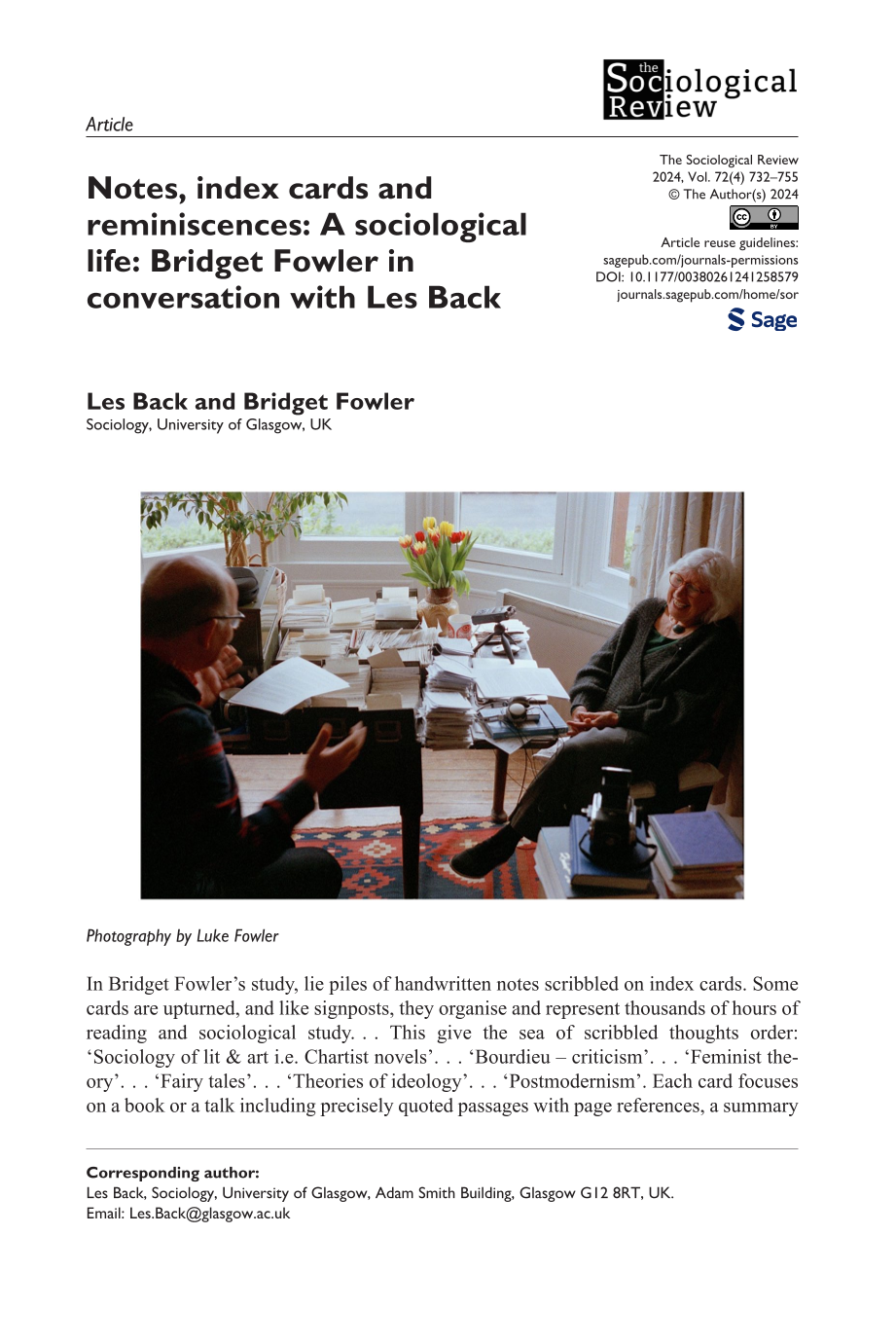
Photography by Luke Fowler
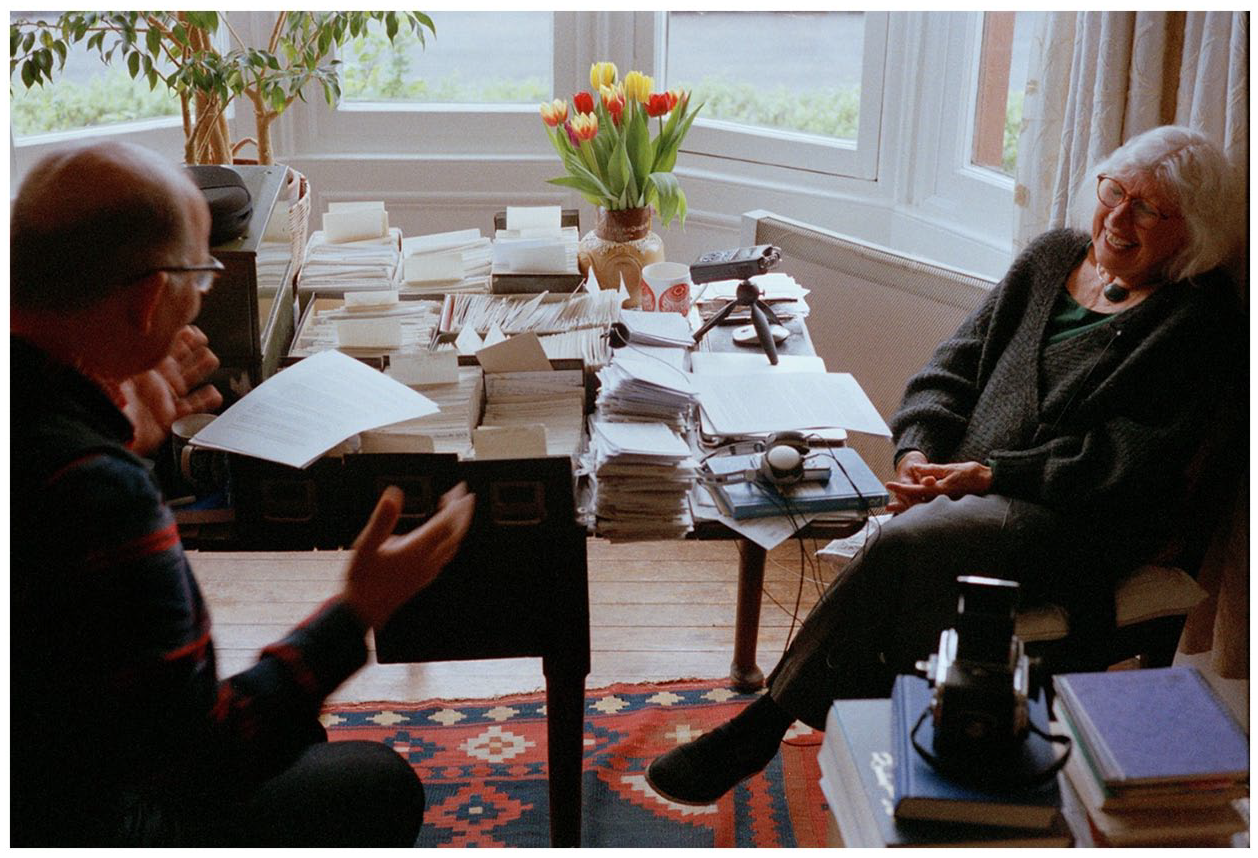
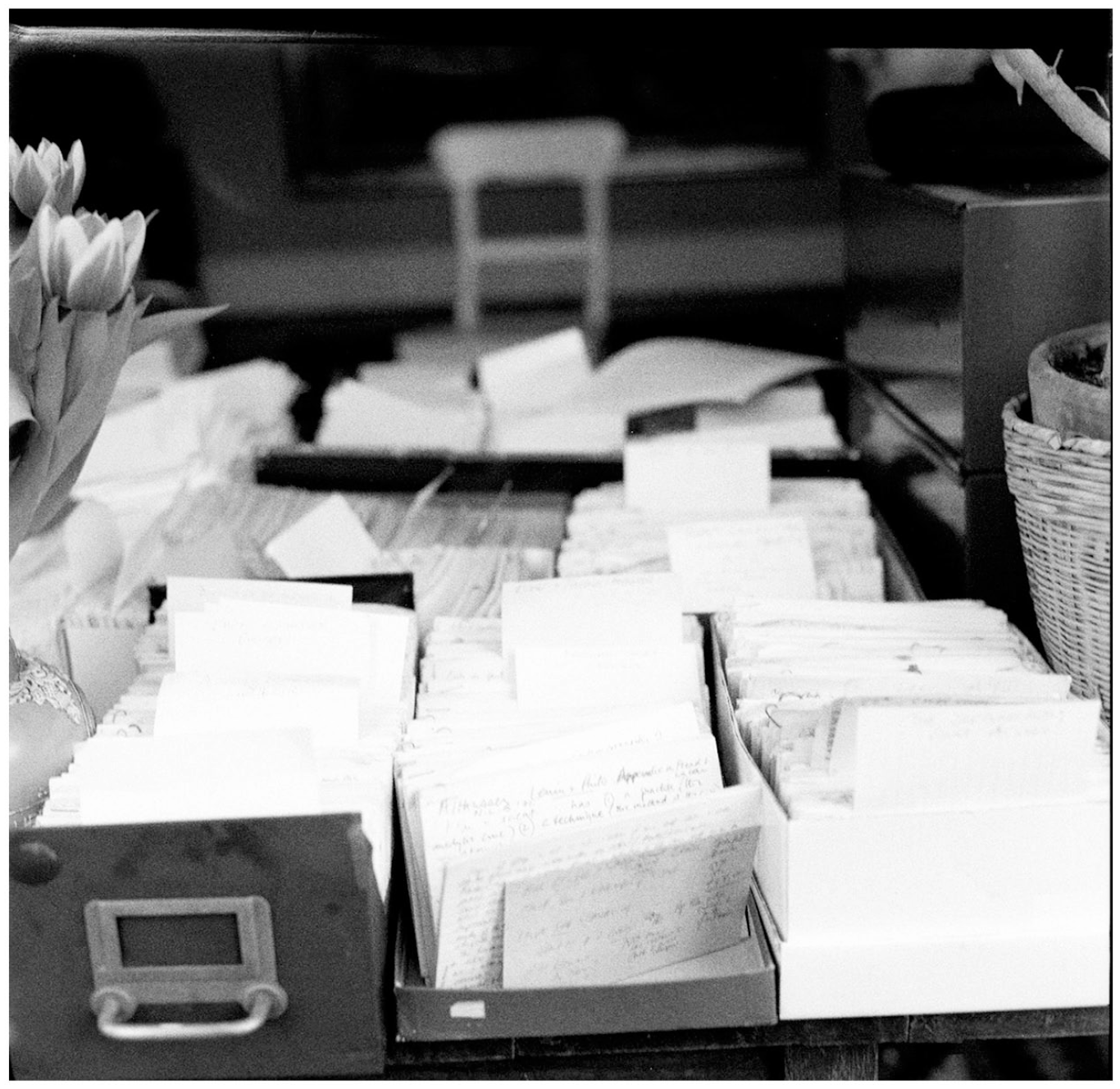
In Bridget Fowler’s study, lie piles of handwritten notes scribbled on index cards. Some cards are upturned, and like signposts, they organise and represent thousands of hours of reading and sociological study. . . This give the sea of scribbled thoughts order: ‘Sociology of lit & art i.e. Chartist novels’. . . ‘Bourdieu – criticism’. . . ‘Feminist theory’. . . ‘Fairy tales’. . . ‘Theories of ideology’. . . ‘Postmodernism’. Each card focuses on a book or a talk including precisely quoted passages with page references, a summary of the overarching arguments, or Bridget’s critical thoughts signalled through being encased in a square bracket. The cards are collected in boxes, or stacked in neat piles. Others are simply secured with a binder clip. It is an archive of Bridget’s sociological curiosity and diligence and an appropriate place to begin this conversation about her life in sociology.
Bridget started her practice of notetaking out of necessity; owning books was too expensive for a scholar also raising a young family. These thoughts and précises captured in longhand also convey the sensibility of the person holding the pen. The rigour of Bridget’s thought is manifest in those free lines and annotations. It is also evidence that her life was not the entitled life of a ‘University Don’. Rather her scholarship has been practised frugally through effort and seriousness alongside a self-deprecating sense of humour and lightness.
She has lived in her Glasgow tenement since 1978. A card on her desk entitled ‘J Fowler. . . Charisma’, includes notes from a talk her husband gave. John (who died in May 2000) was an exuberant and much-loved Politics lecturer at the University of Glasgow. Bridget was a founding member of the Department of Sociology where she is now Emeritus Professor. They raised their four children here in what Bridget calls an ‘edgeland’ between the solidly middle-class West End and the working-class Maryhill a couple of hundred metres away. John was fond of saying that their street was made up of ‘middle-class dropouts’. This neighbourhood of Glasgow is now gentrifying, but as Bridget explains with customary sociological precision, the salary of the young professionals working on insecure contracts is not much more than an electrician earns.
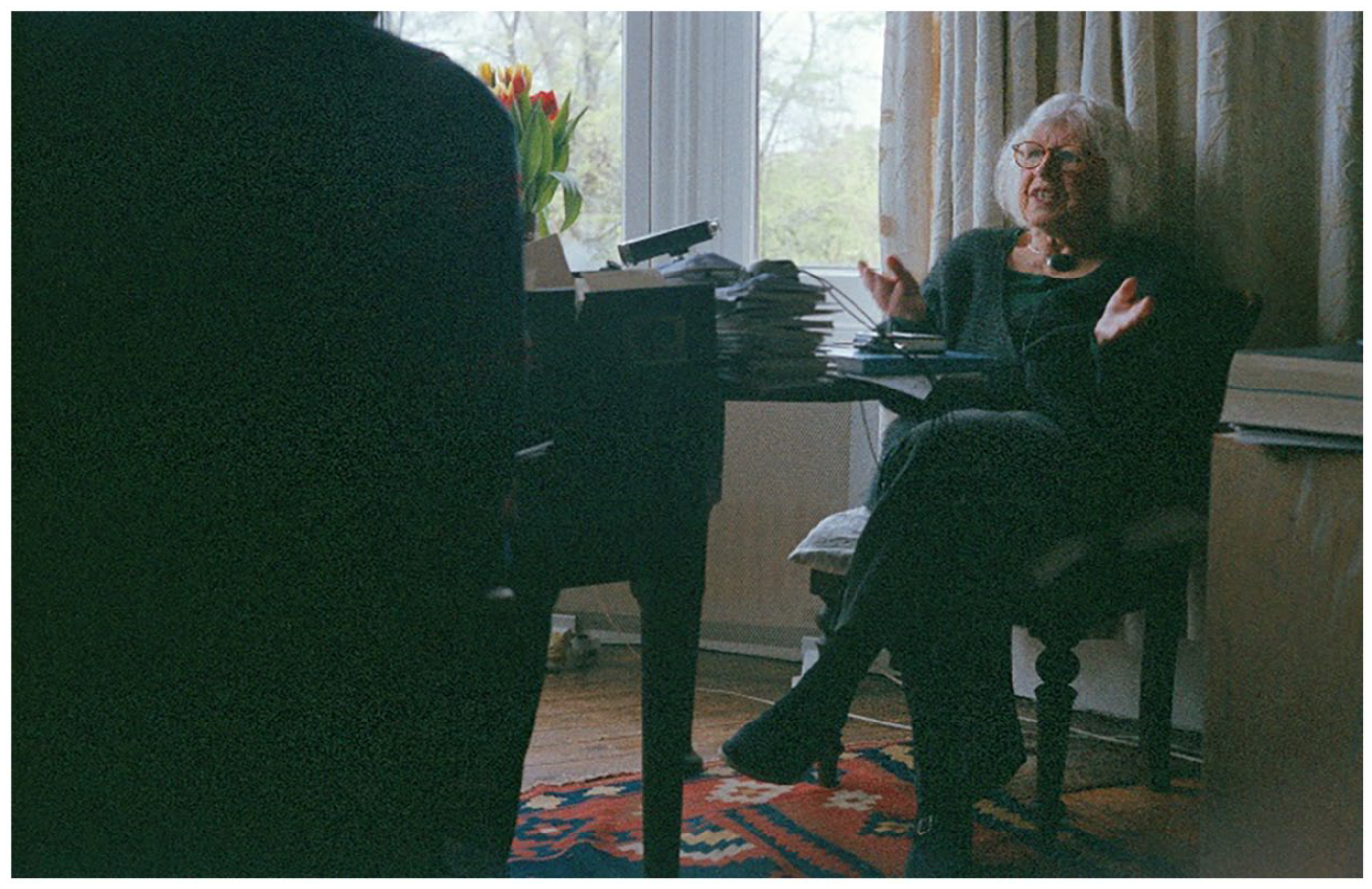
Preparing for this conversation I had ‘crowd sourced’ questions from those who work with her. The affection for Bridget was immediately striking in the enthusiastic responses to this request. Luke Fowler, Bridget’s son, was present during the conversation that spanned more than four hours in three sittings. It took place on a bright spring morning, 21 May 2021, in accordance with the social distancing protocols then in place. Luke provides the photographs included in this piece and helped with the sound recording. An established filmmaker, he made his own document of his mother’s sociological craft in 2018, and the short film Mum’s Cards was awarded the 2019 Scottish Short Film Award at the Glasgow Short Film Festival, as well as the prize for Best Short Film at the Punto de Vista International Documentary Film Festival of Navarra, Spain.
In Luke’s film, Bridget comments: ‘I have always found theoretical position-taking immensely difficult but very important . . . These wars of ideas don’t just preoccupy you when you are a student but, if you have a temperament with an open mind . . . they go on disturbing you all your life.’ In September 2021 I made a second trip to Glasgow to shape and edit the following text with Bridget. While we talked about the turbulence caused by living with ideas, the atmosphere of the conversation was one of joy and fun too. I started by asking Bridget how she became a sociologist.
Sociological beginnings and influences
Well, sociology was little-known amongst the public in Britain in 1961 when I started my degree at Leeds University. I had chosen it because I wanted to be a medical social worker. Why did this social science turn out to suit me? This came out of many experiences, particularly an early awareness of different social perspectives. Sociologists quite often come from working-class origins, I don’t. But my family was what you might call ‘relatively deprived middle class’: the people they associated with had more money, and, in Weberian terms, more status. They felt they couldn’t share their lifestyle: for example, I only went to a restaurant twice in the whole period of living at home.
My paternal grandfather had become bankrupt in the Great Depression. My father was forced to leave school at 16 and that winter he couldn’t even afford an overcoat. There was certainly no question of higher education. He also had a horrific car-crash when he was 19, so the ensuing disability meant that it was my mother who did all the decorating, the heavy digging. . . So, through force of circumstances, but also her own volition, she was living a more ‘masculine’ life than most women at that time. . . we lived in the country and I have memories of her painting the house and haymaking.
My father was a civil engineer: he undertook land drainage for farmers, a profession for which he was trained by the civil service. This work needed to expand in the War by giving farmers 100% subsidies, because the Ministry of Agriculture wanted farmers to use their land more intensively for wheat, barley and oats. My first experience of privatisation came later, in the late 1950s, when the Ministry of Agriculture stopped the full subsidy and no longer carried out this work, so that private companies emerged to do it instead. My father then moved from the civil service, where he’d been quite friendly with the people who actually worked on the land and an easy-going, cheerful person. He became instead the executive director of a small, indebted, agricultural company set up by a rich farmer. I saw his personality change: he became much more managerial and very critical of the people he was working with: the ‘Didcot gang’ of rural labourers. I was about 16 at that time, and I was very upset by that. In my view, this sort of change is revealing, both about people’s altered situations and the attitudes they adopt. Yet my father was never a conservative. My parents were always News Chronicle readers: in other words, liberals. They had been in an East End commune before the war; the books they owned were by writers like Orwell and Titmuss. But this left culture rapidly disappeared when my father became the manager of this private company.
When still in the civil service, he had been moved from Guildford (Surrey) to Yorkshire, where I went to the Ripon Grammar School. Only four girls were going into the Sixth Form there, so I returned to the Guildford Grammar School, staying first with friends who moved in Quaker and atheist circles. That was a world of G. B. Shaw and other Fabians, and of trade union studies. In the second year, I lived with another friend’s family. They were educated Catholics who had that early twentieth century Catholic ‘back to the land’ ethos; but they were also supporters of Franco and Salazar. So these were strangely conflicting influences.
When I went to Leeds [University] there was a remarkable group of people in and around sociology. Most of them were exiles, so that meant again another rapid opening of my eyes – to the reality of apartheid with John Rex, for example, who was an exile from the South African police. Hermínio Martins, who also taught me, was an exile from Salazar’s/Caetano’s Portugal and Mozambique. Two lecturers were exiles from McCarthyite America, Justin Grossman and Owen Lattimore. British sociology has been transformed by exiles, and this was certainly my experience.
So true that Bridget, isn’t it? We need a much more careful history of that. I mean, it feels like listening to you that, you know, there’s all the traces of so much of what you’ve gone on to write about, actually, in what you’ve just given us in that very short portrait of your early life really, I mean, the things about class, status and distinction. Yeah. I mean, it reminds me of Norman Mailer when you talk about your dad, you know, how precarious is one’s own stake on those ladders of status, if you like. But then, you know, one of the things which those exiles brought into British sociology was really serious engagement with social theory.
Absolutely, yes. And this is why, when people talk about the empiricism of British sociology, that is there to a degree, particularly in the more policy-orientated sociology. But it wasn’t my experience at Leeds. Both John Rex and Hermínio Martins were then involved in significant confrontations with structural functionalism. John Rex’s development was to offer a focus on the sociology of conflict, which is a radical Weberian/Marxist take. Hermínio Martins, who had briefly flirted with Communist Party thinkers, such as [J. B. S.] Haldane and [J. D.] Bernal, offered what he used to call ‘Martinsian Marxism’, not to be outdone by ‘Althusserian Marxism’ [laughter]. He had later adopted, for a while, the conceptual armoury of structural functionalism. Yet it was because he saw that as allowing Continental social theory to survive, whereas there was a danger in Britain that it wouldn’t. Subsequently, he and Roland Robertson, another Leeds lecturer, moved on from structural functionalism – see for example, Martins’ brilliant ‘Time and Theory in Sociology’ – whereas some of the Americans never did, as you know [laughter]. But we were also given, from the start, the absolutely key critiques of structural functionalism, like David Lockwood’s. So, they were, in that sense, very even-handed.
Even that Department of Sociology at Leeds had numerous conflicting strains within it. I became a member of what was then called the Socialist Labour League, which was a predecessor to the Workers’ Revolutionary Party. There was an anthropologist, Cliff Slaughter, who was a leading figure within it. On the one hand, I was going to [laughs] classes with Cliff Slaughter and selling party newspapers, and then, on the other hand, I was getting Popper from Hermínio Martins, eventually deciding Popper was very convincing. So, I said “Look, could I take leave of absence? I’m going to have to throw myself more into working out how much of Popper I accept”. Now I would have said that Popper’s version of Marxism which he was criticising so intently, was a very Second International or Stalinist version of Marxism. But nevertheless, he did have some very good points, on falsifiability, for example.
At that time, there was also the emergence of the New Left, in which John Rex was involved; Hermínio Martins as well. They, in turn, knew people like Perry Anderson and Juliet Mitchell. Terry Lovell, who was also at Leeds, was on the periphery of that group. So, what people sometimes refer to as the First New Left was very important. I started subscribing – I’ve been taking New Left Review ever since.
Extraordinary moment and place for you to be entering into the sort of world of ideas and radical thinking.
Yes, indeed: the moment of the 1960s – and especially 1968 – was very important. But I might mention that I didn’t get into a hall of residence, so I lodged with a Glaswegian turner and his wife. They had a four-year-old child and I remember this man, a skilled worker in a local factory, saying ‘We can’t afford to have another.’ He worked incredibly hard but had very little money. They were Catholics: I recall one evening – maybe he had had a glass or two – he told me: ‘I can’t make love to my wife because we’re not allowed to use contraception.’
To me, that was extraordinary. If you wanted to have another child, you had one. So, they gave me what I would now call an invisible curriculum in sociology, much better than if I’d gone to a hall of residence.
The first book I found for myself as a student was Richard Hoggart’s The Uses of Literacy. The second book was Culture and Society by [Raymond] Williams. I was quite critical of The Uses of Literacy, which I thought wasn’t theoretical enough and didn’t sufficiently analyse the different strands of working-class culture: Catholic and Methodist, for example. But Williams, I really swallowed hook, line and sinker. He opened up for me an entry into the sociology of literature which was never taught at Leeds, but which I realised that I wanted to spend time on. What I liked about Williams was his erudition: he could give you the history of words – including certain sociological concepts – and show their changes over the years. In particular, he showed how different classes had different inflexions in the signs that they used, and that there could be a struggle over the hegemonic meaning of a word. I also liked the way in which, unlike Althusser, he didn’t see all literature as ideology. He made a crucial demarcation between ideology and literature. Okay, certain popular romances would certainly come into the ‘ideology’ category for him. But there was this category of ‘Literature’, which allowed for what he called a ‘complex seeing’, especially for those forms which ‘expose contradictions with the maximum intensity’. I still think that’s very important. Williams’ The Country and The City, in particular, was an eye-opening book for me.
That is such an extraordinary book, isn’t it?
I admired the way in that book he looks at the mode of production, then the sort of lived experience a social group has and finally, the way in which those experiences are coded through structures of feeling in the writing. His notion of ‘residual’, ‘emergent’ and ‘dominant’ structures of feeling are ones that we need to hold on to, not just let slip by because he’s died. What is more, I like the fascinating way in which the book starts off with complaints about the fraught relations between country and the city or about the land-owning class’s domination in the country, then goes back to an earlier generation to see what they are disturbed by. He reveals the same or even accentuated antagonisms in that time, and then reels back to the generations preceding that. This backwards escalator, so to speak, was a brilliant way of organising the idea.
I suppose Hoggart, too, is basing his book on his experience of growing up in Hunslet, in Leeds. You think of Hoggart and Williams alongside each other, but they end up in very different places, don’t they? In the sense that Williams holds on to that kind of theoretical engagement, also deeply historical. . .
Deeply historical. And, you know, whereas he’d been dismissive of Marxism in Culture and Society, which was the reductive, economistic Marxism that had been prevalent in the 30s and 40s, by 1977, he is writing Marxism and Literature. He’s discovered Gramsci and Goldmann, and he’s finding a way to becoming his own kind of Marxist sociologist. Actually, he didn’t have the contempt for sociology that a lot of literary critics had then. He wrote a book called Culture at the end of which he described it as a ‘sociology of culture’. So, considering what an upstart discipline sociology was in the eyes of a lot of literary critics, it showed a remarkable freshness of vision.
You know, it’s strange that, isn’t it? You hear, to this day, that sort of suspicion of sociology that characterised intellectuals formed in that moment: people like Paul Gilroy, for example, who were very ambivalent in their relationship to sociology. Stuart Hall, maybe, is closer to Williams in an openness to sociology but the Birmingham School of Cultural Studies as a whole were also divided. . .
Yes. I think that for many people, especially with a background in philosophy, sociology was seen as being too simplistic. It just didn’t have the status in universities, at the time, in the 60s and 70s, that it has now.
Working with Bourdieu
You’ve written so much about Pierre Bourdieu’s contributions across a whole range of topics. One of the first times that we met was around the Bourdieu ‘Photography in Algeria’ exhibition. Interestingly, you’re studying in Leeds in 1961; he had been in Algeria, not that many years before.
Yes, between 1955 and 1960.
Yeah, that is right! It is a similar kind of moment, the decolonising moment or the moment of actually colonial war. Could you say a little bit about your interest in that, and how you encountered Bourdieu’s ideas? What was it that drew you?
Well, I can remember at Leeds reading a journal article on a demonstration in Paris [perhaps that of 17 October 1961 – the ‘Massacre of Algerians’] in which the extreme right, including the OAS [the Organisation armée secrete: a French far-right paramilitary organisation] had confronted and battled with the demonstrators, leading to girls having broken bottles put up their vaginas, etc. So, I was aware from quite an early age how bitter that conflict was in France.
But my first encounter with Bourdieu’s work was in connection with the Birmingham Cultural Studies Centre where he published articles on the sociology of knowledge and the sociology of education. From those, I went on to look at some of his early writings on the artist. I thought: ‘This is going to be very good for my class on Sociology of Literature and Art’. So, then, roll on a few years and Distinction appeared in English. . .
So, where were you teaching?
I was teaching in Glasgow. After Leeds, I had a couple of years in Oxford, but Glasgow wanted a lecturer – specifically sociology of literature and art. I got the job, and I haven’t moved since then. I met my husband, John Fowler, within the first couple of years. We were both in the Department of Politics: it took some time for sociology to become a separate department. He was an Australian, a lecturer in political philosophy: sadly, he died suddenly in 2000, at only 60.
Distinction came out in 1984, and I read it almost immediately. Bourdieu got a lot of flak for that book because it demystified the way in which consumers with cultural capital perceived the arts. But it chimed in with what I had seen for myself about the way people used art and literature to acquire distinction: I’d also been reading Adorno on the arts as a ‘status adornment’. So I was critical about these uses of the arts. Further, I was disturbed by Bourdieu’s notion that good sociology doesn’t come out of good intentions. You’ve got to really pursue the analytical truth as far as it takes you, even if you come across things that are unpleasant to deal with. But his major problematic was always why do the subordinate class – subject to great symbolic violence – not rebel more against their condition: the same problematic that another important figure, Barrington Moore, poses in Injustice. . . I think for much of my life this has been the puzzle that I have been trying to solve. . .
When, later, I became interested in reception – which, curiously, often wasn’t approached empirically – I came to interview readers about what kinds of literature they liked and why. The ethnographic and statistical studies in Distinction became the model for my first book, The Alienated Reader in 1991, with a sample of 115 readers.
That book, Distinction, was such an important moment, wasn’t it? Do you think that, certainly in the English speaking and reading world, that book, in a way, overshadowed the things that he’d done before? I do think that, in certain respects, he’s kind of made in North Africa. . .
I absolutely agree with you. But the problem was that Bourdieu’s fascinating photographs [of Algeria] didn’t come out until much, much later. It was so good that you could put them on at Goldsmiths, and your introduction to them was really illuminating as well. [. . .] A lot of those early books by Bourdieu on Algeria were in French. Unless you read French, in Britain, you didn’t know what he was saying about the peasants who had been uprooted and the kinds of work they were reduced to in Algeria. . .
. . . and his collaborations too, I guess, with Abdelmalek Sayad and other Algerians.
Yes. I. . . read those as by someone who, in my opinion, was actually deeply formed by Marxism. He only says ‘I was the Left of the Left’, [laughs] and he was always very critical of the French Communist Party. But there is a biography by Lescourret which says that he had problems with the lycée he taught in because he ordered several copies of Capital for the school library. And, you know, those Algerian texts, especially those edited by Tassadit Yacine, do seem to me to be about the primitive accumulation of capital, the way in which the indigenous farmers were being forced off their family lands. The role of colonial law in legitimating this dispossession was highly important. But, I don’t know if you remember, in that book Yacine writes about how Bourdieu had to be helicoptered out of Algeria very quickly, in 1960, in the middle of the night, and that was because they got word that the Algerian OAS were going to attack him. Word had got around that he was not a ‘persona grata’ for the armed Algérie-Française group. It was clear to me that he was in favour of the FLN [the Front de libération nationale – the Algerian independence movement]. In particular, he talks about his Algerian friends – teachers, such as Mouloud Feraoun, for example –who had opted for the FLN even though they had French higher education, etc.
It’s such an extraordinary arc of a biography, isn’t it, in a way, in the making of a sociological life? People have written to me and said: ‘Well, you know, what does Bridget feel about the Bourdieu of today in British sociology and, and how, what’s your sense of, of how well represented are the things that are important about his legacy?’
I do think there is a danger, as with Shakespeare, of bowdlerising Bourdieu. People are taught about the three major concepts. He started this in a way himself because in Distinction you can see this formula, which is ‘capital bracketed with field plus habitus equals practice’. And so, people have tended to disregard the other concepts which are also very important. This idea of ‘misrecognition’, I think, is absolutely fundamental, because it goes back to the notion of ideology; together with this, there are his notions of doxa, orthodoxy when the taken-for-granted is unchallenged, and then the heterodox. Most people don’t talk enough about the way he took up Weber’s priest/prophet distinction, although the prophet for him is a very important category. It’s secular as well as religious, and it designates people – not just Martin Luther but like Daniel Cohn-Bendit, whom he mentions, [laughs] or Simone de Beauvoir, etc. – who, in certain circumstances, help to introduce historical change.
People tend to call Bourdieu exclusively a ‘sociologist of reproduction’, conjuring up the ways in which the elites, or dominant class, will go on being replaced generation to generation. Phillip Gorski comments that this comes from the fact that his mid-career books were translated into English first, like Reproduction and Distinction and the others (such as the Algerian studies) weren’t. So, we can say now that this doesn’t represent a good understanding of the whole corpus of Bourdieu.
And you’ve written recently about his thinking and writing on social transformation [in] a paper published probably a year or so ago [in Theory and Society].
Yeah. For me, this is perhaps the most significant intervention I’ve made.
Do you think that we see somebody who’s trying to make sense of how power endures and holds its grip, to the expense of the other parts of his thought that are interested in transformation and the nature of it?
Yes. It’s partly coming from the time that Distinction was published in France – 1978 – in the aftermath of the 1968 Paris Spring. Many of the people involved had made a move into managerial positions: they’d become neoliberals. Moreover, this was a period when people in the subordinate classes accepted their subaltern position to a considerable extent. So, these were the structures of feeling he outlined in Distinction. Yet, if you read it carefully, you can see that he is also saying that there are sources of resistance and of disaffection, which we shouldn’t ignore. He discusses the ‘velvet glove’ of the market that incites the subordinate classes to want consumer goods and to be happy with being affluent workers. But then he also talks about the ‘iron hand’ of the market as well. For example, he’s very aware that many of those first-generation university students will not get professional jobs, so he talks about them having to adjust to being – say – postmen and working in fragmented labour in sorting offices. He is talking about this ‘dialectic of disqualification and devaluation’ creating ‘hysteresis’. These workers’ hysteresis is unstable: it stems from having acquired great expectations when their social reality is not going to be able to bear them out in practice.
In The Rules of Art he’s looking at people like Baudelaire and Manet whom he sees as introducing symbolic revolutions. In my view, what he had seen as being missing, in the period of his lifetime, was an adequate set of ‘heretical’ views. He talks about the importance of needing new ways of looking at the world, not the tired old ways of past revolutions. And I think he has always felt that you need someone – or a set of people – with a very clear vision of the world. When such a group emerges, the economic troubles that people have – and the class anxieties or ‘racism of class’ – that they experience can be related to this alternative vision of the world. He says, for example, that within his field, Manet helped to bring about a symbolic revolution, one that shattered wider views of social hierarchy (e.g. about fit subjects for painting). In other words, Bourdieu does possess a theory of transformation and it’s pinned to the Marxist or Leninist triggering-point of crisis: at certain crucial points, the subaltern classes will change to support ‘heretical’ leaders, if you like [laughs]. I think he was the originator of a symbolic revolution himself, and one that used the resources of philosophy to strengthen sociology.
Popular culture and The Alienated Reader
What do you think about the potential for popular culture to provide a space for that kind of theoretical representation of an alternative view of the world?
Yeah, it’s a very good question. Let me start by saying, I was writing on popular romantic fiction at a time when cultural theorists were looking at, say, spy fiction or thrillers in a different way and seeing the radical aspects of those. Yet, I couldn’t see very much radical hope in the way in which the class structure was depicted, or patriarchy interrogated, in these romances. I’m talking particularly about the cheap magazine stories read by working-class women that I studied, written in 1929–1930, at the height of the interwar Depression. However, Catherine Cookson’s novels have been published since then. I am not saying that Catherine Cookson’s fiction is likely be consecrated in the way that writers like the Brontës or George Eliot have been. But I do think that she very clearly had a mission, which was to use historical family sagas to remind people of what their past was like. So, with a certain realism, she does describe nineteenth century miners who are not allowed to become literate; she does describe young women made pregnant by the lord of the manor, who then whipped them publicly – whipping the flesh off their bones. She does describe domestic servants who are forced out of work after being raped by their masters, with only a narrow range of occupations available to them. There’s often a utopian ending, a cross-class marriage ending, but the plot and characterisation is at odds with this. I remember one Cookson reader, a totally uneducated, working-class woman, telling me: ‘They’re good because they’re so down to earth’.
We tend to forget that people like Dickens, Mrs. Gaskell, the Brontës, Thomas Hardy were popular writers once; the literary critics of their time often disregarded them. Tolstoy, too, was very popular which might seem strange now. It actually took unorthodox critics like Raymond Williams to get someone like Thomas Hardy consecrated, and this is something that I feel Bourdieu doesn’t allow for; he is not very sensitive to these things. In other words, I do think there are certain writers who are bestsellers, but, nevertheless, are very important as writers. Eric Ambler, for example, is a very good spy thriller writer: his grasp of deep social structures is acute, and his imagery is very vivid. But he was also very popular (see e.g. The Mask of Dimitrios).
My work on reading shows how taste varies with education, (women’s) occupations and class origins. Paradoxically, those with the worst lives – who, we might dare to say, were most in need of the insights that literature offers – are least likely to gain access to them, reading instead novels and magazine stories ruled by the most rigid conventions of the romance genre. Those who read more ‘literary’ fiction – whether modernist or not – were those who were furthest from material necessities, enjoying the greatest control over their lives. Beyond this binary division, we could address also the readers of middlebrow fictions and, not least, a minority of working-class women who had inherited a radical canon: a body of literature which refracted distinctively Scottish trade-union and political history.
It’s so funny you mentioned Catherine Cookson because the only books in my house were Catherine Cookson books, which my mum loved, for exactly the reasons you described. But do you think that there are contemporary authors who have that quality, that is, telling stories that are recognised as historical but not consecrated by those who are in positions of power?
Yeah, well, I think Linton Kwesi Johnson, as a poet, for example, started off in that way. And I suspect that Anna Burns’s Milkman might well be a bestselling, very popular, text, but it’s highly regarded in literary terms too. Some rap or hip-hop, too, can have very powerful imagery; Bob Dylan rightly got the Nobel for Literature, so we might see certain folk/pop-singers as the oral poets of our time (e.g. Bob Marley).
The question that I’ve been asked to put is about your own commitment to a radical humanist position. Humanist scholars have been accused of ignoring the dangers of universalism. The orientation of our moment now is to know how we balance these things, on the one hand, not falling into humanism that might be exclusive, at the same time, holding to some sense of. . . a shared human vulnerability or likeness.
I can see why people – including Bourdieu – are very critical of universalist pretensions, because the French colonial state had advertised itself as a universalistic state. Yet, pre-Independence, Muslim Algerians, if they remained Muslims, were banned from acquiring French citizenship. It was also a torturing state: I read a Le Monde obituary commemorating someone who had served in the French army, and which referred to French men in Algeria ‘torturing like little Nazis’. So, there was a sense of universalism as being nothing but ideology: hence the revulsion against Enlightenment ideas from 1960 to the mid-1980s. Later, from 1989 on, Bourdieu does talk about the universalism of intellectuals. But for him, a conjecture is only valid as long as it’s linked to reflexivity about intellectuals’ own position within the field, the objective interests they might have – e.g. in the university hierarchy – and the way such interests might distort their perceptions of the world.
As for radical humanism, I’m not a liberal humanist since I don’t accept that social actors live as atomised men and women. But I am a radical humanist in the sense that Erich Fromm or Norman Geras are. However, I’m also very much in favour of genetic constructivism, genetic in the sense of historical and constructivism in the sense of teaching us how much of what we think as ‘natural’ is, in fact, cultural, and has just become our second skin. Anthropologists are trained into a methodological cultural relativism, which I would advocate, but I would strongly contest an ethical relativism. For example, I am opposed to the nihilist conclusions that Nietzsche and some Nietzscheans have adopted, after drawing attention to the perspectivism of thought.
Thus, although genetic constructivism is very important, I’m also, to some degree, an essentialist. For example, humans have never flourished in a state of slavery, in my view, because it is contrary to their species-being. Moreover, I think they know they’re not flourishing in a state of slavery. Equally, women, when they’re terrified in their marriages, know that they are being subordinated and that this is not conducive to the development of their capacities. And I deeply believe that there are jobs such as those based on assembly-line work – or the ‘detailed division of labour’ – that should be examined in a similar way. Adam Ferguson and Marx were quite right to have been repelled by those forms of work, and to see a deformation of character as being produced when people have to labour for a lifetime in such fragmented jobs. Obviously, people make friendships which provide them with sustenance in such work, but globally, the people who are in assembly-line jobs tend to be migrants because they are forced into them materially. Marx saw an alternative society as one in which people could fully develop their individual talents and I follow him in that.
What about the relationship between Marxism and feminism? Michèle Barrett’s Women’s Oppression Today, for example?
Well, early on at university, I’d read Simone de Beauvoir’s The Second Sex and gave it to my mother to read [laughter]. So, these ideas were hovering in the back of my mind right from the start. Yet, interestingly enough, The Alienated Reader (1991) was much more about class to begin with. It was only when it was getting published that the editor said, ‘Right, I think we will change around the structure of the chapters, so, that women are fore-fronted much more.’ This worked well but it shows you that publishers can be gatekeepers, too. . .
In terms of feminist thought, Michèle Barrett’s book was very important, particularly for its feminist political economy. We immediately took it on, for our first year. It’s a little too Althusserian for my taste: she conflates literature with ideology, for example, which I would not have done. However, in the subsequent ‘Sex and Class controversy’, I was more influenced by Johanna Brenner and Maria Ramas than by Michèle Barrett and Mary McIntosh. That was on the logic of working women’s interests in the nineteenth century, given that you didn’t have contraception, and you didn’t have any electric fires and so on, were women better off staying at home, or would they have done better to have stayed in the labour-force? I was pretty clear, evaluatively, that they were better off staying at home. But on this issue, I remember once, a couple of irate feminist students came up at the end of a lecture who said, ‘You didn’t say anything about men doing domestic labour!’
I got even more from Terry Lovell, whose various writings, particularly Consuming Fiction, have been very significant for me. She debates questions of intersectionality in part by taking Bourdieu’s argument about masculine domination and blending it with E. P. Thompson’s idea of ‘the making of the English working-class’. So she is talking, analogously, about ‘the making of emancipated women’ in a long time-period and with several obstacles to surmount. . .
It is so interesting that the. . . that, you know, that your publisher wanted you to sort of slightly reshuffle The Alienated Reader in that way. I mean, not to push it too far, but maybe there is something about the balance in your thinking between the gendered dimension of materialism and the materialist dimensions of gender relations?
You might be right. I noticed that I wasn’t as critical of Bourdieu’s Masculine Domination as some other feminist thinkers were, although I can certainly see major problems in making patriarchy in Kabylia the model for patriarchy in general. [Sylvia] Walby is better on this.
One of my correspondents wanted me to ask you a little bit about your experience of the prevalence of materialist perspectives in the University of Glasgow, as it becomes the Department of Sociology, and how that sort of shaped you, but also the sense of what sociology is here. It’s a question of the sorts of the legacy, I suppose, of the kind of sociology that you’ve been involved in, and also that the department has practised, [which meant] that it took a while for some of the poststructuralist ideas to be engaged with, I am told. But I just wondering if you had any thoughts about that?
The structuralist ‘Althusserian moment’ was present in Glasgow’s sociology, but largely mediated by Bob Miles’ work on racialisation. My affinities, however, were less with Althusser (or Perry Anderson) than with E. P. Thompson and the culturalists, although Stuart Hall’s ‘Two Paradigms’ was important too. Poststructuralism? Well, we were very critical of [Jacques] Derrida, [Jean-François] Lyotard and [Jean] Baudrillard: I have only contempt for the latter two, particularly their anti-Marxism. But Judith Butler is an interesting figure, even if she fails to see the full force of gendered institutions.
Foucault was always taught here: his Discipline and Punish was the subject of lectures by Jason Ditton, a criminologist, whilst David Evans and Matthew Waites have both drawn extensively on Foucault’s volumes on sexuality. I thought that Foucault’s arguments about the extension and even explosion of discourses relating to sexuality in the nineteenth century were valid but didn’t accept his criticism of Marcuse’s ‘repression hypothesis’: Foucault tended to underestimate what Marcuse labels the ‘surplus-repression’ that occurs in capitalist civilisation.
I made a comparison between Foucault and Bourdieu in my Pierre Bourdieu and Cultural Theory, since they share certain things in common, for example, on the historical succession of different types of discourse or doxa (hegemonic knowledge). But I differ when Foucault starts to talk about the ‘death of man’ and how in the future there will be nothing except an effaced image of a man on the sand, half-erased, destroyed by the waves. This was his post-Nietzschean anti-humanist extreme: I found that very chilling.
Being a working mother and ‘La sociologie est un sport de combat’
Are there any scars from your career engaged in what Bourdieu called ‘La sociologie est un sport de combat’? Was it easy during your years at Glasgow University to open up the things you wanted to, sociologically?
Well, I remember going to the Colindale newspaper reading room in London and asking for these 1929/1930 bound copies of The Oracle, Silver Star, Weekly Welcome, People’s Friend, etc. I noticed the absolute disdain with which the (male) porters dropped these volumes on my desk! And for a long time, there was a sense that popular magazines were not a ‘respectable’ subject to be studying at all – Bourdieu felt the same about his work on photography and on fashion. Not only that, but in the 1960s sociology was not really considered a proper subject in Glasgow either, even though ‘social economics’ had been taught there from 1919, and social stratification had been taught in the Scottish Enlightenment. So, we were part of Politics, and we had a certain degree of struggle to be accepted. . .
So, it wasn’t just about how sociology was formed; it was within a larger context of the university in a sort of intellectual landscape?
Yes. And, quite early on, John Eldridge, Greg Philo, Paul Walton and others [Glasgow University] Media Group together and wrote those now celebrated books about the news, which deeply antagonised the BBC upper echelons and beyond. So, we were associated with dangerous, risky work. Yes. . .
Fantastic.
. . ..also, some young lecturers including me, were part of a group called CAFAD, a Campaign for Academic Freedom and Democracy. At that time, I really do think that as sociologists, we were invaders into the University: we always had big classes, we grew very rapidly. You could see it in terms of Bourdieu’s Homo Academicus: there were classics professors and, on the other hand, economics professors, who were probably quite worried about what we were doing because we might take their students, and therefore, it was in their interests to challenge the intellectual quality of our degrees.
Another question that was sent to me, Bridget, it was in connection to Nancy Fraser’s visit to do the David Frisby Memorial Annual Lecture. I really admire her writing about capitalism, especially, capitalism’s hidden abode and the role of unpaid work - gendered work - by women. And personally, I wanted to ask something a bit equivalent in terms of the role of yourself and of women sociologists within the discipline both at Glasgow and more broadly, in terms of women’s contribution to sociology, is it kind of equivalent to Nancy Fraser’s hidden abode?
It’s an interesting question. I wouldn’t say that I’ve ever felt exploited at Glasgow University because everything I’ve done has been covered by what I regarded as a good salary compared with the salaries that women usually have. So, the question might be, have I, as a woman, had to do things which men would perhaps choose not to do? You could make that into a research topic: for example, those labours of love, like peer-reviewing of articles, are there more women who take them on than men? And I think you might find there were [laughter]. What I would say is that, yes, I’ve done quite a few things that I would say were time-consuming and stopped me doing research: writing up lengthy minutes of the staff meetings, for example. What is more, women have tended to adopt more of an integrative role – trying to keep people happy rather than fuelling conflicts – and that takes time, too. Also, there are some roles which I would say women, particularly, tend to interpret in a more conscientious way, such as being honours or postgraduate coordinators, roles which can take up considerable time with individual students. That sort of work can’t be just translated into a mass email; it can either be done fastidiously, or rapidly but inadequately. I’ve probably undertaken it quite carefully, to the detriment of doing research. This was especially the case when we were also bringing up our children: the research was the one thing that got lopped off the end. But having said that women are often quite conscientious about those things, I certainly know men, like [mentions names] who are just as painstaking, thoughtful and serious about everything they do with students. It’s not distinctively gendered.
On questions of promotion, for example, this is quite a tricky question because there are also some men who don’t get promoted from lecturer, although historically it has been more true of women. My observation would be that in general women with children go slower up the ladder. That is partly because they have chosen to spend more time with their children, partly because they have no alternative. But John, Luke’s father, also failed to get promoted, despite being an excellent lecturer, scholar and Chief Adviser. So, it’s very much a problem of what universities choose to recognise.
Yeah. And I wanted to ask you a little bit about that, you know, your sense of the university and how it’s changed during your career, really, and the balance of things we have, we’ve become quite accustomed to thinking of the idea of the university as in particular crisis stage now, we’re just wondering what you think about how the value of universities has changed during that period and, and what your sense of that is.
The older universities had some elements that were very undesirable. In some departments, they had professors who were like little kings and who ruled like autocrats. If you had a conflict with one of those kings, you sometimes had to leave the university or at least leave the department in order to survive. Luckily, I have had mainly good heads of subject: my experience has been very positive in that respect. John Eldridge was particularly sympathetic; perhaps because he’d got young children too. When I was pregnant with the twins, I told him, and he said, ‘Well, you can take a year off unpaid, or you can resign and try to come back again later. But if you do, I’m not guaranteeing there’ll be a job there for you.’ He was very clear about that, so, I just took the year off unpaid. But to be frank, because it was such a male-dominated institution at that point, you never talked about your children in the university. You had to pretend you didn’t have them [laughter]. Being a working mother felt a very precarious position to be in.
For me, it’s kind of shocking to think that, you know, it would be. . . there would be a workplace where you couldn’t mention your children or that you felt like you couldn’t, but at the same time it’s important not to romanticise the past. The commercialisation of higher education is kind of an environment for thinking about doing sociology but how exactly do you think it has changed things?
Well, quite frankly, I don’t think I would have survived if, when I first started to have children, we had operated with the sort of rules we have in place now, particularly the REF rules. I wouldn’t have managed to produce that amount of research when they were young. So, I would have been demoted to university teacher or become unemployed.
It is quite an indictment of the changes, don’t you think?
I believe that some people take time to mature as researchers, thinkers, and writers. At one time, there was much talk about ‘dead wood’ in the universities and how we needed to get rid of it. And I used to say, ‘But how do you really know what is dead wood? Because sometimes dead wood can actually come into leaf again in the spring, when it looks like it’s died.’ And, you know, some of these people you’re labelling as ‘doing nothing’ may actually produce valuable thought. Another analogy, re. the REF: you have to produce things so quickly that it’s using up all the seed corn. You can’t, as E. P. Thompson did with The Making of the English Working Class, spend 10 years on a book. At the very least, you’ve got to get several chapters out in journal form even if you haven’t got to get the whole book out. Such publications may well be premature, indeed, may prejudice the direction you finally want to take.
I’m just mindful that I’ve been itching to ask you about, you know, this wonderful scene here of your index cards and handwritten notes and your craft – to use C. Wright Mills – indeed absolutely, I’ll be able to ask you about your craft and the kinds of ways you work. But also, in the context of what we’re talking about where it feels like we have to publish too fast and finish too quickly with projects or to rush to realise them often, when they may benefit from more time.
I strongly agree. I have been involved with these RAE/REF meetings: on one occasion, I read every publication submitted. Department members were still producing very good articles: only one or two were a bit weak. In general, academics seem to rise to the challenge, but I don’t know at what cost they’ve risen. All the strain might have been taken out on their families, or at the least on their partners.
Okay, so, Bridget, one of the things that has been passed on to me is how powerful and important your kind of critical analysis of romance has been through a feminist take. The question that was asked me was what advice you’d give to young sociologists on the topic of romance? And should sociologists fall in love?
That’s a fascinating question. Absolutely, yes. I really would say if you get the opportunity and let it happen, yes! Because, you know, I think to be able to get so close to someone that you see the world through their eyes is an incredibly privileged new perspective. And we all grow from that. I think that kind of unalienated love, where you’re giving gifts to the other, metaphorically speaking, and you’re not expecting any return, is tremendously valuable. It may not last that long: that unalienated love may slowly disappear. It may not even be replaced by deep companionship. But in both those cases, the love or companionship, two people can do together so much more than one can. Simmel writes about the dyad; he writes also about the adventure. You can go camping on windy Orkney with someone else which you would never do on your own. So, ‘yes’, very strongly, to that.
Having said that, every young woman should be brought up knowing that it might not last forever, and that – to be trite – work is a girl’s best friend. They need work because then they have the basis on which they can be autonomous if they choose to be. They’re not then forced to stay in an unwelcome relationship.
Documented life and the sociology of obituaries
My favourite book of yours is The Obituary as Collective Memory, what drew you to write about obituaries and what is sociologically interesting about them?
Well, they are interesting in terms of being ‘collective memory’ and that I see as having had its roots partly in Bourdieu. He uses the term only once or twice, but his obituary for Maurice Halbwachs – who coined the concept – suggests that Bourdieu continued to like the concept. This doesn’t mean that everyone thinks exactly the same, i.e. collectively, but that you hold in your individual mind images of the past, which, if you’re in a certain setting – like the family – people can correct if you’ve got [them] wrong. In that sense, it’s influenced by what other participants have remembered from the situation. And that’s very much Halbwachs’ view, who drew attention also to the different collective memories of the Paris Commune in different classes. Walter Benjamin also talks about memory in this way, and I find his work exciting and interesting.
And so, there are the three: Halbwachs, Bourdieu and Benjamin, who drew me to the obituary. I felt I had the tools to analyse obituaries, whereas I’m more hesitant to analyse classical drama or a work with a strong set of literary conventions. It’s true that the obituary also has a conventional form: in the 1900s much more codified and uniform than it is now. But I thought that all the work that I’d done on popular literature and its genres could help me with that form as well.
Well, a very good idea, very brilliant. And my favourite style of sociological writing is [. . .] a piece of research or a book that tells a big story through something that you think you know. . . [yeah]. So, I think it’s a beautiful book in that regard. Is one of the problems with obituary writers that they are often overgenerous? You know that famous thing about not being on your own when you’re giving a funeral speech, or whatever, or writing an obituary. And I just wondered about those obituaries that aren’t really deserved, that are too glowing, and how a sociology of obituaries might help us understand this problem.
Yeah, the writers of obituaries feel strong constraints: they cannot write as they would like to. Yet there are critical obituaries: what I call ‘negative obituaries’. I remember one, for example, of John De Lorean, who took money from the Government to set up a Belfast car-factory and then squandered the cash. He was given a no-holds-barred critical obituary. So, when it came to Thatcher dying, I thought: ‘This is going to be really interesting’. I have to say the positive conventions came over very strongly: not only was she given a ‘ceremonial funeral’ but virtually all the newspapers came out with very long and approbatory obituaries. Obituaries are intimately related to the legitimation of power.
Such generosity is not always apparent with politicians’ obits, or not in all quarters. There was one I read from the American Rolling Stone magazine, a dissection of Nixon, that was the most virulent obituary I’ve ever seen, deservedly in my view. But then you can get highly ironic obituaries too, like the one that someone must have had great pleasure writing, either in The Times or The Telegraph, for Barbara Cartland, who was [. . .] a prolific writer of frothy romances [laughter]. You can get tragic obituaries, too, in which something has happened which has changed that person’s life, altering it forever. Many of the sportsmen’s – such as footballers’ – obituaries are tragic. Particularly in the past, they used to spend their money freely; then in their older years, they would end up as alcoholics or lose everything.
Obituaries are also generous because the editors who choose the obituary subjects for commemoration often have an invisible contract with the State: to write obituaries, for example, for all those diplomats who’ve had at least two ‘tours’ [periods abroad]: if you’re a diplomat, this is not an extraordinary level of achievement so it’s a low standard to set. . . And, as you suggest, bar, say, a politician from a ‘rogue state’, it’s rare for the usual constraints on honest reportage to be removed, so the obituary is often midway between realism and a funeral eulogy. I do see them as a form which is in a process of development at the moment, towards greater realism. Even in the past, to add to the legitimacy of the obituary writer, and so that it looked as though he or she knew what she was doing, they would have, usually at the end, some little qualifying or negative comment, which could be very coded. It could be something like ‘he never married’, which might signal that the subject was gay. (Up to the 2000s, you could never write openly about gay men or women. That’s changed totally, much to my relief.) Also, the obituary could include something like: ‘He didn’t suffer fools gladly’. Those who knew that the subject was crabbed, intolerant and egotistic would think to themselves, ‘Well, the writer says it all, there!’ But the obituaries are slowly changing, especially in Britain, the vanguard of obituary writing. They’ll never be as totally realist as a critical realist novel, for obvious reasons: not to hurt the feelings of the bereaved family too much.
Yeah, I want you to ask you a bit about the obituaries of sociologists. I don’t know if you know this story, and it has only just occurred to me, that the couple that C. Wright Mills writes The Sociological Imagination for were a novelist: Harvey Swados, and his wife, Bette, friends of his. Harvey Swados later wrote the most. . . not unfair obituary of Mills, but it was certainly deeply critical. And it was extraordinary, about his vanity, his self-obsession, his lack of interest in others. . . But I just wondered, having written obituaries for other sociologists, could you have envisaged approaching a part of this book, which would be about, you know, the obituaries and sociologists and what we learned from them, what we don’t and what we can’t know from them? You have known quite a few of those names that are now part of the traditional canon, even if we don’t like that word, they are writers that are constantly read.
Yes, that’s true. You know, although I didn’t enjoy my two years’ stay in Oxford, there were people there, whom I met, such as Alasdair MacIntyre, Steven Lukes – both, happily, still alive – and Raphael Samuel and Lucien Goldmann, who, sadly, have died: obituaries of these figures are very important. Obituaries are called the first draft of history, so modern historians often read all the obituaries when they’re writing about the individual, or a period. C. Wright Mills’ valuable concept in The Sociological Imagination was that we may have public troubles, and also private troubles. The obituaries of sociologists can be analysed very interestingly, in those ways. Now, what I’ve done is to write about who gets to have an obituary written about them, and I’m talking about the slow tendency towards democratisation of the obituary, not just in terms of class, but in terms of gender and ethnicity. But there are still whole professions where people don’t get obituaries: it’s not just working-class people who are unlikely to get obituaries but many middle-class too. Obituary editors will admit it. They’ll say: ‘Well, if a pop singer dies and a headmaster of a very good comprehensive dies, who should I give an obituary to?. . . I’ll give it to the pop singer because more people know them.’ But I do think there’s an underlying process, which we might push them into more, that is, finding different measures of what achievement is from the conventional standards of the elites, and extending the fields covered. Interestingly, it’s often people working in those same fields who write the obituaries, journalists don’t always write them themselves.
What’s fascinating about the sociologists’ obits is the really quite remarkable span of social origins that they have. But when I looked at a supplementary sample of a further 75 academics’ obituaries, recently across three societies, the UK, US and France – not just sociologists – it will still perhaps surprise you to know that 66% came from Oxbridge, the French Grande Écoles or the American Ivy League. You see, for Oxbridge, there’s still that very strong sense that ‘This is the real mark of merit and someone’s worthwhile if they’ve gone there’, which, in my view, the obituary editors should resist as too narrow. However, it indicates the significance of that institutionalised cultural capital: Bourdieu is absolutely right in that respect.
So, to have a documented life, you have to carry that kind of capital and be in those places.
It’s important but not absolutely essential. I also wrote in the obituaries book about how few obituaries there were of women overall, only 20%. And that continued to be true when I took the second sample of academics. But on the question of Wright Mills’ ‘troubles’: this was a really interesting range with some issues that I think would quite surprise you. For example, I discovered from the obituary of Peter Worsley – initially an anthropologist – that he’d done field-work in Africa. But he was considered to be an unacceptable person as an anthropologist because he was originally in the Communist Party. So, MI5 brought to an end his anthropological activities.
Yeah, I didn’t know that.
Yes, this was an obituary by the sociologist, J. D. Y. Peel, not known as a radical. Moreover, there was another anthropologist, who became ‘too friendly’ with Africans in urban settings, and he ‘had’ to be recalled to Britain. Then, in the wider global experience, I remember one Iranian, Amir-Hossein Aryanpour, for example, who had been in North America, when the Iranian Revolution took place, he was told to return straight away. So, he started to teach sociology – especially social theory – in Tehran, but he was considered unacceptable lecturing there, so was sent to the provinces. He continued to be considered unacceptable in the periphery, so, he was pushed into theology, not sociology. There were people like Stanley Cohen, who was exiled from South Africa because of apartheid, first of all to Britain. Cohen later went to live and teach in Israel in the 1990s, but chose to repatriate himself from there because he couldn’t stand the government.
But, when you came to the British ones, not just the Worsleys and these radical anthropologists, I noticed through a number of them – either in their own words or in the obituary writers’ words – a reference to the deterioration of universities and to the neoliberal nature of university managements. Ian Craib, who wrote books on social theory, was quoted as saying, ‘But all the things that I’ve spent so long on and care so much about: students and students’ pastoral needs, all these are just of no value now!’ David McCrone and [Frank] Bechhofer, who contributed an obituary about Tom Burns, wrote that Burns retired too early to have witnessed the changes in the University at present, but he would certainly have had very robust things to say about them and to have commiserated with those who had to experience them. So, coming through these obituaries is a sense that people are speaking the truth about what they think the modern university is like.
A life in notes and index cards
But tell me about your cards, though. So, how do you work? So, I’m just looking at them here, you’ve got ‘social philosophy’ and ‘utopianism’ as some of your categories, you’ve also got Elias over here. . .
Yeah, for a long time, my husband and I couldn’t afford to buy books. I would read everything from the library. So, I would read it first and, with a faint pencil, I would mark it on the side. After that, when I’d finished, I would go through and take notes on cards, using all those pencil markings, which I then rubbed out. But sometimes the trouble is that the [notes] get a bit too lengthy. . . [Points to notes] For example, here are the cards on Bourdieu’s Sur L’État. . .
So, these are notes that you’ve written from the marginalia, and then put on to the index cards and summaries, yeah.
I’ve re-read these cards about three times since writing them; any comments or criticisms I’ve made have been marked in another colour [laughter], along with a further brief summary, and then there’ll be little quotes written out that I might use.
I don’t think these things are trivial matters, you know, I really don’t. When you think about, you know, our vocation as a vocation of attentiveness, but also a vocation of thinking, of understanding, of processing. You know that those steps and stages, you know, it’s a very sort of elaborate, sophisticated process of sifting, of selecting, of working through and working over, and you know I may be able to easily become enchanted, very probably true [laughter]. But, but at the same time, you know, you can’t get to the intellectual interpretive nuances of what you’re doing with all your cards over time with a computer package that just sees it as Core Data Processing or management. It’s something I try to foster with younger scholars; it’s about the quality of your thought and interpretation, along with your judgement and the final assessment. Does that make any sense?
Oh, yes, absolutely.
In a way, aren’t all these wonderful cards a kind of index of your thinking?
Yes, yes. . . as I know how weak my memory is, it’s absolutely crucial to have the most important things on the cards. But I should also add that – amongst other sources – I have also learnt so much from having children. I’m sure you feel the same. I would probably have had a more placid life but a much more impoverished life without them, in terms of experience. In certain years of my life as a sociologist, I felt guilty about not doing as much as I should have done: even deprofessionalised. But I would say that you have periods later when you can make up for those somewhat deprofessionalised years; you shouldn’t give up too early. And in terms of the sort of background that I came from – that of relative deprivation or being déclassé – in some ways, it has been difficult, but in others, lucky. But I can’t say how much I’ve had support from my husband, who wanted me to go on, my heads of department who wanted me to go on, and my colleagues, including those in the Centre for Socialist Theory and Movements. I have needed all those people to be able to have the mental space to work through ideas more creatively.
Coda: ‘One last thing’
During the hours of recording, Luke Fowler quietly trained his photographic lens on this joyful exchange. Occasionally, we would the hear ‘click’ of the shutter of his camera. As we came to an end in our conversation I could sense that Luke wanted to say something. I asked him if he had anything to add: ‘So, I would like to say one thing, please, which was that my memory of growing up in this house, when my mum was teaching in the University was that she managed. . . from my tiny observations. . . that she managed to survive with very few hours’ sleep. She made the dinner, and we did the washing up and she got us to bed [yeah]. And then my dad would sit and watch telly, but my mum would stay at that kitchen table until midnight, every night. She didn’t go out to the pub or pictures or anything. [You] can’t underestimate the intellectual labour involved in making these cards.’ The lesson that Bridget’s example teaches us is that scholarship takes time, it takes investment and there are no short cuts in this work. The scribbled notes on the thousands of index cards stacked on her desk provide physical evidence of this truth.
Footnotes
Acknowledgements
Les would like to thank the Fowler family for their kindness and sharing their time so generously and openly. First and foremost, thanks to Bridget for her patience and willingness to collaborate in a deep way, but also, deep thanks to her sons Luke and Ben, who shared insights and memories of growing up in their family. Many thanks to Charlie Back for his help with transcription and the mysteries of otter.ai and to Glasgow friends and colleagues, Andy Smith and Alison Eldridge, for help in making this conversation possible.
Funding
The author received no financial support for the research, authorship, and/or publication of this article.