




Abstract
This article unpacks the concept of rendering to explain how disposal produces value out of waste materials. Rendering draws attention to the management of meaning attached to waste materials, showing how cultures of environmental sustainability and market capitalism shape their valorisation during disposal. To illustrate this, I draw on ethnographic data from research on the operation of corpse disposal in England. This research reveals three mechanisms of rendering: (1) quantification where economic rationale is entangled with the legal-rational authority of environmental metrics; (2) containment where specific spaces of disposal and the movement between them shape the flow of meaning; and (3) the often hidden labour techniques that become a part of the value of the waste. Rendering provides a fuller account of disposal as a production process, which should be at the heart of sociological work that speaks to the often unbalanced relationship between environment and capitalism.
Introduction
This article argues that rendering is a useful concept for analysing the valorisation of waste materials across various fields of study, such as bio-capitalism and animal remains. Rendering is the recovery of resources in the processing of animal byproducts, specifically in the recovery of fats and proteins in flour (Shukin, 2009). At the outset of rendering, animal carcasses comprise a vast array of materials; rendering syphons out the unproductive and potentially hazardous materials, enabling productive matter, such as fats, to be reused. At the heart of rendering is the entanglement of the environmental initiative of reduce, where harmful matter is incinerated, reuse, where fats and proteins are reused and then subsequently recycled into new commodities (Gillespie, 2021). Colombino and Giaccaria (2016) see this as a means of addressing the binary between life and death in bio-capitalism. Their work draws the bioeconomy into these notions of reuse. Shukin’s (2009, p. 88) work locates the rendering industry within the material politics of ‘animal capital’. While there are clear parallels between the environment and the role of capital, both in a bios sense and as a material politics, less sociological work has focused on rendering outside of the industrial management of animal waste. The concept of rendering can address the valorisation integrated into waste management in a broader sense, reflecting how, like in animal rendering, unproductive wastes are reduced, certain productive materials are reused, and then recycled. My way into the sociology of rendering is to tie environmental reuse more closely to capitalist exchange, where that use is exchanged for money, a good or an emotion (Appadurai, 1986; Marx, 2013; Skeggs, 2014).
The concept of rendering has sociological utility for reconsidering the relationship between value, waste and disposal. Waste disposal has been taken as a manner of cultural, ideological and symbolic containment, with many disposal methods, such as landfills reminding us of the ethereal status of the waste material as it skips meaning and knowing (Hird, 2012). I reflect on the structural-symbolic role of environmental and capitalist discourse in the management of value and possibility in these materials. The concept of rendering illuminates the meanings tied to waste through disposal. As Munro (2001, 2016) and Hetherington (2004) both argue, disposal involves the management of surplus meaning. Rendering is the internal mechanism of disposal, which reflects how this management of meaning is skewed towards valorisation through a drawing together of environmental management (the drive to reuse) and capital generation (the drive to exchange). Rendering is a concept to approach the ‘culture that represents the architecture of disposal’ (Munro, 2001, p. 110). Cultures of sustainability and profit come together to classify what is unproductive and to be reduced, while productive wastes are provided with a culturally agreed upon reuse, which then entangles with capitalist exchange. Disposal is a production of value, which is hinged on the rendering of meaning to emphasise the reusable and subsequently exchangeable from the mix of waste that enters disposal.
This article aims to provide a sociological overview of the concept of rendering to show how disposal is a production process where value is generated out of waste. I draw on ethnographic and document-based analysis of corpse disposal to reveal how value is rendered out of waste at the administrative level, the material level, and finally the role of labour in this value generation. The corpse is formulated as multiple ‘waste’ materials (Olson, 2016) as it traverses the funeral director, crematorium and/or burial ground; entering the death profession as a surplus whole that, through rendering, is sorted into different productive components. For example, in the crematorium, organic tissue is stripped from the body through heat, leaving behind dry bone and metals to be reused and recycled, and subject to exchange. As such, in this article, the corpse, at its introduction into the death profession, is taken as a public health issue on both an environmental and health level. As a waste, the materials of the dead body are raw and unprocessed, holding a potential to pollute the atmosphere as they are cremated. The chaos of decomposition, which causes the boundaries of the body to break away, risks potential disease from the tissues spilling onto those managing it. Rendering involves processing these materials that potentially infringe public health, filtering them into valuable resources that contain economic, emotional and moral value.
This value generation is articulated through three mechanisms of rendering which, after I have outlined the methods, provide the structure of the article. The first is quantification, where waste materials are abstracted into numbers and valorised through their use as credits to meet environmental targets. Each cremation is filtered into one credit, with crematoria being required to demonstrate 50% of their total cremations in the form of these credits (Rumble et al., 2014). These schemes are well documented in environmental sociology literature (Lansing, 2010; McElwee, 2017). This article adds that environmental metrics and economic rationality entangle at the administrative level of disposal. The second mechanism is containment where the risks associated with the waste material are contained, secure from spaces where they would be out of place (Douglas, 2002). Producing value through containment reflects valorisation as occurring in specific spaces (Hetherington, 2004; Metcalfe et al., 2012; Reno, 2017) where the meanings of materials flow into a new space of containment. The last mechanism of rendering refers to the labour techniques of disposal workers. This part of the discussion reflects on how waste management labour generates value, highlighting the types of labour undertaken behind the veneer of disgust that envelops waste management.
The cycle of waste and value in disposal
Waste and value have a cyclical relationship, with waste holding a significant role in the circuit of capital generation. Gidwani (2013) argues that waste has a central role in the generation of value as it is enrolled in the circuit of capital. This in turn has important implications on the Marxist ideas of value which do not consider waste to such an extent in the dialectic of profit. Gidwani shows that the capitalist system has extra layers than otherwise considered. Giles (2014) adds that disposed of material could be reintroduced into the market through alternative circulation, which runs parallel to the market economy. Waste ensures that capital stays in motion, playing a vital role in market structures and the operationalising of value, making it difficult to theorise value without also considering its relationship to waste. These discussions on the relationship between waste and value echo Thompson’s (2017) Rubbish Theory. For Thompson, value is argued to be an effect. It is a cycle which is effected by the circulation of objects. Rubbish comes to be one category of what are three different categories that can be applied to objects more widely. These are ‘Transient Value’, whereby a thing is in a state of decreasing value, ‘Durable Value’, where an object exists in an exceptional state, which leads to it maintaining a permanent and increasing value, and the third is ‘rubbish’, the zero degree sum of value. Value cycles through these different categories of waste. Rubbish provides the middle point for an object to fluctuate through transient value to durable value, aiding an object to increase in value.
This cyclical relationship between waste and value has been reflected in European Union practices and policies, operationalised in what has been known as the ‘circular economy’, a concept promoted by the European Union, international business and governments across the world (Geissdoerfer et al., 2017; Lieder & Rashid, 2016). Korhonen et al. (2018) outline that the definition of the circular economy is developed purely by practitioners, but its conceptualisation is remarkably disorganised in research communities. The economic objective of the circular economy is to reduce the economic production–consumption system’s raw material and energy costs, while the social objective reflects an economy based on sharing as opposed to an individual act of consumption. Significantly, these circulations of value are more than economic, but rather the capital generated is regularly entangled with moral values. Gregson et al. (2015) have argued that the implementation of circular economy is fragile, with resource recovery in global recycling efforts being viewed as dirty and bordering on illegal. Crucial here is that resource recovery from wastes in circular economies are framed by particular moral economies, which come from discourses of ecological modernisation, environmental justice and resource (in)security.
While these discussions provide a useful basis for thinking about waste and value, they are often limited in the sociology of disposal. The awareness of morality holding a role in the cycles of waste and value is present in the literature, but the concept of rendering captures this notion of value in a more multifaceted way as it cycles through waste. Through rendering, we see the extraction of a use from a waste material, which is represented as moral, economic and/or emotional value. Rendering through quantification represents how this cyclical relationship between waste and value is managed at the administrative level. There is a sense that the legal authority of administrators of burden sharing schemes shape the extraction of uses from mercury emissions as credits to meet targets. This relates to Gregson et al.’s (2015) discussion of circular economies as this sense of legal authority emerging from discourses of ecological modernisation that seeks to utilise targets to limit emissions. Rendering through containment reflects this cyclical relationship of waste-value at the material level. This echoes Hird’s (2012) discussion of containment whereby she argues that, as material waste moves through containment, the meanings attached to it change. The meaning of waste matter informs how it is used, which is dynamic as it moves through containment. Lastly, the often hidden labour techniques of disposal workers function as a form of production. Rendering through labour technique shows the crucial role that those performing ‘waste labour’ (Wittmer, 2023) hold in the cyclical relationship between waste and value. They generate far more than economic value, but rather work alongside changing moral and emotional meanings attached to the waste, extracting uses from these. Their place in this cyclical relationship shows the core role they hold in a model of capitalism that captures these alternative markets (Gidwani, 2013; Giles, 2014).
Method
The research data underpinning my argument were gathered from English crematoria, where the organic materials of the dead body are reduced by heat. These are at times standalone buildings, but regularly contain a burial ground. Crematoria contain a ceremonial space at the front where funerals take place. Beyond the double doors are the back rooms where the body is cremated. Data were also gathered from English natural burial grounds. In the UK, natural burial is where the dead body decomposes into the landscape to sustain it and feed the life thriving on the burial ground. Alongside this, data were collected from English funeral directors’ premises to which the dead body is transported to and from, and where it is refrigerated and potentially embalmed. I also conducted a document analysis of the UK government regulations for managing the dead body, as well as the advisory documents that crematoria, natural burial grounds and funeral directors are bound by if they are members of a regulatory body.
Data collection methods varied by site. To gather data from crematoria, I used ‘short-term ethnographies’ (Pink & Morgan, 2013). These forms of ethnography lasted between a day and a week and comprised particularly intense means of gathering data. Predominantly, I used these short-term ethnographies to shadow the cremator operators who work in the crematorium backrooms that mourners do not see. They are responsible for cremating the dead body and ensuring that the bone fragments remaining after the cremation are then cremulated – crushed – into a fine powder. Cremator operators also manage the wide array of materials yielded from the dead body, such as medical implants. During these ethnographies, I was up close and personal with the dead body and its materials, witnessing its management first hand. Alongside this shadowing, I also conducted semi-structured interviews with the managers of these crematoria. While I was able to capture the day-to-day management of the dead body from the cremator operators, the crematorium managers provided insights into the governance of the dead body’s waste materials.
At the natural burial ground, I conducted walking interviews (O’Neill, 2014) with natural burial ground operators at five natural burial grounds, which used the landscape and its features as triggers for my questions. Some of these operators were local authority volunteers who helped to maintain the ground, while others were employed by the local authority to oversee the governance of the ground. However, the majority of the natural burial ground operators interviewed were funeral directors that own privately run natural burial grounds. This was important as, unlike operators responsible purely for the management and governance of the ground, these funeral directors were able to explain the entire journey of the dead body from collection to burial.
I also conducted semi-structured interviews with funeral directors at their premises. During these interviews, I received a guided tour of the premises where the dead body is stored and transported to and from. These funeral directors worked across both cremation and natural burial and were mostly independent, small family-run businesses operating in the North of England. Interviews with these funeral directors involved discussing the management of the dead body inside the funeral directors’ premises and their working with other death professionals, such as coroners and crematorium staff. All data collection with human participants was subject to informed consent and received ethical approval through my university ethics committee.
Rendering through quantification
One of the most significant forms of public health pollution from cremation is mercury emissions from the dental amalgam formerly used in teeth fillings (Bernholf, 2012). When the dead body is burned, the mercury evaporates, leaving the chimney and entering into the atmosphere. These emissions are deemed particularly hazardous to public health and have received considerable attention from the Department for Environment, Food and Rural Affairs (DEFRA), as reflected in their Statutory Guidance for Crematoria (2012, p. 47): For the reasons given in two consultation papers issued in 2003 and 2004 it remains Defra and WAG’s view that the environmental impact from mercury emitted from crematoria is through long range transportation before its deposition, take-up by fish, and consumption as food.
This quote from the DEFRA guidance reflects a potential matter for public health as the mercury may end up in the food supply, which has been echoed by those working in cremation:
They don’t want mercury in the atmosphere, getting into the oceans, into the fish, and we eat the fish. Yeah, that’s what they’ve said to us, yeah.
Mercury emissions are characterised from the outset as a danger to public health, their reduction being given attention not only in the documents of governance, but also by those directly managing these emissions. In 2012, a pledge was instituted in Europe where total mercury emissions from crematoria were to be reduced by 50% (Rumble et al., 2014). This pledge has led to filtration being built into cremators, showing how these pieces of technology do not purely function as a means of economic profit, but rather are implemented as an expression of legal-rationality that is woven into the modernisation of ecological understandings of air. Figure 1 is a picture taken inside Crematorium 2 and shows the result of the filtration.
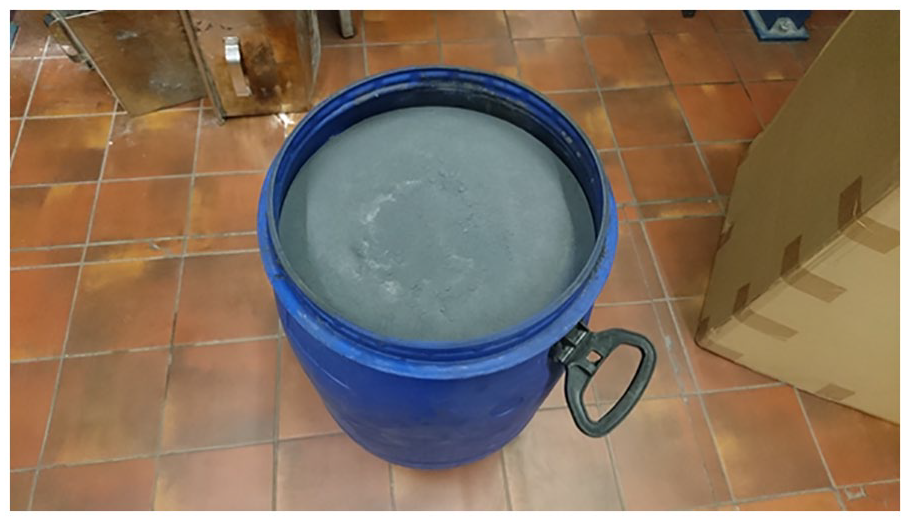
Collected chemical particulate inside Crematorium 2.
This barrelled waste is the result of the filtration, which is designed to cool, capture and collect the mercury, nitrates and carbon monoxide emerging from the dead body. The particular barrel in Figure 1 is full, indicated by the grey colour of the solution. Unused barrels contain a black carbon solution designed to capture any mercury emerging in the waste gases. Once a number of barrels have been filled with these cooled and collected emissions, they are then taken by the local authority and privately incinerated, posing questions around the overall strategy of cooling and capturing emissions in the first place.
Filtration is not solely concerned with the filtering of mercury emissions out of the atmosphere. It also involves filtering the materiality of the waste material, abstracting it into a number. The introduction of a 50% target provides a means for one to quantify the pollution problem to public health and formulate a means to address this. Crematorium managers Mary from Crematorium 2 and Andy from Crematorium 3 describe how this quantification enables pollution trading between crematoria:
Because the legislation is that 50% cremations are abated – I have a shared flue arrangement that means 100% of my cremations are abated. You might not be able to fit abatement in your crematorium because it might be a listed building, you might not have the space to fit it, it may be that you don’t carry out very many cremations and therefore the investment in the plant economically wouldn’t be viable. I might have 1000 going spare, but you might only cremate 1000 people a year and therefore only need 500. That might be cheaper for you than installing the equipment, or there might be other reasons why you can’t install the equipment. Or you might be installing the equipment, but not yet.
We had it done 2012. There’s still some crematoria who haven’t had it done. Because a) they can’t get the planning because they’re old buildings. But you don’t have to get it done. You can do what they call ‘burden share’. So, I could arrange with (nearby crematorium) to part use their filtration. So I would pay them a fee and in return they would issue me a number of credits, which I could then use to offset my cremations without filtration.
These two quotes frame the rest of this section of the article as they outline how the pollution of the waste material is quantified and provided with a use and route for exchange. The starting point for unpacking these data is to consider the use that the mercury emission now has. As a number, the mercury emission can be formed into a credit. The credit itself provides a crucial use as a metric that can be used by the government to oversee individual crematorium compliance with the regulations, as well as for these crematoria to demonstrate their compliance with these targets. This presence of the measure correlates with Beer’s (2015) argument that there has been a growth in systems of measurement that hold power over the way that the social is performed. Environmental compliance is shaped by a growing presence of measurement in social life. Quantification provides a backdrop to measure, compare and shape responses to things, which is symptomatic of Western organisational practices in the 21st century. This idea is reinforced by Brighenti (2018, p. 25): While our focal awareness is inevitably attracted towards measures as technical devices and formal procedures, from the moment in which measures become infrastructural they also become an ‘air’ that we breathe, an atmospheric component of society.
This breathing in and out of measures in social life is inherent in how these measures are used to reduce environmentally driven public health risks. This argument builds on Beer’s (2015) work as he highlights how organisations use metrics to engage with risk. In this sense, the 50% target of lowering emissions sets the parameters for organisations emitting mercury to reduce leakage into the food chain.
These uses become the foundation for a thriving exchange system operated through the ‘burden sharing’ scheme run by a DEFRA approved organisation known as the Crematorium Abatement Mercury Emissions Organisation (CAMEO). Both Mary and Andy outline the propensity for trade between crematoria that participate in this scheme. As the legislation requires only 50% of cremations to be filtered, crematoria like Mary’s and Andy’s are able to sell the surplus emissions to crematoria without the equipment. Glenn, the manager from Crematorium 1, and Andy both explain this in more detail:
You have to legally abate 50 and then we keep 5% as a backup; just in case, if we ever had any down time or the filtration side – we’d have to dip into the 5%, which is basically like a backup. You still have to abate 50%, even if you’re having work done, so you have to take a bit more percent of your cremations, so you sell less.
It’s a bit like waste trading. So, say you’ve got a local authority who hasn’t got an incinerator, they pay another local authority who has got an incinerator to get rid of their waste and then they get credits, which they then go to the government to say that we’re now green. We have now complied.
Andy’s quote about waste trading stands out. Essentially, the trading of waste can only be undertaken because the pollution problem of that waste as a harmful air emission has been abstracted into a metric. These metrics underlie an exchange market where crematoria are able to trade environmental compliance for money. Those that are paying for these credits are able to use them to note compliance, when in reality they are paying to pollute by equating £X for each cremation emission that leaves the crematorium chimney. These uses provide the foundation for an exchange market that predominantly takes place through the CAMEO burden sharing scheme. Here, the value of the waste material comes to be represented through the act of exchange, whereby the mercury emissions credits are exchanged for money. This shows that the polluting features of waste materials are rendered out and replaced with a productive use that forms the basis for exchangeability.
Beyond the crematorium, this rendering through quantification has shown the complex role that numbers have in the valorisation of waste. Through these burden sharing schemes, cultures of sustainability are represented through environmental governance that provides a framework to filter mercury emissions into numbers. This discussion complements work on metrics by showing that numbers are increasingly shaping environmental practices, specifically through their embeddedness in institutional rationale (Beer, 2015). As Brighenti (2018) argues, these numbers are an atmospheric component of environmental governance. This infrastructural air that numbers comprise is an environmentally sustainable air of profit, where numbers are enviro-capitalist technical devices of value production in disposal. More than purely capitalist profit, however, these processes of filtration are shaped through the legal-rational systems of bureaucracy. They are an investment prompted by changing policies around air. In short, the infrastructural components of air emerge from the legal-rational bureaucratic systems that are informed by ecological modernisation. Yet, the air that these infrastructures produce are incorporated, through rationality, into economic systems of exchange.
Core to this connection between the infrastructural and the air is the economic rationality that is woven into this environmental governance of numbers. Numbers are atmospheric within profit systems. Drawing on Marx (2013), Colic-Peisker and Flitney (2017) have argued that numbers are drawn into relation with numbers in economic rationality, where calculus is prioritised over discourse. While numbers (measures) communicate with other numbers (money), these are framed through the discourses of environmental sustainability and profit, which are inherently shaped through the legal authority of the capitalist market. CAMEO managers have the legal authority as part of a DEFRA approved organisation. Calculus needs discourse. Numbers, as calculative conversation (Elden, 2019), are an air of a discourse rather than calculative on their own. Environmental sustainability shapes the reusability of the metric as a form of recognised compliance with the regulations. Valorising this reuse is enacted through its exchange, reflecting the economic rationality of taking the emissions credit number into calculative conversation with another number, the monetary figure. As Fox (2023) notes, it is unclear the role of the market economy in emissions reduction, but the findings of this article suggest that the market economy active in these emissions schemes may be shaped through the strategies of rationality in the form of the legal authority of the facilitators that administrate those schemes and the economic rationality that structures the market.
Rendering through containment
Attached to the dead body are the smells, viscera, sights and hazardous diseases that seep from its creaking boundaries. While in the United States and in Ireland, the body is regularly on view, the fieldwork conducted in the United Kingdom reflected a casket closed, which will have greater significance below. Threats of disease and danger are present as the interiors of dirt (Douglas, 2002) seep from inside the body and into public life. As it decomposes, the known subject of the individual person becomes entangled with the abject horrors of decomposition. When the boundaries of the body break, its containment failing, the dead body becomes what Troyer (2008) has termed ‘quasi-human’, an entity between the human and the monster, unplaceable in public life, and disruptive to systems of order. Parsons (2018) has shown how the dead body must be carefully mediated when entering into public life, with efforts made to preserve the corpse’s humanity through the use of make-up and, in some cases, embalming to provide colour and preserve bodily integrity. The bodily containment of the corpse is exchanged for the containment of the coffin as the body travels through disposal. Rendering through containment occurs at the administrative (Armstrong, 1987) and the material level. Though, as quantification reflected value production at the administrative level of disposal, my aim here is to reflect on value production in disposal at the material level to provide a fuller account of the concept.
Leanne, a funeral director and natural burial ground operator, explains the significance of the coffin in English corpse disposal:
. . . And I said, oh well we always seal the coffin before we bring it here because we don’t want the lid to fall off. Oh, so you want the coffin to be open up here? She said, yeah, well my sisters want to see her anyway, and I’m like oh right, okay then! Luckily, three weeks on, this woman still looks fabulous. She had a little bit of discolouration, but you could barely tell. That was the first time I’ve had an open coffin in here. I had her at the end here – they brought the veil up, I put it on for her. I said, so you want me to leave it open for the family. And they said yeah. So, I had her open. Some of the English friends that came – it wasn’t what they would have expected. I had to warn them – the coffin’s open, if you don’t want to see it, then stay back! But all the family came in and saw her. We then put the lid on before we did the service.
The significance of the coffin as a source of containment is shown when Leanne refers to the dangers of pollution. Here, she changes the deceased from subject to object. Earlier in the quote, when Leanne recalls that decomposition had not set in too badly, she refers to the deceased as a subject, stating how she still looked great. When she recalls the situation where control over the coffin had been given to the family and it had been opened inside of the funeral procession, the dead body becomes an object. In particular, Leanne advises the English funeral goers that ‘if you don’t want to see it, then stay back’. The it has particular relevance to this objectification of the corpse when the coffin has been opened. Seemingly, the dead body inside of the open coffin is a potential source of disgust (Douglas, 2002) for the English funeral goers. While the discolouration was ‘not too bad’, the signs of decomposition were present. Underneath the material layers of the containment of the coffin, the corpse is an object to be managed; it leaks, seeps, and does not always embody the identity that the person carried in life. The boundaries of the skin break and the (dead) body comes to leak its humanity from its orifices (Gjødsbøl et al., 2017; Lawton, 1998). This notion is reinforced as, when the service commenced, the lid of the coffin was used to contain the personhood of the corpse, hiding its objectification. It is as if the containment of the coffin comes to replace the containment of the body as a vessel for wielding the personhood of the deceased. The coffin becomes the acceptable face of the dead.
This objectification of the dead body nurtures its movement from one place of containment (the body) to another (the soil). Crucial to this transport is that the materials of the dead body are controllable, static objects inside of the coffin. This sentiment is echoed by Mandy, a funeral director:
Cardboard in the ground – the best ecological thing you can have. I mean, I make my own shrouds, if people want a shroud. But, with shrouds, that person is on a board. Because the legal requirement is to have a person stiff, not floppy. So, it’s on a board. And then we put some hessian fabric over and pad it with hay, so you haven’t got a face, as it were.
The containment of the corpse involves hiding the features of the residual humanity laced within from spilling into public life where it is drawn into contact with its broken boundaries, forming the dead body into the unknowable ‘quasi-human’ (Troyer, 2008). Containment concerns security in the sense that the materials of the dead body are fixed and static, but so too are the fluid meanings that a dead body takes on as its boundaries break drawing it between the binary of the human and monster. Behind containment, these waste materials are placeable (Hetherington, 2004), they are manageable and able to be mobilised.
Hird (2012) has argued that the disposal of waste acts as a form of containment, whereby the meaning of the waste changes. For example, matter mixes with other wastes in a landfill, but then it may transfer to a new site of containment where it switches from ‘landfill waste’ to ‘incinerated waste’. Jassal (2015) has also shown how the containment of the coffin facilitates the mobility of meanings attached to the dead body, particularly in cases where that body is repatriated. The findings of this article reflect these ideas by showing that the containment of the corpse inside of the coffin nurtures the usability of the materials being disposed of. This is evidenced through the dead body and its natural burial where the coffined body is placed under the soil of a natural landscape. When placed under the soil, the containment of the coffin gives way and the body decomposes into the ground, feeding the natural landscape. Davies and Rumble (2012) have shown that a core motivator for natural burial is the desire to give the body back to the Earth. This spiritual yearning to become part of the world in which one lived underpins the usability of the dead body’s waste materials. Essentially, as the body moves from one space of containment to another its materials can be placed in the correct valorised space.
Containment shows how rendering operates at the material level where waste is handled and abject matter risks the safety of both operators and the public alike (Olson, 2016). The container of waste is, as both Hetherington (2004) and Munro (1998) suggest, a conduit. Conduits are sites of containment such as bins or coffins that materials pass through, changing the meanings they once held. Disposal is therefore not solely a process overseeing the cultural, cyclical relationship between waste and value. Rather, the cyclical relationship between waste and value occurs through conduits of disposal, the specific forms of containment where meanings of matter flow, their status changes, and new uses are extracted from the material. The shaping of these meaning flows within a conduit of disposal (Robins, 2022) is distinctively enviro-capitalist in the sense that the meaning flows are directed towards the reusability of waste. In this case, moral and emotional uses are drawn from the matter where it provides a means of memorialising the deceased as the matter inside of the conduit of disposal – the coffin – moves to the final resting.
This discussion adds further nuance to the conceptualisation of mobility at the heart of the sociological literature of disposal. While Hetherington (2004) and Munro (1998) both emphasise the conduit as located within a static space, this analysis reflects the free-flowing journey that waste takes between containers. That is, valorisation occurs not solely within the fixed space of one conduit of disposal, but rather importantly, the majority of rendering occurs in the transitioning, the journeying from one conduit of disposal to a new one.
Rendering through labour technique
Core to this management of meaning in the material containment of waste is labour. The pollutants of a waste material are rendered out and the valorised, resource-based components are emphasised. This research into labour techniques ties into Marx’s (2013) notion of living labour, where the labour put into the creation of a commodity is a mode of existence of its capital. The labour placed into the rendering of value from the waste materials is incorporated into its exchange value. As I stand inside the crematorium watching the rigorous, machine-like processing of the dead body, Derek, the cremator operator in Crematorium 1 yells Next. Waste is rendered through a production line from the coffin to the cremator where organic matter is reduced, into the cremulator which grinds the bone fragments into ash, and then into the packaging to be handed to the deceased’s family. Each of these components of the journey require the labour techniques of those managing the waste. Disposal is a mode of production, and the labour of removing the pollutants of the waste is part of the value produced through the rendering of waste.
The labour of cremator operators concerns the syphoning of dry matter from the organic materials. This dry matter can be used to commemorate the dead. The pollutants of the dead body are the organic materials, which continue to pose public health concerns. There are two particular techniques that are used to render value out of these organic waste materials of the dead body, namely gauging and manipulation. Both of these techniques are related to one another. Gauging refers to the judgement made by cremator operators on the reduction of organic tissue-based matter. Manipulation refers to the techniques the operators use to ensure this reduction is undertaken efficiently.
Labour techniques are closely tied to the operation of the cremator technology which eliminates the corpse’s wet, organic matter. This is required by DEFRA’s (2012, p. 32) ‘statutory guidance for crematoria’: For all cremators, the remains in the cremator should only be moved when calcination is completed. The removal of ash and non-combustible residues from the cremator should be undertaken carefully so as to prevent dust emissions via the flue; Cremated remains should be moved and stored in a covered container.
The intention is to remove the wetness of the organic matter and to leave dry remains. Cremator operators use gauging and manipulation to enable the reduction of these unproductive organic materials. Gauging and manipulation are techniques for attaining dry remains as efficiently as possible. What the cremator operators are specifically gauging is the calcination of the remains of the deceased. As we stand inside the cremator room, Tony motions for me to look through the small glass hole on the front of the cremator as he explains his technique of gauging the remains:
The idea being that when there’s no flame left, there’s nothing organic left to burn. Everything’s gone – you’ve just got your bones left. That’s how you’re supposed to gauge when it’s done. . . As long as there is nothing organic from the person, that’s fine. You basically rake it all out down into here, and it cools, you drop it down and you take it out.
As Tony points this out to me, he hovers over the small glass observational window on the front of the cremator. Through this small piece of glass, I can see the cremation of a corpse currently being undertaken, and we are now at a point where Tony is gauging the calcination of the remains. What Tony is specifically looking for through the small glass window is evidence of a flame. If the flame lingers, there is a presence of organic material. It appears like no organic matter remains, but the flames linger indicating that organic matter persists inside the cremator. This is gauging. It is a passive action of observation, a scouting of the remains inside the cremator. The information gleaned from gauging the remains inside the cremator directly influenced the second labour technique, which is manipulation.
Tony tells me how he uses his gauging of the flame to inform how he manages each cremation to ensure that all the organic remains are removed as efficiently as possible:
Your brains squishy and made of water – it takes a long time to burn does your brain. So you charge headfirst because the flame’s up here and the main burner comes down this way and it gets that section. Your legs are nothing – they’ll just burn away with just a bit of heat in there. But, your heart and all your organs, and your brain; it takes a long time to burn them away. So, usually, the last thing to go is probably your brain. If you’re full of cancer – that can take a long time to burn.
Tumours?
Yeah, I think they’re denser or something. They can take a long time to burn. You’ve just got to be careful because if we open it now and there is a bit left, you can’t really shut it again. You’d have to open the door and let the residual heat that’s in there – and there’s a lot – work on it. And there just isn’t enough time. But it shouldn’t be too long now.
Crucially, certain organic materials respond differently to the flames of the cremator, and they do not cremate evenly. With gauging having been used to scout the condition of the body, Tony was able to identify the persistent organic materials that require additional work to remove. Cremator operators often do not know the cause of death, so the presence of tumours riddled throughout the dead body is only taken note of in this moment of looking through the glass window.
Manipulation refers to the techniques that cremator operators undertake to ensure an efficient reduction of the organic matter within the dead body. This technique manipulates the dead body or indeed the cremator technology itself. For instance, as the brain takes longer to cremate than the legs, the body is placed into the cremator headfirst to ensure that the flame is concentrated on the head. During the cremation, the flame is controlled by a manipulation of the airflow, where Tony could control an increase or decrease of oxygen being pumped into the machine. If he needed the flame to be stronger or burn for longer, he could increase the oxygen, which would feed the flame and ensure that these difficult to cremate parts of the corpse are calcified. Only by first gauging the status of the cremation can Tony manipulate the oxygen levels to be able to ensure an even burn and confirm that no lingering pieces of organic tissue remain. Gauging and manipulation are therefore not independent from one another.
The materiality of the corpse is fundamental to the rendering of waste through labour technique. The labour techniques of gauging and manipulation syphon the organic waste material and salvage (Alexander & Reno, 2012) the dry materials. The organic tissues have been reduced through the gauging of the organic composition of the matter, with the temperatures of the cremator then being manipulated to either high or low temperatures as a way to reduce the organic waste materials. What remains are two sets of dry materials, bone and metal. Both contain uses and avenues for exchange.
The bone fragments yielded are numerous, correlating with the size and density of the bones of the body. It is these bones that go on to form a use and route for exchange. Cremator operators utilise two additional techniques when retrieving the bone fragments from the containment of the cremator. The first of these is cremulation, which crushes the bone fragments yielded from the cremator into what looks like, and is termed by the public, ‘ash’ – though it is not actually ash. These ‘cremains’, as the industry terms them, comprise the final form of the dead body after a cremation. The cremains are then contained within packaging – either a plastic bag which is placed inside a box, or a plastic container used for scattering or burial. Through gauging, manipulation, cremulation and packaging, a first set of dry remains are retrieved, forming what Olson (2016) terms a funeral commodity. These dry remains are used to commemorate the person in a myriad of ways, such as scattering, burying, diamond making or tattoo art (Mathijssen, 2017), becoming the subject of both monetary and emotional exchange (Appadurai, 1986; Skeggs, 2014). The use of the remains in the commemoration of the deceased is represented back into the social world through the monetary exchange, but also through the emotional exchange of remembrance.
Alongside bone, emerges metal. These metals are, like the bone fragments, salvaged from the body, albeit in an entirely different way. Inside of each crematorium there is a green bin where the metals from the dead body are placed after cooling from the cremation. These metals range from coffin screws to hip implants. I also experienced scalpels, clamping scissors, and, in one case, a car gear stick inside this green bin. If it is metal, it is placed inside the bin. These metals are then recycled by the company ‘Orthometals’; holding a use, a form of rebirth, once they enter this green bin (Hetherington, 2004; Metcalfe et al., 2012). The use of these metals lies in their ability to be recycled into bikes, cars and planes. This usability of these metals as a recyclable material leads to an exchange taking place between the crematorium and Orthometals that emerges as compensation. Both Hoeyer (2009) and Rumble (2019) have noted that the exchange between crematoria and Orthometals is built around the avoidance of profit. The money yielded from the exchange of the metals for money goes directly towards a charity associated with the crematorium. As such, the value emanating from these metals is the subject of compensation rather than profit in the same manner as the value exchanged for mercury emissions credits. The avoidance of profit emerged as a sense of moral value present in the exchange as the money is gifted to charity, which entangles with the economic returns of money.
The role of labour expands far beyond corpse disposal and has been discussed across broader resource disposal/recovery practices (Gregson et al., 2016). What is significant in this discussion is the role of living labour (Marx, 2013) in the value added to waste materials. That is, the value being generated from waste materials through containment should not be thought of as independent from labour. Rather the value generated contains the value of the labour that has been placed into it. The labour techniques used by disposal workers reflects the environmental push of sustainability in the reduction of unproductive wastes and the rendering of specific productive matters from the whole. These productive wastes then generate value through exchange, which itself entails labour. Rendering through labour technique shows how the value generated from waste in disposal is embedded within the labour of disposal workers.
This approach is significant for considering the distinct forms of labour that underpin the disposal of particularly challenging forms of hazardous waste, which aligns with discussions of ‘dirty work’. That is, work that is stigmatised, seen as a source of disgust and takes place out of view (Gregson et al., 2016). The labour done through the management of waste is a significant form of production. This ‘waste labour’ as Wittmer (2023) terms it is an important focal point of disposal as a production process where the most marginalised and hidden in society generate the most value out of matter. My analysis of rendering aligns with these ideas and encourages a continued exploration of (typically hidden) labour and its relationship to the production of disposal.
Conclusion
The concept of rendering illuminates the productive components of disposal, highlighting how uses are provided to waste and how these uses are then opened up to exchange. This concept is of particular utility for sociologists interested in the interplay between waste, value and disposal. It provides a way to chart the fluctuating meanings tied to the disposal of waste that are mediated through the entanglement of environmental cultures of sustainability and market-based cultures within capitalist discourse. While waste and its management provide new ways of knowing the world and our relations with (in)human life (Callén Moreu & López Gómez, 2019; Hird, 2012; Reno, 2017) and there have been broader discussions concerning the notion of value-added waste (Kumar & Pal, 2013; Thompson, 2017), we must not forget the role waste disposal has at the centre of green-led, human-made systems of capital (Gidwani, 2013). Rendering is an alternative approach to the relationship between waste and value in disposal, focusing on the cultural architecture of disposal (Munro, 2001), where waste is a material that is commodified through environmental cultures that pursue the reduce, reuse, recycle model.
I identified three specific mechanisms of rendering the human corpse that hold utility in reflecting disposal as a production process on both an administrative and material level. The first is quantification, which refers to valorisation on an administrative level where material pollutants are filtered into numerical form and reused as an emissions credit to comply with regulation. This mechanism shows how economic rationality and legal-rational authority present in environmental metrics become entangled in rendering at the administrative level. The second mechanism refers to containment, which draws attention to the questions of mobility in the flows of meaning that enter ‘conduits’ of disposal (Hetherington, 2004). While these flows of meaning have often been understood as taking place through the static sites of containment in the sociology of disposal (Hird, 2012; Munro, 1998), this second mechanism of rendering shows how these flows of meaning attached to disposable matter occur in fixed spaces, but more significantly in the transition from one conduit of disposal to another. The third mechanism concerns the labour techniques where value is added to waste. Labour techniques attend to the hidden hand of value generation, which takes place behind a veneer of disgust and danger and out of public view. Referring to disposal as a production of value complements the calls for unpicking the marginalised, hidden forms of labour in the management of waste (Gregson et al., 2016; Wittmer, 2023). As environmental sociologists negotiate the relationship between the environmental cultures of sustainability that frame a push for reuse within the market-based cultures of capitalism, the concept of rendering shows how a fuller account of disposal can sharpen these discussions.
Footnotes
Acknowledgements
I would like to thank the participants of the research for providing their time and insight, and to the peer reviewers for their helpful feedback during the writing of the article.
Funding
The author received no financial support for the research, authorship, and/or publication of this article.