




Abstract
On the night of January 29, 2017, six Muslim worshippers were killed, and many others severely injured when a white man opened fire at a mosque in Québec City (QC, Canada). This article is based on a collective ethno/graphy of the assailant’s trial, from its beginning in March 2018 until the verdict in February 2019. During this period, our research group – formed of three sociologists and a visual artist – attended trial hearings at the Superior Court of Québec and collected related media coverage and political statements. To analyze the legal, political, and media treatment of the 2017 massacre, we put forth a political ethnography of justice, informed by critical scholarship on depoliticization and epistemologies of white ignorance. Our analysis identifies distinct sequences in a process of depoliticization that obscures historical, structural, and political dimensions of anti-Muslim violence. In attending to this process, our article advances sociological research on the institutional treatment, and concealment, of religiously and racially targeted violence.
Keywords
Introduction
To those fleeing persecution, terror and war, know that Canada will welcome you regardless of your faith. Diversity is our strength. #Welcome to Canada.
It was noon on January 28, 2017, when Canadian Prime Minister Justin Trudeau issued this tweet in response to the Muslim Ban, President Donald Trump’s order to temporarily close US borders to persons traveling from seven majority-Muslim countries. Amid international debates on welcoming refugees from war-torn Syria and neighboring countries, Trudeau’s tweet sought to position Canada as a land of refuge for those fleeing conflict.
The following day, January 29, a few dozen women, men and children gathered at the Islamic Cultural Centre of Québec City (ICCQ) to take part in Sunday evening prayers. Before the clock stuck 8:00 p.m., a white man, 27 years old and majoring in political science, pulled up at the Centre armed with a semi-automatic rifle and a pistol. 1 Earlier that day, he had twice consulted the Prime Minister’s tweet, between two visits to the ICCQ’s Facebook page. 2 He would later confess to investigators: ‘There are a lot of them [Muslims], you know. It stressed me out a lot [. . .], you never know what’s gonna happen. . . And now there’s gonna be more and more of them. And I just don’t know what to do. . . I thought that maybe it would save lives, what I did, you know.’ 3
As prayers ended and worshippers gradually left the mosque, the shooter accessed the building and opened fire, murdering six people and gravely injuring five others, not without harming many more. This attack is one of the deadliest mass shootings in Canada’s recent history. In its immediate aftermath, it was described as an act of terrorism by key political figures, including Prime Minister Justin Trudeau and Québec Premier Philippe Couillard. Yet, the assailant was not charged with terrorism-related offences.
This article is based on a collective ethnography of the Québec City mosque shooter’s 2018 trial at the Superior Court of Québec, from its beginning in March 2018 until the verdict in February 2019. This tragedy, as it is often characterized in the public sphere, took place in a context of increased police-reported hate crimes in Canada. 4 Within the province of Québec, state secularism and the ‘integration’ of ethnoreligious minorities had been salient issues of public debate for over a decade 5 (Bilge, 2012; Mahrouse, 2010, 2018). Over that period, anti-Muslim hate crimes ranged from vandalism at mosques, Islamic schools, and community centers to instances of verbal and physical abuse, such as tearing off women’s hijabs (Zine, 2022, pp.32–34). Leading up to the 2017 attack, Québec City had witnessed this rise in acts of violence and hostility targeting Muslims: in November 2015, three mosques in the city were vandalized with posters proclaiming ‘Islam hors de chez moi’ (Islam out of my home/my land), while in June 2016, during Ramadan, the doorsteps of the Québec City Islamic Cultural Centre were littered with a severed pig’s head accompanied by a card reading, ‘Bonne [sic] appétit.’ In the months following the mosque massacre, the city was also the site of an occasional yet uninhibited presence of far-right and anti-immigration groups, who held demonstrations that received considerable media attention. These events question politics in its capacity to understand (and stem) how manifestations of violence, hate, and racism take root in the heart of a country that claims values of openness, humanism, and pluralism.
Given this context, we approached the 2018 trial wondering how ethnoreligious discrimination would be dealt with in a legal recourse involving overt anti-Muslim violence. Our research examines the legal, political, and media treatment of the massacre through a political ethnography of justice, sensitive to the moral and emotional dimensions of social life (Fernandez et al., 2014). Political ethnography is an approach that seeks to disentangle legal processes and norms in practice, accounting for modes of power, effects of authority, structural violence, and social inequalities (Avanza et al., 2016; Bertho, 2008; Fernandez & Gariépy, 2018; Mazouz et al., 2020; Vannetzel et al., 2017). It is also an approach that aims to go beyond official discourses, which are in line with the interests of institutions and their elites, in order to hear the voices of those who remain marginalized within these spaces of power.
In this article, we focus in particular on depoliticization, within the legal and media-political spheres, of survivors and families of the victims’ narratives of adversity. As theorized by Brown (2006, p. 15), depoliticization ‘involves removing a political phenomenon from comprehension of its historical emergence and from a recognition of the powers that produce and contour it.’ This process namely operates through the substitution of emotional and personal vocabularies for political ones (Brown, 2006, p. 16). In the case at hand, we find that emotional and personal vocabularies conceal critical dimensions of the accounts shared by survivors and families of the victims. Confined to the ritualized space of the courtroom, their experiences of Islamophobia and systemic racism, their journeys of immigration and often exclusion, their fallen hopes, as well as their terror and anger following the shooting remain an evanescent, inaudible, and largely unpublicized discourse. These narratives of adversity are contained – even confined – by mechanisms of veiling interpretative, emotional, cultural, and social dissonance.
Research on the experiences of marginalized populations in criminal courts has persuasively demonstrated how common it is for subordinated voices to be ignored or silenced by court norms in ways that uphold existing power hierarchies (Clair, 2020; Conley et al., 2019; Elsrud et al., 2017; Van Cleve, 2016). Our ethnographic work pushes this literature forward by offering novel insights into the institutional treatment, and concealment, of religiously and racially targeted violence. In the case at hand, our analysis identifies distinct sequences in a process of depoliticization – involving prosecutorial decisions, defense strategies and the use of psychiatric expertise, the judge’s sentencing statement, and journalistic styles of reporting – that tend to obscure historical, structural, and political dimensions of anti-Muslim violence. Taken together, we suggest that these sequences operate to conceal the relationship between individual suffering and systemic forms discrimination, thereby evading questions of racist intent and experiences of racism. Methodologically, this analysis is grounded in the immersive work conducted by our team of ethnographers, which included a professional illustrator. The illustrations presented throughout this article constitute an integral part of our collaborative research process and contributed to the study as a whole, but they can also be read independently, in the manner of a graphic novel with its own narrative.
Depoliticizing ‘reverse terrorism’
In its immediate aftermath, the Québec City mosque massacre was characterized as an act of terrorism by prominent political figures and mainstream media. On the night of the attack, Premier Couillard tweeted: ‘As a result of this terrorist act, I asked the #NationalAssembly to lower #Québec’s flag to half-staff. #AllUnited.’ The next morning, newspaper headlines reported, ‘Terrorist attack in Québec City mosque kills six.’
6
Yet, competing understandings of terrorism also emerged from the night of the events. In the middle of a live broadcast a few hours after the shooting, the anchor of a popular local news channel even described the attack as ‘reverse terrorism’: An act committed against a Muslim community here is something that we didn’t see coming. We could have imagined the opposite, that a Muslim community, that a Muslim extremist group, would commit an act, but that we, someone from another community, attack Muslims. . . it’s reverse terrorism, if you’ll allow me the expression.
7
In this statement, the label of terrorism 8 is reserved to violence perpetrated by ‘Muslim extremist groups,’ rendering violence perpetrated against Muslims solely intelligible as ‘reverse terrorism.’ Not only does this rhetoric contribute to ‘maintaining prejudices against Muslims by suggesting that they are more likely to commit terrorist acts,’ as denounced by the Québec Press Council 9 (see also Mahrouse, 2018), the journalist’s spontaneous reaction is indicative of a broader inability to apprehend extremism other than that which is categorized as pertaining to Islam.
This interpretation was reinforced nine months after the attack, in October 2017, as the Crown released its decision not to charge the accused with terrorism-related offences. One of the main arguments held by experts in the public sphere was the challenge of legally demonstrating the accused’s affiliation to far-right extremism. Invited to a national morning radio show, two lawyers explained their interpretation of this decision: ‘Ideology, in the case of the far-right, is not obvious,’ argued one of them. She admitted that there is an injustice, then, ‘in regard to Muslims’: ‘when it is a Muslim who attacks and who says “Allahu Akbar” and we have evidence that he is affiliated [. . .] with the Islamic State, it is easier. The ideology is clear, the terrorist group exists, it is identified, whereas it is not yet the case for ideologies of the far-right.’ 10 The Chair of the National Council of Canadian Muslims expressed deep concern that the Crown’s ‘decision not to lay terrorism charges against [a shooter] who targeted a mosque to commit a massacre, reinforces to the Canadian public the harmful stereotype that only Muslims are terrorists.’ 11
The difficulty expressed by legal experts to dissociate terrorism from religious extremism – and from ‘Muslim extremist groups’ in particular – is central to the construction of terrorism in relation to otherness, relegated to an external, barbaric, and non-white threat (Puar, 2007). Even more so in the context of the ‘War on Terror,’ a range of ethnic, religious, and national groups are subsumed under the category of Muslim, which is conflated with terrorism, fundamentalism, and incompatibility with Western values (Cainker & Selod, 2018; Kumar, 2020; Razack, 2008). As such, post-9/11 counterterrorism strategies have been seldom applied beyond what is categorized as Islamist terrorism, in particular far-right extremism (Beydoun, 2018; Roach, 2021). Islamophobic securitization relies on a framing of Islam ‘as specifically justifying [. . .] terrorist action,’ rendering Muslims a suspect community (Hussain & Bagguley, 2012, p. 718) and thereby affording non-Muslims a ‘permission to hate’ (Poynting & Mason, 2006, p. 367; see also Perry & Scrivens, 2018). This is consistent with research showing how Muslims in Canada experienced Islamophobia in their local communities in the aftermath of 9/11 and the ‘War on Terror’ in the United States (Nagra, 2017; Razack, 2008), including increased religiously and racially motivated hate crimes (Zine, 2022).
The January 29, 2017, attack was committed by a non-Muslim white man at one of the few mosques in Québec City during a time of prayer. Yet, as writes Mahrouse (2018), despite the assailant’s ‘unambiguous and purposeful targeting of Muslims, the public and the courts still debated whether this massacre was racially motivated’ (p. 473; see also Howard, 2019). As we show here, the handling of the massacre by judicial experts, journalists, and politicians tends to conceal victims’ testimonies about disadvantages predicated on racialized classification as well as the accused’s far-right and white supremacist ideology. We argue this is accomplished in part through depoliticized talk about the massacre. As theorized by Brown (2006, pp. 15–16), depoliticization eschews the historical emergence and the power relations that organize contemporary problems. This affects understandings of the sources of inequalities and their handling. As a ‘mode of dispossessing,’ depoliticization tends to substitute emotional and personal or naturalized and essentialized vocabularies for political ones (2006, pp. 15–16).
What Mills (2007) defines as ‘epistemologies of white ignorance’ contributes to this depoliticization. Whereas epistemologies are generally understood as ways of knowing, the epistemologies of white ignorance are ways of concealing the legacy and consequences of white supremacy. Rather than ignorance as the absence of knowing, Mills focuses of how white ignorance teaches ‘how not to understand’ – how to ignore – the mechanisms by which systemic racial oppression is (re)produced. In the words of Ioanide (2015, p. 12), ‘these epistemologies encourage everyone to know how to ignore knowledge, information, and testimonies about the histories of advantage and disadvantage predicated on racial, gender, sexual, national, citizenship, and religious classification.’ Recent research has built on this tradition, showing how white ignorance endures through the ‘dilution’ of history and geopolitics and the unwillingness to grapple with the ways in which they shape the ‘post-racial’ present (Joseph-Salisbury, 2019; see also Peacock, 2023). This also resonates with Patel and Connelly’s (2019) discussion of how contemporary examples of ‘“post-race” racisms,’ such as Islamophobia or anti-migrant sentiments, ‘are often passed off in public and political discourse as legitimate, emerging from a “(natural) fear of strangers” – a xenophobia – which operate to reify whiteness and nativism’ (p. 972). Applied to the legal sphere, this line of theorizing suggests that defining public acts of racism by means of private intentions reiterates epistemological practices of ignorance.
Scholarship on criminal courts demonstrates that legal proceedings operate through specific evidentiary rules and narrative structures that can uphold and reinforce existing power hierarchies (Conley et al., 2019), while courtroom interactions are often characterized by the exclusion of certain voices, particularly those of marginalized or subordinated groups (Clair, 2020; Elsrud et al., 2017; Matoesian, 1993; Van Cleve, 2016). Narratives produced under these conditions generally ‘focus on individual offenders at the neglect of historical trajectories, larger social and cultural forces, and collective responsibilities’ (Savelsberg & King, 2007, pp. 206–207). Yet, as our ethnographic research shows, courtrooms are also sites in which victims of targeted violence and their loved ones make political claims pertaining to the sources of their suffering. Our collective work explores this tension through a political ethnography of justice that disentangles different sequences that obscure structural questions in their presentation of harm in depoliticized terms.
A collective ethnography
Data for this article come from a collective ethnography of the Québec City mosque shooter’s 2018 trial, crossing the observations of three sociologists and a visual artist. Collective ethnography is based on a ‘commitment to collaboration’ in the elaboration, development, and conduction of research (Gordon et al., 2006, pp. 4–5). Our ethnographic fieldwork lasted nearly 12 months, from the beginning of the trial in March 2018 to the verdict in February 2019. During this period, we attended all hearings of the trial at the Superior Court of Québec. Each observer wrote notes, in thick description (Geertz, 1973; see also Anwar & De Goede, 2021, p. 146), throughout hearings, breaks, and press briefings. The data were then cross-referenced and analyzed, as we systematically compared simultaneously collected observations. This approach challenges the archetypal figure of the solitary ethnographer, and instead emphasizes the potential of ethnography as a common, cooperative, and collaborative enterprise (Erickson & Stull, 1998, p. 15). Ethnography as a collective practice not only brought us richer and more accurate descriptions, but also the opportunity to highlight perceptual inconsistencies (and sometimes to recognize the influence of our personal histories and preconceptions on the collection and interpretation of the data). It further enabled us to share our experiences and feelings, and to give them collective meaning (Yeghicheyan & Jaspart, 2018).
Given our interest in how the trial was portrayed in media and political representations, we also collected data by gathering articles published on the shooting and the trial in popular provincial newspapers (from January 2017 to February 2019). We focused particularly on media outlets whose affiliated journalists were present at the hearings and wrote their articles in real time, broadcasting them on their newspapers’ online platforms (Le Journal de Québec, La Presse, Radio-Canada, Le Soleil, etc.). Our purposive sampling of these articles aimed to monitor the content that was being produced and disseminated by the media at each hearing and to draw comparisons with our collective observations. It is through this iterative process that our attention was drawn to the themes of terrorism, racism, exclusion, and Islamophobia – themes that were the subject of dissonance between our courthouse observations and what we saw reported in the press.
Our collaborative approach also aimed to foster dialogue between arts and social sciences. The illustrations included in this article (Images 1–5) are the fruit of collective reflection and are part of the broader methodological project that we characterize as ethno/graphic. This ethno/graphic approach engages in a form of reflexivity that Bourdieu (2003) referred to as participant objectivation. As with the practice of photography, ethnographic drawing is part of a conversion of the gaze that mobilizes both the distance of the observer and the proximity of the familiar (Bourdieu, 2003). By directing our attention to details pertaining to body language, gestures, and emotions, these drawings effectively enabled us ‘to perceive more or see more deeply’ (Causey, 2017, p. 38). Hence, ethno/graphic drawing is not only a method of self-reflexivity; it is also a technique of observation in its own right (Causey, 2017) and ‘a practice of representation,’ which requires a clear statement that becomes a ‘line of argumentation, just like a sentence is a statement in your textual argumentation’ (Wettstein, 2018, p. 19; see also Rumsby, 2020).
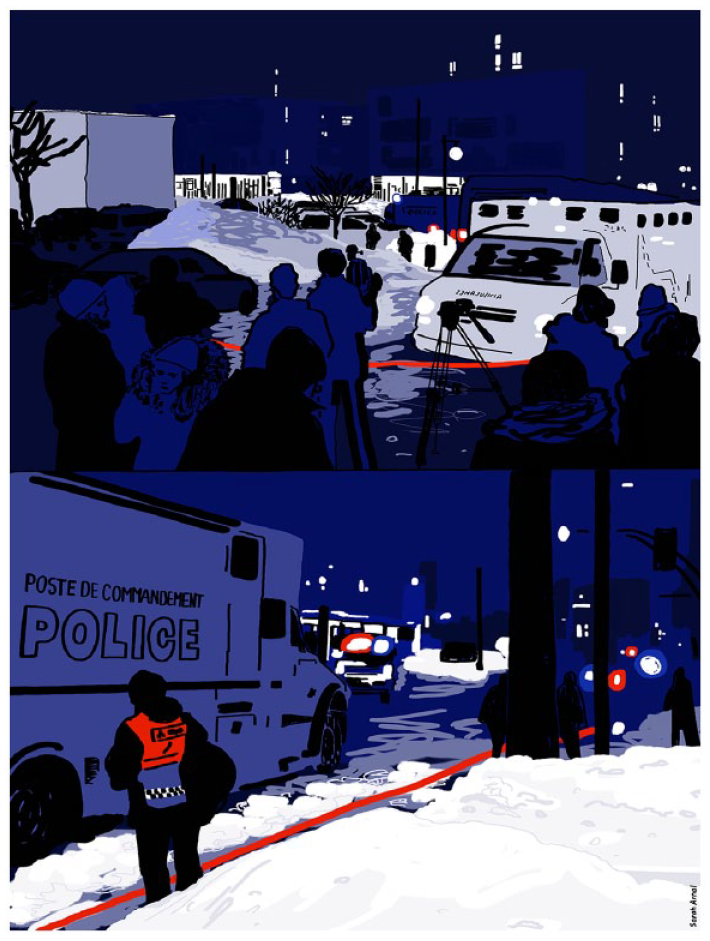
Crime scene on the night of the attack.
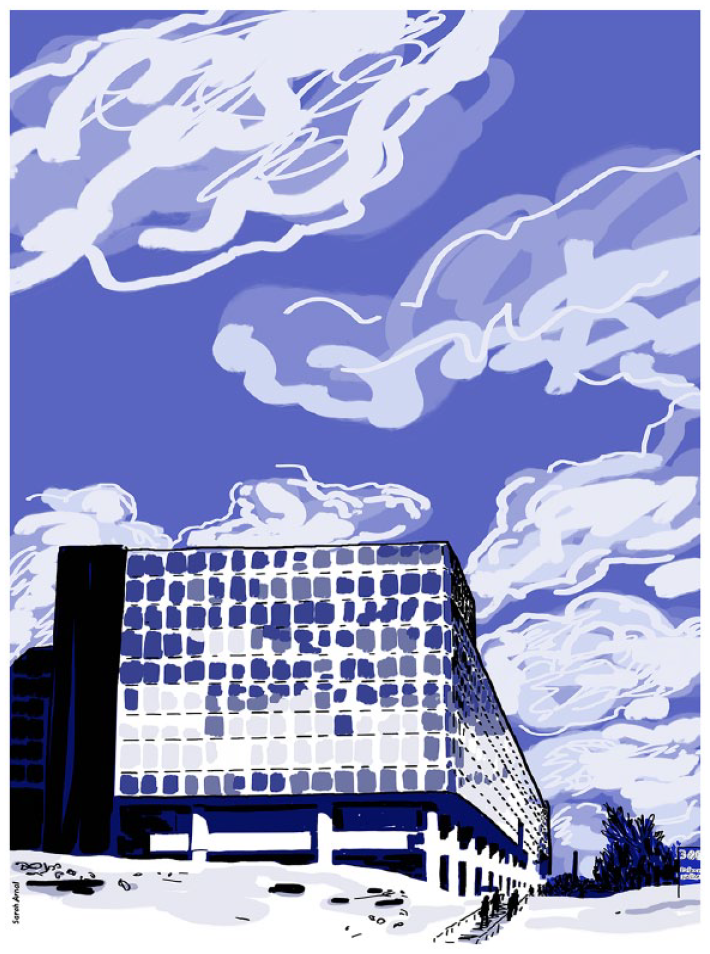
View of the Superior Court of Québec.
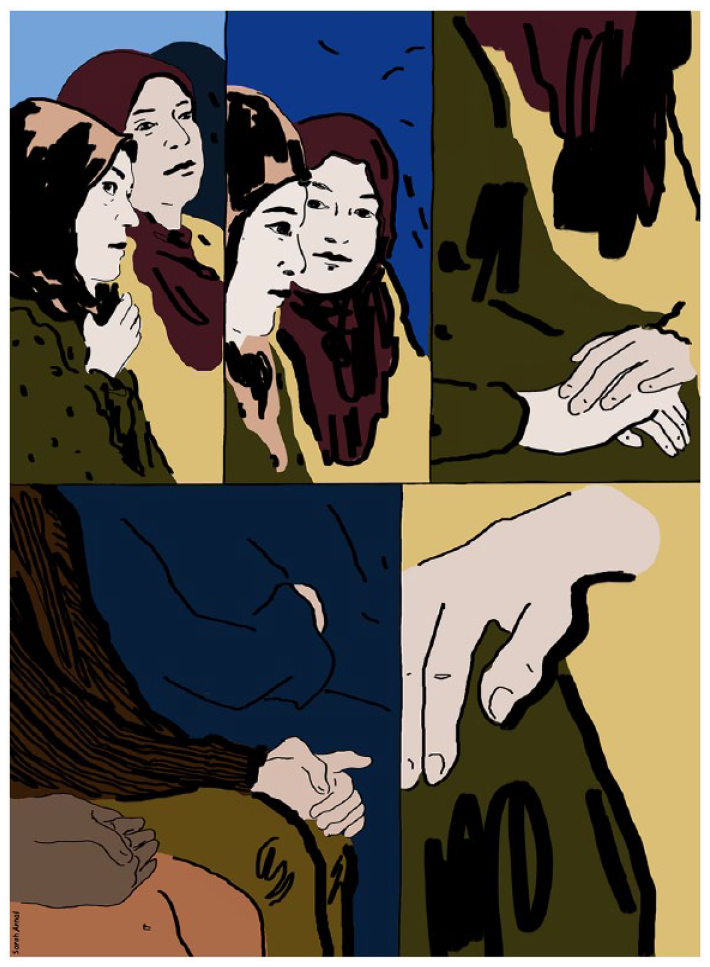
Women hold hands.
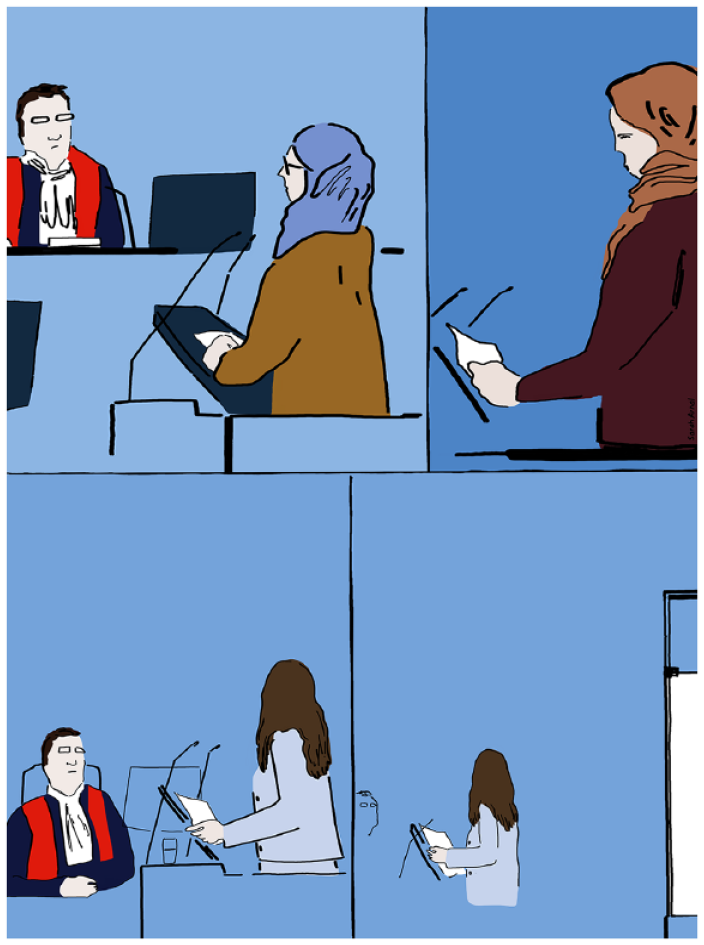
Women take the witness stand.
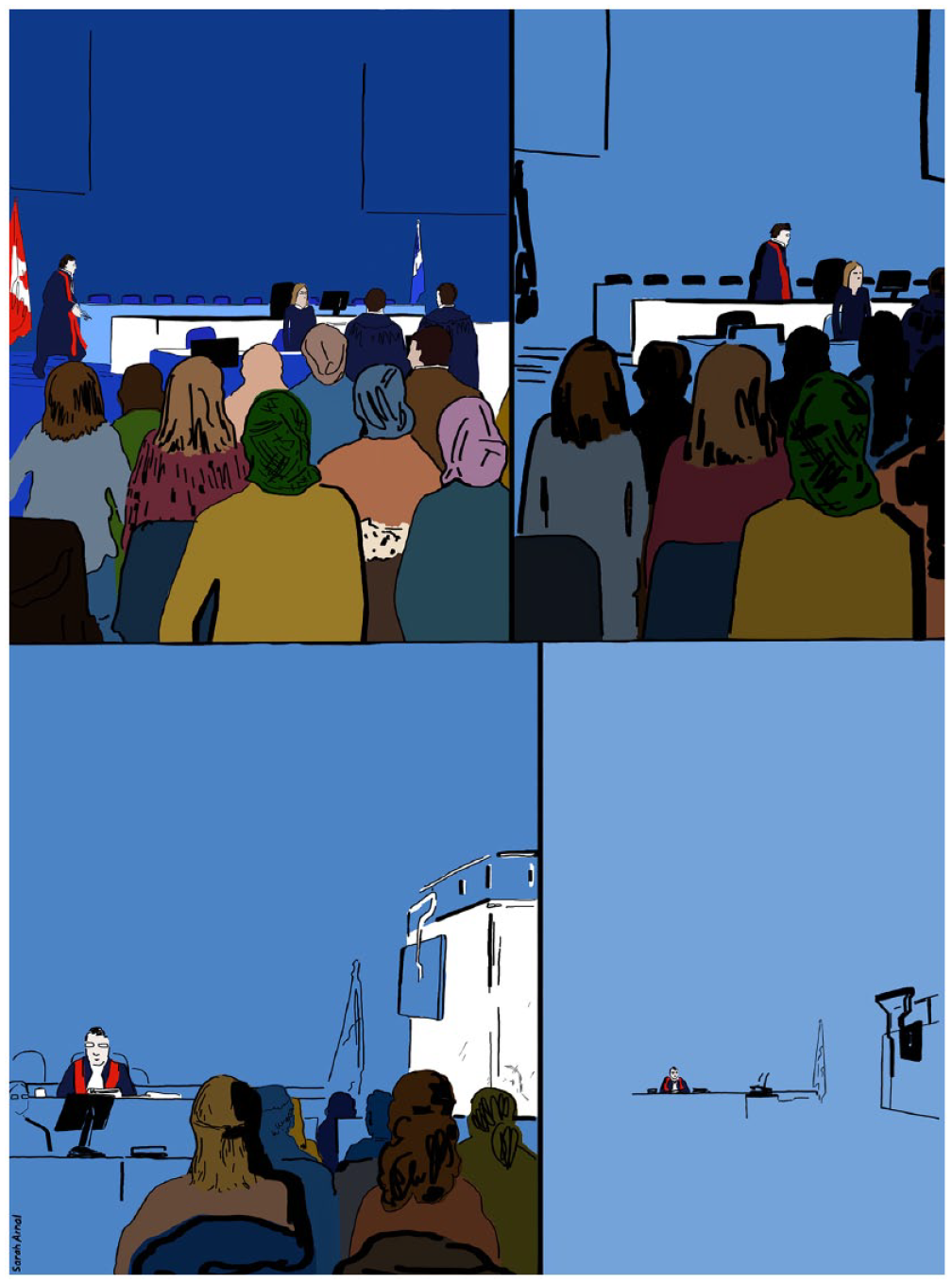
Judge enters the courtroom.
The ethno/graphic sketchbooks that were used within the courtroom served as the basis for the panels presented here. Rather than a single sketch, the composition of small scenes aims to better convey the temporality and spatiality of the trial, as well as the emotions stirred in the courtroom. These illustrations do not seek to replicate the conventions of courtroom sketches. Media-accredited courtroom sketch artists are often given prime seats to depict judicial proceedings and generally produce close-up portraits of the defendant, judge, lawyers, experts, or witnesses. The panels inserted throughout this article were mostly produced from the vantage point of the public gallery, a perspective intended to reflect a sense of distance from the judicial system and capture shared experiences of sorrow and solidarity amongst members of the audience. To create a narrative that would reintegrate the trial into the sequence of events and the setting in which it took place, we decided to include the crime scene and a view from outside the courthouse (Images 1 and 2). This visual narrative aims to hold a complementary role vis-à-vis our written analysis. The images are therefore not intended to ‘illustrate’ the social scientific text, but rather to generate, through a text/image dialogue, new perspectives and ways of understanding social phenomena (Carruthers, 2018; Mookherjee, 2022; Sousanis, 2015).
The ethical implications of studying such a violent and highly mediatized case are numerous. In accordance with movements such as No Name, No Notoriety, we choose not to use the assailant’s name in our work (we also remove his name when citing news articles that explicitly mention it and we avoid using hyperlinks towards those news stories). Activists from these movements urge journalists and researchers to limit occurrences of mass shooters’ names in order to reduce the potential for (self-)glorification and copycat crimes. These concerns were echoed by various experts, victims, and activists throughout the court hearings we attended. This choice is consistent with the focus of our research, which is the judicial, media, and political treatment of the crime, rather than the elucidation of the shooter’s personal motivations.
Judging the ‘color of the times’
The trial for the Québec City mosque massacre began on March 26, 2018, at the Superior Court of Québec, located in the heart of Québec City. After registering with security guards and undergoing an extensive security check, we accessed the courtroom, where the accused sat in a glass-enclosed dock. Shortly after the Superior Court judge entered, the accused was called to the witness stand, handcuffed at his wrists and ankles, and accompanied by two officers. A heavy silence reigned in the room. Without any further ado, the judge began to list the charges laid against him: six counts of first-degree murder and six counts of attempted murder, the last of which encompassed 35 people – including four minors – who were inside the mosque at the time of the attack. At the first murder charge, the accused pleaded not guilty. A woman from the audience let out a cry. The judge continued to list the charges. The accused answered not guilty to each of them. His voice was flat. In the front row of the public gallery (i.e., behind the row of lawyers and the subsequent row of journalists), 12 family members of the victims exchanged sorrowful glances. Women reached out to one another other in condolence. A security guard demanded they refrain from touching each other to respect decorum. As the list of charges and the not-guilty pleas went on, sobs resonated in the courtroom.
We reconvened in the afternoon for the continuation of a trial that promised to be long and difficult. At the opening of the session, the defense informed the judge that the accused wished to change his plea in light of new information that had been brought to his attention. Media reports would later suggest that his lawyers had received a psychiatric report on which they had intended to base their defense of a not guilty plea. Astonishment filled the courtroom. Audience members exchanged whispers and glances. The room returned to silence as the judge expressed his surprise and questioned what appeared as a sudden change of heart. The following hours and days were spent validating the accused’s aptitude to make the decision of changing his plea. He was interrogated by the judge, then assessed by a forensic psychiatrist later that evening, before we returned to the courtroom two days later. On the morning of March 28, 2018, the shooter was declared guilty for the 12 charges laid against him. The remainder of the hearings would therefore be devoted to determining the sentence he should receive, rather than his guilt.
Sentencing hearings took place throughout the month of April 2018. The Crown’s case was presented in two stages: (1) the circumstances of the commission of the crimes (i.e., the high level of premeditation, the violation of a place of worship, the vulnerability of the victims, and the level of violence), and (2) their consequences on the lives of the many victims (i.e., psychological, physical, financial, interpersonal, and societal). The defense focused on attenuating factors, such as their client’s history with bullying, anxiety, and depression, as well as his claimed aptitude for rehabilitation. At the heart of the debate was the Protecting Canadians by Ending Sentence Discounts for Multiple Murders Act, adopted by the Federal Government under conservative Prime Minister Steven Harper in 2011, which allowed judges to decide whether periods without eligibility for parole for each murder conviction should be served consecutively. 13 Whereas the Crown called for the six life sentences to be served consecutively, totalizing 150 years without possibility of parole, the defense argued for them to be served concurrently, meaning the accused could be eligible for parole after 25 years.
Despite initial political statements characterizing the attack as an act of terrorism, no criminal charges of this nature were ultimately laid against the assailant. In the discourse that emerged in the months following the attack, the shooter was generally depicted as a ‘lone wolf,’ rather than a terrorist acting in the name of an ideology or a structured organization (see also Mahrouse, 2018). Throughout the criminal proceedings, experts – mostly psychiatrists and psychologists – presented their interpretations of the defendant’s personality as problematic, some qualifying it as ‘borderline’ or ‘narcissistic,’ although no consensus of diagnosis was reached. For the most part, his dangerousness was assessed as a form of inner fragility or as a psychological vulnerability that could partly explain the crimes committed. Dangerousness and vulnerability appear here as two sides of the same coin, the internal tension of a contemporary moral economy 14 that runs through the practice of mental health assessments (Fernandez, 2015; Fernandez & Lézé, 2011; Fernandez et al., 2010; Pratt, 1997).
The focus on psychological and emotional factors to explain the violence perpetrated by lone wolves tends to divert attention from their shared ideology and political convictions (Berntzen & Sandberg, 2014; Puar, 2007). In the case at hand, the shooter is considered as acting in isolation, rather than as subscribing to a broader surge in far-right extremism. The lone wolf lens fails, then, to account for his affinities with far-right figures and his fascination with misogynist and white supremacist mass shooters (Howard, 2019; Mahrouse, 2018; see also Berntzen & Sandberg, 2014; Beydoun, 2018). At the beginning of sentencing hearings, the court heard evidence pertaining to the defendant’s internet search history, which included materials on racist, anti-feminist and Incel mass murders, their perpetrators, and the Ku Klux Klan, as well as research on various firearms. Further evidence pertaining to the accused’s adherence to anti-multiculturalism, anti-immigration, and anti-refugee political positions – articulated around a hatred of Islam – garnered less clinical attention than his personal life story, namely his struggles with depression and bullying.
The trial’s media coverage contributed to asserting the legitimacy of psychiatric assessments in ‘narrating’ the commission of the crime. Such psychological and psychiatric interpretations found greater resonance in the public sphere than political interpretations of the testimonies. For instance, one of the main narratives put forward during the hearings, and echoed by journalists and politicians, consisted in presenting the shooter’s motivations as personal, even ‘selfish.’ The attack was thereby disconnected from the political context of increased hate crimes against Muslims; instead, hate was framed as a lack of empathy or insufficient emotional intelligence. For example, when discussing violent comments that the accused allegedly made in prison about a man he seriously injured on the night of the attack, experts referred to his ‘limited empathy.’ The profile that emerges is that of a person who lacks the social or emotional capacity to ‘put himself in someone else’s place,’ rather than firmly rooted in his ideological positions. According to another psychiatric expert invited by the defense, it was ‘because of the porousness of his identity’ that the defendant ‘was likely to adhere to the color of the times.’ The expression ‘color of the times’ appears here as a euphemism that depoliticizes the proliferation of anti-Muslim racism in the contemporary political conjuncture (see Zine, 2022).
Framing the victims’ testimonies
Between April 11 and 19, 2018, the court heard the Crown’s evidence on sentencing. This evidence consisted primarily of selected video recordings (including those captured by the mosque’s surveillance cameras on the night of the attack and the shooter’s police interrogation on the following morning), audio recording of the accused’s 911 call, photo albums, plans of the building, expert reports, and written statements from various witnesses, as well as 19 testimonies and 28 letters from victims or members of their families.
One morning, the widow of a man who lost his life in the shooting was called to the witness stand. Before reading a letter she had written to the court, she shared photos of her late husband with the judge, expressing what a loving father he was. Her letter recounted January 29, 2017, that started as ‘an ordinary day,’ and the ‘nightmare’ she had been living since. ‘Nothing can replace a father,’ she continued, crying as she described how the loss of her husband had annihilated their family’s hopes and projects. She closed her statement by condemning terrorism, Islamophobia, and all forms of discrimination in Canada. She confided that her daughters were terrified of suffering the same fate as their father. To her, there was no doubt: this was a terrorist and Islamophobic attack that aimed to terrorize the Muslim community and reject values of inclusion and vivre-ensemble.
This woman’s testimony is exemplary of most of the statements made by victims and their loved ones to the court, insofar as it combined detailed personal information with broader political positions. Referring to the rise of anti-Muslim hate crimes in Québec, the former president of the Islamic Cultural Centre explained how the mosque’s administration was in a ‘race against the clock’ to secure the building. Some witnesses were vocal about the role of private media outlets in vilifying Islam and the Muslim population, as well as the toxic social climate generated by political debates on the regulation of religious symbols. A man who was severely injured on the night of the attack recounted his daughter being forced to remove her headscarf on her first day of high school to conform to the school’s no-hat policy. ‘In a free and democratic society, one should be free to practise their religion,’ he deplored. ‘Can we do so without being bothered every day, without a fight? Do we have to fight every day to exercise our rights guaranteed by the Charter of Rights and Freedoms?’ he asked the judge.
Most witnesses were adamant about their deep attachment to Québec City, a place they had chosen as their home. Some also described challenges of migration and inclusion, in particular the barriers they faced in having their skills recognized in the labor market. Despite having been considered high-skilled workers in their countries of birth, many had been forced to change career paths (e.g., taxi driver, beneficiary attendant) or to return to university when they moved to Québec City. After years of work to better their lives, January 29 signaled the fall of their hopes, according to a woman who lost her husband in the attack. Whereas they had come to Québec City ‘to find peace,’ some families declared they now considered leaving the province. One man shared the experience of a Syrian acquaintance who had survived the bombing of his country and who had begun to fear living a ‘psychological war here.’
When addressing the court, witnesses were explicitly encouraged to focus their testimony on the events surrounding the crime and its consequences on their personal lives. Such efforts to frame their discourses and emotions were manifest throughout the hearings we attended. Within the legal framework, evidence pertaining to these psychological, physical, family, and work-related consequences can be considered as aggravating factors – with the potential to influence sentencing. Yet this insistence on narratives that recount the painful and devastating consequences of the massacre on their personal lives undermines the production of narratives based on shared trajectories of adversity, on the hardships undergone by members of a religious minority in order to be recognized as full citizens. In other words, it tends to mask the eminently political or critical dimensions of their accounts, recoding them into stories of individual suffering and loss.
This framing of witnesses’ discourses within the courtroom was reflected in the live news coverage we observed during the hearings. While victims were advised by their lawyers and the judge to focus their statements on the effects of the shooting on their lives, most of them seized the space of the courtroom to talk about their faith, share their experiences of migration, integration, and discrimination, as well as the rise of Islamophobia and hate crimes. Almost all witnesses described the attack as an act of terrorism. Despite this, corresponding news articles generally focused on the impacts of the crime on witnesses’ personal lives (physical and mental health, trauma, mourning, work leaves, struggles to be present for their families, etc.) and the emotional aspects of their testimonials. An emotional grammar of suffering, placing the reader as a spectator of the victims’ pain, predominated the majority of the press articles that we analyzed during the hearings. This set of attitudes and emotional conventions is part of a politics of pity, one which differs from a politics of justice by considering each person only in terms of their relationship to happiness and misfortune (Boltanski, 1993). The emphasis on suffering in the victims’ narratives was apparent in news headlines: A Lifetime of Suffering for A. D.
15
(Le Soleil, April 17, 2018) Attack at the Québec City Mosque: Vibrant Testimonies of the B. Family. (Radio-Canada, April 18, 2018) The Daughter of the Hero of the Mosque Delivers a Moving Testimony. (Radio-Canada, April 19, 2018)
This mode of emotional framing stresses the tragic nature of the attack, the deep sorrow of grief and the harrowing void left by the loss of a loved one but tends to overlook their social and political context. The climate of fear that preceded the attack and the accentuation of this fear after the events were little discussed (see also Howard, 2019; Mahrouse, 2018). Although victims stressed the historical roots and power dynamics at play in their repeated experiences of marginalization, media coverage most often recoded their suffering into what Brown describes as a ‘problem of personal feeling’ (2006, p. 16). This process of depoliticization is colorblind (Ioanide, 2015) insofar as it fails to account for the particularity of the witnesses’ sadness, anger, and fear – which stem from racism.
Sentencing an ‘unfathomable hatred of Islam’
February 8, 2019, was the day of the verdict. Hundreds gathered at Superior Court of Québec, just over two years after the attack against the Islamic Cultural Centre of Québec City. That day, security measures and media presence were greater than they had ever been. When we entered the crowded and agitated courtroom that morning, all 250 seats were filled, with many having been reserved for members of Québec City’s Muslim community.
For the following six hours, the Superior Court judge read aloud most of his 247-page sentence. In his ruling, the judge rejected both the Crown’s and the defense’s requests that the shooter be sentenced to respectively 150 and 25 years of parole ineligibility. Instead, he changed the provision in the legislation that required periods of parole ineligibility to be assigned in blocks of 25 years in order to hand down a sentence of life in prison with no chance of parole before 40 years. 16 Whilst the judge noted his reluctance to qualify the crime as an act of terrorism, he explained that he would not comment on this aspect, inviting the audience to read his argument in the full document of the sentence. The question of terrorism, which had appeared central to denunciation in the immediate aftermath of the attack, was thereby dismissed – this time by the judge himself. In the written document, one page is dedicated to this discussion: relying in particular on analyses proposed by psychiatric experts, the judge considers that the crime was committed selfishly and not for political, religious, or ideological motives. Therefore, he writes, the attack could not be qualified as terrorism.
In this context, the accused’s ‘unfathomable hatred of Islam,’ his ‘pathological and unquenchable aversion to Muslims,’
17
is interpreted as a form of ‘cognitive distortion’: Struggling with cognitive distortions stemming from poor mental health, [the accused] convinced himself that Muslims in Québec City posed a threat to his own safety, that of his family, and the general population.
18
This dissonance in the accused’s mind is traced back to his ‘precarious mental health’ 19 rather than an anti-Muslim, far-right, or white supremacist ideology. Indeed, throughout the judgment, the shooter is repeatedly described as subscribing to ‘no particular ideology,’ an assessment the judge draws from psychiatric experts who testified in court. 20
The words ‘terrorism’ and ‘terrorist(s)’ are used respectively 10 and 21 times in the text of the sentence. They appear mostly in reference to the accused’s racist perceptions of the people he targeted, rather than to characterize his own crimes: [The accused] also undertakes to read about terrorism. Attacks motivated by religion or ideology seem ‘unacceptable’ to him. (p. 42) The accused is convinced that at least one ‘religious extremist’ or ‘terrorist’ attends the [Islamic Cultural Centre of Québec City]. (p. 33) [Saving people from] terrorism thus serves as a justification for the accused and allows him to rationalize his actions. (p. 43)
Here, terrorism is used to designate the violence of the ‘Other,’ that which the accused claimed to combat by his actions. This othering plays to the opposition between the figures of the terrorist and the lone wolf: terrorism in the name of Islamist extremism is cast as a threat, at the same time as the accused’s actions are disavowed as terrorist. By extension, the framing of the accused’s fears fails to challenge white supremacist tropes of Muslim ‘invasion’ and the so-called ‘great replacement’ (see Miller-Idriss, 2022). In response to this persistent double standard, several survivors of the shooting, members of the mosque, and anti-racist activists have continued to qualify the massacre as a terrorist attack.
Conclusion
On the evening of January 29, 2017, a white man opened fire at the Islamic Cultural Centre of Québec City. Through analyzing the shooter’s 2018 trial at the Superior Court of Québec and its media-political reception, we have highlighted how emotional and personal framing depoliticizes histories and legacies of anti-Muslim violence in Québec. Our political ethnography of justice shows how, within a given society – and in particular, within its legal, political and media centres of power – violence targeting racialized and religious minorities generates ambivalent responses. On the one hand, such violence provokes moral outrage and compassion towards the victims. On the other hand, its public handling tends to conceal the relationship between individual suffering and systemic forms of discrimination, thus obscuring broader social patterns, such as racial and religious hierarchies that organize the body politic. These responses operate through a retreat to an ‘entre-soi,’ which itself hierarchizes narratives within the courtroom in a way that tends to recode political accounts of the attack into accounts of personal suffering. This process of depoliticization is characteristic of instruments of authority (Herzog, 2018) within social control institutions, and works to maintain the hegemony of a dominant culture deaf to the dissonances expressed by its cultural minorities.
In light of our collective ethnography, we understand depoliticization as a process composed of distinct sequences that participate in obscuring the political meanings that victims and their loved ones attach to the context of the massacre and its aftermath. More specifically, our research identifies five sequences that played out either successively or simultaneously throughout the court case: (1) prosecutorial decisions not to charge the attack as terrorism despite initial political responses denouncing a terrorist act; (2) legal officials’ strong suggestions that victims and their loved ones focus on expressing personal harms from the attack, rather than the collective and critical dimensions of their testimonies; (3) defense strategies and the use of psy expertise as a source of legitimate knowledge (Fernandez et al., 2010) to interpret the criminal acts committed, emphasizing personal pathologies and vulnerabilities; (4) the judge’s sentencing statement that deplores ‘an unfathomable hatred of Islam’ while identifying the sources of this hatred as pertaining to ‘no particular ideology’; as well as (5) journalistic styles of reporting, and rapid publishing in real time, that focus on individuals and emotions over structures and politics.
Attending to these sequences sheds light on how courts, as theaters of authority, select what they deem important and dismiss what they deem secondary, veil as much as they reveal, expose as much as they mask, enable free speech as much as they reframe it, and usher certain delicate subjects into silence. This article aimed to reverse the dominant media-political focus on the ‘profile of the shooter’ in order to listen to the narratives of those who were targeted by the attack. Methodologically, it contributes to a growing body of courtroom ethnographies (Anwar & De Goede, 2021; Bögelein et al., 2022; Klosterkamp, 2023) and emphasizes the potential of collective and collaborative methods to advance these approaches. We suggest that composing ethno/graphic narratives is a promising methodology for collecting, analyzing, and interpreting research data. Indeed, the collaboration at the heart of our ethno/graphic approach helped us to both articulate and make visible how we perceived what was unfolding in situ, in the courtroom. In the process, it allowed us to preserve visual traces of our research that could otherwise be lost in the writing process, such as the mental images and sensitive perceptions that informed our understanding of the scenes we witnessed.
Conceptually, this article crosses scholarship on depoliticization (Brown, 2006) and epistemologies of white ignorance (Ioanide, 2015; Joseph-Salisbury, 2019; Mills, 2007; Peacock, 2023) in order to offer novel insights regarding the institutional treatment of religiously and racially targeted violence. Our observations of the trial for this anti-Muslim massacre have implications for the ways in which white supremacist and far-right violence is rendered (un)fathomable across an array of public arenas, and within the regulated space of the courtroom in particular. Core exclusionary mechanisms are obscured when lived experiences of anti-Muslim racism are left unheard, when white supremacy is concealed, and when terrorism is construed as a racialized threat. With attacks continuing to target marginalized communities within and beyond Canada – including other mass shootings at local mosques – attending to processes of (de)politicization should remain of critical interest for sociologists.
Footnotes
Acknowledgements
We would like to express our sincere gratitude to the editor and the three anonymous reviewers who offered such thorough and thoughtful feedback on our paper. Previous versions of this article were presented at the 89th Congrès de l’ACFAS in 2022 (Québec, Canada), the 21st Congrès de l’AISLF in 2021 (Tunis, Tunisia), and the international colloquium ‘Faire silence: expériences, matéralités, pouvoirs’ at the Centre Norbert-Elias (Marseille, France) in 2019. Sophie Marois would like to thank Ellen Berrey for her 2019 seminar on law, race and racism at the University of Toronto as well as members of the 2022 Terrorism in Court workshop at Bielefeld University (Germany).
Funding
This research was supported by a grant from the Social Sciences and Humanities Research Council of Canada for a project entitled ‘Collaboration entre la sociologie et les arts graphiques – dialogue interdisciplinaire,’ directed by Fabrice Fernandez.