




Abstract
Over the past two decades, recognition of same-sex relationships and non-normative families has increased alongside greater access to reproductive technologies. Despite this progress, surrogacy, a potential path to parenthood for gay couples, remains banned in many countries. Research indicates that gay couples, facing legal restrictions, often seek reproductive services abroad, navigating complex legal, political and sociocultural contexts in both their home and destination countries. However, existing research lacks cross-country comparisons that explore how different contexts shape gay couples’ reproductive practices. This study enhances our theoretical understanding of the intricate interplay between social structure and social interactions. It explores how normative family conceptions, ingrained in legal frameworks, societal norms and cultural values at the macro level, profoundly influence the (normalising) practices of couples at the micro level. Empirically, this study compares Germany and Israel, where gay couples face starkly different challenges. Germany universally prohibits surrogacy, while Israel permits it, although not for gay men during my interviews. Drawing on interviews with couples from both countries who engaged surrogates abroad, this study analyses their struggles for legal recognition and social visibility as ‘gay father families’. In both countries, couples navigate legal, political and sociocultural contexts differently, encapsulated in a process termed ‘becoming a gay father family’, involving concealing surrogacy and appropriating heteronormative family narratives. The data indicate that the couples’ social interactions reflect and reinforce a discernible normative shift from heteronormativity to repronormativity in the context of assisted reproduction.
Keywords
Introduction
In the past two decades, social scientists have observed a shift in policies on same-sex sexualities, characterised by the emergence of ‘homotolerance’ (Roseneil et al., 2013) in international human rights law. This shift has led to increased recognition of same-sex relationships and families with same-sex parents, affording individuals the ability to openly live ‘beyond the closet’ (Seidman, 2002). Consequently, this transformation has expanded opportunities for non-heterosexual intimacies, the establishment of same-sex everyday lives, and the formation of non-normative families (Weeks et al., 2001). These sociohistorical shifts have allowed gay men to imagine themselves simultaneously as gay and parents (Berkowitz, 2007), with increased opportunities to become parents, such as through co-parenting arrangements (Jadva et al., 2015; Wimbauer, 2021), foster care or adoption (Goldberg et al., 2011), or transnational gestational surrogacy, in which a surrogate is implanted with an embryo conceived through in-vitro fertilisation using donated oocytes. However, they often face legal obstacles in their resident country, struggling for legal recognition and social visibility, owing to structural heteronormativity, reflecting societal norms of gender binary and heterosexuality. Moreover, purchasing assisted reproductive technologies (ARTs) is generally very costly and usually not (fully) covered by health insurance. Consequently, access to fertility treatments is primarily affordable by wealthy upper middle-class patients. Furthermore, commercial surrogacy is illegal in many countries that view it as a market-driven, exploitative, ethically challenging practice (Rudrappa & Collins, 2015). Embedded in a transnational capitalist market, surrogacy is inherently gendered and (usually) structured by racial and class inequalities (Twine, 2011). Thus, gay couples opting for surrogacy violate family values’ normative social order and concepts in at least three ways. As same-sex couples, they ignore the heteronormative family gender binary, reject the idea that heterosexuality is the only natural ‘foundation of life’ (Butler, 2002, p. 29) by using ARTs, and disobey the norm of non-commodification in family formation (see also Smietana, 2017).
Many queer kinship scholars and LGBT* family studies point out that parenting rights remain a contested field in granting equal rights to same-sex couples (e.g. Butler, 2002; Eggert & Engeli, 2015; Hopkins et al., 2013; Park et al., 2016; Teschlade et al., 2023a). How do these legal exclusions affect the social practices of gay couples who become parents via cross-border surrogacy and their efforts to seek legal recognition for their parenthood? To what normative conditions must they conform to become recognisable? These matters deserve further sociological exploration.
Drawing on qualitative interviews with gay couples from Israel and Germany who contracted a surrogate abroad, this study systematically explores how they navigate legal, political and sociocultural contexts in their resident country to become legally recognised and socially visible as parents. In the two countries, same-sex parenting and surrogacy face different, opposing, biopolitical regulations, which have different consequences on how the couples navigate obstacles and restrictions as well as how they engage with opportunities and loopholes in their process to become a family with children. Therefore, Israel and Germany provide an interesting comparison regarding how family policies regulate queer kinship and help clarify differences and similarities in policies’ impacts on gay couples’ social practices. The Israeli state has a liberal approach to reproductive technologies, and surrogacy is legal (e.g. Teman, 2010, 2018), but during the interview period (2015–2017), it was legal only for heterosexual couples (single women gained access in 2018). Conversely, Germany strictly limits access to certain reproductive technologies, and egg donation and surrogacy are prohibited (Dücker & Hörnle, 2018). While gay couples in both countries must circumvent national legal restrictions to access surrogacy services abroad, my analysis shows that compared to couples from Germany, Israeli couples face a rather legally enabling environment, and a more affirmative social discourse grants them greater visibility.
This study contributes several novel aspects to current research. While a thorough body of previous research compares Israel’s and Germany’s different legal regulations and normative perceptions regarding genetic testing and ARTs (Mitra et al., 2018; Raz & Schicktanz, 2016), this study adds a comparative perspective on the influence of legislation on gay parenthood. I systematically assess how the similarities and differences in the legal and social context impact gay couples’ social practices and reproductive decision-making. Considerable research has been dedicated to same-sex couples and surrogacy in different contexts, such as in the US (Gamson, 2015; Smietana, 2017), the UK (Golombok, 2015) and Israel (Moreno, 2016; Tsfati & Ben-Ari, 2019). This study includes data conducted in Germany and adds a novel, understudied aspect to surrogacy research, queer kinship and family studies.
Additionally, the research design acknowledges transnational reproductive markets and global fertility chains (Vertommen et al., 2022) that provide international customers with fertility services unavailable in their home country. Couples interviewed for this study were involved in transnational surrogacy arrangements (mostly in the US) because they had no access to surrogacy services in their resident countries. Nevertheless, they represent a comparatively privileged group. Owing to their (wealthy) middle-class background, they were able to circumvent national regulations and afford a surrogacy process abroad.
This study aimed to establish how gay couples achieve legal recognition and social visibility for their parenthood despite legal restrictions, especially their appropriation and use of relevant laws. Sociologically, this advances our theoretical understanding of how social structure and human (inter)action mutually condition each other concerning family and parenthood: I show how normative family conceptions at the macro level (inscribed in law, norms, culture, etc.) shape the (normalising) practices of the couples at the micro level, such as the social interactions involving their engagement with the law when they conform to the normative idea of a family, which in turn influences the macro level. Examining the empirical data through this theoretical lens indicates that the couples’ social interactions reflect and reinforce a broader normative shift from heteronormativity to repronormativity. This shift gains momentum as the traditional privileged status of the normative heterosexual order is disrupted, particularly within the context of assisted reproduction. Here, repronormative ideals, emphasising diverse paths to procreation, fertility and family formation, come into sharper focus.
The first section reviews the social science research on pathways to non-heteronormative parenthood and introduces recognition and normalisation as sensitising concepts (Blumer, 1954), which provide the theoretical foundation guiding my research. Next, I briefly review legal and social conditions in Israel and Germany concerning demographic politics, ART regulation and same-sex relationship policies. I elaborate my findings using an empirically grounded theory (Corbin & Strauss, 2015) by translating same-sex couples’ practices into a trajectory model (Strauss, 1993) for becoming a recognisable, visible gay parent. Here, I integrate theoretical considerations with empirical findings to show how normalisation works amid the interplay between normalisation practices and resistance to heteronormative family images.
‘The trouble with normal’ 1 : Gay parents’ struggle for legal recognition and social visibility
Despite growing recognition of same-sex relationships in many countries (Ayoub, 2016; Roseneil et al., 2013; Tang et al., 2020), their equal access to parenthood or reproductive technologies remains contested. Heteronormative and nuclear family norms regulate laws and policies, depriving same-sex couples of equal parenting rights and opportunities to have a biogenetically-related child (Bernstein & Reimann, 2001; Eggert & Engeli, 2015; Hopkins et al., 2013). Butler (2002) critically analysed the institutionalisation of same-sex marriage and asserted that, although same-sex marriage grants legal protection and social benefits to same-sex relationships, this is an ‘ambivalent gift’ (p. 17), which requires partial assimilation into heteronormative structures. Therefore, recognition depends on complying with the normative conditions that legitimise and recognise (cf. Butler, 2009). Similarly, Stychin (2003, p. 4) addressed the law’s normalising function, speculating that legal recognition may limit the variety and diversity of intimate lives and interactions. Engaging with Stychin’s reservations, Smart (2007) suggested a shift in focus from abstract macro issues, such as ‘equality’ for same-sex people, to micro-practices and what same-sex couples actually do. Smart encouraged a sociological perspective that examines how people negotiate social conditions that impact their social practices and relationships, instead of simply imposing presumptions about assimilating to heteronormative family ideals. Embedded in theories of social (inter)actions (Mead, 1934/2015; Strauss, 1993), this study follows a similar line, systematically researching both context and practice by focusing on social discourse and legal regulations, as well as couples’ views, experiences and relational processes when interacting with family, friends or state officials. To enrich this theoretical perspective, I apply the concept of legal consciousness from the field of studies in law and society (Ewick & Silbey, 1998) to arrive at a grounded theory (Corbin & Strauss, 2015) on how gay couples experience, interpret and appropriate (heteronormative) legal regulations on kinship, parenthood and family to become legally and socially recognised as a gay father family.
Notable studies on queer kinship explored pathways to parenthood, and how both cultural assumptions and national legislation affect the families’ experiences, reproductive decision-making and available options (Hopkins et al., 2013; Park et al., 2016; Shapiro, 2013). Legal barriers and normative assumptions about the nuclear family ideal impede progress towards diversifying family models (Butterfield & Padavic, 2014).
Baumle and Compton (2015) adopted the concept of legal consciousness (Ewick & Silbey, 1998) to analyse how the law becomes relevant in same-sex families’ lives, reproductive decision-making and everyday practices, and shapes pathways to parenthood. Drawing on in-depth interviews with LGBT parents, they showed how different sociolegal and political contexts across US states influence how parents grapple with differing legal contexts according to their individual circumstances. Their results showed that LGBT parents face obstacles because legal constructions of family and parent–child relationships exclude them. Sometimes they manipulated the law or rejected current legislation – usually to protect their family within the heteronormative system. Baumle and Compton (2015) found that parents ‘acquire rights and legitimacy primarily through seeking legal recognition of their family by referencing and appealing to heteronormative legal standards’ (p. 238).
I adopted a micro-sociological, praxeological perspective to study how gay couples do recognition in heteronormative societies. Consistent with symbolic interactionism theories (e.g. Blumer, 1954; Mead, 1934/2015), I explored how gay couples negotiate legal regulations to achieve legal recognition and social visibility – key targets when fighting for recognition. Ayoub’s (2016, p. 23) research on LGBT recognition in Europe distinguished between interpersonal visibility within social relationships and networks, and public visibility, where the collective LGBT community seeks to be seen by society and the state. For example, the 1969 Stonewall Riots led to empowerment and greater equality for the formerly criminalised LGBT* community. Gay couples in most countries today see themselves as bearers of rights enshrined in law owing to the LGBT* rights movement. Remaining legally excluded from equal rights to parenthood contradicts the principle of recognition.
Butler (2009) noted that being recognisable depends on compliance with norms; to be intelligible as a non-normative family and consequently recognised as family, individuals must conform to and engage with normative conceptions of a family. While ‘norms of recognisability prepare the way for recognition, schemas of intelligibility condition and produce norms of recognisability’ (Butler, 2009, p. 7). To what normative conditions must gay couples conform to become intelligible and hence visible? Does reiterating these norms also produce or shift recognisability terms? Butler’s (1990) conception of performativity framed gay couples’ simultaneous subversion and reproduction of norms, based on impermanence that allows for shifts, alterations or displacements; what constitutes the heteronorm can always change (p. 41) (similarly Teschlade et. al., 2023b, p. 5). Butler’s theoretical approach is a great framework to analyse how the gay couples in my sample become intelligible and recognisable as parents and a family. Linking this with the concept of legal consciousness, I argue that couples are legally competent actors who creatively influence the law in their favour (Carlin et al., 1966, p. 70). This allows me to analyse what constitutes being perceived as normal from a micro and macro perspective: observing their creative practices, I scrutinised how couples appropriate constitutive rules (Garfinkel, 1984) of normative family perceptions to be recognised as conforming to the norm.
Sociocultural and legal contexts in Israel and Germany
Comparing gay couples’ parenthood pathways in Israel and Germany, particularly how legal and social contexts shape the process of becoming parents through cross-border transnational surrogacy, is intriguing for various reasons. Following Mitra et al. (2018), Israel and Germany represent a heterogeneity of practices, as ‘“prototypes” of diverse forms of governance and socio-political attitudes of ART’ (p. 5). Three lines of comparison guided my analysis: demographic politics, policies on assisted reproduction and LGBT* parenthood legislation.
Social policies on family and reproductive health, taxation and financial incentives reflect the nation-state’s demographic interests and affect how individuals negotiate normative family expectations and the respective roles of family and individual needs and wishes. I viewed Germany as having a more individualistic culture emphasising self-determination than Israel, where collectivist aspects, such as family-centredness, coexist with individualist aspects (Hofstede, 1985, p. 354). Family-centredness is evident in the Israeli state’s pronatalist policies, aimed at reproducing the Jewish nation (Kahn, 2000). Three origins are usually mentioned: (1) religion and the biblical prescription to ‘be fruitful and multiply’; (2) Holocaust trauma, leading to an ethos to procreate to somehow undo the loss of life; and (3) present-day demographic politics based on armed conflict with Palestinians (Birenbaum-Carmeli & Carmeli, 2010, pp. 6–8; Hashiloni-Dolev, 2018). Within Israeli public discourse, parenthood is constructed as an unconditional human right (Gooldin, 2013). The right to parenthood is based on parents’ basic rights to emotional well-being and happiness (Gooldin, 2013, pp. 94–97), a discourse that does not exist in Germany. Nevertheless, German social policies also follow a selective pronatalism to increase demographic growth. Characterised by class-related exclusions and racial hierarchisation (Schultz, 2015, p. 340), family policies focus on highly skilled, middle-class women by granting financial incentives and offering childcare to allow compatibility between family and career.
Research emphasises the contrast between Israel and Germany regarding assisted reproduction (Raz & Schicktanz, 2016), and typically cites religion and the Holocaust as the main influencing cultural factors. Judaism and Christianity offer different approaches to this biomedical and ethical question. In Israel, the Jewish religious-halachic tradition has a strong influence on policymaking in family matters (Hashiloni-Dolev, 2018), and rabbis advise the Minister of Health regarding halachic formulations of reproductive medicine legislation (Kahn, 2000). In Germany, religious beliefs also play an important role in social discourse on assisted reproduction, but Christian churches in Germany have a less institutionalised influence on legislation compared to the Rabbinate in Israel. The German Bishop’s Conference and the Protestant Church argue that embryos are human beings at fertilisation and must be protected, demanding restrictive regulations on ARTs (Rothmayr & Ramjoué, 2004, p. 184).
Germany’s restrictive policies are grounded in World War II experiences, the Holocaust and the country’s ethical/philosophical engagement with the individual (Rothmayr & Ramjoué, 2004). Access to ARTs is limited by apprehension about possible ideological appropriation or instrumentalisation of these technologies (Hashiloni-Dolev & Raz, 2010). IVF is available to single women, heterosexual and lesbian couples (although preimplantation genetic diagnosis is restricted), while egg donation and surrogacy are prohibited by the Embryo Protection Act (ESchG) and Adoption Placement Act. The ESchG aims to respect/protect human dignity and the right to life (Dücker & Hörnle, 2018). However, the current German government states that options to legalise egg donation and altruistic surrogacy will be considered (SPD, Bündnis 90/Die Grünen & FDP, 2021).
In comparison, Israel is permissive towards ART, especially regulating and subsidising reproductive services (e.g. fully funding reproductive medical services for citizens) (Birenbaum-Carmeli & Carmeli, 2010, pp. 17–25). Lesbian couples and single women have the right to donor insemination and IVF, and Israel was the first country to introduce a surrogacy law (Embryo Carrying Agreement Act) (Teman, 2010).
This leads us to surrogacy and gay parenthood legislation in both countries. Israel’s LGBT* rights movement has been successful in achieving legal recognition and equality (social status, civil rights and parenting/family rights) through litigation and petitions to the Supreme Court, while the Knesset (the legislature) has been amiss in this regard (Dotan, 2015). Since 2006, same-sex marriages performed abroad have had ‘common-law’ status and can be legally registered. Lesbian couples have been allowed to adopt stepchildren since 2005, and same-sex couples to adopt non-biological children since 2008. In January 2022, Israel opened surrogacy to same-sex couples, single men and transgender people, based on a 2020 Supreme Court decision.
Nevertheless, local surrogacy access has limited capacity. Israeli families take surrogacy journeys abroad in around 75% of cases (Trachman, 2022). If Israeli gay men access surrogacy abroad, the state grants citizenship to their children. Post-2010, a male partner can adopt his spouse’s son born to a surrogate; post-2014, same-sex couples with children can request recognition of the non-genetic parent as a legal parent. Until 2016, such couples needed genetic testing to prove that father and child were related; today, paperwork suffices to prove paternity, and the second father then receives a parental order. However, the fathers’ Jewishness cannot be passed on because of religious law. This ambiguity leaves same-sex couples in a vulnerable position: ‘[E]ven though they have achieved a wide range of family rights, they remain vulnerable to the discretion of courts and public authorities’ (Lustenberger, 2015, p. 208).
Germany introduced civil unions (Eingetragene Lebenspartnerschaft) for same-sex couples in 2001 and allowed same-sex marriages and adoption rights in 2017. Same-sex families have had constitutional protection since 2013, when the Federal Constitutional Court ruled same-sex couples are eligible for second-parent adoption. Considering that surrogacy is illegal, couples who want to employ a surrogate must go abroad, and they face legal risks such as they may not be recognised as their child’s legal parent, and their child would then not be granted German citizenship. The legal situation for gay parents was slightly improved in 2014 when the Federal Court of Justice (BGH 2014 XII ZB 463/1) ruled in favour of the two plaintiffs, a male same-sex couple from Berlin, that a birth certificate issued by the Superior Court of the State of California must be accepted by the Berlin registry office (Dücker & Hörnle, 2018, p. 241). This ruling eased the legal and administrative procedures for accepting birth certificates from children born through surrogacy in the US. Gay couples usually appropriate existing family laws instated for heterosexual families, such as recognition of paternity, a voluntary declaration of intent that requires maternal consent and can be pursued before the child is born. However, for this recognition, the surrogate may not be married, because the German Civil Code confers legitimacy of the child to the person who birthed the child and her husband, if any.
Methods and data
Following the premises of grounded theory methodology (e.g. Corbin & Strauss, 2015), I view qualitative researchers never just as neutral observers, but as subjects of the research process. They inevitably bring their own perspectives, knowledge, assumptions and biases to the research process which ‘influences how they interact with participants and interpret data’ (Corbin & Strauss, 2015, p. 77). Following the (Black) feminist intervention on the positionality of knowledge production (e.g. Harding, 1986; Hill Collins, 2000), my study pays attention to (self-)reflexivity and the analysis of power relations (Clarke, 2005, pp. 11–16) with my own preconceptions of procreative norms or who can and is supposed to be parents. Furthermore, in scrutinising law and policies, a critical approach towards claims of universalism is necessary to acknowledge the situatedness of knowledge (Haraway, 1988), particularly important for the comparative analysis of Israel and Germany, where I contextualise the different regimes of knowledge about ARTs.
I collected my data during qualitative fieldwork that examined views and experiences of gay male couples from Israel and Germany who intended to become or had already become fathers via surrogacy (gestational or traditional) conducted abroad (United States, Thailand, Cambodia). 2 I was interested in how they achieved legal recognition and social visibility for their parenthood, and negotiated the legal, political, social and cultural contexts of their home countries, as captured in their reproductive and family-making narratives.
The study comprises 48 interviews with gay couples, medical staff, attorneys and surrogacy agency representatives. I conducted 26 semi-structured, in-depth (Wengraf, 2001) couple interviews with 15 couples (eight from Germany, seven from Israel) in different stages of the surrogacy process (some already had children, others did not), which allowed me to understand and differentiate social and legal conditions in Israel and Germany over time. Six couples became key informants; I interviewed them several times over two years. Most interviews were face-to-face in Israel, Germany and the US from 2015 through 2017. The US became a third site of exploration because 13 of the 15 couples purchased a surrogacy arrangement there. To fully understand couples’ complex entanglements within the transnational surrogacy field, and how medical and legal advice guided their decision-making, I integrated a short-term ethnographic study (Hammersley & Atkinson, 2007) in two surrogacy agencies and a fertility clinic in the US. I work-shadowed and interviewed medical and non-medical staff and conducted another 22 interviews with industry experts.
The couple and parent recruitment started at a 2015 international conference on parenting options for gay men. Fertility industry representatives forwarded my call for participation to their German and Israeli clients. I also used non-probability snowball sampling, recruiting interviewees via couples I had interviewed and my acquaintances.
All men in my sample were cis-gendered, economically well-off and highly educated. All but three interviewees had at least a first university degree and a professional occupation. All German couples were either in a Lebenspartnerschaft (civil union) or married abroad. All Israeli couples were Jewish and married abroad.
Each interview began with an open-ended, broad question that concentrated on the surrogacy journey’s early phase: how they decided to have a child and work with a surrogate, and their general experiences. Interlocutors’ responses guided the interview direction, although I also asked specific questions (e.g. about the surrogacy agency and fertility clinic they worked with, how they imagined their future as a family with children, and the surrogate’s role in their children’s lives). They were encouraged to elaborate on their feelings and views on surrogacy and family. Interviews lasted two to five hours and were recorded and verbatim transcribed. For anonymity, pseudonyms are used here and all identifying information has been changed. All participants provided written informed consent to participate. The Faculty of Social Sciences Ethics Committee at the Hebrew University of Jerusalem approved this study.
Drawing from grounded theory (Corbin & Strauss, 2015), I coded the data and compiled my analysis using thick description, and employed Strauss’s (1993) trajectory concept to analyse how processes develop under changing conditions over time. The resulting arc of action (Figure 1) depicts the cumulative process of action and interaction that shapes the phenomenon’s course (Strauss, 1993, p. 56).
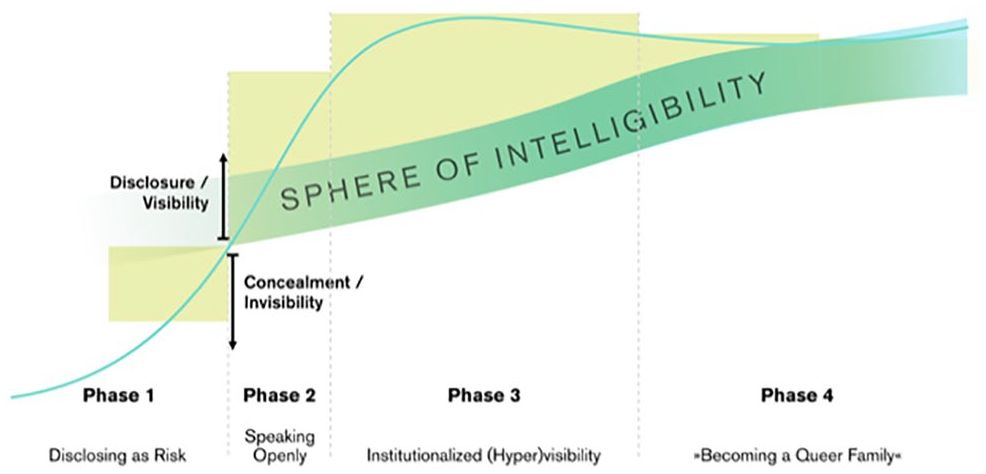
Arc of action: Becoming a recognisable, visible gay parent.
The reproductive trajectory: Pathways to gay parenthood
The decision to become a family via surrogacy usually preceded a lengthy process of figuring out how to become parents as a gay couple. All of the couples considered various options before choosing surrogacy as a reliable and successful alternative to adoption and co-parenting. The couples felt more control over the process, and comfortable with the normative ideal of a two-parent family without an ‘unnatural’ third or fourth parent with rights and risk (also Berkowitz, 2013; Teschlade, 2020, p. 55ff.). They needed to familiarise themselves with third-party reproduction abroad and relevant medical and legal procedures. The struggle for legal recognition of parenthood begins as couples gradually become visible as gay parents, which I call ‘becoming a gay father family’. I integrated the different contexts, temporalities and conditions of Israel and Germany into a coherent model, and identified four phases of the trajectory, structured along the continuum of ‘concealment’/‘invisibility’ through ‘disclosure’/‘visibility’ (Figure 1). These factors explain gay couples’ process of seeking and finding visibility and recognition. Next, I elaborate on each phase and show how the trajectory ascends from invisibility to hypervisibility and then descends through normalisation. Each phase represents the phenomenon in relation to temporality and Israel’s and Germany’s legal and social environments, as couples implemented suitable, context-specific practices to seek recognition by aligning their practices with heteronormative assumptions and legal categories that define parenthood, family and kinship. This process fosters accountability and intelligibility as a surrogacy family, creatively engaging with the law to overcome legal challenges.
Phase 1. Disclosing as risk: Concealing practices and suggesting normality
This first phase of disclosing as risk refers to settings where children born through surrogacy abroad are not legally recognised. Couples appropriated practices I framed as concealing and suggesting normality to fly under the radar and avoid detection by authorities for engaging in reproductive practices illegal in their resident country. I reconstructed these practices only for those German couples who started their surrogacy process before December 2014 (ruling BGH 2014 XII ZB 463/1 by the Federal Court of Justice). Germans opting for surrogacy before this decision were in a legally precarious position. Nevertheless, most German couples described being cautious about disclosing the surrogacy to authorities or seeking advice and confirmation from friends, lawyers or local officials to not endanger the legal process of obtaining custody. Independently of the timing, many couples (German and Israeli) discussed insecurities around how individual authorities may handle recognising children.
Concealing practices reflect the social order of the gender binary, heterosexuality and womanhood’s non-negotiable role in parenting and family, which suggest normality and trustworthiness. Anton and Frank’s story illustrates how concealing practices become apparent in situations involving direct contact with authorities, in the context of paternity recognition. Anton and Frank worked with a US surrogate, Anna. They chose Anna because she was unmarried, but had had a child with her long-term partner, which allowed Frank to officially acknowledge the child’s paternity and German citizenship with German authorities in the US before the birth – taking the law as given and applying it to their specific situation.
Frank qualified the couple’s intended transparency regarding the surrogacy process: ‘well, we wanted to do everything as open and honest as possible’. While completely legal, the couple’s actions moulded the law to their needs. Anton described their actions as ‘conspiratorial’ because German authorities were not supposed to know that this was a surrogacy pregnancy. Procedurally, Frank and Anna jointly filed an official document and appeared to the state delegate as a man and woman having a child together. This produced an ambivalent, almost paradoxical situation: Frank and Anna made use of heterosexual privilege by reiterating the norm of heterosexual reproduction and family creation. Their supposedly mutual parenthood was recognisable by outsiders because they appropriated heteronormative social practices and acted as normal as possible. In doing so, they concealed (1) the child’s conception via surrogacy, and (2) Frank’s status as a gay man. Frank explained how baffled he was when the German delegate explained why they had to acknowledge the paternity: They told us that ‘when a child is born, you always know who the mother is, but you do not know who the dad is’ and both of us [Anna and Frank] thought ‘who the mother is, is completely unclear; there are two women [the egg provider and the surrogate]. Who the dad is, is completely clear, and by the way, there are two of them’ and these are sentences where you think – ‘dude, we live in the 21st century’.
Frank’s narrative illustrates the ambiguity of the norms and normative assumptions about procreation – heterosexual intercourse and the inseparability of social, biological and genetic motherhood. Frank must act according to heteronormative expectations, which briefly forced him into a heterosexual subject position and re-closeted him as a gay man. Only by conforming to normative preconceptions could he be recognised as a parent and consequently, in future, as a gay dad. Disclosure could have jeopardised the couple’s custodial rights because of German legal regulations, but once Frank achieved legal status as the child’s father, his partner, Anton, who had been excluded from the process, became visible as Frank’s partner and the other parent. The surrogate, Anna, had to relinquish her parental rights for Anton to adopt the child and for the two fathers to become the child’s only legal and social parents.
Social practices like concealing and suggesting normality are especially necessary and unavoidable if the legal situation or social context is precarious. Couples manipulated the law to navigate challenges and achieve their goal, state recognition, within the system. By concealing the surrogacy and their same-sex relationship, they simultaneously appropriated, adjusted and reinvented legal norms. Through suggestions of normality, they pleased the heteronormative order by becoming a family, while simultaneously challenging it by achieving legal recognition of their gay parenthood.
Phase 2. Speaking openly: Partial disclosure and greater visibility
In this phase, couples became partially visible by disclosing to their friends/family or social network their plan to become parents through surrogacy. The German couples focused on disclosing the surrogacy (one German father described this as a ‘second outing’). The Israeli couples emphasised that being a two-dad family (without a female parent) was a matter for discussion among family and friends. However, surrogacy is a legal and familiar practice in Israel and does not need much justification. The German couples also mentioned discussions with family and friends about parenting as two men. Mostly they debated gay parenthood as a matter of state discrimination.
Being pregnant usually means the couple (or pregnant person) has to come out as pregnant to a greater public of friends, family and colleagues (Hirschauer et al., 2014, p. 73). Discussing the different steps of the procedure, Anton elaborated how he ‘let’ his ‘colleagues and [. . .] boss in’. Letting somebody in on something requires trust, to let them partake in the journey to parenthood. Frank agreed. He framed this as the time when they ‘told people’ about the surrogacy process. Anton described how he informed people step-by-step to get them on board.
You have to do it with sensitivity because many people do not understand what you are doing.
[. . .] you have a need to communicate [. . .] [it felt like] a second coming out, it is [A: yes, totally] like to reveal oneself at a very personal place not knowing how the other one is going to react. Does he find it good or bad? And, in doing so, you stand out as a further section of minority among the minorities; well, we had different experiences.
Their explication illustrates the uncertainties gay couples face regarding the wider public’s reaction to their personal revelations as gay men who, first, will be parents, and second, have commissioned a surrogate abroad to carry their child. Furthermore, while coming out as gay means inclusion in a minority group, facilitating a collective struggle for recognition, becoming a gay parent can result in alienation from the LGBT* community, where families with children are (still) a minority. 3
To reduce prejudices and avoid exclusion, Anton and Frank educated people about the surrogacy process. Numerous German couples mentioned the general misperception that the surrogate gives away her child. They assumed that the perceptions stemmed from a lack of knowledge of gestational surrogacy. Consequently, they appropriated different strategies to educate them: Ingo took his mother to the US and introduced her to their surrogate, Despina, helping the mother to understand and internalise the situation. Thus, couples reflected on and engaged in social discourses on motherhood and surrogacy, which often fail to capture surrogacy’s complex entanglements.
In Israel, Eli felt that although Israeli society is not the ‘most liberal [. . .] this surrogacy thing is very accepted’. His partner, Yehuda, confirmed this perception: ‘You probably won’t be the first [. . .] so you don’t have to explain everything [. . .] and it’s not a big surprise or something new to learn.’
However, Israeli couples had to take responsibility for their reproductive decisions and justify them to families and friends. While surrogacy was usually not criticised, couples often needed to justify having children as a gay couple and raising them without a mother. For example, one couple explained that their mothers would have preferred if they had co-parented children with a woman (hence, a mother).
The Israeli couples I interviewed generally felt socially integrated, but normative perceptions of gendered parental roles persist in Israel (see Tsfati & Ben-Ari, 2019). Finn and Koren’s story highlights that couples felt a need to justify being a two-dad family. During the interview, Finn constantly engaged with the possible objections of a potentially homophobic environment that questions their reproductive choices. In his narratives, he constantly proved his capability as a parent, which was only necessary if their competence as parents was questioned. He overused euphemisms, such as ‘everything was so easy’, and his partner Koren explained, ‘we had a [. . .] picture-perfect process. Everything went fine. There [. . .] was [. . .] no problem’, which strengthened this interpretation, because these semantic expressions are often used to disguise conflict-ridden issues (Corbin & Strauss, 2015, p. 98ff.). Finally, Finn concluded, his children were growing up in a safe and loving environment, and it does not matter if they were raised by two fathers or in a heteronormative family: I think that part of my family is very traditional and being gay was strange to them, and the idea of having a gay family was something that they could not even fathom. They are madly in love with us, our children, they are very proud of us, and I often hear from them that they finally see that we have a beautiful family, and that gender is really irrelevant. And this comes from people that four years back, wouldn’t even imagine such a situation, and now they see it.
The couples’ narratives and their experiences speaking openly in disclosing their reproductive practices and gay parenthood remind us of the precariousness and vulnerability of people who come out of the closet (Sedgwick, 1990, p. 80). While coming out is commonly framed as a mechanism to become visible to the state and society and to connect people to fight for social recognition (Ayoub, 2016), it always risks intolerance and rejection from family, friends and colleagues (Bernstein & Reimann, 2001, pp. 5–9). The couples in my sample anticipated societal presumptions around their plans to use surrogacy as gay men and made them understandable/intelligible to family and friends.
Phase 3. Institutionalised hypervisibility: Confessing the truth and getting legally recognised
The third phase, institutionalised hypervisibility, defines the arc of action’s visibility peak, involving interactions between gay fathers and the state, litigation against the state, or certain mobilisations (e.g. demonstrations in Israel against the Knesset’s decision to exclude gay men from surrogacy in 2018) that make gay fathers hypervisible as a distinct minority subject to discriminatory state practices. Many couples discussed the discrimination they experienced in their struggle for recognition. After the children were born, the legal situation in both countries demanded what I framed as forced confessions. Considering that they were same-sex parents, they must disclose intimate information about their family planning (e.g. How was the child conceived? Who is the biological parent?). While this allowed the state to categorise and legally recognise them as gay parents, it is an ambivalent process; some couples once again felt criminalised for being gay.
Israel has introduced measures to legally recognise children born by a surrogate abroad, but the vague legal situation in Germany leaves couples vulnerable. For example, Dieter and Ingo had to litigate for paternal discrepancy in Germany to obtain sole custody of their child. They started their surrogacy process in 2010, when surrogacy was not regularly debated in Germany, especially not for gay men. Despina, the surrogate they worked with, was married when she birthed their child. The German authorities could not accept the American birth certificate that named Ingo as the father because German law necessitated that Despina’s husband be named the child’s father. They decided not to disclose the surrogacy process until the judge ordered a maternity test, which would have revealed that the child was not genetically related to Despina, considering that they used an egg provider. Forcing the couple to confess how the child was conceived placed Ingo and Dieter in an awkward position. Dieter remembered that he felt criminalised: ‘In court, you really feel like a criminal. [. . .] we are talking here about our child and does he [the judge] want to dispute it? I know I am the father.’
The need to account for their paternity to the court produced discomfort. First, they circumvented German law to fulfil their wish for a child via surrogacy abroad; second, they were two fathers parenting a child, which was legally impossible at the time.
Although Israel has a process for legally recognising children born via surrogacy abroad, Moshe described how he and his partner Hillel had to reveal intimate facts about their relationship. To receive a parental order for the second father without adoption, they had to file an official statement declaring their decision to have the child. Drafting this joint life agreement felt intrusive because they had to negotiate all eventualities as if they were divorcing – only they were not. Moshe described it as putting their ‘life on paper’. Furthermore, they had to complete genetic testing to receive Israeli citizenship for their child. Their biogenetic relationship to their child, Ori, was unknown at birth because they deliberately chose not to know who was the biogenetic father. However, the state forced them to reveal it, which felt like a violation. Moshe labelled these practices discriminatory; nevertheless, the situation has since improved.
. . . all these process[es] of genetic tests, to verify who is who, is still discriminating [sic]. Okay, today it is much better than what it used to be, but still, it is pure discrimination [. . .]. The Supreme Court has some discussions about that, it is still pending, [. . .] we need to be acknowledged without any tests, the same way they acknowledge heterosexual couples, so I hope one day to skip that because it is not so nice [. . .] to go to the genetic test lab. [. . .] There are some very nasty people there [. . .] they need to do some genetic tests for prisoners and [. . .] you wait there [. . .]. [. . .] It does not sound right, although we understand why they need to verify to avoid some kid trafficking but [. . .] do the same with heterosexual[s].
Although Moshe accepted the necessity of genetic testing, he felt the laboratory experience associated him with criminals. He was there to prove his paternity, but through this was associated with people labelled deviant, which did not match his self-conception. Although they do not have to act in secrecy in Israel, their legal inclusion relies on heteronormative and biogenetic kinship norms. Moshe felt policed by the state as a gay man, because different regulations applied to heterosexual couples, showing up how heteronormative and Jewish cultural and religious perceptions are inscribed in kinship and citizenship regulations (Mitra et al., 2018, p. 5). Genetic testing is tightly linked with how Israel frames ethno-national and religious belonging (El-Haj, 2012, p. 108; Rexer, 2021). Consequently, Moshe’s and Hillel’s parenthood was not taken for granted. Although the state did not offer them a civil marriage, it still demanded a written commitment to their partnership and mutual parenthood because one father’s relationship with the child was non-biogenetic.
Nevertheless, receiving the official state documents (e.g. an Israeli ID for their son) had symbolic weight, said Moshe: ‘this acknowledgement from society is very important for us’. I framed this as institutionalised visibility or state institutions’ official legal recognition. The children’s Jewishness was also relevant considering that citizenship is closely associated with Jewishness in the Israeli context (Ochs, 2011). Numerous Israeli couples mentioned that it was important to them that their children were recognised as both Jewish and Israeli citizens, making the interconnection between state (nation) and religion/ethnicity (nationality) relevant to legal recognition, which is a foundational characteristic of Israel as a Jewish state. The Chief Rabbinate of Israel determines matters of conversion and who is accepted as Jewish in Israel; it does not accept children born through surrogacy in the US as Jewish. Thus, couples adopt practices to bend religious law by seeking help from Reform Rabbis in the US to convert their children to Judaism so that Israel will accept them as Jewish.
Frank also highlighted the importance of an official act of recognition. He described the adoption appointment with the local US court when the surrogate, Anna, forfeited her rights to the child, and compared this act of recognition to an emotionally dramatic cinematic moment: ‘It was like in an American movie’. He described losing self-control and crying, ‘because a state institution recognised what you were doing and not [. . .] like the German authorities somehow pushing you into the corner’.
Although greater visibility has ambivalent consequences, because couples must publicly disclose their reproductive practices (e.g. upon enforced court orders), these confessions also shift attention to their situation (e.g. judges become more familiar with surrogacy and gay parenthood), trailblazing for future gay parents. Reflecting upon the time since their first surrogacy process in 2010, Ingo said he now speaks more freely about the process: [Surrogacy] became a little bit recognised, although according to the laws in Germany, it is still illegal if you want to do it here. [. . .] but still it led to [. . .] that you do not feel ostracised in the sense that you feel like you must not openly communicate it [. . .].
On the continuum of time and context, this phase illustrates how state institutions in Israel and Germany have already recognised these families but are still delegitimising them. As Butler (2002, p. 24) asserted, recognition ‘becomes the instrument for the refusal of recognition’. Hence, the hypervisibility phase marks the shift where the couples are intelligible. Despite being contested, they are visible in public; they interact with the state and contest discriminatory practices, eventually leading to legal changes and greater recognition.
Phase 4. Creating a room of one’s own: Becoming a queer family
The fourth phase’s trajectory is descending, as the couples with children move toward normalisation and less exposure. Instead of being closeted, they enjoyed greater independence in private and public spheres and actively shaped discourses on family norms and perceptions. The Israeli couples felt like an integral part of society because surrogacy is a somewhat normalised practice and gay parents are increasingly common, but the German couples had not yet reached this phase. They provided information to family and friends only sensitively and selectively, while the Israeli couples could seek support from and exchange experiences with friends and acquaintances who were surrogacy parents. Eli felt included in mainstream society: Yeah, so it’s [. . .] very important to have kids and for some reason [. . .] once you know you have, even if you are in a same-sex relationship, once you are at the stage that you are having, starting a family then [that] suddenly makes you even more accepted [in] society, community, whatever so [. . .]. Yeah, in some way [. . .] it makes us [. . .] more normal or something, I guess, to have kids.
Although heterosexuality is Israel’s institutionalised ‘normative sexuality’ for reproduction, family orientation provides a supportive environment, and having children has a normalising effect on recognising couples’ sexual orientation. Furthermore, in this phase, social relationships move beyond interpersonal visibility and couples create broader gay networks of trust and solidarity. The Israeli couples often expressed consciousness of their historical/political situation in the gay community, acknowledging themselves as beneficiaries of past generations’ fights for queer parental rights. Moshe felt privileged to ‘enjoy’ the improving legal conditions despite continued discriminatory practices. Hillel was positively ‘surprised by the system’ that provided governmental decrees to grant child allowances to them for their firstborn.
I was really surprised. I thought it [would] be a very big fight to get all the rights for something.
Yeah, but someone else maybe [fought] the fight before us. That’s [. . .] the bigger truth, we didn’t do anything because [. . .] someone has already done it.
Hillel reflected upon the ambiguity of inclusion; despite greater recognition, he still anticipated legal discrimination. Creating a community of Israeli gay fathers is important for integrating their families into a larger network of care and support. Some couples mentioned that they want their children to be part of ‘something larger than this house’ (Finn), referring to family and friends, and pointed to a broad vision of changing family norms in general. For example, Lior remarked on gay parenting playdates, which are important for him to change perceptions of parental roles: ‘it’s really, really nice because it feels like we’re not only creating a new life within our inner nuclear family [but also] creating a new surrounding for us, for the future’. This illustrates how his nuclear family was not merely a private affair, but also a political move, changing future perspectives on kinship, family and society.
Compared to the Israeli couples, the German couples acted more covertly. Many referred to discriminatory state practices. They felt invisible as a family in public and disregarded by childless queer peers. Frank and Anton compared their life in Germany – where they were invisible as a gay father family, and people only enquired about the absent mother – with their US experience, where Americans approached them and asked about their child. Frank explained: ‘We always have the feeling that people do not get it and do not perceive us as a family’, and Anton added: as ‘a couple with a child’. Some couples experienced exclusion from their gay peer group. Anton and Frank described being ignored by their friends while they were feeding their newborn: ‘I do not find it normal if you know each other and you do not say congratulations, I mean, it is my child, right?’ It seemed that their decision to have a family was also sanctioned by their gay peers. My findings showed that, instead of being integral societal members, the German couples had a token status. For example, if offered a kindergarten spot because they are a gay family, they are not seen as an individual family, but as representatives of a minority, where their family constellation helps the kindergarten’s diversity.
As the Israeli parents’ cases show, this phase illustrates how integration into the normative order is necessary to have the freedom to define who is a legitimate, recognised part of society, and to influence perceptions of kinship and family narratives. Conversely, the German couples still felt invisible; despite the same social benefits (child allowances, parental leave, daycare), their legal pathways to parenthood remained precarious.
Conclusion
Becoming a gay father family via transnational surrogacy comes with legal and social challenges that differ by resident country. My research shows that couples from Israel and Germany circumvented legal constraints and shaped their reproductive trajectories by bending legal norms and appropriating social practices associated with normative family perceptions. While adhering to certain constitutive rules and conforming to norms, they became intelligible and, thus, visible as a gay father family. The comparative perspective of the trajectory shows that couples do this according to the legal and social context they face in their country of residence. Depending on the structural conditions, they navigate, similarly or differently, the obstacles and restrictions or use context-specific tactics to appropriate (legal) loopholes to become a family with children.
My findings represent the first comparative analysis of the social practices of gay couples in Israel and Germany and their struggle for legal recognition and social visibility. They contribute to research on pathways to parenthood by systematically examining the sociolegal and political context on a macro level, reflecting social practices and interactions with law on a micro level. Echoing previous studies on LGBT* parents and their engagement with the law (Baumle & Compton, 2015; Hopkins et al., 2013), my findings suggest that the transformative or ‘revolutionary’ (Butterfield & Padavic, 2014, p. 770) potential of these practices is limited; families must align social practices with available norms and categories to become recognised and visible. To comply with the hegemonic heteronormative institution of the family, couples in both countries creatively engaged with the law to overcome legal challenges.
By investigating how they accomplished this, I dismantled how normalisation works through different stages. The key finding of the comparative analysis is that while the Israeli couples became part of the reproductive mainstream, the German couples stayed beyond the radar, remaining invisible or providing an exception to the norm. I translated my findings into a trajectory of becoming a legally recognised and socially visible gay family. Conceptualising the process as a trajectory allowed me to compare both countries in their legal, political and sociocultural specificities without focusing on differences per se, and to remain attentive and sensitive to similarities. The trajectory integrates the different sociolegal contexts into one model that depicts (1) legal and social changes over time, (2) how these contexts impact social practices, and (3) how social practices change the normative order. It suggests that a legally enabling environment and affirmative social discourse grant greater visibility to gay couples with children conceived through surrogacy, which has different consequences for couples in Israel and Germany. Both countries follow a similar selective pronatalism that encourages reproduction based on heteronormativity, although each with a different emphasis. However, their stark differences in legislating ARTs, which are grounded in history, religious values and demographic interests, influence how couples in Israel and Germany pursue reproductive pathways. The German couples faced state discrimination. To comply with the hegemonic heteronormative family institution, they used legal loopholes to fulfil their wish to have a child, and thus normalised surrogacy through the normative power of the factual. Raising children brought Israeli couples into the reproductive mainstream, although they did have to shield themselves from normative family assumptions. They worked on normalising their reproductive choices and were recognised as two-dad families, changing the heteronormative familial structure.
These findings suggest future developments. Following the trajectory’s analytic lens, a fifth phase could be named Queer Futures. How may queer or non-normative families be part of future family norms? Muñoz (2009, p. 1) stated that ‘queerness is not here yet’ and we ‘may never touch queerness’. My analysis suggests that Muñoz is probably correct – queerness might not arrive. Nevertheless, the normative heterosexual order is losing its privileged monopoly, and the rigid distinction between ‘hetero’ and ‘homo’ might not hold in the future (Sedgwick, 1990). Rather, the organisation and arrangements of differentiation and normativity of what is considered the ‘good family’ and ‘deviant family’ are changing. Class, socioeconomic status, education and sociocultural capital remain relevant as defining factors of what is ‘good’ for children (Briggs, 2017). Reflecting this, the gay couples in my sample represent a privileged group of well-educated individuals, with the economic power to finance their desire to become a family with biogenetically-related children. Furthermore, depending on the context, certain racial and ethnic groups may define parenting norms. Ability and beauty traits may also define how parents fit in. For future research, I suggest theorising these factors in the context of family studies that deal with assisted reproduction as repronormative ideals (e.g. Weissman, 2017) about procreation and family formation.
Different types of families have become more visible and recognised as families. Recent developments in Israel show that legal change is possible. In early 2022, surrogacy became available for same-sex couples, single men and transgender people. Additionally, access to altruistic surrogacy and egg donation will be discussed in Germany during this parliamentary term. German couples’ use of legal loopholes to fulfil their wish to have a child and normalise surrogacy invites further research on opportunities for queer reproductive justice (Mamo, 2018), ethical approaches to ART, making accountable reproductive choices, and being sensitive to reproductive stratification and different subject positions (e.g. reproductive service providers, including surrogates and egg providers, consumers and medical staff) within a transnational capitalist system.
Footnotes
Acknowledgements
I express my gratitude to all research participants who generously shared their stories and experiences. Special thanks to Christine Wimbauer, Leoni Linek, Almut Peukert, Mona Motakef, Lilian Hümmler, Veronika Siegl, Gala Rexer, the participants of the weekly colloquium ‘Sociology of Work and Gender Relations’ at Humboldt-University Berlin and the anonymous reviewers for their insightful feedback on previous drafts. I also extend my appreciation to Gili Drori, Hilge Landweer and Hannes Hoepfner.
Funding
The research was funded by the German Research Foundation (DFG) (project number 215932069) and conducted within the context of the Joint Interdisciplinary Doctoral Programme GRK 1879 ‘Human Rights under Pressure – Ethics, Law, and Politics’ at the Freie Universität Berlin (2014–2017).