




Abstract
This article contributes to research on citizenship and belonging in the post-Brexit white East European migration to the UK. It explores wearing a garment as an act of citizenship and an embodied methodology. It is formed of two interrelated parts: the first presents the argument that wearing a particular garment at a specific spatio-temporal juncture can be considered an act of citizenship. The second part proposes wearing as an affective method in researching citizenship that has the potential to explore the sensory and emotional dimensions of (non)belonging. White embodiments and discomfort are two threads that connect the main arguments. The article builds on autoethnographic notes made after preparing for a job interview as a white East European woman wearing a Victorian male costume while travelling from East to South London in the wake of the General Election on 12 December 2019.
Introduction
Our bodies are key sites upon and through which citizenship as an active practice is negotiated, claimed and struggled for. More often than not, we encounter bodies dressed. Joanne Entwistle notes that ‘the social world is a world of dressed bodies’ (2000, p. 6). Clothing is a fundamental part of our embodied engagement with the world, our sense of belonging and the experience of citizenship. Bodies of citizenship have been addressed by studies on embodied citizenship and belonging (Bacchi & Beasley, 2000, 2002; Di Gregorio & Merolli, 2016; Hildebrandt & Peters, 2019; Netz et al., 2019; Prokhovnik, 2014; Wiseman, 2019), but less attention has been paid to the dressed body and to the lived experience of wearing a garment (with some rare exceptions of wearing a mask or the hijab; see Schaub, 2019; El Hamel, 2002).
In this article, I focus on the affective entanglements of the dressed body and its relationship to citizenship. I dress my own body of a white East European woman in a Victorian male costume. I carefully pay attention to discomfort as an affective relationality that evolved between the body and the garment to establish a link between the lived experience of wearing and (non)belonging as citizenship. Through this, I develop two arguments: the first is that clothing a body and wearing a particular garment can be considered an ‘act of citizenship’, in Engin Isin’s and Greg Nielsen’s conceptualisation, which focuses on deeds that ‘instantiate ways of being that are political’ (2008, p. 2); the second that wearing can serve as an embodied research method. Regarding the first, it needs to be acknowledged that citizenship as a political and legal institution based on origin and nationality primarily articulated as legally enforced rights and obligations concerning the nation-state has been challenged by recent scholarship asserting that in the twenty-first-century citizenship is constantly rearticulated in both citizen’s and non-citizen’s embodied struggles and practices (Hildebrandt & Peters, 2019). Citizenship is constantly evolving and is ‘on the move’ beyond what is legislated and enforced by the state and its institutions, the rights and obligations that legal citizenship holds. Subjects enact themselves as citizens through various events, through ‘acts of citizenship’ (Isin & Nielsen, 2008).
Wearing clothing is an embodied, affective and relational experience of belonging. I focus on the concept of embodied citizenship, which has demonstrated that belonging is agentic and affective and not solely dependent on the state’s regulations and obligations and legal acknowledgements. In their analysis of embodied citizenship, Carol Lee Bacchi and Chris Beasley assert that ‘bodies give substance to citizenship and that citizenship matters for bodies’ (2000, p. 337). I focus attention on how our bodies are felt and perceived in relation to how our sense of belonging to our chosen worlds is affected by wearing a particular garment (Back et al., 2012; Bell, 2001; May, 2011; Yörükog ̆lu, 2020). Through a focus on the intimacies of wearing the costume, I ask: How have the changing affective relationships with the costume and the ways in which it acted upon the body produced ‘acts of citizenship’? Can an act not intentionally aimed at citizenship still be considered as an ‘act of citizenship’?
Following on from my first proposition, the second argument of this article is that wearing a garment as an embodied method can serve as a means to researching citizenship from the perspective of the wearer, because of its potential to excavate knowledges of bodies and explore the affective dimensions of belonging. I demonstrate ‘the act of wearing, or the embodied experience of clothing, as a tool for the production of knowledge about the relationships between wearer and worn’ (Sampson, 2018, p. 56). I ask: how can my singular affective enactment of claiming my right to belong through wearing a costume at a particular spatio-temporal conjunction be helpful in social research?
To illustrate my two arguments, I am drawing on the autoethnographic notes of a single performative act I made after my journey as a white East European woman wearing a Victorian male costume for a job interview and travelling from East to South London in the wake of the General Election on 12 December 2019 all the while wearing the same garment. The interview was for a postdoctoral position in a research project investigating citizenship and clothing inventions. Dressing in a costume was not required for the interview. My decision to wear a specific garment was partly informed by my previous research that used cross-dressing and performance, 1 experiences which I hoped would be valuable for the job, and by the dire prospects of getting a researcher position in the bleak academic job market – I wanted to leave a distinctive mark in the interview panel. My reasons for choosing a dandy costume are best summed up by Horace D. Ballard, who, drawing on Avanessian (2015), asserts that ‘the dandy is not defined by his clothes, but the ethics and worldview that chose the clothes’ (2020, p. 476). In my understanding, this means freedom from being determined and fixed by the garment, which carries centuries-old racial histories of imperialism and colonialism and the ‘ethics and worldview’ of exclusive class, race and gender norms of the white English aristocracy. Instead of passing as a male and even less as a dandy, I wanted to convey the racial history of the costume at the interview, the notion of garments evoking layers of meanings that have been accumulated over centuries and which my own body was further complicating. The approach of tracing affect’s resonances with citizenship through wearing a garment is an ambitious move to expand research in the scholarly field that enquires into how people formally excluded from citizenship and denied access to essential public services are making claims mirroring that of citizens (Rumsby, 2021).
Throughout this article, I analyse autoethnographic notes to elucidate and develop my two arguments. The analysis integrates the performance of a singular autoethnographic act with critical reflection on how this act can be understood as an affective assemblage of an ‘act of embodied citizenship’, the theoretical limitations of the experientiality and subjective singularity of the account, and on wearing and autoethnography as a methodological practice. Discomfort and white embodiments (of East European migrants living in the UK before and after Brexit and of the figure of the Victorian dandy) are two threads that connect the article’s main arguments. Although the fieldnotes mention the school uniform of my daughter and my identity as a mother, I solely focus on the wearing of the Victorian dandy costume as an East European migrant woman. I conclude by suggesting that wearing as an act of citizenship and as an embodied methodology helps us to be more attentive to dressed bodies that produce sensed experiences of (non)belonging.
Wearing a garment as an act of citizenship
While I dress my daughter for school, I look at the dandy costume hanging on the wardrobe door: trousers, white shirt, vest, coat, tie with a pin. The hat is on the chair next to the bed, the shoes under it. I look at this garment of Britishness while I help my child to put on her school uniform. Here we are, both of us putting on the uniforms of our chosen country, which does not want us any longer. The evening before we were glued to the BBC. At 10 pm, they announced that ‘Get Brexit Done’ had won the elections for the Tories. It was not hope that I had carried with me since the referendum in 2016. It was more an utter disbelief that it would happen. Brexit cannot happen; it just cannot. For the reasons that had been rehearsed in the media and like a daily mantra I had been listening to religiously since we came to London in 2017. And for all the other reasons that have lived in me, too convoluted to be able to articulate. I am London; my life is in London, and now my child’s, too.
(Non)Belonging as citizenship
The fieldnotes follow my struggles to come to terms with my belonging as an East European migrant woman who has made London her and her family’s home. I am focusing on citizenship as belonging, on the necessarily political realities of belonging to one’s context, and not on citizenship as formal political and social rights at the national or international levels, or civic participation bound up with membership in a ‘community of value’ (Anderson, 2013). I am drawn to consider citizenship through the concept of belonging because of its political, agentic and affective dimension, of the longing to belong that it carries (Probyn, 1996) and because it is helpful in exploring the complex and dynamic ways people creatively engage with their surroundings affecting social change (May, 2011). Belonging captures the fluidity of contemporary citizenship ‘in the making’ through a simultaneous and ambivalent performance of withdrawal and becoming. Individuals continuously reinvent citizenship through their various daily articulations of belonging or non-belonging. Citizenship, thus, is argued to be ‘essentially contested’ (Hildebrandt & Peters, 2019, p. 3), moving, never resting or standing still.
Literature on the concept of belonging emphasises its emotional charge (Jones & Jackson, 2014; Yörükog ̆lu, 2020). While building on the emotional, affective content of belonging, I also want to pay attention to the dynamic between the self and society. Therefore, I am using Vanessa May’s approach, which asserts that it is an ‘actively lived’ relation between the two: ‘A focus on belonging thus allows a dynamic examination of the mutual influence between self and society, and of how everyday practices are both regulated and creative, and hence generative of social change’ (2011, p. 363). Belonging is foremost relational: it is a persistently shifting and evolving affective investment in one’s social, cultural, political and material world, with temporal and geographical dimensions (Gidley et al., 2018; May, 2017). Starting with a focus on the person, on their motivations and longings to connect through their various identifications at any given time and place, May argues that belonging is ‘more than just a feeling – it is also a hotly contested political issue with collective consequences’ (2011, p. 369).
Beyond creating a sense of self through a yearning to feel at ease and at home in one’s context, a sense of belonging is also ‘an achievement at several levels of abstraction’ (Bell, 1999, p. 3), an achievement in terms of political recognition and inclusion in society to actively shaping it through participation at different levels.
This political element means that there are ‘hierarchies of belonging’, various acts of exclusions through which groups of individuals are pushed to the margins of society: ‘we will suggest that hierarchies of belonging are marked through the ranking of immigration status that positions mobile citizens in a globalised world’ (Back et al., 2012, p. 143). Drawing on Schotter (1993), May asserts that to build a sense of belonging to a ‘collectively shared culture’, one must also be allowed to take part in the formation of ‘the “living tradition” or the reflexive arguments of that society’ (May, 2011, p. 368): ‘that is, arguments about what should be argued about, and why. . . . to be able to feel that in doing so one is contributing to one’s world, one must be able to participate in the argument’ (Shotter, 1993, p. 193, quoted in May, 2011, p. 368). By focusing on white embodiments, in the following section I elucidate the political position that Brexit assigned me as a Hungarian migrant woman in the hierarchies of belonging and how it consequently constricted my contribution to the living culture of the country before moving on to performing citizenship.
White embodiments
But we have to hurry. I have to be the first in line to drop off my daughter so I can get back in time to put on the costume and get to New Cross for the interview. I rush back home, up the stairs, quickly shower and take a glance in the mirror. The face of a Hungarian mother. Can I transform it today to an English gentleman of the Victorian era, imperial, self-assured, privileged, with two solid feet on the ground of his motherland, that built an Empire and himself? I wasn’t sure before, but now I know I must use the stuffed condom. I quickly push it to the left. I am a leftie and have been a ‘man for a day’ before.
2
The fieldnotes evoke different white embodiments – of the East European migrant woman and the Victorian dandy. As an EU/Hungarian migrant, I could not vote in general elections, and my voting and candidacy rights were restricted to the local levels before the UK left the EU. Along with another 3.6 million EU-born migrants, amounting to 5.5% of the UK population (Vargas-Silva & Walsh, 2020), I could not participate in the General Election of 12 December 2019. ‘Get Brexit Done’ was the political slogan and pledge of the British Conservative Party, which eventually won them the election by 43.6%. ‘Unleashing Britain’s potential’ meant unleashing the livelihoods and prospects of 3.6 million people who came to this country and settled down. In their 2020 report on EU migration to and from the UK, Vargas-Silva and Walsh use the term ‘migrant’ ‘to refer to the foreign-born’ (2020, p. 2). From 31 December 2020, EU migrants, formerly commonly and interchangeably called ‘EU citizens’, are subject to the same immigration rules as anyone coming to the UK since their right to free movement had been officially ended.
The term ‘migrant’ is hotly contested and has no single definition in law, policy or social research and has dire consequences for those who are defined as such. Before Brexit, EU nationals were not ‘subject to immigration control’ but were often still described as migrants (Anderson & Blinder, 2019; Jones et al., 2017). Using Paul Gilroy’s conceptualisation of ‘the figure of the immigrant’ as ‘a key political and intellectual mechanism through which our thinking is held hostage’, Les Back et al. argue that rather than the history or any quality assigned to people flows, it is the effects of racism that define who is considered ‘immigrant’ at any time (2004, p. 165, quoted in Back et al., 2012, p. 141). They note a terminology shift from citizen to immigrant in the history of colonial subjects who came to the UK after the Second World War, a shift that is scripted by racism.
Long before EU white migrants’ experiences of ‘xenoracism’ were documented after the Brexit referendum in 2016 (Fekete, 2009; Rzepnikowska, 2019), the long history of Irish migration and the racism they have experienced has drawn attention to white populations: ‘Some white migrants are invisible, while others are marked out for distinction and differentiation’ (Back et al., 2012, p. 141). Fox et al. argue that shared whiteness between Hungarians, Romanians and most British populations has not exempted East European migrants from racialisation in immigration policy and tabloid journalism (2012). They state that ‘racialisation does not require putative phenotypical or biological difference’ and that the racialised somatic schema is adjustable: ‘the nominal absence of somatic difference does not get in the way of xenophobic racism; it turns out racialised difference can be invented in situ’ (Fox et al., 2012, p. 681). Studies have confirmed racialisation and prejudice towards East European migrants after the A8 countries joined the EU in 2004 (Dawney, 2008; Kempny, 2011; Rzepnikowska, 2016). This distinction and differentiation continued to be present in the 2009 European election campaign, during which particularly East European migrants were selected by the British National Party (BNP), the UK Independence Party (UKIP) and the Conservative Party for a focused hostility (Back et al., 2012). Nationals from two East European countries, Bulgaria and Romania, were further distinguished by stripping their social and employment rights by the Labour Party after they joined the EU in 2007. In the run-up to the Brexit referendum in 2016, East European migration, in particular, was blamed for unemployment.
In the General Election of 12 December 2019, Brexit became a key vehicle again to win the election for the Conservative Party – the relevance of which got strengthened by the temporal dimension of the account, which charts how my day unfolded on 13 December 2019, the day after the election. The relationships with my chosen country had been transformed within a considerably limited timeframe of one day multiple times. Without the General Election the previous day, my experience of wearing the costume (which I had planned to wear only to get a job) would have likely been very different. As a white Hungarian migrant woman wearing a Victorian male costume, it could be argued that I claimed a different white embodiment to that of my own: of the white ‘English gentleman of the Victorian era, imperial, self-assured, privileged’. Staying within whiteness and the privileges it affords by wearing a male costume and amplifying its masculinity by using a stuffed condom, I moved out of the confines inscribed onto the female body that has historically restricted women from full citizenship.
Women’s continuing exclusions as citizens have been based on boundaries drawn not only along national lines (nationals and non-nationals) but also inside the nation-state, where the dividing lines are drawn between public and private spheres and where the enjoyment of full citizenship is awarded to those who fully participate in public life as autonomous agents (Lister, 1991; Narayan, 1997). Consequently, women who have been confined to the private spheres of life are marginalised, which is further reinforced by the gendered and racialised distinction in the model of differentiating between the ‘control over’ and ‘controlled by’ body subject (Bacchi & Beasley, 2002). Women have been overwhelmingly relegated to the domestic sphere and to the category of lesser citizens presumed to be controlled by their bodies and have consequently faced more regulation and exclusions.
Critical feminist thinking has been central in bringing bodies back to citizenship by addressing the lived realities of marginalised and excluded groups, including women, amongst others (Bacchi & Beasley, 2000, 2002; Lister, 2003). Based on contemporary body theory asserting that subjectivity is always embodied, Bacchi and Beasley suggest attending to how subjects ‘engage in fleshy social interaction’ and instead of attempting to ‘fix up’ those bodies that are deviating from white hegemonic masculinity, ‘substance’ is needed to be given ‘to the notion that all bodies need care and that bodies differ’ (2000, p. 350). In moving away from the ‘control over body’ and ‘controlled by body’ model, they use ‘flesh’ to give the embodied experience more weight in studies of citizenship and how material bodies shape the positioning of political subjects and ‘social’ to denote intersubjective bodily experiences, including movement and touch (Ahmed, 2000).
The wearing of the costume of the imperialist, colonial white English male could be perceived not only as my desire to take on this particular embodiment at the top of racial, gender and national hierarchy and thus escape my own, but as reifying whiteness as a form of racial privilege and power and as upholding the authority of white hegemonic masculinity. But close attention to how the body – the flesh – inside the costume reacted to it affords a critique. The gender dimension of my experience is stark in the account: it starts with the domestic scene of me as the migrant mother first looking after my child before stepping out into the public sphere where I was hoping to find work and went to the extremes to do so in a politically unstable situation which effectively meant that shortly my right to work in the UK would be questioned. I nevertheless faced up to this uncertainty and further exacerbated it by putting on a visibly obvious male costume of a different era. By the act of wearing, I could be seen as wanting to rid myself of being ‘controlled by my body’ and following ‘an extremely pervasive motivation’ to belong, I privileged a white male English embodiment to that of my own (Baumeister & Leary, 1995, p. 497, quoted in May, 2011, p. 368). But I would argue the contrary: this particular body of citizen clashed with my body, first registered as alienation and discomfort and as my journey unfolded as an active fight against it.
My white female body was inscribed by the historically gendered exclusions of citizenship and the marginalisation incited by the Brexit referendum. But instead of sliding into the nation and accepting the political position it has afforded me through affirming its structures of power by being passively receptive to it, my body actively wrestled with it through its affective micro-powers, its capacity to enter into social relations of affecting and being affected (Slaby & Mülhoff, 2019). To be clear, I am not claiming that as a white migrant woman, I have arrived in a place of effectively fighting white normative power. On the contrary, even as a white person the weight of whiteness still hit me – ambushed my white body that continues to be produced by ‘racist habits that create a form of racist inertia even as the white body attempts to undermine its somatic normativity’ (Yancy, 2008, p. 231). While theorising my experience is already a form of producing a comfort zone of critical distancing available only for people racialised as white, I am invested in exploring ways of fracturing whiteness exactly because I am ‘always already complicit’ in it (Yancy, 2008, p. 231).
After this necessary discussion on how the (white female) body in wearing can be conceived of as ‘a way to bring citizenship to life by giving it material flesh’ (Bacchi & Beasley, 2002, p. 340), I now return to the particular act of wearing itself.
Performing embodied acts of citizenship
With each piece of costume that I am putting on, tears start to gather in my eyes. By the time I’m on the street running to the overground, I sob heavily. My body trembles under the garment. It prickles my skin with thousand needles. How can I ever identify with what this garment brings, the country’s history, from the days of Empire until Brexit? I feel reduced and small in these clothes. They overpower me.
The key critique that Isin and Nielsen articulate concerning investigating citizenship – whether in its formal (legal status) or substantive forms (political, social, cultural, symbolic practices) – is that the analysis always focuses on the subject and its arguably ultimate objective: on achieving the status of citizen (2008). The concept of ‘acts of citizenship’ radically shifts the focus away from the individual as a citizen and as subject to citizenship institutions to that of deeds, which individually or collectively ‘rupture social-historical patterns’ (2008, p. 2): Acts of citizenship are understood as deeds that contain several overlapping and interdependent components. They disrupt habitus, create new possibilities, claim rights and impose obligations in emotionally charged tones; post their claims in enduring and creative expressions; and, most of all, are the actual moments that shift established practices, status and order. (2008, p. 10)
Building on the definition offered by Isin and Nielsen, I would propose that wearing the costume produced a new way of being political towards the nation-state. ‘Acts of citizenship’ is conceived as an event which individuals and groups of people do when ‘regardless of status and substance, subjects constitute themselves as citizens or, better still, as those to whom the right to have rights is due’ (2008, p. 2, my emphasis). Wearing the Victorian male costume can be regarded as an ‘act of citizenship’, an event through which I constituted myself as a citizen of my chosen country – my argument here is that through this event, I affectively claimed the right to have rights to live my life fully beyond the exclusions that Brexit called forth. In other words, the act of wearing the costume can be seen as a political doing of claim-making for the recognition of rights due (Bell, 1999). In this embodied act of citizenship, my own body became a site of political struggle through the tacit exchanges between my body and the garment, through their reciprocity in actively and affectively acting upon each other. The costume threw me further in my sense of non-belonging, heightened my discomfort, and the touch of the textiles on my skin became untenable – like my position in British society. But my relationship with the costume changed, or rather, our mutual acting upon each other evolved as I travelled from East to South London. In my affective journey entangled with the physical one, ‘the migrant city’ (Back et al., 2012) and its inhabitants not only enclosed me and the garment but in my utter bewilderment and feeling lost, they anchored me to the point of claiming my right to stay, to fight, to belong.
Finally, I want to understand the political possibilities of an unintentional act of citizenship more closely. Referring to Isin’s and Nielsen’s critique of the ultimate objective of individuals to become citizens, I would assert that my aim with wearing the costume was not to achieve the status of citizen or to be acknowledged to belong one way or the other. The only intention I had in wearing the garment was to convey my experience and skills in arts- and body-based research at the job interview beyond a verbal presentation I was asked to do. Because of my experience in doing sociological research through performance art, I knew I had to wear the garment throughout my journey to the interview if I wanted to be able to talk about the dressed body in performance (and not only change just before entering the interview room). It was clear from the outset that the reason for me to seek out a costume rental, select and pay for the costume, and wear it on the day was to get a job and was not meant to make a political statement.
‘When an act of citizenship occurs that is not intentionally directed towards issues of citizenship, is it still an act of citizenship?’ asks Ian Morrison (2008, p. 221). I am following his lead in thinking through whether designating an act as an ‘act of citizenship’ is dependent on the intent of the actor and the interpretation of the act. Morrison argues that engaging with the temporal dimension of an act is crucial in answering this question, in that it never happens in isolation regardless of its singularity. Thus, a future interpretation of an act as an act of citizenship is constitutive of the act itself in the present: my interpretation of my act of wearing ‘as an act of citizenship enacts it as an act of citizenship, becoming thus implicated in what the act itself becomes’ (2008, p. 222). In other words, the interpretation of the act becomes a constituent component of the act of citizenship at hand. In Morrison’s understanding, it is ‘vital’ to refrain from exploring the conscious or unconscious intentions of the actor (2008, p. 222, my emphasis). Similarly, for Ilgin Yörükog ̆lu, neither rational nor intentional decision-making nor an audience is required ‘to “confirm” the meaning behind the act’ (2020, p. 60). Detaching the act from the motivations of the actor allows the analysis to be shifted to examining how the act arrived in a particular temporal-spatial context: ‘The occurrence of an act cannot be separated from its arrival. . . . acts are continually becoming and arriving in various forms’ (Morrison, 2008, p. 223). In the next section, I think through the ‘various forms’ in which I registered the act of wearing in and through my body.
Discomfort as (non)belonging
I find a seat on the train and slowly gather myself. I look around, London is all around me, and passengers go on about their daily life without much notice of me. Where have you all come from, and where are you going, I wonder. I am one of many who must feel out of place. I start arriving in myself and in the costume. It no longer feels like a costume, something removed and alien to me. I feel the life my body carries with it growing inside the garment, not ready to give up just yet, without a fight. By the time I arrive at Goldsmiths, wearing the garment has become my tool of resistance: I am here to stay.
In my narrative, it is possible to detect non-belonging as a spectrum of the different affective states I had arrived at in my relationship with the garment, which represented the historical and geographical context of my life. In a sense, the garment itself was my social-political context, the field in which I have arrived not once but multiple times, along a continuum that began with an overwhelming physical and emotional discomfort to a vigilant resistance. I departed from the discomfort that originated from not being wanted and being pushed out from my chosen home, and my place of arrival was that of resistance that could be understood as rupturing ‘social-historical patterns’ that got accumulated in the Brexit referendum (Isin & Nielsen, 2008, p. 2). While a sense of discomfort does not necessarily engender radical or transformative movements or actions (Ahmed, 2017; Hemmings, 2012), in my case, the discomfort as a form of rupture that my body expressed produced a sense of (non)belonging suffused with resistance (Figure 1).
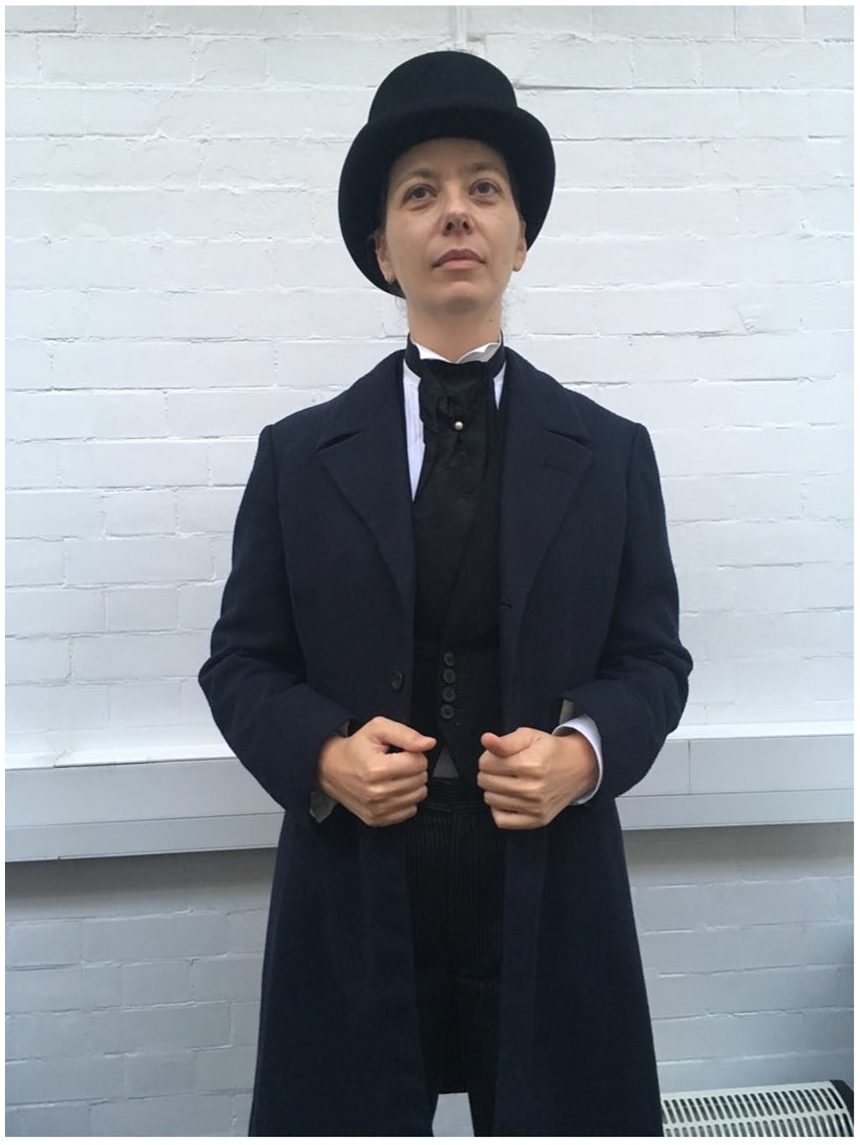
Moment of wearing the Victorian male costume after the job interview.
Back et al.’s (2012) approach of connecting belonging to immigration status, combined with that of May (2011), helps to understand the discomfort as a sense of (non)belonging that my fieldnotes express. In the hierarchy of belonging, my migration status did not allow me to participate in the national election and thus ‘in the reflexive arguments that contribute to changes in society’ (May, 2011, p. 374), and this exclusion had a profound effect on my sense of self and my place in British society. As a country, the UK voted against future membership in the EU, which had allowed me and my family to come and make a life in London. I made use of my right to free movement within the EU, including the right to participate in the politics of my chosen country at the local level, which in my case was the Borough of Hackney in London. In this borough, different migrant communities have lived historically. A tension between my strong attachment to London and my sense of unease with British society at large (Back et al., 2012) can be detected in the fieldnotes. The limits of the sense of belonging that I could achieve had been drawn clearly and repeatedly: ‘At 10 pm, they announced that “Get Brexit Done” had won the elections for the Tories. It was not hope that I had carried with me since the referendum in 2016. It was more an utter disbelief that it would happen. Brexit cannot happen; it just cannot.’ The longing that I felt to be included is captured by the denial of the fact of the outcome of the Brexit referendum and by the nearly religious belief of some announcement by the media that would turn reality into a bad dream of the past. However, there was none. The Tories and Brexit had won again. The garments mentioned amplify this unease, this discomfort: the school uniform and the Victorian male costume. They represent the history and identity of our chosen country, woven through and through with racism and xenophobia from Victorian times up until the day of 13 December 2019, the day after the General Election, when my daughter and I both had put on these garments.
Suppose belonging is a feeling of ease, of being at home, being included, listened to and being able to participate fully. In that case, the unease, the discomfort that my fieldnotes describe, is a sense of non-belonging: ‘My body trembles under the garment. It prickles my skin with thousand needles . . . I feel reduced and small in these clothes. They overpower me.’ While asserting that the urge to belong is ‘an extremely pervasive motivation’ (Baumeister & Leary, 1995, p. 497, quoted in May, 2011, p. 368) and is not only an internal but an intersubjective ‘negotiated accomplishment’ (May, 2011, p. 368) that comes about in social interaction, May also cautions against a too fast celebration of belonging. She argues that non-belonging inspires people to creatively carve out alternative ways of living and forms of identifications and thus contribute to social change. Being denied access to participate in the major decisions that directly affected the life of my child and me, I found another way to enter into dialogue with the society we lived in: we have put on the garments that represent this country and its people. The act of wearing enabled us to take part, be present, and be seen.
Nevertheless, the discomfort of not being wanted in this country did not stop with the act of wearing itself. On the contrary, it got heightened when the garment touched my body. The wearing of the costume could be interpreted as transforming the body as a site of resistance towards the state and its institutions, but also the nation which voted for Brexit. The garment embodied for me the British nation-state, which I put on my body; I brought it to the closest proximity to my skin. I will come back to this intimate relationship between garment and body in the second part of the article. Here, I want to argue that it was not only my conscious mind that engaged with the Brexit referendum and its consequences to my life, but my body itself reacted to it in unexpected and deeply affective ways through the act of wearing. It was the nation-state that framed my experiences. My relationship with the garment was formed by the Empire, Brexit, and the history of the nation fuelled by anti-immigrant sentiments. My body responded to the garment as it embodied the nation-state in its contemporary and historical forms. An affective battle unfolded between the body of the nation manifested by the costume and my own body, a body of an immigrant who is not wanted. The act of wearing itself, putting on a garment of a country not of my origin, established an affective relation with Britain: my body in discomfort moved from a strong sense of an overwhelming non-belonging to an active fight against the marginalisation I experienced. This ‘act’ – even if not manifested in anything else than in the transformation of my own affective dispositions – has helped me to carve out my place in the UK: a citizen of an uncomfortable position.
Wearing a garment as a research method
Wearing and the dressed (white) body in discomfort
My main concern in this section is to answer the question: so what? How does a single autoethnographic performative act matter for social research? How can I translate my own experiences and claims I have made about enacting citizenship through wearing that particular garment on that particular day just after the General Election of 12 December 2019 to be made useful for researching citizenship? The second argument of the article is to use wearing as an affective method for researching embodied citizenship and as a tool to essentially contest citizenship. Being able to generate and access the affective tension that lies between formal and lived citizenship is where wearing can be a useful method for social scientists researching belonging and embodied citizenship, migration, racialisation and whiteness, as it enables the interrogation of the dynamic between power and social norms manifested in citizenship laws and policies and the affective responses of the bodies they inscribe. Entwistle argues for considering dress as a situated and embodied practice in everyday life that brings together ‘the discursive and representational aspects of dress and the way the body/dress is caught up in relations of power’ and ‘the embodied experience of dress and the use of dress as a means by which individuals orientate themselves to the social world’ (2000, p. 39). My fieldnotes expressively convey how my body became entangled in power relations that the Victorian male costume brought close and how the tactile experience of the garment oriented my sense of self and sense of (non)belonging. Here, I want to explore this dynamic between wearer and worn further, and the discomfort that produces this dynamic.
At the centre of wearing as a method is the wearer: their body with its affective and emotional dimensions, curiosity, sensibility and subjectivity. The knowledge that the experiential body offers helps explore ‘how dress operates on a phenomenal, moving body and how it is a practice that involves individual actions of attending to the body with the body’ (Entwistle, 2000, p. 10, emphasis original). Entwistle offers a productive way forward. I want to push her arguments further on the experiential, phenomenal body to also consider its affective dimensions, the affective entanglements and exchanges between the wearer and the worn, the body and the dress, and think with ‘the ways people experience their bodies generate knowledges’ (Bacchi & Beasley, 2002, p. 345).
My specific focus is on normative whiteness and the sense of (non)belonging registered as discomfort that it has evoked in a white female body through the act of wearing a dress – and the epistemological and methodological potential of this discomfort. For Sarah Ahmed, discomfort as a ‘fidgety feeling’ foregrounds the social norms which ‘we do not quite inhabit’ and thus reappear in view: they take shape anew like the imprint of a body that does not fit comfortably in a chair (2014). Rachelle Chadwick conceptualises discomfort as ‘both an embodied and affective product of socio-material relations, physical spaces and locations, body-to-body exchanges and power relations and an affective force which does things in methodological, interpretive and analytic spaces’ (2021, pp. 558–559, emphasis original). For Chadwick, ‘staying with’ (Haraway, 2016) discomfort matters in feminist methodologies because it can open up (and/or close down) questions of enquiry because as ‘an affective intensity’, it ‘can dis/orientate researchers in particular’ (2021, p. 557). Through examining the tacit knowledges that the body produces in wearing, it becomes possible to expand on discomfort as a methodology in relation to wearing as an act of citizenship and to whiteness as the socio-political-historical context in which the wearing of the costume induced this discomfort.
My argument is that wearing as a research method enables the registering of the affective intensity of discomfort as a form of tacit knowledge of the body (Shotwell, 2011). Because of the affective knowledge embodied and produced in wearing a garment, it can serve as a potentially radical ‘epistemic resource for knowledge production and theory-making’ (Chadwick, 2021, p. 557) exactly because it does not reassure knowledge already out there but shifts the focus to other kinds of knowing that are deeply visceral and thus are capable of disturbing us at an intensely corporeal level (Hemmings, 2012). As discussed above, the fieldnotes capture the disorientation I felt as a result of my utter discomfort about carrying on living in a country that voted me out, a disorientation that got further exacerbated by the wearing of the garment. Following Chadwick, I would argue that the discomfort that my dressed body exhibited was not only a product of the dynamics between my intersecting discursive, representational, socio-material, embodied and relational contexts but also ‘did things’: it moved me to resist the confines of formal citizenship regulations and exclusions and create my own lived sense of (non)belonging and embodied sense-making about my changing political position and subjectivity.
Autoethnographic performances of white embodiments
‘Staying with’ the unease, the discomfort of being a problem is crucial for rupturing whiteness and for developing ethical research on whiteness by white researchers that resist the impulse for comfort by flattening out ways in which power relations and differences materialise (Yancy, 2015). I want to retain the focus on the body in discomfort in an autoethnography of whiteness within a ‘methodology of the privileged’ (Sholock, 2012). As a correlative to a ‘methodology of the oppressed’ (Sandoval, 2000), a methodology of the privileged works towards refusing ‘the systematic nature of ignorance’ that white Western feminists display in anti-racist and transnational feminism due to their privileged socio-material and epistemic positionings (Sholock, 2012, p. 703). Chadwick argues for staying with discomfort to ‘engage and resist normative whiteness and enact “epistemic uncertainty” as a mode of feminist praxis’ and thus can be part of a methodology of the privileged (2021, p. 560).
Expanding Sholock’s and Chadwick’s approach to an ‘autoethnography of whiteness’ (Moosavi, 2022) that uses wearing as a tool to dwell on ‘feeling-senses’ (Chadwick, 2021, p. 560) of the body, I want to challenge the disposal of affects as the subjective feelings of researchers and argue for them to be regarded as a ‘way of knowing otherwise’ (Shotwell, 2011) and as having an agency on their own terms. Critiques of autoethnography as self-indulgent and narcissistic without much merit concerning knowledge production (Delamont, 2009; Walford, 2020) are particularly pertinent to Critical Whiteness Studies, which from the 1980s (when it became a broader field of scholarly interest) have been haunted by its paranoia of re-centring whiteness as an object of analysis (Ahmed, 2004). Autoethnography by white academics, however, has discussed whiteness, most notably through McIntosh’s influential text on white privilege (1989).
While McIntosh’s list of privileges is based on the routine encounters of her daily life, the autoethnography presented in this article is of a single performative act of a single day. Acknowledging that the empirical grounding of the arguments presented in this article might be critiqued for its singularity, I would assert that the specific spatio-temporal context of the act and particular body of the wearer and the garment worn merit the autoethnographic performance the rich empirical premise upon which theorising the affective assemblage of an ‘act of embodied citizenship’ was made possible. Drawing on Harold Lloyd Goodall Jr, the ‘felt-text’ that is the autoethnography of this article aimed to be ‘done well’, in that it ‘completely dissolves any idea of distance, doesn’t produce “findings,” isn’t generalizable, and only has credibility when self-reflexive, and authority when richly vulnerable’ (Goodall, 1998, p. 2). In his autoethnography of whiteness, Moosavi refers to ‘analytic autoethnography’ by Anderson (2006) and ‘moderate autoethnography’ by Wall (2016), who ‘suggest that autoethnographies should be attuned to existing academic literature, theory and concepts, and aim for a realistic degree of objectivity and accuracy in the research process’ (2022, p. 111), which I have also aimed to follow in this article. In the face of these critiques against white autoethnography, I would maintain that conceiving of an ‘autoethnography of whiteness’ within the framework of a ‘methodology of the privileged’ the focus of analysis should be shifted to bodies and their affective entanglements and the tacit forms of knowing they hold and produce. As Tami Spry put it: ‘If autoethnography is epistemic, then the evidence of how we know what we know must reside in the aesthetic crafting of critical reflexion upon the body as evidence’ (2009, p. 603).
Wearing a garment is the most tacit and tactile experience of the body, ‘of “being in” or “being with” rather than observing from the outside’ (Sampson, 2018, p. 55). Because of this, wearing can be used effectively to ambush how comfortable epistemic racialised certainties are being reproduced that continue to centre white Western middle class cis-gendered, heterosexual and able-bodied knowledges. Analysing the affects of discomfort that wearing can bring about could be a potentially productive tool for countering ‘racialised ignorance’ (Sholock, 2012, p. 701) of white researchers precisely because their analytic focus is redirected to how they are implicit in reproducing colonial modes of doing research (Chadwick, 2021).
Conclusion
I step into the interview room: the faces of the panel, when they see me, tell me that they will get me. They will be open to what I have to say about arriving dressed like this.
After the interview, when I walk to the library, I run into my PhD supervisor: I salute her by raising my hat. We laugh.
The relationship between discomfort, embodied citizenship, belonging and wearing has been the focus of this article. As I have shown, clothing is at the centre of what it means to belong, to feel included, valued and of worth and can be used not only as a tool for researching citizenship and belonging but as a means to resist exclusion and marginalisation. By paying close attention to how individuals can be moved to act regardless of the positions they occupy I have demonstrated the generative power of discomfort. The arguments I have presented in this article on using wearing as a research method to access the affective life of power at the intersubjective and intercorporeal level are relevant to research on migration, racialisation, whiteness, belonging and citizenship studies, as well as to embodied methodologies. With the two propositions I have developed in the article, I have brought (1) embodied methodologies to citizenship research and (2) belonging as the affective aspect of citizenship to the embodied method of wearing a garment. I have demonstrated that dressed bodies and the sensed experience of (non)belonging they produce are worthy of attention.
With a particular focus on the intimacies of wearing clothing, citizenship unfolded in my account as ‘lived’, revealing ‘what citizenship actually means in people’s lives and how our lives as citizens are affected by our social and material circumstances’ (Hall & Williamson, 1999, p. 2). Through engaging with my own ‘gut feelings’ (Ahmed, 2017), the article has opened up a new avenue of producing a subject who is carving out a form of (non)belonging via wearing a particular historical garment at a specific spatial-temporal conjuncture. As Isin and Nielsen assert, ‘acts of citizenship create a sense of the possible and of a citizenship that is “yet to come”’ (2008, p. 4). At the time of wearing the costume and up until writing this article, I do not know if there was any formal citizenship yet to come for me, but I have affectively claimed certain rights through the act of wearing and demonstrated that (non)belonging as discomfort and as ‘an affective point of rupture’ (Chadwick, 2021, p. 561) could be a useful resource in researching citizenship.
Footnotes
Acknowledgements
My heartfelt thanks to Fauzia Ahmad for encouraging me to write about this experience, to Katja May for her unconditional support during the challenging postdoctoral job we both were hired for, and to Monica Degen for her invaluable feedback. The editor and the anonymous reviewers provided me with the most insightful comments and guided me through a revision process of care. I will always be grateful for their knowledge and kindness.
Funding
The author received financial support for the research and authorship of this article from the Leverhulme Trust.