




Abstract
Recent works on stigma have emphasised the importance of ‘looking up’ towards issues of power and stigma production. In that process, empirical attention to stigma resistance ‘from below’ has remained limited. When resistance is discussed, it typically takes the form of collective, organised and explicit resistance. Drawing on insights from resistance studies, this article pays attention to everyday practices of resistance that are subtle, unorganised and implicit and calls for an empirically robust theory of stigma resistance. In doing so, it contributes to the recent revival of the sociology of stigma. Based on ethnographic research methods, the article discusses the stigmatisation of people with intellectual disabilities in sheltered workshops and identifies three anti-stigma practices: (1) redirecting, (2) replacing and (3) redefining stigmatising norms. Two lessons can be learned from this study and inform future research. First, everyday resistance is ambivalent: it implies a partial incorporation and partial rejection of norms. Second, rather than political intention (only), stigma resistance can be based on a variety of desires and needs. Recognising this allows us to see stigmatised people as individuals who have at least some power to fight and transform stigma.
Introduction
The last years have seen a renewed attention for the concept of stigma. While Goffman (1963) long occupied an authoritative position in the field, his work was recently criticised for being too micro-sociological and failing to pay attention to power (Link & Phelan, 2001; Parker & Aggleton, 2003; Scambler, 2018, 2020; Tyler, 2018, 2020; Tyler & Slater, 2018). His approach would sideline political questions about ‘where stigma is produced, by whom and for what purposes’ (Tyler & Slater, 2018, p. 721). Increasingly, stigma is conceptualised as a form of power used to discipline and exploit people (see for example the special issue from 2018 in this journal titled The Sociology of Stigma). Hence, stigma production is approached as part of a political strategy, and the focus lies on institutions, states, corporate and financial organisations.
With the turn to power and stigma production little is said about how individuals negotiate and resist stigma (Dukelow et al., 2022; Hicks & Lewis, 2020; Müller, 2020). Summarising the various contributions of a recent themed section on ‘Interrogating welfare stigma’, Dukelow et al. conclude that ‘[resistance] is still somewhat of a black box in our interrogation of stigma’ (2022, p. 628). While various authors point out the importance of attending to stigma as a site of struggle and resistance (Link & Phelan, 2001; Tyler, 2020), empirical attention to stigma resistance has remained limited. In the few instances resistance is discussed, it typically takes the form of collective, organised and explicit resistance. Exceptions are found in studies of devaluation and marginalisation on housing estates, working-class communities and territorial stigmatisation (e.g. Leaney, 2019; McKenzie, 2015). However, these works have not explicitly engaged with the theoretical legacy of stigma and its recent powerful revival.
Drawing on insights from resistance studies, this article looks at how stigma as a structuring power is met and resisted by a group of young men with mild intellectual disabilities working at sheltered workshops in the Netherlands. Following decades of oppression, exclusion and discrimination, the second half of the twentieth century saw disability movements fight for more participation (Barnes et al., 2002; Digby, 1996; Trent, 1994; Weijers & Tonkens, 1999). Part of their struggle was access (or return) to employment (Van Oorschot & Hvinden, 2000). Local governments embraced the emphasis disability movements put on labour participation. With social security costs on the rise, the prevalent idea was that the welfare measures were too generous, turning citizens into dependent, lazy subjects (Holmqvist, 2010; Newman & Tonkens, 2011; Van Oorschot & Hvinden, 2000). Activating policies had to bring a change to this scenario and were implemented from the 1980s onwards.
While the ideal of labour participation is related to both top-down economic restructurings and bottom-up demands for equal rights and access to employment (Tonkens, 2016; Trappenburg, 2015), participation is increasingly defined as competitive labour participation (Abberley, 2002; Borghi & Van Berkel, 2007; Butcher & Wilton, 2008; Holmqvist, 2010; Van Oorschot & Hvinden, 2000). Goodley (2011, 2014) speaks about ‘neoliberal ableism’ as a state of affairs that idealises citizens that are physically and cognitively able and competent, autonomous, self-sufficient and economically viable. This article focuses on people with mild intellectual disabilities who cannot live up to neoliberal demands of autonomy and productivity and on the consequences this bears in terms of stigma and stigma resistance. These are not entirely new topics for disability researchers (see for example Frederick, 2017; Logeswaran et al., 2019; Scior et al., 2022). Despite interesting empirical insights, these works typically do not refer, or add to, recent developments in the sociology of stigma.
This article explicitly aims to put its empirical insights at the service of this evolving field. It presents three anti-stigma practices that respectively revolve around redirecting, replacing and redefining stigmatising norms. The ethnographic data highlight (a) the ambivalence of resistance practices in everyday life, and (b) the variety of desires and needs that lie at their basis. In the discussion of the article, attention is paid to the limits and possibilities of these resistance practices and lessons for future research are outlined. The article contributes to the recent revival of the sociology of stigma by opening the ‘black box’ of stigma resistance and calling for a nuanced, empirically robust account of stigma resistance that recognises and theorises subtle, unorganised and implicit forms of resistance.
Stigma and power
In his famous work Stigma: Notes on the Management of Spoiled Identity (1963, p. 3), Erving Goffman defines stigma as an ‘attribute that is deeply discrediting’, spoiling a person’s social identity. However, rather than an attribute, stigma must be thought of as an issue of relationships and interactions between subjects (Goffman, 1963). Goffman speaks about ‘social norms’ to describe the specific rules and conventions that govern social life. From a very young age, so Goffman argues, people are socialised into learning about these norms and behaving accordingly. People who deviate from social norms in a particular situation get stigmatised. When particular social norms lead to the stigmatisation of (groups of) people, we might call them ‘stigmatising norms’ or what Graham Scambler (2020) calls ‘norms of shame and blame’, i.e. norms that, when violated, lead to stigmatisation and experiences of shame and blame. According to Link and Phelan (2001), particular social norms lead to stigmatisation when four components co-occur, namely labelling and stereotyping differences, separating ‘us’ from ‘them’, status loss and discrimination.
Throughout the decades, Goffman’s perspective on stigma has been taken up by various symbolic interactionists (Tyler & Slater, 2018, p. 729). In recent years, some scholars have critiqued the symbolic interactionist approach for narrowly focusing on interactions and failing to take into account the role of power and social structures (e.g. Parker & Aggleton, 2003; Scambler, 2020; Tyler, 2020). Goffman’s account of social norms would fail to recognise that stigmatisation serves a particular purpose and that what counts as normal does not exist outside of specific power-constellations (Scambler, 2020, pp. 18–20; Tyler, 2020, p. 99). Taking this critique as their point of departure, authors like Imogen Tyler and Graham Scambler have written ambitious and valuable works that approach stigma as a mode of governing that is deeply embedded in power hierarchies. From this perspective, the production of stigma serves political and economic ends such as capital accumulation (Tyler, 2020; Tyler & Slater, 2018) and ‘financial capitalism’ (Scambler, 2018, 2020). The stigmatisation of vulnerable groups legitimises austerity measures by framing them as undeserving and unworthy of state support (Scambler, 2018; Tyler, 2018). Therefore, the focus of stigma research should lie on institutions, states, corporate and financial organisations, their motives and political strategies rather than on interactions between individuals.
One such example is Tyler and Slater’s study of the stigmatisation and destigmatisation of mental health in the UK (2018). Zooming in on a mental health campaign aiming to remove stigma, the authors note that mental health is turned into a biogenetic issue. In doing so, the campaign overlooks the social explanations of mental distress, as well as important cultural, political and economic questions regarding the distribution of distress in society, such as the erosion of public service provisions (Tyler & Slater, 2018). Other similar analyses deal with HIV/AIDS related stigmatisation (Parker & Aggleton, 2003), discriminatory policies for people with disabilities (Scambler, 2018), people suffering from asthma (Monaghan & Gabe, 2019), migrants, chronic illness, sex-workers and the homeless (Scambler, 2020). In all these studies, authors show the importance of paying attention to the structural and structuring forces of stigma.
Stigma resistance
The particular interest of this article lies with the theme of stigma resistance and its role in the recent stigma literature. In the process of ‘looking up’ towards issues of power and stigma production, relatively little attention has been paid to stigma resistance (Dukelow et al., 2022; Hicks & Lewis, 2020; Müller, 2020). Resistance can be defined as ‘an act or patterns of actions, which might undermine or negotiate different power-relations’ (Baaz et al., 2017, p. 128). With regard to stigma, resistance can be defined as those actions that undermine or negotiate stigmatisation and the shame it instils.
Recent works on stigma recognise the importance of studying stigmatisation as a site of struggle and resistance (Scambler, 2020; Tyler, 2020). However, empirical attention to stigma resistance has remained limited, resulting in what Dukelow et al. have called the ‘black box’ of stigma resistance (2022, p. 628). In the few instances that resistance is given empirical attention, two things are remarkable. First, resistance is conceptualised as (effective) resistance only when it is collective and organised. For example, Tyler (2018, 2020) discusses resistance in the context of formally organised social movements like the Civil Rights Movement. She describes how resistance against the stigma of racial inferiority took the form of ‘staged kneel-ins at segregated churches, sleep-ins at segregated motels, swim-ins at segregated pools’ (Tyler, 2020, p. 94). An estimated 50,000 people participated in various anti-stigma actions, thereby growing into the ‘largest mass movement for racial reform and civil rights in the 20th century’ (Tyler, 2020, p. 94). For their part, Scambler (2020) and Scambler and Paoli (2008) introduce the concept of ‘project stigma’ to denote individuals’ active resistance to discrimination and the internalisation of shame. While Scambler recognises that (individual) project stigma can lead to change, he delegitimises this point when claiming that ‘[e]ffective resistance to attributions of shame and blame is reliant, in the last resort, on structural, cultural and institutional change, and key to such change is class mobilisation’ (2020, pp. 101–102, my emphasis). In other words, in both Tyler and Scambler’s writings the emphasis lies on collective, organised forms of resistance.
A second tendency is that resistance is only conceptualised as such when it is based on explicit political intentions. Scambler’s project stigma is defined as an ‘explicit rejection of stigma . . . and purposeful intent to resist and counter [stigma]’ (2020, p. 26, my emphasis). Tyler’s examples too highlight how various participants and actors strive towards the same goal with a clearly visible, political intention (2018, 2020). Little attention is given to forms of resistance that are more subtle, implicit and not formally organised. 1 This reflects a more general tendency in the academic literature and the public debate, namely that resistance is often conceptualised as the ‘public confrontations of authorities by formally organised collectives (in the conventional forms of political parties, nongovernmental organizations, civil society associations or social movement organizations)’ (Johansson & Vinthagen, 2020, p. 3). In disability studies dealing with the theme of stigma resistance, such organised collectives take the form of advocacy groups and social justice movements (e.g. Deaf Movement, Disability Justice Movement) (Frederick, 2017; Scior et al., 2022). It is through advocacy groups that people with (intellectual) disabilities learn to redefine stigmatising norms and transform negatively evaluated identity traits to positive ones, or learn to see their diagnosis as pertaining to only a (small) part of their identity (Logeswaran et al., 2019; Scior et al., 2022). Individual agency, as well as more implicit and ambivalent forms of resistance remain out of sight.
This article is not the first to note the lack of attention for the agency of the stigmatised (Hicks & Lewis, 2020; Müller, 2020). According to Frederick’s (2017) work on people with disabilities, the stigma literature has tended to emphasise the tragic aspects of living with disabilities and has left little space for agency. In reviewing the recent stigma literature, Müller (2020, p. 11) argues that many studies assume individuals have no power or agency to fight and resist stigma. A few exceptions can be found in recent works published in The Sociological Review (Hicks & Lewis, 2020; Queirós & Borges Pereira, 2018; Thomas, 2021). However, only in Hicks and Lewis (2020) do we find an explicit theoretical point about stigma resistance. Building on Plummer’s (1975) interactionist account of stigma, they argue that ‘the stigmatised’ also resist and allocate stigma (to others), or they rework the stigma in such a way that it becomes the basis for claims of respectability (Hicks & Lewis, 2020).
This article agrees with other authors who have argued that stigma resistance is an important and promising avenue for future research (Dukelow et al., 2022). By ethnographically studying the everyday lives of people with mild intellectual disabilities it identifies empirical forms of stigma resistance. Drawing on resistance studies, more specifically the concept of ‘everyday resistance’ (Baaz et al., 2017; Johansson & Vinthagen, 2020; Peterie et al., 2019; Scott, 1985), the article aims to contribute to a nuanced, empirically robust account of stigma resistance. James Scott introduced the concept in 1985 to point at forms of resistance that were politically meaningful, yet did not resemble the collectively organised forms of resistance that were typically discussed. Everyday resistance points at day-to-day practices through which relatively powerless individuals and groups attempt to resist their marginalisation. It is typically ‘hidden or disguised, individual and often not politically articulated’ (Johansson & Vinthagen, 2020, p. 5). From this perspective, resistance is a practice that can be organised and played out by large movements but also by individuals and subcultures; it can ‘undermine or negotiate different power-relations, but sometimes ends up reproducing and strengthening relations of dominance’ (Baaz et al., 2017, p. 128).
The usefulness of the concept of everyday resistance for studying the lives of people with disabilities has been noted before. Frederick (2017) identifies three types of resistance strategies of mothers with physical and/or sensory disabilities, which she respectively calls visibility politics, respectability politics and disengagement. Despite her valuable empirical contributions to the literature on stigma resistance, she does not integrate her findings in the broader sociological debate on stigma.
In this article, it is suggested that the concept of everyday resistance has important contributions to make to the conceptualisation of stigma resistance in the sociology of stigma. First, everyday resistance is ambivalent; it implies a partial incorporation and partial rejection of norms. In the discussion it is suggested that recognising ambivalent forms of stigma resistance helps to underscore the tenacity of ‘stigma power’ that recent works on stigma highlight (Scambler, 2018, 2020; Tyler, 2020; Tyler & Slater, 2018). Second, rather than political intention (only), stigma resistance can be based on a variety of desires and needs. Recognising this allows us to see stigmatised people as individuals who have at least some power to fight and transform stigma.
Methods
The article draws on 19 months of ethnographic fieldwork (2013–2016). Fieldwork was carried out in three sheltered workshops for people with (mild) intellectual disabilities, part of a large care organisation in the Netherlands (referred to as ‘CareWell’ in this article). Sheltered workshops are workplaces for people with disabilities who would not otherwise have access to the open labour market (European Union [EU], 2015). A general distinction is made between traditional and transitional sheltered workshops (EU, 2015). Transitional sheltered workshops make products, perform services that can be sold, or train people to do so in the future. Transitional sheltered workshops are preferred, mainly because of the cost benefits they offer in comparison to traditional ones (EU, 2015). This European-wide preference reflects an increasing concern with the productivity side of participation, as well as efforts to marketise welfare arrangements like sheltered workshops. The sheltered workshops included in this research focused on technical reparations, green maintenance, and retail work for a regular company.
A total of 37 workers with mild intellectual disabilities and 22 professionals supporting and working with them on a daily basis were included in the research. The focus on men was a pragmatic one: men outnumbered women in all but one of the sheltered workshops that were visited in preparation for this study. The majority of the young men working at the sheltered workshops came from lower class backgrounds and roughly one third of all participants had a migration background.
The main method of the study was participant observation. It consisted of joining workers and supervisors in their daily activities at sheltered workshops, carrying out tasks (such as repairing things, weeding or cleaning toilets) and learning from the workers, engaging in informal conversations, drinking coffee and taking breaks together. Attention was directed to people’s talk, emotions, body posture, facial and verbal expressions that were in any way related to their positioning as workers with disabilities at the sheltered workshop. Approximately 600 hours of observations were carried out. Notes were taken during fieldwork, mostly on the cell phone, and transcribed the same day in order to provide a thick description of everyday life at the sheltered workshops. This resulted in 306 pages of observations.
Observations were enriched by interviews and informal conversations. Informal conversations with workers included talking about their past and future aspirations, daily work experiences, relationships with colleagues and professionals. Participation in the interviews was voluntary and flexible. Semi-structured interviews were conducted with 19 of the 37 workers across the three sheltered workshops. With the majority of the remaining workers, an interview was not possible because they had left the sheltered workshop or because they were absent for a variety of reasons (irregular attendance, unknown reason, sick, in rehabilitation or crisis). In two cases, workers did not want to be interviewed.
Research involving people with (mild) intellectual disabilities requires a high level of ethical awareness and sensibility (Doody, 2018). Informants were repeatedly informed about the purpose of the study, their right to refrain from participation and the anonymisation of collected data, leading to what has been called ‘continuous consent’ (Duncombe & Jessop, 2002). A ‘logbook’ was kept to keep track of how workers responded to the given information, and professionals were asked to ‘double-check’ the researcher’s interpretation of those reactions. Persons who reacted negatively were excluded from the observations. For the interviews, recorded verbal consent was obtained from all participants. This combination of keeping a logbook and recording verbal consent was devised in accordance with CareWell and the Ethical Committee of the Amsterdam Institute for Social Science Research (University of Amsterdam). The latter formally approved this study.
Ethnographic data were contextualised through a thematic content analysis (Hsieh & Shannon, 2005) of various policy documents, including publications from national research institutes, legislation from Dutch ministries, (publicly available and internal) documents from CareWell’s sheltered workshops, vision documents and annual reports, personal notes from meetings and conferences with CareWell’s managers and coordinators. Interviews were transcribed verbatim and, together with all field notes, analysed thematically (Hsieh & Shannon, 2005) in the qualitative data analysis programme Atlas.ti.
This research builds on a constructivist paradigm that takes seriously the researcher’s positionality and his/her influence on the process of knowledge production (Spencer & Davies, 2010). For example, being the only woman in a masculine environment clearly impacted what happened in the field (for more details, see Sebrechts, 2018). Likewise, my position as a university researcher cannot be detached from power hierarchies that unequally value citizens who are cognitively able, self-sufficient, economically viable and citizens who are not (Goodley, 2014). Casting my gaze ‘downwards’ to study the lives of people with intellectual disabilities, then, might have generated or intensified moments of shame and stigma. By reflecting on my implication in the field and my role in potential (de)stigmatising practices in various empirical parts of the article, I aim to add rigour to the ‘validity’ of the study (in its constructivist rather than positivistic sense) (Green & Thorogood, 2009).
Disabling stigma
The diagnosis of mild intellectual disability is medically defined according to three criteria (Schalock et al., 2007): an intelligence quotient below average (IQ 50–70), social and practical problems (e.g. with empathy, social judgement, interpersonal communication, daily self-care), and the identification of these problems before age 18.
Before diving into the theme of stigma resistance, it is important to briefly discuss the ways in which people with mild intellectual disabilities are stigmatised and the political context in which this occurs. Following Link and Phelan’s (2001) four components of stigmatisation we see, first, that the ‘differences’ of people with mild intellectual disabilities are distinguished and labelled. From an early age, children whose intellectual capacities fall behind, are followed up by various professionals. Before the age of 18, these problems are labelled as signs of a mild intellectual disability. Second, their differences are negatively stereotyped (Link & Phelan, 2001). Contrary to various other types of disabilities, people with intellectual disabilities have only minimally been able to construct their differences as ‘positive differences’ that could provide them with a sense of pride and value (Anderson & Bigby, 2016; Goodley, 2011). Third, people with intellectual disabilities are separated from society (Link & Phelan, 2001). Despite the move away from institutionalisation, many still live in special housing blocks, and across different countries, only 9–40% of people with intellectual disabilities have regular paid employment (Ellenkamp et al., 2016). Last, people with mild intellectual disabilities experience status loss and discrimination on a daily basis (Link & Phelan, 2001).
Respondents in this research recalled experiences of being bullied, of discrimination on the regular labour market and of feeling looked down upon for their dependency on professional support, welfare benefits and their involvement in sheltered workshops. Working at sheltered workshops is typically not seen as ‘real work’. Like a welfare official said to one of the respondents in this study (Billy): ‘sheltered employment is not worth much’ [‘stelt niks voor’, literally ‘does not represent anything’]. Additionally, there is a constant emphasis on transitioning to the regular labour market, indicating that sheltered workshops stand at the bottom of a hierarchical system that values productivity.
The stigmatisation of sheltered workshops and intellectual disabilities resulted in feelings of shame among respondents. Some openly expressed their feelings of shame, others showed their shame more indirectly, for example through hiding the workshop’s logo behind a pin, cutting the logo from their trousers, wearing work clothes from a previous (paid) job and showcasing a fictive job at a company on their Facebook profiles (Sebrechts, 2018). It is worth noting that respondents might have felt more ashamed in interactions with me, a cognitively able, self-sufficient and economically viable researcher from a powerful institution. Nevertheless, conversations with workers and professionals confirmed that feelings of shame were a more general and recurrent experience for many workers.
Workers’ feelings of shame cannot be properly understood without turning to the production of stigma on an institutional level as the recent revival of the sociology of stigma suggests (Scambler, 2018, 2020; Tyler, 2020; Tyler & Slater, 2018). With the implementation of the (revised) Social Support Act [WMO 2015] and the Participation Act [Participatiewet 2015], Dutch sheltered workshops were forced to marketise their products and services. This was accompanied by budget cuts, leading many sheltered workshops to end up in financial troubles with little certainty about the future. Simultaneously, the access to disability benefits [Wajong] for people working at sheltered workshops became stricter. Only people with no so-called ‘wage value’ [loonwaarde] and with no future possibilities retained the old benefits of 75% of the national minimum wage, i.e. €1275 per month. All others 2 now rely on less royal social assistance benefits (€1078) accompanied by a set of strict re-integration duties and sanctions. Recent research has shown that this new system has not resulted in more job opportunities for people with (mild) intellectual disabilities, but rather, caused more insecurity and precarity (Van Echtelt et al., 2019).
From the perspective of stigma power, cuts to social provisions are legitimated through strategies of stigma production that depict people with intellectual disabilities as deviants (with moral deficits rather than ontological deficits) who are undeserving of state support (Scambler, 2020; Tyler, 2020). That also rings true in the context of this study: in the process of marketising sheltered workshops and restructuring the benefit system, an increased emphasis is put on workers’ responsibility to become independent and productive. Those who fail to become independent and productive workers, ideally on the regular labour market, are increasingly shamed and blamed for failing to succeed (Sebrechts, 2018). However, the story does not end there. Within this stigmatising context workers also resisted their stigma in various ways.
Stigma resistance practices
Practice 1: Redirecting
Workers in this study repeatedly distanced themselves from other workers at the workplace and redirected the stigma surrounding sheltered workshops to their colleagues. In interviews and informal conversations workers explained to me who ‘real [welfare] clients’ were and emphasised how they were different from them. Differences were mainly based on a range of skills and behaviours related to independency and productivity, as opposed to the dependency and lack of productivity associated with people working at sheltered workshops. Kevin, for example, explains to me:
On our side [referring to one of two sheds at the sheltered workshop] there actually work normal people; you don’t notice the disability. But when you look at the other shed [. . .] Those are people who do deserve the label. You really see they have a mild intellectual disability [. . .] in how they behave and stuff [. . .]
How do they behave then?
I don’t know. . . differently than we do, I think! [. . .] I think they need more supervision and direction in what they do, for their projects.
For Kevin, what it means to be a ‘real client’ is linked to people’s outer appearance but also to their behaviour: they do not look and act what he considers to be ‘normal’ because they need support in their daily work activities.
The emphasis on dependence is a recurrent theme in workers’ stories about being a client in a sheltered workshop. According to Dylan, another worker, it means ‘that you are involved with CareWell [care organisation] on a daily basis’. Mitchell, too, after laughing at my question of whether or not he sees himself as a person with intellectual disabilities, expresses the belief that a person with disabilities is ‘somebody who really cannot do anything on his own’. Yet another worker, Adriaan, upon asking him whether he sees himself as a CareWell client, strongly and indignantly answers ‘nooo, I am not a client’, ‘I often give grass trimmer lessons [. . .] When new people come, I have to teach them.’ Rather than being in need of support, he presents himself as someone who gives support to other people. There is definitely some truth in this: Adriaan also taught me how to trim the grass and keep the pathways beautiful. But what Adriaan does not mention is that this seldom happens. The emphasis on (in)dependence is entwined with an emphasis on productivity. Adriaan’s example already hints at this: in presenting himself as a person who gives trimmer lessons, he distances himself and ridicules dependency, but also hints at his productivity: by trimming the grass and teaching newcomers, he makes an important contribution to the workplace.
Dylan also repeatedly emphasises his important status at the sheltered workshop. He does so by pointing to the work tasks he carries out and contrasting this with the inability of ‘real clients’ to do so. Dylan is one of the few workers who possesses a driving licence and is responsible for delivering cooked meals to nearby CareWell facilities. This makes Dylan feel valued and indispensable. Dylan repeatedly explains to me that he knows how to drive the car, does not need instructions or support from professionals, and does something important: people need food! In contrast to his colleagues who are helpless and ‘in need of CareWell’, Dylan acts and feels like a boss: he regularly commands his colleagues and considers himself ‘some sort of manager’ at the sheltered workshop. Like Dylan, many workers put huge effort into making the distance between themselves and the other ‘real’ clients as big and obvious as possible, perhaps as a way of not getting ‘contaminated’ by that other person’s stigma (Goffman, 1963).
The above examples can be identified as acts of everyday resistance because they (temporarily) undermine or destabilise (some aspect) of dominance (Johansson & Vinthagen, 2020). In this case, workers distance themselves from the dominant, stigmatising framing of people with mild intellectual disabilities as dependent on support and as not contributing to society through work. Others might be dependent and unproductive, yet they are not. In different ways and to various degrees, workers tell stories and perform actions to prove to professionals and to me, the researcher, that they are in fact making important, independent contributions to the workplace.
At first sight, these practices might not be recognised as ‘stigma resistance’ because they in no way resemble a public confrontation of authorities by a formally organised collectivity. Yet, they are more than purely individual and isolated acts. They are clear ‘patterns of practices done by individuals or informal gatherings of groups, in which they engage with power relations or the effects of power in their ordinary lives’ (Johansson & Vinthagen, 2020, p. 3), in this case the inferior positioning of people with intellectual disabilities working at sheltered workshops.
While this first resistance practice allows some of the workers to escape feelings of shame, it must be noted that they simultaneously reproduce the norms of independency and productivity. Some workers can stand out as ‘productive’ and ‘independent’ workers in contrast to those others who cannot live up to those norms. In other words, the stigma is reproduced and redirected to others, and results in a divisive atmosphere at the sheltered workshops. This resembles findings from other welfare studies that describe how social assistance recipients reproduce the stigmatising public discourse when talking about fellow recipients as a way to distance themselves from the stigma and maintain a sense of self-respect (Chase & Walker, 2012; Shildrick & MacDonald, 2013). In the discussion of this article, more will be said about this ‘ambivalence’ of everyday resistance, i.e. its potential to undermine and simultaneously strengthen relations of dominance.
Practice 2: Replacing
Workers also resisted stigmatisation by replacing stigmatising norms with other, local, social norms that could provide them with a sense of pride and self-esteem. The dominant norms of independency and productivity were made irrelevant in relation to other norms, in this case, being ‘streetwise’.
What stood central in this type of resistance is that working at a sheltered workshop was presented as resulting from (partly) self-chosen, rough behaviour and spoken about braggingly. When I ask Gino why he works at a sheltered workshop, he answers ‘because I have a criminal record’. He beams with pride and adds that he even threw a party when he first received a criminal record. Another example occurs on a day when there is little work at the sheltered workshop:
Worker Kevin is ‘playing’ with the van (driving around in circles, driving backwards, etc.) on the premises of the sheltered workshop. I feel bored and also a little uncomfortable about being bored, so I go and sit next to him in the van. He stops driving. Not much later his colleague David joins us. We talk about the event tomorrow – we are going to a so-called Participation Fair for people with intellectual disabilities where various sheltered workshops, including this one, try to recruit new clients. I ask Kevin how he would call the people who attend the event. He replies ‘street criminals’. I ask him: ‘are you a street criminal then’, to which he replies that he has done a number of bad things [‘ik heb wel wat op mijn kerfstok staan hoor’, literally ‘to have a lot of debts on one’s tally’]. Kevin repeats it twice. It is not the first time I hear him mention this, which makes me suspect he is proud of it. [10 November 2014]
Without making it as explicit as Gino, Kevin indicates that people who work at sheltered workshops (like himself) or intend to do so (referring to visitors of the Participation Fair) generally do not have clean hands. Not having clean hands is a reason for having ended up at the sheltered workshop and for being ‘stuck’ there for a number of years already.
Another worker, Roy, proudly points at his aggressive conduct as the reason for being a worker at the sheltered workshop. ‘My mother had a difficult time because I was aggressive.’ He continues to say: ‘I started fighting and so my mother asked for help.’ The help came in the form of a boarding school, after which he was sent to live in different assisted living facilities and ended up at the sheltered workshop under supervision of CareWell.
In these various situations, workers resisted the dominant (and medicalised) discourse that frames their intellectual disability as something that necessarily defines them and their life course. Instead of feelings of shame, feelings of pride surface. This indicates a second way in which workers could resist stigmatisation in everyday life: by replacing dominant norms of independency and productivity with other norms related to being a ‘bad boy’, a (petty) criminal and acting streetwise. These norms are intersubjectively constructed as valuable at the sheltered workshops, but rely on broader discourses of (working-class) masculinity (Connell, 2005). According to Johansson and Vinthagen (2020, p. 37), ‘[it is] the existence of norms in a subaltern community that creates the circumstances in which coordination is possible, which makes what seems like spontaneous and individual acts into collective patterns of acts [of everyday resistance] within a community’.
Reflecting on this second anti-stigma practice, it can be noted that stigmatising norms of independency and productivity are not challenged, but are also not reproduced, in the sense that they are not the norms workers refer to. Other, local social norms are made relevant and value is rearticulated in alternative terms (see also Evans, 2022; Skeggs, 2011). As such, workers could move past the stigma that being a welfare client at a sheltered workshop implied and regain status. Instead of passively accepting their stigmatisation, they use their agency to (re)interpret their life course as something they (partly) direct because of their streetwise behaviour. This makes them feel proud instead of ashamed and enables them to resist (part of) the inferior positioning.
Practice 3: Redefining
A third type of stigma resistance consisted of redefining dependency as interdependency. Rather than redirecting the stigma to (more) dependent and unproductive others (practice 1), or making independency and productivity irrelevant (practice 2), in this practice dependency was transformed from abnormal and shameful into a normal and universal human characteristic.
Workers proclaimed in different ways that ‘everybody needs a little help once in a while’. For example, Samir explains to me that CareWell is just an institution for ‘everybody’ but then specifies it is ‘for people who are handicapped or people who have difficulties with learning’. He explains that he is a client at CareWell because he is not good at reading and writing but that ‘all people have their own problems’ and ‘everybody has his own shortcomings’ for which they need help. Samir normalises the difficulties and the support he needs.
Other social actors at the sheltered workshop, like professionals and volunteers, seemed to play an important role in this stigma resistance practice. One day, while sitting at the coffee table, one of the professionals says to the workers:
‘Everybody is intellectually limited [‘beperkt’ in Dutch]: if you cannot read or do maths well you are already intellectually disabled’. A volunteer mingles in the conversation and asks us whether we have ever seen people who are normal and whether that was fun. [Worker] Marco answers ‘normal people are boring’. I quickly add (not wanting to be labelled ‘normal and boring’) that I am bad at maths and that I am ‘limited when it comes to technical matters’. [16 June 2014]
Stigma resistance here occurs by reframing workers’ differences, not as something to be ashamed of, but as something normal and universal. Just like people with mild intellectual disabilities need support from time to time, other people too have difficulties and are dependent on support. Volunteer Joe, for example, exclaims that he is digitally illiterate and needs help from the workers at the sheltered workshop to use his phone. He emphasises the interdependency between himself and the workers by saying to them: ‘If I didn’t have you, then where would I be? What would a supervisor be without his clients?’ In the process, Joe normalises his dependency on others, and through that destabilises the idea that dependency is shameful.
These moments can be identified as a resistance practice because workers transform the stigma of dependency into a human and universal characteristic. They challenge the dominant idea that people with intellectual disabilities need a special work environment, segregated from people without intellectual disabilities. Indirectly, they criticise the current system that inhibits them from working on the regular labour market because of their lack of productivity or need for support. The differences for which they are stigmatised, namely their reliance on (professional) support, are (temporarily) normalised. They reframe their needs as needs among a sea of needs, and construct themselves as equals on the basis of the norm of interdependency.
Other social actors, like professionals, volunteers, and myself as a researcher, played a key role in this stigma resistance practice. This finding corresponds with other studies that have argued that for processes of destigmatisation to be successful, it is essential that various key social actors collaborate (Clair et al., 2016; Lamont et al., 2016). From this perspective, my role as a researcher is an important one: through writing and disseminating ‘knowledge’ about this specific group of people, I can contribute to their stigmatisation or to their destigmatisation. Participating in the kind of conversations where intellectual disabilities are normalised, doing ethnographic research with lots of space for respondents’ own voices, and letting them decide how to be called in my writings (‘workers’ instead of ‘people with intellectual disabilities’) are some of the ways in which I have tried to contribute to their destigmatisation.
Discussion
In the current sociological literature on stigma, resistance takes the form of collective, organised and explicit resistance (for an exception see Hicks & Lewis, 2020). The major argument of this article is that such an approach to resistance overlooks many of the subtle, unorganised and implicit ways in which people resist stigma in everyday life. Drawing on insights from resistance studies that have long recognised the power of ‘everyday resistance’ (Baaz et al., 2017; Johansson & Vinthagen, 2020; Peterie et al., 2019; Scott, 1985), this article makes an attempt to open the ‘black box’ of stigma resistance (Dukelow et al., 2022, p. 628). The central actors in this study are (young) people with mild intellectual disabilities working at sheltered workshops who resisted their stigmatisation in various ways. This study is not the first to empirically discuss stigma resistance of people with disabilities (Frederick, 2017; Logeswaran et al., 2019; Scior et al., 2022). However, it adds to these works an explicit engagement with, and contribution to, the recent revival of the sociology of stigma.
On the basis of ethnographic research methods, the article identifies three different practices of stigma resistance (see Table 1). In the first practice workers redirected the stigma surrounding dependency and lack of productivity to others. Through a range of practices, workers tried to prove how independent and productive they ‘actually’ were, especially in contrast to their colleagues. This resistance practice enabled individual workers to escape feelings of shame and maintain a sense of self-esteem. At the same time, it reproduced the negative evaluation of dependency and lack of productivity by redirecting the stigma to other workers.
Stigma resistance practices.
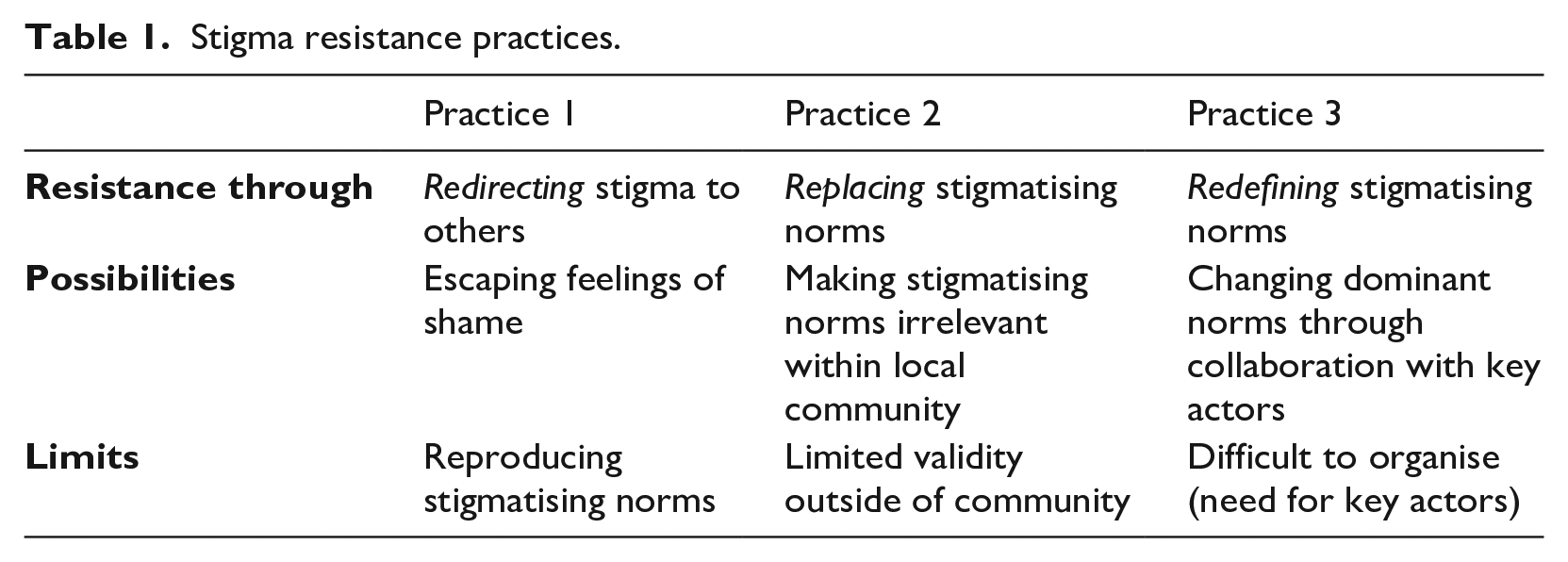
The second practice consisted of making stigmatising norms irrelevant and replacing them with alternative norms fostering pride and self-esteem. Workers resisted the dominant (and medicalised) discourse that frames their intellectual disability as something that necessarily defines them and their life course. Instead, they (re)interpret their life course as something they (partly) directed because of their own, streetwise behaviour. The stigmatising norms of independency and productivity were not directly challenged, but replaced by alternative, local social norms: being a tough, streetwise male in control of his own life course. The limitation of this resistance practice lies in the localised nature of alternative norms. Within the sheltered workshop, some men obtained a high status through their streetwise masculinities, yet outside of the sheltered workshop this status is limited. It is a type of ‘cultural capital’ that misfires in the job economy relying mostly on polite, upper-middle-class cultural capital (Hansen et al., 2014).
The third resistance practice challenged norms of independency and productivity by asserting that everybody needs a little help once in a while. In such moments, workers were not ashamed of their difficulties, but redefined them as within the range of normality. Instead of redirecting or replacing stigmatising norms, they redefined them. Consistent with literature on destigmatisation (Clair et al., 2016; Lamont et al., 2016), this resistance practice depended on the collaboration between key actors like workers, professionals and volunteers. Together, they transformed the norm of independency into one of interdependency. However, the need for collaboration also posed a limitation in the sense that it might be difficult to get organised when people have different interests. In this case, many professionals saw their clients’ lack of acceptance of their diagnosis as one of the biggest obstacles for providing help. Rather than attempting to normalise their difficulties then, they benefitted more from ‘abnormalising’ them, or at least from emphasising clients’ dependency and need for professional support.
This third type of stigma resistance overlaps with stigma resistance as previously discussed by scholars in the field of disability (Logeswaran et al., 2019; Scior et al., 2022). In those works, the value and importance of positive group identification is seen as the most important element to resist stigma. Through advocacy groups and social justice movements, stigmatising norms can be redefined and people with (intellectual) disabilities can learn to transform negatively evaluated identity traits or learn to see their diagnostic label as pertaining to only a (small) part of their identities. However, like Frederick (2017, p. 137) also argues with regard to what she calls ‘visibility’ politics, this type of collective, organised resistance might be less accessible to people without class privileges, a hypothesis that is confirmed by this study with people from mostly lower class backgrounds. 3 In addition, people with intellectual disabilities have only minimally been able to construct their differences as ‘positive differences’ (Anderson & Bigby, 2016; Goodley, 2011), creating an obstacle for collective organising and resistance. 4 Considering that both the ‘new’ sociology of stigma and disability-stigma studies mostly emphasise overt and collective forms of resistance, this study calls attention to the more everyday, implicit and ambivalent resistance strategies.
When attending to everyday resistance practices, two major lessons can be learned and inform future research on stigma resistance. First, identifying subtle, unorganised and implicit forms of resistance means paying attention to their ambivalence. As Johansson and Vinthagen (2020) argue, everyday resistance can simultaneously undermine and strengthen different forms of dominance, a finding shared by Frederick in her study on the resistance strategies of mothers with disabilities (2017, p. 137). In this study, workers partly adopted and partly rejected the norms of independency and productivity. They offered resistance, but at the same time participated in the reproduction of their own, and fellow workers’ stigmatisation. This underlines Hicks and Lewis’s (2020) argument that there is less of a rigid distinction between stigmatiser and stigmatised than the current literature on stigma has us believe. Stigma might be produced on the macro level by people wanting to accumulate more capital (Scambler, 2020; Tyler, 2020; Tyler & Slater, 2018); it is also (re)produced by ordinary people in everyday life, including members from the stigmatised group.
Some might argue that this signals the resistance practice is not ‘successful’ and should thus not be defined as resistance in the first place. In line with Johansson and Vinthagen (2020), this article disagrees with this view, believing that what it means to ‘successfully’ undermine some aspect of dominance is not a clear-cut, either-or issue in empirical reality. Everyday stigma resistance typically implies a partial incorporation and partial rejection of (stigmatising) norms. Despite the fact that workers demonstrate resistance against their stigmatisation, it does not allow them to escape the power of stigma altogether (see also Evans, 2022). Their agency to resist stigmatisation is bounded and needs to be understood in the context of material and structural constraints (Leaney, 2019). Concepts like ‘project stigma’ (Scambler, 2020; Scambler & Paoli, 2008) wrongly present resistance as a process in which people fully and systematically reject dominant norms. Such an approach to resistance actually undermines what many stigma scholars try to show: namely the tenacity or insidiousness of stigma power (Link & Phelan, 2001; Parker & Aggleton, 2003; Scambler, 2018, 2020; Tyler, 2020; Tyler & Slater, 2018). By contrast, recognising the ambivalence of everyday stigma resistance – its potential to undermine and simultaneously strengthen relations of dominance – helps to underscore this.
Second, this study shows that stigma resistance practices are not necessarily based on the political intentions of actors, but on a variety of desires and needs. In this research, workers’ resistance practices were motivated (among others) by the desire to be seen as equals by professionals and by me, the researcher. Seeing political intention as the only possible basis of everyday resistance privileges the politically educated and marginalises, excludes and silences many others (Johansson & Vinthagen, 2020, p. 49). A concept like everyday resistance is critical in the sense that it gives words to actions and patterns that might otherwise remain invisible to our eyes (Frederick, 2017, p. 137). Taking seriously different articulations of everyday resistance – based on desires, needs, affects, practical problems – allows us to approach stigmatised individuals as individuals who have at least some power to fight and transform stigma, something that is largely missing in the current stigma literature (Hicks & Lewis, 2020; Müller, 2020). As a final note, an empirically robust theory of stigma resistance is needed because everyday forms of resistance ‘add up’ and are likely to have a substantial impact on destigmatisation in the long run (Lamont et al., 2016, p. 282). Even though they might not be perfect (e.g. because they partly reproduce stigmatising norms or because they do not have an explicit political intention), overlooking them also overlooks the (bounded) agency of members from vulnerable and stigmatised groups in society.
Footnotes
Acknowledgements
First and foremost, I would like to thank the workers of the sheltered workshops for generously sharing their stories with me and letting me into their lives. I also want to thank Jante Schmidt for the inspiring conversations while writing this article. Finally, I want to thank the members of my department, Citizenship and Humanisation of the Public Sector, at the University of Humanistic Studies for their helpful comments on an earlier version of this article.
Funding
The research on which this article is based was conducted as part of the Long-Term Care Partnership (Amsterdam, Netherlands). The author gratefully acknowledges the partnership for its financial support of her PhD research on Citizenship and People with Mild Intellectual Disabilities.