



Abstract
Since the 2016 EU referendum, estimates on net-migration by the UK’s Office for National Statistics have shown two parallel trends: declining new arrivals from the EU (EU immigration) and increasing departure of EU nationals formerly living in the UK (EU emigration). To date, little is known of the latter and of the circumstances and factors that inform and shape EU citizens’ decisions to leave the UK. Drawing on in-depth qualitative interviews with 37 EU families who left the UK after the EU referendum, this article offers insights into their social hopes, migratory trajectories, motivations and decision-making. Using a family-centred approach, the analysis of these ‘exit trajectories’ through the lens of migration infrastructures reveals a range of challenges EU migrants must negotiate and overcome – often within their households. The analysis complicates assumptions of the meaning and experience of ‘going home’ as seen from a family perspective and reveals the intergenerational tensions, challenges and accommodations that ‘return’ produces and how these differently affect each family member. Faced with diverging interests, needs and expectations, families pursued two main strategies for accommodating these differences: a spatial strategy, namely negotiating and choosing a destination that would suit the present and future of the family members, or a temporal one, planning the exit strategy not as a one-off event but taking place over a longer period. However, accommodation and reconciliation are not always possible, leading in some cases to the fragmentation or dissolution of the family unit.
Introduction
Nicole and Hemmo have two children. We visited their family at home just a few days before they moved to the Netherlands in April 2019. Piles of boxes filled every room of the house, ready to be shipped over the coming days. Despite having lived in the UK for several years, the family was led to reassess their life project by Brexit and reconsider the place where the family’s future lay. Leaving the UK was something all members of the family agreed to, but choosing a destination proved more laborious, not least because ‘going back home’ was not an option – at least not for everyone at the same time. Nicole is originally from Germany, her husband Hemmo is Dutch, and their children were both born in the UK. Their family like thousands in the UK (Lessard-Phillips & Sigona, 2018), embodied the EU aspiration to a pan-EU citizenry – a by-product of the principle of freedom of movement and the practice of intra-EU mobility (Medrano, 2020) – and, like many other such families, had to come to terms with what the UK’s 2016 decision to leave the EU meant for them and their future.
This article aims to better understand the circumstances, motivations and decision-making of those EU families that decided to leave the UK following the 2016 EU referendum. Our analysis of post-Brexit exit migration highlights how by embracing a family perspective in the analysis, we can nuance established understanding of migrants’ decision-making as a series of uncomplicated binaries: staying or leaving; returning home or moving onward (see Sime et al., 2020). We argue that such a dichotomous understanding of migration decision-making, even when more agentic perspectives are embraced, assumes – often implicitly – migration as an individual experience. Here we look at migration decisions as actions of the family unit, as well as the position of different members within it (both parents and children). We show that family emigration can take the form of several trajectories shaped by multiple intertwined factors: the composition of the family unit, the socio-demographic profile and legal status of each member, migration experiences in the UK prior to Brexit, social status in the country of origin, recent and long-standing aspirations to return or to stay, how opportunities and resources are split between the UK and the home country, and more.
Our interviews were carried out during the Brexit negotiations, when many EU citizens faced protracted uncertainty about their legal status and confusion over their rights; for some, these concerns have not yet faded (see Fernández-Reino & Sumption, 2022; Jablonowski & Pinkowska, 2021; Sumption & Kone, 2018). This uncertainty over their status in the UK as well as fears for a future in which they would be subject to the hostile policy environment that other immigrants in the UK had experienced for years (Yeo et al., 2019) led many EU citizens to weigh different options, including securing their position via naturalisation or leaving the UK, and sometimes opting for both decisions (Godin & Sigona, 2022).
Data from the UK’s Office for National Statistics (ONS) covering the period between the EU referendum and the first Covid-19 lockdown (starting 26 March 2020) shows two parallel trends: declining arrivals in the UK from the EU (EU immigration), and increasing departure of EU citizens formerly living in the UK (EU emigration). However, despite its increase, EU emigration is still relatively low considering the size of the EU27 population in the UK (Lessard-Phillips & Sigona, 2018) and the discontent expressed by many EU nationals regarding the reality emerging from the Brexit negotiations (Godin & Sigona, 2022). Similarly, research conducted with UK-based EU families has shown that whereas many EU parents expressed a willingness to leave the UK (Sigona & Godin, 2019), most eventually stayed put. This article, however, focuses on those who did leave, investigating what triggered them to act on their aspiration to leave, as well as how and where they went.
Over the last few years, an increasing number of researchers have challenged conceptualisations of intra-European migration as only ‘liquid’, showing instead that mobile EU citizens also aspire to lead more ‘grounded’ lives under less ‘liquid’ conditions (Bygnes & Erdal, 2017; Lulle et al., 2018). In addition, the study of return migration of European migrants within the EU has often concentrated on a small number of groups, such as Eastern European migrants –especially since EU enlargement – or British citizens abroad (Giner-Monfort & Huete, 2021); meanwhile, White (2013) looked at the case of ‘failed returns’ by Polish migrants leading to what she termed as a ‘double return’ back to the original country of destination (in this case, the UK).
Since Brexit, a new literature on EU migration has emerged centring on the experiences of different categories of EU migrants who find themselves newly ‘unsettled’ (e.g. Benson et al., 2022; Kilkey & Ryan, 2022): pushed out of the ‘citizen’ and into the ‘migrant’ category for the first time in their lives (D’Angelo & Kofman, 2018), or with their movement reframed as ‘migration’ instead of ‘movement’ (Benson et al., 2022). Some scholars have specifically looked at the experiences and plans for the future of EU migrants in light of the referendum. Studying young EU migrants, Lulle et al. (2018) made a distinction between those who decided ‘to root in’ the UK based on their jobs and/or relationships, leading them towards actions such as acquiring citizenship, and those who ‘envisaged their own exit’ by returning to their home country or moving elsewhere in the EU (Sime et al., 2020). Similarly, Sredanovic (2021) explored various reasons why EU27 citizens in the UK and British citizens in the EU were planning (or not planning) an onward or return migration, detailing the obstacles they encountered.
While more studies are now taking into consideration the diversity of the EU population’s pre- and post-Brexit experiences in the UK (see e.g. Godin & Bica, 2019; Sigona & Godin, 2023; Turcatti & Vargas-Silva, 2022), in relation to questions of staying put versus onward or return migration, most studies still consider migrants as single units of analysis that independently make migration-related decisions. This is partly due to the legacy of scholarship on intra-European mobility, which has primarily focused on labour migration, especially from Central and Eastern Europe to West European cities (Favell, 2018), and its impact on national labour markets as well as welfare systems (e.g. Anderson et al., 2006). An increasing number of studies show not only that migration aspirations and decisions are connected to an individual’s life course (de Jong & de Valk, 2020) but also that migration aspirations are not fixed but can transform over time (Boccagni, 2017).
Less attention to date has been afforded to family migration within the EU and to the related question of how family formations, as well as Brexit-related changes to the infrastructure of migration in and out of the UK, shape migrant families’ decisions and aspirations over time (Zambelli et al., 2022, 2023).
This article intends to fill this research gap by offering qualitative insights into the motivations and experiences of ‘EU families’ who have left the UK since 2016. It contributes to the field of return and onward migration scholarship by considering complex intra-familial dynamics of migration decision-making. It looks at how different aspirations are being considered as well as negotiated, inter- and intra-generationally (between spouses as well as between parents and children) thereby shedding new light on the many assumptions surrounding the meaning of ‘going home’ in the context of return migration. In bringing a family perspective to the analysis of return migration, this article complicates the ideas of ‘home’ and ‘return’ – two notions that we shall discuss by introducing the concept of ‘exit trajectories’.
Infrastructuring EU migrants’ exit trajectories and social hope
For the over 3 million EU citizens in the UK at the time of the referendum, Brexit has involved the legal transition from living in the UK as EU citizens in an EU member state, with corresponding rights and protections enshrined in EU law, to living in the UK as immigrants from the EU under the UK’s immigration regime (D’Angelo & Kofman, 2018). While the legal residence of long-established EU citizens is now regulated via a new, ad hoc regulatory regime, the EU Settlement Scheme, the entry and settlement of new EU migrants is left to the logic, rules and requirements of the UK’s existing immigration legislation.
For many, the consequences of Brexit stretch beyond the domain of rights and freedoms individually retained or lost and into their most intimate relations (Zambelli, 2020; Zambelli et al., 2022). While the enjoyment of the EU’s freedom of movement has always been conditional to a varying degree – inter alia on the basis on race, gender and class – the privileged mobility (potentially) bestowed upon EU citizens extends to their qualifying family members. This broad applicability offers EU citizens the possibility of leading and sustaining their relationships in another EU member state as well as transnationally and to move in, out and onward as much as they wish and/or can afford. The mixed, transnational and cross-European intimate relationships and families enabled by this framework have been put under huge pressure by Brexit and the UK’s shifting migration policy landscape (Sigona et al., 2022). Faced with the rigidities and constraints of the new regulatory regime, families have developed a range of coping strategies according to their social, political and economic capital. These have included applying for naturalisation, formalising partnerships in the belief that formal marriage would strengthen the right to family life, accelerating family reunion plans and, for some, reassessing their future in the UK (Godin & Sigona, 2022).
International migration is heavily regulated. Dynamic assemblages of interlinked micro-, meso- and macro-factors and processes (Sheller & Urry, 2006) not only shape migrant trajectories but also produce specific configurations of subjectivities, rights, entitlements, constraints and challenges in the places where migrants’ lives and aspirations unfold (Gonzales & Sigona, 2017; Xiang & Lindquist, 2018). These factors reverberate in every aspect of migrants’ lives, including intimate and family relationships and aspirations. Hopes and fears are embedded in migrants’ everyday social lives, which are full of potentiality and uncertainty. This potentiality is grounded in what is possible: it is shaped by society’s practices and constraints rather than individual fantasy or abstract optimism (Kleist, 2016). It informs individuals’ aspirations and prospective futures – what can be called ‘social hope’ (Hage, 2003). Migrants’ social hope, we argue, also reflects existing migration infrastructures. Naturalised as taken-for-granted systems, infrastructures perform politics in their daily use through specific configurations of actors and elements and their relations: ‘By recognising migration as the contestational result of these moments in infrastructuring, it then becomes possible to appreciate what makes migrant mobilities “real” and “noteworthy” in the first place’ (Lin et al., 2017, p. 169).
Our approach in this article applies the framework of infrastructures to the examination of the decision-making processes surrounding EU families’ departure from the UK as a result of the Brexit referendum. The literature on migration infrastructures first developed to explain how people migrate from one country to another, particularly in the context of East and Southeast Asia (Lin et al., 2017; Xiang & Lindquist, 2018). It then moved to trying to better understand how migrants settle in through the concepts of ‘arrival infrastructures’ (Meeus et al., 2019) and ‘infrastructures of settlement’ (Sigona et al., 2021). More recently, the focus has been on the infrastructures used during migratory journeys (see e.g. Düvell & Preiss, 2022). Little attention has been granted to exit mobility and how it is shaped by structural changes occurring at macro-political level, although exceptions can be found, such as the three-pronged analysis suggested by Sigona et al. (2021), which puts a combined focus on the infrastructures of entry, settlement and exit/deportation in order to provide a better understanding of the lived experiences of migrants’ irregularity in two national contexts, the UK and Japan. In addition, more recent research on migration infrastructures has tried to overcome ‘methodological bi-nationalism’ (Sperling, 2014), which inadequately reflects the complex ‘lifeworlds’ of (onward) migrants (see Ahrens & King, 2022). Here we argue for a processual understanding of the impact of infrastructures on mobility plans: we consider the life cycle of migrant households and the relationship between individual and collective social hopes. Seen in this light, infrastructures are not just a background to migration but should be understood as ‘dynamic, shifting and affective platforms that are involved in the ongoing production of migrant mobilities’ (Lin et al., 2017).
In this article, we focus on the reconfiguration of migration aspirations and migratory projects by EU families due to the real and/or perceived changes resulting from the Brexit referendum. Therefore, the resulting analytic framework intersects, on the one hand, a family-centred analysis of migration decision-making attentive to EU family configurations (e.g. nationality and legal status, country of birth, children’s age) and the negotiations occurring between parents and children and, on the other hand, a consideration of infrastructures that combine social, economic and political opportunity structures with citizenship and migration regimes. Bringing a family perspective to the analysis of the infrastructures that can produce different migration trajectories – both spatially and temporally – contributes to a better understanding of how ideas of ‘home’ and ‘return’ are negotiated in migrant households and how different aspirations and life projects that may include, simultaneously, to ‘stay put’, to ‘leave’, to ‘return’ and ‘to move onward’, either within or beyond the EU, can be reconciled.
Methodology
Responding to the call to counter the dominant ‘methodological individualism’ in migration research (Street, 2014) by paying more attention to intergenerational motivations (Soehl et al., 2020) and household dynamics (de Haas, 2021), this article puts intra-family dynamics at the centre of Brexit-focused analysis. The aim is to capture the inter- and intra-generational negotiations surrounding return and/or re-immigration decision-making, as well as the hopes, fears and aspirations that accompany and often drive these migratory projects at a time when the UK migration and citizenship regime is undergoing rapid changes post Brexit.
As de Haas (2021, n.p.) writes, ‘people make migration decisions as members of social groups’ in which ‘migratory and sedentary behaviour are often interrelated’. Indeed, noting the co-dependency between non-migrant and migrant family members (Stark, 1991) has been commonplace in migration scholarship for some time. However, the co-dependency between migrants of the same family unit has received less attention. In fact, migrant trajectories are shaped by social relationships: the significance of ‘linked lives’, a principle of life-course theory which emphasises how the lives of individuals affect and are affected by the lives of ‘others’ (Settersten, 2015), should be stressed.
In our analysis, we draw upon 37 in-depth qualitative interviews carried out between December 2018 and June 2019 with EU citizens who left the UK post the Brexit referendum. These interviews were collected as part of ESRC-funded EU Families and ‘Eurochildren’ in Brexiting Britain research project whose aim was to understand the impact of political and legal uncertainty resulting from the EU referendum on EU families and the mitigating strategies they enacted to address this. All the interviews but one were conducted online. They were digitally recorded, transcribed, and coded with the assistance of the qualitative software package NVivo. To preserve confidentiality, pseudonyms were used. The participants were recruited via different routes, including a Call for Participants emailed by our partner organisations to their memberships, and circulated via our institutional social media channels and personal social networks, as well as snowballing. Overall, our participants moved to nine EU member states, with Germany as the main destination for both those with native German parents and EU citizens from other EU member states.
We adopted a ‘family-centred approach’ in the interview process to capture the differences, negotiations and tensions that arose within families when making decisions about migration. The other members of an interviewee’s family were not systematically interviewed; however, the interview guide was designed to elicit information about family dynamics. For instance, questions were asked about how the impact of Brexit was felt by different members of the family, whether Brexit led to tensions among family members, with what consequences and how these were dealt with. To be considered an ‘EU family’ for the purpose of our study, a family unit had to include at least one child and one EU27-born parent. Our typology of ‘EU families’ based on the parents’ country of birth identified five types of EU family: family with parents born in the same EU country (EU-same); a family with one EU-born parent and one UK-born parent (EU-UK); a family with parents born in different EU countries (EU-different); a single parent family with a parent born in the EU (EU-single); and, finally, a family with an EU-born parent and one born in neither the UK nor the EU (EU-TCN) (see Table 1).
Typology of EU families.
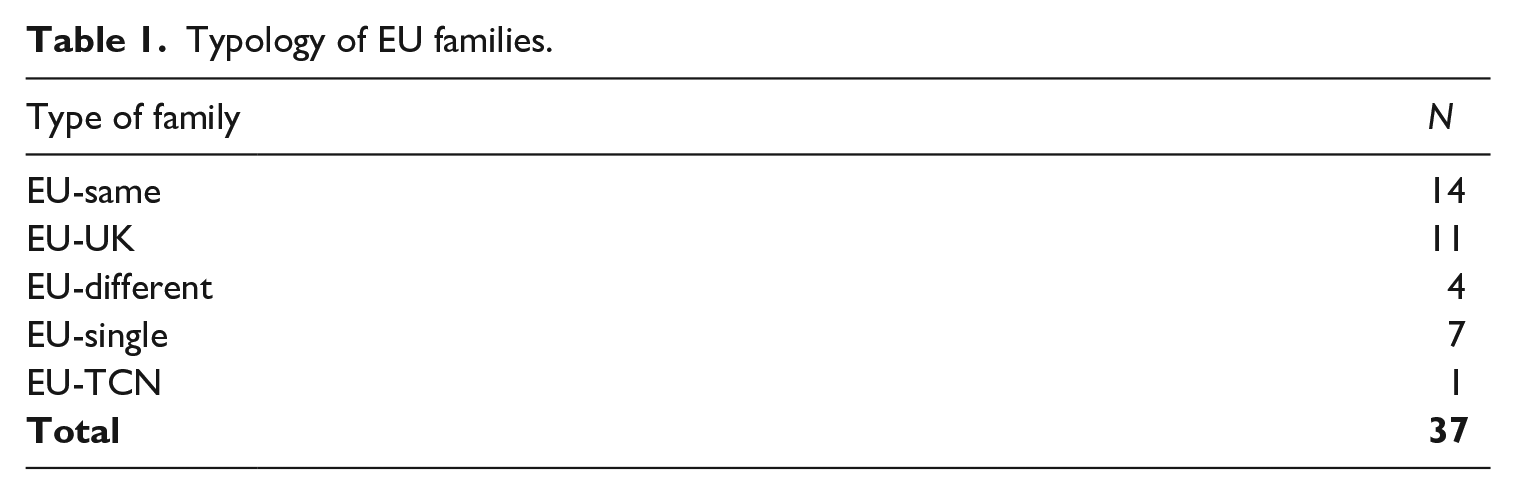
Our typology was informed by mapping studies of the profile of EU families in the UK (Lessard-Phillips & Sigona, 2018) and using parents’ country of birth as the main variable. This enabled us to capture challenges and opportunities families might face due to different legal statuses within the family and how these impacted their options, aspirations and actions regarding migration. With each interviewee, we discussed the migration trajectories of each member of their family to capture the complexity of these trajectories and how they are shaped by specific life-stage events – both planned and unexpected – and other more structural changes, such as Brexit.
Our sample included families with children born in the UK, families with children born elsewhere in the EU, and families with both. The children’s country or countries of birth are relevant not only because they have implications for the children’s legal status and access to citizenship but because they affect family strategies of Brexit mitigation (Sigona & Godin, 2019), in particular ideas of home so central in literature on ‘return’. Overall, our interviewees’ 37 EU families had 81 children, of whom 57 were born in the UK and 10 families included both UK-born and non-UK-born children. Many children in our sample held dual citizenship (British and EU).
Negotiating exit trajectories: A family matter
Our analysis of the social hopes and exit trajectories of migrant families shows that Brexit impacted on families differently according to their configuration and socio-demographic characteristics. Family configurations also affected what migratory options were available and how they were implemented. Faced with diverging interests, needs and expectations, families who eventually moved away from the UK due to Brexit pursued two main strategies of accommodating these differences: either spatially, negotiating and choosing a destination that would suit the present and future of the family members, or temporally, planning the exit strategy not as a one-off event but something taking place over a longer period. However, our study also shows that accommodation did not always succeed, with diverging and/or conflicting aspirations leading in some cases to the breakup of the family unit. Even leaving aside the debate over what makes a place ‘home’, our adoption of the family perspective blurs the clear-cut distinction between ‘going home’ and ‘going elsewhere’ which has been so central to the literature of exit migration (i.e. Benson, 2021; Green, 2005; Hammerton, 2017). This is because one must account for the position of each family member vis-a-vis the chosen destination (especially in the case of, say, a mixed-nationality couple with children born in the UK).
Our approach also enables shifting the focus from a particular location to the process of how choice of destination is reached, as well as the intra-familial negotiations that occur in a situation of asymmetrical power relations. It also reveals how accommodation of divergent needs and social hopes is in some cases achieved by managing the timing and speed of migration, including temporary separation of the family unit. Table 2 summarises the choice of destination and mode of exit by type of family.
Sample EU families by destination and mode of exit.
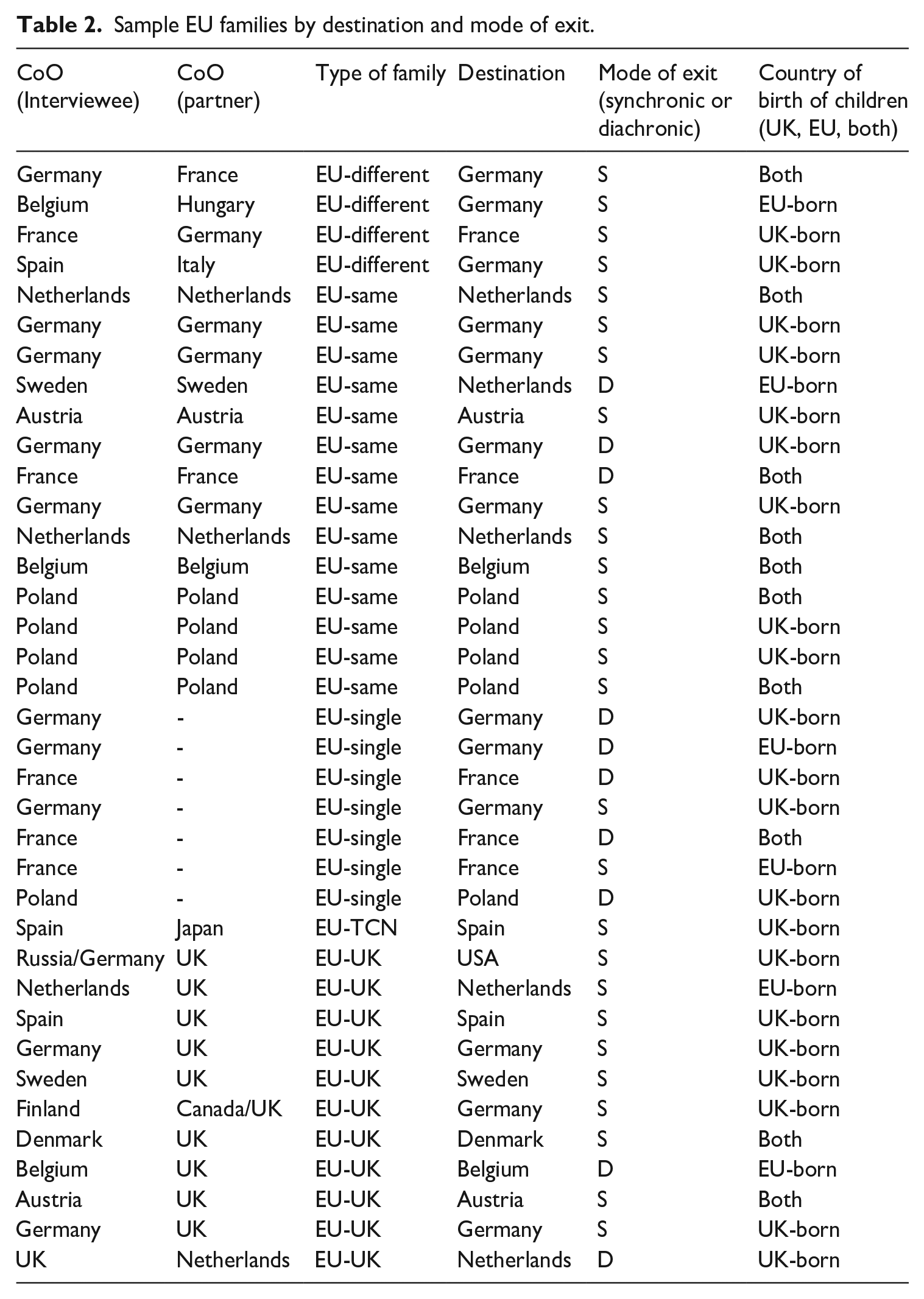
The largest group in our sample is made up of couples originally from the same EU country: out of these 14 families, only three moved diachronically and all but one moved back ‘home’. ‘Home’ was also the destination of all single-parent family units. However, in most cases, family exits were arranged diachronically, with children, particularly older ones, left in the UK. All the couples from two different EU countries moved synchronically, with half of them moving to a third EU country (Germany). Finally, among mixed-nationality couples, including those with a UK-born parent, most travelled synchronically to the country of the EU-born partner.
Below we draw upon the interviews with participants to examine the intra-familial negotiations and considerations that informed different aspects of their families’ exit trajectories. In families with younger children, this was done almost exclusively by the parents; in families with older children, these children were more directly involved in the family’s deliberation. We first discuss exit trajectories where all members of the family moved together – what we term synchronic exit trajectories – and focus on negotiations surrounding choice of destination. We then move to negotiations that led to the family unit splitting up across countries and going in different directions for a certain period of time – diachronic exit trajectories.
In the final empirical section, we look at cases in which the accommodation of different needs and aspirations could not be found: neither spatially in terms of where to move nor through the management of the timing of migration.
Synchronic exit trajectories: Between ‘going home’ and ‘going elsewhere’
Among most participants the prospect of leaving the UK had only occasionally surfaced in family conversations before Brexit – often located in a distant future. However, for some the plan to leave had been part of daily conversations even pre-Brexit, with the referendum only acting as the trigger to leave: it ‘tipped the scale’, in the words of Olga. Her family left together in 2017 after over a decade living in the UK: In the day of [the] referendum results, my husband and I looked through the window and realized that at least half of those people had voted against us. That’s how it was. So, despite owning a house in the UK, what else, having a wonderful job, in six months we decided to leave. But as I say, we were thinking about it before, Brexit was something that just tipped the scale. (Polish interviewee, EU-same, 2 UK-born children)
Migration decisions are dynamic processes with ‘the time horizons of migration plans changing enormously as migrants’ experiences, expectations, relationships and responsibilities evolve through the life course’ (Ryan & D’Angelo, 2018, p. 149). The role played by the Brexit referendum in the decision to return was often linked to no longer feeling welcome in the UK, with the desire to be closer to family and dissatisfaction with the UK’s public services also mentioned often.
For some, Brexit did not come as a surprise: the experience of the ‘hostile environment’ had started before the referendum (Rzepnikowska, 2019). Even in these cases, when hostility had permeated the experience of the UK for years, it remained hard to cut the ties built in those years, as illustrated in this extract from our interview with Alexandra, a Polish mother who returned to Poland in 2017 after 11 years in the UK: It didn’t bother me, you know, after what I’ve experienced in the UK, how Poles were harassed there, we have been treated quite badly. Brits who were not even on very high positions, even those on benefits and they were talking to me: ‘Ooooh, another Pole, who is stealing our job’, so I used to say: ‘So come and work if you want to, I can work somewhere else, right?’ Brits just were mean to us. So, when they [Britain] said they are leaving, on the one hand I felt quite relieved that it’s going to be impossible to go back there again, but on the other hand. . . 11 years, that’s a lot, right? (Polish interviewee, EU-same, arrived in 2007 and left in 2017 to Poland, two UK-born children)
Many interviewees spoke of feeling insecure since Brexit; they felt they had the responsibility to ‘bring their children into safety’. In explaining their decisions to leave, they put great emphasis on how things had changed for them and how they felt that their British home was no longer a home: To me, [leaving] is to bring my child into safety because of the uncertainty of the situation [. . .] I didn’t want my son to grow not knowing when and where his mum might have to go. I decide to cut the chase and say okay, I’m going. (French interviewee, EU-single, 1 UK-born child)
For others, particularly those from ‘old’ member states who had largely not experienced anti-immigration hostility in previous years, the referendum campaign, and its result marked a sudden and unexpected rupture. Many characterised it as a trauma that shook their sense of self and home, that led them to question if they had ever really understood the UK.
In other cases, it was the experiences of direct discrimination and hostility after the referendum, either in their workplace or in public spaces (such as in the street, playground or local shops) the ‘tipped the scale’ and led EU families to leave. In the following example, the mother is from Belgium and the father is from Hungary. Their family made the decision to move to Germany: Being Belgian, I think that is not something that people feel particularly strongly about, but my husband, being Hungarian, had a few negative comments, not necessarily in London but also in other cities. So we started realising that there was something going on that we didn’t really like that much. Once the referendum happened, I think it was very obvious to us that we were going to leave. We both feel very strongly European and we had no plans to settle outside the EU in the long term. (Belgian interviewee, EU-different, 1 EU-born child)
In most cases above, the choice of destination was influenced by the language proficiency of the children, the international dimension of the place to facilitate the children’s integration, the professional opportunities back home for at least one of the parents, and the family support available upon arrival, along with relatively easy access in the destination country to a set of public services (education, school, nursery and health). The ability to mobilise what has often been defined in the literature as ‘arrival infrastructures’, particularly in urban settings (see Meeus et al., 2019, p. 2), is often what explains the leaving trajectory of going back ‘home’ to start a ‘new home’.
In mixed-nationality families there was often a sincere appreciation of the challenges that settling in back ‘home’ would involve for the non-national partner. However, parents engaging in synchronic return migration seemed to assume that the settlement of their children, particularly younger ones, was going to be unproblematic, even if they were born in the UK and had never lived back ‘home’ before. For mixed-nationality families with a UK-born partner, the choice of destination was also linked to retaining the right to freedom of movement in the EU.
For families who migrated to a new place within the EU, Germany was the most popular destination; this was particularly the case for mixed-European couples. Germany is often described as a welcoming place where being European is very much valued, in contrast to the perceived current climate in the UK and even some current EU member states. A mixed-EU family describes why after migrating from Denmark to the UK, they moved again eventually settling in Germany: Well, my husband, you know, he’s the one who really provides for us [. . .] So we decided like a good year ago to start looking for cities or countries. America was an option for my husband to work over there, but not in a thousand years would I go there now. No, I said: ‘Trump?! No, no, no.’ [. . .] so the options were, you know, Germany or Spain. In Spain was the area of Barcelona but [. . .] the political unrest in the region as well, we thought, ‘Okay, we’re going to go there, we’re going to settle and then exactly the same. . . another Brexit, whatever they would call it.’ And we didn’t want to – these two years have been massively psychologically painful and draining [. . .] so we decided that wasn’t an option, so the only realistic option was to move to Germany. So my husband got a really good offer for a job which will, you know, allow us to come here and we are still – you know, in the same kind of like lifestyle that we would have had in the UK. (Spanish interviewee, EU-different, 2 UK-born children)
As pointed by Sredanovic (2021), the negative imagination about what the UK will become after exiting the EU has been directly replaced by a positive imagination about moving to an EU country. Germany has often been portrayed as a country not only thriving economically but also harbouring the EU project as something still valued, protected, and very much alive. After Brexit, some EU families felt Germany was the best destination to emigrate in order to reaffirm their Europeanness. This migration decision by parents not born in Germany can thus be understood as a way to reclaim EU citizenship not only for them but also for their UK-born children, who would otherwise now be unable to grow up in the EU.
Diachronic exit trajectories: Managing speed and timing of migration
For Mira and Alex – a British-Dutch family, with a child, born in the EU – the choice of where to move was transactional. It was a means to the end for Alex to retain the right to freedom of movement in the future, with the ultimate destination being exit migration to outside Europe. Mira explains: So we were first thinking about Austria, Switzerland, Scandinavia and then Germany, those were the options, including the Netherlands. And then finally we went, oh, the EU citizenship. So it makes more sense if we first live in my country and then we would go elsewhere, perhaps, later. (Dutch interviewee, EU-UK, 1 EU-born child)
Considerations of time also surface in other exit trajectories, with families deciding to temporarily split up in order to mitigate the risks of resettlement and accommodate the different needs and aspirations of family members. This has led to new forms of transnational family configurations and, in some cases, the dissolution of the family unit.
In most cases (27 of 37), the whole family moved together, especially if the children were still in their early years (see Table 2). However, in instances where the children were older, other choices were often made. All EU families are transnational in different ways, but Brexit led some families to split across different countries because they were unable to find one destination to satisfy every member’s aspirations for the future. Different configurations of transnational EU families have emerged because of Brexit (Sime et al., 2020; Zontini & Però, 2020): for instance, some parents have decided to leave the UK while their older children have decided to remain. As one Polish stepmother explained, her children were socially and culturally anchored in the UK, either being born in the country or having migrated with their parents at a very early age: They both are rather on that British side. They are anchored there and to my mind that must be very disturbing situation for them and it cause[s] a little problem with their behaviour and anxiety, because that family was anchored in the UK mainly because of my partner, who was there for a long time, had a legal job for many, many years and was a prop for them all. (Polish interviewee, EU-same, 1 UK-born child and 2 EU-born children)
Some children left behind have dual citizenship and will therefore be able to keep their freedom of movement. However, the rights of their parents to move and settle are often more precarious, with having left the UK before securing their right to return. While emigrating parents hoped they would still be able to come to the UK and visit their children, the decision to leave did, for many, involve the risk that they would not be able to come back easily with the end of free movement after Brexit.
A German stay-at-home mother with three children decided to remain in the UK while her partner accepted a job offer in Germany. Having just bought a home in the UK, the parents believed it was better for their children’s education not to be disrupted and for the children to complete their primary education in the UK before an eventual move. Due to their insecurity regarding the outcome of the Brexit negotiations, they decided to opt for a transitionally transnational family arrangement. Sometimes, however, the reverse was the case, with the mother and children leaving the country while the father remained in the UK. In the following example, a Polish mother went back to Poland with her three children, while the father started going back and forth between Poland and the UK: For six months we are living here. He is self-employed there. As a self-employed, he is working as an Uber driver and has been flying back and forth, he was a month there and next three weeks in Poland, two weeks here and then he was flying back, it was dependent on the earning opportunities [. . .] We will see how things go here. He might be flying back and forth in 2019, if it will be possible for him, but it’s highly uncertain regarding what’ll happen after the end of the March. (Polish mum, EU-same, 2 UK-born children, 1 EU-born child)
In another example, a French mother and her three children moved to the north of France to enable the father to commute between the UK and France more easily: Very early on, we tried to see if we could buy something in France for practical reasons, because it’s close to London, not because we’re French [. . .] No, it’s just because it’s close to Calais, so my husband is still working in London. We looked at Belgium. We looked at Ireland. We would have loved to go back to Ireland, it’s just for practicality, not because we’re French. (French mum, EU-same, 3 EU-born children and 2 UK-born children)
Moving across the now more rigid borders between the EU and the UK was not seen as optimal or even as a real choice; some openly described it as undesirable and involuntarily accepted it. These examples illustrate the diversity of exit trajectories not only between EU families but also within family units. It also shows how homing (Boccagni, 2022, p. 585) as the ‘attempt to tread the fine line between past ascriptions and future-oriented potentialities’ is disrupted by a macro-political shift in the infrastructures of mobility and migration regulatory frameworks (Bygnes & Erdal, 2017).
Among the diachronic movers, we identify different modes of diachronic migration: one or both parents moving and leaving the children behind; the children moving with one parent while the other parent stays behind; the family splitting into one parent staying behind with or without one or more children and one parent moving, with or without one or more children. More complex transnational family configurations also emerged, such as in one case: one child going back to his parent’s country of birth (Sweden) to start university, the older children staying put in the UK, and the parents moving onward with their youngster to another EU member state (NL). These diachronic strategies are not mutually exclusive, negotiations over where to go can change over time and involve each member of the family at different points in time. Similarly, after initial synchronic migration, some members of the family may decide to move back to the UK while some stay put.
The long-term sustainability of these novel transnational arrangements, with new ways of ‘doing families transnationally’ (Zontini & Reynolds, 2018) leading in some cases to multi-sited households (Ahrens & King, 2022), was challenged by the implementation of travel restrictions and the substantial curtailment of global freedom of movement due to the Covid-19 pandemic (Zambelli et al., 2022). Those who left the UK before the implementation of the EU Settlement Scheme 1 had to reconsider their plans, at least to some extent, once the details of that scheme finally became clear.
Falling apart: Irreconcilable social hopes
Finally, the result of the Brexit referendum was a trigger for some couples to separate (though it never drove these outcomes entirely). When children were involved, the loss of freedom of movement for either or both parents became problematic in cases of shared custody. This raises questions concerning the need for special visas to travel to the UK with children, and the rights of fathers and mothers to visit or even stay longer to be close to their children.
A newly married Polish couple joined a relative in the UK in 2006 to start ‘a new life’, as the interviewee recalled. Four years later, their first child was born, followed by another a few years later. They stayed until 2017, a year after the Brexit referendum vote. Returning to Poland was always at the back of their minds; the plan was to amass enough savings to build a house back home. As the interviewee tells us: So, Brexit didn’t affect my decision to leave the UK, because we had almost finished building our house in Poland, I was fed up with the life there, so we’ve decided that I’m coming back with the kids and my ex-husband was going to stay there to help us financially, to pay for some internal finishes in the house, but it went awry and it is what it is. (Polish interviewee, EU-same, 2 UK-born children)
So, Brexit did accelerate the family’s process of exiting the UK, as they were waiting for the right time to do so anyway; it provided the nudge they were both waiting for to make the final decision to return to Poland. The plan was for the mother and children to go first, shortly followed by the father. A diachronic exit trajectory had been planned to make the family’s return smoother and ensure they would have enough income while transitioning to a new life in Poland. Talking about her children, the mother stated: They’ve wanted to come back to Poland themselves, because they were missing grandparents, our family, aunts and uncles. They were truly delighted that we were returning to Poland. (Polish interviewee, EU-same, 2 UK-born children)
In the end, things did not entirely go according to plan. The separation between the husband and the rest of the family was longer than planned, and the marriage eventually collapsed. As the mother said: We are getting a divorce, those are the consequences. That’s the only downside of our return [. . .] Long-distance relationship is not for everyone. (Polish interviewee, EU-same, 2 UK-born children)
Sometimes things can become even more complex, especially in the case of reconstituted or ‘patchwork families’, as described by one of the interviewees, Magda. The case of her and her new partner – both from Poland – is telling. She came to the UK in 2011, initially on a two-year scholarship. While living mainly in the UK, she was officially employed in Poland where she paid her taxes; she moved back and forth between the two places until 2017. She met her current partner in 2014, who was also from Poland and already had two sons also living in the UK (one born in Poland in 2002 and one in the UK in 2009). They made the choice to go back to Poland not only due to Brexit but mainly to look after Magda’s elderly parents and because she owned a house in Poland. The decision to leave the UK was very hard for the children; their stepmother Magda told us about the splitting up of the family and the impact it had on them: They both are rather on that British side. They are anchored there and to my mind that must be very disturbing situation for them and it cause[d] a few problems with their behaviour and anxiety, because that family was anchored in the UK mainly because of my partner, who was there for a long time, had a legal job for many, many years and was a prop for them all. (Polish interviewee, EU-same, 2 UK-born children, 1 EU-born)
Magda has now started a new life in Poland with her partner and they have just welcomed a daughter there. For the partner, going back to Poland meant he had to leave his older children in the UK. Brexit has complicated the lives of these children, who did not have a lot of agency in the decision-making process regarding their father’s move.
Maria, a French mother, explained how the UK’s ‘divorce’ from the European Union was the reason she ended up divorcing her British husband. She arrived in the UK in 1986 and met her ex-husband a year later. In total, she stayed in the UK for more than 30 years, and she thought she would never go back to France. She saw herself as being very much rooted in the UK, having had her children there. Her children are now 21 and 24 years old and feel strongly attached to the UK. When Brexit happened, Maria wanted to talk about its consequences with her husband, but he was not interested. She started to attend marches, conferences, and talks about EU citizens’ rights, but her husband didn’t get involved. She explained: He voted remain but like so many others, they just think, I’ve done my job, I ticked the right box and then they washed their hands of the thing after that. They just don’t do anything and don’t want to hear about it. (French interviewee, EU-single, 2 UK-born children)
She then started to think about buying a place in France where she could feel at home, where she could feel safe. As she felt unsupported and dismissed, she planned her return to France alone and divorced her husband, hoping that her children would want to join her at some point in the future: I have no desire whatsoever to go back to the UK, but of course I will have to make the effort if my children don’t come regularly enough. I will have to go to London. At least I’m lucky, it’s not too far. This is what I tell myself. My children could be in the same country as me, but so many miles apart. It takes you longer to get from one to another, whereas Brittany to London, it’s still achievable. You can do it in one day drive or a couple of days. But it’s not too far . This is what Brexit is costing me really. This is the biggest thing. To force me to not live in the same country as my children and possibly to not live in the same country as my future grandchildren as well, if they might settle down in the UK, which looks fairly probable (French interviewee, EU-single, 2 UK-born children)
Conclusion
In times of rupture and crisis (Lulle et al., 2018), such as that ensuing from the Brexit vote, different bifurcations of migrant family life trajectories take place. While some migrants frame these trajectories as permanent and others frame them as transitory, all recognise the high volatility of the political context as something they have little control over in the long run. This belief inevitably affects exit trajectories. The study of return migration of European migrants within the EU has often concentrated on specific groups, such as Eastern European migrants – especially since the enlargement of the EU – or British citizens abroad, with little attention given to migrant families. This article contributes to the field of return and onward migration studies by considering the complex intra-family dynamics of migration decision-making. Some interviewees returned to their country of birth, even to their hometown. For others, leaving Britain meant settling down in a new country altogether. The variety of the interviewees’ exit trajectories reveals the range of challenges EU families previously residing in the UK have had to overcome when deciding to leave, even when going ‘back home’. Moreover, by employing the family as a unit of analysis, this article has revealed the intergenerational tensions, challenges and accommodations ‘return’ produces and how it differently affects each family member, leading in some cases to new forms of variously constrained, even forced, transnationalism which put the family unity under pressure.
The interviewees’ exit trajectories were far from linear, with many adjustments required along the way, as in the case of diachronic exit migration. For some, leaving led to traumatic family separation, for others, to family members being spread across international borders. Rapid changes in terms of both aspirations and decisions in the family migration trajectory sometimes led to situations of ‘involuntarily transnationalism’ (Carling & Erdal, 2014), with some feeling that they had no choice but to stay, whereas others felt they had no choice but to leave.
Different configurations of social hopes and infrastructures can push families to plan on moving together (either back home to the EU or beyond the EU) or to split up across countries, leading to new ways of ‘doing families’ transnationally (Zontini & Reynolds, 2018). In the empirical section, we showed forms of negotiations and reconciliation between converging, diverging and complementary social hopes within families and how these impact different exit trajectories, both spatially and temporally.
Family members experienced leaving the UK in different ways, especially in the case of mixed-nationality families. For many, the prospect of leaving was ‘an escape route they did not expect to take’, with the passing of time, the protraction of Brexit negotiations, and the uncertainty over EU citizens’ rights in the UK, they felt forced to leave the country. However, others within the same family often decided to ‘stay in place’ (Schewel, 2020), leading to a mix of migrant trajectories within family units (including the coexistence of exit and settling trajectories). The plurality of these migrant trajectories reveals the importance of considering not only their fluidity across time and space but also the possibility of heterogeneous migrant trajectories within one family unit.
One limitation of the research on Brexit and migration to date has been its ‘presentism’ (Benson et al., 2022). The current literature overlooks not only the history of migration, citizenship and processes of racialisation but also the long-term impact of Brexit on both EU and non-EU migrants and their families in the UK, as well British citizens in the EU. Brexit and migration research have been characterised by methodological nationalism, leading to consider Brexit as a unique phenomenon reinforcing the idea of British exceptionalism. By adopting both quantitative and qualitative longitudinal approaches, researchers may enable to better capture the long-term impact of major geopolitical events such as Brexit on families and their transnational arrangements, migrants’ sense of belonging and resettlement processes both inside and outside the UK. Moving beyond the study of only EU migrants, multi-scalar processes of re-bordering will become more visible not only within the UK but also outside the UK, allowing researchers to explore the nexus between UK and EU migration regimes and global politics.
Footnotes
Acknowledgements
We would like to thank Aleksandra Grzymała-Kazłowska, Anne-Laure Donskoy and Aleksandra Szkudlarek for their contribution to data collection.
Funding
This article draws on the EU Families and ‘Eurochildren’ in Brexiting Britain: Renegotiating Inclusion, Citizenship and Belonging research generously funded by the UKRI Economic and Social Research Council (ESRC) Grant ES/R001510/1.