



Abstract
This article is one of a series of explorations of the curious, ordinary-extraordinary practice of turning over pottery by people in/from Stoke-on-Trent. This is the widely practised habit of turning over a piece of ceramic ware, in situations away from home, to examine its origins. While on the surface, this practice is ostensibly to check the backstamp (the maker’s mark) that identifies its origins, I argue that it has a number of deeper meanings and resonances. What those who are not local often only understand as a question of antique provenance or value, my work shows that this practice carries with it broader meanings of the material culture of pottery-in-use, complex conceptions of the locality, as part of wider socio-cultural narratives of Stoke-on-Trent. In this article, I address the critical, theoretical context in which this turning over practice might also be understood as marking, feeling and resisting socio-historical change. Drawing on both qualitative, empirical data and interdisciplinary theoretical work on affects, ritual/material culture and hauntology, the article suggests the complex and often conflicted role that turning over plays is part of a response to de-industrialisation in Stoke-on-Trent. In recognising this specific micro-practice in this context of cultural troubling/haunting, the article proposes object-focused rituals may operate homologically to ‘turn over’ locality.
Introduction: Turning over 1
Lorraine:
2
Turning is a nostalgic habit. Comforting and reassuring. From a less stressful age when work was plentiful and camaraderie amongst fellow pottery workers was the norm. Bustling town centres each Friday lunch and Potters’ Fortnight holidays last week in June, first in July. I think people locally knew where they stood and expected to gain a skill and always have work. Today the area is fractured. It was always six distinct towns but one area – The Potteries. Now there are divisions. Cultural and economic, with less pride and less sense of belonging. Now less desirable places to live and gaining an increasing reputation for urban deprivation and slum areas with high unemployment. Turning pots is a tactile/physical response as well as emotional. If you see someone caress a plate, turn it and use their fingers and flat of the hand on that piece you immediately know certain things. You know that they have worked in pottery in some way. They are checking for pitting or smoothness of glaze. They will look for signs that denote it was marked as a second quality item.
To understand the practice of turning over, and my contention that this is a local ritual and affective practice of significance, it is helpful to characterise the context and specificities of what happens. ‘Turning over’ is used here – and in everyday language locally in North Staffordshire – to mean the practice of turning over ceramic ware (dishes, plates, bowls, cups, mugs, teapots, etc.). It is done mostly in public settings – in restaurants, cafes, pubs, hotels, shops, markets, etc. – in order, primarily, to determine if the piece is from Stoke-on-Trent by examining the backstamp. Turning over is carried out very frequently (Leach, 2016) by large numbers of people in/from North Staffordshire and particularly from Stoke-on-Trent (including outsiders who engage in the practice as part of their adopted local identity). It is, on the surface, an insignificant act which raises mild amusement for those who do not understand it, but it is a deeply meaningful practice for many people locally.
The determination of local origin that occurs in turning over is found by identifying or confirming the backstamp: the brand name of the producer is usually clear, and other identifying marks are often known to locals and experts. Levels of expertise vary about backstamps, but much original UK ware made in the Potteries is marked ‘Made in Stoke-on-Trent’ (as opposed, for example, to those globally outsourced brands such as Wedgwood and Royal Doulton, who now only use the brand name since their shifting of much production overseas). Further, many locals worked in, had relatives who worked in, or are knowledgeable about ‘potbanks’ (pottery firms) and brands, so they easily recognise backstamp imagery. A smaller group have lay curatorial skills (Leach, 2016): ‘ordinary experts’ from contact with the industry or collecting, often they not only know backstamps, but also precise shapes, designs, makers and dates, from look or touch alone.
Turning over, I argue below, is a habitual, compulsive and meaningful practice for the people in and of Stoke-on-Trent (or ‘The Potteries’ as North Staffordshire is widely known). Because of its status as ‘local’ ware, pottery plays a significant role in the material culture of ‘local’ people. The ceramic industry may have changed dramatically since its inception, industrialisation and de-industrialisation, but this article argues that there are socially significant phenomena emergent in local people’s relationships with what they see as ‘their’ pottery which provide context for these changes. This article suggests that locals are enacting symbolic psycho-socio-cultural responses to these broader economic/industrial changes and the continued consequences, partly through their everyday affective practice (Wetherell, 2012) of turning over. As Back (2015) points out, exploring the everyday, when linked to a deep contextual understanding of the making of place and class, can illuminate the subtle sociological nuances of meanings not often made visible. This approach testifies to the value of seeking out the significance of a mundane act – in turning over – that unlocks a deeper understanding of class, place and loss in the context of Stoke-on-Trent. As Back (2015, p. 834) concludes, finding the ‘big story in the most trifling ordinary detail’ is important, since these surprising miniature moments often turn out to be transformative.
Stoke-on-Trent continues to be listed as in the top ten UK regions that have local areas with more than six domains of deprivation (Noble et al., 2019, p. 41). Its legacy – poor health and disempowered communities – from the dirty, dangerous yet once globally economically powerful industries of mining/ceramics, lives on. Much ceramic production still thrives in the region, yet the loss of its centrality and economic wealth is keenly felt. In this context, the backstamp – the object of turning over – is not only a branding device: it has a controversial status as a (politicised) mark of local origin.
The forces of globalisation often resist this status: larger manufacturers’ own marketing suggests their global consumer does not care about the backstamp, or that origin does not affect sales, and changing political contexts mean that tensions over protectionism have not given these debates much commercial salience (see e.g. Ewins, 2014, 2015). The consumer brands that seek global reach move beyond the localism of the historic backstamp, believing the name carries more weight than the place of production; meanwhile ‘locals’, who value and hold on to local cultural meanings, often feel swept away in this long de-industrialising process. So the existence of the backstamp is more than a commercial and legal identifier: it also carries within it the tensions over locality and who ‘owns’ a ‘local’ industry.
In the current context, Stoke-on-Trent has become a kind of national emblem for what current government/journalistic narratives (e.g. Domokos, 2018) like to call ‘left behind’ places which need ‘levelling up’ (a role that has emerged since the 2016 Brexit referendum and 2017 by-election turned national eyes in this direction) – and which local social scientists and policy makers prefer to characterise instead as multiple deprivation (Mahoney & Kearon, 2018). The so-called ‘left-behindness’ of post-industrial economies/landscapes is identified in academic commentary as a powerful cultural representation of decline and loss. Further, such landscapes are seen as both creating and containing an affective presence in those connected to it, for example, as discussed within critical commentaries on Stoke-on-Trent (Edensor, 2000, 2015, 2017; Jayne, 2000a, 2000b; Mah, 2017; Mahoney & Kearon, 2018; Strangleman, 2017a, 2017b). Despite some discomfort with what is sometimes called ‘ruin porn’ (Mah, 2014; Strangleman, 2013), the recognition of the importance of the meaning of place to locals identifies the relics and brownfield spaces of a ripped-out industry as ambivalent memorials, bringing the past to life for ex-workers, at the same time re-opening painful wounds. However, there is less engagement with the notion of the products or objects of that industry itself as part of this ambivalent relationship.
Examples of research in which the role of specific objects (as opposed to places/sites) has been discussed include Taylor’s (2020) powerful ethnography of carpet makers, and the attachment to making/belonging left behind once the business left her home town, and Strangleman’s (2013, pp. 31–32) work on the need to memorialise this change in fortunes (of workers, of a place) with the memento:
‘. . . at least I deserve a brick’ [quoting Dudley’s The End of the Line]. In virtually all the research projects I have been involved in, the workers I encountered have had mementos of working life. . . . it is an attempt to come to terms with the intangibility of work now when compared to the past.
Likewise, this issue is addressed in passing by Beynon in his observations about the role of the Ford car itself as a meaningful object: ‘Never a Ford’ (1984, p. 122) for Ford’s own workers, due to their alienated inner knowledge of production quality – in this case, not buying/using the object is a bitter-sweet form of resistance. A further account exploring the complex heritage of post-industrial material culture is found in Roberts’ (2008) work on the contrasting material heritage of mining and shipbuilding in the North-East of England, which recognises the distinct cultural heritage afterlife, of shipbuilding and mining material cultures, and captures the idea of ‘things-in-use’ (which I deploy below) in identifying distinct and changing cultural narratives and ambivalences of object meanings.
A highly pertinent local example is found in Mydland and Brownsword’s (2013a, 2013b, 2015, 2017a, 2017b) ongoing project in which pottery makers’ skills are embodied, captured, celebrated and critically re-created as part of a long artistic engagement with place, skill and social change, focusing partly on the spaces of ‘obsolescence’ and production but also engaging specifically with the materiality of ceramics themselves. This memorialisation of worker places, and the recording/celebrating/creatively exploring of the making of the ‘thing’ are centring production, workplaces and embodied/critical skills, although the project has a much wider scope.
This version of an industrial material culture is attuned to the legacy of alienation written into the objects, alongside craft skill and expertise. The social context of ‘things-in-use’ in this approach – emerging from a sociology and anthropology of consumption and material culture – is to highlight the use (literally, but also narration, meaning, value and affordance of social relations) of objects in social settings. I argue here that the social processes of ‘object lives’ extend beyond their alienation/commodification and expertise in production. What Kopytoff (1986) and Miller (1987, 2009) describe as the transformation of commodities back into inalienable objects also has a distinct significance for industrial cultural heritage. While that commodification is one important part of the cycle, the de-commodification of objects in circulation and use is the focus of much consumption and material culture studies. So, while the meanings of objects are partly set by workers/firms, in alienated conditions, their life, meanings and values also circulate once they leave the factory. In that process, the pottery object creates an independent trajectory to that intended in its making; and it, in turn, supports/creates different moments of significance in the lives of people. There is thus another set of social relations also shaping the meaning of objects when circulated by ‘never-been-workers’ or, more poignantly, ex-workers. The pottery object-in-use tells a different, but parallel and equally significant, story of de-industrialisation.
This approach allows pottery to be seen as a social entity and not simply a mute object, and to move across realms (commodity, valuable, repository of meaning). The objects themselves remain mute so the material culture approach must trust that there is a correspondence between the social meanings and metaphors attached to them, and that this gives objects a form of agency. Tilley (2002, p. 25) suggests: ‘artefacts perform active metaphorical work in the world in a manner which words cannot. They have their own form of communicative agency.’ Thus, Tilley suggests, the metaphorical powers of things help us understand ourselves and what constitutes our culture and identity.
Understanding turning over within this wider socio-cultural frame of material culture matters because it would be a mistake to interpret it as simply an irrelevance, or as a trivial reflection of touristic/antique/exchange value of objects. Instead, I draw on Back’s (2015, p. 822) call for: ‘attentiveness to what is easily discarded as unimportant. [The sociologist as] . . . a collector of the discarded and the enchantment of the mundane’ and Pickering and Keightley’s (2006, p. 921) reminder that
Nostalgia can . . . be seen as not only a search for ontological security in the past, but also as a means of taking one’s bearings for the road ahead in the uncertainties of the present. This opens up a positive dimension in nostalgia, one associated with desire for engagement with difference, with aspiration and critique, and with the identification of ways of living lacking in modernity. Nostalgia can be both melancholic and utopian.
What this article suggests, then, is that turning over is thus partly an exercise in collective memorialisation, part of the present/history of the region, an emotional and visceral moment that keeps social change alive at every encounter. I argue that it can be interpreted as a transitional response to this process of de-industrialisation, and while not quite a form of ‘radical nostalgia’ (Lawler, 2014; Raychaudhuri, 2018), the practice nevertheless enacts the ambivalence of both loss and pride very viscerally.
In what follows, I suggest two (connected) theoretical lenses through which turning over can be framed to interpret these meanings: first, as a compulsive but also potentially redemptive ritual, in which the socially communicative, repetitively patterned act creates a form of contained rebellion; second, I frame turning over as part of the haunted, affective symbolic landscape of de-industrialisation. In so doing, I also set out some empirical accounts of the practice in action. I contend that turning over is a mode of engagement with material and consumer culture which reconnects interstitial traces of the past with the present, sometimes providing a chilling haunting of the present, sometimes an affective and embodied sense of comfort/discomfort captured in the handling of fragile ware as if it were cherished ancestors. Often, however, turning over can be seen as a compulsive repetition seeking to hold together this apparently (but not quite) erased past with a hoped for but possibly unreachable future – the chipped or crazed china in the hands of ordinary experts as a homology for the failures/successes of Stoke-on-Trent.
The (ritual) practice of turning over?
This work is based on a period of ethnographic engagement, between 2015 and the present, working alongside a number of local arts organisations/charities, including ongoing social media conversations using the ‘Turnover Club’ social media outlets, an online survey with over 600 participants and over 20 direct interviews with locals and local arts practitioners. 3 This project, which commenced in 2015, set out to explore qualitative accounts of turning over and to gauge its salience and reach as a practice, linking this to broader accounts of material culture, consumption and industrial heritage. I collaborated with local arts organisation Ceramic City Stories who co-hosted a number of ethnographic research encounters, including a Heritage Open Day, and publicly engaged research encounter at the Emma Bridgewater factory. As part of the data collection, which explored some of the meanings of/reasons for turning over, I have been involved in ongoing ethnographic observation as a local resident and volunteer arts producer, and carried out the 20 interviews with those who turn over or who have an interest in local ceramics and the online survey (n = 600); and both interviewees/survey respondents who consented were invited to send follow-up written communications. The survey was shared online by invitation to those who recognise themselves as ‘turnover-ers’, a phenomenon which has been long established as a practice/identity in the local community. As such it is a self-selected, non-representative sample but lack of resources prevented a more robust sampling strategy. The survey gives a good description of the qualitative sense of turning over and included a number of open, qualitative questions as well as demographic data. Qualitative interview/survey data were thematically analysed, but supplemented by observation notes and a theoretical, interpretive reading of the practice/documents based on ongoing immersion/conversation.
To capture some of the significance of turning over, consider the plate in Figure 1. Sold via Homebase as an ‘unlimited multiple’, the plate was one of the best-selling items of the At Home with Art project (Leach, 2002; Painter, 1999, 2002). It was a dinner plate size, made in white bone china, and across the rim, slightly indented, are the fingerprint impressions of a man’s – Wentworth’s – hand. These are overlaid with gold-leaf fingerprint lithographs. The stories told (Leach, 2002) of the plate captured some of the meaning of ceramic objects for locals (and others) today. It is almost impossible to come across this plate without trying one’s hand against the handspan. I have fairly large hands for a woman, and I can only just make it with a stretch; and of course one is immediately aware of the differences in angle, size, feel and the microscopic details of the fingerprint. The plate, respondents told us, was primarily used for ‘special’ things, like birthday cake or party food: not least because most people (except the odd collector) didn’t have a set but just one, and they wanted it ‘in use’ rather than ‘on display’ – part of the intention of the project to mix up the categories of consumer and (domestic) art object.
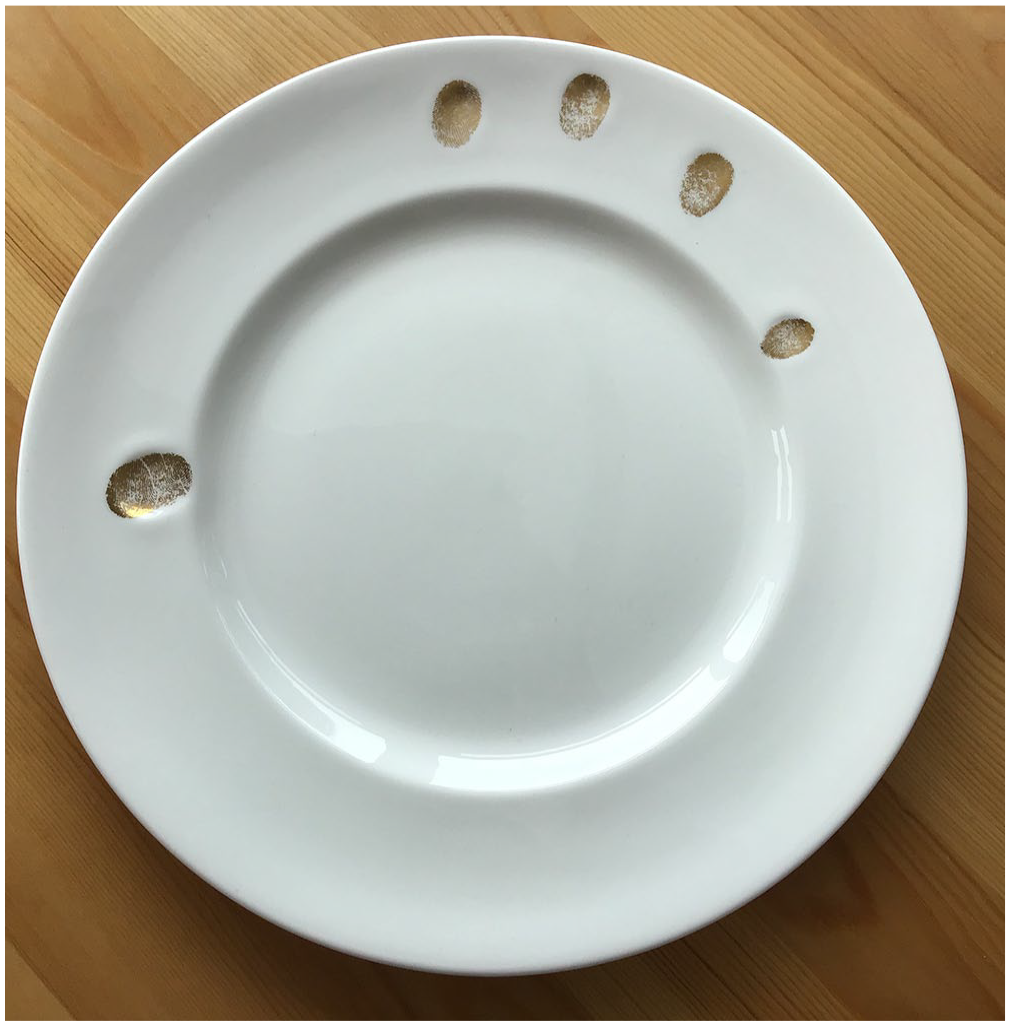
Plate, by Richard Wentworth/Royal Doulton, for At Home With Art, curated by Colin Painter for Arts Council England; Hayward & Tate Galleries; Homebase. (Photo: author’s own.)
On the back of the plate is a backstamp (Figure 2). Royal Doulton kept many of their ‘special projects’ in the Potteries after their global outsourcing of other tableware from the 1980s, and so this plate was commissioned and produced in Stoke-on-Trent. The backstamp duly says ‘Made in England’ around the official Royal Doulton stamp, above the artist’s initials ‘RW 2000’. But encircling this, we see the text setting out one significant meaning of the piece: A Royal Doulton plate is touched more than twenty times during its making.
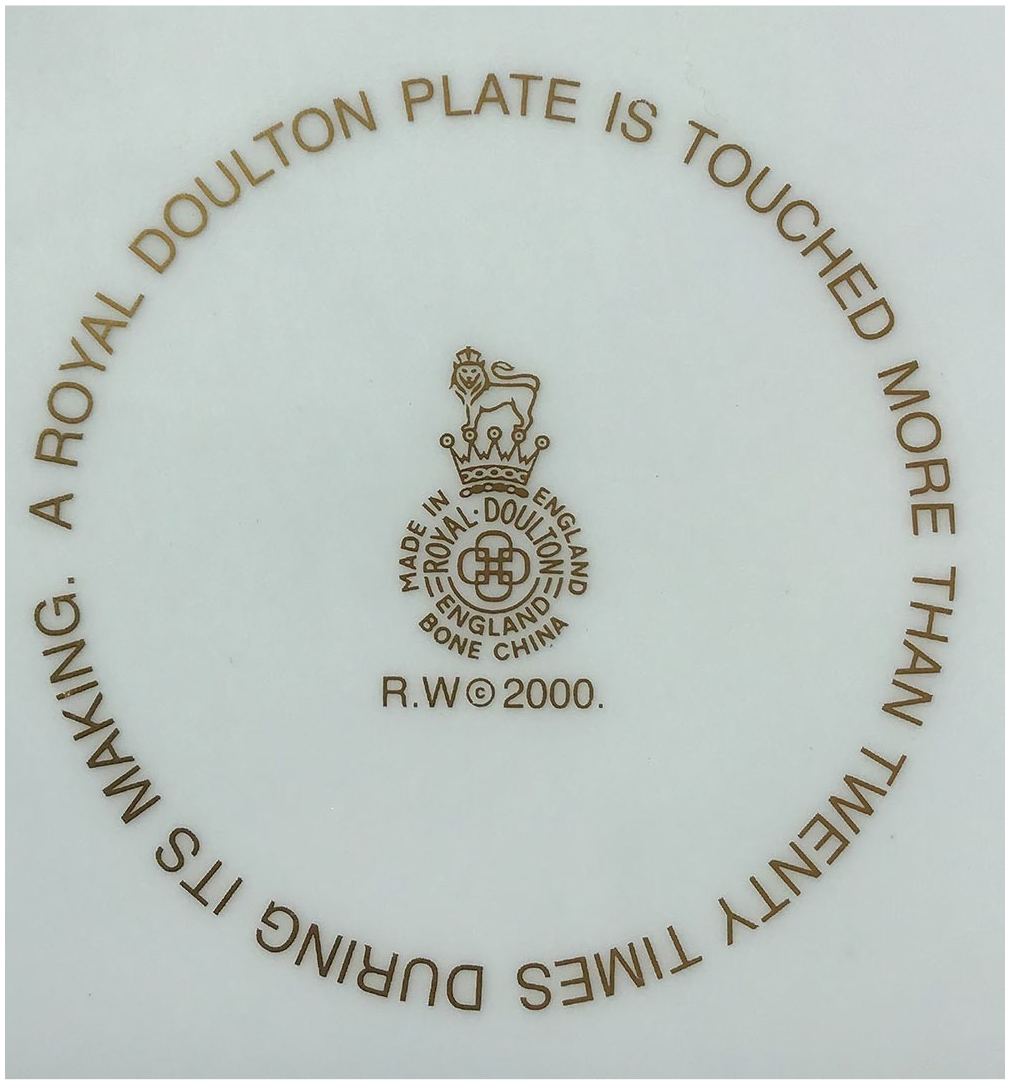
Back and backstamp of plate, by Richard Wentworth/Royal Doulton for At Home with Art. (photo: author’s own).
This object’s story is important to the story of turning over because it captures the sentiment and affective feeling captured in an embodied experience of pottery very evocatively. The call to handle the piece speaks directly to the ideas of locals, who often talk of ‘touching the hands of ancestors’ through a piece of pottery. So, Wentworth’s prints allow looking back into the past, imagining whose hands went before. For owners of that plate (Leach, 2002), the experience is fairly abstract: invited to marvel at beauty, skill and to reflect a little, indirectly, on the decline of that expertise/endeavour. For many Stoke-on-Trent locals touching a piece of pottery does not need the invitation of Wentworth’s fingerprints to evoke some connection ‘through’ the thing into the past. People often have a visceral and emotional experience in recollecting or imagining their own ancestors busy at the ‘rough’ (clay) or the ‘posh’ (decorating) end of production (Hart, 2005). As discussed elsewhere (Leach, 2016, and below), this is not always a pleasant viscerality. Moreover, as I show below, many of those who do not experience this direct sense of connection, at least feel an imaginary belonging to place/past through the ritual turning.
‘Made from the same clay’: Miniature rituals
The notion of ritual as a meta-message draws on Durkheimian notions of collective solidarity, ritual providing ‘a sense of permanence, consistency, reliability, certainty, sanctity, even truth, a general posture toward and experience of the world that cannot be obtained through other means’ (Stephenson, 2015, p. 42). In this functionalist model where ritual begets solidarity, turning over can be considered ritual – it is performed in specific times/places, it fits a structured pattern and its public nature (in shops, restaurants and often communicating to others a shared, secret meaning) connotes this practice as a ritual. In what follows, I suggest the purpose of this ritual is to attempt to positively raise the sacred status and value of local pottery, and connect to others in that moment. Thus it is, of course, a secular, consumerised ritual, but its ritual status as an attempt at collective effervescence (Durkheim, 1912/1976, pp. 216–219) is no less important for that. That the practice serves the market in the form of trademark recognition, or tourism, makes it no less meaningful to ordinary collectivities and identities either.
A more critical model of ritual configures it not as creating harmony, but its precise opposite: embodying social difference and disruption, of covering up disharmony yet at the same time manifesting it. Gluckman’s (2004) powerful notion of ‘rites of rebellion’ is a culturally allowed disruption, a letting off steam, and thus in the end serving cultural, political and economic hierarchies.
These are important contrasts on the purpose and function of ritual: on the one hand, the Durkheimian, optimistic notion of ritual as collective effervescence – a positive expression of shared and unified group membership, recast by the repetitive and performative reminders of the values held by that group. But for Gluckman, the practice is more ambivalent: ritual performs the role of obscuring tensions and enacting performed conflicts in ways that divert actual conflict. Ritual is thus interpreted as, variously and sometimes in conflict, stylised repetition, and communicative action, providing the space for collective solidarity, the deployment of the communication of power and power hierarchies (and, conversely, their resistance). Arguably, turning over is a form of ordinary ritual. It is not the formal, institutional ceremony of organised religion/governance, but it does constitute ritual practice in several ways. First, patterning/stylisation emerges (Bell, 1992; Gluckman, 2004), specifically with local handling expertise as a deft flip or lift on the one hand, and often as part of various – mostly public – settings which have their own ritual in themselves, such as eating out or with friends, and shopping. It is repetitive and rhythmic: these kinds of encounters have their own dances of hands, glances, comments and orderings in time – before the meal starts, a surreptitious or ostentatious plate-flip; after the meal has begun, the ‘Potter’s Lift’ – the plate raised above eye level, food still present requiring a measured and reverent approach.
For many locals, this is an essential and necessary part of the opening of a meal or refreshment out of the house; most (Leach, 2016) do it every time they encounter pottery in a kind of necessary enacting of Stoke-on-Trent-ness. There are informal rules/‘policings’ wrapped up with minor but important moments of affect, such as relief/delight, shame or frustration: turning over following a meal can be a rushed afterthought and brings with it requisite guilt (at failing to notice the importance of Stoke-on-Trent ware) and risk – slops in the lap are a just reward for failing in pottery reverence; ‘ordinary expert’ locals often test themselves, guessing the maker/pattern before checking the backstamp. The act is communicative – both virtually/serially: that is, as in most acts of consumer culture ritual, by oneself but aware of the shared community of users doing the same. However, the act is also communicative in other important ways – in the shared glances that identify, or imaginatively project, people hoping to be spotted, or imagining other spotters while, for example, on holiday. In the act, turnover-ers become ‘one of us – i.e. from Stoke’. It is also literally communicative: this repetition is something people want to do, to show and tell others about – in person, on social media, as a conversation piece. As Bob and Barbara
4
(a married couple in their thirties, interviewed during a public research encounter) discuss:
Barbara: I don’t recall doing it as a child. But now when we’re in a restaurant, round the world even, we turn them over and see where they’re made [laughs] . . . Bob: It’s probably in the last twenty years. . . that we’ve realised the pottery industry has declined to such an extent that it’s rare to see something from Stoke-on-Trent. So whenever we go anywhere else, even if it’s on a ship in the Caribbean, we’ll turn the plates over. It was Steelite. [It’s] seeing what’s still around. It’s pride and knowing, I suppose, knowing where it comes from. Barbara: Disappointed if it’s not from Stoke. . . . Oh actually, my mum worked at Mintons. In the offices. She was very disappointed with the decline and the fact that they were sold off and they didn’t keep any of the original stuff made here. Interviewer: was your mum a turnover-er? Barbara: No. No, I don’t know. I don’t think my mum turns things over because she’ll just recognise the plates, yeah. Bob: She knows from patterns. Barbara: We do it everywhere. We do it here as well, see if local people use it. Sometimes it’s disappointing if they don’t!
The legion of ‘distant’ locals, often either on holiday or having migrated, make this active chasing into an enactment of noting Stoke-on-Trent’s place in the world. Likewise ‘incomers’ (like me) fervently adopt this chase as an emblem of belonging. This miniature drama – with its miniature capture/failure as catharsis – forms part of the repetitive, ritualised character of the encounter. Typical comments within the survey include:
My dad had always worked in pot banks, and so it was a regular thing in the family to turn over and check the bottoms! More often than not, even when we were somewhere as far as Egypt, it would be pottery from Stoke. It felt a bit like stamp collecting – who had been the furthest of strangest place, and the pottery was still Dudsons!
Using Gluckman’s (2004) version, ritual contributes to the fetish character of the objects of ritual therein – in this interpretation the ritualisation of turning over pots is a cover for, while also being homologous to, those unresolved hierarchies and inequalities that beset the production/consumption relations of de-industrialised capitalism. What turning over tells us in the context of this more critical view, of ritual as power, the relation to hierarchies and status symbols, then, is an appropriation and inversion (literal and figurative) of a commercial power order. Dan captures some of this:
Dan: We went to a tea shop. And the first thing the missus did was [mimes turning over the cups] ‘Yeah it’s wonner ours. . .!’ It was a Stoke one. We can’t go anywhere can we [without doing it]. It’s sortalike I’ve got a coupla friends now in America, and they do it. I’ve started saying ‘Look at where your pots come from’. Everywhere we go. It’s the first thing we do. Whether it’s a mug, plate, breakfast bowl: ‘Yep! It’s one of ours!’ Interviewer: Is that what it’s for: just to check it’s from Stoke-on-Trent? Dan: Sometimes I do a little bit more. The wife’s more into it because she, er, did the lithographic. She did it as a YTS in the Eighties. She also used to do all the chains on the china shire horses. Interjection by Ceramic City Stories collective member: Oh, for, er, Beswick’s? [To me] You do realise of course you don’t say Bezzick’s? It’s BesWick’s round here?
At face value, this account is a very typical one; further, survey respondents reported that almost all (85%) of them who identify as turnover-ers do it every time they encounter a piece of ceramic ware. These accounts capture the repetition and compulsion of the act. However there are some nuances here: there is throwaway expertise in ‘sometimes I do a little bit more; [the wife] did the lithographic’ and a polarising homology in defining who belongs: turned over pots are ‘wonner ours’ and the local heritage expert reminds me that I am not ‘wonner ours’, because I don’t know how to pronounce Beswick properly. Linguistic membership is also part of belonging, but in the Potteries that extends to knowing the proper terminology: knowing to use industry terms such as hollow-ware, flat-ware, lining, lithographic, ‘Bezzicks’, is part of the repertoire of belonging.
However, it is the staking of the claim for importance: ‘it’s wonner ours!’ that matters most in this ritual of rebellion. As Alice explicitly states, the resistance is expressed with every turn:
I think it definitely shows a pride in the history of the area, of its craftsmanship, especially when the industry has been depleted so much. For me it’s about proving Stoke’s worth a little bit – it gets a bad rep these days, with loads of negative stereotypes and press coverage and lots of people (including me, in the past!) slating it. But seeing the volume and quality of ware that was (and is) made is Stoke and telling other people about it makes me feel like I’m redressing the balance. There’s a sort of defiance there, a stubbornness.
The emotional charge invested in the process is evident in the words used by locals turning over in the local environment. There is a repeated, high stakes ‘policing’ of pottery for proof of locality which charges the ritual with meaning, and this contributes to the high emotional temperature of the process, as explained:
Sandra: If the pottery is made in England, I’m ok and if it’s made in The Potteries I’m
However, this is not focused only on generic pottery experiences – in the local environment the process is even more highly charged. For example, respondents are deeply affected by emotions when ‘local’ ware turns out not to be:
Barbara: How do I feel when I turn the pot over and it is NOT from Stoke-on-Trent? Frank: Last week I went into the Portmeirion shop in Stoke and bought a butter dish. For once I didn’t turn it over. I assumed it had been made in the factory there. When I got it home, I found that it had been made in China.
Frank’s disgust is so strong he feels the need to dispose of the piece immediately – this acknowledgement of the cost of global outsourcing creating real pain turns the object from an inalienable piece (a local piece for local people) to a doubly alienated ‘horror’: not only not local (and thus merely a global commodity) but worsened by Frank’s own normally ritualised failure to check.
One of the dimensions that seems to indicate the ritual and slightly magical nature of the meaning of the process is the hidden and ambivalent parts of the process – to outsiders, it is incomprehensible in its meaning, but to those ‘in the know’ it is a badge of membership shared, recognised and a secret representation of hidden value and expertise:
Bob: It makes me feel part of a different community with our own identity – I know that very few people outside the Potteries ‘turn over’ and so I feel special – I have a Alice: It feels kind of like an in-joke or a
This moment of secret recognition also incorporates other elements of local meaning when the language of Stoke-on-Trent is deployed to demonstrate common membership: ‘Eh up duck’ immediately identifies a fellow Potter and brings them into the shared ritual as an acknowledgement of understanding of what is going on. No more often needs to be said, although deeper local identity can be communicated with a ‘Which town?’, acknowledging awareness of the distinctiveness of Stoke-on-Trent as a federation of Six Towns – another important and emotive part of local history.
The contention here, then, is that this practice – repetitive, secret but shared for ‘those in the know’, embodied while deeply symbolic and emotive – gives itself forward as part of a ritual construction and reinforcement of local belonging. Further, its magicality lies – partly, although this warrants further empirical investigation – in the investment of meaning locals pursue in the idea of a kind of ‘touching hands’ or being present with ancestors. This sense of special belonging to a community of ancestors invoked by the practice is evident in multiple, typical responses in the brief qualitative elements of the survey. Some of this is quite literal – actual potbank ancestors, or early memories wrapped up with local pottery but no less significant for it:
Probably got/had friends or family working on there who could very possibly of made the item in front of me.
6
Sometimes it reminds me of going to my Grandparents as a child and particular plates that we used to have cakes and things served on. My Dad used to turn over pots He used to work for Royal Doulton i think of him when I do this.
But many of the responses are more subtle – nuanced with a rich sense of belonging and using the word ‘connection’ to invoke this:
A connection. Expression of my roots. Recognising a mark or piece makes me feel I’m sharing some deep part of myself. (Lol). But it does! The experience of the industry is in the blood, terminology, processes, the larger families has many people in the industry. I always feel a connection with the potteries. Blood sweat tears of previous generations.
Nowhere is this expressed better than in this brief but poignant account (of those who came later being, magically, ‘of the same stuff’):
Breathed the same air, trod in the footsteps of the people who made pots. . . made from the same clay.
Many of these accounts evoke a romantic attachment to place, past and real or imagined ancestors, but as I have shown, it is often not a triumphant or celebratory inversion of power – instead, it is done with modesty, loss, and often visceral rage/disgust alongside the pride. An interpretation of turning over, then, is as a ritual attempt at resolution of these conflicts of affect. If one of the central purposes of ritual is to mediate ambivalent affects, what begins as a communication between the inner emotional world and the outer social one serves to mitigate the tensions, desires and fears that this encounter generates. This turning over can be considered a stylisation of a repetitious resolution of conflict – between the ideal of the productive past (confirmation bringing relief); and the loss/rage crystallised in recognising this piece is not of Stoke-on-Trent. The meal (or the shopping trip) continues, but the turning ritual releases and enacts that tension each time.
This compulsive and repetitive process is a form of serial ritual with which those generations of locals who remain connected – in person, or with enough family connections/stories – remember, and thus love/hate this legacy. Often ritualised practices stand in for conflict and violence – mockery, mimicry and stylised opposition/movement takes the place of battle. The question is posed, then, what are the affects – the losses, hopes, desires and violences – that this ritual of compulsive turning over is replacing or indeed scratching at; what pasts/futures is the compulsive ritual enacting in idealised form; and what transformations are being sought?
Haunting, compulsion and affective practices
The embodied and deeply symbolic ‘touch’ of hands through the material object captures some of the sense of how the objects live on past their production and their functionality, yet still speaks directly to the hidden histories of de-industrialisation. Thus Wentworth’s plate provides an apt illustration of one of the key moments that respondents (above, and in Leach, 2016) describe as their experience of pottery-as-lived, connects to notions of pasts and ancestors and helps to frame future potential research into this topic, exploring this embodied and symbolic encounter in more depth. To characterise this framing further, the rest of this article sets out some theoretical contentions for thinking of pottery-in-use in this way, and why this is significant to the story of Stoke-on-Trent, and potentially, other ‘industry towns’/regions where single forms of product might also be examined as part of this transitional moment. Emotions are drawn out for those engaging in the process. Thus the second framing position that this article takes is the notion of turning over as an affective practice (Wetherell, 2012), of the fleeting but emotional/embodied encounter as a meaningful something (Gordon, 2008; Stewart, 2007).
Stewart (2007, p. 40) gives an example from Alphonso Lingis about how this fleeting affective encounter in the present is embodied, noticed, felt but also imprinted in the scar tissue on the hands of miners who had no choice but to put out cigarettes on their own hands. The fraternity of pain and scar tissue is the key moment here – the speeding up of history, captured in both the original pain and the fleeting, but visceral recognition of it, and its ability to unlock in the moment, almost magically, a whole backstory of shared context, meaning and significance. Similarly, the social psychologist Walkerdine (2010, p. 93) defines ‘affect as sensation plus ideation’ combined with unconscious processes, meaning that ‘sensation and ideation are linked through fantasy’. Thus, in her interpretation, affect has three aspects: ‘the sensation, the ideation of that as pain, for example, and the defence against the pain which is the fantasy of pleasure – that pleasure is the pleasure of control, or of being somewhere else or someone else’. Walkerdine (2016) makes use of this notion of affects to understand the rupture of the closing of a steelworks in South Wales, creating a communal affective response: sensation, ideation and fantasy as part of a shared sense of being-ness in community, and – more importantly – how this can be challenged by local ruptures, and resisted by the creation of communal, psychic ‘skin’ as a form of containment of the emotional and physical challenges of these ruptures.
Walkerdine (2010, p. 96; 2016) further draws on psychoanalytic models of the experience of the idea of skin as psychological ‘containment’. Making the analogy from psychoanalysis that a community does not have a physically containing body, just as the self sometimes does not in times of challenge – and the consequent distress that this boundarylessness can create – the community also operates an ‘imagined’ containment. Thus the loss of the steelworks, Walkerdine concludes, operates as the disruption of this ‘skin’ creating a lack of containment, and injecting community fantasies with danger, threat and resistance, and a ‘second skin’ appears which forms a kind of carapace, trapping locals in strict containment in the form of rules of conduct, resistance to outsiders and an internally focused vision.
This notion of a ‘hardened’ second skin is an apt metaphor for the grip that pottery has on the collective fantasy of Stoke-on-Trent. Enmeshed with the ‘real’, and the ‘experiential’ (real wastelands, real loss of jobs and continued economic degradation enacted and allowed by external forces; the real experienced brutality of the work itself: illnesses and countless industrial injuries), and the casual expertise of locals who just ‘know’ the value of the piece (Leach, 2016), there is also a consumerist/artistic narrative (pottery as commodity and art), combining with the necessary containment fantasy of collective identity. As I will argue, however, the pottery in this narrative provides a metaphoric resolution not as hardened second skin, but as the thing that needs gentle handling for fear it might already be damaged beyond repair.
In some turning over moments, consumerist and aesthetic narratives combine – for example in the attempts to actively mobilise the narrative of turning over by pottery companies and tourist bodies (e.g. the now defunct Visit Stoke ‘Backstamp Club’). However, it would be wrong to see this as a sole source of the fantasy. The practice/narrative of turning over both prefigured and shaped this ‘appropriation’: for example, an early national narrative is found in a Sunday Mirror piece from 1930, mocking Stoke-on-Trent, its grandees and particularly writer Arnold Bennett, whose love-hate relationship with Stoke-on-Trent and regular boastful presence using Savoy hotel hollow-ware may have consolidated the idea of turning over, and indeed the local joke that Potteries people always cheer or – as one respondent reminded me – shout ‘Up the Potters!’ when they hear a plate smash (Magill, 1930, p. 18).
However, for ‘locals’, pottery is not just held, cheered or revered, it is turned, in what becomes a moment of minor jeopardy, the reveal relieving the tension, or increasing it. For some it is either a redemption (‘we’re still here!’) or an angry catharsis (‘what are we now, in the face of this change?’), in those who understand what happened to the industry. For others – in particular, younger generations, who as I set out elsewhere (Leach, 2016; Leach et al., 2013) are much less interested in ceramics as defining their identity – it is a moment of numb acceptance. As one respondent points out, the older generation hold on to turning over because they actively see the connection to the past:
Sandra: I was discussing this with my 20-year-old daughter and although she’s seen me do this it’s not something she’d ever do, and she doesn’t really fully understand it. I think the reason people do it is because there’s a pride and a sense of loyalty to the area and the industry that it’s so famous for. I think Stoke gets such bad press that people hold on to the positive bits and try to protect the memory of what it was so famous for.
Thus the rage, pain and loss stand alongside the joy and pride, to be followed by a quiet forgetting and numbness in subsequent generations.
I suggest then that this daily revival of difficult emotions, moment by moment, is a version of the stubbing out of the cigarette on the hand. Like mining, though with different risks, ceramic production was a dirty, dangerous business for many in which the hardening of surfaces to protect was necessary. The turned over pot permits the unsaid to be said, that is the loss and rage overall of the consequences of de-industrialisation (the loss of work), but beyond, the pains of industrialisation too – exploitation and injury. The turning over as a movement also signals distance and locality: as locals centripetally move away (in migration or travel), it propels them back to the static moment of home; or if they move in, and seek to become ‘of’ the region, they/we frantically adopt it to signal our (brittle) belonging. There’s also silence involved in the act – on the surface, turnover-ers recognise each other: a tweet, a wink, a passing comment, a moment of serial community; but there is, at the same time, a kind of silence over the futility of the act: we have it (local ware) but we don’t use it; we have it but we don’t like it; we know we should have it, so we (over-)revere it. These ambivalences in the everyday actions and evocations of turning over act then as a perpetual, repetitive and compulsive reminder of the past: the scab being picked, painfully revealing fresh flesh, picking it again.
The questions remain, however, that if we accept that turning over contains elements of ritual and everyday affective practice, which create emotional challenges in everyday encounters, then what is it at a larger, symbolic scale that these embodied rituals speak to? What are the narratives/fantasies of Stoke-on-Trent that are being summoned in ritual, affective acts? To get closer to answers on this, I consider the ‘spectral turn’, represented by Derrida’s (1994) Specters of Marx. This work, applied specifically to de-industrialisation and affects, frames the contemporary condition as temporally confused, in that traces of the (difficult) past are always already with us, and to a great extent ‘create’ the present. Fisher (2012, p. 19) identifies ‘broken time’ in Derridean hauntology as ‘that which is . . . no longer, which is still effective as a virtuality (the traumatic “compulsion to repeat,” a structure that repeats, a fatal pattern)’. He says: ‘Haunting can be seen as intrinsically resistant to the contraction and homogenization of time and space. It happens when a place is stained by time, or when a particular place becomes the site for an encounter with broken time’ (Fisher, 2012, p. 19). Fisher links these cultural hauntings with the end of post-war Fordism, and the birth of a neoliberal consensus based on ‘immaterial’ labour. ‘Broken time’, in this context, implies the ‘agency of the past’ (Fisher, 2012, p. 21) continuing to assert its presence now. As we see in Walkerdine and others’ (Studdert & Walkderdine, 2016) account of de-industrialisation in the UK, the need for responses to loss and disruption manifest in various forms. We can understand the experience of the haunted place (and I suggest, object) in a psychosocial context. As Featherstone (2020, p. 421) suggests, on the condition of people in late capitalism, subjects are:
Cast out of the meaningful symbolic systems that have historically, to use Winnicott’s language, ‘held’ the individual and made them human, the self has no way to orientate itself in time or understand the connections between past, present, and potential futures that structure the possibility of free will.
In response to this psychosocial anomie, turning over can be interpreted as a form of individual response, and quasi-collective communication. We can read the practice as a response to living in an apparent perpetual present where the inexorable churn of global connection and social change creates a sense of futuristic anxiety/utopian projection but with no certainty as to which way we will turn. It feels, to some, as though the past is erased in this process. However, Pickering and Keightley (2006, p. 920) speak powerfully of this ‘broken time’ not as erasure, but as a resetting: nostalgia as ‘a means of taking one’s bearings for the road ahead in the uncertainties of the present’.
To understand ritual affective practices and haunting relating to real objects (as opposed to, say, landscapes), I turn to the work of Miller (1987, 2009), who has empirically/theoretically demonstrated Derrida’s point – that the traces of the past are always with us – in the trenchant refusal to accept Marx’s ‘fetishistic’ character of objects as the only story. This work draws on traditions in anthropology which have not quite abandoned the notion that ‘things contain spirits’ – however commodified/complex – precisely because the human agency which transforms them into commodities is the mirror of the agency of those objects as they continue through time. As Miller points out (2009, pp. 93–94):
We think that we human subjects are free agents who can do this or that to the material culture we possess. But inevitably we can’t. Objects can be obdurate little beasts, that fall from the mantelpiece and break. . . . If, in all such cases, they are clearly not reflecting the agency that is represented by us, then it seems reasonable to start talking in terms of the agency represented by them – the gremlins. . . . Things do things to us, and not just the things we want them to do.
Likewise, Parish (2018a, 2018b, 2022) recently opened this line of enquiry into ‘spectral material culture’ further in relation to animated objects mediating anxiety, recognising that – rather than framing the spectral as ‘other-worldly’ – instead an
. . . examination of a spectral material culture entails analysing the ‘micro-sociological’ aspects of interactional situations and repertoires to engender minute connections between ritual spheres, creating spaces for the generative self and new forms of knowing/unknowing about misfortune. (Parish, 2022, pp. 119–120)
Hetherington (2004) similarly makes the case that the social is always present, even in apparent disappearances. This ‘haunting’ or ghostly capturing of past decisions or future manifestations of our choices and values is ever present in the circulation of stuff, for example in the case of sentimental value as distinct from other values from exchange processes or external regimes – such as consumer taste or antique/expert/art history valuation. In contrast to more structured/institutional regimes of value, sentimental value is actively constructed as a response to social and familial context, and as such is (partially) independent of other value structures. Pottery turning over has some of this sentimental value, in which the turning over act repeatedly reconstitutes the story of connections to family and locality as I discuss below, yet in the moment does so vicariously and serially. Typically, none of the pottery is owned – since by default, turning over is usually in public settings and ancestors are not (always) directly connected to the pots; yet in the act it is clearly ‘owned’ and ancestors are invoked: the precise purpose of turning is to ‘own’ the piece socially and symbolically by identifying it as ‘wonner ours’, ‘of’ this place, and to hold in their hands through the pot a vicarious ancestor, whereby the turnover-er has a momentary sense of also being ‘of’ them.
As these various positions point out, objects in material culture are always already haunted by the spirits of those who made them (their alienation, as in Wentworth’s plate above) but also by the cultural investments (their return to inalienability) of those who line up their fingers on the gold lithographs or turn over pots, as below.
In the case of turning over, it is a memorialisation of change – a ritual enactment of a shift between two historic moments, two cultural worldviews located in past and present. The story of what is ‘ours’ is at the heart of this process and its enactment in turning over is not so much nostalgic as melancholic – it is bittersweet, as each turn evokes what has been lost and what is being fought for to hold on to, as much as what can be held up as part of the future. As Woodward points out, the objects of daily life can have moral weight (2021, p. 1227), part of a moral economy (Carrier, 2018) of post-industrialism; similarly, the materiality of the turned object throws this complex temporality together – the thing that just will not be absorbed into an industrial past keeps, literally, turning up and being troubling. One example of this melancholic resonance is found in the repetitive, embodied handling – and judging – of the flawed, cracked or chipped piece. On the one hand, the holding, handling and judging process is a pleasurable and aesthetic moment, in which turnover-ers often test their own expertise, join others in communicating this and briefly engage with pottery as aesthetic museum piece. On the other hand, however, handling and turning over also constitute an ‘affective practice’ (Wetherell, 2012) in the embodied emotional pull of expertise, pride and loss in one fractional moment in time that nevertheless captures whole swathes of personal, regional and global history in its meaningfulness. For example, turning over a cracked/chipped piece highlights its liminal status as ‘failed ware’ in the hands of ordinary experts, such pieces simultaneously ‘wear’ the life of those who either made or lived with these pieces within their histories. Sandra expresses this well:
I feel the pottery carefully for lumps checking the smoothness all over. When handling a cup in particular I carefully feel every edge – the rim, the handle and the underneath to feel for imperfections, rejecting if I believe there is anything I’m not happy with. I do this in a specific order. . . . When I do these checks, I feel like I know what I’m doing! Especially if I’m in a shop or something! If I’m in a shop locally I feel like people will understand what I’m doing. Nothing except perfection at home – once there is a crack, a stain, it becomes ‘crazy’ or a chip I throw it away and replace [it].
Further, the connection between the losses and fragilities of the piece, alongside the embedded love and connection to others, to place, is evocatively captured by Amanda:
I like to feel the ‘weightiness’ of a piece. Tableware must feel heavy, China must feel light. I do find sometimes (especially when browsing seconds shops) I can find myself running my fingers over ware, to find any little bumps introduced on glazing/firing. . . . Both parents worked in the industry. Mum especially picks items, I’ve noticed it with mugs and beakers, she holds the mug on its side, and has an almost rolling action, she did spend some of her working life as a fettler/sponger. I like to watch others very carefully. I love to spot ‘turnovers’ when I’m out and about, certainly in eateries, and the odd factory shop. I think whilst watching my Mum especially, she turns without thinking, born of hours of working, and years of practice.
This notion – the meaningful object’s absences, cracks/crazing and chips that have continuing resonance, and physically lived out in the tactile, compulsive handling – is a powerful explanation of what turning over signifies and what it ‘does’ for its practitioners: it is partly a practice of loss – not only the loss of one’s own ceramic usage, but also the loss of the wider industry. Turning over in public places, I suggest, enacts the changing value of ceramics for those generations who hold onto the memories and who curate the story of the past. It is a kind of collective mourning ritual in which the past is touched and sent on its way, but the ancestors are also called into the present.
We can also see the pot turning, inspired by Miller’s (1987) discussion of the ‘humility of objects’, as a form of ‘ontogenesis’: playful toy-handling in which the development of a sense of place is (literally) played out. However, turning over is not quite the playful, enquiring, exploratory handling of the child – it is more the haunted, repetitive fort/da game from Freud (1955, pp. 14–15) in which the object returns endlessly to remind us of our separation, to try to hold onto continuity in that separation. Stoke-on-Trent, the mother city, the fantasy, is returned to over and over: Fort/gone, out of reach; Da/(t)here where it can be held/hold us. Like its later incarnation in Winnicott’s transitional object, it is passionately loved and hated in equal measure.
Miller claims:
The humility of the common object is especially clear in an area of mass material culture such as furnishing. While it is possible to draw attention to these object frames as forms of display, more commonly they are the appropriate background for living. What is important is that they should not draw our attention to them by appearing in some way wrong, inappropriate, or misconceived. (Miller, 1987, pp. 101–102)
The turned over pot has something of this kind of ‘wrongness’ about it. Turning over is a moment of attempting, and probably failing, to reconcile the past, present and future. The point about ceramics in use is that they are supposed to be ‘furnishing’ eating – humble objects in Miller’s sense: to disappear into invisibility, not to be alive, where they might draw attention to their commodity fetishism, their failures, their losses. The ritualisation of the object in its regular turning is thus a kind of (currently) failed transition – not quite museum object, not quite celebratory ritual piece, not quite in-use (because, for example, cheaper IKEA pots made in China have taken over).
Turning over, then, re-enacts the object in failed transition, in a long, slow death but not yet dead or broken, not yet relegated – or promoted? – to become proper history as an archaeological shard. Yet the local pottery object’s careful, curatorial handling by ordinary people, its expert description, its engagement of communality in public spaces, its embodiment of ancestors and the re-enacting of their skills and stories also make it a living transitional object.
Conclusion: Homologically inverting Stoke-on-Trent?
In Stoke-on-Trent, I have shown, there is a strange ambivalence over pottery in which everyone is proud of it, but no-one is quite sure what that now means. Local people revere, celebrate, own and understand pottery – as my and others’ research demonstrates yet many no longer set out to buy it as ordinary tableware. Local MPs (e.g. Hunt, 2013, among others) have long pursued the idea of the backstamp having the same protected origin status as, e.g., the appellation controllée; yet some of the biggest globalised industry players believe global markets care little about origin, while some brands such as Emma Bridgewater capitalise heavily on their local origin and Britishness. In this context, the richness of the everyday experiences of locality and material culture is important to mark alongside the ‘official’ narratives, as the story of Stoke-on-Trent is a contested one.
The demonstration of this richness is found in an interpretative account of turning over. In this reading, the personal/familial emotional legacy of pottery and Potteries ‘ancestors’, of The Potteries as a locality and an ideal, and the effervescence of loss and melancholic rage resulting from de-industrialisation are all around. This emergence of ‘ordinary affects’ is not just a mournful legacy found in the traces, stories, bodies of dreadful work, and the dreadful loss of that work; and nor is it solely found in the more celebratory story of heritage, tourism and artistic legacy. It is found in the intense ambivalence experienced in the more ordinary, everyday affects and meaning that Potteries’ pottery is presented within: at once, Potteries’ pottery is an emblem of deeply felt pride; a high art object; a skilfully ‘made’ commodity that potters were exploited for, yet as a consequence imbibed expert/curatorial knowledge of; passed on through generations as something to have embodied knowledge of; but equally a dangerous relic to be hidden away/avoided; a romanticised, idealised thing that demands ‘expert handing’ and allows the ‘touching of hands’ of the ancestors; a mourning object, evoking brutal industrial work; or – in contrast and much more commonly – a rage-object because turning over reveals a non-UK piece that signals a negation of all this work, this pride, this identity.
Pottery remains globally ubiquitous, despite a transient attraction to artisanal boards, slate platters and galvanised aluminium buckets, and a generational shift to platform food delivery packaging. Local cultural, educational and tourist partners are keen to keep knowledge/skills and heritage alive, but there is a need for a reconciliation between the need to ‘move on’, to keep alive only that which has value/salience, while not losing the importance of things that are meaningful to older generations. This ubiquity may be part of a special material quality (see also Edensor & Sobell [2021] on silver’s material/symbolic salience) that affords practical/symbolic richness. The lasting power of ceramic as food ware (like steel and glass) does come partly from its remarkable physicality: smooth, cool but heat-transferable, part of its ability to communicate its environment and become humanised extensions of the body. Likewise, its ability to be washed completely clean at high temperatures allows it to be framed within our social meanings of risk and hygiene, and its decorative properties means it is maintained as a symbol of status. This continued use of the thing despite the de-industrialisation of its production is, of course, true of most of the other de-industrialised sectors that the field considers – people still use carpets, beds, cars, steel. It would be interesting to further compare if this is similarly experienced by the residents of Sheffield or Stourbridge: perhaps they feel a similar affective history loom large as they eat out too. The handling of (small scale) ware may be crucial here: a pot, like a knife or a glass, can usually be held in its entirety in the hands and thus speaks more directly to the meaningful touch of fingers across generations: would the same, or very different, affective moments be experienced by Beynon’s (1984) ex-car workers driving a ‘local’ as opposed to an ‘incomer’ car; or Taylor’s (2020) ex-carpet makers, where the experience is more an ‘enclosure’, and where driving and sleeping may not have quite the same ritual character as eating/drinking.
This article has offered an interpretation of what, at first glance and in this context, seems a trivial practice, the turning over of pottery. This reading has drawn in a wider context of the cultural and historical experience of Stoke-on-Trent as a locality, and a ‘Potteries’ identity to place this practice as part of this context. It is rich and replete with meaning and with history, as well as synchronous if quiet ‘conversation’ with the social changes around it experienced by locals. These turned over objects themselves, as commodity, collectable and catering ware in circulation, are not in themselves part of a ‘topography of the obsolete’ (Mydland & Brownsword, 2013a, 2013b, 2015, 2017a, 2017b), although they are ‘from’ it, because they continue, unavoidably, to serve and trouble people every day, while homologically ‘turning over’ Stoke-on-Trent.
One of the implications of seeing this practice as a ritualisation of change and a frustrated homology for the ‘inversion’ of Stoke-on-Trent (as an important place with an important industry) is that to move on, there needs also to be some ritual/cultural resolution of this inversion: a changed place/people should neither ignore its haunted past, but nor should they have to dwell, trapped in it, compelled to repeat, forever. These haptic hauntings and communal nudges are not always easy or enjoyable, however much the industry, heritage and tourist marketing might wish it to be. The pottery ghosts can be thought of, then, as both ancestors needing honouring, pottery as warmly held shrine-objects; but also those needing to be put back to sleep: spirits waiting to be put to rest, but also abject, formless and unspeakable things in need of containment/repression. As I have shown, belonging (to Stoke-on-Trent as a complex, de-industrialised place) has a history that needs to be traversed carefully in relation to the ‘big story’ (Back, 2015) – the globalisation of the pottery industry. That the ‘trifling detail’ of turning over continues to haunt is significant for the emergent ‘big story’ of what matters in de-industrialised communities.
Footnotes
Acknowledgements
I am very thankful to all the colleagues who have taken the time to read/improve this article with feedback, including the editor/anonymous reviewers, Ronnie Lippens, Jane Parish and the late Pnina Werbner, and presentation audiences. I am grateful to all the respondents and to those who provided support to allow this research to take place: Keele University Institute for Social Inclusion, Kerry Jones/ArtsKeele and the Bridgewater-Rice ‘Back to the Drawing Board’ project, the Emma Bridgewater company, Chris Pointon @crispphotos and – in particular - Danny Callaghan and the Ceramic City Stories collective. More information about the survey, heritage encounters and early stages of this publicly-engaged research project can be found on the Ceramic City Stories page https://ceramiccitystories.postach.io/page/turnover-club-2 and on the Twitter page @turnoverclub and Facebook page  .
.
Funding
The author received no financial support for the research, authorship, and/or publication of this article.