




Abstract
On 25 November 2021, the editors of this monograph had the honour and pleasure of talking to five founding members of the narcofeminist activist movement from Eastern Europe and Central Asia. They discuss the history and vision of the movement, the issues confronting women and gender minorities who use drugs, and the significance of the political context of drug prohibition in shaping their experiences. This article documents this conversation as simultaneously interpreted by Lyu Azbel.
Thank you again for agreeing to take part in this conversation. To begin with, please could you tell us a bit about the history of your movement?
The movement started in 2016. It was when we started to cooperate with AWID (The Association for Women’s Rights in Development). At that time they were organising a forum in Brazil. We were invited and some of our movement’s women went there. But at that moment, we didn’t have anything in mind about a Narcofeminist movement, it was actually the first time for us to see how different feminist movements worldwide are gathering, on which topics they’re working, like what’s going on. Also, it was a good time for us to bring our own agenda into the feminist movement as women who use drugs. 3 In Brazil, at the AWID forum, we actually had a campaign, we made a campaign which was called Women for Humane Drug Policy. And if I remember, we had a session there. We had some very nice marches which we were doing there so that’s how our first connection started with AWID.
In 2018, AWID contacted us and said they have an opportunity and some funding to cooperate with us. They were interested in a topic related to women who use drugs and violence or human rights violations related to it. So basically our first meeting happened in Berlin, in Germany, where maybe 15 of us gathered, women from different countries of Eastern Europe and Central Asia. We had a meeting [called Strengthening Feminist Movement-Building and Engagement of Women Working in Drug Policy in Eastern Europe and Central Asia] with AWID where we tried to understand how their agenda fits with ours, how feminist movements can cooperate with movements of women who use drugs, especially in our region. Then we learned also about intersectionality more and how it is important to speak about women who use drugs, especially in the feminist movement. After Berlin, we knew our movement was different from other feminist movements, and it was actually the point where we decided we were creating a new movement.
I wanted to add: the thing that helped is that we visited a lot of women’s organisations in Berlin. AWID introduced us to all [kinds of] different movements of women, like refugees, etc. And I think this also inspired this movement. And then, Larisa’s story 4 was published in the book. 5 All of these inspiring women that we met in Berlin helped our women to create our movement.
After Berlin, we had another meeting. We started to plan another meeting, which was in Barcelona, Spain. That meeting, I would say, was more global because we invited representatives from the women who use drugs networks from different countries. There was Judy Chang from the International Network of People who Use Drugs [INPUD]. There were also Metzineres, 6 it’s a local organisation. It is an amazing grassroots movement of women and non-binary gender people who use drugs and who survive multiple situations of violence and vulnerability. They organise harm reduction services in Barcelona and they’re fighting for women’s rights and they’re so open-minded, creative. They’re creating a safe and imaginative space for women who use drugs in Barcelona. It’s actually a movement which is really inspiring lots of our women’s movements in different parts of the world so that’s why we thought that it would be nice to have this second meeting also in a nice liberal country, inspiring people there.
We went to Spain and visited different kinds of harm reduction services. We saw how it works there, and of course we visited Metzineres at their space. We saw how women are organising themselves, what actions they’re taking, how they’re cooperating with neighbours. Because their harm reduction services opened in a busy neighbourhood, we learn how they are working with their neighbours.
We started a discussion of what our global movement should be called, because we had some issues with the name. When we say narco in some countries, especially in Latin American countries, it sounds very bad. It sounds like those who are trafficking, smuggling drugs, right? It has a bad connotation. So we had lots of discussions: what should we call it? Because narcofeminism can sound not very good. Maybe we should call ourselves. . . and now, I don’t even remember what names, what alternatives we had. Maybe Maria or Olga will remember. But yeah basically then we said, ‘Okay, this is something we can definitely have for our region because in our region it sounds okay.’ Like in the Russian language, narkotik, it means drugs. And this is like basically the main word which we are using and it’s nothing bad. It’s not related with trafficking, it’s just related to drugs. So yeah that’s how we started to call ourselves the Narcofeminists. But even before that, we created our logo.
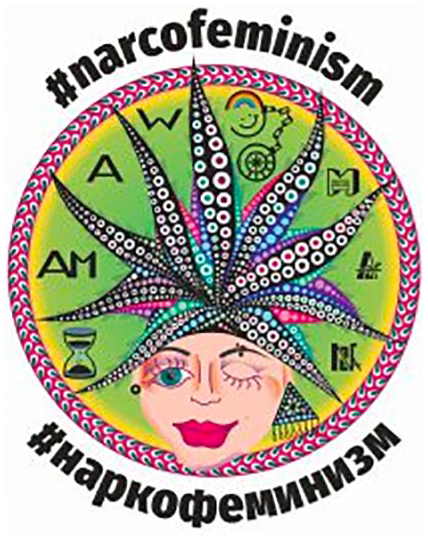
Narcofeminism logo, co-created by advocacy movements for women who use drugs.
We also had a meeting in Porto during the Harm Reduction International Conference 7 with women from around the globe. It was in 2019. A lot of women from different regions came. And it was a good meeting to introduce this movement, and everyone was really interested. But somehow this international [Narcofeminist] movement, it was going on for a while, but I don’t know if it’s still there.
It is going on, because I mean like even now, when we have an opportunity to meet online. AWID organised a forum this year because it [was] supposed to be last year and then COVID happened. This year it was organised online and we still had a session on women and there were topics of narcofeminism there. And a few weeks ago, we had a conference in Prague, it was the European Harm Reduction Conference, 8 where we also had a session about women and of course, again we mentioned narcofeminism. I mean, it’s always on the agenda of all the meetings for sure. It’s just, I guess, we don’t have network-strengthening opportunities now because of lack of money and we can’t bring people to one place because everybody lives in different countries, so that’s the only issue I guess.
I asked Eliza and Maria to explain how this started because I wasn’t in Brazil. They were there when it began. I joined the movement in 2018 in Berlin. We were there together and we were also together in Barcelona. And, of course, what I saw there, I was so inspired by these amazing women and these opportunities that they were providing. I was so inspired and I returned to Kyrgyzstan. We decided in 2019 to start our own branch there and we started joining the Campaign for 16 Days Against Violence against Women. 9 We decided every day to provide a new theme, 10 every one of those 16 days.
These were different stories related to various oppressions that we were facing as women who use drugs in our region. We published this on Facebook. But local journalists in Kyrgyzstan, 11 they saw this publication and started reposting it and there was an article in a newspaper called Case #. 12 They started to harass me because I was a representative of this movement in Kyrgyzstan. There was an article published about me and then there was kind of public shaming. Neighbours and people working in my child’s daycare were calling me out. There were threats from law enforcement, and Aibar Sultangaziev, who is very active in the [harm reduction] movement, and [Aleksandr Zelichenko] a former government official who worked with Narcotics Control in Kyrgyzstan, were asked to comment.
He was always a supporter, when we were speaking about funding and changing policies, he supported drug user movements in Kyrgyzstan. But then when this story happened with Alla, he gave an interview with this local newspaper which published about Alla, and it was like very, how do you say, like not a nice way of saying like, ‘Oh, these women, what are they doing, these crazy women? I don’t understand, I don’t support it.’ I can even find a quote later of what he literally said because it was really not nice. [He said, ‘We have the official authorities responsible for anti-drug activities. I think they have to react. React severely, as only a state can.’ 13 ] It was just a long time ago. I don’t remember word for word. But yeah, he kind of blamed us and said, ‘It’s not appropriate, you know, like to be organised in such a movement and what they’re doing here.’ Yeah and then as Alla said, this publication made her life very hard because all the neighbours and in children’s schools or kindergarten, everybody was watching and judging Alla because her picture was shown in the publication and [people labelled her. . . as] ‘the woman who is starting Narcofeminism in Kyrgyzstan’.
What struck me when I was reading about that campaign and how it was reported in the media was that it seemed to be particularly when drugs were associated with care and pleasure that people took issue.
We spoke about the right of a woman to use marijuana, that an adult woman has the right to smoke marijuana, or drink wine, and that this should be normal and not be judged. But in our society. . . it was like a bomb went off, that women are making statements about their right to use drugs. Men responded, ‘What do you mean?! Sit and be quiet.’ And all the hate that we got was from men, not women, but men. Men are always getting into our business about drug use.
I think it’s also because women are mothers and if you normalise drug use then mothers will be using drugs, and this is [seen as] completely unacceptable in our countries. Also, we have these laws that, based on drug use, the government can take away your parental rights. So it’s a highly moralised topic in the region. And yeah when Alla was trying to say that is okay, and a woman can choose and it doesn’t make her a bad person or bad mother, their mind exploded.
Can I pick up on that? Thank you for sharing that with us and being so candid. We appreciate that. Both Alla and Maria have touched on some of the issues that women in particular face related to the moralisation surrounding drugs and motherhood. I wonder if they could comment a bit more on the issues that women in particular face.
This is very much related to moral values. We have patriarchal values in Kyrgyzstan. We have a very strong influence of tradition where women are supposed to be humble. They are supposed to be looking down at the floor and at the ground. And even though we do live in a modern world, Kyrgyzstan is moving very heavily into the direction of Islamisation. It’s happening a lot here, and if women are talking about their rights, well, we can’t even go out on International Women’s Day on March 8 onto the street. We get beaten up and I’m sure that if I went out with some sort of protest banner, stating ‘Narcofeminism’, I would be beaten up. I would see my photo again in newspapers and all that hate would erupt.
We lived through another revolution last year. We changed presidents and with every new president in Kyrgyzstan comes a new Constitution. The new Constitution is focusing on family values and many feminists are saying, ‘How can we go forward and defend our rights if the Constitution is against equality and doesn’t defend our rights?’
I can say more about this. I remember when women inside the drug user movement started to speak about specific women’s issues and this was not understood by the men in this community, like, ‘Why do you need some specific services? What is so special about you? Because we’re all stigmatised. Why do you need special attention?’ So even inside this movement it’s also not accepted. AWID helped a lot to bring this issue forward inside the feminist movement, but before that and I’m sure it still exists at the local level in a lot of countries, the issues of women who use drugs among the feminist movement are not discussed. And it’s all because all of us are part of the society and, as Alla said, all of the countries are very patriarchal and the issue of women using drugs is highly moralised. You see it everywhere, I mean in policy decision-making. And actually the interesting thing is that we don’t have statistics on women who use drugs, the statistics are non-existent. It’s usually [an estimate], we have like 300,000 people using drugs and approximately 20% of them are women. No one even counts them, so it’s hard to advocate for services for women because of that. No one pays attention to this issue and you see this with the doctors and services that are designed to help women. Like in maternity [care], they don’t know anything about drug use. Women who use drugs are very stigmatised in these places and can’t get proper care. The doctors that provide ob-gyn [obstetrics and gynaecology] services don’t know about drugs and the people who know about drugs don’t know about women’s issues. They don’t work together so it’s all a mess. And maybe Olga can also expand on this.
Maria, thank you so much for explaining this point. We feel pain because our brothers do not accept our community, the Narcofeminist movement.
Yes, your movement seems to be occupying a difficult space between services and support groups: not accepted by your brothers in harm reduction, not paid attention to in mainstream services and not always understood by feminist organisations. Could you say a little more about these challenges?
Okay. Where I come from, in my country, the word ‘feminist’ is an insult. It’s bad to be a feminist. There’s a very negative view of this word. Before, we were talking about the negativity we get from men in these key communities that I work, [but also] there’s actually a lot of hate from women in the activist community. We were preparing information and pamphlets about sex workers, and various other issues, and we wanted to include information about narcofeminism, but I got so much hate from these women themselves in the UN Committee on the Elimination of Discrimination against Women (CEDAW), 14 and that was very, very hard to deal with.
That’s really difficult. Picking up again on this term narcofeminsim and the difficult space it occupies. . . what was it about narcofeminism that these groups were taking issue with?
For some people, feminism is bad, for other people, drugs are bad … so it’s like all together combined, it’s a red flag for people.
In light of this, there seems to be a political difference between a woman who uses drugs and a narcofeminist? We were wondering if you could say a bit more about what narcofeminism means to you?
Okay, happy to be doing this, thank you. So a woman experiences a lot of self-stigmatisation, especially a woman who uses drugs, and I was always living with the thought that I was a person living the wrong way and I had to go through many things and a long winding path to learn that wasn’t the case and this understanding of yourself, it comes from the contradictions present in society: a society that thinks that women need to stay home and manage the household, children and their husband; that a woman doesn’t have a right to use drugs and when she talks about her right, it’s like a bomb goes off and then that’s when you get all of this very open antagonism within society.
I want to say that in Berlin there was a really powerful women’s rights movement in 2019 to end violence against women. There was a march, and there were 10,000 women there, we just filled the space. And this was an amazing experience to feel that there are so many like-minded women. I think Berlin is really an exception to this. And today at 2pm there will be a movie, a documentary that I’m going to see about the problem of motherhood and discrimination.
We have many issues in common with feminists and common causes to fight for: Our rights to choose and to choose our career and how we go about life. Then, with people who use drugs, everyone who uses drugs experiences stigma and discrimination. But women experience many times more stigma and discrimination. And this is when it all kind of concentrates and becomes starker and at those points where that concentration happens, this is where we, people who use drugs, tie into feminist movements and therefore we use the word narcofeminism.
So I can give a simple example: even if a woman with drug dependence goes to a doctor, the first thing you will hear is, ‘But you’re a girl, you’re a woman!’ So that’s the first thing you’ll hear from society that it’s not okay for women. It’s three times worse or even more and that’s why we say narcofeminists. We have many problems in common with feminist movements. And we decided to bring together these movements and these drug use problems among women. The problem can be sexual, medical, you won’t even get housing. In 2019, we were in a big city in Ukraine and we went out on the streets to march against violence against women on the 8th of March. Women from different groups were there and said their opinions and various slogans. I was given the microphone and the speech that I gave was recorded. It was put on the internet, on Facebook. And as a result, at the time, I was renting an apartment and soon after, the people renting it to me asked me to vacate it because I was speaking to defend the rights of women to use drugs. So these problems are particular within women’s spheres of life.
Narcofeminism, for me, several important things: opioids, they saved me from suicide at the age of 13. At that point, there were no people near me who could understand my situation. These were the ’80s at that time. And we had access to drugs, they weren’t so bad. And for many years, people didn’t see and didn’t understand what was going on with me. There was no change in the way that I was treated. The way that I was treated changed when problems began and that’s when shame and guilt came to the fore. And what do I mean? If you’re using drugs, you have no voice, you can’t solve your own problems. So several times, I was forcibly hospitalised. I didn’t have as many problems with drugs as I did with the doctors who were trying to save me from using drugs. I had to run away from the hospital because they didn’t even let me into the doctor’s office. It was just my mum and my sister who were meeting with the doctors and I wasn’t allowed there. They were talking about drilling a hole in my head and I had to listen through the door to understand what would happen to me, and then I concocted plans to run away from the facility.
When I got to know this Metzineres organisation in Barcelona and I met Eliza and Maria and started our movement, and I became acquainted with intersectional feminism, I felt the support and I started to treat myself differently and have a different perspective on my life. And now my work is different, I want to be able to translate my experiences to people working or intervening with people who use drugs, like people who defend their rights. And [with] doctors and police, my goal is to change their opinions.
I’m really keen to know more about the kind of practical strategies that you engage [in] to support each other to build community. So if you could tell us about practical things that you do to support each other and to support women who use drugs?
First, I want to say, what attracted me to narcofeminism is its appeal to intersectionality and it allowed me to accept all kinds of different women in all their diversity. It’s my personal victory that this happened. And in terms of practical issues or approaches, I have experienced organisations of sex workers who don’t accept women who use drugs, organisations of women who use drugs or communities who won’t accept sex workers. Or LGBTQ communities who will not accept a lesbian who uses drugs. And for me narcofeminism was this island that accepts all women, and this really empowers me and motivates me. And [one of our colleagues Svetlana Moroz who] is not here with us, she is working in the Eurasian Women’s Network on AIDS. It’s one of the few organisations that embraces narcofeminism. They run these feminist schools. I’ve been to all three. There’s always a narcofeminist session where we talk about this and tell other people in various other networks and communities about narcofeminism. I also had the opportunity when I was experiencing the smear campaign to access their services for psychological support. And this got me out of my depression. And during COVID lockdowns we also organised ourselves, we made phone calls, and supported each other morally. And perhaps next year, we will arrange other activities so that narcofeminism, little by little, continues to develop. In this way narcofeminism, with the support of regional networks including the Women’s AIDS Network, whose strategy is to develop capacity and build an activist community, will continue to grow.
Yeah, what Alla said was basically very similar to what I wanted to say about this movement. I think, also, the topic of feminism is not very popular, not a lot of women actually understand what it means and I think, also in our first meeting in Berlin, it was kind of a new thing for a lot of women that were present there. And this idea of intersectionality and bodily autonomy, the women saw how it was all connected, and connected to their lives and how they are also their issues. I think what the Eurasian Women’s Network on AIDS is doing is very important in explaining feminism to women and helping them accept themselves because internal stigma is very high inside our region because of the situation that women live in. This movement is about women’s power and acceptance. When you feel safe enough and powerful enough, you are able to demand your rights, so I think this movement is helping with that.
I think in part my question has been answered. But I would like to bring out the question of when you use the term ‘woman’, do you see it as encompassing trans women and non-binary people? And everyone’s nodding, so I think they don’t need to. . .
We definitely do and actually also in our Barcelona Declaration, 15 which we developed in 2019 after the Barcelona meeting, we also mentioned women, gender non-conforming [people] so it’s like definitely all.
It seems to me that this is really quite challenging you know, in terms of the number of issues that you’re dealing with, the kind of opposition that comes from women outside the movement, that comes from people who are kind of anti-drugs. And so I wondered whether it has created a particular response from narcofeminists, whether it’s changed the way in which you address issues by taking into account the diverse ways in which people live their experience with sexuality and with drugs?
Maybe I can answer first. I know, maybe Alla will have something from the national perspective to say. I mean our region itself is very challenging as you could already hear about all the patriarchy and understanding of what is drugs, what is feminism, etc. I would say that we didn’t do much until now on the issues of people who are gender non-conforming or non-binary and well, at least from what I know, we don’t have any specific practices. But I mean it’s always about support, and having each other stand by when we need each other, when there are challenging situations. I advise you to look up the Metzineres, 16 because they have good practices and principles of work and everything that is related to this topic. But as we didn’t work that much in it, I’m not sure if we can share that much information. Maybe Alla will have something to add from the Kyrgyzstan perspective. . .
So in terms of some sort of political response or strategy, of course, we face this major challenge of taking into account the diverse experiences and issues of these various organisations and communities with separate interests. We feel the challenge of bridging this. But I’m not sure we have an official strategy.
We started a women’s network of key populations and it brings together women from many different groups, and these are all activists and people who defend human rights and also representatives from [People Who Use Drugs] PWUD groups. And right now, in Kyrgyzstan with the challenges we face today for narcofeminism, this is enough. Narcofeminists also entered this umbrella organisation and there are people there who share our views and our mission and we started campaigns with them, with other feminists who welcomed us warmly. But we don’t put these hefty goals in front of ourselves in Kyrgyzstan because it’s frankly just not safe to speak openly about how we are using drugs, this is not safe. We work towards goals to fight for the rights of women who use drugs and to change narcopolitics, to change drug policy. For now, for us, this is enough.
I’m really conscious that a lot of your work is about changing the conversation on drugs to focus, not just on the negative side, but also to explore the role of pleasure. And, can you tell us a bit more about the role of pleasure in your campaign, so why talking about the role of pleasure is important?
I think talking about pleasure is very difficult. It’s very hard to get pleasure from using drugs in our region, in Eastern Europe and Central Asia, there are very repressive laws. We don’t have drug checking services to check the quality of the drugs we’re buying. If we talk about pleasure, pleasure comes with quality drugs and it’s hard to get quality drugs and check the quality. And Olga was talking about a movie. 17 After the smear campaign that I experienced and survived in 2019, I wanted to talk about my experience. It’s not related to narcofeminism, but you can watch it and you can think about this yourself. There are topics there about pleasure and also about not getting pleasure. The topic of pleasure from drug use is a very difficult topic. To get pleasure from substances in Kyrgyzstan is very difficult. For me it’s not about pleasure, it’s more suffering.
In Kyrgyzstan, I would say it like this: the quality of drugs is very low and it’s problematic to get quality drugs. But it’s not only that, it’s also about the police and law enforcement and the various law breaking and dysfunction that exists in relation to that. You can’t relax and get high from a substance because you’re always stressed from this whole situation and when a person, a woman uses drugs, I don’t know, it’s not pleasure. Maybe, if I were young and didn’t have so many cares in the world, then. . . but, for me, as a mother, it’s in no way pleasurable, it’s more a tragedy, nuisance, something like this.
Thank you. And so I think we’d like to hear a little bit about what your vision is for the future of narcofeminism? Or how do you see it changing societal understanding of drugs and maybe even influencing different kinds of drug policies in future?
Okay, so I can say a bit on this, so it’s about the particularities, the specificity of our region, as Alla said. And how it’s different for the countries where you live and work. I’m not sure about Australia, but I’ve been to Germany and the UK and it’s about the availability of a substance. Just this fact of not being able to prepare or to get it, and then go home calmly, it’s not possible in our countries, so using illegal drugs is tied to big risks and danger. And so you get a substance and rather than using it for pleasure, you use it to relieve the stress from the situation you ran away from this time.
I noticed the following for me: psychoactive substances for me are directed towards self-medication or towards accepting yourself and expanding your mind. In our region, they’re used in this way because it’s dangerous, there’s a lot of pain, and substances, a lot of the time, you don’t know what you’re using, so there are lots of overdoses and cases of death. This is why our mission in the Eurasian Network of People who Use Drugs is to stop people who use drugs from becoming sick and those who already have become sick, our mission is to help them preserve their health.
So our main goal now through various meetings and trainings, and gatherings of like-minded people is to get people, women who use drugs and move them to countries that have more progressive drug policies, so they can rid themselves of the self-stigmatisation, and so they can make the first steps to communicating with the world about using drugs without stigma and guilt.
Thank you. That makes a lot of sense. And this is a final, final question, but we were just wondering how we or other people might be able to help you in your narcofeminist vision?
I can answer this. I think you can help us by talking positively about us, by showing the human face of an unpopular problem. Society tells us to be quiet [but] every person that allows us to speak openly to say that women who use drugs are people, are normal people in this. Showing this face of it, would be a great help.
I wanted to give a little more information about my experience because I know we’re ending here, and why narcofeminism allowed me to accept myself the way that I am, and to admit things that were difficult for me to admit. When I first tried drugs, I was an adult, I had my own business and people in my community could see me as an example and look up to me. Then horrible things started to happen in my life. I buried two of the people closest to me, my father and my grandmother. And I had to be strong and I wasn’t allowed to cry and the stress, as I see it, came through in the form of an illness. I was diagnosed with cancer and they gave me morphine. At the time, they gave me two weeks to live and, at this time, I didn’t find pleasure from [taking morphine]. I just felt that I could continue to live, think, work, analyse and function. I came to terms that this was going to be the end and I accepted it. I didn’t have long to live. But then weeks passed and then two months, and then they called me in and they did some analysis and the sarcoma in the female organs, it wasn’t there. My body was fine.
I’m still sure that opioids helped my nervous system calm down to the point where my body was able to return to its normal state. And this was my treatment at the time. When I was told my sarcoma wasn’t there anymore, I asked if I could continue to get morphine, and the doctor told me, of course, that I couldn’t. So, I started to buy it on the street. And because of my social status, no one suspected, no one could tell I was using drugs and this continued for four years. Much in opposition to this view that people who use drugs degrade, I really prospered in these four years. I expanded my business. I opened four new stores. And I said at that point that I would go into the hospital and stop using drugs.
After being in the hospital, I decided to tell everyone why I had been absent during this time. I decided to tell everyone openly that I had this problem. I thought no one would judge me. I thought, because they saw me for those years and never judged me. When they asked where I was and I told them that I was in the hospital being treated for drug dependence, my life changed in a matter of days. After they learned that I was being treated for drug dependence, even though we had communicated and they’d seen me every day for four years and everything was fine, they turned away from me, everyone, except my close people, my mum.
This situation brought me to rock bottom, even though I had never interfaced with the criminal justice system. The situation when everybody turns away from you, and then you degrade, you turn away from yourself. The person just degrades, they turn away from society, from themselves and they turn away because of substance use. We didn’t have harm reduction programmes in our country and then harm reduction programmes came and I became a participant and I started to tell the story that stigma and discrimination is what is detrimental to life. Narcofeminism, what it did for me, it allowed me to feel like a person again. Irrespective of the fact that we’re from different countries, in different cities, this brings us together, allows us to accept ourselves the way that we are and to give other women the assurance that we will do the same for them. We look after each other.
We did a study to show the various issues that women come up against: police, discrimination surrounding drug use, medical issues. We want to communicate and provide for the lived experience of women in our region. And pleasure too. Currently, I have been taking buprenorphine [an opioid substitution treatment] for 10 years already, and I don’t feel any pleasure. But for pleasure, I smoke marijuana with my husband.
Narcofeminism accomplishes a very important task of talking about these issues in such an oppressive environment and we’re very happy about that. Partly because drugs are so demonised, we don’t know what they do, medically. Because of the ban that exists worldwide, people don’t know how to take them correctly and I think drugs should be decriminalised. I know two people who have diabetes and they take insulin, but when they were using opioids they weren’t needing any insulin so their blood sugar wasn’t going up, 18 and this is very important because it shows that there needs to be a better understanding of drugs, around the whole world.
I want to finish with this phrase. In terms of pleasure, just not experiencing pain is already pleasure. Thank you.
I have been thinking about this, you know, pleasure and drug use, and this movement, and there is another side of it. We’re inside the community of people who use drugs, we’re inside of an activist community who are trying to change drug policy in our region so we know, maybe, too much of the problems and we cannot take these things lightly.
The reason we asked about pleasure is because we noticed that on your website, the movement speaks about the right to take drugs and enjoy them.
Yes, there’s a lot about acceptance, acceptance of yourself. When you want to take drugs, you shouldn’t feel ashamed of your desire to take drugs or your need to take drugs, you shouldn’t feel ashamed. This is so you can relax and feel pleasure. Yeah, I think it’s about this: for people to not feel alone and know that it doesn’t make you a bad person. It’s okay, everybody uses something, it just happens that these substances are illegal.
Yes, thank you. And thank you so much everybody for taking part. It’s been great hearing from you and learning more about your experiences, and the Narcofeminist movement, and what you’re hoping for the future and how we can all contribute towards this vision of acceptance and justice for women and gender non-conforming people.
It would be great to engage in common research – because you are scientists and know the technologies, to involve more women from different countries and different social groups – addressing the same question of how we can work together to reduce self-stigma and enable women to join this movement.
Footnotes
Acknowledgements
The editors would like to sincerely thank the narcofeminist activists for giving their time and energy to share their experiences and to Lyu Azbel for their expert simultaneous interpretation.
Funding
The authors received no financial support for the research, authorship, and/or publication of this article.