



Abstract
Given their salience in many sports and physical cultures, it is surprising that the practices, processes and production of intercorporeality and ‘doing together’ remain under-explored from a sociological perspective. The ongoing achievement of ‘togethering’ can be particularly important for the embodied partnership between a visually impaired (VI) runner and a sighted guide (SG) runner: a specific sporting dyad whose experiences are currently under-researched. To address this lacuna and contribute original insights to sensory sociological studies, here we explore the accomplishment of running-together by VI runners and sighted guides, focusing on the auditory dimension. To illustrate how these runners put the sense of hearing ‘to work’ in achieving finely attuned intercorporeality, often at considerable speed, we draw on qualitative data from a research project on VI running in the UK, involving five VI runners and five SGs. Here, we focus on auditory attunement in two domains identified as highly salient in the running-partners’ intercorporeal experiences: (1) Listening out – auditory attention to non-linguistic sounds; and (2) Tuning in – the importance of attending to team-talk between VI runners and SG runners.
Introduction
Whilst there now exists a substantial sociological research literature on sport and physical cultures, to date the concrete practices, processes and production of intercorporeality and ‘doing sport together’ remain under-researched (Allen-Collinson et al., 2021; Hammer, 2015; Meyer & Wedelstaedt, 2017). Extant research on ‘doing together’ and ‘we-ness’ tends to be based on ethnomethodological studies, relating to, for example: rock climbing (Jenkings, 2017), swimming (Allen-Collinson et al., 2021) and distance running (Hockey & Allen-Collinson, 2013). There is also a small body of sociological research (including social phenomenological studies) on ‘doing together’ in physical cultures, for example: cycling (Shilling, 2022), rowing and/or swimming (McNarry et al., 2021; Schmitz & Effenberg, 2017), running (Allen-Collinson, 2008), and on more-than-human ‘doing together’, such as in canicross (Merchant, 2020) where humans participate in cross-country running with dogs. In general, however, experiences of intercorporeality in physical cultures remain under-researched (Meyer & Wedelstaedt, 2017), particularly from a sensory perspective (Hockey & Allen-Collinson, 2009; Powis, 2019; Sparkes, 2009).
This is a surprising gap, given that in many sports bodyminds must coordinate with one another in highly intricate and complex ways, including sensing, monitoring and anticipating the movements, paths, and trajectories of others (Hockey & Allen-Collinson, 2006; Shilling, 2022), often at great speed (Meyer & Wedelstaedt, 2017). Such finesse of coordination is salient in the embodied partnership between visually impaired (VI) 1 runners and their sighted guide (SG) runners. Via social interaction, these runners seek to synchronise their arm and leg movements to achieve running-together at speed. As has been noted (Hall et al., 2023), the quality of these partnerships, as with similar VI togetherings (e.g. in cricket [Powis, 2018], cycling [Hammer, 2015] and walking [Macpherson, 2017]), can have a profound impact on the quality of sports and physical-activity opportunities available to those with visual impairments and disabilities.
To address this lacuna, our qualitative, interview-based study with 10 participants (five VI runners/five SG runners) was undertaken to elicit both VI and SG runners’ accounts of running embodiment. Encompassing SGs’ experiences is important, as much past research on disability sports has, understandably, focused primarily on disabled people’s experiences (Hall et al., 2023; Jaarsma et al., 2014). Furthermore, in respect of social interaction in guided running, neglecting SGs’ perspectives would risk overlooking important insights. In the wider context, also, our research was timely, given the publication of the first-ever national and international guidelines on physical activity for disabled adults (World Health Organization, 2020).
To address our topic, and to consider intercorporeality in physical cultures more widely, below we delineate our theoretical perspective of sociological phenomenology. Our phenomenological inspiration draws from Merleau-Ponty’s (2001) existential phenomenology, given his focus upon the centrality of the body in lived experience. As other ‘carnal’ sociologists (e.g. Crossley, 1995; Shilling, 2001) have found, Merleau-Ponty’s work, allied to sociological perspectives, can generate a powerful theoretical nexus. We are not, however, uncritical of elements of Merleau-Ponty’s oeuvre, such as his implicit assumption of male-as-norm. Butler (2006), for example, takes to task Merleau-Ponty for a lack of specificity regarding the kinds of bodies and sexualities he analyses. Nevertheless, his concept of intercorporeality (l’intercorporéité) or ‘carnal intersubjectivity’ is germane to our purpose here, highlighting how body-selves interact and influence each other in ‘we-relationships’. So central is intercorporeality to embodiment and being-in-the-world that the feminist phenomenologist Weiss (1999, p. 5) argues that: ‘To describe embodiment as intercorporeality is to emphasize that the experience of being embodied is never a private affair but is always already mediated by our continual interactions with other human and nonhuman bodies’, requiring frequent reorientation of one mobile body in reference to other mobile bodies. We would also include in our conceptualisation of intercorporeality that, akin to Pink’s (2015) notion of ‘emplacement’, intercorporeality involves relationships between bodies, minds and the materiality and sensoriality of the environment. 2
Our sociological thinking was informed by ‘phenomenological commitments’ (Høffding & Martiny, 2016). To address our purpose, the article is structured as follows. After delineating our theoretical framework of sociological phenomenology, we describe the qualitative study, before portraying our key auditory findings identified in relation to intercorporeality and the production of running-together by VI runners and their guides. The auditory, it emerged, was a crucial sensory modality in achieving VI–SG running-together, and it is to the general context of vision impairment, and VI running in the UK, that we now turn.
Vision impairment in sport
It is estimated that at least 2.2 billion people globally have some form of vision impairment (World Health Organization, 2021). VI adults identify substantial barriers to engaging in exercise and physical activity, such as fear of falling (Nguyen et al., 2015), lack of peer companions (Jaarsma et al., 2014), negative perceptions of VI people’s ability to participate in sport and exercise (British Blind Sport, 2014), hazardous footpaths and pavements (Phoenix et al., 2015) and inadequate equipment and facilities (British Blind Sport, 2014). Furthermore, given the considerable variation in experiences across different physical cultures, and between different disability groups, research on specific sporting activities and disability groups is much needed, to generate more detailed, domain-specific understandings and to inform policy and practice. Interest in VI running has grown considerably in recent years (Hall et al., 2023). In the UK, national governing bodies provide training workshops for SG runners, and specialist databases allow VI and SG runners to seek out suitable running partners. To overcome some of the challenges and constraints confronting VI runners, many participate in the sport with the help of an SG runner, for example, via an ‘elbow lead’, together with verbal ‘instruction’ from the guide.
In terms of the wider, but still sparse, literature on intercorporeality and ‘running-together’, research has investigated sighted runners who train together (Allen-Collinson, 2008; Denison, 2006; Hockey & Allen-Collinson, 2013), and more rarely VI runners and their guides (Hall et al., 2023). This work addresses both ‘planned’ and deliberative intercorporeality in the form of co-running with human partners, and also with dogs in canicross (Merchant, 2020) or with guide dogs specifically (Lieberman et al., 2019). It also encompasses analyses of unplanned (and often undesired) intercorporeality, in the form of pedestrians, cyclists, and dogs as running hazards (Allen-Collinson & Hockey, 2015) and deliberate physical harassment (Allen-Collinson, 2008; Brockschmidt & Wadey, 2022; Gimlin, 2010). The running partnerships between VI runners and guides produce distinctive kinds of ‘togethering’. Despite the centrality of these in VI people’s engagement in running, there remains scant research in this domain (Hall et al., 2023). This sociological lacuna is worthy of research, given that insights can be gleaned from studying the interactional production of VI running, to enhance understanding of VI runners’ experiences and how these might be improved. Our purpose here, therefore, is to contribute fresh and original perspectives to the limited sociological research literature on intercorporeality in sports and physical cultures, and also to the sociology of the senses, via a specific focus on the auditory in VI running, as this sensory modality was identified as crucial to safe and enjoyable VI running. Merleau-Ponty’s existential phenomenological conceptualisation of the salience of intercorporéité in human being-in-the-world contributes specific insights to our own theoretical framework of sociological phenomenology. We next address this perspective, before considering the methods utilised for data collection and analysis.
Sociological phenomenology and intercorporeality
Departing from their philosophical roots in Husserlian (1999) descriptive phenomenology, forms of empirical and applied phenomenology have been adopted by sociological researchers in physical cultures (e.g. Allen-Collinson & Jackman, 2022; Crossley, 1995; Hockey & Allen-Collinson, 2009; Liu, 2022; McNarry et al., 2021), often drawing upon the works of key existential phenomenologists, such as de Beauvoir and Merleau-Ponty. Existential phenomenology highlights the ways in which the world, body and consciousness are fundamentally intertwined and mutually influencing. Merleau-Ponty (1968) argues for the importance of ‘reversibility’ in that bodies are sensible and sentient, touchable and tactile, audible and hearing, visible and seeing; although this latter form of reversibility was fundamentally challenged in the lived experience of VI participants. Indeed, positing a universalism of human experience, so central to much philosophical phenomenology, has given rise to trenchant critiques from sociologists. Various forms of sociological and/or critical phenomenology (e.g. Ahmed, 2006; Allen-Collinson & Jackman, 2022; Chandler, 2019; Liu, 2022) thus explicitly acknowledge, analyse and theorise the culturally situated nature of human experience.
Combining phenomenological insights with sociology, Schütz (1967) was particularly interested in Husserlian conceptions of intersubjectivity and the lifeworld: the world of everyday experience, intersubjectively and intercorporeally shared with others, and in the centrality of the ‘we-relationship’ in human existence. It is intersubjective, and particularly intercorporeal, experiences that we explore here. Furthermore, as Tanaka (2017) notes, the notion of intercorporeality demonstrates how, through a certain ‘resonance’ between bodies, we can seek to grasp and understand the intention of another’s action (see also Csordas, 2008). This focus on intercorporeality and corporeal resonance proved insightful in exploring the sensory experiences of VI and SG runners in their mind–body engagements.
Although there is not the scope here to review in-depth the burgeoning field of the sociology and anthropology of the senses and the ‘sensorial revolution’ that Howes (2006) so evocatively describes, it is worth noting that very little of this work is situated within the sociological phenomenological tradition. We are in agreement, however, with sociologists and anthropologists, regarding the need to investigate sensoriality, and the different forms of sensoria, across social groups (e.g. Howes & Classen, 2013; Low, 2012; Paterson, 2014; Pink, 2015; Vannini et al., 2013), including vis-a-vis distinctive physical cultures (e.g. Allen-Collinson et al., 2021; McNarry et al., 2021; Powis, 2018), and also the specificities of sensuous bodies, such as those with visual impairments (e.g. Hammer, 2015; Macpherson, 2017; Petty, 2021; Powis, 2019). Via various theoretical lenses, the salience of the senses and society nexus emerges strongly in this research corpus. As previously highlighted (e.g. Allen-Collinson & Hockey, 2015), singular sensory modality is unusual, and for the most part, lived experience is synaesthetic in that multiple senses work in concert. Such synaesthesia coheres with Merleau-Ponty’s (2001, p. 221) existential phenomenological observation that ‘no sensation is atomic, all sensory experience presupposes a certain field, hence co-existences’. Here we focus specifically on auditory experiences in VI running, as these were so strongly identified by both VI runners and guides in the interviews, but we also note that, to a lesser extent, the sense of touch was discussed. As we and many others have already addressed in-depth the haptic senses in running, and exercise (e.g. Allen-Collinson & Hockey, 2011, 2015; Allen-Collinson & Jackman, 2022; Barnfield, 2020; Brown, 2017), the originality of our focus here lies in analysing the role of the auditory in achieving and maintaining running-together. We also seek to challenge the ocular-centrism still prevalent in much research in the sociology of sport and physical cultures (and beyond), via a consideration of the salience of listening and hearing.
The research
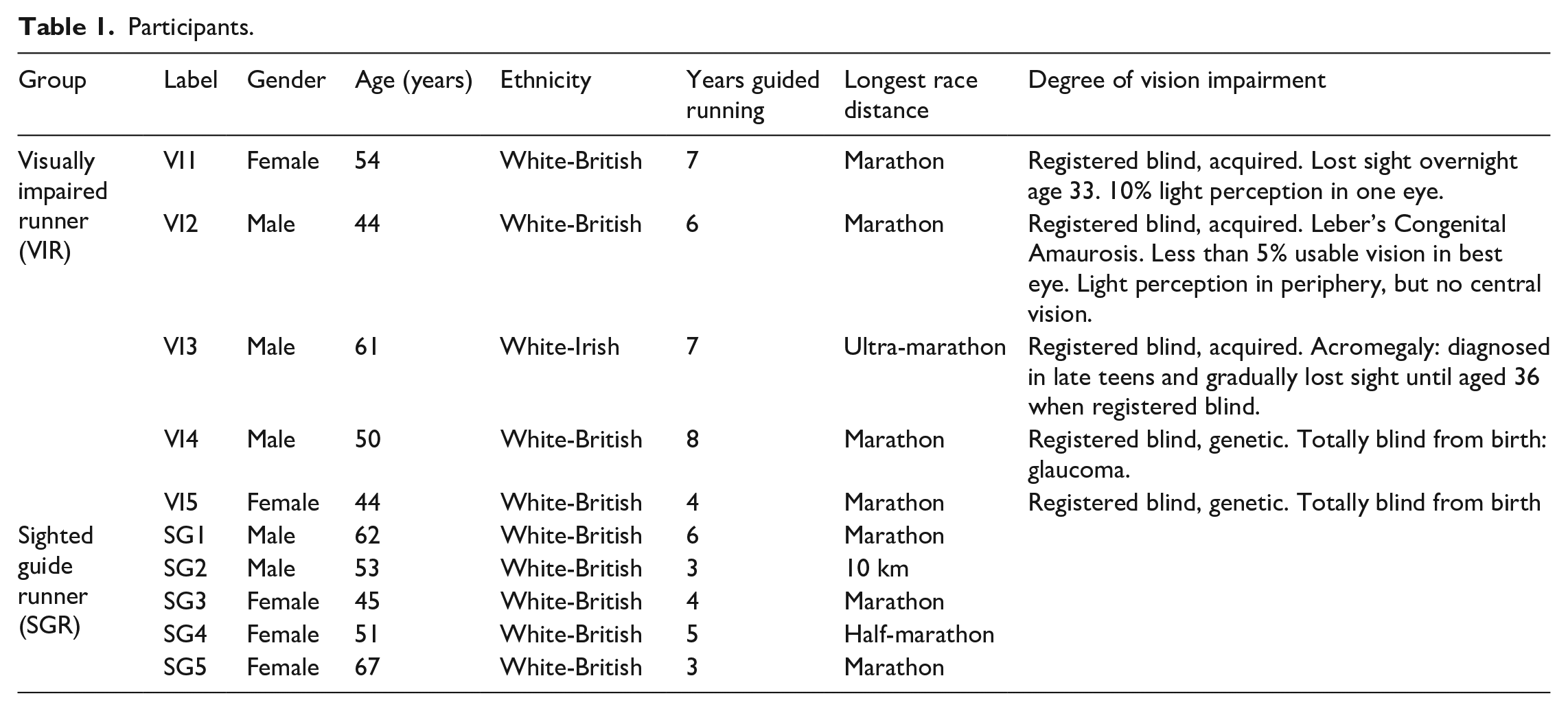
Ethical approval was granted by the authors’ university. We sought participants aged 18 and above who had engaged in running for at least six months previously, either as a VI runner (spanning various degrees of vision impairment; see Table 1) or as an SG. A poster and study information were posted on social media platforms used by VI and SG runners. After initial responses, snowball sampling was used to supplement the participant group, resulting in the recruitment of a total of five VI runners and five SG runners, all UK-based. All participants were committed recreational runners and took part in distance races, ranging from five kilometres to ultra-marathons; further details are shown in Table 1, including the degree of vision impairment and whether this was genetic or acquired.
Participants.
After providing informed consent, each participant took part in an online, semi-structured interview with the second author, Dona, via Microsoft Teams™ (as was necessary during Covid-19 restrictions) during which she sought to elicit detailed accounts of participants’ embodied experiences of guided running. Thus, after initial introductory questions (e.g. length of involvement in VI running), Dona encouraged participants’ rich experiential accounts of running-together with their partner (e.g. ‘When you are running, what do you think about and how do you feel?’). Throughout the interviews, to encourage reflection on, and discussion of, what can be deeply embodied and sometimes unreflective practices and experiences, she used prompts such as ‘Can you tell me more about that?’ Interviews lasted on average 62 minutes (range = 42–94 minutes) and were recorded via the MS Teams™ platform. A summary of initial findings was forwarded to all participants, who were asked if they would be willing to participate in a follow-up interview to discuss emergent findings and offer additional thoughts; seven participants accepted, while three did not respond. These ‘member-reflections interviews’ (Smith & McGannon, 2018) provided additional insights that were included in our dataset. A total of 17 interviews was thus conducted.
For data analysis, initially we employed a flexible version of reflexive thematic analysis, drawing on insights from the work of Braun and Clarke (2019). The multidisciplinary research team then discussed the analysis collectively, with team members acting as ‘critical friends’ (Smith & McGannon, 2018) to one another, for example, by questioning elements of the initial analysis, and offering different interpretations and suggestions for theorisation. We then decided, for the specific purposes of a phenomenologically contoured discussion, to draw upon applied phenomenological analysis (Giorgi, 1977) as has previously been utilised in qualitative work in physical cultures (e.g. Allen-Collinson & Jackman, 2022; McNarry et al., 2021; Purser, 2018). We thus sought to stimulate our phenomenological sensitivities and insights and apply these to the empirical data. This is a long-standing practice in empirical phenomenology (Martínková & Parry, 2011). As Ravn (2023) emphasises, phenomenological insights can be employed highly effectively in the analysis and discussion of phenomena, and in the analysis of data collected by traditional, qualitative approaches, such as interviews. Our phenomenological data analysis thus drew on Giorgi’s (1977) guidelines for such analysis, involving: (1) the collection of detailed descriptions of phenomena from participants; (2) the adoption of an open and questioning attitude (the phenomenological attitude); (3) initial, impressionistic reading of participants’ descriptions, to gain a feel for the dataset in toto; (4) more in-depth re-reading of these accounts to facilitate data-immersion; (v) identification of key structures of experience, and the grouping of these into higher order themes.
Analysing data via this framework of ‘empirical phenomenology’ (Allen-Collinson, 2009; Martínková & Parry, 2011) can give rise to the deployment of phenomenological concepts, such as lifeworld, intercorporeality (intercorporéité) and body auxiliaries, for example. The application of such concepts to qualitative data is increasingly utilised within social-science research (see for example, Aalten, 2007; Allen-Collinson, 2022; Høffding & Martiny, 2016; Jackman et al., 2022; Zahavi, 2021). Furthermore, it coheres well with drawing on Merleau-Pontian perspectives, given that Merleau-Ponty does not adopt in full Husserl’s (1999) conceptualisation of the phenomenological method, with its reliance on the epoché (Allen-Collinson, 2009; Zahavi, 2021). Full epoché demands the researcher suspend all her/his preconceptions or assumptions regarding the phenomenon under study, and thus is deemed an impossibility for sociological researchers (Allen-Collinson, 2009). Our purpose in this article is specifically to generate understandings of the intercorporeal experiences of VI runners and their guides, via the application of phenomenological insights (Høffding & Martiny, 2016). This accords with the ethos of a ‘carnal sociology’ (Crossley, 1995; Shilling, 2001).
Throughout the research process, all researchers were cognisant of being sighted runners, so critical reflection on our beliefs, interests, positionality and reflexivity was a key concern (see also Brighton, 2015; Hammer, 2013; Macbeth, 2010). Dona is herself an experienced, licensed running-guide, and prior to data collection discussed the research with British Blind Sport, a British charity organisation providing support to blind and partially-sighted people wishing to participate in sport. She sought guidance on appropriate terminology and suitable recruitment approaches. Her background as an SG runner helped develop rapport with participants and engender a degree of ‘somatic empathy’ (Allen-Collinson et al., 2016) with the embodied experiences recounted by participants. Despite such rapport and elements of shared experience, we nevertheless fully acknowledge that it is not possible for us to know what it feels like to be a VI runner, and it is requisite to respect such differences in experience (see also Paterson, 2014; Smith et al., 2009). Other members of the research team had no experience of VI running prior to involvement in the study and were thus able to act as ‘critical friends’ (Smith & McGannon, 2018), for example, by posing ‘naïve’ questions to encourage questioning of initial data interpretations.
In the following sections we portray analytically participants’ experiences of intercorporeality in VI running.
Intercorporeality and VI running
As has previously been identified (Allen-Collinson, 2008; Hall et al., 2023; Hockey & Allen-Collinson, 2013), running-together requires a considerable degree of sensory attunement to a co-runner or co-runners, together with a reciprocity of attention. Analogous to other forms of on-the-move intercorporeality, such as walking (Macpherson, 2017; Ryave & Schenkein, 1975), cycling (Hammer, 2015; Themen & Popan, 2022) and swimming (Allen-Collinson et al., 2021; Schmitz & Effenberg, 2017), considerable sensory interactional work is involved. For VI runners and their guides, sustained ‘auditory attunement’ (Allen-Collinson & Owton, 2014) was identified as crucial for achieving safe and enjoyable running-together. As Feld (2000) notes, sound and our awareness of sonic presence are powerful forces shaping everyday sense-making activity and producing a specific ‘acoustemology’ (acoustic epistemology) based on how our lived experience of sound generates particular bodily ways of knowing. The salience of ‘auditory knowledge’ (Rice, 2010) has been noted by some sensory scholars, but as Powis (2018) points out, such knowledge has received limited academic attention. Although there was not the scope in the original research design (and ethical approval) to examine the ways in which the VI runners had over time developed their auditory knowledge in everyday life, it was clear from the data that both VI runners and their guides engaged in active and agentic listening, or what Bull and Back (2003) term ‘deep listening’, during actual running-together. To explore how such listening and hearing were employed by both VI runners and SGs, we have structured the findings into two overarching descriptive themes: (1) Listening out – non-linguistic indicators; and (2) Tuning in – team-talk.
Listening out – non-linguistic indicators
As Bull and Back (2003) point out, ‘deep listening’ requires careful auditory attention to both other people and the wider ‘soundscape’.
3
This, Schafer (1994) portrays as the acoustic environment of a specific space (see also Powis, 2018), or what has been termed ‘sonoric space’ by Revill (2013). Schafer (1994) highlights the importance of attunement to the nuanced and multiple layers of meaning enfolded in sound. Powis (2018) and Themen and Popan (2022) emphasise how responding to auditory structures of a specific context is not passive, but active. This resonates with Merleau-Ponty’s perspectives, where perception is always both active and passive. He argues (2012, p. 451) that: ‘What we call passivity is not our reception of an external reality or the causal action of the outside upon us: it is being encompassed, a situated being . . . that we perpetually start over and that is constitutive of us.’
4
VI and SG runners described the many ways, during both training and racing contexts, in which they ‘listened out’ for a range of sounds that assisted in signalling the presence and proximity of a co-runner, and thus achieving synchronised intercorporeality: I listen to the footsteps, I’m always listening to the footsteps, and I try and put my footsteps the same as their footsteps, which is not always easy if you’ve got a taller guide, they take longer strides, I take smaller. One of my guides, his watch bleeps every time he takes a step, is it a metronome? I quite like that because I do my footsteps with that and I know exactly where he is, he doesn’t even have to speak, but I know exactly where he is because he’s got that on his watch. . . (VI1)
Other auditory devices, such as bells and sound-emitting watches used by guides, were employed by VI runners as ‘body auxiliaries’ (Merleau-Ponty, 2001), providing a form of bodily extension that helped signal a guide’s location. This assisted VI runners with spatial awareness, enabling maintenance of the appropriate distance to achieve and sustain running-together: We had music coming out of the loudspeaker [of the watch] and it was just a noise, it could be any noise for him to follow, and it was on my wrist that was closest to him so he could focus on that, he could keep that in his mental image of where that was, spatially at all times, and just kept the appropriate distance, then as much as he could to keep on track. (SG1)
These devices tended to be used when training on running tracks (or other smooth surfaces), especially those with predictable bends and contours. In addition to listening out for audible devices such as bells and myriad sound effects from watches, which were deliberately emitted, participants also reported paying auditory attention to what Vannini and colleagues (2010, p. 331) term ‘non-symbolic sonorous expressions’: the sounds of non-musical and non-linguistic bodily acts and processes, such as panting, coughing, wheezing. A primary aural cue used to assess other runners’ ‘going’ or performance is that of respiration rate and style: the rapidity, depth and general noise characteristics of breathing. Participants described developing acute awareness of, and listening out for, these kinds of ‘sonorous expressions’ emitted by running partners, such as heavy, laboured breathing, panting, grunting, and other audible indicators that their partner in the VI running dyad was struggling. Such auditory attention to these sonorous expressions has been described by Allen-Collinson and Hockey (2015) vis-a-vis sighted runners, but in the case of VI runners, the degree of attunement to such sounds was much more refined and salient, forming an intense focus of attention. The following instance relates to an example of a training run: . . . although I can’t usually see what’s happening, I’m always tethered to my guide on my left. I can hear footfall, I can hear breathing, and I concentrate on things like that, and when we’re running hills or stuff like that, I’m coaching them on what to do, managing how to handle it, if they’re struggling how to manage those struggles. (VI3)
Such auditory concentration aligns with Powis’s (2019) observation that hearing is the process of perceiving sound, whilst listening is an active skill requiring a level of individual mediation. Listening is a key component of ‘auditory work’, as we have previously argued (Allen-Collinson & Owton, 2014), involving aural sense-making that is strongly shaped by culture, and also physical culture. Once having heard, interpreted and made sense of aural cues, as part of their auditory work, interviewees reported adjusting their own pace or rhythm, to maintain running-together. A guide indicated how their VI running-partner (a more accomplished runner, who had helped the guide achieve two half-marathon personal bests) had developed fine auditory attunement to the SG’s state of running-being and corporeal indicators, and could hear when it was appropriate to ‘push’ his guide, to increase the pace during training: Robert [VI runner] doesn’t push me unless I want to be pushed, but he can hear that I’m working quite hard. . . he’s able to consider me holistically enough that he knows when to push me and when not to. (SG4)
This highly developed bodily resonance (Tanaka, 2017) and somatic awareness of another’s state of being cohere strongly with social phenomenological perspectives on the importance of the ‘we-relation’ (Cox, 1973; Schütz, 1967): that is the intersubjective and intercorporeal experience of individuals co-present in a situation. In the above comments, the SG also suggests that a more developed ‘we-relationship’ (Cox, 1973, p. 122) had developed over time between members of the dyad, facilitating bodily resonance and ‘somatic empathy’ (Allen-Collinson et al., 2016) when co-runners sought to put themselves ‘in the (running) shoes’ of their partner. Our findings also resonate with comments from Hammer’s (2015) cycling-tandem dyads, who similarly developed a sense of how a co-rider was feeling, which was embedded in the culture of VI cycling. Drawing on understandings of other intercorporeal dyads (e.g. Poczwardowski et al., 2020), our analysis suggests that the power dynamics between a VI runner and their guide can be characterised by high levels of reciprocity and complementarity, albeit with qualitative differences in roles (see Hall et al., 2023).
Tuning in – team-talk
Together with listening out for the non-linguistic indicators described above, the runners also discussed verbal interaction between dyad members. As we have highlighted in earlier analyses of running-together (e.g. Allen-Collinson, 2008), the role of verbal communication can at times be important for sighted runners. Specific to VI running, however, a key element of many runs was reported to be the ‘painting’ of a picture via evocative verbal descriptions, by both VI runners and guides, to provide a feel for the setting and environmental conditions. As one VI runner noted of his SG: ‘he’ll tell me about the environment, about average number of people, who’s there, the services’ (VI1). The employment of such descriptive scene-setting has been identified in other VI sports, such as cricket (Powis, 2018) and cycling (Hammer, 2015). VI runners often participated in training sessions and races alongside sighted runners, and participants emphasised the importance of describing the scene – not only vis-a-vis what was happening, but also what actions VI runners needed to take to be included in the social environment, alongside fellow runners. SGs in particular provided many examples, including social inclusion in warming-up/cooling-down exercises when others’ ocular-centrism risked socially excluding VI runners: Their warm-ups and cool-downs, they were very visual, and nobody was coming and explaining to her what she needed to do, and I felt that one week some of the other beginner runners were laughing at her because she couldn’t do it, because she couldn’t see to know how she had to do the exercise. So, it was very much trying to be hands-on and say: [directly and explicitly] ‘This is where you need to put your leg’ and stuff like that. (SG3)
In the above instance, the guide used auditory instruction alongside haptic demonstration to convey sensory information that otherwise was too ocular-centric, socially excluding VI runners despite their physical co-presence. Here, the role of the auditory in the form of ‘team-talk’ between the running dyad facilitated their corporeal running preparations, but also, importantly, their social inclusion. Another guide similarly emphasised providing verbal feedback as a ‘translation’ of visuals, before and during the run or race, and also at the conclusion when runners gathered to celebrate and socialise, collect medals, ‘goodie bags’ and refreshments, so that VI runners were included in the social interaction: You’re giving them feedback the whole time of what’s happening, ’cause we can see it. So, it just all comes into us through our sense of vision, but they don’t have that, so you’ve got to paint that picture with your voice, let them know what’s happening with the surroundings, the tables with T-shirts on, people holding medals out, the goodie bags, beers on the table. (SG1)
The salience of verbal communication in the form of clear, audible ‘instructions’ was also reported, with many VI runners and guides using the terminology of ‘commands’ and ‘instructions’ to assist with sustaining running-together. These might relate to which direction to take or warning a VI partner of potential hazards such as obstacles or difficult conditions underfoot. Such warning ‘utterances’ have been analysed in our previous research on co-running in sighted runners (e.g. Allen-Collinson, 2008; Allen-Collinson & Hockey, 2015), but these utterances were more pertinent to running collegiality rather than made of necessity to avoid hazards that might otherwise not be perceptible. Conversely, whilst SGs would identify visually obstacles or dangers, VI runners were attuned to auditory signals of potential hazards of which their SG partner might not be immediately cognisant: They’re not focused on the environmental noise, but I’m reliant on everything. I need to know everything that’s going off by sound, whether it’s going to be a car breaking, whether I can hear a bike coming behind me, or horses or whatever. I’ll say, ‘oh, there’s a horse coming’; they’ll say, ‘there isn’t’ and then they’ll look round and say ‘yes, there is!’ So, I have to be always aware of my environment and in tune with what’s going off. (VI1)
As distinct from research findings on sighted running-together, participants reported the responsibilities of their distinctive sensory-related roles, including SGs’ provision of clear, auditory emergency cues. As an experienced SG explained: So, if we’re going on a run, I always remind them that the emergency word is ‘stop’. So, if we’re in a dicey situation that I can’t be messing about trying to explain what to do, just ‘stop’, and we stop. If we’re running along the road, I’ll tell them a little bit about the environment and I’ll always make sure I’ve got the visually impaired person away from the traffic. . . So, if we’re running along the road I’ll tell them the escape lane’s on the right, and if we’re ever to get in a tricky situation I just explain to them that I’ll just push them onto the verge, so that would be a real, real emergency thing to do. (SG1)
As this guide identified, such team-talk provides a verbal description of the running-scape, and ‘commands’ give useful, even crucial, auditory information, not only required to maintain intercorporeality, but also at times to disrupt or abruptly halt the running-together – for safety reasons.
Being reliant on their hearing meant that VI runners had highly developed auditory capacities and attention, which they considered sighted people often lacked. During dyadic team-talk, VI runners would draw a guide’s attention to aspects of the soundscape that otherwise might elude the latter: Because I’m in tune to all the noises going off around me, sighted people sort of blank it out. Like today, I went to do parkrun with a guide, and I said, ‘listen to that chiffchaff’ and she said ‘what?’ and she had to listen to hear the chiffchaff. But it’s so obvious. . . Because I’m reliant on my hearing, and it’s not like they [sighted people] don’t know, it’s just that they don’t make use of it like we do if we’re visually impaired. (VI1)
Whilst participants portrayed to us the importance of the soundscape and their specific acoustemology, they also described how ‘too much’ distractive noise was problematic, particularly when generated by others beyond the running dyad. To cope with potential auditory overload, VI runners and guides had developed strategies to block out extraneous noises and/or to assist in tuning into the sounds directly germane to achieving running intercorporeality as the ‘task-at-hand’ (Merleau-Ponty, 2001). A guide explained how being deeply engaged in conversation helped one of the VI runners focus her auditory attention, and tune into running-together, thus emphasising the mind–body nexus so central in sociological-phenomenological perspectives: The running is enabled if we engage in really quite high-level kind of cerebral discussions. . . But some things she really struggles to block out, like the worst is when people have got keys or coins in their pocket and that’s rattling, and I have to get her away from that. . . But she copes by just being totally intellectually engaged with a conversation. (SG4)
As the above guide suggests, SGs must also be attuned to the soundscape, seeking ‘somatic empathy’ (Allen-Collinson et al., 2016) with their VI running-partner, to imagine themselves in the VI person’s place and assess the soundscape to identify which sounds might be enabling or, conversely, distractive and hindering, of running performance, running-together and safety. VI runners portrayed how engaging in conversation could shift attention away from other people in the immediate vicinity, who might otherwise have proved an auditory distraction: We were having this really in-depth conversation while running (laughs) about head and heart matters and (laughs) literally, I was not aware of the time, I was not aware of, sort of, I know this sounds weird, but I wasn’t aware of people around me. I was just really engrossed in the conversation. . . (VI4)
VI and SG runners both portrayed how such team-talk could enhance the running experience, adding to their mutual enjoyment of running-together (Hall et al., 2023).
Above, we have portrayed two key elements of auditory attunement identified as highly salient in the runners’ accounts, cohering around ‘listening out’ and ‘tuning in’. Runners had, over time, and with experience, learned to develop and refine their auditory skills in a form of ‘body pedagogics’ (Shilling, 2022) specific to the physical-cultural lifeworld of VI running, and which was requisite for achieving and sustaining running-together. Although there is not the scope here to chart this learning over time, we highlight that so successful was their production of running intercorporeality that both VI and SG runners reported at times forgetting they were separate individuals, with occasional disastrous consequences. A VI runner recounted: I’ve been unlucky as well because I’ve been run into rivers, that’s where my guide forgot that they were guiding, although we were tethered by a strap, my friend – he forgot he had me there. How he forgot he had 16 stone and six foot of me attached to him I don’t know, but he did forget. . . and he misjudged the path and I was in the river. . . I just, I become part of them. (VI3)
Concluding thoughts
In this article, we contribute novel conceptual insights, drawn from the theoretical perspective of sociological phenomenology (Allen-Collinson, 2009), to the sparse sociological research literature on intercorporeality experiences, particularly in sports and physical cultures. Our specific focus has been on intercorporeality in fast-moving bodies, via an analysis of the importance of the auditory to both VI and sighted runners in achieving dyadic running-together. Given their salience in physical-cultural embodiment, it seems surprising that the practices, processes and ‘body pedagogics’ of intercorporeality remain sociologically under-researched (Meyer & Wedelstaedt, 2017; Shilling, 2022), particularly from a perspective that foregrounds the lived, sensory, embodied experience of participants. As portrayed above, VI runners often rely on finely attuned intercorporeality with a sighted guide to participate safely, and actively to enjoy running (Hall et al., 2023). This form of intercorporeal engagement and attunement requires the development of somatic knowledge about, and ‘somatic empathy’ (Allen-Collinson et al., 2016) with, one’s co-runner, to sustain this ‘we-relationship’, often at considerable speed and over challenging terrain. Drawing on Merleau-Ponty’s (1968) phenomenological concept of intercorporéité, we too emphasise the fundamental relationship between body–minds in social interaction.
Here, we have focused on the salience of auditory experiences, as clearly articulated by VI runners and guides, and identified as a key structure of their experience. As has been noted in the research literature (e.g. Paul & Steinlage, 2014; Powis, 2018, 2019; Themen & Popan, 2022) there is currently a real dearth of research examining auditory experiences, including in sport and physical cultures, and we sought to address sociologically that specific lacuna. The findings from our small-scale study also challenge the ocular-centrism still prevailing in much sociological research in sport and physical activity, and highlight how sport can be practised, and ‘done together’ in different ways, including by those with different abilities. Our findings demonstrate the analytic power of sociological phenomenology in drawing attention to the role of auditory senses and sense-making in VI running, in contributing to the production of enjoyable and safe running-together. Not only is this of importance in its theoretical contribution, but also in praxis, given that fear of falling (Nguyen et al., 2015) and other hazards, such as poor footpaths and pavements (e.g. Phoenix et al., 2015), have been identified as key barriers to social (and physical) inclusion of VI people.
Our concepts of ‘auditory attunement’ and ‘somatic empathy’ (Allen-Collinson et al., 2016) emerged as central, in that VI runners and guides not only need to ‘tune in’ to hear and otherwise ‘feel’ how a co-runner is ‘going’, but they also know from lived experience the mind–body feelings involved. We fully acknowledge that there are, of course, limits to such shared experience, corporeal knowing and somatic knowledge. For, however tuned in and empathic SGs might be toward a VI co-runner, they do not know what it feels like to be VI (unless they have previously been VI). As Smith and colleagues (2009) remind us, it is important to acknowledge such experiential distance between individuals, including between researchers and participants.
There are inevitable limitations to the study, which was small-scale and employed a participant group comprised of White-British, committed runners, both VI and SG. We nevertheless aspire to address the research criterion of analytical and conceptual generalisability (Smith, 2018) that resonates so strongly with much qualitative sociological research, via the deployment of sociological phenomenological concepts such as intercorporeality, auditory attunement and somatic empathy. These concepts are applicable beyond the domain of sport and physical cultures. With reference to the salience of intercorporeality in human embodied experience, ours appears to be the first sociological study to investigate lived experiences of intercorporeality and ‘togethering’ in guided running. Future research is certainly needed, including to explore the experiences of VI runners (and guides also) who give up VI running, to understand reasons for their withdrawal, whether temporary or longer term. Multi-ethnic and cross-cultural research could also help generate fresh understandings of VI running and other physical-activity participation. This expanded research could then help shape more targeted and effective policies and practices to support VI runners and VI people participating in physical cultures more widely.
In sum, drawing on conceptual insights afforded by sociological phenomenology, we contribute fresh explorations and understandings of VI running-together as an interactional achievement that requires the development of refined and nuanced auditory attunement, and considerable somatic empathy between running partners. Here, we have analytically explored the work involved in the ongoing achievement of running-together, drawing on Merleau-Ponty’s (2012) concept of intercorporéité, in addition to wider conceptualisations of intercorporeality (Hammer, 2015; Meyer & Wedelstaedt, 2017; Shilling, 2022). Intercorporeality in general is currently under-researched in the sociological literature, particularly in relation to bodies-on-the-move. Deploying sociological phenomenology as a theoretical framework extends understandings of the lived experience of VI running-together, as part of a lifeworld that is inhabited, shared, shaped and co-constructed by VI runners and SG runners as equal partners.
Footnotes
Acknowledgements
We are grateful to all the runners, who generously gave their time to provide such valuable insights, and to the editor and three reviewers who provided thought-provoking and constructive feedback on the article.
Funding
The authors received no financial support for the research, authorship, and/or publication of this article.