




Abstract
This article outlines the collaborative process of making a watercolour animation drawn from research with women who swim wild in rivers, lakes and seas. Discussing graphic storytelling in sociology, anthropology and related disciplines, we share our experiences of creative collaboration, describing in detail the practical process of making a research-led animation to share with the wider swimming community and situating the project within a larger discussion of graphic and public ethnography, live methods and the possibilities of representation. The article contributes to the ways we can make methods lively and shows how we can both literally and metaphorically animate sociology.
Two friends quickly undress at the edge of the lake. Pulling on wetsuits and helping each other zip up, they walk towards the water. The seasons are turning and there is no time to waste. Without hesitating they walk barefoot into the still clear lake. The water gently ripples around their ankles in reply. A few more steps and they are waist-deep. The swimmers pause, laughing and swearing at the cold, feeling the water seep and trickle in, and then their bodies plunge under. There are many different rituals that swimmers use to enter cold water. Some clap their hands, others speak words aloud – ‘delicious, delightful, warm, rejuvenating, refreshing!’. Some swimmers stand in the water, splashing their wrists and necks, waiting for their bodies to adjust and accept the cold. Some ease their bodies in slowly, keeping their arms raised, feeling the water inch up their bodies, touching their thighs, wrapping around their waists, approaching their shoulders, resisting immersion until the last second. Others rush towards the water, knowing that they need to get in without hesitation. Whichever approach you take, there is a moment of no return, in which you must commit to taking the plunge. As Roger Deakin describes in Waterlog, entering the water is a deeply important physical and metaphysical moment, whereby both we and the environment we are part of change and are changed.
The swimmers look at each other, checking and reassuring one another, taking strength and resolve from being submerged together. These women are swimming through winter together, and they have made a promise to each other, to encourage, support and watch for each other in the water. Swimming in cold water invites people to be vulnerable and brave, to open themselves up to the elements while wrapping themselves up in their friendships. Downstream a solo swimmer floats, carried by the water. All over the UK, people enter cold waters where and when others do not follow. There are many reasons why we swim, but alone and together, swimmers recognise the power of water to comfort, restore and revive. As one swimmer wrote, ‘It’s always been my cold hug, my confidante and friend.’ Out at sea a pod of swimmers bob together in the waves, and a curious seal reminds us that we do not occupy the water alone. Sharing the water can be one of the most magical moments of a swim but these encounters have to be negotiated, and are powerful reminders of our place in the water.
As the cold starts to nag a bit more insistently, it is time to get out of the water and return to dry land, to peel off wet layers and seek warmth in a hot drink. The experience of being in the water is different depending on the water, the season, the kit we are using. It changes depending on how we feel, the stroke we swim and the people we are with. But, each swim, every time we enter the water, is marked by the commitment to crossing thresholds and moving from land to water, and this involves new ways of being and becoming. Entering cold water, we learn to be vulnerable, to understand risk, to know water, and to trust ourselves, each other and the waters we swim in. We make friends with other swimmers and with the water, forming close bonds that endure. Submerging in cold water simultaneously reveals our strength and our vulnerability, and swimming both exposes us to wildness and shelters us within the natural world. We leave the water with renewed strength and hope, and with a longing to return.
Introduction
Swimming outdoors is part of a long British culture. A century ago, Britain had hundreds of outdoor swimming clubs, and people swum wherever there was water. But after the Second World War outdoor swimming clubs and lido culture declined, waterways became increasingly polluted, and swimming became a regulated and sanitised indoor practice. The practice has only recently been revived with the establishment of the Outdoor Swimming Society in 2006. Numbers of people participating in outdoor swimming are now on the rise, and the practice is gathering substantial attention in the media and public imagination. All around the British Isles new swimming groups are bringing people together to form communities in and around the water. Many of these communities have been created by women, from small groups of friends who swim together to large networks and communities that offer tips and support and share a love of swimming. Inclusive and embracing, these groups are bringing together people of all ages and swimming abilities and creating new spaces of belonging for women in the outdoors.
Responding to this revival, we set out to research the practice of wild swimming around the UK. Our work joined with an academic swell of interest in blue spaces, leisure and wellbeing (Olive & Wheaton, 2021), including research on marathon swimming (Throsby, 2013), sea swimming (Britton & Foley, 2021; Denton & Aranda, 2019), swimming clubs (Gould et al., 2021) and outdoor swimming events (Moles, 2021). In different ways, the embodied, multisensory and affective elements of being in the water are a key focus of this body of work, with research being conducted in and from the water using (auto)ethnographic and creative methods, including ‘swim-alongs’ with participants (Denton et al., 2021).
Originally, we intended to work primarily with video, using versatile and waterproof GoPro action cameras to record embodied and multisensory experiences of swimming and gather instantaneous and personal accounts of what it means to swim outdoors (Bates & Moles, 2023). But pandemic restrictions and lockdowns meant that our opportunities to travel with the GoPro were limited, and not all of our participants were comfortable working with the cameras on their own, or even at all. We needed an agile, creative solution to continue the project. As Ash Watson and Deborah Lupton (2022) write, ‘agile methods’ can offer novel methodological insights in a pandemic world, and sensory, affective and relational elements can still be researched from a distance.
We kept hold of the immersive focus of the project and adapted our methods to hear and tell stories from the water. Over a year, we worked closely with a group of 30 women aged between 20 and 80 who had responded individually and in small groups to an open call for participants published in a national outdoor swimming magazine. Instead of being there, we invited swimmers to share their swims with us remotely by creatively responding to prompts. Each prompt focused on something different, for example: the moment of entering the water, the feeling after a swim, swimming rituals and kit, or friendships and community. We asked the swimmers to respond in ways that made sense to them and that they felt comfortable with. We also posted cameras to some of the swimmers, and asked them to send us images from the water. Images were made with mobile phone cameras, disposable waterproof cameras and with GoPros. Working with different devices and technologies, we were able to give the swimmers cameras that they could use with numb fingers and through which they could make still and moving images while swimming in cold water.
Responses arrived in the form of emails and audio notes, photographs and videos, drawings and paintings, stories and songs, filling our inbox with rich and creative accounts from the water. Each time we sent a new prompt was exciting and the swimmers continually surprised us with their deep insights, soulful voices and creative talents. Flooded with data in so many forms and feelings, we soon began to question what we could do with it. While writing can bring research to life, reducing such rich multisensory data to text-based forms seemed limiting. We had intended to work with the GoPro footage to make a short film, but these more diverse data required something different. We needed a new tactic more akin to collage – an art technique that brings different materials together to create a new image, and a way of ‘gluing the diverse and individual seascapes and sources together into one overlapping and blended image’ (Ingersoll, 2016, p. 27).
In this article, we reflect on the collaborative process of working with an illustrator to draw together data and animate the project. Our work responds to and engages with the Live Methods manifesto and Les Back and Nirmal Puwar’s call for a more ‘artful and crafty’ sociology (2012, p. 6), together with new creative and collaborative methods, which are rapidly expanding the possibilities for doing and presenting sociology differently. We begin by focusing on current approaches to graphic storytelling in sociology, anthropology and related disciplines. Then, we share our own experiences of collaboration, describing in detail the process of making a research-led animation to share with the wider swimming community and screen at film festivals and to public audiences. We situate the project within a wider discussion of graphic and public ethnography, live methods and the possibilities of creative collaboration, showing how we can make methods lively, infuse our work with wonder and curiosity, and both literally and metaphorically animate sociology.
Graphic storytelling
Howard Becker (2007) wrote that there are many different ways of telling about society, from fiction to films, photographs and maps. These unconventional ways of communicating what we know about society to others have been outside the boundaries of conventional social science for many years. But they are beginning to seep in, as we raise questions about how to enliven, transform and better communicate our craft (Back, 2012a, p. 257). At the same time, the conventions of academic presentation are centred on writing, and even those of us working with visual methods often find ourselves translating and turning images back into words. Much of what we see through our research is hidden from the wider world, whether because it does not lend itself to representation, because we lack the skills and platforms to render it visible, or because it is lost in translation.
One way of telling that is currently reviving ways of sharing research visually is the ethno-graphic. As Dimitrios Theodossopoulos (2022) notes, graphic ethnography is ‘on the rise’ and we are witnessing a ‘new wave’ of creativity. There is growing interest in comics as a powerful narrative medium that can engage public audiences, and the graphic turn in anthropology has established the graphic novel as an alternative form for ethnographic research. Publishing research in a form that combines text and images to tell a story is still niche, but a growing list of titles (see, for example, the ethnoGRAPHIC series published by University of Toronto Press) show the possibilities of this form. Gemma Sou (2019) suggests four reasons to graphically illustrate research: creating ethical public representations, making research more democratic, teaching in engaging and innovative ways, and releasing inner creativity, while Charlie Rumsby (2020) writes about her desire to convert text-heavy research into visual stories that the children she worked with could access, and that would reach a non-academic audience. Within sociology, Imogen Tyler’s collaboration with artist Charlotte Bailey (2019) shows how a graphic essay can be drawn from a published paper to bring research to new readers.
Another alternative mode of graphic storytelling that academics are beginning to explore is animation. Stacy Bias’s (2016) animation Flying While Fat, based on survey research and interviews, empathically brings to life the challenges of fitting into spaces that both socially and materially exclude some bodies. Michaela Benson and Tom Morris (2019) worked together to create a series of short animations to capture the stories of British citizens living in the EU and their experiences of Brexit. As a form of public sociology, the animations concisely summarise key points from the research through graphic drawings and narration. Factual animation is also used more commonly beyond sociology as a form of science communication, effectively communicating difficult subjects to wide public audiences. While factual animation is typically used to present information in a short and understandable way, it can combine emotive storytelling with compelling graphics to be thought provoking and emotive, as exemplified through social worker Rupert Williams and animated documentary director Ellie Land’s (2020) short film Bathroom Privileges, which looks at some of the difficulties people face accessing public bathrooms.
These different modes and examples provided inspiration for our own project, while also highlighting some of the challenges we faced. Typically, ethno-graphics and academic animations are based on text-heavy research in the form of interviews, fieldnotes and published papers. In this sense, they work to translate words into images. They also combine images with text or voice, rather than seeking to leave words behind altogether. As Nick Sousanis (2015, p. 53) observes, in comics, pictures are anchored in words. Illustration and text work together to tell the story, and words and pictures interanimate each other (Kuttner et al., 2021). Ethno-graphics draw heavily on comic practices to move between conversation and action, and when characters are not speaking their thoughts and feelings are still captured in bubbles and words. Even the multisensory aspects of voice – volume, tone and emotion – are expressed through textual representations such as font types and sizes (Kuttner et al., 2021). While the textual possibilities of ethno-graphics and animations move beyond standard writing conventions and can be useful ways of writing differently, blending sequential and simultaneous communication (Kuttner et al., 2021), making space for linguistic layers and multiple languages to sit together on the page (Bonanno, 2019), or allowing the author to speak through an authoritative narrator or voice-over, our own project required a different process of translation.
Both ethno-graphics and animations draw on a long tradition of observational drawing in the field, which is also receiving renewed attention across sociology, anthropology and geography (Brice, 2018; Heath et al., 2018; Quinn, 2021). This practice inspired us too – although again there are significant differences, which are useful to think with. Most obviously, we were looking for a way to work with the images and other data that the swimmers had drawn, made and shared with us, rather than making our own observational drawings. Even if we had picked up our own pencils, our limited artistic skills would not have produced drawings that we would have wanted to share. Drawing as a method can usefully range from doodling to fine art, but there is a difference between drawing to see (Causey, 2016) and drawing to communicate. While some researchers have the skills and learn the craft to do both (Carruthers Thomas, 2018), others rely on artistic collaboration.
We also wanted to move beyond writing or drawing in frozen or static moments on the page. Drawing is used by artists to both study and convey movement and it can be a useful research method for recording the movements of people and things (Hall, 2020; Hurdley et al., 2017), but we wanted to hold onto the motion within the video footage and move with the water. Swimming is an embodied and mobile practice in a fluid environment, a state of flow. Drawing from these examples the diverse dimensions and possibilities of graphic storytelling and the importance of collaboration, we looked for an illustrator to work with on the project and to bring our diverse data together in a new form – an amphibious, flowing animation.
Collaboration
With little more than the seed of an idea, we met Lily, an illustrator, animator and wild swimmer with her own affinity with the water. Led by a love of gentle storytelling and traditional techniques, Lily’s work immediately connected with the project and with us. While there are some beautiful examples of researchers working directly with participants and their data to create animations (Wilson, 2018), we wanted to work remotely from a distance, to draw together many disparate forms and media – GoPro footage, photographs, drawings, notes and conversations, and to hold onto the evocative, emotive and textural ways in which the swimmers had shared and presented their experiences of being in the water. To do this, we needed a new, amphibious media. As Celia Lury writes, the term ‘amphibious’ is used ‘to refer to animals that live both on the land and in the water, that is, live in two media’ (2012, p. 194). Working in more than one medium, we hoped to create an ‘amphibious sociology’ (Lury, 2012) that could exist on land and in water just like the swimmers, and share a ‘frog’s eye view’ (Deakin, 2000) that would inhabit a swimming perspective and take our research back to the water it had risen from.
Together, we began to explore ideas and possibilities. We shared the swimmers’ images and videos with Lily, and talked about the ways we were beginning to think and write about wild swimming. One advantage of collaborating during the fieldwork phase of the project, rather than after the project had ended, was that we were able to share the idea of making an animation, gain consent to share the data, and show Lily’s drawings to the swimmers, in a transparent, collaborative and ethically informed relationship. This generated excitement and engagement, and gave us time to address any potential concerns about representation (although none were ever expressed). Although we introduced the collaboration mid-way through the project, we had outlined and discussed the ethics of working with visual methods and the possibilities of representation from the outset, including our intention to produce a visual output alongside more conventional written publications. We worked closely with participants to ensure that the data they made and shared with us were created ethically, and that we worked with those data in ways that the participants were comfortable with.
Lily immersed herself in the data, went on her own swims, and began gathering ideas and sketches together. These first sketches, drawn from the data, resonated with practices of ethnographic drawing. Lily was able to enter the field through the video footage, and her drawings helped us to see, feel and think with the data in new ways. For example, Lily’s study of movement in the water (Figure 1) invited us to focus on different swimming strokes and the relationships between bodies in the water. It also led us to think about movement’s counterpart, stillness, and the significance of floating – a moment which we later added to the animation, and which became a feature of our thinking and writing. This collaborative way of working with the data and exchange of ideas resonates with ethnographic understandings of drawing as a mode of analysis, a way of seeing and a way of listening (Hall, 2020).
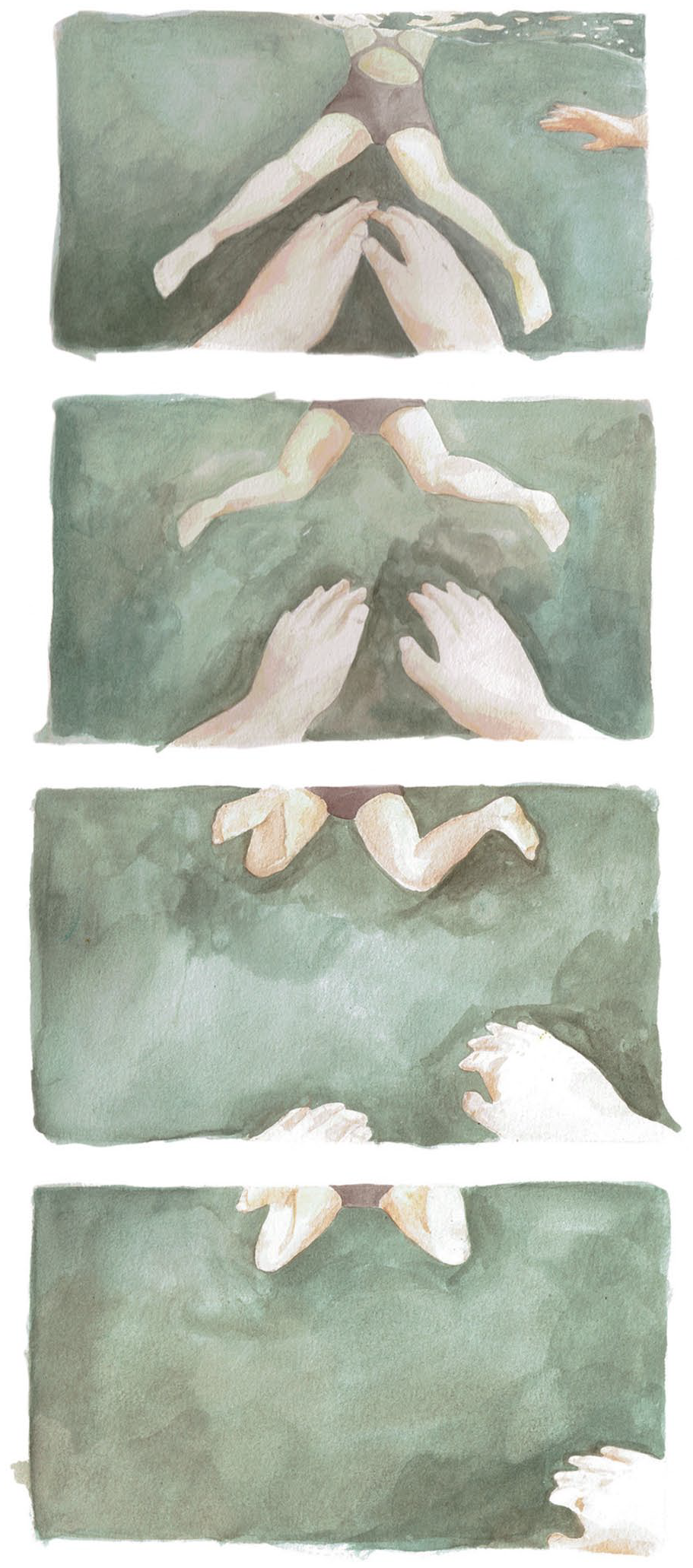
Movement by Lily Mae Kroese, 2021.
Lily also introduced us to different styles, techniques and materials, and showed us artistic animations that inspired us and opened new possibilities beyond the more academic graphic storytelling examples we were familiar with, which typically use computer generated digital images and cartoon-style aesthetics. Painter Jeff Scher’s L’eau Life, a short experimental film about summer, water and people in it, hits the viewer with an intensity alike to a splash of cold water, while Charlotte Ager and Katy Wang’s poetry film of Wendell Berry’s The Peace of Wild Things lulls the viewer into a calmer sense of peace. These different speeds and affective registers helped us to define how we wanted our own animation to be felt and experienced by viewers.
We invited Lily to bring her own artistic style to the project, and she responded with watercolour paintings. The medium of watercolour naturally resonated with the data, wetting the textured paper Lily worked with, saturating the images with subtle tones and colours, and infusing the animation with water. Working directly with the video footage, Lily used a rotoscope technique to paint the data frame by frame. Rotoscoping is a technique that animators use to trace over motion picture footage to produce realistic action. In a very different process, Andy Balmer (2021) describes ‘painting with data’ as a way of reworking textual data in playful and poetic ways. While rotoscoping is technically precise and literal, Lily’s artistic translation of the data made action footage poetic and breathed life into the animation, moving her paintings from ethnographic observation to illustration. As Balmer writes, ‘Painting, being a particular kind of embodied practice, lent movement, space, strength, feeling and form’ (2021, p. 1155) to the process of working with data. Each frame was hand-painted and filled with care, echoing the ways in which we understood and wanted to represent wild swimming as an embodied, intimate and caring practice.
Working with hours of footage and hundreds of images, and distilling them to a short animation, was a challenging process. Inspired by Kevin Macdonald and Ridley Scott’s documentary Life in a Day (2020), a film composed from home movie footage filmed by people around the world on a single day, we wanted to draw the data together and evoke many different experiences, places, seasons and relations in one swim. With this idea in mind, Lily began to storyboard the animation (Figure 2). A storyboard is a series of graphic images displayed in sequence for the purpose of visualising the final animation sequence. This sounds simple, but the process involved making some difficult decisions about what to include and highlighted some of the limitations of the video data. The storyboard allowed us to arrange, order and draw together the data in particular ways, identifying key moments through which we could tell a story and creating a multi-layered, sociological and graphic composition with its own narrative flow. Each scene was carefully composed to hold onto a fleeing moment that is sociologically meaningful.
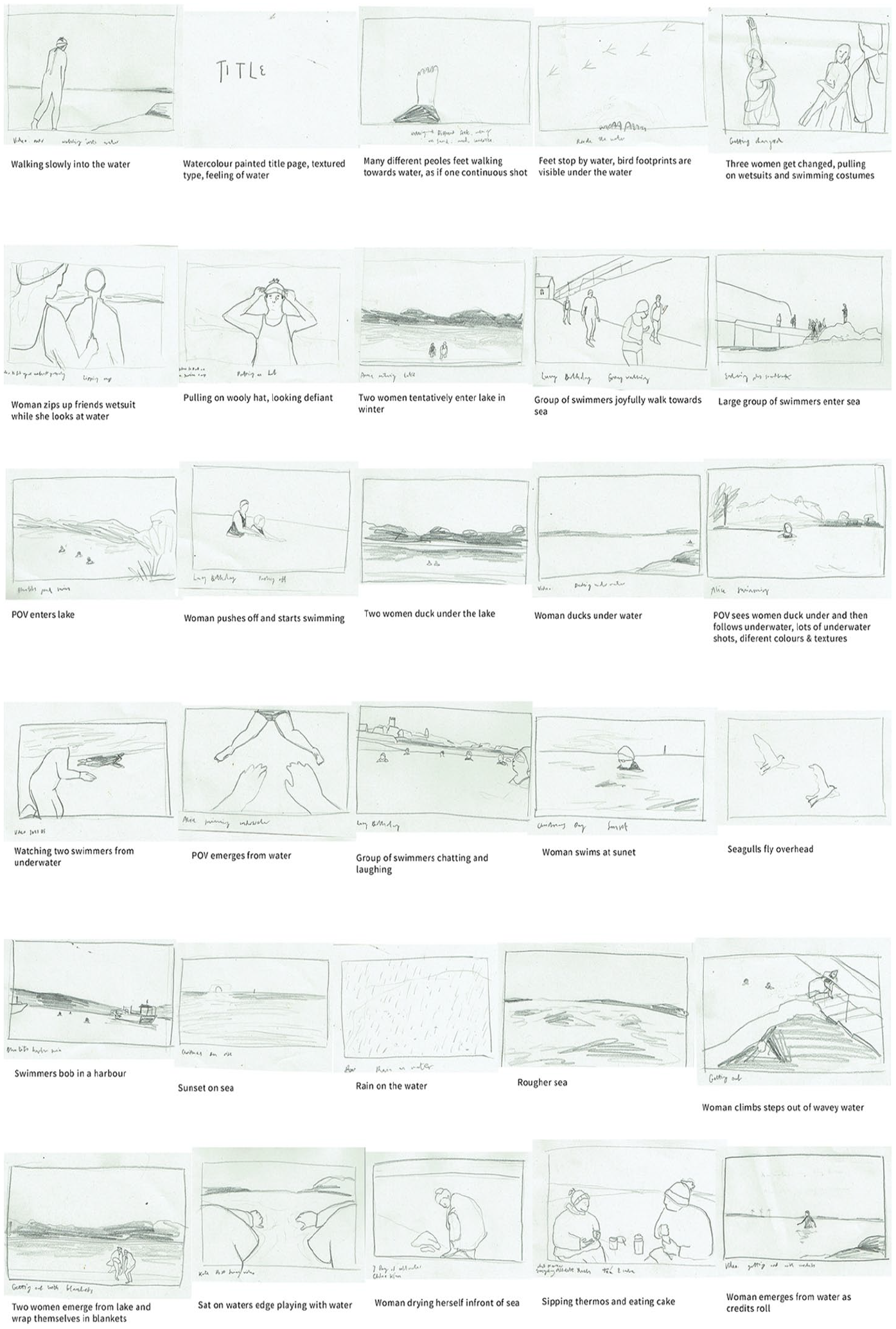
Storyboard by Lily Mae Kroese, 2021.
Composing an artful and multi-layered representation from raw video footage challenged us to think visually about the data. With most of the footage recorded on GoPro cameras worn on swimmers’ heads and bodies, we were naturally led into a point of view (POV) from a swimmer’s embodied perspective. Redrawing the data, we began to play with this perspective, using other data from the project to move between different perspectives that immerse the viewer in the water and in the scene in different ways. We also found that there were moments and perspectives we wanted to include but which were not recorded in the data, for example the floating scene, where we move from a frog’s eye view in the water to a bird’s eye view from above. In these cases, Lily was able to draw in the gaps, using her own research footage and found visual references to illustrate experiences that the swimmers had shared with us in notes and conversations but which were not documented on camera for practical reasons.
Thinking critically and ethically about the visual representation of wild swimming involved attending to the ways in which bodies were made visible, places were evoked, and swimmers were drawn together. While we wanted to share the peace and beauty of swimming wild, we also wanted to challenge stereotypical media representations of beautiful bodies and blue waters, and to show the diversity of bodies and waters that we encountered in our research. We were careful to show that some swimmers wear wetsuits while others wear swimsuits, that people swim together and alone, and that the waters we swim in are sometimes blue, but more often green, grey or brown. These details are important, and open up sociological questions about communities, tribes and belonging, wellbeing and pollution, and our relationships with the natural world.
We also wanted to add a layer of anonymity to the data and the swimmers, while maintaining a close attachment to bodies and waters. Lily’s artistic style and illustrative technique created a layer of abstraction without distancing the viewer, bridging multiple accounts and binding them together in loosely drawn bodies and shared experiences that expand the ways we represent those with whom we work. Other small but significant details were freely illustrated to show encounters or evoke sensations, for example the steam rising from a mug of tea, sharing the water with a seal or a bird flying overhead. These moments add context, depth and detail, showing the ritual of shared tea and cake after a swim and the ways in which we encounter and connect with nature and each other. The storyboard was revised and developed as together we rearranged and edited scenes, finding the flow and simplifying the story that we wanted to tell. Once all these details had settled into place, Lily began to paint the data. To turn sequences of still frames into flowing movement Lily painted 12 images for each second of animation, with over 1500 hand painted frames composing the final two minutes and 20 seconds animation.
While the video data contained sound that was a useful reference point, it was low audio quality and like the visual data needed artistic translation. This audio data included monologues and conversations between swimmers, but it also included shrieks and laughter, waves lapping and gulls calling, underwater sounds of breathing and bubbles, and other background sounds. As Les Back writes, ‘If we stop listening only to “voices”, then we can reanimate the idea of description and attention’ (2012a, p. 253). Listening to the soundtrack within the video data and paying attention to sounds that may ordinarily go unnoticed revealed the distinct rhythms and aesthetics of swimming, and amplified the qualities of watery places (Gallagher, 2015a). Working with composer and sound designer Jennifer Walton, we took inspiration from the audio data and added another layer to the animation with an ambient soundtrack composed of environmental sounds, from muffled chatter to the splash of water, and original musical composition. This audio layer leads the audience away from land and into water and amplifies the sensory experience of swimming. Like water, sounds are ‘fleeting movements, waves propagating amongst bodies’ (Gallagher, 2015b, p. 569), and the soundtrack sets the tempo and affective register of the animation, sounding and carrying the movement of water and bodies together.
Ripples
Graphic storytelling has the potential to reach wide audiences, offering the possibility of expanding who might access these stories (Haapio-Kirk, 2022). But as Phillip Vannini (2015) writes, there is a difference between accessibility and publicity. Actualising this potential and reaching a sizeable audience requires more than simply uploading a work to YouTube or Vimeo, although this can be a useful first step. Social media, film festivals, and more ambitiously professional distributors, can release our work beyond academic circuits. These strategies require effort, skill and intense collaboration (Vannini, 2015), and are part of a broader need to connect with communities and make public ethnography matter.
To launch our animation into the world we collaborated with WOW Wales One World Film Festival, sharing the animation online and speaking in a panel discussion as part of the event ECOSINEMA: Reflecting on Water. By the end of the weeklong event, the animation had 1.6k views. We also shared the animation with the Outdoor Swimming Society (OSS), the largest outdoor swimming community in the UK. The animation was shared in the OSS monthly journal Elsewhere and through OSS social media channels, connecting with swimmers around the UK and internationally. It has since been submitted to academic and public film and animation festivals around the world, and has screened at Cardiff Animation Festival and Kendal Mountain Festival, where it won the Best Creative Film Award. Through these events and by being publicly and freely available on Vimeo, the animation had nearly 8k views at the end of one year. To put these viewing figures into context, Phillip Vannini (2015) notes that few academic videos have more than 500 views, and anything above 2000 is a success.
Marion Ernwein describes film screenings as ‘corporeal events’ (2022, p. 791), the being-together of an audience in a dark room intensifies the experience through shared attention and collective sensory experience. This amplification of emotion and experience can be powerful, capturing attention, adding impact and creating ripples. Stacy Bias describes how the cinematic experience opens up a space to enhance empathy and understanding in ways that can contribute to the public conversation. As she writes, ‘In the creative dissemination of research, animation is a powerful tool to create impact and understanding, to make data “real” and resonant, accessible and emotionally intelligible’ (2021, p. 157). As public ethnography, we wanted the animation to challenge dominant and stereotypical representations of the practice, to offer a fresh look at wild swimming, and to show that sociology is for everyone.
Importantly for us, screening the animation at festivals is also an opportunity to bring people together and create momentary communities – echoing the focus of our research and the story that the animation tells. What is most important to us are the responses that we have received, from the swimmers who took part in the project and from the wider swimming community. To summarise this response, one swimmer wrote to us, ‘The film is just lovely. I really like the way you get a sense of togetherness, support, humour, kindness and community. Thanks for sharing.’ As Laura Haapio-Kirk (2022) writes, graphic collaborations between research and illustration can provoke and enable dialogue with stakeholders, communities and participants. The animation has been both a way of giving back to the community and of making our ethnography public in felt ways, sharing our findings in a deceptively simple way and offering a contemplative and visceral engagement with wild swimming.
Reflections
Our aim to create an amphibious sociology has taken us beyond words and brought us back to them, allowing the project to breathe on land and in water, in two different media. Importantly, the animation is not supplementary to or a graphic simplification of our writing. The ability to move beyond words resonates with our research focus and our multisensory methods, and working with an illustrator has enhanced the data and our understanding of it. Laura Haapio-Kirk writes that we need to understand illustration beyond the narrow capacity of images to accompany text and explore the possibilities illustration holds for ‘showing, illuminating, and revealing hidden worlds’ (2022, p. 2). Illustration and animation can make data visible in new ways, but as Nirmal Puwar and Sanjay Sharma (2012) note, art is typically used in the final stages of research to produce an output for public communication, missing the possibilities of autonomy, exchange and collaboration. By collaborating during our fieldwork we were able to bring our creative knowledge practices together and embed them in the ongoing conversations we were having with our participants. The animation works across material, sensory and affective registers, ‘radically transforming how we work with our materials’ (Balmer, 2021, p. 1160), intensifying their potency and amplifying and attuning us to the multisensory qualities of the data that might otherwise have been lost or fallen out of our accounts. Requiring a different working process, it has allowed us to think, feel and understand the data from different perspectives, to hold the data in a different way, and to work without words.
But, as you can see, we have not abandoned writing entirely. Moving beyond text to animate our work has also led us to ‘seek forms of writing that do justice to the critical curiosity that animates sociology’ (Kirby & Gilloch, 2022, p. 635). Creating words and images in parallel has helped us to see and feel in new ways, to understand the differences and similarities, and to expand the possibilities of both media. While different methods and media require different skills, resonant moments helped us to develop our disciplinary practices alongside each other. Both writing and illustration are representational practices, and each involves storytelling and composition. Melissa Febos writes that, ‘The craft of writing is primarily an art of making decisions’ (2022, p. 36) and in our experience the craft of illustration only made this more apparent. Illustration forced us to make difficult decisions about which image or scene to choose while also allowing us to layer the data, bringing multiple moments together and condensing the data we were working with – containing hours of footage, hundreds of images and months of research in a short animation. Good ethnographic writing can do this too, with vignettes breaking the surface of a text like icebergs with hidden depths, but the animation works in a different affective and emotive register, and is ultimately a more intense and evocative representation than any text we could write.
Still, this article opens with a vignette that was written to accompany the animation. This reversed relationship is important, with the text being shaped by the animation and words finding their flow in response to it. Vignettes typically focus on a single moment or scene, but writing from the animation brings multiple scenes together. We chose to begin our article in this way to show how working in different media with different conventions has influenced our creative practices and shaped our ways of telling stories and writing our research, as well as in recognition of the textual format and linear page our work is printed on. Text and animation cannot be substituted, but they can be complementary. Working in different ways and requiring different platforms, they can make us attentive to different things, open up different choices, and expand the ways we represent our research beyond the dominance of words.
Evocative and lively, the animation is a powerful reminder that good ethnographic representation should evoke the liveness of the world rather than assassinate, flatten or dilute it. As Les Back writes, ‘The challenge is how to find ways to represent such lives and objects that sustain rather than foreclose their vitality and ongoing life’ (2012b, p. 21). Life does not have to be ‘rendered in a monochromatic palette’ (Balmer, 2021, p. 1144) and the subtle tones and movement of watercolour lend our research a different hue. By taking a more artful approach, we simultaneously extended the ‘range, texture and quality of what passes as academic representational practice’ (Back, 2012b, p. 28) and enlivened our own writing. Collaboratively creating a more artful reality that conveys the embodied and sensory experience of wild swimming to multiple audiences while remaining embedded in our ethnographic data, we have worked with an aesthetic mode of data production and analysis (Balmer, 2021) as well as with a sensory aesthetic and expressive mode of representation. Graphic experiments like this hold the potential to enhance our ways of working, collaborating and sharing our research in performative, imaginative and immersive ways.
The time, effort and skill that working both collaboratively and in two media demands also needs to be acknowledged. This was a small, unfunded project (with an internal grant to pay a freelance illustration fee), an experiment, and a labour of love. If the possibilities and affordances of graphic storytelling are to be expanded, then the conditions of production to support collaborative and creative labour need to be recognised and supported more widely. While public engagement and impact are key research terms, collaborative and creative ways of producing knowledge are often not valued or counted in the dominant conception of research excellence. But making complex subject matter accessible and reaching new audiences are only part of the potential of graphic storytelling. Playful and poetic, enchanting and engaging, animation can bring research to life in more personal and immediate ways, making research tangible and creating new spaces of relation and engagement. Like the water we swim in, The Water Holds Me / The Water Binds Us animates, holds and binds us together.
Footnotes
Funding
The authors received no financial support for the research, authorship, and/or publication of this article.