



Abstract
The implications of sociography for thinking with global environmental problems are foregrounded by Bruno Latour in Down to Earth. In order to deal with the metamorphosis of the world and take into account multiplying viewpoints, Latour argues sociologists must shift the focus of enquiry from theoretical analyses of environmental problems to descriptions of the existence of environmental issues in experimental settings, local shared spaces and common practices. Taking up Latour’s challenge of description from the bottom up, this article examines London’s #OneLess refill water fountain pilot project initiated in 2018 to reduce plastic water bottle consumption, as an example of how scientists are at the forefront of assembling the public existence of environmental problems in local settings. Addressing my participant observation in the refill experiment, the article highlights the methodological challenges the #OneLess pilot poses for generating descriptions of what it means to engage with environmental issues sociographically. By engaging description as a methodological problem, the article examines the strengths and limitations of existing descriptive approaches and develops a different way of deploying a sociographical imagination that attempts to make sense of hesitation as a transformative practice of environmental knowledge production.
Keywords
Introduction
For over two decades the methodological problem of description in the social sciences and humanities has been called into question, contested, rethought and reclaimed by a range of academics. Calls to reimagine data sources of sociological description (Savage, 2009; Savage & Burrows, 2007), build a better description (Marcus et al., 2016), re-engage description from an empirical standpoint (Vitellone et al., 2021), expand the method of sociography to include descriptions of all the things making up objects (Akrich, 1992), produce descriptions of things that are ungraspable (Stewart, 2016), conduct critical description of living things in a more-than-human ethnography (Tsing, 2013), and description of everyday practices in the problem space of the Anthropocene (Harvey et al., 2019; Latour, 2018), all seek to revitalise and re-energise the method and practice of description in the social sciences and humanities. Comparing the descriptive turn with Sedgwick’s reparative reading, Heather Love (2010) highlights the methodological gain of privileging descriptive methods of attentiveness, acts of noticing and being surprised to the blunt method of critique. Taking as my starting point Sharon Marcus, Love and Stephen Best’s (2016) invitation to rethink and revalue the status and role of description in our disciplinary practices, reassess the uses of descriptive methods, and renew the practice of thin and thick description as an opportunity to engage differently with our objects and get a handle on the world, this article takes up the challenge of what a better description might look like. Following Nicole Vitellone, Michael Mair and Ciara Kierens’s (2021) response to this call to return to the problem of description, as an opportunity for social scientists to re-engage with description as an empirical problem encountered in the thick of things, the article examines what we might learn from taking up this challenge in global environmental change research.
In the first half of the article, I investigate the diversity in understanding the possibilities posed by description to research practice. By re-engaging with the descriptive practices of science and technology scholars, sociologists, ethnomethodologists and anthropologists, I consider the capacity and effects of descriptive research to facilitate engagements with environmental issues and transform taken for granted disciplinary practices. In so doing, I consider how, where and when it becomes possible to engage descriptively with the objects, devices and practices of environmental experimentation. In the second half of the article, I engage the challenge of doing descriptive research in a real-world environmental experiment. Turning to my study of the #OneLess refill water fountain pilot, an experiment to reduce single use plastic bottled water consumption in London initiated in 2018, the article examines the consequences of adopting a descriptive stance for engaging global environmental problems in local shared spaces. Addressing the methodological problem of aligning our descriptive practices with the presence of humans and technical objects in everyday empirical settings, the article outlines the uses of a sociographical imagination for activating knowledge of the impact and consequences of environmental participation.
Rethinking social science and descriptive practices for global environmental change research
More than three decades after the world was alerted to the climate crisis, the growing demand for novel academic forms and practices of interdisciplinarity and public engagement has acquired a new urgency. The potential for developing new and alternative ways of experimenting in environmental research on global change has been the topic of much discussion and debate in the social sciences (Bulkeley, 2019; Castree, 2014, 2015, 2017). What is missing from global change research, according to Noel Castree, are ‘human questions and approaches to understandings of “human dimensions”’ (2017, pp. 57, 63). Outlining the relevance of the people’s disciplines for environmental research, Castree elucidates the distance between geoscientists and social scientists as a major obstacle to producing alternative approaches to matters of fact and matters of concern in knowledge practices. In seeking to correct and reverse the paucity of intellectual engagements between geoscience disciplines and the social sciences and humanities, Castree identifies the challenges for broadening the impact of the ‘people disciplines’ within and outside academia. One of the problems, Castree argues, is that geoscientists ignore and consider irrelevant the work of anthropologists, critical social scientists and the environmental humanities. A solution, he suggests, is to produce ‘more and better interactions’ between scientists and specialists in the people disciplines (p. 58). Castree adds disarmingly, social scientists and humanities scholars have to date ‘done a poor job of reaching out to geoscientists or to people outside universities’, and ‘often remain content to respond to geoscience at a distance within their established disciplinary domain’ (pp. 64, 62). The scale of the challenge is daunting. The way for scientists, social scientists and humanities scholars to overcome this distance is to come out of our professional disciplinary comfort zones and co-produce knowledge with a range of stakeholders. Calling for more multidisciplinary research, Castree privileges new means of combining professional expertise ‘not merely to collaborate but to unsettle each other’ (p. 65, emphasis in original).
The role of the social scientists and uses of social research methods for engaging global environmental problems are not uncontested. Comparing the methodological approaches of natural and social scientists, Sheila Jasanoff (2010) argues interpretive methods provide an invaluable tool for developing global environmental change research. The promise of interpretive social science, according to Jasanoff, lies in the capacity to reconnect global concerns with local meaning making practices in experimental spaces (p. 249). In privileging ‘subjectively appreciated facts that matter’, social scientists have a particular role to play ‘to restore to public view, and offer a framework in which to think about, the human and the social in a climate’ (pp. 248, 249). The task is to describe the varying ways large scale environmental knowledge is produced through smaller meaning making interactions and conversations of common sense making in local experimental spaces (p. 245). Despite Jasanoff’s concerns of science having displaced the specificity of local social contexts, and removed traces of the human mind and hand in environmental knowledge making practices, Bruno Latour suggests otherwise. In an interview with Jakob Stein Pedersen and Nikolaj Schultz, Latour argues science is ‘not withdrawn from the public sphere’ (Stein Pedersen et al., 2019, p. 219). The sciences, according to Latour, have left the ivory tower and ‘are at the center of the institutions through which we assemble the situation’ (p. 219). Without the scientists, the ‘public existence of the situation’ would not exist, and citizens would not be able to ‘absorb the situation’ (p. 219). The sea change ‘is when people begin to take it as a question of self-interest’ (p. 220). What is critical for engaging, motivating and making a difference, argues Latour, is the capacity to connect relations between a people and a land. Other motives make no difference. ‘People will simply say “Yes, yes, the planet is in danger, it is not my problem”’ (p. 221). ln reassembling the situation in the public sphere and showing and proving to the people the existence of the problem, Latour shows how scientists have been instrumental in laying the ground for translating their methods from the lab to land and their instruments into public practice. The task for social scientists, according to Latour, is to describe the reassembly of connections between politics, a land and a people.
The title of Latour’s book, Down to Earth (2018), provides some clues on how to rethink and redescribe the politics of landing and attachment to the local as a method for change. In figuring out how to deal with ecological questions sociologically, Latour warns against describing the situation of climate scepticism as concerning the public’s lack of understanding of matters of fact and concern. The danger of framing the problem in terms of public knowledge, and inventing methods which involve changing people’s attitudes, argues Latour, is that we fail to address the ‘deficit in shared practice’ and living in the ruins ‘without a shared world’ (p. 25). What is at stake is not a matter of ‘learning how to repair cognitive deficiencies, but rather of how to live in the same world’ (p. 25). What this requires in practice is not a change in attitude, ‘but the form and weight of the world to which those attitudes have the function of reacting’ (p. 52). Drawing on the work of Noortje Marres, Latour points out environmental change is always an effect of ‘object-oriented politics’, and is always ‘oriented towards objects, stakes, situations, material entities, bodies, landscapes and place’ (p. 52). The achievement of grounding knowledge of environmental problems through material participation cannot be underestimated. There is nothing more innovative, technical, creative and more present, argues Latour, ‘than to negotiate landing on some ground’ (p. 53). The challenge for sociology is to ‘generate alternate descriptions’ (p. 94, emphasis in original) of attachments to local shared dwelling places ‘from the bottom up, by investigation’, which includes ‘the work of description on the part of all animate beings’ (pp. 95, 98). In order to generate alternate descriptions of the composition of local shared dwelling places in the new climatic regime, Latour suggests sociologists shift their focus of enquiry from critical epistemological analyses of global environmental issues, problems and policies, to descriptions of attachment in local experimental settings. Describing all the beings that participate in the composition of a shared dwelling place is crucial, as each ‘has its own way of identifying what is local and what is global, and of defining its entanglement with others’ (p. 93).
Researching the methods and devices of material participation in environmental issues
Investigating the politics of social research methods in performing environmental change, Kristin Asdal and Marres (2014) revisit the question of the role of descriptive methods for researching participation in environmental issues. They ask, ‘can we begin to assume that the relevance of social science approaches to environmental change is becoming established, and that the periods of marginalization of social science and social aspects in environmental issues is coming to an end?’ (2014, p. 2055). From this point of view, the question is not the contribution of social research methods to environmental knowledge. The question is ‘how social scientific methods participate in performing change’ and ‘intervene in the world’ in relation to environmental change (pp. 2061, 2055). In calling attention to the broad range of methods and devices considered relevant to modify and transform social practices, Asdal and Marres reorient the debate on the role of social scientists and relevance of social science methods in global environmental change research. What could be done differently, they argue, requires not merely changing the conduct of our enquiry to include better interactions with scientists, and better descriptions of local settings and social interactions, but also changing what counts as credible objects of enquiry to include more engagement with the deployment of social methods by others. The relevant problem to explore, they argue, concerns ‘the environmental issues upon which such methods operate and the settings through which they are made to act’ (p. 2062).
The methodological implications of Marres’ study of the objects, methods and settings of material participation in environmental issues are more fully developed in a Special Issue on ‘The Turn to Ontology in STS’ in Social Studies of Science. Engaging the political capacity of social methods situationally and environmentally, according to Marres, requires investigating ‘how objects become invested with specific normative powers through the deployment of particular settings and devices’ (2013, p. 419, emphasis in original). Describing the experimental setting of the eco-show home as an empirical site that asks the confusing question: ‘Is it the bathtub or the issue of climate change that draws us in or both?’, Marres suggests the eco-show home suspends a singular answer to the question of who or what is doing the engagement (p. 439). In providing a ‘public stage’ for the ‘conferral of capacities of engagement to things’ (p. 439), Marres points out environmental experiments in sustainable living offer observations to demonstrate the empirical importance of mundane practices, the active and visible role of material objects, and the potential of the material setting of the home to enable people to ‘act upon environmental issues and “be part of the change”’ (p. 425). In describing the empirical site of eco-show homes as ‘material devices of public participation’, Marres’ experimental ontology offers a solution to the methodological problem of description in the new climatic regime (p. 425). Foregrounding the deployment of instruments to engage residents, stakeholders and wider audiences including information, posters on walls, doors and windows and the labelling of objects as experimental as methods of material participation, Marres widens the focus of empirical description to observations of the technologies and objects which encourage the public to actively participate in performing environmental change within particular local experimental settings. The descriptive task of specifying the features of material participation empirically is distributed among a broad range of actors and registers ‘in which the setting, actors, stuff, statements on posters and the researching theorist all have parts to play’ (p. 428). Many examples in Marres’ book address the question of what descriptive methods are for in environmental change research. Calling for an expanded empiricism, one which shifts the focus of enquiring from theorising objects and publics, to describing the experimental nature of participatory materials ‘as dependent on an entanglement with object, devices, and settings’, Marres and Javier Lezaun (2011, p. 503) and Lezaun et al.’s (2017) material centred descriptive approach warns against assuming that everyday objects simply have normative capacities that solve the problem of environmental change. Taking the normative variability of objects in different settings as a starting point for descriptive research, Marres’ empirical investigation of the eco-show home seeks ‘to learn to value experimental indetermination’ and ‘do justice to what happens in practice’ (2013, pp. 436, 437). Paying attention to the variable normativity of objects and empirical devices to engage publics and effect ontological change in specific settings, Marres shows how the political capacity of things must be examined as a practical accomplishment of experimental settings.
In opening up the question of how particular objects come to be invested with normative and political capacities, Marres highlights the need to make an allowance for the contingency of things in sociographical research. The methodological implications of Marres’ experimental ontology for STS forms of enquiry are further explored by Steve Woolgar and Lezaun (2013). The scope of entities associated with ontological enactment in STS, they argue, ‘has thus far been fairly limited’ (p. 325). In producing a way of understanding the normativity of mundane objects not as given, but as variable precarious achievements, Woolgar and Lezaun suggest Marres (2013) produces a way of looking differently at debates about ordinary common objects. Understanding the politics involved requires social scientists ‘take seriously the accomplished ontological status of entities (objects, technologies, persons)’ (p. 333, emphasis in original). Exploring how material objects are ‘brought into being’ and ‘realised in the course of a certain practical activity’ refuses to draw on context and materiality as a descriptive tool (pp. 323–324, emphasis in original). Following Garfinkel’s interrogation of the ‘whatness of things, to understand how entities come to seem what they are’, Woolgar and Lezaun (p. 333) highlight the importance of investigating the possibilities of politics in mundane settings as involving attempts to sustain and establish the singularity of an object as a particular way of being in the world. Focusing on the achievement of ‘ontological singularity’, they argue, departs from existing STS analyses of the political, where the emphasis to date has involved the description of multiple, fluid and diverse entities and unstable realities in ‘ontological multiplicity’ (p. 336). The extent to which analysts can claim to be involved in the ontological politics of world making in the study of ordinary objects, according to Woolgar and Lezaun, requires articulating the relevant stakes and stakeholders.
In proposing a methodological framework for describing the objects of enquiry that takes seriously the politics and practices, stakes and stakeholders of ontological singularity, Woolgar and Lezaun’s ontologically sensitive science and technology studies takes a different descriptive turn to Marianne de Laet and Annemarie Mol’s (2000) widely cited translation of the fluid technology of the Zimbabwean Bush Pump. In de Laet and Mol’s descriptive practices they avoid fixing the technology’s boundaries as solid, and imposing normative standards to judge the object, preferring instead ‘to be moved by it’ (p. 253, emphasis in original). By loosening the hold of professional intellectual criticism, and becoming attached to the Zimbabwean Bush Pump, a pumping device used to extract water from a well, they find there is ‘no single self-evident standpoint to speak from’ (p. 253). Their beloved Bush Pump is ‘vague and moving’, ‘adaptable, flexible, responsive – in short, a fluid object’, ‘entangled in terms of both its performance and its nature, in a variety of worlds’ (pp. 225, 227). In their variegated description of the different worlds enacted by the Zimbabwean Bush Pump, de Laet and Mol problematise measuring the success or failure of the activities of their fluid object in binary terms. In their descriptive practices evaluating the success of a fluid technology is ‘not clear-cut’ (p. 247). ‘The pump may work as a water provider and yet not bring health’ (p. 252). And their descriptive evaluation of the Bush Pump’s activities is ‘fluid, too’ since the capacity of this object to transform surroundings and ‘shape “worlds”’ is ‘intertwined’ with the ‘methods and insights’ of those who use it (pp. 247, 257, 251, emphasis in original). By enacting different ways of describing the pump’s ‘variability’ and flexibility, de Laet and Mol insist their definition of fluidity as positive should not become a normative standard to measure case studies of technological objects designed for ‘intractable spaces’ (pp. 257, 253). From where they stand, it is ‘not possible to say whether or not it is unequivocally better than its siblings and competitors – or even, for which sites and situations it might be so’ (p. 253). While ‘it may be good’, they suggest, ‘you find out for yourself whether or not it is in the cases that you happen to deal with’ (p. 253, emphases in original).
In order to determine whether a particular technology is good, de Laet and Mol call for social scientists to develop different ways of describing its capacity as a ‘changeable object’ (p. 228). What their descriptive research claims to offer is a solution to the interpretation of the meaning of technology created through detached academic practices of intellectual criticism and empirical observation. The concept of fluidity proposes methodological innovation in the social sciences that asks new questions and answers them with new descriptions. Rather than interpret technological devices approvingly or disapprovingly from a neutral distance using normative standards of what good pumps should do, or engage in a comparative evaluation of objects using traditional ethnographic methods of direct observation and thick description, de Laet and Mol’s concept of fluidity is descriptive and evaluative of the intertwined relations between objects and the world. The empirical materials come from the scientists, inventors, pump makers and health workers they study. The descriptive success of the Bush Pump as a fluid, ‘indefinite object’ to change shape and shape worlds, according to John Law (2004), is an achievement of the technology’s adaptability, variability and flexibility as a descriptive device.
Reclaiming thick description for noticing the yet to come
Looking back at Mol’s fluid theory of objects and comparing it with Marres’ experimental ontology in the empirical case study of the eco-show home, Michael Lynch (2013) points out there is a danger in the absence of participants in descriptive research. One difficulty in posing the methodology of attachment for descriptive based STS is that the language of love can feel descriptively thin. Ontological questions refuse to go away. While Mol has a preference for ontological multiplicity over ontological singularity (see also Mol, 1999), Lynch argues Marres’ (2013) investigation of material participation does not assume ontological questions of what the world is, and what is in it, can be known in advance independently of the conduct of descriptive research. Marres’ ethnographic investigative practice, according to Lynch, produces a depth of insight into world making and world sustaining practices derived from the case under study which does not assign ontological priority to multiplicity. How we engage with questions of what counts as knowledge, Lynch argues, ‘is bound up with methods for generating such knowledge’, and is not separate from the ‘practical, conceptual and political means through which it is implemented’ (p. 455). As an alternative to devising a theory about any object, Lynch recommends investigating practical ontologies, where we ‘look for instances in which matters of concern are locally relevanced and locally contested’ (p. 456). Description, for Lynch, is critical for avoiding ontologising matters of concern as a ‘master category’ and engaging what counts as knowledge in the practical settings studied (p. 456). Description can also provide an orientation to how matters of concern and matters of fact ‘are composed and invoked by participants’ (p. 458). In order to reorient the practice of description away from theoretical reflections of what is in the world, towards ethnomethodological studies of locally situated ontographies, Lynch recommends pursuing ethnographic investigations that describe the mundane, down to earth, uninteresting and unstudied methods through which members achieve accountable activities, and the ‘procedures through which that fact is accomplished’ (2000, p. 43).
Lynch’s ethnomethodological conception of ontography reorientates investigations of technical objects from theoretical reflections of multiple material realities, to descriptions of what counts as knowledge in ordinary local settings. His call for thick description encourages us to go the other way and examine how we connect to technology. This move resonates with Isabelle Stengers’ (2005) description of an ecology of practices. The question of what is knowledge, for Stengers, is always a practical local problem, ‘never a universal problem mattering for everybody’ (2010, p. 28). It is a mistake, Stengers argues, to describe the salience of practices ‘as they are’, rather than ‘as they become in different surroundings’ (p. 26). For social scientists, the challenge is to avoid attributing or imposing a meaning, value, or interpretation to a particular practical setting from ‘outside this setting’ (p. 26). In order to avoid ‘theoretical voyeurism’, Stengers proposes social scientists describe the salience of local practices not as they are, or normative and rule following, but ‘from the point of view of their eventual particular achievement and what we can learn from it’ (pp. 31, 23). What this means in practice is learning how to situate ourselves in experimentations, not from the standpoint of technology or the majority terms of the ‘vested interests of stakeholders’ (p. 21), but as a witness ‘forced to think by the situation’ (2018, p. 153). In order to redirect the focus of descriptive enquiry in the experimental setting to the minority practices of laypeople in the construction of knowledge, Stengers calls on anthropologists and sociologists ‘not to interpret away’ or ‘deprive others of their authority about their own practical experience’ (p. 150). And accept we are part of those experimentations by playing an active part in apprehending the collective achievements of experimental settings as a minority technique. What this calls for in practice is a shift from descriptions of the ontological multiplicity or singularity of objects to what Stengers defines as ‘“ontological tact”’ (p. 153), a methodological commitment to describe practices in situated encounters as unknown and uncertain from the point of view of their eventual achievement. Describing minority practices in experimental settings not as they are, but what they may become, Stengers points out, means taking a risk and ‘paying attention to the effects of this encounter on you’, and ‘learning what this encounter demands and how it transforms’ (p. 154).
The descriptive risk at play in becoming attentive to an ecology of practice that has the power to make us think and feel requires we take seriously the nonhuman attachments that force practitioners to wonder and hesitate. Taking hesitation as a starting point to differentiate practices that have the power to force thinking from habitual practices, Stengers’ ontological approach renews the methodological problem of describing attachments to technological objects of enquiry and the methods through which members achieve accountable activities. By slowing down thought, Stengers’ method of hesitation cultivates curiosity to attachments that gather and cause thinking in experimental settings. Creating space for Stengers’ practice of hesitation, according to Martin Savransky (2014), is a crucial task for social scientists addressing the challenges of global social science in the age of the Anthropocene. Beginning from the experience of hesitation, Savransky argues, transforms the empirical task to ‘make present the need to think about how knowledge circulates materially through the world’s fabric’ (p. 244). In order to become attentive to minority practices of hesitation and how knowledge circulates materially, Stengers deploys Anna Tsing’s methodological practice of the ‘art of noticing’ (Savransky & Stengers, 2018, p. 144). Noticing, for Tsing (2019), involves ways of looking at human practices, and direct observation of nonhumans and materials, and the way they interact with us from the standpoint of a witness. By being there, noticing and witnessing everyday interactions, and ways of being in a more-than-human anthropology, Tsing reclaims traditional ethnographic methods of direct observation and thick description as relevant to the ontological turn in the social sciences and STS to ‘bring things to the center of social inquiry’ (p. 240, emphasis in original), and central to the slow science of renewing empiricism. While STS scholars have learnt about their research objects by following the knowledge work of scientists and how they relate to technical objects, Tsing argues, ‘they erect a wall against the nonhuman objects of the study’ (p. 228). In order to expand descriptive practices to the objects of enquiry, Tsing calls for the research methods of close observation and thick description to be taken seriously as tools for noticing the yet to come.
The #OneLess campaign pilot project
A question worth raising again is the role of social scientists within global environmental change research. What might we learn from placing ourselves in unfamiliar worlds? What might be developed in including the human and nonhuman objects of study in anthropological practice? What might be gained by utilising thick description to respond to uncertainty and life as it might become? To address the challenge of developing habits of noticing and becoming attentive to an ecology of practices in sociographical enquiry, I turn to my participation in the #OneLess campaign refill pilot project. The #OneLess pilot project was initiated by the Marine and Freshwater Team in the Conservation and Policy Department of the Zoological Society of London (ZSL), in conjunction with the Mayor of London in 2018, to reduce plastic bottled water consumption. The pilot involved the installation of refill water fountains in sites across London, with 20 installed by the end of 2018. The #OneLess experiment serves as a clear example of how scientists have left the ivory tower and are at the forefront of assembling the public existence of global environmental problems in local public settings. The #OneLess pilot scheme also serves as an example of the role social scientists might play in thinking about how knowledge circulates materially in the Anthropocene. The challenge is to generate better descriptions of the connections between politics, a land and a people. What is distinctive about the #OneLess experiment is the materials, devices and settings deployed to reassemble the existence of environmental problems in shared public spaces. The pilot project pioneers methods to create new ways of grounding knowledge of global environmental issues in local settings of everyday material participation. In my ethnographic study of the pilot, I engaged in fieldwork observation of the first three refill water fountains installed in the different public spaces across central London and conducted face to face interviews with four of the #OneLess campaign team. The description that follows draws on qualitative interviews with the biological scientists at ZSL who project managed and directed the #OneLess campaign pilot, and direct observations of the three refill water fountains installed in London, over a period of five weeks during October 2018, April 2019 and July 2019.
My initial encounters with the #OneLess campaign team at ZSL in October 2018 revealed how an engagement with the methods of the life sciences can open up exchanges that combine and unsettle disciplinary expertise. The question of how to get people to value the ocean and build a more ocean friendly society was central to the scientists’ public experiment. The goal of reducing the volume of single use plastic water bottles entering the ocean involved trying to solve the ‘missing link’ of ‘how to connect people with the ocean and make the connection with people so that they understand how these everyday actions are impacting the ocean’. In addressing the problem of how best to communicate the ocean story, get people to think, and make direct connections between the local and the global, the pilot scheme combined a communication campaign to change personal attitudes about single use disposable plastic water bottles with an inventive method of creating shareable public refill water fountains. The idea of the pilot was to test if people would use refill water fountains, and understand what works and what doesn’t work, to catalyse change. The experimental approach in practice enabled the scientists to see how things have changed.
Within the experimental setting, the refill water fountain was deployed alongside visual images of the #OneLess campaign logo (Figure 1) inside a plastic disposable water bottle, and an image of the ocean to engage the public in environmental material participation.
#OneLess campaign logo.
The visibility of the hash tag #OneLess bottle in the ocean aims to visually connect people to the global causes and effects of marine plastic pollution and produce public knowledge about marine conservation and ocean conservation. The refill water fountain provides a proactive ‘solution’ to building an ocean story that is accessible, engaging and motivating: ‘empowering people to do it’ and produce personal difference around behaviour change. This local experimental intervention became a ‘focal point’ for measuring the success of the pilot to connect people to a long-term common goal through their everyday choices. The development of the refill revolution involved interdisciplinary collaborations with scientists, designers, creators, engineers and architects ‘to come up with new ways of doing so’. The co-director of the #OneLess campaign pilot explained the strategic rationale of bringing designers in to work with marine biologists to produce a behaviour change through the experimental setting of the refill water fountain. ‘As a scientist obviously you care about the devil in the detail and so you have to pick the level of engagement and what’s going to actually make a difference’, while careful not to approach environmental problems from a large scale that paralyses people or demonises plastic. Although the refill fountain experiment aims to involve the public in environmental issues through mundane practices of material participation, the focus of the #OneLess pioneer network is primarily directed towards engaging a range of private London stakeholders including businesses, organisations, visitor attractions and venues to help them make their transition to one less and make a change
As an evidenced-based organisation, the #OneLess stakeholder evaluation process involves tracking how many companies they work with, how many single use plastic water bottles these companies have sold, how many they now sell, and how many disposable water bottles are collected from the River Thames along different sites, measured fortnightly. The data is published on the #OneLess pioneer website (onelessbottle.org). Evidence for evaluating the effectiveness of the #OneLess campaign to reduce the number of plastic water bottles in circulation was also produced through water flow meters, which recorded how often refill fountains are used, and the volume of water going out of them. Deploying statistical methods alongside the method of following the life of plastic disposable water bottles produced evidenced-based evaluations of stakeholder practices. While tracing the social life of plastic water from distribution to disposal shows the relevance of social research methods within environmental experimentation, what is missing from the #OneLess evaluation process is evidence on the refill fountain and data on the publics interaction with it. This lack of empirical engagement with public stakeholders and the nonhuman participants of the pilot was discussed in my interviews with the life scientists at ZSL and acknowledged as an effect of ‘grappling with measuring things that are less explicit, more qualitative’. Through interviews with the #OneLess campaign team, my particular interest in the empirical object of the refill water fountain formed the basis of a rapport that informed my subsequent fieldwork in the experimental setting. While the success of the campaign to catalyse and enable change was understood to reflect deeply held cultural, aesthetic and spiritual values that people hold about the ocean, and act as a trigger to enable change, my collaboration with the life scientists at ZSL provoked questions on how to measure and evaluate the refill water fountain pilot, how to increase their uptake and usage, and what could be done to facilitate interaction.
In her description of being and working alongside life scientists, Joanna Latimer (2019) illustrates how objects were central for becoming ‘entangled’ and connected with her scientific colleagues over time, and her participation in experimental knowledge making practices (p. 269). Objects were critical for producing research ‘openings’ and ‘possibilities for gathering’ (p. 281). What made the creation of common ground between life scientists and social scientist possible, for Latimer, was understanding ‘how people become attached to and detached from different materials of extension’ (p. 269, my emphasis). Paying attention to how and when attachments in common take place, according to Latimer, is not to collapse differences in disciplinary enquiry, or overcome divisions in methodological approaches in the social and life sciences, but to see how our attachments and detachments to and from things bring us into contact with each other, and ‘reaffirms that which animates and breathes life into our knowledge-making’ (p. 269). It is also to do STS ‘by other means’, that make affective, intimate and embodied processes of knowledge making with others, including things, relevant as an ‘object of but also as a means of enquiry’ (Latimer & Lopez Gomez, 2019, pp. 251, 252, emphasis in original). In foregrounding intimacy as a site for the social production of knowledge, Latimer (2019) and Latimer and Lopez Gomez (2019), propose an affective methodology for STS that poses questions about how we become attached. Describing attachments to things we care for and about in interdisciplinary research, for Latimer, ‘makes explicit the tensions that would normally keep us apart’ (2019, p. 280).
While Latimer’s description of her ethnographic experience of being in common with the life sciences involved a form of co-experimenting with intimate human–animal entanglements, my encounters with the life scientists at ZSL produced different descriptive practices. Coming into contact with the marine biologists responsible for the #OneLess refill pilot project did not involve an intimate attachment to animals and things mutually cared for and about. The creation of common ground was made possible by not becoming ‘intimately entangled’ (Latimer, 2019, p. 275, emphasis in original) with their attachment to the animal and the ocean, and compassion for the welfare of the dead whale, turtle or sea bird with ‘plastic in their guts’. Nor were we gathered by a mutual detachment to single use plastic water bottles. What made the research opening possible was our uncommon attachments. The object that made the research opening between a social scientist and life scientists possible and brought us into contact with each other’s knowledge making practices was the marginalised refill water fountain, and grappling with how to measure things that are less explicit and more qualitative in environmental change research.
Sociography of a curious object
By shifting the object of enquiry from the disposable plastic water bottle to the neglected refill water fountain and marginalised local experimental setting, my encounters with the life scientists brought into focus the particular role of social scientists in a real-world environmental experiment. In making explicit the methodological problem of how to describe the success or failure of the refill water fountain pilot scheme, my participation in the #OneLess refill experiment opened possibilities for researching environmental issues sociographically. Re-privileging social science methods involved not only talking to and following the scientists’ knowledge making practices, but also, following Tsing, engaging in critical description of the nonhumans ignored and sidelined within the experimental setting. Taking care to notice undervalued and marginalised things, and how we respond to and engage with them, for Maria Puig de la Bellacasa (2017), requires we remain curious and attentive to not knowing about them. What made a sociography of a curious object possible was not allowing myself to judge, or be moved by the refill water fountain, but forced to think by encounters with it. By being there, watching, observing and noticing the local experimental setting, and paying attention to what causes thinking in the encounter with the #OneLess pilot, my goal was to see what could be learnt with others in the empirical setting of environmental participation.
In order to describe and evaluate the effects and achievements of the #OneLess refill pilot to transform knowledge of environmental issues, I approached the empirical devices and practical methods of experimentation from the standpoint of a witness. Reclaiming the ordinary ethnographic methods of close observation and thick description enabled me to connect to the ways in which environmental issues are experimentalised and apprehended in the empirical setting. Taking hesitation as a starting point to describe what we might learn from the encounter as a shared event, my fieldwork involved extended periods of looking at the devices and methods of experimentation from the point of view of their eventual achievement. Participant observation took place in three different empirical settings for a period of two weeks in October 2018, one week in April 2019, and two weeks in July 2019. The first fieldwork site involved direct observation at a major central London railway terminus.
At first glance, describing this object as utilitarian seems clear cut (Figure 2). The shiny, stainless steel design is functional and practical. It works manually with users having the option of pressing a round silver pushbutton to deposit water directly into a bottle or leaning in to drink from the water fountain. Instructions on where to push and how to use the refill device are inscribed into the steel shell, with images of an index finger pressing a pushbutton and where to position the bottle. There are no instructions how to manually use the water fountain device. While the water fountain’s capacity to act and deliver free drinking water to the greatest number of people in a public setting can be measured as a public good, and the technology’s failure to provide drinking water as a bad, evaluating the activity of this particular object to reduce single use plastic water bottle consumption is less clear cut. On the one hand, the sign ‘Rehydration Point’ printed in large bold letters across the top of the refill water fountain, and on the floor below, printed on a bright blue background of flowing water imagery, situates the object as a water provider. On the other, the setting is saturated with empirical devices of material participation. This includes the signs ‘supported by The Mayor of London’, the ‘#OneLess’ logo, and a communication digital device that counts the number of 500 ml bottles saved by each use of the refill function, encouraging the public to actively participate in performing environmental change in the local experimental setting. In evaluating the success of this empirical setting as an experimental intervention my direct observations of the refill water fountain took a different direction to de Laet and Mol’s (2000) and Marres’ (2013) descriptive practices. What caused action was not merely the capacity of the refill water fountain to alter its boundaries from a solid, clear, and fixed, immutable drinking technology, to a fluid, changeable refill water fountain, or the empirical devices of material participation including information about the #One Less campaign, but how it became this way and worked in this particular practical setting. By unblocking attention to empirical materials in use, descriptive research brought into focus the politics of mundane settings and minority practices of environmental participation.
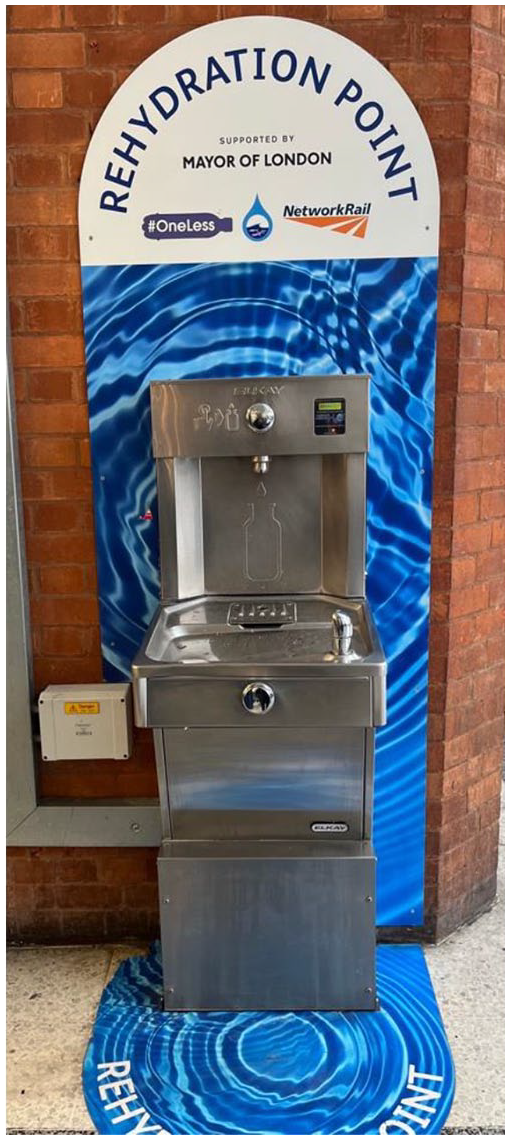
#OneLess pilot setting.
Compared to other empirical sites I investigated, what differentiates this particular experimental setting is the utilitarian design of the refill water fountain and the visibility of the signage and inscription devices to attach it to an experimental pilot of environmental participation. From an ontological perspective, this mundane object can be described as both singular and multiple. Public engagement with it is normative and variable. Some people use it to refill their reusable water bottles, others to fill empty single use plastic water bottles, and those with no empty water bottles to fill, to drink directly from the water fountain. No one used both its refill and drinking functions simultaneously. It also had another practical use as a disposal device to leave waste, including disposable coffee cups, plastic take away coffee lids and wooden sugar stirrers. The descriptive capacity of the refill water fountain as a fluid technology to change shape and shape worlds was less obvious. There was a lot of confusion on what it was, how to engage with it, and ways to make it work. Surprised by the presence of the refill water fountain, I observed people walking past observing it, stopping, noticing, staring, pausing, looking up, glancing at the object as they walked by, watching others using it, stopping to observe and touch, and trying to find out for themselves how it works through trial and error. The success of the empirical setting to transform a disposable drinking culture to an environmentally engaged refill public involved more than a flexible, adaptable technology, and empirical devices of material participation. What made this refill water fountain work was the uncertainty, doubt and confusion on what it was, what it was for, and how it worked through shared practices of hesitation and learning. What was salient were the practical methods of generating knowledge of this curious object composed by the public in an ecology of practice.
Participating in the mundane unstudied methods deployed by the public in the experimental setting took a different descriptive turn in my observations of the refill water fountain at a major historic central London food market.
Here there were no visible signs defining this object as a rehydration point (Figure 3). Nor were there any empirical posters to connect the public to the ocean or attach the device to the #OneLess campaign. The refill water fountain’s function as an experimental object is ambivalent. What is significant about this particular object is its visibility. Standing at almost 180 cm tall and 100 cm wide, the freestanding outdoor refill water station is elevated by a 10 cm concrete platform. Situated in the centre of the structure is a refill device adjoined to two drinking water fountains attached at different heights on either side. Combining utilitarian stainless-steel basins and manual pushbuttons to access water, with a distinctive dark olive-green colour, the unusual texture and design of the refill and water fountain situate it as a curious object. Its unusual size and shape arouse interest. In order to engage with it, participants have to step up onto the elevated concrete platform. The act of stepping up connects the local setting to an experimental context. Being observed and witnessing others in the empirical setting connect the refill and water fountain to a local shared space and common practices of environmental participation. In evaluating the success of this particular object to produce environmental change in a public setting I became attuned to practices of hesitation and the practical methods for generating knowledge. Orienting the practice of description towards locally unstudied settings and ordinary methods of material participation produced interesting ontographical observations. While many participants performed refill, and others learnt by watching, observing and witnessing others refill plastic disposable and reusable water bottles in the practical setting, some drunk directly from the water fountain. The ontological multiplicity of the refill water fountain in this experimental setting lost its empirical significance as a normative object of environmental participation and became an everyday device to drink from, wash hands and faces, wet hair, wash fruit, clean shellfish and spot wash clothes.
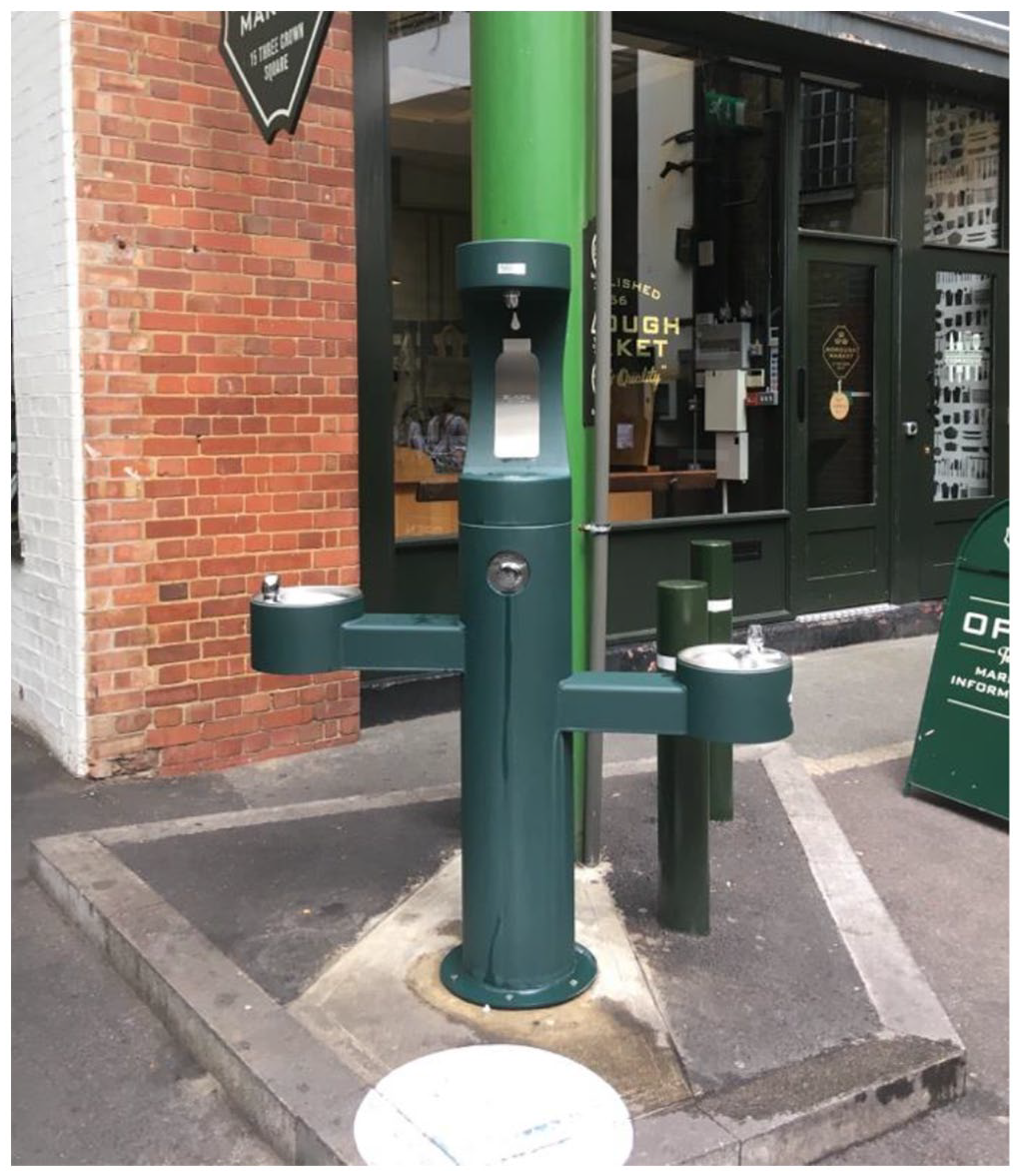
Refill and water fountain.
Hesitation as a practice of knowledge
Limiting the flexibility of the refill water fountain’s working order was central to the third experimental setting I investigated in central London. The first refill water fountain installed in the #OneLess pilot project in March 2018, this empirical setting was the most experimental I witnessed. The composition of this particular setting included the familiar material devices of environmental participation located on one tall narrow column (Figure 4). The ‘#OneLess’ campaign logo appears alongside an image of a tap and water drop with the inscription ‘Refill not Landfill’. Situated in the middle of the column is a small dark green water refill fountain 50 cm high and 10 cm wide attached to the wall at eye level, with the silver pushbutton below. In the refill area a bright purple bottle shaped sticker with the ‘#OneLess’ logo is visible alongside ‘Because everything we do touches the ocean’, and the logo ‘Sponsored by the Mayor of London’. What was different about this experimental setting was the absence of the utilitarian function of the technology to provide free drinking water to the public. The water fountain works only as a refill device. The design constricts the hydraulic mechanism to a refill function. Attempting to drink water directly from the refill fountain is physically impossible. Trying to access water for multiple purposes is practically constrained. Distinctive in design, it is hard to misconstrue its use. While the refill fountain does not look ambiguous, it is not obvious how this curious object works. People have to think about how to get water out, why they can’t access drinking water, what’s different about the way the technology works, and why it is different.
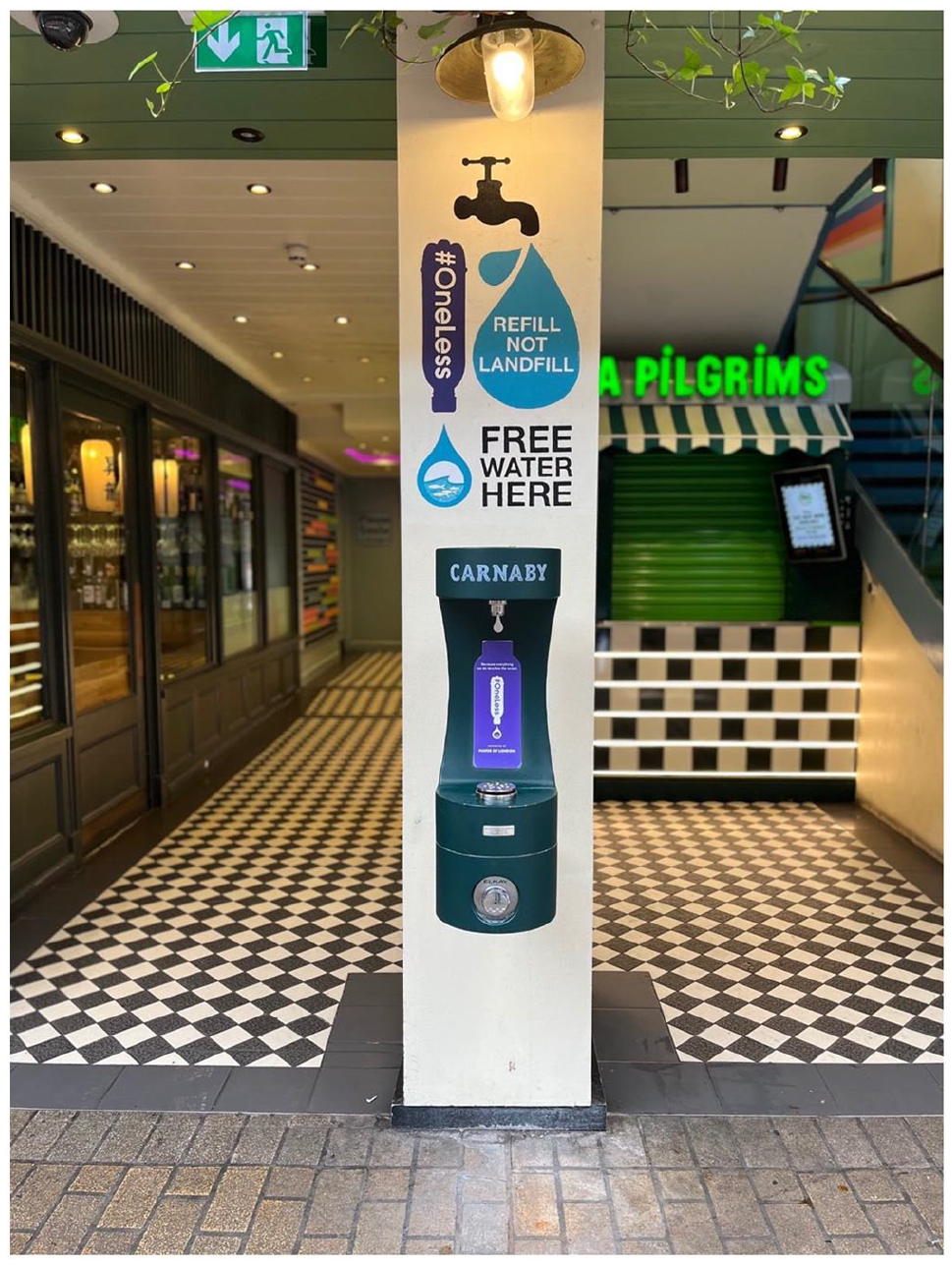
Refill water fountain.
How might we descriptively evaluate this refill fountain’s transformation from a water access technology to an everyday device of material participation? How might we measure the capacity of this experimental object to connect the public to the ocean and shape better worlds? How might we describe the success of the #OneLess pilot to enable and catalyse change in this particular experimental setting? While restricting the capacity of the refill fountain to provide free drinking water was deliberately chosen by the management team to prevent the object’s mundane use as a water access device, ashtray and urinal, describing the refill pilot’s success through generative constraint-based design cannot be attributed to the majority practices of the #OneLess campaign stakeholders and designers. Empirical observations of what caused the achievement of ontological singularity in this particular experimental setting were not the vested interests of stakeholders responsible for the everyday management of the pilot, but the minority practice of participants engaged in practices of hesitation. Reorientating the methodological practice of description away from the standpoint of science, technology and a detached or attached analyst, towards the standpoint of a witness, allowed me to engage in direct observations of the refill fountain and the practical construction of knowledge in local shared dwelling places. Situating myself alongside the refill fountain I became attuned to an ecology of practice. Paying attention to the public’s engagement in the experimental setting involved noticing everyday interactions with the object of enquiry and how knowledge circulates materially through practices of hesitation. In my fieldwork I noticed people stopping and staring, looking up, pointing, glancing and noticing, looking back, touching and pushing, trying and failing to access drinking water, and conversations on how it worked, and how to use it. By being there I witnessed how others are provoked into thinking in their encounter with the refill fountain. This was particularly the case for those who attempted to access drinking water but failed. What caused action in this experimental setting was the provocation of a curious object to arouse collective interest and force thinking. What made the accomplishment of ontological singularity in this experimental setting possible were practices and gestures of hesitation, confusion, and how to respond to uncertainty as a shared collective learning.
Conclusion
Despite being left out of global environmental change research and being relegated to studying the deployment of social research methods in real-world experimental settings, this article has shown what disciplinary exclusion makes possible; to inspire curiosity and hesitation as a requirement for better description. In proposing a descriptive methodological agenda for global environmental change research that takes as its starting point the study of curious objects in experimental settings, the case study of London’s #OneLess refill water fountain pilot calls attention to the possibilities of a sociographical imagination for expanding the role and capacity of descriptive methods as important entry points for social scientists to engage in environmental issues that enable us to speak back to scientists and do environmental research together. Such a sociographical perspective begins to address the role of descriptive research in recognising practices of hesitation in the material production of knowledge. Engaging in the study of what causes thinking in practical experimental settings, and how matters of concern are composed and incited in minority practices, develops new lines of enquiry into environmental issues. In order to comprehend the role of the social sciences to get to grips with the way global environmental problems are assembled in local settings and do justice to unstudied practices of material participation, social scientists must reposition their descriptive methodological apparatuses as relevant for addressing practices of hesitation as concerning the public existence of environmental problems. Thick description gains relevance as a means and method of enquiry to unblock the neglected practices and marginalised objects in science and technology studies and environmental change research. By being fully present as a witness, my investigation of the #OneLess refill pilot has highlighted the importance of descriptive research for taking practices of hesitation seriously as important starting points to join unconnected and previously neglected associations, and generate conversations and collaborations across the sciences and social sciences. In moving the focus of sociographical enquiry from the description of everyday devices and technologies, and what experts do and say about them, to direct observations of how others are forced to think, we can begin to grasp where and how knowledge is produced. As we have seen, in these experimental settings engaging with how a curious object comes to matter as a device of environmental participation not only entails asking questions about the ontological status of everyday technical objects, devices and settings, but also becoming attuned to practices of hesitation as central to understanding the production of knowledge of environmental issues. Deploying descriptive methods to evaluate the success of the #OneLess refill water fountain pilot project produced evidence of an experiment that turned out to be unsettling, provocative, and even radical. Whether we are forced to recognise practices of hesitation as central to building a better description, it becomes necessary to think with the methods of sociographical enquiry as contributing to the task of getting a handle on the changing world and enlarging the sociological imagination for global environmental change research. What this article has called for is not a description of environmental change but a change in descriptive practice on how others learn and our desire to learn with them.
Footnotes
Acknowledgements
Many thanks to the #OneLess team at ZSL and the management team at Carnaby for their time, support and generous feedback in making this research collaboration possible.
Funding
This work was supported by research development funding from the School of Law and Social Justice at the University of Liverpool.