




Abstract
I was writing about the Chernobyl Exclusion Zone when the global pandemic of Covid-19 hit. Everywhere I looked news articles crowded with infographics of the infected made me suspicious of spheres: curves needed flattening. No matter where I turned for information there were human shapes in rings marking distance. I was disturbed by how often the phrase ‘what goes around comes around’ popped into my head, like some kind of self-hazing ritual initiating me into a new normal. As I send this sociography to publication, Russia has invaded Ukraine. The Chernobyl Zone, along with the rest of the country, has become a battlefield. There is no other way for me to write this, from a distance, other than to do so through a looping disorientation. And so I write by turning paragraphs into zones that surround ideas, memories, facts, and feelings of place that are never stable, but always on the move.
Although I experienced being in the zone in the Chernobyl Exclusion Zone as a set of spontaneously felt feelings and an emerging state of mind, I had anticipated this space of intense attention even before arrival. In part because I was prepared to do so, when I was in it, I was in it. In other words, I was keenly attuned to the ambiance of the place because that is what I went there to do – the sounds, the light of the sky, the colors and textures of ruin, all the things that crossed my vision in a blur, and everything I snapped into place in my phone or jotted down in my fieldnotes took on the feeling of great importance. Yet, when I got home to try to write it became difficult to get in the zone out of the Zone. Part of this was because I had a lot to learn, and part of it was because I was trying to train myself to think zonally.
Thinking zonally, for me, means to think with and from the registers of feeling, mood, and atmosphere that exist inside spaces. This mode of considering, of taking in, eschews framing things as either ‘in’ or ‘outside the box.’ A first step to thinking zonally is to put aside the idea that you are going with or against convention: you will need to use everything you can. A second step is understanding that there is no box that can completely hold the wild, spiraling, irradiated things of this world. Those boxy, buried, crumbling, and lead-lined dreams of twentieth century utopianism and twenty-first century futurism are what I draw zones around, but they are also where I draw them from.
There is no clear beginning, middle, or end to thinking zonally, although zones themselves sometimes have beginnings and endings with middles that can only be sussed out after their dissolution. Even when zones are finished, have lost their powerful charge, or have disappeared, their half-lives and after-lives continue to reverberate, sending out signals that can be picked up, leaving trace evidence in artifacts, memories, and affects. Thinking zonally has a lot of potential as a method because zones are so plentiful in our material and imaginative worlds. Zones can be clearly defined spaces, such as postal zones or no-fly zones. They can also respond to changing conditions, like a zone defense on a field of play, or a zone of high or low pressure in the atmosphere. There is often a solid materiality to zones, but there can be an amorphous or porous quality too. Some zones can be crossed without notice, others are rife with checkpoints and gatekeepers. A zone is also a desired state of being where performance is heightened, and attention is focused. Zones are common to genres as diverse as manuals for transcendental meditation to bureaucratic documents detailing safety and security measures, to horror films and science fiction stories.
When the global pandemic of Covid-19 hit, everyone seemed to be thinking zonally, almost everywhere. News articles crowded with infographics of the infected made circular zones into something suspicious. Diagrams showing human shapes inside rings marking various distances became de rigueur. Inside these rings one figure was depicted as emitting molecules from their mouth, and the other was either kissed or missed by this spray, based on proximity. Graphics were designed to show that virus-laden particles pinwheeling around could find anyone, and that anyone could send them flying, but the reality was that some people much more than others found themselves in zones of susceptibility because of their family structures, living conditions, or occupations. Risk and access to care were structured along national, racial, and class lines.
In 2020–2021, as shelter-in-place orders were issued almost everywhere, new zones of alienation emerged. My planned research trips to the Chernobyl Exclusion Zone were rightly cancelled, so I spent the year writing at home in Vancouver. Initially, I thought my work on Chernobyl was on hold, and I turned my focus to writing about pandemic affects, public feelings, and new modes of sociality as they unfurled in real time in the small circle of my neighborhood and through daily trips to the nearby forest or the swimming pool. Then I began to see some of the overlapping concerns of these very different global emergencies: the fear of the unseen and invisible; tiny particles causing massive damage and death; the aesthetics and logics of social distancing; and the attempts to contain the uncontainable through spherical spatial strategies. Writing about Chernobyl helped me think through the zones created during the coronavirus pandemic, while the ontologies of Covid contagion and worry were useful for thinking about the Chernobyl Exclusion Zone, and zones of isolation and abandonment more generally. 1
One of the most famous depictions of a zone can be found in Arkady and Boris Strugatsky’s (1972/1977) sci-fi novel Roadside Picnic, which influenced Andrei Tarkovsky’s (1979) film Stalker (with a screenplay written by the Strugatsky brothers). The novel introduces the term ‘stalker’ to describe a person who illegally enters an eerie, alien-affected area – the Zone – to collect mysterious, other-worldly artifacts in order to sell them to make a living. In Roadside Picnic there are many stalkers, but the protagonist is Redrick ‘Red’ Schuhart, a rough character who is drawn to the Zone for more than just alien scrap to sell; he also seeks the ‘Golden Sphere,’ an elusive object which is thought to grant wishes. In Tarkovsky’s Stalker, the main characters lose their names and are described only by their vocations as Stalker, Professor, and Writer. In the film, Stalker is a professional and quasi-spiritual guide to the Zone, who leads people through the dangerous landscape in order to reach the ‘Room,’ a kind of zone in itself, which lies at its center. The Room is believed to bring to fruition the deepest desires of whoever enters it. To step inside is a risk because who can be assured that they know themselves enough to know what the Room will reveal. 2
Today, a stalker is anyone who enters the Chernobyl Exclusion Zone illegally. A subculture has emerged around the practice, driven in part by the Strugatsky brothers’ novel, Tarkovsky’s film, as well as video games which feature the Zone, especially the S.T.A.L.K.E.R. series. 3 About 400 stalkers are detained each year and made to pay a small fine for breach of administrative regulations. Many Ukrainian stalkers’ parents (and increasingly grandparents) were liquidators, the name given to those who participated in the efforts to quell the Chernobyl disaster in 1986. For these stalkers the Zone has a different pull and weight than those desiring to bring a sci-fi novel, film, or video game to life, although that is not to say that the practices inspired by science fiction and fantasy do not hold meaning as well. Stalkers of all stripes play a game of cat and mouse with the officials who police the Zone, and they are mostly tolerated. Some stalkers have even gone on to become official guides in the Zone, using their outlaw knowledge of the place for a more stable and financially beneficial occupation. Their identities as former stalkers add a veneer of realness or authenticity to their tour guide performances. Other stalkers are disgusted by the tourism industry that has emerged around the Zone and have a more anti-capitalist, punk, or spiritual relationship to the area.
After the Chernobyl accident, the pop-culture imagination of a dangerous zone that attracts stalkers and seekers, but also causes illnesses and mutations felt eerily prescient. In both the novel Roadside Picnic and the film Stalker, the exact location of the Zone is ambiguous. I had always imagined it somewhere in Eastern Europe. 4 Then I read Ursula Le Guin’s foreword to Roadside Picnic, where she suggests the Zone might be in Canada, although she can’t say precisely ‘on what evidence’ her assumption is guided. The only thing she can point to that makes the setting feel Canadian is ‘the economics of exploitation shown at work.’ 5 As I read her foreword, I thought of a line from Billy-Ray Belcourt’s memoir, A History of My Brief Body, where he refers to Canada as ‘not a country, but a radioactive wolf in wolf’s clothing.’ 6 Belcourt’s metaphor leapt out of its paragraph, out of history, and circled over to lope around in Le Guin’s map of the country where I sit at my desk. With this newly activated and altered cartography in mind, I felt Vancouver could be a good enough place to write about radiation, nuclear ghost towns, and irradiated wolves. Writing in this space could hold me over, at least until I am able to travel back to Ukraine for more fieldwork. If Le Guin’s suspicion is right I am not too far from the Zone of sci-fi fame, and if she is wrong, I am still not too great a distance from actual zones of devastation due to uranium mining in the Northwest Territories and northern Saskatchewan, places where radioactive wolves wearing wolves’ clothing can be easily seen fooling no one.
Even if Canada is a fitting place to write about weird and radioactive zones, it is not unique in this regard. In Roadside Picnic, the Zone was one of six, but in our world, zones of sacrifice are too plentiful to count. If we were to make a list only of the nuclear zones – where my mind tends to go – there are still too many places that would be good to think with and from. There are sites of accidents where zones have been established, and sites of accidents where life goes on as if normal. Zones of alienation can be made in an instant and they can be made very slowly over time, like the drip drip drip of a leaky faucet: wherever nuclear weapons and fissionable materials were, are, and will be stored; wherever nuclear tests were, are, and will be conducted; wherever uranium mines were, are, and will be active; and wherever nuclear powerplants were, are, and will be in operation. The potential for new disasters is staggering.
The place where I was born and where my mother still lives, Oak Ridge, Tennessee, is snugly on this list. Oak Ridge was one of the first cities of the Atomic Age, and it owes its existence to the Manhattan Project and the nuclear weapons, medical isotopes, and nuclear storage industries that followed. It was initially created as a secret government city in the 1940s in order to separate uranium for the bomb, Little Boy, that was dropped on Hiroshima. Oak Ridge continued to supply the US nuclear arsenal throughout the Cold War, contributing something to each and every American nuclear bomb in existence. The small city remains one of the key sites in the American nuclear landscape with the world’s largest supply of fissionable uranium at the ready. If something were to go terribly wrong, if there was a natural disaster or an enemy attack, the circle of devastation drawn would likely include my mother’s house, her Volvo, and her black walnut tree. The Oak Ridge Exclusion Zone would then be given over to the radioactive frogs, geese, heron, white-tailed deer, wolves, stalkers, and atomic tourists that make up the irradiated history, present, and future of atomic Appalachia. 7
*
What follows are sociological prose poems crafted from thinking with the affects, colors, histories, memories, myths, pop culture, and scientific facts that circle around and within the Chernobyl Exclusion Zone. My computer turns these circling, zonal thoughts into lines and rectangles, but I will ask you to imagine them with me as moving things, curving, and going round and round. Sociological poetry is both a method and a genre. I use this method as a way of theorizing while writing, by thinking with and through the material and immaterial things of this world. Sociological poetry helps me to pay attention to the atmospheres that radiate from the things that draw me in, while acknowledging all along that things change with the looking. As I write, I’m driven by the poet Lisa Robertson’s assertion: ‘Form – it’s because there are consequences.’ 8 The consequences I’m after are for the reader to come along with me, to find points of convergence, compatibility, or friction, and to convey social facts through the conjuring of atmospheres of meaning rather than didacticism.
Like a zone defense, this kind of writing requires ‘a commitment to scheming and practicing, learning the nuances of zones, such as spacing, which require familiarity and experience.’ 9 This is not a genre that pairs up player-to-player; it does not focus on one element with the intention of exhausting it, instead it aims to track a space and to pick up on the things happening there. There are weaknesses to this approach, sometimes things break through the zones as I’ve conceived them, they slip through a gap or a hole never to be seen again. This method is not comprehensive, and no method ever is when thinking about a place, especially one with the historical weight and symbolic significance of the Chernobyl Exclusion Zone. All the places of the world are open to being turned over and around with almost limitless epistemic and ontological modes. The beauty of this approach, of thinking zonally, and social research more generally, is that when it is not overly sure of itself, and when it does not commit to one direction too soon, it has an openness and flexibility to pivot, pause, and change direction when it feels right.
Many of the particular details you will read below arise from a research trip I took to the Chernobyl Exclusion Zone in the summer of 2018 and the ongoing discussions and friendships that were sparked by that trip. Through and beyond this fieldwork, I track the ongoingness of the Chernobyl accident of 1986 and its social, cultural, and ecological impacts to trace how a certain 86ness can never leave the place. I want to show how half-lives whirl from that time into our time and how they are swirling still, like the eyes of cartoon characters under hypnosis or in extreme shock. Beyond Chernobyl, what this kind of writing offers are some ways to think zonally and poetically to consider places and times both sacrificed and sanctified for their relationship to crisis.
Circling the Chernobyl Exclusion Zone
Laps
I spend a few days with friends, fellow writers and researchers, circling the Chernobyl Exclusion Zone imaging life before the creep of nature and the slump of regret. Our travel turns increasingly inward, but in a haphazard fashion, as the roads, our guides, and other groups’ locations dictate. People from HBO are there too, and they’ve paid to keep everyone else out of the areas where they are filming, so we take care to avoid them. First, we visit some of the villages on the edge of the Zone, next we travel to Chornobyl city, then further into the interior towards Pripyat and the nuclear powerplant, and then we work our way back out again, through the checkpoints at the 10 km and 30 km zones, with one last stop at the little market to buy beer and water, ultimately arriving at Ecopolis where we are staying just outside the Zone. This is our routine, our rhythm, the laps we take each day to train ourselves to see, feel, and think this place.
Plagiarized
After taking in so many images of the Zone before my arrival I worried the actual place would look plagiarized. I soon realized (again) that there is so much about a place that is not circulated through Internet image searches or found in color-saturated coffee table books, and there is no substitute for being there. I was reminded of the time I went to Detroit to gaze at the massive ruins of the American twentieth century, the same ones I’d seen featured in glossy photographic spreads in countless articles celebrating and bemoaning the aesthetics of decay; the kinds of images that led Rebecca Solnit to call Detroit ‘post-American.’ 10 What I didn’t see in the images but witnessed in situ was that across the street facing the once-grand-now-decrepit train station was a sleek coffee shop and a collection of smartly-designed restaurants. The coffee shop was filled with artfully dressed people carrying expensive cameras, someone’s fuzzy boom was propped up in the corner. Jessi and I were part of the scene too with our tiny puppy shivering in a canvas tote bag as we ordered pour over coffees and a chocolate chip cookie to share. Even though our trio was likely seen as one of a certain type, and we were that, we were also uniquely ourselves. Coffees in hand, we took our little dog out of her bag to run around in front of the ruins, and we showed her the toy raccoon we had brought from home. She couldn’t believe it. She leapt with delight and looked at the raccoon, like ‘how did you get here?’ Sometimes it takes a dog to remind you to find yourself surprised in a landscape, to jog you out of a jadedness, and to show you again that the world and your experiences of it are not copy pasted.
A stalker’s favorite reading spot
After the accident, a thousand square miles were evacuated including the cities of Chornobyl and Pripyat plus eighty-six villages, close to 120,000 people. Many of the contaminated villages were buried in the weeks immediately following the disaster, making another zone below the Zone. Over the years, the houses, businesses, and community centers that remained above ground have been ransacked by stalkers and swallowed by roots, vines, and other wild things. Almost all of the houses are empty and slouched. Around their perimeters, once-proud wooden fences lean like wind-bent trees. In many of the homes, window frames and door panes have been removed to make perfect scenes for photography. As we walk around one of these ghost villages, I’m drawn to a house with peeling paint that resembles the bark of a tree – imagine birch, but pale green, like arsenic. A glassless section of one of the windows hosts an open book romantically resting on the seal (Figure 1). I wonder if I’m supposed to imagine the person who lived in the house was casually reading and looking out the window, drinking a cup of coffee or a glass of vodka when they were told that they had to leave; or if I’m to surmise that this is a stalker’s favorite reading spot; or maybe this is a tableau from the collective unconscious brought to conscious life, like a scene from a movie that you’re certain you’ve dreamed before seeing it played out cinematically.
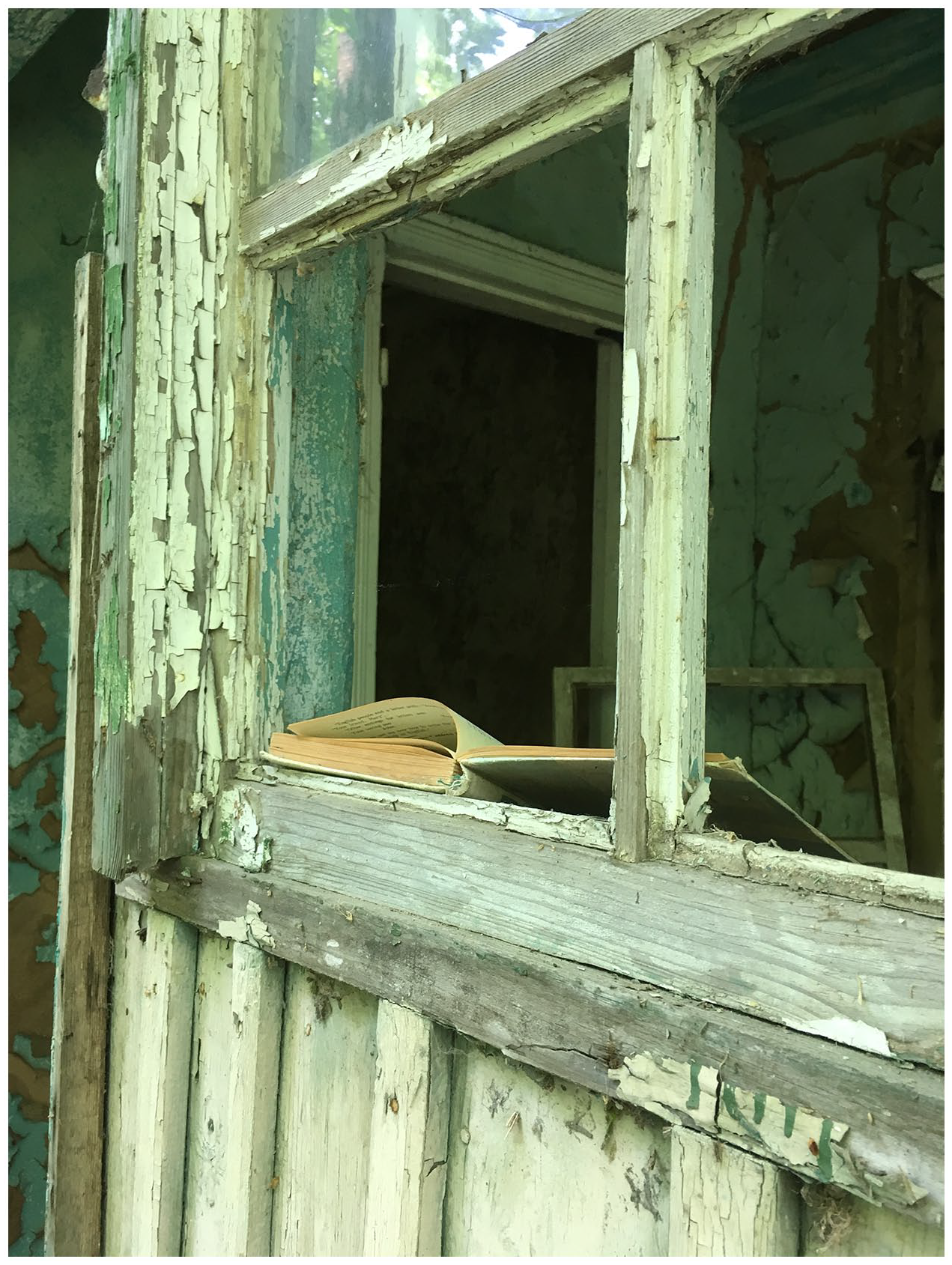
A stalker’s favorite reading spot.
First impressions of Chornobyl City
A Soviet-era bus travels a circuitous route transporting workers to and from the grey mass of the nuclear powerplant. Workers typically spend two weeks on and two weeks off, leaving the Zone and then returning. In Chornobyl, the Zone’s bureaucratic headquarters, time is organized by the rhythms of half-lives and exposure levels. At the post office, paper-and-ink letters have been replaced by electronic ribbons written in radioactive language. A small LCD panel on the outside of the building displays Geiger counter readings from hot spots all across the Zone (updated every hour). Next door from the post office is the now not-so-secret secret service office. Across the street, one of the last remaining Lenin statues in all of Ukraine stands on his low plinth, yellow flowers at his feet in June (Figure 2). 11
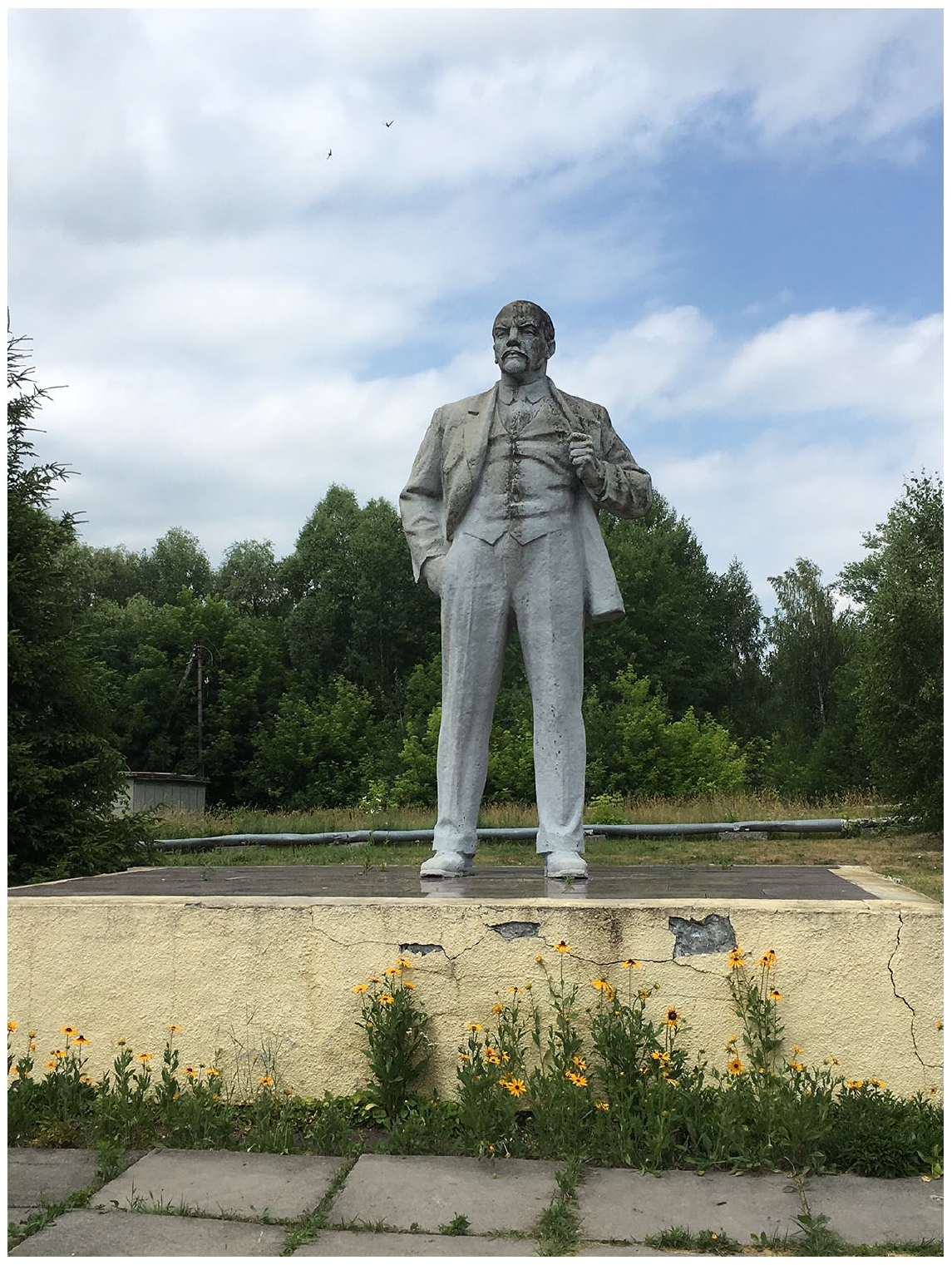
First impressions of Chornobyl City.
A brief history of Leninopad
During the Soviet era, Lenin statues could be found across all the Soviet republics, but Ukraine had the most Lenins of all. Even after independence in 1991, the majority of the statues stayed in place in Ukraine until the Euromaiden protests in 2013–2014. Then with the toppling of the Lenin on Taras Shevchenko Boulevard in Kyiv on December 8, 2013, the statutes started to come down in rapid succession all over the country in a process called ‘Leninopad’ or ‘Leninfall.’ Many of the statues were beheaded and chopped apart, little pieces were taken as souvenirs, like chunks of the Berlin Wall, but stranger things happened too – some Lenins were painted in bright colors and displayed in an ad hoc museum on the grounds of an old collective farm; one Lenin head was mounted on metal spider legs, the face smashed badly by hammer blows, the mouth turned into a void; at least one was transformed into Darth Vader; other Lenins were collected along with statues of Marx, Engels, Dzerzhinsky, and Nadezhda Krupskaya (Lenin’s wife) and taken to Cape Tarkhankut off the Crimean coast and then sunk to form an underwater museum called ‘The Valley of Leaders.’ I’ve heard that the water is so clear there that the submerged Soviets can be seen from the surface, although some people swear that to get past the thresholds of ordinary sensation, you must dive in and swim up them.
In April 2015, Verkovna Rada, the Ukrainian parliament, passed laws for decommunization of the country, which included mandatory destruction of communist monuments and symbols. 12 Officially, the Lenin statues inside the Zone have so-far escaped decommunization because there is no local authority or self-governing body who can vote to make the decision to take them down. Unofficially, some people in Chornobyl like to keep things as they are, others simply do not care if Lenin stays or goes, while still others know that Soviet symbols are part of what brings in tourists, and therefore money into the area. There are two Lenin statues still standing in the Zone: there is the one I’ve already told you about across from the Chornobyl post office, and there is another in the former shipyard adjacent to the Pripyat River. This Lenin is sculpted with his right arm extended, an echo to Russian Orthodox statuary, which often depicted Jesus in a similar posture, as if he was frozen while conferring a blessing. 13
The end of writing
The first thing I notice when we arrive in Pripyat is that there is a duplicity, a double city: there is the ghost town of ruin porn and internet fame, and there is the space you find in situ, teeming with nature and dotted with objects left behind after the city’s undoing. There are the YouTube videos of stalkers swaggering and drinking radioactive water, and there is the softening concrete of the former atomograd, pine-eaten and tender. 14 There is evidence of the end of writing on the once-beautiful desks dissolving, and the beginning of something like research, thanks to Svitlana’s invitation. When writing takes place, it happens ex situ in the West End of Vancouver on a desk made in Brooklyn by an anthropologist who dreamed of becoming a carpenter.
Still life
In the Zone everything is paused or everything is hot or everything smashes into everything else. Buildings ambulate off their foundations, lean on one another, and then collapse completely. Stray dogs stay next to the workers at the nuclear powerplant and sniff out tourists or (some people say) get eaten by wolves. Re-settlers offer pre-disaster vodka and post-disaster pickles to visiting researchers who are not supposed to eat or drink them but do anyway. The places where we walk are either made of shards of glass or pine needles. Paint peels, but remains vibrant, unlike the flags placed on the moon, which are now bleached bone-white.
Red sensitive
Margret draws my attention to an abandoned school, and I peer into a window with only a houndstooth shape of glass remaining and catch sight of old, yet still-vibrant Soviet-red posters celebrating the 40th anniversary of the USSR. I want to stand there for a long while taking in the scene, but Sasha insists we have a schedule to keep, plus there are poisonous snakes in the area and we should not linger. I learned from Josef Albers’ Interaction of Color that ‘staring at red will fatigue the red-sensitive parts,’ tiring out the rods and cones of the eye that make sense of color. As I remember this chromatic lesson, I become less agitated about being rushed and more assured that this will leave a vivid impression, however brief my encounter. 15 As we are hurried along, I notice the red is still working on me: the palette, ideological and clear.
Ukrainian blue
In the Exclusion Zone, colors repeat. The bright blue of the Ukrainian flag decorates the walls of homes (Figure 3), adorns post offices and schools, and dances among the patterns of the babushka’s scarves. The blue is so pleasing to the eye that it momentarily interrupts, providing a point for hesitation or disorientation. During a chromatic encounter like this it is possible to fall into daydream of swimming in Pripyat’s once-grand Azure swimming pool; or a nightmare, imagining the sky-blue flash over reactor 4, which is the telltale sign of xenon fucking up the chain reaction, the ionization of the air.
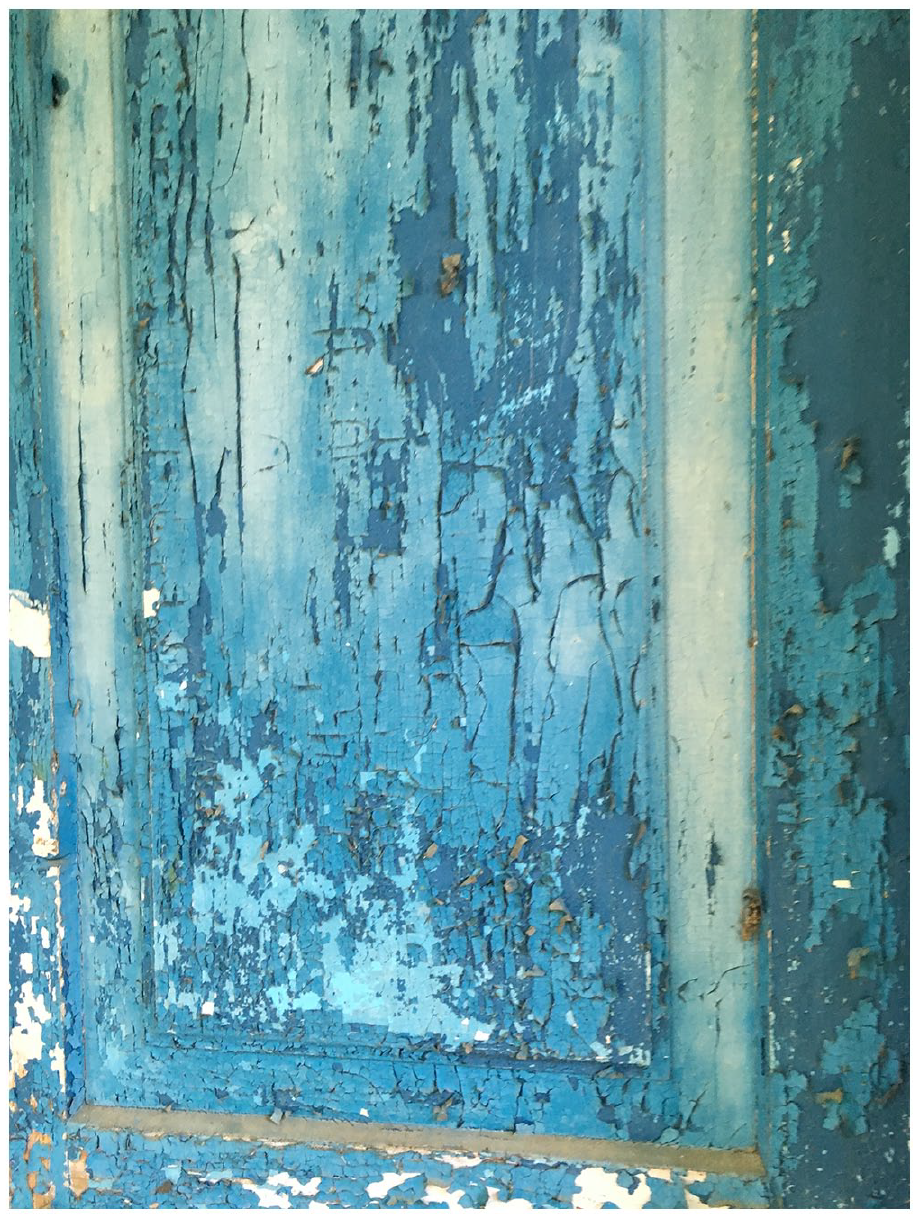
Ukrainian Blue.
Trefoil
The fan-shaped black trefoil, usually found on a yellow background, is the international symbol of ionizing radioactivity. 16 The three rings of the ‘fan’ represent the types of radiation: alpha, beta, gamma. The symbol first appeared at the Radiation Laboratory at the University of California-Berkeley in 1946. The design was intended to show activity radiating from an atom, something still, but representing lots of movement, like the action lines drawn by Steve Ditko for Captain Atom comics, or the painterly technique used in Marcel Duchamp’s Nude Descending a Staircase, No. 2.
The earliest ionizing radioactivity signs printed at Berkeley carried a magenta symbol on a blue background. The magenta was chosen for its distinctiveness and expense: the color did not correspond to any existing color codes that the scientists were working with, and they felt that the high cost associated with printing magenta would prevent people from using it excessively. The Berkeley scientists had very little blue in the areas where they were conducting radioactive work, so they thought it would catch the eye.
Not everyone was on board with the blue and magenta design. Blue tended to fade, especially outdoors, making it harder to see. By 1948 the Oak Ridge National Laboratory and the Los Alamos National Laboratory were using the standardized yellow (sometimes with magenta, sometimes with black). Other labs soon followed the chromatic shift. Ultimately the black and yellow design took precedence, for its visibility and its relative cheapness to produce. 17 These signs proliferate across the globe because of the increasing spots where ionizing radioactivity can be found – laboratories, hospitals, nuclear powerplants, nuclear test sites, and sites of nuclear accidents and attacks. They poke out everywhere in the Chernobyl Exclusion Zone, like toothpicks piercing hors d’oeuvres in a party tray. Sometimes they mark the hottest spots in the Zone, and sometimes they are moved by tourists, stalkers, or researchers to make the best photo ops.
I take off my hat and ask Eldritch to snap my picture close to one of the signs against the backdrop of the massive Duga radar, otherwise known as the Russian Woodpecker. Even though Sasha assures me that this sign has been moved for tourists, I won’t get too close. The soft soles of my canvas sneakers make imprints in the sand, temporary evidence that I was there as a witness to dangerous atoms coming apart.
The Zone yields its own celebrities
After a day of touring the area immersed in decay, we rounded a corner and there was Simon the famous sandwich-making fox standing at a slash before us; he looked like he didn’t have ‘a comma to eat.’ 18 This is not how I imagined him from his online presence. In the video that made Simon an internet sensation, tourists feed him pieces of ham and bread, which he carefully stacks together into a six-decker sandwich of impressive height, seemingly all he can wrap his jaws around. 19 Then he lopes off with his meal in a zig-zag fashion, his feet are light, and his red tail with the white tip hangs like a jaunty arrow: it is a hero’s exit. When we meet Simon, it has been a few years since he had his 15 minutes of fame and he looks frail and ragged (Figure 4). It is hard to tell if this is just because Simon has aged, or if living in a radioactive landscape has taken its toll.
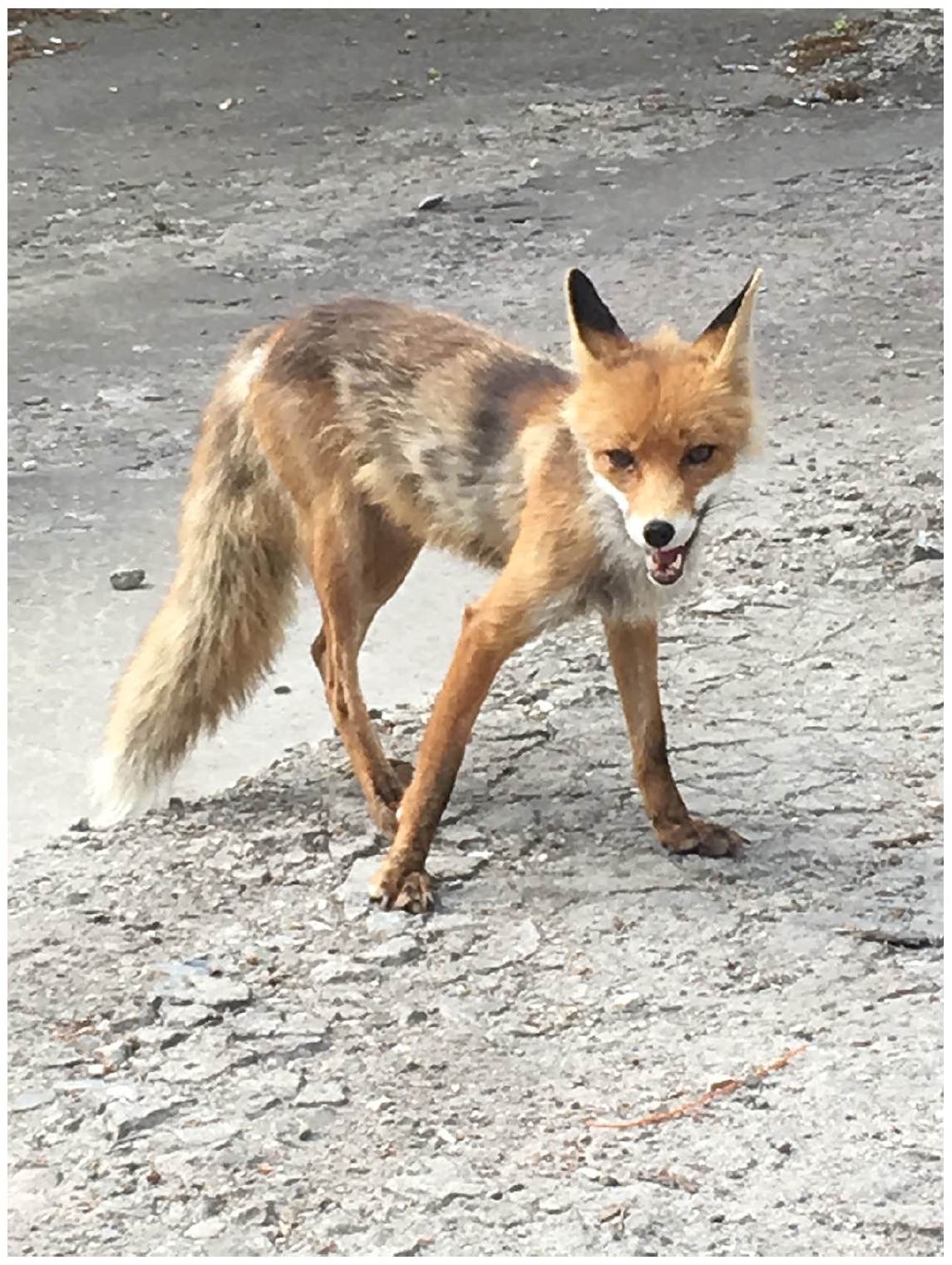
The Zone yields its own celebrities.
Ecopolis
At night we sleep in Ecopolis, a camp outside of the Exclusion Zone comprised of 30 small brightly painted cottages, a sauna, and a laboratory, all built by scientists. The vibe of the place is rustic with an aesthetic that can only be summed up as radioactive nerd meets Twin Peaks. Here, too, the owls are not what they seem (Figure 5). Once in camp, we quickly develop a routine: first, we shower to wash off radioactive dust, then we drink beer and cognac under a little structure with an A-lined roof and talk about our lives – jobs, cities, sex, and time. Each night we loosen from the slightly aloof collegiate postures we hold in the Zone and fall into a more intimate space of feelings. Occasionally, someone goes off among the pines to call a loved one who is just starting their morning on the other side of the world, then they drift back and drop right into our swirling and animated conversations.
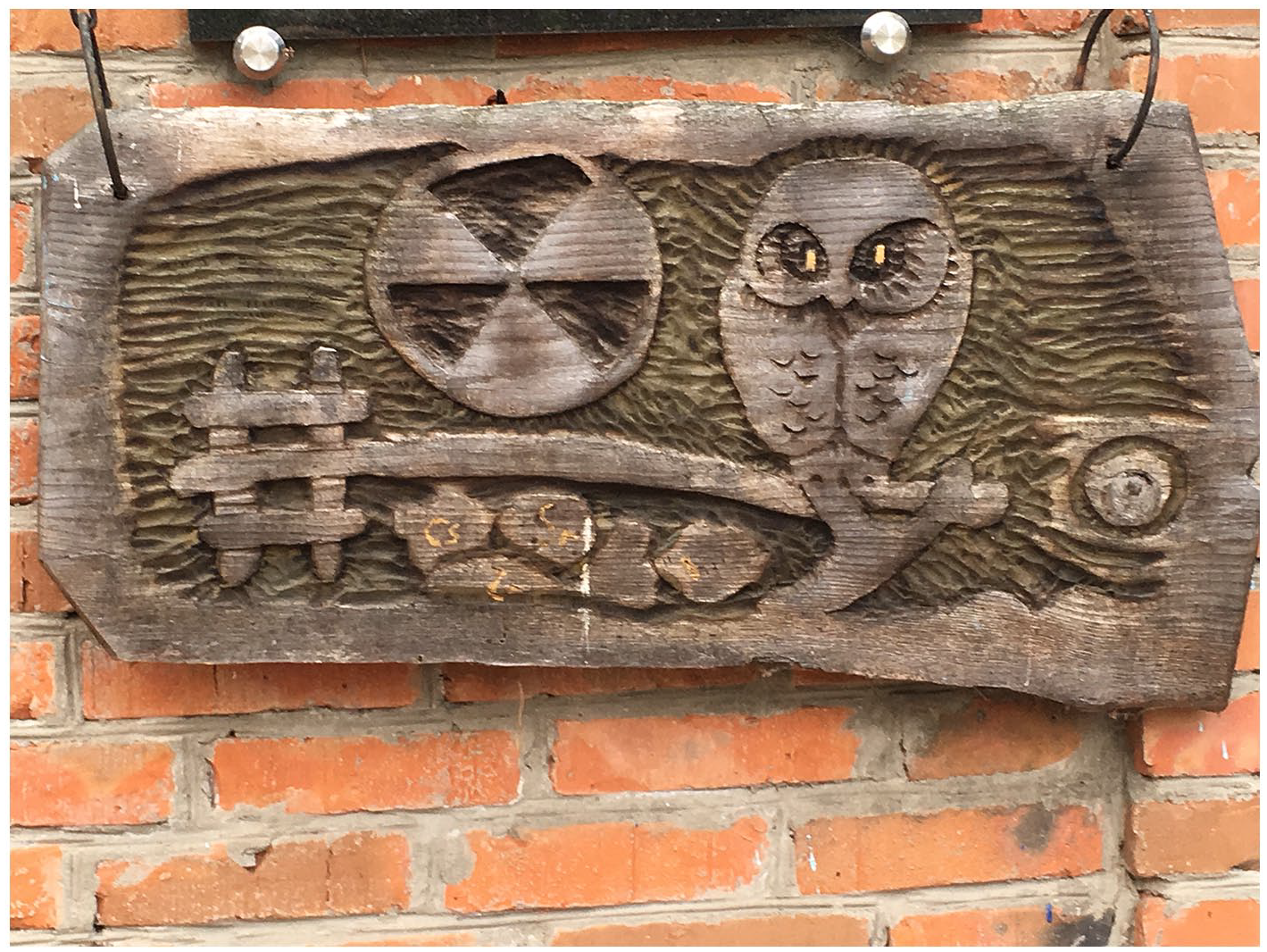
Ecopolis.
Nuclear people are drawn to nuclear places
On the last day at Ecopolis we are given a tour of the tiny laboratory on site where scientists test soil, birds, fish, and other things from the Zone for radioactivity and its effects. The lab is located in a small cottage and the space is cramped with equipment, most of it from another era. I’m sleepy and distracted as I move through the space, delighting only when I see some kind of machine in the temporal signaling orange hue of the 1970s, or a bit of paper or a notebook featuring the symbol for ionizing radiation with an owl – the symbolic creature of Ecopolis – perched on top. Then I see something that snaps me to attention: a lovely pen and watercolor drawing of the Oak Ridge National Laboratory (ORNL) Environmental Science Division from 1991 (Figure 6). The buildings of ORNL are painted in a soft ochre, green hints of the forest rest behind the lab, a blue sedan with inked shadow lines is parked in front, and two loosely drawn human figures are coming or going. I fall into this drawing back to Tennessee, to where I’m from, moving with the irreversible histories of these nuclear places, their strange mingling and contagion, their lines of flight. The place in the drawing is at the heart of what brought me here, to Ukraine, to see and experience one of the most toxic places on earth.
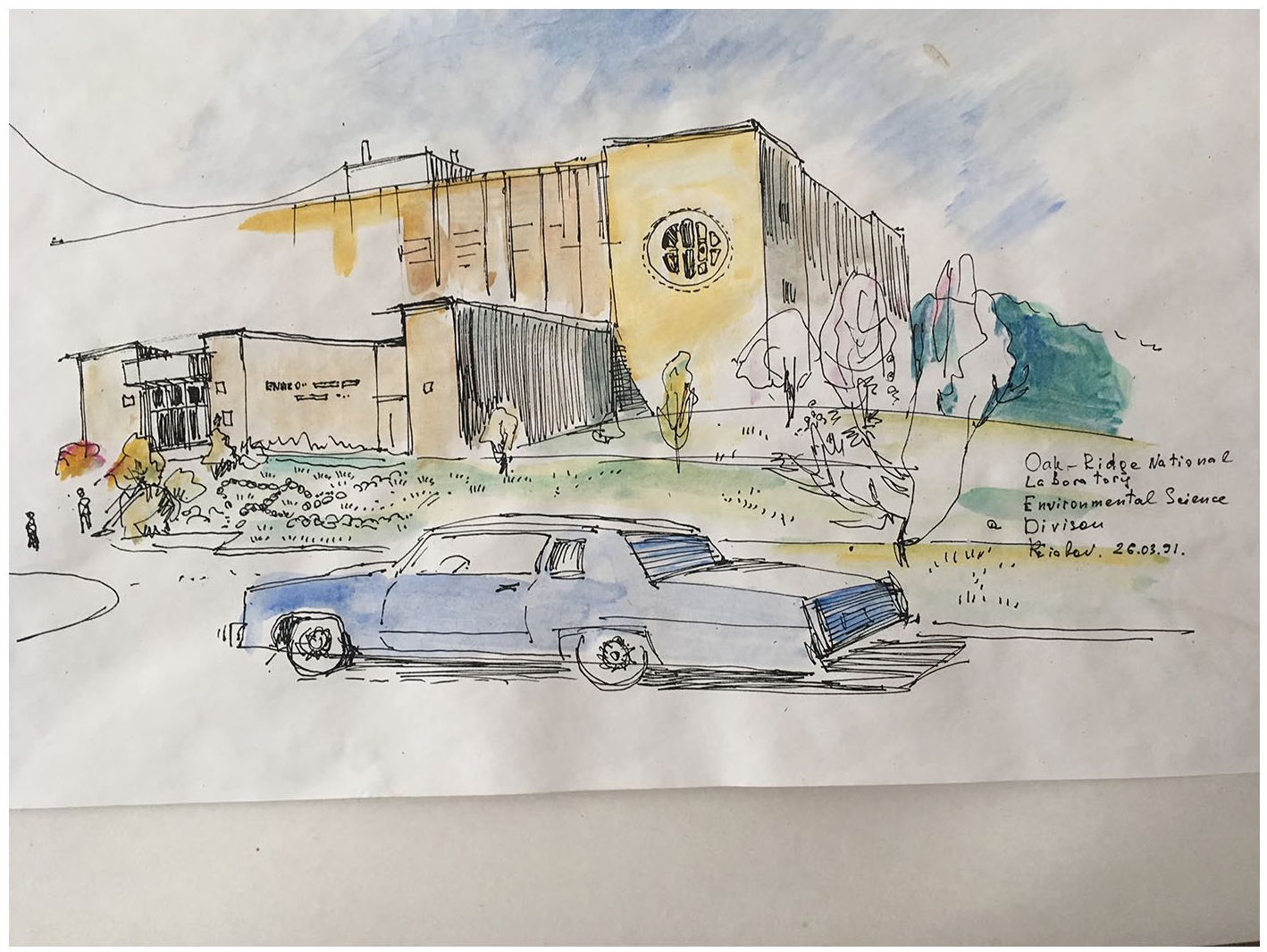
Nuclear people are drawn to nuclear places.
Glitter and strontium
You don’t have to unwind history too far for it to make sense that the moody British band Suede filmed the video for their song ‘Life is Golden’ in the Chernobyl Exclusion Zone. In just under four minutes, director Mike Christie loops in swooping shot upon swooping shot of atmospheric architecture featuring yellow-leafed birch trees in the fall, warm life in relief against a rain-slicked Pripyat. The camera swoons at the sight of the empty, golden-yellow Ferris wheel and the rusty, bumper cars tagged with graffiti; their colors weaker from what they’ve endured. This collision of sensibilities is no accident. For us gen-Xers, they are of our age – Britpop and fission, glitter and strontium. Then there’s Suede, even saying or hearing the name sounds and feels good. The band makes it easy on the eyes and ears for children of the Cold War and atomic tourists of a certain age to match the feeling of being in radioactive ruins at the blue hour when you can’t tell a dog from a wolf, or a wolf from a sandwich-making fox.
Blue stuff
Some mornings I drink coffee from a blue and white porcelain mug I bought in the Zone from a small market decorated with a mural of Roadside Picnic. I felt a little shy as I paid for it because I didn’t want to be too much of the wrong kind of tourist. Elise bought one too, which gave my consumer confidence a little boost. The mug says ‘Chernobyl’ in Ukrainian on one side and English on the other with the date commemorating the accident printed in very small type. The ‘O’ in both languages is a radioactive sign. As the coffee recedes, more of the pleasant blue is visible, which makes me think of the ‘blue stuff,’ as described in Roadside Picnic. The ‘blue stuff’ is the mysterious substance found in the ‘full empties’ collected by stalkers. 20 The color unleashed in the novel by the Strugatsky brothers was prescient, just as their discussion of the Zone was, but the blue has been given much less attention.
In What Color is the Sacred?, Mick Taussig writes: ‘color is the genie that lets ethnography out of the bottle. This is because there is color, and then there is “color,” . . . as in “local color,” meaning something more vague, more suggestive – that outer reach of words so necessary to grasp the inner nature of things. The two overlap and intertwine.’ 21 The blue of my mug, the blue of Ukraine, the blue of the Russian sci-fi novel, the blue that jumps off my photographs of the Zone and leaps out of my fieldnotes like something alive – this color, both a color and local color, mixes with caffeine and puts me in a zone that enables writing.
This will indicate a hole
In The Ravickians, Renee Gladman writes: ‘If you are engaged in a translation and discover that a quality you need to convey does not exist in your language, the language into which you are moving, do not pick the next best thing. Sometimes you will have to put an “O” there; this will indicate a hole.’ 22 ‘O’s’ proliferate as I write, even as colors and things liberate my thinking. An ‘O’ is a circular shape that expands and contracts – sometimes it is just big enough to draw the radioactive symbol on a coffee mug, and sometimes it is large enough for a fox to fall into. This book is riddled with holes, like the ceiling of an old saloon kissed with bullets, or a net for catching trout that the river runs through. You can imagine all the white spaces on these pages filled with holes, each invisible ‘O,’ a small detail that can make or unmake a world.
Round and round
Karen sends me a series of photographs of Chernobyl Zone resettlers by the Azerbaijani photographer Rena Effendi. The one I like best is of Maria Harlam, an 82-year-old resettler to Chornobyl city, sitting on her couch under a bald lightbulb and an assortment of family photographs (Figure 7). 23 Harlam’s dressed in a combination of patterns: a plaid skirt and a multi-colored sweater with shapes resembling lightning bolts. The design (reminiscent of the 1980s) is so lively that for the first time I understand the British use of the word ‘jumper.’ Under her sweater, she’s wearing a white wide-collared shirt with one side folded over a bit funny, like a dog-eared page of a paperback. The detail warms me to the person photographed, and it also makes me think of one of the photos that hooks Roland Barthes in Camera Lucida of a boy with an exaggerated collar. I wonder if that book trained me to think of extra-large collars as something worthy of notice.
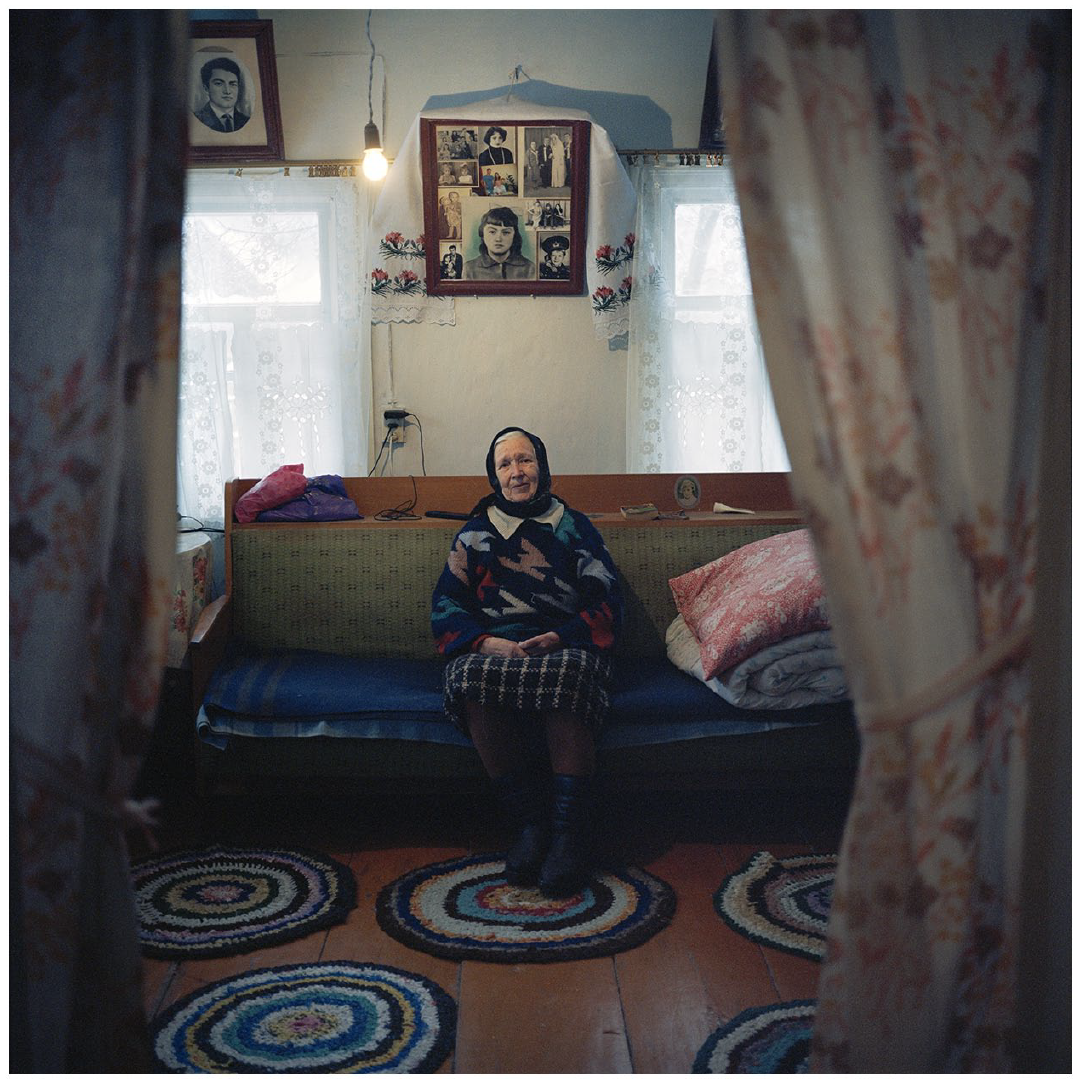
Rena Effendi, “Maria Harlam,” Still Life in the Zone, 2010.
The sweater causes me to linger, and the shirt leads me to wonder, but it is Maria Harlam’s rugs that really hold and keep me there, animating my thoughts about atoms, utopian dreams, disaster, evacuation, alienation, and return. I am mesmerized by the small circular rugs of concentric color design that decorate the wide-planked wooden floor; they remind me of the occult paintings of Hilma af Klint. The rugs share the color palette of the sweater, and quickly they start to feel like zones themselves, like something a person could fall into. The experience makes me want for a new category of looking that explains how some photographs put me in a meditative and contemplative zone, a zone that makes me want to write, and others don’t.
Most photographs of the Zone, I give only a glance. Others, I scour for information, make a note and move on, retaining only fuzzy traces of the images themselves. Out of all of the images I’ve seen of the Chernobyl Zone, Effendi’s photograph of Maria Harlam is one of the few that I can clearly recall. The photograph does not wound me, I feel something diffuse, a kind of spacey sensation. This feeling is not something that can be forced or even deliberately coaxed, although it can come from a staged setting. Effendi’s photograph and the others that keep me in the zone thinking about the Zone, do not aim to shock: they are not necessarily beautiful, although they can be. They do not silent-scream disaster from a ghastly sea of gas masks or rely on a sad baby-doll with a missing limb to set the mood. These images move me to write – to make a record, but also send me on a kind of reverie – round and round, not taking, but turning, following the layers of the past in the present.
Pripyat’s angel of history
Green foliage licks her golden legs like flames. Her arms are outstretched, and her head is at a tilt, pointing slightly upwards. She was once smartly dressed for science, but today only parts of her outfit remain. One breast is completely bare. Her concrete core looks strong against the red, orange, and blue pieces of opaque colored glass called smalto that still cling like sequins, but I wonder if her belly has gone soft like the steps in the secret computer laboratory. Solid or yielding, she should not be mistaken for one of those ‘women who could have given themselves to us,’ whose memory pains Walter Benjamin in his desperate essay, ‘Theses on the Philosophy of History.’ 24
Immediately I recognize her as an angel of history, but she is not like the one I know from Benjamin. She doesn’t look us in the eye like Paul Klee’s Angelus Novus, that work of art that enchanted and inspired Benjamin, and why would she want to? Pripyat’s angel of history, as I think of her, was created by the famous Soviet mosaicist Ivan Semenovych Lytochenko. He called her Demeter, after the ancient Greek goddess of the harvest and of the sacred laws of life and death. Affixed to a wall on Lenin Avenue since 1982, she holds court alongside scientists gripping uranium rods. There she has become a witness to a catastrophe, with a futurity that just won’t quit, ‘which keeps piling wreckage upon wreckage.’ 25 Benjamin writes: ‘The angel would like to stay, awaken the dead, and make whole what has been smashed.’ But this is not the way it is with atoms and nuclear meltdowns. Pripyat’s angel looks up, but she is not looking for progress; she knows that like pleasure, there is no progress in catastrophe, ‘nothing but mutations.’ 26 This progress is what we can catastrophize.
Perhaps Pripyat’s angel of history is over this obsession with the smashing of atoms, and the race for progress – both in weapons and this loose category called power. Maybe she is just done with the machismo of the historical materialist who must be ‘man enough’ and ‘in control of his powers,’ while he is busy blasting continuums and brushing history against its grains. Meanwhile, the past becomes less citable with every tile that sloughs off her body and every camera that captures her as an image, in an instant, including my own (Figure 8).
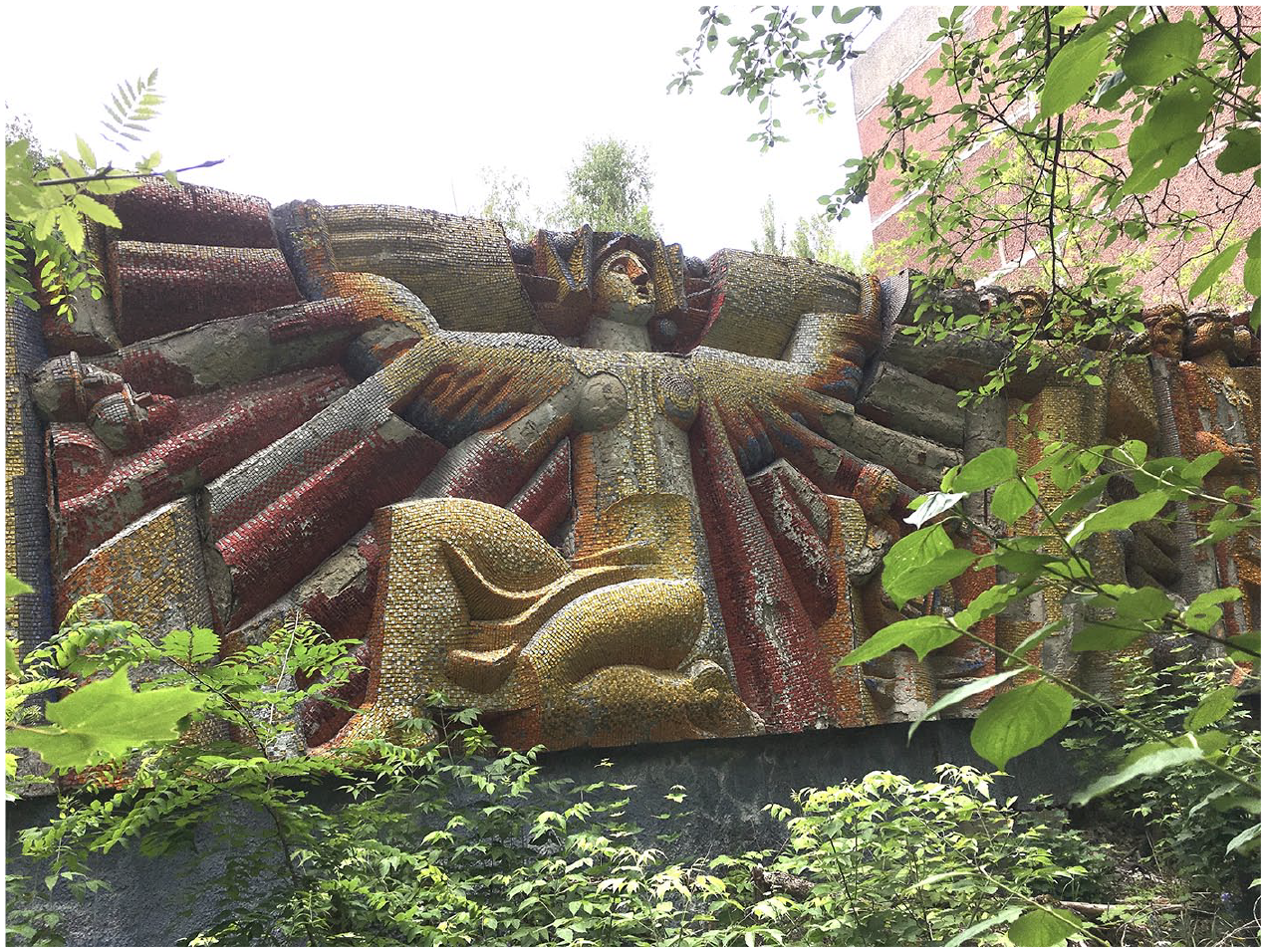
Pripyat’s angel of history.
What does it mean to be clean?
I step out of the van and into the radiation checkpoint. The detection equipment appears to be decades old. I follow the others and face forward with my hands on either side of the machine (Figure 9). The electronic display should move one down to the level that reads ‘ЧИСТО (clean)’, but instead it issues warning sounds, and the red light leaks another word ‘ГРЯЗНО’ that I later find out means (dirty). No one seems concerned by this, but me. Sasha says simply ‘do it again.’ When I do as he says, the light moves down to the clean button, like all that just happened never happened. I know that there is no clear line between dirty and clean, and that these distinctions depend on the cultures of societies in specific slices of time. What is of importance are the rituals put in place, the performances that mark distinctions – these ensure a sense of order and a faith in the boundary, which is anything but definitive. I learned from the queer poet and novelist Garth Greenwell that cleanness can be filth, and that filth, cleanness. Between what is clean and what is dirty, betwixt purity and danger exist spaces where one can slip between the cracks, if one simply did it again. 27
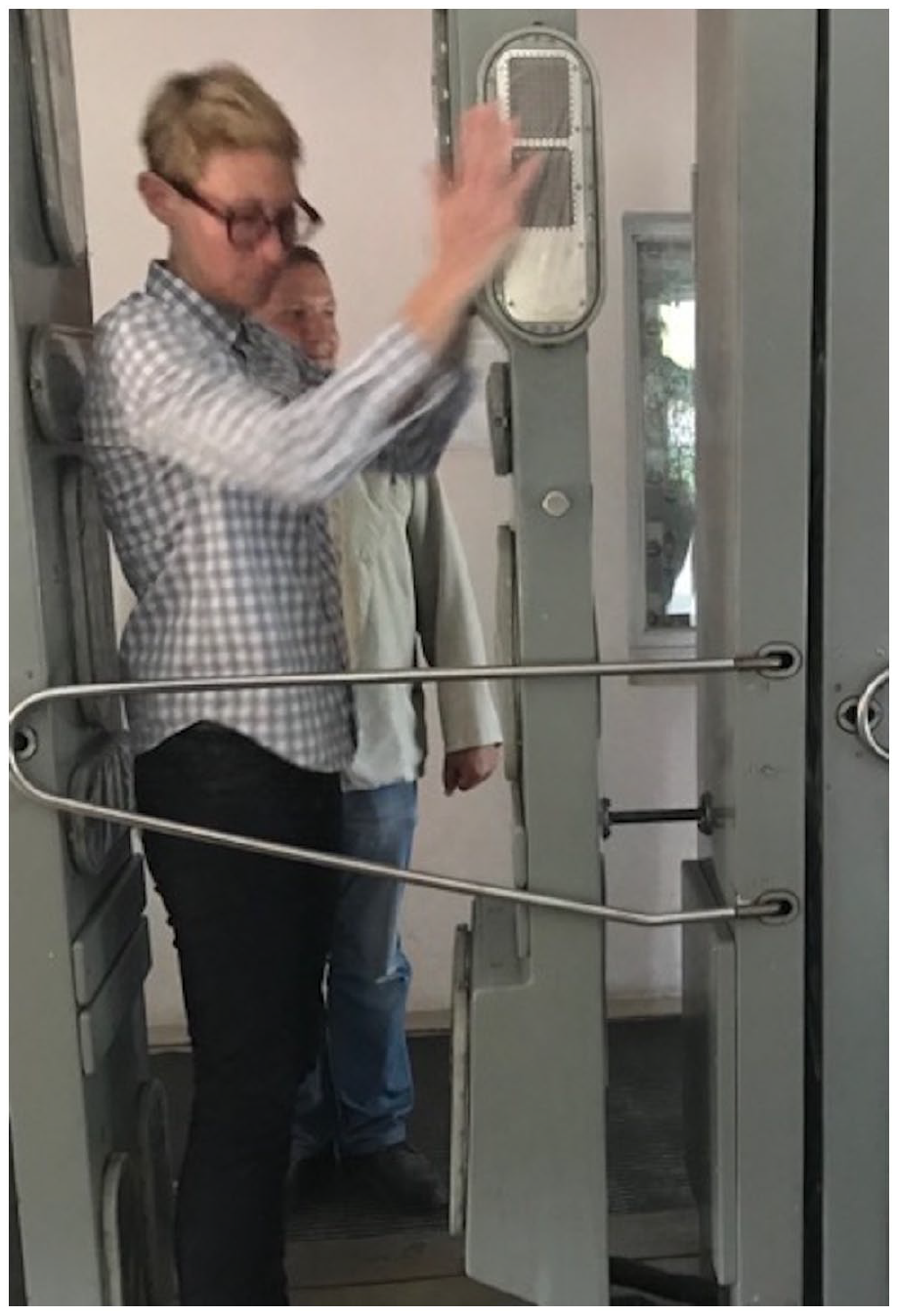
What does it mean to be clean?
Silkwood shower
When I returned from Chernobyl a friend made a joke, asking me if I had a ‘Silkwood shower’ after leaving the Zone. The question made me remember how for the longest time I thought that a Silkwood shower was something really sexy. I would allude to it as such in conversation, and finally after years of doing this, my friend SJ said: ‘Linz, I don’t think you know what that means.’ So, I watched the film and saw Meryl Streep, as Karen Silkwood, get scrubbed raw after setting off the radiation meter at the Kerr-McGee Cimarron Fuel Fabrication Site where she worked making plutonium fuel rods for the breeder reactor at the Hanford Site. That cinematic scene is part of the haunting imagery that lies in the collective memory of the nuclear twentieth century that floats into the twenty-first, popping into conversations unexpectedly, like a nuclear form of Tourette’s. The unfunny joke exercised or exorcized something in me, and I responded without thinking: ‘Yes, now I’m clean as a whistle-blower.’
Wonderland for wolves
I learned from Anne Carson that in ancient Greek poetry the wolf is a symbol of marginality, an animal shorthand meaning ‘outsider’. She writes: ‘The wolf is an outlaw. He lives beyond the boundary of usefully cultivated and inhabited space marked off as the polis, in that blank no man’s land,’ a space that was known as ‘the unbounded.’ 28 The wolves from Chernobyl have become extra outlaw, their presence, and the fear of their invasion into other spaces carries a truth: The Zone cannot be contained. The wolves come from a space marked as uninhabitable, a space meant to be bounded, but they are felt to be breathing at the door of the livable. So scientists tag them and follow their trajectories – they delight, and then worry and wonder about the future. Michael Byrne, a wildlife ecologist at the University of Missouri, explained that a team of scientists tracked the movements of several gray wolves in the Belarussian region of the Exclusion Zone. They affixed them with GPS collars like paranoid parents secretly implanting spyware in their teen’s cellphones. What they discovered was that the adults remained in the Zone, as has been their lifelong habit, but one young wolf traveled 186 miles beyond its borders.
In my research files, news stories of radioactive wolves pile up like a pack. They have anxious, panic-inducing titles, like: ‘A wolf left its irradiated Chernobyl home. What happens if it mates?’ or ‘Are Chernobyl wolves spreading mutant genes?’; and my favorite: ‘Ghosttowns of Chernobyl becoming wonderland for wolves.’ I imagine those wolves, really whooping it up, riding on that oft-photographed Ferris wheel in Pripyat, smashing into each other in bumper cars, eating junk food, getting belly aches, and grinning, full of memory and history. 29 But really those wolves are just doing what creatures do, circling before sleep, making a microsphere of safety, and trying to escape the universal rule of oblivion in a spectacularly-toxic landscape. After all a wonderland is just some place where the ordinary and the miraculous collide.
Hypnotic optimism
During an early period of coronavirus social isolation, I spent three full days doing nothing but watching Ukrainian documentaries about Pripyat from before the disaster. This was one manifestation of my pandemic mania. I became hooked on the hypnotic optimism of the atomograd spinning into life, which reminded me of Oak Ridge, the atomic city where I was born, and the dream of a scientific utopia they shared. There was an eerie supersymmetry between these places: both Oak Ridge and Pripyat were engineered ‘instant’ cities set inside landscapes renowned for their beauty, places where, in both propaganda and reality, science and nature were entwined, and where if the nuclear industries exploded there would be some distance from a metropolitan center. These opposing cities of splitting atoms were so much alike with their wild pears near the kindergarten, walkable neighborhoods where no one locked their doors, parks filled with young children and fuzzy puppies jumping around like excited electrons; cities where each flower-laden microzone was filled with shops, pleasures, and spaces to meet neighbors in that easy, casual way Jane Jacobs loved, with a large green zone surrounding it all.
A reflection on Chernobyl as a metaphor in lieu of a conclusion
In 2020, during the Covid-19 pandemic, the President of the United States suggested ingesting cleaning products or shooting light into our bodies would halt the virus. Then he said he was joking. Everywhere people clamored for precedents, read up on the Spanish flu, and fumbled for the right metaphors. Newspaper and magazine headlines shouted the need for a ‘Manhattan Project’ to find a vaccine, while op-eds speculated that the governmental response to the health crisis could result in the United States’ ‘Chernobyl moment,’ meaning that the virus would expose fundamental weaknesses in the nation and bring it to its knees, much like the way the Chernobyl tragedy accelerated the end of the USSR.
In times of crisis when there is a rush to metaphor and a carelessness with historical connection it can sometimes feel like language is collapsing in on itself. During the pandemic, it has been forgotten that the Manhattan Project and Chernobyl are related. Historical amnesia obscures the fact that the first American and Soviet nuclear bomb projects and their corresponding versions of ‘atoms-for-peace’ in the form of nuclear powerplants went hand-in-hand. Significantly, almost no one in the West misses this connection when they talk about Iran’s nuclear program. Those calling for a new virus-focused ‘Manhattan Project’ have either never known, forgotten, or do not care that most American workers developing the first atomic bombs, including my grandfather, had no idea what they were working on or working with, and that many of them unknowingly labored in dangerous conditions because their government found them expendable. The casual call for a new ‘Manhattan Project’ also quickly side-steps the incredible loss of life as a result of the Hiroshima and Nagasaki bombs. Even for those who believe those bombs were necessary, who feel their use expedited the end of the war, must admit that the metaphor conjures up mass death, even if it also brings feelings of mastery or ‘winning.’
I wonder why these examples of the Manhattan Project and Chernobyl continue to dominate thinking, and why when choosing metaphors, people so often go there – to the nuclear option. I think it has something to do with the enormity of the nuclear and the place it occupies in politics and culture as both the limit and limitlessness of the human capacity to control and be controlled. And I think it also has to do with the fear of the small and invisible threats to our world, the entirety of things we neglect or can’t see that can tear us apart, like tiny atoms wreaking havoc with their chain reactions, or viruses working their ways inside us silent and unseen.
One of the few places where the national government is not at least posturing concern over the new coronavirus is Belarus, the nation most devastated by the Chernobyl nuclear disaster. The Belarusian president, Alexander Lukashenko, describes concerns about the pandemic as psychosis. He has issued no closures or pleas for social distancing. Instead, in true daddy state fashion, Lukashenko puffs out his chest at every turn: attending a packed Orthodox Easter mass to show God is on his side; holding a military parade to celebrate the historic defeat of the Nazis, even as Russia, and other post-Soviet states cancelled theirs; even playing in an amateur hockey game, tossing teddy bears to the spectators from the ice. The only public health directive he has delivered is to drink vodka and make regular trips to the sauna to prevent sickness (an echo to post-Chernobyl advice to consume alcohol for combating radiation). When most of the world was on lockdown, Lukashenko travelled to Belarus’s exclusion zone to plant pine trees in the Pripyatsky National Park for the anniversary of the nuclear accident, and while there he declared the area – one of the most radionuclide-filled patches of land in the world – ready for resettlement.
In response to Lukashenko’s dismissive attitude toward the pandemic, even as the death tolls were rising in his country, some people started to suggest that the government’s failure to respond to the coronavirus might be Belarus’s ‘Chernobyl moment.’ This was a headscratcher, since Chernobyl was already Belarus’s ‘Chernobyl moment.’ Seventy percent of the radioactive fallout from the 1986 disaster landed in Belarus, and as much as a quarter of the country is still ecologically compromised due to the accident. Belarus’s exclusion zone, known as the Polesye Radiation and Ecological Reserve, is not as well-known as its Ukrainian counterpart, and there is very little nuclear tourism industry in place. Although it is difficult to get reliable information, stalking seems to be less popular there too.
Despite my frustration with the abundance of nuclear metaphors in the middle of the pandemic, I too was contemplating the enormity of the nuclear and the dangerous threats posed by small things by writing about Chernobyl. I do not believe the events of the coronavirus pandemic and the Chernobyl disaster are similar at their core, but what these catastrophes share is a concern for danger delivered in small doses, the creation of zones of alienation as a response to crisis, and a level of enormous bureaucratic fuckery that is dramatically changing the world-as-we-know-it. To think about these events often feels like being caught in a loop, where you’ve got no choice other than to hold on where you are and write through it.
Footnotes
Acknowledgements
Lindsey Freeman wishes to thank her fellow travelers to the Chernobyl Exclusion Zone: Julian Breinersdorfer, Margret Grebowicz, Sanem Guvenc, Elise Hunchuk, Lyubzja Knorozok, Eldritch Priest, Oleksiy Radynsk, and especially Svitlana Matviyenko, for the invitation, the lending of her Pripyat documentaries, and her ongoing writing and thinking from Kamyanets-Podilsky during the fog of war. She also wants to thank Karen Engle for bringing Rena Effendi’s photographs to her attention and to the photographer herself, for allowing permission for the image.
Funding
The author received no financial support for the research, authorship, and/or publication of this article.