



Abstract
In this article, we develop the concept of affective infrastructure as the entanglement of affects, meanings and materiality to analyse protest camps as a specific organisational form of social and political movement. Drawing on two ethnographic research projects investigating an asylum seekers’ protest camp in Helsinki, Finland, we argue that affects can be understood as having an infrastructural quality. The article contributes to research on affective politics by empirically studying the affective infrastructure of a protest camp. We distinguish between three interrelated dimensions of the affective infrastructure of a protest camp. First, affects are mobilised to mediate place-related meanings, the alteration of which is crucial to all protest camps. Second, affects are involved in creating the social space and atmosphere necessary to sustain a long-lasting protest. Third, affects impress themselves on abstract objects and ideas that must be managed as a part of the protest’s political message. Affects not only join subjects and objects together but also divide them, illustrating that an infrastructure becomes visible when it staggers or fails.
Introduction
Affect is central to all political processes (Slaby & Bens, 2019), from building political communities at the local, national and global levels (e.g. Di Gregorio & Merolli, 2016; Ross, 2014) to the ways in which subjects and citizens are governed (Fortier, 2010; Stoler, 2007). Affects are especially important in social movements and collective action. In this article, we argue that, for a political protest to last, an affective infrastructure must be created and maintained. This requires the mobilisation, maintenance and circulation of affects and the capacity of bodies to affect and be affected.
Our research contributes to social movement studies, in which scholars have emphasised that the political dimension of emotions is critical to understanding collective action and protest (Della Porta, 2016; Goodwin et al., 2000; Jasper, 1998). We also contribute to the more specific research literature that has analysed the various infrastructures needed for protest camps to foster both political action and daily life (Feigenbaum et al., 2013, p. 2; see also Brown et al., 2017; Feigenbaum et al., 2013; Frenzel et al., 2014) and the roles that emotions and affects play in activism (Brown & Pickerill, 2009; Jasper, 1998; Juris, 2008).
Drawing on ethnographic fieldwork conducted by the authors at the Right to Live protest camp and interviews with activists in Helsinki from 2017 to 2018, we discuss three interlinked dimensions of affective infrastructure. The bodies needed to act together in public to create a political protest are gendered and racialised (Butler, 2015, p. 86). The first dimension of affective infrastructure relates to the capacity of racialised and gendered bodies and subjects to enact alternative radical politics (Hage, 2012) and refigure meanings related to political subjectivities in the specific places and spaces they occupy. In this way, racialised and gendered bodies are an important part of the affective infrastructure. Second, affective labour (Gutiérrez-Rodríguez, 2010) within the protest is needed to create and maintain the affective infrastructure. This labour becomes visible in the form of an atmosphere (Anderson, 2014) and what Ahmed (2014) terms ‘atmospheric walls’. Third, affects impress and circulate between subjects, materialities and abstract objects, and ideas about asylum seekers and refugees. The notion of infrastructure as an underlying framework is useful because it draws attention to elements that are taken for granted: infrastructures become visible when they fall apart (Star & Ruhleder, 1996).
In what follows, we first describe the context of our research, considering the existing literature. We then present the notion of affective infrastructure and the empirical data our article is based on. Finally, we empirically demonstrate the affective infrastructures present within the Right to Live protest camp and end with conclusions.
Right to Live protest as part of global refugee mobilisation
The war in Syria and protracted conflicts in Afghanistan and Iraq forcing people to seek refuge, combined with a temporary opening of borders on the West Balkan route, caused over 2.3 million people to seek asylum in the EU in 2015–2016 (Eurostat, 2021). In Finland, the number of asylum applications increased almost 10-fold, from 3,651 in 2014 to 32,476 in 2015; these were mainly Iraqis, Afghans and Somalis (Migri, 2019). The Finnish media, echoing an EU-wide political discourse, described the increase in applications as a ‘crisis’ that demanded swift political action.
While the increase in the number of refugees during the ‘long summer of migration’ in 2015 was met with the heightened fortification of state borders, it also prompted many Europeans to act (Della Porta, 2018; Rosenberger et al., 2018), including asylum seekers themselves (Näre, 2020a). When asylum rejections and deportations increased, asylum seekers and their supporters offered a politicised response by demonstrating against these tightened asylum regimes and deportations. Non-citizen protest camps were set up in various European cities, including Helsinki, Finland. In December 2016, failed asylum seekers organised demonstrations in Helsinki, followed by a six-month ‘Right to Live’ protest camp in spring 2017. It became the second-longest ongoing demonstration and the first major non-citizens’ protest in Finland’s history. Like other protest camps (e.g. Brown et al., 2017; Burgum, 2018; Gerbaudo, 2012), the Right to Live protest was organised through social media and by occupying a physical place in the centre of town.
The protest was a reaction to Finland’s conservative government’s introduction of new restrictions into asylum legislation and processes in 2016. These restrictions removed humanitarian protection as a basis for asylum and free legal aid during asylum interviews, except for vulnerable applicants; abbreviated the time to appeal a negative asylum decision; and introduced income limits on family unification for those receiving secondary protection (Näre, 2020b). In addition, new country safety assessments regarding safety in Iraq and Afghanistan were introduced. Before these restrictions, two in three applicants were granted asylum; after the restrictions were introduced, the ratio dropped to one in three (Eurostat, 2020). The Right to Live protesters demanded that asylum seekers’ legal rights be guaranteed, faulty asylum decisions be reviewed, deportations be halted until asylum decisions were revised, and that people not be removed from reception centres without proper accommodation and income support.
The protest was organised through a Facebook group created by an Iraqi asylum seeker for refugees who had received negative decisions regarding their asylum applications in Finland. The protesters had help from Finnish activists, first from ‘no borders’ activists and, soon, from a wide network of humanitarian actors and volunteers, the majority of whom were women. Iraqi protesters were soon joined by Afghan asylum seekers. The protest camp consisted of tents and canopies, with activists staying in the camp around the clock in shifts. Because camping is forbidden in the city, the police banned the protesters from sleeping in the tents. In addition to being a demonstration in which issues related to the asylum process were politicised and made public, the protest camp was a meeting place for asylum seekers; here, they could obtain legal assistance, learn Finnish, and find accommodation. Similar to Hinger et al. (2018), anti-deportation activism not only attempts to prevent actual deportations but also to mitigate the harmful effects of deportability, which creates isolation and insecurity, and foster temporary spaces in which the politics of in/visibility are reversed.
The Right to Live protest attracted media interest, and problems related to the asylum process became the topic of several prime-time talk shows. The protest sparked other protests around Finland and acts of support, such as a petition for the rights of asylum seekers signed by over 10,000 art and cultural professionals and another petition signed by thousands of academics (Näre, 2018). The Right to Live demonstration was partly defined by continuous confrontations with an anti-immigration protest set up nearby and the violence and threats that the counter-demonstrators directed toward Right to Live activists.
The concept of affective infrastructure
In developing the concept of an affective infrastructure, we draw on feminist affect theorists and recent conceptual approaches to infrastructures. In our approach to infrastructure, we are inspired by Berlant’s (2016, p. 393) definition of the term as the ‘living mediation of what organizes life: the lifeworld of structure’ that is ‘defined by use and movement’ and, hence, different from a structure. Similarly, science and technology studies (STS) approaches infrastructure as heterogeneous relations that require maintenance, encompass a variety of practitioners and users, and function in various, often unpredictable, ways (Michael, 2020).
The concept ‘affective infrastructure’ has been used to refer to the ways in which affects can be attached to and mediate infrastructures (Knox, 2017; Street, 2012) or as an element in the process of infrastructuring in which affects are one part of larger arrangements that can take the form of an apparatus and atmosphere (Anderson, 2014; Michael, 2020). We use the term ‘affective infrastructure’ to refer to the life-word of structure involving both affects, i.e. ‘processes of life and vitality which circulate and pass between bodies’ (Blackman, 2012, p. 26), and affection, bodies’ capacity to affect and be affected through impressions made by external bodies (human and non-human) (Spinoza, 1677/1982). For us, the bodies that sense and are impressed by affects are living bodies, not any bodies, as STS scholars suggest (Anderson, 2014; Michael, 2020). Moreover, the affective infrastructure is shaped by the political cultural economy of emotions and affects, i.e. an ordering and valuing of feelings through informal and formal institutional practices (Fortier, 2016), as feminist affect theorists (Ahmed, 2014; Berlant, 2011; Ngai, 2002) have emphasised. Hence, affects are ‘at once deeply felt and embodied and social and public’ (Fortier, 2016, p. 1039).
Frenzel et al. (2014) argue that it is useful to study political demonstrations using the concept of infrastructure. While Frenzel et al. (2014) emphasise the importance of affects and infrastructure in protest camps, they identify the two as separate analytical categories. They further divide infrastructure into subcategories of domestic, action, communication and governance infrastructures and affect into affective attachments, conflict and collaboration, transmissions of affect, and belonging and difference. Our concept of affective infrastructure emphasises that affects are not separate but, rather, constitute one kind of infrastructure in a protest camp.
Our ethnographic research has allowed us to distinguish between three intertwined forms of affective infrastructures in a protest camp. First, racialised and gendered bodies occupying public spaces in a protest are affected but also have the power to affect; through this capacity, they enact alternative, radical politics (Hage, 2012). They can refigure meanings related to the political subjectivities, places and spaces they occupy. The second form of affective infrastructure appears through affective labour, i.e. working on the ‘intuitive expression of our vital impulses in relation to others and our environment’ (Gutiérrez-Rodríguez, 2010, p. 14). The third form of affective infrastructure appears in the ways in which affects impress themselves upon abstract objects and figures, such as the asylum seeker or the refugee, that circulate in the collective and increasingly mediated spaces related to the protest. As Ahmed (2004, p. 7) reminds us, ‘Emotions are both about objects, which they hence shape, and also shaped by contact with objects.’ One task for a protest is to attempt to mediate the objects of affects that circulate in mediated spaces and manage the objects that ‘become sticky, or saturated with affect, as sites of personal and social tension’ (Ahmed, 2004, p. 11).
Methods and data
This article is based on two ethnographic research projects conducted from 2017 to 2018 during and after the protest, both individually and collaboratively. Lena conducted participant observation in the protest camp from early March until the end of the protest in mid-July 2017. She spent from one to four hours regularly at the protest camp, participated in organisational meetings and meetings with the police, and followed online chats and posts in the social media groups. During the protest, she conducted in-depth interviews with 37 Iraqi and Afghan activists and shorter ethnographic interviews with another 30 activists with refugee or Finnish backgrounds. After the protest ended, she interviewed nine Finnish activists, two of whom were interviewed together with Maija.
Maija conducted participant observation at the protest site, protest meetings and online discussions from mid-February until the end of May 2017. In addition to informal talks with the informants, she interviewed two protesters, 10 Finnish activists, two police officers and two city officials during – but mostly after – the protest. Maija also gathered all of the posts concerning the protest (approximately 500 individual posts) from the Facebook group the Refugee Hospitality Club (RHC). With 50,000 members, the RHC was a part of the affectual infrastructure of the protest, forming its outer layer and providing affectual and material support. Maija qualitatively analysed one-third of the posts via random selection. Research ethics concerning social media data have few strict guidelines (Markham & Buchanan, 2012), and usually, there is no need to ask for permission to use public social media data for research (Wilkinson & Thelwall, 2011). Despite the RHC group’s public status on Facebook, Maija asked the group’s administrators for permission to use posts related to Right to Live for research purposes because the group is closed, the topic is a sensitive one, and some of the participants (particularly the asylum seekers) are in vulnerable positions (Markham & Buchanan, 2012). We have ensured that all the posts used in this article do not contain any personal information and that the participants remain anonymous.
We analysed the data separately and together using theory-driven thematic analysis (i.e. analysing fieldnotes and interviews thematically and then going back and forth between themes and analytical concepts that we abductively drew from the wider themes and theoretical discussions). Through this theorising, we were able to discern the various dimensions of affective infrastructure and chose empirical examples that best represented these dimensions. According to the University of Helsinki regulations, because all of the participants were adults, research ethics approval was not formally required. That said, we collected written informed consent in Dari or Arabic from research participants from Afghanistan and Iraq. We both paid close attention to the micro-ethics of the research (i.e. we were attentive to any discomfort that the research situation may cause to the research participants) (Guillemin & Gillam, 2004). All the names used in this article are pseudonyms.
Building up the affective infrastructure
Amal, one of the Iraqi organisers of the protest, describes the first days of the protest and how the affective infrastructure of the protest began to build up: When we continued for another two days, two parliament members, one from the Green and one from the Left party, came. Day after day, more [protesters] start [joining] the eight guys. There was 50 to 54 people. . . . When they saw the parliament members coming to the protest, [they were like] wow! Two parliament members are here! . . . After that, many people joined, and the Finnish [activists] supporting us, they were so happy. Wow! There is attention now, and the media started to write. On the other side [of the street], the racist group, they were in front us, and we were shouting ‘Iraq not safe! Stop deportation!’ and they are shouting too. It was something that made people interested in the protest. (Interview with Amal)
The protesters’ embodied presence and capacity for affection through the occupation of a public place and their shouting generates affects both internally and externally. Internally, the protest creates affects of amazement and joy among the protesters, which we understand as part of the internal dimension of the affective infrastructure. Externally, the protest manages to draw the attention of Finnish politicians and the media from the beginning. Amal argues that part of the attention the protest began receiving was due to the juxtaposition created by the anti-immigration counter-protest. Similar to Kunreuther’s (2018) analysis of āwāj as the sonic and metaphorical meanings of voice in acts of participatory democracy in Nepal, we understand the protesters’ engagement in shouting as a combination of noise, sound and voice. However, one week into the protest, the police ordered the protest camp to move because of noise complaints. The protesters chose Railway Square as the new location, and it was at this time that Afghan asylum seekers joined the protest. While making noise is a deliberate expressive act of subversion, redefining shouting, speaking, or singing as ‘noise’ is also a common strategy adopted by those in dominant positions against unruly subaltern groups (Novak, 2015, pp. 130–131). Over the course of the protest, it generated less sound in the form of shouting as compared to its first weeks and how noisy demonstrations usually are. Instead of shouting, the protest’s affective infrastructure was built mainly on other factors, which are introduced in the analysis below.
Place has significant meaning for all contentious politics, but this is especially true for protest camps (Brown et al., 2017; Burgum, 2018; Feigenbaum et al., 2013; Frenzel et al., 2014). Frenzel et al. (2014, p. 465) discuss autonomy as an important dimension of protest camp infrastructure, describing it as an attempt to create ‘an exceptional space that explicitly stands against the surrounding status quo’. We argue that creating an exceptional space of protest always occurs against the backdrop of the affective meanings attached to a place and through the refiguration of place-related meanings. Similar to the Occupy London camp located outside of St Paul’s Cathedral (Burgum, 2018), Right to Live took place in a central location that allowed semi-permanence and a place that held symbolic meanings the activists could refigure. We follow Lilja (2017) in arguing that this refiguration of meanings as related to a place happens through an assemblage of bodies, affects and the material environment – furthermore, it always expresses in excess what is being said.
Railway Square is one of the most central locations in Helsinki’s city centre. It is surrounded by nationally and architecturally significant buildings dating back to the Finnish nationalist era of the nineteenth and early twentieth centuries, such as the Finnish National Theatre, the Finnish National Gallery Ateneum and the Helsinki central railway station. One side of the square is a transportation hub for local bus traffic, but most of the square is filled with emptiness: no benches to sit on, no cafes or kiosks, and no flower beds or plants (see Figure 1). While occasionally serving as the site of events, such as food and drink or multicultural festivals, as well as hosting a small ice-skating rink in the winter, most of the time, the cobblestoned square is empty except for the passers-by walking through it. It is not a convivial place for grassroots socialising.
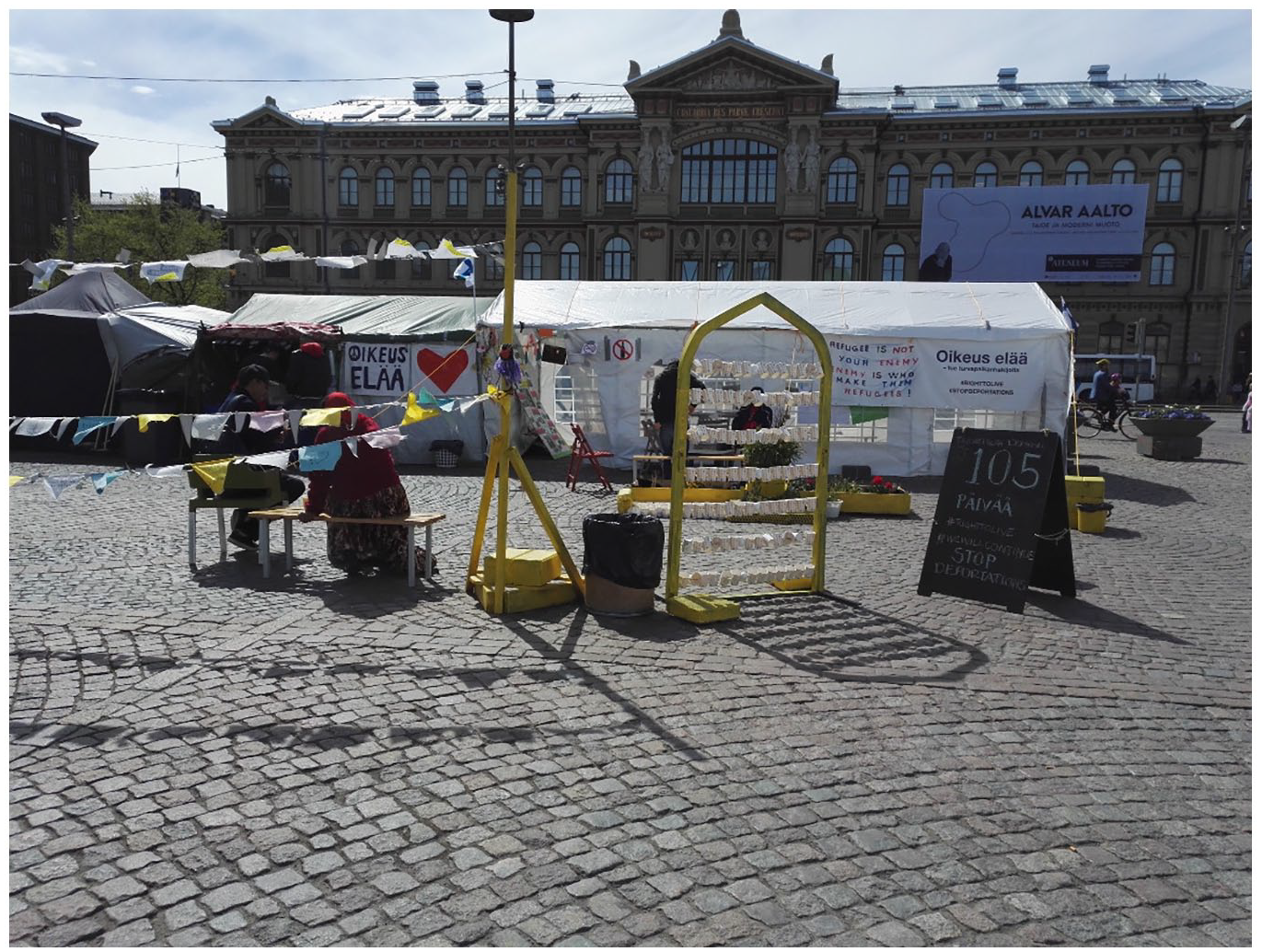
Right to Live protest tents in Helsinki Railway Square (Photograph by Lena).
Considering Railway Square’s national importance, the square’s transformation during the protest was particularly striking. The protest’s affective infrastructure became visible in the symbolic support that the national icons – the cultural organisations – displayed. The National Theatre, located in front of Railway Square, displayed the text ‘Right to Live’ on its billboard during the protest. The national art gallery, the Ateneum, located opposite the Railway Square, showed its support for the protest by hanging a large banderol, an art piece called ‘Europe’s Greatest Shame #11’ (referring to Europe’s closed borders), which was created by a prominent Finnish graffiti artist (see Figure 2).
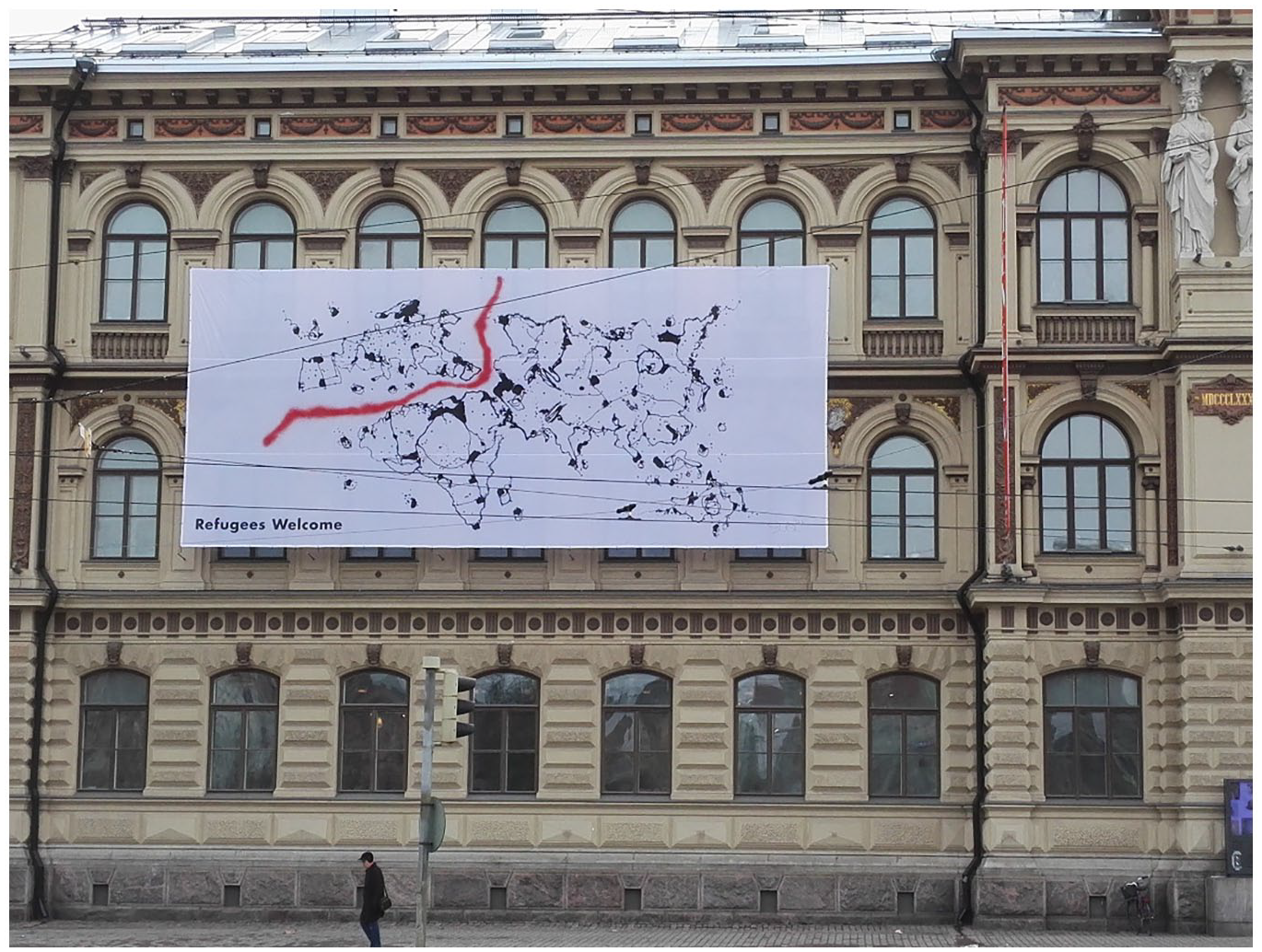
‘Refugees Welcome’ banner on the façade of the Ateneum in April 2017 (Photograph by Lena).
By gaining support from such nationally iconic cultural institutions, the Right to Live protest was able to generate refigurations of meanings and affects attached to Finnishness and Finnish nationalism as white, exclusive, and ignorant of racialised others, such as asylum seekers. Mari described such refigurations of meanings against the backdrop of a selfish society: We Finns, we did not know anything about asylum seekers, because they were isolated in the reception centres. We were able to get to know them, and it was fantastic. . . . In a selfish society, in times of capitalism, a completely free community at the Railway Square in Helsinki was set up. It had no other borders than ‘out with racism and racist violence’. (Interview with Mari)
Indeed, the strategic location of Railway Square, at the intersection of commuters’ paths to and from Helsinki, enabled ‘transformative encounters’ between asylum seekers and passers-by (Frenzel et al., 2014). The open space of the square allowed for the demonstration to expand from one to three tents and strengthened the establishment of the demonstration as a meeting place where everyone was able to gather.
However, the protesters had to engage in continuous negotiations regarding the meanings and affects attached to the protest. In a meeting with representatives of the Helsinki police in mid-March, over a month into the protest, the police officers wanted to know how long the protest would continue: When it lasts this long, we also need to consider other citizens’ basic rights and their right to a sense of security. . . . Since Thursday, ordinary citizens have been feeling quite a lot of insecurity, not only because of you but also because of [the counter-demonstrators] and because of their images [of the protest]. (Fieldnotes from a meeting with the police)
By creating a juxtaposition between ordinary citizens and their perceived sense of insecurity, the police were not only excluding the protesters from the realm of ordinary, assumedly white, Finnish citizens but also engaging in a struggle over the meanings and affects related to the protest. In March, the result of these negotiations was that the police allowed the protest to continue. However, at the end of June, a decision was made to move the protest back to its original location, in front of the Museum of Contemporary Art Kiasma, and limit its duration to the daytime. A police officer who was closely involved in the surveillance of the two opposing protest camps explained the reasons for moving the protest: This is now my [personal] opinion – but, yes, Railway Square had already become somehow a so-called ‘sacred place’. And, in a way, [it is] an emotional place that aroused a lot of emotions, I mean in citizens and protesters also. And it became somehow this kind of place that was defended. Somehow, it had become that sort of a flagpole, and then, when this kind of thing, it evokes emotions. Then, soon, those emotions go overboard . . . (Interview with the dialogue police officer)
The officer describes Railway Square as a sacred and an emotional place that becomes a threatening space due to emotions going ‘overboard’. The entanglements of the affects related to the object of Railway Square as the place of the two opposing protests create emotional overload and the need to defend the place, which constitutes danger in the eyes of the police officer. This illustrates how affective infrastructure works in unpredictable ways. Emotions and affects that helped support the protest were seen as threats by the police.
Affective labour and ambivalence
Rosenberger and Winkler (2014) have analysed emotional labour in relation to refugee solidarity protests from the point of view of strategic action – how to build support in the media. We focus on the affective labour of creating an atmosphere, defined here as the bodily-sensed energies that derive from encounters but are dispersed throughout the space inside the protest (Gutiérrez-Rodríguez, 2010; Kolehmainen & Mäkinen, 2019), as one way to maintain the affective infrastructure of the protest. In the Right to Live protest, this affective labour took various forms, from support messages posted in social media groups to the support and care the activists provided inside the protest camp. Lotta, who visited the protest camp several times per week, perceived the affective labour of creating the right atmosphere and providing support as her primary task. She explained that, when she first began to visit the protest, she did not know what she could do there, because she did not have any expertise in the relevant matters. However, she soon realised that she could listen and empathise. Lotta said that, even though she felt tired, she would ‘psych herself up’ to create positive energy at the protest (Interview with Lotta).
In relation to protests, researchers have termed the outcome of affective labour ‘affective solidarity’ (Juris, 2008), ‘the affective atmosphere’ of a protest (Frenzel et al., 2014; Yaka & Karakayali, 2017), or an ‘affective community’ (Vrasti & Dayal, 2016). Researchers tend to categorise affects as positive or negative for the protest, but as Gould (2009) and Ayata and Harders (2019) discuss, affects are inherently messy and ambivalent, and they cannot be linearly assessed as leading to either positive or negative outcomes. For instance, Gould (2009) finds that despair can lead to both mobilisation and immobilisation. In a similar way, the affective infrastructure of the Right to Live protest was fraught with ambivalence. The constant fear of attacks and the actual, realised attacks against the Right to Live protest created feelings of insecurity and tension among the protesters, while simultaneously, the ‘demo’, as the activists called the protest, was described as a safe, homely space, like a living room or village: It felt like a living room this afternoon and early evening. . . . [T]he lovely smiling faces of the people preparing tea. . . . A group of men around the fire, Afghans and Iraqis, talking this and that. . . . A woman helping a refugee from Northern Finland find a place to stay. What a great day. Thank you everybody. Shukran sulle [to you]! <3. (A post on the RHC group Facebook page, original written in English)
Similarly, Street (2012, p. 46) argues that ‘[s]pace is a particularly important vehicle for and transmitter of affect’. Frenzel et al. (2014) discuss how the domestic and public spheres become reversed in protest camps because protesters must create a home and conduct practical chores in a public place, as well as maintain its internal, affectual coherence. In the Right to Live protest, the serving of tea was a means of creating the sense of a homely, welcoming space and an invitation to engage with the protesters: ‘I went out of solidarity that first protest day; then, I stood somewhere like 10 metres away and watched. Then, the same day, I went a little closer and watched. Then, it was maybe the third day, I ended up even a little closer, and I was asked if I wanted tea, and I got tea’ (Ronja explaining how she got involved with the protest, Interview with Ronja).
A crucial aspect of the production of the affective infrastructure of a long-term protest is building ties between activists for collaboration, and serving tea was a practice that served this purpose. The personal relationships formed during the protest played a crucial role in mobilising people, especially in terms of how committed they became. Liisa describes the human relations as a ‘huge transformative force’ (Interview with Liisa). Similarly to Gerbaudo’s (2012) analysis, the Right to Live protest became a ‘venue of magnetic gathering, with a great power of emotional attraction’ (Gerbaudo, 2012, p. 95). A common topic of discussion among the protesters was how ‘addictive’ the protest was and how difficult it was to visit it quickly because one would get ‘stuck’ there. Here, affects were described as the glue of affective infrastructure: they made people commit to the protest wholeheartedly. Consider the following exchange between an activist and Maija:
It’s kind of like, you just got stuck there. You couldn’t just go for a visit. It didn’t really work like that.
What was there that you somehow got stuck?
There was this certain community, and, like, there was always a new person who you stayed to talk to, and when I’m leaving and then there was someone again coming there again, ‘Hi. Oh yeah, I haven’t seen you in a long time’, and then, you’re stuck there again. (Interview with Taina)
This ‘home’ stood in stark contrast to the world outside it – in fact, it drew much of its homeliness from ‘alterity, working in tension with its surroundings’ (Matthews, 2018, p. 134): [The sense of communality was formed] partly from the shared experience. I mean just that other people didn’t understand any of what was going on there, that we were so intensely together night and day, and [we] fought together. It brought [us] together but also separated us from the outside world. Because when one spent most of one’s time there, it felt like there was not really anything to discuss with anyone from the outside, that it was the only place where people understood me. (Interview with Ronja)
The affective infrastructure of the protest created such a strong sense of shared experience that it alienated the activists from what they termed ‘outsiders’. This sense of community was emphasised by referring to the active members as the ‘demo family’ or the ‘Right to Live family’ and to one another as brothers and sisters. However, those in the outer layers of the protest perceived referring to each other as the demo family to be an exclusionary practice. Affects circulating between subjects not only unite but also separate and can even cause infrastructure to break down.
Keeping the protest camp running around the clock demanded enormous physical and affective effort on the part of the activists. The demonstration continued for months and did not prevent deportations, dampening the enthusiasm of the early days. This manifested in the reduced number of protesters: ‘The demo is peaceful, only about six people. Akram says that, after 30 days, people are starting to feel tired, and that’s why so few people are here’ (Fieldnotes from the protest).
The fatigue the protesters were experiencing became an important theme of discussions in the meetings and a source of conflict among the activists. To deal with burnout, activists organised psychological guidance for the core group. Some of the asylum seeker protesters were excluded from the protest due to others’ complaints that they were not working hard enough. These symptoms of fatigue and the ensuing conflicts reveal the crucial nature of a protest’s affective infrastructure – it becomes visible when it fails.
The fatigue of the protesters would have required recruiting new people, but the activists had no resources for doing so, and entering the inner circle was difficult. One had to prove oneself by ‘hanging around’ in the protest before any trustworthy tasks would be assigned: ‘It’s pretty difficult, the building of trust, somehow, if no one knows you’ (Interview with Miranda). Lotta, who was not able to find her place in the core group, described this exclusion: ‘I feel like there’s pretty tough criteria [in terms of] who’s included in the group and who’s not’ (Interview with Lotta). According to Jaana, the problem of recruiting new people was clear early on in the protest: Although we were pretty much in the beginning [of the protest], already, by that point, people were so tired, so to have energy to recruit people and open up all the things that are going on there and chat with them about what they’re interested in and then be a mentor there and hold hands when [they] start doing [things], that’s a, a pretty big job . . . so there were no resources to offer the support and induction that would have been needed. And [there was] a little bit of a kind of inner circle vibe at some point. (Interview with Jaana)
Like all infrastructures, affective infrastructure requires maintenance, yet as a heterogeneous life-world of structure, it can have unexpected outcomes. While the affective infrastructure depends on the creation of a sense of unity among the protesters, this easily turns into an exclusionary atmosphere, which Jaana terms an ‘inner circle vibe’ that prevents new people from joining in and leads to fatigue among those who are part of the inner circle.
Affective atmospheres and affects sticking to objects
Ahmed (2014) discusses ‘atmospheric walls’ as a technique of structuring privilege and exclusion along racial, class and gender lines. In a related fashion, in the Right to Live protest, white, female bodies were a way in which the activists sought to create an atmosphere of safety in a racist society that commonly perceives non-white male bodies as a threat.
Ronja was an experienced migrant activist, but instead of engaging in overtly political action, she began by ‘being there and talking, being there . . . as a mental support . . . and . . . to be seen there’ (Interview with Ronja). This ‘be[ing] seen there’ resonates with what Akram, one of the Afghan protesters, explained on several occasions to Lena. He stated that the best way to help their cause was via embodied presence: ‘You are here. That’s what matters’ (Fieldnotes from the protest). Indeed, posts calling for an embodied white presence especially at night were repeated during the protest: Tomorrow night, we need MANY Finns! Otherwise, we’re not gonna handle this. Last night was really tough, when, at the time of last orders in bars, people, as we expected, came to the protest with a lot of aggression. (Message in the closed ‘Inside the demo’ Facebook group)
Bodies are sites of racialisation (Ahmed, 2002), and by being seen and being there, the white Finnish bodies were called to embody solidarity with the racialised bodies of asylum seekers in a white nation-state. The white bodies were mobilised to create an affective atmosphere that could potentially protect the protest against racist harassment from drunken passers-by, racist provocateurs and counter-protesters, especially at night and on the weekends.
Moreover, the Right to Live protest sought to actively transform and mediate the affects commonly attached to the figures of ‘asylum seeker’ and ‘refugee’ that are negatively loaded and signal strangeness in the Finnish public sphere. This is similar to the strategies humanitarian organisations use to support immigrants by altering the stigmatised and xenophobic public figure of the immigrant (Marciniak, 2013). In the Right to Live protest this was done through various practices. To signal their sense of belonging to Finland, and as a commentary on the anti-asylum counter-protest’s large Finnish flag, the Right to Live protesters hung a Finnish flag outside one of their tents. Messages that sought to disrupt the common narrative of asylum seekers as threatening were attached to the tents, such as ‘[the] refugee is not your enemy, [the] enemy is who make[s] them refugees’. A great deal of thought was put into how the protest looked to create the ‘right kind of political aesthetics’ (Tyler & Marciniak, 2013, p. 153) so that everyone would feel welcome and ‘dare’ to enter the protest, not just activists. For example, the participants discussed the colour of the tents, favouring light colours instead of colours associated with the military. Various installations and exhibitions set up outside and inside the tents were used to create a colourful, non-threatening environment (see Figure 3).
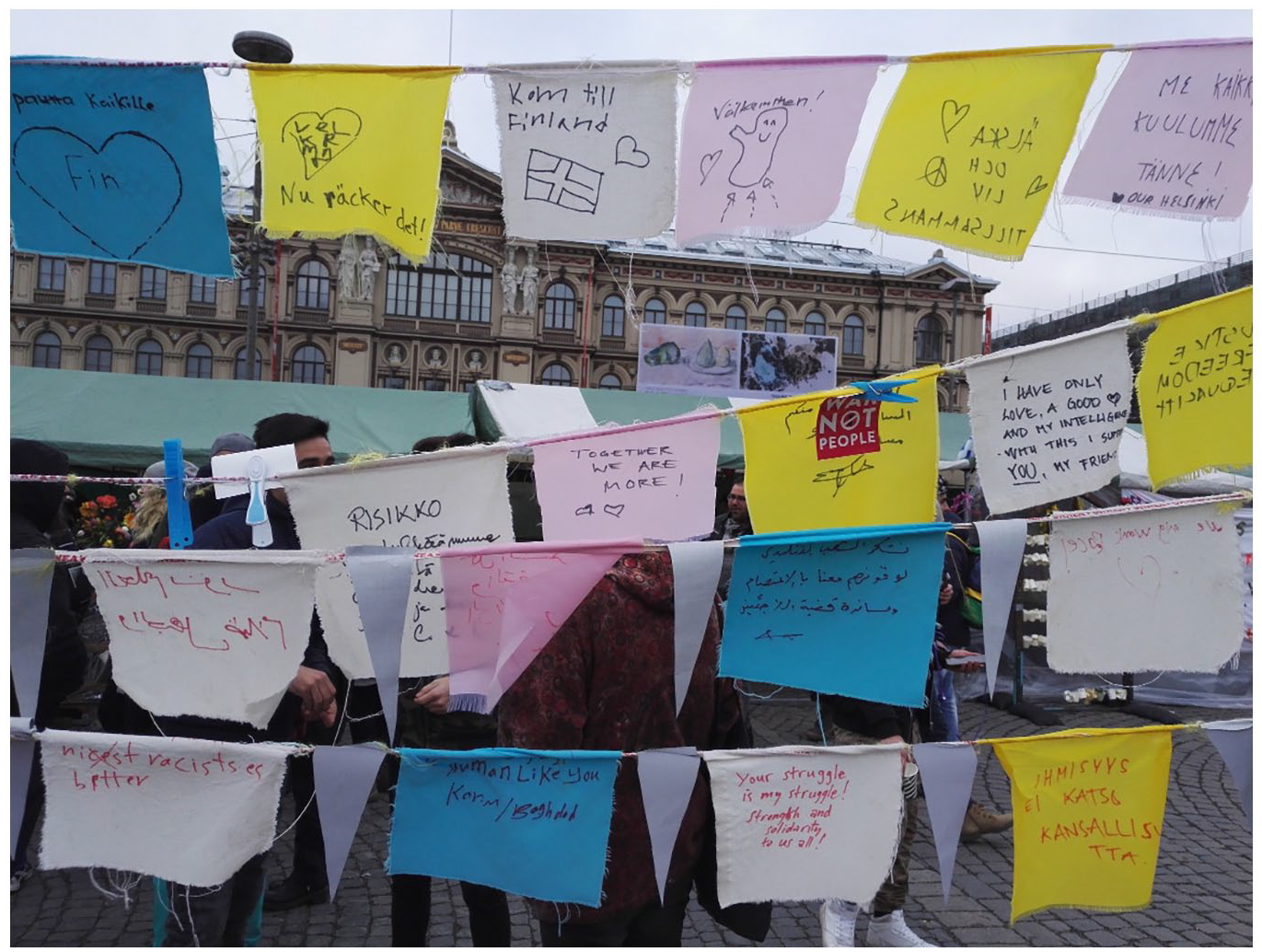
Exhibition of ‘Messages on the Line’ at the Right to Live protest (Photograph by Lena).
Through the practice of offering tea, passers-by were invited to meet and engage with the activists and eventually transform the meanings attached to the racialised and gendered figure of the asylum seeker. One of the activists, Lotta, explained that, when she would go to the protest, she attempted to be friendly and answer all the questions that passers-by had: ‘What they always ask [is] why are there only young men, and why won’t you fight back [in their country of origin]’ and ‘No, they [asylum seekers] aren’t all dangerous’ (Interview with Lotta).
While there were occasional ‘demonstration moments’ at the protest, with chanting, dancing, playing music, and holding up demonstration signs such as ‘Stop Deportations’, an emphasis was placed on organising happy events. The protest had to look like ‘my mother could go there’ (Fieldnotes from the protest). The activists sought to disrupt the image of asylum seekers as potentially aggressive men by organising parties and support concerts at the site. On International Women’s Day, activists organised a party for women and children, with clowns, balloons and activities: The protest is celebrating Women’s Day, and there are many women, clowns, and two social workers from the City of Helsinki. . . . Riitta is taking children ice-skating. There is a group of women dressed as clowns. The clowns play music on their phones and pose for the cameras. . . . The organisers are giving out chocolate, marshmallows, and dates in honour of the event. The tent is decorated with balloons. There are children here whom I have not seen before at the protest. There is also a local leftist cultural magazine conducting interviews with the activists. Riitta reminds Hasan that he should, under no circumstances, talk to the media alone, that, today, women have to be represented. (Fieldnotes from the protest)
The activists sought to manage the gendered stereotypes and affects regarding representations of asylum seekers as young, single men who have left their families behind. By creating a carnival-like atmosphere, the protesters attempted to create positive, fun and ‘light’ affects at the protest despite the harsh reality in which the asylum seekers lived.
What struck Maija as surprising was hearing protesters’ occasional chants of ‘Thank you, Finland’ and ‘Thank you, police’. Moulin (2012, p. 60) argues that, in the liberal tradition, humanitarian protection has the status of a gift (from sovereign authorities to displaced groups) and, thus, the logic of gratitude. He claims that, in this logic, in exchange for safety, refugees give away their autonomy and, thus, their political subjectivity. In the Right to Live protest, the ‘thank you’ chants were intended to counterbalance the autonomy and political subjectivity the asylum seekers were acting out through protesting. The entire affective infrastructure of the protest, including its materiality, atmosphere and soundscape, was aimed at transforming the image of the asylum seekers into a non-threatening one. Asylum seeker activists were in a volatile position during the protest (Conlon & Gill, 2013), as Mikko pointed out in an interview: We need to remember that asylum seekers do not have the same legal protection as we do. . . . If an asylum seeker is suspected of committing a crime, s/he can be deported. . . . A racist can come and do anything, hit with a baseball bat. And the other cannot respond to that in any way. (Interview with Mikko)
Thus, state sovereignty could not openly be confronted at the protest. Instead, the protest and its affective infrastructure worked in a prefigurative manner because its social relations between asylum seekers and Finnish citizens troubled and exceeded ‘citizenship as the primary social relationship’ (Tyler & Marciniak, 2013, p. 151).
Conclusion
We propose the concept of affective infrastructure to be useful, especially to the analysis of protest camps. While emotions and affects are important in all forms of politics and social movements, organising and maintaining a protest camp requires a great deal of affective infrastructural work from activists. Political action is as much about the material and practical tasks of providing food, care and material resources as it is about managing the movement affectively – about being present and mediating affects circulating among human and non-human bodies and materialities. The notion of affective infrastructure aims to grasp both the importance of affects in sustaining a protest but also the ambivalences inherent to protest camps. With this concept, we are invited to rethink normative liberal accounts of political subjectivities that commonly exclude the affective realms. In contrast to previous accounts about the infrastructural quality of protest camps, we see affects as inseparable from the said infrastructure. Protests create a rupture in the everyday order of things by occupying central places in cities. Even though no actual political changes were achieved via the Right to Live protest, questions around asylum politics were added to public debates, raising people’s awareness and creating political pressure. Also, the protest created an alternative space for racialised asylum seekers to enact radical politics, affecting the wider, mainly white, publics in a context in which asylum seekers had been seen mainly through statistics (Laine et al., 2021, pp. 16–17) and migration had been approached in the aggregate, using macroeconomics as the arbiter of ‘good’ policy (Jones et al., 2017, p. 70). At the same time, the protest revealed the racialised and gendered orders of the Finnish society when white female bodies were required to ‘protect’ the protest from racist attacks. Maintaining affective infrastructure has ambivalent, unexpected consequences. Sustaining a protest camp depends on the affective labour of activists who seek to create a sense of community and coherence, an inner group, which, by definition, will make it difficult for outsiders to join the movement. In the case of Right to Live protest, the affective infrastructure became visible when it began breaking down, visible in the sense of the fatigue and exhaustion experienced by the core group, as well as conflicts among the protesters.
The eventual breaking down of the affective infrastructure does not diminish the political importance of the protest. The protest had political goals, but it was also political in the here and now – understood as prefigurative politics, as a different reality (Hage, 2012). While the political cause of the Right to Live protest was to fight deportations and unfair asylum practices, its affective infrastructure created a vibrant space that bound people together and generated a protest against marginalising and polarising politics in itself, making claims for inclusivity among refugees and citizens. Right to Live was able to ‘disarticulate the borders between citizens and noncitizens in ways which open up spaces for collective resistance’ (Tyler & Marciniak, 2013, p. 148). As Said concluded after the protest had ended, ‘We could not affect the asylum system, but we could affect the hearts of the people’ (Fieldnotes from a meeting).
Footnotes
Acknowledgements
We would like to thank the members of the ‘Struggles over home and citizenship – Neighbourhood solidarity as a response to the asylum crisis’ project: Elina Paju, Anna-Maria Tapaninen, Paula Merikoski, Olivia Maury, Anna Knappe and Amir Jan, for their excellent comments on the earlier versions of this article, as well as the reviewers and editors of The Sociological Review.
Declaration of conflict of interest
The authors declare that there is no conflict of interest.
Funding
This research received funding from Kone Foundation (grant numbers 4705839 and 088481).