



Abstract
Pandemic modelling functions as a means of producing evidence of potential events and as an instrument of intervention that Tim Rhodes and colleagues describe as entangling science into social practices, calculations into materializations, abstracts into effects and models into society. This article seeks to show how a model society evinced through mathematical models produces a model not only for society but also for citizens, showing them how to act in a certain model manner that prevents an anticipated pandemic future. To this end, we analyse political speeches by various Norwegian ministers to elucidate how various model-based COVID-19 responses enact a ‘model citizen’. Theoretically, we combine Rhodes et al.’s arguments with Foucault’s concepts of law, discipline and security, thus showing what a model society might imply for the model citizen. Finally, we conclude that although the model society is largely informed by epidemiological models and liberal biopolitics that typically place responsibility on individual subjects, sovereign state power remains manifestly present in the speeches’ rhetoric.
Introduction
Predictive modelling has been a tool for responding to infectious disease at least since the break-out of smallpox in 18th-century Western Europe. Michel Foucault observed in 1978 that the problem posed by the major smallpox epidemic was handled very differently from previous epidemics, which were met with disciplinary techniques of isolation, partitioning of cities and quarantine of those infected. Seen from the perspective of the smallpox epidemics, said Foucault, the problem was ‘knowing how many people are infected with smallpox, at what age, with what effects, with what mortality rate, lesions or after-effects, the risks of inoculation’ (2007, p. 10). This new approach to epidemics, which combined statistical prediction with vaccination campaigns, identifies the probable morbidity in the population caused by smallpox infection. Probable morbidity was soon differentiated on specific age groups, different regions, different parts of the town, and different occupations, as they were being affected differently by the disease. The idea of ‘a “normal” morbidity or mortality’ was hereby born, notes Foucault (2007, p. 62), giving to modern anti-epidemic strategies a long-lived predictive rationality.
Tim Rhodes and his colleagues offer a similar analysis from the vantage point of the COVID-19 pandemic. They note that mathematical models supply crucial evidence on the current pandemic, arguing that such modelled projections not only inform policy decisions but also promote citizens’ scientific understanding and social action with regard to the disease (2020b). According to Rhodes et al., pandemic modelling functions as a way of ‘making evidence of potentials and not yet knowns as a means to intervene’ – a process that ‘entangles science into social practices, calculations into materializations, abstracts into effects, and models into society’ (2020b, p. 255). In this article, we seek to show first how mathematical models and projections evidence a model society that enables citizens to act in a certain model manner and thus avoid an anticipated pandemic future, and, more specifically, how modelling and the model society Rhodes et al. portray have been key to the rhetorical armature of Norway’s political speeches during the ongoing COVID-19 pandemic.
Case in point is how the modelling of the ‘basic reproductive number’ of COVID, better known as R0, has influenced political action based on mathematical projections. As R increases or is modelled to increase in the course of the pandemic, Norwegian politicians have called upon citizens to act in manners that are expected to reduce R with the ultimate goal of reducing R to the less than 1 since this reduction would halt the spread of COVID and, ultimately, end the pandemic in Norway. Yet, the continuation of the pandemic in Norway, despite the Norwegian Institute of Public Health’s (NIPH) models’ indication of R<1, a mathematical impossibility without importation and/or misestimating (it is most likely both), reveals the limitations of computational modelling as a guide to politics. Indeed the promise of ‘ending COVID’ by reaching R<1 in terms of reproduction levels points to a technocratic overreliance on what is best described as subjective, uncertain instruments cloaked by objectivity. We take this initial observation to be an illustrative example of this article’s overall argument: that models and metrics have performative and recursive power, especially when they become part of politics. Analysing how predictive models are used to call citizens to undertake specific forms of self-conduct, this article adds to the emerging scholarship on the performative power of metrics, supplementing this scholarship with a Foucauldian inspired analysis.
Examining political speeches’ role in this pandemic, recent scholarship has demonstrated the particular strategies with which these speeches approach the pandemic (Dada et al., 2021; Gjerde, 2021a, 2021b). Whereas most such studies seek to analyse speeches qualitatively and thematically, we pursue an alternative approach combining Foucauldian discourse analysis with corpus-assisted quantitative analysis. As such, we follow a recent research stream integrating critical discourse analysis with corpus linguistics (Baker, 2012; Baker et al., 2008; Orpin, 2005).
We analyse various political speeches by Norwegian ministers to empirically elucidate how various model-based COVID-19 responses enact a ‘model citizen’, and combine Rhodes et al.’s arguments with Foucault’s concepts of law, discipline and security to show the effects of a model society on the model citizen. We conclude that although epidemiological models and liberal biopolitics, which typically make the individual responsible, largely inform the model society, the sovereign power of the state remains ever present in the speeches’ rhetoric.
Theoretical framework
Rhodes et al. observe that models and projections are becoming ‘ubiquitous as tools of anticipatory governance’ in many sectors (2020b, p. 253). Adams et al. have similarly shown how global health often operates under a regime of ‘anticipatory’ projections (2009). Models and projections eliminate uncertainty, creating a collective sense of control by invoking a discourse of ‘trust in numbers’ (Porter, 1996). Predictive models can reduce complexities and help determine the unknowns in the governable present and the actions currently required to avoid a projected future. Authorities may not adopt models or projections because their constant entanglement in complex games of evidence-making exposes them to contestation and uncertainty (Rhodes et al., 2019, 2020a).
The model society’s models target an aggregated ‘social body’ – the population – with a sufficiently large number of individual bodies to produce the projections, calculations and scenarios on which the society’s authorities depend. Here, Foucault’s biopolitics (2007, 2008) can bridge Rhodes et al.’s work on modelling with research focused on ‘disciplinary quantification’.
We find Foucault’s work to offer helpful resources for analysing the transformations of state power witnessed during the pandemic. First, Foucault extensively described governmental responses to the major epidemics in European history. This historical work remains pertinent to contemporary debates on containing pandemics’ spread. In his analysis, Foucault develops the tripartite concepts of law, discipline and security he later uses to describe 17th- and 18th-century debates on governing issues like crime and disease in cities (2007). As such, he unmasks the face of our present by excavating the recent past.
To develop his distinction between law and discipline, Foucault contrasts the exclusion of lepers with the inclusion of plague victims. In the Middle Ages, he observes, a series of laws binarily dividing lepers and healthy individuals were used to sanction lepers’ incarceration (Foucault, 2007, p. 9). In more general terms, law undertakes to maintain and reinstitute the social order by submitting a group of more or less loyal subjects to its rule. This binary division of lawful versus unlawful echoes the strict division of healthy versus infected Foucault discovered in lepers’ incarceration. Although scholars have focused much attention on disciplinary anti-COVID-19 measures, the law continues to play a major role. Rather than speaking of a new disciplinarization of society, we submit, scholars should refer to a recomposition where national governments resurrect sovereign law in conjunction with disciplinary techniques and security calculations.
As for discipline, the 17th-century plague epidemic spurred the development of disciplinary techniques aimed to minutely divide and monitor the city space. Foucault saw these as including regulations cordoning off the town, its strict division into quarters, and the enforcement of home quarantine orders. Discipline can be said to reach further and permit more detailed interventions than law. Foucault sometimes describes discipline as an ‘infra-law’, or a ‘counter-law’ that expands ‘the general forms defined by law to the infinitesimal level of individual lives’ (2012, pp. 222–223). During COVID-19, many governments have resorted to such disciplinary techniques to create new forms of surveillance combining the old techniques of spatial division and quarantine with such novel techniques as physical distancing, mandatory mask use, and the use of communication technology, particularly contact tracing apps. Such apps register individuals’ movements and interactions with others, feeding these data to health authorities mandated to monitor the virus. This minute regulation of public spaces also amplifies citizens’ awareness of their visibility to others, which can serve to diffuse a generalized disciplinary gaze across society.
Beyond law and discipline, a third, more recent response to epidemics is what Foucault terms security. While law and discipline seek to constrain the circulation of epidemics, isolating the healthy from the infected, security rests on the recognition that viruses inevitably circulate and therefore aims to predict, prepare for and minimize their effects on the population. From a security perspective, epidemics are considered a natural, ineradicable fact, for which reason, explains Foucault, one must aim for acceptable incidence levels seen against the costs of intervention. ‘Instead of a binary division between the permitted and the prohibited, one establishes an average considered as optimal on the one hand, and on the other, a bandwidth of the acceptable that must not be exceeded’ (2007, p. 6). Security measures were invented and systemized during the 18th-century smallpox outbreak in Europe. Foucault notes that this new response paid acute attention to ‘the statistical effects on the population in general’ (2007, p. 10). Instead of excluding victims of leprosy, or quarantining plague sufferers, the new smallpox response entailed medical campaigns aimed to slow the epidemic and minimize its damages. First variolation and, later, the now-familiar vaccination became the principal instruments of security. Another analytical resource we draw on in Foucault is his emphasis on the complex interplay of the three major forms of governmental power: sovereign, discipline and security. One of us has suggested using this differential view of power as an analytical framework for studying pressing governmental problems like migration and pandemics (Villadsen, 2021). As such, we contend that this framework is relevant for studying current governmental reactions to COVID-19, as it allows one to explore the new and, perhaps, surprising interplay of law, discipline and security in current anti-COVID-19 strategies. Inspired by Foucault’s original analysis of this interplay – its mutually supporting and contradictory dynamics – in problems of city governance, we conduct the analyses described below to pursue the assumption that a new intersection of legal sovereignty, disciplinary normalization and the predictive calculations of security exists in the government of the model citizen.
We connect this Foucauldian framework to Rhodes et al.’s work on predictive models, suggesting that their model society produces an ideal model citizen called upon to enact a combination of sovereign, disciplinary and security responses to the pandemic. From the perspective of this extended theoretical framework, the model society produces predictive models that both inform and implement predominant governmental anti-COVID-19 strategies. However, to subjectify the individual as someone ‘doing their part’ and hence becoming a ‘model pandemic citizen’, these strategies must be communicated effectively to the public, and political speeches are essential to such communication.
Methods and data material
The data material consists of speeches made to the Norwegian public during the ongoing COVID-19 pandemic. The speeches were collected from the official Norwegian Government online webpage (Regjeringen.no.) under the heading ‘speeches and communications’. Since the study was designed to explore how political speeches articulate disciplinary, sovereign and biopolitical power in anti-COVID-19 strategies, we compiled all speeches given from 10 March 2020 to 10 March 2021 by the Ministry of Justice and Preparedness, represented by Minister of Justice Monica Mæland (55 speeches); the Ministry of Health, represented by Minister of Health Bent Høie (91 speeches); and the Prime Minister’s Office, represented by Norwegian Prime Minister Erna Solberg (40 speeches).
We supplemented these 186 speeches, totalling 95,126 words, with reports and strategy documents published by the Norwegian Directorate of Health as well as with reports and modelling documents from the Norwegian Institute of Public Health (NIPH). These sources provided us with the background material to map and understand the various modelling activities informing governmental strategies and, specifically, the substance of the speeches analysed.
We deployed a combination of corpus linguistics and Foucauldian discourse analysis, following Baker et al. (2008), to integrate the two and thus ‘reveal the degree of generality of, or confidence in, the study findings and conclusions, thus guarding against over- or under-interpretation’ (2008, p. 297). Using Sketch Engine software (Kilgarriff et al., 2014), we uploaded the entire corpus for analysis. Next, we conducted a preliminary computational analysis, using corpus linguistics to automatically determine large-scale patterns across the dataset while keeping in mind such observations must be ‘combined with a close, detailed examination of the material in the context of the original material’ (Collins, 2022, p. 382).
Our research questions pertain to (1) how Norwegian politicians were informed by epidemiological modelling and (2) how they ‘rationalized, justified, or elaborated on the government’s means and ends or perceptions of the two objects of governance in these speeches, Covid-19 and the population’ (Gjerde, 2021b, p. 476). We used the Sketch Engine keyword function – a quantifying tool – to analyse keywords by comparing a focus corpus with a reference corpus, defining a keyword as any word ‘found to be outstanding in its frequency in the text’ (Baker, 2004, p. 90). As such, to find keywords appearing more frequently in our dataset, we compared it to Sketch Engine’s own Norwegian Web 2017 corpus, which contains 2,472,483,911 words of Norwegian internet content. This keyword calculation normalized word frequency per million and then compared the focus corpus score with that of the reference corpus. This normalization gave us a clear picture of ‘key’ words, as their relative frequency compared to another corpus was mathematically expressed. By normalizing the calculations per million, the method manifestly showed which of the words concerned appeared more frequently in the respective corpora.
As Baker explains, ‘keywords are important because they reveal the most significant lexical differences or features in a text or between texts. They, therefore, act as lexical signposts, revealing what producers of a text have chosen to focus on’ (2004, p. 90).
We generated a keyword list with the 300 most frequent words, then counted and listed keywords associated with disciplinary and sovereign power as well as with liberal biopolitics. Keywords regarding sovereign and disciplinary power included ‘infectious disease law’, ‘curfew’, ‘bar ban’ and ‘mandatory quarantine’. With respect to disciplinary and liberal biopolitics, keywords comprised terms such as ‘travel advice’, ‘the one-metre rule’ and ‘dugnad’.
Using the Sketch Engine collocation function, we then investigated the words most often collocating with the keywords. This gave us a better sense of the context in which the keywords were used. Finally, we used the software’s concordance lines function to further map the co-text of the keywords and, on this basis, analyse the thematic context of the keywords vis-a-vis our research questions. With this analytical tool, we could extract all sentences containing a given keyword and their surrounding paragraphs, thus enabling us to contextually read the text around a keyword.
Projections of pandemic futures
Norway confirmed its first case of COVID-19 on 26 February 2020, and on 12 March the government implemented what was officially termed ‘the strictest and most intrusive interventions in Norway in peacetime’ (Solberg, 12 March 2020). By then 19 people in Norway had died of COVID-19, and 1552 cases had been confirmed, with 102 involving hospitalization. 1 Thus, 12 March 2020 is arguably a turning point in Norway’s general perception of the pandemic, as on this date the government introduced many of its most intrusive nonpharmaceutical interventions (NPIs) to the public. On 24 March, the NIPH released a report that included a mathematical model projecting the future of the pandemic in Norway (NIPH, 2020). This model was based on the COVID-19 projection made by Imperial College in the UK (Ferguson et al., 2020), which ‘predicted 2,200,000 deaths in the USA and 510,000 in the UK without some kind of coordinated pandemic response’, a worst-case scenario that came to form the basis for public health decisions implementing physical distancing and other pandemic-aimed measures (Biggs & Littlejohn, 2021). It should be noted however, that the researchers at Imperial College were careful to specify that this projection depended on a further condition: ‘In the (unlikely) absence of any control measures or spontaneous changes in individual behaviour’ (Rhodes et al., 2020b, p. 256). This later point is important to bear in mind as this was often forgotten in the public debate and media coverage, which focused on the Imperial College model. The authors of the Imperial College model did not, in fact, base their projections solely on a lack of government, or ‘coordinated’ response. Rather, their mathematical modelling was predicated on an absence of spontaneous adjustment of both individual and collective behaviour, and they even acknowledged that the latter was ‘unlikely’, since people would begin to self-regulate in response to rising death tolls. As such, the performative function of the Imperial College model was more often than not read in a vacuum: a model wherein people were projected to not self-regulate and adjust their own behaviour.
The Norwegian report used three basic reproduction numbers (R0) – 2.4 1.3, and 0.9 – to estimate the pandemic’s spread in Norway over time. At an R of 2.4, Norway would have 22,380 cases by 30 March; 54,235 by 6 April and 145,950 by 13 April (NIPH, 2020). By extension, an R of 2.4 would mean that between 480 and 580 people would need ICU beds by 13 April (NIPH, 2020). According to this projection, in one year’s time 2.2 million cases of COVID-19 would occur in Norway (42% of the population); 733,000 people would develop symptoms; and 22,000 people would need hospitalization, with 5500 requiring intensive care.
Consequently, the NIPH launched two strategies: break (brems) and suppress (undertrykk). Estimated to last a year, the break scenario aimed to bring R down from 2.4 to 1.3. This strategy was assessed as likely to heavily impact the healthcare system and lead to high rates of mortality and morbidity, but then 40% to 50% of the population would become immune. In contrast, with a projected R of 0.9 the suppress strategy would not fully control the virus for at least 2 years, or until an effective vaccine was developed. However, the healthcare system impact would be minor, and mortality and morbidity rates low, although the percentage of people developing immunity would also remain low (5–10%). Each scenario built on different interventions. The break strategy kept interventions at a targeted minimum but required people to minimize social contact and sought to mitigate local outbreaks of COVID-19 clusters. The suppress strategy projected long-lasting and extensive interventions to decrease R0 towards zero, while acknowledging that the strategy would have to be maintained for around 2 years or until an effective vaccine was available. The strategy for this scenario involved large-scale school closedowns, work-from-home orders, and the closure of service industries and large public gatherings.
The fear was expressed that unless the authorities controlled the pandemic, in this case by suppressing it, the healthcare system and hospitals would collapse under the burgeoning hospitalizations and patients requiring intensive care. The Norwegian government officially adopted a combination of the suppress strategy and a so-called elimination strategy focused on the modelled projection that if Norway brought the reproduction number below 0.9, the pandemic would eventually cease or be confined to a few local, minor outbreaks that an effective test-trace-and-isolate strategy could easily control.
This strategy pivoted on a race to harness the pandemic through NPIs such as physical distancing, travel restrictions and national and regional lockdowns. These interventions were fed into models, and the projected outcomes disseminated in press releases (Ferguson et al., 2020). In this sense, the proliferation of epidemiological modelling (Montgomery & Engelmann, 2020) served as a public event that prompted rapid policy decisions (Rhodes et al., 2020a). In this rapidly changing landscape, models and scenarios competed to provide the most credible path for tackling the pandemic with measures implemented in the present to prevent the perceived detrimental or even catastrophic effects in the future.
The political speeches analysed contain several mentions of ‘the epidemic curve’. Indeed, with a frequency of 37.7 million, the term epidemic curve (smittekurve) ranks as our material’s 129th most frequent keyword, while its frequency is zero in the reference corpus. This disparity tells us that, in the generalized linguistic context represented by the reference corpus, ‘smittekurve’ is a rare word, but is hardly so in the political speeches analysed here. Of course, it is hardly surprising that keywords highly specific to a global pandemic situation are at the forefront of government speeches during a global pandemic, just as they are absent from texts written prior to COVID-19. Nevertheless, we take the above findings to show that COVID-19 has introduced a new linguistic repertoire for politicians and the general public to navigate.
This statement by the Norwegian Prime Minister, Erna Solberg, illustrates this repertoire.
Therefore, we must all follow the advice of the health authorities to prevent infections. The important thing now is to avoid too steep peaks in the epidemic curve so that not too many people get sick at once. This is important for two reasons: the health service must have the capacity to treat both corona patients and those who fall ill for other reasons. Therefore, we need to flatten the peaks. (Solberg, 10 March 2020)
This quote clearly shows how epidemic models become performative in Norwegian ministers’ political rhetoric and how epidemic models serve as evidence in political rhetoric, thus demonstrating that such models have become a matter of not only facts but also concern (Latour, 2004). This statement by the Prime Minister also exemplifies the evidence-making function of predictive models:
The new analyses provide a basis for cautious optimism. We see that the infection curve has flattened and that the infection control measures are working. Together, we have reached the goal that on average each person should only pass the infection on to one other person. As you heard yesterday, the reproductive number is now estimated to be at 0.7. This is gratifying, but this is just a snapshot. (Solberg, 7 April 2020)
A curious corollary here is that if, as the Prime Minister claims, R were truly at 0.7 and one person thus only infected 0.7 others, then the virus would inevitably die out. However, since the pandemic has continued, either the epidemiological modelling was erroneous or additional cases were imported into the exposed population. This uncertainty shows the predictive limits of epidemiological models, an interesting observation that supports Rhodes and Lancaster’s (2020) point that politicians not only resort to epidemic models to manage a population but are themselves also managed by statistical reasoning.
Returning to Solberg’s statement, we note the way it illustrates how models travel and become effective tools of political rhetoric as well as how the recourse to ‘flattening the curve’ aligns with a politics of securitization. First, stating that it is acceptable for one person to infect another explicitly accepts the inevitability of some infections occurring in society. This acceptance resonates with Foucault’s description of security: ‘instead of a binary division between the permitted and the prohibited, one establishes an average considered as optimal on the one hand, and the other, a bandwidth of the acceptable that must not be exceeded’ (2007, p. 6).
Indeed, the NIPH’s model predictions can be associated with this paradigm insofar as the institute suggested that a ‘break strategy’ with an R of 1.3 was the best option. As such, this strategy deems some infections both manageable and cost-effective, understood in terms of economic setback and the burden that lockdowns and other NPI efforts place on the population. By accepting some rates of infections, the Norwegian anti-COVID strategy entailed a securitization establishing a bandwidth of acceptable infection levels (indicated here by R0). Ultimately, the Norwegian government pursued a suppress strategy with an acceptable bandwidth of no higher than 1 – that is, each infected person infects no more than one other – and optimally of below 1, which would stall and then end the epidemic. This last point brings us to how the model of flattening the curve by reducing R to under 0.9 produces not only a model society as Rhodes et al. (2020b) described but also a model citizen.
Results
Individual responsibility, solidarity and ‘dugnad’
The government’s calls for individuals to take voluntary actions to reduce the spread of COVID-19 within society can be understood as liberal and biopolitical. The model citizen is caught between two poles: the liberal biopolitics of self-governance and the disciplinary and sovereign power exerted by the state. In our dataset, we highlighted keywords specifically appealing to citizens to voluntarily change their behaviour, and noted how the government often relies on giving advice rather than enacting legal bans and other forms of disciplinary power.
In the 300 most common keywords, we found several such injunctions, which we list in Table 1 according to their frequency per million in the material.
Rankings of the 300 most common keywords.
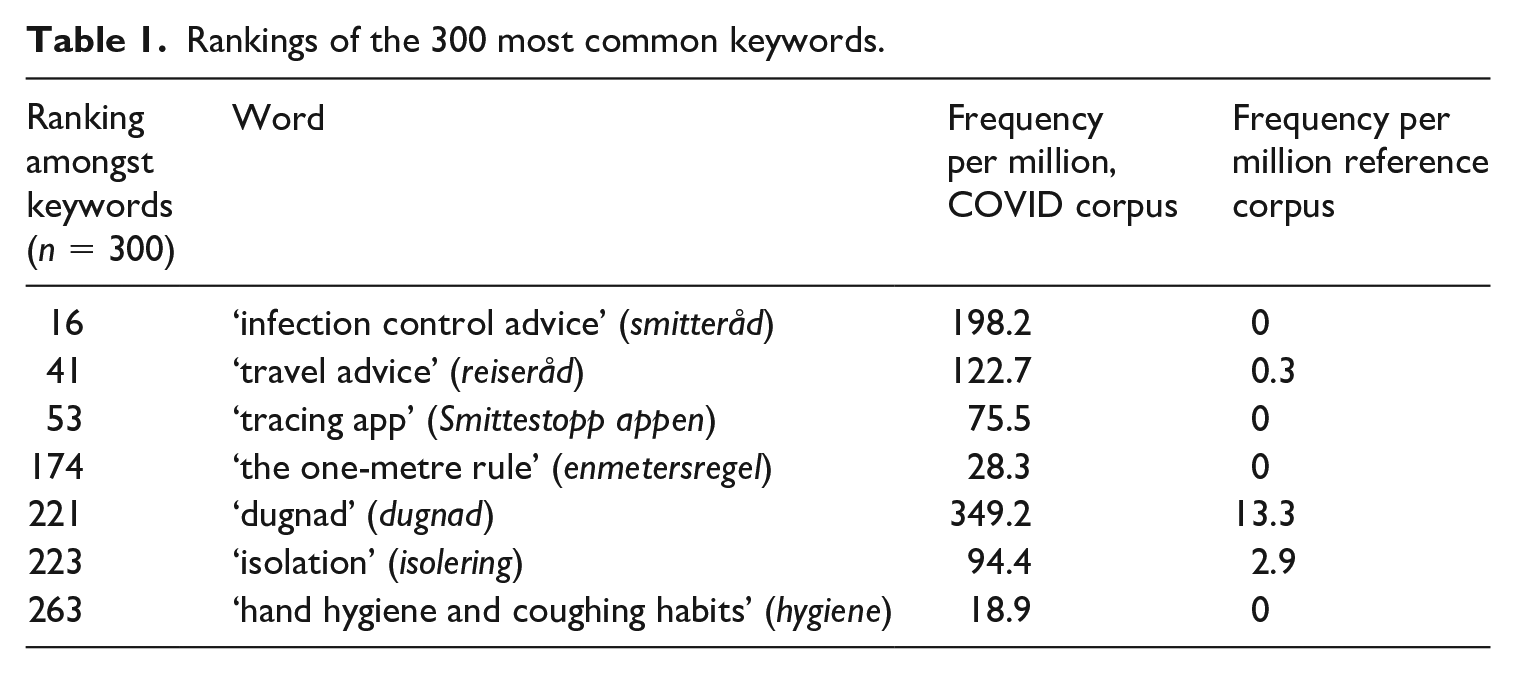
As Table 1 shows, several keywords cluster around what can be conceptualized as liberal biopower.
We further note a broad range of injunctions the government has made when urging Norwegian citizens to adopt specific behaviours intended to flatten the curve and thus suppress the virus. This approach to power contrasts with the classical, sovereign power Foucault describes. In Table 1, however, we see that the injunctions entail a variety of exhortations intended to regulate and control, some of which are communicated through the medium of advice, such as ‘infection control advice’ or ‘travel advice’. Some of these voluntary actions include working from home; using mobile contact tracing apps; and observing the one-metre rule, hand hygiene and coughing habits. However, we want to highlight the injunction propagated by the government that each and every citizen participate in a dugnad. This call to mobilize solidarity in defence of the population correlates with stricter, more tangible responses like border closures and general lockdowns – ordinances characteristic of national sovereignty. The appeal to show solidarity with the Norwegian nation dovetails with the reaffirmation of national sovereignty, as it rearticulates the pandemic’s presumably pressing exceptionality and the nation-state’s population as the primary target of protective measures.
The word ‘dugnad’ comes from the Old Norse ‘dugnaðr’, connoting help or support, and is derived from the Norwegian verb ‘duge’, meaning ‘to be able to’, ‘to be of use’, or to be appropriate’ (Nilsen & Skarpenes, 2022, p. 263). In current Norwegian usage, dugnad – which has no direct equivalent in any language – resembles a form of unpaid voluntary labour common among non-commercial groups and organizations in Norway (Myhre, 2020, p. 326), but differs in that people are unpaid, meet face-to-face, engage in tasks within predetermined timeframes, and gather for a social event after completing the work (Simon & Mobekk, 2019, p. 818). Lorentzen and Dugstad note that not all voluntary work classifies as dugnad, because voluntary work has to neither be face- to-face nor include a social happening (2011). As such, dugnad participation is often seen as ‘prosocial behaviour’, which Biglan defines as ‘behaviours that benefit individuals and those around them’ (2015, p. 818) and consists of ‘behaviours that have to do with helping others, contributing to the community [and are] associated with greater personal well-being’ (Simon & Mobekk, 2019, p. 818). This makes dugnad not only a particular cultural practice that builds community when people engage in collective work, but also a practice involving social control. As Knut Christian Myhre states, Norwegians ‘often complain about dugnad as an inconvenient imposition, but also acknowledge it as a means to complete tasks for which we would otherwise need to pay’ (2020, p. 326). Indeed, dugnad can pragmatically organize different communal tasks, but has itself also become a specific social value or norm (Myhre, 2020; Nilsen & Skarpenes, 2022; Simon & Mobekk, 2019) involving social control whereby people that do not participate risk being denounced as ‘free-loaders’. In the material analysed, dugnad emerges as just such a trope invoking everyone’s responsibility to ‘do their part’ and thus bringing the governmental aspect of cultural norms into play. This is where dugnad becomes biopolitical, its being entangled with pandemic modelling and strategies that, without explicitly promoting dugnad, still raise the concept in political rhetoric as a way of subjectifying the populace as one that complies with pandemic response measures. The term dugnad occurs 37 times in the material and reflects a biopolitical strategy intended to discipline behaviour by inducing personal responsibility and what we call pandemic norms. Dugnad is most frequently associated with the words ‘global’, ‘national’, ‘joint’, ‘extra’, ‘digital’ and ‘large’, and ‘continue’ and ‘take’ are verbs taking dugnad as their object. Finally, dugnad is collocated with ‘effort’, ‘solidarity’ and ‘cooperation’.
On 11 March, the day before Norway implemented nationwide lockdown measures, Minister of Health Bent Høie used the dugnad metaphor, stating that ‘when we’re all doing this in a collective effort like a large dugnad, we’re slowing and suppressing further transmission, which is not dangerous for most of us, but very dangerous for a few of us. We’re part of a dugnad that is saving lives’ (Pettrem, 2020). Here, he invoked dugnad as a collective responsibility to suppress the virus and slow its spread, that is, to lower the effective reproduction number, Re, and as part of a collective responsibility to shield the ‘few of us’ potentially at risk of contracting severe COVID-19.
On 20 March, Norwegian Minister of Justice Monica Mæland largely echoed this rhetoric, stating that ‘the most important job is to combat infections. To do so, we must all participate in dugnad. To shield the most vulnerable amongst us’ (Pettrem, 2020). Once again, the cultural trope of dugnad became part and parcel of the model society. Predictive models might have informed and projected what actions should be taken, but imaginary cultural figures were invoked to create the model citizen repeatedly called upon during COVID-19: someone that proudly participates in the national dugnad to protect the most vulnerable.
Norwegian Prime Minister Erna Solberg played directly on the trope of dugnad as uniquely Norwegian in one of her speeches: ‘In Norway, we stand together when it matters the most. We mobilize to do the dugnad and cooperate in small and large local communities. This is more important than ever’ (Pettrem, 2020). On 26 March, she stated:
We’re fighting a common battle against an invisible enemy. The more of us who participate in dugnad, the faster we can find our way back to everyday life as we know it. We work to ensure that as many of us as possible have a job to go to the day it happens. A shared battle against an invisible enemy. (Solberg, 26 March 2020)
The Prime Minister initiated policies based on models like those in the model society, yet by calling on the population to do their part, also invoked a cultural narrative subjectifying the model citizen as someone that acts in a model fashion – in this case a subject that stands together at a distance, follows governmental advice, and cooperates with the government.
As in Gjerde’s analysis (2021b), the above observations confirm that the rhetoric of the Norwegian government’s speeches take recourse in a liberal biopolitics reliant on voluntary changes in behaviour. However, this liberal and advisory form of power cannot be presumed to have no coercive force. By utilizing discourses such as dugnad and solidarity, the government employed these tools as a way of recruiting the population to be ‘partners’ rather than passive objects of control (Gjerde, 2021b, p. 480). Dugnad and the injunctions to show solidarity towards others (at-risk groups and the healthcare system) thus became tools for indirectly governing ‘free’ individuals (Rose, 2001). As such, the government relied more strongly on liberal notions of advice and encouragement than on disciplinary and coercive interventions. However, we argue the concept of dugnad in its recent re-articulation has been ‘weaponized’, as Gjerde notes (2021b, p. 481). While the government might appeal to sentiments like dugnad and solidarity, the normative pressure to conform to such cultural tropes has also engendered a pandemic norm. As Foucault notes, division practice creates what is considered ‘normal’ versus abnormal and deviant, and Gjerde states that ‘the dugnad and war discourses are utilized to motivate subjects to embrace the subjectification as “partners” in the dugnad, while recommendations are utilized to produce the knowledge these “partners” need for their conduct to be successful’ (2021b, p. 481). We argue that the use of such tropes should not be seen as purely liberal instances of a partnership between the state and citizens to suppress a virus. Rather, this use displays the logic of discipline, its creating norms for personal conduct aimed to reduce the circulation of the pandemic by restricting its human carriers’ movement in public spaces.
However, although we argue that dugnad as cultural trope has been enlisted in the name of public health and pandemic governmental control, one should be careful not to reify the term. Although we further recognize Gjerde’s main argument about the term’s role, we also note that a key invention of the Norwegian government came of its deployment of dugnad to transplant the term into a late-modern and digital pandemic context. Indeed, the government succeeded in re-articulating the term as a pandemic norm in the digital age by coining the term ‘digital dugnad’.
We also want to differentiate our analysis from Gjerde’s by offering a critical perspective on how the usage of dugnad in the name of pandemic control has glossed over several important socio-political tensions in Norway. The rhetorical command voiced by the Prime Minister to take part in a dugnad, in a self-sacrificing and unifying act of solidarity, can be criticized as obscuring inherent differences and tensions within the population. By invoking a unifying ‘national’ dugnad, the Prime Minister and other governmental officials downplayed or neglected structures of social differentiation and inequalities, including between urban and rural geographical location, its being easier to ride out a pandemic in sparsely populated rural spaces than in urban centres, and between ethnicities, a factor arguably ignored in the unifying nationalist discourse of dugnad. In Norway several discourses have articulated ‘culture’ in order to weaponize ethnic backgrounds and blame ethnic minorities when surveys revealed some ethnic groups having higher rates of infection, hospitalization and deaths due to COVID-19 than ethnic Norwegians. 2 Official explanations of COVID-19 infection rates have generally neglected patterned socio-economic disparities and underlying health inequalities as well as differences in housing conditions and intergenerational living, opting instead to make ‘culture’ an explanatory ‘black box’ in public COVID-19 debates. 3 Finally, dugnad, as propagated by the government, largely glosses over socio-economic differences linked to class. By this we mean the disproportionate burden carried by service workers who, unlike more affluent telecommuters and homeowners, could not comfortably self-quarantine without fear of transmitting the virus. Similarly, inner-city inhabitants have had to live in housing with little or no extra space for self-isolation. Making matters worse, many fundamental health disparities have been created by a ‘necropolitics’ of health, often naturalized by empty signifiers such as ‘lifestyle’, ‘underlying disease’, or ‘culture’. The inherent violence of economic and political inaction, neglect and inequitable politics can, in fact, be said to create these conditions.
Here, we would like to pause from the critical observations emerging from our material inspired by our Foucauldian theoretical framework and provide a counterbalance to the critical tenor of our analysis. Although we have argued that the propagandistic use of the term dugnad obscures the way the dugnad strategy has involved some groups carrying a greater burden than others, let us view this rhetoric from a slightly different vantage point. From this perch, one could argue that the call for a national dugnad partnering the state with its citizens has proved a highly successful means of handling the pandemic in Norway thus far. Indeed, Norway has had among the lowest incidences of COVID-19 in Europe and, according to EUROMOMO, had excess mortality rates comparable to pre-pandemic years. 4 Conversely, neighbouring Sweden has suffered close to 10 times as many COVID-19 deaths per capita as Norway. The two countries are often seen to differ in that Sweden’s initial approach was more liberal than that of Norway. Although the precise mechanisms accounting for these outcomes remain contested, the Norwegian biopolitical response has arguably saved more lives. Consequently, we might well tout the usefulness of a Foucauldian framework, but do not side with Agamben, who wrote a series of disputed articles insisting on a minimalist pandemic response in the name of freedom and resistance. For us, the analytical benefit of using Foucault’s concepts of law, discipline and security is not the framework’s critical vocabulary for scrutinizing the exercise of state power and generalized surveillance, but rather its value in helping us describe a differential field of intersecting forms of governmental power. In our textual analysis, one modality of power is communicated as a voluntary and solidary partnership between state and citizens, another is conveyed as prudent norms to which responsible citizens submit, and a third takes the medium of command to invoke the law’s binary distinction between lawful and unlawful.
Governmental anti-pandemic strategies clearly play an essential role in helping and protecting citizens. We have not sought to dispute that, but to explore how legal sovereignty, the imposition of norms, and the predictive knowledge of modelling come to the fore and intersect in political speeches. Although we have indicated some problematic aspects of the dugnad campaign, our analysis offers no uniform rejection of anti-pandemic strategies and thus clearly departs from Agamben’s use of Foucault to radically denounce governmental anti-COVID-19 interventions. 5
Sovereign power and the rule of law
The current COVID-19 approach as seen in these speeches rests on not only the influence of models and liberal power, but also the spectre of sovereign and disciplinary power. Keywords clustering around such power are listed in Table 2.
Clusters of keywords invoking sovereign and disciplinary power.
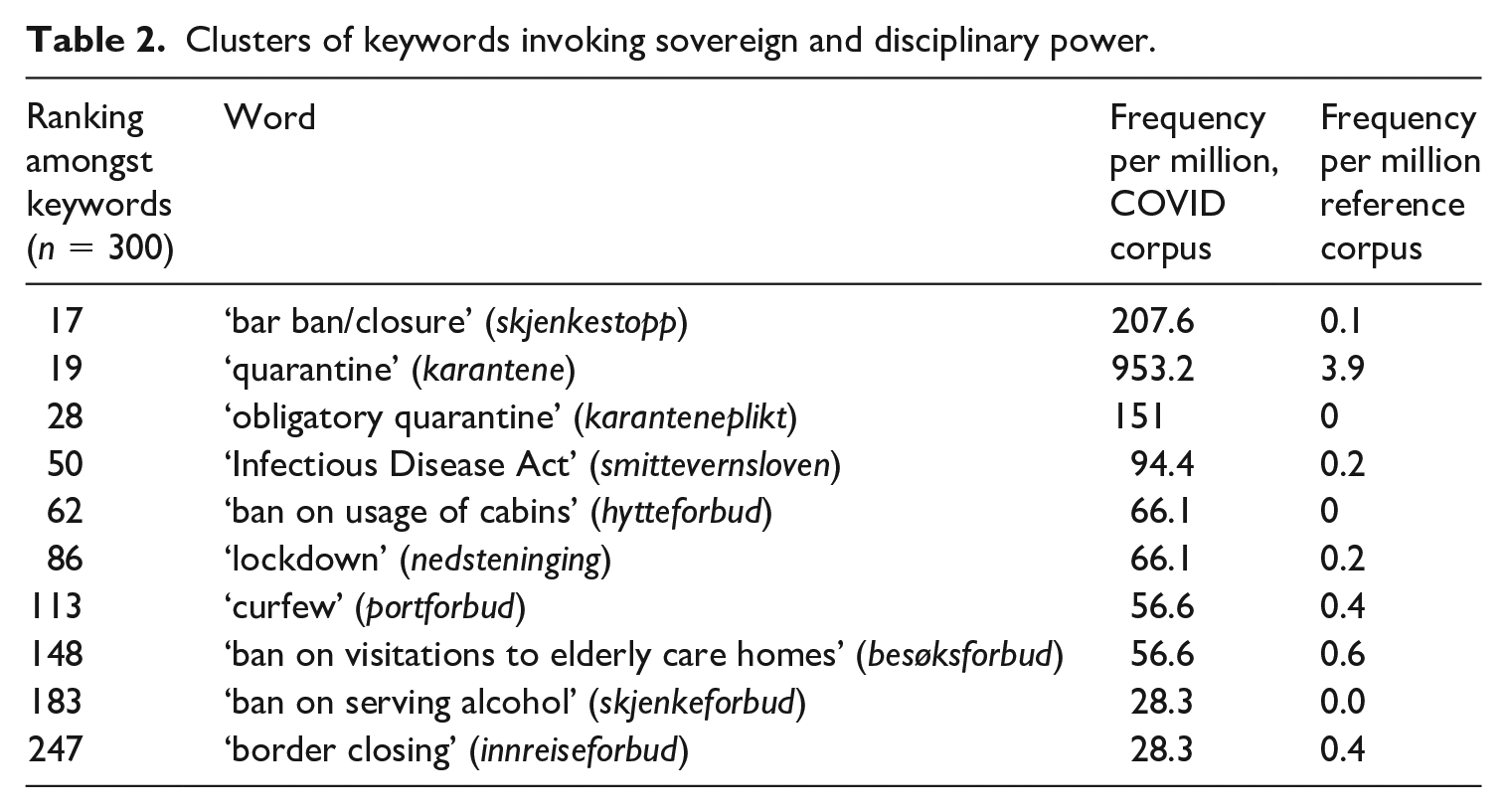
The table clearly shows how the Norwegian government has also relied on sovereign power by implementing legal measures and banning certain activities. Chloe Taylor defines sovereign power as:
. . . a power which deduces. It is the right to take away not only life but wealth, services, labor and products. Its only power over life is to seize that life, to end, impoverish or enslave it; what it does not seize it leaves alone. Sovereign power’s right over life is merely the right of subtraction, not of regulation or control. (Taylor, 2011, p. 42)
The keywords listed in Table 2, we argue, follow many of the tendencies Taylor describes, thus demonstrating interventions that (1) take away good and services; (2) take away wealth; (3) remove the right to free movement; and (4) penalize with economic fines and ultimately even imprisonment.
Such interventions are often rationalized as protecting the most vulnerable and preventing the healthcare system from collapsing. The following statement evinces this reasoning: ‘the overall goal of our infection control efforts is to reduce the size of the epidemic and in particular to protect groups of the population with an increased risk of serious disease outcomes’ (Høie, 19 March 2020). The Prime Minister similarly stated that ‘the government has also decided to look at measures to better protect the elderly and risk groups. This can relieve the health service and save lives. Here I also ask family members and friends to both take responsibility and to care’ (Solberg, 23 March 2020). Finally, the following statement exhibits the same rationale for using authoritarian and legal measures to suppress the virus: ‘the number of infections has increased because many of us have travelled more and met more people. It has increased because we have not been good enough at following the rules and advice that will prevent us from infecting each other when we meet each other’ (Høie, 7 August 2020).
An example of discipline is found in the use of mandatory quarantining for people either suspected of having COVID-19 or testing positive. The intervention has a long history as an epidemic response (Engelmann et al., 2018; Engelmann & Lynteris, 2020; Lakoff, 2017). In our corpus, the word ‘quarantine’ occurs 101 times. Ten verbs take ‘quarantine’ as their object, including the verbs ‘impose’, ‘respect’, ‘break’, ‘continue’ and ‘hold’. By examining some of the concordance lines, we can add context to how quarantine becomes a disciplinary technology, as this excerpt illustrates: ‘When we’re quarantined, we also take care of each other. . . . It may not feel like you’re making an effort when you sit down in the home office at the kitchen table because you’re in quarantine. . . . When you quarantine, you give a gift to the people around you’ (Høie, 25 August 2020).
Interestingly, this quote calls upon the listener to assume a normative sense of responsibility, asserting that quarantine is a way of ‘taking care of others’ and that being quarantined is a ‘gift to the people around you’. The above rhetoric apparently makes a liberal appeal for every citizen to voluntarily do their part, but, as we have argued, quarantine also involves disciplinary power. The following statement illustrates this point: ‘If you’ve been in close contact with someone who is infected or travelling to a country marked as “red”, you must be in quarantine for ten days. That means you should not go to work or school and not seek out places with many people. Neither should you take public transport. . . . So stay in quarantine – help stop the infection!’ (Høie, 25 August 2020). This quote obviously communicates strong disciplinary injunctions.
We should note, of course, that the use or threat of incarceration is integral to the disciplinary continuum, which ranges from self-discipline to juridical regulations rooted in legal sovereignty. Consider, for example, the case of a healthcare worker convicted of violating corona laws in Oslo in December 2020 and sentenced to 24 days’ imprisonment. 6 This resurrection of legal sovereignty is also evidenced in the many people fined for violating various exceptional corona laws. Such examples indicate how in Norway’s anti-COVID-19 strategies, discipline and security have often intersected in tension-riddled relations. However, the government has been careful to use both voluntarism and what Bourdieu termed ‘right-handed’ statist interventions, which denote the legal-punitive function of the ambidextrous state (Peck, 2010). 7
Our analysis of the anti-COVID-19 strategies is not intended to evaluate their manifest efficacy in controlling the pandemic and saving lives. Rather, we have sought to explore how predictive models and projections like the epidemic curve inform political campaigns, and have seen Rhodes et al.’s notion of the model society as highly relevant for analysing these aspects of the current pandemic. Specifically, we have examined how the model society produces model citizens by translating epidemiological knowledge into a multipronged campaign conducted in political rhetoric, news media broadcasts, online articles, etc. Finally, we have also confirmed, albeit with other tools, the conclusions Gjerde (2021b) reached in his analysis of Norwegian political speeches, that is, that liberal biopolitics is intricately linked with disciplinary and sovereign power.
Concluding remarks
Rhodes et al. have recently explored how predictive models travel and become sites of ‘public troubles’ in media communications and policymaking (Rhodes & Lancaster, 2020). As in the UK, anti-pandemic strategies in Norway have determined which groups should bear the burden of pandemic suppression measures, and prioritized protecting those vulnerable, such as the elderly and immunocompromised. This prioritization clearly show the increasing intertwinement of predictive models, epidemiological data and bio-citizenship (Petryna, 2004; Rose & Novas, 2005).
We have also suggested that the model society reinvest liberal biopolitics with sovereign interventions and disciplinary techniques in order to produce a model citizen. We have used performative political speech acts as our principal vantage point for exploring how normalized citizenship models become articulated. The speeches selected also evinced elements of sovereign state power when the register of communication shifted from appeals and advice to indisputable commands and prohibitions. This evolving reconfiguration of governmental power thus challenges the governmentality literature emphasizing ‘governing through freedom’. As such, influential contributions to this literature provide a framework particularly oriented to government practices and techniques that operate through subjects who govern themselves freely. A few scholars have argued that coercion is integral to liberal reasoning (Valverde, 1996) and that the governmentality approach tends to neglect the constitutive sovereign dimension of contemporary neoliberal governance (Prozorov, 2004). Our study has taken a step towards interrogating how the political perception of an extraordinary threat to the population has resurrected both discipline and sovereign power. How exceptional crises like pandemics spur governmental power to transmute into nationalist sovereignty is a crucial question for future political and sociological research.
Footnotes
Acknowledgements
The authors would like to thank the anonymous reviewers for their constructive inputs to the manuscript and their engagement with our thinking and writing.
Funding
The authors received no financial support for the research, authorship, and/or publication of this article.