




Abstract
Diversity is a widely shared concern within contemporary universities. Most diversity research focuses on what universities are saying and doing about diversity. Herein lies the assumption that researchers already know ‘the’ problem of diversity before studying it and that it stays the same during and after investigation. This article takes a different approach by following how diversity becomes a problem in a concrete academic setting. More specifically, we ask how conditions of knowledge production intervene with, transform, and contribute to what is known as the problem of diversity. We thereby demonstrate how diversity is made into multiple problems throughout a single setting. More importantly, we show how these problems never fully come to contain the controversy of diversity as epistemic troubles routinely (re)emerged. Indeed, our research provoked such troubles. As one of the researchers was recurringly understood as an embodiment of diversity, fieldwork itself elicited and shaped the persistent controversy of diversity.
Introduction
What happens when we do not ask ‘what are universities saying and doing about diversity?’, but instead ask ‘how is diversity in the university encountered and known in the first place?’ This is the central question we address in this article. Much research has answered the first question by studying the multiple meanings diversity discourse involves (Bhopal & Henderson, 2019; Bonjour et al., 2020; Iverson, 2012; Wekker et al., 2016) and how saying and doing don’t align (Ahmed, 2012; Bhopal & Pitkin, 2020; Van den Brink & Benschop, 2012). Some scholars have explained this multiplicity and non-performativity through the notion of empty signifier, implying that diversity may mean whatever meaning is imposed upon it (Hearn & Louvrier, 2015). This implies that ‘we’ can self-impose what diversity is and what work it is supposed to do for ‘us’ (Marten, 2020). This approach fails to recognize that what diversity can mean and when and where it gains significance remains connected to its histories of struggle (Ahmed, 2012).
Whether working from a management or social justice perspective, the tendency in most diversity research is often to render diversity tangible and operational (Ahmed, 2009), which enables an evaluation of diversity policies\ potential to resolve ‘the’ problem (Ahonen et al., 2014). An important weakness of diversity research is, therefore, that it does not study how the conditions of knowledge production intervene in, transform and contribute to what is eventually known as ‘the’ problem in the first place. Instead, researchers tend to settle on what ‘diversity’ is, how it can be studied and assume that diversity remains stable throughout our enquiries (Ahonen et al., 2014) and across contexts (Jonsen et al., 2011). This article aims to address these assumptions and contribute to the existing literature an approach to diversity as multiple and a problem that is shaping and shaped in efforts, including our own, to know it (Lury, 2021; Marres, 2014).
To do so, the article is divided into four sections. The first section presents our theoretical approach to problems and introduces diversity’s specific significance in the Dutch context. Second, we explain how our empirical material was gathered. In a third section, we explore how diversity became a problem in our research. Finally, we conclude and reflect on the contribution of this study to diversity research. We show how diversity becomes a manageable problem that is articulated through the competitive and meritocratic logics of the neoliberal university. While diversity’s problematization through these logics may serve to evade discussions about knowledge production and academic community, they nonetheless provoke them by linking diversity and quality. This in turn persistently leads to epistemic troubles about what quality is and who can produce it. Eventually, these tensions coalesce as the epistemic problem of a marked body.
On knowing and composing a problem
To ask how diversity can be known, is to ask about the entanglement of methods and problems. How diversity is composed, depends on what methods are used, how data are analysed and presented. Law et al. (2011) have argued that we ought to attend to the double life of social methods. Methods are social because they are constituted by the social world they are part of. Such an understanding implies that methods are not disinterested procedures but are employed as tools that reflect the concerns of their advocates (Law et al., 2011). Methods are also social, because they help to enact and organize the social world. What is ‘out there’ is what we do (Law & Singleton, 2015). This requires rethinking methods as tools for knowing about problems already ‘out there’ to methods as ways of composing problems in specific ways.
In this regard, Lury’s recent work (2021) on problem spaces is important for understanding the composition of problems. Lury (2021) describes a problem space as ‘a representation of a problem in terms of relations between three components: givens, goals and operators’ (p. 2). The relation between these components is often understood as stable and unchanging: facts and goals are assessed, after which operators are identified and implemented to define and analyse ‘the’ problem. Instead Lury (2021) proposes a transformational approach to problem spaces, in which ‘the problem is a problem, becomes a problem as it is investigated’ (p. 2). In line with calls for inventive research (Lury & Wakeford, 2012; Marres et al., 2018), we aim to study how problems of diversity take shape in and through the research process itself. We ought to question the different ways in which a problem is composed and attend to our own enrolment in problematizations. Instead of merely approaching such questions as epistemological and conceptual matters, we aim to study problem composition in the field.
Management and social justice approaches are prevalent in diversity research. In management approaches, diversity is perceived as an inherent quality of certain individuals who are managed to materialize certain benefits (Ahonen et al., 2014). Following this approach, research tends to study whether diversity policies have indeed worked to that end. Consequently, the management approach is critiqued for essentializing differences (Bannerji, 2000; Zanoni et al., 2010) and merely focusing on these differences to gain competitive advantages while masking existing power relations (Litvin, 1997) in which white, heterosexual, upper-class men are the managers and those ‘who look different’ (Ahmed, 2012) are managed (Nkomo & Stewart, 2006). Indeed, this approach always already knows diversity, how to study and manage it (Ahonen et al., 2014) while assuming diversity to be the same across contexts (Jonsen et al., 2011). The social justice approach, however, has demonstrated how power in diversity work (re)produces inequalities, but often struggles to go beyond a critique of diversity talk and towards a situated engagement with knowledge production on and around diversity (Ahonen et al., 2014). Without studying how diversity becomes a problem as it is investigated, Ahonen et al. (2014) argue that diversity research can only produce dislocated knowledge. We will start out situating diversity in the neoliberal context of contemporary European universities and Dutch genealogies of difference in particular.
Between gender and race in the Dutch neoliberal university
As diversity travels through the Dutch context, lack and lag have been its recurrent, operative meanings (Essed, 1994; Ghorashi & Ponzoni, 2014). Diversity gained significance in light of exceptionalist imaginaries of an ‘emancipated’ and ‘tolerant’ country that champions women’s emancipation and sexual freedoms (Mepschen et al., 2010; Wekker, 2016), while accommodating ‘newcomers’ and ‘their’ difference (Ghorashi, 2006). Deficit thinking has persisted, Ghorashi (2006) argues, as governmental paternalism and colonial forms of knowledge shaped the post-1970s politics of migration and citizenship (Essed, 1994; Schinkel, 2017). Diversity policies have focused on advancement of women in academia (Timmers et al., 2010) while policies around ethnicity and race aim to target ‘problem populations’ (Nimako, 2012). Bonjour et al. (2020) also find that most university diversity policies focus on gender advancement, while sometimes mentioning ethnicity but mostly in terms of lack of study success.
Contemporary European universities are situated in a neoliberal context where academic work is driven by logics of performance, excellence and competition (Joseph-Salisbury & Connelly, 2021). It is within this context that diversity must be located (Ferguson, 2012; Van den Brink & Benschop, 2012). Although gender equality policies are longstanding within Dutch universities (Timmers et al., 2010), it was not until changes in European research funding occurred that attention to diversity intensified after 2015. Gender diversity became a criterion to apply for European funding. The Vision of Science 2025: Choices for the Future 1 – a document which describes important themes to improve the future of Dutch academia – explicitly mentioned the importance of increasing the number of women. In this light, government funds were provided to universities to appoint women professors.
Ethnic and, in particular, racial difference have received far less attention (Essed & Nimako, 2006). When student-led protests and occupation of university buildings at the University of Amsterdam produced calls for a transformation of university, decolonization could not be an explicit part of a report on new diversity policies (De Ploeg & De Ploeg, 2017). Marten (2020) argues that diversity can easily circulate within the university’s meritocratic logics, while issues of decolonization, knowledge production and inequalities remain unaddressed (cf. Ahmed, 2012; Bhambra et al., 2018; Bhopal & Pitkin, 2020).
Ethnographic fieldwork: (Trans)forming a problem
We adopted an ethnographic approach of ‘following the thing around’ (Marcus, 1995), tracing the circulation of an object of study through various locales and contexts. Within the research setting one of us was a master’s student (principal fieldworker) and another an assistant professor. We drew from various events, practices and materials, including policy documents, public discourse and interviews with key actors. The principal fieldworker also took extensive fieldwork notes on the research process and responses of informants to research activities. Along the way we traced the shifting compositions of diversity. Our research focused on the circulation of metaphors, symbols and signs while also tracing the social groundings of associations in language and media (Marcus, 1995). Diversity as a matter of shifting concerns circulates and acquires multiple situated meanings (Ahmed, 2012) and may refer to all social and cultural differences (Bannerji, 2000). While ‘following the thing around’ is usually associated with multi-sited ethnographies, we aimed to adapt this approach to a single setting, because it can be a way of exploring the multiplicity already at play. As Candea explains:
The account stays put precisely because places themselves . . . are already . . . shifting and multi-sited, because people’s presence are already trajectories, and their histories and identities always already hark to wider wholes, elsewhens, elsewhere. (Candea, 2010, p. 36)
Research site
We focus on the Erasmus University Rotterdam (EUR), which implemented a gender equality policy plan and initiatives since 2007. The number of women professors, however, has remained significantly lower at EUR as compared to other Dutch universities (Landelijk Netwerk Vrouwelijke Hoogleraren [LNVH], 2019). Given the slow pace of change and previous attempts to address disparities, EUR introduced a diversity programme in 2015. The programme featured the appointment of a chief diversity officer, programme manager, policy advisor and two diversity practitioners. A new gender diversity policy was introduced in 2016. This led to the creation of a diversity and inclusion office (D&I Office) in September 2018. Diversity gained wider attention through events of the D&I Office, faculties, and articles in Erasmus Magazine (EM), the independent news magazine of EUR. As concerns over diversity expanded in this period, EUR made a theoretically fitting case to trace diversity. When tracing diversity, policy documents were our initial starting point, but fieldwork simultaneously consisted of the analysis of public discourse, interviews, observations and reflections on fieldwork (Figure 1). Tracing was an ongoing process in which tracing in one place did not mean the end of tracing it elsewhere.
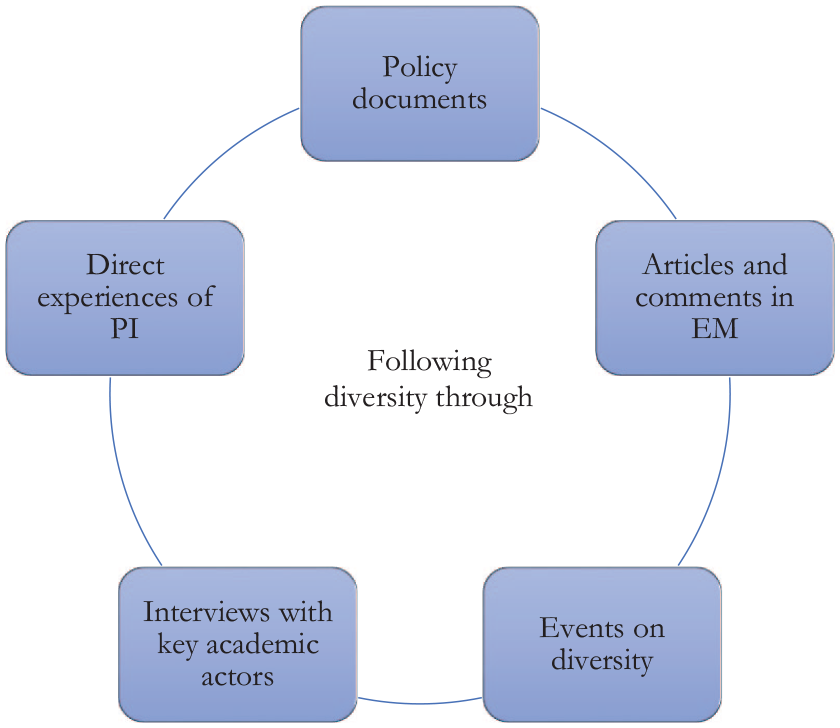
Following diversity through.
Policy documents
To understand how diversity is made into an administrative problem, we collected and analysed two important documents from the D&I Office: The Programme Initiation Document (PID) (2015–2017) and the Gender Diversity Policy (GDP) (2016). The PID explains the necessity of a diversity programme and interventions. The GDP provides proposed solutions for the problems of diversity. We conducted a discourse analysis, where our analysis focused on the meanings, problems of and solutions of diversity (see Iverson, 2012). For instance, a low proportion (problem) of female professors (meaning of diversity) meant revising recruitment and retention practices (solution).
Public discourse
Our analysis of public discourse focused on articles in EM and events of the D&I Office. A search on ‘diversity’ on EM’s website resulted in 21 articles about diversity at EUR. We analysed them together with comments on these articles. Our discourse analysis focused on which positions were taken, by whom and in what ways. We coded for the justificatory logic that were displayed in these comments (see Boltanski & Thévenot, 2006). For instance, many comments deployed the notion of ‘merit’ to problematize diversity initiatives, implying that ‘diversity’ and ‘merit’ are conceived to be incompatible. We attended two ‘lecture cafes’ of the D&I Office: on anti-racism and anti-discrimination in higher education and on homophobia and transphobia. During these events, students and employees discussed various diversity topics. We made extensive notes of the arguments and responses of attendees, focusing on their justificatory logic to understand how diversity is problematized in public discourse.
Interviews
We conducted 11 interviews (between 30 and 90 minutes) with key academic actors: diversity practitioners, academic staff concerned with diversity and evaluations of departments. D&I’s programme manager, a diversity practitioner and faculty diversity officer were also interviewed. Interview topics included diversity’s meaning(s) within the university, meaning(s) of academic quality, its relation to diversity, current diversity initiatives and challenges. We also interviewed the programme manager of the Expertise Centre for Diversity and Inclusion in Higher Education 2 about her experiences in advising EUR. Finally, we spoke to an initiator of an open letter calling for improving diversity at EUR about her engagement with diversity.
Our other interviews focused on academic evaluations of departments. Diversity is included in the Standard Evaluation Protocol (SEP), which is used to evaluate academic quality of research units in the Netherlands (e.g. departments). Research units are given a score on three criteria: research quality, relevance to society and viability. Additionally, three aspects are considered – PhD programmes, research integrity and diversity – for which they get recommendations. We interviewed the chair of the SEP workgroup about when and how diversity became important in academic evaluations. Similar questions were raised with a former chair of the Dutch Network of Women Professors (DNWP), 3 who was involved in adding diversity to the SEP. Our attention then turned to two research directors at EUR. We discussed perceptions of their disciplines, their definitions and indicators of academic quality, their views on diversity and its relation to academic quality. We interviewed a senior policy officer who organized an evaluation and a member of an interim evaluation committee, with whom we discussed the documents of an evaluation. This deepened our understanding of how academic quality is defined, evaluated and which meaning diversity acquires in these evaluations.
Following diversity around
As detailed above, we encountered diversity in a variety of compositions throughout our fieldwork. Along the way we became increasingly concerned with the way in which our research was itself implicated in how diversity was composed into a knowable and relatable problem. We start with a vignette from our field notes to draw us into the field.
Vignette A: Knowing diversity through embodiments of diversity
I meet with the diversity practitioner in a small room, where we discuss her role in the team. She focuses on student diversity, for which programmes are developed at entry-level, because students with ‘non-western migration backgrounds’ were considered to have less study success than ‘Dutch’ students. Through a pre-academic programme, these students receive support in adjusting to academic learning. The conversation turns to me when she says I may recognize these difficulties and may have taken part in the programme. I disaffirm. The conversation goes on about how ‘ethnic minorities’ may not feel at home in the university. She adds that I might recognize this. To make them feel at home the diversity team organizes events. One event she mentions is an iftar for international Muslim students, after which she looks at me, points at me and says: ‘I can see that you wear a headscarf can I assume that you’re Muslim?’ I affirm. The diversity practitioner says she didn’t want to assume that I’m Muslim just because of my headscarf, but that she could really use my help with the event since I’m Muslim. She asks me for feedback. I hesitate but agree to provide written feedback.
4
In vignette A, the diversity practitioner understands the researcher’s presence as a diverse presence through which she might know the problem of diversity. The power relations shift as the diversity practitioner turns to the researcher as a student with a non-Western migration background who may recognize certain difficulties and feelings. Through that assumption, the capacity to know the problem of diversity is placed into the hands of the researcher. She is expected, not only as a researcher but as an embodiment of diversity, to know and render the problem of diversity solvable. To embody diversity while researching diversity is to arrive at a research setting intending to ask questions but leaving as the one being questioned (Icaza Garza & Vazquez, 2017). As such, diversity becomes a problem of those who embody difference for the organization (Ahmed, 2009), who need to articulate and help to resolve how the problem of diversity can be known. Right from the start, diversity is something that is ‘brought in’ by specific bodies and appearances. As we turned to policy documents and other articulations of the problem(s) of diversity, this embodied presence of diversity becomes a diversity problem.
The problem-free university with a problem
A diversity problem emerged from diversity’s significance for the competitive and meritocratic logics of the university. Paradoxically, this happens when policy is deliberately designed and articulated to move from ‘problems’ of deficit to ‘opportunities’ of added value. Diversity’s tense relation to deficit became evident in the rationale for a new policy:
Although several effective measures have already been developed and implemented with respect to diversity, these often focus on ‘resolving the problem’. The desired results have not (yet) been realised, if we look at the gender balance at higher education position levels. The approach with respect to educational innovation has not substantially reduced the absolute lag in study success of non-Western students of foreign heritage.
5
The policy decouples gender and race/ethnicity and thereby reinforces white masculinity as the unmarked norm (Nkomo & Stewart, 2006; Wekker, 2016). Diversity is understood as a problem of gender imbalance between ‘men’ and ‘women’ and a ‘lack’ of study success of ‘non-Western students of foreign heritage’. Diversity as a gender imbalance is supported by tables on the underrepresentation of women compared to men and consequently omits recognition of non-binary academics or intersecting identities (Tzanakou & Pearce, 2019). Similarly, ‘non-Western students of foreign heritage’ are understood to lag behind white Dutch students, which consequently collapses differences between ‘non-Western students’ (Litvin, 1997).
D&I’s programme manager perceived a shift in policy perspectives:
This theme [diversity] was so often framed as a problem so we wanted to approach it more positively. This calls for a shift from trying to fix the problem that women have to showing the value of diversity in the broadest sense of the word.
6
In a contrast to the past – diversity policy as addressing ‘the problem that women have’ – the goal of adding to the university’s value through diversity emerges. Diversity becomes a management problem. The GDP document defines added value, with reference to McKinsey & Company’s strategic advice on diversity, as better team performances, better use of available talent, better response to their situations and better financial results. Diversity bolsters the university’s competitive position. Yet, this document also mentions ‘this is not insignificant – our organisation can offer everyone equal opportunities’. 7
So, the policy programme combines multiple arguments for diversity (see also Dobusch, 2017), but diversity’s place in the economizing logics of the university undermine social justice aims (Marten, 2020; Tzanakou & Pearce, 2019). First, a discourse of added value is a continuation of diversity as a problem of changing women. Both reproduce white masculinity as the standard against which value must be determined (Iverson, 2012). Diversity ‘adds’ to the university what was already recognized to be beneficial. The university as it currently exists (predominantly masculine and white) already has value and already knows how to recognize it. Certain people (e.g. women and people of colour) become part of the university if and when they bring in additional value. As has been frequently observed, diversity does not disrupt the ways in which organizations know and designate their ‘value’ (Nwonka & Malik, 2018).
Second, gender diversity tends to be prioritized, as the following fragment shows:
Research shows that teams perform better if their composition is more diverse as regards gender. We are on the right path when we look at the proportion of women, but there is plenty of room for improvement.
8
Gender diversity increases the performances that were already valued. Concrete initiatives for improving the gender balance include mentoring and career programmes, implicit biases workshops, and ‘make applying for the job appealing to women and other minorities (by using gender-neutral language)’. 9 Notwithstanding an expressed attempt to move away from problems of deficit, policies are geared primarily to women and imply that underrepresentation can be addressed by assisting women. The shift to ‘added value’ prioritizes gender over race/ethnicity, while not qualitatively changing the paternalistic design of policy interventions (Ferguson, 2012).
This composition of the problem resonates with the analyses of Schinkel (2017) and Ghorashi (2006), which show how the goal of Dutch immigrant integration policy reproduces deficit thinking. First, the process of integration is conceived as the addition of outsiders to an already constituted whole. This not only implies that integration must be a responsibility of outsiders, but also entails that certain outsiders may be better suited to such inclusion than others. Even if integration is explicitly articulated as an opportunity for societal improvement, the failure to integrate is nonetheless known and measured according to the social distance of outsiders. Even if it is concluded that insiders did not do enough to assist newcomers, the paternalistic relation between actors remains intact. What’s more, certain differences – i.e. gender – appear more amendable to change than others – i.e. race/ethnicity. Diversity becomes a problem of all those who due to their deficits fail to enter and advance within the university, and as such, are viewed as outsiders within the university (Iverson, 2007). This produces a paradoxical tension in which a university has a problem that is at once inside and outside of itself. It has a problem, named ‘diversity’, but in trying to know and understand this problem it is only ever observed as the distance of outsiders to the university. Precisely in their shift to ‘added value’, EUR’s new diversity initiatives ultimately uphold this image of a problem-free university.
It is through connections between diversity and quality that controversies arose and diversity returns as a problem for the university as such.
Diversity as epistemological threat and repair
The introduction of the diversity initiatives became the object of controversy when faculty members signed an open letter to call for more diversity to strengthen the quality of research:
Our university strives for high-quality research that is relevant for society. . . . Allowing different types of people with a variety of experiences and insights to engage in producing this research is a prerequisite for obtaining this goal.
10
In the letter, a lack of diversity of people and perspectives is argued to produce one-sided and impoverished knowledge. Moreover, diversity is seen as constitutive of good knowledge production and the goal of education ‘to prepare students for the world in which they will act after (but also during) their studies’. 11 Finally, it details how the university is currently reproducing inequalities. EUR carries the slogan ‘Diversity and Inclusion is in our DNA’, while white Dutch men dominate top positions. Diversity transforms from a management problem to a professional, epistemic problem of impoverished knowledge and inequalities.
The letter drew much reaction. Most notably, the chair of the JOVD (the youth party of the liberal conservatives) presented diversity measures as a threat to academic quality, calling them ‘unnecessary and undesirable’. Through an internal poll she aimed to illustrate that not all women were supportive of these measures:
Women don’t want to be hired for being women, but for their individual qualities. We believe that staff should be hired because they are suited for the job not because of their sex.
12
The public controversy was thereby directly concerned with the boundaries, so crucial in the policy document, between the inside and the outside of EUR. The response of the JOVD chair implied that the current mode of knowledge production is working and should be left undisturbed. Diversity should not be allowed to impinge on internal, academic concerns from the ‘political’ outside. An initiator of the open letter turned this very logic against this critique by arguing that the JOVD should itself not have interfered with the issue at EUR:
Diversity is a ‘political’ issue at the university, because it concerns structures of dominance. It is the politics of our workplace, of our university community, not a party-political issue. . . . But bringing the symbolic weight of the biggest political party to bear on a university community constitutes a threat to academic freedom.
13
The initiator effectively engaged in a politics of re-attachment (Ahmed, 2012) and traced the problem of diversity back to structures of dominance and workplace politics. When the JOVD invited their critic ‘to enter a discussion about diversity at EUR’, he dismissed them as illegitimate speakers unless they would use their titles as EUR students or staff. The features of this controversy were already latent in the policy documents. Indeed, the GDP recognized how diversity measures could cause stigmatization and resistance, which is why a positive slogan, ‘Diversity in our DNA’, was chosen. Although the slogan attempts to evade the controversy, it already highlights the question what is and is not internal to the university. This tension between diversity and academic quality directed our attention to how (non)-academic actors actually evaluated quality.
Vignette B: When encouraging becomes managing
I was discussing with an evaluation committee member how the evaluation was conducted. When I asked about diversity, I noticed how his attention suddenly shifted to me as he said: ‘I think the women’s issue is a bit nonsense that that would be difficult, because there are plenty of talented women, so I don’t think that is the problem. Cultural diversity is complicated, which is also an issue we struggle with because – we have quite a lot of students who are second and third generation immigrants – but they generally do not want to continue in academia. So, we have to see how we get them to do that. It is good that you are doing a research master, but there are few people with a migration background in our research master.’
14
In vignette B, the attention shifts from questions around quality to the researcher as an embodiment of diversity. The distinction between gender and cultural diversity suggests that gender diversity is already completed within the university (‘plenty of talented women’). The problem, however, is a lack of ‘motivated’ ethnic minorities, given their apparent absence in research masters. This articulation of the problem of diversity fits within the Dutch self-image in which women’s emancipation is completed while ethnic minorities are perceived to have deficiencies (Wekker, 2016) who need help to ‘catch up’ (Ghorashi, 2006). The evaluation committee member provides this help as he turns to the researcher – as a second-generation immigrant – and makes encouraging remarks. Ahmed (2012) reminds us how enthusiastic responses can be oppressive. Indeed, talking about diversity with a researcher seamlessly shifts into the management of diversity by encouraging an ‘immigrant student’. Encouraging talk becomes a way of managing difference.
On diversity and academic quality: A problem of rights to speak
The vignette highlights that questions about quality and diversity hinge on a distribution of the right to speak (Bourdieu, 1993). By taking on subordinated positions, various non-academic staff members argued that they had a supporting role when evaluating academic quality. While non-academic staff members had their ideas, they expressed they could not influence how academic quality was understood.
When asking the policy officer what he thought of the SEP and the addition of diversity to the framework, he answered:
Some people can influence the SEP, because that SEP is also made with the influence of academics. . . . But I, certainly in my role, am the one who guides and executes it [evaluation process]. I do have my opinion, but I am not the right person to make a change.
15
This policy officer takes on a subordinate position by distinguishing between non-academics and academics. Contrary to academics, non-academics are not invited to discussions about evaluation and quality. This implies that because he is not an academic, it is not his place to articulate what academic quality is. Similarly, D&I’s programme manager, argues:
We could provide guidance through the development of this recruitment and selection toolkit and workshops about implicit bias. But that’s all we can do. In the end, they decide what academic quality is and how to evaluate it.
16
She distinguishes between ‘we’ (diversity officers) and ‘they’ (academic staff). The expression ‘that’s all we can do’ implies that D&I’s programme manager has a limited capacity to influence what is viewed as academic quality. Dealing with the distribution of the right to speak, non-academics displace questions about quality to academics. Here, the position of diversity officers is particularly interesting as they are expected to speak about quality and are expected to have a supporting role. Diversity officers need to cope with the paradox of having to speak about quality, but not having the position to do so. The faculty diversity officer explained how she used her position as a professor:
I – as a diversity officer – cannot say: this is how we will implement diversity. But as a philosopher among philosophers, I must simply ask the question: what does diversity or diversity policy mean for philosophy?
17
Apparently, what matters is which positions one can occupy: as a diversity officer she cannot tell others how to implement diversity yet as a philosopher she must ‘simply ask the question’. Diversity policy produces legitimate diversity subjects (Ahonen et al., 2014; Dobusch, 2017), but also legitimate diversity actors who are considered and consider themselves capable of articulating what the problem of diversity is.
As the definition of quality was deferred to academics, we raised questions about quality with research directors. Although research directors named certain quality indicators (e.g. number of publications, citations, key notes, serving in panels, supervising PhDs, societal engagement), they could not define quality. They argued that indicators are signs of quality, but that it is difficult to define quality as such. One research director stated: ‘The big problem here is it is very difficult to explicitly set criteria for this.’ Later, he argued that a list of requirements could not be given, but he could still recognize it at, for example, a conference event. By comparing a good movie and a good candidate, he argued that in the case of a good movie: ‘there is also no list of requirements but it [quality] is often recognized by the majority’. Another deferral takes place as the capacity to define quality is now displaced to ‘the majority’. The right to speak, occupied by academic staff, eventually allows them to refrain from using it. As did another research director:
These are tough issues; I don’t know the answer. It is terribly complex, because you get into these issues what is quality, who determines what quality is. I can’t answer.
18
Contrary to non-academics, whose answers defer to others, academics can displace quality without allocation. This underlines how a division of rights to speak constitutes who has the right not to define what quality is. Yet, as we already encountered in the vignettes, the issue of quality and diversity returns in the form of an epistemic problem of specific bodies.
How does it feel to be a diversity problem?
As we have seen, the principal fieldworker – a veiled Muslima of colour – was repeatedly interpellated as an embodiment of diversity during fieldwork. In interviews she was asked whether she was Muslim, of Moroccan descent, where her parents ‘originally’ come from and when she came to the Netherlands. Links were drawn between problems of diversity and her ‘diverse’ presence. Indeed, when discussing struggles of people who are underrepresented within the university, one research director, a white woman, asked her whether she felt at home:
If we know then we will make changes, but then you have to speak up. Otherwise, we cannot know and we cannot change. If we know then we are more than willing to change and make everyone feel at home. What about you? Do you feel at home here?
19
A distinction between ‘we’ and ‘you’ is made, where asking whether ‘you’ feel at home was itself a moment in which a ‘diverse’ person was enlisted to ‘speak up’. This distinction underlines how certain bodies are perceived to be natural inhabitants of university spaces as they feel at home, while Others need to be made at home (Puwar, 2004). Some informants expressed the idea that the researcher probably knew better than they that prejudices and obstacles exist. Others, like the former chair of DNWP, said the researcher might fight battles that others need not: ‘I can imagine it is even harder for you, because you are a woman, Muslima and Moroccan, which must be difficult.’ 20 These remarks show how easily relations of researcher–researched could be reversed or slip into relations of student–mentor. Once more, the problem of diversity was placed in the hands of the researcher instead of the researched, who as a ‘diverse’ presence is given the capacity and responsibility to resolve it.
These responses remind us of the unasked yet revolving question W. E. B. Du Bois found at the heart of talk about race: ‘How does it feel to be a problem?’ (Du Bois, 1903, p. 1). This question consolidates racist hierarchies within knowledge production in academia where the Other is constructed as the academic ‘known’ whom can be questioned by white people who position themselves as academic ‘knowers’ to produce knowledge about a problem ‘out there’ (Johnson, 2018, 2020).
So, ‘How does it feel to be a diversity problem?’ This implicit question kept returning as the principal fieldworker navigated between the roles of researcher and embodiment of diversity. Indeed, some informants questioned her objectivity when researching diversity. While some were concerned with her ‘interest’ in the topic, others were more concerned with her ‘personal experiences’ that brought her to research a topic she was perceived to be embodying. D&I’s programme manager asked why she was so ‘fascinated’ by diversity, while the former chair of DNWP asked what had happened to her that motivated her to conduct this research. Doubts about objectivity became more explicit when asking questions about diversity and quality. Instead of responding with an answer to these questions, informants asked after the researcher’s thoughts. As did the chair of the SEP workgroup:
What do you want to prove, that more diversity leads to more quality? What do you personally think about the relation between these two? You could not research that in this way, right? Perhaps by doing an experiment but I would not know how? How could you say that more diversity leads to more quality?
21
Some informants expressed their curiosity for what was going to be written. One research director said:
I am very curious to see what you can make out of all this. You have chosen the right moment to write about diversity. It is a hot topic. And we apparently need you, because you are diversity and you apparently have some quality.
22
Of course, we acknowledge the principal fieldworker’s proximity to the issue at hand. Nor would we want to claim a view from nowhere (Haraway, 1988). What concerns us here is how informants developed a narrative in which the controversy surrounding diversity is evaded as attention shifted to the researcher herself as an embodiment of diversity. This narrative straddles between a questioning of objectivity and an attribution of epistemic privilege. While informants would raise questions of distance and bias, would advise on how to conduct the research, they would pivot to asking what the researcher thought about the relationship between diversity and quality. The researcher’s ability to produce knowledge about diversity was at once problematized and naturalized. Diversity becomes a problem of how knowledge is produced and by whom. The controversy of diversity and its relation to quality remains, but not as the problem of the university. Rather, it becomes the epistemic problem of a marked body. The unasked yet revolving question becomes: How does it feel to be an epistemic problem?
Conclusion and discussion
This article started with asking how diversity in an academic setting is encountered and can be known. We pose this question amidst discussions on whether or not diversity is an empty signifier (Ahonen et al., 2014; Bannerji, 2000; Hearn & Louvrier, 2015; Marten, 2020). At the same time, there is growing critique that diversity researchers tend to produce ‘dislocated knowledge’ as they do not consider how conditions of knowledge production contribute to what is known as ‘diversity’ in research (Ahonen et al., 2014). Following Lury (2021), we aimed to show in which ways diversity becomes a problem as it is investigated.
We find that diversity took shape as multiple problems within the competitive and meritocratic logics of the neoliberal university (Ahmed, 2012; Ferguson, 2012; Marten, 2020; Tzanakou & Pearce, 2019). Scholars have argued that this makes diversity a comfortable idea that prevents us from questioning and disrupting structures of inequality (Ahmed, 2012; Bhopal & Pitkin, 2020; Campion & Clark, 2021) or to address fundamental issues around knowledge production and inequalities (Bhambra et al., 2018; Marten, 2020). While our findings resonate with these conclusions, we also encountered diversity’s persistent tendency to resist reduction into manageable issues. Controversy tends to return through the epistemic troubles that it tends to (re)generate and bring to the fore. In different ways, diversity becomes a way of avoiding more fundamental epistemological issues, but it also invokes them when its relation to quality comes into play. This inevitably leads to epistemic troubles about what quality is and who is capable of producing it.
What remains controversial and recurs when tracing diversity became most poignantly visible in the responses to the very research conducted. Producing knowledge about the problem of diversity was recurrently associated with the researcher and her positionality: a bodily presence that itself embodied the thing in question. Indeed, this marked body became a reason to worry about the objectivity of knowledge and the goals of research. Yet, positive encouragements and recognitions equally implied an unasked question: ‘How does it feel to be an epistemic problem?’ This question and the epistemic troubles that persist in diversity work demonstrate, we would argue, that diversity cannot be reduced to issues of numbers, representation, bias or integration. Issues of diversity proliferate as they touch on the composition of the academic community itself, on the gathering of members whose common sense is deemed good enough to tell what is and is not of value for the university (Johnson, 2018).
Any problematization of diversity constitutes an admission of epistemic deficiency. Hence, a ‘diverse’ researcher was met with a complex of distrust and fascination. This marked body presented both the dangers of perspectivism, being personally invested in the topic of research, and the promise of epistemic repair, being in the position to know how the university currently fails to compose a proper epistemic community. Despite diversity uses as a discursive escape from the problems of patriarchy and white supremacy, these problems still tended to reappear where and when diversity became an epistemic issue. While the university appears to need ‘diverse’ people to know its deficiencies, their inclusion must at once be justified through already existing, yet presumably deficient criteria of quality. As long as these epistemic troubles continue to be associated with ‘diversity’, we would expect controversy to persist.
We argue that these findings should be placed within a Dutch context. Here, diversity work is primarily about ‘helping’ or ‘allowing’ previously excluded demographics to succeed (Ghorashi & Ponzoni, 2014). This meant that diversity talk tended to bifurcate between gender equality and ‘ethnic’ diversity. The former was certainly the object of controversy but was nonetheless articulated widely as it fits a nationalist imaginary of ‘emancipated women’, while ‘ethnic’ diversity remains a more deeply controversial issue as it remains tied to immigration rather than racist and colonial legacies (Wekker, 2016). Thereby, questions of ‘cultural lag’ take the place of racial and colonial boundaries (Nimako, 2012). If diversity is a problem introduced by the Other, ‘ethnic’ diversity – in contrast to gender diversity – is a problem that only exists because Others decided to ‘come here’. It is, in this discursive formation, up to immigrants to show what they have to contribute to Dutch progress.
We also want to highlight the similarities between diversity and integration thinking (Schinkel, 2017). The discourse of ‘added value’ is a ‘happy’ continuation of deficit thinking (Ghorashi, 2006) which places the problem of diversity into the hands of ‘diverse’ Others and discursively places them outside of the university. This enables the university to wash its hands of any responsibility and imagine itself to be problem-free, while it simultaneously is making space for a problem. The problem, however, becomes one of certain bodies and not others. Connections between diversity and the researcher’s ‘diverse’ presence were mainly articulated in terms of ethnicity, nationality and religion but hardly in terms of gender.
This can be related to the centralization and homogenization of gender in diversity policy (Litvin, 1997). The decoupling of gender and race/ethnicity makes visible that the policy is not just about ‘women’, but specifically about white women (Icaza Garza & Vazquez, 2017; Wekker, 2016; Wekker et al., 2016). Such a homogenization of gender denies intersectional positions (Icaza Garza & Vazquez, 2017; Tzanakou & Pearce, 2019). Indeed, a strong institutionalization of gender equality can silence articulations of racial inequalities (Ahmed, 2012; Bhopal & Henderson, 2019; Dobusch, 2017). Gender and race come with different political historicities, in which gender is imagined to be part of an emancipatory project while race is understood to have been surpassed and left behind.
Future research could focus on how the imagination of time and progress shape the articulation and silencing of different articulations of difference. Moreover, research could investigate how diversity politics may not only produce legitimate diversity subjects (Ahonen et al., 2014; Dobusch, 2017) but also legitimate diversity actors. Such research can attend to the often complex roles of ‘diversity officers’ and ‘faculty diversity officers’ and their rights to speak on diversity.
We hope to have contributed to the critical and careful tracing of diversity as a multiple set of problems within academic settings. Most crucially, we hope to have shown that the epistemic troubles recurrent in diversity issues help to understand how it is that controversy persists in institutional attempts to manage it. As matters of composition, diversity problems inevitably raise questions about how the epistemic community is formed and who is in a position to know what that composition should be.
Footnotes
Acknowledgements
We thank the three reviewers for their very useful comments. Zakia would like to thank Willem Schinkel and Liesbet van Zoonen for their support and the opportunity to work on an earlier version of this article, Maurice Crul for providing time and feedback to revise the article and Marieke van den Brink for her invaluable encouragement and mentoring in the past year. Rogier would like to thank the participants of the compositions seminar of the Erasmus University Rotterdam.
Funding
The authors received no financial support for the research, authorship, and/or publication of this article.